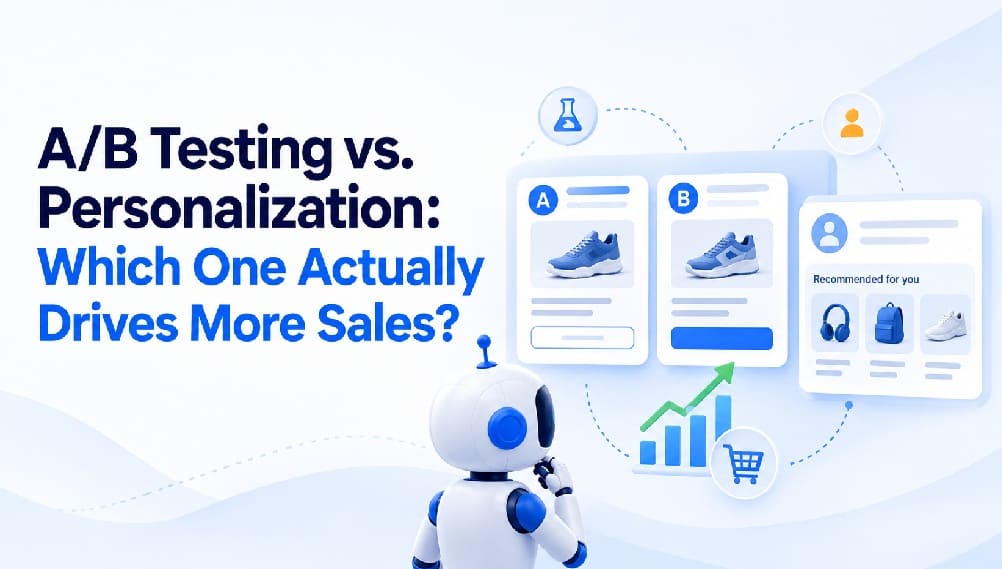
A/B Testing vs. Personalization: Which One Actually Drives More Sales?
Driving traffic to your ecommerce store is only half the job. The harder part is getting the people who show up to actually buy something.
Most visitors won’t. They’ll click around, maybe drop a product in their cart, and then vanish without checking out. If you’re running an online store, fixing those moments – the browsing, the hesitating, the abandoning usually moves the needle more than pouring extra money into ads.
Two tools get used a lot for this: A/B testing and personalization. People tend to lump them together, but they’re not really solving the same problem. A/B testing tells you which version of something performs better. Personalization tries to give different visitors a version that actually fits them.
So which one wins? Honestly, that’s the wrong question. It depends entirely on what you’re trying to fix and in most cases, the stores getting the best results aren’t choosing one over the other. They’re running both.
What A/B Testing Actually Is
At its core, A/B testing is just a controlled experiment. You split your visitors into groups and show each group a different version of a page or element, then see which one wins.
A store might test things like:
● “Buy Now” vs. “Add to Cart”
● A product video instead of a static photo
● Free shipping messaging placed above or below the description
● A short product description vs. a longer one
Half your traffic sees the original, half sees the variant, and you compare results on whatever metric matters: conversion rate, add-to-cart rate, revenue per visitor, average order value, whatever you’re optimizing for.
The whole point is to stop guessing. Rather than assuming customers will prefer a certain layout or headline, you actually test it and let real behavior tell you the answer.
What Personalization Actually Is
Personalization works differently. Rather than picking one “best” version and showing it to everyone, it adjusts the experience based on who’s looking at it. A returning shopper might see recommendations tied to what they browsed last time. A first-time visitor might see a broader intro to the brand instead. Stores typically personalize around things like:
● Where the traffic came from
● Location
● Device
● New visitor vs. returning customer
● Products they’ve already looked at
● Browsing or shopping behavior
● What’s in their cart
● The campaign or link they clicked to get there
The idea is simple: make the site feel like it was built for the person actually looking at it. Good personalization tools can shift recommendations, banners, copy, offers even entire sections of a page based on signals like these.
The Real Difference Between the Two
Here’s the simplest way to think about it. A/B testing answers: “Which version wins overall?” Personalization answers: “What’s most relevant for this specific person?”
Say a fashion brand tests two homepage headlines. The A/B test shows Headline B beats Headline A across all traffic. Good now you know what performs better on average.
But “on average” is doing a lot of work in that sentence. A visitor who clicked in from a paid Instagram ad probably doesn’t respond to the same messaging as someone who found you through a Google search. First-timers and repeat customers aren’t the same audience either.
That’s the gap personalization fills instead of picking one winner for everybody, you can run different experiences for different groups.
When A/B Testing Is the Right Call
A/B testing is advantageous when one wants to check a specific assumption before implementing it across the company. It is regarded as a useful tool for testing headlines, calls to action, design of product pages, and images.
For example, if a particular group assumes that placing customer reviews next to the “Add to Cart” button will increase sales, it can carry out an A/B test.Instead of just shipping that change to every visitor, they can test it first. If the variant wins, they’ve got actual evidence, not a hunch, backing the decision.
This is especially useful early on, when you’re still figuring out what your audience even responds to. It turns decision-making into something structured instead of something argued over in a meeting.
When Personalization Is the Right Call
Personalization earns its keep when your audience segments genuinely behave differently from each other.
Take a skincare brand. A first-time visitor probably needs some education on which products fit their skin type, why one line is different from another. A returning customer who already bought a cleanser is more likely interested in what pairs well with it, or a reminder that it’s time to restock.
Showing both of those visitors the exact same homepage doesn’t serve either one particularly well. Personalization lets the store adjust different recommendations, different messaging, different offers depending on who’s actually there. Most teams use a dedicated personalization tool for this rather than manually building separate site versions for every segment.
So Which One Actually Drives More Conversions?
There’s no clean winner here, and anyone promising you one is oversimplifying. A/B testing can produce real, measurable lifts because it’s built to find what actually moves behavior but it’s usually optimizing for the strongest overall version. Personalization adds another layer on top of that by making things more
relevant to specific groups, rather than chasing a single best-for-everyone answer.
A decent way to frame it: A/B testing optimizes the experience. Personalization optimizes the experience for the person having it.
If your traffic is still limited and you’re mostly trying to figure out what resonates, start with A/B testing. If you already know your customers well and have real, meaningful segments, personalization will likely get you further. And if you’ve got enough traffic and data to support both do both.
Why the Two Work Better Together
The biggest mistake here is treating these as rival strategies you have to pick between. They’re not. They fit naturally into the same process.
Say a brand wants to improve a product page. Step one: Initially, the two formats are tested through A/B testing to determine which format performs best overall.
Once a format is identified that works well, components of that format can be created for different audiences. New users can receive trust indicators/reviews, returning users can be given recommendations in line with their previous activity, the campaign traffic would see targeted messages, and the relevant offers/bundles can be provided to high-intent customers.
From there, you keep testing the personalized versions too. It becomes a loop: test, learn, personalize, measure, test again. Personalization stops being a guess because the testing already told you what works – you’re just figuring out where and for whom it works best.
CustomFit.ai helps implement these concepts; it’s a platform designed for integrated testing and personalization processes.
Don’t Just Chase Conversion Rate
One thing worth flagging: pick your success metric carefully. A variant might get more clicks without actually driving more purchases. Another might raise your conversion rate while quietly dragging down average order value.
Worth tracking beyond conversion rate alone:
● Revenue per visitor
● Average order value
● Add-to-cart rate
● Checkout completion rate
● Customer lifetime value
If a personalized recommendation gets more clicks but doesn’t lead to more completed purchases, it’s not actually helping the business, it just looks like it is. The goal isn’t to make people click more. It’s to build experiences that actually contribute to growth.
How to Decide Where to Start
If you’re stuck between investing in testing or personalization first, look at the problem you’re actually trying to solve.
Go with A/B testing if:
● You have a specific change you want to validate
● You want proof before rolling something out broadly
● You’re still learning what messaging or design resonates
● You have enough traffic to get statistically meaningful results
Go with personalization if:
● Your audience segments behave noticeably differently
● Your customers have different needs or intent
● You already have useful behavioral or contextual data
● You want the shopping experience to feel more relevant
Do both if:
● You’ve got the traffic and data to support it
● You want a continuous feedback loop
● You have real, distinct audience segments
● You want to scale your wins to the right people
The Bottom Line
This was never really a competition. A/B testing tells you what works. Personalization tells you what works for whom. Any serious ecommerce strategy needs both answers.
A/B testing strips the guesswork out of optimization. Personalization takes what you’ve learned and turns it into something that actually feels relevant to the person on the other end of the screen. The strongest approach isn’t picking a side, it’s building a process where each one feeds the other.
Test. Watch how real customers actually behave. Find the audience differences that matter. Personalize where it counts. Then test again. That loop is what turns conversion optimization from a one-off project into something that keeps paying off.
