Before You Move Your SEO Budget to GEO, Read This
It is Monday morning, and a new proposal has landed in your inbox. It includes a fresh line item called GEO. A few paragraphs later, the SEO retainer is slightly smaller. Nobody planned a trick. The market moved quickly, and the paperwork followed.
The urgency behind that proposal is real. Pew Research Center (2025) found that Google users clicked a traditional search result in 8% of visits when an AI summary appeared, compared with 15% of visits when none appeared. Fewer clicks make any owner or marketing lead ask the same thing: should money move from SEO to generative engine optimization, or GEO?
Here is the short answer. Some of it may move, and the share is often smaller than a proposal first suggests, because a good portion of GEO is work that a healthy SEO plan already covers. The longer answer takes about fifteen minutes to read, and it ends with a five-minute method for reviewing any GEO line item you receive. We will also point out where the work is truly new, since that is where fresh budget earns its place.
In 60 Seconds
Google says optimizing for its AI features is part of SEO, and most marketers surveyed by Semrush agree. A smaller slice of GEO is new: measuring AI answers, building your reputation beyond your own website, and testing across AI platforms. The Keep, Extend, Add Test sorts each line item into shared work you pay for once, light adjustments that deserve a modest add-on, and new activities that deserve a pilot with a clear measure.
Where We Are Headed
- Why everyone is suddenly talking about GEO
- GEO in one minute
- What Google says, in its own guide
- Do marketers see it the same way?
- The Keep, Extend, Add Test
- Where the new work really is
- Your proposal review in five minutes
- Questions owners ask before moving budget
- A bolder idea: fix the foundation first
- What changes for B2B and B2C
- A 90-day starter plan
- The decision in plain terms
Why Everyone Is Suddenly Talking About GEO
Three forces arrived at the same time. The first is behavior. AI summaries now answer many questions at the top of the results page, and Pew Research Center (2025) found that people clicked a link inside the summary itself in only 1% of visits. When fewer people reach your pages, every reporting dashboard feels different.
The second force is budget. Gartner’s 2025 CMO Spend Survey put marketing budgets at 7.7% of company revenue, flat for the year, and 59% of CMOs said their budgets could not fully support their strategy (Gartner, 2025). When the total stays level, a new priority has to be funded from an existing line. SEO is the most common donor.
The third force is momentum. In Digiday’s reporting on a Scribewise survey of 205 marketing leaders, 55% said they already had dollars set aside for GEO, and agency executives described moving part of existing SEO budgets in that direction (McCoy, 2026). That is a lot of activity around a term many teams met only recently, so a careful look before moving money is time well spent.
GEO in One Minute
SEO helps your pages appear when people search on Google, Bing, and similar engines. GEO helps your business appear inside answers written by AI systems such as Google’s AI Overviews and AI Mode, ChatGPT, and Perplexity. You may also see the term answer engine optimization, or AEO, used for the same idea. Both serve one business goal: the right buyer finds you at the moment of need, then calls, books, or buys.
- Who needs it: businesses whose customers research with AI assistants as well as search engines.
- How it works: AI systems retrieve pages and other sources, summarize them, and name the ones that look relevant and reliable.
- Why it matters: a mention inside an answer can shape a buyer’s shortlist before anyone visits your website.
What Google Says, in Its Own Guide
Google Search Central published a dedicated guide in 2026, titled Optimizing your website for generative AI features on Google Search, and updated it in July. It describes how AI Overviews and AI Mode work. Google’s systems retrieve relevant pages from the search index to ground each answer, a technique called retrieval-augmented generation, and they run several related searches at once, a technique called query fan-out (Google Search Central, 2026). In other words, the AI layer sits on top of the same index and quality systems that SEO has always served.
The guide addresses the acronyms directly. From Google’s perspective, optimizing for generative AI search is still SEO (Google Search Central, 2026). It then lists tactics that are not required for Google’s AI features:
- LLMs.txt files and similar special files.
- Splitting content into very small pieces for AI.
- Rewriting pages in a special style for AI systems.
- Collecting mentions that are not authentic.
- Special schema markup, although structured data continues to help with rich results.
What does the guide recommend instead?
Original, helpful pages that offer a point of view readers cannot find everywhere else, a clear technical structure, a good page experience, and accurate business details in tools such as Merchant Center and Google Business Profiles. It even offers a one-line test for any page: would a visitor find this satisfying? You can already check your own results in the Generative AI performance report inside Search Console.
One caution keeps the picture honest. The guide describes Google. ChatGPT, Perplexity, and other assistants run their own retrieval systems, so a portion of GEO reaches beyond what Google covers. We will get to that portion shortly.
Do Marketers See It the Same Way?
Mostly, yes.
A Semrush survey of 481 marketers, business owners, and SEO professionals found that 77% describe AI search as part of SEO, while 15% treat it as a separate channel (Loktionova, 2026). The more interesting result concerns execution.
Only 22% of respondents ran SEO and AI search fully integrated across strategy, execution, and reporting. Teams that ran the two as one integrated effort were far more likely to report AI-driven traffic or leads: 81%, against 36% of teams working in separate tracks (Loktionova, 2026). Semrush sells search software, so it helps to read the survey as one informed perspective, and it points the same way as Google’s guide.
Digiday’s reporting adds some history.
SEO veterans quoted there compared GEO with earlier waves such as AMP and featured snippets, which were once presented as separate disciplines and later turned out to be extensions of familiar search logic.
One agency chief executive estimated that about 80% of GEO is fundamental SEO. Others pointed out that retrieval systems and presence across platforms are new territory, and one expert argued that AI search may eventually earn its own dedicated team, the way social media did (Guaglione, 2026). That 80% figure is a professional estimate, not a measured result, so treat it as a handy rule of thumb.
When you line these sources up, three points stand out:
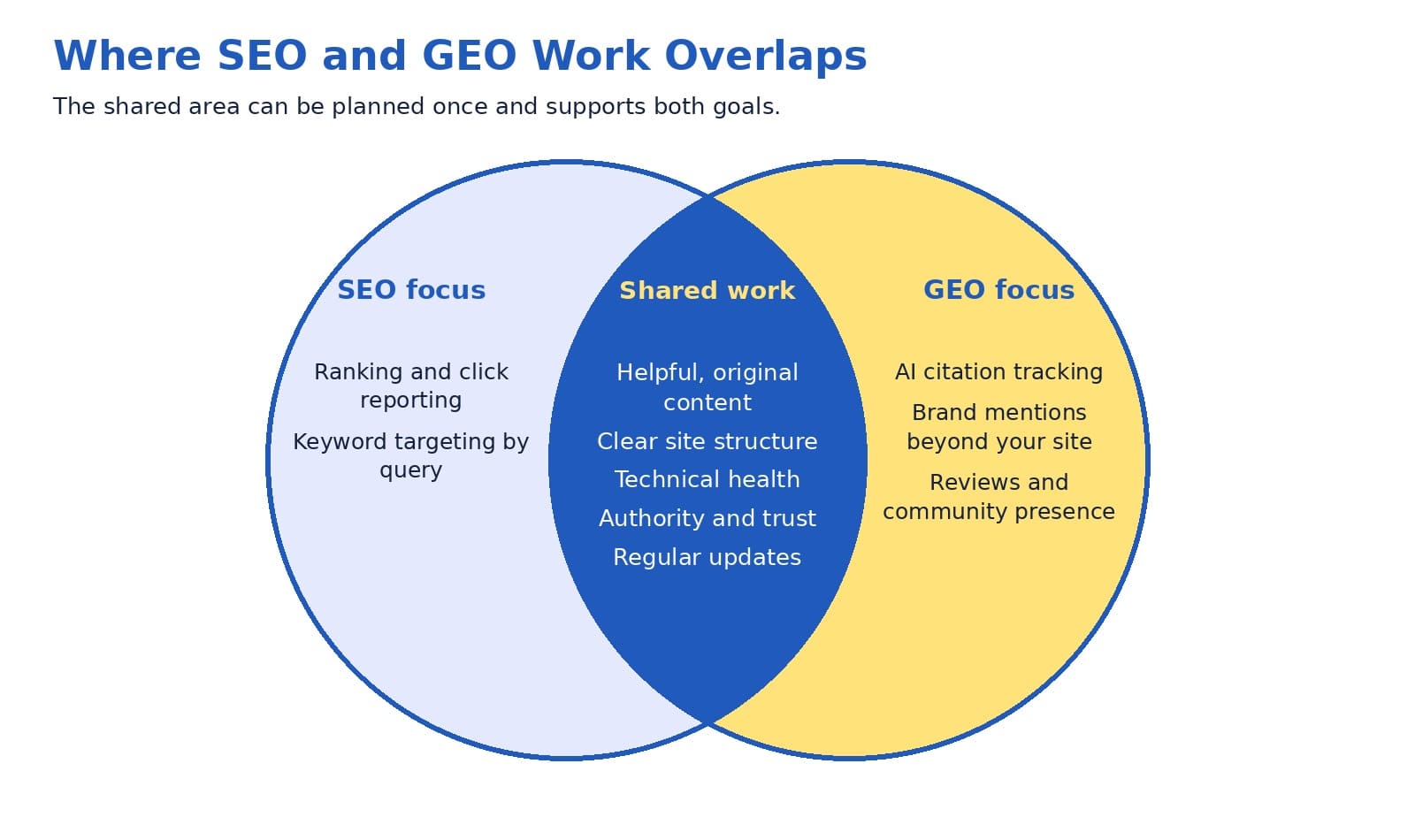
- Strong SEO foundations lift visibility in AI answers.
- A real, smaller set of GEO activities is new.
- Outcomes in AI platforms vary by prompt, so pilots with clear measures make sense.
The Keep, Extend, Add Test
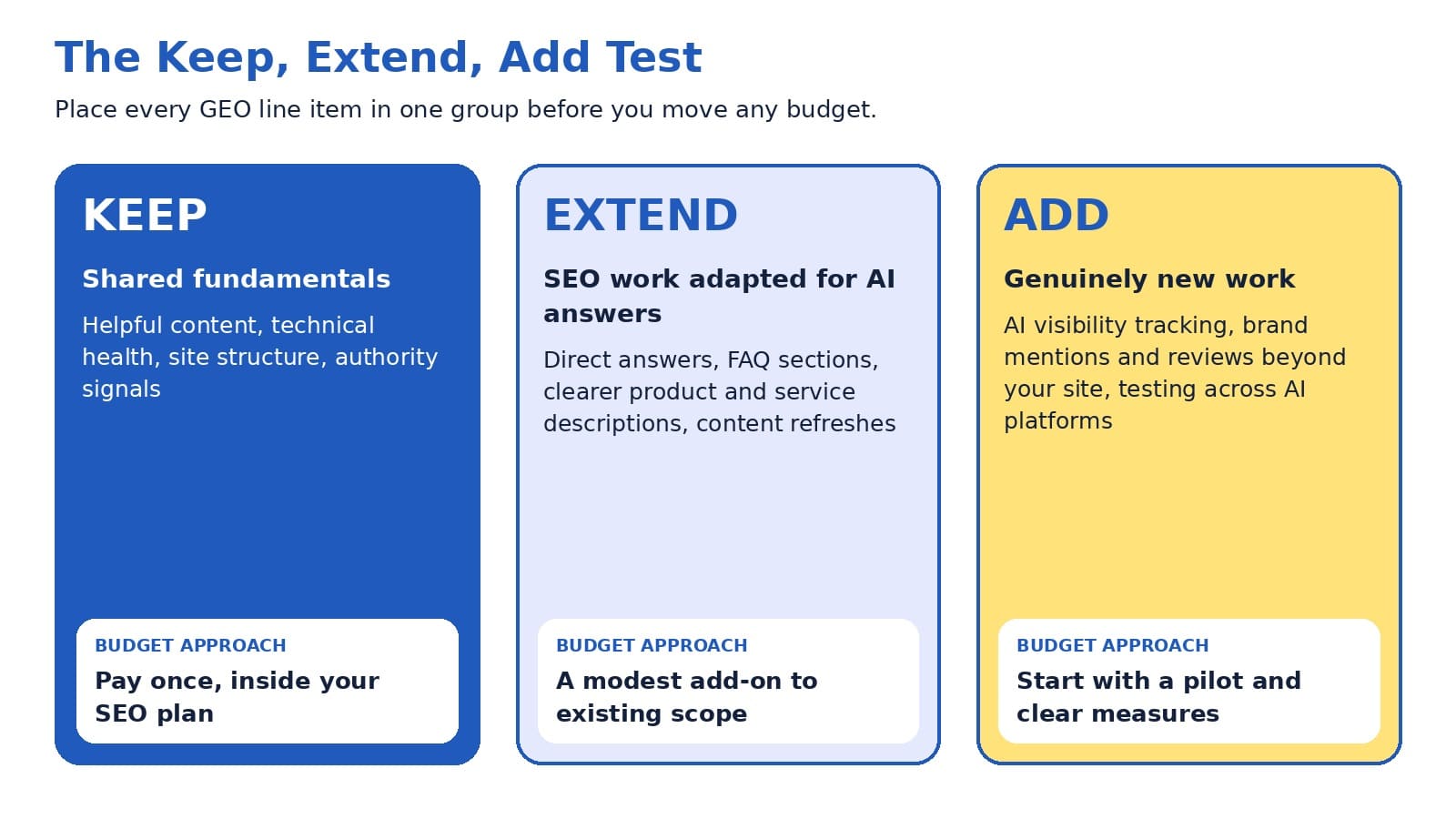
Proposals tend to arrive as a single line that says GEO. The Keep, Extend, Add Test turns that one line into three honest groups, and each group gets its own budget logic.
- Keep: shared fundamentals such as helpful content, technical health, site structure, and authority building. They support search results and AI answers alike, so you fund them once, inside the SEO plan.
- Extend: SEO work adapted for AI answers, such as direct answers near the top of a page, richer FAQ sections, clearer service descriptions, and refreshed older content. These usually justify a modest add-on.
- Add: new activities such as tracking your visibility in AI answers, earning reviews and mentions beyond your site, and testing how each AI platform describes you. These fit a pilot.
Here is Extend in action. Picture an accounting firm with a page about small business tax planning. The page already exists, so the team adds a short opening summary that says who the service helps, what it includes, and what a client can expect.
Then it answers the four questions prospects ask most, updates the details, and adds a clear next step. One edit helps searchers on Google and gives AI systems clean, relevant passages to draw from. Nobody built a new page, and nobody needed a new retainer.
Now picture the Add side. A regional home services company decides to pilot. It picks a short list of questions homeowners ask before hiring, such as how to choose a contractor and what a repair should cost. Each month, the team checks how the major AI assistants answer those questions, notes whether the company is named, and compares that with calls and form submissions.
At the same time, it asks recent customers for honest reviews. The pilot has a small budget, a named owner, and a review date, so the learning arrives before the larger spend does.
The test also gives owners and marketers a shared vocabulary. Owners see which parts of a proposal overlap with work already funded. Marketers show where fresh effort is required. Providers explain what is new with confidence, because the framework makes the case on its own.
Where the New Work Really Is
A fair review gives credit to the new parts of GEO, because that is where fresh budget has the best case. The Semrush survey and Digiday’s reporting point to four areas:
- Your reputation beyond your website. AI answers draw on reviews, community discussions, video, and press coverage. Yet only 8% of surveyed marketers used digital PR for AI visibility, 9% managed online reviews, and 11% built mentions through communities and social platforms (Loktionova, 2026). That is an open field.
- Access and readability for AI systems. Which AI crawlers may reach your content, and how easily they can read your pages, are decisions worth making on purpose.
- Measurement. Answers vary by prompt and platform, and many tracking tools estimate results from simulated prompts instead of real user queries (Guaglione, 2026). In the Semrush survey, 49% of marketers named the effect of AI on pipeline or revenue as a leading measurement challenge, and 40% relied mainly on manual spot checks in ChatGPT.
- Platform differences. Each assistant may retrieve and cite differently, so results from one platform may need confirming on another.
What about traffic? AI platforms currently send a small share of visits to many publishers. Similarweb data cited by Digiday showed less than 1% of overall traffic for the news outlets it examined, while one publisher reported a markedly higher subscription conversion rate among visitors arriving from AI platforms (Guaglione, 2026).
Small volume with strong intent is a classic reason to run a pilot first, measure leads and revenue, and scale what works.
Your Proposal Review in Five Minutes
Take the GEO proposal on your desk and read each line item against two questions. Is it already part of the current SEO scope? Does it adapt something you already have? Anything left over is new, and new work deserves a pilot with an owner, a measure, and a review date.
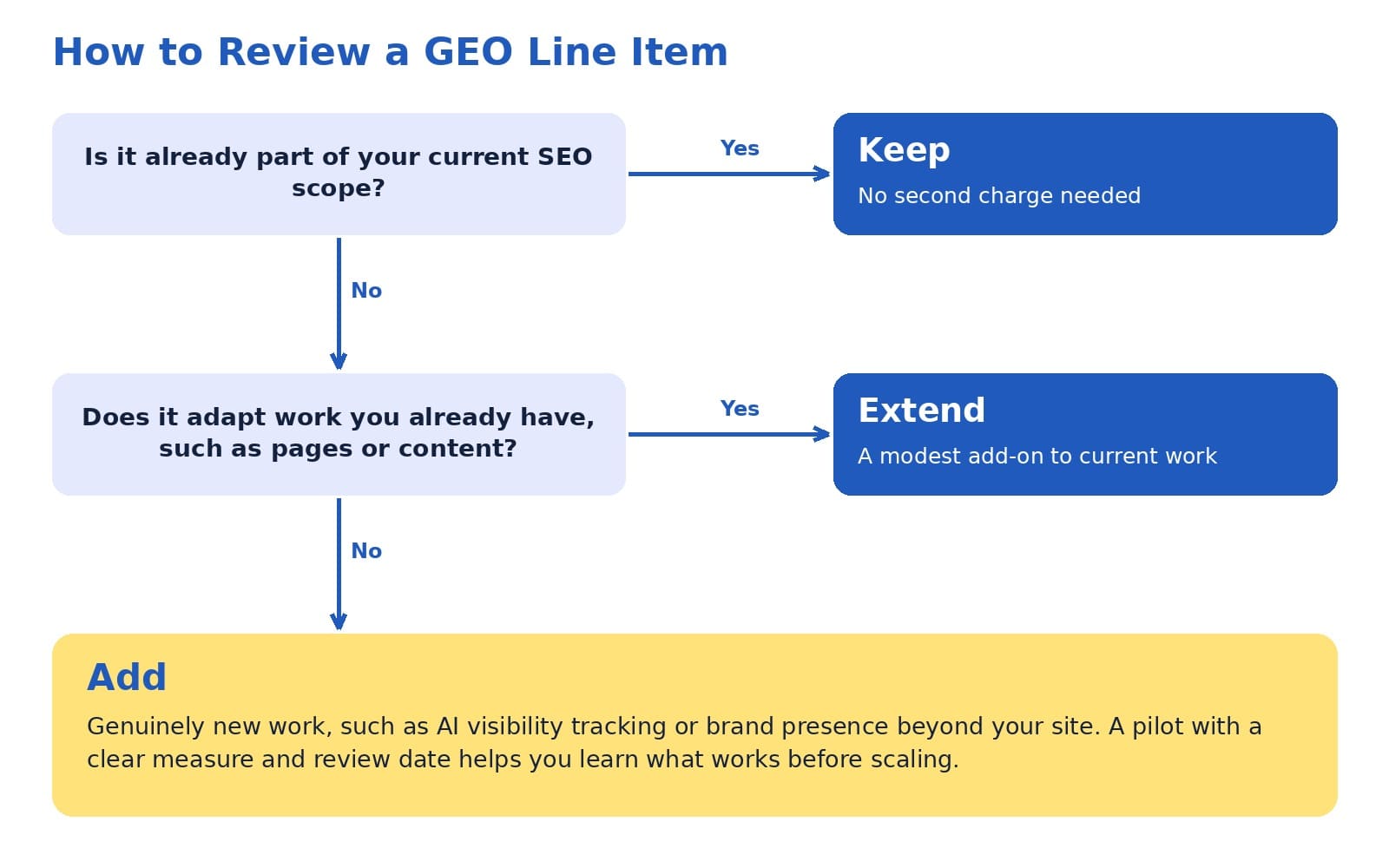
Bring these questions to the conversation with any provider, whether an agency, a freelancer, or an internal teammate:
- Which part of this work already sits inside our current SEO scope?
- Which pages or technical items will change, and how will we confirm it?
- What counts as success: qualified leads, calls, form submissions, revenue, or AI mentions?
- How long does the pilot run, and when do we review it together?
- What do we own at the end, including content, reports, and data?
- Will SEO and GEO appear in one report with one baseline?
Good answers build trust quickly. They also give you a tidy summary to share with a colleague who missed the meeting.
Questions Owners Ask Before Moving Budget
Should we pause SEO to fund GEO? A pause removes the work that GEO builds on. Google’s guide ties AI feature eligibility to the same indexing and quality systems that SEO serves (Google Search Central, 2026), so most teams do better by keeping the foundation funded and adding a pilot on top.
How much should a GEO budget be? No universal figure exists. In the Scribewise survey reported by Digiday, 70% of marketers with GEO dollars said it made up 11 to 20% of that budget (McCoy, 2026). Treat that range as one data point from one survey. A pilot sized to what your team can measure and manage is a sound starting point.
How will we know it works? Set a baseline before anything changes. Track leads, conversion rate, and branded search alongside AI visibility, and use the Generative AI performance report in Search Console for Google’s features. When AI mentions rise and qualified leads follow, you have found a pattern worth funding.
A Bolder Idea: Fix the Foundation First
Here is a thought that rarely appears in budget meetings. For many businesses, the highest-return GEO investment is an SEO repair. Google’s guide states that a page must be indexed and eligible to appear in Search with a snippet before it can be shown in AI features (Google Search Central, 2026). A page that search systems struggle to find or understand has little to offer an AI answer, whatever name appears on the invoice.
So the order of spending matters. Start by confirming that your core pages are crawlable, indexed, and clear about who you serve and what you sell. Next, extend the strongest pages with direct answers and current details. Then fund a defined pilot for the new activities, drawn from a modest slice of the search line and expanded when the evidence supports it. We call this protect the base, pilot the extension.
Moving a large share of SEO budget before any pilot has produced results may weaken the very foundation that AI visibility relies on. A steadier path keeps leads flowing today and gives you your own data for tomorrow. Since AI visibility is still measured imperfectly across the industry, learning at a measured pace is a competitive advantage.
What Changes for B2B and B2C
The Keep, Extend, Add mix shifts with your audience. B2B buyers often research a purchase through many questions over several weeks, and an AI assistant may help build their shortlist along the way. Clear service pages, case studies, and consistent descriptions of your offer carry extra weight in that journey.
B2C and local businesses may find accurate business details matter most. Google notes that Merchant Center and Google Business Profiles help products and services appear in AI responses and other search results (Google Search Central, 2026).
Reviews and customer feedback add another layer, because AI answers can draw on them. In both cases, the first move is the same: learn the questions your best customers ask, answer them clearly on your own site, and keep your details accurate everywhere they appear. Those tasks live in Keep and Extend, which is why the Add budget may come out smaller than expected.
A 90-Day Starter Plan
You can run this plan inside most existing engagements, and each step produces something you can show your team:
- Weeks 1 and 2, baseline: review indexing, site structure, your top pages by leads, and the Generative AI performance report in Search Console.
- Weeks 3 to 6, extend: add direct answers, FAQ sections, current service details, customer proof, and accurate business profiles to priority pages.
- Weeks 6 to 12, pilot: choose a focused list of customer questions, record how AI platforms answer them each month, and begin earning reviews and credible mentions.
- End of quarter, decide: compare leads, conversion rate, and AI mentions with your baseline, then set the next budget.
By day ninety, you hold real evidence from your own business. That makes the next budget conversation shorter and a lot more confident.
The Decision in Plain Terms
AI search is a genuine opportunity, and exploring it is a smart move. The evidence from Google, Semrush, and Digiday tells one consistent story: most of GEO stands on SEO, and a smaller set of activities is new. Keep what is shared, extend what can be adapted, and pilot what is new. When you follow that order, each dollar has a clear job, and every stage aims at leads and sales you can count.
Ready to see where your own budget stands? Share your current SEO scope and any GEO proposal you have received, and we will map every line to Keep, Extend, or Add in a one-page summary for your team.
Want to see how the pieces fit before you decide? Explore the work of our website design company team, the programs from our SEO agency specialists, and the planning behind our digital marketing agency services.
References
Gartner, Inc. (2025, May 12). Gartner 2025 CMO spend survey reveals marketing budgets have flatlined at 7.7% of overall company revenue [Press release]. https://www.gartner.com/en/newsroom/press-releases/2025-05-12-gartner-2025-cmo-spend-survey-reveals-marketing-budgets-have-flatlined-at-seven-percent-of-overall-company-revenue
Google Search Central. (2026, July 10). Optimizing your website for generative AI features on Google Search. Google for Developers. https://developers.google.com/search/docs/fundamentals/ai-optimization-guide
Guaglione, S. (2026, March 10). GEO hype busted: How it differs (and how it doesn’t) from SEO. Digiday. https://digiday.com/media/geo-hype-busted-experts-call-it-more-seo-than-new-discipline/
Loktionova, M. (2026, June 3). Only 22% of marketers have fully integrated AI search and SEO. They’re pulling ahead. [Study]. Semrush Blog. https://www.semrush.com/blog/the-operational-gap-ai-seo-study/
McCoy, K. (2026, March 25). Marketers shift growing shares of search spending to GEO. Digiday. https://digiday.com/marketing/marketers-shift-growing-shares-of-search-spending-to-geo/
Pew Research Center. (2025, July 22). Google users are less likely to click on links when an AI summary appears in the results. https://www.pewresearch.org/short-reads/2025/07/22/google-users-are-less-likely-to-click-on-links-when-an-ai-summary-appears-in-the-results/

Freelancer vs Agency vs In-House: How to Choose the Marketing Team That Fits Your Business Right Now
Gartner’s 2025 CMO Spend Survey found that marketing budgets average 7.7% of company revenue, and 59% of the marketing leaders surveyed reported budgets that fall short of what their strategy requires (Gartner, 2025). The survey focused mostly on larger companies, yet the pattern is likely familiar to owners and marketers at any size: there is usually more worth doing than there are hours, people, or dollars to do it. That is why the question of who does the work carries so much weight.
This guide walks through freelancers, agencies, and in-house teams in plain language. It introduces a three-question tool we call the 3C Fit Framework, and it shares a perspective that many providers may hesitate to mention: the best answer often changes as your business grows, so a thoughtful sequence can work better than one permanent choice.
As a website design and digital marketing agency, we are glad to say that the right starting point for many businesses is a freelancer or an internal hire. Our goal is for you to finish this article with a clear sense of which structure fits your next twelve months, whether or not that includes working with us.
The short version
Freelancers tend to fit defined projects and quick starts. Agencies tend to fit businesses that need SEO, website design, content, and paid media to work as one plan. In-house teams tend to fit companies with steady daily marketing work and the budget for a full compensation package. The 3C Fit Framework (Capacity, Coordination, Continuity) can help you decide, and many growing businesses find that one internal owner supported by external specialists offers a strong balance.
What you will find inside:
- Why this decision shapes your marketing results
- What each option looks like in plain language
- The 3C Fit Framework
- When a freelancer is a strong choice
- When an agency is a strong choice
- When an in-house team is a strong choice
- The Owner Hours Test
- A perspective worth considering
- A simple path to decide
- Questions worth asking any provider
- How this applies to SEO, website design, and lead generation
Why this decision shapes your marketing results
Choosing between a freelancer, an agency, and an in-house hire influences more than your budget. It affects how quickly campaigns launch, how well your website, SEO, and advertising work together, and how much of your own time goes into managing the work. A team that matches your stage of growth can make each of those areas smoother, while a mismatch can slow results even when everyone involved is talented.
Talent is rarely the only variable. In many cases, a capable professional placed in a setting that suits the business need will produce more than an equally capable professional in a setting that does not. For this reason, we encourage owners and marketing managers to begin with the shape of the work and compare prices afterward.
Your answer may also evolve. A founder launching a first website may benefit from a freelancer. A company running SEO, content, and paid media together may benefit from an agency. An established business with daily campaign needs may benefit from an in-house team. Each can be the right call at the right moment, and the sections below help you recognize which moment you are in.
It also helps to define what success means before comparing options. For most businesses, success comes down to a steady flow of qualified leads, a healthy conversion rate on the website, and a cost per lead that supports profitable growth. When those targets are written down, each structure can be evaluated against them, and the conversation becomes more objective and more productive for everyone involved.
What each option looks like in plain language
The Freelancer
A freelancer is an independent professional who usually specializes in one discipline, such as copywriting, web design, SEO, or paid search. Three points summarize how this option tends to work:
- Who it suits: businesses with a defined project or a specific skill gap.
- How it works: you agree on scope, timeline, and price, and the freelancer delivers while working directly with you.
- Why owners choose it: speed, deep specialization, and the flexibility to engage help only when it is needed.
The talent pool is broad. The Upwork Research Institute (2023) estimated that 64 million Americans, or 38% of the U.S. workforce, performed freelance work in 2023, and 47% of freelancers provided knowledge services such as marketing and programming. That range gives businesses plenty of choice, and it also means that careful selection is worthwhile.
The Agency
A digital marketing agency is a team of specialists, often including strategists, SEO professionals, designers, developers, writers, and paid media managers, working within one process.
- Who it suits: businesses that need several disciplines to support one goal, such as lead generation.
- How it works: engagements usually run on a monthly retainer or a defined project, with account management and regular reporting.
- Why owners choose it: breadth of skills, shared tools, and coverage when one person is unavailable.
The In-House Team
An in-house team is made up of employees who work solely for your company.
- Who it suits: businesses with steady, daily marketing work and the budget for salaries, benefits, software, and management.
- How it works: you recruit, onboard, and lead the team, and in return they learn your products, customers, and culture in depth.
- Why owners choose it: communication is quick, and priorities can shift the same day a conversation with sales or customer service suggests a new direction.
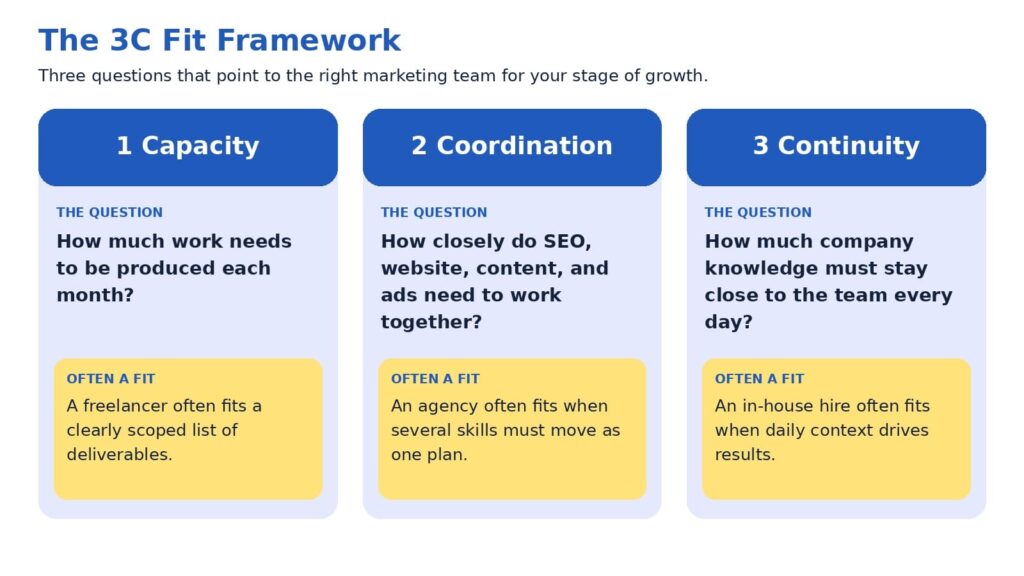
The 3C fit framework: capacity, coordination, continuity
A useful way to compare the three options is to look at what your marketing needs from the team rather than at the team type itself. Three questions usually point toward an answer, and we call them the 3C Fit Framework.
- Capacity asks how much work needs to be produced each month, such as a set of service pages, a number of articles, a few ad campaigns, or a website rebuild. When the list of deliverables is clear and finite, a freelancer can often handle it efficiently.
- Coordination asks how closely your SEO, website, content, advertising, and analytics need to work together. Search intent informs page structure, page structure influences conversion rate, and conversion rate determines how much paid traffic is worth buying. When disciplines depend on one another this way, an agency’s shared process can reduce handoffs and keep decisions consistent.
- Continuity asks how much company knowledge needs to stay close to the work every day. Product details, sales feedback, and customer conversations all shape strong marketing, and an in-house team has the most direct access to them.
Most businesses start with one of the three C’s as their main need, and growth then adds the others. That progression is a big reason why the right structure shifts over time.
When a freelancer is a strong choice
Freelancers often shine when the goal is specific: a new landing page, a set of service pages, a technical SEO cleanup, or an email sequence. Because they work directly with you, feedback loops can be short, and many bring deep experience in a single craft. For a business testing a new offer or launching a first website, this can be an efficient way to move forward.
A few practices help the engagement go smoothly:
- Define the deliverables, the timeline, and what success looks like before work begins.
- Confirm availability for revisions and for questions after launch.
- Plan how the work connects to your other marketing channels, since one specialist typically covers one of them.
Because a freelancer usually covers one discipline, you or a teammate often serve as the coordinator who connects the pieces. Owners who enjoy that role may find this arrangement rewarding. Owners with limited time may prefer to review the Owner Hours Test later in this guide before deciding.
When an agency is a strong choice
An agency can be a strong choice when marketing outcomes depend on several disciplines moving together. Lead generation is a good example. Search visibility brings the right visitors, website design and messaging encourage them to act, paid media extends reach, and analytics show which efforts contribute to revenue. When those elements sit within one team, decisions can be made with the full picture in view.
It is also worth acknowledging that expectations of agencies are rising. In Gartner’s 2025 survey, 39% of CMOs planned to reduce agency budgets, and 22% said generative AI had lessened their reliance on external agencies for creativity and strategy. Among the top actions CMOs cited for saving on agency costs were ending unproductive relationships and streamlining agency rosters (Gartner, 2025). We see this as a healthy development, because it encourages agencies to demonstrate clear process, transparent reporting, and measurable contribution to leads and sales.
An agency may be a good fit when:
- Your goals involve more than one channel, such as SEO, website design, and paid media.
- You prefer a regular reporting rhythm and a named team over a single point of contact.
- You would like to scale activity up or down without recruiting.
The strongest agency relationships tend to feel like a partnership, with shared goals, open access to data, and honest conversations about what is working.
When an in-house team is a strong choice
An in-house team can be an excellent choice when marketing work is steady, varied, and closely tied to daily business activity. Team members learn your products, hear sales conversations firsthand, and can respond quickly when priorities change. For businesses with consistent campaign needs, that proximity can make marketing feel like a natural extension of the company.
The cost picture deserves a full view. The U.S. Bureau of Labor Statistics (2026) reports that benefits made up 30.0% of employer compensation costs for private industry workers in June 2026, with wages and salaries making up the remaining 70.0%. Using those averages for illustration, a role with $70,000 in wages would represent roughly $100,000 in total employer compensation. Recruiting adds to that figure, and the Society for Human Resource Management (SHRM, 2022) reported an average cost per hire of nearly $4,700 before any salary is paid. Software subscriptions, training, and management time are additional considerations.
A second factor is range. A single marketing hire usually brings one primary strength, such as content, paid media, or analytics, while growing businesses often need several. Many companies address this by pairing a first hire with external specialists, which leads naturally to the hybrid approach discussed below.
An in-house team may be a good fit when:
- Marketing work fills a full week, every week.
- You have a leader who can set priorities and review results.
- Your budget covers compensation, tools, and room to grow the team.
The three options side by side
The comparison below summarizes the patterns discussed so far. Individual freelancers, agencies, and companies vary, so please treat it as a starting point for your own evaluation.
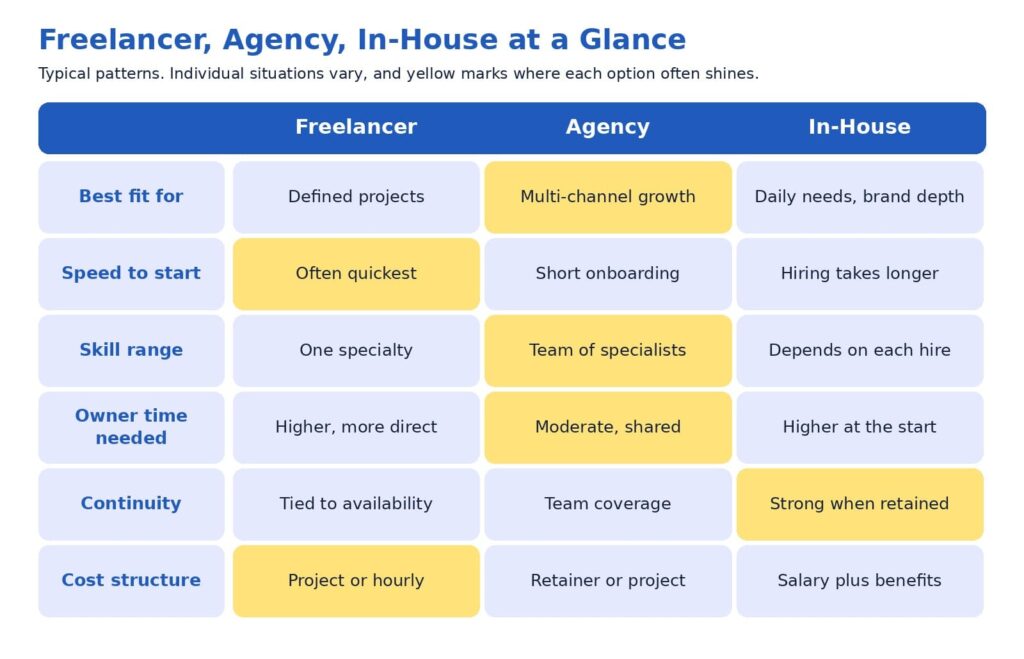
You may notice that no option leads in every row. That balance is exactly why the decision benefits from a framework instead of a ranking.
The owner hours test: a cost that rarely appears on an invoice
Every option has a price on the proposal and another one on the calendar. The calendar cost is the number of hours you and your team spend briefing, reviewing, coordinating, and following up. This cost is easy to overlook, yet it often decides whether an engagement feels smooth or demanding.
A simple test can bring it into focus. Estimate how many hours per week you are able to dedicate to directing marketing, and compare that with what each option typically asks of you. A freelancer working on several separate projects may rely on you to connect them. An agency usually supplies a project manager, which can reduce your coordination load. An in-house hire needs onboarding and ongoing leadership, especially in the first months.
If your calendar has room for hands-on direction, a freelancer or an in-house hire may fit comfortably. If your calendar is full, the coordination an agency provides may be worth more than it first appears on a proposal. Considering this early often leads to better satisfaction on both sides, because expectations match reality from the first week.
A perspective worth considering: rent execution first, then decide what to own
Here is a view that some providers may hesitate to share, because it can reduce their own project volume: many businesses may achieve better results by validating what works through external execution before building an internal team. The reasoning is practical. Early marketing involves a great deal of learning, such as which keywords bring buyers, which pages convert, and which channels produce qualified leads at a sustainable cost. External specialists can test those questions at a pace that fits your budget, and the answers then shape what a first internal hire should be responsible for.
A first hire made before those answers exist is often asked to cover strategy, writing, analytics, design coordination, and advertising at once. That is a wide range for one person, and even an excellent candidate may find it demanding to excel at every part. Starting with external execution gives the future hire a clearer job description, better data, and a stronger chance to succeed.
The same logic works as a business matures. Once you know which activities run every day and produce results, bringing a marketing leader in-house can strengthen continuity, while freelancers and agencies continue to supply specialist capacity. In short, direction can live inside the company while execution stays flexible. We find this structure tends to protect marketing ROI, since fixed costs grow only when the evidence supports it.
This perspective sometimes leads us to recommend a freelancer or an internal hire rather than our own services. We share it because clients tend to do well when the structure fits, and that outcome is good for everyone involved.
A simple path to decide
If you would like a quick way to apply the 3C Fit Framework, the path below turns three questions into a suggested starting point. It is intended as a guide for discussion with your team, so feel free to adapt it to your circumstances.
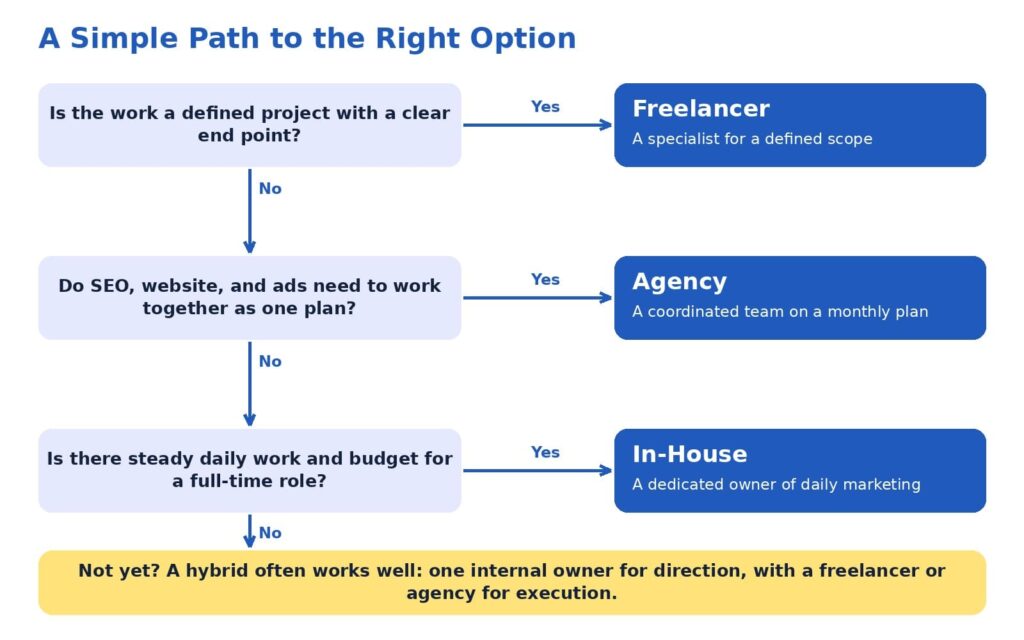
A few reminders can make the path even more useful:
- Plan around the next twelve months of goals, which is a longer horizon than the next few weeks.
- Select the option that matches your largest need, then add support where gaps appear.
- Revisit the decision once a year, since goals and budgets evolve.
Mixed answers are common and entirely fine. A business that needs defined projects today and daily management next year can begin with a freelancer or agency and plan an internal role for later, using results from the first phase to guide the hire.
Questions worth asking any provider
Whether you are speaking with a freelancer, an agency, or a candidate for an internal role, the conversation goes further when it includes specific questions. The following list can help you compare options consistently:
- Which results have you helped similar businesses achieve, and what process produced them?
- How will we measure success, and how often will we review it together?
- Who will do the daily work, and how can I reach that person?
- How will SEO, website, content, and advertising decisions be coordinated?
- What do you need from me each week to keep progress steady?
- Which numbers will you report, such as leads, conversion rate, cost per lead, and revenue influenced?
- What happens to my accounts, content, and data if we conclude our work together?
Thoughtful answers to these questions usually reveal how a provider thinks about results, communication, and long-term value. They also give you a fair way to compare very different proposals side by side.
How this applies to SEO, website design, and lead generation
SEO, website design, and lead generation make a useful case study because they depend on each other. SEO services attract the right audience by aligning pages with search intent. Website design services turn those visitors into leads or customers through clear structure, messaging, and user flow. Conversion optimization services then refine pages using real behavior data, so the same traffic produces more leads over time.
A freelancer can deliver any one of these areas with skill. An in-house marketer can manage them day to day. An agency can connect all of them into one system with shared reporting, so each improvement supports the next. At ICO WebTech, we build marketing systems that help businesses attract the right audience, convert visitors, and grow consistently, and we are glad to collaborate with freelancers and in-house teams whenever that is the best structure for a client.
If you would like a second opinion on which structure fits your goals, we would be happy to review your current setup and share what we see, including where an existing freelancer or internal team is already doing well.
Choosing with confidence
Freelancers, agencies, and in-house teams can each be the right answer. Freelancers bring focused skill and fast starts, agencies bring coordinated expertise across channels, and in-house teams bring daily context and continuity. The 3C Fit Framework helps you match those strengths to what your business needs now, and the Owner Hours Test helps you account for the time each option asks of you.
Many businesses grow best through a sequence: external execution to learn what works, an internal owner to guide direction, and specialists to keep capacity flexible. High expectations pair well with this approach, because each stage is designed to produce measurable leads and sales before the next investment is made.
If you are weighing these options for your own business, our team at ICO WebTech would enjoy helping you map the next twelve months. You can learn more about our web design agency work, our SEO agency approach, and our digital marketing agency approach to see how the pieces fit together.
References
Gartner, Inc. (2025, May 12). Gartner 2025 CMO spend survey reveals marketing budgets have flatlined at 7.7% of overall company revenue [Press release]. https://www.gartner.com/en/newsroom/press-releases/2025-05-12-gartner-2025-cmo-spend-survey-reveals-marketing-budgets-have-flatlined-at-seven-percent-of-overall-company-revenue
Society for Human Resource Management. (2022). The real costs of recruitment. https://www.shrm.org/topics-tools/news/talent-acquisition/real-costs-recruitment
U.S. Bureau of Labor Statistics. (2026). Compensation costs for private industry workers averaged $46.89 per hour worked in June 2026. The Economics Daily. https://www.bls.gov/opub/ted/2026/compensation-costs-for-private-industry-workers-averaged-46-89-per-hour-worked-in-june-2026.htm
Upwork Research Institute. (2023, December 12). Freelance Forward 2023. Upwork. https://www.upwork.com/research/freelance-forward-2023
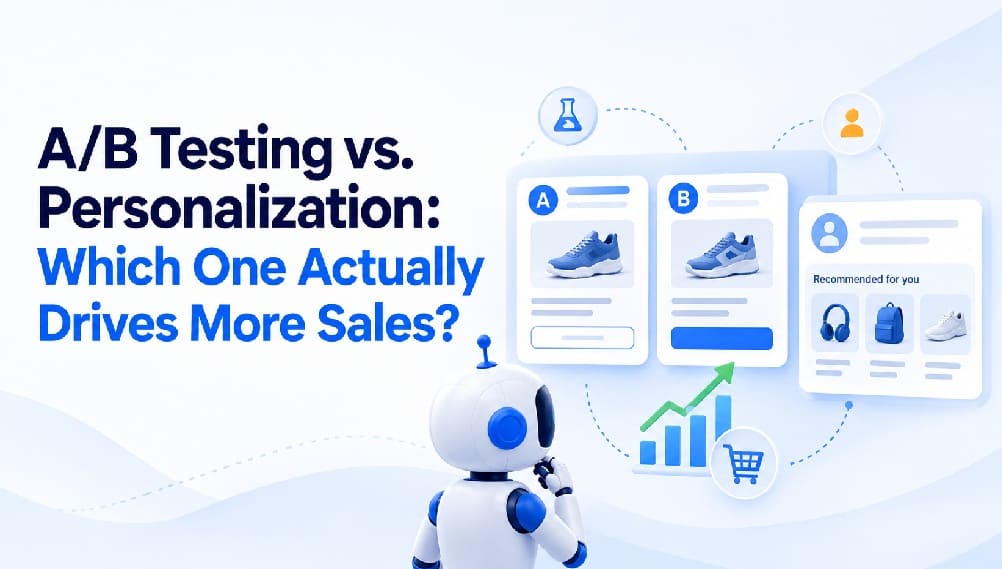
A/B Testing vs. Personalization: Which One Actually Drives More Sales?
Driving traffic to your ecommerce store is only half the job. The harder part is getting the people who show up to actually buy something.
Most visitors won’t. They’ll click around, maybe drop a product in their cart, and then vanish without checking out. If you’re running an online store, fixing those moments – the browsing, the hesitating, the abandoning usually moves the needle more than pouring extra money into ads.
Two tools get used a lot for this: A/B testing and personalization. People tend to lump them together, but they’re not really solving the same problem. A/B testing tells you which version of something performs better. Personalization tries to give different visitors a version that actually fits them.
So which one wins? Honestly, that’s the wrong question. It depends entirely on what you’re trying to fix and in most cases, the stores getting the best results aren’t choosing one over the other. They’re running both.
What A/B Testing Actually Is
At its core, A/B testing is just a controlled experiment. You split your visitors into groups and show each group a different version of a page or element, then see which one wins.
A store might test things like:
● “Buy Now” vs. “Add to Cart”
● A product video instead of a static photo
● Free shipping messaging placed above or below the description
● A short product description vs. a longer one
Half your traffic sees the original, half sees the variant, and you compare results on whatever metric matters: conversion rate, add-to-cart rate, revenue per visitor, average order value, whatever you’re optimizing for.
The whole point is to stop guessing. Rather than assuming customers will prefer a certain layout or headline, you actually test it and let real behavior tell you the answer.
What Personalization Actually Is
Personalization works differently. Rather than picking one “best” version and showing it to everyone, it adjusts the experience based on who’s looking at it. A returning shopper might see recommendations tied to what they browsed last time. A first-time visitor might see a broader intro to the brand instead. Stores typically personalize around things like:
● Where the traffic came from
● Location
● Device
● New visitor vs. returning customer
● Products they’ve already looked at
● Browsing or shopping behavior
● What’s in their cart
● The campaign or link they clicked to get there
The idea is simple: make the site feel like it was built for the person actually looking at it. Good personalization tools can shift recommendations, banners, copy, offers even entire sections of a page based on signals like these.
The Real Difference Between the Two
Here’s the simplest way to think about it. A/B testing answers: “Which version wins overall?” Personalization answers: “What’s most relevant for this specific person?”
Say a fashion brand tests two homepage headlines. The A/B test shows Headline B beats Headline A across all traffic. Good now you know what performs better on average.
But “on average” is doing a lot of work in that sentence. A visitor who clicked in from a paid Instagram ad probably doesn’t respond to the same messaging as someone who found you through a Google search. First-timers and repeat customers aren’t the same audience either.
That’s the gap personalization fills instead of picking one winner for everybody, you can run different experiences for different groups.
When A/B Testing Is the Right Call
A/B testing is advantageous when one wants to check a specific assumption before implementing it across the company. It is regarded as a useful tool for testing headlines, calls to action, design of product pages, and images.
For example, if a particular group assumes that placing customer reviews next to the “Add to Cart” button will increase sales, it can carry out an A/B test.Instead of just shipping that change to every visitor, they can test it first. If the variant wins, they’ve got actual evidence, not a hunch, backing the decision.
This is especially useful early on, when you’re still figuring out what your audience even responds to. It turns decision-making into something structured instead of something argued over in a meeting.
When Personalization Is the Right Call
Personalization earns its keep when your audience segments genuinely behave differently from each other.
Take a skincare brand. A first-time visitor probably needs some education on which products fit their skin type, why one line is different from another. A returning customer who already bought a cleanser is more likely interested in what pairs well with it, or a reminder that it’s time to restock.
Showing both of those visitors the exact same homepage doesn’t serve either one particularly well. Personalization lets the store adjust different recommendations, different messaging, different offers depending on who’s actually there. Most teams use a dedicated personalization tool for this rather than manually building separate site versions for every segment.
So Which One Actually Drives More Conversions?
There’s no clean winner here, and anyone promising you one is oversimplifying. A/B testing can produce real, measurable lifts because it’s built to find what actually moves behavior but it’s usually optimizing for the strongest overall version. Personalization adds another layer on top of that by making things more
relevant to specific groups, rather than chasing a single best-for-everyone answer.
A decent way to frame it: A/B testing optimizes the experience. Personalization optimizes the experience for the person having it.
If your traffic is still limited and you’re mostly trying to figure out what resonates, start with A/B testing. If you already know your customers well and have real, meaningful segments, personalization will likely get you further. And if you’ve got enough traffic and data to support both do both.
Why the Two Work Better Together
The biggest mistake here is treating these as rival strategies you have to pick between. They’re not. They fit naturally into the same process.
Say a brand wants to improve a product page. Step one: Initially, the two formats are tested through A/B testing to determine which format performs best overall.
Once a format is identified that works well, components of that format can be created for different audiences. New users can receive trust indicators/reviews, returning users can be given recommendations in line with their previous activity, the campaign traffic would see targeted messages, and the relevant offers/bundles can be provided to high-intent customers.
From there, you keep testing the personalized versions too. It becomes a loop: test, learn, personalize, measure, test again. Personalization stops being a guess because the testing already told you what works – you’re just figuring out where and for whom it works best.
CustomFit.ai helps implement these concepts; it’s a platform designed for integrated testing and personalization processes.
Don’t Just Chase Conversion Rate
One thing worth flagging: pick your success metric carefully. A variant might get more clicks without actually driving more purchases. Another might raise your conversion rate while quietly dragging down average order value.
Worth tracking beyond conversion rate alone:
● Revenue per visitor
● Average order value
● Add-to-cart rate
● Checkout completion rate
● Customer lifetime value
If a personalized recommendation gets more clicks but doesn’t lead to more completed purchases, it’s not actually helping the business, it just looks like it is. The goal isn’t to make people click more. It’s to build experiences that actually contribute to growth.
How to Decide Where to Start
If you’re stuck between investing in testing or personalization first, look at the problem you’re actually trying to solve.
Go with A/B testing if:
● You have a specific change you want to validate
● You want proof before rolling something out broadly
● You’re still learning what messaging or design resonates
● You have enough traffic to get statistically meaningful results
Go with personalization if:
● Your audience segments behave noticeably differently
● Your customers have different needs or intent
● You already have useful behavioral or contextual data
● You want the shopping experience to feel more relevant
Do both if:
● You’ve got the traffic and data to support it
● You want a continuous feedback loop
● You have real, distinct audience segments
● You want to scale your wins to the right people
The Bottom Line
This was never really a competition. A/B testing tells you what works. Personalization tells you what works for whom. Any serious ecommerce strategy needs both answers.
A/B testing strips the guesswork out of optimization. Personalization takes what you’ve learned and turns it into something that actually feels relevant to the person on the other end of the screen. The strongest approach isn’t picking a side, it’s building a process where each one feeds the other.
Test. Watch how real customers actually behave. Find the audience differences that matter. Personalize where it counts. Then test again. That loop is what turns conversion optimization from a one-off project into something that keeps paying off.

Invisible to Local Customers? How ICO WebTech Puts Your Business on the Map
Imagine this scenario: It is a crisp Tuesday morning. You have spent months, perhaps years, perfecting your business. Your storefront is immaculate, your inventory is premium, your staff is trained to offer world-class hospitality, and your services are unmatched in quality. You open the doors, turn on the lights, and wait. But the bell above the door remains silent. The foot traffic you expected is non-existent.
Frustrated, you take a walk down the street to clear your head. As you pass your direct competitor’s establishment just three blocks away, you notice something infuriating. Their waiting area is packed. Customers are lining up out the door. You know, with absolute certainty, that your product is superior and your prices are fairer. So, what is happening here? Why is the marketplace treating you like a ghost?
The answer isn’t found on the physical streets; it is found on the digital ones. While you were focusing on your physical storefront, your competitor was busy dominating the digital landscape. Right now, a customer less than a kilometer away is pulling out their smartphone and typing a simple phrase into Google: “best services near me” or “local retail store open now.” Within milliseconds, Google displays the coveted “Map Pack”—the top three local business listings tied to a map illustration. Your competitor is sitting comfortably at position number one. Your business, however, is buried on page three of the search results, completely invisible to the local ecosystem.
This is the harsh reality of modern commerce. If you do not appear in local search results and Google’s Map Pack, your business practically does not exist to high-intent local buyers. That is where partnering with a dedicated, ground-level SEO company in Delhi like ICO WebTech changes everything. We specialize in taking brilliant local businesses out of the shadows and planting them firmly where consumers are actively looking to spend money.
The Anatomy of Local Invisibility: Why Great Businesses Lose the Search Game
For a long time, traditional business advice dictated that location was everything. If you had a shop on a busy corner, you would succeed. While physical visibility still holds merit, digital proximity has superseded it. Modern consumer behavior has evolved into a “just-in-time” search methodology. We no longer wander around looking for signs; we let our mobile devices act as our digital concierges.
When someone searches for a local service, they are not casual window shoppers. They are high-intent consumers. A person searching for an emergency plumber, a dental clinic, a boutique garment hub, or a specialized printing press usually intends to make a phone call or visit a location within 24 hours. If your digital infrastructure is broken, you are effectively turning these ready-to-buy customers away and handing them directly to your competitors.
Standard SEO practices focus on global or national keyword rankings, which is fantastic for e-commerce giants or software companies. However, for a local storefront or regional service provider, a broad digital strategy is a waste of resources. You don’t need traffic from across the globe; you need traffic from your neighborhood, your district, and your city. Local optimization isn’t a passive setup; it’s a living, breathing digital storefront that requires the analytical precision of an experienced SEO company in Delhi to navigate the complex algorithmic rules that dictate local visibility.
The Core Pillars of Local SEO: How ICO WebTech Reclaims Your Turf
To move a business from the outer fringes of the internet to the absolute center of local search results, a multi-layered framework is required. At ICO WebTech, we do not believe in superficial fixes or vanity metrics. We deploy a comprehensive, four-part Local SEO strategy built to convince Google’s algorithm that your business is the most relevant, reliable, and authoritative choice in your area.
1. Master the Matrix: Google Business Profile (GBP) Optimization
Your Google Business Profile (formerly Google My Business) is the absolute foundation of your local digital presence. It is not merely a directory listing; it is an interactive asset that bridges the gap between search engines and physical foot traffic. Sadly, the vast majority of local business owners simply claim their profile, fill out the basic contact fields, and leave it to gather digital dust.
An optimized profile is highly dynamic. ICO WebTech goes deep beneath the surface to calibrate every aspect of your GBP:
- Category Harmonization: Google relies heavily on business categories to match intent. Selecting the wrong primary or secondary category can completely misalign your business with consumer searches. We run competitive analyses to identify the exact category mix that drives conversions.
- Hyper-Localized Micro-Copy: Your business description should not be a copy-paste of your website’s corporate pitch. It must incorporate neighborhood markers, specific regional service offerings, and local landmarks that signal geographic relevance to Google’s crawlers.
- Visual Geotagging and Media Audits: High-resolution photographs of your storefront, team, and products do more than just build customer trust; they send contextual metadata to search engines. We implement regular, optimized image updates that keep your listing fresh and highly favored by algorithms.
- Product and Service Attributes: We break down your offerings into interactive, scannable menus directly within your Google profile, enabling users to view pricing, specifications, and availability without ever leaving the search results page.
2. The NAP Consistency Matrix: Localized Citation Building
Imagine if your physical address was listed as “Street Number 4” on one street sign, “St. #4” on another, and your old phone number was still painted on a wall around the corner. Customers would get confused, and more importantly, the city planners would be frustrated. This is exactly what happens online when your Name, Address, and Phone number (NAP) data is inconsistent across the web.
Search engines crawl hundreds of local directories, business listings, and social platforms every single day. If Google finds your business listed as “The Spice Hub LLC” on Yelp, “Spice Hub Cafe” on TripAdvisor, and “Spice Hub” on your own website, it begins to doubt the validity of your data. When a search engine is confused, it hides your listing to protect its users from a poor experience.
ICO WebTech cleans up this digital clutter through systematic citation building and data normalization. We perform a comprehensive audit of every mention of your brand online. We erase duplicate listings, correct outdated phone numbers, and standardize your address across authoritative local directories, regional mapping applications, and niche-specific business portals. This creates an undeniable web of data consistency that proves your business is legitimate, established, and ready to be recommended.
3. The Reputation Engine: Authenticity-Driven Review Management
Let’s speak plainly about human nature: people trust people more than they trust advertisements. A stunning website design can say you are the best at what you do, but a stream of real, detailed feedback from your actual customers is what seals the deal. Reviews are the single most powerful form of modern social proof, and they double as a massive ranking factor for Google’s local algorithm.
However, getting consistent reviews is difficult. Customers who have a seamless experience often walk away happy but forget to say anything online, while the rare customer who encounters a minor inconvenience will scramble to leave a one-star review out of frustration. To win the local map game, you must actively steer your reputation engine.
ICO WebTech implements automated, frictionless review generation strategies. We help your business integrate smart SMS and email review triggers, custom QR codes for physical checkout counters, and automated follow-ups that gently encourage your best clients to tell their stories online. Furthermore, we train your team on how to respond to reviews natively. Replying to a five-star review with targeted keywords boosts your SEO, while responding to a negative review with poise, empathy, and a clear path to resolution signals to prospective customers—and Google—that you operate with absolute integrity.
4. Hyper-Local On-Page SEO Architecture
Your website needs to speak the language of your physical geography. If you serve multiple neighborhoods, sub-cities, or regions, a single generic contact page will not suffice. You need dedicated, beautifully structured local landing pages that cater specifically to the communities you operate within.
We restructure your website’s content architecture to integrate hyper-local signals. This includes creating localized service pages embedded with maps, regional case studies, neighborhood-specific service portfolios, and schema markup code. Schema markup acts as a direct translator for search engines, explicitly stating your exact coordinates, operating hours, and service radiuses in a structured data format that search bots can instantly catalog.
Real Transformation: The 90-Day Metamorphosis of a Local Brand
To truly understand the power of targeted local optimization, let us look at a real-world case study executed by our team. A premium, family-owned home decor and bespoke interior styling studio based in an upscale district was struggling to survive. They had invested heavily in inventory and a magnificent physical showroom, but their walk-in traffic was dwindling. Larger corporate franchises with massive corporate advertising budgets were vacuuming up all the local digital interest.
When the owners reached out to ICO WebTech, they were skeptical. They had tried running generic Facebook ads with minimal returns and had worked with standard digital agencies that promised global keyword rankings that yielded absolutely zero local phone calls or storefront visits. When analyzing why this transformation worked so quickly, it became apparent that working alongside an agile SEO company in Delhi helped the brand adapt to local algorithmic updates faster than their corporate competitors.
Our team stepped in and diagnosed the underlying issue: they were completely invisible on the map. Their Google profile was unverified, their business address format varied across four different directories, and they had exactly seven Google reviews accumulated over three years.
We immediately put our localized framework into motion:
- We claimed, verified, and completely overhauled their Google Business Profile, injecting high-definition visual tours of their showroom and categorizing their bespoke design services accurately.
- We deployed a rapid-response citation campaign, fixing 43 broken NAP instances and listing them on 60 highly authoritative regional business hubs.
- We integrated a post-consultation review system that prompted happy homeowners to share photos of their completed spaces directly onto the studio’s Google profile.
- We crafted hyper-local landing pages targeted at specific affluent neighborhoods within a 15-kilometer radius of their showroom.
The Dynamic Growth Shift
The results were nothing short of breathtaking. Within 90 days of continuous optimization, the studio’s analytics panel told an entirely new story. They achieved a staggering 140% increase in “directions requested” via Google Maps and an equally impressive surge in direct phone inquiries.
People were no longer stumbling upon their store by accident; they were actively using their smartphones to navigate directly to their front door. The studio went from being an unrecognized gem to the definitive choice for home decor in their region, proving that strategic localized visibility can comfortably level the playing field against competitors with far larger budgets.
A Strategic Roadmap for Local Business Dominance
For business owners who want to begin auditing their own digital presence today, here is a practical checklist to identify where you might be losing valuable leads:
| Local SEO Checkpoint | The Risk of Neglect | The Ideal Optimization Goal |
|---|---|---|
| Google Business Profile Verification | Unclaimed profiles can be modified or even hijacked by competitors or malicious user edits. | A fully verified, owned profile with complete operating hours, attributes, and services. |
| NAP Consistency Audit | Mismatched addresses and phone numbers confuse search bots and degrade your map trust scores. | Identical business name, phone number, and physical address across every directory on the web. |
| Review Acquisition Strategy | An empty review section or unanswered negative remarks drives prospective customers away instantly. | A steady, automated influx of authentic weekly reviews paired with professional, keyword-rich brand responses. |
| Mobile and Speed Optimization | Slow-loading websites cause users on mobile devices to bounce back to search results within seconds. | A lightning-fast, ultra-responsive website designed explicitly for mobile users who need instant data. |
Reclaim Your Neighborhood: Partner with ICO WebTech Today
The digital marketplace is highly competitive, but it is also remarkably democratic. The Google Map Pack does not care how large your physical corporation is or how massive your billboard advertising budget might be. It cares about relevance, proximity, clarity, and trust. When you give the algorithm exactly what it needs to see, it rewards you with unparalleled visibility that converts directly into cold, hard revenue.
Stop letting nearby competitors walk away with high-intent clients who should be yours. Stop allowing your immaculate storefront or premium service offerings to remain an undiscovered secret. Local growth requires a dedicated roadmap designed by digital specialists who understand your terrain, your audience, and the technical mechanics behind local search behavior.
If you are ready to turn your digital invisibility into an absolute local monopoly, it’s time to leverage the capabilities of a leading SEO company in Delhi like ICO WebTech. Let us do the heavy algorithmic lifting while you focus on what you do best: running an exceptional business and welcoming the massive wave of new customers walking through your doors.
Contact the expert team at ICO WebTech today for a deep-dive, no-obligation local search audit of your business. Let’s work together to put your brand exactly where it belongs—firmly on the map.


Businesses Don’t Need More Traffic — They Need Better Digital Experiences
For over two decades, the holy grail of online business has been a singular, easily measurable metric: traffic. Hit counters evolved into sophisticated Google Analytics dashboards, but the core obsession remained unchanged. Marketing directors, founders, and stakeholders gathered around boardrooms weekly, tracking the upward trajectory of unique visitors, page views, and sessions. The logic seemed bulletproof: more traffic equals more visibility, which naturally translates to more customers and exponential revenue growth.
But in today’s hyper-saturated, ultra-competitive online economy, this logic has completely broken down. Businesses across the globe are pouring staggering amounts of capital into programmatic ads, Search Engine Optimization (SEO), influencer sponsorships, and social media campaigns, only to watch their bottom-line stagnate. They face a frustrating, costly paradox: traffic is hitting record highs, yet profit margins are thinning, customer acquisition costs (CAC) are skyrocketing, and conversion rates remain stubbornly low.
The brutal truth that modern enterprises must face is this: businesses don’t need more traffic—they need better digital experiences. Attracting a visitor to a website is merely winning the opening handshake; the real battle lies in what happens next. If your digital infrastructure is clunky, confusing, slow, or generic, that hard-earned traffic bounces away in milliseconds, directly into the open arms of competitors. When looking to fix these underlying structural leaks, partnering with a forward-thinking digital marketing company in Delhi can provide the analytical depth and strategic overhaul required to transform passive browsers into lifelong brand advocates.
The Delusion of the Traffic Vanity Metric
Vanity metrics are data points that look spectacular on paper but fail to correlate directly with meaningful business outcomes like revenue, retention, or customer lifetime value. High traffic volumes are the ultimate vanity metric. It is incredibly satisfying to see a chart trending sharply upward, but without context, that data is empty calories.
Consider two contrasting digital scenarios:
| Metric | Website A (Traffic-Focused) | Website B (Experience-Focused) |
|---|---|---|
| Monthly Unique Visitors | 500,000 | 50,000 |
| Average Conversion Rate | 0.2% | 3.5% |
| Total Monthly Conversions | 1,000 | 1,750 |
| Average Order Value (AOV) | $45 | $85 |
| Monthly Revenue | $45,000 | $148,750 |
Website A attracts ten times the volume of traffic as Website B, yet generates less than a third of Website B’s revenue. Website A is trapped in the traffic delusion. They are likely overspending on broad-match keywords, clickbait content, and low-intent ad networks. Meanwhile, Website B understands that the true leverage point in modern commerce is the optimization of the user journey. Every dollar spent by Website B works three times harder because their digital ecosystem is designed to welcome, guide, and convert visitors efficiently.
When you rely solely on increasing traffic to scale your business, you are essentially trying to fill a leaking bucket by turning up the faucet. The smarter, infinitely more profitable strategy is to plug the holes in the bucket first. By focusing on Digital Experience Optimization (DXO), businesses can unlock massive revenue growth from the audience they already have, without spending an additional dime on media acquisition.
Why the Modern Consumer Has Zero Tolerance for Bad UX
The contemporary digital consumer is radically different from the consumer of a decade ago. Today’s internet users have been conditioned by tech giants like Apple, Amazon, Netflix, and Uber. These platforms have invested billions of dollars into perfecting frictionless, predictive, and hyper-personalized user experiences. As a result, consumer expectations have been permanently elevated across every industry. A consumer does not judge your B2B software platform against your direct B2B competitor; they judge it against the seamless convenience of their last Amazon purchase or Spotify playlist generation.
This shift has eroded user tolerance for substandard digital design down to zero. The human attention span online is now measured in fleeting fractions of a second. If your website takes more than two seconds to load, over half of your mobile visitors will abandon the page. If your navigation menu resembles a complex maze, or if your checkout process requires unnecessary account creation and twelve input fields, users will leave instantly. To diagnose and rectify these points of friction, collaborating with a top-tier digital marketing company in Delhi ensures that your platform aligns with modern user psychology and expectations.
“Good design is invisible. It is only when the experience fails that the design becomes glaringly obvious to the user.”
When a digital experience fails, the emotional response elicited from the user is frustration, anxiety, and distrust. In a digital economy where a competitor is always just a click or a swipe away, friction is a multi-billion dollar business killer.
The Anatomy of a Broken Digital Experience
To fix a problem, you must first learn how to recognize its symptoms. Broken digital experiences rarely stem from a single catastrophic flaw; instead, they are the result of an accumulation of micro-frustrations that degrade the user’s journey over time. Let’s examine the primary components that destroy digital experiences:
1. Performance Bottlenecks and Slow Load Times
Speed is the foundation upon which all digital experiences are built. You can have the most beautiful, innovative interface in the world, but if it takes seven seconds to load, no one will ever see it. High-resolution imagery that hasn’t been compressed, bloated JavaScript frameworks, unoptimized database queries, and cheap hosting servers are the silent killers of conversion rates. Google’s Core Web Vitals have made page speed an official search ranking factor, proving that performance is no longer just a technical IT metric—it is a critical marketing pillar.
2. Content-Design Mismatch and Information Asymmetry
Often, a business succeeds in ranking for a high-volume search term, but when the user arrives, they find a massive wall of unformatted text, vague corporate jargon, or aggressive sales pitches that fail to answer their original query. This mismatch between user intent and on-screen content creates instant cognitive overload. When text lacks hierarchy, bullet points, interactive components, or white space, the brain perceives reading it as hard work and prompts the user to bounce.
3. Misaligned Mobile Experiences
While almost every company claims to be “mobile-friendly,” the reality on the ground is starkly different. Mobile responsiveness is frequently treated as an afterthought—simply shrinking a desktop layout to fit a smaller screen. This results in microscopic, unclickable text links, images that cut off abruptly, overlapping navigation elements, and intrusive pop-ups that block the entire screen and are impossible to close. Given that over 60% of global web traffic originates from mobile devices, a subpar mobile layout is tantamount to locking the front door of your storefront to more than half of your walk-in traffic.
4. Complex and Multi-Step Checkouts
The cart abandonment rate across e-commerce sits at a staggering 70%. When analyzed, a massive percentage of these abandoned sales are driven by unnecessary complexity during the final yard. Forcing a user to create a username and password before buying, refusing to offer modern digital wallets (like Apple Pay, Google Pay, or PayPal), hiding shipping fees until the final confirmation page, and requiring repetitive billing and shipping data entries are institutional flaws that destroy conversions at the absolute finish line.
Digital Experience Optimization (DXO): The Ultimate Growth Engine
Shift your perspective from acquisition to optimization. Digital Experience Optimization (DXO) is the holistic process of analyzing every single touchpoint a user has with your brand online and systematically removing friction, enhancing clarity, and delivering tailored value. DXO is not a one-time web design project; it is an ongoing, data-driven philosophy that fuses user interface (UI) design, user experience (UX) research, conversion rate optimization (CRO), and content strategy into a powerful growth machine.
When an organization successfully transitions from a traffic-first mindset to a DXO mindset, the benefits compound rapidly across every department:
- Reduced Customer Acquisition Costs (CAC): When your website converts twice as many visitors, your ad spend is instantly twice as efficient. You can afford to outbid competitors for premium traffic because your monetization engine is fundamentally superior.
- Elevated Customer Lifetime Value (LTV): Exceptional experiences leave lasting psychological impressions. A customer who enjoys a seamless, delightful initial transaction is highly likely to return without requiring expensive retargeting ads.
- Impenetrable Brand Equity: In a world where products can be easily replicated, your digital experience is your ultimate differentiator. A flawless platform builds profound trust and professional authority that competitors cannot steal overnight.
To execute a comprehensive DXO strategy, local expertise paired with global execution methodologies is indispensable. For firms navigating competitive domestic and international landscapes, leveraging the specialized skill sets of an elite digital marketing company in Delhi helps bridge the gap between complex user data and stunning, high-converting digital interfaces.
The Core Pillars of a World-Class Digital Experience
Building a digital experience capable of turning high volumes of traffic into highly profitable revenue requires a structured framework. It cannot be achieved through guesswork, aesthetic trends, or personal biases. A world-class experience is constructed upon four core pillars:
Pillar 1: Speed, Performance, and Technical Reliability
Before you can engage a user’s mind, your platform must satisfy their demand for instantaneous delivery. Technical optimization must be treated as a continuous performance discipline. This involves adopting next-generation image formats (like WebP and AVIF), leveraging global Content Delivery Networks (CDNs) to cache assets close to users worldwide, implementing lazy loading for media assets, minimizing CSS and JavaScript payloads, and utilizing advanced server-side caching techniques. Every millisecond shaved off your load time correlates directly to an incremental lift in conversion efficiency.
Pillar 2: Intuitive Information Architecture and Cognitive Comfort
When a user lands on your site, they should immediately know where they are, what value you offer, and what action they should take next. Information architecture is the science of organizing content logically. Menus should be descriptive rather than creative. Headings should utilize clear typographic hierarchies (H1, H2, H3) to allow for seamless scanning. Visual cues, such as contrasting button colors and directional whitespace, should effortlessly guide the user’s eye toward primary calls to action (CTAs), reducing the cognitive burden required to complete a task.
Pillar 3: Contextual Personalization
The era of the one-size-fits-all website is officially over. Modern digital platforms must adapt dynamically based on who is viewing them. Contextual personalization involves utilizing real-time data points—such as geographic location, referral source, past browsing history, and device type—to alter the content displayed. A returning enterprise customer should see a completely different dashboard, messaging framework, or pricing structure than a first-time small-business lead. By presenting the right message to the right user at the exact right moment, relevance increases exponentially.
Pillar 4: Accessible and Inclusive Design
An exceptional digital experience leaves no user behind. Digital accessibility (ensuring your platform is completely usable for individuals with visual, auditory, motor, or cognitive disabilities) is not just a legal requirement under frameworks like the ADA and WCAG—it is an ethical obligation and a powerful business driver. This means ensuring high color contrast ratios, providing comprehensive descriptive alt text for imagery, designing keyboard-navigable interfaces, and structuring clean HTML forms that screen readers can parse perfectly. Inclusion expands your addressable market significantly while demonstrating authentic brand values.
Data-Driven Experience Design: Moving Past Guesswork
Many businesses redesign their websites based on the subjective design tastes of the CEO or the marketing director. This is a recipe for financial disaster. Digital experience design must be rooted deeply in empirical user data. To truly understand why your traffic isn’t converting, you must deploy a mix of quantitative and qualitative analytical tools to map the real-world behavior of your audience.
The Quantitative Toolkit: Tracking the ‘What’
Quantitative analytics platforms like Google Analytics 4 provide hard, mathematical data regarding user actions. You must look beyond aggregate page views and dive deep into behavioral funnels. Track exactly where users drop off in your multi-step forms. Monitor the exact element abandonment rates on checkout landing pages. Measure custom event clicks on crucial resource guides. This numeric foundation isolates the precise pages or features where friction is occurring.
The Qualitative Toolkit: Understanding the ‘Why’
Numbers show you where users leave, but qualitative tools reveal exactly why they left. Deploying tools such as Hotjar or Microsoft Clarity allows you to view randomized, anonymous session recordings of users navigating your interface. Watching a user repeatedly click an unclickable element (known as “rage clicking”) or scroll rapidly up and down a page in a state of confusion is incredibly eye-opening. Heatmaps reveal how far down your pages users are actually scrolling, helping you place critical conversion triggers exactly where collective human attention naturally peaks.
For mid-sized and enterprise companies, interpreting this vast sea of behavioural data requires specialized analytical infrastructure. Engaging a premier digital marketing company in Delhi empowers brands to distill complex data streams into actionable engineering sprints, systematically transforming friction points into lucrative funnels.
The Hidden Operational Costs of Chasing Only Traffic
When an enterprise prioritizes traffic volume over user experience, it creates a cascade of hidden operational inefficiencies that can severely compromise company health. The true cost of a broken digital experience extends far beyond missed sales numbers.
1. Flooded Customer Support and Helpdesks
If users cannot find answers to basic questions on your website regarding product specifications, shipping timelines, integration capabilities, or return policies, they are forced to take one of two paths: they either abandon your brand completely, or they flood your customer support department with support tickets, emails, and phone calls. This dramatically inflates your overhead costs, forcing you to hire larger support teams to handle inquiries that a well-designed, intuitive self-service portal or knowledge base should have solved automatically.
2. Ad Account Deflation and Decreased Quality Scores
Advertising ecosystems like Google Ads and Meta Ads utilize algorithmic quality scores to determine how much you pay per click. If your ads direct traffic to a slow, irrelevant, or poorly structured landing page that causes users to immediately bounce back to the search results, the ad networks penalize you. Your Quality Score plummets, causing your Cost Per Click (CPC) to rise significantly. In essence, a terrible website experience makes your media buying progressively more expensive over time, punishing your bottom line from both sides.
3. Internal Team Burnout and Fractured Alignment
When conversion rates drop despite rising traffic, a natural friction arises between your marketing and sales departments. Marketing points proudly to the soaring visitor charts, claiming they are delivering an abundance of leads. Sales counters that the leads are of incredibly poor quality and completely unprimed for a conversation. This toxic loop breeds internal resentment, destroys company morale, and wastes valuable human resources on broken workflows.
Real-World Case Studies: Experience Over Expanse
Let’s examine how real brands unlocked dramatic enterprise growth not by increasing their inbound traffic pipelines, but by optimizing their digital experiences.
Case Study 1: The E-Commerce Pioneer (Streamlining the Friction)
An established mid-market apparel retailer was spending $40,000 per month on Google and Meta ads, driving roughly 150,000 visitors to their storefront monthly. Despite healthy traffic, their conversion rate hovered around 1.1%, resulting in $74,250 in monthly revenue. Instead of increasing their ad budget to capture more traffic, they invested in a six-week user experience overhaul.
They compressed all product imagery, migrated to a fast headless commerce architecture, introduced a one-click checkout option via Shop Pay, and added an interactive, AI-driven sizing calculator to minimize user size uncertainty. The results were immediate and profound: while their monthly traffic remained virtually unchanged at 150,000 visitors, their conversion rate jumped from 1.1% to 2.4%, and their average order value grew by 15%. Monthly revenue skyrocketed from $74,250 to over $180,000 without a single dollar added to their advertising budget.
Case Study 2: The B2B SaaS Solution (Clarity Over Complexity)
A B2B enterprise software provider specializing in cloud inventory management was generating thousands of organic visits to their pricing page through highly targeted SEO content. However, their demo request rate was abysmally low at 0.5%. Their pricing page featured an incredibly complex matrix comparing forty distinct features across four different tiers, causing immense decision paralysis.
They restructured the page entirely, implementing a simple, dynamic interactive slider where users could select their company size and instantly see the single best plan tailored to them. They removed the long 12-field lead form and replaced it with a simple, clean field requesting only an enterprise email address, followed by an instant calendar scheduler tool. This simple reduction in cognitive friction boosted their demo booking conversion rate by 300%, completely transforming their sales pipeline using the exact same traffic pool.
Firms looking to emulate these striking transformations often require seasoned strategic guidance. Partnering with an expert digital marketing company in Delhi gives you access to full-funnel CRO specialists, UX designers, and web performance engineers who can orchestrate these high-ROI optimizations flawlessly.
A Step-by-Step Blueprint to Auditing and Revamping Your Brand’s Digital Experience
If you are ready to break free from the vanity metrics trap and start maximizing the revenue potential of your existing web traffic, follow this logical, comprehensive execution framework:
Step 1: Benchmark Technical Performance and Speed Metrics
Run your primary business landing pages through Google PageSpeed Insights, GTmetrix, and WebPageTest. Pay close attention to your Core Web Vitals, specifically:
- Largest Contentful Paint (LCP): Measures perceived loading speed (aim for under 2.5 seconds).
- Interaction to Next Paint (INP): Measures user interface responsiveness (aim for under 200 milliseconds).
- Cumulative Layout Shift (CLS): Measures visual stability of elements on screen (aim for a score under 0.1).
Document every performance warning, large uncompressed script, or image resource asset that is actively throttling your site speed, and prioritize these fixes immediately in your next engineering cycle.
Step 2: Execute Comprehensive Cross-Device and Browser Testing
Never assume your website looks uniform across all devices. Use tools like BrowserStack or Chrome DevTools to manually audit your conversion flows across multiple operating systems (iOS, Android, Windows, macOS) and web browsers (Safari, Chrome, Firefox, Edge). Look for broken forms, layout overlaps, unclickable elements, and broken navigation inputs. Test specifically on older mobile models to ensure your code runs efficiently even on constrained hardware processors.
Step 3: Conduct a Friction and Heuristic Audit
Step completely outside your role as a business owner and attempt to buy your own product or submit a lead form as a brand-new user. Count every single click, field entry, and second required to complete the action. Look for moments of hesitation, vague instructions, hidden costs, or forced choices. Every single unnecessary input field or block of text you eliminate represents a direct boost to your conversion capabilities.
Step 4: Launch Continuous A/B Testing Experiments
Once you have eliminated obvious technical bugs and blatant design flaws, transition into continuous optimization via controlled experimentation. Use tools like VWO, Optimizely, or self-hosted platforms to run A/B split tests. Test high-impact variables such as your core value proposition headlines, button copy (e.g., “Get Started Now” vs. “See Demo”), button color placements, layout structures, and the presence of social proof. Only allow empirical user data to determine which variation stays permanently on your live production site.
For organizations lacking the internal hours or technical engineering bandwidth to execute this continuous testing operational cycle, aligning with a reliable digital marketing company in Delhi can ensure that data collection, script deployment, and creative asset variations are executed professionally, securely, and continuously.
The Future of Digital Experiences: Trends to Watch
The digital experience landscape is never static. As consumer technologies mature, businesses must prepare for next-generation interactive shifts to retain their competitive edge. Here are the prominent trends defining the future of digital product experiences:
1. Voice and Natural Language Search Interfaces
With the ubiquitous rise of AI assistants and smart voice hardware, users are shifting away from rigid keyword strings toward natural conversational queries. Digital experiences must evolve to accommodate voice-driven exploration and conversational search parameters, ensuring content is structured semantically to provide direct, natural answers instantly.
2. Immersive Realities (AR and VR)
Augmented Reality is moving rapidly out of the gaming world and into enterprise applications. E-commerce platforms are leveraging AR to allow users to visualize furniture in their physical living rooms or try on glasses virtually via their smartphone cameras. This immersive dimension radically bridges the digital-physical experience gap, eliminating purchase hesitation and lowering return rates dramatically.
3. Predictive AI Customer Journeys
Rather than merely reacting to user inputs, future digital architectures will actively predict user needs. Machine learning models will analyze real-time cursor tracking, temporal data, and historical preferences to instantly adjust layout hierarchies, offer contextual pricing promotions, or proactively surface customer support answers before the user even types a query.
Staying ahead of these rapid technological paradigm shifts requires deep technical intuition and agile execution frameworks. Collaborating with a forward-looking digital marketing company in Delhi helps position your brand at the absolute cutting edge of design innovation, ensuring your platform is perpetually ready for the future digital consumer.
The Role of Content as an Experiential Element
Many organizations isolate “content” from “design,” treating content as mere text strings to be stuffed into pre-built wireframes. This fundamental misunderstanding severely damages the user journey. Content is the experience. Every word of microcopy on a button, every error state notification, every product description, and every single onboarding email shapes how a human feels about your company.
To design an experience that converts, your content strategy must emphasize:
- Clarity Over Cleverness: Avoid confusing insider industry acronyms and overly poetic corporate messaging. Use direct, simple language that communicates exactly what your product does, who it is for, and how to get it.
- Empathetic Tone of Voice: Understand the exact psychological state your user is in when they encounter your brand. If they are looking for a cybersecurity tool after a data breach, your tone must exude security, calmness, and absolute authority. Adjust your messaging to match their emotional baseline.
- Microcopy Mastery: The small snippets of text found on forms, links, and tooltips have an outsized impact on user comfort. Adding a small line of text below an email input field stating “We hate spam too. Unsubscribe with one click anytime” builds instant trust and dramatically lowers form friction.
To ensure absolute cohesion between stunning UI visuals and compelling copy vectors, professional execution is paramount. A comprehensive digital marketing company in Delhi can bridge these operational gaps perfectly, crafting unified, multi-channel narrative paths where interactive design and human copywriting elements work in total harmony.
Conclusion: Shift Your Focus and Watch Your Business Transform
The race to acquire more traffic is an expensive, endless treadmill. As ad costs continue to climb and organic search algorithms become increasingly volatile, building a sustainable business based solely on driving higher visitor numbers is an incredibly high-risk strategy. Traffic is a commodity; the user experience you deliver is your proprietary intellectual asset.
It is time to step off the traffic treadmill. Take a deep, critical look at your analytics funnels, watch real users interact with your mobile site, optimize your code base for blistering speeds, and simplify your checkout pathways. Treat every single visitor who arrives on your platform as a precious opportunity that you cannot afford to waste.
By shifting your organizational focus from acquisition volume to experience optimization, you will transform your website from a passive digital brochure into a highly efficient conversion engine. Stop searching endlessly for more people to look at your business—instead, build an exceptional, memorable digital experience that gives your existing audience exactly what they are looking for.


The Rise of Zero-Click Search and What Brands Must Do Next
For years, businesses invested heavily in ranking on Google because clicks meant opportunity. More clicks meant more traffic, more leads, and ultimately more revenue. SEO strategies were built around one central idea: get users to visit your website.
But search behavior is changing rapidly.
Today, users are increasingly getting answers directly on the search results page without clicking any website at all. Google displays AI-generated summaries, featured snippets, knowledge panels, maps, FAQs, shopping carousels, and instant answers before users ever reach a brand’s website.
This shift is called zero-click search, and it is redefining the future of SEO.
For brands, publishers, ecommerce businesses, and service providers, the implications are massive. Traditional SEO is no longer enough. Ranking #1 alone does not guarantee traffic anymore. Visibility, authority, entity recognition, and brand trust are becoming equally important.
The rise of AI Overviews and generative search experiences has accelerated this transformation even further. Search engines are evolving from “directories of websites” into “answer engines.”
Businesses that adapt early will dominate visibility in this new environment. Those that rely solely on outdated keyword tactics may slowly disappear from search relevance.
Table of content
-
- What zero-click search really means
- Why Zero-Click Searches Are Growing So Fast
- The Impact of AI Overviews on SEO
- SEO Is Shifting from Keywords to Context
- Featured Snippets Are the New Front Page
- The Growing Importance of Entity SEO
- Branding Is Becoming a Core SEO Factor
- Why Clicks Are No Longer the Only SEO KPI
- How Content Strategy Must Change
- Video SEO Is Becoming Critical
- Why Technical SEO Still Matters
- Schema Markup Is More Valuable Than Ever
- Local SEO Is Also Changing
- The Role of AI-Optimized Content
- What Brands Must Do Next
- The Role of a Modern SEO Company in India
- Why Human Content Still Matters
What Is Zero-Click Search?
A zero-click search happens when a user gets the information they need directly from the search results page without clicking any website.
Google has been moving toward this model for years.
When someone searches:
- “What is the capital of Australia?”
- “Weather in Delhi”
- “How many calories in a banana?”
- “Best time to visit Japan”
Google often provides the answer immediately.
The user receives value instantly, which improves convenience and user experience.
However, for website owners, this creates a new challenge.
Even if your content powers the answer, users may never visit your website.
This means businesses can no longer rely solely on traditional click-through traffic models.
Why Zero-Click Searches Are Growing So Fast
Zero-click search did not appear overnight. It is the result of years of evolution in how people use the internet and how search engines deliver information.
Users today expect speed, convenience, and instant answers. They no longer want to open five different tabs just to find a simple piece of information. Search engines understand this behavior very well, and platforms like Google are redesigning the search experience around immediacy.
The modern search engine is slowly transforming from a “website finder” into a complete “answer engine.”
Instead of simply showing links, Google now tries to solve the user’s query directly within the search results page itself. This is exactly why zero-click searches are growing at such a rapid pace.
Several major trends are accelerating this shift.
1. AI Overviews Are Changing the Entire Search Experience
One of the biggest reasons behind the rise of zero-click search is the introduction of AI Overviews.
Google now uses artificial intelligence to generate summarized answers directly inside search results. Instead of forcing users to visit multiple websites and compare information manually, Google attempts to provide a complete response instantly.
For users, this feels incredibly convenient.
Imagine someone searching for:
- “Best SEO strategies for ecommerce websites”
- “How to improve website loading speed”
- “What is entity SEO?”
Previously, users would need to click several articles, read different opinions, and gather information themselves.
Now, AI Overviews often combine insights from multiple sources into one summarized answer displayed right at the top of the results page.
This dramatically changes user behavior.
Many people now get enough information without clicking any website at all.
For businesses and publishers, this creates both a challenge and an opportunity. While clicks may decrease, visibility inside AI-generated answers becomes incredibly valuable for branding and authority building.
Brands that consistently produce high-quality, trustworthy, and well-structured content are more likely to be referenced or cited within these AI experiences.
This is why modern SEO is no longer only about rankings. It is also about becoming a trusted source that search engines feel confident using inside AI-generated responses.
2. Mobile Search Has Created a Culture of Instant Answers
The rise of smartphones has fundamentally changed how people search online.
Mobile users behave very differently compared to desktop users from a decade ago.
Today’s users are constantly searching while:
- Traveling
- Shopping
- Working
- Watching videos
- Talking with friends
- Visiting stores
- Eating at restaurants
In many cases, these searches happen in moments of urgency or immediate curiosity.
People want fast answers, not long research sessions.
For example, when someone searches:
- “Nearest coffee shop”
- “Weather today”
- “Restaurant closing time”
- “How many calories in an apple”
They usually expect an instant answer within seconds.
Google understands this behavior and prioritizes convenience heavily in mobile search results.
This is why search results now include:
- Maps
- Business hours
- Reviews
- Directions
- Quick definitions
- Instant calculations
- Direct summaries
The goal is to reduce friction for users.
As mobile usage continues to dominate internet traffic globally, zero-click search behavior naturally increases alongside it.
For brands, this means mobile optimization is no longer optional. Businesses must ensure that their content is structured clearly, loads quickly, and delivers value immediately.
3. Voice Search Naturally Reduces Website Clicks
Voice search has also played a major role in the growth of zero-click behavior.
When users interact with voice assistants like Google Assistant, Siri, or Alexa, they are usually looking for one quick answer — not a list of websites.
Unlike traditional search results that display multiple links, voice assistants often provide only a single spoken response.
For example, if someone asks:
“What is technical SEO?”
The voice assistant will typically read one summarized answer aloud.
The user may never even look at a webpage.
This fundamentally changes how visibility works.
Brands now compete not only for rankings but also for “answer ownership.”
The websites most likely to be selected for voice search responses are usually those that:
- Provide clear answers
- Use structured formatting
- Demonstrate authority
- Have strong SEO foundations
- Use schema markup properly
Voice search also aligns perfectly with changing user habits.
People increasingly use voice search while:
- Driving
- Cooking
- Walking
- Working
- Using smart devices
In these situations, convenience becomes more important than browsing websites.
This continues to push search behavior toward zero-click experiences.
4. Featured Snippets Dominate Attention in Search Results
Featured snippets have become one of the most powerful visibility elements in modern SEO.
These highlighted answer boxes appear above traditional organic results and are designed to answer questions immediately.
They often include:
- Definitions
- Lists
- Steps
- Tables
- Short explanations
Because featured snippets appear at the very top of search results, they attract enormous attention.
Users frequently get the information they need directly from the snippet itself without clicking any link.
For example, if someone searches:
“How to optimize images for SEO”
Google may display a numbered list summarizing the steps instantly.
The user receives immediate value without visiting a webpage.
This behavior contributes significantly to zero-click searches.
However, featured snippets still offer major branding advantages.
Even if users do not click, they repeatedly see your brand associated with expertise and authority. Over time, this builds trust and recognition.
In many cases, users remember the brand name and return later when they are ready to take action.
This is why modern SEO strategies increasingly focus on snippet optimization, not just traditional rankings.
5. Knowledge Panels and Entity-Based Search Are Reshaping SEO
Google’s understanding of the internet has become far more sophisticated over the years.
Instead of viewing webpages simply as collections of keywords, Google now understands relationships between people, brands, companies, products, places, and topics.
These are known as entities.
Entity-based search allows Google to organize information in a much smarter and more contextual way.
This is why users now frequently see:
- Knowledge panels
- Brand summaries
- Company information
- People profiles
- Product details
- FAQs
- Related searches
directly within search results.
For example, when users search for a well-known company, Google may instantly display:
- Founding date
- CEO name
- Social profiles
- Reviews
- Locations
- Services
- Popular products
Users often get enough information without needing to click the official website.
This is another major reason zero-click searches continue to grow rapidly.
Entity-based search also means branding now plays a much bigger role in SEO success.
Google increasingly rewards brands that demonstrate:
- Authority
- Consistency
- Trustworthiness
- Industry relevance
- Strong online presence
This is why businesses today must think beyond keywords alone.
Modern SEO involves building a recognizable digital identity that search engines can confidently understand and trust.
As AI-powered search continues evolving, entity recognition and brand authority will likely become even more important in determining visibility across search ecosystems.
The Impact of AI Overviews on SEO
AI Overviews are arguably the most disruptive change to search engines since Google introduced mobile-first indexing.
For years, search worked in a relatively predictable way. A user typed a query into Google, the search engine displayed a list of blue links, and users clicked through websites to find the information they needed.
That model is now evolving rapidly.
Google is no longer acting only as a gateway to websites. It is increasingly becoming an answer engine powered by artificial intelligence.
With AI Overviews, Google can now generate detailed summaries directly within search results by combining information from multiple sources across the web.
Instead of showing users ten separate links and asking them to do the research themselves, Google attempts to provide a complete, conversational answer instantly.
This dramatically changes how people interact with search.
For users, the experience feels faster and more convenient.
For businesses, publishers, marketers, and SEO professionals, it completely changes the rules of visibility.
Traditional SEO was largely built around one primary objective: getting clicks.
Brands focused heavily on ranking higher because higher rankings usually meant more traffic.
Previously, SEO strategies revolved around areas like:
- Keyword optimization
- Backlink acquisition
- Technical SEO
- On-page optimization
- Search rankings
These elements still matter today. They remain important foundations of SEO.
However, AI-powered search introduces an entirely new layer of complexity.
Modern search engines are no longer simply matching keywords to webpages. They are trying to understand meaning, intent, expertise, context, and trust.
As a result, AI search is placing much greater importance on factors such as:
- Authority
- Trustworthiness
- Brand recognition
- Semantic relevance
- Entity relationships
- Content clarity
SEO Is No Longer Just About Ranking
One of the biggest mindset shifts businesses must understand is that modern SEO is no longer purely about ranking positions.
Visibility itself is changing.
In the past, appearing as the first blue link was often enough to drive traffic.
Today, users may never even reach the traditional organic listings because AI Overviews dominate the top portion of search results.
When someone searches for:
- “How does technical SEO work?”
- “Best ways to improve website speed”
- “What is entity SEO?”
Google may instantly generate an AI-powered explanation before users ever scroll down to websites.
This creates a major shift in user behavior.
Many searchers now get immediate answers without needing to visit multiple pages.
That means brands can no longer depend entirely on traditional click-through traffic models.
Instead, businesses must focus on becoming part of the AI-generated conversation itself.
AI Systems Prefer Content They Can Easily Understand
AI search systems work differently from traditional ranking algorithms.
They are designed to process huge amounts of information quickly and generate accurate summaries for users.
Because of this, AI models naturally prefer content that is:
- Well-structured
- Clear and readable
- Factually accurate
- Semantically organized
- Trustworthy
- Contextually rich
Messy, confusing, overly promotional, or poorly structured content becomes much harder for AI systems to interpret confidently.
On the other hand, content that clearly explains topics, answers questions directly, and demonstrates expertise is far more likely to be referenced inside AI-generated summaries.
This is one reason why content quality matters more today than ever before.
Businesses can no longer rely on thin articles created solely to target keywords.
AI systems are becoming increasingly effective at distinguishing genuinely useful content from low-value SEO content.
The Shift from Keywords to Meaning
Traditional SEO often emphasized exact-match keywords heavily.
Many websites tried to rank simply by repeating phrases multiple times throughout a page.
But AI-powered search engines are becoming much more sophisticated.
They now understand:
- User intent
- Topic relationships
- Contextual meaning
- Semantic connections
- Brand associations
This means Google no longer depends entirely on exact keyword matches to determine relevance.
For example, a high-quality article about “AI-driven SEO strategies” may rank for searches related to:
- Future of SEO
- AI search optimization
- Generative search
- Semantic SEO
- Modern search trends
even if every phrase is not repeated word-for-word.
Search engines are becoming increasingly capable of understanding the broader meaning behind content.
This is why semantic relevance is now critical.
Brands must build topic depth instead of focusing only on isolated keywords.
Authority and Trust Are Becoming Core Ranking Signals
One of the biggest impacts of AI Overviews is the growing importance of trust.
AI-generated answers create a major responsibility for search engines.
If Google presents inaccurate or misleading information inside AI summaries, user trust can decline quickly.
Because of this, search engines increasingly prioritize content from sources they consider reliable and authoritative.
This means businesses must work harder to establish credibility online.
Modern SEO success now depends heavily on signals such as:
- Industry expertise
- Brand reputation
- Author authority
- Quality backlinks
- Positive user engagement
- Consistent publishing
- Transparent information
Google wants confidence that the information it surfaces through AI systems is accurate and trustworthy.
This is why branding and SEO are becoming deeply interconnected.
Brand Recognition Is Now an SEO Advantage
Well-known brands often have a significant advantage in AI-driven search environments.
Search engines naturally trust brands that already demonstrate strong digital authority.
If users frequently search for a brand, mention it online, engage with its content, and recognize it within an industry, Google interprets those signals positively.
This is why modern SEO is increasingly connected to:
- Digital PR
- Thought leadership
- Social visibility
- Content marketing
- Community engagement
- Online reputation management
Businesses that invest in long-term brand building are often more likely to perform well in AI-powered search results.
In many ways, SEO is evolving from pure technical optimization into broader digital authority optimization.
Entity Relationships Are Reshaping Search Visibility
AI-powered search also relies heavily on entity understanding.
Google increasingly interprets brands, people, locations, products, and concepts as connected entities within a larger knowledge graph.
This helps search engines understand context far more intelligently.
For example, if a company is consistently associated with topics like:
- Technical SEO
- AI optimization
- Website performance
- Digital marketing strategy
Google begins recognizing that brand as an authoritative entity within those subject areas.
This strengthens visibility across both traditional search results and AI-generated responses.
Entity SEO is becoming one of the most important long-term strategies for brands that want to remain visible in future search ecosystems.
Content Clarity Matters More Than Ever
AI systems are designed to summarize information quickly.
That means content clarity has become incredibly important.
Articles that are confusing, poorly structured, or overloaded with unnecessary filler become harder for AI systems to process.
Clear formatting now provides a major advantage.
Brands should focus on:
- Simple language
- Logical structure
- Clear headings
- Short paragraphs
- Direct answers
- Well-organized sections
- Easy readability
This not only improves user experience but also helps AI systems extract and summarize information more effectively.
In many ways, writing for AI-powered search actually encourages better writing overall.
The focus shifts away from manipulative SEO tactics and toward genuinely useful communication.
The Future of SEO Is AI-Aware Content Strategy
The rise of AI Overviews signals that SEO is entering a completely new era.
Businesses can no longer create content only for search engine crawlers or ranking algorithms.
They must now create content that works effectively for:
- Human readers
- AI summarization systems
- Voice assistants
- Featured snippets
- Knowledge graphs
- Entity-based search systems
This requires a more sophisticated approach to digital marketing.
Brands must focus on building authority, creating genuinely valuable content, strengthening semantic relevance, and developing strong digital identities.
The companies that adapt to this AI-driven shift early will likely dominate visibility in the years ahead.
The businesses that continue relying on outdated SEO shortcuts may struggle to remain competitive.
Ultimately, AI Overviews are not simply changing how search results look.
They are fundamentally changing what it means to succeed in SEO.
SEO Is Shifting from Keywords to Context
For many years, SEO was heavily focused on keywords.
Businesses researched high-volume search terms, inserted them repeatedly into webpages, and optimized content primarily around exact-match phrases.
If a company wanted to rank for “best digital marketing agency,” the common strategy was often simple: repeat the phrase as many times as possible across headings, paragraphs, metadata, image alt text, and URLs.
In the early days of search engines, this approach worked surprisingly well.
Google relied more heavily on keyword matching to understand what a webpage was about. The more frequently a phrase appeared, the more relevant a page was assumed to be.
But search engines have evolved dramatically since then.
Today, AI-driven search is far more intelligent, contextual, and human-like in the way it interprets information.
Google no longer looks only at isolated keywords. It tries to understand the complete meaning behind a search query.
This represents one of the biggest shifts in modern SEO.
Search engines are moving away from simple keyword matching and toward deeper contextual understanding.
Google Now Understands Intent, Not Just Words
Modern search algorithms are designed to understand why a user is searching — not just what words they typed.
This is known as user intent.
For example, if someone searches:
“Best ecommerce SEO strategies for fashion brands”
Google no longer depends only on pages that repeat that exact phrase multiple times.
Instead, it tries to understand the broader purpose behind the search.
The algorithm recognizes that the user is probably looking for:
- Advanced ecommerce SEO advice
- Fashion industry optimization strategies
- Ways to improve online store visibility
- Technical SEO insights
- Content and product page optimization tips
- Practical strategies backed by expertise
This allows Google to surface content that best satisfies the actual need behind the query — even if the exact wording is slightly different.
That is a huge change from traditional SEO.
Search Engines Now Understand Topic Relationships
AI-powered search engines are becoming increasingly skilled at understanding how topics connect to one another.
Instead of treating keywords as isolated terms, Google now evaluates semantic relationships between concepts.
For example, if an article discusses:
- Product page optimization
- Category page SEO
- Structured data
- Site architecture
- Core Web Vitals
- Fashion ecommerce trends
- User experience optimization
Google can recognize that the content is highly relevant to ecommerce SEO — even if every exact keyword variation is not repeated constantly.
This contextual understanding allows search engines to evaluate content more intelligently.
Instead of rewarding pages that simply repeat keywords, Google increasingly rewards pages that comprehensively cover a topic.
This is why topical depth matters more today than keyword density.
Semantic Meaning Is Replacing Exact-Match Optimization
Modern SEO is increasingly driven by semantic search.
Semantic search focuses on meaning, context, and relationships between words rather than exact phrase matching alone.
For example, Google understands that terms like:
- Online store optimization
- Ecommerce visibility
- Digital retail SEO
- Product search optimization
- Shopping search rankings
are all semantically related.
This means content no longer needs to sound robotic or repetitive to perform well.
In fact, natural language often performs better because it improves readability and user experience.
AI systems are becoming increasingly capable of interpreting content the way humans do.
They can identify themes, context, relationships, and meaning even when exact keywords are not repeated excessively.
This is one reason why many older SEO tactics are becoming less effective.
Brand Authority Is Becoming a Powerful Ranking Signal
Another major shift in modern SEO is the growing importance of brand authority.
Google now evaluates not only what the content says but also who is publishing it.
Search engines increasingly prefer sources that demonstrate:
- Industry expertise
- Credibility
- Trustworthiness
- Consistent quality
- Strong online reputation
For example, if two websites publish similar articles about ecommerce SEO, Google may favor the brand that:
- Has stronger industry recognition
- Earns high-quality backlinks
- Receives positive user engagement
- Demonstrates subject expertise
- Publishes authoritative content consistently
This is especially important in the age of AI Overviews and zero-click search.
Google wants confidence that the information it surfaces is trustworthy and accurate.
As a result, brand building is becoming deeply connected to SEO success.
Contextual Relevance Matters More Than Keyword Frequency
One of the biggest misconceptions in outdated SEO is the belief that repeating a keyword more times automatically improves rankings.
Modern algorithms are much more sophisticated than that.
Today, Google evaluates whether content truly fits the broader context of a search query.
It analyzes:
- The depth of information
- The structure of the content
- The semantic relevance of related topics
- The expertise demonstrated
- The usefulness for readers
- The overall quality of the experience
This means a well-written, deeply informative article can outperform a poorly written page that simply repeats keywords unnaturally.
Context has become more important than raw keyword usage.
AI Search Evaluates Expertise More Carefully
AI-driven search systems are increasingly designed to identify genuine expertise.
When evaluating content, Google now looks beyond basic optimization techniques.
It tries to determine:
- Whether the content genuinely demonstrates knowledge
- Whether the information feels reliable
- Whether the topic is covered comprehensively
- Whether the author appears experienced
- Whether users would likely trust the source
This means shallow content created only for search rankings is becoming far less effective.
Modern SEO rewards content that provides real value.
Businesses must now focus on educating, informing, and helping users rather than simply targeting keywords.
Why Keyword Stuffing Is Becoming Ineffective
Keyword stuffing was once a common SEO tactic.
Some websites overloaded pages with repeated phrases in an attempt to manipulate rankings.
This often created awkward, unnatural content that was unpleasant to read.
Today, those tactics are increasingly ineffective — and sometimes even harmful.
AI-powered algorithms can easily recognize unnatural optimization patterns.
Instead of rewarding keyword repetition, modern search engines prioritize:
- Content quality
- Clarity
- User experience
- Semantic richness
- Natural language
- Authority
- Topical relevance
This is why many low-quality SEO pages are gradually losing visibility.
Search engines are becoming better at distinguishing between content created for humans and content created purely for algorithms.
The Future of SEO Is Topic-Centric, Not Keyword-Centric
The future of SEO is moving toward comprehensive topic authority.
Instead of creating dozens of isolated pages targeting slight keyword variations, brands should focus on building strong content ecosystems around important subjects.
For example, an ecommerce-focused brand could create interconnected content covering:
- Technical ecommerce SEO
- Product page optimization
- Fashion SEO strategies
- Core Web Vitals
- AI-powered search optimization
- Schema markup
- User experience optimization
This creates deeper semantic relevance and stronger topical authority.
Google increasingly rewards websites that demonstrate broad expertise within a subject area.
This shift also creates a better experience for users because the content becomes more educational, useful, and comprehensive.
Modern SEO Requires Human-Centered Content
Ironically, as AI becomes more advanced, successful SEO is becoming more human-focused.
Search engines are trying to prioritize content that genuinely helps people.
This means businesses should focus less on manipulating algorithms and more on creating meaningful experiences.
The best-performing content today is often content that:
- Answers real questions
- Provides practical insights
- Demonstrates expertise
- Feels authentic
- Uses natural language
- Offers genuine value
Modern SEO is no longer about chasing keywords mechanically.
It is about understanding people, understanding intent, and creating content that fits naturally within the broader context of what users actually need.
In the AI-driven search era, context is becoming more powerful than keywords alone ever were.
Featured Snippets Are the New Front Page
In today’s search landscape, featured snippets have become some of the most powerful visibility opportunities on Google.
They are no longer just an “extra SEO feature.” In many cases, they have become the new front page of search.
Featured snippets appear at the very top of Google’s search results, often above traditional organic listings. Because of their prominent placement, they immediately capture user attention before people even scroll down to standard results.
These snippets are designed to answer questions quickly and directly.
Instead of forcing users to click through multiple websites, Google extracts information from webpages and presents it in a simplified, easy-to-read format.
This can include:
- Short definitions
- Step-by-step instructions
- Bullet point lists
- Tables
- FAQs
- Quick summaries
For users, this creates a faster and more convenient search experience.
For brands, it creates a completely new kind of competition.
Businesses are no longer competing only for rankings — they are competing for immediate visibility and “answer ownership.”
Why Featured Snippets Matter More Than Ever
In the era of zero-click search and AI-powered search experiences, featured snippets have become incredibly important.
Users increasingly expect instant answers.
When Google can provide the information directly on the results page, many users never feel the need to click a website at all.
This means the search result itself is becoming the experience.
As a result, featured snippets often receive the highest visibility on the page.
They dominate valuable screen space, especially on mobile devices where screen size is limited.
In many cases, the snippet becomes the first and only thing users read.
That level of exposure is extremely powerful for branding.
Even if users do not immediately click your website, they still repeatedly see your brand associated with expertise and authority.
Over time, this creates familiarity and trust.
That visibility can influence future purchasing decisions, brand recognition, and customer confidence.
In many ways, featured snippets function like mini digital billboards positioned at the top of Google.
Featured Snippets Influence User Trust
Users naturally assume that information highlighted by Google is trustworthy.
When your content appears inside a featured snippet, it sends a subtle psychological signal:
“Google considers this source valuable enough to showcase directly.”
This creates instant credibility.
For businesses trying to establish authority in competitive industries, this can be incredibly valuable.
Appearing consistently in featured snippets helps brands position themselves as experts within their niche.
This is especially important for industries like:
- SEO
- Healthcare
- Finance
- Technology
- Legal services
- Ecommerce
- Digital marketing
where trust plays a major role in user decisions.
Featured Snippets Are Closely Connected to Voice Search
Another reason snippets matter so much is their relationship with voice search.
Voice assistants like Google Assistant, Siri, and Alexa often rely heavily on featured snippet content when answering spoken queries.
For example, if someone asks:
“How does technical SEO work?”
the voice assistant may read information pulled directly from a featured snippet.
In this situation, your content effectively becomes the spoken answer.
This dramatically increases brand exposure across voice-based search experiences.
As voice search continues growing through smartphones, cars, smart speakers, and wearable devices, snippet optimization becomes even more important.
Featured Snippets Increase Brand Recall
One common misconception is that snippets are only valuable if they generate clicks.
That is not entirely true.
Even when users do not visit your website immediately, repeated exposure still has branding value.
People remember brands they see consistently.
If users repeatedly encounter your company name at the top of search results whenever they search industry-related questions, your brand gradually becomes associated with expertise.
This phenomenon is known as brand recall.
Over time, users begin recognizing your business as a trusted authority even before they become customers.
Later, when they are ready to make a purchase or hire a service provider, they are far more likely to remember the brand they have already seen multiple times.
In the modern SEO landscape, visibility itself has become a major competitive advantage.
Featured Snippets Support Zero-Click Branding Strategies
Zero-click search has changed how businesses measure SEO success.
Traffic is still important, but visibility and authority are now equally valuable.
Featured snippets help brands remain highly visible even when user behavior changes.
In many cases, the goal is no longer simply to earn a click.
The goal is to:
- Own visibility
- Build trust
- Establish authority
- Strengthen brand recognition
- Become the default industry reference
Featured snippets play a major role in achieving those objectives.
How to Optimize for Featured Snippets
Winning featured snippets requires more than simply publishing content.
Google prefers content that is structured clearly and easy to extract into quick answers.
Content formatting has become just as important as the information itself.
Brands should focus on creating content that is both highly valuable and highly organized.
Answer Questions Clearly and Directly
One of the most effective ways to optimize for snippets is to answer questions immediately and clearly.
When users search for a question, Google wants concise answers that provide instant value.
For example, instead of writing long introductory paragraphs before addressing the topic, brands should provide a direct explanation early in the content.
Simple, straightforward answers are easier for Google to extract and display inside snippets.
Use Structured Headings
Well-organized content performs significantly better in modern search.
Using clear heading structures helps search engines understand the hierarchy and context of your information.
Headings also improve readability for users.
Content should be logically divided into sections using:
- H2 headings
- H3 subheadings
- Clear topic separation
- Question-based headings
This structure helps Google identify which sections are most relevant for snippet extraction.
Create FAQ Sections
FAQ sections are highly effective for snippet optimization because they mirror the way people naturally search online.
Users increasingly type conversational queries into search engines, such as:
- “What is entity SEO?”
- “How do AI Overviews work?”
- “Why is technical SEO important?”
Well-written FAQ sections directly answer these types of questions in a format Google can easily understand.
FAQ schema markup can further improve visibility opportunities.
Use Concise Definitions
Featured snippets often favor short, clean definitions that explain concepts quickly.
Brands should create concise introductory explanations for important topics.
For example:
“Entity SEO is the process of optimizing a brand, person, or concept so search engines can better understand its relationships and authority.”
Simple definitions like this are highly snippet-friendly because they provide immediate clarity.
Include Numbered Steps and Bullet Points
Google frequently displays list-style snippets for tutorials, guides, and processes.
Content that includes:
- Step-by-step instructions
- Bullet point summaries
- Ordered lists
- Process breakdowns
is often easier for Google to feature directly in search results.
This formatting also improves readability and user engagement.
Improve Content Readability
Readable content performs better for both users and AI systems.
Modern search engines increasingly prioritize content that is easy to consume.
Brands should focus on:
- Short paragraphs
- Simple sentence structures
- Clear explanations
- Logical formatting
- Natural language
Content that feels clean and understandable is far more likely to appear inside snippets.
Use Schema Markup
Schema markup helps search engines interpret your content more effectively.
Structured data provides additional context about your pages and improves your chances of appearing in rich search features.
Important schema types for snippet optimization include:
- FAQ schema
- How-to schema
- Article schema
- Organization schema
- Review schema
Schema markup does not guarantee snippets, but it strengthens Google’s understanding of your content.
Content Structure Is Now as Important as Content Quality
One of the biggest lessons from modern SEO is that great information alone is no longer enough.
Content must also be structured in ways that search engines and AI systems can easily interpret.
In the past, many websites focused only on publishing long articles packed with keywords.
Today, clarity, organization, readability, and semantic structure play an enormous role in visibility.
The best-performing content is often content that:
- Answers questions naturally
- Provides immediate value
- Uses logical formatting
- Feels easy to scan
- Demonstrates expertise clearly
Featured snippets represent the future direction of search.
Search engines increasingly want to deliver information instantly, efficiently, and conversationally.
Brands that understand how to structure content for this new environment will gain a major visibility advantage in the AI-driven search era.
The Growing Importance of Entity SEO
One of the biggest shifts happening in modern SEO is the move from simple keyword recognition to entity understanding.
For years, search engines mainly focused on crawling webpages, analyzing keywords, and matching content to search queries.
Today, Google has evolved far beyond that.
It is no longer just indexing pages.
It is trying to understand the real-world entities behind those pages and how they connect to people, industries, topics, products, and concepts across the internet.
This evolution is changing the foundation of SEO itself.
Modern search engines are becoming increasingly focused on understanding context, relationships, authority, and meaning rather than simply matching words.
This is where entity SEO becomes extremely important.
What Is an Entity in SEO?
In simple terms, an entity is something that search engines can recognize, define, and understand independently.
An entity can be:
- A person
- A company
- A brand
- A product
- A place
- An event
- A concept
For example:
- A global company like Apple
- A city like New York
- A public figure
- A software product
- A restaurant
- A digital marketing agency
- A topic like technical SEO
These are all entities because Google can identify them as distinct things with relationships, attributes, and contextual meaning.
Instead of seeing the internet only as pages filled with text, Google increasingly sees it as a connected network of entities and relationships.
Google’s Knowledge Graph Changed SEO Forever
One of the biggest developments behind entity SEO is Google’s Knowledge Graph.
The Knowledge Graph is essentially Google’s massive database of interconnected entities and information.
It helps search engines understand:
- Who people are
- What companies do
- How topics connect
- Which brands belong to certain industries
- How concepts relate to one another
This allows Google to interpret searches much more intelligently.
For example, if someone searches for:
“best SEO company for ecommerce brands”
Google is no longer looking only for pages containing those exact words repeatedly.
Instead, it evaluates:
- Which companies are strongly associated with SEO
- Which brands have authority in ecommerce optimization
- Which websites consistently publish relevant expertise
- Which entities are trusted within the digital marketing industry
This contextual understanding is powered heavily by entity relationships.
Search Engines Now Understand Relationships
One of the most powerful aspects of entity SEO is that Google can understand how different entities connect to each other.
For example, if a digital marketing company consistently publishes content related to:
- Technical SEO
- AI search optimization
- Website performance
- Content strategy
- Ecommerce SEO
Google begins associating that company with those topics.
Over time, the search engine starts recognizing the brand as an authoritative entity within those subject areas.
This is extremely important because AI-driven search systems rely heavily on contextual understanding.
Search engines no longer want to simply rank webpages.
They want to surface the most trustworthy and contextually relevant entities.
Entity SEO Is Replacing Old-School Keyword Thinking
Traditional SEO often focused heavily on exact-match keywords.
Businesses created separate pages targeting slightly different keyword variations in hopes of ranking for more searches.
But modern search algorithms are becoming much smarter.
Google now understands semantic meaning, topic relationships, and contextual relevance far more effectively than before.
This means simply repeating keywords is no longer enough.
Search engines increasingly evaluate:
- Who is publishing the content
- Whether the brand demonstrates expertise
- How the brand is discussed online
- Whether users trust the source
- How strongly the brand is associated with a topic
In many ways, SEO is shifting from “keyword optimization” toward “entity optimization.”
This represents a major evolution in how visibility works online.
Why Entity SEO Matters
Entity SEO helps search engines recognize your brand as a legitimate authority within your industry.
Instead of relying only on keywords to determine relevance, Google increasingly evaluates broader signals connected to your brand identity.
This includes:
- Brand mentions
- Online reputation
- Author expertise
- Industry relevance
- Semantic associations
- Content consistency
These signals help Google determine whether your brand is genuinely knowledgeable and trustworthy within a particular topic area.
This becomes especially important in AI-generated search environments where search engines need confidence in the information they present.
Brand Mentions Build Entity Recognition
One major component of entity SEO is brand mentions across the web.
Google pays attention when your business is discussed on:
- Industry blogs
- News websites
- Social media platforms
- Forums
- Podcasts
- Review websites
- Professional directories
Even unlinked mentions can help strengthen your entity presence.
If your company is consistently referenced in conversations related to SEO, AI marketing, or website optimization, Google begins associating your brand with those topics naturally.
This creates stronger semantic relationships around your entity.
Online Reputation Matters More Than Ever
Search engines increasingly evaluate reputation as part of authority assessment.
Google wants to understand whether users trust your business.
Positive signals can include:
- Customer reviews
- Industry recognition
- Expert contributions
- Positive mentions
- Strong engagement
- Professional credibility
Brands with stronger reputations are often more likely to perform well in AI-powered search experiences.
This is because search engines want to minimize misinformation and surface reliable sources.
Author Expertise Strengthens Entity Authority
Google increasingly pays attention to the people behind content.
Author expertise has become a critical part of modern SEO.
If your content is written or reviewed by experienced professionals, it strengthens trust signals significantly.
This is especially important in industries involving:
- Finance
- Healthcare
- Technology
- Legal services
- Digital marketing
Search engines want evidence that the content comes from knowledgeable sources.
Strong author profiles, professional credentials, and transparent expertise help build stronger entity recognition.
Semantic Associations Help Google Understand Your Brand
Semantic associations refer to the topics, concepts, and ideas that search engines connect with your brand.
For example, if your company is frequently associated with:
- Digital marketing
- Technical SEO
- AI SEO strategies
- Website optimization
Google gradually builds a stronger understanding of your entity within those subject areas.
The more consistently these relationships appear across your website and the wider internet, the stronger your topical authority becomes.
This is one reason why consistent branding and content strategy are so important today.
Consistency Across the Web Builds Stronger Entities
Search engines look for consistency when evaluating entities.
If your company presents conflicting information across different platforms, it becomes harder for Google to confidently understand your brand identity.
Businesses should maintain consistency in areas like:
- Brand messaging
- Business descriptions
- Contact information
- Author bios
- Social profiles
- Industry positioning
- Content themes
Consistency strengthens entity clarity.
It helps search engines connect all digital signals together into one recognizable and trustworthy brand identity.
Entity SEO Is Critical for AI-Powered Search
AI-generated search experiences depend heavily on entity understanding.
When Google creates AI Overviews or generative search responses, it pulls information from sources it considers authoritative and contextually relevant.
Strong entity recognition increases the likelihood that your brand may appear within those AI-generated answers.
This is becoming increasingly valuable in the zero-click search era.
Even if users do not click immediately, appearing as a recognized authority inside AI-generated search results builds enormous visibility and trust.
The Future of SEO Belongs to Strong Digital Entities
Entity SEO is not just another temporary SEO trend.
It represents a fundamental evolution in how search engines understand the internet.
Google is moving toward a world where understanding relationships, expertise, authority, and context matters more than simple keyword repetition.
Brands that invest in building strong digital entities will have a major advantage in future search ecosystems.
This requires businesses to think beyond traditional SEO tactics.
Success now depends on:
- Building authority
- Creating consistent expertise-driven content
- Strengthening brand recognition
- Developing semantic relevance
- Earning trust across the web
In the AI-driven future of search, the brands that become recognized entities will be the brands that dominate visibility.
Branding Is Becoming a Core SEO Factor
For a long time, businesses treated branding and SEO as two completely separate marketing strategies.
Branding was often seen as something emotional and creative — focused on logos, colors, messaging, and public perception.
SEO, on the other hand, was viewed as a technical process centered around keywords, rankings, backlinks, and search traffic.
But the digital landscape has changed dramatically.
Today, branding and SEO are deeply interconnected, and the line between them is becoming increasingly blurred.
Modern search engines are no longer focused only on webpages and keywords. They are trying to understand which brands users trust, recognize, and engage with consistently.
This shift is becoming even more important in the age of AI-powered search.
AI-driven search engines prioritize trusted and recognizable brands because trust helps reduce the risk of misinformation.
When search engines generate AI summaries or answer user questions directly, they want confidence that the information comes from reliable sources.
As a result, strong branding is no longer just a marketing advantage.
It is becoming a major SEO advantage as well.
Why Branding Matters More in Modern Search
Search engines today evaluate far more than keywords and backlinks.
They increasingly analyze broader trust and authority signals connected to your brand.
This includes:
- How often your brand is mentioned online
- Whether users search for your company directly
- How people engage with your content
- Your online reputation
- Your industry credibility
- Your visibility across multiple platforms
Google wants to surface brands that users genuinely recognize and trust.
This becomes especially important in zero-click search environments where users may see your brand name long before they ever visit your website.
Even when users interact primarily with AI-generated summaries, snippets, or knowledge panels, recognizable brands still stand out.
People naturally feel more comfortable trusting brands they have seen repeatedly.
Strong Branding Now Influences SEO Performance
Brand strength increasingly affects how businesses perform across modern search ecosystems.
Today, strong branding can directly influence:
- Search visibility
- Click-through rates
- AI citations
- User trust
- Engagement signals
- Conversion rates
These factors are becoming deeply connected.
For example, if users consistently recognize your company name in search results, they are more likely to click your content over unfamiliar competitors.
Higher click-through rates send positive engagement signals to search engines.
Similarly, if users trust your brand, they are more likely to spend time on your website, engage with your content, share your articles, and convert into customers.
All of these behaviors strengthen your overall digital authority.
This creates a powerful cycle where branding supports SEO, and SEO further strengthens branding.
AI Search Is Increasingly Favoring Recognizable Brands
AI-generated search experiences are accelerating the importance of branding even further.
When Google creates AI Overviews or generative summaries, it prefers pulling information from sources it considers authoritative and trustworthy.
Recognizable brands often have an advantage because they already demonstrate strong digital signals across the web.
Search engines evaluate:
- Brand mentions
- Reputation
- Topical authority
- User engagement
- Industry presence
- Content consistency
If your brand is consistently associated with expertise in a specific field, Google becomes more confident using your content within AI-generated responses.
This means branding now directly influences your chances of appearing in AI-powered search results.
Recognition Creates Instant Trust
One of the most powerful effects of branding is familiarity.
People naturally trust what feels familiar.
When users recognize your brand name, they are more likely to believe your content is credible — even before reading it fully.
This psychological advantage becomes extremely valuable in crowded search environments.
Imagine a user searching for:
“Best technical SEO strategies for ecommerce websites”
If they see content from a brand they already recognize, they are much more likely to engage with it.
Even in AI-generated search summaries, recognizable brands create stronger confidence.
Users may not consciously realize it, but branding heavily influences perception.
That trust often leads to:
- Higher engagement
- Better conversions
- More return visits
- Stronger loyalty
- Increased word-of-mouth visibility
In many ways, branding acts as a trust shortcut for users.
Brand Searches Matter More Than Ever
One of the clearest signals of brand strength is branded search behavior.
Google pays close attention when users specifically search for:
- Your company name
- Your products
- Your services
- Your founders
- Your brand-related keywords
These branded searches signal real-world relevance and user awareness.
When people actively search for your brand, it tells Google that your business has recognition and demand beyond generic keyword targeting.
This is incredibly important in modern SEO.
Brands with strong branded search volume often perform better because search engines interpret those searches as indicators of trust and authority.
For example, if users frequently search directly for a specific SEO company in India, Google may view that company as a more established and recognized entity within the SEO industry.
This can positively influence visibility across broader search terms as well.
SEO Alone Is No Longer Enough
In the past, some businesses relied almost entirely on technical SEO tactics to gain visibility.
But modern search ecosystems are far more complex.
Brands can no longer depend only on rankings and keyword optimization.
To build long-term search authority, businesses must invest beyond SEO alone.
They need to build an actual brand presence across the digital world.
This includes:
- Thought leadership
- PR visibility
- Social authority
- Industry credibility
- Community engagement
- Consistent branding
These broader signals help search engines understand that your business is not simply another website trying to rank for keywords.
They help establish your company as a legitimate authority within your industry.
Thought Leadership Builds Search Authority
Thought leadership has become incredibly important for modern SEO.
Businesses that publish original insights, expert opinions, research, and valuable educational content naturally build stronger authority signals.
Search engines increasingly reward brands that contribute meaningful expertise to their industries.
Thought leadership can include:
- Industry blogs
- Case studies
- Webinars
- Podcasts
- Conference speaking
- Research reports
- Expert interviews
The more your brand becomes associated with expertise, the stronger your digital authority becomes.
PR Visibility Strengthens Brand Signals
Digital PR is now closely connected to SEO success.
When reputable websites mention your business, it strengthens both brand recognition and search authority.
These mentions help search engines understand that your company is relevant and respected within its industry.
PR visibility also increases the likelihood of earning:
- High-quality backlinks
- Brand mentions
- Social discussions
- Industry recognition
- Audience trust
In modern SEO, visibility across the broader web matters far more than before.
Social Authority Supports Brand Recognition
Social media itself may not directly determine rankings, but strong social presence can indirectly strengthen SEO performance.
Brands that consistently engage audiences across platforms often generate:
- Higher visibility
- More brand searches
- Increased sharing
- Greater audience trust
- Broader digital reach
Social platforms also help brands become recognizable entities across the internet.
The more users encounter your brand in different environments, the stronger your overall digital presence becomes.
Consistency Builds Trust Across Every Platform
One of the most important elements of branding is consistency.
Search engines prefer brands that present clear, unified signals across the web.
This includes consistency in:
- Brand messaging
- Visual identity
- Content quality
- Tone of voice
- Industry positioning
- Business information
Consistency helps both users and search engines understand exactly who you are and what your brand represents.
Over time, this strengthens recognition and trust.
The Future of SEO Belongs to Strong Brands
Modern SEO is evolving beyond pure technical optimization.
The future belongs to businesses that successfully combine:
- SEO expertise
- Brand authority
- Thought leadership
- Content quality
- User trust
- Digital visibility
Search engines increasingly want to surface brands that users genuinely value and recognize.
This means businesses must stop thinking about SEO and branding as separate departments or isolated strategies.
They are now deeply connected parts of the same digital ecosystem.
In the AI-driven era of search, the brands that build trust, recognition, and authority will be the brands that dominate visibility.
Why Clicks Are No Longer the Only SEO KPI
For many years, SEO success was measured primarily by one metric: traffic.
The logic was simple.
Higher rankings led to more clicks, more clicks led to more website visitors, and more visitors created more opportunities for leads and sales.
Because of this, traditional SEO reporting focused heavily on metrics like:
- Organic traffic growth
- Keyword rankings
- Click-through rates
- Session counts
- Pageviews
Traffic became the central definition of SEO success.
But search behavior is changing rapidly.
In the era of AI-powered search, featured snippets, AI Overviews, knowledge panels, and zero-click results, traffic alone no longer tells the complete story.
Today, users often interact with brands directly inside search results without ever clicking a website.
This represents a major shift in how visibility works online.
Modern SEO is no longer only about driving clicks.
It is increasingly about building visibility, authority, recognition, and trust across the entire search ecosystem.
The Search Results Page Has Become the Experience
One of the biggest reasons clicks are becoming less dominant as an SEO KPI is because Google itself is changing.
Search engines are no longer simply directing users toward websites.
They are increasingly trying to answer questions directly within the search results page.
Today, users frequently receive information through:
- AI Overviews
- Featured snippets
- Knowledge panels
- People Also Ask sections
- Local business profiles
- Shopping results
- Maps
- Instant answers
In many cases, users get exactly what they need without ever visiting a webpage.
This creates a completely different search environment compared to traditional SEO.
The search results page itself has become a destination.
That means visibility inside search results is now just as important as website traffic itself.
Traffic Alone No Longer Reflects Brand Influence
One of the biggest problems with relying only on traffic metrics is that they often fail to capture the true influence of a brand.
A user may interact with your brand multiple times before ever clicking your website.
For example, someone might:
- See your brand inside a featured snippet
- Notice your company name in an AI Overview
- Read your business profile in a knowledge panel
- Encounter your content repeatedly in search results
- Watch your videos on YouTube
- See your insights quoted across the web
Even if they never click immediately, those impressions still shape perception.
Over time, repeated exposure builds familiarity, trust, and recognition.
Eventually, when the user is ready to make a decision, your brand may already feel familiar and credible.
This is why visibility itself now has enormous value.
Modern SEO Requires New Performance Metrics
Because search behavior has evolved, businesses must also evolve how they measure SEO success.
Modern SEO reporting should go far beyond simple traffic numbers.
Brands now need to monitor broader visibility and authority signals such as:
- Search visibility
- Brand impressions
- SERP dominance
- Featured snippet ownership
- AI Overview mentions
- Knowledge panel visibility
- Brand recall
These metrics provide a much deeper understanding of how users encounter and perceive your brand across search ecosystems.
Search Visibility Is Becoming More Important Than Rankings Alone
Traditional SEO often focused narrowly on ranking positions.
Businesses celebrated reaching the #1 spot for competitive keywords.
But modern search results are far more complex than a simple list of blue links.
Today, visibility can come from many different search features.
A brand might appear in:
- AI-generated summaries
- Featured snippets
- Video carousels
- Knowledge panels
- Local packs
- FAQ sections
- Image results
In some cases, a brand ranking lower organically may still dominate user attention because it owns multiple search features.
This is why overall search visibility is becoming more meaningful than rankings alone.
Brand Impressions Build Long-Term Recognition
Impressions are becoming one of the most underrated SEO metrics.
Every time users see your brand in search results, it strengthens familiarity.
Even if they do not click immediately, those repeated exposures still influence future decisions.
Think about how people naturally make purchasing choices.
Users rarely buy from a brand they have never seen before.
Instead, trust is often built gradually through repeated exposure.
If your company consistently appears whenever users search industry-related topics, your brand slowly becomes associated with expertise and authority.
That visibility compounds over time.
In many ways, modern SEO functions similarly to digital brand advertising.
The more visible your brand becomes, the more trusted it often feels.
SERP Dominance Creates Competitive Advantage
Search Engine Results Page dominance is becoming a major SEO goal.
Instead of trying to earn only one organic listing, brands increasingly aim to occupy multiple areas of the search results page simultaneously.
This may include:
- Featured snippets
- FAQ results
- Video results
- AI citations
- Knowledge panels
- Image results
- Organic listings
The more space your brand occupies on the search page, the more authority and trust you project.
This also reduces visibility opportunities for competitors.
In crowded industries, SERP dominance can create a major competitive advantage.
Featured Snippet Ownership Is a Visibility Asset
Featured snippets are now some of the most valuable pieces of search real estate.
When your content appears in a featured snippet, users immediately associate your brand with expertise.
Even if they never click your website, your brand still benefits from:
- Increased visibility
- Authority positioning
- Trust reinforcement
- Voice search exposure
- Higher recognition
Owning featured snippets repeatedly across important industry topics can significantly strengthen your digital authority over time.
AI Overview Mentions Are Becoming a New SEO Metric
As AI-generated search experiences continue expanding, brands will increasingly need to monitor their visibility inside AI Overviews.
This is becoming one of the newest forms of SEO visibility.
If Google’s AI systems regularly reference your content, it signals that your brand is considered authoritative and trustworthy.
Appearing inside AI-generated summaries may become just as important as traditional organic rankings in the future.
Businesses that ignore AI visibility may struggle to understand how users are truly discovering information online.
Knowledge Panel Visibility Builds Instant Credibility
Knowledge panels have become powerful trust signals in modern search.
When users search for your business and immediately see:
- Company details
- Reviews
- Social profiles
- Industry information
- Services
- Brand descriptions
it strengthens legitimacy instantly.
Knowledge panel visibility helps establish your business as a recognized entity within Google’s ecosystem.
This contributes heavily to long-term authority building.
Brand Recall Is Becoming a Critical SEO Outcome
One of the most valuable outcomes of modern SEO is brand recall.
Brand recall refers to how easily users remember your company after encountering it online.
In the zero-click search era, users may interact with your brand many times before they ever become customers.
For example, they may:
- Read your snippet today
- See your AI citation next week
- Watch your video later
- Search your brand directly months afterward
Every interaction contributes to recognition.
This long-term visibility creates cumulative trust.
Eventually, users begin viewing your brand as a familiar authority in your industry.
That recognition often plays a major role in purchasing decisions.
SEO Is Becoming a Visibility and Authority Game
The future of SEO is much broader than simple traffic generation.
Modern search optimization is increasingly focused on:
- Visibility
- Authority
- Trust
- Recognition
- Presence across search ecosystems
Traffic still matters, of course.
But clicks are no longer the only measure of influence.
A brand that dominates search visibility may significantly impact customer perception even before users ever visit the website.
This is especially true in AI-powered search environments where users increasingly consume information directly inside search interfaces.
The Businesses That Adapt Early Will Win
Businesses that continue measuring SEO only through traffic reports may miss the bigger picture entirely.
The brands that succeed in the future will be the ones that understand how modern search behavior is evolving.
They will focus not only on attracting clicks but also on becoming visible, recognizable, and authoritative across every stage of the search experience.
In the AI-driven future of search, SEO success will increasingly belong to brands that dominate attention — not just traffic.
How Content Strategy Must Change
The way businesses create content is undergoing one of the biggest transformations in the history of SEO.
For many years, content marketing was heavily driven by search volume and keyword targeting.
Brands often published large numbers of articles designed primarily to rank for specific phrases.
The strategy was simple:
- Find keywords with high search volume
- Create separate pages for slight keyword variations
- Publish content at scale
- Focus heavily on rankings and traffic
In many cases, quantity mattered more than quality.
This led to the rise of shallow, repetitive, and overly optimized content across the internet.
Thousands of websites began publishing articles that sounded almost identical because they were written primarily for search engines rather than for real people.
But search engines are becoming much smarter.
AI-powered systems can now evaluate content quality, context, expertise, clarity, and usefulness far more effectively than before.
As a result, the old “publish as much content as possible” strategy is becoming increasingly outdated.
Modern search engines are rewarding depth, expertise, originality, and trust instead of mass-produced keyword pages.
This means businesses must fundamentally rethink how they approach content strategy.
Shallow Keyword Content Is Losing Effectiveness
Five years ago, many websites could rank successfully simply by creating basic keyword-focused articles.
Even low-quality pages sometimes performed well if they targeted the right search terms and had enough backlinks.
Today, that approach is becoming far less sustainable.
AI-driven search engines are increasingly capable of identifying:
- Thin content
- Generic information
- Keyword stuffing
- Low originality
- Weak expertise
- Mass-produced AI content
Search engines now want content that genuinely helps users solve problems.
They are prioritizing quality over volume.
This is why many websites built around shallow SEO tactics are losing visibility.
Publishing hundreds of weak articles no longer guarantees success.
In fact, it can sometimes dilute a brand’s authority rather than strengthen it.
Modern Content Must Deliver Real Value
Today’s content strategies must focus on usefulness first.
Modern SEO is increasingly aligned with user experience.
The best-performing content is often content that genuinely educates, informs, guides, or solves a problem effectively.
AI systems are becoming increasingly sophisticated at identifying content that demonstrates real value.
This means modern content must be:
- Comprehensive
- Human-focused
- Experience-driven
- Well-structured
- Semantically rich
- Trustworthy
- Original
Each of these qualities is becoming increasingly important in the AI-driven search era.
Comprehensive Content Performs Better
Search engines increasingly favor content that covers topics deeply and thoroughly.
Instead of publishing multiple thin articles around closely related keywords, brands should focus on creating comprehensive resources that fully address user intent.
For example, instead of creating separate short pages for:
- “What is technical SEO?”
- “Technical SEO checklist”
- “Technical SEO tips”
- “Technical SEO best practices”
it is often more effective to create one highly detailed, authoritative guide that covers the entire topic comprehensively.
Comprehensive content improves:
- User satisfaction
- Semantic relevance
- Topical authority
- AI understanding
- Search visibility
Depth now matters far more than simply targeting isolated keywords.
Human-Focused Content Wins Long-Term
One of the most important changes in modern SEO is the shift toward human-centered content.
Search engines increasingly reward content that feels natural, useful, and authentic.
Content should no longer be written only to satisfy algorithms.
It should be written to genuinely help people.
This means businesses must focus on:
- Clear communication
- Practical insights
- Helpful explanations
- Emotional connection
- Real-world usefulness
Ironically, as AI becomes more advanced, authenticity becomes even more valuable.
Users are becoming overwhelmed with generic content.
Brands that sound genuinely human will increasingly stand out.
Experience-Driven Content Builds Trust
Search engines are placing greater importance on real-world experience.
Content created from firsthand knowledge often performs better because it feels more credible and insightful.
For example, an article written by someone who has personally optimized ecommerce websites provides stronger value than generic rewritten advice copied from existing content online.
Experience-driven content can include:
- Personal insights
- Real examples
- Case studies
- Practical lessons
- Industry observations
- Real results
This type of content creates stronger trust with both users and search engines.
It also becomes harder for competitors to replicate.
Structure Matters More Than Ever
Modern content must also be easy to understand and navigate.
AI systems prefer content that is clearly organized and logically structured.
Good structure improves both readability and search interpretation.
Well-structured content typically includes:
- Clear headings
- Short paragraphs
- Bullet points
- FAQ sections
- Logical topic flow
- Easy-to-scan formatting
Search engines increasingly extract information directly from content for featured snippets, AI summaries, and voice search responses.
Clean structure helps AI systems process information more efficiently.
Semantic Richness Improves Contextual Understanding
Modern SEO is heavily influenced by semantic search.
This means search engines analyze contextual meaning rather than just exact keywords.
Semantically rich content naturally includes:
- Related concepts
- Supporting terminology
- Connected topics
- Contextual explanations
- Industry language
For example, a strong article about technical SEO may naturally discuss:
- Core Web Vitals
- Schema markup
- Crawlability
- Indexation
- Site architecture
- Page speed
This helps search engines understand the broader context of the topic.
Semantic richness improves topical authority and AI comprehension significantly.
Originality Is Becoming a Competitive Advantage
As AI-generated content becomes more common, originality becomes more valuable.
The internet is increasingly flooded with repetitive information that says the same thing in slightly different ways.
Search engines are working hard to prioritize unique perspectives and genuinely useful insights.
Original content stands out because it offers something new.
This may include:
- Unique opinions
- Industry research
- Data analysis
- Custom frameworks
- Fresh perspectives
- Real experiences
Brands that create original value are far more likely to build long-term authority.
Content Should Solve Problems, Not Just Target Keywords
One of the most important mindset shifts businesses must make is understanding that content should exist to solve user problems — not simply target search terms.
In the past, many articles were created mainly because a keyword had high search volume.
But modern search engines increasingly evaluate whether the content genuinely satisfies user intent.
The best content today often answers:
- What users actually want to know
- What problems they need solved
- What decisions they are trying to make
- What information they genuinely need
When content prioritizes usefulness over manipulation, it naturally performs better in modern search environments.
EEAT Is More Important Than Ever
Google increasingly emphasizes a framework known as EEAT:
- Experience
- Expertise
- Authoritativeness
- Trustworthiness
This framework plays a major role in how modern search systems evaluate content quality.
It is especially important in AI-driven search environments where Google wants confidence in the accuracy and reliability of information.
EEAT strongly influences:
- Search rankings
- AI Overview visibility
- Featured snippets
- Knowledge panel trust
- User confidence
Brands that demonstrate stronger EEAT signals are often more likely to perform well in modern search ecosystems.
Experience Makes Content More Credible
Google increasingly values firsthand experience.
Content written from real-world involvement often feels more trustworthy and practical.
For example, an SEO professional sharing actual campaign insights provides more credibility than generic theoretical advice.
Experience helps content feel authentic rather than artificially generated.
Expertise Builds Search Confidence
Search engines want evidence that content creators genuinely understand their topics.
This is why expertise matters so much today.
Brands should demonstrate expertise through:
- Detailed explanations
- Professional insights
- Industry-specific knowledge
- Advanced analysis
- Practical guidance
Expertise increases both user trust and algorithmic confidence.
Authority Is Earned Through Consistency
Authoritativeness develops over time.
It is built through consistent high-quality publishing, industry recognition, positive mentions, backlinks, and audience trust.
Brands become authoritative when they repeatedly provide valuable expertise within their niche.
Authority cannot be manufactured overnight.
It must be earned gradually through real contribution and credibility.
Trustworthiness Is the Foundation of Modern SEO
Trust has become one of the most important factors in AI-driven search.
Google wants to minimize misinformation and surface reliable sources.
Brands can strengthen trustworthiness through:
- Transparent authorship
- Accurate information
- Secure websites
- Clear business details
- Reliable sourcing
- Positive reputation
Trust influences both user behavior and search visibility.
Brands Must Demonstrate Real Expertise
In modern SEO, simply claiming expertise is no longer enough.
Brands must actively demonstrate it.
This can be done through:
- Case studies
- Original research
- Expert insights
- Detailed analysis
- Transparent authorship
These elements show both users and search engines that your content is grounded in genuine knowledge and experience.
As AI-powered search continues evolving, the brands that create the most trustworthy, insightful, and experience-driven content will gain the strongest long-term visibility.
The future of content strategy belongs to businesses that prioritize quality, authority, and real human value over shortcuts and mass production.
Video SEO Is Becoming Critical
The way people consume information online is changing rapidly, and video is now at the center of that transformation.
Users today increasingly prefer watching content instead of reading long blocks of text. Whether they want to learn a skill, compare products, understand a concept, or research a service, many people now search for videos first.
This shift in user behavior is having a massive impact on SEO.
Video content is no longer just an optional marketing asset.
It is becoming one of the most powerful visibility tools in modern search ecosystems.
As AI-powered search continues evolving, video SEO is becoming increasingly critical for brands that want to remain discoverable online.
Search Engines Are Prioritizing Rich Media Experiences
Modern search engines are designed to improve user experience as much as possible.
Google increasingly prioritizes content formats that keep users engaged, satisfied, and interacting longer.
Video naturally performs extremely well in this environment.
Compared to plain text, videos often provide:
- Faster understanding
- Higher engagement
- Better emotional connection
- Stronger storytelling
- More memorable experiences
This is one reason why Google frequently displays video results directly inside search pages.
Today, users commonly encounter:
- YouTube carousels
- Video snippets
- Short-form video previews
- How-to video results
- Product demonstration videos
before even reaching traditional website listings.
Video is becoming deeply integrated into the search experience itself.
Video Performs Exceptionally Well in AI-Powered Search
AI-driven search systems are increasingly focused on delivering content in formats users prefer most.
Video content often aligns perfectly with this goal because it combines:
- Visual explanation
- Audio communication
- Human expression
- Practical demonstration
- High engagement potential
For many topics, videos provide a more efficient learning experience than text alone.
For example, users often prefer watching videos for:
- SEO tutorials
- Website optimization guides
- Product walkthroughs
- Software demonstrations
- Marketing strategies
- Technical problem solving
AI-powered search engines recognize this behavior.
As a result, video content is increasingly being surfaced across search results, AI summaries, and recommendation systems.
Videos Improve User Engagement Significantly
One of the biggest reasons video SEO matters is engagement.
Videos naturally capture attention more effectively than plain text.
They combine motion, visuals, sound, and storytelling, which makes them highly engaging for users.
Strong engagement signals can positively influence overall SEO performance.
Video content often increases:
- Time spent on page
- User interaction
- Content consumption
- Social sharing
- Return visits
When users spend more time interacting with your content, it signals value and relevance.
Search engines increasingly pay attention to these behavioral signals.
High engagement often indicates that users are finding the content useful and satisfying.
Dwell Time Matters More in Modern Search
Dwell time refers to how long users stay engaged with content after clicking through from search results.
Video content can dramatically improve dwell time because users naturally spend longer watching videos compared to skimming text.
For example, a well-produced 8-minute tutorial video can keep users engaged far longer than a short article alone.
This extended engagement helps strengthen overall user experience signals.
Even when videos are embedded inside blog content, they can significantly increase session duration and interaction.
Modern SEO increasingly rewards content experiences that keep users genuinely engaged.
Video Builds Trust Faster Than Text Alone
One of the most underrated benefits of video SEO is trust building.
Videos allow users to:
- See real people
- Hear real voices
- Watch demonstrations
- Observe expertise directly
- Connect emotionally with a brand
This creates a level of authenticity that text alone often struggles to achieve.
For example, if a digital marketing agency publishes video explainers, case studies, or strategy breakdowns, users can directly experience the team’s communication style and expertise.
This helps humanize the brand.
In industries where trust strongly influences purchasing decisions, video becomes extremely valuable.
Users are far more likely to trust brands they can see and hear.
Video Improves Cross-Platform Discoverability
Modern search is no longer limited to Google alone.
Users now discover content across multiple platforms including:
- YouTube
- TikTok
- X (Twitter)
Video content performs exceptionally well across nearly all of these platforms.
This gives brands far greater discoverability compared to relying only on traditional blog content.
A single video can generate visibility through:
- Google search results
- YouTube recommendations
- Social media sharing
- Short-form clips
- Embedded blog content
- AI-generated recommendations
This multi-platform visibility is becoming increasingly important in modern digital marketing.
YouTube Is a Massive Search Engine
Many businesses still underestimate the power of YouTube SEO.
But YouTube is not simply a video platform.
It is the world’s second-largest search engine.
Millions of users search YouTube every day for:
- Tutorials
- Reviews
- Product comparisons
- Educational content
- Business advice
- Industry insights
In many industries, users now search YouTube before they search Google.
This is especially true for younger audiences who increasingly prefer visual learning over traditional text-based research.
Businesses that ignore YouTube SEO are potentially missing enormous visibility opportunities.
Video Results Are Dominating More SERPs
Google increasingly integrates videos directly into search engine results pages.
For many search queries, video carousels appear prominently near the top of the results.
This means video content is now competing directly alongside traditional organic pages.
In some cases, videos may receive more visibility than standard website listings.
For example, searches related to:
- How-to guides
- Product tutorials
- Software setup
- Marketing strategies
- Technical fixes
- Educational topics
often display video-heavy search results.
Brands without video content may struggle to capture visibility in these search environments.
AI Search Systems Prefer Multi-Format Content
AI-powered search systems increasingly favor content ecosystems rather than isolated webpages.
Brands that publish across multiple formats often appear more authoritative.
This includes:
- Articles
- Videos
- Podcasts
- Infographics
- Webinars
- Interactive content
Video plays a major role in this multi-format strategy because it strengthens semantic relevance and engagement signals across platforms.
AI systems increasingly analyze broader digital presence when evaluating authority.
Brands with strong video ecosystems often appear more established and trustworthy.
Video SEO Requires Optimization Too
Simply uploading videos is not enough.
Video content also requires proper optimization to maximize discoverability.
Important video SEO elements include:
- Keyword-rich titles
- Detailed descriptions
- Transcripts
- Captions
- Thumbnail optimization
- Structured playlists
- Engaging watch time
- Strong retention rates
Search engines need context to understand video content properly.
Optimized metadata helps platforms categorize and recommend videos more effectively.
Short-Form Video Is Influencing Search Behavior
The rise of short-form content on platforms like TikTok, Instagram Reels, and YouTube Shorts is also reshaping search behavior.
Many users now prefer quick, visually engaging content for learning and discovery.
This trend is influencing how people interact with information online.
Search engines are adapting accordingly.
Google increasingly indexes and surfaces short-form video content within search results.
Brands that understand this shift can gain visibility across rapidly growing content formats.
Video Humanizes Brands in the AI Era
As AI-generated content becomes more widespread, human connection becomes increasingly valuable.
Video helps brands feel more real, authentic, and relatable.
Users can:
- See real expertise
- Hear real explanations
- Observe personality
- Build emotional familiarity
- Develop stronger trust
This emotional connection becomes a major competitive advantage in crowded digital markets.
Video allows businesses to stand out in ways that purely text-based content often cannot.
Brands That Ignore Video SEO Risk Falling Behind
The future of search is becoming increasingly visual, interactive, and multimedia-driven.
Brands that rely only on traditional text content may gradually lose visibility as search behavior evolves.
Video is no longer just a supporting content format.
It is becoming a core component of modern SEO strategy.
Businesses that invest early in video SEO can gain significant advantages in:
- Visibility
- Engagement
- Trust building
- Cross-platform reach
- AI-powered search discoverability
As search engines continue prioritizing richer and more engaging experiences, video content will likely become even more important in the years ahead.
The brands that adapt early will be the brands that dominate future search ecosystems.
Why Technical SEO Still Matters
Even though AI is transforming search, technical SEO remains essential.
Search engines still need to crawl, interpret, and understand your content efficiently.
Important Technical SEO Areas Include:
- Website speed
- Mobile responsiveness
- Structured data
- Schema markup
- Core Web Vitals
- Indexation optimization
- Internal linking
- Clean architecture
AI systems rely heavily on structured understanding.
Well-organized websites perform better because they provide clearer signals.
Schema Markup Is More Valuable Than Ever
As search engines become more advanced, one thing is becoming increasingly clear:
Google does not just want content.
It wants understanding.
Modern search engines are no longer simply scanning pages for keywords. They are trying to interpret meaning, relationships, context, and intent with much greater accuracy.
This is exactly why schema markup and structured data have become so important in modern SEO.
Schema markup acts like a translation layer between your website and search engines.
It helps Google understand exactly what your content represents rather than forcing algorithms to guess based only on visible text.
In many ways, schema markup helps organize information in a language search engines can process far more efficiently.
As AI-powered search continues evolving, this structured understanding is becoming even more valuable.
What Is Schema Markup?
Schema markup is a form of structured data added to a webpage’s code that helps search engines understand the content more clearly.
Instead of leaving interpretation entirely to algorithms, schema provides explicit information about what different elements on a page actually mean.
For example, schema can tell Google:
- This is a product
- This is a review
- This is an author
- This is a business location
- This is an FAQ
- This is an event
- This is a recipe
- This is an organization
Without structured data, search engines must rely more heavily on assumptions and contextual interpretation.
With schema markup, the information becomes much clearer and easier to process.
Search Engines Are Becoming More Entity-Driven
Modern search is increasingly built around entities, relationships, and contextual understanding.
Google wants to understand not only what words appear on a page but also:
- Who created the content
- What the business represents
- What products are being discussed
- How topics connect
- What users should expect
Schema markup helps provide these signals directly.
It strengthens Google’s ability to interpret your website accurately within its broader knowledge graph and entity ecosystem.
This is becoming especially important in AI-powered search environments where clarity and structured understanding matter more than ever.
Structured Data Helps Search Engines Interpret Content More Effectively
One of the biggest advantages of schema markup is improved interpretation.
Search engines crawl billions of webpages constantly.
Structured data helps them process content faster and more accurately.
For example, if a page contains:
- Customer ratings
- Product prices
- Business details
- Author information
- FAQs
schema markup helps Google identify those elements immediately.
This improves contextual understanding significantly.
In AI-powered search systems, structured data acts like a roadmap that helps algorithms organize information efficiently.
Schema Markup Supports Rich Results
One of the most visible benefits of schema markup is its ability to improve eligibility for rich results.
Rich results enhance standard search listings with additional information and visual elements.
These enhanced results often attract far more attention than traditional blue links.
Schema markup can improve visibility for:
- FAQs
- Products
- Reviews
- Organizations
- Articles
- Events
- Authors
- Local businesses
These search enhancements help listings stand out visually and provide users with more information before they even click.
In crowded search environments, this extra visibility can make a major difference.
FAQ Schema Helps Capture Informational Searches
FAQ schema has become especially valuable for informational content.
Users increasingly search using conversational questions such as:
- “What is entity SEO?”
- “How do AI Overviews work?”
- “Why is schema markup important?”
FAQ schema helps search engines understand question-and-answer content more effectively.
This can improve visibility within:
- Featured snippets
- People Also Ask sections
- AI-generated summaries
- Voice search results
Well-structured FAQs also improve user experience because they provide direct, organized answers.
Product Schema Strengthens Ecommerce Visibility
For ecommerce websites, product schema is becoming increasingly important.
Structured product data helps search engines understand:
- Product names
- Pricing
- Availability
- Ratings
- Reviews
- Descriptions
This information can enhance search listings with rich product details directly inside results pages.
As Google increasingly integrates shopping experiences into search, structured product information becomes even more valuable.
Brands without proper product schema may lose visibility opportunities compared to competitors with stronger structured data implementation.
Review Schema Builds Trust Instantly
Reviews strongly influence user decisions online.
Review schema helps search engines display ratings and review information directly within search results.
Those visible star ratings often improve:
- User trust
- Click-through rates
- Brand credibility
- Conversion potential
Even before users visit your website, visible review information helps create stronger confidence in your brand.
In many industries, this trust advantage can significantly influence purchasing behavior.
Organization Schema Strengthens Entity Recognition
Organization schema helps search engines understand your business identity more clearly.
This can include:
- Company name
- Logo
- Website
- Social profiles
- Contact details
- Business descriptions
Organization schema strengthens entity clarity and helps search engines connect your brand across different digital platforms.
This is especially important in modern entity-based SEO where Google increasingly evaluates businesses as interconnected digital entities.
Author Schema Supports EEAT Signals
Google increasingly values transparency and expertise in content creation.
Author schema helps search engines understand who created or contributed to a piece of content.
This supports EEAT signals related to:
- Experience
- Expertise
- Authority
- Trustworthiness
Clear authorship becomes particularly important for industries involving:
- Finance
- Healthcare
- Technology
- Marketing
- Legal services
Search engines want confidence that information comes from knowledgeable and credible sources.
Local Business Schema Improves Local Search Visibility
For local businesses, structured data plays a major role in visibility.
Local business schema helps search engines understand:
- Business locations
- Operating hours
- Services
- Contact information
- Geographic relevance
This information supports local search features such as:
- Google Maps
- Local packs
- Business profiles
- Voice search queries
Accurate structured data improves consistency and strengthens local entity recognition.
Schema Markup Is Becoming Essential for AI Search
AI-powered search systems rely heavily on structured understanding.
When Google generates AI Overviews or summarized answers, it needs confidence in the information it extracts.
Structured data helps reduce ambiguity.
It provides clearer signals about:
- What the content means
- Which entities are involved
- How information should be categorized
- What relationships exist between topics
This structured clarity becomes incredibly valuable in AI-generated search environments.
The better Google understands your content, the more likely it may be included within:
- AI summaries
- Featured snippets
- Knowledge panels
- Voice search answers
- Rich results
Schema Helps Build Semantic Relevance
Modern SEO increasingly revolves around semantic understanding.
Search engines now evaluate context, meaning, and relationships rather than just keywords.
Schema markup strengthens semantic clarity by helping search engines connect your content to broader topic ecosystems.
This improves:
- Entity understanding
- Topical relevance
- Knowledge graph associations
- AI interpretation
As AI search evolves, semantic clarity will likely become even more important.
Most Websites Still Underutilize Schema
Despite its growing importance, many websites still fail to implement structured data properly.
This creates a major opportunity for businesses willing to invest in technical SEO improvements.
Websites with strong schema implementation often gain visibility advantages because they provide cleaner and more organized signals to search engines.
In competitive industries, these advantages can become increasingly valuable over time.
Schema Markup Is No Longer Optional
In the early days of SEO, schema markup was often viewed as a technical enhancement or optional optimization.
Today, it is becoming far more important than that.
As search engines move toward AI-driven experiences, entity understanding, and contextual interpretation, structured data is becoming a foundational part of modern SEO.
Businesses that ignore schema markup risk falling behind in search visibility as AI-powered search ecosystems continue evolving.
The brands that invest in structured clarity today will likely have a stronger advantage in the future of search.
Local SEO Is Also Changing
The rise of zero-click search is not only transforming global SEO strategies — it is also dramatically reshaping local SEO.
For local businesses, this shift is especially important because users now interact with businesses directly inside Google’s ecosystem more than ever before.
In many cases, customers no longer need to visit a company’s website to make decisions.
Instead, they gather information directly from Google search results, Google Maps, and Google Business Profiles.
This represents a major change in how local discovery works online.
Today, when users search for:
- “Best coffee shop near me”
- “SEO company in India”
- “Dentist open now”
- “Website designer nearby”
- “Restaurant near me”
Google often provides immediate business information directly inside search results.
Users can quickly view:
- Business hours
- Reviews
- Directions
- Phone numbers
- Photos
- Services
without ever opening the actual website.
This is one of the clearest examples of zero-click behavior in action.
Google Business Profiles Are Becoming the New Homepage
For many local businesses, the Google Business Profile is now functioning almost like a second homepage — and sometimes even the primary customer touchpoint.
Users often make decisions directly from what they see in the local search results.
For example, a customer searching for a local service provider may decide:
- Whether the business looks trustworthy
- Whether the reviews are positive
- Whether the location is convenient
- Whether the business appears active
- Whether the photos look professional
- Whether the company seems credible
all before ever visiting the website.
This means local businesses must now optimize not only their websites but also their entire local search presence.
Visibility inside Google’s local ecosystem has become incredibly important.
Local Search Is Becoming More Immediate and Intent-Driven
One reason local SEO is changing so quickly is because local searches often carry very high intent.
When someone searches for a nearby business, they are frequently ready to take action immediately.
They may want to:
- Call a business
- Visit a location
- Book an appointment
- Request a quote
- Read reviews
- Get directions
Because of this, Google prioritizes speed and convenience heavily in local search results.
The search engine wants users to complete actions quickly without unnecessary friction.
This is why local search results increasingly focus on direct interaction rather than website browsing.
Reviews Are Becoming One of the Strongest Local SEO Signals
Customer reviews now play an enormous role in local SEO success.
Reviews influence both:
- User decisions
- Search engine trust signals
Positive reviews help businesses appear more trustworthy, credible, and active.
In many cases, users decide which business to contact based primarily on review quality and quantity.
For example, if two businesses offer similar services, users will often choose the one with:
- More positive reviews
- Higher ratings
- Recent customer feedback
- Responsive business interactions
Google also pays attention to these engagement signals.
Businesses with strong review profiles often perform better in local rankings because reviews help reinforce trust and relevance.
Photos and Visual Presence Matter More Than Ever
Visual content is becoming increasingly important in local SEO.
Users want to see what businesses actually look like before making decisions.
Photos help create transparency and trust.
Businesses that regularly upload high-quality images often appear more active and professional.
This may include:
- Office photos
- Team images
- Products
- Storefronts
- Completed projects
- Customer experiences
Strong visual presence can significantly influence local customer behavior.
In many cases, photos become a major factor in whether users choose to engage with a business.
Local SEO Is No Longer Just About Rankings
Traditional local SEO often focused heavily on map rankings and local keyword optimization.
While rankings still matter, modern local SEO is becoming much broader.
Today, businesses must optimize the complete local customer experience.
This includes:
- Visibility
- Trust
- Reputation
- Engagement
- Accuracy
- User experience
Local SEO now overlaps heavily with branding, customer service, and reputation management.
The businesses that appear most trustworthy often gain the strongest visibility.
Google Business Profile Optimization Is Essential
One of the most important local SEO priorities today is Google Business Profile optimization.
An incomplete or outdated profile can significantly reduce visibility and trust.
Businesses should ensure their profiles include:
- Accurate business information
- Updated hours
- Professional photos
- Relevant categories
- Service descriptions
- Regular updates
- Contact details
Google wants to provide users with accurate and reliable information.
Businesses that maintain complete and active profiles often perform better in local search results.
Review Management Has Become a Core SEO Activity
Review management is no longer just a customer service task.
It has become a major part of local SEO strategy.
Businesses should actively encourage satisfied customers to leave reviews while also responding professionally to feedback.
Review activity signals engagement and authenticity.
Google increasingly favors businesses that demonstrate:
- Customer interaction
- Responsiveness
- Active reputation management
- Consistent feedback
Ignoring reviews can weaken both visibility and customer trust.
Local Citations Still Matter
Local citations remain an important part of local SEO.
A citation refers to any online mention of your business information, including:
- Business name
- Address
- Phone number
Search engines use citations to verify business legitimacy and consistency.
Strong citation presence across trusted directories helps reinforce local authority.
Important citation platforms may include:
- Business directories
- Industry listings
- Review websites
- Local directories
- Social profiles
Consistent citations strengthen Google’s confidence in your business information.
Consistent NAP Information Builds Trust
NAP stands for:
- Name
- Address
- Phone number
Consistency across all platforms is extremely important.
If different websites display conflicting business details, search engines may become less confident about your information.
Inconsistent NAP data can negatively affect local visibility.
Businesses should ensure their contact information remains identical across:
- Websites
- Directories
- Social platforms
- Google Business Profiles
- Review platforms
Consistency helps strengthen local entity recognition and trust signals.
Localized Content Improves Relevance
Localized content is becoming increasingly valuable in modern local SEO.
Search engines want to understand geographic relevance clearly.
Businesses should create content connected to:
- Local areas
- Regional services
- Community topics
- Location-specific expertise
- Nearby customer needs
This helps search engines associate the business more strongly with specific locations.
Localized content also feels more relevant and personal to nearby users.
Reputation Management Is Now a Visibility Factor
Reputation is becoming deeply connected to local search performance.
Google increasingly evaluates whether businesses appear trustworthy and credible.
This includes analyzing:
- Reviews
- Ratings
- Mentions
- Customer feedback
- Engagement patterns
Businesses with stronger reputations often gain advantages in both rankings and user trust.
In many ways, modern local SEO is becoming reputation-driven SEO.
Mobile Search Is Accelerating Local SEO Changes
Most local searches now happen on mobile devices.
Users frequently search while:
- Traveling
- Shopping
- Driving
- Exploring cities
- Looking for immediate services
This creates a strong demand for instant answers and frictionless experiences.
Google increasingly prioritizes businesses that provide fast, accurate, and user-friendly local information.
Mobile behavior continues pushing local SEO further into the zero-click search world.
Local SEO Is Becoming More AI-Driven
AI-powered search experiences are beginning to reshape local discovery as well.
Search engines increasingly summarize local information automatically, recommend businesses contextually, and personalize local search experiences.
This means businesses must focus on building:
- Structured data
- Strong entity signals
- Accurate profiles
- Positive reputation
- Consistent information
AI systems rely heavily on trustworthy data when recommending local businesses.
The businesses with stronger digital signals will likely gain greater visibility in future local search ecosystems.
The Future of Local SEO Is Trust and Visibility
Local SEO is no longer simply about ranking higher on a map pack.
It is becoming a broader strategy centered around:
- Trust
- Reputation
- Convenience
- Engagement
- Entity clarity
- User experience
Businesses that actively manage their local presence, reputation, and visibility will have a major advantage as search continues evolving.
In the zero-click and AI-driven search era, the businesses that provide the clearest, most trustworthy, and most engaging local experiences will dominate local visibility.
The Role of AI-Optimized Content
The rise of AI-powered search is changing not only how people search for information, but also how content itself needs to be created.
For years, SEO content was often written primarily for algorithms.
Many websites focused heavily on:
- Keyword repetition
- Search volume targeting
- Exact-match phrases
- Ranking-focused formatting
In many cases, the content felt mechanical, repetitive, and overly optimized.
But modern AI-driven search systems are evolving rapidly.
Today, search engines are becoming much better at understanding meaning, quality, context, expertise, and user satisfaction.
This means content must now work effectively for both:
- Human readers
- AI interpretation systems
However, this does not mean businesses should start writing robotic content.
In fact, the opposite is true.
One of the biggest misconceptions about AI-optimized content is the belief that it should sound highly technical or machine-oriented.
Modern AI systems increasingly prioritize content that feels:
- Natural
- Authentic
- Useful
- Trustworthy
- Insightful
- Human-centered
Search engines are trying to deliver the best possible user experience.
That means they increasingly favor content that genuinely helps people rather than content designed purely to manipulate rankings.
AI Systems Are Becoming Better at Understanding Human Language
Modern AI search systems no longer rely only on exact keyword matching.
They are increasingly capable of understanding:
- User intent
- Contextual meaning
- Topic relationships
- Natural language patterns
- Semantic relevance
- Conversational phrasing
This is a major shift from older search algorithms.
Previously, SEO often revolved around inserting target keywords repeatedly throughout content.
Today, AI systems can understand broader meaning even when exact phrases are not constantly repeated.
This allows businesses to write more naturally while still maintaining strong search visibility.
In many ways, modern SEO is becoming closer to effective communication than technical manipulation.
AI-Optimized Content Must Feel Human
Ironically, as AI becomes more advanced, human authenticity becomes even more valuable.
The internet is increasingly flooded with low-quality AI-generated content that sounds generic and repetitive.
Search engines are actively trying to identify content that offers genuine value instead of mass-produced filler.
As a result, successful AI-optimized content often feels:
- Conversational
- Helpful
- Insightful
- Experience-driven
- Emotionally intelligent
- Easy to understand
Users are far more likely to engage with content that feels relatable and authentic.
Search engines increasingly recognize these positive engagement signals as indicators of quality.
Clear Structure Helps AI Systems Understand Content Better
One of the most important characteristics of AI-friendly content is structure.
AI systems process information more efficiently when content is organized clearly.
Well-structured content improves both:
- User experience
- Search engine interpretation
Modern AI-friendly content should include:
- Clear headings
- Logical sections
- Short paragraphs
- Bullet points
- FAQ sections
- Easy-to-scan formatting
This structure helps search engines identify key topics, extract direct answers, and understand contextual relationships more accurately.
It also improves readability for users who increasingly skim content quickly.
Natural Language Performs Better in Modern Search
Natural language is becoming one of the strongest SEO advantages in AI-driven search.
Modern search engines are increasingly trained on conversational patterns and human communication.
This means content no longer needs to sound overly optimized or unnatural.
In fact, robotic writing often creates a poor user experience.
Natural language improves:
- Readability
- User trust
- Engagement
- Semantic understanding
- Voice search compatibility
Content should sound like it was written by a knowledgeable human expert — not generated purely for search algorithms.
This shift is especially important as voice search and conversational AI continue growing.
Semantic Relevance Is More Important Than Keyword Density
Modern AI systems analyze semantic meaning rather than simply counting keywords.
Semantic relevance refers to how well content naturally covers related concepts, topics, and contextual ideas.
For example, a strong article about technical SEO may naturally discuss:
- Site speed
- Core Web Vitals
- Schema markup
- Indexation
- Crawlability
- Internal linking
These related concepts help search engines understand the depth and completeness of the topic coverage.
AI systems increasingly reward comprehensive contextual understanding rather than repetitive keyword usage.
Expert Insights Help Content Stand Out
As AI-generated content becomes more widespread, expertise becomes a major differentiator.
Search engines increasingly prefer content that demonstrates:
- Real knowledge
- Industry understanding
- Practical experience
- Unique perspectives
- Original thinking
Generic content that simply rewrites existing information often struggles to stand out.
Expert-driven insights provide something far more valuable: authenticity and authority.
Brands should focus on adding:
- Professional analysis
- Real examples
- Case studies
- Industry observations
- Practical lessons
This makes content both more useful for users and more valuable for AI interpretation systems.
Direct Answers Improve AI Visibility
AI-powered search systems increasingly favor content that answers questions directly and clearly.
This is especially important for:
- Featured snippets
- Voice search
- AI Overviews
- Conversational search results
Users today expect fast answers.
Search engines want to provide those answers immediately.
Content that quickly addresses user questions has a stronger chance of being surfaced inside AI-generated search experiences.
This is why modern content strategies often include:
- Question-based headings
- Clear summaries
- Short definitions
- FAQ sections
- Step-by-step explanations
Directness improves both usability and AI comprehension.
Contextual Depth Builds Authority
AI systems increasingly reward content that explores topics deeply rather than superficially.
Shallow articles that barely explain a subject are becoming less effective.
Modern search engines want to understand whether content genuinely satisfies user intent.
This means strong content should provide:
- Detailed explanations
- Broader context
- Supporting insights
- Related subtopics
- Practical guidance
Contextual depth helps search engines view your content as authoritative and comprehensive.
It also improves user satisfaction because readers feel their questions are fully answered.
Strong Readability Improves User Experience
Readability is becoming increasingly important in AI-driven search.
Users want content that is easy to consume quickly.
AI systems also prefer content that is clearly written and logically organized.
Strong readability includes:
- Simple sentence structures
- Short paragraphs
- Logical formatting
- Clear explanations
- Scannable layouts
Readable content performs better because it improves:
- User engagement
- Retention
- Understanding
- Accessibility
- Search extraction potential
Modern SEO increasingly rewards content experiences that feel smooth and user-friendly.
Content Must Anticipate User Intent
One of the biggest shifts in AI-optimized content strategy is moving from reactive keyword targeting to proactive intent understanding.
Traditional SEO often focused on reacting to keywords users typed into search engines.
Modern AI search goes much deeper.
Search engines increasingly try to predict:
- What users truly want
- What follow-up questions they may ask
- What context they need
- What problems they are trying to solve
As a result, effective content should anticipate user needs rather than merely responding to isolated keywords.
For example, if someone searches:
“How to improve ecommerce SEO”
they may also need information about:
- Technical optimization
- Product page SEO
- Site speed
- Schema markup
- User experience
- AI search visibility
Strong content anticipates these related needs naturally.
This creates a more satisfying and complete experience for users.
The Future of Content Is Human + AI Collaboration
The future of SEO content is not about choosing between humans and AI.
It is about creating content that works effectively for both.
AI systems are becoming increasingly skilled at evaluating:
- Quality
- Context
- Trust
- Readability
- Authority
- User satisfaction
At the same time, users still crave authenticity, emotional connection, and real expertise.
The brands that succeed in the future will be the ones that combine:
- Human insight
- Strategic structure
- Semantic clarity
- Real expertise
- Excellent user experience
AI-optimized content is not about sounding robotic.
It is about communicating so clearly, naturally, and intelligently that both humans and AI systems can instantly recognize its value.
What Brands Must Do Next
The rise of zero-click search is not the end of SEO.
It is the evolution of SEO.
Brands that adapt strategically can still grow significantly.
However, they must evolve beyond outdated SEO thinking.
1. Build Brand Authority
Brand authority is becoming one of the strongest ranking signals.
Businesses should invest in:
- Thought leadership
- PR campaigns
- Industry partnerships
- Expert-led content
- Podcast appearances
- Video content
- Social engagement
The goal is to become a recognizable entity within your industry.
2. Focus on Topic Authority
Instead of publishing disconnected keyword articles, brands should build topical depth.
Create content ecosystems around core subjects.
This improves semantic authority.
For example, a digital marketing brand should comprehensively cover:
- Technical SEO
- Content marketing
- AI SEO
- Local SEO
- Ecommerce SEO
- Analytics
- Conversion optimization
Google increasingly rewards topical expertise.
3. Optimize for Entities, Not Just Keywords
Modern SEO requires entity optimization.
Brands should:
- Maintain consistent brand mentions
- Use structured data
- Improve author profiles
- Earn quality mentions across trusted sites
- Build semantic relevance
The goal is to help search engines fully understand your brand identity.
4. Create Snippet-Friendly Content
Content should be structured for easy extraction.
Use:
- Short answer paragraphs
- FAQs
- Tables
- Lists
- Definitions
- How-to steps
This increases visibility inside featured snippets and AI summaries.
5. Invest in Multimedia Content
Search is becoming increasingly visual and interactive.
Brands should expand into:
- Videos
- Infographics
- Podcasts
- Interactive tools
- Webinars
These formats improve discoverability across modern search ecosystems.
6. Improve Trust Signals
Trust matters enormously in AI search.
Brands should strengthen:
- Author transparency
- Case studies
- Testimonials
- Industry certifications
- Customer reviews
- Data-backed insights
Search engines increasingly evaluate credibility signals.
7. Monitor AI Visibility
Businesses must begin tracking visibility inside AI-generated search experiences.
This includes:
- AI Overview mentions
- Featured snippets
- Knowledge panels
- Voice search results
- Brand sentiment
SEO reporting must evolve beyond traditional ranking metrics.
The Role of a Modern SEO Company in India
The SEO industry is going through one of the biggest transformations in its history.
Search engines are becoming more AI-driven, user-focused, entity-based, and context-aware than ever before.
As a result, businesses can no longer rely on outdated SEO tactics built purely around keyword stuffing, low-quality backlinks, or mass-produced content.
The future of SEO now demands a far more sophisticated approach.
Brands need strategies that combine:
- Technical precision
- AI adaptability
- Content expertise
- Brand authority
- Semantic optimization
- User experience
This is why choosing the right SEO partner has become more important than ever.
Businesses today need agencies that understand where search is going — not agencies still relying on strategies from ten years ago.
A modern SEO company in India can play a major role in helping businesses adapt successfully to this evolving digital landscape.
India Has Become a Global SEO Powerhouse
Over the past decade, India has emerged as one of the world’s leading hubs for advanced SEO and digital marketing services.
Initially, many global businesses outsourced SEO work to India primarily because of cost advantages.
But today, the value goes far beyond affordability.
India now has a massive ecosystem of highly skilled SEO professionals, strategists, developers, technical experts, content specialists, and digital marketers who work with businesses across virtually every industry.
Many Indian agencies are now competing globally not just on pricing — but on expertise, innovation, scalability, and strategic thinking.
This evolution has positioned India as a major force in the future of SEO.
Modern SEO Requires More Than Basic Optimization
The definition of SEO itself is changing.
In the past, SEO campaigns often focused mainly on:
- Keyword rankings
- Backlink quantity
- Meta tags
- Traffic growth
While those elements still matter, modern search ecosystems are becoming much more complex.
Today, successful SEO requires understanding:
- AI-generated search experiences
- Entity-based search
- Semantic relevance
- User intent
- Search behavior patterns
- Brand authority
- Content ecosystems
Businesses need SEO partners that can think strategically across all these areas simultaneously.
This is where experienced Indian SEO agencies are increasingly making a global impact.
Indian SEO Agencies Are Adapting Quickly to AI Search
One major advantage of many modern Indian SEO companies is adaptability.
The digital marketing industry evolves extremely quickly, and agencies in India often work across highly competitive global markets where staying updated is essential.
As AI-driven search continues transforming SEO, many Indian agencies are already integrating modern strategies such as:
- AI-driven optimization
- Entity SEO
- Semantic content structuring
- Schema implementation
- EEAT-focused content strategy
- Technical SEO automation
- AI visibility analysis
This allows businesses to prepare for the future of search rather than simply reacting to algorithm updates after they happen.
Technical Expertise Is Becoming Essential
Modern SEO is increasingly technical.
As search engines become more sophisticated, businesses need websites that are:
- Fast
- Well-structured
- Mobile-friendly
- Easy to crawl
- Schema optimized
- Technically stable
Many Indian SEO agencies now combine strong technical SEO expertise with development and website optimization capabilities.
This is especially valuable for:
- Ecommerce businesses
- Large enterprise websites
- Headless websites
- WooCommerce stores
- International SEO campaigns
Technical SEO is no longer optional in the AI-driven search era.
Search engines increasingly reward websites that provide clean, fast, and structured user experiences.
Content Strategy Has Become a Core SEO Service
Modern SEO success depends heavily on content quality.
But content today is about much more than publishing blogs.
Businesses need content strategies that build:
- Authority
- Trust
- Semantic relevance
- Topic depth
- Brand recognition
Many advanced Indian SEO agencies now provide highly strategic content services that focus on:
- Topical authority
- AI-friendly content
- Long-form educational content
- Conversion-focused copywriting
- EEAT optimization
- Semantic SEO
This helps businesses build stronger digital ecosystems rather than isolated keyword-targeted pages.
Entity SEO Is Becoming a Major Competitive Advantage
As Google increasingly shifts toward entity-based search, modern SEO agencies must understand how to strengthen digital entity recognition.
Many forward-thinking SEO companies in India are now focusing heavily on:
- Brand entity building
- Knowledge graph optimization
- Structured data implementation
- Semantic associations
- Authority signal development
This is especially important in AI-generated search environments where search engines rely heavily on trusted entities.
Businesses that fail to strengthen their digital entity presence may struggle to remain competitive in future search ecosystems.
Data Analysis Is Becoming More Important Than Rankings Alone
Modern SEO requires much deeper analysis than simply tracking keyword positions.
Businesses now need to understand:
- User behavior
- Search intent
- Engagement patterns
- SERP visibility
- AI Overview presence
- Brand search growth
- Conversion journeys
Many modern Indian agencies are investing heavily in analytics and data-driven SEO strategies.
This allows businesses to make smarter optimization decisions based on real behavioral insights rather than assumptions alone.
Branding and SEO Are No Longer Separate
One of the biggest shifts in modern SEO is the growing connection between branding and search visibility.
Search engines increasingly prioritize recognizable and trustworthy brands.
As a result, many SEO agencies in India are expanding beyond traditional SEO services into:
- Brand strategy
- Digital PR
- Content authority building
- Social visibility
- Online reputation management
This integrated approach helps businesses build stronger long-term visibility across AI-powered search ecosystems.
Scalability Is a Major Advantage
Another reason businesses worldwide increasingly work with Indian SEO agencies is scalability.
Many Indian firms have built large, highly specialized teams capable of handling:
- Enterprise SEO
- Large content operations
- Technical optimization projects
- International SEO campaigns
- Ecommerce SEO
- Multi-location SEO
This allows businesses to scale their digital growth efforts much more efficiently.
For growing brands, having access to scalable SEO expertise can become a major competitive advantage.
What Businesses Should Look for in an SEO Partner
Not all SEO providers are prepared for the future of search.
Some agencies still rely heavily on outdated tactics focused only on rankings and keyword manipulation.
But modern SEO requires a much broader and more strategic skill set.
Businesses should look for agencies that genuinely understand:
- AI search optimization
- Semantic SEO
- Technical SEO
- Entity building
- Content strategy
- Digital PR
- Brand authority development
These areas are becoming essential for long-term search visibility.
AI Search Optimization Is Becoming Essential
Search engines are rapidly integrating generative AI into search experiences.
This means SEO agencies must understand how AI systems:
- Interpret content
- Generate summaries
- Select trusted sources
- Understand entities
- Evaluate authority
Businesses should work with agencies that are actively adapting to these changes instead of relying only on traditional ranking tactics.
Semantic SEO Reflects the Future of Search
Modern search engines increasingly evaluate context and meaning rather than isolated keywords.
Semantic SEO focuses on:
- Topic relationships
- User intent
- Content depth
- Entity connections
- Contextual relevance
Agencies that understand semantic SEO can help brands build stronger topical authority and broader search visibility.
Technical SEO Remains the Foundation
No matter how advanced AI becomes, technical SEO still matters enormously.
Search engines need websites that are:
- Fast
- Structured
- Secure
- Mobile-friendly
- Easy to crawl
- Easy to interpret
Businesses should look for SEO partners with strong technical capabilities, especially for complex websites and ecommerce platforms.
Digital PR and Authority Building Matter More Than Ever
Modern SEO increasingly overlaps with digital PR.
Search engines pay attention to:
- Brand mentions
- Industry recognition
- Media visibility
- Thought leadership
- Public trust
Agencies that understand authority building can help brands strengthen both SEO visibility and overall reputation simultaneously.
The Future of SEO Requires Broader Strategic Thinking
The future of SEO is no longer limited to optimizing webpages.
It now involves building complete digital ecosystems centered around:
- Authority
- Trust
- Visibility
- Entity recognition
- User experience
- Brand strength
This requires agencies that can think beyond rankings alone.
The most successful SEO companies in the future will be those that combine:
- Technical excellence
- AI adaptability
- Content intelligence
- Brand strategy
- Data analysis
- Long-term growth thinking
As search engines continue evolving, businesses will increasingly need SEO partners capable of navigating a much more intelligent, AI-driven, and authority-focused search landscape.
In this new era of search, a modern SEO company in India can become far more than a service provider.
It can become a long-term strategic growth partner helping brands build visibility, trust, and authority in the future of digital search.
Why Human Content Still Matters
One of the most interesting realities of the AI era is this:
The more artificial intelligence grows, the more valuable authentic human content becomes.
At first glance, this may sound contradictory.
After all, AI can now generate articles, summaries, captions, product descriptions, social media posts, and even long-form blogs within seconds.
The internet is being flooded with content faster than ever before.
But that massive increase in content volume is creating a new problem:
Much of it feels repetitive, generic, emotionally empty, and interchangeable.
Users are beginning to notice the difference.
People are becoming overwhelmed with shallow AI-generated content that often says the same things in slightly different ways.
As a result, audiences are increasingly searching for something far more valuable:
- Real expertise
- Authentic opinions
- Practical experiences
- Unique insights
- Trustworthy guidance
This shift is changing the future of content marketing and SEO in a very important way.
AI can generate information quickly.
But human experience still creates meaning.
People Crave Authenticity More Than Ever
Modern internet users consume enormous amounts of content every single day.
They scroll through:
- Articles
- Videos
- Social posts
- AI summaries
- News feeds
- Marketing campaigns
Because people are exposed to so much information constantly, they have become much better at recognizing content that feels artificial or generic.
Users can often sense when content lacks:
- Real experience
- Original thinking
- Emotional depth
- Human perspective
- Authenticity
This is one reason why many purely AI-generated articles feel forgettable.
They may be technically correct, but they often lack personality, lived experience, nuance, and emotional intelligence.
Human content stands out because it feels real.
It reflects actual thinking, genuine experiences, and meaningful perspectives that cannot easily be replicated through automation alone.
Experience Creates Trust
One of the strongest advantages human-created content has over generic AI output is firsthand experience.
People trust advice more when it comes from someone who has genuinely done the work, solved the problem, or lived through the experience.
For example:
- An SEO expert sharing lessons from real campaigns
- A business owner discussing actual growth challenges
- A developer explaining technical issues they personally solved
- A marketer analyzing strategies based on real results
This kind of content feels more credible because it is grounded in reality.
Users increasingly value practical insights over theoretical information.
They want guidance from people who truly understand the subject — not just content assembled from existing information online.
This is also why Google’s emphasis on EEAT continues growing.
Search engines increasingly prioritize content that demonstrates genuine expertise and experience.
Human Perspectives Make Content Memorable
AI can summarize facts efficiently.
But memorable content often comes from human perspective.
What makes an article truly impactful is not always the information itself.
It is often:
- The storytelling
- The insight
- The opinion
- The emotion
- The personal experience
- The unique angle
These human elements create emotional connection.
They make content feel alive rather than manufactured.
For example, two businesses may write about the same SEO topic.
But the article that includes:
- Real client experiences
- Practical mistakes
- Lessons learned
- Industry observations
- Honest analysis
will usually feel far more engaging and trustworthy.
That emotional authenticity is difficult for generic AI-generated content to replicate consistently.
Original Thinking Is Becoming a Competitive Advantage
The internet already contains enormous amounts of recycled information.
AI systems are often trained on publicly available content, which means many AI-generated outputs naturally resemble existing material.
This creates a growing demand for originality.
Brands that contribute genuinely fresh thinking will increasingly stand out.
Originality can come from:
- Unique opinions
- Industry predictions
- Research findings
- Case studies
- Creative frameworks
- Personal experiences
- Contrarian perspectives
Users are far more likely to remember brands that offer something distinctive instead of repeating the same generic advice found everywhere else.
As AI-generated content becomes more common, originality becomes more valuable.
Trustworthy Guidance Matters in an AI-Flooded Internet
One major challenge of the AI era is information overload.
Users are constantly exposed to massive amounts of content, but not all of it is reliable.
This creates uncertainty.
People increasingly want guidance from sources they can genuinely trust.
Trustworthy content often includes:
- Transparent authorship
- Real expertise
- Accurate information
- Balanced analysis
- Practical examples
- Clear explanations
Brands that consistently produce reliable content gradually build stronger authority and audience loyalty.
Trust becomes even more important in industries involving:
- Finance
- Healthcare
- Technology
- Marketing
- Business consulting
where users depend heavily on accurate and credible guidance.
Human Content Creates Emotional Connection
One thing AI still struggles to fully replicate is genuine emotional understanding.
Humans connect deeply through:
- Stories
- Emotion
- Empathy
- Humor
- Personality
- Shared experiences
These emotional elements make content more engaging and memorable.
Users often remember how content made them feel — not just the information it contained.
This emotional connection becomes a major competitive advantage for brands.
Businesses that communicate with authenticity and personality often build stronger long-term relationships with audiences.
Search Engines Are Also Prioritizing Human Value
Modern search engines are becoming increasingly sophisticated at evaluating content quality.
Google’s AI systems increasingly analyze signals related to:
- Usefulness
- Originality
- Experience
- Authority
- User satisfaction
- Engagement
This means purely mass-produced content may struggle over time.
Search engines want to surface content that genuinely helps people.
As AI-generated spam increases across the web, authentic human expertise becomes even more important for maintaining search quality.
Ironically, AI itself is helping increase the value of human-driven content.
Quality Is Replacing Quantity
For many years, some businesses focused heavily on publishing large amounts of content as quickly as possible.
But modern SEO is moving away from quantity-driven strategies.
The future does not belong to businesses that simply publish the most content.
It belongs to businesses that create the most meaningful content.
One exceptional article with genuine insight can now outperform dozens of shallow keyword-focused pages.
This is because modern search engines increasingly reward:
- Depth
- Expertise
- Trustworthiness
- User satisfaction
- Original value
Businesses that prioritize thoughtful, experience-driven content will build stronger authority over time.
Human + AI Collaboration Is the Real Future
The future of content is not about humans competing against AI.
It is about humans using AI intelligently while still contributing uniquely human value.
AI can help with:
- Research
- Idea generation
- Content organization
- Efficiency
- Automation
But human expertise remains essential for:
- Strategy
- Creativity
- Original thinking
- Emotional intelligence
- Real-world insight
- Authentic storytelling
The strongest brands in the future will likely combine both effectively.
They will use AI as a tool — not as a replacement for genuine expertise and meaningful communication.
Meaningful Content Builds Long-Term Authority
In the AI-driven search era, businesses must think beyond simply ranking pages.
The real goal is building trust, recognition, and long-term authority.
Brands that consistently publish deeply useful, insightful, and authentic content will gradually become recognized authorities within their industries.
Users remember brands that genuinely help them.
Search engines increasingly reward those brands as well.
As the internet becomes more automated, authentic human value becomes rarer — and therefore far more powerful.
That is why human content still matters so much.
Not because AI is weak, but because authenticity remains something people will always value.
Final Thoughts
The rise of zero-click search is not a temporary trend.
It is the future of search.
AI Overviews, featured snippets, entity-based indexing, and generative search experiences are permanently changing how users interact with information online.
For businesses, this requires a major mindset shift.
Success will depend on far more than ranking for keywords.
Brands must become trusted entities.
They must build authority across multiple platforms, create genuinely useful content, and establish stronger digital identities.
Businesses that adapt early will gain a significant competitive advantage.
Those that continue relying on outdated SEO tactics may gradually lose visibility in the AI-powered search landscape.
The future belongs to brands that understand one simple truth:
Modern SEO is no longer just about getting clicks. It is about becoming the answer.
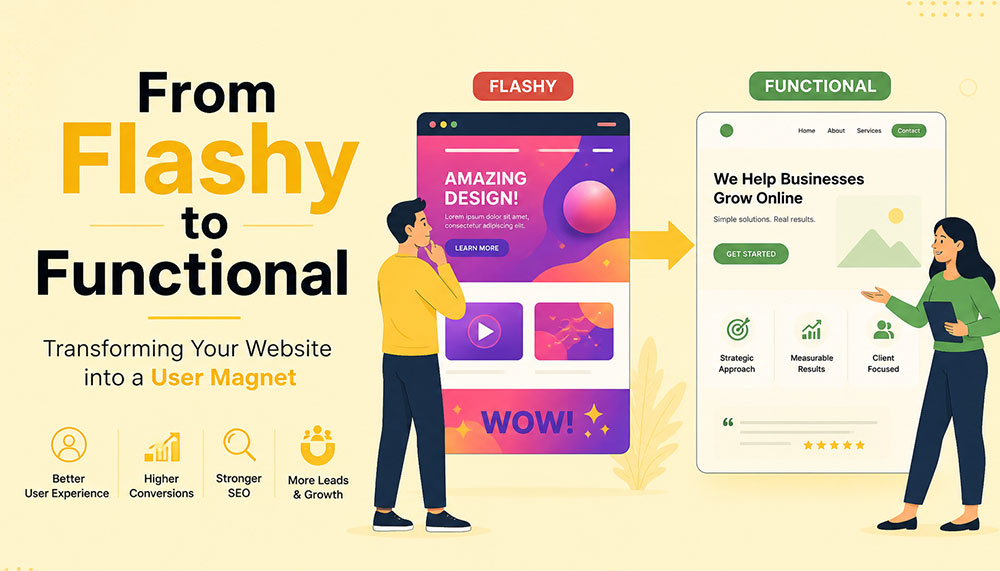
From Flashy to Functional: Transforming Your Website into a User Magnet
In the early days of the internet, a flashy website was often enough to impress visitors. Bright colors, animations, auto-playing media, and complex layouts were seen as signs of creativity and innovation. But times have changed. Today’s users are smarter, faster, and far less patient. A visually overloaded website is no longer impressive—it’s exhausting.
If your website looks stunning but fails to convert visitors into customers, then it’s not doing its job. The modern approach to web design focuses on functionality, usability, speed, and experience. Businesses that understand this shift are the ones that win.
This article explores how to transform your website from merely flashy to genuinely functional—and ultimately turn it into a powerful user magnet.
The Problem with “Flashy” Websites
At first glance, a flashy website can feel impressive. Bright visuals, animations, sliders, and interactive effects often give the illusion of sophistication and creativity. But here’s the reality—what looks exciting to a designer can quickly become frustrating for a user.
Today’s internet users are not browsing casually—they’re searching with intent. They want answers, solutions, and clarity within seconds. If your website slows them down or overwhelms them, they won’t admire the design—they’ll abandon it.
Flashy websites often prioritize aesthetics over usability. While they may look appealing initially, they tend to create friction in the user journey. And in the digital world, even small friction points can lead to big losses in engagement and conversions.
Let’s take a closer look at the common problems:
- Slow loading times: Heavy animations, large images, auto-playing videos, and complex scripts can significantly slow down your website. Users today expect pages to load almost instantly. Even a delay of a few seconds can cause frustration and increase bounce rates.
- Confusing navigation structures: Over-designed menus, hidden navigation elements, or too many options can leave users unsure of where to go next. When visitors feel lost, they rarely try to figure things out—they simply exit.
- Distracting visual elements: Too many moving parts—sliders, pop-ups, flashing banners—can shift attention away from what actually matters: your message. Instead of guiding users, these elements overwhelm them.
- Poor mobile responsiveness: A design that looks great on a desktop may completely break on a mobile device if not optimized properly. With the majority of users browsing on smartphones, this is a critical flaw.
- Low accessibility: Flash-heavy designs often ignore accessibility standards. Poor contrast, unreadable fonts, or non-intuitive layouts can make it difficult for users with different abilities to interact with your website.
Think about your own browsing habits. When you land on a website that takes too long to load or feels complicated, what do you do? Most likely, you hit the back button. That’s exactly what your visitors are doing too.
Modern users expect instant gratification. They want fast, smooth, and effortless experiences. If your website fails to deliver that within the first few seconds, you’ve already lost their attention—and potentially their business.
This is why businesses today are shifting their focus from “looking impressive” to “working effectively.” A professional Website Designing company in India understands this balance. Instead of adding unnecessary elements, they focus on creating clean, user-friendly designs that guide visitors naturally and help businesses achieve real results.
Because in the end, a website isn’t meant to just impress—it’s meant to perform.
Understanding the Shift: From Design to Experience
There was a time when website design was judged almost entirely by how it looked. If it was visually appealing, colorful, and “different,” it was considered successful. But that definition has evolved—dramatically.
Today, design alone is not enough. A website can look stunning and still fail miserably if it doesn’t deliver a smooth, intuitive experience. This is where the shift happens—from design-centric thinking to experience-centric thinking.
In simple terms, it’s no longer just about how your website looks. It’s about how it feels to use.
When a user lands on your website, they are not there to admire your design skills. They are there with a purpose—maybe to learn something, compare options, or make a purchase. The faster and easier you help them achieve that goal, the more successful your website becomes.
This is why User Experience (UX) and User Interface (UI) design have become the backbone of modern websites. These disciplines focus on understanding user behavior, removing friction, and creating seamless interactions.
Instead of asking “Does it look good?”, businesses now need to ask deeper, more practical questions:
- Is it easy to use? Can a first-time visitor navigate your website without confusion, or do they have to think too much before taking action?
- Can users find what they need quickly? In a world where attention spans are shrinking, every second matters. If users have to dig through multiple pages to find basic information, they won’t stick around.
- Does it guide users toward action? A good website doesn’t just present information—it gently leads users toward the next step, whether that’s filling out a form, making a purchase, or contacting your team.
- Does it work seamlessly on all devices? Your audience is browsing on phones, tablets, laptops, and everything in between. A consistent and smooth experience across all devices is no longer optional.
Think of your website like a physical store. A beautifully designed store with confusing layouts, hard-to-find products, and unhelpful staff will struggle to make sales. On the other hand, a clean, well-organized store that makes shopping easy will naturally attract and retain customers.
The same principle applies online.
Functionality doesn’t mean sacrificing beauty—it means giving beauty a purpose. Every design element, from colors to typography to spacing, should support usability rather than distract from it.
This is where experienced professionals, such as a Website Designing company in India, bring real value. They don’t just design for visual appeal—they design for human behavior, ensuring that every click, scroll, and interaction feels natural and meaningful.
Because at the end of the day, users don’t remember how “cool” your website looked. They remember how easy it was to use—and whether it helped them get what they came for.
Key Elements of a Functional Website
A functional website doesn’t happen by accident—it’s the result of thoughtful planning, user understanding, and smart design decisions. Every element on your website should have a purpose. When all these elements work together, they create an experience that feels smooth, intuitive, and satisfying for the user.
Let’s break down the core elements that truly make a website functional—not just visually appealing, but genuinely effective.
1. Clear and Intuitive Navigation
Your website should feel effortless to explore. A visitor should land on your homepage and instantly understand where to go next—without thinking too hard. The moment users feel confused, they start losing trust.
Think of navigation as a roadmap. If the directions aren’t clear, people won’t keep wandering—they’ll simply leave and find another destination.
A well-structured navigation system includes:
- Simple menus with clear labels: Avoid clever or vague naming. “Services,” “About,” and “Contact” may sound basic, but they work because users instantly recognize them.
- Logical page hierarchy: Your pages should be organized in a way that makes sense. Important information should never be buried deep within multiple clicks.
- Easy access to key pages: High-priority pages like pricing, services, or contact information should always be easy to find—preferably within one or two clicks.
If users get lost, they leave. It’s that simple. Good navigation doesn’t draw attention to itself—it just works seamlessly in the background.
2. Fast Loading Speed
Speed is one of the most critical factors in user experience. No matter how beautiful your website is, if it takes too long to load, users won’t wait around to see it.
We live in a world of instant results. A delay of even one second can feel like an eternity—and that’s often enough to lose a potential customer.
To improve your website’s speed:
- Optimize images: Large, uncompressed images are one of the biggest causes of slow websites. Proper optimization keeps quality high while reducing load time.
- Use efficient code: Clean, streamlined coding reduces unnecessary load on your website.
- Leverage caching: Caching helps store data so returning users can access your site faster.
- Choose reliable hosting: Your hosting provider plays a major role in your website’s performance. A slow server means a slow website—no matter what you do.
A skilled Website Designing company in India understands that performance is not an afterthought. They build speed optimization into the foundation of your website from the very beginning.
3. Mobile Responsiveness
Take a moment to think about how often you use your phone to browse the internet. Now imagine your website being viewed on that small screen. Does it still look clean? Is it easy to navigate? Can users interact with it comfortably?
With mobile users now dominating web traffic, your website must perform flawlessly across all screen sizes. A responsive design ensures that your website adapts automatically—no matter what device is being used.
This includes:
- Content that adjusts smoothly: Images, text, and layouts should resize and rearrange themselves for different screen sizes.
- Tap-friendly buttons: Buttons should be large enough and spaced properly so users can easily tap them without frustration.
- Readable text: Users shouldn’t have to zoom in just to read your content. Proper font sizing is essential.
A mobile-first approach is no longer optional—it’s the standard. If your website doesn’t work well on mobile, you’re likely losing a significant portion of your audience.
4. Strong Visual Hierarchy
When users land on your website, they don’t read every word—they scan. Your design should guide their eyes naturally, helping them understand what’s important within seconds.
This is where visual hierarchy comes in. It’s the art of organizing content in a way that leads users through your website effortlessly.
You can achieve this through:
- Proper use of headings: Headlines should stand out and clearly communicate key messages.
- Contrasting colors: Important elements like call-to-action buttons should be visually distinct.
- Whitespace: Giving elements room to breathe makes your website easier to read and less overwhelming.
- Strategic placement: Key information should be positioned where users naturally look first.
A clean, well-structured layout often outperforms a cluttered design. Simplicity doesn’t mean boring—it means effective.
5. Compelling and Clear Content
Design might bring users in, but content is what keeps them there—and ultimately convinces them to take action.
Your messaging should speak directly to your audience. It should answer their questions, address their concerns, and clearly explain how you can help them.
Effective website content is:
- Clear and concise: Avoid unnecessary jargon or long-winded explanations. Get to the point quickly.
- User-focused: Instead of talking only about your business, focus on what the user gains.
- Easy to scan: Use short paragraphs, bullet points, and headings to make content digestible.
Within a few seconds of landing on your website, visitors should understand exactly what you offer and why it matters to them. If they have to guess, you’ve already lost them.
When all these elements come together—navigation, speed, responsiveness, hierarchy, and content—you don’t just have a website. You have a powerful user experience that attracts, engages, and converts.
Why Functionality Drives Conversions
At the end of the day, your website has a job to do. Whether it’s generating leads, selling products, or encouraging inquiries—everything comes down to conversions. And here’s the truth many businesses overlook: people don’t convert because your website looks good… they convert because it feels easy.
A functional website removes friction from the user journey. It makes every step—from landing on the page to taking action—feel natural and effortless. When users don’t have to struggle, think too much, or second-guess their decisions, they are far more likely to move forward.
Think of it like walking into a well-organized store. You can quickly find what you need, understand the pricing, and check out without confusion. Compare that to a cluttered store where nothing is clearly labeled—you’d probably walk out. The same psychology applies to your website.
Functionality builds trust. And trust is the foundation of every conversion.
When users can easily navigate your website, find relevant information, and complete actions without frustration, they begin to feel confident in your brand. On the other hand, even small issues—like a confusing layout or a slow-loading page—can create doubt and push them away.
A conversion-focused website is intentionally designed to guide users toward action. It doesn’t leave things to chance. Every element plays a role in helping users take the next step.
Here’s what that looks like in practice:
- Clear call-to-action (CTA) buttons: Your CTAs should stand out and communicate exactly what users need to do next—whether it’s “Get a Quote,” “Book a Demo,” or “Buy Now.” There should be no confusion or hesitation.
- Minimal distractions: Too many pop-ups, animations, or competing elements can overwhelm users and dilute your message. A clean, focused design keeps attention where it matters most.
- Trust signals: People are naturally cautious online. Reviews, testimonials, case studies, certifications, and client logos help reassure users that they’re making the right choice.
- Simplified forms and checkout processes: The more steps you add, the more users you lose. Shorter forms, fewer fields, and a smooth checkout experience can significantly increase conversions.
It’s important to understand that users don’t want to “work” to interact with your website. The easier you make things for them, the more likely they are to take action.
This is why businesses increasingly partner with a Website Designing company in India that focuses on performance-driven design. Instead of adding unnecessary features, they refine the user journey—removing obstacles and guiding users toward meaningful actions.
Every element on your website should have a clear purpose. If something doesn’t contribute to the user experience or support conversions, it’s likely doing more harm than good.
Because in the digital world, simplicity isn’t just a design choice—it’s a competitive advantage.
The Role of User Psychology
Behind every click, scroll, and decision on your website, there’s a human mind at work. And that mind doesn’t behave randomly—it follows patterns. Understanding these patterns is what separates an average website from one that truly connects with users.
One of the biggest misconceptions in web design is assuming that users carefully read everything on a page. In reality, they don’t. People scan. They skim through headings, glance at visuals, and look for familiar cues that help them quickly understand what to do next.
This means your website isn’t just a collection of pages—it’s an experience shaped by human behavior. The more you align your design with how people naturally think and interact, the more effective your website becomes.
Let’s explore some key psychological principles that influence user behavior:
- Familiarity: Users feel comfortable with what they already recognize. This is why most successful websites follow certain standard patterns—like having a logo at the top left, navigation at the top, and contact information easily accessible. When you stick to familiar structures, users don’t have to “learn” how to use your website—they already know.
- Clarity: The human brain prefers simplicity. When a website is cluttered or overly complex, it increases cognitive load—meaning users have to work harder to process information. And when things feel difficult, people tend to give up. Clean layouts, simple messaging, and clear pathways reduce this mental effort and keep users engaged.
- Trust: First impressions happen in seconds. A clean, professional-looking website instantly builds credibility, while a messy or outdated design raises doubts. Elements like consistent branding, high-quality visuals, testimonials, and secure browsing indicators all contribute to building trust.
- Urgency: People are more likely to take action when they feel a sense of urgency. Strategic prompts like limited-time offers, countdowns, or phrases such as “Only a few spots left” can encourage users to act sooner rather than later. When used thoughtfully, urgency can significantly improve conversions without feeling pushy.
Think about your own online behavior. When you visit a website, you instinctively look for certain things—clear headings, easy navigation, and quick answers. If those elements are missing, frustration builds almost instantly.
This is why understanding user psychology isn’t optional—it’s essential. A website that aligns with human behavior feels intuitive, trustworthy, and easy to use.
A modern Website Designing company in India doesn’t just focus on visuals or code—they dive deeper into how users think, what motivates them, and what stops them from taking action. By combining design expertise with behavioral insights, they create websites that don’t just look good—they feel right.
Because when your website speaks the language of your users’ minds, engagement and conversions naturally follow.
Common Mistakes to Avoid
Sometimes, the biggest problems on a website aren’t what’s missing—they’re what’s unnecessarily added. Many businesses invest time and money into their websites, yet unknowingly make decisions that hurt performance instead of improving it.
The tricky part? These mistakes often come from good intentions—trying to impress users, add more information, or stand out from competitors. But in reality, they end up doing the opposite.
Let’s break down some of the most common website mistakes and why they matter:
- Overusing animations and effects: Animations can enhance a website when used sparingly, but too many moving elements can overwhelm users. Sliders, pop-ups, hover effects, and auto-playing media can quickly turn from engaging to distracting. Instead of focusing on your message, users get caught up in visual noise—and often leave before taking any action.
- Ignoring mobile users: This is one of the most costly mistakes today. A website that works perfectly on desktop but feels clunky on mobile is guaranteed to lose a large portion of its audience. Tiny buttons, misaligned content, and slow mobile performance create frustration and drive users away almost instantly.
- Cluttering pages with too much information: It’s tempting to put everything on one page—every service, every feature, every detail. But more information doesn’t always mean better communication. When pages are overcrowded, users don’t know where to focus. Instead of reading more, they end up reading nothing at all.
- Using unclear or generic CTAs: Call-to-action buttons like “Click Here” or “Submit” don’t tell users what they’re getting. Strong CTAs are specific and action-driven—like “Get Your Free Quote” or “Book a Consultation.” Clarity here can make a huge difference in conversion rates.
- Neglecting SEO fundamentals: A beautiful website is useless if no one can find it. Ignoring SEO basics—like proper headings, meta tags, keyword optimization, and page speed—limits your visibility on search engines. Without traffic, even the best-designed website won’t deliver results.
If you look closely, all these mistakes have one thing in common: they prioritize business preferences over user needs. And that’s where things start to go wrong.
The good news is that these issues are completely fixable. In fact, addressing even a few of them can lead to noticeable improvements in user engagement, time on site, and conversions.
This is why many businesses turn to an experienced Website Designing company in India to audit and refine their websites. With a fresh perspective and user-focused approach, they can identify hidden issues and transform your website into something far more effective.
Because sometimes, improving your website isn’t about adding more—it’s about removing what’s getting in the way.
Balancing Aesthetics and Functionality
There’s a common misconception in web design—that you have to choose between a website that looks beautiful and one that works well. In reality, the most successful websites don’t pick one over the other. They strike a balance.
Visual appeal matters. It creates the first impression, sets the tone for your brand, and captures attention. But if that visual appeal comes at the cost of usability, it quickly loses its value. On the other hand, a purely functional website that lacks personality can feel dull and forgettable.
The real goal is to bring both together—where design enhances functionality, not competes with it.
Think of your website like a well-designed workspace. It should look inviting and professional, but more importantly, everything should be placed exactly where it’s needed. Nothing should feel out of place, unnecessary, or confusing.
Here are some practical ways to achieve that balance:
- Using a consistent color palette: Colors play a huge role in how users perceive your brand. A consistent palette creates a sense of harmony and professionalism. It also helps guide user attention—for example, using a specific color for buttons makes them instantly recognizable.
- Choosing readable fonts: Stylish typography can enhance your design, but readability should always come first. If users have to strain their eyes to read your content, they won’t stick around. Clean, simple fonts with proper spacing make a big difference in user comfort.
- Maintaining visual consistency: Consistency builds familiarity and trust. When elements like buttons, headings, spacing, and layouts follow a uniform style across your website, users feel more comfortable navigating it. Inconsistency, on the other hand, creates confusion and disrupts the experience.
- Using images purposefully: Images should support your message—not just fill space. High-quality visuals can enhance storytelling, explain concepts, and create emotional connections. But irrelevant or excessive images can slow down your website and distract users from your core message.
It’s also important to remember that simplicity is powerful. A clean design with thoughtful spacing and focused content often feels more premium than a cluttered, over-designed layout.
This is where experienced professionals, such as a Website Designing company in India, truly make a difference. They understand how to blend creativity with usability—ensuring that every design choice serves a purpose and contributes to the overall experience.
At its core, design is not the end goal—it’s a tool. A tool to communicate, guide, and engage your users. When used wisely, it doesn’t just make your website look better—it makes it work better.
And that’s the kind of balance that turns visitors into loyal users.
How SEO and Functionality Work Together
SEO and website functionality are often treated as two separate things—but in reality, they are deeply connected. You can’t build a strong online presence by focusing on just one. The websites that perform best today are the ones where SEO and user experience work hand in hand.
Search engines like Google are no longer just scanning your website for keywords. They are analyzing how users interact with it. Do people stay on your site? Do they explore multiple pages? Or do they leave within seconds? These behaviors send powerful signals about the quality of your website.
In simple terms, search engines want to recommend websites that users actually enjoy using. And that’s exactly where functionality comes into play.
A functional website naturally supports SEO because it creates a better experience for users—and when users are happy, search engines take notice.
Here’s how functionality directly impacts your SEO performance:
- Improving page speed: Fast-loading websites not only keep users engaged but are also favored by search engines. Speed is a ranking factor, and even small improvements can make a noticeable difference in your visibility.
- Enhancing mobile usability: With mobile-first indexing, search engines prioritize how your website performs on mobile devices. A responsive, mobile-friendly design ensures that your site ranks better and reaches a wider audience.
- Reducing bounce rates: When users land on your website and immediately leave, it signals that something isn’t working—whether it’s slow speed, poor design, or irrelevant content. A functional website keeps users engaged and encourages them to stay longer.
- Encouraging longer session durations: When your website is easy to navigate and provides valuable content, users naturally spend more time exploring it. This increased engagement sends positive signals to search engines about your site’s relevance and quality.
It’s important to understand that SEO is no longer just about ranking—it’s about retention. Getting users to your website is only half the battle. Keeping them there is what truly makes the difference.
This is why businesses are increasingly working with a Website Designing company in India that understands both SEO and user experience. Instead of treating them as separate strategies, they integrate them into a unified approach—building websites that are not only easy to find but also enjoyable to use.
When your website is fast, intuitive, and user-friendly, visitors stay longer, interact more, and trust your brand. And when that happens consistently, search engines recognize your website as valuable—and reward it with better rankings.
Because in today’s digital landscape, the formula is simple: when users love your website, search engines do too.
Steps to Transform Your Website
Transforming your website from flashy to functional isn’t about making random changes—it’s about taking a structured, thoughtful approach. The goal is to create a website that not only looks better, but works better for your users and your business.
Think of it as a continuous improvement process rather than a one-time redesign. Every step you take should bring you closer to a smoother, more effective user experience.
1. Audit Your Current Website
Before making any changes, you need to understand where you currently stand. A website audit helps you uncover what’s working well and what’s holding you back.
Start by looking at real user data:
- User behavior: How do visitors interact with your site? Which pages do they visit most? Where do they drop off?
- Bounce rates: Are users leaving quickly after landing on certain pages? If yes, those pages may have usability or content issues.
- Conversion data: Which pages are driving results, and which ones are not?
You can also review your website from a user’s perspective. Try navigating it as if you were a first-time visitor. Is everything clear and easy to find? Or does it feel confusing?
This step lays the foundation for everything that follows.
2. Simplify the Design
Once you know what’s not working, the next step is to simplify. Many websites try to do too much—and end up overwhelming users.
Simplification doesn’t mean removing value—it means removing distractions.
Focus on:
- Eliminating unnecessary animations and visual clutter
- Reducing the number of competing elements on each page
- Highlighting key messages and actions
Ask yourself: “Does this element help the user, or does it just look nice?” If it doesn’t serve a purpose, it probably doesn’t belong.
A clean, focused design makes it easier for users to understand your website—and take action.
3. Improve Performance
Performance is a critical part of functionality. Even the best-designed website will fail if it’s slow or unresponsive.
Improving performance involves both technical and design-related optimizations:
- Speed optimization: Compress images, minimize code, and use caching to reduce load times.
- Responsive design: Ensure your website works smoothly across all devices and screen sizes.
- Technical improvements: Fix broken links, optimize server response times, and ensure clean coding practices.
This is often where working with a Website Designing company in India can make a big difference. Their technical expertise ensures that your website performs efficiently without compromising on design.
4. Enhance Content Strategy
Your website’s content is what communicates your value to users. If your messaging is unclear or unfocused, even the best design won’t help.
Shift your content strategy from “what we want to say” to “what users need to hear.”
Effective content should:
- Address user problems and offer solutions
- Be easy to read and scan
- Clearly explain your services or products
- Guide users toward the next step
Every page should have a purpose—and every piece of content should support that purpose.
5. Test and Optimize Continuously
Your website is never truly “finished.” User behavior evolves, trends change, and new opportunities emerge. That’s why ongoing testing and optimization are essential.
Use tools and techniques like:
- A/B testing: Compare different versions of a page to see what performs better
- Analytics: Track user behavior, engagement, and conversions
- Heatmaps: Understand where users click, scroll, and focus their attention
Small improvements over time can lead to significant results. Even minor tweaks—like changing a button color or simplifying a form—can have a noticeable impact on conversions.
The key is to stay curious, keep testing, and continuously refine your website based on real data.
When you follow these steps, you’re not just redesigning your website—you’re transforming it into a powerful tool that attracts users, engages them, and drives meaningful results.
The Importance of Professional Expertise
Transforming a website isn’t just about changing colors, adding new sections, or updating a layout—it’s a much deeper process. It requires a careful balance of design, technology, user psychology, and marketing strategy. And this is exactly where many businesses struggle when trying to handle everything on their own.
A website today is not just a digital brochure—it’s a performance-driven asset. It needs to attract visitors, engage them, guide them, and ultimately convert them. Achieving all of that requires more than creativity—it requires expertise.
This is why many businesses choose to partner with a professional Website Designing company in India. Instead of relying on guesswork or trial-and-error, they gain access to a team that understands how to build websites that actually work.
Let’s look at what such expertise brings to the table:
- Industry experience: Professionals who have worked across different industries understand what works and what doesn’t. They’ve seen trends evolve, tested strategies, and know how to avoid common pitfalls. This experience helps them make informed decisions that save time and deliver better results.
- Technical expertise: From coding and performance optimization to responsiveness and integrations, there’s a lot happening behind the scenes of a functional website. A skilled team ensures that everything runs smoothly—so users never have to think about the technical side at all.
- Strategic thinking: A great website isn’t built randomly—it’s planned. Professionals approach design with a clear strategy in mind, aligning your website with your business goals. Every element, from layout to content placement, is designed to support conversions and user engagement.
- Cost-effective solutions: While hiring experts may seem like an added expense, it often saves money in the long run. Avoiding mistakes, reducing redesigns, and getting things right the first time leads to better ROI and fewer ongoing issues.
Another key advantage is perspective. When you’re deeply involved in your own business, it’s easy to overlook usability issues or assume things are “obvious” to users. A professional team brings an outside perspective—seeing your website the way your visitors do.
They don’t just ask, “Does this look good?” They ask, “Does this work?”
And that shift in thinking makes all the difference.
The result is a website that doesn’t just impress visually—it performs consistently. It loads faster, guides users better, communicates clearly, and converts more effectively.
Because in today’s competitive digital space, a good-looking website is no longer enough. You need a website that delivers results—and that’s exactly what professional expertise helps you achieve.
Real-World Impact of Functional Design
When businesses shift their focus from flashy visuals to functional design, the results are not just noticeable—they’re measurable. This isn’t about subjective opinions like “it looks better” or “it feels smoother.” It’s about real, data-driven improvements that directly affect how your website performs and how your business grows.
A functional website doesn’t just change how your site looks—it transforms how users interact with it. And when user behavior improves, everything else follows.
Here’s what businesses typically experience when they make this shift:
- Higher conversion rates: When users can easily navigate your website, understand your offering, and take action without confusion, conversions naturally increase. Whether it’s filling out a form, making a purchase, or booking a service—simplicity leads to action.
- Lower bounce rates: A well-structured, fast-loading, and user-friendly website encourages visitors to stay instead of leaving immediately. When users find what they’re looking for quickly, they’re far more likely to explore further rather than exit.
- Increased user engagement: Functional design keeps users interested. They spend more time on your site, visit multiple pages, and interact with your content. This deeper engagement not only improves user experience but also strengthens your brand connection.
- Better search rankings: Search engines pay close attention to how users behave on your website. Lower bounce rates, longer session durations, and improved usability all contribute to better rankings—bringing in even more organic traffic.
But beyond the metrics, there’s a bigger picture.
A functional website builds confidence. It makes your business feel reliable, professional, and easy to work with. Users don’t just visit—they trust. And when trust is established, conversions become a natural outcome rather than a forced action.
Many businesses notice that after optimizing functionality, they don’t need to push as hard with aggressive marketing. Their website starts doing the heavy lifting—guiding users, answering questions, and encouraging decisions organically.
This is why working with a Website Designing company in India that focuses on performance-driven design can be a game-changer. Instead of chasing trends or adding unnecessary features, they focus on what truly impacts user behavior and business outcomes.
Because in the real world, success isn’t measured by how impressive your website looks—it’s measured by how effectively it works.
And when your website works seamlessly, growth isn’t just possible—it becomes predictable.
Future Trends in Website Design
Website design is constantly evolving—but one thing is becoming clearer every year: the future belongs to websites that truly understand and serve their users. Trends may change, technologies may advance, but the core focus remains the same—creating seamless, meaningful, and human-centered experiences.
What’s exciting is that the next wave of web design isn’t just about looking modern—it’s about becoming smarter, more intuitive, and more inclusive. Businesses that adapt early will not only stand out but also build stronger, long-lasting connections with their audiences.
Let’s explore some of the key trends shaping the future of website design:
- Minimalistic design approaches: The shift toward simplicity is only getting stronger. Clean layouts, ample whitespace, and focused content are replacing cluttered, over-designed pages. Minimalism isn’t about doing less—it’s about doing what matters most. By removing distractions, websites can guide users more effectively and create a calmer, more enjoyable browsing experience.
- AI-driven personalization: Websites are becoming smarter and more adaptive. With the help of artificial intelligence, websites can now tailor content, recommendations, and user journeys based on individual behavior. Imagine a website that understands what a visitor is looking for and adjusts its content accordingly—this level of personalization can significantly improve engagement and conversions.
- Voice and gesture-based interactions: As technology evolves, the way users interact with websites is also changing. Voice search and voice commands are becoming more common, especially with the rise of smart devices. Gesture-based interactions, particularly on mobile and touch devices, are also shaping how users navigate and engage with content. Designing for these interactions means thinking beyond clicks and taps.
- Accessibility-first design: Inclusivity is no longer optional—it’s essential. Future-ready websites are built to be accessible to everyone, including users with disabilities. This includes better color contrast, keyboard navigation, screen reader compatibility, and clear content structure. Accessibility doesn’t just expand your audience—it also improves overall usability for all users.
Another important shift is the growing expectation for speed, privacy, and trust. Users want websites that load instantly, respect their data, and provide a smooth, secure experience. These factors will continue to influence design decisions moving forward.
For businesses, this means one thing: staying static is not an option. A website that works well today may feel outdated tomorrow if it doesn’t evolve with user expectations.
This is where partnering with a forward-thinking Website Designing company in India becomes valuable. Such teams stay updated with emerging technologies and user trends, ensuring your website doesn’t just keep up—but stays ahead.
Because in the digital world, success isn’t just about where you are today—it’s about how prepared you are for what’s coming next.
And the future? It belongs to websites that are not only functional—but intelligent, inclusive, and deeply user-focused.
Conclusion
A flashy website might capture attention—but a functional website captures users.
In today’s competitive digital landscape, success depends on how well your website serves your audience. By focusing on usability, performance, and clarity, you can create an experience that not only attracts visitors but keeps them coming back.
Whether you’re revamping an existing site or building a new one, the goal should always be the same: create a website that works for your users.
And when done right, your website doesn’t just become a digital presence—it becomes your most powerful business asset.


How to Use Search Intent Data to Create Targeted Content
In digital marketing, creating content without understanding what users truly want is like sailing without a compass. Businesses often publish blogs, landing pages, and service pages hoping to attract traffic, but traffic alone does not guarantee leads or conversions. What matters most is attracting the right audience with the right message at the right stage of their journey. This is where search intent data becomes one of the most valuable tools in modern SEO.
Search intent refers to the reason behind a user’s search query. When someone types a keyword into Google, they usually have a specific goal. They may want to learn something, compare options, find a business, or make a purchase. If your content aligns with that purpose, search engines are more likely to rank your page, and users are more likely to engage with it.
For businesses competing online, especially service providers such as an SEO company in India, understanding search intent can help create content that attracts qualified visitors and converts them into customers. Instead of producing generic content, brands can build pages that answer precise needs and solve real problems.
This guide explains how to use search intent data to create targeted content that ranks well, builds trust, and drives results.
What Is Search Intent?
Search intent, sometimes called user intent, is the purpose behind an online search. Every query entered into Google reflects a need. Search engines analyze behavior, context, and language patterns to deliver the most relevant results.
For example:
- “What is local SEO?” – The user wants information.
- “Best SEO tools for agencies” – The user wants comparisons.
- “Affordable SEO services near me” – The user is considering a purchase.
- “Contact SEO company in India” – The user is ready to take action.
When you understand intent, you stop chasing keywords blindly and start creating meaningful content.
Why Search Intent Matters for SEO
Search engines are designed to deliver the most relevant and useful results for every query. Their goal is not simply to match keywords, but to understand what the user truly wants and present pages that best satisfy that need. This is why search intent has become one of the most important factors in modern SEO.
If your page closely matches what users expect to see when they search, it has a much stronger chance of ranking well. On the other hand, even a technically optimized website with strong backlinks can struggle if the content does not align with user intent.
For example, if someone searches for “best SEO tools” and your page is a hard-selling service page instead of a comparison guide, users may leave quickly. Search engines notice these signals and may reduce your rankings over time.
Intent alignment helps search engines trust that your content deserves visibility because it solves the problem behind the search.
Benefits of Using Search Intent Data
Higher Rankings in Search Results
When your content matches the purpose behind a keyword, Google is more likely to rank it above pages that only target the phrase without satisfying the user. Relevant pages often outperform keyword-stuffed content.
Lower Bounce Rates
If visitors land on a page that immediately answers their question or meets their need, they are more likely to stay rather than return to search results. This creates stronger engagement signals.
Longer Time on Page
Users spend more time reading content that feels useful and relevant. This can improve user experience metrics and create more opportunities for conversions.
Improved Click-Through Rates
Titles and descriptions that clearly reflect search intent attract more clicks. Users are more likely to choose a result that appears to match exactly what they are looking for.
Better Lead Quality
Intent-focused SEO attracts visitors who are genuinely interested in your product or service. This means fewer unqualified clicks and more meaningful inquiries.
Higher Conversions
When the right audience lands on the right page at the right stage of the buying journey, conversions naturally improve. Transactional users convert faster when pages meet their expectations.
More Effective Content Strategy
Understanding intent helps businesses create smarter content instead of publishing random topics. Every page can be mapped to awareness, consideration, or decision stages.
Competitive Advantage
Many websites still focus only on keyword volume and content quantity. Businesses that focus on intent often outperform competitors producing large volumes of low-value content because their pages are more useful, targeted, and conversion-driven.
In today’s SEO landscape, relevance wins over volume. Search intent helps brands build content that not only ranks, but also drives real business results.
The Four Main Types of Search Intent
Understanding search intent becomes easier when it is divided into clear categories. While some keywords may overlap, most searches fall into four primary intent types. Each type represents a different stage of the user journey and requires a different style of content.
When you identify the correct intent behind a keyword, you can create pages that satisfy users faster, improve rankings, and increase conversions.
1. Informational Intent
Informational intent occurs when users want to learn, understand, or solve a problem. They are searching for knowledge rather than trying to buy something immediately.
These users may be beginners exploring a topic, professionals researching solutions, or potential customers at the awareness stage of the buying journey.
Examples:
- How does SEO work?
- What is keyword research?
- Benefits of content marketing
- How to improve website traffic
- What is local SEO?
What users expect:
- Clear explanations
- Step-by-step guidance
- Useful examples
- Actionable tips
- Trustworthy information
Best content formats:
- Blog posts
- Long-form guides
- Tutorials
- FAQs
- Explainer videos
- Checklists
SEO Tip: Focus on answering the main question quickly, then expand with deeper insights and related questions.
2. Navigational Intent
Navigational intent happens when users already know the brand, website, or platform they want to visit. They use search engines as a shortcut rather than typing the full URL.
These searches usually indicate brand awareness and familiarity.
Examples:
- Google Search Console login
- HubSpot blog
- OpenAI ChatGPT
- Facebook business manager
- Canva homepage
What users expect:
- The official website
- Login or dashboard pages
- Specific tools or sections
- Fast access to trusted destinations
Best content formats:
- Homepage
- Brand pages
- Support pages
- Login pages
- Help center pages
SEO Tip: Ensure your branded pages are optimized with clear titles, descriptions, and structured navigation so users can find the correct destination quickly.
3. Commercial Investigation Intent
Commercial investigation intent appears when users are considering a purchase but need more information before deciding. They are comparing providers, reading reviews, evaluating pricing, or looking for the best option.
This is a highly valuable stage because users are close to converting.
Examples:
- Best SEO agency for ecommerce
- Top digital marketing companies
- SEO pricing comparison
- Best CRM software for startups
- SEO freelancer vs agency
What users expect:
- Comparisons
- Pros and cons
- Pricing details
- Testimonials
- Case studies
- Proof of results
Best content formats:
- Comparison pages
- Case studies
- Service pages
- Reviews
- Listicles
- Buyer guides
SEO Tip: Build trust with data, reviews, examples, and transparent information. Users at this stage want confidence before taking action.
4. Transactional Intent
Transactional intent means the user is ready to act now. They may want to buy, book, request a quote, schedule a call, or contact a service provider.
These searches often have the highest conversion potential because the decision stage is already near.
Examples:
- Hire SEO expert now
- Book SEO consultation
- SEO company in India
- Buy email marketing software
- Request website audit
What users expect:
- Clear service details
- Pricing or package information
- Strong trust signals
- Simple contact options
- Fast-loading pages
- Easy calls-to-action
Best content formats:
- Landing pages
- Pricing pages
- Contact pages
- Lead generation pages
- Consultation booking pages
SEO Tip: Remove friction. Make it easy for users to contact you, request a quote, or make a purchase immediately.
Why These Four Types Matter
Every keyword usually reflects one of these intent categories. If you match the wrong content type to the keyword, rankings and conversions can suffer.
For example:
- Using a sales page for an informational keyword may increase bounce rate.
- Using a blog post for a transactional keyword may lose leads.
- Using weak comparison content for commercial queries may reduce trust.
When businesses align content with intent, they create a smoother journey from discovery to decision.
How to Collect Search Intent Data
Creating targeted content begins with understanding what users truly want when they search. Search intent data helps uncover the purpose behind keywords so you can build pages that match user expectations and improve SEO performance.
The good news is that search intent can be identified using a combination of search engine analysis, keyword tools, user behavior data, and real customer insights. When these sources are combined, they provide a clear picture of what type of content should be created.
1. Analyze Google Search Results
The easiest and often most accurate way to understand search intent is to manually search the keyword in Google and study the top-ranking results. Search engines have already analyzed user behavior and determined which pages best satisfy that query.
By reviewing the first page results, you can identify strong intent patterns quickly.
Ask yourself:
- Are the top results blog posts, landing pages, product pages, or service pages?
- Do pages focus on education, comparison, or direct conversion?
- Are videos ranking in the results?
- Are listicles such as “Top 10” or “Best Tools” common?
- What questions appear in featured snippets?
- Are local businesses appearing in map packs?
- Do results come from brands, publishers, or ecommerce stores?
Example:
If you search “best SEO tools,” and most top results are comparison blogs, the dominant intent is commercial investigation. If you search “hire SEO expert,” and service pages dominate, the intent is transactional.
Google’s search results often reveal intent more clearly than any software tool because rankings reflect real user behavior.
2. Use Keyword Research Tools
Keyword research platforms such as Ahrefs, SEMrush, Ubersuggest, Moz, and Google Keyword Planner help uncover related keywords, search volume, and valuable modifiers that indicate intent.
These tools are especially useful for finding secondary keywords and hidden opportunities around a core topic.
Examples of intent modifiers:
- Informational: how, why, guide, tutorial, tips, examples
- Commercial: best, top, compare, review, alternatives
- Transactional: buy, hire, pricing, quote, order, book
- Navigational: brand names, company names, platform names
Example:
- How to do SEO = informational
- Best SEO agency for startups = commercial
- SEO pricing packages = transactional
- SEMrush login = navigational
These patterns help you understand not only what users search, but what they expect next.
3. Review Search Console Data
Google Search Console is one of the most valuable free sources of intent data because it shows the exact queries users already use to find your website.
This data often reveals opportunities that businesses overlook. You may discover pages ranking for unexpected keywords, informational searches reaching service pages, or pages getting impressions but low clicks.
What to review:
- Queries with high impressions but low click-through rate
- Keywords sending traffic to the wrong page
- Pages ranking on page two or three
- Branded vs non-branded queries
- Informational queries with conversion potential
Example:
If a service page ranks for “what is local SEO,” it may need educational content added or a dedicated guide page created.
Search Console helps align your existing pages with real user behavior.
4. Analyze Customer Questions
Some of the best search intent insights come directly from your audience. Sales calls, inquiry forms, emails, WhatsApp chats, live chat transcripts, and support tickets reveal the real language people use when looking for solutions.
Unlike SEO tools, customer conversations often expose emotional intent, pain points, urgency, and objections.
Examples:
- How long does SEO take to work?
- Do you offer affordable monthly plans?
- Can you help a local business rank on Google Maps?
- What makes your agency different?
- How soon can we start?
These questions can become blog topics, FAQs, service page sections, and lead magnets.
Often, customer language is more powerful than tool-generated keyword suggestions because it reflects real buying intent.
5. Monitor Competitor Content
Your competitors can reveal what search engines currently reward in your niche. By studying their top-performing pages, you can understand how they match search intent and where gaps exist.
Look for patterns such as:
- Which keywords they rank for
- What content types perform best
- How long their pages are
- Whether they use comparisons, videos, or case studies
- How they structure headings and calls-to-action
- What topics they have missed completely
Example:
If multiple competitors rank with pricing pages for a keyword and you only have blogs, it may indicate stronger transactional intent than expected.
Competitor research helps you create better content rather than copying blindly.
Additional Ways to Discover Search Intent
While keyword tools and Google search results are powerful starting points, there are several additional methods that can help uncover deeper user intent. These sources often reveal hidden questions, emotional triggers, objections, and search behavior that standard SEO tools may miss.
Using multiple data sources gives you a clearer picture of what users really want and helps you create content that is more accurate, useful, and conversion-focused.
Use Google Autocomplete
Google Autocomplete suggestions appear when users begin typing a search query. These predictions are based on real searches made by users and can provide valuable clues about what people commonly want to know next.
Autocomplete is especially useful for identifying long-tail keyword opportunities and variations in search intent.
Example:
- SEO company
- SEO company pricing
- SEO company near me
- SEO company for small business
- SEO company in India
Each variation reflects a different type of intent such as local, transactional, or comparison-based searches.
Use these suggestions to create dedicated pages, FAQs, or blog topics that directly answer what users are searching for.
Study “People Also Ask”
The “People Also Ask” section in Google search results contains related questions users frequently ask around a topic. These questions are extremely valuable because they show follow-up intent and deeper informational needs.
When users search one keyword, they often need additional answers before taking action. People Also Ask helps reveal that journey.
Example for SEO queries:
- How long does SEO take?
- Is SEO worth it for small businesses?
- How much does SEO cost?
- What is the difference between SEO and PPC?
These questions can be used as subheadings, FAQ sections, blog topics, or supporting content clusters.
Review Analytics Behavior
Your website analytics can reveal whether your content currently matches user intent. If visitors land on a page and leave quickly, it may indicate that the content is not meeting expectations.
Behavioral metrics provide real-world feedback on how users respond after clicking through to your site.
Signals to monitor:
- High bounce rates
- Low average engagement time
- Poor scroll depth
- Low click-through on calls-to-action
- Weak conversion rates
- High exit rates on important pages
If a page receives traffic but performs poorly, review whether the keyword intent and page purpose are aligned.
Check Social Media Discussions
Communities on Reddit, Quora, LinkedIn, Facebook groups, and industry forums can reveal real conversations happening around your niche. These discussions often expose problems, frustrations, buying signals, and common questions in natural language.
Unlike keyword tools, social discussions often show emotional context and urgency.
Examples:
- Why is my website traffic suddenly dropping?
- Can SEO help a new business?
- How do I choose the right agency?
- Is monthly SEO worth paying for?
This language can help you create relatable content that connects directly with user concerns.
Turn Data into Action
Collecting search intent data is only the first step. Real SEO success comes from applying those insights to create the right content format for each type of query.
Once you understand what users want, match the intent with the correct page type.
Guides for Informational Queries
Create educational blog posts, tutorials, how-to articles, checklists, and beginner guides for users who are researching or learning.
Comparison Pages for Commercial Searches
Use reviews, alternatives pages, pricing comparisons, and “best of” lists for users evaluating options before making a decision.
Service Pages for Transactional Terms
Build optimized landing pages, pricing pages, quote request pages, and consultation pages for users ready to hire or buy.
Brand Pages for Navigational Searches
Ensure homepage, about pages, contact pages, login pages, and branded service pages are easy to find and fully optimized.
Why This Matters
The more accurately you understand intent, the more targeted and effective your SEO content becomes. Instead of guessing what users need, you create pages based on real behavior and real demand.
This leads to stronger rankings, better engagement, higher-quality leads, and more conversions over time.
How to Map Search Intent to the Buyer Journey
Search intent becomes far more valuable when it is connected to the buyer journey. Not every visitor is ready to purchase immediately. Some users are only beginning to understand their problem, while others are actively comparing providers or ready to make a decision today.
When businesses align content with each stage of the funnel, they create a smoother path from discovery to conversion. Instead of pushing the same message to every visitor, you can deliver the right content at the right moment.
The buyer journey is commonly divided into three main stages:
- Top of Funnel (Awareness)
- Middle of Funnel (Consideration)
- Bottom of Funnel (Decision)
Each stage reflects a different level of intent and requires a different type of content.
Top of Funnel (Awareness)
At the awareness stage, users are learning, researching, and identifying problems. They may know something is wrong, but they are not yet sure of the best solution. These searches are usually informational in nature.
Users at this stage are asking questions, looking for explanations, and trying to understand opportunities or challenges.
Examples:
- Why is my website traffic dropping?
- What is technical SEO?
- How does SEO work?
- Why am I not ranking on Google?
- What affects website speed?
What users need:
- Clear explanations
- Problem diagnosis
- Educational guidance
- Industry trends
- Actionable beginner advice
Create:
- Educational blogs
- Industry insights
- Beginner guides
- How-to articles
- Checklists
- Explainer videos
Goal: Build trust, educate the audience, and introduce your brand as a helpful authority.
SEO Tip: Use internal links from awareness content to deeper comparison or service pages so users can continue their journey naturally.
Middle of Funnel (Consideration)
At the consideration stage, users understand their problem and are now exploring possible solutions. They are comparing providers, services, strategies, and pricing models.
These searches usually show commercial investigation intent. Users are interested, but they need proof and confidence before choosing.
Examples:
- SEO freelancer vs agency
- Best SEO company in India
- SEO services for ecommerce brands
- How much does SEO cost?
- Top digital marketing companies
What users need:
- Comparisons
- Case studies
- Testimonials
- Service details
- Pricing guidance
- Proof of expertise
Create:
- Comparison pages
- Case studies
- Testimonials
- Service explainers
- Industry-specific landing pages
- FAQ pages
Goal: Differentiate your business, remove doubts, and show why your solution is the best fit.
SEO Tip: Use trust signals such as client logos, reviews, before-and-after results, and measurable outcomes.
Bottom of Funnel (Decision)
At the decision stage, users are ready to contact, purchase, request a quote, or schedule a consultation. These searches usually have strong transactional intent and high conversion potential.
Users already know what they need. They now want the fastest and safest path to action.
Examples:
- Hire SEO company in India
- SEO pricing packages
- Book SEO consultation
- Request SEO audit
- Affordable monthly SEO plans
What users need:
- Clear service offers
- Transparent pricing
- Simple contact methods
- Strong trust signals
- Fast-loading pages
- Clear next steps
Create:
- Landing pages
- Consultation pages
- Pricing pages
- Strong CTA pages
- Contact forms
- Quote request pages
Goal: Remove friction and make conversion as easy as possible.
SEO Tip: Use clear calls-to-action such as “Book a Free Call,” “Get a Quote,” or “Start Today.”
Why Funnel Mapping Matters
Many businesses lose leads because they show the wrong content to the wrong audience. Sending awareness-stage users directly to aggressive sales pages can reduce trust. Sending ready-to-buy users to long educational blogs can slow conversions.
Mapping search intent to funnel stages helps you meet users where they are.
- Awareness content builds trust
- Consideration content builds confidence
- Decision content drives action
Build a Full Content Ecosystem
Instead of relying on one page, create connected content across the entire buyer journey.
Example for an SEO business:
- Top Funnel: What is local SEO?
- Middle Funnel: Local SEO freelancer vs agency
- Bottom Funnel: Hire local SEO company in India
This structure attracts users at every stage and increases the chance of long-term conversions.
Final Insight
The most successful SEO strategies do not just target keywords. They guide people from curiosity to confidence to conversion. When search intent is mapped to the buyer journey, content becomes more strategic, more relevant, and more profitable.
How to Create Targeted Content Using Search Intent Data
Once you understand what users want when they search, the next step is turning that insight into content that ranks, engages, and converts. Search intent data helps you move beyond generic keyword targeting and create pages designed for specific user needs.
Targeted content performs better because it matches expectations. When users find exactly what they were hoping for, they stay longer, trust the brand more, and are more likely to take action.
Instead of creating one-size-fits-all pages, build content based on the dominant intent behind each keyword.
1. Choose One Primary Intent Per Page
Every page should have one clear purpose. Trying to target multiple conflicting intents on the same page can confuse both users and search engines.
For example, a page that tries to educate readers while aggressively selling services may fail at both goals. Visitors looking for guidance may feel pushed, while ready-to-buy users may have to dig through unnecessary information.
Keep the page focused:
- Blog post = Informational
- Service page = Transactional
- Comparison article = Commercial
- Homepage = Navigational / Brand trust
Best Practice: If a keyword has mixed intent, create separate supporting pages rather than forcing everything into one page.
2. Match the Format Users Expect
Search engines reward pages that satisfy users in the format they prefer. If the top-ranking results are long guides, users likely want in-depth education. If service pages dominate results, users are probably looking to hire or contact a provider.
Always study the search results before creating content.
Examples:
- If users expect a guide, create a stronger and more useful guide.
- If users expect comparisons, create a better comparison page.
- If users expect pricing details, publish transparent pricing content.
- If users expect service pages, do not publish a blog instead.
Tip: Matching intent is often more important than word count.
3. Use Intent-Based Headlines
Your headline is one of the first things users see in search results. It should instantly show that your page matches their goal.
Strong intent-based headlines improve click-through rates and help users feel confident they are clicking the right result.
Examples:
- How to Improve Organic Rankings in 2026
- Best SEO Strategies for Ecommerce Stores
- Affordable SEO Company in India for Small Businesses
- SEO Pricing Guide for Startups
- Hire an SEO Expert for Local Business Growth
Headline Tips:
- Use action words
- Be specific
- Reflect the intent clearly
- Include numbers or years where relevant
- Avoid clickbait that misleads users
4. Solve the Core Problem Fast
Modern users want quick answers. If they click your page and cannot find value immediately, they may return to search results.
Start by addressing the main problem near the top of the page rather than using long generic introductions.
Examples:
- If the query is “How to rank on Google Maps,” begin with the key ranking steps.
- If the query is “SEO pricing packages,” show package ranges early.
- If the query is “Best SEO agency,” explain evaluation criteria immediately.
Tip: Use summaries, quick answers, and clear headings so users can scan efficiently.
5. Add Supporting Elements
Strong content is not just text. Supporting elements improve trust, readability, and conversion potential.
Useful additions include:
- FAQs
- Statistics
- Case studies
- Real examples
- Screenshots
- Charts or visuals
- Testimonials
- Clear CTAs
These elements help users feel informed and confident while increasing page quality signals.
Using Search Intent for Service Businesses
Service businesses can benefit significantly from intent-focused SEO because users search with different needs at different stages of the buying journey.
Instead of relying on one generic service page, create multiple targeted pages for different intents.
For example, an SEO company in India can create:
- What does an SEO agency do? – Informational
- SEO agency vs in-house team – Commercial
- SEO pricing in India – Commercial / Transactional
- Hire SEO company in India – Transactional
- Best SEO services for ecommerce brands – Commercial
This creates a complete content ecosystem that attracts users from awareness to conversion.
Why This Works
- Informational pages build trust
- Comparison pages build confidence
- Transactional pages generate leads
- Internal links connect the journey
Examples of Intent-Based Content Strategy
Keyword: Local SEO Services
Likely Intent: Transactional
Users searching this term are usually looking to hire a provider or request services.
Create:
- Dedicated service page
- Pricing overview
- Case study
- Local results examples
- Contact CTA
Keyword: How to Rank on Google Maps
Likely Intent: Informational
Users want to learn the process before hiring anyone.
Create:
- Step-by-step guide
- Checklist
- Video tutorial
- Common mistakes section
- Optional consultation CTA
Keyword: Best SEO Company in India
Likely Intent: Commercial Investigation
Users are comparing providers and looking for proof.
Create:
- Authority page with proof
- Awards and certifications
- Testimonials
- Results and case studies
- Industry expertise sections
- Consultation CTA
Build Content Around Real Needs
The best SEO content is not built around keywords alone. It is built around user expectations, motivations, and readiness to act.
When you create pages that solve the right problem in the right format, rankings improve naturally and conversions become easier.
Final Insight
Search intent data turns content creation from guesswork into strategy. Instead of asking “What should I write about?” ask “What does the user need right now?”
That shift is what creates targeted content that drives real business growth.
How to Optimize Existing Content with Intent Data
You don’t always need to create brand-new pages to improve your SEO performance. In many cases, your existing content already has authority, backlinks, and rankings—but it may not fully align with what users expect when they search. By using search intent data, you can refine underperforming pages, improve user engagement, and increase conversions without starting from scratch.
Updating old content is often faster and more cost-effective than producing new articles. It also helps preserve the SEO value that existing pages have already built over time.
Check Pages with High Impressions but Low Clicks
If a page receives many impressions in Google Search Console but has a low click-through rate, it usually means users are seeing your page in results but choosing another option. This often happens when your title tag or meta description does not match search intent.
For example, if users search for a guide and your title sounds overly promotional, they may skip it. If they want a service provider and your title appears too informational, they may click a competitor instead.
To improve these pages:
- Rewrite titles to match user expectations
- Use action-driven and benefit-focused language
- Add current year where relevant
- Make meta descriptions clearer and more compelling
- Match the tone of top-ranking competitors
Check High Traffic but Low Conversion Pages
Some pages bring plenty of traffic but generate few leads or sales. This is often a sign that intent and page purpose are mismatched.
For instance, an informational blog may attract visitors researching a topic, but if it pushes aggressive sales messaging too early, users may leave. Similarly, a service page ranking for educational keywords may attract the wrong audience.
To improve these pages:
- Identify whether the traffic is informational, commercial, or transactional
- Adjust calls-to-action based on funnel stage
- Add trust signals such as reviews or case studies
- Offer downloadable guides or consultations
- Create smoother pathways to service pages
Rewrite Headers and Structure
Many older pages rank but fail to satisfy modern search expectations. Updating headings and page structure can significantly improve readability and relevance.
Search engines and users both rely on headers to understand content quickly. If your structure is weak, users may bounce before finding answers.
Best practices include:
- Use clear H2 and H3 headings based on common questions
- Answer the main query near the top of the page
- Break large text blocks into readable sections
- Add bullet points, tables, or step lists
- Improve mobile readability with shorter paragraphs
Add Internal Links by Funnel Stage
Internal linking helps guide users naturally from one stage of the buyer journey to another. Someone reading an informational article may later need a comparison guide, then a pricing or contact page.
Examples:
- Blog post → Case study
- Beginner guide → Service page
- Comparison article → Consultation page
- FAQ page → Contact page
Well-placed internal links improve user experience, reduce bounce rate, and help distribute authority across your website.
Common Mistakes to Avoid
1. Targeting Keywords Without Intent
Many marketers focus only on keyword volume. High-volume keywords may bring traffic, but if the intent is wrong, that traffic may never convert.
Always ask: What does the user want when searching this phrase?
2. Forcing Sales on Informational Queries
If someone searches for advice or education, they are not always ready to buy immediately. Overly sales-heavy pages can create friction.
Provide value first, build trust, and guide users naturally toward the next step.
3. Ignoring SERP Changes
Search intent can shift over time. A keyword that once showed blogs may now show product pages or videos. Google constantly adapts results based on user behavior.
Review target keywords regularly to ensure your content format still matches current results.
4. Creating Duplicate Pages for Similar Intent
Publishing multiple pages targeting nearly identical intent can confuse search engines and split rankings. This is known as keyword cannibalization.
Instead, create one strong page or consolidate overlapping content.
5. Overusing Keywords
Repeating keywords unnaturally no longer helps rankings. Search engines now understand context, synonyms, and related terms.
Focus on clarity, depth, and usefulness rather than keyword density.
Advanced Tips for Better Results
Use Semantic Keywords
Semantic keywords are related words and phrases that support the main topic. They help search engines understand context while making content more natural.
For example, an article about SEO may also include terms like rankings, backlinks, organic traffic, search visibility, and keyword strategy.
Study “People Also Ask”
The “People Also Ask” section in Google reveals common follow-up questions users have. These questions provide valuable insight into deeper intent.
Use them to build subheadings, FAQ sections, and supporting content.
Segment by Device
User behavior often changes by device. Mobile users may want quick answers, fast-loading pages, and simple navigation. Desktop users may spend longer comparing options.
Optimize page layout, CTAs, and formatting based on device behavior.
Use Analytics Signals
Metrics such as scroll depth, bounce rate, average engagement time, form submissions, and assisted conversions can reveal whether your content matches intent.
If users leave quickly, the page may not be meeting expectations.
Refresh Old Content Regularly
Search trends, language, and user needs evolve constantly. Updating old content with fresh statistics, examples, visuals, and improved structure can revive rankings.
Even small updates can make a major difference over time.
Intent-based optimization is not a one-time task. It is an ongoing process of understanding user behavior, refining content, and adapting to changing search patterns.
Why Search Intent Is the Future of SEO
Modern search engines use AI, natural language processing, and user behavior data. They understand context more than ever before. This means keyword stuffing and outdated tactics are losing value.
Brands that understand audience motivation will win. Search intent bridges the gap between SEO and customer psychology. It transforms content from mere traffic bait into a conversion tool.
Final Thoughts
If you want stronger rankings, better engagement, and more qualified leads, search intent should be at the center of your content strategy. Instead of asking, “What keyword should I target?” start asking, “What does the user truly want?”
When you answer that question effectively, rankings often follow naturally.
Whether you run an ecommerce store, local business, SaaS brand, or an SEO company in India, intent-driven content helps you reach the right people at the right moment.
Focus on understanding users, matching their expectations, and guiding them to the next step. That is how targeted content creates lasting SEO success.

The Witchcraft Behind Conversion Optimization
Some marketers call it science. Others call it psychology. But anyone who has stared at a stubbornly low conversion rate at 2:37 a.m. knows the truth:
Conversion optimization is witchcraft.
Not the pointy-hat, broom-flying kind. The subtle, data-soaked, user-obsessed magic that turns casual visitors into loyal customers. The kind of magic practiced quietly inside every ambitious SEO company in Delhi, every web development company in Delhi, and every sleep-deprived SEO expert in India trying to squeeze one more percent out of a landing page.
Tonight, we open the grimoire.
The Conversion Coven: Who’s Stirring the Cauldron?
Behind every high-converting website is a strange little coven of specialists:
- The Strategist: Knows what the business wants and what the user fears.
- The UX Alchemist: Rearranges buttons, layouts, and forms until they feel inevitable.
- The Copy Enchantress: Uses words that slip under logical defenses and speak directly to desire.
- The Data Necromancer: Summons insights from the dead bodies of failed campaigns.
- The Developer Wizard: Turns sketchy dreams into working, trackable reality—often a quiet hero inside a website development company in India.
In many agencies, those roles live inside one roof: a web design company in Delhi that also acts as a SEO company in India, mixing code, content, and analytics in the same heavy iron pot.
Spell One: The Curse-Breaking Audit
Every good witch starts by breaking curses—and your website has more curses than you think.
Slow load times. Confusing menus. Forms that demand too much too soon. Pop-ups that appear like jump scares in a horror movie. All of these act like invisible hexes on your conversion rate.
The Audit Ritual
- Summon the heatmaps: Watch where users hover, rage-click, or flee.
- Consult the scroll maps: See exactly where attention dies.
- Channel user recordings: Observe real humans silently judging your layout.
- Read the analytics bones: Bounce rate, exit rate, time on page—each metric a bone in the divination circle.
It’s not glamorous. It’s not sexy. It’s the part of witchcraft where you sweep the cottage and scrub the cauldron. But without this, nothing else works.
This is where an experienced web design agency or website development company behaves less like a vendor and more like a seasoned witch-doctor: they diagnose the real curse, not the convenient one.
Spell Two: The Potion of Irresistible Offers
Bad offers are like weak potions—they smell nice, sparkle a bit, and do absolutely nothing.
If your landing page says “Contact us to know more,” that’s not a call-to-action. That’s a damp twig in a thunder ritual.
Ingredients for a High-Converting Offer
- Specific outcome: “Increase leads by 30%” is stronger than “Grow your business.”
- Concrete proof: Testimonials, case studies, and numbers from your past victories.
- Low perceived risk: Free audits, demos, or trials that feel safe to try.
- Urgency: Limited spots, limited time, or limited bonuses.
When a seasoned SEO company in Delhi designs an offer, they’re not just being clever. They’re mixing desire, trust, and fear of missing out into a single potent potion—and pouring it into your CTA button.
Spell Three: The Shape-Shifting Landing Page
Some pages just sit there like stone statues. Others feel alive.
A high-converting landing page is a shapeshifter. It bends itself around the visitor’s attention, guiding them from curiosity to clarity to commitment—without them realizing they’ve been gently nudged the whole way.
The Anatomy of a Living Page
- The opening incantation (headline): Names the visitor’s struggle so accurately it feels like mind-reading.
- The mirror section: Reflects the user’s current pain, frustration, or secret goals.
- The transformation promise: Paints the “after” state—what life looks like once they say yes.
- The proof altar: Social proof, logos, reviews, screenshots, results.
- The gateway (CTA): A single, obvious next step—not twelve conflicting options fighting for attention.
Conversion witchcraft is subtle: remove one unnecessary field, and completion rates soar. Rephrase one sentence, and suddenly strangers start clicking “Book a Call” like it’s a reflex.
It’s the kind of tuning a web development company in Delhi does when it stops being just “developers” and starts acting like revenue engineers.
Spell Four: A/B Testing – Divination by Parallel Realities
A/B testing is the closest thing marketing has to peeking into alternate universes.
In one world, your button is green. In the other, it’s orange. In one world, your headline whispers. In another, it roars. The test tells you which universe makes more money.
Rules of Ethical Split-Testing Witchcraft
- Test one spell at a time: Change the headline, not the entire universe.
- Gather enough souls (data): Don’t declare victory after 30 clicks.
- Trust the numbers, not your ego: If the version you hated wins, let it live.
- Keep a spellbook: Document what you tested, why, and what you learned.
Every serious SEO company in India lives and dies by disciplined experimentation. They don’t “feel” what works. They test it in the fire and keep only what survives.
Spell Five: Lead Generation Sigils
Lead generation is the art of getting strangers to raise their hands and say, “Fine. You may now email me for the rest of my natural life.”
To do that, you need sigils—small, symbolic mechanisms that carry disproportionate power: forms, pop-ups, sticky bars, chat widgets, quiz results, downloadable templates.
Designing High-Power Sigils
- Minimum sacrifice: Ask for only what you truly need. Name and email can open more doors than a 12-field confession form.
- Instant reward: Give something back immediately—a PDF, a video, a calculator, a mini audit.
- Contextual placement: A form at the right moment is magic; the same form at the wrong time is noise.
- Clear intent: Label the CTA with what they get, not what they do: “Get My Free Strategy” beats “Submit.”
Powerful lead generation isn’t random. It’s the carefully drawn sigil in the corner of your user journey map, created by the quiet sorcerers at your favorite web design company in Delhi or hybrid design–SEO team.
Spell Six: The Trust Hex-Removal Ritual
Visitors arrive with invisible hexes already on them:
- “This will be too expensive.”
- “They’re just another agency making big promises.”
- “What if I sign up and regret it?”
Your job is to lift those hexes one by one.
Trust-Building Ingredients
- Real photos & names: Replace stock models with actual humans behind the brand.
- Specific results: “Helped a local retailer increase online sales by 140%” hits harder than “We deliver results.”
- Transparent process: Outline exactly what happens after they click “Get Started.”
- Risk reducers: Guarantees, cancel-anytime terms, or low-commitment first steps.
This is where a seasoned website development company in India pairs up with a grounded strategist at a SEO company in Delhi to design trust signals that sit in all the right places—header, footer, testimonials, pricing tables, and forms.
Spell Seven: Messaging That Possesses the Reader
There are two kinds of copy:
- Words that explain what you do.
- Words that crawl inside someone’s brain and refuse to leave.
Conversion witchcraft is always the second kind.
The Possession Formula
- Speak in their voice: Use the exact phrases your customers say in calls, reviews, and emails.
- Promise something vivid: “Get more traffic” is vague; “Wake up to 50 extra qualified visitors a day” is cinematic.
- Contrast before and after: Show the cursed present and enchanted future side by side.
- End on action: Every section should point somewhere—CTA, link, or next idea.
A gifted copywriter and a data-anchored SEO expert in India working together can turn a boring service page into something that feels dangerously persuasive.
The Dark Art of Knowing When to Stop
Here’s the secret most people don’t tell you: witchcraft gets addictive.
Once you see what a 1% increase in conversion rate does to revenue, you’ll want 2%. Then 3%. Then you’ll be arguing with your designer about the angle of a single arrow icon in a button.
But true mastery comes when you know when to stop tinkering and let the spell run.
Signs Your Spell Is Working
- Leads arrive consistently—even on days you don’t post on social media.
- Sales teams quietly stop complaining about “low-quality inquiries.”
- Your calendar fills with discovery calls you didn’t beg for.
- Your analytics no longer look like an erratic ECG monitor.
That’s when you realize: the witchcraft is no longer experimental. It’s baked into your systems.
Final Incantation: Make Peace with the Magic
In the end, conversion optimization isn’t literal sorcery—though on good days, it feels close.
It’s the disciplined, creative, obsessive practice of understanding what your visitors fear, want, doubt, and dream of—and then reshaping every pixel, sentence, and interaction to honor that truth.
It’s part math, part psychology, part design, part narrative, and part… something you can’t quite name but you know when you feel it.
If that feels overwhelming, you don’t have to brew alone. That’s what a well-practiced SEO company in India, a conversion-focused web development company in Delhi, or a hybrid web design agency is for: a modern-day coven of digital witches who’ve spent years learning which buttons to press, which pages to rewrite, and which spells to never cast again.
Because the real witchcraft behind conversion optimization isn’t tricking people. It’s understanding them so deeply that saying “yes” feels like the only natural next step.

7 Blog Post Formats That Drive Traffic: A Content Marketing Guide for 2025
In the ever-changing world of digital marketing, content is still king, but not all content performs equally. The formats you choose for your blog posts can dramatically impact your traffic, engagement, and conversions. Whether you’re a small business, a startup, or an enterprise, knowing which blog post formats drive traffic is critical to a successful content marketing strategy.
This guide will explore seven blog post formats proven to get more clicks and shares, how to use them effectively, and why incorporating these strategies can help your business thrive — especially when working with an SEO company in India to optimize your content for global and local audiences.
Why Blog Post Formats Matter
Content marketing isn’t just about writing — it’s about how you present your content. Readers have different needs, attention spans, and intentions, and blog formats allow you to cater to each one.
Here’s why formats matter:
- Boost Engagement: Certain formats encourage readers to spend more time on your site, reducing bounce rates.
- Encourage Sharing: Visually engaging or list-based content is more likely to be shared on social media.
- Optimize for SEO: Structured formats with headings, lists, and multimedia improve search engine indexing.
- Cater to Different User Intent: Some users want quick answers, while others prefer in-depth guides.
Working with an SEO company in India can help you tailor each format for maximum search visibility, ensuring that every blog post aligns with on-page SEO, keyword optimization, and structured data.
-
List Posts: The Classic Click-Driver
Format: Numbered or bulleted lists, often with titles like “10 Tips,” “7 Ways,” or “5 Strategies.”
Why it works:
- Easy to scan and digest.
- Provides a clear value proposition upfront.
- Encourages sharing because lists are visually appealing.
Example:
“7 Blog Post Formats That Drive Traffic” — yes, even this article is a list post!
Tips for creating list posts:
- Keep the list manageable: 5–15 items is ideal.
- Include a brief description or actionable tip for each item.
- Use visuals, screenshots, or infographics to break up the text.
SEO benefit: List posts naturally include long-tail keywords (“blog post formats that drive traffic”), improving ranking potential.
Pro Tip: Partner with an SEO company in India to research trending long-tail keywords and ensure your list posts target high-intent queries.
-
How-To Guides: Step-by-Step Instructions
Format: Instructional posts that teach the reader how to do something.
Why it works:
- Provides high value to readers actively seeking solutions.
- Generates backlinks as authoritative resources.
- Often ranks well in Google’s “featured snippets” or AI summaries.
Example:
“How to Create a Content Marketing Plan That Boosts Traffic in 30 Days”
Tips for creating how-to guides:
- Break instructions into clear, numbered steps.
- Include examples, screenshots, or video tutorials.
- Target action-oriented long-tail keywords, e.g., “how to optimize blog posts for SEO in India.”
SEO benefit: How-to guides align with search intent, increasing dwell time and click-through rates.
Pro Tip: An SEO company in India can audit your guide for structured data markup, improving visibility in rich results.
-
Case Studies: Showcasing Real Results
Format: In-depth analysis of a real project, campaign, or client success story.
Why it works:
- Builds credibility and trust.
- Demonstrates tangible results your audience can relate to.
- Attracts industry backlinks and social proof.
Example:
“Case Study: How Our Blog Optimization Increased Organic Traffic by 120% in 3 Months”
Tips for creating case studies:
- Include data, charts, and measurable outcomes.
- Highlight challenges, strategies, and results.
- Feature quotes or testimonials for authenticity.
SEO benefit: Case studies often target conversion-focused long-tail keywords, like “SEO case study India” or “content marketing ROI examples,” driving both traffic and leads.
Pro Tip: Collaborating with an SEO company in India can help structure case studies to attract international and local audiences simultaneously.
-
Opinion/Thought Leadership Posts
Format: Articles that express insights, predictions, or expert opinions.
Why it works:
- Establishes your brand as an authority.
- Encourages discussion and social shares.
- Appeals to readers who value expertise and unique perspectives.
Example:
“Why AI Will Redefine Content Marketing in 2025”
Tips for creating opinion posts:
- Base your opinions on data, trends, or personal experience.
- Include actionable takeaways for readers.
- Invite discussion with questions or prompts at the end.
SEO benefit: Opinion posts can rank for thought leadership keywords like “top SEO trends India” or “content marketing predictions 2025,” boosting authority and trust.
Pro Tip: An SEO company in India can optimize your post with relevant schema, author markup, and link-building strategies to enhance credibility.
-
Curated Content: Aggregating Value
Format: Posts that compile insights, tools, or resources from multiple sources.
Why it works:
- Saves readers time by aggregating valuable content.
- Encourages backlinking from sources featured.
- Positions your brand as a resource hub.
Example:
“Top 10 Tools Every Content Marketer Should Use in 2025”
Tips for creating curated posts:
- Credit original sources with proper links.
- Add your own commentary or insights to add unique value.
- Organize content clearly with headings or categories.
SEO benefit: Curated posts often target comparison or resource-related long-tail keywords, like “best SEO tools India 2025.”
Pro Tip: Work with an SEO company in India to identify trending resources and optimize for rich snippets.
-
Infographic Posts: Visual Storytelling
Format: Posts centered around visually-rich infographics.
Why it works:
- Highly shareable on social media.
- Makes complex information easy to digest.
- Encourages backlinks as other websites embed your infographic.
Example:
“Content Marketing Stats 2025: Infographic Guide to Driving Traffic”
Tips for creating infographic posts:
- Keep graphics clear, simple, and visually appealing.
- Include data sources and references for credibility.
- Optimize images for SEO and page speed.
SEO benefit: Infographics improve engagement metrics and can rank in image search results, attracting extra traffic.
Pro Tip: An SEO company in India can ensure your infographics are optimized for ALT tags, file names, and mobile responsiveness.
-
Listicles With a Twist: Entertaining or Interactive Lists
Format: Fun or interactive list-based content, sometimes including quizzes, polls, or calculators.
Why it works:
- Encourages participation and sharing.
- Increases dwell time through interactive elements.
- Stands out in crowded content spaces.
Example:
“Which Content Marketing Strategy Fits Your Business? Take the Quiz!”
Tips for creating twist listicles:
- Add interactive elements like polls, quizzes, or sliders.
- Make content fun but informative, balancing entertainment with value.
- Include clear calls-to-action to guide readers toward conversion.
SEO benefit: Interactive listicles often generate high engagement metrics, which Google may interpret as quality signals, improving ranking potential.
Pro Tip: Partner with an SEO company in India to integrate schema markup for quizzes, surveys, and polls for rich search results.
Bonus Tip: Combining Formats for Maximum Impact
Many successful blogs combine multiple formats in a single post. For example:
- Start with a how-to guide, include statistics in infographic form, and end with a case study or testimonial.
- Integrating formats keeps readers engaged, improves shareability, and maximizes SEO impact.
How an SEO Company in India Can Help
Creating traffic-driving blog posts isn’t just about writing — it’s about strategy, keyword research, optimization, and analytics. Partnering with an SEO company in India offers multiple advantages:
- Keyword Strategy: Identifying trending long-tail keywords and high-intent searches.
- On-Page SEO: Optimizing meta tags, headings, URLs, and internal linking.
- Technical SEO: Ensuring fast-loading, mobile-friendly, and crawlable pages.
- Analytics & Reporting: Monitoring performance, engagement, and conversions for continuous improvement.
- Global Reach: Localizing content for multiple regions while targeting international search trends.
With the right expertise, your blog can attract more clicks, shares, and qualified leads, turning content marketing into a growth engine.
Tips for Implementing These Blog Post Formats
- Understand Your Audience: Analyze demographics, behavior, and pain points to choose the best format.
- Align With Search Intent: Each post should target a specific stage in the buyer journey.
- Optimize for SEO: Include keywords naturally, structure content clearly, and use multimedia.
- Promote Actively: Share on social media, newsletters, and relevant online communities.
- Measure & Iterate: Track metrics like traffic, engagement, and conversion to refine your strategy.
Conclusion
Not all blog posts are created equal. The format you choose can be the difference between a post that gets ignored and one that drives massive traffic, engagement, and conversions.
From list posts and how-to guides to case studies, opinion pieces, and interactive content, these seven formats have proven to work in real-world content marketing campaigns.
By combining high-quality content with strategic SEO practices, and working with an SEO company in India, your blog can:
- Attract high-intent visitors
- Improve user engagement and social shares
- Rank higher in search results globally and locally
- Boost conversions and ROI
Start experimenting with these formats today, track your results, and create a content marketing strategy that works for 2025 and beyond.
