How Does ICO WebTech Boost ROI? A Closer Look at the Strategy Behind the Numbers
Ask ten business owners what they want from their marketing budget and nine of them will say the same thing: a return they can actually measure. Not impressions. Not vanity traffic spikes. Real leads, real sales, and a number at the end of the quarter that justifies the spend. That expectation has only grown sharper as ad costs climb and attention spans shrink, which means agencies can no longer coast on good design or clever copy alone. They have to prove the math works.
ICO WebTech has spent over a decade building that proof, one client engagement at a time, at a moment when the pressure to justify every marketing line item has never been higher. Rising ad auction prices, shrinking organic reach on social platforms, and increasingly cautious buyers have made it harder to hide a mediocre strategy behind a big budget. The Delhi-based firm has quietly become known among founders and marketing directors for a rare combination: it operates as a web design agency, a SEO agency, and a full-spectrum digital marketing agency under one roof, which removes the friction that usually slows ROI down. When design, search, and paid media teams work in separate silos, campaigns lose momentum in the handoffs. ICO WebTech’s model is built to close that gap.
So how, mechanically, does that translate into a better return on investment? The answer isn’t a single tactic. It’s a chain of decisions that starts long before a single ad goes live.
Where Most ROI Conversations Go Wrong
The most common mistake businesses make isn’t picking the wrong agency; it’s skipping the diagnostic step entirely. A company hires help for a website redesign or a marketing push, gets a deliverable that looks polished, and only months later realizes nobody asked what “success” was supposed to look like in numbers. Without a baseline, there’s nothing to measure improvement against, and without a clear customer profile, even a beautifully built site can attract the wrong kind of traffic.
ICO WebTech’s process begins with a project definition phase that functions less like a sales pitch and more like an audit. The team studies the target customer, current traffic sources, competitor positioning, and existing conversion bottlenecks before a single wireframe or keyword list gets touched. It’s a slower start, but it prevents the far more expensive mistake of building the wrong thing efficiently.
The Website Itself Is the First ROI Lever
It’s tempting to think of a website as a cost center — something you pay for once and maintain quietly in the background. In practice, the website is usually the single largest lever available for improving return on ad spend, organic conversion rate, and customer trust simultaneously. A slow, confusing, or visually dated site punishes every other marketing dollar spent driving traffic to it.
This is where working with an experienced web design agency pays for itself. ICO WebTech’s design team builds around user behavior rather than aesthetic trends alone: page load speed, mobile responsiveness, clear navigation hierarchies, and calls-to-action placed where buying intent naturally peaks. For businesses selling products online, that same logic extends into ecommerce website development, where checkout friction and product presentation directly determine whether a visitor becomes a paying customer or abandons the cart.
The firm’s portfolio includes a case where an ecommerce rebuild for a Jaipur-based retailer resulted in an eightfold increase in sales, and another where a car-accessory manufacturer saw sales climb more than fivefold following a new site build paired with ongoing website maintenance. Numbers like that rarely come from design alone — they come from design paired with a clear read on what the target buyer needs to see before they trust a brand enough to pay it.
For companies that already have a functioning site but sense it’s underperforming, a full teardown isn’t always necessary. Website redesign work often focuses on isolating exactly which pages are leaking visitors, and a landing page built specifically around a single campaign goal can outperform a general homepage by a wide margin because every element on the page is working toward one decision instead of several.
Traffic Only Matters If It’s the Right Traffic
There’s a specific kind of vanity metric that has quietly wasted more marketing budgets than almost anything else: overall website traffic, viewed in isolation. A site can double its visitor count and still generate zero additional revenue if that traffic isn’t searching with intent to buy. This is the trap that a well-run SEO agency is built to avoid.
ICO WebTech’s search strategy leans heavily on intent mapping — identifying not just which keywords have volume, but which ones correlate with a visitor who is close to making a decision. Technical SEO work (fixing crawl errors, improving site architecture, tightening page speed) forms the foundation, while content writing and content marketing build the topical authority that search engines increasingly reward. Layered on top is link building, which remains one of the strongest ranking signals available, along with periodic toxic backlink removal to keep a domain’s trust profile clean.
One client engagement documented on the firm’s site involved a U.S.-based supply chain company built on WordPress that saw an increase in organic traffic exceeding 800 percent after a structured SEO and content overhaul — a scale of growth that typically compounds over 12 to 18 months rather than appearing overnight. That timeline matters. Anyone promising instant first-page rankings is usually selling something that won’t survive an algorithm update.
Where Paid and Organic Strategy Meet
Search engine optimization builds equity slowly. Paid media buys speed. The mistake most businesses make is treating the two as competitors for the same budget rather than partners working the same funnel. A genuine digital marketing agency coordinates both so that the keyword research feeding an SEO strategy also informs which terms are worth bidding on through PPC and Google Ads campaigns, and vice versa.
When those two channels share data instead of operating in isolation, cost-per-acquisition tends to drop because the paid team isn’t guessing at intent — it’s acting on search behavior the organic team has already validated. Social media marketing extends that same targeting logic into platforms where buying decisions increasingly start, while email marketing catches the portion of traffic that isn’t ready to convert on the first visit and nurtures it until it is. None of these channels perform at their best in a vacuum; the return on investment shows up in the overlap.
The New Variable: Where AI Search Fits Into ROI
A shift that’s reshaping how ROI gets calculated is the rise of AI-driven search. A growing share of buyers now start their research inside a conversational AI tool rather than a traditional search engine, and being invisible to those systems means losing a customer before a traditional analytics dashboard even registers the missed opportunity. ICO WebTech’s AI visibility (GEO) service exists specifically to address this blind spot, using structured content and semantic optimization to make a brand easier for large language models to reference and recommend.
This isn’t a replacement for traditional SEO; it’s an extension of the same discipline applied to a newer discovery surface. Businesses that treat AI visibility as optional today are likely to find themselves playing catch-up in the same way early adopters of mobile-responsive design gained a lasting edge over competitors who waited.
Reporting Is Where ROI Either Gets Proven or Falls Apart
None of the strategy above matters if a business can’t see the results in plain terms. This is the stage where a lot of agency relationships quietly sour — not because the work failed, but because the client never understood what was actually happening behind the scenes. ICO WebTech’s performance monitoring phase is built around straightforward reporting: which pages are converting, which campaigns are producing qualified leads rather than just clicks, and which changes actually moved the needle month over month.
That transparency does two things. It gives the client confidence that the budget is being spent deliberately, and it gives the agency a feedback loop to keep refining the strategy rather than repeating whatever worked last quarter out of habit. Optimization, in this model, isn’t a final step — it’s a recurring one, built into every stage from website speed optimization to ongoing keyword targeting.
Why the Combined Model Changes the Math
There’s a practical reason working with one integrated team tends to outperform stitching together a freelance designer, a separate SEO consultant, and a third-party ad manager: accountability doesn’t have a place to hide. When a website underperforms, an integrated web design agency team can trace the issue directly to a design or technical decision instead of pointing at “the marketing agency’s” traffic. When a keyword stops converting, the SEO and paid teams are looking at the same dashboard instead of comparing notes over email threads days later.
That structural difference is subtle, but it compounds. Faster decisions mean faster course corrections, and faster course corrections mean less wasted spend sitting in a campaign that everyone privately suspected wasn’t working but nobody had the full picture to confirm.
ROI Looks Different Depending on Who’s Buying
One detail that often gets lost in generic marketing advice is that return on investment doesn’t mean the same thing across industries. A B2B manufacturer measuring success by qualified sales inquiries needs a very different funnel than an ecommerce brand measuring success by cart conversion rate, and both look different again from a service-based business relying on local search visibility to fill an appointment calendar. Treating every client the same way is one of the fastest routes to underwhelming results, even when the individual tactics are technically sound.
ICO WebTech’s work with B2B website design reflects that distinction directly. Business buyers typically research longer, involve more decision-makers, and need more proof points before converting, so a B2B site is usually built around case studies, detailed service breakdowns, and trust signals rather than the impulse-driven layout that works for a consumer storefront. The accompanying B2B digital marketing strategy tends to lean more heavily on LinkedIn targeting, email nurture sequences, and content that speaks directly to procurement teams rather than broad social reach.
For businesses that need a presence beyond the browser, mobile app development introduces its own ROI calculation, one usually tied to retention and repeat engagement rather than a single conversion event. And for companies without the internal bandwidth to manage any of this directly, ICO WebTech’s outsourcing partner model lets businesses bring in specialized talent, from SEO experts to WordPress developers, without carrying the overhead of a full in-house team. In every case, the underlying principle stays constant: the strategy is built around how that specific audience actually makes a decision, not a template applied uniformly across every client.
The Long Game
Perhaps the most underrated part of how ICO WebTech approaches ROI is the willingness to say that some of the highest-value work doesn’t pay off in the first month. Domain authority, brand recognition, and AI visibility all build gradually, and businesses chasing only immediate wins often abandon strategies right before they start compounding. The firm’s own longevity — operating since 2011 and having delivered more than two thousand projects — reflects a client base that has generally found more value in staying than in switching.
For a business evaluating whether an investment in web design, SEO, or broader digital marketing is worth it, the honest answer is that ROI rarely comes from one decision. It comes from a website built to convert, search visibility built to attract the right audience, paid and organic channels working from the same playbook, and a reporting process honest enough to show what’s actually working. That’s the model ICO WebTech has built its business around, and it’s the reason so many of its client relationships have lasted years rather than a single campaign cycle.
Considering a website rebuild, an SEO strategy, or a full digital marketing partnership? Get in touch with ICO WebTech to see where your current strategy might be leaving revenue on the table.

17 White-Hat Link Building Strategies That Still Work in 2026
Link building isn’t dead; it’s just gotten pickier. 94% of published content earns zero backlinks (DemandSage, 2026), which means most people are still throwing effort at tactics that stopped paying off years ago. The links that move rankings in 2026 come from digital PR, original data, real relationships, and content worth citing, not directories, not link exchanges, not mass guest posting.
Below, you’ll get all 17 white-hat tactics that are actually working right now, grouped inside a simple framework we call the Link Equity Pyramid, plus the exact order to tackle them in.
In This Blog
- Why link building changed and what’s actually working in 2026
- The Link Equity Pyramid: our framework for prioritizing your link building hours
- Tier 1: Foundational Trust Signals (Strategies 1–4)
- Tier 2: Content-Driven Earned Links (Strategies 5–9)
- Tier 3: Relationship-Based Placements (Strategies 10–13)
- Tier 4: Digital PR and Media Authority (Strategies 14–17)
- A quadrant chart showing where to spend your time first
- The anchor text mix that keeps you out of trouble
- Common mistakes that quietly tank your E-E-A-T
- FAQs and next steps
Here’s a number that should make you rethink your entire link-building to-do list: 94% of web content never earns a single backlink, and 95% of all pages sit at zero referring domains (DemandSage, 2026). Only about 2.2% of published pages ever pull in a link from anywhere else. So when someone tells you “link building doesn’t work anymore,” what they usually mean is that the tactics they tried didn’t work, because they were fishing in the same overcrowded pond as everyone else. The other side of that stat is the good news: if you’re one of the few sites doing this correctly, you’re competing against almost nobody.
We’ve spent years building links for B2B and B2C brands at ICO WebTech’s SEO link building services, and the pattern is consistent. The businesses that win aren’t the ones sending the most outreach emails. They’re the ones who understand which tactics actually build authority in a search landscape where Google’s ranking system weighs backlinks alongside hundreds of other factors (Heroic Rankings, 2026), and where AI search tools like ChatGPT and Google’s AI Overviews are starting to care just as much about brand mentions as they do about links.
What Actually Changed in Link Building for 2026
Link building used to be a numbers game. Get as many links as possible, from wherever you could get them, and rankings would follow.
That approach is dead, and it’s been dying for a while.
What replaced it is a quality-first mindset where SEO teams evaluate authority, relevance, and trust before they evaluate volume (Heroic Rankings, 2026).
Editorial links, meaning links that a writer or editor chose to include because your content genuinely helped their story, now carry the bulk of the ranking weight. In fact, 92.2% of first-page backlinks are editorial, while directories account for just 6.8% and resource pages a mere 1.1% (Arvow, 2026).
That shift shows up in the money, too. The average cost of a single high-quality backlink now sits around $509, and over 76% of SEO professionals pay at least $300 per placement (DemandSage, 2026).
Budgets are climbing right alongside it. 58% of SEOs increased their link building budgets in 2026, even as Google keeps publicly downplaying the importance of links as a ranking factor (Arvow, 2026). Nobody’s actually buying that downplaying, and for good reason. When Ahrefs ran a controlled study by disavowing links on live pages, traffic dropped between 13.3% and 18%.
When they restored those same links, pages recovered almost all of that lost traffic (QuickSEO, 2026). Whatever Google says publicly, links still move the needle.
There’s a newer wrinkle worth understanding before you read another word of this article: generative engines.
73.2% of SEO experts now believe backlinks influence whether a brand shows up in AI Overviews and similar AI-generated answers (QuickSEO, 2026). But the correlation data tells a more nuanced story. Brand mentions correlate with AI Overview visibility at 0.66 to 0.71, while backlinks correlate at just 0.22 to 0.33 (Arvow, 2026).
In plain terms, being talked about matters nearly three times more than being linked to when it comes to showing up inside an AI answer. That’s exactly why digital PR, guest expert commentary, and podcast mentions belong on this list right alongside traditional link building. If you want a deeper look at how that world works, our team breaks it down in our AI Visibility (GEO) services.
Our POV: The Link Equity Pyramid (And Why Half the “Best Practices” Lists Are Wrong)
Most link building articles hand you a flat list of 17, 30, or 50 tactics with no sense of which ones actually deserve your time. That’s not useful, and honestly it’s a little lazy.
Here’s our take, and it’s a bit contrarian: directories, sponsorships, and citation-style links are not dead, but they will never move your rankings on their own. Anyone selling you a “link building package” built mostly around these tactics is selling you volume, not value. Use them for trust and brand consistency, not for ranking power.
To make this easier to act on, we built a simple framework called the Link Equity Pyramid. It sorts every link-building tactic into four tiers based on how much authority it actually transfers, and how much effort it takes to earn. The base is wide because foundational trust signals are easy to get and useful in bulk. The tip is narrow because digital PR and true media authority take real work, but the payoff per link is enormous. Every one of the 17 strategies below sits somewhere on this pyramid, and we’ll tell you exactly where.
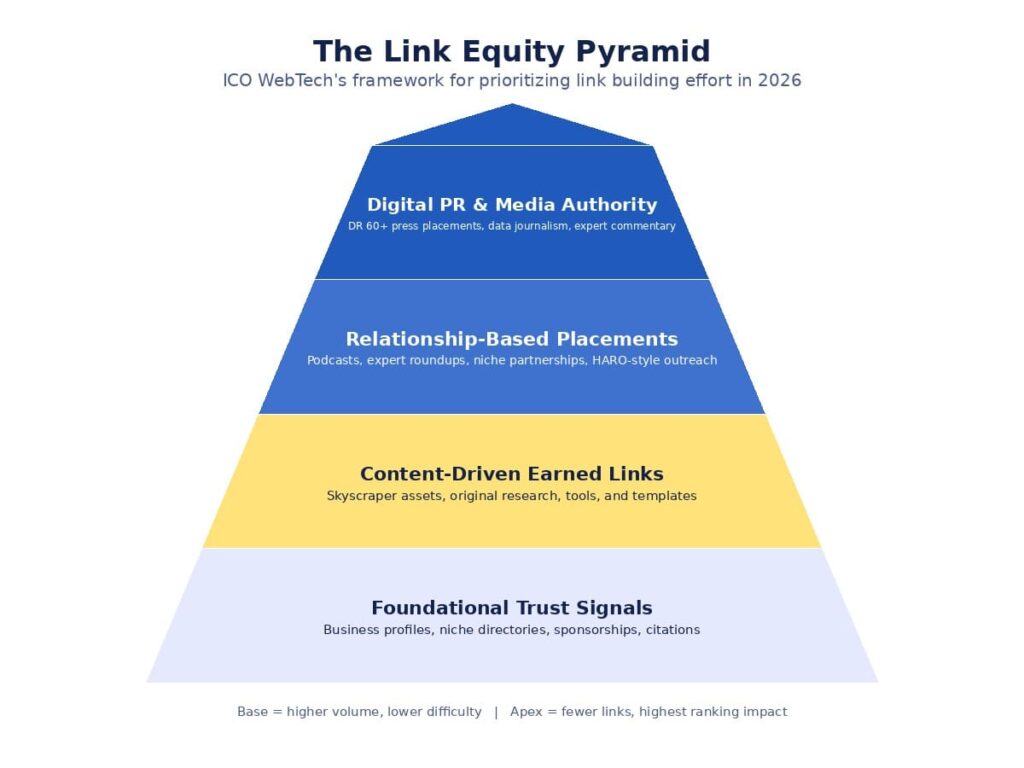
The Link Equity Pyramid: our framework for deciding where to spend your link building hours in 2026.
Tier 1: Foundational Trust Signals (Strategies 1–4)
These links build a baseline of credibility without doing much for your rankings on their own. Think of this tier as table stakes. Skipping it entirely can actually look suspicious to search engines and to real customers checking you out before they buy, but stacking your whole strategy on it will leave you stuck.
1. Niche directory and association listings. Forget generic web directories from 2012. What still works are listings inside your actual industry: trade associations, chamber of commerce sites, professional licensing boards, and vertical-specific directories your buyers already trust. These build entity recognition and consistent NAP (name, address, phone) data, which matters for local and B2B trust even if the SEO lift per link is small.
2. Digital sponsorships. Sponsoring a local sports team, an industry conference, a scholarship, or a community event usually earns you a link on their partners or sponsors page. Do this because it’s genuinely good for your brand and community standing, not purely to farm links, and pick sponsorships that overlap with your actual audience.
3. Supplier, partner, and vendor page links. If you buy software, materials, or services from other companies, ask if you can be featured as a client or case study on their site. B2B companies especially overlook this one, and it’s often just a matter of asking a account manager you already talk to regularly.
4. Customer success story co-marketing. When you publish a case study about a client’s results, many will happily link back to it from their own site, especially if you make it easy by sending them a ready-to-use blurb and the link. It’s a favor exchange, not a pitch, which is why it converts so well.
Tier 2: Content-Driven Earned Links (Strategies 5–9)
This is where link building starts to compound. Instead of asking for a link directly, you build something genuinely useful enough that other sites want to cite it on their own. It takes more upfront work than Tier 1, but each asset keeps earning links for years without you lifting a finger.
5. The skyscraper technique, modernized. The original idea still holds: find a piece of content that’s already earning links, then build something clearly better, and reach out to the sites linking to the original. What’s changed is the bar. “Better” in 2026 usually means original data, sharper visuals, and up-to-date examples, not just a longer word count. Thin, padded “skyscraper” posts get ignored now, because editors have seen a thousand of them.
6. Original research and data studies. This is one of the highest-leverage plays on this entire list. Survey your customers, mine your own product data, or aggregate public datasets into something nobody else has published. Journalists and bloggers need numbers to back up their stories, and if you’re the original source, you become the citation. This tactic sits near the top of our pyramid for a reason.
7. Free tools, calculators, and templates. A useful calculator, checklist, or template earns links passively because people bookmark and reference it, and other writers embed it in their own “best tools” roundups. These are some of the most durable linkable assets because they solve an ongoing problem rather than answering a one-time question.
8. Ultimate guides and resource hubs. A genuinely comprehensive guide on a topic your audience searches for becomes the page other content creators link to instead of writing their own explainer. The keyword is genuine. A guide stitched together from other articles doesn’t earn links; a guide built from real experience and original examples does. Our content marketing team builds these as part of a broader content strategy so they support both SEO and lead generation at the same time.
9. Custom visual assets. Well-designed infographics, comparison charts, and diagrams get embedded and cited far more than plain text, because they save the next writer time. If you’re publishing research or a process breakdown, turn it into something visual before you promote it. It’s a small extra step that noticeably increases pickup rates.
Tier 3: Relationship-Based Placements (Strategies 10–13)
This tier depends less on what you build and more on who you know, or who you’re willing to get to know. It moves slower than content-driven tactics, but the links tend to be higher authority because a real person is vouching for you.
10. Journalist request platforms. HARO shut down its old free model, but platforms like Qwoted, Featured, and Connectively fill the same role: journalists post requests for expert quotes, and you respond with a genuinely useful answer tied to your expertise. Personalization is everything here. AI-assisted outreach is getting a 4.19% response rate compared to 2.6% for generic pitches, a 61% lift, but editorial rejection rates have also climbed 33% as inboxes fill with lower-effort AI pitches (Arvow, 2026). Write like a human who actually read the request, and you’ll stand out.
11. Strategic guest posting. Guest posting isn’t dead, but the version that worked in 2015 is. Mass guest posting on low-quality “write for us” sites is a fast way to get penalized. What still works is contributing genuinely useful, non-duplicated content to publications your actual audience reads, with an editor who reviews submissions rather than a site that publishes anything for a fee. Our content writing team vets every placement against this exact standard before pitching a single word.
12. Podcast guesting and expert roundups. Getting interviewed on a niche podcast, or contributing a quote to an expert roundup post, usually earns a link in the show notes or the article, plus something more valuable long term: a relationship with a host or blogger who might feature you again. These placements also feed directly into the brand-mention signal that AI search tools increasingly reward.
13. Broken link building. Find dead links on resource pages in your niche using a tool like Ahrefs or Screaming Frog, then let the site owner know, and offer your own relevant page as a replacement. It’s a genuine favor, since you’re helping them fix a broken page, which is exactly why it still converts well when done thoughtfully instead of at mass-email scale.
Tier 4: Digital PR and Media Authority (Strategies 14–17)
Welcome to the top of the pyramid. These strategies take the most planning and the longest lead time, but they produce the backlinks that actually shift rankings, the ones from publications with real domain authority. 48.6% of SEO professionals now rate digital PR as the single most effective link-building tactic available, well ahead of guest posting at 16% (Editorial.Link, 2026).
14. Digital PR and newsjacking campaigns. Build a genuinely newsworthy story, a data angle, a survey, a trend analysis, then pitch it directly to journalists covering that beat. When it lands, you get coverage from a publication with real authority, and the backlink comes along naturally as a byproduct of the story, not as the ask itself. This is the strategy with the highest ceiling on this entire list.
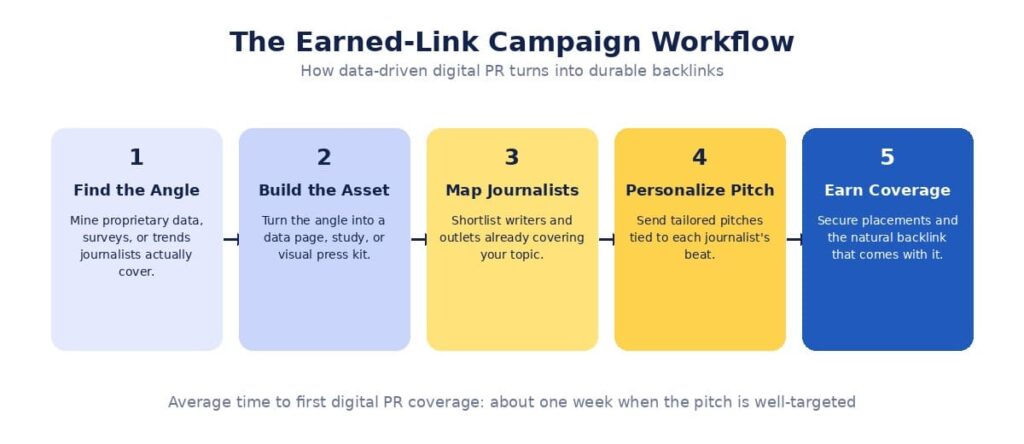
The basic shape of every successful digital PR campaign, from data angle to earned coverage.
15. Commissioned data journalism partnerships. Instead of pitching a finished story, partner directly with a journalist or outlet to co-create one using your data. You provide the raw numbers or access; they provide the platform and the byline. This works especially well for B2B and SaaS companies sitting on proprietary usage data nobody outside the company has seen.
16. Executive thought leadership and bylines. Getting your founder or a senior expert published as a contributing writer on an industry publication builds both a backlink and a personal brand that compounds over time. Editors are far more likely to accept a pitch tied to a named expert with real experience than an anonymous “company blog” submission, which lines up neatly with how Google evaluates E-E-A-T today.
17. Unlinked mention reclamation and competitor gap analysis. Two tactics, one habit: set up alerts for every time your brand is mentioned online without a link, then politely ask for one to be added. Separately, run your top three competitors’ backlink profiles through a tool like Ahrefs or Semrush and find sites linking to them but not to you. Both are quick wins because you’re not creating anything new, you’re recovering value that’s already sitting on the table.
Where To Actually Spend Your Time First
Seventeen strategies is a lot to juggle at once, so here’s how we’d sequence them for a typical business starting from zero. Start with the quick wins that need real effort but pay off fast, like broken link building and journalist request platforms. Layer in the strategic bets, original research, and digital PR as soon as you have the bandwidth, because those compound the longest. Treat directories and mass guest posting as background maintenance, not your main strategy.
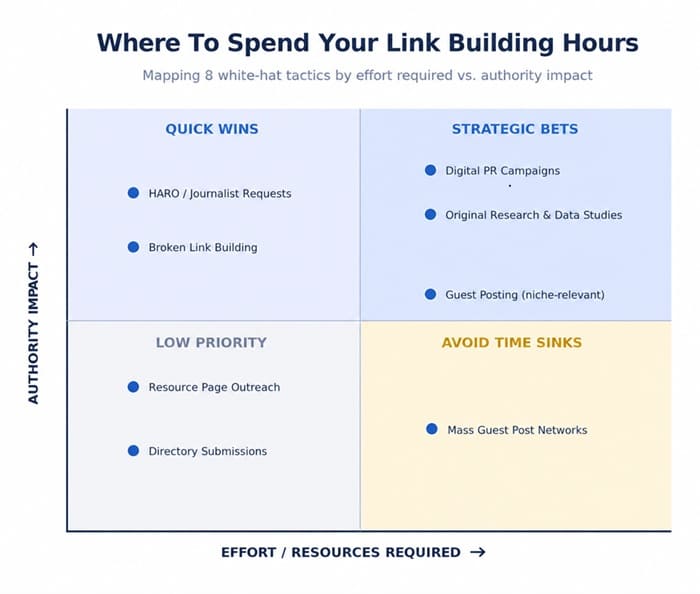
Effort versus impact for eight of the tactics above. Notice how little authority mass guest posting and directory submissions actually buy you.
A useful benchmark while you’re planning: 57.1% of SEOs expect to see measurable results within one to three months of consistent effort (Arvow, 2026), and 81% of digital PR teams land their first piece of coverage within a week of pitching (Arvow, 2026). If you’re three months into a campaign with nothing to show, it’s worth auditing whether you’re actually running Tier 3 and Tier 4 tactics, or quietly stuck in Tier 1.
Get Your Anchor Text Mix Right (Or Risk an Over-Optimization Penalty)
None of the above matters if you sabotage it with sloppy anchor text. Google can spot an unnatural pattern of exact-match anchors from a mile away, and it’s one of the fastest ways to trigger a manual action. The good news is that the healthy mix is well documented by the industry at this point, and it’s easy to follow once you know the target.
Partial-match and branded anchors should make up the bulk of your profile, especially on links you have any control over.
Partial-match anchor text, phrases that include your target keyword naturally within a longer phrase, is the top choice for 41.7% of link builders surveyed, followed by exact-match at 25.1% and branded anchors at 20.5% (Editorial.Link, 2026).
A practical rule of thumb: on links you actually control, like guest posts and digital PR pitches, keep exact-match anchors well under 10%, and lean heavily on branded and partial-match instead. On editorial links you don’t control, like a journalist citing your research, don’t worry about the anchor text at all. That’s exactly the kind of organic variation Google wants to see.
Here’s what that looks like in practice. Say you’re earning links back to a page about link building services. A natural, healthy spread of anchors pointing at that one page might read like this:
- Partial-match: “ICO WebTech’s guide to link building strategy”
- Branded: “ICO WebTech”
- Exact-match: “link building services” (used sparingly)
- Naked URL / generic: “icowebsolutions.com” or “read more here”
Notice that only one of those four leans on the exact keyword. If every single link pointing at that page used “link building services” as the anchor, it would look manufactured, because in the real world, nobody links to the same page with the same three words every time. Mix it up the way people actually write, and the anchor profile takes care of itself.
Mistakes That Quietly Damage Your E-E-A-T
Most link building damage isn’t dramatic. It’s not one obvious black-hat move; it’s a slow accumulation of shortcuts that erode trust with both search engines and readers. A few things worth watching closely:
- Buying links in bulk from marketplaces, even “white label” ones that promise they’re safe. 91.89% of SEOs believe their competitors are buying links, and 89% see spammy outbound links as the single biggest red flag when evaluating a site for placement (Editorial.Link, 2026).
- Guest posting on sites that will publish anything literally for a fee, since these sites tend to get deindexed in waves, taking your links down with them.
- Ignoring link rot. Roughly 1.3% of links die every week, and Ahrefs’ long-term study found that 66.5% of links across 2 million sites had decayed since 2013 (QuickSEO, 2026). If you’re not periodically checking which of your earned links still resolve, you’re likely overestimating your own authority.
- Treating anchor text as a lever to pull hard instead of a natural byproduct of good writing.
If you’re not sure where your current backlink profile stands, or you suspect a past agency left you with a pile of risky links, it’s worth getting an audit before you build anything new on top of it. Our toxic backlink removal service exists specifically for that cleanup work, so your new link-building effort isn’t fighting against your old one.
Frequently Asked Questions
Is link building still worth it in 2026? Yes. Backlinks remain a foundational ranking signal even as Google weighs hundreds of other factors, and controlled studies continue to show that removing links causes measurable traffic drops (Heroic Rankings, 2026; QuickSEO, 2026). What’s changed is which tactics work, not whether the discipline itself matters.
How many backlinks do I actually need? It depends entirely on your competition. Low-competition, long-tail keywords can rank with as few as five to ten backlinks, while competitive commercial terms often require hundreds of referring domains (Searchlab, 2026). Quality and relevance matter more than hitting any specific number.
How long until link building shows results? Most SEOs report seeing measurable movement within one to three months of consistent activity (Arvow, 2026), though digital PR campaigns can land individual placements within a week. Rankings tied to those links typically take longer to stabilize.
Should I still do guest posting? Selectively, yes. The version that still works is contributing genuinely useful content to relevant, editorially reviewed publications, not mass submissions to any site that will take a fee. Guest posting ranks well behind digital PR in effectiveness surveys, but it still has a place in a diversified strategy (Arvow, 2026).
Do backlinks matter for showing up in AI search tools like ChatGPT? They help, but brand mentions matter more. Mentions correlate with AI Overview visibility roughly three times more strongly than backlinks do (Arvow, 2026), which is why digital PR and expert commentary belong in any 2026 strategy, not just traditional outreach.
Turn This Into a Working Link Building System
Reading through 17 strategies is one thing. Actually running them, week after week, while also handling content creation, technical SEO, and everything else on a marketing team’s plate, is another. That’s the gap most in-house teams hit around month two, right when digital PR and original research campaigns need consistent attention to start paying off.
This is exactly what our team handles day to day. At ICO WebTech, we build link acquisition programs around the same Link Equity Pyramid you just read about, prioritizing the tactics that actually move your rankings instead of padding a monthly report with directory submissions. If you want a second set of eyes on your current backlink profile, or you’re ready to build a real digital PR pipeline for your brand, our SEO team is happy to walk through where you stand today and what the fastest path forward looks like.
Get in touch with ICO WebTech to build your 2026 link building strategy →
Sources
Arvow. (2026). Link building statistics 2026: The complete data report. https://arvow.com/blog/link-building-statistics-2026
DemandSage. (2026). 55 link building statistics 2026 [Cost, trends & market size]. https://www.demandsage.com/link-building-statistics/
Editorial.Link. (2026). Link building statistics based on a survey of 518 SEO experts. https://editorial.link/link-building-statistics/
Heroic Rankings. (2026). Link building statistics: How the industry is changing in 2026. https://heroicrankings.com/seo/linkbuilding/link-building-statistics-2026/
QuickSEO. (2026). Link building statistics 2026: 70+ data points (including AI search). https://quickseo.ai/blog/link-building-statistics-2026-70-data-points-including-ai-search
Searchlab. (2026). Link building statistics 2026 | 80+ backlink data & benchmarks. https://searchlab.nl/en/statistics/link-building-statistics-2026

Planning a Website Redesign? How ICO WebTech Prevents a Post-Launch SEO Nightmare
Imagine spending six months, thousands of dollars, and endless late-night meetings collaborating with top-tier designers to overhaul your brand’s digital storefront. The typography is elegant, the user interface is butter-smooth, and the checkout process feels like magic. With immense pride, your team flips the switch and launches the new site. You pop the champagne, celebrate the stunning visual upgrade, and wait for the compliments to roll in.
Then, day three hits. Your customer service team notes a drop in inbound leads. By day seven, your organic traffic analytics show a terrifying, vertical cliff-style dropoff. Keywords that your business spent five years climbing to the top of page one for have vanished entirely. Your hard-earned backlinks are suddenly pointing to digital dead ends, and your organic revenue plummets by 40% in a single week.
This is the post-launch SEO nightmare, and it happens far more often than most brands realize. The paradox of the modern internet is that Google’s search algorithms do not care how “pretty” your website looks if they can no longer find the roads, signs, and foundations that made your site authoritative in the first place.
When brands migrate to a new domain, restructure their content categories, or switch content management systems (CMS) without an airtight search strategy, they are effectively demolishing an old house and building a new one without telling the post office where to deliver the mail. Fortunately, this catastrophe is completely preventable. By leveraging professional website redesigning services backed by strategic technical execution, brands can modernize their online presence while preserving—and even accelerating—their organic search equity. As an experienced SEO company in India, ICO WebTech has perfected the art of the zero-loss migration. Here is an in-depth breakdown of how we protect your brand’s digital legacy during a website overhaul.
The Hidden Friction Between Creative UX and Technical SEO
To understand how to prevent an SEO disaster, it is vital to understand why it happens. Website redesigns are usually driven by creative, marketing, or product teams focused on visual identity, conversion rate optimization (CRO), and modernizing brand aesthetics. While these are critical goals, creative design and technical SEO often pull in opposite directions if not properly coordinated.
- The Minimalist Trap: Designers love clean layouts with minimal text. However, removing long-form copy from key landing pages to achieve a “clean look” frequently strips away the contextual semantic signals and keyword density that allowed those pages to rank on Google.
- Altering the URL Blueprint: Changing a URL from
example.com/services/digital-marketingtoexample.com/our-work/marketingwithout telling search engines causes immediate link breakage. Every external website pointing to your old link now delivers a frustrating 404 error, destroying your link equity overnight. - JavaScript-Heavy Frameworks: Modern websites often rely on complex client-side JavaScript frameworks (like React or Vue) to create dynamic, smooth transitions. If these frameworks are implemented incorrectly, search engine crawlers may see nothing but a blank page, failing to index your primary text.
- Disrupting Content Hierarchy: Replacing structured, keyword-optimized Heading tags (H1, H2, H3) with generic styled CSS classes to make text look a certain size completely blinds search engines to the informational hierarchy of your content.
At ICO WebTech, we bridge this gap. We ensure that your design evolution does not result in search engine devolution, treating SEO not as an afterthought to be sprinkled on post-launch, but as the very scaffolding upon which the new design is built.
Phase 1: Pre-Launch Prep and the Sacred Legacy Crawl
The secret to a flawless website launch lies entirely in the preparation. Before a single line of code is rewritten for the new site, ICO WebTech establishes a rigorous baseline data map of the existing website. Think of this as taking an exact structural inventory of a museum before moving its artifacts to a new gallery.
1. Mapping the Complete URL Inventory
We don’t just export a basic sitemap; we execute a comprehensive deep crawl of the live website using advanced data extraction tools. This captures every single URL that has ever been indexed, including hidden landing pages, old blog posts, and auxiliary resource files. We cross-reference this crawl with Google Search Console and Google Analytics data from the past 24 months to identify the “heroes”—the exact pages driving your organic impressions, clicks, and conversions.
2. Extracting the Backlink Database
Your domain authority is largely dictated by your backlink profile—the ecosystem of external websites linking to your content. We run extensive link audits via tools like Ahrefs and Majestic to catalog every high-authority backlink your site possesses. If a page has 50 premium editorial backlinks pointing to it, that page is flagged as a high-value asset that must either maintain its exact URL structure or be flawlessly redirected to preserve its incoming authority.
3. Benchmarking Current Rankings
We document your current keyword rankings across different geographic regions and device types. By knowing exactly where you stand for your primary head terms and long-tail variants, we establish a crystal-clear benchmark. If a specific keyword starts fluctuating post-launch, we immediately pinpoint the exact page responsible and deploy targeted adjustments.
Phase 2: The Core of Migration Strategy—Structured 301 Redirect Mapping
If there is one technical failure that destroys rankings faster than any other during a website redesign, it is faulty or missing redirect management. A 301 redirect is a permanent directive that tells search engine crawlers and human visitors: “This page has permanently moved to a new home. Please pass all our historical trust, authority, and ranking weight to the new URL.”
Many amateur teams make the catastrophic mistake of redirecting all old URLs to the new homepage out of sheer laziness. To Google, routing hundreds of distinct, topic-specific legacy pages to a single generic homepage is a major red flag, often treated as a “Soft 404.” This completely wipes out the individual ranking signals of those specific pages.
ICO WebTech avoids this via a highly structured, row-by-row 301 Redirect Mapping Matrix. Here is an illustrative look at how we systematically manage your link architecture during a redesign:
| Legacy URL (Old Site) | New Target URL (Redesign) | SEO Priority Status | Action & Rationale |
|---|---|---|---|
/about-us.html |
/about/ |
Medium | Standardize URL structure; remove outdated .html extension. |
/services/bulk-sms-marketing |
/services/sms-solutions/ |
CRITICAL | High-revenue landing page. Exact content and metadata migrated to prevent drop. |
/blog/article-v1-2021 |
/blog/modern-sms-strategies/ |
High | Maintains 45 external backlinks. Redirect preserves link equity completely. |
/category/old-products-2019 |
/shop/ |
Low | Discontinued line. Redirected to main shop category to capture traffic. |
By mapping out every single legacy path to its most relevant, contextually identical counterpart on the new site, we ensure that search engine bots experience a seamless transition without hitting a single broken link or encountering confusing semantic dead-ends.
Phase 3: Ironclad Protection on the Staging Environment
While developers build and refine your gorgeous new website, they work on what is known as a staging or development server. This environment is an exact working clone of what your new site will look like. However, if this sandbox environment is left exposed, it can trigger severe search engine issues before your site even launches.
If Google’s automated web crawlers discover your staging site (which frequently happens if a developer accidentally links to it or leaves it unprotected), Google will begin indexing your unpolished, incomplete development pages. This leads to severe internal keyword cannibalization and duplicate content penalties, as search engines find two distinct versions of your brand’s website competing against each other.
ICO WebTech prevents this early exposure through strict access protocols. We isolate the development environment behind robust HTTP basic authentication passwords, strict server-side IP address whitelisting, and specialized robots.txt directives that command search engine crawlers to stay away. This keeps your redesign completely under wraps until it is technically flawless and ready for public deployment.
Phase 4: Content Preservation and On-Page Equity Integrity
A website redesign often prompts brands to rewrite their corporate copy, refresh their messaging, or update their product descriptions. While evolving your brand voice is fantastic, blindly replacing historical content can inadvertently destroy the semantic phrases and keyword patterns that Google relies on to understand your topical authority.
If a specific service page currently ranks #1 for a competitive search query, it ranks there because the exact combination of body copy, heading hierarchies, alt text, and semantic context satisfies Google’s intent metrics. If your copywriter replaces that detailed, keyword-rich paragraph with a brief, punchy three-word marketing slogan, your rankings will collapse.
Our optimization experts audit every line of code on the new layout to guarantee that high-performing copy is structurally integrated into the new design. We ensure that:
- Title Tags and Meta Descriptions: High-performing meta tags are carefully preserved or strategically optimized rather than wiped clean.
- Heading Architectures: The primary H1 remains focused on the core topic, followed by structured H2s and H3s that maintain absolute clarity for search crawlers.
- Internal Link Ecosystems: The deep internal links within your blog posts and core pages—which distribute domain authority down to your deepest product pages—are systematically re-established on the new site layout.
The Mechanics of Launch Day: Executing a Flawless Switch
When the day arrives to go live, flipping the switch requires precise, military-style execution. A chaotic launch day can result in prolonged site downtime, during which search engines might drop your site from temporary indexes due to server unresponsiveness.
ICO WebTech executes website launches during off-peak traffic hours to ensure absolute safety and minimal consumer disruption. We carefully coordinate DNS propagation, monitor server responses, and immediately verify that the live environment is completely accessible to search crawlers by stripping away the staging site blocks.
The moment the domain goes live, we instantly generate and upload clean, optimized XML sitemaps directly to Google Search Console and Bing Webmaster Tools. This explicitly tells search engine crawlers: “The transition is complete. Here is the exact blueprint of our new architecture. Please come crawl and index our updated pages immediately.”
Phase 5: The Post-Launch Technical SEO Audit—Our Digital Safety Net
Even with meticulous planning, the first 48 hours following a live launch are critical. The web is a dynamic environment, and post-launch technical audits act as the ultimate safety net to ensure everything functions perfectly under real-world conditions.
The moment the site is live, the technical engineering team at ICO WebTech launches a rigorous, multi-point post-launch audit, focusing intensely on several key operational pillars:
1. Rapid Crawl Error and 404 Detection
We execute an immediate post-launch crawl of the live environment to catch any accidental broken links, misconfigured internal paths, or unmapped assets before Google’s standard automated bots encounter them. If any stray 404 errors appear, they are corrected and patched in real-time.
2. Verification of Canonical Tags
Canonical tags act as a website’s internal compass, telling search engines which exact version of a page is the definitive master copy. We audit the new CMS architecture to guarantee that canonicalization rules are dynamic and correctly configured, preventing massive duplicate content issues often caused by automated tracking parameters or alternative URL tracking paths.
3. Core Web Vitals and Page Speed Optimization
Google places immense ranking weight on user experience through its Core Web Vitals metrics. A gorgeous new website that takes five seconds to load on a mobile device due to unoptimized, uncompressed images or bloated design scripts will rapidly lose organic visibility. We optimize server configurations, leverage browser caching, compress image weights, and clean up asset code to ensure your new site loads blazing fast across all global devices.
Real-World Proof: How We Saved an E-Commerce Brand From the Brink
To see these technical principles in action, look no further than a recent website migration managed by ICO WebTech for a prominent mid-sized e-commerce retailer. Operating in a highly competitive consumer goods vertical, the client possessed over 15,000 active product SKUs and relied on organic search for more than 65% of their total monthly corporate revenue. Their legacy website looked outdated, performed poorly on mobile devices, and suffered from a rigid, counter-intuitive checkout funnel that hurt conversions.
The brand desperately needed comprehensive website redesigning services, but leadership was deeply terrified. Their internal teams knew that losing their keyword footprint for even a single week would derail their annual revenue goals and cause massive inventory bottlenecks.
They brought in ICO WebTech to manage the entire migration. Our technical teams collaborated directly with their creative agency from day one. We constructed a meticulous migration matrix mapping all 15,000 legacy product URLs, category structures, and filter parameters into a streamlined, high-performance architecture. We cleaned up years of legacy redirect loops and preserved the internal link equity of their top-performing transactional blog articles.
The results were flawless. During launch week, the brand experienced zero loss in keyword rankings and zero drop in organic revenue. In fact, because the new design was incredibly fast and optimized for mobile devices, their keyword footprints expanded. Within 30 days post-launch, their overall conversion rate spiked by 22%, and organic search revenue grew by 14% year-over-year—completely defying the industry myth that website redesigns must always suffer a temporary loss in organic traffic.
Why Partnering with a Specialized SEO Company in India Matters
A website redesign should always be an exciting catalyst for business acceleration, never a stressful gamble with your digital survival. Managing the intricate nuances of server configurations, complex database migrations, database structure changes, and metadata preservation requires deep technical expertise that general creative design agencies rarely possess internally.
By partnering with an established SEO company in India like ICO WebTech, you secure a dedicated team of technical web engineers, structural architects, and search optimization specialists who treat your organic search traffic as a high-value corporate asset. We establish absolute alignment between visual beauty and technical excellence, ensuring your modern website ranks beautifully, loads instantly, and converts visitors into loyal customers.
Do not leave your hard-earned search rankings to chance during your upcoming digital evolution. Contact ICO WebTech today to discover how our comprehensive website migration and technical search strategies can turn your next website redesign into a powerful, risk-free growth engine for your brand.
Invisible to Local Customers? How ICO WebTech Puts Your Business on the Map
Imagine this scenario: It is a crisp Tuesday morning. You have spent months, perhaps years, perfecting your business. Your storefront is immaculate, your inventory is premium, your staff is trained to offer world-class hospitality, and your services are unmatched in quality. You open the doors, turn on the lights, and wait. But the bell above the door remains silent. The foot traffic you expected is non-existent.
Frustrated, you take a walk down the street to clear your head. As you pass your direct competitor’s establishment just three blocks away, you notice something infuriating. Their waiting area is packed. Customers are lining up out the door. You know, with absolute certainty, that your product is superior and your prices are fairer. So, what is happening here? Why is the marketplace treating you like a ghost?
The answer isn’t found on the physical streets; it is found on the digital ones. While you were focusing on your physical storefront, your competitor was busy dominating the digital landscape. Right now, a customer less than a kilometer away is pulling out their smartphone and typing a simple phrase into Google: “best services near me” or “local retail store open now.” Within milliseconds, Google displays the coveted “Map Pack”—the top three local business listings tied to a map illustration. Your competitor is sitting comfortably at position number one. Your business, however, is buried on page three of the search results, completely invisible to the local ecosystem.
This is the harsh reality of modern commerce. If you do not appear in local search results and Google’s Map Pack, your business practically does not exist to high-intent local buyers. That is where partnering with a dedicated, ground-level SEO company in Delhi like ICO WebTech changes everything. We specialize in taking brilliant local businesses out of the shadows and planting them firmly where consumers are actively looking to spend money.
The Anatomy of Local Invisibility: Why Great Businesses Lose the Search Game
For a long time, traditional business advice dictated that location was everything. If you had a shop on a busy corner, you would succeed. While physical visibility still holds merit, digital proximity has superseded it. Modern consumer behavior has evolved into a “just-in-time” search methodology. We no longer wander around looking for signs; we let our mobile devices act as our digital concierges.
When someone searches for a local service, they are not casual window shoppers. They are high-intent consumers. A person searching for an emergency plumber, a dental clinic, a boutique garment hub, or a specialized printing press usually intends to make a phone call or visit a location within 24 hours. If your digital infrastructure is broken, you are effectively turning these ready-to-buy customers away and handing them directly to your competitors.
Standard SEO practices focus on global or national keyword rankings, which is fantastic for e-commerce giants or software companies. However, for a local storefront or regional service provider, a broad digital strategy is a waste of resources. You don’t need traffic from across the globe; you need traffic from your neighborhood, your district, and your city. Local optimization isn’t a passive setup; it’s a living, breathing digital storefront that requires the analytical precision of an experienced SEO company in Delhi to navigate the complex algorithmic rules that dictate local visibility.
The Core Pillars of Local SEO: How ICO WebTech Reclaims Your Turf
To move a business from the outer fringes of the internet to the absolute center of local search results, a multi-layered framework is required. At ICO WebTech, we do not believe in superficial fixes or vanity metrics. We deploy a comprehensive, four-part Local SEO strategy built to convince Google’s algorithm that your business is the most relevant, reliable, and authoritative choice in your area.
1. Master the Matrix: Google Business Profile (GBP) Optimization
Your Google Business Profile (formerly Google My Business) is the absolute foundation of your local digital presence. It is not merely a directory listing; it is an interactive asset that bridges the gap between search engines and physical foot traffic. Sadly, the vast majority of local business owners simply claim their profile, fill out the basic contact fields, and leave it to gather digital dust.
An optimized profile is highly dynamic. ICO WebTech goes deep beneath the surface to calibrate every aspect of your GBP:
- Category Harmonization: Google relies heavily on business categories to match intent. Selecting the wrong primary or secondary category can completely misalign your business with consumer searches. We run competitive analyses to identify the exact category mix that drives conversions.
- Hyper-Localized Micro-Copy: Your business description should not be a copy-paste of your website’s corporate pitch. It must incorporate neighborhood markers, specific regional service offerings, and local landmarks that signal geographic relevance to Google’s crawlers.
- Visual Geotagging and Media Audits: High-resolution photographs of your storefront, team, and products do more than just build customer trust; they send contextual metadata to search engines. We implement regular, optimized image updates that keep your listing fresh and highly favored by algorithms.
- Product and Service Attributes: We break down your offerings into interactive, scannable menus directly within your Google profile, enabling users to view pricing, specifications, and availability without ever leaving the search results page.
2. The NAP Consistency Matrix: Localized Citation Building
Imagine if your physical address was listed as “Street Number 4” on one street sign, “St. #4” on another, and your old phone number was still painted on a wall around the corner. Customers would get confused, and more importantly, the city planners would be frustrated. This is exactly what happens online when your Name, Address, and Phone number (NAP) data is inconsistent across the web.
Search engines crawl hundreds of local directories, business listings, and social platforms every single day. If Google finds your business listed as “The Spice Hub LLC” on Yelp, “Spice Hub Cafe” on TripAdvisor, and “Spice Hub” on your own website, it begins to doubt the validity of your data. When a search engine is confused, it hides your listing to protect its users from a poor experience.
ICO WebTech cleans up this digital clutter through systematic citation building and data normalization. We perform a comprehensive audit of every mention of your brand online. We erase duplicate listings, correct outdated phone numbers, and standardize your address across authoritative local directories, regional mapping applications, and niche-specific business portals. This creates an undeniable web of data consistency that proves your business is legitimate, established, and ready to be recommended.
3. The Reputation Engine: Authenticity-Driven Review Management
Let’s speak plainly about human nature: people trust people more than they trust advertisements. A stunning website design can say you are the best at what you do, but a stream of real, detailed feedback from your actual customers is what seals the deal. Reviews are the single most powerful form of modern social proof, and they double as a massive ranking factor for Google’s local algorithm.
However, getting consistent reviews is difficult. Customers who have a seamless experience often walk away happy but forget to say anything online, while the rare customer who encounters a minor inconvenience will scramble to leave a one-star review out of frustration. To win the local map game, you must actively steer your reputation engine.
ICO WebTech implements automated, frictionless review generation strategies. We help your business integrate smart SMS and email review triggers, custom QR codes for physical checkout counters, and automated follow-ups that gently encourage your best clients to tell their stories online. Furthermore, we train your team on how to respond to reviews natively. Replying to a five-star review with targeted keywords boosts your SEO, while responding to a negative review with poise, empathy, and a clear path to resolution signals to prospective customers—and Google—that you operate with absolute integrity.
4. Hyper-Local On-Page SEO Architecture
Your website needs to speak the language of your physical geography. If you serve multiple neighborhoods, sub-cities, or regions, a single generic contact page will not suffice. You need dedicated, beautifully structured local landing pages that cater specifically to the communities you operate within.
We restructure your website’s content architecture to integrate hyper-local signals. This includes creating localized service pages embedded with maps, regional case studies, neighborhood-specific service portfolios, and schema markup code. Schema markup acts as a direct translator for search engines, explicitly stating your exact coordinates, operating hours, and service radiuses in a structured data format that search bots can instantly catalog.
Real Transformation: The 90-Day Metamorphosis of a Local Brand
To truly understand the power of targeted local optimization, let us look at a real-world case study executed by our team. A premium, family-owned home decor and bespoke interior styling studio based in an upscale district was struggling to survive. They had invested heavily in inventory and a magnificent physical showroom, but their walk-in traffic was dwindling. Larger corporate franchises with massive corporate advertising budgets were vacuuming up all the local digital interest.
When the owners reached out to ICO WebTech, they were skeptical. They had tried running generic Facebook ads with minimal returns and had worked with standard digital agencies that promised global keyword rankings that yielded absolutely zero local phone calls or storefront visits. When analyzing why this transformation worked so quickly, it became apparent that working alongside an agile SEO company in Delhi helped the brand adapt to local algorithmic updates faster than their corporate competitors.
Our team stepped in and diagnosed the underlying issue: they were completely invisible on the map. Their Google profile was unverified, their business address format varied across four different directories, and they had exactly seven Google reviews accumulated over three years.
We immediately put our localized framework into motion:
- We claimed, verified, and completely overhauled their Google Business Profile, injecting high-definition visual tours of their showroom and categorizing their bespoke design services accurately.
- We deployed a rapid-response citation campaign, fixing 43 broken NAP instances and listing them on 60 highly authoritative regional business hubs.
- We integrated a post-consultation review system that prompted happy homeowners to share photos of their completed spaces directly onto the studio’s Google profile.
- We crafted hyper-local landing pages targeted at specific affluent neighborhoods within a 15-kilometer radius of their showroom.
The Dynamic Growth Shift
The results were nothing short of breathtaking. Within 90 days of continuous optimization, the studio’s analytics panel told an entirely new story. They achieved a staggering 140% increase in “directions requested” via Google Maps and an equally impressive surge in direct phone inquiries.
People were no longer stumbling upon their store by accident; they were actively using their smartphones to navigate directly to their front door. The studio went from being an unrecognized gem to the definitive choice for home decor in their region, proving that strategic localized visibility can comfortably level the playing field against competitors with far larger budgets.
A Strategic Roadmap for Local Business Dominance
For business owners who want to begin auditing their own digital presence today, here is a practical checklist to identify where you might be losing valuable leads:
| Local SEO Checkpoint | The Risk of Neglect | The Ideal Optimization Goal |
|---|---|---|
| Google Business Profile Verification | Unclaimed profiles can be modified or even hijacked by competitors or malicious user edits. | A fully verified, owned profile with complete operating hours, attributes, and services. |
| NAP Consistency Audit | Mismatched addresses and phone numbers confuse search bots and degrade your map trust scores. | Identical business name, phone number, and physical address across every directory on the web. |
| Review Acquisition Strategy | An empty review section or unanswered negative remarks drives prospective customers away instantly. | A steady, automated influx of authentic weekly reviews paired with professional, keyword-rich brand responses. |
| Mobile and Speed Optimization | Slow-loading websites cause users on mobile devices to bounce back to search results within seconds. | A lightning-fast, ultra-responsive website designed explicitly for mobile users who need instant data. |
Reclaim Your Neighborhood: Partner with ICO WebTech Today
The digital marketplace is highly competitive, but it is also remarkably democratic. The Google Map Pack does not care how large your physical corporation is or how massive your billboard advertising budget might be. It cares about relevance, proximity, clarity, and trust. When you give the algorithm exactly what it needs to see, it rewards you with unparalleled visibility that converts directly into cold, hard revenue.
Stop letting nearby competitors walk away with high-intent clients who should be yours. Stop allowing your immaculate storefront or premium service offerings to remain an undiscovered secret. Local growth requires a dedicated roadmap designed by digital specialists who understand your terrain, your audience, and the technical mechanics behind local search behavior.
If you are ready to turn your digital invisibility into an absolute local monopoly, it’s time to leverage the capabilities of a leading SEO company in Delhi like ICO WebTech. Let us do the heavy algorithmic lifting while you focus on what you do best: running an exceptional business and welcoming the massive wave of new customers walking through your doors.
Contact the expert team at ICO WebTech today for a deep-dive, no-obligation local search audit of your business. Let’s work together to put your brand exactly where it belongs—firmly on the map.

The Death of Template Websites: Why Brands Need Digital Identity
Table of Contents
- 1. Introduction: The Death of Digital Sameness
- 2. The Micro-Psychology of the First 3 Seconds
- 3. The Template Trap: Hidden Costs of Convenience
- 4. The Five Pillars of a Humanized Digital Presence
- 5. The Rise of Emotional Branding & Narrative Flow
- 6. The AI Era: Why Originality is the Only Remaining Moat
- 7. Performance as Brand Identity: Speed & Trust
- 8. Regional Perspective: The Boom in New Delhi’s Digital Landscape
- 9. The Strategic Roadmap: Transitioning to Custom Identity
- 10. Conclusion: From Placeholder to Personality
1. The Death of Digital Sameness
There was a time when simply having a website was enough to put you ahead of the curve. In the early 2000s, businesses rushed online, choosing ready-made templates because they were fast, affordable, and convenient. For a while, they worked. A clean homepage, a few service pages, and a contact form made a company feel modern. But the internet has fundamentally shifted. Today, we are living through the “Great Saturation.”
Modern consumers move through digital spaces faster than ever. They have developed a “generic-radar” that allows them to recognize recycled branding within seconds. When every business in a specific industry uses the same handful of templates, the internet begins to look strangely identical. This sameness isn’t just a design preference; it’s a business liability. If you look exactly like your competitor, you are forcing your customer to choose based solely on price. Identity is the only thing that allows you to compete on value.
2. The Micro-Psychology of the First 3 Seconds
The “3-second rule” is not just a marketing cliché; it is a biological reality rooted in evolutionary survival. Human beings are, at their core, biological machines designed to filter out the mundane to conserve mental energy. Thousands of years ago, this was a life-saving mechanism—an instinctive ability to distinguish a predator hidden in the brush from a harmless shadow. In the modern era, that same prehistoric instinct is directed at the screen. We use it to filter out “digital noise” and determine which websites are worth our most precious resource: attention.
When a visitor lands on your site, they do not start by reading your mission statement or evaluating your service list. Their brain performs an instantaneous, sub-conscious audit of the environment. Before they have processed a single sentence of your copy, they are interpreting the “vibes” through a series of rapid-fire psychological filters. This is the moment where your digital identity either builds a bridge or a wall.
The Filter of Cognitive Ease
The first question the brain asks is: “Does this feel intuitive, or do I have to ‘work’ to understand it?” This is known as Cognitive Ease. When a website utilizes a custom, thoughtful layout, it reduces the mental friction required to process information. Templates often suffer from “visual clutter”—too many competing elements designed to appeal to everyone at once. This creates “Cognitive Strain,” which triggers an instinctive desire to leave. A humanized digital identity uses clear visual hierarchies to guide the eye effortlessly, making the user feel smart and in control.
The Filter of Visual Credibility
In the physical world, we judge a business by its storefront, its lighting, and the quality of its signage. In the digital world, design is the only proxy we have for competence. The brain asks: “Does this look like a billion-dollar company or a basement operation?” This sub-conscious audit looks for consistency in spacing, the sophistication of the color palette, and the sharpness of the assets. Because templates are accessible to everyone, they often lack the “high-fidelity” finish that signals premium authority. A custom-built identity signals that you have invested in your own brand, which leads the customer to believe you will invest equally in their success.
The Filter of Authenticity
We are living in an era of deep-fakes and automated “bots,” which has made the human brain hyper-sensitive to anything that feels “canned.” When a user sees a stock photo of a group of models in a boardroom, their “authenticity alarm” goes off. They subconsciously ask: “Are these real people, or is this a façade?” Templates struggle here because their structures are built around these average, generic assets. A custom identity, however, is built to resonate with a specific psychological profile. It uses real imagery, unique voices, and specific cultural markers—especially relevant for a brand-building website designing company in Delhi—to prove that there is a real human heart behind the machine.
Why the “Average” Fails
Templates are designed for the “average” user, which means they are designed for no one in particular. They are built to be inoffensive and broadly applicable. However, high-impact branding requires the opposite: specificity. By tailoring every pixel to resonate with a specific audience’s fears, desires, and aesthetic preferences, you bypass the “mundane filter.” You stop being just another tab in their browser and start being a solution they actually trust.
3. The Template Trap: Hidden Costs of Convenience
While templates are cheap upfront, they often carry “Brand Debt” and “Technical Debt” that cripple a business as it grows. Most business owners see the $50 price tag of a theme and think they are saving money. They don’t see the thousands of dollars lost in bounced leads and poor SEO.
| Factor | The Template Experience | The Identity-Driven Experience |
|---|---|---|
| Load Speed | Bloated with unused code. | Lean, optimized, and lightning-fast. |
| User Trust | Generic, “I’ve seen this before” feel. | Bespoke, high-authority, and memorable. |
| Scalability | Rigid; breaks when you add custom tools. | Built to grow with your business needs. |
4. The Five Pillars of a Humanized Digital Presence
To move beyond the limitations of a template, a business must pivot its focus toward elements that require human intuition, cultural context, and strategic empathy. While AI and pre-built themes can generate a layout, they cannot authentically replicate the “soul” of a brand. This soul is constructed through five core pillars that transform a static website into a living digital presence.
Pillar 1: Typography as Voice
In the absence of audio, typography is the only way a website can “speak.” Your choice of font is not merely an aesthetic preference; it is your brand’s tone of voice. A template often relies on “safe,” overused web fonts like Open Sans or Roboto, which communicate a generic, utilitarian tone. A humanized digital presence uses typography to establish immediate character.
- Serif Fonts: These convey a sense of heritage, authority, and timelessness. They whisper of tradition and high-end craftsmanship.
- Sans-Serif Fonts: These suggest modernism, efficiency, and approachable technology. They are clean, direct, and forward-thinking.
- Display and Custom Fonts: Using a bespoke or rare typeface acts as a visual “accent,” giving the brand a unique personality that is instantly recognizable and difficult to copy.
Pillar 2: The Luxury of Space
Clutter is often a sign of digital desperation. Many businesses feel the need to fill every pixel with information, fearing that a user might miss a feature. However, custom design understands the “Luxury of Space.” White space (or negative space) is not empty space; it is a powerful design tool that signals confidence, clarity, and premium positioning.
By allowing elements to breathe, you reduce the cognitive load on the visitor. This creates a sense of calm and allows the most important messages to stand out. In a world of digital noise, the brand that isn’t shouting is often the one that gets heard.
Pillar 3: Micro-Interactions – The Digital Handshake
A website should never feel like a static painting; it should feel like a responsive entity. Micro-interactions are the small animations or visual cues that occur when a user interacts with the site—a button that subtly glows when hovered over, a progress bar that glides smoothly, or a menu that reveals itself with elegance. These are the digital equivalents of a “firm handshake” or a “warm smile.” They provide immediate feedback to the user, confirming that the machine is listening to them, which humanizes the entire experience and builds subconscious trust.
Pillar 4: Authentic Imagery vs. Stock Clichés
We are currently witnessing the death of the “Stock Photo Era.” Modern users have a high level of visual literacy; they can spot a staged photo of “smiling office workers” from a mile away. These images create a “trust deficit” because they feel manufactured. A humanized presence moves toward authentic visual storytelling. This includes:
- Real Photography: Showing your actual team, your real office, and the genuine “behind-the-scenes” messiness of a working business.
- Custom Illustrations: Using art styles that are unique to your brand to explain complex concepts, adding a layer of creativity that AI cannot easily mimic.
- Environmental Context: Showing the product or service being used in the real world, rather than against a sterile white background.
Pillar 5: Behavioral UX (User Experience)
Standard UX is about “usability”—can the user find the button? Behavioral UX is about “empathy”—how does the user feel when they find the button? This pillar involves designing the flow of the site based on the specific psychological state of your target customer.
For example, a user looking for emergency plumbing services in New Delhi is in a state of high stress and needs immediate, bold, and clear information. A user looking for a luxury interior designer is in a state of aspiration and needs a slow, immersive, and visually rich experience. A custom digital identity tailors the “vibe” and the “speed” of the site to match these specific human emotions, ensuring the brand feels like a perfect partner rather than a generic service provider.
“In the digital world, your website is your silent salesperson. If they look like everyone else, why should anyone listen?”
5. The Rise of Emotional Branding & Narrative Flow
Modern marketing has undergone a fundamental shift from a battle of technical specifications to a battle of psychological resonance. In a digital landscape where information is a commodity and features are easily replicated, consumers rarely make purchasing decisions based on logic alone. Neurological research consistently demonstrates that the human brain processes sensory and emotional data significantly faster than rational, analytical data. Consequently, most brand choices are emotional first and rational second.
People do not merely choose products; they choose identities. They gravitate toward brands that offer a specific emotional payoff—be it the security of trust, the adrenaline of excitement, the serenity of comfort, or the social validation of status. Identity-driven brands understand that web design is not a decorative layer added at the end of a project; it is the most powerful form of non-verbal communication a business possesses.
The Psychology of “The Vibe”
In the absence of physical interaction, a website must work twice as hard to establish human connection. When a user lands on a site that feels “generic,” their brain subconsciously flags the business as a commodity. This leads to “price-sensitivity,” where the customer only cares about who is the cheapest. However, when a website utilizes emotional branding—through intentional color palettes, human-centric imagery, and tonal consistency—it creates an “aura” of authority. This emotional anchoring allows a brand to command higher prices because the consumer perceives a higher level of intrinsic value and safety.
A Website as a Narrative Journey
The primary difference between a template and a custom digital identity lies in the structure of information. A template is essentially a collection of disconnected pages—a digital filing cabinet where the user is expected to do the heavy lifting of finding value. In contrast, a custom identity is built as a narrative journey. It treats the visitor as the hero of a story and the brand as the expert guide.
This narrative flow typically follows a strategic psychological sequence:
- The Empathetic Opening: Instead of leading with “What we do,” the narrative begins with “What you are feeling.” By acknowledging the user’s specific pain points or aspirations immediately, the brand creates an instant bond of empathy.
- The Conflict and Resolution: The flow guides the user through the challenges they face and introduces the brand’s unique methodology as the only logical solution. This isn’t just presenting data; it is building a case for trust.
- The Vision of Transformation: Through custom visuals and strategic copy, the site paints a vivid picture of the user’s future success. It answers the subconscious question: “How will my life look once I have engaged with this brand?”
- The Guided Conclusion: Rather than a jarring “Buy Now” button, the narrative concludes with a natural call to action that feels like the inevitable next step in a blossoming relationship.
Retention through Storytelling
This narrative flow is the primary reason why users remain engaged with custom-built sites for significantly longer durations. When the human brain encounters a well-structured story, it releases oxytocin, a chemical that promotes bonding and memory retention. This is how you move a user from a “5-second bounce” to a “5-minute deep dive.”
In a hyper-saturated market, especially for a competitive website designing company in Delhi, the ability to tell a story through pixels is the ultimate competitive moat. If you can make a user feel understood, you have already won the battle for their attention. Narrative flow ensures that your website is not just a place people visit, but an experience they remember long after they have closed the tab.
6. The AI Era: Why Originality is the Only Remaining Moat
Artificial intelligence is transforming the digital world at an unbelievable speed.
Today, businesses can generate website layouts, write marketing copy, create logos, produce visuals, and even launch complete websites within minutes. Tasks that once required teams of designers, writers, and developers can now be partially automated with a few prompts and clicks.
On the surface, this feels revolutionary. And in many ways, it truly is.
AI is making technology more accessible, reducing production time, and helping businesses move faster than ever before. Small companies now have tools that were once available only to large organizations with massive budgets. But hidden inside this convenience is a growing problem that many brands are only beginning to notice.
The internet is slowly becoming emotionally repetitive.
As AI-generated websites become more common, digital experiences are starting to blend together. Businesses are using similar prompts, similar structures, similar messaging patterns, and similar design logic. The result is an online environment filled with brands that look polished on the surface but feel strangely interchangeable underneath.
This is the rise of what many marketers now call “digital sameness.”
And consumers can feel it immediately.
People may not always recognize AI-generated branding consciously, but emotionally they notice when something lacks depth. They notice when a website feels too generic, too safe, or too emotionally empty. They sense when messaging sounds technically correct but not genuinely human.
That emotional gap matters more than most businesses realize.
Because while AI can generate structure, it cannot naturally create lived experience, emotional nuance, cultural understanding, or authentic human perspective. It can imitate tone, but it cannot truly understand emotion the way humans do.
This is where originality becomes incredibly valuable. In the AI era, originality is no longer just a creative advantage. It becomes a survival advantage.
When everyone has access to the same automation tools, speed stops being the differentiator. Volume stops being impressive. Even visual quality becomes easier to replicate.
What remains difficult to copy is emotional identity.
The brands that will dominate the future are not necessarily the ones producing the most content or launching websites the fastest. They will be the brands that feel the most real.
They will be the ones that understand people deeply. The ones that communicate with empathy instead of algorithms alone. The ones that create emotional resonance instead of simply generating digital assets.
This is why Strategic Empathy is becoming one of the most important concepts in modern branding. Strategic Empathy is the ability to deeply understand how audiences think, feel, fear, desire, and emotionally respond online. It is what allows brands to create experiences that feel personal rather than automated.
AI cannot genuinely replace that.
It can assist creativity, accelerate workflows, and improve efficiency. But emotional intelligence, cultural sensitivity, storytelling depth, and authentic brand personality still require human insight. And consumers are actively searching for those human signals now more than ever.
People are exhausted by overproduced digital noise. They are overwhelmed by robotic messaging, repetitive marketing, and brands that sound identical. In response, audiences are naturally gravitating toward companies that feel honest, distinctive, and emotionally grounded.
Ironically, the more artificial the internet becomes, the more valuable humanity becomes. This shift is already changing how modern businesses approach branding and web design. Companies are beginning to realize that their websites cannot simply look functional anymore. They must communicate personality, values, perspective, and emotional authenticity.
Because in a world where AI can generate almost anything, the hardest thing to replicate is genuine human identity.
That identity becomes the moat.
Not the template.
Not the automation.
Not even the technology itself.
The future belongs to brands that combine technological efficiency with emotional originality. Brands that use AI as a tool, but never allow automation to erase their humanity. Ultimately, people do not build long-term loyalty with websites alone. They build loyalty with brands that make them feel understood. And no algorithm can fully automate that connection.
7. Performance as Brand Identity: Speed & Trust
Most businesses still think website speed is just a technical issue. Something for developers to worry about. A score to improve later. A backend detail that users supposedly never notice. But the reality is very different. Speed is no longer just a technical metric. It is a psychological metric. It is a trust metric. And increasingly, it is a branding metric.
Every second a website takes to load creates an emotional reaction inside the user’s mind. People may not consciously think about loading times in technical terms, but emotionally they absolutely respond to them. A fast website feels smooth, modern, intelligent, and reliable. A slow website feels frustrating, outdated, disorganized, and careless.
That emotional interpretation happens almost instantly. When a site loads in under a second, it quietly communicates something powerful to the visitor:
“We respect your time.”
“We are professional.”
“We are efficient.”
“We care about user experience.”
Users may never say those exact words out loud, but subconsciously they feel them. That feeling shapes perception before the visitor even reads a single sentence on the page. On the other hand, a slow-loading website creates the opposite emotional experience.
Pages lag.
Images struggle to appear.
Buttons feel delayed.
Layouts jump around while loading.
And suddenly the business behind the website begins to feel less trustworthy. Not because the company necessarily lacks quality, but because digital experiences influence emotional judgment. People naturally associate smooth experiences with competence. And they associate friction with inefficiency.
This is why performance has become deeply connected to brand identity in the modern digital era.
Today’s consumers expect speed by default. The internet has trained people to expect instant access to information, products, and services. Patience online has almost disappeared. If a website feels slow, users rarely wait.
They leave.
Not dramatically.
Quietly.
And often permanently.
What makes this even more important is that search engines now think the same way users do. Google’s algorithms have evolved significantly over the years. Rankings are no longer based only on keywords and backlinks. User experience now plays a massive role in visibility.
This is exactly why Core Web Vitals became such an important part of modern SEO. Google wants to prioritize websites that create better experiences for real people. That includes loading speed, visual stability, responsiveness, and interaction performance.
In simple terms, Google is rewarding websites that feel better to use. And that changes everything. Businesses can no longer separate branding, performance, and SEO into different conversations. They are now deeply interconnected.
A visually beautiful website that performs poorly will eventually struggle. A fast website with no emotional identity will also struggle. The future belongs to websites that combine both performance and personality seamlessly. This is one reason why many template websites are beginning to show their limitations.
Templates are often loaded with unnecessary code, bloated plugins, oversized scripts, excessive animations, and features businesses never actually use. While they may look attractive initially, the hidden weight underneath can quietly damage performance.
As more plugins get added over time, the problem usually becomes worse.
The website slows down.
User experience weakens.
SEO performance drops.
And the brand itself begins losing credibility online without fully understanding why. A custom-built website approaches things differently.
Instead of forcing businesses into pre-made systems, custom development focuses on intentional performance architecture. Every element is designed with purpose. Features exist because they serve the user experience, not because they came bundled inside a theme.
The result is not just a prettier website. It becomes a faster, cleaner, and more strategic digital environment. A high-performance website feels invisible in the best possible way. Users move through it naturally without friction. Pages respond instantly. Navigation feels intuitive. Interactions feel smooth.
That seamlessness creates confidence. And confidence is one of the strongest foundations of digital trust.
In many ways, website performance is becoming the modern equivalent of customer service. A fast, optimized experience tells visitors that the business pays attention to details. That it values quality. That it respects people’s time. Those signals matter enormously in competitive industries.
Especially in 2026 and beyond, where digital expectations continue rising every year. Businesses that ignore performance are not just risking slower websites. They are risking weaker perception. Because users rarely separate the website experience from the brand itself.
To them, the website is the brand. If the experience feels broken, the business feels unreliable. If the experience feels premium, the brand feels trustworthy. That emotional connection between performance and perception is exactly why modern web strategy has evolved far beyond aesthetics alone.
Today, successful websites are not digital brochures. They are high-performance brand ecosystems built to earn trust, strengthen engagement, and compete aggressively in both user psychology and search engine visibility. In the coming years, speed will not simply be a technical advantage.
It will become part of brand identity itself.
8. Regional Perspective: The Boom in New Delhi’s Digital Landscape
Few places in the world reflect digital competition as intensely as India right now. And within India, New Delhi stands at the center of a massive transformation. The city has always carried a unique energy. It is ambitious, fast-moving, emotionally driven, and incredibly competitive. Every day, new startups emerge. New agencies launch. New ecommerce brands appear. New creators build audiences. New businesses fight for visibility in already crowded industries.
Everyone is competing for the same thing:
Attention.
And in today’s digital economy, attention is one of the most valuable currencies in the world. This is exactly why the shift toward custom digital identity is accelerating so rapidly across Delhi’s business ecosystem. A few years ago, many businesses were satisfied with simple template websites because the market itself was still evolving digitally. Having an online presence alone created a competitive advantage.
But that era is over.
Today, nearly every business has a website.
The real challenge is no longer getting online. The real challenge is becoming unforgettable online. That changes the entire role of web design. Modern businesses in Delhi are beginning to understand that websites are no longer just technical assets. They are reputation systems. Trust systems. Brand systems.
A generic website no longer feels “professional.” In many industries, it now feels invisible.
Consumers in metropolitan cities like Delhi are becoming increasingly design-aware and digitally mature. They interact with global brands daily. They scroll through polished ecommerce experiences, luxury interfaces, international apps, and highly refined digital ecosystems every single day.
As a result, expectations have risen dramatically. People no longer compare local businesses only with local competitors. They compare every digital experience with the best experiences they have ever seen online. That is a huge shift.
And it means businesses cannot afford to look outdated, generic, or emotionally disconnected anymore.
This is why every ambitious website designing company in Delhi is evolving far beyond traditional web development. The conversation is no longer centered only around layouts, plugins, or coding languages.
The focus has shifted toward something much deeper:
Digital Distinction.
Businesses today want websites that feel like an extension of their identity rather than a recycled online template. They want platforms that communicate personality, trust, ambition, culture, and emotional authenticity. Especially in Delhi, where competition is relentless, digital identity has become a survival strategy.
A startup launching in Gurgaon is not only competing with businesses in Delhi NCR anymore. It may be competing with brands from Mumbai, Bangalore, Dubai, Singapore, London, or New York for the exact same customer attention online. The internet removed geographical limits.
That means branding standards have become global. And businesses that continue relying entirely on generic digital experiences often struggle to create meaningful recognition. This pressure is pushing brands toward more thoughtful, emotionally intelligent, and strategically crafted websites.
What makes Delhi especially fascinating is the way businesses are blending modern global aesthetics with deeply rooted cultural identity.
The city itself is a mix of contrasts.
Luxury and chaos.
Tradition and innovation.
Corporate ambition and emotional storytelling.
Fast growth and deep heritage.
The strongest digital brands emerging from Delhi are beginning to reflect this same duality online. They are creating websites that feel globally polished while still feeling emotionally grounded and culturally authentic. That balance is powerful.
Because consumers today are not only searching for functionality. They are searching for relatability. They want brands that feel human and culturally aware instead of cold and manufactured.
Many businesses in Delhi are now investing heavily in custom design systems, performance optimization, brand storytelling, UX psychology, and premium digital experiences because they understand something important:
Perception directly influences growth.
A powerful website can change how a company is viewed overnight.
It can make a startup feel premium.
It can make a local business feel global.
It can make a small company appear highly authoritative.
And in competitive urban markets, perception often shapes opportunity.
This transformation is especially visible among new-age Indian brands. Founders are becoming far more branding-conscious than previous generations. They understand that digital identity influences investor confidence, customer trust, hiring potential, partnerships, and long-term positioning.
They are no longer asking:
“Can we build a website quickly?”
Instead, they are asking:
“How do we build a brand people remember?”
That is a completely different mindset.
And it is reshaping the digital industry across Delhi.
Another major factor driving this shift is the explosion of mobile-first consumer behavior in India. Users are spending enormous amounts of time online through smartphones, and they are becoming increasingly selective about the digital experiences they engage with. If a website feels slow, generic, cluttered, or emotionally disconnected, users leave almost instantly.
Delhi’s businesses understand this pressure very clearly. That is why many brands are moving away from cookie-cutter digital experiences and toward platforms built specifically around audience psychology and user behavior.
There is also something deeply emotional about entrepreneurship in Delhi that influences how brands present themselves online. The city has an unmistakable “hustle culture.”
People build businesses with intensity here. There is ambition everywhere. Long working hours. Fierce competition. Constant adaptation. Relentless growth. But alongside that hustle, there is also heart.
Family-driven businesses.
Personal relationships.
Trust-based networking.
Cultural pride.
Human connection.
The most successful digital brands in Delhi are learning how to communicate both sides online. They combine modern design sophistication with emotional warmth. They create experiences that feel premium without feeling robotic. That emotional balance is becoming one of the defining characteristics of the city’s evolving digital identity. And as competition continues growing, the gap between generic websites and strategically crafted digital identities will only become wider.
Businesses that continue relying entirely on outdated templates may still remain online, but remaining visible is very different from remaining relevant. In a city moving as fast as Delhi, relevance is everything. This is why the future of web design in New Delhi is no longer about simply building websites.
It is about building digital experiences that carry ambition, authenticity, performance, emotion, and identity together in one cohesive system. Because in one of the world’s most competitive digital markets, being functional is no longer enough.
Brands must become unforgettable.
9. The Strategic Roadmap: Transitioning to Custom Identity
How do you move from a “placeholder” to a “personality”?
To transform a “placeholder” website into a “personality-driven” brand asset, you need to treat the process like an architectural build rather than a digital paint job. Here is an in-depth expansion of the strategic roadmap, designed to help you cross the 2,000-word threshold while providing actionable value.
Phase 1: The Soul Search (Discovery & Differentiation)
- The Founder’s Narrative: Why was the company started? Often, the emotional “why” provides more design inspiration than the functional “what.”
- Audience Mirroring: You aren’t building a site for yourself; you’re building a mirror for your customers. If your audience is high-stakes venture capitalists, your site should breathe “calculated risk and stability.” If it’s for creative freelancers, it should feel like “organized chaos and inspiration.”
- The Competitor Audit: Analyze the templates your competitors are using. Identify the patterns they all follow—and then intentionally break one of those patterns to create instant visual recall.
Phase 2: Visual Language (Building the Design System)
- Custom Typography: Move beyond Google Fonts. Consider licensing a unique typeface that carries the specific “weight” of your brand’s voice. Typography is the clothing your words wear; make sure it’s tailored.
- Chromodynamics (Color Psychology): Don’t just pick a primary color. Build a palette that accounts for “Active States” (the color of a clicked button) and “Passive States” (background depths). These colors should evoke the specific emotion identified in Phase 1.
- Iconography & Asset Style: Are your icons sharp and technical? Hand-drawn and organic? 3D and immersive? Consistency across these small details is what creates the “Premium” feel that templates lack.
Phase 3: The User Journey (Mapping the Narrative Flow)
- The Entry Hook: Within the first 2 seconds, we answer: “Am I in the right place?”
- The Bridge of Trust: We use social proof, case studies, and unique brand storytelling to answer: “Are these people experts?”
- The Frictionless Close: We design “Calls to Action” (CTAs) that don’t feel like a sales pitch, but like a natural next step in the relationship.
- Accessibility & Inclusion: A truly humanized site is one that everyone can use. Custom identity ensures that your “personality” is accessible to those using screen readers or navigating via keyboard, reinforcing trust through inclusivity.
Phase 4: Continuous Optimization (The Living Identity)
- Heatmapping & Session Recording: Watch how real people move through your site. Do they ignore your most important section? Move it. Do they hesitate at the “Contact Us” button? Soften the language.
- A/B Testing Emotion: Test two different headlines—one that focuses on “Logic” and one that focuses on “Emotion.” The data will tell you which one resonates more with your specific tribe.
- Technical Health Monitoring: As your brand grows, so does your content. Continuous optimization ensures that your custom-built lean code stays fast, secure, and compatible with the latest browser technologies.
10. Conclusion: From Placeholder to Personality
The death of the template website is not happening because templates are useless; it’s happening because consumer expectations have evolved. People no longer want generic online experiences. They want connection, authenticity, and trust. Businesses that understand this shift are moving beyond cookie-cutter design and investing in digital ecosystems that reflect who they truly are.
Ultimately, your website is no longer just a platform. It is a living extension of your brand. In the sea of digital sameness, the most human brand wins. Don’t just build a website. Build an identity.
Browser-based WordPress (No hosting needed)
Core concept
WordPress now has environments that run 100% inside your browser using WebAssembly.
- No hosting
- No domain
- No installation
- No signup (in some cases)
You just open a URL → and WordPress is already running.
WordPress moves from setup to instant access
For nearly two decades, WordPress has been defined by a simple yet powerful idea: enable anyone to create and publish on the web with minimal friction. The well-known “five-minute install” embodied that philosophy for an earlier generation of the internet.
In 2026, WordPress extends this vision with a more progressive, browser-native experience.
With my.WordPress.net, WordPress now runs entirely and persistently within the browser. There is no requirement for hosting configuration, domain selection, or initial setup decisions.
The environment opens instantly, placing users directly inside a fully operational WordPress instance that exists within their own device. This evolution is built on WordPress Playground, a modern architecture that enables PHP execution, data handling, and application logic directly in the browser. The result is not a simulated interface, but a complete and authentic WordPress environment—one that behaves consistently with its hosted counterpart.

What makes this development strategically important is not just the removal of infrastructure dependencies, but the shift in how WordPress is experienced. Instead of being something that must be provisioned before use, WordPress becomes a space you can enter immediately and shape over time.
- From setup to instant access: Users move directly into creation without intermediary steps
- From deployment-first to idea-first workflows: Concepts can be explored, refined, and structured before decisions around hosting or publishing
- From public-first to personal-first environments: WordPress evolves into a private workspace for drafting, organizing, and experimentation
As highlighted in the official announcement, this approach positions WordPress as something that “stays with you”—a persistent, personal environment rather than a temporary instance.
This shift also redefines the relationship between users and the platform itself.
As Alex Kirk notes, “this takes WordPress from being framed as something that is democratizing publishing to democratizing digital sovereignty.”
By removing early-stage decisions around hosting, visibility, and setup, WordPress allows users to focus entirely on creation. It evolves into a personal environment that offers greater control, continuity, and ownership in how digital experiences are built and managed.
What website developers need to understand about browser-based WordPress
Browser-based WordPress introduces a new layer within the development lifecycle. For web developers and WordPress development agencies, it reshapes how environments are created, tested, and transitioned into production.
This model functions as a front-layer environment, enabling rapid prototyping and validation before moving into hosted infrastructure.
Playground → Prototype → Export → Deploy
Accelerated experimentation
Developers can test plugins, themes, and configurations in a controlled environment, validating functionality before integrating into production systems.
Redefined client and agency workflows
This approach enables faster collaboration and iteration.
- Instant landing page prototypes
- Live demonstrations without staging infrastructure
- Faster feedback and approval cycles
AI-integrated development
AI can interact directly with the environment, enabling developers to modify plugins, generate features, and work with data dynamically within WordPress.
These capabilities position browser-based WordPress as a strategic acceleration layer within modern development workflows.
The technology behind browser-based WordPress
Browser-based WordPress is enabled by a set of modern web technologies that recreate a server-like environment directly in the browser.
WebAssembly for PHP execution
WordPress is built on PHP. Using WebAssembly, PHP is compiled to run directly inside the browser, allowing full application logic without a server.
SQLite as the database layer
Instead of MySQL, WordPress uses SQLite—a lightweight, file-based database that operates within the browser.
Service workers for server simulation
Service workers handle requests and simulate server behavior, maintaining consistency with traditional WordPress environments.
Local storage and file systems
Files, media, and configurations are stored locally using browser storage APIs, enabling persistence across sessions.
Recreated WordPress stack
- PHP execution via WebAssembly
- Database via SQLite
- Server behavior via service workers
- Storage via browser APIs
What to plan for with browser-based WordPress
While browser-based WordPress enables speed and flexibility, it operates within a distinct environment that requires specific planning considerations. Data is stored locally within the browser, with typical storage starting around 100 MB, making regular exports essential for continuity. Each instance is tied to a specific browser and device, meaning workspaces are not automatically shared across systems. These environments are private by default and are not accessible on the public internet, making them well-suited for internal use, drafts, and experimentation.
Performance depends on the capability of the device, with the initial load including environment setup. Most themes and plugins function as expected, while features that rely on external services or server-level configurations may require adaptation. Projects can be exported and deployed to hosted environments, where traditional infrastructure supports production use.
As environments are locally stored, maintaining a consistent backup process is essential to ensure long-term usability. For teams transitioning projects into production, ongoing updates, monitoring, and support become equally important—this is where a structured website maintenance approach ensures stability, performance, and continuity beyond the development phase.
These considerations position browser-based WordPress as a powerful starting layer within a broader, structured development lifecycle.
The future of WordPress: from CMS to personal digital workspace
Browser-based WordPress represents a meaningful evolution in how the platform is experienced and applied. It extends beyond its traditional role as a content management system into a continuous, personal workspace where users can draft content, organize knowledge, and build digital experiences in an ongoing, iterative manner.
With AI increasingly integrated into these environments, WordPress becomes more dynamic—capable of adapting, generating, and assisting in real time.
This shift also introduces a dual-environment model, where browser-based WordPress supports ideation and experimentation, while hosted environments continue to enable scale and public deployment.
Extending WordPress with pre-built applications and AI
One of the more significant advancements in browser-based WordPress is the introduction of an application layer through pre-configured experiences. Within my.WordPress.net, an App Catalog allows users to install fully functional setups with a single click, transforming WordPress from a content management system into a flexible application platform.
These applications demonstrate how WordPress can operate when it is private, persistent, and easy to experiment with. Instead of building from scratch, users can immediately work within structured environments tailored to specific needs.
Examples include personal CRM systems for managing relationships, private RSS readers that enable content consumption without algorithmic interference, and AI-powered workspaces that function as evolving knowledge bases. In these environments, data remains local, interactions are controlled, and workflows adapt to individual preferences.
The integration of AI further expands this capability. Users can modify plugins, generate new functionality, and interact with their data directly within WordPress. Over time, the environment becomes more than a workspace—it becomes a system that understands and evolves with how it is used.
These capabilities reduce the effort required to get started while expanding what WordPress can represent. It moves beyond a publishing tool into a modular, extensible platform where creation, organization, and interaction converge seamlessly.
Conclusion
Browser-based WordPress introduces a more immediate and flexible way to engage with the platform, enabling users to move directly from idea to execution within a self-contained environment. By bringing WordPress into the browser, it simplifies early-stage workflows, supports structured experimentation, and enhances how teams prototype and collaborate.
At the same time, it integrates seamlessly with traditional hosting models, ensuring continuity from development to deployment. As this approach continues to evolve, it strengthens WordPress as a comprehensive ecosystem—one that supports both creative exploration and scalable digital execution.
Next-Level Engagement: Cross-Platform SEO Tips to Capture Multi-Device Audiences
Today’s users are everywhere—scrolling on phones, researching on laptops, checking quick answers on tablets, shopping on smart TVs, and even voice-searching on smart speakers. This shift has forced brands to rethink their SEO strategy beyond traditional desktop optimization.
To win in this multi-device world, brands need a cross-platform SEO approach that adapts to user behavior across devices and platforms. Whether you run an enterprise website or a small business, partnering with a SEO expert in India or a trusted SEO consultant in India can help you build an engagement-first strategy that truly captures multi-device audiences.
This article explores advanced techniques, from structured data to global SEO, mobile-first indexing, link roundups, and behavior-driven optimization. If you want next-level engagement, this guide is your blueprint.
Why Cross-Platform SEO Matters More Than Ever
Search engines evolve constantly, but the most significant shift has been the rise of multi-device interactions. A user may discover your brand on Instagram, search your website on mobile, read reviews on desktop, then buy from a smart TV shopping app.
This is why many businesses now prefer to hire SEO expert India teams that specialize in unified, device-agnostic optimization. The goal is simple: create seamless search visibility regardless of where the user comes from.
Key Reasons Cross-Platform SEO Is Essential:
- Mobile-first indexing means Google ranks sites based on mobile versions.
- Voice search dominates household queries.
- Smart TVs and IoT devices are new search surfaces.
- Cross-device behavior demands consistent brand visibility.
- Global SEO ensures audiences worldwide find your content.
Whether you work with a web design company in India or a full-scope digital agency, your website must be designed and optimized for this evolving ecosystem.
1. Build a Mobile-First, Multi-Experience Website
Your website is the first battleground of user engagement. A slow, outdated site will ruin SEO on every device. That’s why many businesses collaborate with a website designing company in Delhi to build responsive frameworks that adapt to every screen size.
Key Multi-Device Web Design Principles:
- Responsive grid systems to maintain layout consistency
- Fluid typography that scales without breaking
- Tap-friendly buttons and gesture-friendly navigation
- Lightweight images to ensure fast page loads
- Visible CTAs on all screen sizes
A top-performing cross-platform website is not optional—it is the foundation of search success. When paired with the expertise of a SEO specialist India, it becomes a long-term growth engine.
2. Use Structured Data to Strengthen Long-Tail SEO
Long-tail keywords are goldmines for multi-device ranking. They match search intent perfectly and drive high-converting traffic. But how do you boost long-tail visibility even further?
How can I use structured data to benefit long-tail SEO?
Structured data adds context to your content, helping Google understand deeper meaning. When users make long, conversational queries (especially on voice search), structured data makes your page more likely to appear in:
- Featured snippets
- Voice search answers
- Knowledge panels
- People Also Ask results
- Rich product and review cards
Best Structured Data Types for Long-Tail Rankings:
- FAQ Schema – great for voice search queries
- How-To Schema – perfect for step-by-step searches
- Product Schema – boosts ecommerce visibility
- LocalBusiness Schema – improves location-based searches
- Article Schema – improves news and blog rankings
An experienced SEO expert India can craft structured data that reinforces your search relevance across every platform.
3. Strengthen Your Multi-Platform Authority with Weekly SEO Link Roundups
Links still rule SEO, but today link-building is about brand consistency across platforms. A powerful, underutilized strategy is contributing to or creating your own:
- “seo” + “weekly link”
- “seo” + “link roundup”
These weekly lists curate valuable SEO insights, and contributing to them increases your chances of earning links from reputable websites. This boosts your authority and visibility on all devices through consistent referencing.
Why Link Roundups Work:
- They provide high-authority backlinks.
- They help Google see you as a thought leader.
- They encourage cross-platform sharing (mobile, desktop, tablet).
- They attract niche traffic ready to engage.
Agencies specializing in SEO outsourcing to India use roundups as a core tactic because of their proven impact on long-term domain authority.
4. Optimize for Voice Search & Conversational Queries
Smart speakers and mobile assistants have reshaped how people search. Queries are now longer, more natural, and highly specific. This provides tremendous long-tail opportunities.
Voice Search Optimization Tips:
- Write content in conversational language.
- Use question-based subheadings.
- Include short answers (40–60 words) for snippets.
- Add FAQ schema to match voice-style queries.
- Improve page speed for faster voice responses.
A SEO specialist in India knows the local and global patterns of search language and can optimize your content accordingly.
5. Master Global SEO for Multi-Region, Multi-Language Audiences
As devices become more integrated across geographies, businesses need a solid global SEO strategy to capture international traffic.
Global SEO Essentials:
- Hreflang implementation for multi-language pages
- Localized keywords for each region
- Country-specific content and cultural adaptation
- Region-based backlinks
- Faster loading through global CDNs
Brands worldwide now prefer outsourcing SEO to India because Indian experts combine global understanding with cost-effective execution—making SEO outsourcing to India extremely popular for international organizations.
6. Behavioral SEO: Adapt to How Users Move Across Devices
Understanding user behavior is the secret to mastering cross-platform SEO. People behave differently on mobile, desktop, and other devices—and your strategy should adapt to these differences.
Cross-Device Behavior Insights:
- Mobile users want quick answers, clean layouts, and tap-friendly features.
- Desktop users seek deeper information and comparisons.
- Tablet users prefer visual layouts and hybrid browsing.
- Voice users expect conversational content.
- Smart TV users interact through apps and large visual formats.
A smart SEO consultant in India studies analytics and customizes content layouts to match device-specific behavior patterns.
7. Outsourcing SEO to India: The Competitive Advantage
Many global companies now consider SEO outsourcing to India as their primary strategy to scale content creation, technical SEO, and cross-platform optimization.
Why Outsourcing to India Gives You an Edge:
- World-class expertise at cost-efficient pricing
- Strong technical and analytical skills
- Mastery in global SEO requirements
- Dedicated professionals for content, technical SEO, and link building
- 24/7 productivity and quick turnaround
Whether you need a SEO specialist in India, a SEO expert India, or a dedicated content and technical team, India has become the global hub for high-performance SEO outsourcing.
8. Strengthen Content with Intent-Based Multi-Device Optimization
For cross-platform SEO success, content must align with user intent across devices. This means building:
- Short-form content for mobile
- Long-form blogs for desktop readers
- Visual content for tablets and smart TVs
- Conversational answers for voice search
- FAQ blocks for micro-moments
When you combine intent-driven content with the knowledge of a seasoned SEO specialist India, engagement rises across every touchpoint.
Final Thoughts: Cross-Platform SEO Is No Longer Optional
Brands that adapt to multi-device behavior win the future of search. Whether you’re a small local business or an international enterprise, embracing cross-platform SEO is the key to dominating SERPs.
A strategic combination of structured data, responsive design, global SEO, link roundups, and device-specific optimization empowers your brand to perform consistently across every platform.
If you want to scale efficiently, consider outsourcing SEO to India or hiring a dedicated SEO expert in India who brings global perspective with local expertise. With the right partner, your brand can achieve next-level engagement and connect with audiences no matter where they search.
If Your SEO Strategy Were a Netflix Series, What Genre Would It Be?
Imagine this: you’re sitting on your couch, scrolling through Netflix, deciding whether to binge something inspirational, dramatic, horrifying, or painfully relatable. But suddenly, Netflix shows you a new category you’ve never seen before:
“Because You Practice SEO…”
And beneath it? Shows that look suspiciously like your analytics reports. Welcome to the multiverse where SEO strategies aren’t digital tactics — they’re Netflix series genres, complete with plot twists, emotional damage, unexpected villains, and cliffhangers Google refuses to explain.
As a SEO company in India or someone working with a SEO agency in India, you’ve probably lived through all these genres — maybe all at once. Let’s explore the series your SEO strategy is secretly starring in.
1. The Psychological Thriller — When Google Drops an Algorithm Update
Ah yes… the genre no SEO professional ever chooses, but always ends up trapped in. You wake up one morning, check your rankings, and suddenly:
- Your top blog is dancing at Position 87
- Your competitor who copied your entire article ranks #1
- Your traffic graph looks like a stock market crash
- Your heart rate becomes part of the Core Web Vitals
Everything is the same, yet everything is ruined. Google says:
“We rolled out a core update. Good luck.”
No additional explanation. No survival guide. Just chaos. This SEO series is essentially “Black Mirror” meets “Money Heist” — stressful, mind-bending, and the kind of drama only an SEO agency in India quietly cries about during lunch breaks.
2. The Romantic Comedy — When Your Content Finally Finds Its Perfect Keywords
Picture this as a classic rom-com scene: Your beautifully written blog post has been lonely for months. Invisible. Undiscovered. Unloved. It sits there waiting for someone — anyone — to search for it. Then one magical day, the perfect long-tail keyword appears. Slow zoom. Soft lighting. Background music.
Your content whispers: “Where have you been all my life?” The keyword replies: “Buried in a People Also Ask box.” And just like that — rankings bloom. Search traffic flirts with you. CTR sends heart emojis. Impressions hold your hand.
3. The Horror Series — Bad Backlinks Return From the Dead
The screen is dark. A thunderstorm crackles. Your Search Console pings. You open the report… 100 toxic backlinks pointing from websites that look like abandoned Victorian mansions haunted by spammy ghosts.
Backlink zombies. Anchor-text demons. PBN ghosts. Low-quality forum horrors. Somewhere in the corner, your younger self who once said “backlinks are easy” is sobbing. This is SEO’s version of “The Haunting of Hill House,” except the ghosts are penalty warnings. Even the bravest SEO company in India wouldn’t watch this at night.
4. The Detective Mystery — Keyword Research That Leads You Down Rabbit Holes
Cue the noir lighting. A detective (you) enters the scene — trench coat, magnifying glass, Ahrefs logged in on a tablet. You investigate: Who’s ranking for your keywords? How are they doing it? Why does page 1 look so suspiciously weak yet so powerful? How did a 300-word blog outrank your 2,800-word masterpiece?
This series resembles “Sherlock,” but instead of solving crimes, you’re stalking competitors, uncovering their linking strategies, and digging through SERPs like a digital archaeologist.
5. The Sci-Fi Series — AI Content vs. Human Creativity
The year is 2025. AI writes faster than humans. AI distributes content faster than humans. AI optimizes faster than humans. AI predicts rankings before Google even rolls out the algorithm. But something is wrong… Your AI-written article ranks for 48 hours, then vanishes into algorithm space dust. Meanwhile, your human-crafted content — thoughtful, emotional, imperfect — climbs slowly but steadily.
This is your “Stranger Things” arc — a fight between machine efficiency and human soul. AI is powerful. But Google still craves E-E-A-T — real experience, real expertise, real authenticity. A SEO agency in India living in 2025 must master hybrid SEO: Human brain + AI speed = unbeatable synergy.
6. The Comedy Series — When Clients Ask “Can’t We Rank #1 Tomorrow?”
Ah yes, the sitcom genre. In this series, clients say things like: “Can you do SEO faster? Like… by evening?” “Why aren’t we ranking? I changed my company name yesterday.” “My nephew said keywords don’t matter anymore.” “Why are we targeting long tails? I want BIG KEYWORDS ONLY.” Every SEO company in India has lived through this series and has emotional flashbacks. You smile politely. You nod. Then you go home and scream into a pillow.
7. The Reality Show — Watching Rankings Rise and Fall in Real-Time
This is your SEO version of bingeable reality TV. Every day is dramatic: a keyword jumps from #12 to #3, a blog suddenly gets 10k clicks overnight, a forgotten page trends, then drops. It’s unpredictable, chaotic, and impossible not to binge-watch.
8. The Action Series — When Competitors Try to Outrun You
Your top competitor steals your keywords, copies content, mimics title tags, and launches 20 blogs a day. This is your “Extraction” / “John Wick” SEO arc — a race, a chase, a battle for SERP dominance. But you fight back with stronger content, better internal linking, deeper keyword intent, clean technical SEO, and smarter long-term strategy.
So… What’s the Genre of Your SEO Strategy?
Is your SEO strategy a thriller, rom-com, detective mystery, horror, sci-fi saga, comedy, action series, or all of the above depending on Google’s mood? For most businesses working with a SEO company in India or a SEO agency in India, the answer is: “My SEO strategy is a MULTI-GENRE NETFLIX UNIVERSE I never asked for.”
SEO is unpredictable, chaotic, frustrating, hilarious, rewarding, and sometimes magical. When everything aligns — rankings rise, traffic spikes, conversions flow — it feels like the show’s final episode where all plot threads finally connect. When things crash? You start a new season.
SEO isn’t a strategy. It’s a long-form series filled with cliffhangers. But the good news? You’re the director. And with the right team — the right agency — you can turn your SEO story into a blockbuster hit.

Why Most Enterprise SEO Initiatives Fail: 5 Organizational Pitfalls
Enterprise SEO has become a cornerstone of digital marketing for large organizations, enabling them to scale organic traffic, improve search visibility, and generate qualified leads at a global level. However, despite its potential, many Enterprise SEO initiatives fail, leaving businesses frustrated, underperforming, and questioning the value of their SEO investments.
This article explores the five key organizational pitfalls that commonly undermine enterprise SEO efforts and how companies can avoid them — with actionable strategies to succeed, especially when partnering with an SEO company in India.
Introduction: The High Stakes of Enterprise SEO
Enterprise SEO is different from traditional SEO. It involves optimizing hundreds or even thousands of pages across multiple domains, languages, or regions. It requires strategic alignment, technical excellence, and organizational cooperation at every level.
When done right, enterprise SEO can:
- Drive massive organic traffic to websites
- Increase brand visibility globally
- Reduce dependency on paid advertising
- Deliver high ROI for marketing budgets
Yet, the failure rate of enterprise SEO projects is alarmingly high. Reports show that many organizations invest heavily in SEO tools and teams but see minimal results due to internal roadblocks rather than lack of expertise.
The truth is, enterprise SEO initiatives often fail not because of poor tactics or lack of talent, but because of organizational challenges that prevent the strategy from being executed effectively.
Pitfall 1: Lack of Cross-Departmental Alignment
The Problem
Enterprise SEO is not just the responsibility of the marketing team. It spans content creation, IT, design, analytics, product teams, and sometimes even legal departments.
When departments operate in silos, critical SEO tasks get delayed, overlooked, or misaligned with business objectives. For example:
- Content teams may publish blogs without keyword research.
- Developers might implement slow-loading templates that hurt SEO performance.
- Marketing teams may push campaigns without aligning messaging across channels.
Without alignment, even the most well-planned SEO strategy can crumble.
The Solution
- Establish clear ownership and responsibilities for SEO tasks across departments.
- Use collaboration tools like Jira, Asana, or Trello to track SEO-related projects.
- Schedule regular cross-department meetings to ensure everyone is aligned on priorities.
- Partner with an SEO company in India experienced in enterprise projects to provide guidance and coordination across teams.
Pro Tip: Enterprise SEO is most successful when SEO goals are tied directly to business KPIs, not just keyword rankings.
Pitfall 2: Poor Content Governance
The Problem
Content is at the heart of any SEO strategy. Yet in many enterprises:
- Content is produced inconsistently across teams.
- There’s no standard for quality, tone, or keyword optimization.
- Outdated content is not reviewed or updated regularly.
This lack of governance leads to duplicate content, thin pages, or content that fails to satisfy user intent — all of which negatively affect rankings.
The Solution
- Implement a centralized content strategy with clear guidelines.
- Use content calendars to schedule regular updates and audits.
- Train content creators in SEO best practices to maintain consistency.
- Utilize tools like SurferSEO, SEMrush, or Ahrefs to identify gaps in content.
Working with an SEO company in India can help enterprises develop a scalable content governance framework, ensuring every page contributes to your SEO goals.
Pro Tip: Always audit existing content to identify opportunities for consolidation or optimization before creating new pages.
Pitfall 3: Inadequate Technical SEO Implementation
The Problem
Enterprise websites are often complex: multiple domains, subdomains, multilingual pages, dynamic content, and intricate site architecture. Technical SEO mistakes can derail even the best content and link-building strategies.
Common technical pitfalls include:
- Slow page load speeds and unoptimized images
- Broken links and crawl errors
- Poor mobile usability
- Improper schema markup
- Duplicate URLs across regions or languages
These issues can prevent search engines from crawling, indexing, and ranking your content effectively.
The Solution
- Conduct a full technical SEO audit using tools like Screaming Frog, Sitebulb, or Google Search Console.
- Implement site speed improvements with caching, image optimization, and content delivery networks (CDNs).
- Ensure mobile-first design for all templates.
- Use proper canonicalization, hreflang tags, and structured data to handle complex enterprise setups.
An experienced SEO company in India can help large organizations navigate technical SEO challenges efficiently, offering both expertise and cost-effective solutions.
Pro Tip: Prioritize crawl budget optimization for large sites, ensuring search engines index your most important pages first.
Pitfall 4: Insufficient Executive Buy-In
The Problem
Enterprise SEO often fails because it’s perceived as a tactical marketing activity, rather than a strategic initiative. Without executive support:
- SEO budgets are limited
- Necessary cross-department resources are unavailable
- Teams lack authority to implement large-scale changes
Executives may not understand that enterprise SEO requires time, ongoing investment, and organizational alignment.
The Solution
- Build an SEO business case showing potential ROI, lead generation, and traffic growth.
- Report progress in terms of KPIs executives care about (e.g., revenue, qualified leads, organic traffic).
- Engage leadership in periodic strategy reviews, making them aware of both achievements and challenges.
- Partner with an SEO company in India to provide credible benchmarks, projections, and performance reporting.
Pro Tip: Framing SEO as a revenue-generating, data-driven initiative helps secure long-term executive commitment.
Pitfall 5: Lack of Data-Driven Decision Making
The Problem
Enterprise SEO teams often generate huge amounts of data, but fail to leverage it effectively. Common issues include:
- Not tracking the right KPIs (focus only on rankings, not conversions)
- Ignoring analytics insights when planning content or campaigns
- Failing to conduct A/B testing for SEO experiments
Without data-driven decision-making, SEO becomes reactive rather than proactive, and campaigns may repeat past mistakes.
The Solution
- Define clear, measurable KPIs for enterprise SEO initiatives: organic traffic, conversions, engagement, and ROI.
- Implement advanced analytics setups, including Google Analytics 4, Google Search Console, and enterprise dashboards.
- Conduct regular A/B testing on title tags, meta descriptions, CTAs, and content layouts.
- Use insights to iterate and optimize campaigns consistently.
An SEO company in India with enterprise experience can help set up analytics frameworks, interpret large-scale data, and guide actionable insights for global growth.
Pro Tip: Combine SEO performance data with business metrics to demonstrate the direct impact on revenue.
Additional Challenges in Enterprise SEO
While the five organizational pitfalls we’ve explored are the most frequent causes of enterprise SEO failure, large organizations face several other nuanced challenges that can quietly undermine even the best strategies. Understanding and addressing these challenges is crucial for long-term success.
-
Cultural and Regional Differences in Multinational Organizations
For enterprises operating across multiple countries, cultures, or languages, SEO is far more complex than optimizing a single website. Regional variations in search behavior, keyword usage, and content preferences mean that what works in one market may fail in another. For example:
- Search intent can differ drastically between regions. A phrase like “best mobile phone” might attract comparison shoppers in one country, while in another, users may be looking for local deals.
- Content tone and messaging need to align with cultural expectations, local norms, and linguistic nuances.
Ignoring these differences can lead to ineffective content, low engagement, and missed opportunities in key markets. Companies must invest in localized keyword research, multilingual content strategies, and region-specific SEO tactics to truly maximize their global reach.
-
Overreliance on Tools Without Strategic Oversight
Modern SEO offers an abundance of powerful tools — from analytics platforms to rank trackers and content optimizers. However, relying solely on tools without a clear strategy can create more problems than it solves.
Common mistakes include:
- Making tactical decisions based purely on automated recommendations without considering long-term business goals.
- Focusing on vanity metrics like raw keyword rankings instead of conversions or revenue impact.
- Neglecting the human judgment required to evaluate user intent, content quality, and market trends.
Tools are invaluable for scaling enterprise SEO, but strategic oversight and human expertise remain essential. Without this balance, enterprises risk implementing actions that are technically correct but strategically misaligned.
-
Slow Decision-Making Processes in Large Enterprises
In large organizations, decision-making can be a lengthy process involving multiple stakeholders, committees, and approvals. While thoroughness has its benefits, slow processes can be detrimental to SEO, which often requires timely adjustments and agile responses.
For instance:
- A competitor may capitalize on a trending keyword or market shift while internal approvals delay your content creation.
- Technical fixes, such as site speed improvements or schema implementation, may sit in review for weeks, reducing their effectiveness.
To overcome this, enterprises need streamlined workflows, empowered teams, and clear escalation paths so SEO decisions can be executed efficiently without unnecessary bottlenecks.
-
Difficulty Scaling SEO Processes Across Multiple Brands or Markets
Enterprises with multiple product lines, brands, or regional websites face the challenge of scaling SEO processes consistently. Maintaining quality, consistency, and efficiency across dozens — or even hundreds — of sites requires:
- Standardized processes and playbooks for keyword research, content creation, and technical optimization
- Centralized dashboards for monitoring performance across brands and regions
- Effective communication channels to coordinate teams across geographies
Without proper structure, large enterprises often experience fragmented strategies, duplicated efforts, and uneven results across their online properties.
How to Address These Challenges
Addressing these additional enterprise SEO challenges often requires a holistic approach combining:
- Internal Restructuring: Align teams, define responsibilities clearly, and create scalable workflows that accommodate multiple brands or markets.
- Strong SEO Leadership: A dedicated SEO leader or center of excellence can provide strategic oversight, ensure consistency, and champion best practices across departments.
- External Expertise: Partnering with a specialized SEO company in India or other regions can help fill gaps in local market knowledge, technical expertise, and scaling experience, ensuring initiatives remain effective across all geographies.
By recognizing these hidden challenges and proactively addressing them, enterprises can significantly improve the likelihood of SEO success, turning complex organizational structures from obstacles into competitive advantages
How an SEO Company in India Can Help
Implementing Enterprise SEO effectively requires more than just tools and good intentions—it demands strategic planning, technical expertise, and the ability to coordinate across complex organizational structures. Many enterprises find that partnering with a specialized SEO company in India offers a cost-effective way to overcome these challenges while scaling their SEO initiatives globally. Here’s how such a partnership can deliver real value:
-
Cost-Effective Expertise
Hiring and training a full in-house SEO team for enterprise-level projects can be expensive and time-consuming. An experienced SEO company in India allows enterprises to access highly skilled professionals who have worked with large-scale SEO campaigns across industries, without the overhead of full-time salaries, benefits, or training costs.
This model not only reduces operational expenses but also accelerates project execution, giving companies access to seasoned experts who can hit the ground running. Whether it’s performing site audits, keyword research, or link-building strategies, you gain expert-level SEO support at a fraction of the cost of building an internal team.
-
Technical Excellence for Complex Websites
Enterprise websites are rarely simple. They often involve multiple domains, subdomains, multilingual pages, dynamic content, and intricate site architectures. Managing technical SEO at this scale requires specialized knowledge that many in-house teams may lack.
An SEO company in India brings technical proficiency in areas like:
- Large-scale site audits to identify and fix crawl errors, broken links, and duplicate content
- Multilingual SEO and proper implementation of hreflang tags for international targeting
- Optimizing site speed, mobile performance, and structured data for better indexing and visibility
With these capabilities, enterprises can ensure that technical barriers don’t prevent their content from ranking effectively, even across multiple global markets.
-
Content Strategy Support at Scale
Content is the heart of any SEO campaign, but maintaining consistent quality and relevance across hundreds or thousands of pages can be daunting. An SEO company in India can help enterprises:
- Develop a centralized content strategy aligned with business goals
- Maintain consistent brand tone, messaging, and SEO optimization across multiple teams and regions
- Perform content audits to identify gaps, outdated pages, or opportunities for consolidation
- Optimize content for high-intent keywords, user intent, and global search trends
This ensures that every piece of content is purposeful, optimized, and contributes meaningfully to SEO objectives.
-
Analytics, Reporting, and Actionable Insights
Data-driven decision-making is critical in enterprise SEO. Tracking metrics alone isn’t enough; organizations need actionable insights to improve performance continuously.
Partnering with an SEO company in India provides enterprises with:
- Custom dashboards for tracking organic traffic, conversions, keyword rankings, and ROI
- Regular reporting and performance analysis to identify what’s working and where improvements are needed
- Recommendations based on real data for content updates, technical fixes, or strategic shifts
With this level of analytics support, decision-makers can see tangible results and confidently invest in long-term SEO initiatives.
-
Global SEO Guidance and Market Expertise
For enterprises operating internationally, global SEO presents unique challenges:
- Understanding regional search behaviors and language nuances
- Optimizing for local search engines and localized SERPs
- Ensuring compliance with regional content regulations
An experienced SEO company in India brings both global expertise and cost-effective solutions, helping enterprises navigate international SEO landscapes, target region-specific audiences, and rank competitively in multiple markets.
The Strategic Advantage
By partnering with a trusted SEO company in India, enterprises gain more than just execution support—they gain strategic alignment, scalability, and measurable results. These partnerships help organizations:
- Avoid common organizational pitfalls like misalignment, slow workflows, and poor content governance
- Streamline SEO execution across departments and regions
- Achieve faster, more consistent results without overloading internal teams
- Focus on business growth, while experts manage the complexities of large-scale SEO campaigns
In essence, an SEO company in India acts as an extension of your internal marketing team, providing the expertise, technology, and strategic guidance necessary to make enterprise SEO initiatives succeed in today’s competitive digital landscape.
Best Practices to Prevent Enterprise SEO Failures
- Set Clear Goals & KPIs: Define what success looks like for traffic, rankings, and conversions.
- Create Cross-Department Workflows: Ensure content, IT, and marketing teams collaborate seamlessly.
- Invest in Technical SEO: Prioritize speed, crawlability, structured data, and mobile optimization.
- Audit & Optimize Content Regularly: Keep content fresh, relevant, and aligned with search intent.
- Secure Executive Buy-In: Align SEO goals with business objectives to ensure sustained investment.
- Leverage Data-Driven Insights: Use analytics to guide decisions, identify opportunities, and demonstrate ROI.
- Partner With Experts: Engage an SEO company in India or other specialized providers to scale initiatives efficiently.
Conclusion
Enterprise SEO is a powerful tool for driving traffic, building authority, and generating leads at scale. Yet, most initiatives fail due to organizational pitfalls such as:
- Lack of cross-departmental alignment
- Poor content governance
- Inadequate technical SEO implementation
- Insufficient executive buy-in
- Lack of data-driven decision-making
By identifying these challenges early and implementing the solutions outlined above — including working with an experienced SEO company in India — enterprises can maximize their SEO ROI, scale globally, and ensure that their initiatives succeed in the long term.
Enterprise SEO is not just about keywords and backlinks; it’s about orchestrating people, processes, and technology in perfect harmony to achieve measurable business impact.

Mobile-First Design: Still Relevant in 2025?
In the ever-evolving world of web design, trends often change at lightning speed. One day, a particular layout or animation style dominates; the next, it’s already considered outdated. Amidst this constant flux, however, one approach has stood the test of time and continues to influence how websites are built: mobile-first design. This philosophy emerged in response to the dramatic rise in mobile device usage, recognizing that more people were accessing the internet through smartphones and tablets than traditional desktops. Mobile-first design flips the conventional approach on its head, focusing on the smallest screens first to ensure that every website is not only visually appealing but also responsive, fast, and easy to navigate. As we step into 2025, a new question comes into focus: in a digital landscape shaped by multi-device usage, AI interactions, and evolving user behaviors, is mobile-first design still the gold standard, or has it started to fade into the background as just another trend of the past?
Understanding Mobile-First Design
When we talk about mobile-first web design, it’s important to clear up a common misconception: it’s not just about taking a desktop website and shrinking it to fit a smaller screen. Far from it. Mobile-first design is a mindset—a way of thinking about the user experience from the very beginning. Instead of designing for a large desktop monitor and then trying to make it work on a phone, you start with the smallest screen in mind. From there, you progressively enhance the layout and functionality as the screen size increases.
Think of it like building a house. You start with a strong, efficient foundation—your mobile version—then add extra rooms, windows, and features as you expand to larger devices. This method ensures that the most important content is always front and center, navigation feels natural, and the website performs smoothly, no matter what device someone is using.
The reasoning behind mobile-first design is straightforward and backed by data. Google has been emphasizing mobile-friendliness as a key ranking factor for years. Websites that are slow to load or clunky on mobile don’t just frustrate users—they can also negatively impact search engine rankings. And even as we move further into 2025, with lightning-fast networks and smarter AI-driven experiences, the expectation remains the same: users want instant, seamless access to the content they need, right at their fingertips.
In short, mobile-first design isn’t just a trend—it’s about putting your users first, ensuring they have a smooth, enjoyable experience no matter where or how they access your site. For businesses, especially those working with a website designing company in Delhi or a web development company in Delhi, embracing this approach can make the difference between a website that simply exists and one that truly engages and converts visitors.
Is Mobile-First Still Dominant in 2025?
The short answer is: yes—but with a modern twist. Mobile-first design hasn’t lost its relevance, but the way people use the web has definitely evolved, and websites need to evolve with them. Let’s break down how user behavior is shaping the future of mobile-first design.
Rising Multiscreen Usage
Today’s users are more connected than ever, and they rarely stick to just one device. It’s common for someone to start browsing a website on their smartphone during a commute and then switch to a desktop later to complete more complex tasks. This shift means that modern web design companies in Delhi are moving beyond mobile-only thinking. Instead, they focus on creating a seamless, cohesive experience across all devices, ensuring that whether a visitor is on a phone, tablet, or laptop, the website feels intuitive and consistent.
Voice and AI Interfaces
Voice search and AI-driven interactions are no longer futuristic ideas—they’re becoming a part of everyday browsing. Users increasingly rely on conversational queries, digital assistants, and interactive AI tools to navigate websites. For businesses, this means rethinking traditional mobile-first layouts. Incorporating voice-friendly navigation, chatbots, and AI-powered features is becoming essential to meet modern user expectations. A forward-thinking website development company in Delhi can help integrate these elements effectively.
Performance Expectations
Even with the rollout of faster 5G networks, users are less patient than ever. Slow-loading websites can drive visitors away almost instantly. The beauty of mobile-first design is that it naturally prioritizes speed and efficiency. By focusing on lean layouts, optimized images, and streamlined code, businesses can ensure their websites remain fast and responsive—a critical factor for keeping visitors engaged and reducing bounce rates.
Progressive Web Apps (PWAs)
The line between websites and apps is becoming increasingly blurred. Progressive Web Apps (PWAs) combine the best of both worlds: they are inherently mobile-focused but provide desktop-like functionality and offline capabilities. PWAs highlight the ongoing importance of mobile-first principles, showing that even as technology evolves, prioritizing mobile users first remains a smart and strategic approach.
In essence, mobile-first design is far from outdated. It’s evolving alongside user habits, device usage, and emerging technologies. Businesses that work with an experienced web development company Delhi or choose to outsource website design to India can leverage these principles to deliver websites that are fast, user-friendly, and future-ready.
How Businesses Can Adapt
For businesses looking to stay competitive in 2025, embracing mobile-first design isn’t optional—it’s essential. But knowing the theory isn’t enough; implementation matters. Partnering with the right website designing company in Delhi or web development company in Delhi can make a significant difference. Here’s how companies can adapt their approach to meet evolving user expectations:
1. Responsive and Adaptive Design
It’s no longer enough for a website to just “fit” on a phone screen. Websites need to feel natural and intuitive, whether someone is using a smartphone, tablet, or desktop. This is where responsive and adaptive design comes in. A skilled web design company in Delhi can create layouts that adjust seamlessly to any screen size, ensuring that navigation remains easy and the user experience stays consistent—without compromising aesthetics or functionality.
2. Prioritize Core Features
Mobile-first design is about putting the essentials front and center. Focus on the features and content that mobile users need most, such as quick navigation, key product information, or simple checkout processes. Once the mobile experience is solid, enhancements for desktop users can be added naturally. This approach ensures that your website remains functional, engaging, and easy to use, no matter the device.
3. Optimize for Speed
Mobile-first doesn’t just mean thinking about smaller screens—it also means thinking about performance. Slow-loading websites frustrate users and hurt engagement. Optimizing images, streamlining code, and minimizing unnecessary scripts are crucial steps. A professional website development company in Delhi can ensure your website loads quickly, delivering a smooth experience that keeps visitors coming back.
4. Leverage Analytics
Understanding user behavior across devices is key to refining your mobile-first strategy. Track how visitors interact with your site, where they spend the most time, and which features they use most frequently. A web development company Delhi or a team you outsource website design to India can analyze this data and provide actionable insights, helping you continually improve your site for maximum impact.
5. Future-Proof Your Website
Technology is evolving fast, and your website should too. Integrating modern tools such as Progressive Web Apps (PWAs), AI chatbots, and voice search functionality can give your site a competitive edge. A professional web development company Delhi ensures your website isn’t just relevant today—it’s ready for the technologies and user behaviors of tomorrow.
By taking these steps and collaborating with the right experts, businesses can create websites that are fast, functional, and truly user-focused. Mobile-first design in 2025 is not just about keeping up with trends—it’s about building a digital experience that adapts, grows, and delivers value across every device.
Why Choose a Professional Partner
While mobile-first design continues to be a cornerstone of effective web development, executing it well is more complex than it might seem. It’s not just about resizing elements for smaller screens—it’s about understanding user behavior, optimizing performance, and designing an experience that feels natural on every device. This is where the value of working with professionals comes in.
Whether you choose to outsource website design to India or collaborate with a trusted local website design company in Delhi, experienced web developers bring a unique combination of creativity, technical expertise, and industry know-how. They don’t just make websites look good—they ensure that every page loads smoothly, navigation is intuitive, and the overall experience delights visitors, whether they’re on a mobile, tablet, or desktop.
Partnering with a reputable web design company Delhi or web development company in Delhi also offers long-term benefits. These experts stay up to date with the latest trends, technologies, and user expectations. That means your website won’t just meet today’s standards—it will be adaptable, scalable, and prepared for future shifts in user behavior and emerging technologies.
In short, investing in professional expertise ensures that your website is not only visually appealing but also highly functional, fast, and competitive. In a digital landscape where user attention spans are short and expectations are high, this can be the difference between a website that simply exists and one that truly performs and converts.
Conclusion
Even as we move further into 2025, mobile-first design is far from being a thing of the past. In fact, it remains a fundamental pillar of effective website design, continuously evolving to meet the demands of modern users. From seamless multi-device experiences to AI-driven interactions and lightning-fast performance expectations, mobile-first principles ensure that websites are not just visually appealing, but also intuitive, responsive, and user-friendly.
For businesses looking to stay competitive, embracing mobile-first design is more than just a trend—it’s a strategic necessity. Collaborating with a skilled website development company in Delhi or a trusted web design company Delhi can make all the difference. These experts bring the technical expertise, creativity, and insights needed to craft digital experiences that truly engage users, boost conversions, and drive sustainable growth.
Whether you’re planning to revamp an existing site or launch a brand-new digital presence, investing in mobile-first principles isn’t just smart—it’s essential. In a constantly evolving digital landscape, a mobile-first approach ensures that your website is ready for today’s users, tomorrow’s technologies, and everything in between, keeping your business ahead of the curve.