
How We Build an SEO Content Roadmap That Actually Works in the AI Search Era
A practical, step-by-step walkthrough of the process we actually run with clients, including where AI Overviews change the decisions we make and where they don’t.
Most SEO content roadmaps fail for a boring reason. Not because the writing was bad or the keyword research was sloppy, but because the plan was built to chase visibility instead of the thing that visibility was supposed to lead to.
A ranking or a spike in impressions feels like progress, and it can be, right up until you look at the pipeline six months later and realize none of it turned into actual leads or revenue. AI Overviews have made this problem worse, not better, because now a page can rank well and still get almost no clicks if an AI-generated summary is sitting above it answering the question for free.
So when we build a content roadmap for a client now, the AI search layer isn’t an add-on step at the end. It’s built into the plan from the first decision we make. Below is the process itself, walked through with a real kind of example so you can see how each step actually plays out, not just what it’s called.
To keep things concrete, I’ll use a composite example throughout: a mid-size commercial HVAC equipment distributor that sells to contractors and facility managers, not homeowners.
It’s a good example because the buying decision is relationship-driven and technical, which means a wrong keyword priority can waste months of content production on traffic that was never going to turn into a sales conversation.
Step 1: Get Specific About What the Content Is Actually For
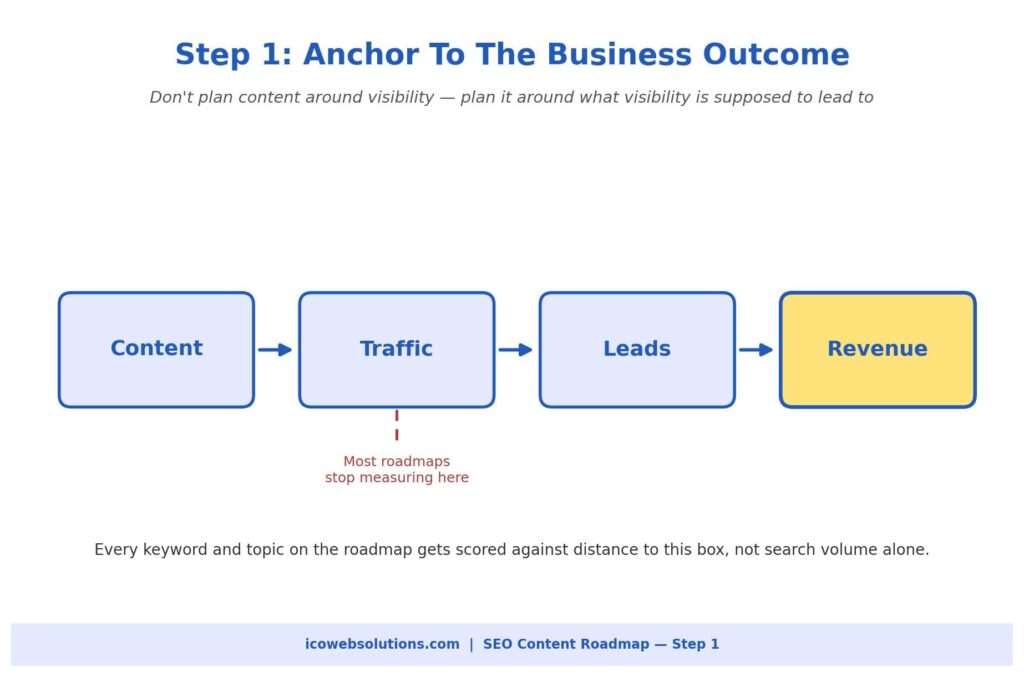
Before any keyword research happens, we force a conversation that sounds simple but gets skipped constantly: what does a “win” actually look like for this content, in terms the business already tracks? Not traffic.
Not rankings. The thing after that.
For our HVAC distributor, a win isn’t someone reading a blog post about ventilation standards. It’s that person filling out a quote request form, and that form eventually turning into a signed equipment contract worth tens of thousands of dollars.
This matters because it changes what “good” means for every decision downstream. If you skip this step, you end up with a roadmap optimized for a vague idea of relevance instead of the specific outcome the business actually needs.
A media company selling ad impressions genuinely wants raw traffic and pageviews, and that’s a fine goal for them. Almost nobody else should be optimizing for that. If your business model depends on booked meetings, signed contracts, or completed purchases, every keyword you consider should get measured against how close it sits to that outcome, not how many people search for it.
For the HVAC distributor, this meant writing down plainly that we were chasing contractors and facility managers with a real, current need, not general curiosity about HVAC systems. That single sentence ended up ruling out a surprising number of high-volume topics later in the process, including some that would have looked great in a traffic report and done nothing for the sales team.
It’s worth being honest about how uncomfortable this step can feel the first time you do it properly. Marketing teams are used to defending their work with traffic and ranking numbers, because those numbers are easy to produce quickly.
Tying every topic back to pipeline or revenue means some of your favorite ideas, the ones that would clearly perform well in search, have to get cut or deprioritized because they don’t actually move the business forward.
That’s a harder conversation to have internally, but skipping it just moves the hard conversation to six months later, when the roadmap is finished and the numbers don’t add up to anything the leadership team cares about.
Step 2: Build the Full Keyword List, Then Find What You’re Actually Missing
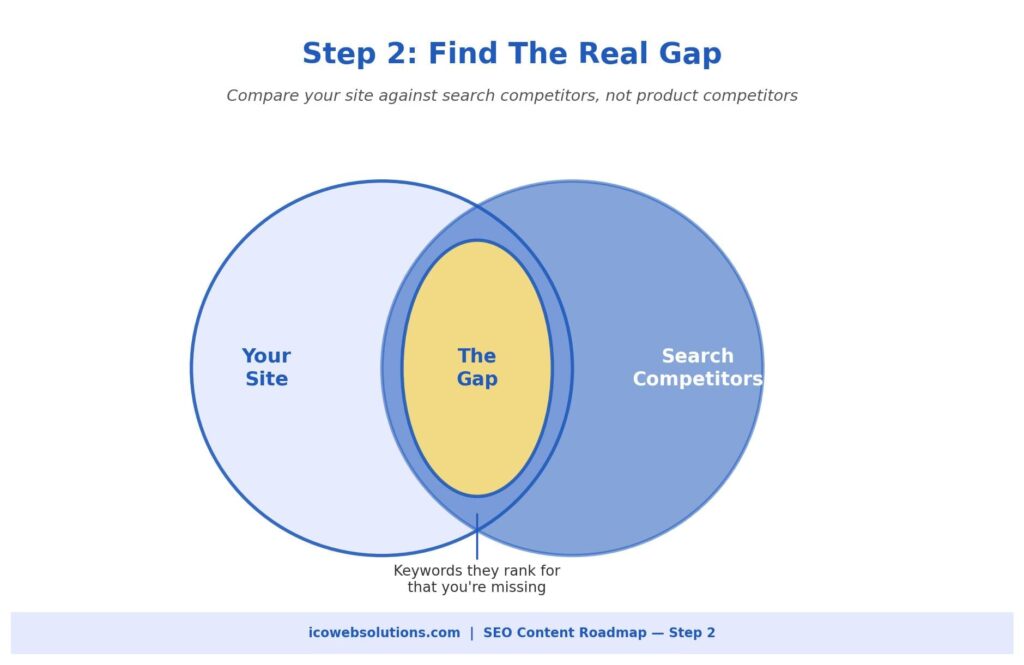
With the goal nailed down, the next step is mapping out every term your buyers might realistically search, and then comparing that against which of those terms you already show up for.
We use a standard SEO research tool for this part, something like Ahrefs or Semrush works fine, by pulling our own domain alongside three or four competitors who we know we’re actually losing visibility to in search, not just competitors the sales team talks about internally.
Those two lists are often different, and conflating them wastes time chasing SEO fights you were never actually in.
The output at this stage is messy on purpose. You’ll get a long list of keyword opportunities, a decent chunk of which will be irrelevant, branded, or far too broad to be useful. That’s expected. The real work here is in the filtering.
For the HVAC distributor, the obvious head term was something like “commercial HVAC equipment,” a huge, broad, expensive-to-rank-for phrase. But sitting right next to it were much more specific, much more winnable terms like “rooftop HVAC unit replacement for commercial buildings” and “HVAC equipment financing for contractors,” both with a fraction of the search volume but an enormous amount more buying intent behind them.
- Pick search competitors based on who you actually compete with in results, not who sales considers a rival
- Expect most of the raw keyword export to be noise, and budget real time for manually trimming it
- Specific, narrower terms with clear intent are usually worth more than broad terms with bigger volume
Step 3: Look at the Actual Search Results Page, Not Just the Keyword Numbers
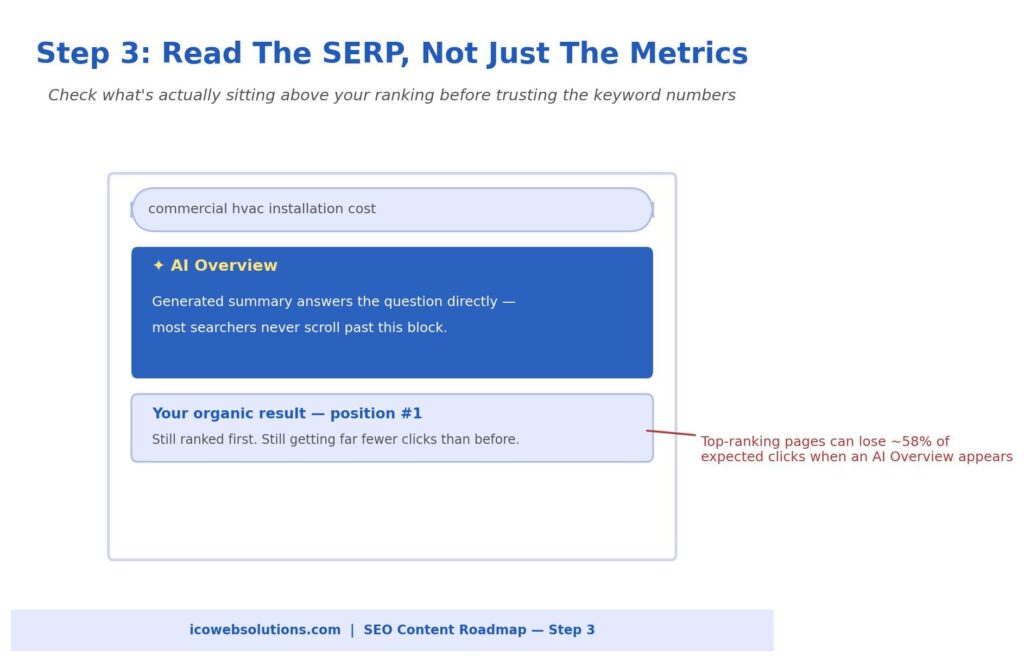
This is the step that didn’t exist in quite the same form a few years ago, and it’s the one most roadmaps still skip. Search volume and keyword difficulty tell you whether you can rank. They don’t tell you what that ranking is actually worth anymore, because the page itself might look completely different depending on whether an AI Overview, a shopping carousel, or a stack of ads sits above the organic results.
Ahrefs has published research showing that the top-ranking organic result can lose roughly 58% of its expected clicks when an AI Overview appears on that search page.
That’s a massive difference, and it means two keywords with identical volume and difficulty scores can be worth wildly different amounts depending on what else is occupying that results page.
So at this stage, we manually check the SERP for every shortlisted keyword, not just the metrics report, and note which ones already trigger an AI Overview, a People Also Ask block, or heavy ad placement.
This isn’t automatically a reason to avoid a keyword. It’s a reason to decide, deliberately, what you’re actually trying to win there.
For our HVAC distributor, nearly every broad, informational term, things like “how commercial HVAC systems work”, triggered an AI Overview that fully answered the question without anyone needing to click through.
We didn’t abandon those topics entirely, because getting cited inside that AI summary still has brand value, but we stopped expecting them to drive form fills, and we shifted our click-focused effort toward the narrower, more technical, bottom-of-funnel terms where AI Overviews were far less dominant.
Step 4: Group Keywords Into Topics the Way a Buyer Actually Thinks
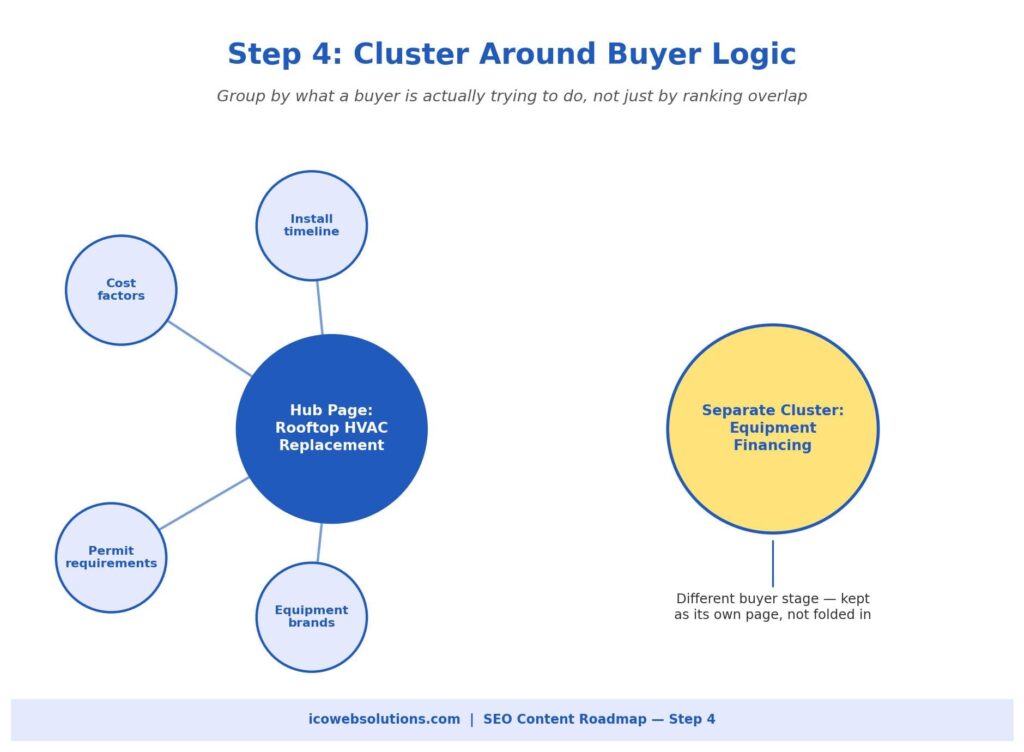
A spreadsheet full of individual keywords isn’t a plan, it’s just a longer list. The next step is organizing those keywords into topic clusters, groups of related terms that can realistically be served by one well-built page, or that clearly need separate pages because they represent different stages of the buying journey.
Most research tools will suggest a clustering based on which pages currently rank for overlapping terms, and that’s a useful starting point, but it’s not the final word.
The judgment call here is making sure the clusters reflect how a real buyer thinks, not just how a crawler groups similar phrases. In the HVAC example, a tool-based clustering initially lumped general commercial HVAC terms together with equipment financing terms, because there was some ranking overlap between them.
But those are genuinely different buyer situations. Someone researching how commercial HVAC systems work is early and exploring. Someone searching for equipment financing options has already decided what they need and is now trying to figure out how to pay for it.
We split those into two separate clusters with two separate pages, because treating them as one topic would have buried a high-intent, close-to-purchase audience inside a general awareness page.
Step 5: Decide What Gets Built First, Using More Than One Filter
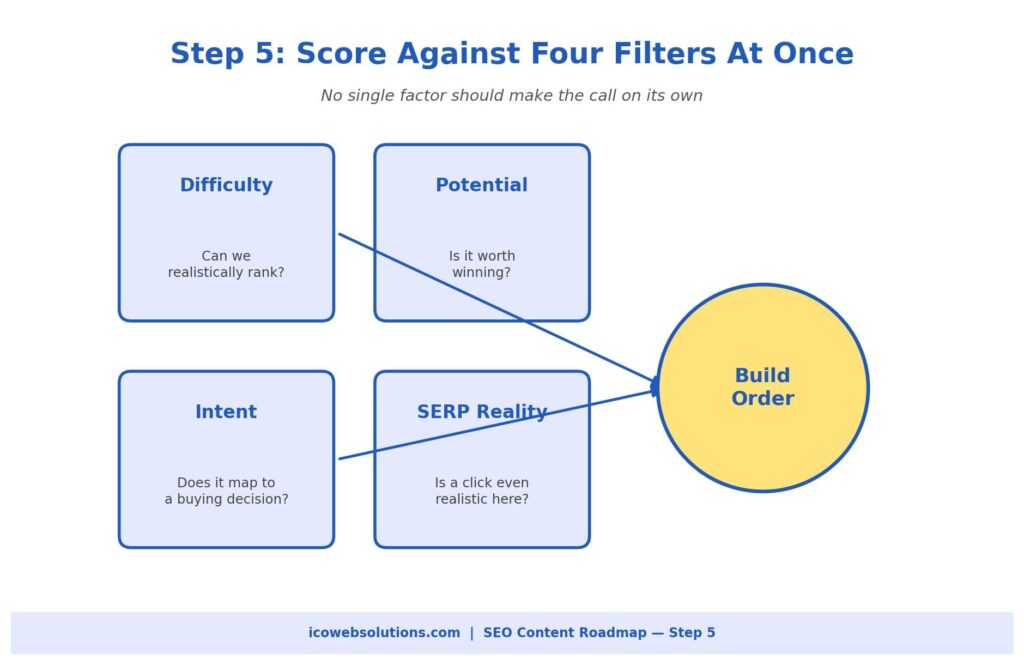
Once the clusters exist, you still have to decide what order to build them in, and this is where a lot of roadmaps quietly go wrong by picking the biggest, most tempting keyword first instead of the smartest one. We score every cluster against four things at once: how difficult it would be to rank, how much it’s genuinely worth if we win it, how close the searcher’s intent sits to an actual purchase decision, and what we learned in Step 3 about whether a click there is even realistic.
No single one of those four factors should make the decision alone. A term can have huge volume and still be a poor first choice if it’s dominated by an AI Overview and sits at the very top of the awareness stage. A term with modest volume can jump to the front of the line if it’s realistically winnable and sits one step away from someone filling out a form.
For the HVAC distributor, that meant pushing the broad “commercial HVAC equipment” topic further down the roadmap, even though it had the biggest search volume by far, and prioritizing “rooftop HVAC unit replacement” and the equipment financing cluster first, because both were realistically winnable, clearly tied to a buying decision already in motion, and far less crowded out by AI-generated summaries.
- Score clusters on difficulty, potential value, buyer intent, and SERP reality together, not one at a time
- Be willing to deprioritize your biggest, most obvious keyword if it’s dominated by an AI Overview and sits too early in the buying journey
- Let a cluster’s closeness to an actual purchase decision outweigh raw search volume when the two conflict
Step 6: Turn the Priority List Into Briefs Built to Be Found and Quoted
A roadmap only matters once it turns into content someone can actually read, and by this point we know enough to write a genuinely useful brief instead of a vague topic assignment. Each brief includes the primary keyword, the supporting terms from that cluster, where the buyer sits in their decision process, what we learned about the SERP for that term, and a specific angle the piece needs to take to stand out.
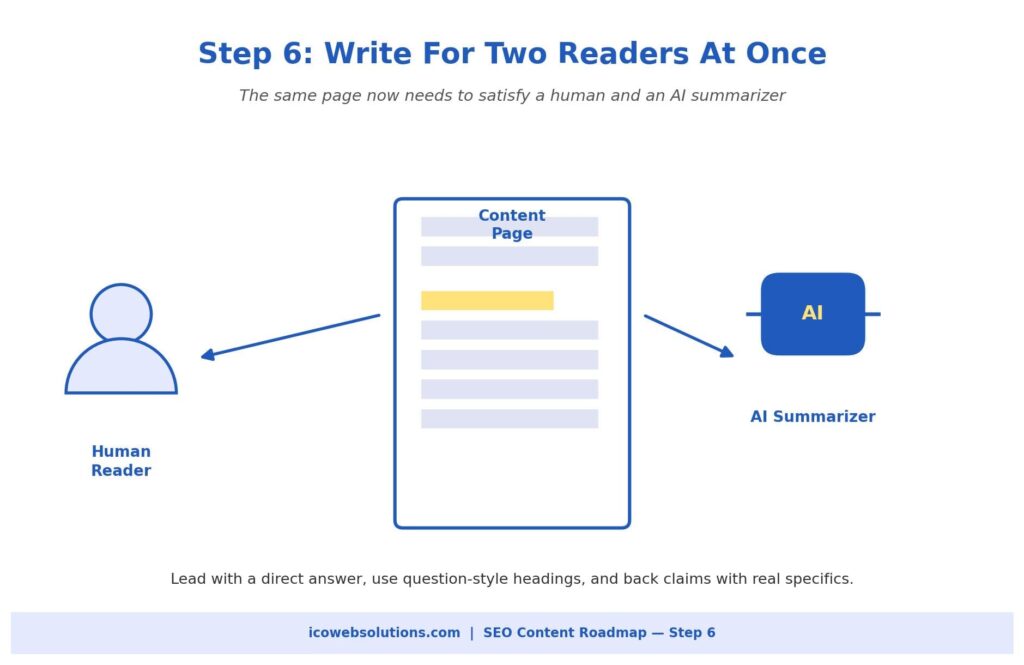
The writing itself needs to work for two audiences at once now: the human reader and the AI system that might lift a chunk of it into a summary somewhere else.
In practice, that means answering the core question directly within the first sentence or two of each section rather than building up to it slowly, using headings phrased the way someone would actually ask the question out loud, and backing claims with real, specific detail rather than vague generalities.
For the HVAC distributor’s financing page, that meant opening with a direct, plain explanation of how equipment financing actually works for commercial HVAC purchases, then supporting it with real numbers and terms, rather than easing into the topic with a long introduction before getting to the useful part.
This is also where genuine expertise becomes a real advantage rather than a nice-to-have. AI systems and careful human readers both tend to notice the difference between a page written by someone who clearly understands the subject and a page that’s technically correct but generic. Specific numbers, named standards, real customer situations, and a clear point of view are much harder for a rushed competitor to copy quickly, which is exactly the kind of advantage a content roadmap should be protecting.
Why We Still Write for Topics an AI Overview Will Swallow Whole
One objection comes up almost every time we walk a client through this process: if a topic is clearly going to get answered by an AI Overview before anyone reaches the organic results, why bother writing about it at all? It’s a fair question, and the honest answer is that we still write those pieces, just with a different goal attached to them and a different way of measuring whether they worked.
Getting cited as a source inside an AI Overview isn’t nothing, even without the click. It puts your brand name in front of someone at the exact moment they’re asking the question your business answers for a living, and repeated exposure like that builds a kind of familiarity that shows up later when they’re ready to actually buy.
There’s also a practical reason to keep showing up on these broader topics: the clustering from Step 4 only works if the awareness-stage content exists to link into the bottom-of-funnel pages, since a hub page with no supporting content around it tends to carry less authority than one surrounded by a genuinely useful cluster.
For the HVAC distributor, the broad educational pages stayed in the roadmap, just later in the build order and measured by brand visibility and assisted conversions rather than direct form fills.
What This Looks Like Once It’s Running
Once a roadmap like this is built, it’s tempting to feel like the hard part is over, but there are two things worth doing immediately rather than filing it away. The first is capturing an honest baseline: your current rankings, your current organic traffic, and ideally your current click-through rates on the terms that matter most, before you start making changes.
AI Overviews and SERP layouts keep shifting, and without a clear “before” snapshot, it becomes very hard to prove later whether the work actually moved anything. This is particularly important for businesses investing in emerging areas such as AI search, where visibility increasingly depends on how clearly a brand, its expertise, and its content can be understood by generative search systems.
The second is resisting the urge to overhaul every piece of content at once. Pick one cluster, run it through this exact process, publish it, and give it a few weeks to settle before comparing its performance against content you built the old way.
That comparison is genuinely more useful than any amount of planning, because it tells you, with your own real data, whether this approach is actually earning more qualified attention for your specific business, not just in theory but in practice. The same principle applies whether you’re working with an in-house team or a content marketing agency: the goal is not simply to produce more content, but to understand which content contributes to meaningful business outcomes.
It’s also worth revisiting the whole roadmap on a regular schedule rather than treating it as a one-time document. Search results keep shifting, AI Overviews expand into new categories of queries every few months, and a cluster that was a smart priority six months ago might already be crowded out by competitors who went through a similar process after watching you succeed.
Building in a quarterly check-in, even a short one, to re-run the SERP checks from Step 3 and confirm the priority order from Step 5 still makes sense keeps the roadmap from quietly going stale while everyone’s attention moves on to the next project. If your website, content architecture, or technical foundation also needs attention, this is often the right point to assess whether improvements from a specialist in website design in Delhi could support the broader search strategy rather than treating design and SEO as separate initiatives.
None of this requires a massive team or an enormous budget to start. It requires picking a real business outcome, being disciplined about checking what the search results actually look like before committing to a topic, and being willing to build the less exciting, narrower pages first if that’s genuinely where the buyers already are.
That discipline is really the whole difference between a content roadmap that produces a nice-looking report and one that produces an actual pipeline of people ready to talk to your sales team.
If you’d rather have a second set of eyes build this roadmap with you, or run it on your behalf from the keyword research through the finished, publish-ready briefs, that’s exactly the kind of work our team takes on at ICO WebTech. We can also help businesses adapt their broader organic strategy for the changing search landscape as an AI search company, combining content strategy, SEO, website expertise, and AI visibility into one practical roadmap. We’re happy to walk through what a first roadmap would look like for your specific business before you commit to anything.


10 Expert-Approved B2B Lead Generation Strategies That Actually Fill Your Pipeline
The Quick Take: Most B2B companies aren’t struggling to generate leads — they’re struggling to generate leads that actually turn into revenue. The ten strategies below, from account-based marketing to live chat to referral programs, are the ones backed by real 2025-2026 data for consistently producing leads sales teams actually want to talk to. Pick two or three that fit your sales cycle, do them well, and you’ll likely see more pipeline than trying to run all ten at once.
What’s Inside This Guide:
- 1. Account-Based Marketing (ABM)
- 2. LinkedIn Thought Leadership and Social Selling
- 3. SEO-Driven Content and Gated Lead Magnets
- 4. Personalized Email Nurture Sequences
- 5. Webinars and Virtual Events
- 6. Formal Referral and Partner Programs
- 7. Live Chat and Conversational Marketing
- 8. Video Marketing
- 9. Retargeting and Intent-Based Paid Ads
- 10. Sales Intelligence and Intent Data
- Bringing It All Together
Here’s a number worth sitting with before you spend another dollar on lead generation: 79% of marketing leads never turn into a sale, largely because of weak follow-up and nurturing, not because the leads were bad to begin with (Salesforce, as cited in G2, 2026). That statistic alone explains why so many B2B marketing teams feel like they’re constantly filling a bucket with a hole in the bottom.
Generating a name and an email address was never really the hard part. Turning that name into a qualified conversation with sales, and eventually into a closed deal, is where most strategies quietly fall apart.
The good news is that the B2B lead generation strategies actually working right now aren’t secret or complicated. They’re well documented, backed by solid research, and used by real companies generating real pipeline. What separates the teams getting results from the teams spinning their wheels usually isn’t the tactic itself, it’s how consistently and thoughtfully it gets executed. Below are ten strategies that consistently show up in current data as genuinely effective, along with what the research says about why each one works and how to put it to use.
1. Account-Based Marketing (ABM)
Account-based marketing flips the traditional funnel on its head. Instead of casting a wide net and hoping the right people notice, ABM starts by identifying a focused list of high-value target accounts and then builds personalized campaigns aimed specifically at the decision-makers inside those companies. It’s a slower, more deliberate approach, but for B2B companies selling complex or high-ticket products, it tends to outperform broader tactics by a wide margin.
The numbers back this up convincingly. Companies running ABM programs report boosting revenue by as much as 208% over three years, and 76% of marketers say ABM delivers a higher return than other marketing strategies they run (Saffron Edge, 2026). Personalized ABM campaigns also outperform generic ones according to 87% of B2B marketers, and companies with strong sales-and-marketing alignment, something ABM naturally forces, grow revenue 32% faster than those without it (Saffron Edge, 2026). If your average deal size is large enough to justify custom outreach, and your buying committee typically includes more than one decision-maker, this is very likely the single highest-leverage strategy on this list.
- Start with a short list of 20 to 50 dream accounts rather than trying to run ABM at scale immediately
- Involve sales in building the account list so marketing and sales agree on what a “good fit” actually looks like
- Personalize the message to the account’s specific industry and pain points, not just their first name
2. LinkedIn Thought Leadership and Social Selling
LinkedIn has become the closest thing B2B marketing has to a home turf, and the data leaves little room for debate. LinkedIn now drives 80% of all B2B social media leads, and 89% of B2B professionals use it specifically to generate business (Martal Group, as cited in SHNO, 2026). Leads from LinkedIn also convert at roughly double the rate of other social platforms, according to 2026 HubSpot research (Searchlab, 2026). That’s not a small edge. It suggests that time spent building a presence on LinkedIn is simply more productive than the same time spent almost anywhere else in social media.
The strategy that works best isn’t running LinkedIn ads in isolation, though those help too. It’s a combination of consistent thought leadership content from real people at your company, genuine engagement in the comments of your prospects’ posts, and a sales team that treats LinkedIn as a relationship-building tool rather than a place to blast cold pitches. Buyers can tell the difference between someone building credibility over months and someone trying to close a deal in a single DM, and they respond very differently to each.
3. SEO-Driven Content and Gated Lead Magnets
Content marketing remains one of the most reliable, compounding ways to generate B2B leads, and the research keeps confirming it. According to a 2025 study, content marketing generates roughly three times more leads than outbound marketing while costing 62% less to run (Demand Metric, as cited in SHNO, 2026). And 87% of B2B marketers say content marketing successfully generates leads for their business, an increase of eleven percentage points in just a couple of years (Email Vendor Selection, 2025, as cited in SHNO, 2026).
SEO deserves special mention here because of how differently it performs over time compared to paid channels. B2B companies that consistently invest in SEO see a 5.7 times higher return on investment after twelve months compared to running paid search alone (BrightEdge, as cited in Searchlab, 2026). Paid ads stop working the moment you stop paying for them. A well-ranked blog post or resource page keeps generating leads for years with no ongoing spend, which is exactly why SEO tends to be underrated by teams looking for quick wins and underrated no more once they see a year-two comparison. As an SEO agency in Delhi working with B2B clients across long sales cycles, this is consistently the pattern we see: businesses willing to be patient with SEO end up with the cheapest, most durable lead source on this list.
Gated content, meaning guides, templates, or reports that visitors trade an email address to access, still plays an important role here too, though it’s worth using selectively. Gated assets convert two to five times better than ungated ones, but ungated content drives roughly three times more traffic overall (Demand Gen Report, as cited in Searchlab, 2026).
A smart approach uses both: plenty of open, freely accessible content to build organic traffic and authority, with a smaller number of genuinely valuable gated resources reserved for your highest-intent visitors.
- Build content around the specific questions your sales team hears most often on discovery calls
- Reserve gating for your best assets, not every blog post, since over-gating quietly kills your organic traffic
- Treat SEO as a twelve-month investment, not a campaign you evaluate after six weeks
4. Personalized Email Nurture Sequences
Email still holds one of the best returns of any B2B marketing channel, with the average campaign delivering a striking 36 to 1 return on investment (Litmus, as cited in Searchlab, 2026). But the era of generic, one-size-fits-all newsletters blasted to an entire list is largely over. Personalized emails see a 14% improvement in click-through rates and a 10% lift in conversions compared to generic sends (Gartner research, as cited in Biteable, n.d.), and nurtured leads go on to make purchases that are 47% larger on average than leads that never received any nurturing at all (as cited in ReferralRock, n.d.).
The strategic shift worth making here is moving away from a single generic drip sequence and toward multiple nurture tracks based on where a lead actually is in their buying journey. A visitor who just downloaded an introductory guide needs a very different email than someone who’s already requested a demo and gone quiet. Segmenting your list this way takes more setup work upfront, but it’s a major part of why 79% of leads currently fail to convert. Most of them simply weren’t nurtured in a way that matched where they actually were.
5. Webinars and Virtual Events
Webinars have quietly become one of the highest-quality lead sources available to B2B marketers, and 73% of B2B marketers now call webinars their number one source of high-quality leads (ZoomInfo, as cited in Hubilo, 2025). The cost efficiency is hard to ignore too. Webinars generate leads at roughly $72 each, compared to over $800 for a trade show and around $198 for a conference (SHNO, 2026). Companies typically see 20% to 40% of webinar attendees enter the sales pipeline as genuinely qualified leads, and webinars with a clear, specific call to action can convert as much as 47% of attendees into leads (SHNO, 2026).
What makes webinars particularly valuable compared to a downloadable PDF or blog post is the built-in qualification. Someone willing to block out 30 to 45 minutes of their calendar to attend a live session on a specific topic has already told you a lot about how seriously they’re considering a solution like yours. That single behavioral signal, attendance itself, is often a stronger indicator of intent than a dozen anonymous page views.
- Pick topics narrow enough to attract genuinely interested prospects rather than a broad general audience
- Send the replay within 24 hours, since on-demand viewing can account for nearly half of total views
- End with one specific next step, not a vague “let us know if you have questions” close
6. Formal Referral and Partner Programs
If there’s one strategy on this list that’s dramatically underused relative to how well it performs, it’s referrals. Roughly 84% of B2B decision-makers start their buying process with a referral (Edelman Trust Barometer, as cited in GrowSurf, n.d.), and companies with formal referral programs report a 70% higher conversion rate on referral leads compared to leads sourced any other way (Heinz Marketing, as cited in GrowSurf, n.d.). Referred leads also close roughly 69% faster than non-referred leads, and companies with structured referral programs saw 86% revenue growth over two years, compared to 75% for companies without one (Heinz Marketing, as cited in ReferralRock, n.d.).
Despite results like these, only around 30% of B2B companies have a formal referral program in place at all (Influitive, as cited in ReferralRock, n.d.), which means most companies are leaving one of their highest-converting lead sources almost entirely up to chance. A referral program doesn’t need to be complicated to work. It needs a clear ask, an easy way for happy customers to make an introduction, and a reason for them to bother, whether that’s a financial incentive, early access to new features, or simply genuine appreciation delivered consistently.
7. Live Chat and Conversational Marketing
Adding live chat to a B2B website tends to produce results that surprise teams who assumed it was mainly a retail or customer-support tool. Website visitors who chat with a company in real time are 82% more likely to convert into customers, and they go on to spend 13% more than visitors who never chat at all (Intercom, n.d.). Even a modest exchange makes a measurable difference. Just one reply to a visitor’s message makes them 50% more likely to convert, and a short six-message conversation can make them up to 250% more likely to convert (Intercom, n.d.). Broader industry data backs this up too, with live chat linked to a 20% average increase in conversion rate and a reported 305% return on investment (American Marketing Association, as cited in SmartBug Media, 2017).
The reason this works is almost embarrassingly simple: speed. A prospect with a question who has to fill out a contact form and wait a day for a reply has plenty of time to lose interest, get distracted, or check out a competitor instead. A prospect who gets a helpful answer in under a minute is still standing at your door, so to speak, ready to keep the conversation going. For B2B sites with any meaningful traffic, live chat is one of the fastest and least expensive improvements you can make to your conversion rate.
8. Video Marketing
Video has moved from “nice to have” to genuinely essential in B2B marketing. 78% of businesses report increased website traffic after adding video to their content strategy, 69% generate more leads because of it, and 54% see increased sales as a direct result (as cited in SwellAI, n.d.). Perhaps most tellingly, B2B marketers who use video grow revenue 49% faster than those who don’t (as cited in SwellAI, n.d.), and landing pages that include video can see conversion increases of 86% or more (as cited in MediaPost, n.d.).
Personalized video, where a salesperson records a short, specific message for an individual prospect rather than sending a generic pitch, is proving especially effective in outbound efforts. Video email campaigns show five times higher open rates and eight times higher open-to-reply rates in prospecting compared to plain text emails (as cited in Sagefrog, n.d.). You don’t need studio-quality production for this to work. A well-lit laptop camera and a genuinely useful, specific message tends to outperform a polished but generic video every time, because the personalization is what actually earns the reply.
- Use short explainer videos on high-traffic landing pages where visitors are deciding whether to convert
- Have sales reps send brief personalized videos instead of another templated cold email
- Repurpose webinar recordings into shorter clips for social and email rather than letting them sit unused after the live event
9. Retargeting and Intent-Based Paid Ads
Most visitors to a B2B website will never convert on their first visit, no matter how good your page is, simply because B2B buying decisions usually involve multiple stakeholders and take weeks or months to finalize. Retargeting exists specifically to solve that problem by keeping your brand visible to people who’ve already shown interest. Retargeting through display ads has been shown to influence a striking 70% of website visitors toward eventually making a purchase (as cited in MediaPost, n.d.), and personalized exit-intent offers, shown right as a visitor is about to leave your site, can boost leads and conversions by as much as 200% (as cited in MediaPost, n.d.).
The key to making retargeting feel helpful rather than intrusive is relevance. Someone who read a blog post about your product’s pricing should see a different retargeting ad than someone who only viewed your careers page. Segmenting your retargeting audiences by the specific page or content they engaged with, rather than running one generic ad to everyone who’s ever visited your site, is usually the difference between retargeting that converts and retargeting that just feels like being followed around the internet.
10. Sales Intelligence and Intent Data
The final strategy worth building into your lead generation approach isn’t really a channel at all, it’s a layer of intelligence that makes every other channel work better. Intent data tracks the buying signals companies give off before they ever fill out a form, things like researching competitor comparisons, visiting review sites, or spending unusual amounts of time on certain topics. Combined with personalization, this kind of targeting has real financial impact. Gartner has projected that B2B companies using personalization in digital commerce can see revenue increases of up to 15% (as cited in SaleFuel, n.d.).
This strategy also directly addresses one of the biggest structural problems in B2B marketing right now: 85% of B2B marketers admit they struggle to connect their marketing performance to actual business outcomes (G2, 2026), and 41% report difficulty getting marketing-generated leads to meet sales’ expectations for quality (G2, 2026). Intent data helps close that gap by giving both teams a shared, objective signal for which leads are actually ready for a conversation, rather than relying on gut feeling or an arbitrary lead score that sales has learned to ignore.
Bringing It All Together
Reading through ten strategies at once can feel like a lot, and that’s exactly the trap worth avoiding. Trying to launch all ten simultaneously is a fast way to execute all of them poorly. The stronger approach is to look honestly at your sales cycle, your average deal size, and where your current pipeline is actually breaking down, then choose two or three strategies from this list that most directly address that specific gap. A company selling a $500 monthly subscription probably gets more out of SEO content and email nurturing than a full ABM program. A company selling $200,000 enterprise contracts almost certainly should be running ABM alongside LinkedIn thought leadership, with live chat catching the inbound interest both of those generate.
Whichever combination fits your business, the underlying principle stays the same across every strategy on this list: the leads that convert aren’t the ones you generated the most of, they’re the ones you followed up with the fastest, personalized the most thoughtfully, and nurtured with genuine relevance until they were actually ready to buy. That’s not a flashy insight, but it’s the one the data keeps confirming over and over again.
If your pipeline has been feeling unpredictable, or your marketing and sales teams keep disagreeing about what counts as a “good lead,” it might be less about needing a new tactic and more about needing the right systems, tracking, and website experience to support the strategies you’re already running. That’s exactly the kind of work our team handles at ICO WebTech, a website designing agency in Delhi that builds high-converting landing pages and sets up the live chat, tracking, and personalization infrastructure that turns these strategies from theory into a predictable pipeline.
Talk to ICO WebTech About Your Lead Generation Strategy
References
Biteable. (n.d.). Create next-level B2B marketing campaigns with personalized videos. https://biteable.com/blog/personalized-video-marketing-for-b2b/
G2. (2026). Lead generation statistics for 2026: Key marketing data. https://learn.g2.com/lead-generation-statistics
GrowSurf. (n.d.). B2B referral marketing statistics. https://growsurf.com/statistics/b2b-referral-marketing-statistics/
Hubilo. (2025). Webinar marketing statistics and benchmarks for 2025. https://www.hubilo.com/blog/webinar-marketing-statistics-benchmarks
Intercom. (n.d.). From first touch to qualified lead: How to use live chat for sales. https://www.intercom.com/blog/
MediaPost. (n.d.). Stats and snippets on B2B email: Why it’s the most valuable channel. https://www.mediapost.com/publications/article/346495/
ReferralRock. (n.d.). B2B referral marketing statistics. https://referralrock.com/blog/b2b-referral-marketing-statistics/
Saffron Edge. (2026). 45+ account-based marketing statistics for 2026 B2B marketing strategy. https://www.saffronedge.com/blog/account-based-marketing-statistics/
SaleFuel. (n.d.). B2B companies using personalization in digital commerce to see up to 15% increase in revenue. https://salesfuel.com/b2b-companies-using-personalization-digital-commerce-see-15-increase-revenue/
Sagefrog. (n.d.). Start more conversations with leads in 2020 with personalized video emails. https://www.sagefrog.com/blog/start-more-conversations-leads-2020-personalized-video-emails/
Searchlab. (2026). B2B marketing statistics 2026. https://searchlab.nl/en/statistics/b2b-marketing-statistics-2026
SHNO. (2026). B2B lead generation statistics for 2026: Channels, costs, conversion rates, and trends. https://www.shno.co/marketing-statistics/b2b-lead-generation-statistics
SHNO. (2026). Content-led lead generation statistics. https://www.shno.co/marketing-statistics/content-led-lead-generation-statistics
SHNO. (2026). Webinar marketing statistics for 2026. https://www.shno.co/marketing-statistics/webinar-marketing-statistics
SmartBug Media. (2017). 4 powerful ways live chat on your website improves B2B inbound sales. https://www.smartbugmedia.com/blog/live-chat-on-your-website-improves-b2b-inbound-sales
SwellAI. (n.d.). B2B video marketing statistics. https://www.swellai.com/blog/b2b-video-marketing-statistics


How To Find Your Target Audience In 3 Simple Steps
You can have the best-looking website, the smoothest checkout, and a product worth buying — and still struggle to sell, if you’re talking to the wrong people. Most businesses don’t fail because their offer is bad. They fail because they’re marketing to “everyone,” which in practice means marketing to no one.
But here’s what most generic advice on this topic gets wrong: a brand-new startup and an established business are not solving the same problem. A startup has no customers yet, so “finding your audience” means building an educated hypothesis and testing it fast. An established business already has customers — its job is to stop guessing and start reading the data it’s already sitting on. Applying the same playbook to both is why so much of this advice feels vague and unusable.
So this guide splits every step two ways: what to do if you’re just starting out, and what to do if you’re already in the game. Pick the version that matches where you actually are.
Why “Everyone” Is Not an Audience
Before the steps, one reframe worth sitting with: the businesses that win aren’t the ones with the widest audience — they’re the ones who understand a narrower audience deeply enough to speak directly to them. A skincare brand for “everyone” competes with thousands of generic skincare brands. A skincare brand for “working women in Delhi NCR dealing with pollution-related skin issues” has an actual angle — for its messaging, its product positioning, and eventually, its website design and SEO strategy.
This matters more than most founders expect, because your target audience doesn’t just inform your ad targeting — it shapes your website structure, your product photography, your checkout flow, and the keywords you should be ranking for in search. Get the audience wrong, and every downstream decision compounds that mistake.
Step 1: Understand Who You’re Actually Selling To
If You’re a Startup (No Customers Yet)
Without existing customer data, you’re working from hypothesis, not history — and that’s fine, as long as you treat it as a hypothesis to test, not a fact to defend.
Start with these:
- Study your closest competitors’ customers. Look at who’s engaging with their social posts, leaving Google reviews, or commenting on their content. If three competitors’ reviews all mention “fast delivery” and “affordable pricing,” that tells you something about what the market cares about — even before you have a single customer of your own.
- Talk to 10-15 real people who fit your rough idea of a buyer. Not a formal survey — actual conversations. Ask what they currently use to solve the problem your product addresses, what frustrates them about it, and what would make them switch.
- Use search behavior as a signal. Tools like Google Keyword Planner or even Google’s autocomplete will show you what real people are typing when they’re looking for something like what you sell. If people are searching “affordable ecommerce website design Delhi” far more than “custom enterprise ecommerce solutions,” that tells you where the actual demand sits — and that’s a market signal, not a guess.
- Define a narrow starting segment, on purpose. Founders often resist narrowing because it feels like leaving money on the table. In reality, a startup that tries to serve “small businesses, D2C brands, and enterprises” from day one usually serves none of them well. Pick the narrowest group where you can realistically win first.
If You’re an Established Business
You have the one thing a startup doesn’t: real behavioral data. The mistake most established businesses make isn’t a lack of data — it’s never actually sitting down and looking at it.
- Pull your order and customer data. Age range, location, order value, repeat purchase rate, product category preferences. Most ecommerce platforms and CRMs already have this — the data just hasn’t been looked at with fresh eyes.
- Run a simple RFM analysis (Recency, Frequency, Monetary value) if you have enough order history. This separates your one-time bargain shoppers from your loyal repeat buyers — two very different audiences that usually need very different messaging.
- Check your website analytics for behavioral patterns, not just totals. Which landing pages have the highest conversion rate? What device and time of day is your highest-value segment browsing on? Which traffic source — organic search, paid ads, direct — brings in customers who actually stick around?
- Segment, don’t average. If you’re averaging “all customers” into one profile, you’re likely missing that you actually have two or three distinct buyer groups with different needs. A business selling home decor might have both budget-conscious first-time buyers and repeat premium buyers furnishing a whole home — treating them as one audience means your messaging under-serves both.
The core difference here: a startup is building a profile from assumptions and outside signals. An established business is refining a profile from its own transaction history. Neither should stop at guessing — one just has a head start.
Step 2: Build a Usable Customer Profile
Whichever stage you’re at, the next step is the same: turn scattered signals into a short, specific, working profile — not an elaborate persona document with a fake name and a stock photo, but a paragraph you can actually act on.
For Startups
Since you’re working from early signals, keep the profile flexible and mark it as a hypothesis:
“Our initial target customer is a 25-35 year old small business owner in Delhi NCR who currently manages orders manually or through WhatsApp, is price-sensitive but values reliability, and is likely to search for us using terms like ‘affordable website designing company in Delhi’ rather than more generic or enterprise-level search terms.”
Notice this profile is intentionally narrow and includes the language your audience actually uses to search — that detail matters later when you get into SEO and website copy.
For Established Businesses
Your profile should reflect the segments your data actually revealed, not a single blended average:
“Our core high-value segment is a 28-40 year old repeat buyer who purchases every 45-60 days, browses primarily on mobile in the evening, responds well to loyalty offers over discount codes, and came to us originally through organic search rather than paid ads. Our secondary segment is a one-time, price-driven buyer acquired mostly through festive-season sale campaigns, with a much lower repeat rate.”
Two segments, two different strategies — one profile for retention-focused messaging, one for acquisition-focused offers. This is the level of specificity a real customer profile needs; anything vaguer than this won’t actually change how you market or design for them.
Step 3: Test the Profile Against Real Behavior — Don’t Just Trust It
A customer profile, no matter how carefully built, is still a hypothesis until it’s been tested against actual behavior. This is the step almost everyone skips, and it’s the one that separates businesses that keep refining their targeting from ones that lock in a guess and never revisit it.
For Startups
- Run two small ad sets with different messaging aimed at slightly different audience assumptions, and let actual click and conversion data — not opinions in a meeting — decide which one is closer to reality.
- Launch a simple landing page before your full website is even built, and measure sign-ups or interest against the audience segment you targeted to reach it.
- Track where your first 10-20 customers actually came from, and what they say when you ask them directly why they chose you. Early customers are your richest, most underused source of validation.
For Established Businesses
- A/B test messaging across your identified segments, not just across generic “Version A vs Version B” — test whether your loyalty-focused messaging actually performs better with your repeat-buyer segment than a discount-led message does.
- Watch conversion rate by segment, not just overall. An overall conversion rate can look fine while masking that one segment is converting poorly and dragging the average down.
- Re-run this analysis every quarter. Buyer behavior shifts — especially around festive seasons, new competitor entries, or after a website redesign — and a profile built a year ago may no longer reflect who’s actually buying today.
Whatever you learn from testing, feed it back into Step 2. This isn’t a one-time exercise for either a startup or an established business — it’s a loop that should keep tightening the more real data you collect.
Common Mistakes Businesses Make at Both Stages
- Confusing “who we want to sell to” with “who actually buys from us.” Founders in particular often build a profile around their ideal customer rather than the one showing up in the data or the early signals.
- Treating the target audience as a one-time exercise. A profile defined at launch and never revisited becomes stale fast — especially for a business scaling quickly or entering a new city or category.
- Building the website before the audience is defined. This is one of the most common and costly sequencing mistakes. A generic template built before you understand your buyer usually needs a costly rebuild later, once real data shows who’s actually converting and who isn’t.
- Ignoring the language your audience actually searches with. Businesses often write website copy in the language they use internally, not the language customers use to search — a gap that quietly costs both conversions and search visibility.
Why This Matters Beyond Marketing
Knowing your target audience shouldn’t just shape your ad campaigns — it should directly shape your website and your search strategy, because that’s where most of your audience will actually meet your business for the first time.
A website built for a price-sensitive, deal-driven audience needs a fast, low-friction checkout, prominent offers, and trust signals like reviews right up front. A website built for a premium, trust-driven audience needs high-quality visuals, clear policies, and a slower, more considered browsing experience. If your site was built as a generic template rather than around how your specific audience actually browses and decides, that mismatch shows up directly in your conversion rate — no amount of ad spend fixes a website that doesn’t speak to the people landing on it.
The same logic applies to search visibility. Once you know the exact language your audience uses — “affordable,” “custom,” “near me,” “best,” “agency” — that vocabulary should show up in your website’s headings, page copy, and metadata. This is where a defined audience and a real SEO strategy start working together instead of pulling in different directions.
Two Worked Examples
Abstract advice is easy to nod along to and hard to apply. Here’s what this looks like in practice for each stage.
Startup Example
Imagine a founder launching a D2C brand selling organic skincare, with no customers yet. Following Step 1, they study three competitor brands’ Instagram comments and Google reviews, and notice a recurring theme: buyers repeatedly mention “sensitive skin” and “pollution damage” rather than generic beauty concerns. They also run a quick search on Google Keyword Planner and find that “organic skincare for pollution Delhi” gets meaningful search volume, while a broader term like “best skincare brand India” is dominated by large, established players they can’t realistically outrank yet.
Based on this, their Step 2 profile becomes: “Working women, 25-40, in Delhi NCR, dealing with visible skin damage from pollution and long commutes, currently using generic drugstore products, willing to pay a premium for a product that specifically addresses this problem.”
For Step 3, instead of building a full ecommerce site immediately, they launch a single landing page focused on this exact positioning, run two small ad sets — one emphasizing “organic ingredients,” the other emphasizing “pollution protection” — and let the data decide. The pollution-focused messaging converts nearly twice as well. That result doesn’t just inform the ad copy going forward — it tells them their entire website homepage, hero section, and even product naming should lead with pollution protection, not generic “organic” positioning.
Established Business Example
Now imagine a business that’s been selling home furnishings online for four years, with a decent customer base but flat growth. Following Step 1, they pull two years of order data and run a basic RFM analysis. It reveals something they hadn’t noticed: 60% of revenue comes from a relatively small group of repeat buyers who order every 2-3 months, while the much larger group of one-time buyers acquired through festive sales rarely returns.
Their Step 2 profile now splits into two: a high-value repeat segment that values curation and loyalty perks over discounts, and a low-retention, price-driven segment acquired mostly through sale campaigns. Previously, all of their marketing and website messaging had been built around discounts and sales — which was actively working against their most valuable segment.
For Step 3, they test loyalty-focused messaging and an early-access program specifically with the repeat-buyer segment, while keeping discount-led campaigns for new-customer acquisition. Within one quarter, repeat purchase rate among the loyalty segment increases measurably. The next logical step, which they hadn’t previously considered, is redesigning parts of their website — a dedicated loyalty program page, curated collections for repeat visitors — because the audience data revealed a segment the existing site wasn’t serving at all.
Both examples follow the same three steps. Neither one is a lucky guess — both come from treating the audience-finding process as something to build, test, and revise, not something to assume once and move on from.
Quick FAQ
How often should I revisit my target audience definition?
For a startup, revisit it after every major test or campaign in the first six months — your early data will shift quickly. For an established business, a quarterly review is usually enough, with a deeper look whenever you notice growth flattening or a new competitor entering your space.
Can a business have more than one target audience?
Yes, and most established businesses do — the mistake is treating multiple audiences as one blended average instead of building distinct messaging, and sometimes distinct website pages, for each meaningful segment.
What’s the biggest sign a business hasn’t actually defined its target audience?
Website copy and ad messaging that reads as generic — speaking to a broad category of buyer rather than a specific person with a specific problem. If your homepage could belong to almost any competitor in your space with a logo swap, that’s usually the clearest sign.
Bringing It Together: From Audience to Website to Visibility
Here’s how the three pieces connect in practice:
- You define your audience (startup: hypothesis-driven; established business: data-driven).
- Your website is designed and written around that specific audience — its language, its priorities, its buying behavior — not a generic template.
- Your SEO strategy targets the exact terms that audience is searching, so the right people find that website in the first place.
Skip any one of these three, and the other two lose most of their effectiveness. A perfectly targeted ad campaign sending traffic to a generic website converts poorly. A beautifully designed website that isn’t optimized for the terms your audience searches never gets found. And a strong SEO strategy targeting the wrong keywords brings in visitors who were never your audience to begin with.
If you know your audience but your website wasn’t built with them in mind, that’s a design problem worth solving before spending another rupee on ads. As a website designing company in Delhi, we build sites around who’s actually going to buy from you — not a generic template retrofitted after the fact.
And if your website is right but the right people still aren’t finding it, that’s where the right SEO agency in Delhi comes in — making sure your site shows up for the exact searches your defined audience is already running.
Whether you’re validating your first customer segment as a startup, or refining years of buyer data as an established business, the goal is the same: stop guessing, start testing, and build everything downstream — website, content, and search strategy — around the audience the data actually points to.


B2B Search Engine Marketing: 3 Ways to 10X Visibility Before Your Competitors Even Notice
TL;DR: Most B2B companies are still fighting over search traffic that stopped converting years ago. Zero-click results, AI Overviews, and 10-month buying cycles have quietly rewritten the rules of B2B search engine marketing. The businesses pulling ahead in 2026 aren’t the ones publishing more blog posts or bidding on more keywords. They’re the ones running what we call the Compound Visibility Loop — a three-part system that stacks paid intent capture, AI citation, and account-based retargeting into one engine instead of three disconnected budgets. This article breaks down exactly how it works, backed by current research, and shows you how to build it for your own pipeline.
In This Blog:
- Why traditional B2B SEM is quietly losing its grip — and the real data behind it
- The Compound Visibility Loop: our proprietary 3-part framework for 2026 search visibility
- Way #1: Bidding on bottom-funnel intent instead of chasing volume
- Way #2: Structuring content so AI engines cite you (and why this multiplies your ad performance)
- Way #3: Retargeting the buying committee, not the browser
- A controversial but accurate take on where B2B ad budgets should actually go in 2026
- A practical starting checklist you can run this quarter
Here’s a number that should make every B2B marketing leader sit up: 74% of high-intent B2B research searches now end without a single click, and when Google slots an AI Overview above the results, that number climbs to 83% (Onely, 2026; LinkedIn/ie.linkedin.com, 2026). Read that again. Roughly eight out of every ten searches your ideal customer runs about a problem you solve never turn into a visit to your website. Not because they’re not interested. Because the answer got handed to them before they had a reason to click.
If your search strategy hasn’t changed in the last eighteen months, you are almost certainly bidding on keywords, writing content, and reporting on click-through rates the way everyone did in 2022. And that’s the real problem this article is here to solve. Not with fear, because panic never grew a pipeline. With a framework you can actually run, starting this week, that treats search as one connected system instead of three separate budgets fighting for the same buyer’s attention.
Why “More Keywords, More Budget” Stopped Working
For a long time, B2B search engine marketing was a fairly simple game. You picked keywords your buyers typed into Google, you wrote a landing page, you bid on the terms, and you counted the leads. That game still exists, but the board has changed shape underneath it. Search behavior has fragmented across ChatGPT, Perplexity, Google’s AI Overviews, and traditional blue links, and the buyer who used to click ten links before picking up the phone now often gets a synthesized answer and moves on with barely a trace left in your analytics dashboard.
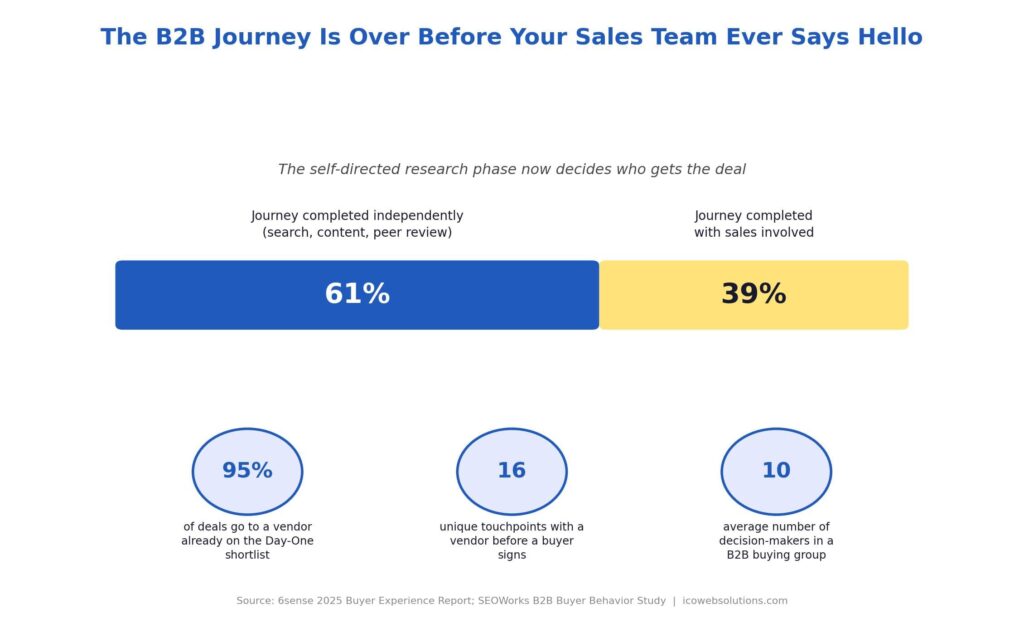
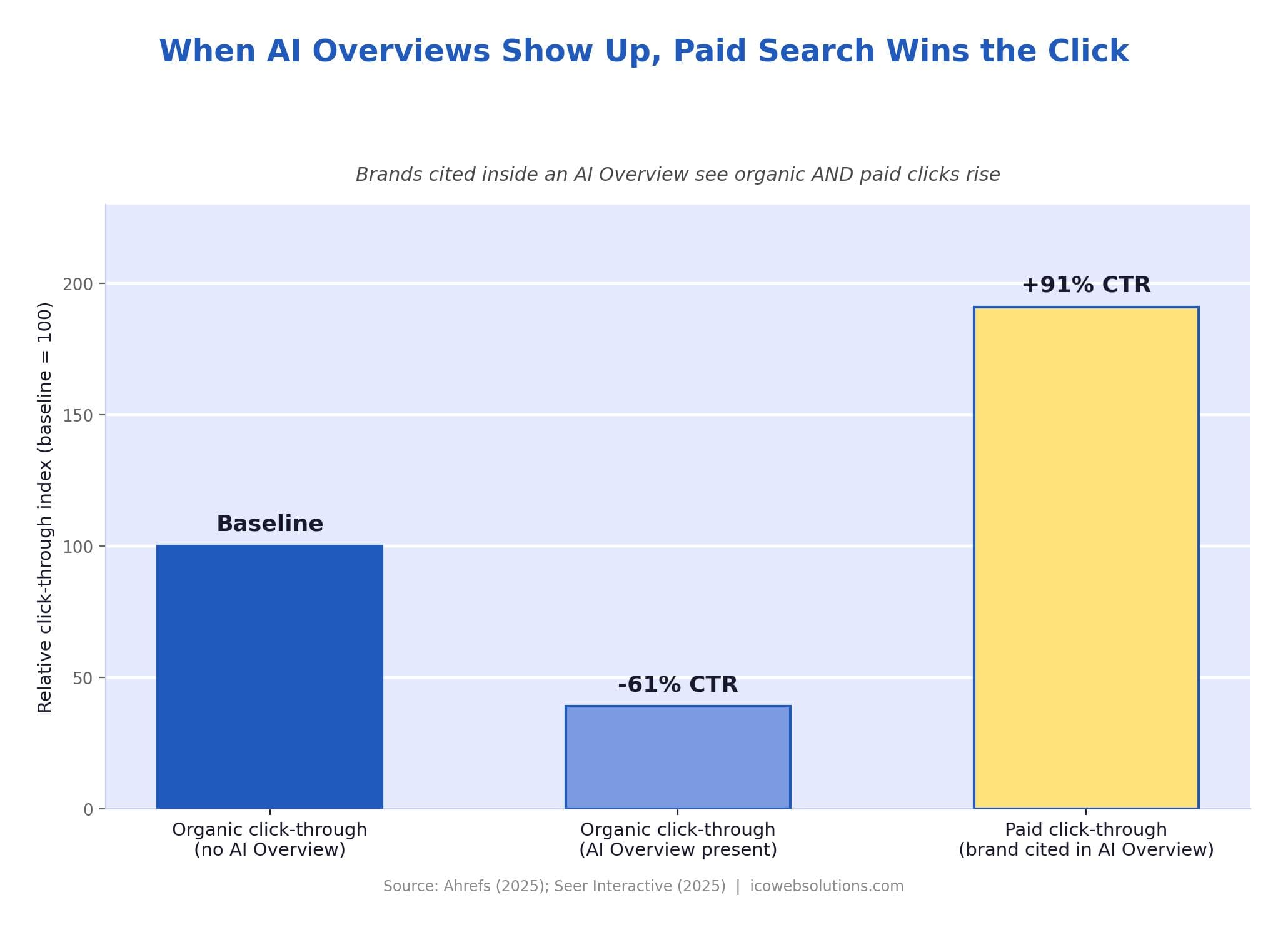
The scale of this shift is genuinely surprising once you look at the research directly. Google’s AI Overviews now show up on a large share of informational queries, and when they appear, organic click-through rates fall by around 61% according to Seer Interactive’s 2025 study (WhiteHat SEO, 2026). At the same time, the buying journey itself has compressed. The 2025 6sense Buyer Experience Report, based on more than 4,000 buyers across North America, EMEA, and APAC, found that the split between independent research and seller engagement has moved from a 70/30 balance to 60/40, and that average buying cycles shortened from about eleven months to ten (Business Wire, 2025). Buyers are deciding earlier. They’re doing it with less visible search behavior. And they’re doing it across more devices and assistants than a single campaign can realistically track.
None of this means B2B search engine marketing is dead. It means the old scoreboard — rankings, impressions, raw click volume — no longer tells you the truth about whether you’re winning. That’s exactly where our framework comes in.
Our Take: Stop Treating SEO and PPC as Two Different Budgets
Here’s the part of this article most agencies won’t say out loud, because it’s a little uncomfortable for anyone selling “SEO packages” and “PPC management” as separate line items. In B2B, search engine optimization and paid search are no longer two channels. They are two hands doing the same job, and treating them as competitors for budget is quietly costing you pipeline.
The evidence for this is stronger than most marketers realize. Research from Ahrefs found that brands cited inside an AI Overview see paid clicks increase by roughly 91%, and organic clicks increase by about 35%, compared to brands that don’t earn a citation (WhiteHat SEO, 2026). In other words, the same piece of content that gets you cited by an AI engine also makes your paid ads perform better, because the buyer has already seen your name once before they see your ad. Visibility compounds. It doesn’t sit in silos.
This is the idea behind what we call the Compound Visibility Loop — a framework built specifically for how B2B buyers actually behave in 2026, not how they behaved when most SEM playbooks were written. It has three connected moves, and each one makes the next one cheaper and more effective. Let’s walk through all three.
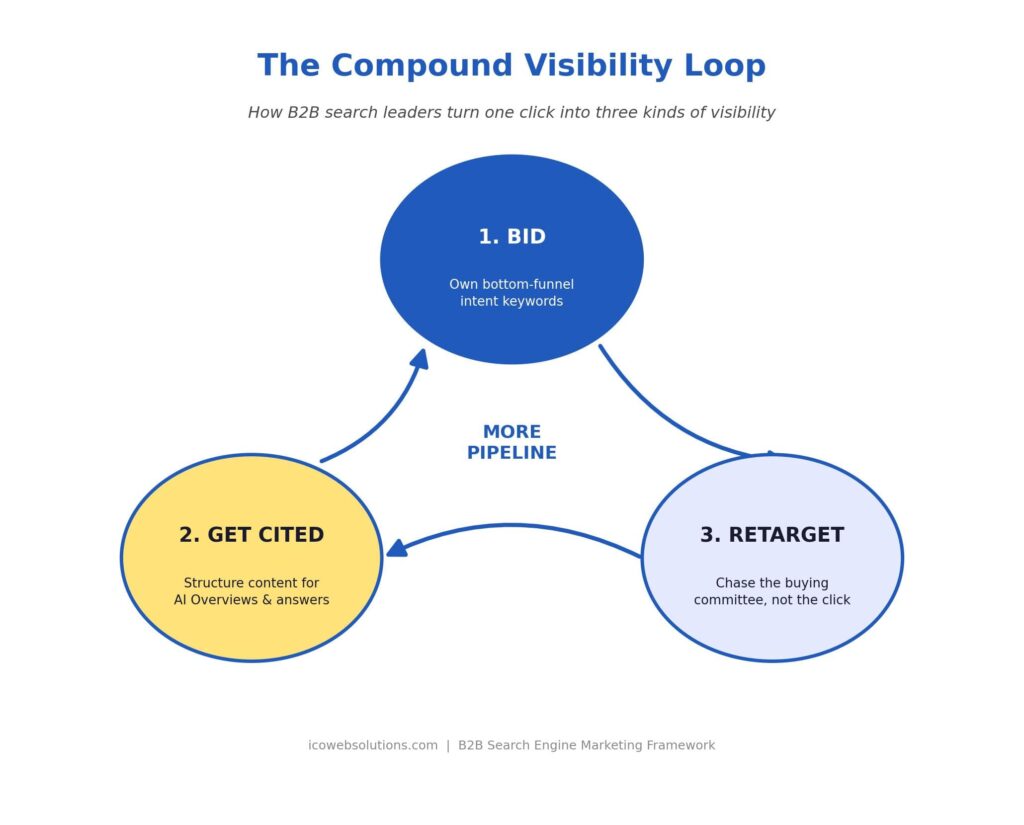
Way #1: Bid on Bottom-Funnel Intent, Not Search Volume
Most B2B paid search accounts we review are still built around volume. Big, broad keywords with a lot of monthly searches, because volume feels safe and easy to report on. But volume is exactly the part of search that’s disappearing into zero-click results and AI summaries. The clicks that remain, and remain valuable, are the ones tied to real buying intent: comparison terms, “vs” searches, pricing questions, category-specific software or service terms, and branded competitor searches from people actively shortlisting vendors.
This matters because the research shows something reassuring buried inside the scary zero-click headlines. Zero-click behavior is eating the shallow, informational end of search — the “what is” and “how does X work” queries that were never going to convert well anyway. High-stakes, high-consideration B2B decisions still involve real digging, because no AI Overview is going to get a procurement director to sign off on a six-figure contract based on a two-sentence summary (Redevolution, 2026). That’s your opening. Bottom-funnel B2B search intent is exactly the kind of search that still results in a genuine click, a genuine visit, and a genuine conversation with your sales team.
Cost per click across Google Ads has climbed to an average of $5.26, up from $4.66 the year before, and conversion rates have actually improved to around 7.5% to 8.2% as advertisers get smarter about targeting (Search Engine Land, 2025). That tells you cheap, broad traffic is genuinely going away, but advertisers who tighten their targeting are converting better than ever. The lesson isn’t to spend less. It’s to spend on the 20% of searches that were always going to close deals, instead of the 80% that were always going to bounce.
A few practical shifts make this real:
- Redirect budget away from broad, top-of-funnel keywords and into comparison, alternative, and pricing-intent terms where your buyer has already done the education phase
- Bid aggressively on your own branded terms and your top two or three competitors’ branded terms, since 92% of B2B buyers start research with a specific vendor already in mind and you want to be the alternative they consider (SEOWorks, 2026)
- Build landing pages for each intent cluster instead of sending every click to the same generic homepage, since specificity is what turns a click into a form fill
- Track cost per qualified lead, not cost per click, as your primary success metric going forward
None of this is about abandoning awareness-stage marketing altogether. It’s about being honest with yourself that awareness-stage paid search, in a world of AI Overviews and 61% CTR drops, is often lighting money on fire. Bottom-funnel intent is where B2B SEM still earns its budget line, and it’s the first move in the Compound Visibility Loop.
Also read: LinkedIn Thought Leadership for B2B Founders: The Framework That Turns Posts into Pipeline
Way #2: Get Cited by AI Engines, Not Just Ranked by Google
Here’s where most B2B marketing teams are behind, and it’s genuinely not their fault, because this shift happened fast. Ranking on page one of Google used to be the finish line. Now it’s just one of several places your buyer might encounter your brand, alongside ChatGPT, Perplexity, and Google’s own AI Overview panel. Being cited as a source inside those AI-generated answers is quickly becoming more valuable than holding the number one organic position, because that citation is what plants your brand name in a buyer’s head before they’ve clicked anything at all.
The mechanics of earning that citation are different from classic SEO, and this is genuinely good news, because it rewards clarity over cleverness. Content that answers a question directly in the first paragraph, uses clean definitions, comparison tables, and FAQ-style structure, gets cited far more often than dense, keyword-stuffed articles written primarily to rank. One industry analysis found that restructuring content into these semantic answer fragments increased share-of-answer visibility by roughly 40% (GrackerAI, 2026). Another cross-account study across 250-plus B2B SaaS companies found that campaigns built around answer-first, conversational content saw 47% higher visibility inside AI search engines compared to traditional keyword-first content (Triple Dart, 2026).
And here’s the part that ties this back to your ad spend directly: getting cited doesn’t just help your organic presence. It makes your paid search dollars work harder too. Remember that 91% lift in paid click-through rate for brands cited in AI Overviews. That’s not a coincidence. When a buyer sees your name in an AI-generated answer and then sees your ad ten minutes later on a comparison search, you’re no longer a stranger asking for a click. You’re a name they already half-recognize, which is exactly the kind of familiarity B2B buyers say they want before they’ll engage with a vendor at all.
Practical ways to start earning AI citations this quarter:
- Rewrite your most important service and comparison pages so the direct answer appears in the first two sentences, before any preamble
- Add FAQ sections with FAQPage schema markup to your highest-intent pages, since structured data is what AI crawlers use to extract clean answers
- Build genuine comparison content (you vs competitor, category A vs category B) instead of only “what is” explainer content, since comparison queries are where B2B buyers are still clicking through
- Earn mentions on LinkedIn, Reddit, and industry publications, since roughly a third of AI citations trace back to traditional search visibility while a meaningful share also comes from social platforms and press coverage (SyncGTM, 2026)
This is not a replacement for paid search. It’s fuel for it. Treat your content and your ad accounts as one team working toward the same citation, and you’ll see both channels get cheaper and more effective at the same time.
Way #3: Retarget the Buying Committee, Not Just the Browser
This is the move most B2B companies skip entirely, and it’s arguably the one with the highest return, because it acknowledges a simple truth about B2B buying: the person who clicked your ad is rarely the only person who needs to say yes. The average B2B buying group now involves around ten unique decision-maker functions, and buyers report an average of sixteen distinct interactions with a vendor before they finally sign (SEOWorks, 2026). A single click from a single stakeholder was never going to be enough, and treating it as the end goal of your SEM campaign is leaving pipeline on the table.
The good news is that this compression of the buying journey, while it looks intimidating in the aggregate statistics, is actually an opportunity if you build for it deliberately. Ninety-five percent of the time, the vendor that eventually wins the deal was already on the buyer’s day-one shortlist, and the first-choice vendor on that list wins roughly 80% of the time (SEOWorks, 2026). That means the goal of your search engine marketing isn’t just “get a click.” It’s “become impossible to forget across every stakeholder who touches this decision,” so that when the shortlist gets written, you’re already on it.
Retargeting built for a committee, rather than an individual, looks different from a standard remarketing campaign. It’s less about chasing one visitor around the internet with the same banner ad, and more about layering sequential messages that speak to different roles across the buying group over the following weeks. A technical evaluator needs proof points and integration detail. A finance stakeholder needs cost-of-inaction framing. An executive sponsor needs a fast, confident summary. Feeding all three the same generic “come back and buy” ad wastes the budget you just spent earning that first visit.
- Build LinkedIn retargeting audiences segmented by job function, not just by page visited, so a technical buyer and a finance buyer see genuinely different follow-up messaging
- Sequence your display and LinkedIn ads over a three-to-four week window rather than showing the same static ad on a loop, matching the pace of a real evaluation cycle
- Layer in account-based display advertising for named target accounts once they show research intent, so multiple stakeholders inside the same company see consistent, coordinated messaging
- Feed your sales team a simple visibility report of which accounts are engaging across search, LinkedIn, and your site, so outreach happens while interest is warm, not weeks after it’s gone cold
Put together, these three moves are what we mean by the Compound Visibility Loop. Bidding on real intent gets you the first click. Getting cited by AI engines makes that click cheaper and more trusted. Retargeting the full committee turns one click into the sixteen touches it actually takes to close a B2B deal. Run all three together, consistently, and you’re not just optimizing a channel. You’re building a visibility system that keeps paying you back long after the individual ad has stopped running.
Also read: State of B2B Websites: Survey Report
Building a Stronger Brand Through Strategic B2B Web Design
What This Actually Means for Your Budget This Quarter
If you take one thing away from this article, let it be this: the businesses that will win B2B search visibility in 2026 are not the ones spending the most. They’re the ones spending on the right 20%, structuring content so machines can quote them accurately, and following through with every stakeholder in a deal instead of stopping at the first click. That’s genuinely encouraging news if you’ve been feeling like your search budget has gotten less effective lately. It’s not that the game got harder in some unbeatable way. It’s that the scoreboard changed, and most competitors haven’t noticed yet.
That gap is your advantage, and it won’t stay open forever. Every month that passes, more B2B marketing teams read this same research and start rebuilding their search strategy around it. The companies moving now, while a lot of their competitors are still bidding on the same broad keywords they used in 2022, are the ones who’ll own the AI citations, the bottom-funnel bids, and the retargeting sequences that quietly decide who makes the shortlist a year from now.
If you’d rather not rebuild this alone, that’s exactly what our team at ICO WebTech does for B2B companies every day. We audit your current search accounts and content, map out where you’re losing visibility to AI Overviews and zero-click results, and build a Compound Visibility Loop strategy specific to your buying committee and your sales cycle. Book a free 30-minute B2B search visibility audit with our team today, and we’ll show you exactly which keywords, pages, and audiences are costing you pipeline right now — no generic template, just a plan built around your numbers.
A Quick Checklist to Start This Week
Before you go, here’s a short, honest checklist you can run through this week without waiting for a full strategy overhaul. Pull your last 90 days of Google Ads data and flag which keywords are broad, top-of-funnel terms rather than comparison or pricing-intent terms, then shift ten percent of that spend toward the intent-driven terms and watch what happens to your cost per qualified lead.
Open your three highest-traffic service pages and check whether the direct answer to the page’s main question appears in the first two sentences; if it’s buried in paragraph four, that’s costing you AI citations.
And finally, look at your retargeting audiences and ask honestly whether you’re speaking to one persona or several, because if every visitor sees the same ad regardless of role, you’re leaving most of the buying committee cold.
None of these three moves require a bigger budget. They require a different lens on the budget you already have. That’s the whole point of the Compound Visibility Loop, and it’s the exact system we’d love to help you put in place.
Sources
- Business Wire. (2025, November 12). The timeline for influencing B2B buyers is shrinking: Insights from 6sense’s 2025 Buyer Experience Report. https://www.businesswire.com/news/home/20251112018032/en
- Focus Digital. (2025, July). Average Google Ads cost per click by industry: 2025 report. https://focus-digital.co/?p=6055
- GrackerAI. (2026). GEO: Winning zero-click AI search. https://gracker.ai/static/GEO%20Winning%20Zero-Click%20AI%20Search.DrChv2D-.pdf
- Onely. (2026). Zero-click dominates: The new reality for B2B SEO strategy. https://onely.com/blog/proven-b2b-seo-strategies
- Redevolution. (2026). Zero-click search: What 68% really means for B2B marketers. https://www.redevolution.com/blog/zero-click-search-what-68-really-means-for-b2b-marketers
- Search Engine Land. (2025). Google Ads costs keep rising, but conversion rates improved in 2025. https://searchengineland.com/google-ads-costs-keep-rising-but-conversion-rates-improved-in-2025-477927
- SEOWorks. (2026). B2B buyer behavior statistics. https://www.seoworks.co.uk/downloads/b2b-buyer-behavior-statistics/
- SyncGTM. (2026). How AI influences organic search traffic and lead gen: Key insights for B2B teams (2026). https://syncgtm.com/blog/how-does-ai-influence-organic-search-traffic-and-lead-gen
- Triple Dart. (2026). AI in SEO. https://tripledart.com/b2b-seo/ai-in-seo
- WhiteHat SEO. (2026). Embracing AI in SEO. https://whitehat-seo.co.uk/blog/embracing-ai-in-seo

How Does ICO WebTech Boost ROI? A Closer Look at the Strategy Behind the Numbers
Ask ten business owners what they want from their marketing budget and nine of them will say the same thing: a return they can actually measure. Not impressions. Not vanity traffic spikes. Real leads, real sales, and a number at the end of the quarter that justifies the spend. That expectation has only grown sharper as ad costs climb and attention spans shrink, which means agencies can no longer coast on good design or clever copy alone. They have to prove the math works.
ICO WebTech has spent over a decade building that proof, one client engagement at a time, at a moment when the pressure to justify every marketing line item has never been higher. Rising ad auction prices, shrinking organic reach on social platforms, and increasingly cautious buyers have made it harder to hide a mediocre strategy behind a big budget. The Delhi-based firm has quietly become known among founders and marketing directors for a rare combination: it operates as a web design agency, a SEO agency, and a full-spectrum digital marketing agency under one roof, which removes the friction that usually slows ROI down. When design, search, and paid media teams work in separate silos, campaigns lose momentum in the handoffs. ICO WebTech’s model is built to close that gap.
So how, mechanically, does that translate into a better return on investment? The answer isn’t a single tactic. It’s a chain of decisions that starts long before a single ad goes live.
Where Most ROI Conversations Go Wrong
The most common mistake businesses make isn’t picking the wrong agency; it’s skipping the diagnostic step entirely. A company hires help for a website redesign or a marketing push, gets a deliverable that looks polished, and only months later realizes nobody asked what “success” was supposed to look like in numbers. Without a baseline, there’s nothing to measure improvement against, and without a clear customer profile, even a beautifully built site can attract the wrong kind of traffic.
ICO WebTech’s process begins with a project definition phase that functions less like a sales pitch and more like an audit. The team studies the target customer, current traffic sources, competitor positioning, and existing conversion bottlenecks before a single wireframe or keyword list gets touched. It’s a slower start, but it prevents the far more expensive mistake of building the wrong thing efficiently.
The Website Itself Is the First ROI Lever
It’s tempting to think of a website as a cost center — something you pay for once and maintain quietly in the background. In practice, the website is usually the single largest lever available for improving return on ad spend, organic conversion rate, and customer trust simultaneously. A slow, confusing, or visually dated site punishes every other marketing dollar spent driving traffic to it.
This is where working with an experienced web design agency pays for itself. ICO WebTech’s design team builds around user behavior rather than aesthetic trends alone: page load speed, mobile responsiveness, clear navigation hierarchies, and calls-to-action placed where buying intent naturally peaks. For businesses selling products online, that same logic extends into ecommerce website development, where checkout friction and product presentation directly determine whether a visitor becomes a paying customer or abandons the cart.
The firm’s portfolio includes a case where an ecommerce rebuild for a Jaipur-based retailer resulted in an eightfold increase in sales, and another where a car-accessory manufacturer saw sales climb more than fivefold following a new site build paired with ongoing website maintenance. Numbers like that rarely come from design alone — they come from design paired with a clear read on what the target buyer needs to see before they trust a brand enough to pay it.
For companies that already have a functioning site but sense it’s underperforming, a full teardown isn’t always necessary. Website redesign work often focuses on isolating exactly which pages are leaking visitors, and a landing page built specifically around a single campaign goal can outperform a general homepage by a wide margin because every element on the page is working toward one decision instead of several.
Traffic Only Matters If It’s the Right Traffic
There’s a specific kind of vanity metric that has quietly wasted more marketing budgets than almost anything else: overall website traffic, viewed in isolation. A site can double its visitor count and still generate zero additional revenue if that traffic isn’t searching with intent to buy. This is the trap that a well-run SEO agency is built to avoid.
ICO WebTech’s search strategy leans heavily on intent mapping — identifying not just which keywords have volume, but which ones correlate with a visitor who is close to making a decision. Technical SEO work (fixing crawl errors, improving site architecture, tightening page speed) forms the foundation, while content writing and content marketing build the topical authority that search engines increasingly reward. Layered on top is link building, which remains one of the strongest ranking signals available, along with periodic toxic backlink removal to keep a domain’s trust profile clean.
One client engagement documented on the firm’s site involved a U.S.-based supply chain company built on WordPress that saw an increase in organic traffic exceeding 800 percent after a structured SEO and content overhaul — a scale of growth that typically compounds over 12 to 18 months rather than appearing overnight. That timeline matters. Anyone promising instant first-page rankings is usually selling something that won’t survive an algorithm update.
Where Paid and Organic Strategy Meet
Search engine optimization builds equity slowly. Paid media buys speed. The mistake most businesses make is treating the two as competitors for the same budget rather than partners working the same funnel. A genuine digital marketing agency coordinates both so that the keyword research feeding an SEO strategy also informs which terms are worth bidding on through PPC and Google Ads campaigns, and vice versa.
When those two channels share data instead of operating in isolation, cost-per-acquisition tends to drop because the paid team isn’t guessing at intent — it’s acting on search behavior the organic team has already validated. Social media marketing extends that same targeting logic into platforms where buying decisions increasingly start, while email marketing catches the portion of traffic that isn’t ready to convert on the first visit and nurtures it until it is. None of these channels perform at their best in a vacuum; the return on investment shows up in the overlap.
The New Variable: Where AI Search Fits Into ROI
A shift that’s reshaping how ROI gets calculated is the rise of AI-driven search. A growing share of buyers now start their research inside a conversational AI tool rather than a traditional search engine, and being invisible to those systems means losing a customer before a traditional analytics dashboard even registers the missed opportunity. ICO WebTech’s AI visibility (GEO) service exists specifically to address this blind spot, using structured content and semantic optimization to make a brand easier for large language models to reference and recommend.
This isn’t a replacement for traditional SEO; it’s an extension of the same discipline applied to a newer discovery surface. Businesses that treat AI visibility as optional today are likely to find themselves playing catch-up in the same way early adopters of mobile-responsive design gained a lasting edge over competitors who waited.
Reporting Is Where ROI Either Gets Proven or Falls Apart
None of the strategy above matters if a business can’t see the results in plain terms. This is the stage where a lot of agency relationships quietly sour — not because the work failed, but because the client never understood what was actually happening behind the scenes. ICO WebTech’s performance monitoring phase is built around straightforward reporting: which pages are converting, which campaigns are producing qualified leads rather than just clicks, and which changes actually moved the needle month over month.
That transparency does two things. It gives the client confidence that the budget is being spent deliberately, and it gives the agency a feedback loop to keep refining the strategy rather than repeating whatever worked last quarter out of habit. Optimization, in this model, isn’t a final step — it’s a recurring one, built into every stage from website speed optimization to ongoing keyword targeting.
Why the Combined Model Changes the Math
There’s a practical reason working with one integrated team tends to outperform stitching together a freelance designer, a separate SEO consultant, and a third-party ad manager: accountability doesn’t have a place to hide. When a website underperforms, an integrated web design agency team can trace the issue directly to a design or technical decision instead of pointing at “the marketing agency’s” traffic. When a keyword stops converting, the SEO and paid teams are looking at the same dashboard instead of comparing notes over email threads days later.
That structural difference is subtle, but it compounds. Faster decisions mean faster course corrections, and faster course corrections mean less wasted spend sitting in a campaign that everyone privately suspected wasn’t working but nobody had the full picture to confirm.
ROI Looks Different Depending on Who’s Buying
One detail that often gets lost in generic marketing advice is that return on investment doesn’t mean the same thing across industries. A B2B manufacturer measuring success by qualified sales inquiries needs a very different funnel than an ecommerce brand measuring success by cart conversion rate, and both look different again from a service-based business relying on local search visibility to fill an appointment calendar. Treating every client the same way is one of the fastest routes to underwhelming results, even when the individual tactics are technically sound.
ICO WebTech’s work with B2B website design reflects that distinction directly. Business buyers typically research longer, involve more decision-makers, and need more proof points before converting, so a B2B site is usually built around case studies, detailed service breakdowns, and trust signals rather than the impulse-driven layout that works for a consumer storefront. The accompanying B2B digital marketing strategy tends to lean more heavily on LinkedIn targeting, email nurture sequences, and content that speaks directly to procurement teams rather than broad social reach.
For businesses that need a presence beyond the browser, mobile app development introduces its own ROI calculation, one usually tied to retention and repeat engagement rather than a single conversion event. And for companies without the internal bandwidth to manage any of this directly, ICO WebTech’s outsourcing partner model lets businesses bring in specialized talent, from SEO experts to WordPress developers, without carrying the overhead of a full in-house team. In every case, the underlying principle stays constant: the strategy is built around how that specific audience actually makes a decision, not a template applied uniformly across every client.
The Long Game
Perhaps the most underrated part of how ICO WebTech approaches ROI is the willingness to say that some of the highest-value work doesn’t pay off in the first month. Domain authority, brand recognition, and AI visibility all build gradually, and businesses chasing only immediate wins often abandon strategies right before they start compounding. The firm’s own longevity — operating since 2011 and having delivered more than two thousand projects — reflects a client base that has generally found more value in staying than in switching.
For a business evaluating whether an investment in web design, SEO, or broader digital marketing is worth it, the honest answer is that ROI rarely comes from one decision. It comes from a website built to convert, search visibility built to attract the right audience, paid and organic channels working from the same playbook, and a reporting process honest enough to show what’s actually working. That’s the model ICO WebTech has built its business around, and it’s the reason so many of its client relationships have lasted years rather than a single campaign cycle.
Considering a website rebuild, an SEO strategy, or a full digital marketing partnership? Get in touch with ICO WebTech to see where your current strategy might be leaving revenue on the table.


Popups Are Driving Visitors Away — Here’s How One Publisher Doubled Sign-Ups Without Annoying Anyone
You’ve felt it yourself. You land on an article, start reading the first line, and before your eyes even adjust — bam. A full-screen popup slams down asking for your email, blocking the entire page behind a translucent grey wall. You hunt for the tiny “X” hidden in the corner, usually the size of a pixel, half-annoyed and half-impressed by how deliberately hard it is to find. Then you leave. Maybe not that page — the whole site.
Now flip the script: you’re the site owner. That same popup you just closed in frustration is sitting on your own homepage right now, and it’s probably costing you more visitors than it’s converting into leads.
This is the quiet contradiction at the center of most lead capture strategies — the tactic marketers reach for to grow their list is often the exact thing pushing people out the door before they ever get the chance to subscribe. The good news is that the fix isn’t “stop using popups.” It’s building smarter ones.
The Problem With the Popups Everyone Still Uses
Full-screen, immediate-load popups were everywhere for years because, in isolation, they worked — they’re impossible to ignore, so of course some percentage of visitors converts. But that short-term win comes with long-term costs that rarely get measured in the same dashboard.
They tank the user experience
A visitor arrives with intent — to read an article, compare a product, find an answer — and instead they’re met with an interruption before they’ve had a chance to decide if your content is even worth their time. That’s a terrible first impression, and first impressions on the web are unforgiving. Most people don’t get annoyed and stay anyway; they get annoyed and leave.
They can trigger Google penalties
This one surprises a lot of marketers. Google has explicitly penalized intrusive interstitials — the full-screen kind that cover the main content immediately on mobile — in its search rankings. A page that looks great in your CMS preview can be actively working against your SEO the moment Google’s crawler sees a wall of popup covering your content on a mobile screen.
They spike bounce rate, especially on mobile
On a small screen, a full-screen popup isn’t a small interruption — it’s the entire experience. There’s no scrolling past it, no glancing around it. Mobile visitors, who often have less patience and more competing tabs open than desktop users, bounce out at a noticeably higher rate when they’re met with an aggressive overlay before they’ve even scrolled once.
They train visitors to distrust your site
Beyond the immediate bounce, there’s a compounding trust cost. A visitor who gets ambushed by a popup on their first visit is primed to leave immediately on their second visit too — even if you’ve since toned things down. First impressions on the web don’t just affect a single session; they shape whether someone gives you a second chance at all.
Also read:
UX & Conversion Optimization
Website Speed and Conversion Relationship
So Why Do So Many Sites Still Use Them?
Mostly inertia. A lot of popup implementations are “set it and forget it” — someone installed a plugin years ago, set it to trigger immediately on page load, and nobody has revisited it since, even as the traffic mix shifted heavily toward mobile and Google’s rules changed. The tool didn’t fail; it just never got upgraded to match how people actually browse today.
The other reason is a mismeasurement problem. Teams look at “popup conversion rate” as a standalone metric and it looks great — 3%, 5%, sometimes higher. What they don’t see in that same report is the bounce rate spike, the SEO ranking dip, or the visitors who left annoyed and never came back to convert through any channel at all. A popup can win on one metric and quietly lose on three others.
The Smarter Alternative: Behavior-Triggered Overlays
The fix isn’t removing lead capture — it’s changing when and how it shows up. Instead of interrupting every single visitor the instant they land, smart popups wait for a signal that the visitor is actually engaged, then ask at a moment when saying yes feels natural rather than intrusive.
Scroll-depth triggers
Instead of firing on page load, the popup waits until a visitor has scrolled 50%, 70%, or 90% down the page. By that point, they’ve demonstrated real interest in the content — they’re no longer a stranger deciding whether to stay, they’re an engaged reader who might genuinely want more of what you’re offering. Asking for an email at that moment feels like a natural next step, not an ambush.
Time-on-page triggers
Similar logic, different signal. If a visitor has been on the page for 30, 45, or 60 seconds, they’re clearly reading, not bouncing. A popup that waits for this threshold respects the fact that the first few seconds of a visit are for orientation, not conversion.
Exit-intent triggers
This is the cleverest of the three. Exit-intent detection tracks cursor movement on desktop (or scroll-up behavior and back-button presses on mobile) to predict when someone is about to leave, and shows the offer at that exact moment. The logic is simple but powerful: if they were going to leave anyway, a well-timed offer costs nothing in terms of user experience — you’re not interrupting a reader mid-flow, you’re catching someone on their way out the door.
Lightweight code structures
Beyond timing, the technical build matters just as much. Bloated popup scripts slow down page load, which independently hurts both user experience and SEO. A well-built overlay uses lightweight, asynchronous-loading code that doesn’t compete with the core content for load priority, doesn’t block rendering, and disappears cleanly without leaving background scripts running. This is exactly the kind of performance-first thinking a good web development company in Delhi builds into a site from the ground up, rather than bolting on after the fact. The goal is an overlay that feels instant and unobtrusive, not one more thing the browser has to fight through before the page becomes usable.
What This Looked Like for One B2B Publisher
Here’s where theory meets results. A B2B publisher running a content-heavy site was using a traditional immediate-load, full-screen popup for newsletter sign-ups — the kind that appeared the second a visitor landed, regardless of device or engagement level. Sign-up numbers were decent, but mobile bounce rate was creeping upward, and organic rankings on key articles had quietly started slipping.
The fix wasn’t a redesign of the offer itself — the newsletter pitch stayed largely the same. What changed was the delivery mechanism. The full-screen interstitial was replaced with a scroll-triggered slide-in that appeared only after a visitor hit roughly 60% scroll depth, paired with an exit-intent trigger for desktop visitors who showed signs of leaving before reaching that point. The new popup was also rebuilt with a lighter script, load-tested specifically for mobile performance.
The results were the kind that get a marketing team’s attention in a single meeting: newsletter sign-up rate doubled, and mobile bounce rate dropped by 18% in the same period. Two metrics that are usually assumed to trade off against each other — more aggressive lead capture versus better user experience — moved in the same direction at once. The lesson wasn’t “popups don’t work.” It was “badly-timed popups don’t work, and well-timed ones do double duty.”
How to Rebuild Your Own Popup Strategy
If your current setup is a full-screen, immediate-load popup, here’s a practical path to something smarter.
1. Audit what you actually have live
Check every popup currently running on your site — including ones a plugin might be running by default that nobody actively configured. Note the trigger type, the device behavior, and whether it’s blocking content on mobile specifically, since that’s where Google’s interstitial penalties bite hardest.
2. Pick a trigger that matches visitor intent
Scroll depth works well for content-heavy pages where reading time matters. Time-on-page works well for product or service pages where visitors browse rather than scroll linearly. Exit-intent works everywhere but only on desktop, since mobile browsers don’t expose the same cursor-movement signals — mobile needs a scroll-based or back-button-based equivalent instead.
3. Rebuild with mobile-first performance in mind
Test the popup on an actual mobile connection speed, not just a desktop preview. Check that it doesn’t cover the full viewport, doesn’t block the ability to close it easily, and doesn’t slow down the page’s core load time. If your site’s overall mobile experience feels dated beyond just the popup, it might be worth a broader look — a experienced website design agency in Delhi can audit the whole mobile journey, not just the overlay sitting on top of it.
4. Make the offer worth the interruption
Even a perfectly timed popup underperforms if the offer behind it is generic. “Sign up for our newsletter” converts worse than a specific, tangible reason tied to what the visitor is already reading — a related guide, a checklist, a relevant discount, or early access to something useful.
5. Measure the full picture, not just the popup conversion rate
Track bounce rate, average session duration, and organic ranking movement alongside sign-up numbers. A popup redesign that improves lead capture while quietly protecting — or improving — the rest of your site health metrics is the actual win, not just the sign-up count in isolation.
The Bigger Picture
Lead capture and user experience don’t have to be in conflict. The publishers and brands getting this right have simply stopped treating popups as a blunt, one-size-fits-all interruption and started treating them as a piece of on-site content that deserves the same thought as anything else a visitor sees — right message, right moment, right device.
The instinct to interrupt every visitor immediately comes from a fear that if you wait, you’ll miss the chance to convert them. In practice, the opposite tends to be true: waiting for the right signal — engagement, intent to leave, meaningful time on page — produces an offer that feels earned rather than forced, and visitors respond to that difference even if they couldn’t articulate why.
If your current popup setup hasn’t been touched since it was first installed, there’s a good chance it’s quietly working against the very goals it was built to support. A short audit and a smarter trigger strategy is often all it takes to turn an annoyance into an asset — and it’s exactly the kind of conversion-focused fix a full-service digital marketing agency or a SEO agency can handle alongside the rest of your growth strategy.

ICO WebTech Launches Dedicated B2B Digital Marketing Services to Help Companies Turn Complex Buying Journeys into Predictable Pipeline Growth
FOR IMMEDIATE RELEASE
New Delhi, India — ICO WebTech, a digital marketing and web development agency serving clients in 15+ countries since 2011, today announced the launch of its dedicated B2B Digital Marketing Services, a specialized offering built to help business-to-business companies generate qualified leads, shorten sales cycles, and grow revenue in an increasingly research-driven buying environment.
The new service line addresses a shift the agency has seen play out across its client base: B2B buyers today are informed, independent, and selective, often researching extensively and engaging multiple internal stakeholders before ever speaking with a sales team. Traditional marketing playbooks built for high-traffic, single-decision consumer purchases fall short in this environment, where success depends on reaching the right decision-makers, generating qualified, not just voluminous leads, and proving marketing’s contribution to pipeline and revenue.
“B2B marketing isn’t about generating traffic; it’s about influencing complex buying decisions. Business purchases often involve multiple stakeholders and longer sales cycles, and buyers spend significant time researching before they ever engage with sales. Our new B2B services are built specifically around that reality.”
— Pratibha Sharma, Marketing Manager
A Framework-Driven Approach
At the core of the new offering is ICO WebTech’s proprietary TARGET™ Framework, a structured methodology designed to help B2B companies attract the right buyers, generate qualified demand, and continuously optimize performance as they scale. Rather than relying on one-size-fits-all campaigns or predefined playbooks, the agency builds each engagement around a client’s specific buyers, competitive landscape, and growth goals — moving through a five-stage model: know your buyer, find your message, get seen, build trust, and grow steadily.
Services Included
The B2B Digital Marketing Services offering brings together an integrated set of capabilities, including:
- Performance Marketing — paid search, paid social (LinkedIn, Meta), ad creative, landing pages, and conversion tracking
- Demand Generation — LinkedIn Ads, Google Ads, Meta Ads, and email marketing
- SEO & Organic Visibility — technical SEO, content-led SEO, AI search optimization, and digital PR/link building
- Website Design & Development — B2B-focused UX/UI and conversion rate optimization
- Account-Based Marketing (ABM) — target account identification, asset development, multi-channel activation, and reporting
- Lead Generation — gated content, webinar marketing, landing page optimization, and lead scoring/routing
- Content & Creative — content marketing, landing page copy, video production, and branded creative assets
Built Around Pipeline, Not Just Traffic
A defining feature of the new service is its emphasis on transparency and accountability. Engagements begin on a short-term basis rather than long-term contracts, are led by the same team that plans and executes the strategy, and are reported against leads and pipeline impact rather than traffic and impressions alone. Clients retain full ownership of their website, content, and ad accounts throughout and after the engagement.
ICO WebTech also takes a measured approach to AI in its service delivery — using it to expand the volume of options available during campaign development, such as ad copy variants and research signals, while keeping strategic decisions about messaging, creative direction, and performance interpretation in the hands of its marketing team.
The agency has worked with B2B organizations across a wide range of industries, including technology and SaaS, energy and natural resources, financial and professional services, industrial and manufacturing, logistics and trade, and healthcare and education.
Availability
ICO WebTech’s B2B Digital Marketing Services are available now to companies worldwide. Businesses interested in learning more can visit icowebsolutions.com/b2b-digital-marketing or contact the ICO WebTech team directly to discuss their specific growth goals.
About ICO WebTech
Founded in 2011, ICO WebTech is a digital marketing and web development agency that has delivered more than 2,500 projects for clients in over 15 countries. The agency offers integrated services spanning web design and development, SEO, content marketing, paid media, and now dedicated B2B digital marketing, with offices in New Delhi, India, and a presence in New York, USA.
Media Contact:
ICO WebTech Press
Email: inquiry@icowebsolutions.com
India: +91 8447380262
USA: +1 (806) 402-8343 (WhatsApp)
Website: https://icowebsolutions.com
###
Invisible to Local Customers? How ICO WebTech Puts Your Business on the Map
Imagine this scenario: It is a crisp Tuesday morning. You have spent months, perhaps years, perfecting your business. Your storefront is immaculate, your inventory is premium, your staff is trained to offer world-class hospitality, and your services are unmatched in quality. You open the doors, turn on the lights, and wait. But the bell above the door remains silent. The foot traffic you expected is non-existent.
Frustrated, you take a walk down the street to clear your head. As you pass your direct competitor’s establishment just three blocks away, you notice something infuriating. Their waiting area is packed. Customers are lining up out the door. You know, with absolute certainty, that your product is superior and your prices are fairer. So, what is happening here? Why is the marketplace treating you like a ghost?
The answer isn’t found on the physical streets; it is found on the digital ones. While you were focusing on your physical storefront, your competitor was busy dominating the digital landscape. Right now, a customer less than a kilometer away is pulling out their smartphone and typing a simple phrase into Google: “best services near me” or “local retail store open now.” Within milliseconds, Google displays the coveted “Map Pack”—the top three local business listings tied to a map illustration. Your competitor is sitting comfortably at position number one. Your business, however, is buried on page three of the search results, completely invisible to the local ecosystem.
This is the harsh reality of modern commerce. If you do not appear in local search results and Google’s Map Pack, your business practically does not exist to high-intent local buyers. That is where partnering with a dedicated, ground-level SEO company in Delhi like ICO WebTech changes everything. We specialize in taking brilliant local businesses out of the shadows and planting them firmly where consumers are actively looking to spend money.
The Anatomy of Local Invisibility: Why Great Businesses Lose the Search Game
For a long time, traditional business advice dictated that location was everything. If you had a shop on a busy corner, you would succeed. While physical visibility still holds merit, digital proximity has superseded it. Modern consumer behavior has evolved into a “just-in-time” search methodology. We no longer wander around looking for signs; we let our mobile devices act as our digital concierges.
When someone searches for a local service, they are not casual window shoppers. They are high-intent consumers. A person searching for an emergency plumber, a dental clinic, a boutique garment hub, or a specialized printing press usually intends to make a phone call or visit a location within 24 hours. If your digital infrastructure is broken, you are effectively turning these ready-to-buy customers away and handing them directly to your competitors.
Standard SEO practices focus on global or national keyword rankings, which is fantastic for e-commerce giants or software companies. However, for a local storefront or regional service provider, a broad digital strategy is a waste of resources. You don’t need traffic from across the globe; you need traffic from your neighborhood, your district, and your city. Local optimization isn’t a passive setup; it’s a living, breathing digital storefront that requires the analytical precision of an experienced SEO company in Delhi to navigate the complex algorithmic rules that dictate local visibility.
The Core Pillars of Local SEO: How ICO WebTech Reclaims Your Turf
To move a business from the outer fringes of the internet to the absolute center of local search results, a multi-layered framework is required. At ICO WebTech, we do not believe in superficial fixes or vanity metrics. We deploy a comprehensive, four-part Local SEO strategy built to convince Google’s algorithm that your business is the most relevant, reliable, and authoritative choice in your area.
1. Master the Matrix: Google Business Profile (GBP) Optimization
Your Google Business Profile (formerly Google My Business) is the absolute foundation of your local digital presence. It is not merely a directory listing; it is an interactive asset that bridges the gap between search engines and physical foot traffic. Sadly, the vast majority of local business owners simply claim their profile, fill out the basic contact fields, and leave it to gather digital dust.
An optimized profile is highly dynamic. ICO WebTech goes deep beneath the surface to calibrate every aspect of your GBP:
- Category Harmonization: Google relies heavily on business categories to match intent. Selecting the wrong primary or secondary category can completely misalign your business with consumer searches. We run competitive analyses to identify the exact category mix that drives conversions.
- Hyper-Localized Micro-Copy: Your business description should not be a copy-paste of your website’s corporate pitch. It must incorporate neighborhood markers, specific regional service offerings, and local landmarks that signal geographic relevance to Google’s crawlers.
- Visual Geotagging and Media Audits: High-resolution photographs of your storefront, team, and products do more than just build customer trust; they send contextual metadata to search engines. We implement regular, optimized image updates that keep your listing fresh and highly favored by algorithms.
- Product and Service Attributes: We break down your offerings into interactive, scannable menus directly within your Google profile, enabling users to view pricing, specifications, and availability without ever leaving the search results page.
2. The NAP Consistency Matrix: Localized Citation Building
Imagine if your physical address was listed as “Street Number 4” on one street sign, “St. #4” on another, and your old phone number was still painted on a wall around the corner. Customers would get confused, and more importantly, the city planners would be frustrated. This is exactly what happens online when your Name, Address, and Phone number (NAP) data is inconsistent across the web.
Search engines crawl hundreds of local directories, business listings, and social platforms every single day. If Google finds your business listed as “The Spice Hub LLC” on Yelp, “Spice Hub Cafe” on TripAdvisor, and “Spice Hub” on your own website, it begins to doubt the validity of your data. When a search engine is confused, it hides your listing to protect its users from a poor experience.
ICO WebTech cleans up this digital clutter through systematic citation building and data normalization. We perform a comprehensive audit of every mention of your brand online. We erase duplicate listings, correct outdated phone numbers, and standardize your address across authoritative local directories, regional mapping applications, and niche-specific business portals. This creates an undeniable web of data consistency that proves your business is legitimate, established, and ready to be recommended.
3. The Reputation Engine: Authenticity-Driven Review Management
Let’s speak plainly about human nature: people trust people more than they trust advertisements. A stunning website design can say you are the best at what you do, but a stream of real, detailed feedback from your actual customers is what seals the deal. Reviews are the single most powerful form of modern social proof, and they double as a massive ranking factor for Google’s local algorithm.
However, getting consistent reviews is difficult. Customers who have a seamless experience often walk away happy but forget to say anything online, while the rare customer who encounters a minor inconvenience will scramble to leave a one-star review out of frustration. To win the local map game, you must actively steer your reputation engine.
ICO WebTech implements automated, frictionless review generation strategies. We help your business integrate smart SMS and email review triggers, custom QR codes for physical checkout counters, and automated follow-ups that gently encourage your best clients to tell their stories online. Furthermore, we train your team on how to respond to reviews natively. Replying to a five-star review with targeted keywords boosts your SEO, while responding to a negative review with poise, empathy, and a clear path to resolution signals to prospective customers—and Google—that you operate with absolute integrity.
4. Hyper-Local On-Page SEO Architecture
Your website needs to speak the language of your physical geography. If you serve multiple neighborhoods, sub-cities, or regions, a single generic contact page will not suffice. You need dedicated, beautifully structured local landing pages that cater specifically to the communities you operate within.
We restructure your website’s content architecture to integrate hyper-local signals. This includes creating localized service pages embedded with maps, regional case studies, neighborhood-specific service portfolios, and schema markup code. Schema markup acts as a direct translator for search engines, explicitly stating your exact coordinates, operating hours, and service radiuses in a structured data format that search bots can instantly catalog.
Real Transformation: The 90-Day Metamorphosis of a Local Brand
To truly understand the power of targeted local optimization, let us look at a real-world case study executed by our team. A premium, family-owned home decor and bespoke interior styling studio based in an upscale district was struggling to survive. They had invested heavily in inventory and a magnificent physical showroom, but their walk-in traffic was dwindling. Larger corporate franchises with massive corporate advertising budgets were vacuuming up all the local digital interest.
When the owners reached out to ICO WebTech, they were skeptical. They had tried running generic Facebook ads with minimal returns and had worked with standard digital agencies that promised global keyword rankings that yielded absolutely zero local phone calls or storefront visits. When analyzing why this transformation worked so quickly, it became apparent that working alongside an agile SEO company in Delhi helped the brand adapt to local algorithmic updates faster than their corporate competitors.
Our team stepped in and diagnosed the underlying issue: they were completely invisible on the map. Their Google profile was unverified, their business address format varied across four different directories, and they had exactly seven Google reviews accumulated over three years.
We immediately put our localized framework into motion:
- We claimed, verified, and completely overhauled their Google Business Profile, injecting high-definition visual tours of their showroom and categorizing their bespoke design services accurately.
- We deployed a rapid-response citation campaign, fixing 43 broken NAP instances and listing them on 60 highly authoritative regional business hubs.
- We integrated a post-consultation review system that prompted happy homeowners to share photos of their completed spaces directly onto the studio’s Google profile.
- We crafted hyper-local landing pages targeted at specific affluent neighborhoods within a 15-kilometer radius of their showroom.
The Dynamic Growth Shift
The results were nothing short of breathtaking. Within 90 days of continuous optimization, the studio’s analytics panel told an entirely new story. They achieved a staggering 140% increase in “directions requested” via Google Maps and an equally impressive surge in direct phone inquiries.
People were no longer stumbling upon their store by accident; they were actively using their smartphones to navigate directly to their front door. The studio went from being an unrecognized gem to the definitive choice for home decor in their region, proving that strategic localized visibility can comfortably level the playing field against competitors with far larger budgets.
A Strategic Roadmap for Local Business Dominance
For business owners who want to begin auditing their own digital presence today, here is a practical checklist to identify where you might be losing valuable leads:
| Local SEO Checkpoint | The Risk of Neglect | The Ideal Optimization Goal |
|---|---|---|
| Google Business Profile Verification | Unclaimed profiles can be modified or even hijacked by competitors or malicious user edits. | A fully verified, owned profile with complete operating hours, attributes, and services. |
| NAP Consistency Audit | Mismatched addresses and phone numbers confuse search bots and degrade your map trust scores. | Identical business name, phone number, and physical address across every directory on the web. |
| Review Acquisition Strategy | An empty review section or unanswered negative remarks drives prospective customers away instantly. | A steady, automated influx of authentic weekly reviews paired with professional, keyword-rich brand responses. |
| Mobile and Speed Optimization | Slow-loading websites cause users on mobile devices to bounce back to search results within seconds. | A lightning-fast, ultra-responsive website designed explicitly for mobile users who need instant data. |
Reclaim Your Neighborhood: Partner with ICO WebTech Today
The digital marketplace is highly competitive, but it is also remarkably democratic. The Google Map Pack does not care how large your physical corporation is or how massive your billboard advertising budget might be. It cares about relevance, proximity, clarity, and trust. When you give the algorithm exactly what it needs to see, it rewards you with unparalleled visibility that converts directly into cold, hard revenue.
Stop letting nearby competitors walk away with high-intent clients who should be yours. Stop allowing your immaculate storefront or premium service offerings to remain an undiscovered secret. Local growth requires a dedicated roadmap designed by digital specialists who understand your terrain, your audience, and the technical mechanics behind local search behavior.
If you are ready to turn your digital invisibility into an absolute local monopoly, it’s time to leverage the capabilities of a leading SEO company in Delhi like ICO WebTech. Let us do the heavy algorithmic lifting while you focus on what you do best: running an exceptional business and welcoming the massive wave of new customers walking through your doors.
Contact the expert team at ICO WebTech today for a deep-dive, no-obligation local search audit of your business. Let’s work together to put your brand exactly where it belongs—firmly on the map.

Businesses Don’t Need More Traffic — They Need Better Digital Experiences
For over two decades, the holy grail of online business has been a singular, easily measurable metric: traffic. Hit counters evolved into sophisticated Google Analytics dashboards, but the core obsession remained unchanged. Marketing directors, founders, and stakeholders gathered around boardrooms weekly, tracking the upward trajectory of unique visitors, page views, and sessions. The logic seemed bulletproof: more traffic equals more visibility, which naturally translates to more customers and exponential revenue growth.
But in today’s hyper-saturated, ultra-competitive online economy, this logic has completely broken down. Businesses across the globe are pouring staggering amounts of capital into programmatic ads, Search Engine Optimization (SEO), influencer sponsorships, and social media campaigns, only to watch their bottom-line stagnate. They face a frustrating, costly paradox: traffic is hitting record highs, yet profit margins are thinning, customer acquisition costs (CAC) are skyrocketing, and conversion rates remain stubbornly low.
The brutal truth that modern enterprises must face is this: businesses don’t need more traffic—they need better digital experiences. Attracting a visitor to a website is merely winning the opening handshake; the real battle lies in what happens next. If your digital infrastructure is clunky, confusing, slow, or generic, that hard-earned traffic bounces away in milliseconds, directly into the open arms of competitors. When looking to fix these underlying structural leaks, partnering with a forward-thinking digital marketing company in Delhi can provide the analytical depth and strategic overhaul required to transform passive browsers into lifelong brand advocates.
The Delusion of the Traffic Vanity Metric
Vanity metrics are data points that look spectacular on paper but fail to correlate directly with meaningful business outcomes like revenue, retention, or customer lifetime value. High traffic volumes are the ultimate vanity metric. It is incredibly satisfying to see a chart trending sharply upward, but without context, that data is empty calories.
Consider two contrasting digital scenarios:
| Metric | Website A (Traffic-Focused) | Website B (Experience-Focused) |
|---|---|---|
| Monthly Unique Visitors | 500,000 | 50,000 |
| Average Conversion Rate | 0.2% | 3.5% |
| Total Monthly Conversions | 1,000 | 1,750 |
| Average Order Value (AOV) | $45 | $85 |
| Monthly Revenue | $45,000 | $148,750 |
Website A attracts ten times the volume of traffic as Website B, yet generates less than a third of Website B’s revenue. Website A is trapped in the traffic delusion. They are likely overspending on broad-match keywords, clickbait content, and low-intent ad networks. Meanwhile, Website B understands that the true leverage point in modern commerce is the optimization of the user journey. Every dollar spent by Website B works three times harder because their digital ecosystem is designed to welcome, guide, and convert visitors efficiently.
When you rely solely on increasing traffic to scale your business, you are essentially trying to fill a leaking bucket by turning up the faucet. The smarter, infinitely more profitable strategy is to plug the holes in the bucket first. By focusing on Digital Experience Optimization (DXO), businesses can unlock massive revenue growth from the audience they already have, without spending an additional dime on media acquisition.
Why the Modern Consumer Has Zero Tolerance for Bad UX
The contemporary digital consumer is radically different from the consumer of a decade ago. Today’s internet users have been conditioned by tech giants like Apple, Amazon, Netflix, and Uber. These platforms have invested billions of dollars into perfecting frictionless, predictive, and hyper-personalized user experiences. As a result, consumer expectations have been permanently elevated across every industry. A consumer does not judge your B2B software platform against your direct B2B competitor; they judge it against the seamless convenience of their last Amazon purchase or Spotify playlist generation.
This shift has eroded user tolerance for substandard digital design down to zero. The human attention span online is now measured in fleeting fractions of a second. If your website takes more than two seconds to load, over half of your mobile visitors will abandon the page. If your navigation menu resembles a complex maze, or if your checkout process requires unnecessary account creation and twelve input fields, users will leave instantly. To diagnose and rectify these points of friction, collaborating with a top-tier digital marketing company in Delhi ensures that your platform aligns with modern user psychology and expectations.
“Good design is invisible. It is only when the experience fails that the design becomes glaringly obvious to the user.”
When a digital experience fails, the emotional response elicited from the user is frustration, anxiety, and distrust. In a digital economy where a competitor is always just a click or a swipe away, friction is a multi-billion dollar business killer.
The Anatomy of a Broken Digital Experience
To fix a problem, you must first learn how to recognize its symptoms. Broken digital experiences rarely stem from a single catastrophic flaw; instead, they are the result of an accumulation of micro-frustrations that degrade the user’s journey over time. Let’s examine the primary components that destroy digital experiences:
1. Performance Bottlenecks and Slow Load Times
Speed is the foundation upon which all digital experiences are built. You can have the most beautiful, innovative interface in the world, but if it takes seven seconds to load, no one will ever see it. High-resolution imagery that hasn’t been compressed, bloated JavaScript frameworks, unoptimized database queries, and cheap hosting servers are the silent killers of conversion rates. Google’s Core Web Vitals have made page speed an official search ranking factor, proving that performance is no longer just a technical IT metric—it is a critical marketing pillar.
2. Content-Design Mismatch and Information Asymmetry
Often, a business succeeds in ranking for a high-volume search term, but when the user arrives, they find a massive wall of unformatted text, vague corporate jargon, or aggressive sales pitches that fail to answer their original query. This mismatch between user intent and on-screen content creates instant cognitive overload. When text lacks hierarchy, bullet points, interactive components, or white space, the brain perceives reading it as hard work and prompts the user to bounce.
3. Misaligned Mobile Experiences
While almost every company claims to be “mobile-friendly,” the reality on the ground is starkly different. Mobile responsiveness is frequently treated as an afterthought—simply shrinking a desktop layout to fit a smaller screen. This results in microscopic, unclickable text links, images that cut off abruptly, overlapping navigation elements, and intrusive pop-ups that block the entire screen and are impossible to close. Given that over 60% of global web traffic originates from mobile devices, a subpar mobile layout is tantamount to locking the front door of your storefront to more than half of your walk-in traffic.
4. Complex and Multi-Step Checkouts
The cart abandonment rate across e-commerce sits at a staggering 70%. When analyzed, a massive percentage of these abandoned sales are driven by unnecessary complexity during the final yard. Forcing a user to create a username and password before buying, refusing to offer modern digital wallets (like Apple Pay, Google Pay, or PayPal), hiding shipping fees until the final confirmation page, and requiring repetitive billing and shipping data entries are institutional flaws that destroy conversions at the absolute finish line.
Digital Experience Optimization (DXO): The Ultimate Growth Engine
Shift your perspective from acquisition to optimization. Digital Experience Optimization (DXO) is the holistic process of analyzing every single touchpoint a user has with your brand online and systematically removing friction, enhancing clarity, and delivering tailored value. DXO is not a one-time web design project; it is an ongoing, data-driven philosophy that fuses user interface (UI) design, user experience (UX) research, conversion rate optimization (CRO), and content strategy into a powerful growth machine.
When an organization successfully transitions from a traffic-first mindset to a DXO mindset, the benefits compound rapidly across every department:
- Reduced Customer Acquisition Costs (CAC): When your website converts twice as many visitors, your ad spend is instantly twice as efficient. You can afford to outbid competitors for premium traffic because your monetization engine is fundamentally superior.
- Elevated Customer Lifetime Value (LTV): Exceptional experiences leave lasting psychological impressions. A customer who enjoys a seamless, delightful initial transaction is highly likely to return without requiring expensive retargeting ads.
- Impenetrable Brand Equity: In a world where products can be easily replicated, your digital experience is your ultimate differentiator. A flawless platform builds profound trust and professional authority that competitors cannot steal overnight.
To execute a comprehensive DXO strategy, local expertise paired with global execution methodologies is indispensable. For firms navigating competitive domestic and international landscapes, leveraging the specialized skill sets of an elite digital marketing company in Delhi helps bridge the gap between complex user data and stunning, high-converting digital interfaces.
The Core Pillars of a World-Class Digital Experience
Building a digital experience capable of turning high volumes of traffic into highly profitable revenue requires a structured framework. It cannot be achieved through guesswork, aesthetic trends, or personal biases. A world-class experience is constructed upon four core pillars:
Pillar 1: Speed, Performance, and Technical Reliability
Before you can engage a user’s mind, your platform must satisfy their demand for instantaneous delivery. Technical optimization must be treated as a continuous performance discipline. This involves adopting next-generation image formats (like WebP and AVIF), leveraging global Content Delivery Networks (CDNs) to cache assets close to users worldwide, implementing lazy loading for media assets, minimizing CSS and JavaScript payloads, and utilizing advanced server-side caching techniques. Every millisecond shaved off your load time correlates directly to an incremental lift in conversion efficiency.
Pillar 2: Intuitive Information Architecture and Cognitive Comfort
When a user lands on your site, they should immediately know where they are, what value you offer, and what action they should take next. Information architecture is the science of organizing content logically. Menus should be descriptive rather than creative. Headings should utilize clear typographic hierarchies (H1, H2, H3) to allow for seamless scanning. Visual cues, such as contrasting button colors and directional whitespace, should effortlessly guide the user’s eye toward primary calls to action (CTAs), reducing the cognitive burden required to complete a task.
Pillar 3: Contextual Personalization
The era of the one-size-fits-all website is officially over. Modern digital platforms must adapt dynamically based on who is viewing them. Contextual personalization involves utilizing real-time data points—such as geographic location, referral source, past browsing history, and device type—to alter the content displayed. A returning enterprise customer should see a completely different dashboard, messaging framework, or pricing structure than a first-time small-business lead. By presenting the right message to the right user at the exact right moment, relevance increases exponentially.
Pillar 4: Accessible and Inclusive Design
An exceptional digital experience leaves no user behind. Digital accessibility (ensuring your platform is completely usable for individuals with visual, auditory, motor, or cognitive disabilities) is not just a legal requirement under frameworks like the ADA and WCAG—it is an ethical obligation and a powerful business driver. This means ensuring high color contrast ratios, providing comprehensive descriptive alt text for imagery, designing keyboard-navigable interfaces, and structuring clean HTML forms that screen readers can parse perfectly. Inclusion expands your addressable market significantly while demonstrating authentic brand values.
Data-Driven Experience Design: Moving Past Guesswork
Many businesses redesign their websites based on the subjective design tastes of the CEO or the marketing director. This is a recipe for financial disaster. Digital experience design must be rooted deeply in empirical user data. To truly understand why your traffic isn’t converting, you must deploy a mix of quantitative and qualitative analytical tools to map the real-world behavior of your audience.
The Quantitative Toolkit: Tracking the ‘What’
Quantitative analytics platforms like Google Analytics 4 provide hard, mathematical data regarding user actions. You must look beyond aggregate page views and dive deep into behavioral funnels. Track exactly where users drop off in your multi-step forms. Monitor the exact element abandonment rates on checkout landing pages. Measure custom event clicks on crucial resource guides. This numeric foundation isolates the precise pages or features where friction is occurring.
The Qualitative Toolkit: Understanding the ‘Why’
Numbers show you where users leave, but qualitative tools reveal exactly why they left. Deploying tools such as Hotjar or Microsoft Clarity allows you to view randomized, anonymous session recordings of users navigating your interface. Watching a user repeatedly click an unclickable element (known as “rage clicking”) or scroll rapidly up and down a page in a state of confusion is incredibly eye-opening. Heatmaps reveal how far down your pages users are actually scrolling, helping you place critical conversion triggers exactly where collective human attention naturally peaks.
For mid-sized and enterprise companies, interpreting this vast sea of behavioural data requires specialized analytical infrastructure. Engaging a premier digital marketing company in Delhi empowers brands to distill complex data streams into actionable engineering sprints, systematically transforming friction points into lucrative funnels.
The Hidden Operational Costs of Chasing Only Traffic
When an enterprise prioritizes traffic volume over user experience, it creates a cascade of hidden operational inefficiencies that can severely compromise company health. The true cost of a broken digital experience extends far beyond missed sales numbers.
1. Flooded Customer Support and Helpdesks
If users cannot find answers to basic questions on your website regarding product specifications, shipping timelines, integration capabilities, or return policies, they are forced to take one of two paths: they either abandon your brand completely, or they flood your customer support department with support tickets, emails, and phone calls. This dramatically inflates your overhead costs, forcing you to hire larger support teams to handle inquiries that a well-designed, intuitive self-service portal or knowledge base should have solved automatically.
2. Ad Account Deflation and Decreased Quality Scores
Advertising ecosystems like Google Ads and Meta Ads utilize algorithmic quality scores to determine how much you pay per click. If your ads direct traffic to a slow, irrelevant, or poorly structured landing page that causes users to immediately bounce back to the search results, the ad networks penalize you. Your Quality Score plummets, causing your Cost Per Click (CPC) to rise significantly. In essence, a terrible website experience makes your media buying progressively more expensive over time, punishing your bottom line from both sides.
3. Internal Team Burnout and Fractured Alignment
When conversion rates drop despite rising traffic, a natural friction arises between your marketing and sales departments. Marketing points proudly to the soaring visitor charts, claiming they are delivering an abundance of leads. Sales counters that the leads are of incredibly poor quality and completely unprimed for a conversation. This toxic loop breeds internal resentment, destroys company morale, and wastes valuable human resources on broken workflows.
Real-World Case Studies: Experience Over Expanse
Let’s examine how real brands unlocked dramatic enterprise growth not by increasing their inbound traffic pipelines, but by optimizing their digital experiences.
Case Study 1: The E-Commerce Pioneer (Streamlining the Friction)
An established mid-market apparel retailer was spending $40,000 per month on Google and Meta ads, driving roughly 150,000 visitors to their storefront monthly. Despite healthy traffic, their conversion rate hovered around 1.1%, resulting in $74,250 in monthly revenue. Instead of increasing their ad budget to capture more traffic, they invested in a six-week user experience overhaul.
They compressed all product imagery, migrated to a fast headless commerce architecture, introduced a one-click checkout option via Shop Pay, and added an interactive, AI-driven sizing calculator to minimize user size uncertainty. The results were immediate and profound: while their monthly traffic remained virtually unchanged at 150,000 visitors, their conversion rate jumped from 1.1% to 2.4%, and their average order value grew by 15%. Monthly revenue skyrocketed from $74,250 to over $180,000 without a single dollar added to their advertising budget.
Case Study 2: The B2B SaaS Solution (Clarity Over Complexity)
A B2B enterprise software provider specializing in cloud inventory management was generating thousands of organic visits to their pricing page through highly targeted SEO content. However, their demo request rate was abysmally low at 0.5%. Their pricing page featured an incredibly complex matrix comparing forty distinct features across four different tiers, causing immense decision paralysis.
They restructured the page entirely, implementing a simple, dynamic interactive slider where users could select their company size and instantly see the single best plan tailored to them. They removed the long 12-field lead form and replaced it with a simple, clean field requesting only an enterprise email address, followed by an instant calendar scheduler tool. This simple reduction in cognitive friction boosted their demo booking conversion rate by 300%, completely transforming their sales pipeline using the exact same traffic pool.
Firms looking to emulate these striking transformations often require seasoned strategic guidance. Partnering with an expert digital marketing company in Delhi gives you access to full-funnel CRO specialists, UX designers, and web performance engineers who can orchestrate these high-ROI optimizations flawlessly.
A Step-by-Step Blueprint to Auditing and Revamping Your Brand’s Digital Experience
If you are ready to break free from the vanity metrics trap and start maximizing the revenue potential of your existing web traffic, follow this logical, comprehensive execution framework:
Step 1: Benchmark Technical Performance and Speed Metrics
Run your primary business landing pages through Google PageSpeed Insights, GTmetrix, and WebPageTest. Pay close attention to your Core Web Vitals, specifically:
- Largest Contentful Paint (LCP): Measures perceived loading speed (aim for under 2.5 seconds).
- Interaction to Next Paint (INP): Measures user interface responsiveness (aim for under 200 milliseconds).
- Cumulative Layout Shift (CLS): Measures visual stability of elements on screen (aim for a score under 0.1).
Document every performance warning, large uncompressed script, or image resource asset that is actively throttling your site speed, and prioritize these fixes immediately in your next engineering cycle.
Step 2: Execute Comprehensive Cross-Device and Browser Testing
Never assume your website looks uniform across all devices. Use tools like BrowserStack or Chrome DevTools to manually audit your conversion flows across multiple operating systems (iOS, Android, Windows, macOS) and web browsers (Safari, Chrome, Firefox, Edge). Look for broken forms, layout overlaps, unclickable elements, and broken navigation inputs. Test specifically on older mobile models to ensure your code runs efficiently even on constrained hardware processors.
Step 3: Conduct a Friction and Heuristic Audit
Step completely outside your role as a business owner and attempt to buy your own product or submit a lead form as a brand-new user. Count every single click, field entry, and second required to complete the action. Look for moments of hesitation, vague instructions, hidden costs, or forced choices. Every single unnecessary input field or block of text you eliminate represents a direct boost to your conversion capabilities.
Step 4: Launch Continuous A/B Testing Experiments
Once you have eliminated obvious technical bugs and blatant design flaws, transition into continuous optimization via controlled experimentation. Use tools like VWO, Optimizely, or self-hosted platforms to run A/B split tests. Test high-impact variables such as your core value proposition headlines, button copy (e.g., “Get Started Now” vs. “See Demo”), button color placements, layout structures, and the presence of social proof. Only allow empirical user data to determine which variation stays permanently on your live production site.
For organizations lacking the internal hours or technical engineering bandwidth to execute this continuous testing operational cycle, aligning with a reliable digital marketing company in Delhi can ensure that data collection, script deployment, and creative asset variations are executed professionally, securely, and continuously.
The Future of Digital Experiences: Trends to Watch
The digital experience landscape is never static. As consumer technologies mature, businesses must prepare for next-generation interactive shifts to retain their competitive edge. Here are the prominent trends defining the future of digital product experiences:
1. Voice and Natural Language Search Interfaces
With the ubiquitous rise of AI assistants and smart voice hardware, users are shifting away from rigid keyword strings toward natural conversational queries. Digital experiences must evolve to accommodate voice-driven exploration and conversational search parameters, ensuring content is structured semantically to provide direct, natural answers instantly.
2. Immersive Realities (AR and VR)
Augmented Reality is moving rapidly out of the gaming world and into enterprise applications. E-commerce platforms are leveraging AR to allow users to visualize furniture in their physical living rooms or try on glasses virtually via their smartphone cameras. This immersive dimension radically bridges the digital-physical experience gap, eliminating purchase hesitation and lowering return rates dramatically.
3. Predictive AI Customer Journeys
Rather than merely reacting to user inputs, future digital architectures will actively predict user needs. Machine learning models will analyze real-time cursor tracking, temporal data, and historical preferences to instantly adjust layout hierarchies, offer contextual pricing promotions, or proactively surface customer support answers before the user even types a query.
Staying ahead of these rapid technological paradigm shifts requires deep technical intuition and agile execution frameworks. Collaborating with a forward-looking digital marketing company in Delhi helps position your brand at the absolute cutting edge of design innovation, ensuring your platform is perpetually ready for the future digital consumer.
The Role of Content as an Experiential Element
Many organizations isolate “content” from “design,” treating content as mere text strings to be stuffed into pre-built wireframes. This fundamental misunderstanding severely damages the user journey. Content is the experience. Every word of microcopy on a button, every error state notification, every product description, and every single onboarding email shapes how a human feels about your company.
To design an experience that converts, your content strategy must emphasize:
- Clarity Over Cleverness: Avoid confusing insider industry acronyms and overly poetic corporate messaging. Use direct, simple language that communicates exactly what your product does, who it is for, and how to get it.
- Empathetic Tone of Voice: Understand the exact psychological state your user is in when they encounter your brand. If they are looking for a cybersecurity tool after a data breach, your tone must exude security, calmness, and absolute authority. Adjust your messaging to match their emotional baseline.
- Microcopy Mastery: The small snippets of text found on forms, links, and tooltips have an outsized impact on user comfort. Adding a small line of text below an email input field stating “We hate spam too. Unsubscribe with one click anytime” builds instant trust and dramatically lowers form friction.
To ensure absolute cohesion between stunning UI visuals and compelling copy vectors, professional execution is paramount. A comprehensive digital marketing company in Delhi can bridge these operational gaps perfectly, crafting unified, multi-channel narrative paths where interactive design and human copywriting elements work in total harmony.
Conclusion: Shift Your Focus and Watch Your Business Transform
The race to acquire more traffic is an expensive, endless treadmill. As ad costs continue to climb and organic search algorithms become increasingly volatile, building a sustainable business based solely on driving higher visitor numbers is an incredibly high-risk strategy. Traffic is a commodity; the user experience you deliver is your proprietary intellectual asset.
It is time to step off the traffic treadmill. Take a deep, critical look at your analytics funnels, watch real users interact with your mobile site, optimize your code base for blistering speeds, and simplify your checkout pathways. Treat every single visitor who arrives on your platform as a precious opportunity that you cannot afford to waste.
By shifting your organizational focus from acquisition volume to experience optimization, you will transform your website from a passive digital brochure into a highly efficient conversion engine. Stop searching endlessly for more people to look at your business—instead, build an exceptional, memorable digital experience that gives your existing audience exactly what they are looking for.

The Rise of Zero-Click Search and What Brands Must Do Next
For years, businesses invested heavily in ranking on Google because clicks meant opportunity. More clicks meant more traffic, more leads, and ultimately more revenue. SEO strategies were built around one central idea: get users to visit your website.
But search behavior is changing rapidly.
Today, users are increasingly getting answers directly on the search results page without clicking any website at all. Google displays AI-generated summaries, featured snippets, knowledge panels, maps, FAQs, shopping carousels, and instant answers before users ever reach a brand’s website.
This shift is called zero-click search, and it is redefining the future of SEO.
For brands, publishers, ecommerce businesses, and service providers, the implications are massive. Traditional SEO is no longer enough. Ranking #1 alone does not guarantee traffic anymore. Visibility, authority, entity recognition, and brand trust are becoming equally important.
The rise of AI Overviews and generative search experiences has accelerated this transformation even further. Search engines are evolving from “directories of websites” into “answer engines.”
Businesses that adapt early will dominate visibility in this new environment. Those that rely solely on outdated keyword tactics may slowly disappear from search relevance.
Table of content
-
- What zero-click search really means
- Why Zero-Click Searches Are Growing So Fast
- The Impact of AI Overviews on SEO
- SEO Is Shifting from Keywords to Context
- Featured Snippets Are the New Front Page
- The Growing Importance of Entity SEO
- Branding Is Becoming a Core SEO Factor
- Why Clicks Are No Longer the Only SEO KPI
- How Content Strategy Must Change
- Video SEO Is Becoming Critical
- Why Technical SEO Still Matters
- Schema Markup Is More Valuable Than Ever
- Local SEO Is Also Changing
- The Role of AI-Optimized Content
- What Brands Must Do Next
- The Role of a Modern SEO Company in India
- Why Human Content Still Matters
What Is Zero-Click Search?
A zero-click search happens when a user gets the information they need directly from the search results page without clicking any website.
Google has been moving toward this model for years.
When someone searches:
- “What is the capital of Australia?”
- “Weather in Delhi”
- “How many calories in a banana?”
- “Best time to visit Japan”
Google often provides the answer immediately.
The user receives value instantly, which improves convenience and user experience.
However, for website owners, this creates a new challenge.
Even if your content powers the answer, users may never visit your website.
This means businesses can no longer rely solely on traditional click-through traffic models.
Why Zero-Click Searches Are Growing So Fast
Zero-click search did not appear overnight. It is the result of years of evolution in how people use the internet and how search engines deliver information.
Users today expect speed, convenience, and instant answers. They no longer want to open five different tabs just to find a simple piece of information. Search engines understand this behavior very well, and platforms like Google are redesigning the search experience around immediacy.
The modern search engine is slowly transforming from a “website finder” into a complete “answer engine.”
Instead of simply showing links, Google now tries to solve the user’s query directly within the search results page itself. This is exactly why zero-click searches are growing at such a rapid pace.
Several major trends are accelerating this shift.
1. AI Overviews Are Changing the Entire Search Experience
One of the biggest reasons behind the rise of zero-click search is the introduction of AI Overviews.
Google now uses artificial intelligence to generate summarized answers directly inside search results. Instead of forcing users to visit multiple websites and compare information manually, Google attempts to provide a complete response instantly.
For users, this feels incredibly convenient.
Imagine someone searching for:
- “Best SEO strategies for ecommerce websites”
- “How to improve website loading speed”
- “What is entity SEO?”
Previously, users would need to click several articles, read different opinions, and gather information themselves.
Now, AI Overviews often combine insights from multiple sources into one summarized answer displayed right at the top of the results page.
This dramatically changes user behavior.
Many people now get enough information without clicking any website at all.
For businesses and publishers, this creates both a challenge and an opportunity. While clicks may decrease, visibility inside AI-generated answers becomes incredibly valuable for branding and authority building.
Brands that consistently produce high-quality, trustworthy, and well-structured content are more likely to be referenced or cited within these AI experiences.
This is why modern SEO is no longer only about rankings. It is also about becoming a trusted source that search engines feel confident using inside AI-generated responses.
2. Mobile Search Has Created a Culture of Instant Answers
The rise of smartphones has fundamentally changed how people search online.
Mobile users behave very differently compared to desktop users from a decade ago.
Today’s users are constantly searching while:
- Traveling
- Shopping
- Working
- Watching videos
- Talking with friends
- Visiting stores
- Eating at restaurants
In many cases, these searches happen in moments of urgency or immediate curiosity.
People want fast answers, not long research sessions.
For example, when someone searches:
- “Nearest coffee shop”
- “Weather today”
- “Restaurant closing time”
- “How many calories in an apple”
They usually expect an instant answer within seconds.
Google understands this behavior and prioritizes convenience heavily in mobile search results.
This is why search results now include:
- Maps
- Business hours
- Reviews
- Directions
- Quick definitions
- Instant calculations
- Direct summaries
The goal is to reduce friction for users.
As mobile usage continues to dominate internet traffic globally, zero-click search behavior naturally increases alongside it.
For brands, this means mobile optimization is no longer optional. Businesses must ensure that their content is structured clearly, loads quickly, and delivers value immediately.
3. Voice Search Naturally Reduces Website Clicks
Voice search has also played a major role in the growth of zero-click behavior.
When users interact with voice assistants like Google Assistant, Siri, or Alexa, they are usually looking for one quick answer — not a list of websites.
Unlike traditional search results that display multiple links, voice assistants often provide only a single spoken response.
For example, if someone asks:
“What is technical SEO?”
The voice assistant will typically read one summarized answer aloud.
The user may never even look at a webpage.
This fundamentally changes how visibility works.
Brands now compete not only for rankings but also for “answer ownership.”
The websites most likely to be selected for voice search responses are usually those that:
- Provide clear answers
- Use structured formatting
- Demonstrate authority
- Have strong SEO foundations
- Use schema markup properly
Voice search also aligns perfectly with changing user habits.
People increasingly use voice search while:
- Driving
- Cooking
- Walking
- Working
- Using smart devices
In these situations, convenience becomes more important than browsing websites.
This continues to push search behavior toward zero-click experiences.
4. Featured Snippets Dominate Attention in Search Results
Featured snippets have become one of the most powerful visibility elements in modern SEO.
These highlighted answer boxes appear above traditional organic results and are designed to answer questions immediately.
They often include:
- Definitions
- Lists
- Steps
- Tables
- Short explanations
Because featured snippets appear at the very top of search results, they attract enormous attention.
Users frequently get the information they need directly from the snippet itself without clicking any link.
For example, if someone searches:
“How to optimize images for SEO”
Google may display a numbered list summarizing the steps instantly.
The user receives immediate value without visiting a webpage.
This behavior contributes significantly to zero-click searches.
However, featured snippets still offer major branding advantages.
Even if users do not click, they repeatedly see your brand associated with expertise and authority. Over time, this builds trust and recognition.
In many cases, users remember the brand name and return later when they are ready to take action.
This is why modern SEO strategies increasingly focus on snippet optimization, not just traditional rankings.
5. Knowledge Panels and Entity-Based Search Are Reshaping SEO
Google’s understanding of the internet has become far more sophisticated over the years.
Instead of viewing webpages simply as collections of keywords, Google now understands relationships between people, brands, companies, products, places, and topics.
These are known as entities.
Entity-based search allows Google to organize information in a much smarter and more contextual way.
This is why users now frequently see:
- Knowledge panels
- Brand summaries
- Company information
- People profiles
- Product details
- FAQs
- Related searches
directly within search results.
For example, when users search for a well-known company, Google may instantly display:
- Founding date
- CEO name
- Social profiles
- Reviews
- Locations
- Services
- Popular products
Users often get enough information without needing to click the official website.
This is another major reason zero-click searches continue to grow rapidly.
Entity-based search also means branding now plays a much bigger role in SEO success.
Google increasingly rewards brands that demonstrate:
- Authority
- Consistency
- Trustworthiness
- Industry relevance
- Strong online presence
This is why businesses today must think beyond keywords alone.
Modern SEO involves building a recognizable digital identity that search engines can confidently understand and trust.
As AI-powered search continues evolving, entity recognition and brand authority will likely become even more important in determining visibility across search ecosystems.
The Impact of AI Overviews on SEO
AI Overviews are arguably the most disruptive change to search engines since Google introduced mobile-first indexing.
For years, search worked in a relatively predictable way. A user typed a query into Google, the search engine displayed a list of blue links, and users clicked through websites to find the information they needed.
That model is now evolving rapidly.
Google is no longer acting only as a gateway to websites. It is increasingly becoming an answer engine powered by artificial intelligence.
With AI Overviews, Google can now generate detailed summaries directly within search results by combining information from multiple sources across the web.
Instead of showing users ten separate links and asking them to do the research themselves, Google attempts to provide a complete, conversational answer instantly.
This dramatically changes how people interact with search.
For users, the experience feels faster and more convenient.
For businesses, publishers, marketers, and SEO professionals, it completely changes the rules of visibility.
Traditional SEO was largely built around one primary objective: getting clicks.
Brands focused heavily on ranking higher because higher rankings usually meant more traffic.
Previously, SEO strategies revolved around areas like:
- Keyword optimization
- Backlink acquisition
- Technical SEO
- On-page optimization
- Search rankings
These elements still matter today. They remain important foundations of SEO.
However, AI-powered search introduces an entirely new layer of complexity.
Modern search engines are no longer simply matching keywords to webpages. They are trying to understand meaning, intent, expertise, context, and trust.
As a result, AI search is placing much greater importance on factors such as:
- Authority
- Trustworthiness
- Brand recognition
- Semantic relevance
- Entity relationships
- Content clarity
SEO Is No Longer Just About Ranking
One of the biggest mindset shifts businesses must understand is that modern SEO is no longer purely about ranking positions.
Visibility itself is changing.
In the past, appearing as the first blue link was often enough to drive traffic.
Today, users may never even reach the traditional organic listings because AI Overviews dominate the top portion of search results.
When someone searches for:
- “How does technical SEO work?”
- “Best ways to improve website speed”
- “What is entity SEO?”
Google may instantly generate an AI-powered explanation before users ever scroll down to websites.
This creates a major shift in user behavior.
Many searchers now get immediate answers without needing to visit multiple pages.
That means brands can no longer depend entirely on traditional click-through traffic models.
Instead, businesses must focus on becoming part of the AI-generated conversation itself.
AI Systems Prefer Content They Can Easily Understand
AI search systems work differently from traditional ranking algorithms.
They are designed to process huge amounts of information quickly and generate accurate summaries for users.
Because of this, AI models naturally prefer content that is:
- Well-structured
- Clear and readable
- Factually accurate
- Semantically organized
- Trustworthy
- Contextually rich
Messy, confusing, overly promotional, or poorly structured content becomes much harder for AI systems to interpret confidently.
On the other hand, content that clearly explains topics, answers questions directly, and demonstrates expertise is far more likely to be referenced inside AI-generated summaries.
This is one reason why content quality matters more today than ever before.
Businesses can no longer rely on thin articles created solely to target keywords.
AI systems are becoming increasingly effective at distinguishing genuinely useful content from low-value SEO content.
The Shift from Keywords to Meaning
Traditional SEO often emphasized exact-match keywords heavily.
Many websites tried to rank simply by repeating phrases multiple times throughout a page.
But AI-powered search engines are becoming much more sophisticated.
They now understand:
- User intent
- Topic relationships
- Contextual meaning
- Semantic connections
- Brand associations
This means Google no longer depends entirely on exact keyword matches to determine relevance.
For example, a high-quality article about “AI-driven SEO strategies” may rank for searches related to:
- Future of SEO
- AI search optimization
- Generative search
- Semantic SEO
- Modern search trends
even if every phrase is not repeated word-for-word.
Search engines are becoming increasingly capable of understanding the broader meaning behind content.
This is why semantic relevance is now critical.
Brands must build topic depth instead of focusing only on isolated keywords.
Authority and Trust Are Becoming Core Ranking Signals
One of the biggest impacts of AI Overviews is the growing importance of trust.
AI-generated answers create a major responsibility for search engines.
If Google presents inaccurate or misleading information inside AI summaries, user trust can decline quickly.
Because of this, search engines increasingly prioritize content from sources they consider reliable and authoritative.
This means businesses must work harder to establish credibility online.
Modern SEO success now depends heavily on signals such as:
- Industry expertise
- Brand reputation
- Author authority
- Quality backlinks
- Positive user engagement
- Consistent publishing
- Transparent information
Google wants confidence that the information it surfaces through AI systems is accurate and trustworthy.
This is why branding and SEO are becoming deeply interconnected.
Brand Recognition Is Now an SEO Advantage
Well-known brands often have a significant advantage in AI-driven search environments.
Search engines naturally trust brands that already demonstrate strong digital authority.
If users frequently search for a brand, mention it online, engage with its content, and recognize it within an industry, Google interprets those signals positively.
This is why modern SEO is increasingly connected to:
- Digital PR
- Thought leadership
- Social visibility
- Content marketing
- Community engagement
- Online reputation management
Businesses that invest in long-term brand building are often more likely to perform well in AI-powered search results.
In many ways, SEO is evolving from pure technical optimization into broader digital authority optimization.
Entity Relationships Are Reshaping Search Visibility
AI-powered search also relies heavily on entity understanding.
Google increasingly interprets brands, people, locations, products, and concepts as connected entities within a larger knowledge graph.
This helps search engines understand context far more intelligently.
For example, if a company is consistently associated with topics like:
- Technical SEO
- AI optimization
- Website performance
- Digital marketing strategy
Google begins recognizing that brand as an authoritative entity within those subject areas.
This strengthens visibility across both traditional search results and AI-generated responses.
Entity SEO is becoming one of the most important long-term strategies for brands that want to remain visible in future search ecosystems.
Content Clarity Matters More Than Ever
AI systems are designed to summarize information quickly.
That means content clarity has become incredibly important.
Articles that are confusing, poorly structured, or overloaded with unnecessary filler become harder for AI systems to process.
Clear formatting now provides a major advantage.
Brands should focus on:
- Simple language
- Logical structure
- Clear headings
- Short paragraphs
- Direct answers
- Well-organized sections
- Easy readability
This not only improves user experience but also helps AI systems extract and summarize information more effectively.
In many ways, writing for AI-powered search actually encourages better writing overall.
The focus shifts away from manipulative SEO tactics and toward genuinely useful communication.
The Future of SEO Is AI-Aware Content Strategy
The rise of AI Overviews signals that SEO is entering a completely new era.
Businesses can no longer create content only for search engine crawlers or ranking algorithms.
They must now create content that works effectively for:
- Human readers
- AI summarization systems
- Voice assistants
- Featured snippets
- Knowledge graphs
- Entity-based search systems
This requires a more sophisticated approach to digital marketing.
Brands must focus on building authority, creating genuinely valuable content, strengthening semantic relevance, and developing strong digital identities.
The companies that adapt to this AI-driven shift early will likely dominate visibility in the years ahead.
The businesses that continue relying on outdated SEO shortcuts may struggle to remain competitive.
Ultimately, AI Overviews are not simply changing how search results look.
They are fundamentally changing what it means to succeed in SEO.
SEO Is Shifting from Keywords to Context
For many years, SEO was heavily focused on keywords.
Businesses researched high-volume search terms, inserted them repeatedly into webpages, and optimized content primarily around exact-match phrases.
If a company wanted to rank for “best digital marketing agency,” the common strategy was often simple: repeat the phrase as many times as possible across headings, paragraphs, metadata, image alt text, and URLs.
In the early days of search engines, this approach worked surprisingly well.
Google relied more heavily on keyword matching to understand what a webpage was about. The more frequently a phrase appeared, the more relevant a page was assumed to be.
But search engines have evolved dramatically since then.
Today, AI-driven search is far more intelligent, contextual, and human-like in the way it interprets information.
Google no longer looks only at isolated keywords. It tries to understand the complete meaning behind a search query.
This represents one of the biggest shifts in modern SEO.
Search engines are moving away from simple keyword matching and toward deeper contextual understanding.
Google Now Understands Intent, Not Just Words
Modern search algorithms are designed to understand why a user is searching — not just what words they typed.
This is known as user intent.
For example, if someone searches:
“Best ecommerce SEO strategies for fashion brands”
Google no longer depends only on pages that repeat that exact phrase multiple times.
Instead, it tries to understand the broader purpose behind the search.
The algorithm recognizes that the user is probably looking for:
- Advanced ecommerce SEO advice
- Fashion industry optimization strategies
- Ways to improve online store visibility
- Technical SEO insights
- Content and product page optimization tips
- Practical strategies backed by expertise
This allows Google to surface content that best satisfies the actual need behind the query — even if the exact wording is slightly different.
That is a huge change from traditional SEO.
Search Engines Now Understand Topic Relationships
AI-powered search engines are becoming increasingly skilled at understanding how topics connect to one another.
Instead of treating keywords as isolated terms, Google now evaluates semantic relationships between concepts.
For example, if an article discusses:
- Product page optimization
- Category page SEO
- Structured data
- Site architecture
- Core Web Vitals
- Fashion ecommerce trends
- User experience optimization
Google can recognize that the content is highly relevant to ecommerce SEO — even if every exact keyword variation is not repeated constantly.
This contextual understanding allows search engines to evaluate content more intelligently.
Instead of rewarding pages that simply repeat keywords, Google increasingly rewards pages that comprehensively cover a topic.
This is why topical depth matters more today than keyword density.
Semantic Meaning Is Replacing Exact-Match Optimization
Modern SEO is increasingly driven by semantic search.
Semantic search focuses on meaning, context, and relationships between words rather than exact phrase matching alone.
For example, Google understands that terms like:
- Online store optimization
- Ecommerce visibility
- Digital retail SEO
- Product search optimization
- Shopping search rankings
are all semantically related.
This means content no longer needs to sound robotic or repetitive to perform well.
In fact, natural language often performs better because it improves readability and user experience.
AI systems are becoming increasingly capable of interpreting content the way humans do.
They can identify themes, context, relationships, and meaning even when exact keywords are not repeated excessively.
This is one reason why many older SEO tactics are becoming less effective.
Brand Authority Is Becoming a Powerful Ranking Signal
Another major shift in modern SEO is the growing importance of brand authority.
Google now evaluates not only what the content says but also who is publishing it.
Search engines increasingly prefer sources that demonstrate:
- Industry expertise
- Credibility
- Trustworthiness
- Consistent quality
- Strong online reputation
For example, if two websites publish similar articles about ecommerce SEO, Google may favor the brand that:
- Has stronger industry recognition
- Earns high-quality backlinks
- Receives positive user engagement
- Demonstrates subject expertise
- Publishes authoritative content consistently
This is especially important in the age of AI Overviews and zero-click search.
Google wants confidence that the information it surfaces is trustworthy and accurate.
As a result, brand building is becoming deeply connected to SEO success.
Contextual Relevance Matters More Than Keyword Frequency
One of the biggest misconceptions in outdated SEO is the belief that repeating a keyword more times automatically improves rankings.
Modern algorithms are much more sophisticated than that.
Today, Google evaluates whether content truly fits the broader context of a search query.
It analyzes:
- The depth of information
- The structure of the content
- The semantic relevance of related topics
- The expertise demonstrated
- The usefulness for readers
- The overall quality of the experience
This means a well-written, deeply informative article can outperform a poorly written page that simply repeats keywords unnaturally.
Context has become more important than raw keyword usage.
AI Search Evaluates Expertise More Carefully
AI-driven search systems are increasingly designed to identify genuine expertise.
When evaluating content, Google now looks beyond basic optimization techniques.
It tries to determine:
- Whether the content genuinely demonstrates knowledge
- Whether the information feels reliable
- Whether the topic is covered comprehensively
- Whether the author appears experienced
- Whether users would likely trust the source
This means shallow content created only for search rankings is becoming far less effective.
Modern SEO rewards content that provides real value.
Businesses must now focus on educating, informing, and helping users rather than simply targeting keywords.
Why Keyword Stuffing Is Becoming Ineffective
Keyword stuffing was once a common SEO tactic.
Some websites overloaded pages with repeated phrases in an attempt to manipulate rankings.
This often created awkward, unnatural content that was unpleasant to read.
Today, those tactics are increasingly ineffective — and sometimes even harmful.
AI-powered algorithms can easily recognize unnatural optimization patterns.
Instead of rewarding keyword repetition, modern search engines prioritize:
- Content quality
- Clarity
- User experience
- Semantic richness
- Natural language
- Authority
- Topical relevance
This is why many low-quality SEO pages are gradually losing visibility.
Search engines are becoming better at distinguishing between content created for humans and content created purely for algorithms.
The Future of SEO Is Topic-Centric, Not Keyword-Centric
The future of SEO is moving toward comprehensive topic authority.
Instead of creating dozens of isolated pages targeting slight keyword variations, brands should focus on building strong content ecosystems around important subjects.
For example, an ecommerce-focused brand could create interconnected content covering:
- Technical ecommerce SEO
- Product page optimization
- Fashion SEO strategies
- Core Web Vitals
- AI-powered search optimization
- Schema markup
- User experience optimization
This creates deeper semantic relevance and stronger topical authority.
Google increasingly rewards websites that demonstrate broad expertise within a subject area.
This shift also creates a better experience for users because the content becomes more educational, useful, and comprehensive.
Modern SEO Requires Human-Centered Content
Ironically, as AI becomes more advanced, successful SEO is becoming more human-focused.
Search engines are trying to prioritize content that genuinely helps people.
This means businesses should focus less on manipulating algorithms and more on creating meaningful experiences.
The best-performing content today is often content that:
- Answers real questions
- Provides practical insights
- Demonstrates expertise
- Feels authentic
- Uses natural language
- Offers genuine value
Modern SEO is no longer about chasing keywords mechanically.
It is about understanding people, understanding intent, and creating content that fits naturally within the broader context of what users actually need.
In the AI-driven search era, context is becoming more powerful than keywords alone ever were.
Featured Snippets Are the New Front Page
In today’s search landscape, featured snippets have become some of the most powerful visibility opportunities on Google.
They are no longer just an “extra SEO feature.” In many cases, they have become the new front page of search.
Featured snippets appear at the very top of Google’s search results, often above traditional organic listings. Because of their prominent placement, they immediately capture user attention before people even scroll down to standard results.
These snippets are designed to answer questions quickly and directly.
Instead of forcing users to click through multiple websites, Google extracts information from webpages and presents it in a simplified, easy-to-read format.
This can include:
- Short definitions
- Step-by-step instructions
- Bullet point lists
- Tables
- FAQs
- Quick summaries
For users, this creates a faster and more convenient search experience.
For brands, it creates a completely new kind of competition.
Businesses are no longer competing only for rankings — they are competing for immediate visibility and “answer ownership.”
Why Featured Snippets Matter More Than Ever
In the era of zero-click search and AI-powered search experiences, featured snippets have become incredibly important.
Users increasingly expect instant answers.
When Google can provide the information directly on the results page, many users never feel the need to click a website at all.
This means the search result itself is becoming the experience.
As a result, featured snippets often receive the highest visibility on the page.
They dominate valuable screen space, especially on mobile devices where screen size is limited.
In many cases, the snippet becomes the first and only thing users read.
That level of exposure is extremely powerful for branding.
Even if users do not immediately click your website, they still repeatedly see your brand associated with expertise and authority.
Over time, this creates familiarity and trust.
That visibility can influence future purchasing decisions, brand recognition, and customer confidence.
In many ways, featured snippets function like mini digital billboards positioned at the top of Google.
Featured Snippets Influence User Trust
Users naturally assume that information highlighted by Google is trustworthy.
When your content appears inside a featured snippet, it sends a subtle psychological signal:
“Google considers this source valuable enough to showcase directly.”
This creates instant credibility.
For businesses trying to establish authority in competitive industries, this can be incredibly valuable.
Appearing consistently in featured snippets helps brands position themselves as experts within their niche.
This is especially important for industries like:
- SEO
- Healthcare
- Finance
- Technology
- Legal services
- Ecommerce
- Digital marketing
where trust plays a major role in user decisions.
Featured Snippets Are Closely Connected to Voice Search
Another reason snippets matter so much is their relationship with voice search.
Voice assistants like Google Assistant, Siri, and Alexa often rely heavily on featured snippet content when answering spoken queries.
For example, if someone asks:
“How does technical SEO work?”
the voice assistant may read information pulled directly from a featured snippet.
In this situation, your content effectively becomes the spoken answer.
This dramatically increases brand exposure across voice-based search experiences.
As voice search continues growing through smartphones, cars, smart speakers, and wearable devices, snippet optimization becomes even more important.
Featured Snippets Increase Brand Recall
One common misconception is that snippets are only valuable if they generate clicks.
That is not entirely true.
Even when users do not visit your website immediately, repeated exposure still has branding value.
People remember brands they see consistently.
If users repeatedly encounter your company name at the top of search results whenever they search industry-related questions, your brand gradually becomes associated with expertise.
This phenomenon is known as brand recall.
Over time, users begin recognizing your business as a trusted authority even before they become customers.
Later, when they are ready to make a purchase or hire a service provider, they are far more likely to remember the brand they have already seen multiple times.
In the modern SEO landscape, visibility itself has become a major competitive advantage.
Featured Snippets Support Zero-Click Branding Strategies
Zero-click search has changed how businesses measure SEO success.
Traffic is still important, but visibility and authority are now equally valuable.
Featured snippets help brands remain highly visible even when user behavior changes.
In many cases, the goal is no longer simply to earn a click.
The goal is to:
- Own visibility
- Build trust
- Establish authority
- Strengthen brand recognition
- Become the default industry reference
Featured snippets play a major role in achieving those objectives.
How to Optimize for Featured Snippets
Winning featured snippets requires more than simply publishing content.
Google prefers content that is structured clearly and easy to extract into quick answers.
Content formatting has become just as important as the information itself.
Brands should focus on creating content that is both highly valuable and highly organized.
Answer Questions Clearly and Directly
One of the most effective ways to optimize for snippets is to answer questions immediately and clearly.
When users search for a question, Google wants concise answers that provide instant value.
For example, instead of writing long introductory paragraphs before addressing the topic, brands should provide a direct explanation early in the content.
Simple, straightforward answers are easier for Google to extract and display inside snippets.
Use Structured Headings
Well-organized content performs significantly better in modern search.
Using clear heading structures helps search engines understand the hierarchy and context of your information.
Headings also improve readability for users.
Content should be logically divided into sections using:
- H2 headings
- H3 subheadings
- Clear topic separation
- Question-based headings
This structure helps Google identify which sections are most relevant for snippet extraction.
Create FAQ Sections
FAQ sections are highly effective for snippet optimization because they mirror the way people naturally search online.
Users increasingly type conversational queries into search engines, such as:
- “What is entity SEO?”
- “How do AI Overviews work?”
- “Why is technical SEO important?”
Well-written FAQ sections directly answer these types of questions in a format Google can easily understand.
FAQ schema markup can further improve visibility opportunities.
Use Concise Definitions
Featured snippets often favor short, clean definitions that explain concepts quickly.
Brands should create concise introductory explanations for important topics.
For example:
“Entity SEO is the process of optimizing a brand, person, or concept so search engines can better understand its relationships and authority.”
Simple definitions like this are highly snippet-friendly because they provide immediate clarity.
Include Numbered Steps and Bullet Points
Google frequently displays list-style snippets for tutorials, guides, and processes.
Content that includes:
- Step-by-step instructions
- Bullet point summaries
- Ordered lists
- Process breakdowns
is often easier for Google to feature directly in search results.
This formatting also improves readability and user engagement.
Improve Content Readability
Readable content performs better for both users and AI systems.
Modern search engines increasingly prioritize content that is easy to consume.
Brands should focus on:
- Short paragraphs
- Simple sentence structures
- Clear explanations
- Logical formatting
- Natural language
Content that feels clean and understandable is far more likely to appear inside snippets.
Use Schema Markup
Schema markup helps search engines interpret your content more effectively.
Structured data provides additional context about your pages and improves your chances of appearing in rich search features.
Important schema types for snippet optimization include:
- FAQ schema
- How-to schema
- Article schema
- Organization schema
- Review schema
Schema markup does not guarantee snippets, but it strengthens Google’s understanding of your content.
Content Structure Is Now as Important as Content Quality
One of the biggest lessons from modern SEO is that great information alone is no longer enough.
Content must also be structured in ways that search engines and AI systems can easily interpret.
In the past, many websites focused only on publishing long articles packed with keywords.
Today, clarity, organization, readability, and semantic structure play an enormous role in visibility.
The best-performing content is often content that:
- Answers questions naturally
- Provides immediate value
- Uses logical formatting
- Feels easy to scan
- Demonstrates expertise clearly
Featured snippets represent the future direction of search.
Search engines increasingly want to deliver information instantly, efficiently, and conversationally.
Brands that understand how to structure content for this new environment will gain a major visibility advantage in the AI-driven search era.
The Growing Importance of Entity SEO
One of the biggest shifts happening in modern SEO is the move from simple keyword recognition to entity understanding.
For years, search engines mainly focused on crawling webpages, analyzing keywords, and matching content to search queries.
Today, Google has evolved far beyond that.
It is no longer just indexing pages.
It is trying to understand the real-world entities behind those pages and how they connect to people, industries, topics, products, and concepts across the internet.
This evolution is changing the foundation of SEO itself.
Modern search engines are becoming increasingly focused on understanding context, relationships, authority, and meaning rather than simply matching words.
This is where entity SEO becomes extremely important.
What Is an Entity in SEO?
In simple terms, an entity is something that search engines can recognize, define, and understand independently.
An entity can be:
- A person
- A company
- A brand
- A product
- A place
- An event
- A concept
For example:
- A global company like Apple
- A city like New York
- A public figure
- A software product
- A restaurant
- A digital marketing agency
- A topic like technical SEO
These are all entities because Google can identify them as distinct things with relationships, attributes, and contextual meaning.
Instead of seeing the internet only as pages filled with text, Google increasingly sees it as a connected network of entities and relationships.
Google’s Knowledge Graph Changed SEO Forever
One of the biggest developments behind entity SEO is Google’s Knowledge Graph.
The Knowledge Graph is essentially Google’s massive database of interconnected entities and information.
It helps search engines understand:
- Who people are
- What companies do
- How topics connect
- Which brands belong to certain industries
- How concepts relate to one another
This allows Google to interpret searches much more intelligently.
For example, if someone searches for:
“best SEO company for ecommerce brands”
Google is no longer looking only for pages containing those exact words repeatedly.
Instead, it evaluates:
- Which companies are strongly associated with SEO
- Which brands have authority in ecommerce optimization
- Which websites consistently publish relevant expertise
- Which entities are trusted within the digital marketing industry
This contextual understanding is powered heavily by entity relationships.
Search Engines Now Understand Relationships
One of the most powerful aspects of entity SEO is that Google can understand how different entities connect to each other.
For example, if a digital marketing company consistently publishes content related to:
- Technical SEO
- AI search optimization
- Website performance
- Content strategy
- Ecommerce SEO
Google begins associating that company with those topics.
Over time, the search engine starts recognizing the brand as an authoritative entity within those subject areas.
This is extremely important because AI-driven search systems rely heavily on contextual understanding.
Search engines no longer want to simply rank webpages.
They want to surface the most trustworthy and contextually relevant entities.
Entity SEO Is Replacing Old-School Keyword Thinking
Traditional SEO often focused heavily on exact-match keywords.
Businesses created separate pages targeting slightly different keyword variations in hopes of ranking for more searches.
But modern search algorithms are becoming much smarter.
Google now understands semantic meaning, topic relationships, and contextual relevance far more effectively than before.
This means simply repeating keywords is no longer enough.
Search engines increasingly evaluate:
- Who is publishing the content
- Whether the brand demonstrates expertise
- How the brand is discussed online
- Whether users trust the source
- How strongly the brand is associated with a topic
In many ways, SEO is shifting from “keyword optimization” toward “entity optimization.”
This represents a major evolution in how visibility works online.
Why Entity SEO Matters
Entity SEO helps search engines recognize your brand as a legitimate authority within your industry.
Instead of relying only on keywords to determine relevance, Google increasingly evaluates broader signals connected to your brand identity.
This includes:
- Brand mentions
- Online reputation
- Author expertise
- Industry relevance
- Semantic associations
- Content consistency
These signals help Google determine whether your brand is genuinely knowledgeable and trustworthy within a particular topic area.
This becomes especially important in AI-generated search environments where search engines need confidence in the information they present.
Brand Mentions Build Entity Recognition
One major component of entity SEO is brand mentions across the web.
Google pays attention when your business is discussed on:
- Industry blogs
- News websites
- Social media platforms
- Forums
- Podcasts
- Review websites
- Professional directories
Even unlinked mentions can help strengthen your entity presence.
If your company is consistently referenced in conversations related to SEO, AI marketing, or website optimization, Google begins associating your brand with those topics naturally.
This creates stronger semantic relationships around your entity.
Online Reputation Matters More Than Ever
Search engines increasingly evaluate reputation as part of authority assessment.
Google wants to understand whether users trust your business.
Positive signals can include:
- Customer reviews
- Industry recognition
- Expert contributions
- Positive mentions
- Strong engagement
- Professional credibility
Brands with stronger reputations are often more likely to perform well in AI-powered search experiences.
This is because search engines want to minimize misinformation and surface reliable sources.
Author Expertise Strengthens Entity Authority
Google increasingly pays attention to the people behind content.
Author expertise has become a critical part of modern SEO.
If your content is written or reviewed by experienced professionals, it strengthens trust signals significantly.
This is especially important in industries involving:
- Finance
- Healthcare
- Technology
- Legal services
- Digital marketing
Search engines want evidence that the content comes from knowledgeable sources.
Strong author profiles, professional credentials, and transparent expertise help build stronger entity recognition.
Semantic Associations Help Google Understand Your Brand
Semantic associations refer to the topics, concepts, and ideas that search engines connect with your brand.
For example, if your company is frequently associated with:
- Digital marketing
- Technical SEO
- AI SEO strategies
- Website optimization
Google gradually builds a stronger understanding of your entity within those subject areas.
The more consistently these relationships appear across your website and the wider internet, the stronger your topical authority becomes.
This is one reason why consistent branding and content strategy are so important today.
Consistency Across the Web Builds Stronger Entities
Search engines look for consistency when evaluating entities.
If your company presents conflicting information across different platforms, it becomes harder for Google to confidently understand your brand identity.
Businesses should maintain consistency in areas like:
- Brand messaging
- Business descriptions
- Contact information
- Author bios
- Social profiles
- Industry positioning
- Content themes
Consistency strengthens entity clarity.
It helps search engines connect all digital signals together into one recognizable and trustworthy brand identity.
Entity SEO Is Critical for AI-Powered Search
AI-generated search experiences depend heavily on entity understanding.
When Google creates AI Overviews or generative search responses, it pulls information from sources it considers authoritative and contextually relevant.
Strong entity recognition increases the likelihood that your brand may appear within those AI-generated answers.
This is becoming increasingly valuable in the zero-click search era.
Even if users do not click immediately, appearing as a recognized authority inside AI-generated search results builds enormous visibility and trust.
The Future of SEO Belongs to Strong Digital Entities
Entity SEO is not just another temporary SEO trend.
It represents a fundamental evolution in how search engines understand the internet.
Google is moving toward a world where understanding relationships, expertise, authority, and context matters more than simple keyword repetition.
Brands that invest in building strong digital entities will have a major advantage in future search ecosystems.
This requires businesses to think beyond traditional SEO tactics.
Success now depends on:
- Building authority
- Creating consistent expertise-driven content
- Strengthening brand recognition
- Developing semantic relevance
- Earning trust across the web
In the AI-driven future of search, the brands that become recognized entities will be the brands that dominate visibility.
Branding Is Becoming a Core SEO Factor
For a long time, businesses treated branding and SEO as two completely separate marketing strategies.
Branding was often seen as something emotional and creative — focused on logos, colors, messaging, and public perception.
SEO, on the other hand, was viewed as a technical process centered around keywords, rankings, backlinks, and search traffic.
But the digital landscape has changed dramatically.
Today, branding and SEO are deeply interconnected, and the line between them is becoming increasingly blurred.
Modern search engines are no longer focused only on webpages and keywords. They are trying to understand which brands users trust, recognize, and engage with consistently.
This shift is becoming even more important in the age of AI-powered search.
AI-driven search engines prioritize trusted and recognizable brands because trust helps reduce the risk of misinformation.
When search engines generate AI summaries or answer user questions directly, they want confidence that the information comes from reliable sources.
As a result, strong branding is no longer just a marketing advantage.
It is becoming a major SEO advantage as well.
Why Branding Matters More in Modern Search
Search engines today evaluate far more than keywords and backlinks.
They increasingly analyze broader trust and authority signals connected to your brand.
This includes:
- How often your brand is mentioned online
- Whether users search for your company directly
- How people engage with your content
- Your online reputation
- Your industry credibility
- Your visibility across multiple platforms
Google wants to surface brands that users genuinely recognize and trust.
This becomes especially important in zero-click search environments where users may see your brand name long before they ever visit your website.
Even when users interact primarily with AI-generated summaries, snippets, or knowledge panels, recognizable brands still stand out.
People naturally feel more comfortable trusting brands they have seen repeatedly.
Strong Branding Now Influences SEO Performance
Brand strength increasingly affects how businesses perform across modern search ecosystems.
Today, strong branding can directly influence:
- Search visibility
- Click-through rates
- AI citations
- User trust
- Engagement signals
- Conversion rates
These factors are becoming deeply connected.
For example, if users consistently recognize your company name in search results, they are more likely to click your content over unfamiliar competitors.
Higher click-through rates send positive engagement signals to search engines.
Similarly, if users trust your brand, they are more likely to spend time on your website, engage with your content, share your articles, and convert into customers.
All of these behaviors strengthen your overall digital authority.
This creates a powerful cycle where branding supports SEO, and SEO further strengthens branding.
AI Search Is Increasingly Favoring Recognizable Brands
AI-generated search experiences are accelerating the importance of branding even further.
When Google creates AI Overviews or generative summaries, it prefers pulling information from sources it considers authoritative and trustworthy.
Recognizable brands often have an advantage because they already demonstrate strong digital signals across the web.
Search engines evaluate:
- Brand mentions
- Reputation
- Topical authority
- User engagement
- Industry presence
- Content consistency
If your brand is consistently associated with expertise in a specific field, Google becomes more confident using your content within AI-generated responses.
This means branding now directly influences your chances of appearing in AI-powered search results.
Recognition Creates Instant Trust
One of the most powerful effects of branding is familiarity.
People naturally trust what feels familiar.
When users recognize your brand name, they are more likely to believe your content is credible — even before reading it fully.
This psychological advantage becomes extremely valuable in crowded search environments.
Imagine a user searching for:
“Best technical SEO strategies for ecommerce websites”
If they see content from a brand they already recognize, they are much more likely to engage with it.
Even in AI-generated search summaries, recognizable brands create stronger confidence.
Users may not consciously realize it, but branding heavily influences perception.
That trust often leads to:
- Higher engagement
- Better conversions
- More return visits
- Stronger loyalty
- Increased word-of-mouth visibility
In many ways, branding acts as a trust shortcut for users.
Brand Searches Matter More Than Ever
One of the clearest signals of brand strength is branded search behavior.
Google pays close attention when users specifically search for:
- Your company name
- Your products
- Your services
- Your founders
- Your brand-related keywords
These branded searches signal real-world relevance and user awareness.
When people actively search for your brand, it tells Google that your business has recognition and demand beyond generic keyword targeting.
This is incredibly important in modern SEO.
Brands with strong branded search volume often perform better because search engines interpret those searches as indicators of trust and authority.
For example, if users frequently search directly for a specific SEO company in India, Google may view that company as a more established and recognized entity within the SEO industry.
This can positively influence visibility across broader search terms as well.
SEO Alone Is No Longer Enough
In the past, some businesses relied almost entirely on technical SEO tactics to gain visibility.
But modern search ecosystems are far more complex.
Brands can no longer depend only on rankings and keyword optimization.
To build long-term search authority, businesses must invest beyond SEO alone.
They need to build an actual brand presence across the digital world.
This includes:
- Thought leadership
- PR visibility
- Social authority
- Industry credibility
- Community engagement
- Consistent branding
These broader signals help search engines understand that your business is not simply another website trying to rank for keywords.
They help establish your company as a legitimate authority within your industry.
Thought Leadership Builds Search Authority
Thought leadership has become incredibly important for modern SEO.
Businesses that publish original insights, expert opinions, research, and valuable educational content naturally build stronger authority signals.
Search engines increasingly reward brands that contribute meaningful expertise to their industries.
Thought leadership can include:
- Industry blogs
- Case studies
- Webinars
- Podcasts
- Conference speaking
- Research reports
- Expert interviews
The more your brand becomes associated with expertise, the stronger your digital authority becomes.
PR Visibility Strengthens Brand Signals
Digital PR is now closely connected to SEO success.
When reputable websites mention your business, it strengthens both brand recognition and search authority.
These mentions help search engines understand that your company is relevant and respected within its industry.
PR visibility also increases the likelihood of earning:
- High-quality backlinks
- Brand mentions
- Social discussions
- Industry recognition
- Audience trust
In modern SEO, visibility across the broader web matters far more than before.
Social Authority Supports Brand Recognition
Social media itself may not directly determine rankings, but strong social presence can indirectly strengthen SEO performance.
Brands that consistently engage audiences across platforms often generate:
- Higher visibility
- More brand searches
- Increased sharing
- Greater audience trust
- Broader digital reach
Social platforms also help brands become recognizable entities across the internet.
The more users encounter your brand in different environments, the stronger your overall digital presence becomes.
Consistency Builds Trust Across Every Platform
One of the most important elements of branding is consistency.
Search engines prefer brands that present clear, unified signals across the web.
This includes consistency in:
- Brand messaging
- Visual identity
- Content quality
- Tone of voice
- Industry positioning
- Business information
Consistency helps both users and search engines understand exactly who you are and what your brand represents.
Over time, this strengthens recognition and trust.
The Future of SEO Belongs to Strong Brands
Modern SEO is evolving beyond pure technical optimization.
The future belongs to businesses that successfully combine:
- SEO expertise
- Brand authority
- Thought leadership
- Content quality
- User trust
- Digital visibility
Search engines increasingly want to surface brands that users genuinely value and recognize.
This means businesses must stop thinking about SEO and branding as separate departments or isolated strategies.
They are now deeply connected parts of the same digital ecosystem.
In the AI-driven era of search, the brands that build trust, recognition, and authority will be the brands that dominate visibility.
Why Clicks Are No Longer the Only SEO KPI
For many years, SEO success was measured primarily by one metric: traffic.
The logic was simple.
Higher rankings led to more clicks, more clicks led to more website visitors, and more visitors created more opportunities for leads and sales.
Because of this, traditional SEO reporting focused heavily on metrics like:
- Organic traffic growth
- Keyword rankings
- Click-through rates
- Session counts
- Pageviews
Traffic became the central definition of SEO success.
But search behavior is changing rapidly.
In the era of AI-powered search, featured snippets, AI Overviews, knowledge panels, and zero-click results, traffic alone no longer tells the complete story.
Today, users often interact with brands directly inside search results without ever clicking a website.
This represents a major shift in how visibility works online.
Modern SEO is no longer only about driving clicks.
It is increasingly about building visibility, authority, recognition, and trust across the entire search ecosystem.
The Search Results Page Has Become the Experience
One of the biggest reasons clicks are becoming less dominant as an SEO KPI is because Google itself is changing.
Search engines are no longer simply directing users toward websites.
They are increasingly trying to answer questions directly within the search results page.
Today, users frequently receive information through:
- AI Overviews
- Featured snippets
- Knowledge panels
- People Also Ask sections
- Local business profiles
- Shopping results
- Maps
- Instant answers
In many cases, users get exactly what they need without ever visiting a webpage.
This creates a completely different search environment compared to traditional SEO.
The search results page itself has become a destination.
That means visibility inside search results is now just as important as website traffic itself.
Traffic Alone No Longer Reflects Brand Influence
One of the biggest problems with relying only on traffic metrics is that they often fail to capture the true influence of a brand.
A user may interact with your brand multiple times before ever clicking your website.
For example, someone might:
- See your brand inside a featured snippet
- Notice your company name in an AI Overview
- Read your business profile in a knowledge panel
- Encounter your content repeatedly in search results
- Watch your videos on YouTube
- See your insights quoted across the web
Even if they never click immediately, those impressions still shape perception.
Over time, repeated exposure builds familiarity, trust, and recognition.
Eventually, when the user is ready to make a decision, your brand may already feel familiar and credible.
This is why visibility itself now has enormous value.
Modern SEO Requires New Performance Metrics
Because search behavior has evolved, businesses must also evolve how they measure SEO success.
Modern SEO reporting should go far beyond simple traffic numbers.
Brands now need to monitor broader visibility and authority signals such as:
- Search visibility
- Brand impressions
- SERP dominance
- Featured snippet ownership
- AI Overview mentions
- Knowledge panel visibility
- Brand recall
These metrics provide a much deeper understanding of how users encounter and perceive your brand across search ecosystems.
Search Visibility Is Becoming More Important Than Rankings Alone
Traditional SEO often focused narrowly on ranking positions.
Businesses celebrated reaching the #1 spot for competitive keywords.
But modern search results are far more complex than a simple list of blue links.
Today, visibility can come from many different search features.
A brand might appear in:
- AI-generated summaries
- Featured snippets
- Video carousels
- Knowledge panels
- Local packs
- FAQ sections
- Image results
In some cases, a brand ranking lower organically may still dominate user attention because it owns multiple search features.
This is why overall search visibility is becoming more meaningful than rankings alone.
Brand Impressions Build Long-Term Recognition
Impressions are becoming one of the most underrated SEO metrics.
Every time users see your brand in search results, it strengthens familiarity.
Even if they do not click immediately, those repeated exposures still influence future decisions.
Think about how people naturally make purchasing choices.
Users rarely buy from a brand they have never seen before.
Instead, trust is often built gradually through repeated exposure.
If your company consistently appears whenever users search industry-related topics, your brand slowly becomes associated with expertise and authority.
That visibility compounds over time.
In many ways, modern SEO functions similarly to digital brand advertising.
The more visible your brand becomes, the more trusted it often feels.
SERP Dominance Creates Competitive Advantage
Search Engine Results Page dominance is becoming a major SEO goal.
Instead of trying to earn only one organic listing, brands increasingly aim to occupy multiple areas of the search results page simultaneously.
This may include:
- Featured snippets
- FAQ results
- Video results
- AI citations
- Knowledge panels
- Image results
- Organic listings
The more space your brand occupies on the search page, the more authority and trust you project.
This also reduces visibility opportunities for competitors.
In crowded industries, SERP dominance can create a major competitive advantage.
Featured Snippet Ownership Is a Visibility Asset
Featured snippets are now some of the most valuable pieces of search real estate.
When your content appears in a featured snippet, users immediately associate your brand with expertise.
Even if they never click your website, your brand still benefits from:
- Increased visibility
- Authority positioning
- Trust reinforcement
- Voice search exposure
- Higher recognition
Owning featured snippets repeatedly across important industry topics can significantly strengthen your digital authority over time.
AI Overview Mentions Are Becoming a New SEO Metric
As AI-generated search experiences continue expanding, brands will increasingly need to monitor their visibility inside AI Overviews.
This is becoming one of the newest forms of SEO visibility.
If Google’s AI systems regularly reference your content, it signals that your brand is considered authoritative and trustworthy.
Appearing inside AI-generated summaries may become just as important as traditional organic rankings in the future.
Businesses that ignore AI visibility may struggle to understand how users are truly discovering information online.
Knowledge Panel Visibility Builds Instant Credibility
Knowledge panels have become powerful trust signals in modern search.
When users search for your business and immediately see:
- Company details
- Reviews
- Social profiles
- Industry information
- Services
- Brand descriptions
it strengthens legitimacy instantly.
Knowledge panel visibility helps establish your business as a recognized entity within Google’s ecosystem.
This contributes heavily to long-term authority building.
Brand Recall Is Becoming a Critical SEO Outcome
One of the most valuable outcomes of modern SEO is brand recall.
Brand recall refers to how easily users remember your company after encountering it online.
In the zero-click search era, users may interact with your brand many times before they ever become customers.
For example, they may:
- Read your snippet today
- See your AI citation next week
- Watch your video later
- Search your brand directly months afterward
Every interaction contributes to recognition.
This long-term visibility creates cumulative trust.
Eventually, users begin viewing your brand as a familiar authority in your industry.
That recognition often plays a major role in purchasing decisions.
SEO Is Becoming a Visibility and Authority Game
The future of SEO is much broader than simple traffic generation.
Modern search optimization is increasingly focused on:
- Visibility
- Authority
- Trust
- Recognition
- Presence across search ecosystems
Traffic still matters, of course.
But clicks are no longer the only measure of influence.
A brand that dominates search visibility may significantly impact customer perception even before users ever visit the website.
This is especially true in AI-powered search environments where users increasingly consume information directly inside search interfaces.
The Businesses That Adapt Early Will Win
Businesses that continue measuring SEO only through traffic reports may miss the bigger picture entirely.
The brands that succeed in the future will be the ones that understand how modern search behavior is evolving.
They will focus not only on attracting clicks but also on becoming visible, recognizable, and authoritative across every stage of the search experience.
In the AI-driven future of search, SEO success will increasingly belong to brands that dominate attention — not just traffic.
How Content Strategy Must Change
The way businesses create content is undergoing one of the biggest transformations in the history of SEO.
For many years, content marketing was heavily driven by search volume and keyword targeting.
Brands often published large numbers of articles designed primarily to rank for specific phrases.
The strategy was simple:
- Find keywords with high search volume
- Create separate pages for slight keyword variations
- Publish content at scale
- Focus heavily on rankings and traffic
In many cases, quantity mattered more than quality.
This led to the rise of shallow, repetitive, and overly optimized content across the internet.
Thousands of websites began publishing articles that sounded almost identical because they were written primarily for search engines rather than for real people.
But search engines are becoming much smarter.
AI-powered systems can now evaluate content quality, context, expertise, clarity, and usefulness far more effectively than before.
As a result, the old “publish as much content as possible” strategy is becoming increasingly outdated.
Modern search engines are rewarding depth, expertise, originality, and trust instead of mass-produced keyword pages.
This means businesses must fundamentally rethink how they approach content strategy.
Shallow Keyword Content Is Losing Effectiveness
Five years ago, many websites could rank successfully simply by creating basic keyword-focused articles.
Even low-quality pages sometimes performed well if they targeted the right search terms and had enough backlinks.
Today, that approach is becoming far less sustainable.
AI-driven search engines are increasingly capable of identifying:
- Thin content
- Generic information
- Keyword stuffing
- Low originality
- Weak expertise
- Mass-produced AI content
Search engines now want content that genuinely helps users solve problems.
They are prioritizing quality over volume.
This is why many websites built around shallow SEO tactics are losing visibility.
Publishing hundreds of weak articles no longer guarantees success.
In fact, it can sometimes dilute a brand’s authority rather than strengthen it.
Modern Content Must Deliver Real Value
Today’s content strategies must focus on usefulness first.
Modern SEO is increasingly aligned with user experience.
The best-performing content is often content that genuinely educates, informs, guides, or solves a problem effectively.
AI systems are becoming increasingly sophisticated at identifying content that demonstrates real value.
This means modern content must be:
- Comprehensive
- Human-focused
- Experience-driven
- Well-structured
- Semantically rich
- Trustworthy
- Original
Each of these qualities is becoming increasingly important in the AI-driven search era.
Comprehensive Content Performs Better
Search engines increasingly favor content that covers topics deeply and thoroughly.
Instead of publishing multiple thin articles around closely related keywords, brands should focus on creating comprehensive resources that fully address user intent.
For example, instead of creating separate short pages for:
- “What is technical SEO?”
- “Technical SEO checklist”
- “Technical SEO tips”
- “Technical SEO best practices”
it is often more effective to create one highly detailed, authoritative guide that covers the entire topic comprehensively.
Comprehensive content improves:
- User satisfaction
- Semantic relevance
- Topical authority
- AI understanding
- Search visibility
Depth now matters far more than simply targeting isolated keywords.
Human-Focused Content Wins Long-Term
One of the most important changes in modern SEO is the shift toward human-centered content.
Search engines increasingly reward content that feels natural, useful, and authentic.
Content should no longer be written only to satisfy algorithms.
It should be written to genuinely help people.
This means businesses must focus on:
- Clear communication
- Practical insights
- Helpful explanations
- Emotional connection
- Real-world usefulness
Ironically, as AI becomes more advanced, authenticity becomes even more valuable.
Users are becoming overwhelmed with generic content.
Brands that sound genuinely human will increasingly stand out.
Experience-Driven Content Builds Trust
Search engines are placing greater importance on real-world experience.
Content created from firsthand knowledge often performs better because it feels more credible and insightful.
For example, an article written by someone who has personally optimized ecommerce websites provides stronger value than generic rewritten advice copied from existing content online.
Experience-driven content can include:
- Personal insights
- Real examples
- Case studies
- Practical lessons
- Industry observations
- Real results
This type of content creates stronger trust with both users and search engines.
It also becomes harder for competitors to replicate.
Structure Matters More Than Ever
Modern content must also be easy to understand and navigate.
AI systems prefer content that is clearly organized and logically structured.
Good structure improves both readability and search interpretation.
Well-structured content typically includes:
- Clear headings
- Short paragraphs
- Bullet points
- FAQ sections
- Logical topic flow
- Easy-to-scan formatting
Search engines increasingly extract information directly from content for featured snippets, AI summaries, and voice search responses.
Clean structure helps AI systems process information more efficiently.
Semantic Richness Improves Contextual Understanding
Modern SEO is heavily influenced by semantic search.
This means search engines analyze contextual meaning rather than just exact keywords.
Semantically rich content naturally includes:
- Related concepts
- Supporting terminology
- Connected topics
- Contextual explanations
- Industry language
For example, a strong article about technical SEO may naturally discuss:
- Core Web Vitals
- Schema markup
- Crawlability
- Indexation
- Site architecture
- Page speed
This helps search engines understand the broader context of the topic.
Semantic richness improves topical authority and AI comprehension significantly.
Originality Is Becoming a Competitive Advantage
As AI-generated content becomes more common, originality becomes more valuable.
The internet is increasingly flooded with repetitive information that says the same thing in slightly different ways.
Search engines are working hard to prioritize unique perspectives and genuinely useful insights.
Original content stands out because it offers something new.
This may include:
- Unique opinions
- Industry research
- Data analysis
- Custom frameworks
- Fresh perspectives
- Real experiences
Brands that create original value are far more likely to build long-term authority.
Content Should Solve Problems, Not Just Target Keywords
One of the most important mindset shifts businesses must make is understanding that content should exist to solve user problems — not simply target search terms.
In the past, many articles were created mainly because a keyword had high search volume.
But modern search engines increasingly evaluate whether the content genuinely satisfies user intent.
The best content today often answers:
- What users actually want to know
- What problems they need solved
- What decisions they are trying to make
- What information they genuinely need
When content prioritizes usefulness over manipulation, it naturally performs better in modern search environments.
EEAT Is More Important Than Ever
Google increasingly emphasizes a framework known as EEAT:
- Experience
- Expertise
- Authoritativeness
- Trustworthiness
This framework plays a major role in how modern search systems evaluate content quality.
It is especially important in AI-driven search environments where Google wants confidence in the accuracy and reliability of information.
EEAT strongly influences:
- Search rankings
- AI Overview visibility
- Featured snippets
- Knowledge panel trust
- User confidence
Brands that demonstrate stronger EEAT signals are often more likely to perform well in modern search ecosystems.
Experience Makes Content More Credible
Google increasingly values firsthand experience.
Content written from real-world involvement often feels more trustworthy and practical.
For example, an SEO professional sharing actual campaign insights provides more credibility than generic theoretical advice.
Experience helps content feel authentic rather than artificially generated.
Expertise Builds Search Confidence
Search engines want evidence that content creators genuinely understand their topics.
This is why expertise matters so much today.
Brands should demonstrate expertise through:
- Detailed explanations
- Professional insights
- Industry-specific knowledge
- Advanced analysis
- Practical guidance
Expertise increases both user trust and algorithmic confidence.
Authority Is Earned Through Consistency
Authoritativeness develops over time.
It is built through consistent high-quality publishing, industry recognition, positive mentions, backlinks, and audience trust.
Brands become authoritative when they repeatedly provide valuable expertise within their niche.
Authority cannot be manufactured overnight.
It must be earned gradually through real contribution and credibility.
Trustworthiness Is the Foundation of Modern SEO
Trust has become one of the most important factors in AI-driven search.
Google wants to minimize misinformation and surface reliable sources.
Brands can strengthen trustworthiness through:
- Transparent authorship
- Accurate information
- Secure websites
- Clear business details
- Reliable sourcing
- Positive reputation
Trust influences both user behavior and search visibility.
Brands Must Demonstrate Real Expertise
In modern SEO, simply claiming expertise is no longer enough.
Brands must actively demonstrate it.
This can be done through:
- Case studies
- Original research
- Expert insights
- Detailed analysis
- Transparent authorship
These elements show both users and search engines that your content is grounded in genuine knowledge and experience.
As AI-powered search continues evolving, the brands that create the most trustworthy, insightful, and experience-driven content will gain the strongest long-term visibility.
The future of content strategy belongs to businesses that prioritize quality, authority, and real human value over shortcuts and mass production.
Video SEO Is Becoming Critical
The way people consume information online is changing rapidly, and video is now at the center of that transformation.
Users today increasingly prefer watching content instead of reading long blocks of text. Whether they want to learn a skill, compare products, understand a concept, or research a service, many people now search for videos first.
This shift in user behavior is having a massive impact on SEO.
Video content is no longer just an optional marketing asset.
It is becoming one of the most powerful visibility tools in modern search ecosystems.
As AI-powered search continues evolving, video SEO is becoming increasingly critical for brands that want to remain discoverable online.
Search Engines Are Prioritizing Rich Media Experiences
Modern search engines are designed to improve user experience as much as possible.
Google increasingly prioritizes content formats that keep users engaged, satisfied, and interacting longer.
Video naturally performs extremely well in this environment.
Compared to plain text, videos often provide:
- Faster understanding
- Higher engagement
- Better emotional connection
- Stronger storytelling
- More memorable experiences
This is one reason why Google frequently displays video results directly inside search pages.
Today, users commonly encounter:
- YouTube carousels
- Video snippets
- Short-form video previews
- How-to video results
- Product demonstration videos
before even reaching traditional website listings.
Video is becoming deeply integrated into the search experience itself.
Video Performs Exceptionally Well in AI-Powered Search
AI-driven search systems are increasingly focused on delivering content in formats users prefer most.
Video content often aligns perfectly with this goal because it combines:
- Visual explanation
- Audio communication
- Human expression
- Practical demonstration
- High engagement potential
For many topics, videos provide a more efficient learning experience than text alone.
For example, users often prefer watching videos for:
- SEO tutorials
- Website optimization guides
- Product walkthroughs
- Software demonstrations
- Marketing strategies
- Technical problem solving
AI-powered search engines recognize this behavior.
As a result, video content is increasingly being surfaced across search results, AI summaries, and recommendation systems.
Videos Improve User Engagement Significantly
One of the biggest reasons video SEO matters is engagement.
Videos naturally capture attention more effectively than plain text.
They combine motion, visuals, sound, and storytelling, which makes them highly engaging for users.
Strong engagement signals can positively influence overall SEO performance.
Video content often increases:
- Time spent on page
- User interaction
- Content consumption
- Social sharing
- Return visits
When users spend more time interacting with your content, it signals value and relevance.
Search engines increasingly pay attention to these behavioral signals.
High engagement often indicates that users are finding the content useful and satisfying.
Dwell Time Matters More in Modern Search
Dwell time refers to how long users stay engaged with content after clicking through from search results.
Video content can dramatically improve dwell time because users naturally spend longer watching videos compared to skimming text.
For example, a well-produced 8-minute tutorial video can keep users engaged far longer than a short article alone.
This extended engagement helps strengthen overall user experience signals.
Even when videos are embedded inside blog content, they can significantly increase session duration and interaction.
Modern SEO increasingly rewards content experiences that keep users genuinely engaged.
Video Builds Trust Faster Than Text Alone
One of the most underrated benefits of video SEO is trust building.
Videos allow users to:
- See real people
- Hear real voices
- Watch demonstrations
- Observe expertise directly
- Connect emotionally with a brand
This creates a level of authenticity that text alone often struggles to achieve.
For example, if a digital marketing agency publishes video explainers, case studies, or strategy breakdowns, users can directly experience the team’s communication style and expertise.
This helps humanize the brand.
In industries where trust strongly influences purchasing decisions, video becomes extremely valuable.
Users are far more likely to trust brands they can see and hear.
Video Improves Cross-Platform Discoverability
Modern search is no longer limited to Google alone.
Users now discover content across multiple platforms including:
- YouTube
- TikTok
- X (Twitter)
Video content performs exceptionally well across nearly all of these platforms.
This gives brands far greater discoverability compared to relying only on traditional blog content.
A single video can generate visibility through:
- Google search results
- YouTube recommendations
- Social media sharing
- Short-form clips
- Embedded blog content
- AI-generated recommendations
This multi-platform visibility is becoming increasingly important in modern digital marketing.
YouTube Is a Massive Search Engine
Many businesses still underestimate the power of YouTube SEO.
But YouTube is not simply a video platform.
It is the world’s second-largest search engine.
Millions of users search YouTube every day for:
- Tutorials
- Reviews
- Product comparisons
- Educational content
- Business advice
- Industry insights
In many industries, users now search YouTube before they search Google.
This is especially true for younger audiences who increasingly prefer visual learning over traditional text-based research.
Businesses that ignore YouTube SEO are potentially missing enormous visibility opportunities.
Video Results Are Dominating More SERPs
Google increasingly integrates videos directly into search engine results pages.
For many search queries, video carousels appear prominently near the top of the results.
This means video content is now competing directly alongside traditional organic pages.
In some cases, videos may receive more visibility than standard website listings.
For example, searches related to:
- How-to guides
- Product tutorials
- Software setup
- Marketing strategies
- Technical fixes
- Educational topics
often display video-heavy search results.
Brands without video content may struggle to capture visibility in these search environments.
AI Search Systems Prefer Multi-Format Content
AI-powered search systems increasingly favor content ecosystems rather than isolated webpages.
Brands that publish across multiple formats often appear more authoritative.
This includes:
- Articles
- Videos
- Podcasts
- Infographics
- Webinars
- Interactive content
Video plays a major role in this multi-format strategy because it strengthens semantic relevance and engagement signals across platforms.
AI systems increasingly analyze broader digital presence when evaluating authority.
Brands with strong video ecosystems often appear more established and trustworthy.
Video SEO Requires Optimization Too
Simply uploading videos is not enough.
Video content also requires proper optimization to maximize discoverability.
Important video SEO elements include:
- Keyword-rich titles
- Detailed descriptions
- Transcripts
- Captions
- Thumbnail optimization
- Structured playlists
- Engaging watch time
- Strong retention rates
Search engines need context to understand video content properly.
Optimized metadata helps platforms categorize and recommend videos more effectively.
Short-Form Video Is Influencing Search Behavior
The rise of short-form content on platforms like TikTok, Instagram Reels, and YouTube Shorts is also reshaping search behavior.
Many users now prefer quick, visually engaging content for learning and discovery.
This trend is influencing how people interact with information online.
Search engines are adapting accordingly.
Google increasingly indexes and surfaces short-form video content within search results.
Brands that understand this shift can gain visibility across rapidly growing content formats.
Video Humanizes Brands in the AI Era
As AI-generated content becomes more widespread, human connection becomes increasingly valuable.
Video helps brands feel more real, authentic, and relatable.
Users can:
- See real expertise
- Hear real explanations
- Observe personality
- Build emotional familiarity
- Develop stronger trust
This emotional connection becomes a major competitive advantage in crowded digital markets.
Video allows businesses to stand out in ways that purely text-based content often cannot.
Brands That Ignore Video SEO Risk Falling Behind
The future of search is becoming increasingly visual, interactive, and multimedia-driven.
Brands that rely only on traditional text content may gradually lose visibility as search behavior evolves.
Video is no longer just a supporting content format.
It is becoming a core component of modern SEO strategy.
Businesses that invest early in video SEO can gain significant advantages in:
- Visibility
- Engagement
- Trust building
- Cross-platform reach
- AI-powered search discoverability
As search engines continue prioritizing richer and more engaging experiences, video content will likely become even more important in the years ahead.
The brands that adapt early will be the brands that dominate future search ecosystems.
Why Technical SEO Still Matters
Even though AI is transforming search, technical SEO remains essential.
Search engines still need to crawl, interpret, and understand your content efficiently.
Important Technical SEO Areas Include:
- Website speed
- Mobile responsiveness
- Structured data
- Schema markup
- Core Web Vitals
- Indexation optimization
- Internal linking
- Clean architecture
AI systems rely heavily on structured understanding.
Well-organized websites perform better because they provide clearer signals.
Schema Markup Is More Valuable Than Ever
As search engines become more advanced, one thing is becoming increasingly clear:
Google does not just want content.
It wants understanding.
Modern search engines are no longer simply scanning pages for keywords. They are trying to interpret meaning, relationships, context, and intent with much greater accuracy.
This is exactly why schema markup and structured data have become so important in modern SEO.
Schema markup acts like a translation layer between your website and search engines.
It helps Google understand exactly what your content represents rather than forcing algorithms to guess based only on visible text.
In many ways, schema markup helps organize information in a language search engines can process far more efficiently.
As AI-powered search continues evolving, this structured understanding is becoming even more valuable.
What Is Schema Markup?
Schema markup is a form of structured data added to a webpage’s code that helps search engines understand the content more clearly.
Instead of leaving interpretation entirely to algorithms, schema provides explicit information about what different elements on a page actually mean.
For example, schema can tell Google:
- This is a product
- This is a review
- This is an author
- This is a business location
- This is an FAQ
- This is an event
- This is a recipe
- This is an organization
Without structured data, search engines must rely more heavily on assumptions and contextual interpretation.
With schema markup, the information becomes much clearer and easier to process.
Search Engines Are Becoming More Entity-Driven
Modern search is increasingly built around entities, relationships, and contextual understanding.
Google wants to understand not only what words appear on a page but also:
- Who created the content
- What the business represents
- What products are being discussed
- How topics connect
- What users should expect
Schema markup helps provide these signals directly.
It strengthens Google’s ability to interpret your website accurately within its broader knowledge graph and entity ecosystem.
This is becoming especially important in AI-powered search environments where clarity and structured understanding matter more than ever.
Structured Data Helps Search Engines Interpret Content More Effectively
One of the biggest advantages of schema markup is improved interpretation.
Search engines crawl billions of webpages constantly.
Structured data helps them process content faster and more accurately.
For example, if a page contains:
- Customer ratings
- Product prices
- Business details
- Author information
- FAQs
schema markup helps Google identify those elements immediately.
This improves contextual understanding significantly.
In AI-powered search systems, structured data acts like a roadmap that helps algorithms organize information efficiently.
Schema Markup Supports Rich Results
One of the most visible benefits of schema markup is its ability to improve eligibility for rich results.
Rich results enhance standard search listings with additional information and visual elements.
These enhanced results often attract far more attention than traditional blue links.
Schema markup can improve visibility for:
- FAQs
- Products
- Reviews
- Organizations
- Articles
- Events
- Authors
- Local businesses
These search enhancements help listings stand out visually and provide users with more information before they even click.
In crowded search environments, this extra visibility can make a major difference.
FAQ Schema Helps Capture Informational Searches
FAQ schema has become especially valuable for informational content.
Users increasingly search using conversational questions such as:
- “What is entity SEO?”
- “How do AI Overviews work?”
- “Why is schema markup important?”
FAQ schema helps search engines understand question-and-answer content more effectively.
This can improve visibility within:
- Featured snippets
- People Also Ask sections
- AI-generated summaries
- Voice search results
Well-structured FAQs also improve user experience because they provide direct, organized answers.
Product Schema Strengthens Ecommerce Visibility
For ecommerce websites, product schema is becoming increasingly important.
Structured product data helps search engines understand:
- Product names
- Pricing
- Availability
- Ratings
- Reviews
- Descriptions
This information can enhance search listings with rich product details directly inside results pages.
As Google increasingly integrates shopping experiences into search, structured product information becomes even more valuable.
Brands without proper product schema may lose visibility opportunities compared to competitors with stronger structured data implementation.
Review Schema Builds Trust Instantly
Reviews strongly influence user decisions online.
Review schema helps search engines display ratings and review information directly within search results.
Those visible star ratings often improve:
- User trust
- Click-through rates
- Brand credibility
- Conversion potential
Even before users visit your website, visible review information helps create stronger confidence in your brand.
In many industries, this trust advantage can significantly influence purchasing behavior.
Organization Schema Strengthens Entity Recognition
Organization schema helps search engines understand your business identity more clearly.
This can include:
- Company name
- Logo
- Website
- Social profiles
- Contact details
- Business descriptions
Organization schema strengthens entity clarity and helps search engines connect your brand across different digital platforms.
This is especially important in modern entity-based SEO where Google increasingly evaluates businesses as interconnected digital entities.
Author Schema Supports EEAT Signals
Google increasingly values transparency and expertise in content creation.
Author schema helps search engines understand who created or contributed to a piece of content.
This supports EEAT signals related to:
- Experience
- Expertise
- Authority
- Trustworthiness
Clear authorship becomes particularly important for industries involving:
- Finance
- Healthcare
- Technology
- Marketing
- Legal services
Search engines want confidence that information comes from knowledgeable and credible sources.
Local Business Schema Improves Local Search Visibility
For local businesses, structured data plays a major role in visibility.
Local business schema helps search engines understand:
- Business locations
- Operating hours
- Services
- Contact information
- Geographic relevance
This information supports local search features such as:
- Google Maps
- Local packs
- Business profiles
- Voice search queries
Accurate structured data improves consistency and strengthens local entity recognition.
Schema Markup Is Becoming Essential for AI Search
AI-powered search systems rely heavily on structured understanding.
When Google generates AI Overviews or summarized answers, it needs confidence in the information it extracts.
Structured data helps reduce ambiguity.
It provides clearer signals about:
- What the content means
- Which entities are involved
- How information should be categorized
- What relationships exist between topics
This structured clarity becomes incredibly valuable in AI-generated search environments.
The better Google understands your content, the more likely it may be included within:
- AI summaries
- Featured snippets
- Knowledge panels
- Voice search answers
- Rich results
Schema Helps Build Semantic Relevance
Modern SEO increasingly revolves around semantic understanding.
Search engines now evaluate context, meaning, and relationships rather than just keywords.
Schema markup strengthens semantic clarity by helping search engines connect your content to broader topic ecosystems.
This improves:
- Entity understanding
- Topical relevance
- Knowledge graph associations
- AI interpretation
As AI search evolves, semantic clarity will likely become even more important.
Most Websites Still Underutilize Schema
Despite its growing importance, many websites still fail to implement structured data properly.
This creates a major opportunity for businesses willing to invest in technical SEO improvements.
Websites with strong schema implementation often gain visibility advantages because they provide cleaner and more organized signals to search engines.
In competitive industries, these advantages can become increasingly valuable over time.
Schema Markup Is No Longer Optional
In the early days of SEO, schema markup was often viewed as a technical enhancement or optional optimization.
Today, it is becoming far more important than that.
As search engines move toward AI-driven experiences, entity understanding, and contextual interpretation, structured data is becoming a foundational part of modern SEO.
Businesses that ignore schema markup risk falling behind in search visibility as AI-powered search ecosystems continue evolving.
The brands that invest in structured clarity today will likely have a stronger advantage in the future of search.
Local SEO Is Also Changing
The rise of zero-click search is not only transforming global SEO strategies — it is also dramatically reshaping local SEO.
For local businesses, this shift is especially important because users now interact with businesses directly inside Google’s ecosystem more than ever before.
In many cases, customers no longer need to visit a company’s website to make decisions.
Instead, they gather information directly from Google search results, Google Maps, and Google Business Profiles.
This represents a major change in how local discovery works online.
Today, when users search for:
- “Best coffee shop near me”
- “SEO company in India”
- “Dentist open now”
- “Website designer nearby”
- “Restaurant near me”
Google often provides immediate business information directly inside search results.
Users can quickly view:
- Business hours
- Reviews
- Directions
- Phone numbers
- Photos
- Services
without ever opening the actual website.
This is one of the clearest examples of zero-click behavior in action.
Google Business Profiles Are Becoming the New Homepage
For many local businesses, the Google Business Profile is now functioning almost like a second homepage — and sometimes even the primary customer touchpoint.
Users often make decisions directly from what they see in the local search results.
For example, a customer searching for a local service provider may decide:
- Whether the business looks trustworthy
- Whether the reviews are positive
- Whether the location is convenient
- Whether the business appears active
- Whether the photos look professional
- Whether the company seems credible
all before ever visiting the website.
This means local businesses must now optimize not only their websites but also their entire local search presence.
Visibility inside Google’s local ecosystem has become incredibly important.
Local Search Is Becoming More Immediate and Intent-Driven
One reason local SEO is changing so quickly is because local searches often carry very high intent.
When someone searches for a nearby business, they are frequently ready to take action immediately.
They may want to:
- Call a business
- Visit a location
- Book an appointment
- Request a quote
- Read reviews
- Get directions
Because of this, Google prioritizes speed and convenience heavily in local search results.
The search engine wants users to complete actions quickly without unnecessary friction.
This is why local search results increasingly focus on direct interaction rather than website browsing.
Reviews Are Becoming One of the Strongest Local SEO Signals
Customer reviews now play an enormous role in local SEO success.
Reviews influence both:
- User decisions
- Search engine trust signals
Positive reviews help businesses appear more trustworthy, credible, and active.
In many cases, users decide which business to contact based primarily on review quality and quantity.
For example, if two businesses offer similar services, users will often choose the one with:
- More positive reviews
- Higher ratings
- Recent customer feedback
- Responsive business interactions
Google also pays attention to these engagement signals.
Businesses with strong review profiles often perform better in local rankings because reviews help reinforce trust and relevance.
Photos and Visual Presence Matter More Than Ever
Visual content is becoming increasingly important in local SEO.
Users want to see what businesses actually look like before making decisions.
Photos help create transparency and trust.
Businesses that regularly upload high-quality images often appear more active and professional.
This may include:
- Office photos
- Team images
- Products
- Storefronts
- Completed projects
- Customer experiences
Strong visual presence can significantly influence local customer behavior.
In many cases, photos become a major factor in whether users choose to engage with a business.
Local SEO Is No Longer Just About Rankings
Traditional local SEO often focused heavily on map rankings and local keyword optimization.
While rankings still matter, modern local SEO is becoming much broader.
Today, businesses must optimize the complete local customer experience.
This includes:
- Visibility
- Trust
- Reputation
- Engagement
- Accuracy
- User experience
Local SEO now overlaps heavily with branding, customer service, and reputation management.
The businesses that appear most trustworthy often gain the strongest visibility.
Google Business Profile Optimization Is Essential
One of the most important local SEO priorities today is Google Business Profile optimization.
An incomplete or outdated profile can significantly reduce visibility and trust.
Businesses should ensure their profiles include:
- Accurate business information
- Updated hours
- Professional photos
- Relevant categories
- Service descriptions
- Regular updates
- Contact details
Google wants to provide users with accurate and reliable information.
Businesses that maintain complete and active profiles often perform better in local search results.
Review Management Has Become a Core SEO Activity
Review management is no longer just a customer service task.
It has become a major part of local SEO strategy.
Businesses should actively encourage satisfied customers to leave reviews while also responding professionally to feedback.
Review activity signals engagement and authenticity.
Google increasingly favors businesses that demonstrate:
- Customer interaction
- Responsiveness
- Active reputation management
- Consistent feedback
Ignoring reviews can weaken both visibility and customer trust.
Local Citations Still Matter
Local citations remain an important part of local SEO.
A citation refers to any online mention of your business information, including:
- Business name
- Address
- Phone number
Search engines use citations to verify business legitimacy and consistency.
Strong citation presence across trusted directories helps reinforce local authority.
Important citation platforms may include:
- Business directories
- Industry listings
- Review websites
- Local directories
- Social profiles
Consistent citations strengthen Google’s confidence in your business information.
Consistent NAP Information Builds Trust
NAP stands for:
- Name
- Address
- Phone number
Consistency across all platforms is extremely important.
If different websites display conflicting business details, search engines may become less confident about your information.
Inconsistent NAP data can negatively affect local visibility.
Businesses should ensure their contact information remains identical across:
- Websites
- Directories
- Social platforms
- Google Business Profiles
- Review platforms
Consistency helps strengthen local entity recognition and trust signals.
Localized Content Improves Relevance
Localized content is becoming increasingly valuable in modern local SEO.
Search engines want to understand geographic relevance clearly.
Businesses should create content connected to:
- Local areas
- Regional services
- Community topics
- Location-specific expertise
- Nearby customer needs
This helps search engines associate the business more strongly with specific locations.
Localized content also feels more relevant and personal to nearby users.
Reputation Management Is Now a Visibility Factor
Reputation is becoming deeply connected to local search performance.
Google increasingly evaluates whether businesses appear trustworthy and credible.
This includes analyzing:
- Reviews
- Ratings
- Mentions
- Customer feedback
- Engagement patterns
Businesses with stronger reputations often gain advantages in both rankings and user trust.
In many ways, modern local SEO is becoming reputation-driven SEO.
Mobile Search Is Accelerating Local SEO Changes
Most local searches now happen on mobile devices.
Users frequently search while:
- Traveling
- Shopping
- Driving
- Exploring cities
- Looking for immediate services
This creates a strong demand for instant answers and frictionless experiences.
Google increasingly prioritizes businesses that provide fast, accurate, and user-friendly local information.
Mobile behavior continues pushing local SEO further into the zero-click search world.
Local SEO Is Becoming More AI-Driven
AI-powered search experiences are beginning to reshape local discovery as well.
Search engines increasingly summarize local information automatically, recommend businesses contextually, and personalize local search experiences.
This means businesses must focus on building:
- Structured data
- Strong entity signals
- Accurate profiles
- Positive reputation
- Consistent information
AI systems rely heavily on trustworthy data when recommending local businesses.
The businesses with stronger digital signals will likely gain greater visibility in future local search ecosystems.
The Future of Local SEO Is Trust and Visibility
Local SEO is no longer simply about ranking higher on a map pack.
It is becoming a broader strategy centered around:
- Trust
- Reputation
- Convenience
- Engagement
- Entity clarity
- User experience
Businesses that actively manage their local presence, reputation, and visibility will have a major advantage as search continues evolving.
In the zero-click and AI-driven search era, the businesses that provide the clearest, most trustworthy, and most engaging local experiences will dominate local visibility.
The Role of AI-Optimized Content
The rise of AI-powered search is changing not only how people search for information, but also how content itself needs to be created.
For years, SEO content was often written primarily for algorithms.
Many websites focused heavily on:
- Keyword repetition
- Search volume targeting
- Exact-match phrases
- Ranking-focused formatting
In many cases, the content felt mechanical, repetitive, and overly optimized.
But modern AI-driven search systems are evolving rapidly.
Today, search engines are becoming much better at understanding meaning, quality, context, expertise, and user satisfaction.
This means content must now work effectively for both:
- Human readers
- AI interpretation systems
However, this does not mean businesses should start writing robotic content.
In fact, the opposite is true.
One of the biggest misconceptions about AI-optimized content is the belief that it should sound highly technical or machine-oriented.
Modern AI systems increasingly prioritize content that feels:
- Natural
- Authentic
- Useful
- Trustworthy
- Insightful
- Human-centered
Search engines are trying to deliver the best possible user experience.
That means they increasingly favor content that genuinely helps people rather than content designed purely to manipulate rankings.
AI Systems Are Becoming Better at Understanding Human Language
Modern AI search systems no longer rely only on exact keyword matching.
They are increasingly capable of understanding:
- User intent
- Contextual meaning
- Topic relationships
- Natural language patterns
- Semantic relevance
- Conversational phrasing
This is a major shift from older search algorithms.
Previously, SEO often revolved around inserting target keywords repeatedly throughout content.
Today, AI systems can understand broader meaning even when exact phrases are not constantly repeated.
This allows businesses to write more naturally while still maintaining strong search visibility.
In many ways, modern SEO is becoming closer to effective communication than technical manipulation.
AI-Optimized Content Must Feel Human
Ironically, as AI becomes more advanced, human authenticity becomes even more valuable.
The internet is increasingly flooded with low-quality AI-generated content that sounds generic and repetitive.
Search engines are actively trying to identify content that offers genuine value instead of mass-produced filler.
As a result, successful AI-optimized content often feels:
- Conversational
- Helpful
- Insightful
- Experience-driven
- Emotionally intelligent
- Easy to understand
Users are far more likely to engage with content that feels relatable and authentic.
Search engines increasingly recognize these positive engagement signals as indicators of quality.
Clear Structure Helps AI Systems Understand Content Better
One of the most important characteristics of AI-friendly content is structure.
AI systems process information more efficiently when content is organized clearly.
Well-structured content improves both:
- User experience
- Search engine interpretation
Modern AI-friendly content should include:
- Clear headings
- Logical sections
- Short paragraphs
- Bullet points
- FAQ sections
- Easy-to-scan formatting
This structure helps search engines identify key topics, extract direct answers, and understand contextual relationships more accurately.
It also improves readability for users who increasingly skim content quickly.
Natural Language Performs Better in Modern Search
Natural language is becoming one of the strongest SEO advantages in AI-driven search.
Modern search engines are increasingly trained on conversational patterns and human communication.
This means content no longer needs to sound overly optimized or unnatural.
In fact, robotic writing often creates a poor user experience.
Natural language improves:
- Readability
- User trust
- Engagement
- Semantic understanding
- Voice search compatibility
Content should sound like it was written by a knowledgeable human expert — not generated purely for search algorithms.
This shift is especially important as voice search and conversational AI continue growing.
Semantic Relevance Is More Important Than Keyword Density
Modern AI systems analyze semantic meaning rather than simply counting keywords.
Semantic relevance refers to how well content naturally covers related concepts, topics, and contextual ideas.
For example, a strong article about technical SEO may naturally discuss:
- Site speed
- Core Web Vitals
- Schema markup
- Indexation
- Crawlability
- Internal linking
These related concepts help search engines understand the depth and completeness of the topic coverage.
AI systems increasingly reward comprehensive contextual understanding rather than repetitive keyword usage.
Expert Insights Help Content Stand Out
As AI-generated content becomes more widespread, expertise becomes a major differentiator.
Search engines increasingly prefer content that demonstrates:
- Real knowledge
- Industry understanding
- Practical experience
- Unique perspectives
- Original thinking
Generic content that simply rewrites existing information often struggles to stand out.
Expert-driven insights provide something far more valuable: authenticity and authority.
Brands should focus on adding:
- Professional analysis
- Real examples
- Case studies
- Industry observations
- Practical lessons
This makes content both more useful for users and more valuable for AI interpretation systems.
Direct Answers Improve AI Visibility
AI-powered search systems increasingly favor content that answers questions directly and clearly.
This is especially important for:
- Featured snippets
- Voice search
- AI Overviews
- Conversational search results
Users today expect fast answers.
Search engines want to provide those answers immediately.
Content that quickly addresses user questions has a stronger chance of being surfaced inside AI-generated search experiences.
This is why modern content strategies often include:
- Question-based headings
- Clear summaries
- Short definitions
- FAQ sections
- Step-by-step explanations
Directness improves both usability and AI comprehension.
Contextual Depth Builds Authority
AI systems increasingly reward content that explores topics deeply rather than superficially.
Shallow articles that barely explain a subject are becoming less effective.
Modern search engines want to understand whether content genuinely satisfies user intent.
This means strong content should provide:
- Detailed explanations
- Broader context
- Supporting insights
- Related subtopics
- Practical guidance
Contextual depth helps search engines view your content as authoritative and comprehensive.
It also improves user satisfaction because readers feel their questions are fully answered.
Strong Readability Improves User Experience
Readability is becoming increasingly important in AI-driven search.
Users want content that is easy to consume quickly.
AI systems also prefer content that is clearly written and logically organized.
Strong readability includes:
- Simple sentence structures
- Short paragraphs
- Logical formatting
- Clear explanations
- Scannable layouts
Readable content performs better because it improves:
- User engagement
- Retention
- Understanding
- Accessibility
- Search extraction potential
Modern SEO increasingly rewards content experiences that feel smooth and user-friendly.
Content Must Anticipate User Intent
One of the biggest shifts in AI-optimized content strategy is moving from reactive keyword targeting to proactive intent understanding.
Traditional SEO often focused on reacting to keywords users typed into search engines.
Modern AI search goes much deeper.
Search engines increasingly try to predict:
- What users truly want
- What follow-up questions they may ask
- What context they need
- What problems they are trying to solve
As a result, effective content should anticipate user needs rather than merely responding to isolated keywords.
For example, if someone searches:
“How to improve ecommerce SEO”
they may also need information about:
- Technical optimization
- Product page SEO
- Site speed
- Schema markup
- User experience
- AI search visibility
Strong content anticipates these related needs naturally.
This creates a more satisfying and complete experience for users.
The Future of Content Is Human + AI Collaboration
The future of SEO content is not about choosing between humans and AI.
It is about creating content that works effectively for both.
AI systems are becoming increasingly skilled at evaluating:
- Quality
- Context
- Trust
- Readability
- Authority
- User satisfaction
At the same time, users still crave authenticity, emotional connection, and real expertise.
The brands that succeed in the future will be the ones that combine:
- Human insight
- Strategic structure
- Semantic clarity
- Real expertise
- Excellent user experience
AI-optimized content is not about sounding robotic.
It is about communicating so clearly, naturally, and intelligently that both humans and AI systems can instantly recognize its value.
What Brands Must Do Next
The rise of zero-click search is not the end of SEO.
It is the evolution of SEO.
Brands that adapt strategically can still grow significantly.
However, they must evolve beyond outdated SEO thinking.
1. Build Brand Authority
Brand authority is becoming one of the strongest ranking signals.
Businesses should invest in:
- Thought leadership
- PR campaigns
- Industry partnerships
- Expert-led content
- Podcast appearances
- Video content
- Social engagement
The goal is to become a recognizable entity within your industry.
2. Focus on Topic Authority
Instead of publishing disconnected keyword articles, brands should build topical depth.
Create content ecosystems around core subjects.
This improves semantic authority.
For example, a digital marketing brand should comprehensively cover:
- Technical SEO
- Content marketing
- AI SEO
- Local SEO
- Ecommerce SEO
- Analytics
- Conversion optimization
Google increasingly rewards topical expertise.
3. Optimize for Entities, Not Just Keywords
Modern SEO requires entity optimization.
Brands should:
- Maintain consistent brand mentions
- Use structured data
- Improve author profiles
- Earn quality mentions across trusted sites
- Build semantic relevance
The goal is to help search engines fully understand your brand identity.
4. Create Snippet-Friendly Content
Content should be structured for easy extraction.
Use:
- Short answer paragraphs
- FAQs
- Tables
- Lists
- Definitions
- How-to steps
This increases visibility inside featured snippets and AI summaries.
5. Invest in Multimedia Content
Search is becoming increasingly visual and interactive.
Brands should expand into:
- Videos
- Infographics
- Podcasts
- Interactive tools
- Webinars
These formats improve discoverability across modern search ecosystems.
6. Improve Trust Signals
Trust matters enormously in AI search.
Brands should strengthen:
- Author transparency
- Case studies
- Testimonials
- Industry certifications
- Customer reviews
- Data-backed insights
Search engines increasingly evaluate credibility signals.
7. Monitor AI Visibility
Businesses must begin tracking visibility inside AI-generated search experiences.
This includes:
- AI Overview mentions
- Featured snippets
- Knowledge panels
- Voice search results
- Brand sentiment
SEO reporting must evolve beyond traditional ranking metrics.
The Role of a Modern SEO Company in India
The SEO industry is going through one of the biggest transformations in its history.
Search engines are becoming more AI-driven, user-focused, entity-based, and context-aware than ever before.
As a result, businesses can no longer rely on outdated SEO tactics built purely around keyword stuffing, low-quality backlinks, or mass-produced content.
The future of SEO now demands a far more sophisticated approach.
Brands need strategies that combine:
- Technical precision
- AI adaptability
- Content expertise
- Brand authority
- Semantic optimization
- User experience
This is why choosing the right SEO partner has become more important than ever.
Businesses today need agencies that understand where search is going — not agencies still relying on strategies from ten years ago.
A modern SEO company in India can play a major role in helping businesses adapt successfully to this evolving digital landscape.
India Has Become a Global SEO Powerhouse
Over the past decade, India has emerged as one of the world’s leading hubs for advanced SEO and digital marketing services.
Initially, many global businesses outsourced SEO work to India primarily because of cost advantages.
But today, the value goes far beyond affordability.
India now has a massive ecosystem of highly skilled SEO professionals, strategists, developers, technical experts, content specialists, and digital marketers who work with businesses across virtually every industry.
Many Indian agencies are now competing globally not just on pricing — but on expertise, innovation, scalability, and strategic thinking.
This evolution has positioned India as a major force in the future of SEO.
Modern SEO Requires More Than Basic Optimization
The definition of SEO itself is changing.
In the past, SEO campaigns often focused mainly on:
- Keyword rankings
- Backlink quantity
- Meta tags
- Traffic growth
While those elements still matter, modern search ecosystems are becoming much more complex.
Today, successful SEO requires understanding:
- AI-generated search experiences
- Entity-based search
- Semantic relevance
- User intent
- Search behavior patterns
- Brand authority
- Content ecosystems
Businesses need SEO partners that can think strategically across all these areas simultaneously.
This is where experienced Indian SEO agencies are increasingly making a global impact.
Indian SEO Agencies Are Adapting Quickly to AI Search
One major advantage of many modern Indian SEO companies is adaptability.
The digital marketing industry evolves extremely quickly, and agencies in India often work across highly competitive global markets where staying updated is essential.
As AI-driven search continues transforming SEO, many Indian agencies are already integrating modern strategies such as:
- AI-driven optimization
- Entity SEO
- Semantic content structuring
- Schema implementation
- EEAT-focused content strategy
- Technical SEO automation
- AI visibility analysis
This allows businesses to prepare for the future of search rather than simply reacting to algorithm updates after they happen.
Technical Expertise Is Becoming Essential
Modern SEO is increasingly technical.
As search engines become more sophisticated, businesses need websites that are:
- Fast
- Well-structured
- Mobile-friendly
- Easy to crawl
- Schema optimized
- Technically stable
Many Indian SEO agencies now combine strong technical SEO expertise with development and website optimization capabilities.
This is especially valuable for:
- Ecommerce businesses
- Large enterprise websites
- Headless websites
- WooCommerce stores
- International SEO campaigns
Technical SEO is no longer optional in the AI-driven search era.
Search engines increasingly reward websites that provide clean, fast, and structured user experiences.
Content Strategy Has Become a Core SEO Service
Modern SEO success depends heavily on content quality.
But content today is about much more than publishing blogs.
Businesses need content strategies that build:
- Authority
- Trust
- Semantic relevance
- Topic depth
- Brand recognition
Many advanced Indian SEO agencies now provide highly strategic content services that focus on:
- Topical authority
- AI-friendly content
- Long-form educational content
- Conversion-focused copywriting
- EEAT optimization
- Semantic SEO
This helps businesses build stronger digital ecosystems rather than isolated keyword-targeted pages.
Entity SEO Is Becoming a Major Competitive Advantage
As Google increasingly shifts toward entity-based search, modern SEO agencies must understand how to strengthen digital entity recognition.
Many forward-thinking SEO companies in India are now focusing heavily on:
- Brand entity building
- Knowledge graph optimization
- Structured data implementation
- Semantic associations
- Authority signal development
This is especially important in AI-generated search environments where search engines rely heavily on trusted entities.
Businesses that fail to strengthen their digital entity presence may struggle to remain competitive in future search ecosystems.
Data Analysis Is Becoming More Important Than Rankings Alone
Modern SEO requires much deeper analysis than simply tracking keyword positions.
Businesses now need to understand:
- User behavior
- Search intent
- Engagement patterns
- SERP visibility
- AI Overview presence
- Brand search growth
- Conversion journeys
Many modern Indian agencies are investing heavily in analytics and data-driven SEO strategies.
This allows businesses to make smarter optimization decisions based on real behavioral insights rather than assumptions alone.
Branding and SEO Are No Longer Separate
One of the biggest shifts in modern SEO is the growing connection between branding and search visibility.
Search engines increasingly prioritize recognizable and trustworthy brands.
As a result, many SEO agencies in India are expanding beyond traditional SEO services into:
- Brand strategy
- Digital PR
- Content authority building
- Social visibility
- Online reputation management
This integrated approach helps businesses build stronger long-term visibility across AI-powered search ecosystems.
Scalability Is a Major Advantage
Another reason businesses worldwide increasingly work with Indian SEO agencies is scalability.
Many Indian firms have built large, highly specialized teams capable of handling:
- Enterprise SEO
- Large content operations
- Technical optimization projects
- International SEO campaigns
- Ecommerce SEO
- Multi-location SEO
This allows businesses to scale their digital growth efforts much more efficiently.
For growing brands, having access to scalable SEO expertise can become a major competitive advantage.
What Businesses Should Look for in an SEO Partner
Not all SEO providers are prepared for the future of search.
Some agencies still rely heavily on outdated tactics focused only on rankings and keyword manipulation.
But modern SEO requires a much broader and more strategic skill set.
Businesses should look for agencies that genuinely understand:
- AI search optimization
- Semantic SEO
- Technical SEO
- Entity building
- Content strategy
- Digital PR
- Brand authority development
These areas are becoming essential for long-term search visibility.
AI Search Optimization Is Becoming Essential
Search engines are rapidly integrating generative AI into search experiences.
This means SEO agencies must understand how AI systems:
- Interpret content
- Generate summaries
- Select trusted sources
- Understand entities
- Evaluate authority
Businesses should work with agencies that are actively adapting to these changes instead of relying only on traditional ranking tactics.
Semantic SEO Reflects the Future of Search
Modern search engines increasingly evaluate context and meaning rather than isolated keywords.
Semantic SEO focuses on:
- Topic relationships
- User intent
- Content depth
- Entity connections
- Contextual relevance
Agencies that understand semantic SEO can help brands build stronger topical authority and broader search visibility.
Technical SEO Remains the Foundation
No matter how advanced AI becomes, technical SEO still matters enormously.
Search engines need websites that are:
- Fast
- Structured
- Secure
- Mobile-friendly
- Easy to crawl
- Easy to interpret
Businesses should look for SEO partners with strong technical capabilities, especially for complex websites and ecommerce platforms.
Digital PR and Authority Building Matter More Than Ever
Modern SEO increasingly overlaps with digital PR.
Search engines pay attention to:
- Brand mentions
- Industry recognition
- Media visibility
- Thought leadership
- Public trust
Agencies that understand authority building can help brands strengthen both SEO visibility and overall reputation simultaneously.
The Future of SEO Requires Broader Strategic Thinking
The future of SEO is no longer limited to optimizing webpages.
It now involves building complete digital ecosystems centered around:
- Authority
- Trust
- Visibility
- Entity recognition
- User experience
- Brand strength
This requires agencies that can think beyond rankings alone.
The most successful SEO companies in the future will be those that combine:
- Technical excellence
- AI adaptability
- Content intelligence
- Brand strategy
- Data analysis
- Long-term growth thinking
As search engines continue evolving, businesses will increasingly need SEO partners capable of navigating a much more intelligent, AI-driven, and authority-focused search landscape.
In this new era of search, a modern SEO company in India can become far more than a service provider.
It can become a long-term strategic growth partner helping brands build visibility, trust, and authority in the future of digital search.
Why Human Content Still Matters
One of the most interesting realities of the AI era is this:
The more artificial intelligence grows, the more valuable authentic human content becomes.
At first glance, this may sound contradictory.
After all, AI can now generate articles, summaries, captions, product descriptions, social media posts, and even long-form blogs within seconds.
The internet is being flooded with content faster than ever before.
But that massive increase in content volume is creating a new problem:
Much of it feels repetitive, generic, emotionally empty, and interchangeable.
Users are beginning to notice the difference.
People are becoming overwhelmed with shallow AI-generated content that often says the same things in slightly different ways.
As a result, audiences are increasingly searching for something far more valuable:
- Real expertise
- Authentic opinions
- Practical experiences
- Unique insights
- Trustworthy guidance
This shift is changing the future of content marketing and SEO in a very important way.
AI can generate information quickly.
But human experience still creates meaning.
People Crave Authenticity More Than Ever
Modern internet users consume enormous amounts of content every single day.
They scroll through:
- Articles
- Videos
- Social posts
- AI summaries
- News feeds
- Marketing campaigns
Because people are exposed to so much information constantly, they have become much better at recognizing content that feels artificial or generic.
Users can often sense when content lacks:
- Real experience
- Original thinking
- Emotional depth
- Human perspective
- Authenticity
This is one reason why many purely AI-generated articles feel forgettable.
They may be technically correct, but they often lack personality, lived experience, nuance, and emotional intelligence.
Human content stands out because it feels real.
It reflects actual thinking, genuine experiences, and meaningful perspectives that cannot easily be replicated through automation alone.
Experience Creates Trust
One of the strongest advantages human-created content has over generic AI output is firsthand experience.
People trust advice more when it comes from someone who has genuinely done the work, solved the problem, or lived through the experience.
For example:
- An SEO expert sharing lessons from real campaigns
- A business owner discussing actual growth challenges
- A developer explaining technical issues they personally solved
- A marketer analyzing strategies based on real results
This kind of content feels more credible because it is grounded in reality.
Users increasingly value practical insights over theoretical information.
They want guidance from people who truly understand the subject — not just content assembled from existing information online.
This is also why Google’s emphasis on EEAT continues growing.
Search engines increasingly prioritize content that demonstrates genuine expertise and experience.
Human Perspectives Make Content Memorable
AI can summarize facts efficiently.
But memorable content often comes from human perspective.
What makes an article truly impactful is not always the information itself.
It is often:
- The storytelling
- The insight
- The opinion
- The emotion
- The personal experience
- The unique angle
These human elements create emotional connection.
They make content feel alive rather than manufactured.
For example, two businesses may write about the same SEO topic.
But the article that includes:
- Real client experiences
- Practical mistakes
- Lessons learned
- Industry observations
- Honest analysis
will usually feel far more engaging and trustworthy.
That emotional authenticity is difficult for generic AI-generated content to replicate consistently.
Original Thinking Is Becoming a Competitive Advantage
The internet already contains enormous amounts of recycled information.
AI systems are often trained on publicly available content, which means many AI-generated outputs naturally resemble existing material.
This creates a growing demand for originality.
Brands that contribute genuinely fresh thinking will increasingly stand out.
Originality can come from:
- Unique opinions
- Industry predictions
- Research findings
- Case studies
- Creative frameworks
- Personal experiences
- Contrarian perspectives
Users are far more likely to remember brands that offer something distinctive instead of repeating the same generic advice found everywhere else.
As AI-generated content becomes more common, originality becomes more valuable.
Trustworthy Guidance Matters in an AI-Flooded Internet
One major challenge of the AI era is information overload.
Users are constantly exposed to massive amounts of content, but not all of it is reliable.
This creates uncertainty.
People increasingly want guidance from sources they can genuinely trust.
Trustworthy content often includes:
- Transparent authorship
- Real expertise
- Accurate information
- Balanced analysis
- Practical examples
- Clear explanations
Brands that consistently produce reliable content gradually build stronger authority and audience loyalty.
Trust becomes even more important in industries involving:
- Finance
- Healthcare
- Technology
- Marketing
- Business consulting
where users depend heavily on accurate and credible guidance.
Human Content Creates Emotional Connection
One thing AI still struggles to fully replicate is genuine emotional understanding.
Humans connect deeply through:
- Stories
- Emotion
- Empathy
- Humor
- Personality
- Shared experiences
These emotional elements make content more engaging and memorable.
Users often remember how content made them feel — not just the information it contained.
This emotional connection becomes a major competitive advantage for brands.
Businesses that communicate with authenticity and personality often build stronger long-term relationships with audiences.
Search Engines Are Also Prioritizing Human Value
Modern search engines are becoming increasingly sophisticated at evaluating content quality.
Google’s AI systems increasingly analyze signals related to:
- Usefulness
- Originality
- Experience
- Authority
- User satisfaction
- Engagement
This means purely mass-produced content may struggle over time.
Search engines want to surface content that genuinely helps people.
As AI-generated spam increases across the web, authentic human expertise becomes even more important for maintaining search quality.
Ironically, AI itself is helping increase the value of human-driven content.
Quality Is Replacing Quantity
For many years, some businesses focused heavily on publishing large amounts of content as quickly as possible.
But modern SEO is moving away from quantity-driven strategies.
The future does not belong to businesses that simply publish the most content.
It belongs to businesses that create the most meaningful content.
One exceptional article with genuine insight can now outperform dozens of shallow keyword-focused pages.
This is because modern search engines increasingly reward:
- Depth
- Expertise
- Trustworthiness
- User satisfaction
- Original value
Businesses that prioritize thoughtful, experience-driven content will build stronger authority over time.
Human + AI Collaboration Is the Real Future
The future of content is not about humans competing against AI.
It is about humans using AI intelligently while still contributing uniquely human value.
AI can help with:
- Research
- Idea generation
- Content organization
- Efficiency
- Automation
But human expertise remains essential for:
- Strategy
- Creativity
- Original thinking
- Emotional intelligence
- Real-world insight
- Authentic storytelling
The strongest brands in the future will likely combine both effectively.
They will use AI as a tool — not as a replacement for genuine expertise and meaningful communication.
Meaningful Content Builds Long-Term Authority
In the AI-driven search era, businesses must think beyond simply ranking pages.
The real goal is building trust, recognition, and long-term authority.
Brands that consistently publish deeply useful, insightful, and authentic content will gradually become recognized authorities within their industries.
Users remember brands that genuinely help them.
Search engines increasingly reward those brands as well.
As the internet becomes more automated, authentic human value becomes rarer — and therefore far more powerful.
That is why human content still matters so much.
Not because AI is weak, but because authenticity remains something people will always value.
Final Thoughts
The rise of zero-click search is not a temporary trend.
It is the future of search.
AI Overviews, featured snippets, entity-based indexing, and generative search experiences are permanently changing how users interact with information online.
For businesses, this requires a major mindset shift.
Success will depend on far more than ranking for keywords.
Brands must become trusted entities.
They must build authority across multiple platforms, create genuinely useful content, and establish stronger digital identities.
Businesses that adapt early will gain a significant competitive advantage.
Those that continue relying on outdated SEO tactics may gradually lose visibility in the AI-powered search landscape.
The future belongs to brands that understand one simple truth:
Modern SEO is no longer just about getting clicks. It is about becoming the answer.