
What a good contact page looks like (and why it often decides the sale)
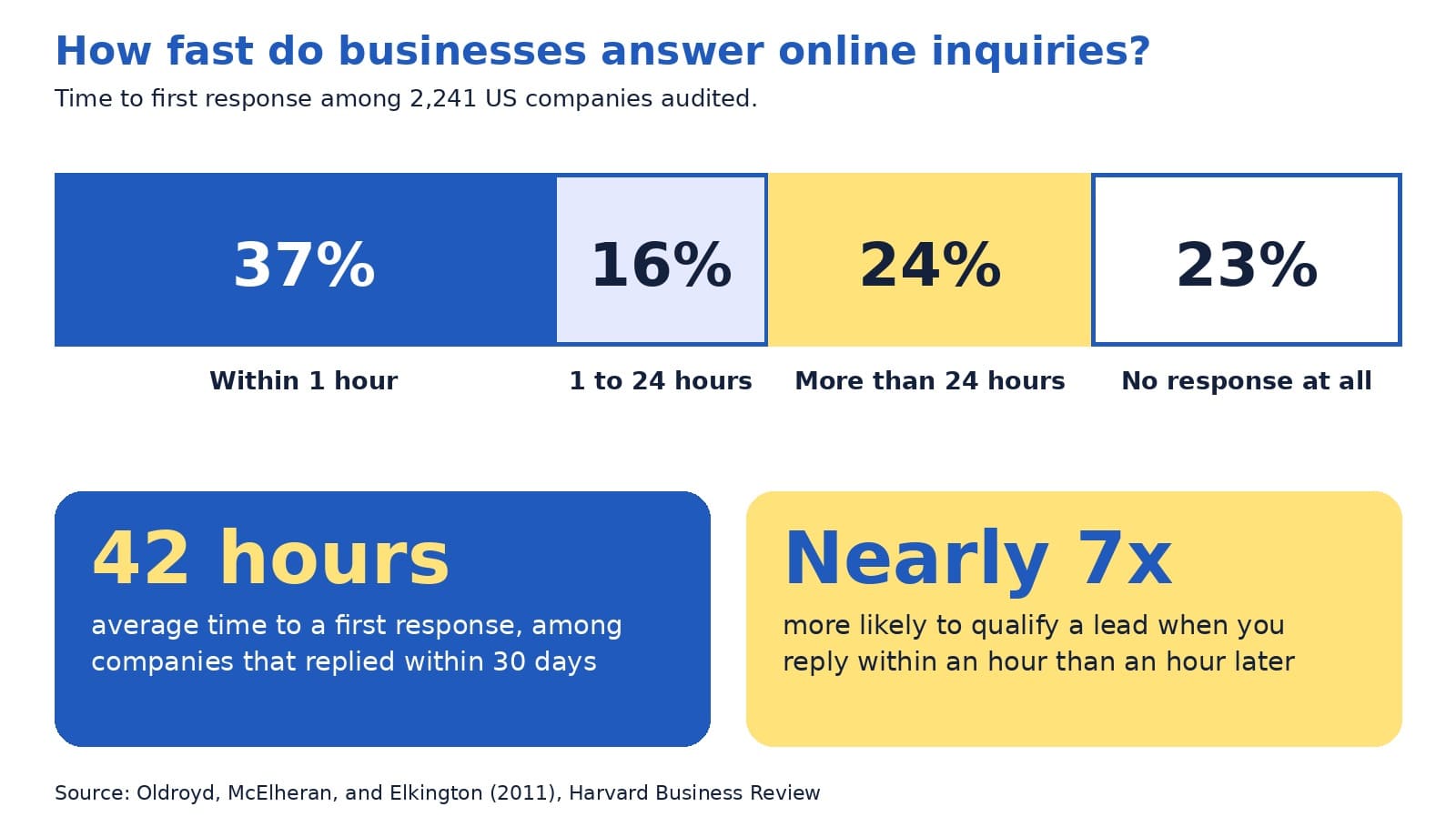
In a Harvard Business Review audit of 2,241 US companies, only 37% answered an online inquiry within an hour, 23% never answered at all, and the average first reply took 42 hours among companies that responded within 30 days (Oldroyd et al., 2011). Behind each of those numbers sat a real person who wanted to buy something.
Every one of those inquiries started on a contact page. A visitor had read enough, decided to reach out, and filled in a form or picked up the phone. That moment is where interest becomes a lead, and it is also where interest can fade. If you want to increase website inquiries, few pages repay your attention more than this one.
A fair caution: the audit is more than a decade old, so treat its exact figures as directional. The lesson still holds up well, and you can check your own numbers in a few minutes.
This guide explains, in plain English, what a good contact page includes, how to design the form, what to show so visitors trust you, and what to do after someone presses send. You will meet the four-R contact page model, see an annotated example, and finish with a 30-minute tune-up you can complete this week.
The quick answer
A good contact page makes it easy to reach you in the way each visitor prefers, asks for only what you need, shows proof that a real and responsive business stands behind the site, and keeps the promise it makes about reply time. A lead generation website works best when the contact page and your follow-up process work as one.
Inside this guide
- Why the contact page matters more than its size suggests
- Key terms in plain English
- The four-R contact page model
- Ready: easy to find and quick to use
- Reach: more than one way to get in touch
- Reassure: show a real business behind the page
- Form design: ask less and label clearly
- An annotated example
- Respond: the part that decides the sale
- A bolder view: the form is a promise, not a button
- Variations by type of business
- Common mistakes and easy fixes
- Quick answers to common questions
- A 30-minute contact page tune-up
Why the contact page matters more than its size suggests
On most websites, the contact page is one of the smallest pages. It is also one of the most important, because the people who reach it have already decided that you might be the right fit. They are no longer browsing. They are deciding whether to take a step toward you.
Many visitors also use the contact page to check that a real business stands behind the site. The Stanford Persuasive Technology Lab, which has published research-based guidelines for web credibility, lists one of them in just six words:
“Make it easy to contact you.”
Stanford Persuasive Technology Lab (n.d.)
The same guidelines explain that clearly showing a phone number, a physical address, and an email address can boost a site’s credibility, and that listing a physical address helps show a legitimate organization is behind the site (Stanford Persuasive Technology Lab, n.d.). In other words, your contact page does two jobs at once: it collects inquiries, and it builds trust before anyone writes a word.
Think of your website as a chain with four links: attract visitors, persuade them, invite them to act, and follow up. The contact page is the third link, and a weak one reduces the payoff from the design, search, and advertising work that came before it.
Key terms in plain English
A few words appear often in this guide. Here is what they mean:
- Lead: a person who has shown interest, such as by sending a message.
- Conversion rate: the share of visitors who take an action. If 100 people visit and 5 send a message, the rate is 5%.
- Call to action: the next step you invite a visitor to take, such as Request Quote.
- Form field: one box in a form, such as Name or Email.
- Tap-to-call link: a phone number that starts a call when tapped on a phone.
- Auto-reply: an automatic message that confirms you received an inquiry.
The four-R contact page model
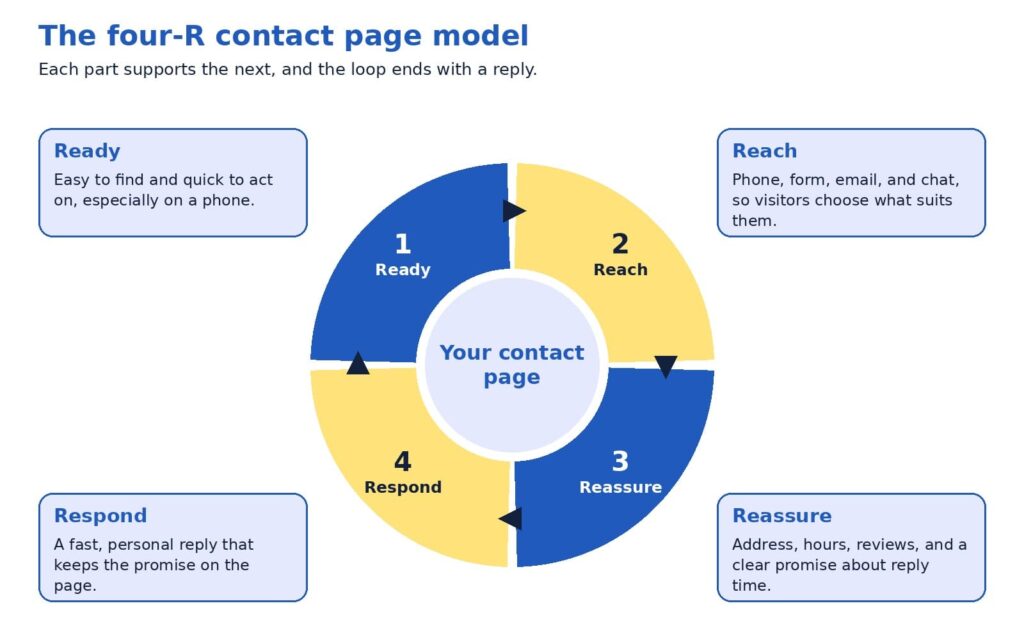
A good contact page is easier to plan when you break it into four parts. We call this the four-R contact page model, and each R answers a question a visitor may be asking.
- Ready: Can I find this page and use it quickly, even on my phone?
- Reach: Can I contact you in the way I prefer?
- Reassure: Is there a real, trustworthy business behind this?
- Respond: Will someone answer me soon, and will I know what happens next?
Most businesses spend their effort on the first two Rs, which are the visible design choices. The last two decide whether the inquiry becomes a customer, and they are the ones that get the least attention. The sections below take each part in turn.
Ready: easy to find and quick to use
Visitors cannot contact you if they cannot find the page. Put a plain Contact link in your main menu, repeat it in the footer, and show your phone number in the header so it is visible on every page. A label such as Contact or Contact us tells visitors exactly what they will find, which is usually better than a creative name.
Once visitors arrive, keep the page focused. Remove sidebars, pop-ups, and long promotional text, because every extra element competes with the one action you want, and make sure the page loads quickly on a phone.
A short form or a clear button at the bottom of each service page also lets a motivated visitor act right away.
Reach: more than one way to get in touch
People differ in how they like to contact a business. Some want to call and hear a voice, some prefer to write a message when it suits them, and some want to book a time on a calendar. A good contact page offers a primary option and one or two alternatives. Typical choices include a phone number with a tap-to-call link, a contact form, an email address, a chat window, and a booking link.
Match the primary option to your business. A heating and cooling contractor whose customers need urgent help may lead with the phone number. A consulting firm whose buyers need to explain a complex project may lead with a form and a calendar link. In both cases, showing the other options costs little and respects each visitor’s preference.
Reassure: show a real business behind the page
At the moment of contact, a visitor often feels a small amount of doubt: will anyone read this message, and is this company legitimate? Reassurance removes that doubt, and the Stanford guidelines point to the ingredients, namely a phone number, a physical address, and an email address (Stanford Persuasive Technology Lab, n.d.).
You can add more. Business hours tell visitors when to expect an answer, and a photo of the person who will reply makes the exchange feel human. A short review or rating near the form shows that others had a good experience, and a one-line privacy note, such as “We use your details only to reply to you,” helps people feel comfortable sharing an email address. Above all, state a clear promise about reply time, as long as you can keep it.
A contact page is a promise. The reply is how you keep it.
Form design: ask less and label clearly
The form is the heart of most contact pages, and research supports keeping it simple. A study by Google’s User Experience Research team and the University of Basel took three real online forms of low, medium, and high quality, improved them using established guidelines, and tested both versions with 65 participants. The improved forms led to faster completion, more successful first-time submissions, and higher satisfaction, and even the high-quality form improved (Bargas-Avila & Seckler, 2014).
The study also points to the changes that mattered most. Participants benefited when rules about format were stated before submission, when error messages appeared next to the field with the problem, and when optional and required fields were easy to tell apart. Placing labels above the fields helped people scan the form with less effort (Bargas-Avila & Seckler, 2014).
For a typical business, a strong starter form has four to five fields: name, email, an optional phone number, and a message box with a prompt such as “How can we help?” If your team qualifies leads, one extra question, such as which service the person needs, can help you reply with the right information. Every additional field gives a visitor another reason to pause, so add one only when your team will use the answer.
A few details finish the job. Use a button label that says what happens next, such as Request Quote or Book Call, and avoid a bare Submit. Keep labels visible above each field, because placeholder text inside a box disappears as soon as someone starts typing.
This also supports accessibility: the Web Content Accessibility Guidelines, a standard published by the World Wide Web Consortium, include a basic requirement that content asking for user input provides labels or instructions (World Wide Web Consortium, 2023).
Finally, choose spam protection that works quietly in the background, so real visitors never need to solve a puzzle.
An annotated example
The mockup below shows how these ideas fit together on one page for a fictional local business. The business name, number, and reviews are illustrative, so please replace them with your own details. The layout uses two columns on a computer, with the form on the left and supporting details on the right, and the same elements stack in one column on a phone.
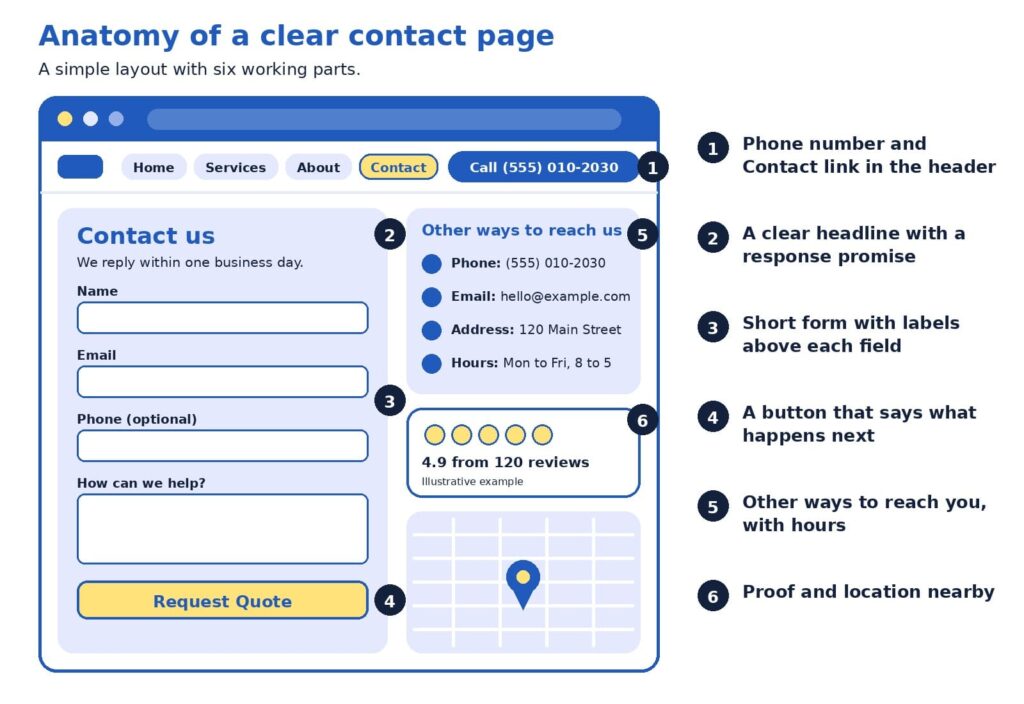
Here is how to read it, following the numbers:
- The header carries a Contact link and a phone number. A visitor on any page can reach you in one tap, which supports Ready and Reach.
- The headline includes a response promise. “We reply within one business day” sets an expectation and shows the business takes inquiries seriously.
- The form is short, with labels above each field. Phone is marked optional, so visitors who prefer email are not blocked.
- The button says what happens next. Request Quote tells the visitor exactly what the click does.
- Other ways to reach you sit beside the form. Phone, email, address, and hours are visible without scrolling, which supports Reach and Reassure.
- Proof and location sit close by. A review rating and a map show a real business that customers have used, which supports Reassure.
Respond: the part that decides the sale
A contact page can be well designed in every way and still lose sales if the reply comes late. The authors of the Harvard Business Review study put it plainly:
“most companies are not responding nearly fast enough”
Oldroyd et al. (2011)
The data behind that conclusion is worth a close look. Among the 2,241 companies audited, 37% responded within an hour, 16% responded within one to 24 hours, 24% took longer than 24 hours, and 23% never responded. The authors also reported, from a companion study of 1.25 million leads, that companies contacting a lead within an hour were nearly seven times as likely to qualify it as companies that waited one more hour, and more than 60 times as likely as companies that waited 24 hours or longer (Oldroyd et al., 2011). Marketers sometimes call this idea speed to lead: the sooner a real person replies, the more likely the conversation continues.
The good news is that a fast reply is mostly a matter of simple habits, and most small teams can build them quickly:
- Show an on-screen confirmation and send an auto-reply that says what happens next.
- Send each inquiry to a person’s phone, and name who is responsible for replying.
- Keep a few friendly reply templates ready, then personalize the first line.
- If the visitor shared a phone number, consider a call as well as an email.
Choose a reply standard that fits your business, such as within one business day or within two hours during opening hours, and publish it only when you can keep it. A modest promise that you meet every time builds more trust than an ambitious one that you miss.
A bolder view: the form is a promise, not a button
Here is a perspective that some marketing teams may hesitate to share, since it does not involve buying anything new: many businesses invest steadily in bringing visitors to the site and then lose some of them in the last step. When the contact page is clear and the reply is quick, each visitor you already attracted has a better chance of becoming a customer, which may make this one of the more cost-effective improvements available.
The most useful test costs nothing. Tonight, fill in your own contact form as a stranger would, using a different email address, and time how long it takes to receive a reply. Do the same on your phone. You will learn whether the form works, whether the message reaches the right person, and how long a real customer waits. Many owners find one surprise, such as a notification that lands in a spam folder.
Variations by type of business
The four Rs stay the same, while the emphasis shifts with the business. A local service company, such as a plumber or a clinic, usually benefits from a prominent phone number, opening hours, a service area, and a map. A business-to-business firm with longer sales cycles often does well with a short form, a calendar link, and a few lines on what happens after the first conversation. An online store sees many existing customers with questions about orders, so a short list of quick answers on shipping and returns above the form can leave the inbox for sales questions.
Common mistakes and easy fixes
Most contact page problems are small, and each one has a simple fix. Here are the ones we see most often:
- The Contact link is hard to find. Place it in the main menu and the footer, outside any dropdown.
- The phone number is an image. Use real text with a tap-to-call link.
- The button says Submit. Name the outcome, such as Send Message or Request Quote.
- The form asks for too much. Keep only the fields your team will use, and mark optional ones.
- Labels live inside the boxes. Placeholder text vanishes when someone types, so keep labels above each field.
- An error clears the form. Keep what the visitor typed, and show the message next to the field to fix (Bargas-Avila & Seckler, 2014).
- Nothing confirms the message. Show a thank-you and send an auto-reply that sets expectations.
- A puzzle blocks real people. Choose spam protection that works quietly in the background.
- Phones were not tested. Check that fields are easy to tap and the button is visible.
- Details differ across the web. Keep your phone, address, and hours consistent on your site, profiles, and listings.
- Notifications go astray. Send them to an address someone monitors, and test monthly.
A quick monthly test, which takes about five minutes, catches most of these problems before a customer does.
Quick answers to common questions
How many fields should the form have? Four or five fits most businesses: name, email, an optional phone number, and a message. Add a question only when your team will use the answer.
Is a contact form or a phone number better? Offering both usually serves more visitors, since some people prefer to talk and others prefer to write.
What should the thank-you page say? Confirm that the message arrived, state when to expect a reply, and offer a next step, such as a link to your case studies. A dedicated thank-you page also lets analytics tools count each submission as a conversion.
How do I know the form works? Submit a test inquiry each month from a computer and a phone, confirm that the notification arrives, and check that the entry appears in your reports.
What about spam? Background spam filters and hidden honeypot fields, which only automated programs fill in, screen out most unwanted messages without troubling real visitors.
Should I ask for a budget? Only if it helps you reply well. Make the field optional and explain why you ask, for example, so you can recommend the right option.
Should I show my full address if I work from home? Not necessarily. If a street address does not suit your privacy needs, a city or service area plus a phone number and email still show a real business.
Do I need live chat? It is optional. Chat suits businesses with someone available to answer during the day, and a clear form with a reliable reply promise may serve others better.
Should the page include a map? A map helps businesses that welcome visitors in person. For online-only businesses, opening hours and a description of the regions you serve are often more useful.
A 30-minute contact page tune-up
You can improve your page this week with a short checklist. Set a timer for 30 minutes and work through it:
- Add or confirm a Contact link in the menu and footer, and a phone number in the header.
- Trim the form to the fields your team uses, and label each one above the box.
- Rename the button so it states the outcome.
- Add your address, hours, and a reply-time promise.
- Submit a test inquiry on a computer and a phone, and time the reply.
Then measure the result. Count the number of contact form submissions and phone calls each month, divide by the number of visitors to the contact page, and watch the rate over time. Even a small improvement compounds, because every future visitor benefits from it.
If you would like a second opinion, send us the link to your contact page. We will review the layout, the form, and the follow-up process, then return a short list of changes ranked by likely impact.
Make the next step easy
A good contact page respects the visitor’s time and the moment of decision. It is easy to find, it offers a choice of ways to reach you, it shows the signs of a real and trustworthy business, and it is backed by a reply that arrives when you said it would. Each of those parts is within reach for a small business, and together they turn more of the visitors you already have into conversations and sales.
Planning a refresh for the whole site? Our web design agency specialists design pages that make contacting you simple, our SEO agency team brings the right visitors to them, and our digital marketing agency services connect the pieces into a steady flow of inquiries. Browse everything we offer on our services page.
References
Bargas-Avila, J., & Seckler, M. (2014, July 14). Simple is better: Making your web forms easy to use pays off. Google Research Blog. https://research.google/blog/simple-is-better-making-your-web-forms-easy-to-use-pays-off/
Oldroyd, J. B., McElheran, K., & Elkington, D. (2011). The short life of online sales leads. Harvard Business Review, 89(3), 28. https://scholarsarchive.byu.edu/facpub/9711
Stanford Persuasive Technology Lab. (n.d.). Stanford guidelines for web credibility. Stanford University. https://credibility.stanford.edu/guidelines
World Wide Web Consortium. (2023). Understanding success criterion 3.3.2: Labels or instructions. https://www.w3.org/WAI/WCAG22/Understanding/labels-or-instructions.html


Get Your Website Problem Fixed Fast
Need Something Fixed on Your Website?
Send us your website. We’ll take a quick look and tell you exactly what’s wrong, no long forms, no sales pitch, just a straight answer.
Send Us Your Website on WhatsApp
or email us your website link instead
What Kind of Problem Are You Dealing With?
If it’s on this list, there’s a good chance we’ve already fixed it for someone else.
- WordPress errors
- Slow website
- Hacked website
- WooCommerce problems
- SSL / DNS issues
- PHP errors
- Google indexing problems
- Hosting migration
Don’t see your issue listed? Send it over anyway, there’s a good chance we can still help.
How It Works
1. Send us your website — just the link and a quick line about what’s going wrong.
2. We take a look — usually within a few hours, not days.
3. We tell you straight — what’s broken, what it’ll take to fix, and what it’ll cost.
No commitment. If it’s a five-minute fix, we’ll just tell you how.
Or Fill the Form Below

How To Find Your Target Audience In 3 Simple Steps
You can have the best-looking website, the smoothest checkout, and a product worth buying — and still struggle to sell, if you’re talking to the wrong people. Most businesses don’t fail because their offer is bad. They fail because they’re marketing to “everyone,” which in practice means marketing to no one.
But here’s what most generic advice on this topic gets wrong: a brand-new startup and an established business are not solving the same problem. A startup has no customers yet, so “finding your audience” means building an educated hypothesis and testing it fast. An established business already has customers — its job is to stop guessing and start reading the data it’s already sitting on. Applying the same playbook to both is why so much of this advice feels vague and unusable.
So this guide splits every step two ways: what to do if you’re just starting out, and what to do if you’re already in the game. Pick the version that matches where you actually are.
Why “Everyone” Is Not an Audience
Before the steps, one reframe worth sitting with: the businesses that win aren’t the ones with the widest audience — they’re the ones who understand a narrower audience deeply enough to speak directly to them. A skincare brand for “everyone” competes with thousands of generic skincare brands. A skincare brand for “working women in Delhi NCR dealing with pollution-related skin issues” has an actual angle — for its messaging, its product positioning, and eventually, its website design and SEO strategy.
This matters more than most founders expect, because your target audience doesn’t just inform your ad targeting — it shapes your website structure, your product photography, your checkout flow, and the keywords you should be ranking for in search. Get the audience wrong, and every downstream decision compounds that mistake.
Step 1: Understand Who You’re Actually Selling To
If You’re a Startup (No Customers Yet)
Without existing customer data, you’re working from hypothesis, not history — and that’s fine, as long as you treat it as a hypothesis to test, not a fact to defend.
Start with these:
- Study your closest competitors’ customers. Look at who’s engaging with their social posts, leaving Google reviews, or commenting on their content. If three competitors’ reviews all mention “fast delivery” and “affordable pricing,” that tells you something about what the market cares about — even before you have a single customer of your own.
- Talk to 10-15 real people who fit your rough idea of a buyer. Not a formal survey — actual conversations. Ask what they currently use to solve the problem your product addresses, what frustrates them about it, and what would make them switch.
- Use search behavior as a signal. Tools like Google Keyword Planner or even Google’s autocomplete will show you what real people are typing when they’re looking for something like what you sell. If people are searching “affordable ecommerce website design Delhi” far more than “custom enterprise ecommerce solutions,” that tells you where the actual demand sits — and that’s a market signal, not a guess.
- Define a narrow starting segment, on purpose. Founders often resist narrowing because it feels like leaving money on the table. In reality, a startup that tries to serve “small businesses, D2C brands, and enterprises” from day one usually serves none of them well. Pick the narrowest group where you can realistically win first.
If You’re an Established Business
You have the one thing a startup doesn’t: real behavioral data. The mistake most established businesses make isn’t a lack of data — it’s never actually sitting down and looking at it.
- Pull your order and customer data. Age range, location, order value, repeat purchase rate, product category preferences. Most ecommerce platforms and CRMs already have this — the data just hasn’t been looked at with fresh eyes.
- Run a simple RFM analysis (Recency, Frequency, Monetary value) if you have enough order history. This separates your one-time bargain shoppers from your loyal repeat buyers — two very different audiences that usually need very different messaging.
- Check your website analytics for behavioral patterns, not just totals. Which landing pages have the highest conversion rate? What device and time of day is your highest-value segment browsing on? Which traffic source — organic search, paid ads, direct — brings in customers who actually stick around?
- Segment, don’t average. If you’re averaging “all customers” into one profile, you’re likely missing that you actually have two or three distinct buyer groups with different needs. A business selling home decor might have both budget-conscious first-time buyers and repeat premium buyers furnishing a whole home — treating them as one audience means your messaging under-serves both.
The core difference here: a startup is building a profile from assumptions and outside signals. An established business is refining a profile from its own transaction history. Neither should stop at guessing — one just has a head start.
Step 2: Build a Usable Customer Profile
Whichever stage you’re at, the next step is the same: turn scattered signals into a short, specific, working profile — not an elaborate persona document with a fake name and a stock photo, but a paragraph you can actually act on.
For Startups
Since you’re working from early signals, keep the profile flexible and mark it as a hypothesis:
“Our initial target customer is a 25-35 year old small business owner in Delhi NCR who currently manages orders manually or through WhatsApp, is price-sensitive but values reliability, and is likely to search for us using terms like ‘affordable website designing company in Delhi’ rather than more generic or enterprise-level search terms.”
Notice this profile is intentionally narrow and includes the language your audience actually uses to search — that detail matters later when you get into SEO and website copy.
For Established Businesses
Your profile should reflect the segments your data actually revealed, not a single blended average:
“Our core high-value segment is a 28-40 year old repeat buyer who purchases every 45-60 days, browses primarily on mobile in the evening, responds well to loyalty offers over discount codes, and came to us originally through organic search rather than paid ads. Our secondary segment is a one-time, price-driven buyer acquired mostly through festive-season sale campaigns, with a much lower repeat rate.”
Two segments, two different strategies — one profile for retention-focused messaging, one for acquisition-focused offers. This is the level of specificity a real customer profile needs; anything vaguer than this won’t actually change how you market or design for them.
Step 3: Test the Profile Against Real Behavior — Don’t Just Trust It
A customer profile, no matter how carefully built, is still a hypothesis until it’s been tested against actual behavior. This is the step almost everyone skips, and it’s the one that separates businesses that keep refining their targeting from ones that lock in a guess and never revisit it.
For Startups
- Run two small ad sets with different messaging aimed at slightly different audience assumptions, and let actual click and conversion data — not opinions in a meeting — decide which one is closer to reality.
- Launch a simple landing page before your full website is even built, and measure sign-ups or interest against the audience segment you targeted to reach it.
- Track where your first 10-20 customers actually came from, and what they say when you ask them directly why they chose you. Early customers are your richest, most underused source of validation.
For Established Businesses
- A/B test messaging across your identified segments, not just across generic “Version A vs Version B” — test whether your loyalty-focused messaging actually performs better with your repeat-buyer segment than a discount-led message does.
- Watch conversion rate by segment, not just overall. An overall conversion rate can look fine while masking that one segment is converting poorly and dragging the average down.
- Re-run this analysis every quarter. Buyer behavior shifts — especially around festive seasons, new competitor entries, or after a website redesign — and a profile built a year ago may no longer reflect who’s actually buying today.
Whatever you learn from testing, feed it back into Step 2. This isn’t a one-time exercise for either a startup or an established business — it’s a loop that should keep tightening the more real data you collect.
Common Mistakes Businesses Make at Both Stages
- Confusing “who we want to sell to” with “who actually buys from us.” Founders in particular often build a profile around their ideal customer rather than the one showing up in the data or the early signals.
- Treating the target audience as a one-time exercise. A profile defined at launch and never revisited becomes stale fast — especially for a business scaling quickly or entering a new city or category.
- Building the website before the audience is defined. This is one of the most common and costly sequencing mistakes. A generic template built before you understand your buyer usually needs a costly rebuild later, once real data shows who’s actually converting and who isn’t.
- Ignoring the language your audience actually searches with. Businesses often write website copy in the language they use internally, not the language customers use to search — a gap that quietly costs both conversions and search visibility.
Why This Matters Beyond Marketing
Knowing your target audience shouldn’t just shape your ad campaigns — it should directly shape your website and your search strategy, because that’s where most of your audience will actually meet your business for the first time.
A website built for a price-sensitive, deal-driven audience needs a fast, low-friction checkout, prominent offers, and trust signals like reviews right up front. A website built for a premium, trust-driven audience needs high-quality visuals, clear policies, and a slower, more considered browsing experience. If your site was built as a generic template rather than around how your specific audience actually browses and decides, that mismatch shows up directly in your conversion rate — no amount of ad spend fixes a website that doesn’t speak to the people landing on it.
The same logic applies to search visibility. Once you know the exact language your audience uses — “affordable,” “custom,” “near me,” “best,” “agency” — that vocabulary should show up in your website’s headings, page copy, and metadata. This is where a defined audience and a real SEO strategy start working together instead of pulling in different directions.
Two Worked Examples
Abstract advice is easy to nod along to and hard to apply. Here’s what this looks like in practice for each stage.
Startup Example
Imagine a founder launching a D2C brand selling organic skincare, with no customers yet. Following Step 1, they study three competitor brands’ Instagram comments and Google reviews, and notice a recurring theme: buyers repeatedly mention “sensitive skin” and “pollution damage” rather than generic beauty concerns. They also run a quick search on Google Keyword Planner and find that “organic skincare for pollution Delhi” gets meaningful search volume, while a broader term like “best skincare brand India” is dominated by large, established players they can’t realistically outrank yet.
Based on this, their Step 2 profile becomes: “Working women, 25-40, in Delhi NCR, dealing with visible skin damage from pollution and long commutes, currently using generic drugstore products, willing to pay a premium for a product that specifically addresses this problem.”
For Step 3, instead of building a full ecommerce site immediately, they launch a single landing page focused on this exact positioning, run two small ad sets — one emphasizing “organic ingredients,” the other emphasizing “pollution protection” — and let the data decide. The pollution-focused messaging converts nearly twice as well. That result doesn’t just inform the ad copy going forward — it tells them their entire website homepage, hero section, and even product naming should lead with pollution protection, not generic “organic” positioning.
Established Business Example
Now imagine a business that’s been selling home furnishings online for four years, with a decent customer base but flat growth. Following Step 1, they pull two years of order data and run a basic RFM analysis. It reveals something they hadn’t noticed: 60% of revenue comes from a relatively small group of repeat buyers who order every 2-3 months, while the much larger group of one-time buyers acquired through festive sales rarely returns.
Their Step 2 profile now splits into two: a high-value repeat segment that values curation and loyalty perks over discounts, and a low-retention, price-driven segment acquired mostly through sale campaigns. Previously, all of their marketing and website messaging had been built around discounts and sales — which was actively working against their most valuable segment.
For Step 3, they test loyalty-focused messaging and an early-access program specifically with the repeat-buyer segment, while keeping discount-led campaigns for new-customer acquisition. Within one quarter, repeat purchase rate among the loyalty segment increases measurably. The next logical step, which they hadn’t previously considered, is redesigning parts of their website — a dedicated loyalty program page, curated collections for repeat visitors — because the audience data revealed a segment the existing site wasn’t serving at all.
Both examples follow the same three steps. Neither one is a lucky guess — both come from treating the audience-finding process as something to build, test, and revise, not something to assume once and move on from.
Quick FAQ
How often should I revisit my target audience definition?
For a startup, revisit it after every major test or campaign in the first six months — your early data will shift quickly. For an established business, a quarterly review is usually enough, with a deeper look whenever you notice growth flattening or a new competitor entering your space.
Can a business have more than one target audience?
Yes, and most established businesses do — the mistake is treating multiple audiences as one blended average instead of building distinct messaging, and sometimes distinct website pages, for each meaningful segment.
What’s the biggest sign a business hasn’t actually defined its target audience?
Website copy and ad messaging that reads as generic — speaking to a broad category of buyer rather than a specific person with a specific problem. If your homepage could belong to almost any competitor in your space with a logo swap, that’s usually the clearest sign.
Bringing It Together: From Audience to Website to Visibility
Here’s how the three pieces connect in practice:
- You define your audience (startup: hypothesis-driven; established business: data-driven).
- Your website is designed and written around that specific audience — its language, its priorities, its buying behavior — not a generic template.
- Your SEO strategy targets the exact terms that audience is searching, so the right people find that website in the first place.
Skip any one of these three, and the other two lose most of their effectiveness. A perfectly targeted ad campaign sending traffic to a generic website converts poorly. A beautifully designed website that isn’t optimized for the terms your audience searches never gets found. And a strong SEO strategy targeting the wrong keywords brings in visitors who were never your audience to begin with.
If you know your audience but your website wasn’t built with them in mind, that’s a design problem worth solving before spending another rupee on ads. As a website designing company in Delhi, we build sites around who’s actually going to buy from you — not a generic template retrofitted after the fact.
And if your website is right but the right people still aren’t finding it, that’s where the right SEO agency in Delhi comes in — making sure your site shows up for the exact searches your defined audience is already running.
Whether you’re validating your first customer segment as a startup, or refining years of buyer data as an established business, the goal is the same: stop guessing, start testing, and build everything downstream — website, content, and search strategy — around the audience the data actually points to.

B2B Search Engine Marketing: 3 Ways to 10X Visibility Before Your Competitors Even Notice
TL;DR: Most B2B companies are still fighting over search traffic that stopped converting years ago. Zero-click results, AI Overviews, and 10-month buying cycles have quietly rewritten the rules of B2B search engine marketing. The businesses pulling ahead in 2026 aren’t the ones publishing more blog posts or bidding on more keywords. They’re the ones running what we call the Compound Visibility Loop — a three-part system that stacks paid intent capture, AI citation, and account-based retargeting into one engine instead of three disconnected budgets. This article breaks down exactly how it works, backed by current research, and shows you how to build it for your own pipeline.
In This Blog:
- Why traditional B2B SEM is quietly losing its grip — and the real data behind it
- The Compound Visibility Loop: our proprietary 3-part framework for 2026 search visibility
- Way #1: Bidding on bottom-funnel intent instead of chasing volume
- Way #2: Structuring content so AI engines cite you (and why this multiplies your ad performance)
- Way #3: Retargeting the buying committee, not the browser
- A controversial but accurate take on where B2B ad budgets should actually go in 2026
- A practical starting checklist you can run this quarter
Here’s a number that should make every B2B marketing leader sit up: 74% of high-intent B2B research searches now end without a single click, and when Google slots an AI Overview above the results, that number climbs to 83% (Onely, 2026; LinkedIn/ie.linkedin.com, 2026). Read that again. Roughly eight out of every ten searches your ideal customer runs about a problem you solve never turn into a visit to your website. Not because they’re not interested. Because the answer got handed to them before they had a reason to click.
If your search strategy hasn’t changed in the last eighteen months, you are almost certainly bidding on keywords, writing content, and reporting on click-through rates the way everyone did in 2022. And that’s the real problem this article is here to solve. Not with fear, because panic never grew a pipeline. With a framework you can actually run, starting this week, that treats search as one connected system instead of three separate budgets fighting for the same buyer’s attention.
Why “More Keywords, More Budget” Stopped Working
For a long time, B2B search engine marketing was a fairly simple game. You picked keywords your buyers typed into Google, you wrote a landing page, you bid on the terms, and you counted the leads. That game still exists, but the board has changed shape underneath it. Search behavior has fragmented across ChatGPT, Perplexity, Google’s AI Overviews, and traditional blue links, and the buyer who used to click ten links before picking up the phone now often gets a synthesized answer and moves on with barely a trace left in your analytics dashboard.
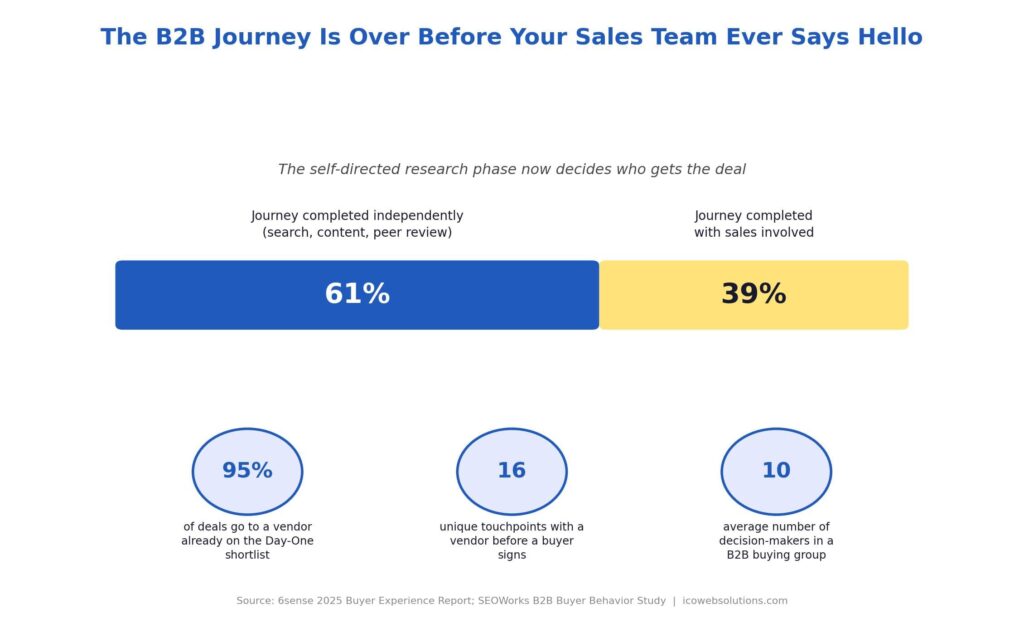
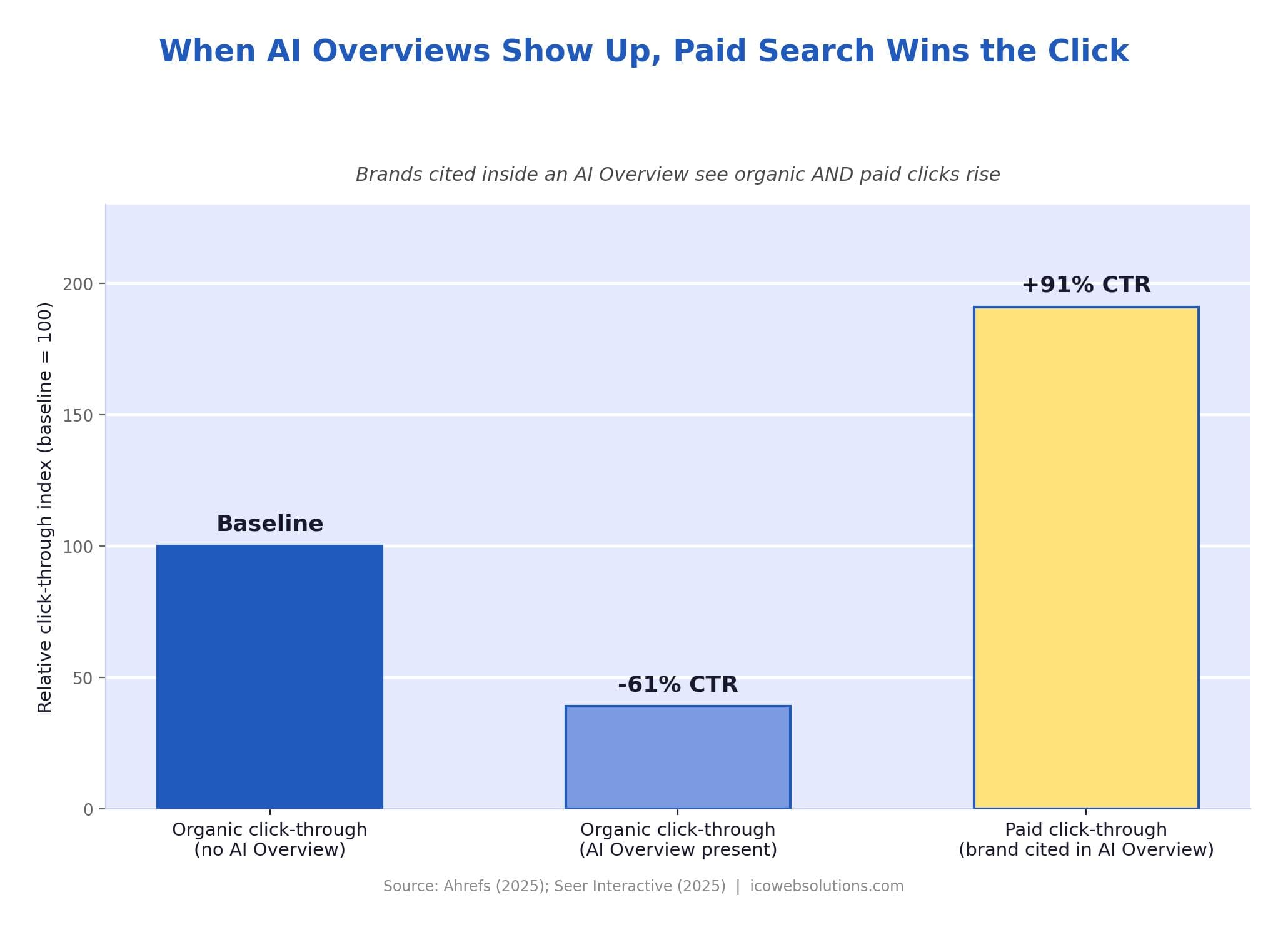
The scale of this shift is genuinely surprising once you look at the research directly. Google’s AI Overviews now show up on a large share of informational queries, and when they appear, organic click-through rates fall by around 61% according to Seer Interactive’s 2025 study (WhiteHat SEO, 2026). At the same time, the buying journey itself has compressed. The 2025 6sense Buyer Experience Report, based on more than 4,000 buyers across North America, EMEA, and APAC, found that the split between independent research and seller engagement has moved from a 70/30 balance to 60/40, and that average buying cycles shortened from about eleven months to ten (Business Wire, 2025). Buyers are deciding earlier. They’re doing it with less visible search behavior. And they’re doing it across more devices and assistants than a single campaign can realistically track.
None of this means B2B search engine marketing is dead. It means the old scoreboard — rankings, impressions, raw click volume — no longer tells you the truth about whether you’re winning. That’s exactly where our framework comes in.
Our Take: Stop Treating SEO and PPC as Two Different Budgets
Here’s the part of this article most agencies won’t say out loud, because it’s a little uncomfortable for anyone selling “SEO packages” and “PPC management” as separate line items. In B2B, search engine optimization and paid search are no longer two channels. They are two hands doing the same job, and treating them as competitors for budget is quietly costing you pipeline.
The evidence for this is stronger than most marketers realize. Research from Ahrefs found that brands cited inside an AI Overview see paid clicks increase by roughly 91%, and organic clicks increase by about 35%, compared to brands that don’t earn a citation (WhiteHat SEO, 2026). In other words, the same piece of content that gets you cited by an AI engine also makes your paid ads perform better, because the buyer has already seen your name once before they see your ad. Visibility compounds. It doesn’t sit in silos.
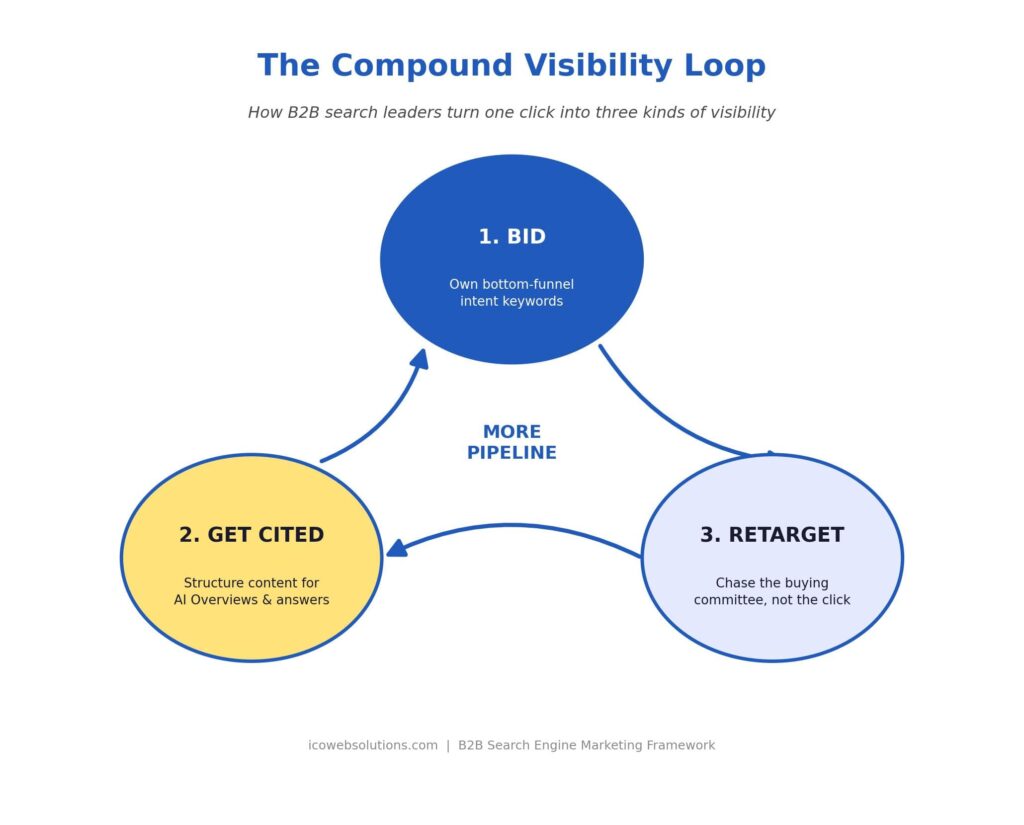
This is the idea behind what we call the Compound Visibility Loop — a framework built specifically for how B2B buyers actually behave in 2026, not how they behaved when most SEM playbooks were written. It has three connected moves, and each one makes the next one cheaper and more effective. Let’s walk through all three.
Way #1: Bid on Bottom-Funnel Intent, Not Search Volume
Most B2B paid search accounts we review are still built around volume. Big, broad keywords with a lot of monthly searches, because volume feels safe and easy to report on. But volume is exactly the part of search that’s disappearing into zero-click results and AI summaries. The clicks that remain, and remain valuable, are the ones tied to real buying intent: comparison terms, “vs” searches, pricing questions, category-specific software or service terms, and branded competitor searches from people actively shortlisting vendors.
This matters because the research shows something reassuring buried inside the scary zero-click headlines. Zero-click behavior is eating the shallow, informational end of search — the “what is” and “how does X work” queries that were never going to convert well anyway. High-stakes, high-consideration B2B decisions still involve real digging, because no AI Overview is going to get a procurement director to sign off on a six-figure contract based on a two-sentence summary (Redevolution, 2026). That’s your opening. Bottom-funnel B2B search intent is exactly the kind of search that still results in a genuine click, a genuine visit, and a genuine conversation with your sales team.
Cost per click across Google Ads has climbed to an average of $5.26, up from $4.66 the year before, and conversion rates have actually improved to around 7.5% to 8.2% as advertisers get smarter about targeting (Search Engine Land, 2025). That tells you cheap, broad traffic is genuinely going away, but advertisers who tighten their targeting are converting better than ever. The lesson isn’t to spend less. It’s to spend on the 20% of searches that were always going to close deals, instead of the 80% that were always going to bounce.
A few practical shifts make this real:
- Redirect budget away from broad, top-of-funnel keywords and into comparison, alternative, and pricing-intent terms where your buyer has already done the education phase
- Bid aggressively on your own branded terms and your top two or three competitors’ branded terms, since 92% of B2B buyers start research with a specific vendor already in mind and you want to be the alternative they consider (SEOWorks, 2026)
- Build landing pages for each intent cluster instead of sending every click to the same generic homepage, since specificity is what turns a click into a form fill
- Track cost per qualified lead, not cost per click, as your primary success metric going forward
None of this is about abandoning awareness-stage marketing altogether. It’s about being honest with yourself that awareness-stage paid search, in a world of AI Overviews and 61% CTR drops, is often lighting money on fire. Bottom-funnel intent is where B2B SEM still earns its budget line, and it’s the first move in the Compound Visibility Loop.
Also read: LinkedIn Thought Leadership for B2B Founders: The Framework That Turns Posts into Pipeline
Way #2: Get Cited by AI Engines, Not Just Ranked by Google
Here’s where most B2B marketing teams are behind, and it’s genuinely not their fault, because this shift happened fast. Ranking on page one of Google used to be the finish line. Now it’s just one of several places your buyer might encounter your brand, alongside ChatGPT, Perplexity, and Google’s own AI Overview panel. Being cited as a source inside those AI-generated answers is quickly becoming more valuable than holding the number one organic position, because that citation is what plants your brand name in a buyer’s head before they’ve clicked anything at all.
The mechanics of earning that citation are different from classic SEO, and this is genuinely good news, because it rewards clarity over cleverness. Content that answers a question directly in the first paragraph, uses clean definitions, comparison tables, and FAQ-style structure, gets cited far more often than dense, keyword-stuffed articles written primarily to rank. One industry analysis found that restructuring content into these semantic answer fragments increased share-of-answer visibility by roughly 40% (GrackerAI, 2026). Another cross-account study across 250-plus B2B SaaS companies found that campaigns built around answer-first, conversational content saw 47% higher visibility inside AI search engines compared to traditional keyword-first content (Triple Dart, 2026).
And here’s the part that ties this back to your ad spend directly: getting cited doesn’t just help your organic presence. It makes your paid search dollars work harder too. Remember that 91% lift in paid click-through rate for brands cited in AI Overviews. That’s not a coincidence. When a buyer sees your name in an AI-generated answer and then sees your ad ten minutes later on a comparison search, you’re no longer a stranger asking for a click. You’re a name they already half-recognize, which is exactly the kind of familiarity B2B buyers say they want before they’ll engage with a vendor at all.
Practical ways to start earning AI citations this quarter:
- Rewrite your most important service and comparison pages so the direct answer appears in the first two sentences, before any preamble
- Add FAQ sections with FAQPage schema markup to your highest-intent pages, since structured data is what AI crawlers use to extract clean answers
- Build genuine comparison content (you vs competitor, category A vs category B) instead of only “what is” explainer content, since comparison queries are where B2B buyers are still clicking through
- Earn mentions on LinkedIn, Reddit, and industry publications, since roughly a third of AI citations trace back to traditional search visibility while a meaningful share also comes from social platforms and press coverage (SyncGTM, 2026)
This is not a replacement for paid search. It’s fuel for it. Treat your content and your ad accounts as one team working toward the same citation, and you’ll see both channels get cheaper and more effective at the same time.
Way #3: Retarget the Buying Committee, Not Just the Browser
This is the move most B2B companies skip entirely, and it’s arguably the one with the highest return, because it acknowledges a simple truth about B2B buying: the person who clicked your ad is rarely the only person who needs to say yes. The average B2B buying group now involves around ten unique decision-maker functions, and buyers report an average of sixteen distinct interactions with a vendor before they finally sign (SEOWorks, 2026). A single click from a single stakeholder was never going to be enough, and treating it as the end goal of your SEM campaign is leaving pipeline on the table.
The good news is that this compression of the buying journey, while it looks intimidating in the aggregate statistics, is actually an opportunity if you build for it deliberately. Ninety-five percent of the time, the vendor that eventually wins the deal was already on the buyer’s day-one shortlist, and the first-choice vendor on that list wins roughly 80% of the time (SEOWorks, 2026). That means the goal of your search engine marketing isn’t just “get a click.” It’s “become impossible to forget across every stakeholder who touches this decision,” so that when the shortlist gets written, you’re already on it.
Retargeting built for a committee, rather than an individual, looks different from a standard remarketing campaign. It’s less about chasing one visitor around the internet with the same banner ad, and more about layering sequential messages that speak to different roles across the buying group over the following weeks. A technical evaluator needs proof points and integration detail. A finance stakeholder needs cost-of-inaction framing. An executive sponsor needs a fast, confident summary. Feeding all three the same generic “come back and buy” ad wastes the budget you just spent earning that first visit.
- Build LinkedIn retargeting audiences segmented by job function, not just by page visited, so a technical buyer and a finance buyer see genuinely different follow-up messaging
- Sequence your display and LinkedIn ads over a three-to-four week window rather than showing the same static ad on a loop, matching the pace of a real evaluation cycle
- Layer in account-based display advertising for named target accounts once they show research intent, so multiple stakeholders inside the same company see consistent, coordinated messaging
- Feed your sales team a simple visibility report of which accounts are engaging across search, LinkedIn, and your site, so outreach happens while interest is warm, not weeks after it’s gone cold
Put together, these three moves are what we mean by the Compound Visibility Loop. Bidding on real intent gets you the first click. Getting cited by AI engines makes that click cheaper and more trusted. Retargeting the full committee turns one click into the sixteen touches it actually takes to close a B2B deal. Run all three together, consistently, and you’re not just optimizing a channel. You’re building a visibility system that keeps paying you back long after the individual ad has stopped running.
Also read: State of B2B Websites: Survey Report
Building a Stronger Brand Through Strategic B2B Web Design
What This Actually Means for Your Budget This Quarter
If you take one thing away from this article, let it be this: the businesses that will win B2B search visibility in 2026 are not the ones spending the most. They’re the ones spending on the right 20%, structuring content so machines can quote them accurately, and following through with every stakeholder in a deal instead of stopping at the first click. That’s genuinely encouraging news if you’ve been feeling like your search budget has gotten less effective lately. It’s not that the game got harder in some unbeatable way. It’s that the scoreboard changed, and most competitors haven’t noticed yet.
That gap is your advantage, and it won’t stay open forever. Every month that passes, more B2B marketing teams read this same research and start rebuilding their search strategy around it. The companies moving now, while a lot of their competitors are still bidding on the same broad keywords they used in 2022, are the ones who’ll own the AI citations, the bottom-funnel bids, and the retargeting sequences that quietly decide who makes the shortlist a year from now.
If you’d rather not rebuild this alone, that’s exactly what our team at ICO WebTech does for B2B companies every day. We audit your current search accounts and content, map out where you’re losing visibility to AI Overviews and zero-click results, and build a Compound Visibility Loop strategy specific to your buying committee and your sales cycle. Book a free 30-minute B2B search visibility audit with our team today, and we’ll show you exactly which keywords, pages, and audiences are costing you pipeline right now — no generic template, just a plan built around your numbers.
A Quick Checklist to Start This Week
Before you go, here’s a short, honest checklist you can run through this week without waiting for a full strategy overhaul. Pull your last 90 days of Google Ads data and flag which keywords are broad, top-of-funnel terms rather than comparison or pricing-intent terms, then shift ten percent of that spend toward the intent-driven terms and watch what happens to your cost per qualified lead.
Open your three highest-traffic service pages and check whether the direct answer to the page’s main question appears in the first two sentences; if it’s buried in paragraph four, that’s costing you AI citations.
And finally, look at your retargeting audiences and ask honestly whether you’re speaking to one persona or several, because if every visitor sees the same ad regardless of role, you’re leaving most of the buying committee cold.
None of these three moves require a bigger budget. They require a different lens on the budget you already have. That’s the whole point of the Compound Visibility Loop, and it’s the exact system we’d love to help you put in place.
Sources
- Business Wire. (2025, November 12). The timeline for influencing B2B buyers is shrinking: Insights from 6sense’s 2025 Buyer Experience Report. https://www.businesswire.com/news/home/20251112018032/en
- Focus Digital. (2025, July). Average Google Ads cost per click by industry: 2025 report. https://focus-digital.co/?p=6055
- GrackerAI. (2026). GEO: Winning zero-click AI search. https://gracker.ai/static/GEO%20Winning%20Zero-Click%20AI%20Search.DrChv2D-.pdf
- Onely. (2026). Zero-click dominates: The new reality for B2B SEO strategy. https://onely.com/blog/proven-b2b-seo-strategies
- Redevolution. (2026). Zero-click search: What 68% really means for B2B marketers. https://www.redevolution.com/blog/zero-click-search-what-68-really-means-for-b2b-marketers
- Search Engine Land. (2025). Google Ads costs keep rising, but conversion rates improved in 2025. https://searchengineland.com/google-ads-costs-keep-rising-but-conversion-rates-improved-in-2025-477927
- SEOWorks. (2026). B2B buyer behavior statistics. https://www.seoworks.co.uk/downloads/b2b-buyer-behavior-statistics/
- SyncGTM. (2026). How AI influences organic search traffic and lead gen: Key insights for B2B teams (2026). https://syncgtm.com/blog/how-does-ai-influence-organic-search-traffic-and-lead-gen
- Triple Dart. (2026). AI in SEO. https://tripledart.com/b2b-seo/ai-in-seo
- WhiteHat SEO. (2026). Embracing AI in SEO. https://whitehat-seo.co.uk/blog/embracing-ai-in-seo

Scaling to Thousands of Pages: The Power of Programmatic SEO
There is a point in the growth of almost every successful online business when traditional SEO starts to reach its limits. A company may have a strong website, a well-researched keyword strategy, useful blog content, technically sound pages, and a capable SEO team, yet there are still thousands of highly relevant searches that remain untouched. The problem is not always a lack of ideas. More often, it is a problem of scale.
Imagine a real-estate platform operating across hundreds of cities and thousands of neighborhoods. It may want to create useful pages for property buyers searching for homes in Delhi, apartments in Gurgaon, luxury properties in Mumbai, flats for sale in Noida, rental properties in Bangalore, and hundreds of other combinations. Creating every page manually would take an enormous amount of time. Even if a team could produce hundreds of pages every month, the process would quickly become expensive, difficult to maintain, and increasingly repetitive.
This is where programmatic SEO changes the equation.
Programmatic SEO allows businesses to create large numbers of search-engine-optimized pages using structured data, reusable templates, intelligent content systems, and carefully designed website architecture. Instead of treating every page as a completely separate editorial project, businesses create a scalable system capable of producing genuinely useful pages for specific searches.
When implemented correctly, programmatic SEO is not simply a method for producing thousands of pages. It is a way of building an SEO infrastructure that can grow alongside a business.
A well-designed programmatic SEO system can take information from a database, combine it with carefully developed templates, add unique contextual information, apply appropriate metadata, generate internal links, create relevant page structures, and publish thousands of landing pages without requiring an SEO professional to manually build each page.
However, there is an important distinction between scalable SEO and mass-produced SEO spam. Simply creating thousands of pages by replacing a city name or keyword inside the same paragraph is not a sustainable strategy. Search engines have become increasingly sophisticated at recognizing pages that provide little independent value. Users are equally good at recognizing them. If ten thousand pages look almost identical and offer nothing useful beyond a changed keyword, the website may end up with thousands of URLs but very little meaningful organic visibility.
The real power of programmatic SEO comes from combining automation with quality.
For businesses working with an experienced SEO company in India or a professional SEO agency, programmatic SEO can become one of the most powerful ways to expand organic search coverage. It can help businesses target location-based searches, service variations, product combinations, industry-specific queries, directories, comparison searches, marketplace queries, and many other search patterns that would be impractical to address manually.
This article explores how programmatic SEO works, why businesses need it, how scalable landing-page architectures are designed, how databases and templates work together, what makes programmatic pages genuinely valuable, what common mistakes businesses should avoid, and how companies can build a programmatic SEO strategy capable of supporting thousands or even millions of pages.
Understanding Programmatic SEO
Programmatic SEO can sound highly technical at first, but the underlying idea is relatively simple. Instead of manually creating every page on a website, a business creates a repeatable system that can generate pages based on structured information.
Consider a business directory containing information about thousands of companies. Each company may have a name, location, category, services, contact details, operating hours, description, ratings, and other attributes. Rather than manually designing an individual webpage for every company, the website can use a standard page template that pulls the relevant information from its database.
The same concept can be applied to SEO landing pages.
A website may have a database containing cities, neighbourhoods, services, industries, products, property types, destinations, or other entities. A page-generation system can combine these data points according to predefined rules and create relevant landing pages around them.
For example, an SEO agency serving businesses across India might have service data and location data that allow it to create genuinely useful pages such as website design company in Delhi, ecommerce development company in Mumbai, SEO services in Bangalore, WordPress development company in Hyderabad, and many other combinations.
The objective is not simply to create a page for every possible combination. The objective is to identify combinations that represent real user demand and then build useful pages around them.
This distinction is fundamental.
Programmatic SEO should be thought of as a system for matching structured user intent with structured business information. Automation is merely the mechanism that makes the system scalable.
Why Traditional SEO Eventually Runs Into a Scaling Problem
Traditional SEO often begins with a relatively straightforward process. An SEO team conducts keyword research, identifies important topics, creates a content brief, writes a page, optimizes the title and headings, adds internal links, publishes the page, and monitors its performance.
This works extremely well when a business has a manageable number of important topics.
Suppose a company needs twenty service pages. A content team can research and write twenty pages. If the company needs fifty pages, the project is still manageable. Even one hundred pages can be handled with sufficient resources.
The challenge appears when the opportunity contains thousands of closely related but individually valuable searches.
A real-estate platform might theoretically need pages for thousands of locations. A travel website might need destination pages for hundreds of cities combined with thousands of hotel or activity categories. A job portal may need pages for different combinations of job titles, locations, industries, experience levels, and employment types. An ecommerce marketplace may need pages for products, brands, categories, specifications, and combinations of filters.
Manually producing all of these pages becomes inefficient.
The problem is not only writing. Every page requires planning, formatting, publishing, optimization, linking, indexing, monitoring, updating, and maintenance. As the number of pages increases, the operational burden grows quickly.
This is where programmatic SEO provides leverage.
Instead of adding SEO pages one by one, a business can create a framework capable of generating many pages from the same underlying data architecture. The SEO team can then spend more time defining the strategy, improving templates, enriching the data, evaluating search intent, and monitoring quality.
In other words, programmatic SEO shifts SEO from a page-production model to a system-building model.
The Difference Between Programmatic SEO and Automatically Generated Spam
One of the biggest misconceptions about programmatic SEO is that it means generating thousands of pages automatically and filling them with AI-written or duplicated text.
That is not what successful programmatic SEO looks like.
A page can be technically unique while still being practically useless. Changing “Delhi” to “Mumbai” in an otherwise identical paragraph does not necessarily create a valuable Mumbai page. Similarly, replacing “apartments” with “villas” in a generic description does not automatically create a useful property page.
High-quality programmatic SEO requires meaningful differentiation.
A location page should contain information that is actually relevant to that location. A product page should contain meaningful product information. An industry page should address the specific needs of that industry. A service-location page should explain how the service applies in that particular market.
The page should answer a question the user genuinely has.
This is why the database behind a programmatic SEO system matters so much. The quality of the final pages can never consistently exceed the quality of the information feeding the system.
If the database contains rich, accurate, structured information, the website has the raw material needed to create useful pages. If the database contains only a list of city names and a generic paragraph, the resulting pages are likely to be thin regardless of how sophisticated the automation appears.
Where Programmatic SEO Works Best
Programmatic SEO is particularly effective when a business has a large number of entities or combinations that follow a predictable structure.
Location-based businesses are one of the clearest examples. A company may operate in dozens, hundreds, or thousands of locations and want to establish organic visibility for searches related to each market.
Directories are another natural fit. A directory may contain thousands of companies, professionals, restaurants, hotels, properties, schools, or other entities. Each entity can have its own optimized page populated from structured data.
Marketplaces can also benefit significantly. A marketplace may have tens of thousands of products or listings, each with attributes such as brand, category, price, specification, location, availability, and condition.
Job portals are another excellent example. Users may search for combinations such as software developer jobs in Delhi, digital marketing jobs in Mumbai, remote Python developer jobs, senior finance jobs, or entry-level marketing positions. The underlying database naturally contains the variables needed to create useful landing pages.
Travel websites can create destination pages, hotel pages, attraction pages, neighborhood pages, activity pages, and combinations of these entities.
Real-estate websites can create pages based on location, property type, price range, bedroom count, furnishing status, project type, developer, and other meaningful attributes.
The common thread is structured information combined with predictable search demand.
The Role of Search Intent in Programmatic SEO
Before creating a programmatic SEO architecture, a business needs to understand why people are searching for the pages it wants to create.
Search intent should determine the page structure, not simply the keyword.
For example, someone searching for “apartments for rent in Gurgaon” probably expects to see available apartments, neighbourhood information, price ranges, property details, and filters. A generic 700-word article about Gurgaon real estate would not satisfy the same intent as effectively.
Similarly, someone searching for “SEO company in India” may want to understand SEO services, compare agencies, review expertise, examine industries served, understand pricing considerations, and ultimately contact a provider. A page built around that intent should be structured accordingly.
Programmatic SEO becomes much stronger when the architecture mirrors the way users search.
The first question should therefore not be “How many pages can we generate?” It should be “Which distinct searches deserve their own useful experience?”
That question prevents one of the most common programmatic SEO mistakes: generating pages simply because a combination exists in a database.
Building the Database Behind a Programmatic SEO System
The database is the foundation of a scalable SEO architecture.
A website might have a locations table containing countries, states, cities, neighborhoods, postal regions, or other geographic entities. It might have a services table containing the products or services offered by the company. It could also have industries, product categories, property types, job categories, or other variables depending on the business model.
These entities can then be connected through relationships.
For example, a digital marketing company might maintain structured information about its services and locations. The service database could contain SEO, PPC, content marketing, website development, ecommerce development, and social media marketing. The location database could contain Delhi, Mumbai, Bangalore, Hyderabad, Chennai, Pune, Ahmedabad, and other cities.
But simply combining every service with every city would create an enormous number of URLs. Some combinations may have no meaningful search demand or business relevance.
A better system stores additional information such as target keyword, search volume, competition, business availability, service relevance, location relevance, unique content elements, page status, indexing priority, and canonical rules.
This allows the SEO system to make intelligent decisions about which pages should exist.
The database therefore becomes more than a content repository. It becomes part of the SEO decision-making infrastructure.
Creating the Page Template
Once the data architecture is established, the next major component is the page template.
A programmatic template defines the structure shared by a group of pages. It can contain a page title, introduction, service description, location information, relevant statistics, FAQs, related services, testimonials, internal links, calls to action, structured data, and other components.
The template provides consistency while the data provides differentiation.
For example, a location-service page might have a structure containing an introduction to the service in the target location, an explanation of relevant local requirements, available services, industries served, examples of work, local considerations, FAQs, and related locations.
The important point is that not every section has to be identical.
Some sections can be shared structurally while their content changes according to the database. Other sections can appear only when relevant information exists.
This creates a dynamic page experience rather than a simple mail-merge document.
How a Database-Backed Page Is Generated
Imagine a real-estate platform with 5,000 target locations.
Each location in the database might contain a location name, geographic coordinates, property inventory, average prices, popular neighbourhoods, property types, nearby landmarks, transportation information, local market trends, and available listings.
The programmatic page template can pull this information dynamically.
When a user visits a page for a specific location, the website retrieves the relevant information and assembles the page. The title references the location. The introduction discusses the local market. Property listings are drawn from that location. Neighborhood information is specific to the area. Internal links point to nearby locations and relevant property categories.
Although the page follows a common design system, its actual usefulness is derived from the underlying data.
At this point, programmatic SEO becomes much more than automated content generation. It becomes automated information architecture.
Why Unique Content Matters at Scale
One of the most difficult aspects of programmatic SEO is producing sufficient uniqueness without creating meaningless variations.
Uniqueness should not be measured only by whether sentences are technically different. The more important question is whether the page contains unique information, context, and value.
A location page can be unique because its listings, market statistics, neighborhoods, local regulations, transport information, and recommendations are different.
A product page can be unique because the specifications, compatibility information, images, pricing, reviews, and use cases are different.
An industry page can be unique because the challenges, terminology, workflows, regulations, and examples are different.
This is why businesses should invest in structured data rather than relying exclusively on automated text.
Data creates genuine differentiation.
Using AI Without Destroying Programmatic SEO Quality
Artificial intelligence can play a useful role in programmatic SEO, but it should not be treated as a shortcut for creating thousands of generic pages.
AI can help transform structured information into readable explanations. It can assist with summaries, FAQs, descriptions, comparisons, category introductions, metadata, and other editorial elements.
However, the AI layer should be controlled by the quality of the underlying information.
For example, an SEO agency could maintain a database of industries it serves, including industry-specific challenges, customer types, compliance considerations, common marketing channels, and relevant case studies. AI could then help create readable explanations from those structured inputs.
This is far more reliable than asking an AI system to independently invent thousands of industry pages.
The best approach is generally data first, editorial logic second, automation third.
Programmatic SEO for Location Pages
Location SEO is one of the most common applications of programmatic SEO.
A business may serve customers across an enormous geographic area. Creating individual pages for every location can be commercially valuable, but manually producing them can be extremely expensive.
Suppose an SEO agency serves businesses across India. It may want to target searches involving major cities, emerging cities, industrial areas, business districts, and specific local markets.
Instead of creating generic location pages with almost identical content, the agency can build a location data system containing information about each target market.
Pages can then include local business context, industries commonly found in the area, services that have greater relevance locally, nearby areas served, examples of projects, local search considerations, and other useful information.
This makes the page more meaningful than simply inserting a city name into a generic paragraph.
Programmatic SEO for Industry Pages
Another powerful opportunity is industry-based SEO.
A company may provide the same core service to many different industries, but the customer’s needs can vary significantly.
An SEO strategy for a dental clinic is not identical to an SEO strategy for a real-estate developer. A manufacturing company may need a completely different content and lead-generation approach from a SaaS business.
Programmatic industry pages can address these differences.
A database might contain industry-specific challenges, target audiences, buying cycles, search behavior, relevant services, case studies, common keywords, compliance considerations, and conversion goals.
The page template can then assemble this information into a meaningful industry-specific experience.
For an SEO agency, this can create a scalable way to establish topical relevance across multiple verticals without manually rebuilding the entire page architecture each time.
Combining Location and Industry
The most interesting programmatic SEO opportunities often emerge when multiple dimensions are combined.
A business may serve different industries in different locations. This can create combinations such as digital marketing for healthcare companies in Delhi, SEO for real-estate companies in Mumbai, ecommerce development for retailers in Bangalore, or website development for manufacturing companies in Ahmedabad.
However, combining variables creates a significant quality challenge.
Just because a database allows a combination does not mean the resulting page deserves to exist.
A scalable architecture should therefore use eligibility rules.
A page might only be generated when the company genuinely serves that industry and location, enough search demand exists, relevant content is available, and the page can provide information that is meaningfully different from related pages.
This filtering layer is one of the most important components of a sophisticated programmatic SEO system.
The Importance of URL Architecture
Programmatic SEO requires careful URL planning because thousands of pages can quickly become difficult to manage.
URLs should be predictable, readable, stable, and logically organized.
A website might use structures based on locations, services, categories, or combinations of entities. The exact architecture depends on the business, but the underlying principle remains the same: users and search engines should be able to understand the relationship between pages.
A clear hierarchy also makes internal linking easier.
For example, a website might have a primary service section, location pages beneath it, and related service-location pages beneath those. Alternatively, a marketplace might organize pages around categories, brands, and products.
The architecture should reflect how users navigate the information rather than being designed solely around database tables.
Internal Linking at Programmatic Scale
Internal linking becomes even more important when a website contains thousands of pages.
Publishing pages without connecting them properly can create large sections of a website that search engines struggle to discover or understand.
A programmatic SEO system can automate many internal linking relationships.
A location page can link to neighboring locations. A service page can link to related services. A product can link to its category, brand, alternatives, and accessories. A property page can link to its city, neighborhood, property type, and related listings.
These links can be generated from database relationships.
However, automated linking should still follow editorial logic. Linking every page to every other page creates clutter rather than useful navigation.
The goal is to create meaningful pathways through the website.
Indexing Thousands of Pages
Creating pages is only one part of programmatic SEO. Search engines must also discover, crawl, evaluate, and index those pages.
This becomes increasingly important as the number of URLs grows.
A website with 5,000 pages should not necessarily treat all 5,000 pages as equally important. Some pages may target high-value commercial queries. Others may be supporting pages. Some may be experimental. Some may not deserve indexing at all.
A strong programmatic architecture therefore includes indexing controls.
The website can identify which pages should be indexable, which should remain accessible but non-indexable, and which should not be generated at all.
This helps prevent unnecessary crawl activity and reduces the risk of filling the search index with low-value URLs.
XML Sitemaps and Large Websites
XML sitemaps are particularly important for large websites because they provide search engines with structured information about URLs the website considers important.
A programmatic SEO platform should ideally be capable of generating and maintaining sitemaps dynamically.
When new pages become eligible for indexing, they can be added to the appropriate sitemap. When pages are removed, discontinued, or made non-indexable, sitemap data should be updated accordingly.
Large websites may require multiple sitemap files organized by content type, location, category, or other logical groups.
The sitemap architecture should be treated as part of the overall SEO infrastructure rather than as an afterthought.
Canonical URLs and Duplicate Content
Programmatic websites can accidentally generate duplicate or near-duplicate URLs very easily.
For example, a filtering system might create multiple URLs representing the same underlying content. Tracking parameters, sorting options, pagination, filters, and combinations of attributes can dramatically increase the number of URLs a search engine can discover.
Canonicalization helps communicate which URL represents the preferred version of a page.
But canonical tags are not a substitute for good architecture.
If a website creates millions of unnecessary URLs and relies on canonical tags to clean up the mess, the underlying problem still exists.
The better strategy is to decide which combinations deserve independent pages before generating them.
Faceted Navigation and Programmatic SEO
Faceted navigation is a particularly important consideration for ecommerce websites, marketplaces, property portals, travel websites, and directories.
Users may want to filter results by price, brand, location, category, rating, size, availability, or other attributes. These filters can create an enormous number of URL combinations.
Some of those combinations can represent valuable search intent and deserve indexable landing pages.
Others may be useful only for users and should not necessarily become search-engine landing pages.
The SEO team must distinguish between useful search-driven combinations and arbitrary filter combinations.
This is one of the areas where an experienced SEO company in India can add significant value because the challenge requires both technical understanding and search-demand analysis.
The 5,000-Page Real-Estate Example
Consider a real-estate platform that wants to expand its organic visibility across thousands of locations.
The platform already has property listings, location information, neighborhood data, property categories, price ranges, and other structured information.
Instead of manually producing location pages, the company develops a database-backed programmatic SEO architecture.
The system identifies 5,000 locations that have sufficient property inventory and meaningful search demand. Each location receives a dedicated page built using a carefully designed template.
The template includes local property information, available listings, neighborhoods, property types, pricing context, frequently asked questions, related locations, and other relevant information.
The pages are integrated into the website’s internal linking architecture, included in appropriate XML sitemaps, and monitored through search performance data.
In the example provided for this strategy, the real-estate platform deployed 5,000 highly optimized location pages and captured approximately 60,000 additional organic visits per month.
The important lesson is not the specific traffic number. The deeper lesson is the relationship between scale and search coverage.
Thousands of relevant locations created thousands of opportunities to appear for searches that would have been impractical to target manually.
When each page satisfies a distinct search need and the underlying data is genuinely useful, the combined effect can become substantial.
Why the Example Matters
It would be easy to look at the example and conclude that creating 5,000 pages automatically produces 60,000 visits.
That would be the wrong takeaway.
The result depends on several factors, including the strength of the domain, quality of the pages, search demand, competition, technical implementation, internal linking, availability of useful data, and the relevance of the pages to users.
The number of pages itself is not the growth strategy.
The strategy is expanding useful search coverage through scalable architecture.
Measuring Programmatic SEO Performance
Programmatic SEO should be measured differently from a small content campaign.
Instead of looking only at individual keyword rankings, businesses should evaluate performance at the page-set level.
For example, an SEO team might compare all location pages against all service pages or compare pages generated during one programmatic rollout with pages generated during another.
Important metrics can include impressions, clicks, click-through rate, indexed pages, ranking distribution, organic conversions, engagement, revenue, leads, and crawl behavior.
Conversion performance is particularly important.
A page receiving thousands of visitors but generating no meaningful business activity may not be as valuable as a page receiving a few hundred highly qualified visitors.
The objective is not to maximize URLs or traffic in isolation. The objective is to create profitable organic visibility.
Using Google Search Console Data
Google Search Console can be particularly useful for evaluating programmatic SEO.
Once a large page set is published, the SEO team can identify which templates and page categories are gaining impressions and clicks.
If hundreds of pages receive impressions but very few clicks, the team can investigate titles, snippets, search intent, content quality, and competition.
If pages are not receiving impressions at all, the problem may involve indexing, internal linking, search demand, page quality, or technical issues.
Performance data can therefore be used to improve the programmatic system itself.
This creates an important feedback loop.
Instead of publishing thousands of pages and forgetting about them, the business learns from how those pages perform and continually improves the architecture.
Template Optimization
One of the biggest advantages of programmatic SEO is that improving a template can improve hundreds or thousands of pages at once.
Suppose a page template has a weak introduction, poor internal links, missing FAQs, or an ineffective call to action. Fixing the template can potentially improve every page using it.
This is one of the strongest forms of SEO leverage available to large websites.
However, it also introduces risk.
A mistake in a template can propagate across thousands of pages just as quickly as an improvement can.
This is why changes should be tested carefully before being deployed globally.
Testing Programmatic Templates
A mature programmatic SEO system should include staging, quality checks, and controlled releases.
Before generating thousands of production URLs, the business should test a smaller sample of pages.
The team should inspect whether titles are correct, descriptions are meaningful, headings make sense, structured data validates, internal links work, images load correctly, canonical URLs are accurate, and pages contain sufficient unique information.
It is also useful to inspect pages manually.
Automation should never become an excuse to stop looking at the actual user experience.
Content Quality at Scale
Content quality becomes more complicated as the number of pages increases.
A page that looks acceptable in isolation may become repetitive when viewed alongside one hundred similar pages.
This is why quality audits should examine groups of pages rather than individual pages alone.
An SEO team should compare pages within the same template and ask whether the content actually changes in meaningful ways.
Are location-specific sections genuinely different?
Are product specifications accurate?
Are FAQs relevant?
Are internal links useful?
Does each page serve a distinct intent?
Does the page contain enough information to justify its existence?
These questions help separate scalable SEO from mass page generation.
Programmatic SEO and E-E-A-T
Trust matters even when pages are generated programmatically.
Websites operating in competitive or sensitive industries should make it clear who is responsible for the information, where data comes from, and how frequently it is updated.
Business information should be accurate. Product information should be current. Local information should not be misleading. Reviews and ratings should be handled responsibly.
Where appropriate, pages should include author information, company information, editorial policies, sources, credentials, and other trust signals.
Automation should never make a website feel anonymous.
The Technical SEO Layer
Programmatic SEO sits at the intersection of content strategy, database architecture, development, and technical SEO.
This means that an SEO team cannot look only at keywords.
Developers need to understand URL structures, server-side rendering, page generation, database queries, caching, pagination, structured data, sitemaps, redirects, canonicalization, performance, and deployment processes.
SEO professionals need to understand how those technical decisions affect crawling, indexing, ranking, and user experience.
This is why large programmatic SEO projects often require close collaboration between an SEO agency, developers, content specialists, and business stakeholders.
Server-Side Rendering and JavaScript
Depending on the technology stack, programmatic pages may be rendered on the server, generated statically, or assembled through client-side JavaScript.
For large SEO-driven websites, rendering strategy deserves careful consideration.
Search engines have become much better at processing JavaScript, but relying unnecessarily on client-side rendering can introduce additional complexity.
For pages where organic search visibility is critical, businesses should ensure that important content, links, metadata, and structured information are available in a crawlable form.
The exact implementation depends on the platform and framework, but the principle is universal: search engines and users should receive a reliable page experience.
Website Performance at Scale
Thousands of pages can also create performance challenges.
A page template that performs well with one hundred records may behave differently when a database contains millions of records.
Database queries need to be optimized. Images need appropriate sizing and caching. APIs need sensible response times. Page caching can reduce repeated processing. Content delivery networks can improve asset delivery for geographically distributed audiences.
Performance should be considered before scaling rather than after the website becomes slow.
A programmatic SEO strategy that generates excellent landing pages but creates an unstable website is not a successful strategy.
Managing Database Quality
Data quality is one of the least glamorous but most important parts of programmatic SEO.
If location names are inconsistent, the problem can appear across thousands of pages. If a product specification is wrong, the error can be replicated everywhere. If an outdated service is marked as active, the website may generate pages that no longer represent the business.
Businesses therefore need processes for data validation.
Structured fields should have defined formats. Duplicate records should be identified. Missing values should be handled intentionally. Outdated information should be flagged. Important changes should trigger page updates.
The database should be treated as an editorial asset.
Programmatic SEO for Ecommerce
Ecommerce businesses often have enormous programmatic SEO potential.
A store may have thousands of products across dozens of categories and brands. Users can search by product type, brand, use case, specification, compatibility, material, size, price range, and other attributes.
Not every filter combination deserves an indexable page, but many do.
For example, a category page targeting a specific product type and brand may have strong commercial intent. A page combining a category with a highly searched specification may also be valuable.
The ecommerce SEO challenge is identifying which combinations represent meaningful search demand and then ensuring that those pages contain enough useful information to stand independently.
Programmatic SEO for SaaS Businesses
SaaS companies can use programmatic SEO in several ways.
They can create industry pages, integration pages, use-case pages, comparison pages, location pages, solution pages, and templates.
Integration SEO is particularly interesting.
A software platform may integrate with hundreds of other tools. Instead of creating a generic integrations page, the company can create individual pages explaining how the integration works, what users can accomplish with it, how setup works, and what workflows it supports.
If the information is genuinely useful, each integration page can become an independent organic acquisition channel.
Programmatic SEO for Travel
Travel websites have naturally scalable datasets.
A travel platform may contain destinations, hotels, attractions, activities, restaurants, neighborhoods, airports, routes, and travel experiences.
These entities can be connected to create useful destination experiences.
However, travel SEO also demonstrates the danger of thin pages. A page for a destination with no meaningful information, no available inventory, and generic text is unlikely to provide a strong user experience.
Programmatic travel SEO works best when pages contain genuinely useful information such as available hotels, activities, attractions, travel details, local context, and practical recommendations.
Programmatic SEO for Job Portals
Job portals are almost perfectly suited to programmatic architecture because their data is naturally structured.
A job listing can have a title, location, salary, employer, industry, experience level, employment type, skills, and publication date.
Search demand also follows predictable patterns.
Users frequently combine job titles with locations, experience levels, employment types, and other criteria.
A job platform can create landing pages around meaningful combinations while ensuring that the pages contain actual jobs and useful information.
Freshness becomes especially important because job pages can become obsolete quickly. A programmatic system must therefore handle expired listings intelligently rather than leaving thousands of dead pages online indefinitely.
Programmatic SEO for B2B Businesses
B2B companies sometimes overlook programmatic SEO because they assume their markets are too specialized.
In reality, specialized B2B markets can provide excellent opportunities when search intent follows structured patterns.
A manufacturer may serve multiple industries and regions. A software provider may support specific business sizes, industries, or use cases. A logistics company may provide different services across multiple cities and transportation routes.
Structured landing pages can help these businesses capture highly specific searches.
Because B2B searches often have lower volume but higher commercial intent, even relatively small amounts of organic traffic can have significant business value.
Programmatic SEO and Local SEO
Programmatic SEO can complement local SEO, but businesses should be careful not to confuse scalable location pages with genuine local business profiles.
A location page can explain that a business serves a particular city or region, but the content should accurately represent the company’s actual presence and service coverage.
Creating pages for locations where a business has no meaningful connection can result in poor user experiences and weak commercial credibility.
Good local programmatic SEO combines accurate location data, genuine service coverage, relevant local information, and appropriate conversion paths.
When You Should Not Use Programmatic SEO
Programmatic SEO is powerful, but it is not appropriate for every website.
A small local business serving one city and offering three services may not need hundreds of automated landing pages. Creating them simply because technology makes it possible can create unnecessary complexity.
Programmatic SEO is most valuable when the business has a large set of meaningful search opportunities and enough structured information to create useful experiences around those opportunities.
If the website does not have sufficient data, search demand, or meaningful differences between page variations, manually curated content may be the better approach.
The Cost Advantage of Programmatic SEO
One reason businesses invest in programmatic SEO is efficiency.
Creating thousands of pages manually can require a large content and development team. A well-built system can reduce the repetitive work involved in producing and maintaining those pages.
This does not mean programmatic SEO is cheap.
The initial architecture can require significant investment in research, database design, development, SEO strategy, content systems, quality assurance, and analytics.
But once the infrastructure exists, the marginal cost of expanding the page set can become dramatically lower than manual production.
This is the key economic advantage.
Programmatic SEO as an SEO Growth Engine
Traditional content marketing often resembles a publishing operation. A team identifies a topic, creates an article, publishes it, and moves on to the next topic.
Programmatic SEO resembles a product.
The team designs a system, launches it, measures how it performs, improves the system, and scales it.
This mindset changes the role of the SEO team.
Instead of asking how many articles can be published this month, the team starts asking how many valuable search experiences can be created, how efficiently they can be maintained, and how the system can improve over time.
The Role of an SEO Agency
Programmatic SEO often requires expertise across several disciplines, which is why businesses may choose to work with an experienced SEO agency.
An effective agency should not simply recommend creating thousands of pages. It should first determine whether programmatic SEO is appropriate, identify the right page types, research search demand, define the database structure, design the URL architecture, develop templates, establish indexing rules, plan internal linking, and create quality-control processes.
The agency should also work closely with developers.
SEO requirements must be translated into technical specifications that developers can implement reliably.
The strongest results usually come from treating SEO as a cross-functional project rather than a content-only campaign.
Building a Programmatic SEO Roadmap
A successful programmatic SEO project should begin with discovery.
The business needs to identify its entities, datasets, search patterns, commercial priorities, geographic coverage, customer segments, and existing website architecture.
The next step is opportunity mapping.
This involves identifying page types that could capture meaningful organic demand. The team may find opportunities around locations, services, products, categories, industries, comparisons, use cases, or other combinations.
After that comes architecture.
The team defines databases, relationships, URL structures, templates, internal links, metadata rules, schema, indexing policies, sitemaps, and technical requirements.
A small pilot should usually follow.
Instead of immediately generating 50,000 pages, the business can launch several hundred or another manageable sample, monitor results, identify quality issues, and improve the system.
Once the model proves effective, it can be expanded.
Starting With a Pilot
The pilot phase is one of the most valuable parts of a programmatic SEO project.
It allows the business to test assumptions before making a large investment.
Suppose a website wants to create 10,000 location pages. Rather than generating all 10,000 immediately, the team could begin with a few hundred locations representing different markets and levels of search demand.
The pages can then be monitored for indexing, impressions, rankings, clicks, engagement, and conversions.
If the pages perform well, the architecture can be expanded.
If they do not, the business can investigate the reasons before scaling the problem.
Quality Assurance for Thousands of Pages
Quality assurance should be automated wherever possible, but manual inspection should remain part of the process.
Automated checks can identify missing titles, duplicate metadata, broken links, empty fields, invalid schema, missing canonical tags, incorrect URLs, and other technical problems.
Human review can evaluate whether the pages actually make sense.
A strong QA process combines both approaches.
The larger the page set, the more important this becomes.
Handling Pages That Stop Being Useful
One of the realities of programmatic SEO is that some pages will eventually become obsolete.
A job category may no longer have listings. A product may be discontinued. A property may no longer be available. A service may be retired. A location may no longer be served.
The system should have rules for handling these situations.
Depending on the circumstances, the page may be updated, redirected, removed, consolidated, or kept available with useful alternative information.
Leaving thousands of outdated pages online indefinitely can reduce the overall quality of the website.
Programmatic SEO and Content Freshness
One of the strengths of a database-backed architecture is that content can update automatically when the underlying information changes.
A property page can display updated availability. A product page can show current pricing. A job page can reflect current listings. A restaurant directory can update operating information.
This makes programmatic SEO particularly powerful for businesses whose information changes frequently.
Fresh data can make pages more useful while reducing the manual maintenance burden.
Using Structured Data
Structured data can help search engines understand what different entities and pages represent.
Depending on the page type, structured data may describe products, organizations, businesses, events, articles, breadcrumbs, reviews, or other supported entities.
Programmatic systems can generate structured data dynamically from the same database that powers the page.
However, structured data must accurately represent the visible content and should not be treated as a mechanism for manipulating search results.
Programmatic SEO and Conversion Optimization
Organic traffic is only one part of the equation.
A programmatic landing page should ultimately help the visitor take the next appropriate action.
For a real-estate website, that might mean viewing listings, requesting information, scheduling a visit, or contacting an agent.
For an SEO agency, it might mean requesting an SEO consultation, viewing a case study, contacting the team, or requesting a proposal.
For an ecommerce website, it might mean purchasing a product.
Calls to action should therefore reflect the page’s intent.
Programmatic pages should not all end with the same generic CTA simply because the template makes it easy.
Balancing Automation With Human Expertise
The strongest programmatic SEO strategies are neither completely manual nor completely automated.
They combine both.
Automation handles scale, repetitive operations, data processing, internal linking, page generation, metadata patterns, and technical consistency.
Humans provide strategy, judgment, editorial direction, quality control, business context, and creativity.
This balance is particularly important when using AI.
Technology can help a team move faster, but speed without judgment can produce thousands of low-value pages just as quickly as it can produce valuable ones.
Common Programmatic SEO Mistakes
One common mistake is starting with the number of pages rather than search intent.
A business may say it wants 10,000 pages without first establishing whether 10,000 useful opportunities actually exist.
Another mistake is relying on a single generic paragraph across every page. This creates pages that are technically different but practically interchangeable.
A third mistake is ignoring internal linking. Thousands of pages cannot perform effectively if they are isolated from the rest of the website.
Another mistake is indexing every possible URL combination generated by filters.
Technical problems can also become serious when templates are deployed without testing.
Finally, businesses sometimes assume that publishing the pages is the end of the project. In reality, programmatic SEO requires continuous monitoring and optimization.
How an SEO Company in India Can Approach Programmatic SEO
An experienced SEO company in India can approach programmatic SEO as a combination of search strategy, content architecture, development, and performance measurement.
The first stage should involve understanding the business model and identifying where scale exists naturally.
The team should then research search demand and determine which variables matter to customers.
Once the opportunity is clear, the agency can work with developers to create the database and page architecture.
The content strategy should define what information each page needs to provide and which sections can be dynamically populated.
After implementation, the agency should monitor indexing, search visibility, user behavior, conversions, and technical health.
This process allows the programmatic system to evolve rather than becoming a static collection of automatically generated pages.
The Future of Programmatic SEO
Search is becoming increasingly complex.
Users are searching through traditional search engines, AI-powered interfaces, maps, marketplaces, social platforms, and specialized vertical search systems.
Businesses therefore need structured information that can be understood and reused across different discovery environments.
This makes well-structured databases even more valuable.
A company that has carefully organized its products, services, locations, expertise, use cases, customer segments, and other entities is better positioned to create useful digital experiences across multiple channels.
Programmatic SEO is therefore evolving beyond automated webpage creation.
It is increasingly becoming an approach to structuring and distributing business knowledge.
Programmatic SEO Is Not About Publishing More Pages
The biggest lesson is simple: more pages do not automatically mean more SEO traffic.
A website with 100 excellent pages can outperform a website with 100,000 weak pages.
The purpose of programmatic SEO is to identify opportunities where scale and usefulness can exist together.
When a business has thousands of real locations, products, services, categories, industries, listings, or other entities, creating a unique manually written page for every opportunity may not be realistic.
Programmatic SEO provides a way to solve that operational problem.
But the system must be designed around users first.
Creating a Sustainable Programmatic SEO Architecture
A sustainable architecture begins with data.
The business should understand what information it owns, what information it can reliably obtain, how frequently the information changes, and which data points are useful to customers.
The next layer is intent.
The business should understand which combinations of entities correspond to meaningful searches.
The third layer is experience.
Each page should provide a useful answer or pathway for the user.
The fourth layer is technology.
The system needs reliable templates, databases, APIs, caching, rendering, URLs, sitemaps, structured data, and monitoring.
The fifth layer is optimization.
Performance data should feed back into the system so that page templates and content rules continuously improve.
When these layers work together, programmatic SEO becomes a powerful growth engine rather than a page-generation trick.
Final Thoughts
Scaling SEO is not simply a matter of hiring more writers and publishing more articles. For businesses with thousands of potential search opportunities, the real challenge is building an infrastructure capable of turning those opportunities into useful experiences.
Programmatic SEO provides that infrastructure.
By combining structured databases, carefully designed templates, meaningful search intent, automated internal linking, technical SEO controls, quality assurance, and continuous optimization, businesses can create thousands of pages without sacrificing usability or strategic direction.
The real-estate example of deploying 5,000 optimized location pages and generating approximately 60,000 additional organic visits per month demonstrates the potential scale of this approach. But the underlying lesson is more important than the headline number. Growth came from creating useful pages around thousands of legitimate search opportunities, not from simply increasing the number of URLs.
For an ecommerce marketplace, the opportunity may exist in product and category combinations. For a travel platform, it may exist across destinations and experiences. For a job portal, it may exist across roles, locations, industries, and employment types. For a B2B company, it may exist across services, industries, locations, and use cases. For an SEO agency, it may involve building scalable service, industry, and location experiences for its own website or for clients.
The common principle remains the same: find the structured patterns in the market, understand the search intent behind them, and build a system that can serve those searches at scale.
That is where programmatic SEO becomes genuinely powerful.
When executed thoughtfully, it allows a business to move from asking, “How can we create another page?” to asking a much more valuable question: “How can we build a system that creates the right page whenever a valuable search opportunity exists?”
That shift in thinking can fundamentally change the way a business approaches organic growth.
And for companies with thousands of locations, products, services, industries, categories, or other structured opportunities, that shift can turn SEO from a manual publishing exercise into a scalable digital growth infrastructure.

Deconstructing the Search Intent Shift: Why Google Swapped Your Product Pages for Informational Accordions
For years, the e-commerce playbook was as simple as it was reliable: build clean product pages, optimize for high-commercial-intent keywords, secure a few authoritative backlinks, and watch the organic revenue roll in. If a user searched for “best enterprise inventory software” or “ergonomic office chairs,” Google rewarded them with a neat list of blue links pointing directly to product, collection, or landing pages designed to convert.
But the organic landscape has undergone a tectonic shift. Today, those same commercial queries frequently return zero product pages in the top organic spots. Instead, the real estate above the fold is dominated by rich, multi-layered informational modules: AI Overviews, People Also Ask (PAA) accordions, product comparison carousels, and multi-sourced information grids. Google has, quite literally, swapped out transactional interfaces for explanatory systems.
This is not a temporary UI test; it is a permanent structural shift driven by semantic search, entity mapping, and the rise of Generative Engine Optimization (GEO). To survive this transition, brand managers, digital marketers, and web architects must rethink the relationship between informational authority and transactional intent. Below, we dissect why Google made this shift, how its indexing engine processes your products as entities, and how to re-engineer your product page architecture to reclaim your organic visibility.
The Evolution of Search: How Transactional Intent Met Semantic Analysis
To understand why transactional product listings are being pushed aside by informational accordions, we must examine the underlying algorithms that power modern search. In the early days of search engine optimization, Google operated primarily on lexical matching—pairing the literal words typed into a search bar with the literal words printed on a page. Under this paradigm, a product page stuffed with the keyword “heavy-duty warehouse storage racks” could easily rank high because of word frequency and basic structural signals.
The introduction of vector search models changed everything. Breakthroughs like BERT (Bidirectional Encoder Representations from Transformers) and MUM (Multitask Unified Model) enabled Google’s search engine to process words in relation to all the other words in a sentence, rather than in one-by-one order. This shifted search from “strings” to “things”—from literal text strings to conceptual, real-world entities.
The “Double-Loop” Buying Journey: Google’s internal data shows that users do not buy in a straight, linear sequence. Instead, they operate in a continuous loop of exploration and evaluation. By turning search results into informational accordions and AI-synthesized summaries, Google is trying to resolve the user’s research needs directly on the search engine results page (SERP) before routing them to a specific merchant.
When a user types in a commercial query, Google’s semantic parser does not just look for matching product titles. It constructs a dynamic understanding of what the user is trying to accomplish. If a buyer searches for “sustainable running shoes,” Google understands that “sustainable” is not just a modifier; it is an entire category of material science, ethical supply chain certification, and ecological footprints. A simple product page with a price tag and an “Add to Cart” button cannot satisfy that curiosity. Consequently, Google surfaces informational accordions, materials guides, and brand comparison tables to educate the searcher first. To bridge this complex gap between transaction and information, many digital brands turn to a specialized SEO company in India to adapt their technical frameworks to these semantic guidelines.
Understanding Entity Mapping: Your Products in the Knowledge Graph
At the heart of modern semantic SEO is the concept of Entity Mapping. In a semantic web, an entity is any well-defined, singular concept, place, object, or thing that can be uniquely identified. Your product is not just a collection of keywords on a web page; to Google, it is an entity that exists in a web of relationships with other entities.
For example, if you sell a “Stainless Steel Grade 316 Plate,” Google’s Knowledge Graph views this product through its connections to other nodes in its semantic map:
| Traditional Keyword Mindset | Modern Semantic Entity Node |
|---|---|
| Target Keyword: “SS 316 sheet price” | Core Entity: Stainless Steel 316 (Alloy Material) |
| Search Volume: 1,200/month | Attributes: Chemical composition (Chromium, Nickel, Molybdenum) |
| Page Goal: Rank for exact phrase matches | Relations: Corrosion resistance, marine applications, tensile strength |
| Measurement: Keyword position tracking | Schema Hook: Product / Material / Brand / Manufacturer entity mappings |
If your website only contains a transactional page listing the price and dimensions of the steel plate, you are failing to provide the semantic context Google needs to confirm your authority. Google’s algorithms ask: Does this site demonstrate deep topical authority about metallurgical specifications? Does it link to materials standards? Does it answer engineering FAQs about SS 316?
If the answer is no, Google will favor informational resources that can populate its accordions, leaving your product page buried beneath layers of synthesized reference material. This is why partnering with an expert SEO company in India is no longer about simple link-building; it’s about deep knowledge representation and teaching search engines exactly how your inventory relates to broader industry concepts.
The Blueprint: Re-architecting E-commerce Pages for Informational Accordions
If Google has swapped pure product pages for informational accordions, your only logical move is to integrate those informational elements directly into your product and category page architectures. This is what we call the Hybrid Commerce Page—a template that satisfies both the algorithmic demand for semantic information and the user’s ultimate goal to make a purchase.
1. The Commercial Layer (Top of Page)
- Clear, high-res product hero images
- Price, stock status, and add-to-cart buttons
- Primary specifications (dimensions, color, weight)
2. The Semantic & FAQ Layer (Bottom of Page)
- FAQ accordions built with strict schema markup
- Material guides and step-by-step instructions
- Contextual links to broader topical resource hubs
To successfully deploy this architecture, you must systematically build elements that Google can easily extract to populate its rich search results. Here is the blueprint to implement this shift:
1. Embed Semantic Accordions directly on Product Templates
Do not isolate your FAQ sections to a generic, orphaned “/faqs” page. Instead, integrate relevant, highly specific FAQs directly onto the individual product page. If you are selling a high-end coffee maker, your product page must feature a collapsible accordion that answers questions like “How do I descale this machine?” or “What is the difference between this model and its predecessor?”. This structure directly prepares your content to be scraped and displayed within Google’s “People Also Ask” search modules.
2. Master the Art of Structured Data Nesting
Schema markup is the translator that speaks directly to Google’s semantic parser. Most e-commerce sites use basic, flat Product schema. To win in a semantic search environment, you must nest your schemas. Within your main Product schema, you should nest FAQPage markup, HowTo steps, and explicit knowsAbout or about properties that link directly to authoritative entity nodes (such as linking a material field to its corresponding Wikidata page).
3. Build Informational Hubs around Commercial Intent
For every major category of products you sell, you need an accompanying informational cluster. If you sell commercial refrigeration units, you must have in-depth, authoritative guides explaining energy efficiency ratings, preventative maintenance checklists, and refrigerant compliance laws. Link these informational guides bidirectionally to your commercial category pages to demonstrate a comprehensive, authoritative topical map.
Step-by-Step Guide: Implementing Semantic Optimizations
Transitioning a legacy e-commerce website to a semantic-first architecture requires a methodical approach. Use the following sequence to audit and upgrade your site’s semantic footprint:
{/* Reason: Re-architecting e-commerce site taxonomy is a highly technical, multi-phase process where each step relies directly on the data gathered in the previous step. */}
Analyze your target commercial keywords. Identify which informational accordions, AI Overviews, or PAA boxes are currently appearing on the first page. Map the specific questions Google is trying to answer for those queries.
Update your product page templates to dynamically inject nested schema. Ensure that any FAQs present on the page are marked up with clean, valid FAQPage structured data, linking properties to global entities via sameAs URLs (e.g., Wikidata or Wikipedia).
Move the transactional interface (images, pricing, CTA) above the fold, but create a seamless, scannable informational section below it. Use accordion modules, comparison tables, and material glossaries to maximize information density without cluttering the mobile buying experience.
Build internal, bidirectional link pathways between your commercial product pages and your deeply researched educational blog posts or resources. Ensure your anchor texts are descriptive and align with the semantic relationship of the target entities.
How ICO WebTech Can Help You Master Semantic Search
Re-engineering your entire digital presence to align with Google’s entity-based algorithmic shift can be a daunting, resource-heavy task. As a leading SEO company in India with over a decade of technical experience, ICO WebTech specializes in bridging the gap between traditional search optimization and next-generation semantic architecture.
At ICO WebTech, we don’t just optimize for basic keywords. We deeply analyze your target audience’s search intent, mapping out key entities and structuring your website’s data to maximize visibility across modern search layouts, including AI Overviews and Generative Engine Optimization (GEO) environments. Our team of technical developers, structured-data specialists, and content architects work in harmony to transform your flat product catalogs into highly semantic, authoritative resource ecosystems that Google’s algorithm loves to index and display.
Our tailored semantic search services include:
- Advanced Schema Engineering: Designing and deploying complex, nested JSON-LD schema architectures (including Product, FAQ, Organization, and LocalBusiness markup).
- Information Gain Content Creation: Producing original, data-driven content, FAQs, and guides that satisfy Google’s search algorithms and keep readers engaged.
- Technical UX & Architecture Redesign: Optimizing page speed, mobile performance, and user layouts to facilitate effortless reading and seamless conversion paths.
- GEO (Generative Engine Optimization): Structuring your brand’s digital footprints to ensure your business is reliably sourced, cited, and recommended in AI search engines and LLM-driven results.
Embracing the Semantic Shift
Google’s decision to replace traditional transactional listings with informational accordions is not a challenge to your business; it is a clear invitation to build a better, more helpful web experience. By shifting your mindset from raw keyword optimization to semantic entity mapping, you can adapt your digital store to the realities of a modern, AI-augmented search landscape.
The brands that win the organic battles of tomorrow will not be those that simply scream their prices the loudest. They will be the brands that systematically build topical authority, map their products as invaluable nodes in the global knowledge graph, and present their insights in structural layouts that search engines can easily digest and display.

The Cost of Direct Translation: Why Global SEO Fails Without Search Intent Mapping
1. Introduction: The Invisible Drop in Global ROI
Imagine investing a significant portion of your annual marketing budget into taking your brand global. You select your top-performing website pages—the ones driving massive organic traffic, steady leads, and high conversion rates in your home market. You hand them over to a highly reputable translation agency. The text is translated flawlessly, matching the target language’s formal grammar rules perfectly. You deploy the localized subfolders or country-code top-level domains (ccTLDs), sit back, and wait for international revenue to climb.
Instead, organic impressions flatline. The traffic that does trickle in bounces immediately. Conversions drop to zero.
What went wrong wasn’t a technical glitch, nor was it a failure of language. The translation agency did exactly what you paid them to do: they translated the words. But in global SEO, translating words is a secondary step. The primary step is translating behavior.
Direct translation looks at content as static text. Global search engine optimization looks at content as an entry point for human intent. When you launch directly translated content into a new geographic market, you are blind-launching pages into an entirely different cultural and digital ecosystem. The result is an invisible drop in global ROI, where businesses waste extensive optimization budgets targeting terms that nobody uses, or fulfilling needs that local searchers don’t actually have.
2. Anatomy of a Failure: Text vs. Behavior
To understand why international SEO fails without intent mapping, we must look at how search engines behave. Google’s algorithm does not rank a page simply because it contains a specific word; it ranks a page because its historical data shows that the page solves a user’s problem better than the alternatives.
When you shift across borders, the way humans formulate problems changes entirely. Direct translation fails because it falls into two distinct traps:
The Zero-Volume Trap
Words that mean the exact same thing in a bilingual dictionary routinely have radically different search profiles in the real world. For example, a business offering logistics platforms might translate “warehouse management software” directly into a European language using a formal linguistic equivalent. However, local supply chain professionals in that country might colloquially and commercially search for “stock control systems” or “depot optimization tools.” By relying on direct translation, the business optimizes its page for a phrase with zero monthly search volume, effectively turning its global site into a ghost town.
The Cultural Blindspot
Language is shaped by local infrastructure, geography, and daily habits. Idiomatic expressions, professional acronyms, and product classifications do not translate cleanly. For instance, the concept of “customer success” is deeply embedded in US enterprise SaaS culture. In many parts of Europe and Asia, searching for “customer success tools” does not map to software; it sounds like an abstract HR phrase or motivational concept. Local buyers looking for that exact software category search instead for “customer retention systems” or “account health platforms.”
[English Source Concept] ──► "Customer Success Tools" (High B2B Purchase Intent)
                                  │
                       (Direct Translation Trap)
                                  ▼
[Target Market Page]     ──► "Tools for Customer Happiness" (Informational/Vague Intent)
                                  │
                        (Intent-Mapped Reality)
                                  ▼
[Actual High-Volume Term] ──► "Customer Retention Software" (True B2B Intent)
Without uncovering these behavioral gaps, your localized content will target phrases that real buyers in your industry never type into a search bar.
3. The 3 Intent Mismatches That Kill International Conversions
When a global expansion fails, marketing teams often blame technical glitches or poor brand awareness. More often than not, however, the real culprit is a misalignment of user intent.
When you directly translate high-performing content from one language to another, you aren’t just moving text—you are moving a specific marketing funnel stage into a completely different market ecosystem. If that ecosystem treats the underlying topic differently, your page lands with a thud.
Here are the three structural search intent mismatches that routinely dismantle international SEO campaigns.
1. The Informational vs. Transactional Drift
A keyword that signals a ready-to-buy buyer in your home country can shift entirely into a research-only query in another region. This happens because markets mature at different rates, and local infrastructure dictates how buyers solve problems.
The Enterprise Software Example:
Imagine a SaaS company offering automated logistics tracking. In the US, the translated term for “automated fleet routing software” targets high-intent buyers looking for software demos. However, if you launch that exact translated phrase in an emerging market where logistics operations are still heavily manual, the search intent behind that phrase might be entirely educational. Users clicking through aren’t looking to purchase—they are searching for basic guides on how to organize a delivery schedule.
If your landing page leads with a high-friction “Request a Demo” form instead of an educational whitepaper, your bounce rate will spike, and conversions will plummet.
2. The Local Nuance Filter
Search queries do not exist in a vacuum; they are filtered through local economic realities, regulatory environments, and structural habits. Directly translated keywords completely miss these underlying forces, leaving you ranking for terms that attract the wrong audience or alienate the right one.
Consider how regional variations in industry standards alter what a buyer expects to find on a page:
| Industry Sector | Home Market Term (US/UK) | Direct Translation Trap | True Local Nuance / Intent |
|---|---|---|---|
| Industrial / Construction | Heavy Equipment Rental | Literal translation of “Rental” | In markets like the GCC (Gulf Cooperation Council), businesses rarely look for simple machine rentals; they search for “Wet Leases” or “Equipment with Operators” due to strict local labor setups. |
| FinTech / Payments | Seamless B2B Checkout | Literal translation of “Checkout” | In regions with low corporate credit card penetration, the actual search behavior centers heavily around “Local Bank Transfer Integration” or … |
| Corporate Real Estate | Flex Workspace | Literal translation of “Flex Space” | Depending on regional commercial zoning laws, users might mean hourly hot-desks, while in others, they strictly mean fully managed, compliance-ready enterprise floors. |
When you optimize for a direct translation, you miss the critical modifiers that indicate a qualified B2B buyer in that specific region.
3. The Trust Signal & E-A-T Gap
Google’s Search Quality Rater Guidelines heavily emphasize E-A-T (Expertise, Authoritativeness, Trustworthiness). The challenge with direct translation is that trust is highly subjective and varies wildly across cultural borders.
What reads as a powerful corporate validation in one country can sound sterile, clinical, or downright suspicious in another.
- The Over-Reassurance Trap: In some western markets, aggressive money-back guarantees and bold “industry-leading” claims drive transactional conversions. In places like Japan or Germany, this hyper-confident marketing copy often triggers skepticism. Buyers there look for dense technical specifications, transparent corporate history, and explicit risk mitigation data.
- Misaligned Social Proof: Showcasing a wall of logos from Fortune 500 companies based in New York or London means very little to a mid-market buyer in Mumbai or São Paulo. If your case studies are not localized to feature regional success stories, local payment methods, and relatable compliance metrics, the user’s intent to evaluate credibility remains completely unfulfilled.
By failing to transcreate these trust elements, your translated page might successfully win the click, but it will consistently fail to win the conversion.
4. The Actionable Blueprint: How to Map International Search Intent
To prevent your international expansion from turning into an expensive translation exercise, your SEO and content teams must shift from a text-first workflow to a behavior-first workflow.
This requires an integrated approach where native-speaking SEO analysts and content strategists collaborate before any content goes live. Here is the operational blueprint to systematically map search intent for a new target market.
Phase 1: Source Audit – Establish the Intent Baseline
Before looking at the new target market, your content team must audit the high-performing source asset in its native language. Document the precise intent signals driving its success:
- Core Query Goal: Is the page acting as a top-of-funnel educational piece, a middle-of-funnel comparison tool, or a bottom-of-funnel product page?
- Conversion Anchor: What specific action satisfies the user’s intent? (e.g., downloading an Excel asset-tracking template, reading a guide, booking a sales call).
- Deliverable: An internal baseline document detailing the exact customer pain point the page solves.
Phase 2: Local Discovery – Conduct Native-First Keyword Research
Never hand a translator a spreadsheet of English keywords and ask for equivalents. Instead, give a native-speaking SEO strategist the core concept of the page.
- The Command: Have them build a localized keyword map from scratch using tools like Semrush, Ahrefs, or Google Keyword Planner set to the target region.
- What to Look For: Focus on regional terminology variations. For instance, an industrial supplier targeting the UK might optimize for “lorry crane hire,” while the exact same service targeting Saudi Arabia or Kuwait might yield zero search volume unless optimized for “mobile crane rental” or “30-ton crane supply.”
- Deliverable: A localized keyword cluster mapped by actual regional search volume, not dictionary translations.
Phase 3: SERP Analysis – Map Local SERP Landscapes
Search engine results pages (SERPs) are a direct mirror of user intent; Google shows what local searchers click on most. Your SEO team must manually change their search location parameters to the target country and analyze the top five organic results for your new keywords.
- Layout Check: Are the top spots held by 3,000-word deep-dives, concise e-commerce category pages, or interactive calculator widgets?
- Feature Check: Is Google rendering local map packs, video carousels, or highly specific “People Also Ask” blocks? If the local SERP is dominated by step-by-step videos, text-only translation will fail to rank regardless of how well it is written.
- Deliverable: A design and format specification brief detailing the required layout of the localized page.
Phase 4: Optimization – Execute Content Transcreation
With the intent baseline, localized keywords, and SERP layout guidelines ready, the content team can begin the process of transcreation (translation + creative adaptation).
- Weave Keywords Naturally: Seamlessly integrate the local high-volume terms into the headers, meta descriptions, and body copy without forcing unnatural syntax.
- Contextual Adjustments: Replace home-market examples, currency references, and industry case studies with data points that resonate locally. If the original piece mentions US compliance laws, rewrite that section to address local regional frameworks (e.g., European GDPR or regional industrial safety standards).
- Deliverable: A finalized, localized page that perfectly satisfies both the technical search algorithm and the cultural expectations of the native user.
Operational Check: Ensure your localization project management platform treats “SEO Transcreation” as a distinct step with independent QA, rather than bundling it under standard translation proofreading. One misplaced word can break an entire keyword strategy.
5. Conclusion: Measuring the ROI of True Localization
Direct translation is an operational cost center; intent-mapped content localization is an international growth engine. When entering global markets, assuming that buyers think, search, and buy exactly like your domestic market is the fastest way to bleed marketing capital.
By taking the time to map search intent across geographic borders, your operations team transforms abstract content budgets into hyper-targeted digital assets. If you want your international platforms to rank, convert, and scale, you must stop optimizing merely for language filters and start optimizing for human behavior. Audit your current global directories today, flag your “zero-volume” translations, and realign them with the actual behavioral signals of your target audience.

The PAA Loophole: Structuring Data Fragments to Intercept Google’s ‘People Also Ask’ Accordions and Vector Carousels
The Death of the Traditional CTR: Surviving the Zero-Click SERP Landscape
For over a decade, the primary goal of search engine optimization was straightforward: rank in the top three blue links for a high-volume target keyword, watch your organic click-through rate (CTR) climb toward double digits, and harvest that traffic onto a conversion-focused landing page. It was a predictable, linear model. But if you have opened a search engine layout recently, you know that this classic digital ecosystem is undergoing a massive structural shift.
Today, the modern Search Engine Results Page (SERP) is no longer a simple directory of links. It has evolved into a dynamic interface dominated by immersive, AI-driven components. Between AI Overviews, rich snippets, interactive Knowledge Graphs, and visual media carousels, the traditional organic links are being pushed further and further down the page. Among these rich elements, one feature has quietly grown to become the most ubiquitous and influential real estate on the web: the People Also Ask (PAA) accordion system.
According to continuous data tracking across billions of queries, PAA boxes now appear in over 90% of all high-intent search results. They are no longer a minor sidebar element; they are a fundamental component of the modern discovery journey. Furthermore, search engines have begun rolling out advanced “Vector Carousels”—horizontally scrollable, machine-learning-driven blocks that group dynamically extracted informational segments together based on contextual relationship mapping.
This reality has triggered a crisis for standard content creators, but it has opened up an incredible tactical opportunity for advanced technical teams. By exploiting what internal groups call the **PAA Loophole**, you can reverse-engineer your code and text architecture to feed search engines perfectly pre-parsed answers. This allows your brand to hijack conversational search real estate directly from established competitors—even if their overall domain authority is vastly higher than yours. Let’s break down the exact operational blueprint to build, structure, and code data fragments that claim these high-value spaces.
—
The Mechanics of the Loophole: How Search Vectors Identify “Answers”
To intercept a PAA box or a vector carousel, you have to stop thinking about keywords and start thinking about semantic data relationships. Modern search algorithms do not simply look for an exact match between a user’s query and a phrase on your webpage. Instead, they process your entire page through dense vector spaces using advanced machine learning architectures.
When a user inputs a conversational question, the search engine assigns that query a specific mathematical coordinate in a multi-dimensional semantic map. It then scans its index for the content fragments that reside closest to those exact coordinates. The algorithm evaluates text based on high-level patterns: **entities** (people, places, concepts), **attributes** (definitions, steps, costs), and **relations** (how those entities connect).
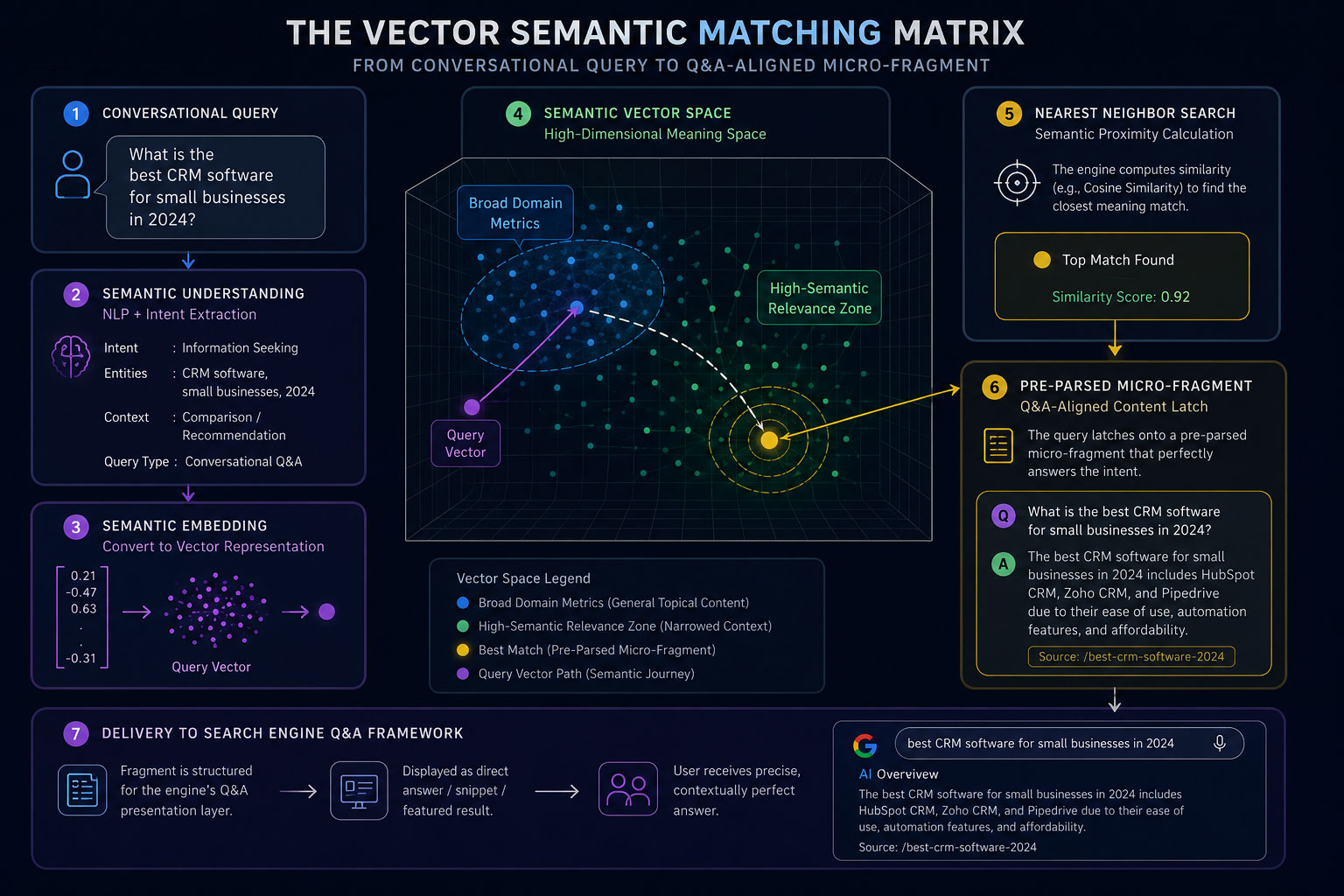
A technical layout visualizing how a conversational query travels through a semantic vector space, passing broad domain metrics to latch directly onto a Pre-Parsed Micro-Fragment that matches the search engine’s Q&A framework.
The “loophole” exists because search engines prioritize structural clarity and immediate utility over domain size when filling PAA accordions. The algorithm needs a fragment that can be extracted cleanly without bringing along unnecessary surrounding layout clutter. If your multi-million dollar competitor writes a sprawling, beautifully written 5,000-word guide but buries the answers inside dense, decorative paragraphs, the algorithm will pass them over. If you provide a tightly coded, explicit text fragment that fits the exact structural blueprint the model expects, you win the real estate.
The Operational Blueprint: Coding Precise Q&A Data Fragments
Winning this conversational real estate is a deliberate engineering process. You must build your content as a series of modular, self-contained data modules. Here is the technical framework required to design fragments that search engines can easily parse and extract.
1. The Proximity Rule: Synchronizing Headers and Paragraphs
The relationship between your question header and the answering body copy must be completely immediate. The target question must be wrapped in a semantic heading tag (typically an `<h3>` or `<h4>`), and the definitive answer must begin on the *very next line* within a standard `<p>` paragraph tag. Do not place images, decorative divider lines, ad banners, or introductory filler phrases between the header and the paragraph. The algorithm looks for high structural proximity; breaking that physical link in your HTML tree disrupts the parser’s pattern matching.
2. The Micro-Copy Formula: Writing for the Parser
The first sentence of your answering paragraph determines whether your fragment will be extracted or ignored. You must use what engineers call an explicit Is-A / Definition linguistic framework. You must repeat the core noun or entity from the question immediately, followed by a clarifying linking verb (such as “is,” “consists of,” “requires,” or “applies when”).
Incorrect (Too Conversational): “If you have been wondering about how corporate cross-linking works, there are a few things to keep in mind first…”
Correct (Optimized for Extraction): “Corporate cross-linking is an advanced internal SEO architecture where two or more distinct web properties share contextual links to distribute topical authority…”
3. Stringent Character and Token Boundaries
Search engines have strict physical limitations regarding how much text can be displayed inside an accordion fold or a carousel card before it must truncate the text. If your answering fragment is too long, it will be discarded in favor of a cleaner option. To optimize your text for extraction, your primary answer paragraph must fit within the following strict boundaries:
$$\text{Optimal Length} = 40 \text{ to } 55 \text{ Words} \quad \left(\sim 280 \text{ to } 350 \text{ Characters}\right)$$
Every single word within this block must deliver high semantic value. Eliminate filler adverbs, conversational jokes, and repetitive phrasing. Treat this space like premium code real estate where efficiency is paramount.
—
Advanced Engineering: Deploying Microdata Schema for Vector Carousels
While organizing your visible text layers correctly is vital, you can drastically improve your extraction success rate by explicitly labeling your content layers behind the scenes using structured microdata. By implementing specialized **JSON-LD Schema**, you eliminate all algorithm guesswork, allowing your team to define exactly where a question ends and where an answer begins within your code database.
To signal a clear conversational matrix to search spiders, embed a dedicated `FAQPage` script block directly into the header or footer of your WordPress page architecture. Here is the exact, production-ready code structure you should deploy:
The AI Data Blackout Ends: Google Unveils Dedicated AI Tracking inside Search Console
Search engine optimization is entering a new era of transparency. Google has officially launched dedicated AI visibility reports within Google Search Console, alongside new AI blocking controls—marking the most significant shift in search analytics since the advent of mobile tracking.
For over a year, webmasters, publishers, and SEO professionals have operated in the dark. Content surfaced inside Google’s AI Overviews and AI Mode was completely bundled into traditional organic search metrics. There was no clear way to separate standard “blue link” traffic from AI-driven citations.
This data blackout ends today. The new Search Generative AI performance report introduces a standalone measurement layer, giving creators clear insights into exactly how Google’s AI models choose, display, and interact with their content.
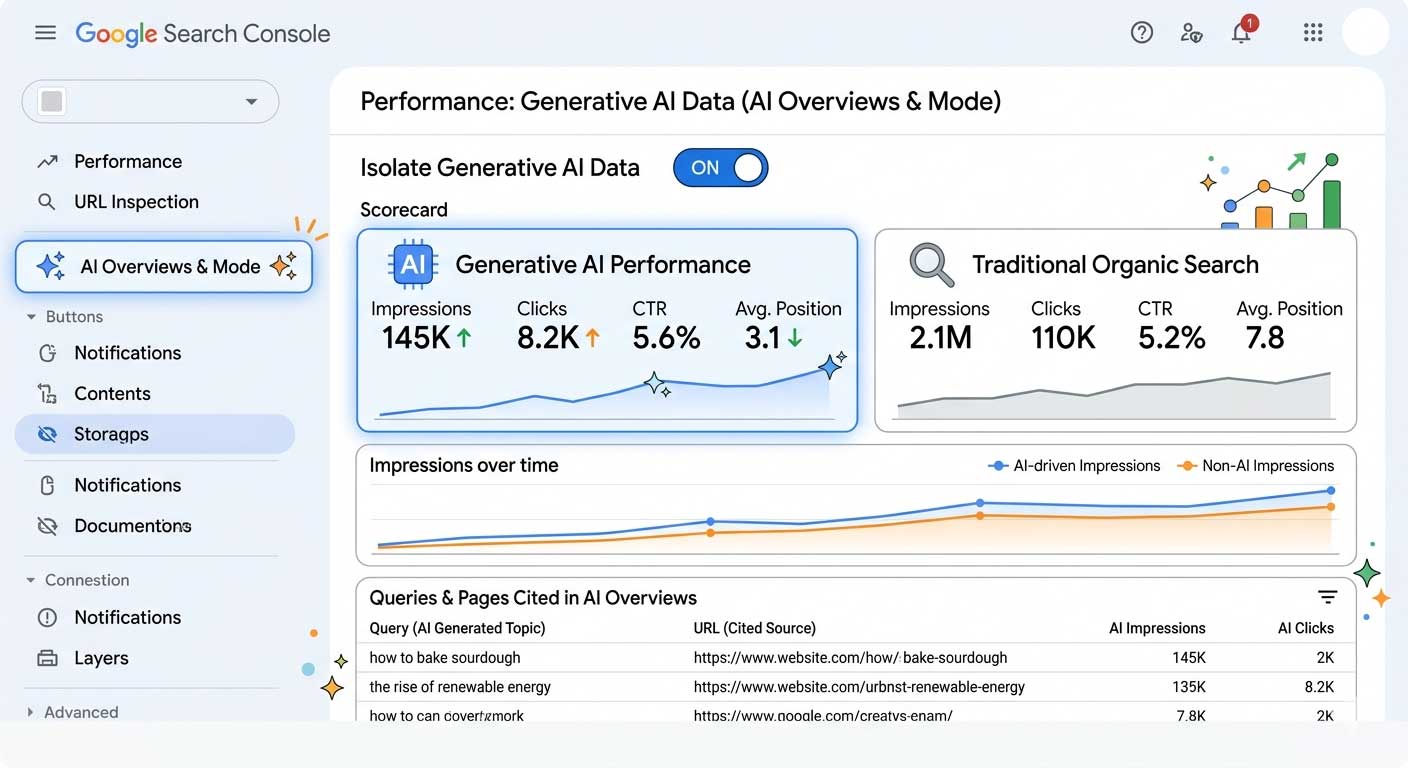
Google’s new Search Console dashboard isolates generative AI metrics from traditional organic data.
Inside the AI Visibility Report: What Metrics Are Tracked?
The new dashboard isolates exposure data across AI-powered search environments, including Google Search and Google Discover. In its launch state, the report focuses heavily on top-of-funnel exposure. While query-level keywords and click data are noticeably absent, webmasters can analyze performance using a structured set of metrics and dimensions:
| Metric / Dimension | Granular Data Tracked |
|---|---|
| Impressions | Tracks how often URLs from your domain are cited as foundational sources or “grounding data” within generative AI elements. |
| Pages | Identifies the exact URLs selected by Google’s algorithms to back up AI-generated responses. |
| Countries | Provides a geographical breakdown to trace where your AI presence is strongest globally. |
| Devices | Categorizes exposure by Mobile, Desktop, and Tablet to pinpoint user environments. |
| Dates | Offers historical timeline trends, with precision data available down to the hour. |
Addressing the lack of click data, Google clarified that the initial release is optimized for visibility tracking. However, the company plans to introduce deeper engagement metrics, including user clicks, in upcoming iterations based on direct publisher feedback.
The AI Opt-Out Switch: Granular Control for Site Owners
Simultaneously, Google is introducing a major infrastructure update: a dedicated Search Generative AI control toggle directly inside Search Console settings.
This feature functions as a master kill-switch for AI inclusion. Flipping the toggle completely blocks Google’s large language models from sourcing, summarizing, or citing your content within live generative features like AI Overviews.
“Opting out of Search Generative AI features will have zero impact on your traditional organic search rankings.”
— Official Google Documentation Summary
Crucially, Google confirmed that choosing to opt out will not harm your traditional organic SEO rankings. If you turn off AI accessibility, your pages will still rank normally in the standard “blue link” organic results. However, your site will immediately stop receiving any impressions or downstream referral traffic generated by Google’s AI interface.
Why Now? Regulatory Pressures Force Google’s Hand
This structural change wasn’t purely an internal product upgrade; it was driven by global regulators. The rollout stems from a direct mandate by the UK’s Competition and Markets Authority (CMA). Regulators have increasingly pushed for tech giants to give publishers explicit, granular choices regarding how their intellectual property is handled for AI fine-tuning and real-time summaries.
Due to the targeted nature of this regulatory framework, Google is testing both the report and the opt-out toggle with a limited subset of UK website owners first. This localized rollout gives Google time to monitor publisher response, optimize data processing, and iron out bugs before deploying the features to a broader global audience.
Strategic Takeaways: How SEOs Should Adapt
The introduction of separate AI analytics demands a shift in content strategy. The industry is rapidly moving from purely optimizing for traditional CTR (Click-Through Rate) to optimizing for LLM Grounding Authority.
For creators and brands, a high volume of AI impressions combined with low baseline clicks should no longer be viewed as a failure. Instead, it indicates that Google’s models view your domain as a primary source of truth. The strategy must adapt: treat highly-cited informational pages as top-of-funnel conversion mechanisms. By strategically inserting high-value internal links and distinct call-to-actions (CTAs) within those heavily-cited informational hubs, you can capitalize on the visibility, routing that authority directly into your conversion funnels.

High SaaS Churn? Fix the Leaky Bucket with Better User Onboarding UI/UX
The Invisible Leaky Bucket: Why Your SaaS Acquisition Strategy is Flawed
You are pouring millions of dollars, thousands of engineering hours, and endless creative energy into the top of your marketing funnel. Your SEO strategies are ranking, your paid ad campaigns are driving targeted traffic, and your sign-up charts are curling upward in a beautiful, venture-capital-pleasing hockey stick curve. On paper, your SaaS company is winning.
But behind the dashboard graphics lies a sobering, cash-burning reality. When you look at your product analytics for week two and week three, the drop-off is staggering. The users who enthusiastically input their email addresses and created passwords just days ago are quietly slipping out the back door. They log in once, look around a chaotic interface, get overwhelmed by a lack of direction, and log out—never to return.
This is the classic SaaS Leaky Bucket Syndrome. Across the software-as-a-service industry, the first 30 days are a brutal proving ground. Studies consistently show that the average SaaS platform loses up to 40% to 60% of its newly registered users within the first month. They aren’t leaving because your core technology is bad or because your pricing is too high. They are leaving because your user onboarding UI/UX failed to guide them to their first meaningful breakthrough moment before their patience ran out.
In an era where alternative software platforms are just a Google search away, cognitive friction is an absolute growth killer. If your interface feels like an unmapped labyrinth, users won’t spend hours trying to figure it out; they will simply cancel their trial and find a competitor who respects their time. To plug the leak, you must transition from an *acquisition-first* mindset to an *activation-first* framework. Let’s dissect the mechanics of 30-day user churn and explore the exact UI/UX design components required to build an elite onboarding engine.
 The Psychology of the First 30 Days: Why New Users Abandon Ship
To fix a broken onboarding experience, you must look at your software interface through the eyes of an anxious, easily distracted new user. When someone signs up for your SaaS app, they are at peak motivation. They have a problem they are desperate to solve, and your marketing materials have convinced them that your platform holds the key.
However, that motivation is a highly volatile resource. The second they step past the login wall, a ticking clock begins. This is what product designers call the race to **Time to Value (TTV)**. Time to Value is the precise duration it takes for a user to realize the product’s core promise—often called the “Aha! Moment.”
If a user signs up for an invoicing tool, the Aha! Moment isn’t setting up a profile or uploading a brand logo; it is sending their very first sleek, professional invoice and seeing how easy the process is. If your UI/UX forces them to fill out 15 form fields, verify three distinct sub-accounts, and read a text-heavy manual before they can even preview an invoice, you are artificially extending your TTV. With every added layer of friction, motivation drops while frustration climbs. By day 14, when the initial excitement has completely withered away, the user quietly deletes their account or lets their trial expire without using a single advanced feature.
The Core UX Principle: Onboarding is not an administrative orientation process; it is an active continuation of your marketing department’s value proposition.
The primary driver of early-stage SaaS churn is cognitive overload. When confronted with an overwhelming array of navigation menus, charts with zero data lines, and generic multi-step product tours that point out every button on the screen without providing actual context, the human brain short-circuits. To counteract this paralysis, your onboarding UI/UX layout must be designed with extreme intentionality, using progressive disclosure to show users exactly what they need to see, precisely when they need to see it.
Architecting the Onboarding Solution: The 4 Core UI/UX Pillars
Plugging the leaks in your 30-day retention bucket requires a systemic restructuring of your platform’s interactive touchpoints. ICO WebTech approaches this problem by deploying four integrated UI/UX pillars designed to minimize friction and flatten the user learning curve.
1. Tailored Interactive In-App Walkthroughs
The days of the unskippable, linear 10-step product tour are dead. Modern enterprise and consumer SaaS users expect an interactive experience that adapts to their specific professional goals. Instead of showing every single user the exact same generic welcome tour, your UI should kick off with a brief, high-value segmentation window. Ask the user simple, goal-oriented questions: *”What are you looking to achieve today?”* or *”What is your primary job role?”*
Based on their selection, the interface should launch a tailored, branching interactive walkthrough. If a manager signs up for a project management tool to track team timelines, they should not be walked through the billing configuration suite. Their interactive tour should guide them exclusively through creating a project board and assigning their first task. By making the walkthrough an active, hands-on exercise rather than a passive slideshow, you dramatically accelerate product adoption and empower users through immediate action.
2. Contextual, Just-In-Time Tooltips
Nothing disrupts a user’s flow quite like an unexpected pop-up window block that hijacks the entire screen to explain a feature they aren’t ready to use yet. To build a truly humanized onboarding experience, you must replace aggressive, interruptive notifications with subtle, contextual tooltips.
Contextual tooltips are reactive design elements that trigger based on specific real-time user behavior. For instance, if a user hovers their cursor over an advanced analytics icon for more than two seconds, a micro-tooltip appears with a single clear sentence explaining what that chart tracks. If they are filling out a complex data formatting line, a small helper bubble appears with an example input style. By serving educational context in small, manageable pieces right at the point of action, you reduce the user’s reliance on external help documentation and keep them deeply immersed within your application workflow.
3. Simplified Dashboard Interfaces & Empty-State Optimization
An overlooked danger zone in SaaS UI design is the “Empty-State Dashboard.” When a user logs into a brand new account, they are often greeted by a sea of blank charts, empty folders, and confusing 0% progress tracking stats. This lack of data makes the application look dead, uninviting, and intimidating.
An elite onboarding experience treats the empty state as a prime educational landscape. Instead of a blank white box, fill that screen space with beautiful, mock-data templates that demonstrate what the product looks like when fully optimized. Insert clear, highly visible action elements directly into the empty space. For example, instead of a blank table, show an illustration with a clean button that reads: “You haven’t imported any contacts yet. click here to sync your list in 30 seconds.” By simplifying the dashboard view and removing secondary features until the primary setup actions are complete, you keep the user’s cognitive eye locked onto the critical path.
4. Frictionless, Multi-Stage Setup Steps
Requiring an exhausting configuration routine right at registration is the absolute fastest way to sink your activation rates. While your engineering team might prefer to have all database connections, API keys, and team invitations configured upfront, your UX team must advocate for the psychological comfort of the user.
Break your configuration cycle down into a frictionless, multi-stage progression. Utilize single sign-on (SSO) protocols through trusted ecosystems like Google or Microsoft to turn registration into a single-click event. Defer non-essential tasks—such as updating billing profiles, configuring advanced notifications, or customizing aesthetic themes—to later in the user lifecycle. Give users a clear visual progress indicator (e.g., a progress tracker showing 25%, 50%, or 75% completion) to gamify the setup process and leverage the human psychological urge to complete uncompleted tasks.
 Case Study: How a Fintech App Lowered 30-Day Churn by 22%
To fully grasp the financial impact of intentional onboarding design, let’s examine a real-world digital restructuring executed for a high-growth business fintech application. This platform was built to help small-to-medium business owners sync their corporate bank accounts, categorize operational expenses, and project real-time tax liabilities.
The platform possessed an incredibly powerful backend engineering architecture, but its early metrics were highly alarming. Over 45% of users who successfully linked a bank account abandoned the application before their 30-day trial period concluded. The marketing team was forced to continually scale up paid spending budgets just to replace the users they were shedding week after week.
ICO WebTech initiated a deep-dive programmatic analysis of user clickstreams and interface behavior. The insights uncovered three major UX bottlenecks:
- The Initial Shock: Immediately upon linking their accounts, users were dropped into a hyper-complex financial dashboard tracking over forty different ledger data variables simultaneously. They had no idea where to start.
- The Content Dead-End: Essential data categorization steps required users to navigating through manual filter settings nested deep within a hidden sub-menu layout.
- The Interruption Factor: A rigid, generic welcome tour kept popping up to explain advanced multi-currency features that were completely irrelevant to 85% of their domestic user base.
The Strategic Redesign Strategy
Our UI/UX design teams executed a radical overhaul of the application’s entry sequence. First, we implemented an interactive segmentation card on screen one, splitting users into two distinct onboarding tracks: *”I want to estimate my upcoming quarterly taxes”* and *”I want to cut down my weekly expense tracking time.”*
Second, we applied a progressive disclosure pattern to the main dashboard. We hid the complex, secondary analytics panels entirely during the first week of use. Instead, the interface morphed into a clean, action-oriented workspace highlighting a clear step-by-step interactive configuration checklist. When a user completed a step, a satisfying animation fired, and the next logical action was illuminated with a soft glowing tooltip block.
Finally, we introduced contextual helper micro-tips over complex financial terms. Instead of sending users off-platform to search a knowledge base for definitions, they could simply tap an interactive tool icon to see a plain-English explanation directly in line with their workflow.
The Compounding Financial Impact
The operational results surpassed all initial forecasts. Within ninety days of deploying the optimized onboarding interface, the fintech app’s 30-day user churn rate dropped by a definitive 22%. By helping users reach their financial “Aha! Moment” within the first four minutes of account creation, customer lifetime value surged, client acquisition costs stabilized, and the company transformed its product into a highly efficient, self-sustaining revenue engine.
—
Measuring What Matters: Onboarding Metrics for Product Teams
You cannot optimize what you do not measure. To build a highly effective user onboarding system, your engineering, design, and marketing product groups must align around a unified set of onboarding-focused Key Performance Indicators (KPIs). Traditional business metrics like “Total Monthly Registrations” or “Daily Active Users” are too broad to diagnose specific UI bottlenecks. Instead, focus your tracking tools on these three precise indicators:
1. The Product Activation Rate
The activation rate is the percentage of registered users who successfully execute a predetermined set of core actions that deliver initial product value. For an email marketing SaaS, this might be uploading a subscriber list and sending a test broadcast. For a design app, it might be exporting a completed canvas asset. Your product data analytics should track exactly how many users hit this activation milestone. If your signups are rising but your activation rate is flatlining, your onboarding interface is actively blocking the door.
2. Time to Value (TTV) Velocity
Track the exact number of minutes or hours that elapse between a user’s initial account creation and their realization of the product’s value. Your ongoing UI/UX updates should constantly look to compress this duration. Every form field removed, every page redirect eliminated, and every automated database integration added serves to accelerate your TTV velocity, securing a psychological win for the user before distraction sets in.
3. Drop-off Step Attribution
Utilize modern behavioral funnel mapping tools to chart every single step of your onboarding walkthrough. Analyze where the visual leaks are concentrated. Do 15% of your users abandon the process when forced to verify their phone numbers? Does a massive drop occur when they reach the team member invitation page? Pinpointing the exact interactive component where users lose momentum allows you to make targeted, data-backed design adjustments rather than relying on qualitative guesswork.
—
Plugging the Leak: Prioritizing UI/UX for Sustainable Scaling
In the highly competitive modern SaaS ecosystem, code features can be replicated, pricing models can be undercut, and marketing strategies can be copied. Your ultimate, sustainable competitive moat is the sheer quality of your user experience. The brands that win the long game are the ones that eliminate friction entirely and make using their software an absolute joy from minute one.
Continuing to fund an aggressive marketing acquisition pipeline while ignoring a confusing, high-churn user onboarding sequence is the economic equivalent of trying to fill a leaky bucket with a high-pressure firehose. It is an incredibly inefficient, deeply stressful way to build an enterprise business.
By investing in tailored interactive walkthroughs, contextual inline guidance, and simplified dashboard environments, you respect your users’ time and lower their cognitive load. You build a digital bridge that guides them securely past early friction points directly to undeniable product value. Stop letting your valuable, hard-won traffic slip away into the dark. Optimize your onboarding UI/UX architecture, plug the month-one retention leaks, and transform your platform into a compounding growth engine that retains every single user it catches.