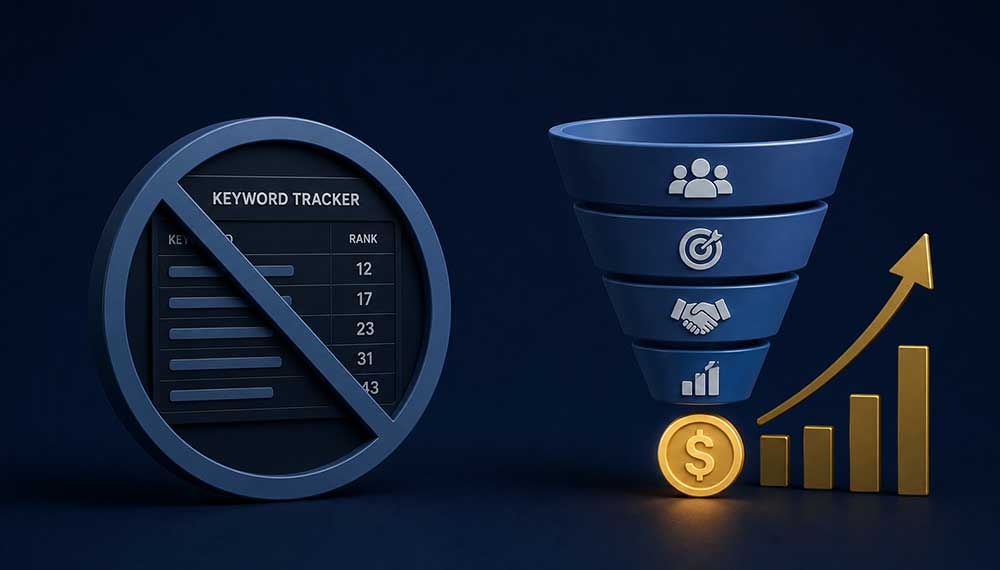
Every quarter, a familiar scene plays out in executive boardrooms across the corporate landscape. The Chief Marketing Officer steps up to the podium, hooks up a presentation deck, and shares slides showing organic keyword movements. The arrows are universally green. The lines trend up and to the right. The report proudly highlights that the brand now owns position #1 for fifty high-volume industry terms, alongside a 35% year-over-year increase in raw organic impressions.
The board nods approvingly, but the Chief Financial Officer quickly raises a critical question: “If our organic search presence expanded by over a third this year, why is our qualified sales pipeline down by 12%? Where is the revenue matching these traffic spikes?”
This stark disconnect is the modern CMO’s dilemma. In an era dominated by algorithmic changes, fragmented buyer journeys, and rising customer acquisition costs, legacy organic search reporting remains stuck in a bygone era. For decades, marketing departments have operated under a dangerous addiction to “reporting theater”—focusing on surface-level vanity metrics like keyword rankings and total traffic volume while losing sight of actual business revenue. When marketing leaders look to scale operations globally, they often turn to an external SEO company in India to handle optimization workflows. However, if that partnership is built entirely on tracking arbitrary keyword positions, the brand is essentially paying for an expensive optical illusion.
To survive in today’s performance-driven market, corporate leaders must initiate a complete vanity metric detox. It is time to dismantle legacy reporting frameworks and replace them with multi-touch organic attribution models that track the metric that truly matters: Pipeline Contribution Value.
The Broken Metric Blueprint: Why Keyword Tracking is Obsolete
To break free from vanity metrics, we must first accept a harsh reality: tracking keyword positions as a primary measure of marketing success is functionally obsolete. The concept of a single, universal search results page no longer exists. Modern search engine architectures rely on highly dynamic, personalized vector systems that tailor search results in real time based on a user’s physical location, historical browsing habits, past search intent patterns, and device ecosystem.
Furthermore, the rapid expansion of AI-driven summary cards and interactive search features has created a permanent “Zero-Click” landscape. When a search engine extracts text from your website and displays it directly on the search page to answer a buyer’s question, that user never clicks through to your domain. Your traditional analytics platform flags this as a flatline in traffic, yet that user just walked away with high brand awareness and deep intent. Conversely, a webpage can rank position #1 for a high-volume keyword phrase, pull in thousands of clicks, and yield absolutely zero conversions because the intent of that traffic was purely informational rather than commercial.
When a marketing team or an outsourced SEO company in India focuses all their reporting energy on a static list of keywords, they are managing for activity rather than outcomes. Ranking for an enterprise software term is meaningless if the traffic it drives consists of college students downloading free templates instead of enterprise infrastructure directors looking for a software vendor procurement cycle.
Dismantling Legacy Reports: Shifting the Telemetry Framework
The vanity metric detox begins by changing what data gets delivered to the executive suite. This doesn’t mean you stop measuring operational performance data entirely; your technical search specialists still need to monitor impressions, crawl errors, and click-through rates to maintain site health. However, these operational diagnostic metrics should never be included in executive-level business briefs.
A high-performance business model requires separating operational diagnostics from executive success metrics. Below is a blueprint for restructuring your marketing dashboard, replacing legacy vanity indicators with true pipeline contribution indicators:
| Legacy Vanity Metric | The Operational Illusion | Pipeline Replacement Metric | The True Business Outcome |
|---|---|---|---|
| Keyword Position (#1-#3) | Signals visibility but ignores personalized results, localized search variations, and zero-click answer blocks. | Share of Search Voice (SoSV) | Measures your brand’s active footprint across a broad cluster of transactional entity topics. |
| Raw Organic Traffic Clicks | Includes low-intent informational visitors who bounce immediately without interacting with the brand. | Productive Pipeline Traffic | Tracks unique users who enter through search and perform a high-value action, like downloading a whitepaper or viewing a demo page. |
| Overall Site Bounce Rate | An unreliable, outdated metric that fails to show whether a user found their answer or left frustrated. | Core Engagement Time | Measures active scrolling, form interaction, and deep reading times on key landing pages. |
| Last-Touch SEO Conversions | Credits 100% of the deal value to the final click, completely ignoring earlier search research steps. | Organic Pipeline Contribution | Calculates the total dollar value of pipeline deals where organic search served as a key touchpoint. |
By shifting your dashboard metrics to focus on value, you instantly change how your marketing team thinks. When performance is judged on pipeline value rather than traffic volume, teams stop writing low-value, clickbait listicles to inflate traffic numbers. Instead, they shift their focus to building deep, comprehensive buyer guides, technical documentation, and product comparison landing pages—the exact middle-of-the-funnel assets that turn casual searchers into high-value sales leads.
The Mechanics of Multi-Touch Organic Attribution
The biggest hurdle to proving the true business value of your organic search strategy is the widespread reliance on **Last-Touch Attribution**. In a standard last-touch model, whichever digital marketing channel drives the very final click before a user fills out a contact form receives 100% of the financial credit for that lead. This model creates a massive structural bias in favor of paid search retargeting ads and direct brand traffic, while completely hiding the heavy lifting done by organic content channels earlier in the journey.
Consider a typical enterprise software buying journey: A VP of Operations searches for a broad solution to a core operational bottleneck, lands on a long-form diagnostic article published by your brand, and reads it for eight minutes. Two weeks later, remembering your insights, they search for a specific technical comparison and read your detailed product breakdown. A month after that, ready to buy, they click a targeted LinkedIn retargeting ad or type your brand name directly into their browser to request a formal sales demo. In a legacy last-touch model, paid social or direct traffic receives all the credit. Organic search is marked as a cost center, despite being the precise engine that discovered, educated, and qualified the buyer in the first place.
To fix this attribution gap, modern CMOs must move toward a **W-Shaped Attribution Model** or a customized, **Data-Driven Attribution Model**. We can mathematically calculate the Pipeline Contribution Value ($V_{pc}$) of an organic search campaign across long enterprise buying cycles using a multi-touch attribution weighting approach:
$$V_{pc} = \sum_{i=1}^{n} \left( W(t_i) \times Deal\_Value \right)$$
Where:
- $t_i$ represents an independent organic search touchpoint identified within an individual customer’s historical contact history.
- $W(t_i)$ represents the specific attribution weight assigned to that touchpoint based on its location in the funnel (e.g., First-Touch = 30%, Mid-Touch = 20%, Lead-Creation Touch = 30%).
- $Deal\_Value$ represents the actual closed-won contract value or qualified opportunity pipeline value recorded inside your CRM platform.
- $n$ represents the total number of organic search interactions that occurred prior to formal sales qualification.
Deploying this data infrastructure requires setting up closed-loop tracking that connects your front-end web telemetry data with your back-end Customer Relationship Management (CRM) databases, such as Salesforce or HubSpot. By working alongside a sophisticated SEO company in India that understands advanced data integration, brands can look past simple Google Analytics reports and track historical user journeys from initial organic anonymous clicks all the way down to final closed revenue pipelines.
The Operational Reality: When you transition from a simplistic last-touch model to a balanced W-shaped multi-touch model, the measurable revenue contribution of your organic search engine marketing campaigns typically scales by 150% to 300%. Suddenly, search is recognized for what it truly is: a powerful customer acquisition foundation.
Operationalizing the Shift: Realignment of Teams and Partners
Implementing a vanity metric detox requires a deliberate shift in how you incentivize your internal marketing teams and hold your external agency partners accountable. If your agency’s monthly performance bonuses are tied to hitting arbitrary keyword ranking milestones, they will continue to optimize for those exact metrics, regardless of whether that traffic generates a single dollar of profit for your business.
You must completely rewrite your agency contracts and key performance indicators (KPIs) to align with business growth. Instead of asking your agency partners to deliver a monthly report detailing where fifty keywords rank on Google, challenge them to show how their optimization efforts reduced your overall Customer Acquisition Cost (CAC) and increased your pipeline velocity. A mature, strategic SEO company in India will welcome this shift, as it frees them from the performative task of manual slide building and allows them to focus entirely on high-impact technical data engineering, conversion rate optimization (CRO), and deep entity mapping.
Internally, this architectural pivot dismantles the traditional walls that separate your content creators, web developers, and sales operations teams. Your search strategy ceases to be an isolated marketing project and becomes a core component of your pipeline generation engine, working hand-in-hand with paid media and account-based marketing (ABM) squads to target the exact corporate accounts your sales team is actively chasing.
The Long-Term Dividend: Predictable, Compounding Growth
Stepping away from the comfort of legacy keyword tracking templates can feel intimidating at first. It forces marketing organizations to accept full financial accountability for their budgets and requires an upfront investment in data infrastructure, attribution software, and cross-department collaboration. However, the long-term strategic benefits are undeniable.
When you stop chasing empty traffic spikes and start optimizing for pipeline contribution value, you build a sustainable competitive moat around your brand. Paid advertising channels deliver immediate, linear results, but the moment you stop spending money on ad networks, your lead flow drops to zero. Organic search, conversely, functions as a long-term capital investment. A single piece of high-value, deeply optimized technical content continues to capture high-intent enterprise buyers, educate prospective clients, and feed your sales pipeline for quarters and years after it is published—all without a recurring cost-per-click fee.
By conducting a comprehensive vanity metric detox, implementing multi-touch attribution loops, and partnering with an analytical SEO company in India focused on real business growth, you transform your organic search strategy from an unpredictable cost center into a reliable, scalable asset. You protect your brand from algorithm volatility, maximize your marketing efficiency, and build a high-performance marketing engine that drives measurable, predictable, and compounding revenue growth for the long-term future of your business.



Related items

Depending on which 2026 survey you read, somewhere between 34% and 77% of US shoppers have


Ahrefs studied one million random web pages and found that only 1.74% of newly published p

If you are new to websites, deciding how many pages to build can feel surprisingly high-st
