
10 Expert-Approved B2B Lead Generation Strategies That Actually Fill Your Pipeline
The Quick Take: Most B2B companies aren’t struggling to generate leads — they’re struggling to generate leads that actually turn into revenue. The ten strategies below, from account-based marketing to live chat to referral programs, are the ones backed by real 2025-2026 data for consistently producing leads sales teams actually want to talk to. Pick two or three that fit your sales cycle, do them well, and you’ll likely see more pipeline than trying to run all ten at once.
What’s Inside This Guide:
- 1. Account-Based Marketing (ABM)
- 2. LinkedIn Thought Leadership and Social Selling
- 3. SEO-Driven Content and Gated Lead Magnets
- 4. Personalized Email Nurture Sequences
- 5. Webinars and Virtual Events
- 6. Formal Referral and Partner Programs
- 7. Live Chat and Conversational Marketing
- 8. Video Marketing
- 9. Retargeting and Intent-Based Paid Ads
- 10. Sales Intelligence and Intent Data
- Bringing It All Together
Here’s a number worth sitting with before you spend another dollar on lead generation: 79% of marketing leads never turn into a sale, largely because of weak follow-up and nurturing, not because the leads were bad to begin with (Salesforce, as cited in G2, 2026). That statistic alone explains why so many B2B marketing teams feel like they’re constantly filling a bucket with a hole in the bottom.
Generating a name and an email address was never really the hard part. Turning that name into a qualified conversation with sales, and eventually into a closed deal, is where most strategies quietly fall apart.
The good news is that the B2B lead generation strategies actually working right now aren’t secret or complicated. They’re well documented, backed by solid research, and used by real companies generating real pipeline. What separates the teams getting results from the teams spinning their wheels usually isn’t the tactic itself, it’s how consistently and thoughtfully it gets executed. Below are ten strategies that consistently show up in current data as genuinely effective, along with what the research says about why each one works and how to put it to use.
1. Account-Based Marketing (ABM)
Account-based marketing flips the traditional funnel on its head. Instead of casting a wide net and hoping the right people notice, ABM starts by identifying a focused list of high-value target accounts and then builds personalized campaigns aimed specifically at the decision-makers inside those companies. It’s a slower, more deliberate approach, but for B2B companies selling complex or high-ticket products, it tends to outperform broader tactics by a wide margin.
The numbers back this up convincingly. Companies running ABM programs report boosting revenue by as much as 208% over three years, and 76% of marketers say ABM delivers a higher return than other marketing strategies they run (Saffron Edge, 2026). Personalized ABM campaigns also outperform generic ones according to 87% of B2B marketers, and companies with strong sales-and-marketing alignment, something ABM naturally forces, grow revenue 32% faster than those without it (Saffron Edge, 2026). If your average deal size is large enough to justify custom outreach, and your buying committee typically includes more than one decision-maker, this is very likely the single highest-leverage strategy on this list.
- Start with a short list of 20 to 50 dream accounts rather than trying to run ABM at scale immediately
- Involve sales in building the account list so marketing and sales agree on what a “good fit” actually looks like
- Personalize the message to the account’s specific industry and pain points, not just their first name
2. LinkedIn Thought Leadership and Social Selling
LinkedIn has become the closest thing B2B marketing has to a home turf, and the data leaves little room for debate. LinkedIn now drives 80% of all B2B social media leads, and 89% of B2B professionals use it specifically to generate business (Martal Group, as cited in SHNO, 2026). Leads from LinkedIn also convert at roughly double the rate of other social platforms, according to 2026 HubSpot research (Searchlab, 2026). That’s not a small edge. It suggests that time spent building a presence on LinkedIn is simply more productive than the same time spent almost anywhere else in social media.
The strategy that works best isn’t running LinkedIn ads in isolation, though those help too. It’s a combination of consistent thought leadership content from real people at your company, genuine engagement in the comments of your prospects’ posts, and a sales team that treats LinkedIn as a relationship-building tool rather than a place to blast cold pitches. Buyers can tell the difference between someone building credibility over months and someone trying to close a deal in a single DM, and they respond very differently to each.
3. SEO-Driven Content and Gated Lead Magnets
Content marketing remains one of the most reliable, compounding ways to generate B2B leads, and the research keeps confirming it. According to a 2025 study, content marketing generates roughly three times more leads than outbound marketing while costing 62% less to run (Demand Metric, as cited in SHNO, 2026). And 87% of B2B marketers say content marketing successfully generates leads for their business, an increase of eleven percentage points in just a couple of years (Email Vendor Selection, 2025, as cited in SHNO, 2026).
SEO deserves special mention here because of how differently it performs over time compared to paid channels. B2B companies that consistently invest in SEO see a 5.7 times higher return on investment after twelve months compared to running paid search alone (BrightEdge, as cited in Searchlab, 2026). Paid ads stop working the moment you stop paying for them. A well-ranked blog post or resource page keeps generating leads for years with no ongoing spend, which is exactly why SEO tends to be underrated by teams looking for quick wins and underrated no more once they see a year-two comparison. As an SEO agency in Delhi working with B2B clients across long sales cycles, this is consistently the pattern we see: businesses willing to be patient with SEO end up with the cheapest, most durable lead source on this list.
Gated content, meaning guides, templates, or reports that visitors trade an email address to access, still plays an important role here too, though it’s worth using selectively. Gated assets convert two to five times better than ungated ones, but ungated content drives roughly three times more traffic overall (Demand Gen Report, as cited in Searchlab, 2026).
A smart approach uses both: plenty of open, freely accessible content to build organic traffic and authority, with a smaller number of genuinely valuable gated resources reserved for your highest-intent visitors.
- Build content around the specific questions your sales team hears most often on discovery calls
- Reserve gating for your best assets, not every blog post, since over-gating quietly kills your organic traffic
- Treat SEO as a twelve-month investment, not a campaign you evaluate after six weeks
4. Personalized Email Nurture Sequences
Email still holds one of the best returns of any B2B marketing channel, with the average campaign delivering a striking 36 to 1 return on investment (Litmus, as cited in Searchlab, 2026). But the era of generic, one-size-fits-all newsletters blasted to an entire list is largely over. Personalized emails see a 14% improvement in click-through rates and a 10% lift in conversions compared to generic sends (Gartner research, as cited in Biteable, n.d.), and nurtured leads go on to make purchases that are 47% larger on average than leads that never received any nurturing at all (as cited in ReferralRock, n.d.).
The strategic shift worth making here is moving away from a single generic drip sequence and toward multiple nurture tracks based on where a lead actually is in their buying journey. A visitor who just downloaded an introductory guide needs a very different email than someone who’s already requested a demo and gone quiet. Segmenting your list this way takes more setup work upfront, but it’s a major part of why 79% of leads currently fail to convert. Most of them simply weren’t nurtured in a way that matched where they actually were.
5. Webinars and Virtual Events
Webinars have quietly become one of the highest-quality lead sources available to B2B marketers, and 73% of B2B marketers now call webinars their number one source of high-quality leads (ZoomInfo, as cited in Hubilo, 2025). The cost efficiency is hard to ignore too. Webinars generate leads at roughly $72 each, compared to over $800 for a trade show and around $198 for a conference (SHNO, 2026). Companies typically see 20% to 40% of webinar attendees enter the sales pipeline as genuinely qualified leads, and webinars with a clear, specific call to action can convert as much as 47% of attendees into leads (SHNO, 2026).
What makes webinars particularly valuable compared to a downloadable PDF or blog post is the built-in qualification. Someone willing to block out 30 to 45 minutes of their calendar to attend a live session on a specific topic has already told you a lot about how seriously they’re considering a solution like yours. That single behavioral signal, attendance itself, is often a stronger indicator of intent than a dozen anonymous page views.
- Pick topics narrow enough to attract genuinely interested prospects rather than a broad general audience
- Send the replay within 24 hours, since on-demand viewing can account for nearly half of total views
- End with one specific next step, not a vague “let us know if you have questions” close
6. Formal Referral and Partner Programs
If there’s one strategy on this list that’s dramatically underused relative to how well it performs, it’s referrals. Roughly 84% of B2B decision-makers start their buying process with a referral (Edelman Trust Barometer, as cited in GrowSurf, n.d.), and companies with formal referral programs report a 70% higher conversion rate on referral leads compared to leads sourced any other way (Heinz Marketing, as cited in GrowSurf, n.d.). Referred leads also close roughly 69% faster than non-referred leads, and companies with structured referral programs saw 86% revenue growth over two years, compared to 75% for companies without one (Heinz Marketing, as cited in ReferralRock, n.d.).
Despite results like these, only around 30% of B2B companies have a formal referral program in place at all (Influitive, as cited in ReferralRock, n.d.), which means most companies are leaving one of their highest-converting lead sources almost entirely up to chance. A referral program doesn’t need to be complicated to work. It needs a clear ask, an easy way for happy customers to make an introduction, and a reason for them to bother, whether that’s a financial incentive, early access to new features, or simply genuine appreciation delivered consistently.
7. Live Chat and Conversational Marketing
Adding live chat to a B2B website tends to produce results that surprise teams who assumed it was mainly a retail or customer-support tool. Website visitors who chat with a company in real time are 82% more likely to convert into customers, and they go on to spend 13% more than visitors who never chat at all (Intercom, n.d.). Even a modest exchange makes a measurable difference. Just one reply to a visitor’s message makes them 50% more likely to convert, and a short six-message conversation can make them up to 250% more likely to convert (Intercom, n.d.). Broader industry data backs this up too, with live chat linked to a 20% average increase in conversion rate and a reported 305% return on investment (American Marketing Association, as cited in SmartBug Media, 2017).
The reason this works is almost embarrassingly simple: speed. A prospect with a question who has to fill out a contact form and wait a day for a reply has plenty of time to lose interest, get distracted, or check out a competitor instead. A prospect who gets a helpful answer in under a minute is still standing at your door, so to speak, ready to keep the conversation going. For B2B sites with any meaningful traffic, live chat is one of the fastest and least expensive improvements you can make to your conversion rate.
8. Video Marketing
Video has moved from “nice to have” to genuinely essential in B2B marketing. 78% of businesses report increased website traffic after adding video to their content strategy, 69% generate more leads because of it, and 54% see increased sales as a direct result (as cited in SwellAI, n.d.). Perhaps most tellingly, B2B marketers who use video grow revenue 49% faster than those who don’t (as cited in SwellAI, n.d.), and landing pages that include video can see conversion increases of 86% or more (as cited in MediaPost, n.d.).
Personalized video, where a salesperson records a short, specific message for an individual prospect rather than sending a generic pitch, is proving especially effective in outbound efforts. Video email campaigns show five times higher open rates and eight times higher open-to-reply rates in prospecting compared to plain text emails (as cited in Sagefrog, n.d.). You don’t need studio-quality production for this to work. A well-lit laptop camera and a genuinely useful, specific message tends to outperform a polished but generic video every time, because the personalization is what actually earns the reply.
- Use short explainer videos on high-traffic landing pages where visitors are deciding whether to convert
- Have sales reps send brief personalized videos instead of another templated cold email
- Repurpose webinar recordings into shorter clips for social and email rather than letting them sit unused after the live event
9. Retargeting and Intent-Based Paid Ads
Most visitors to a B2B website will never convert on their first visit, no matter how good your page is, simply because B2B buying decisions usually involve multiple stakeholders and take weeks or months to finalize. Retargeting exists specifically to solve that problem by keeping your brand visible to people who’ve already shown interest. Retargeting through display ads has been shown to influence a striking 70% of website visitors toward eventually making a purchase (as cited in MediaPost, n.d.), and personalized exit-intent offers, shown right as a visitor is about to leave your site, can boost leads and conversions by as much as 200% (as cited in MediaPost, n.d.).
The key to making retargeting feel helpful rather than intrusive is relevance. Someone who read a blog post about your product’s pricing should see a different retargeting ad than someone who only viewed your careers page. Segmenting your retargeting audiences by the specific page or content they engaged with, rather than running one generic ad to everyone who’s ever visited your site, is usually the difference between retargeting that converts and retargeting that just feels like being followed around the internet.
10. Sales Intelligence and Intent Data
The final strategy worth building into your lead generation approach isn’t really a channel at all, it’s a layer of intelligence that makes every other channel work better. Intent data tracks the buying signals companies give off before they ever fill out a form, things like researching competitor comparisons, visiting review sites, or spending unusual amounts of time on certain topics. Combined with personalization, this kind of targeting has real financial impact. Gartner has projected that B2B companies using personalization in digital commerce can see revenue increases of up to 15% (as cited in SaleFuel, n.d.).
This strategy also directly addresses one of the biggest structural problems in B2B marketing right now: 85% of B2B marketers admit they struggle to connect their marketing performance to actual business outcomes (G2, 2026), and 41% report difficulty getting marketing-generated leads to meet sales’ expectations for quality (G2, 2026). Intent data helps close that gap by giving both teams a shared, objective signal for which leads are actually ready for a conversation, rather than relying on gut feeling or an arbitrary lead score that sales has learned to ignore.
Bringing It All Together
Reading through ten strategies at once can feel like a lot, and that’s exactly the trap worth avoiding. Trying to launch all ten simultaneously is a fast way to execute all of them poorly. The stronger approach is to look honestly at your sales cycle, your average deal size, and where your current pipeline is actually breaking down, then choose two or three strategies from this list that most directly address that specific gap. A company selling a $500 monthly subscription probably gets more out of SEO content and email nurturing than a full ABM program. A company selling $200,000 enterprise contracts almost certainly should be running ABM alongside LinkedIn thought leadership, with live chat catching the inbound interest both of those generate.
Whichever combination fits your business, the underlying principle stays the same across every strategy on this list: the leads that convert aren’t the ones you generated the most of, they’re the ones you followed up with the fastest, personalized the most thoughtfully, and nurtured with genuine relevance until they were actually ready to buy. That’s not a flashy insight, but it’s the one the data keeps confirming over and over again.
If your pipeline has been feeling unpredictable, or your marketing and sales teams keep disagreeing about what counts as a “good lead,” it might be less about needing a new tactic and more about needing the right systems, tracking, and website experience to support the strategies you’re already running. That’s exactly the kind of work our team handles at ICO WebTech, a website designing agency in Delhi that builds high-converting landing pages and sets up the live chat, tracking, and personalization infrastructure that turns these strategies from theory into a predictable pipeline.
Talk to ICO WebTech About Your Lead Generation Strategy
References
Biteable. (n.d.). Create next-level B2B marketing campaigns with personalized videos. https://biteable.com/blog/personalized-video-marketing-for-b2b/
G2. (2026). Lead generation statistics for 2026: Key marketing data. https://learn.g2.com/lead-generation-statistics
GrowSurf. (n.d.). B2B referral marketing statistics. https://growsurf.com/statistics/b2b-referral-marketing-statistics/
Hubilo. (2025). Webinar marketing statistics and benchmarks for 2025. https://www.hubilo.com/blog/webinar-marketing-statistics-benchmarks
Intercom. (n.d.). From first touch to qualified lead: How to use live chat for sales. https://www.intercom.com/blog/
MediaPost. (n.d.). Stats and snippets on B2B email: Why it’s the most valuable channel. https://www.mediapost.com/publications/article/346495/
ReferralRock. (n.d.). B2B referral marketing statistics. https://referralrock.com/blog/b2b-referral-marketing-statistics/
Saffron Edge. (2026). 45+ account-based marketing statistics for 2026 B2B marketing strategy. https://www.saffronedge.com/blog/account-based-marketing-statistics/
SaleFuel. (n.d.). B2B companies using personalization in digital commerce to see up to 15% increase in revenue. https://salesfuel.com/b2b-companies-using-personalization-digital-commerce-see-15-increase-revenue/
Sagefrog. (n.d.). Start more conversations with leads in 2020 with personalized video emails. https://www.sagefrog.com/blog/start-more-conversations-leads-2020-personalized-video-emails/
Searchlab. (2026). B2B marketing statistics 2026. https://searchlab.nl/en/statistics/b2b-marketing-statistics-2026
SHNO. (2026). B2B lead generation statistics for 2026: Channels, costs, conversion rates, and trends. https://www.shno.co/marketing-statistics/b2b-lead-generation-statistics
SHNO. (2026). Content-led lead generation statistics. https://www.shno.co/marketing-statistics/content-led-lead-generation-statistics
SHNO. (2026). Webinar marketing statistics for 2026. https://www.shno.co/marketing-statistics/webinar-marketing-statistics
SmartBug Media. (2017). 4 powerful ways live chat on your website improves B2B inbound sales. https://www.smartbugmedia.com/blog/live-chat-on-your-website-improves-b2b-inbound-sales
SwellAI. (n.d.). B2B video marketing statistics. https://www.swellai.com/blog/b2b-video-marketing-statistics


B2B Search Engine Marketing: 3 Ways to 10X Visibility Before Your Competitors Even Notice
TL;DR: Most B2B companies are still fighting over search traffic that stopped converting years ago. Zero-click results, AI Overviews, and 10-month buying cycles have quietly rewritten the rules of B2B search engine marketing. The businesses pulling ahead in 2026 aren’t the ones publishing more blog posts or bidding on more keywords. They’re the ones running what we call the Compound Visibility Loop — a three-part system that stacks paid intent capture, AI citation, and account-based retargeting into one engine instead of three disconnected budgets. This article breaks down exactly how it works, backed by current research, and shows you how to build it for your own pipeline.
In This Blog:
- Why traditional B2B SEM is quietly losing its grip — and the real data behind it
- The Compound Visibility Loop: our proprietary 3-part framework for 2026 search visibility
- Way #1: Bidding on bottom-funnel intent instead of chasing volume
- Way #2: Structuring content so AI engines cite you (and why this multiplies your ad performance)
- Way #3: Retargeting the buying committee, not the browser
- A controversial but accurate take on where B2B ad budgets should actually go in 2026
- A practical starting checklist you can run this quarter
Here’s a number that should make every B2B marketing leader sit up: 74% of high-intent B2B research searches now end without a single click, and when Google slots an AI Overview above the results, that number climbs to 83% (Onely, 2026; LinkedIn/ie.linkedin.com, 2026). Read that again. Roughly eight out of every ten searches your ideal customer runs about a problem you solve never turn into a visit to your website. Not because they’re not interested. Because the answer got handed to them before they had a reason to click.
If your search strategy hasn’t changed in the last eighteen months, you are almost certainly bidding on keywords, writing content, and reporting on click-through rates the way everyone did in 2022. And that’s the real problem this article is here to solve. Not with fear, because panic never grew a pipeline. With a framework you can actually run, starting this week, that treats search as one connected system instead of three separate budgets fighting for the same buyer’s attention.
Why “More Keywords, More Budget” Stopped Working
For a long time, B2B search engine marketing was a fairly simple game. You picked keywords your buyers typed into Google, you wrote a landing page, you bid on the terms, and you counted the leads. That game still exists, but the board has changed shape underneath it. Search behavior has fragmented across ChatGPT, Perplexity, Google’s AI Overviews, and traditional blue links, and the buyer who used to click ten links before picking up the phone now often gets a synthesized answer and moves on with barely a trace left in your analytics dashboard.
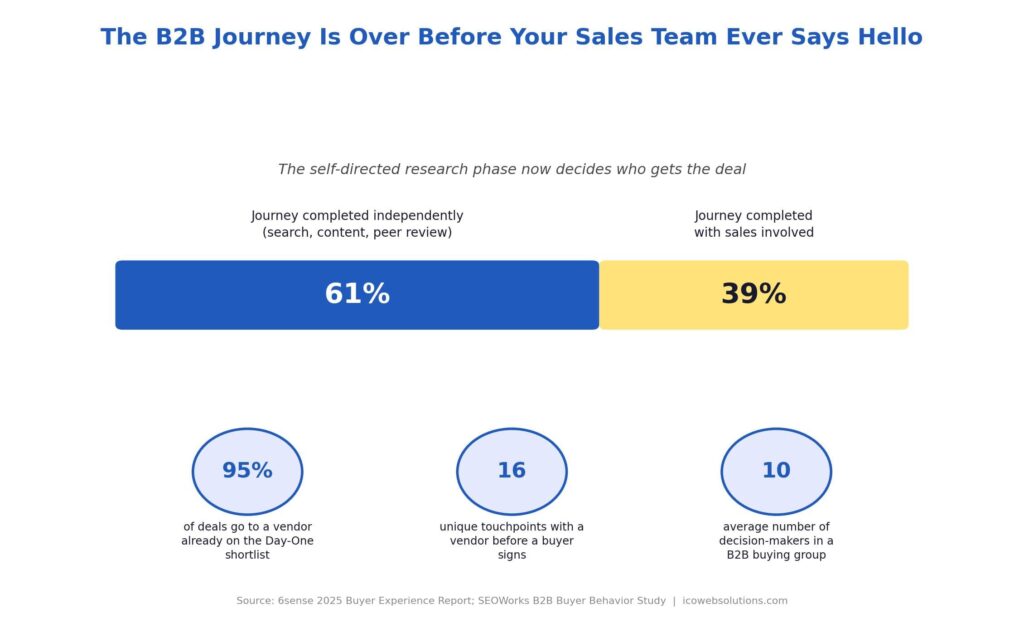
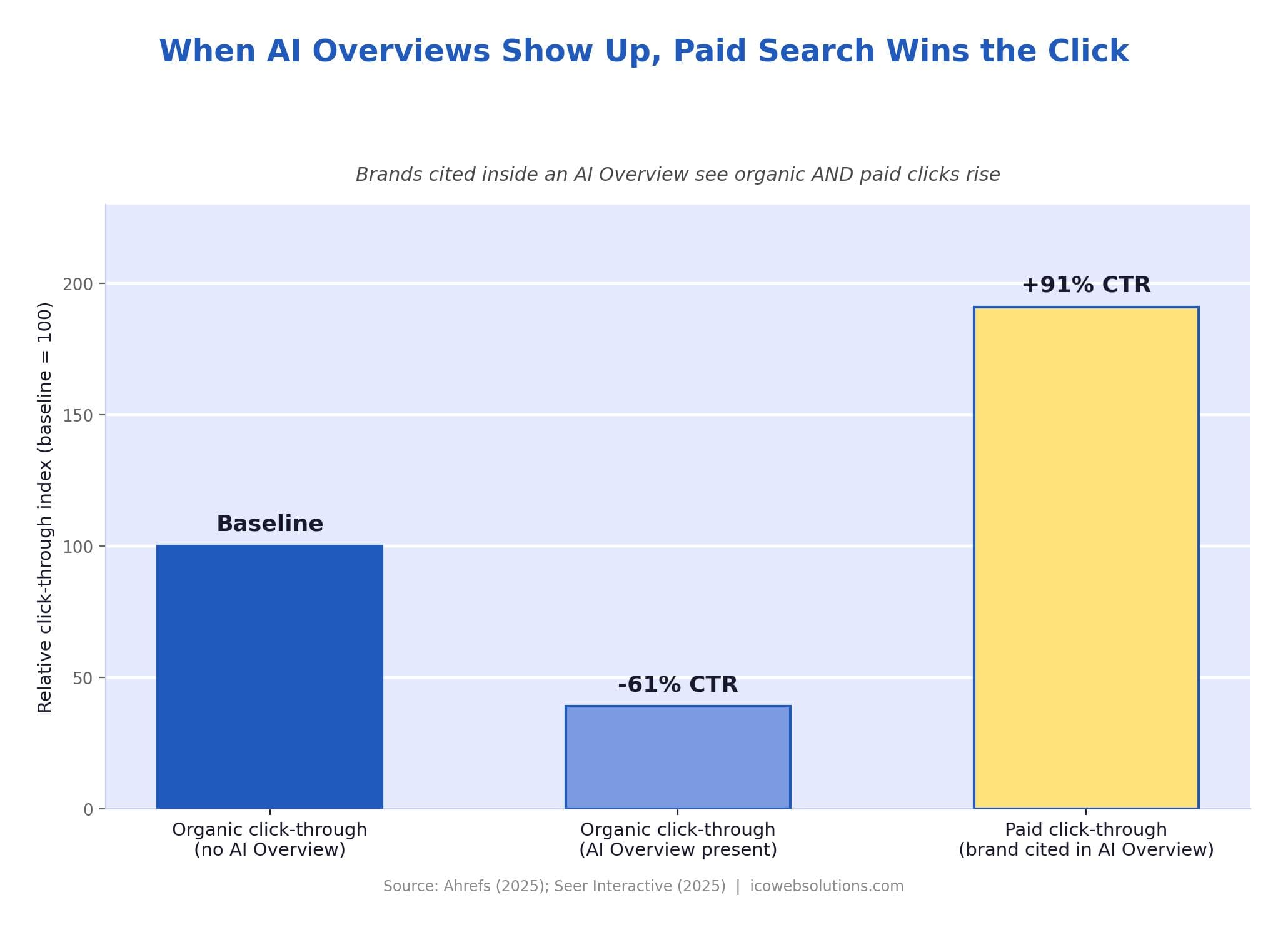
The scale of this shift is genuinely surprising once you look at the research directly. Google’s AI Overviews now show up on a large share of informational queries, and when they appear, organic click-through rates fall by around 61% according to Seer Interactive’s 2025 study (WhiteHat SEO, 2026). At the same time, the buying journey itself has compressed. The 2025 6sense Buyer Experience Report, based on more than 4,000 buyers across North America, EMEA, and APAC, found that the split between independent research and seller engagement has moved from a 70/30 balance to 60/40, and that average buying cycles shortened from about eleven months to ten (Business Wire, 2025). Buyers are deciding earlier. They’re doing it with less visible search behavior. And they’re doing it across more devices and assistants than a single campaign can realistically track.
None of this means B2B search engine marketing is dead. It means the old scoreboard — rankings, impressions, raw click volume — no longer tells you the truth about whether you’re winning. That’s exactly where our framework comes in.
Our Take: Stop Treating SEO and PPC as Two Different Budgets
Here’s the part of this article most agencies won’t say out loud, because it’s a little uncomfortable for anyone selling “SEO packages” and “PPC management” as separate line items. In B2B, search engine optimization and paid search are no longer two channels. They are two hands doing the same job, and treating them as competitors for budget is quietly costing you pipeline.
The evidence for this is stronger than most marketers realize. Research from Ahrefs found that brands cited inside an AI Overview see paid clicks increase by roughly 91%, and organic clicks increase by about 35%, compared to brands that don’t earn a citation (WhiteHat SEO, 2026). In other words, the same piece of content that gets you cited by an AI engine also makes your paid ads perform better, because the buyer has already seen your name once before they see your ad. Visibility compounds. It doesn’t sit in silos.
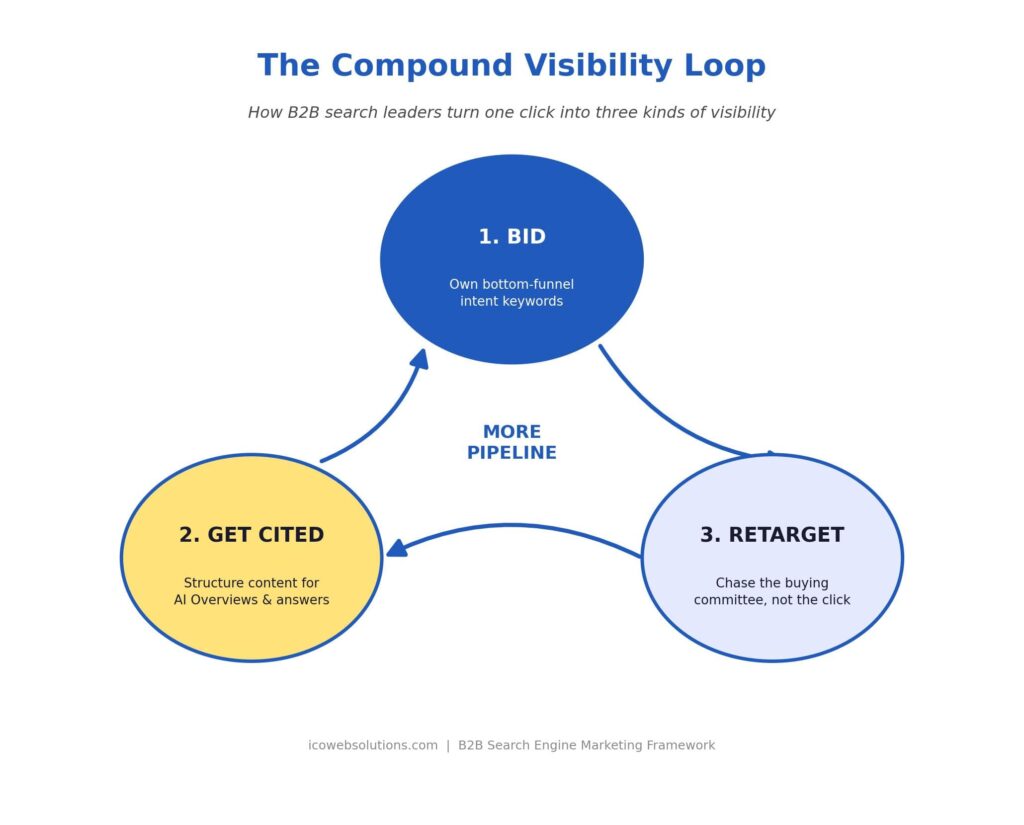
This is the idea behind what we call the Compound Visibility Loop — a framework built specifically for how B2B buyers actually behave in 2026, not how they behaved when most SEM playbooks were written. It has three connected moves, and each one makes the next one cheaper and more effective. Let’s walk through all three.
Way #1: Bid on Bottom-Funnel Intent, Not Search Volume
Most B2B paid search accounts we review are still built around volume. Big, broad keywords with a lot of monthly searches, because volume feels safe and easy to report on. But volume is exactly the part of search that’s disappearing into zero-click results and AI summaries. The clicks that remain, and remain valuable, are the ones tied to real buying intent: comparison terms, “vs” searches, pricing questions, category-specific software or service terms, and branded competitor searches from people actively shortlisting vendors.
This matters because the research shows something reassuring buried inside the scary zero-click headlines. Zero-click behavior is eating the shallow, informational end of search — the “what is” and “how does X work” queries that were never going to convert well anyway. High-stakes, high-consideration B2B decisions still involve real digging, because no AI Overview is going to get a procurement director to sign off on a six-figure contract based on a two-sentence summary (Redevolution, 2026). That’s your opening. Bottom-funnel B2B search intent is exactly the kind of search that still results in a genuine click, a genuine visit, and a genuine conversation with your sales team.
Cost per click across Google Ads has climbed to an average of $5.26, up from $4.66 the year before, and conversion rates have actually improved to around 7.5% to 8.2% as advertisers get smarter about targeting (Search Engine Land, 2025). That tells you cheap, broad traffic is genuinely going away, but advertisers who tighten their targeting are converting better than ever. The lesson isn’t to spend less. It’s to spend on the 20% of searches that were always going to close deals, instead of the 80% that were always going to bounce.
A few practical shifts make this real:
- Redirect budget away from broad, top-of-funnel keywords and into comparison, alternative, and pricing-intent terms where your buyer has already done the education phase
- Bid aggressively on your own branded terms and your top two or three competitors’ branded terms, since 92% of B2B buyers start research with a specific vendor already in mind and you want to be the alternative they consider (SEOWorks, 2026)
- Build landing pages for each intent cluster instead of sending every click to the same generic homepage, since specificity is what turns a click into a form fill
- Track cost per qualified lead, not cost per click, as your primary success metric going forward
None of this is about abandoning awareness-stage marketing altogether. It’s about being honest with yourself that awareness-stage paid search, in a world of AI Overviews and 61% CTR drops, is often lighting money on fire. Bottom-funnel intent is where B2B SEM still earns its budget line, and it’s the first move in the Compound Visibility Loop.
Also read: LinkedIn Thought Leadership for B2B Founders: The Framework That Turns Posts into Pipeline
Way #2: Get Cited by AI Engines, Not Just Ranked by Google
Here’s where most B2B marketing teams are behind, and it’s genuinely not their fault, because this shift happened fast. Ranking on page one of Google used to be the finish line. Now it’s just one of several places your buyer might encounter your brand, alongside ChatGPT, Perplexity, and Google’s own AI Overview panel. Being cited as a source inside those AI-generated answers is quickly becoming more valuable than holding the number one organic position, because that citation is what plants your brand name in a buyer’s head before they’ve clicked anything at all.
The mechanics of earning that citation are different from classic SEO, and this is genuinely good news, because it rewards clarity over cleverness. Content that answers a question directly in the first paragraph, uses clean definitions, comparison tables, and FAQ-style structure, gets cited far more often than dense, keyword-stuffed articles written primarily to rank. One industry analysis found that restructuring content into these semantic answer fragments increased share-of-answer visibility by roughly 40% (GrackerAI, 2026). Another cross-account study across 250-plus B2B SaaS companies found that campaigns built around answer-first, conversational content saw 47% higher visibility inside AI search engines compared to traditional keyword-first content (Triple Dart, 2026).
And here’s the part that ties this back to your ad spend directly: getting cited doesn’t just help your organic presence. It makes your paid search dollars work harder too. Remember that 91% lift in paid click-through rate for brands cited in AI Overviews. That’s not a coincidence. When a buyer sees your name in an AI-generated answer and then sees your ad ten minutes later on a comparison search, you’re no longer a stranger asking for a click. You’re a name they already half-recognize, which is exactly the kind of familiarity B2B buyers say they want before they’ll engage with a vendor at all.
Practical ways to start earning AI citations this quarter:
- Rewrite your most important service and comparison pages so the direct answer appears in the first two sentences, before any preamble
- Add FAQ sections with FAQPage schema markup to your highest-intent pages, since structured data is what AI crawlers use to extract clean answers
- Build genuine comparison content (you vs competitor, category A vs category B) instead of only “what is” explainer content, since comparison queries are where B2B buyers are still clicking through
- Earn mentions on LinkedIn, Reddit, and industry publications, since roughly a third of AI citations trace back to traditional search visibility while a meaningful share also comes from social platforms and press coverage (SyncGTM, 2026)
This is not a replacement for paid search. It’s fuel for it. Treat your content and your ad accounts as one team working toward the same citation, and you’ll see both channels get cheaper and more effective at the same time.
Way #3: Retarget the Buying Committee, Not Just the Browser
This is the move most B2B companies skip entirely, and it’s arguably the one with the highest return, because it acknowledges a simple truth about B2B buying: the person who clicked your ad is rarely the only person who needs to say yes. The average B2B buying group now involves around ten unique decision-maker functions, and buyers report an average of sixteen distinct interactions with a vendor before they finally sign (SEOWorks, 2026). A single click from a single stakeholder was never going to be enough, and treating it as the end goal of your SEM campaign is leaving pipeline on the table.
The good news is that this compression of the buying journey, while it looks intimidating in the aggregate statistics, is actually an opportunity if you build for it deliberately. Ninety-five percent of the time, the vendor that eventually wins the deal was already on the buyer’s day-one shortlist, and the first-choice vendor on that list wins roughly 80% of the time (SEOWorks, 2026). That means the goal of your search engine marketing isn’t just “get a click.” It’s “become impossible to forget across every stakeholder who touches this decision,” so that when the shortlist gets written, you’re already on it.
Retargeting built for a committee, rather than an individual, looks different from a standard remarketing campaign. It’s less about chasing one visitor around the internet with the same banner ad, and more about layering sequential messages that speak to different roles across the buying group over the following weeks. A technical evaluator needs proof points and integration detail. A finance stakeholder needs cost-of-inaction framing. An executive sponsor needs a fast, confident summary. Feeding all three the same generic “come back and buy” ad wastes the budget you just spent earning that first visit.
- Build LinkedIn retargeting audiences segmented by job function, not just by page visited, so a technical buyer and a finance buyer see genuinely different follow-up messaging
- Sequence your display and LinkedIn ads over a three-to-four week window rather than showing the same static ad on a loop, matching the pace of a real evaluation cycle
- Layer in account-based display advertising for named target accounts once they show research intent, so multiple stakeholders inside the same company see consistent, coordinated messaging
- Feed your sales team a simple visibility report of which accounts are engaging across search, LinkedIn, and your site, so outreach happens while interest is warm, not weeks after it’s gone cold
Put together, these three moves are what we mean by the Compound Visibility Loop. Bidding on real intent gets you the first click. Getting cited by AI engines makes that click cheaper and more trusted. Retargeting the full committee turns one click into the sixteen touches it actually takes to close a B2B deal. Run all three together, consistently, and you’re not just optimizing a channel. You’re building a visibility system that keeps paying you back long after the individual ad has stopped running.
Also read: State of B2B Websites: Survey Report
Building a Stronger Brand Through Strategic B2B Web Design
What This Actually Means for Your Budget This Quarter
If you take one thing away from this article, let it be this: the businesses that will win B2B search visibility in 2026 are not the ones spending the most. They’re the ones spending on the right 20%, structuring content so machines can quote them accurately, and following through with every stakeholder in a deal instead of stopping at the first click. That’s genuinely encouraging news if you’ve been feeling like your search budget has gotten less effective lately. It’s not that the game got harder in some unbeatable way. It’s that the scoreboard changed, and most competitors haven’t noticed yet.
That gap is your advantage, and it won’t stay open forever. Every month that passes, more B2B marketing teams read this same research and start rebuilding their search strategy around it. The companies moving now, while a lot of their competitors are still bidding on the same broad keywords they used in 2022, are the ones who’ll own the AI citations, the bottom-funnel bids, and the retargeting sequences that quietly decide who makes the shortlist a year from now.
If you’d rather not rebuild this alone, that’s exactly what our team at ICO WebTech does for B2B companies every day. We audit your current search accounts and content, map out where you’re losing visibility to AI Overviews and zero-click results, and build a Compound Visibility Loop strategy specific to your buying committee and your sales cycle. Book a free 30-minute B2B search visibility audit with our team today, and we’ll show you exactly which keywords, pages, and audiences are costing you pipeline right now — no generic template, just a plan built around your numbers.
A Quick Checklist to Start This Week
Before you go, here’s a short, honest checklist you can run through this week without waiting for a full strategy overhaul. Pull your last 90 days of Google Ads data and flag which keywords are broad, top-of-funnel terms rather than comparison or pricing-intent terms, then shift ten percent of that spend toward the intent-driven terms and watch what happens to your cost per qualified lead.
Open your three highest-traffic service pages and check whether the direct answer to the page’s main question appears in the first two sentences; if it’s buried in paragraph four, that’s costing you AI citations.
And finally, look at your retargeting audiences and ask honestly whether you’re speaking to one persona or several, because if every visitor sees the same ad regardless of role, you’re leaving most of the buying committee cold.
None of these three moves require a bigger budget. They require a different lens on the budget you already have. That’s the whole point of the Compound Visibility Loop, and it’s the exact system we’d love to help you put in place.
Sources
- Business Wire. (2025, November 12). The timeline for influencing B2B buyers is shrinking: Insights from 6sense’s 2025 Buyer Experience Report. https://www.businesswire.com/news/home/20251112018032/en
- Focus Digital. (2025, July). Average Google Ads cost per click by industry: 2025 report. https://focus-digital.co/?p=6055
- GrackerAI. (2026). GEO: Winning zero-click AI search. https://gracker.ai/static/GEO%20Winning%20Zero-Click%20AI%20Search.DrChv2D-.pdf
- Onely. (2026). Zero-click dominates: The new reality for B2B SEO strategy. https://onely.com/blog/proven-b2b-seo-strategies
- Redevolution. (2026). Zero-click search: What 68% really means for B2B marketers. https://www.redevolution.com/blog/zero-click-search-what-68-really-means-for-b2b-marketers
- Search Engine Land. (2025). Google Ads costs keep rising, but conversion rates improved in 2025. https://searchengineland.com/google-ads-costs-keep-rising-but-conversion-rates-improved-in-2025-477927
- SEOWorks. (2026). B2B buyer behavior statistics. https://www.seoworks.co.uk/downloads/b2b-buyer-behavior-statistics/
- SyncGTM. (2026). How AI influences organic search traffic and lead gen: Key insights for B2B teams (2026). https://syncgtm.com/blog/how-does-ai-influence-organic-search-traffic-and-lead-gen
- Triple Dart. (2026). AI in SEO. https://tripledart.com/b2b-seo/ai-in-seo
- WhiteHat SEO. (2026). Embracing AI in SEO. https://whitehat-seo.co.uk/blog/embracing-ai-in-seo


10 Website Design Features Every Okhla B2B Company Should Have
For a B2B company operating in Okhla, a website is no longer simply an online brochure. It is often the first serious interaction a potential buyer, procurement manager, distributor, business owner, investor, or channel partner has with the company. Before making a phone call, requesting a quotation, visiting a facility, or sending an enquiry, today’s B2B buyer is increasingly likely to research the company online.
This is particularly important in Okhla, New Delhi, where businesses operate across a remarkably diverse industrial and commercial ecosystem. From manufacturing companies and engineering suppliers to packaging businesses, exporters, pharmaceutical organizations, technology companies, professional service providers, wholesalers, distributors, and specialized industrial suppliers, Okhla has a large and varied B2B business community.
For many of these companies, the website needs to do considerably more than look attractive. It needs to communicate credibility, explain complex products or services clearly, demonstrate capabilities, answer commercial questions, generate qualified enquiries, and make it easy for prospective customers to take the next step.
This is why B2B website design Okhla should be approached differently from ordinary website design. A B2B website has to accommodate longer buying cycles, multiple decision-makers, technical questions, procurement requirements, repeat visitors, product comparisons, specifications, documentation, and trust-building requirements.
A consumer may visit a website and make a purchase within minutes. A B2B buyer may spend weeks or months evaluating a supplier. The website therefore has to support the entire early stage of that decision-making process.
A well-designed B2B website can become one of the company’s most valuable sales assets. It can introduce the business to new markets, support the sales team, generate enquiries outside office hours, establish credibility before a meeting, showcase products and capabilities, answer frequently asked questions, and help prospective customers understand why the company deserves to be considered.
On the other hand, a poorly designed website can quietly cost a business opportunities every day. A confusing navigation structure, outdated design, slow loading speed, unclear product information, weak enquiry forms, poor mobile usability, or generic content can make a highly capable company appear less credible than its competitors.
For an Okhla-based B2B company planning a new website or redesigning an existing one, the goal should therefore be more strategic than simply creating a modern-looking website.
The website should be designed around how B2B customers actually research, compare, evaluate, and contact suppliers.
In this article, we explore ten essential website design features that every serious B2B company in Okhla should consider. These features are relevant whether the company sells industrial products, provides professional services, manufactures components, supplies equipment, exports products, distributes goods, or operates in another B2B sector.
Why B2B Website Design Is Different in Okhla
Before looking at individual features, it is worth understanding why B2B website design requires a different approach.
Okhla is not a single-industry business district. It includes companies with very different products, customers, sales processes, and operational models. One company may sell directly to manufacturers, another may supply distributors, another may work with government organizations, while another may export products internationally.
The website must therefore communicate the business model quickly without overwhelming visitors.
A B2B buyer may arrive on the website after searching for a very specific product. Another visitor may already know the company and be looking for a catalogue or specification sheet. Someone else may have received a quotation and want to verify the company’s credentials. An international buyer may be researching the company before sending an import enquiry.
These visitors do not necessarily follow the same journey.
A good B2B website anticipates these different journeys and gives each visitor a logical path forward.
This is one of the fundamental principles behind effective B2B website design Okhla strategies. The website should not be designed only around what the company wants to say. It should be designed around what potential customers need to know.
Feature 1: A Strong and Clear B2B Homepage
The homepage is often the most visited page on a corporate website, but it should not attempt to explain everything the company does in one place.
Its primary responsibility is to establish context quickly.
Within a few seconds, a visitor should be able to understand what the company does, what it offers, who it serves, and why the company is worth considering.
This sounds straightforward, but many B2B websites struggle with it.
A homepage may begin with a large image, a vague slogan, and a generic statement such as “Delivering Excellence Since 1995.” While statements about experience can be useful, they do not immediately explain what the company actually sells or whom it serves.
A stronger B2B homepage combines a clear value proposition with relevant visual communication.
For example, a manufacturing company might communicate that it manufactures precision-engineered components for industrial and automotive applications. A packaging company might immediately identify the packaging solutions it provides and the industries it serves. A technology company might explain the business problem its software solves.
The headline should communicate the business rather than simply attempt to sound impressive.
The supporting text can then provide more context about capabilities, industries, products, certifications, geographic reach, or experience.
A prominent call to action should also be visible without requiring visitors to search for it.
For B2B businesses, this might be “Request a Quote,” “Send an Enquiry,” “Talk to Our Team,” “Download Catalogue,” or “Request Product Information.”
The correct CTA depends on the sales process.
A complex industrial product may require an enquiry rather than an immediate purchase. A consulting company may want visitors to schedule a conversation. An exporter may need an international enquiry form. A distributor may want prospective dealers to submit their details.
The homepage should support these actions naturally.
The Importance of Visual Hierarchy
A B2B homepage should have a clear visual hierarchy. Visitors should not be confronted by equal visual emphasis everywhere.
The most important information should receive the strongest visual treatment, followed by supporting information and secondary navigation.
A visitor should naturally move from understanding the company to exploring products or services and then toward contacting the business.
Whitespace, typography, imagery, contrast, spacing, and layout all contribute to this hierarchy.
Professional B2B design does not necessarily mean conservative or boring design. Industrial and corporate websites can have strong visual identities while remaining clear and trustworthy.
Feature 2: Well-Structured Product and Service Pages
For most B2B companies, product and service pages are more important than the homepage.
This is where prospective customers begin evaluating whether the company can actually meet their requirements.
Yet many B2B websites provide surprisingly little information about their products.
A product page may contain nothing more than a photograph, a product name, and two lines of generic text. This forces potential buyers to call the company for information that could easily have been provided online.
While personal sales conversations remain important in B2B, the website should answer as many preliminary questions as possible.
A strong product page should explain what the product is, where it is used, what problem it solves, its key specifications, available variants, applications, industries served, relevant certifications, and how customers can enquire.
The exact structure will vary by industry.
An industrial equipment manufacturer may need technical specifications, dimensions, capacity, materials, operating conditions, downloadable manuals, and application information.
A B2B marketing agency may instead need to explain deliverables, processes, industries served, campaign types, reporting, expected outcomes, and case studies.
The underlying principle remains the same: product and service pages should provide enough information to help the visitor determine whether they have found a potentially suitable supplier.
Product Information Should Be Easy to Scan
B2B buyers are often busy professionals. They may not read every word on a page.
They may scan headings, specifications, images, tables, downloadable documents, and highlighted information.
Website design should therefore make important information easy to locate.
Long paragraphs can still be valuable when they explain complex concepts, but they should be supported by clear headings and logical content sections.
A well-designed page allows a visitor to quickly find the information that matters to them without forcing them to read the entire page.
Feature 3: Powerful Product Catalogue and Search Experience
A B2B company with a large product portfolio needs more than a basic products menu.
Once a website contains dozens or hundreds of products, navigation can become difficult.
This is where product categorization, filtering, search, and structured product archives become important.
A visitor should be able to understand how the product range is organized.
Categories might be based on product type, application, industry, material, technology, size, capacity, or another commercially meaningful classification.
The correct categorization depends on how customers think about the products.
This is an important distinction. A website should not organize products only according to the company’s internal departments if customers use different terminology when searching for them.
For example, an engineering company might internally categorize products by manufacturing process, while customers may search by application or component type.
The website should accommodate the customer’s perspective.
Search Can Become a Major B2B Feature
Website search is especially valuable for companies with extensive product catalogues, documentation libraries, technical resources, or large service portfolios.
A good search system can help visitors find specific products, documents, applications, or technical information quickly.
Search should ideally tolerate common variations in terminology and provide useful results even when users do not know the exact product name.
This can significantly improve usability for returning customers who already know what they are looking for.
Feature 4: Detailed Company Credibility and Trust Signals
B2B purchases often involve significant financial and operational risk.
A buyer is not simply asking, “Do I like this website?”
They may be asking whether the company can deliver consistently, meet specifications, maintain quality, comply with industry requirements, provide after-sales support, and remain a reliable business partner.
The website therefore needs to communicate credibility.
A dedicated About Us section should explain the company’s history, expertise, facilities, leadership, manufacturing capabilities, quality standards, geographic reach, and business philosophy where relevant.
However, simply saying that a company is “trusted,” “leading,” or “world-class” is not enough.
Trust becomes stronger when claims are supported by evidence.
This might include certifications, years of operation, client relationships, project experience, production capacity, quality systems, industry memberships, awards, export markets, case studies, testimonials, and photographs of actual facilities or teams.
Authentic photography can be particularly powerful for B2B companies.
A photograph of an actual manufacturing facility, warehouse, engineering team, laboratory, office, machinery, or project can communicate far more credibility than a generic stock image.
Certifications Should Be Presented Properly
If a company has relevant certifications, the website should make them easy to understand.
Instead of displaying a row of logos without explanation, the website can explain what each certification represents and why it matters to customers.
Where appropriate, certificates can be made available for verification or download.
This is especially useful for businesses selling to procurement teams that need to evaluate supplier qualifications.
Feature 5: Strong B2B Lead Generation and Enquiry Forms
A beautiful website that generates no enquiries is not an effective B2B website.
Lead generation should therefore be built into the design from the beginning.
The enquiry process should be simple enough for a prospective customer to complete without frustration.
At the same time, B2B businesses often need more information than a typical consumer contact form.
A useful B2B enquiry form might ask for the visitor’s name, company, email address, phone number, product or service requirement, quantity, application, location, and message.
But the form should not become unnecessarily long.
Every additional field introduces friction.
The right approach is to collect the information that the sales team genuinely needs for qualification while keeping the form as simple as possible.
Different CTAs for Different Visitors
Not every visitor is ready to request a quotation.
Some may want a catalogue. Others may need technical information. Some may simply want to ask a question.
A B2B website can therefore benefit from multiple conversion paths.
A product page could offer “Request a Quote,” “Download Catalogue,” and “Talk to an Expert.”
A service page might offer “Request Consultation” or “Discuss Your Requirement.”
This gives visitors options based on their level of purchase intent.
Feature 6: Mobile-First and Responsive Design
It is easy to assume that B2B websites are primarily used on desktop computers because many B2B buyers work in offices.
In reality, mobile devices are an important part of the B2B research journey.
A procurement professional may receive a supplier reference while travelling. A business owner may search for a product from a phone. A sales representative may open a product page while meeting a client. An international buyer may research a supplier outside normal working hours.
The website therefore needs to work properly on mobile devices.
Responsive design should not mean simply shrinking the desktop layout.
Mobile interfaces require thoughtful prioritization.
Navigation should be easy to use. Buttons should be large enough to tap. Forms should be comfortable to complete. Product images should remain clear. Tables should be usable. Phone and enquiry options should be accessible.
Important content should not be hidden behind difficult interactions.
Mobile Speed Matters
A responsive website can still provide a poor experience if it loads slowly.
Large images, excessive scripts, poorly optimized plugins, unnecessary animations, and inefficient code can all affect performance.
B2B companies should therefore consider website speed as part of design rather than as a technical issue to address later.
A fast website creates a better user experience and can also support search visibility and conversion performance.
Feature 7: Technical Resources, Downloads, and Documentation
B2B customers frequently need documentation before making a purchase.
Depending on the industry, this might include product catalogues, brochures, technical datasheets, installation manuals, certificates, compliance documents, case studies, presentations, or specification sheets.
A website that makes these resources easy to find can significantly reduce friction in the buying process.
Instead of requiring visitors to email the company for every document, businesses can create structured resource sections.
Documents should be clearly named and associated with the correct products or services.
PDF files should also be optimized for usability. They should be readable on mobile devices where possible, have descriptive filenames, and contain relevant information.
Downloads Can Support Sales
Documentation is not only a customer-service feature. It can also support lead generation.
For example, a technical catalogue download may attract a visitor who is actively researching suppliers.
Depending on the business model, some resources can be offered openly while others can be available through a simple enquiry or lead form.
The correct approach depends on the company’s sales strategy.
Feature 8: Case Studies, Projects, and Real-World Proof
B2B buyers want evidence that a company can deliver.
Case studies are one of the strongest ways to provide that evidence.
A case study should explain the customer’s challenge, the company’s approach, the solution delivered, and the result where disclosure is possible.
For a manufacturing company, a case study might describe how a custom component was developed for a specific application.
For a digital agency, it could describe how a website redesign improved lead generation.
For an engineering company, it might demonstrate how a technical challenge was solved within a defined operational environment.
The value comes from specificity.
Generic claims such as “We deliver excellent solutions” are far less persuasive than a real example explaining what the company actually accomplished.
Visual Case Studies
Whenever possible, case studies should contain photographs, diagrams, product images, project images, before-and-after comparisons, process information, or other evidence.
This makes the content easier to understand and provides visual proof of capability.
Authentic project photography can also make a B2B website feel considerably more credible.
Feature 9: SEO-Friendly Website Architecture
Website design and SEO should not be treated as separate projects.
The architecture of a B2B website directly influences how search engines discover and understand its content.
A company may have excellent products and services, but if its website architecture prevents search engines from finding or understanding important pages, organic visibility can suffer.
SEO-friendly architecture begins with logical page organization.
Important products and services should not be buried several levels deep in navigation.
URLs should be readable and stable.
Page titles and headings should accurately describe the content.
Internal links should connect related pages naturally.
Images should have descriptive alternative text where appropriate.
Important pages should be indexable.
Duplicate or low-value pages should be controlled.
XML sitemaps should be maintained.
The website should also be designed with performance and crawlability in mind.
Keyword Strategy Should Influence Architecture
For businesses targeting customers in Okhla and across Delhi, local search opportunities can be incorporated into the website architecture where they genuinely reflect the company’s services.
A company may have opportunities around terms related to its products, industries, services, and geographic markets.
This does not mean creating hundreds of nearly identical city pages simply to insert location keywords.
Instead, the website should create useful pages around meaningful search intent.
This is particularly important for B2B website design Okhla, because local relevance should support the business rather than dominate the website.
Feature 10: Analytics, CRM Integration, and Measurable Conversion Tracking
A modern B2B website should not operate as a black box.
The company should understand how visitors use the website, which pages attract traffic, which products receive attention, where enquiries originate, and which channels generate qualified leads.
Analytics provides the foundation for this understanding.
However, simply installing an analytics platform is not enough.
Important actions should be tracked.
These may include enquiry form submissions, phone clicks, email clicks, catalogue downloads, brochure downloads, quotation requests, product interactions, contact-page visits, and other commercially relevant actions.
Where possible, website leads should also connect with the company’s CRM or sales-management system.
This allows the business to understand not only how many enquiries were generated, but also which enquiries eventually became opportunities and customers.
From Traffic to Revenue
This distinction is critical for B2B marketing.
A website may receive substantial organic traffic but generate relatively few qualified leads.
Another website may receive less traffic but generate highly valuable enquiries.
The second website may be performing better commercially.
Good B2B website design therefore connects traffic, engagement, enquiries, opportunities, and revenue wherever possible.
How These Ten Features Work Together
The ten features described above should not be viewed as independent checkboxes.
Their real value comes from how they work together.
A strong homepage creates the first impression. Product and service pages provide detailed information. Product navigation helps users find what they need. Trust signals reduce perceived risk. Enquiry forms create conversion opportunities. Mobile design ensures accessibility. Documentation supports evaluation. Case studies demonstrate capability. SEO architecture brings qualified visitors to the website. Analytics shows what is working.
When these components are connected, the website becomes a complete B2B marketing and sales-support platform.
Designing for the B2B Buying Journey
One of the most useful ways to approach B2B website design is to think about the buyer journey.
A potential customer may first become aware of a company through Google. They may then visit the homepage, explore a product, read about the company, look at certifications, download a catalogue, review a case study, and finally submit an enquiry.
Another buyer may already know the company and visit directly to download a technical document.
Another may be referred by a colleague and go straight to the About or Products section.
The website should accommodate all of these paths.
This means there should not be only one route through the website.
Good navigation gives users freedom while still providing clear direction.
Designing for Procurement Managers
Procurement professionals often have specific requirements.
They may need to compare suppliers, verify certifications, understand product specifications, review delivery capabilities, check locations, evaluate minimum order quantities, or obtain quotations.
A B2B website can make their work easier by providing this information in a structured way.
The more efficiently the website answers procurement questions, the more useful it becomes to the buyer.
This can also reduce the burden on sales teams because routine questions can be answered before a sales conversation begins.
Designing for Engineers and Technical Buyers
Technical buyers often have very different requirements from senior decision-makers.
They may want dimensions, tolerances, materials, compatibility information, specifications, performance characteristics, certifications, drawings, installation information, or technical documentation.
A website designed only around marketing language may fail these visitors.
Technical information should therefore have a clear place within the website architecture.
It does not need to dominate the homepage, but it should be accessible from relevant product pages.
Designing for International B2B Buyers
Many businesses in Delhi serve customers outside India, and B2B websites can play an important role in international business development.
International buyers may have never heard of the company before.
They therefore need stronger trust signals and clearer explanations of capabilities.
The website should communicate export experience where applicable, geographic markets served, certifications, manufacturing capabilities, packaging standards, logistics experience, and contact information.
Professional English is particularly important for businesses targeting international markets.
The website should avoid overly complicated language and unnecessary marketing jargon.
The Importance of Professional Photography
Visual content has a major impact on B2B credibility.
Stock photography can be useful for supporting visual design, but actual business photography is often more powerful.
Photographs of manufacturing equipment, facilities, warehouses, products, teams, laboratories, offices, installations, and completed projects provide evidence that the company is real and operational.
For an industrial company, photographs of actual machinery can communicate production capabilities immediately.
For an exporter, photographs of packaging and dispatch operations can communicate scale and professionalism.
For a technology company, screenshots and product demonstrations can communicate functionality more effectively than generic graphics.
Using Video on a B2B Website
Video can be particularly effective when a product or process is difficult to explain through text alone.
A manufacturing company might show its production process. An engineering company might demonstrate machinery. A software company might show a product walkthrough. A service business might explain its process through a short presentation.
Video should serve a clear purpose rather than simply being added because modern websites use video.
Large background videos should also be optimized carefully because they can negatively affect loading speed if implemented poorly.
Website Accessibility
A professional B2B website should also consider accessibility.
Text should have sufficient contrast. Navigation should be understandable. Images should use appropriate alternative text. Forms should be usable. Buttons should have clear labels.
Accessibility improves usability for a broad range of visitors and can make the website easier for everyone to navigate.
Security and Trust
B2B websites collect valuable information through enquiry forms, downloads, login areas, and other interactions.
Security should therefore be considered from the beginning.
The website should use HTTPS, keep its CMS and plugins updated, protect forms against spam, maintain reliable backups, and follow appropriate security practices.
For companies handling sensitive customer information, additional security measures may be appropriate depending on the nature of the business.
A secure website also contributes to customer confidence.
Website Maintenance After Launch
A B2B website is not finished when it goes live.
Products change. Services evolve. Certifications expire. Team members change. New projects are completed. Markets expand. Contact details may change.
The website needs an ongoing maintenance process.
Outdated information can damage credibility surprisingly quickly.
Imagine a potential customer discovering a product that was discontinued two years ago or finding an expired certification displayed prominently on the homepage.
Regular content reviews can prevent these problems.
Why B2B Website Design Should Be a Long-Term Investment
Some businesses approach website development as a one-time expense.
They create a website, launch it, and expect it to remain effective for several years without significant changes.
That approach is increasingly difficult to sustain.
Customer expectations change. Search engines change. Technology changes. Competitors improve their websites. Mobile usage changes. New products are introduced.
A better approach is to treat the website as a long-term business asset.
The initial website should establish a strong foundation, but the company should also have a plan for improving it over time.
Choosing a Website Design Company for an Okhla Business
When selecting a website design partner, an Okhla B2B company should look beyond visual portfolios.
A beautiful website is useful, but B2B website development involves much more than aesthetics.
The agency should understand information architecture, SEO, conversion optimization, responsive design, performance, CMS management, security, analytics, and B2B buying behavior.
The agency should also be willing to understand the client’s products and customers.
A website for an engineering manufacturer cannot be designed effectively without understanding its products, applications, buyers, and competitive environment.
The same applies to pharmaceutical suppliers, technology providers, exporters, professional services companies, and other B2B businesses.
Questions an Okhla B2B Company Should Ask Before a Website Redesign
Before beginning a redesign, the company should identify what the existing website does well and where it fails.
Which pages generate enquiries?
Which products receive the most interest?
Which search queries bring visitors?
Which pages are rarely visited?
Where do users leave the website?
Which information do salespeople repeatedly have to explain?
Which documents do customers frequently request?
Which competitors have stronger online visibility?
Answering these questions can provide a much stronger foundation than simply asking for a more modern design.
Creating a Website Content Strategy
Design and content should be developed together.
A common mistake is designing all the pages using placeholder text and attempting to fit real content into the design later.
This often produces awkward layouts and poor information hierarchy.
B2B websites frequently contain complex information, so the design should be based on realistic content.
Product specifications, technical descriptions, case studies, FAQs, certifications, company information, and other content should influence the layout.
The design should accommodate the content rather than forcing the content into arbitrary visual boxes.
Using FAQs Strategically
Frequently asked questions can be valuable on B2B websites because customers often have practical questions before making contact.
FAQs might cover minimum order quantities, delivery areas, customization, materials, lead times, certifications, installation, support, warranties, payment terms, or other relevant topics.
The best FAQs are based on real customer questions.
Sales teams are often an excellent source of this information because they hear objections and questions every day.
Using Website Design to Support Sales Teams
A good B2B website should make the sales team’s job easier.
Sales representatives can send prospects links to relevant products, services, case studies, brochures, technical documents, and company information.
Instead of explaining the same basic information repeatedly, salespeople can use the website as a supporting resource.
This is particularly valuable for complex sales processes.
The website becomes an extension of the sales presentation.
Building Landing Pages for B2B Campaigns
B2B companies running Google Ads, LinkedIn campaigns, email marketing, or other promotional campaigns should consider dedicated landing pages.
Sending every campaign visitor to the homepage can reduce conversion rates because the homepage is designed to serve many audiences.
A campaign landing page can focus on one product, service, offer, industry, or customer problem.
The page can then guide visitors toward a specific conversion action.
This becomes especially useful when combined with SEO because the same landing-page architecture can sometimes support both paid and organic acquisition.
Local Relevance Without Over-Optimizing
For companies specifically targeting customers in Okhla, local relevance can be incorporated naturally throughout the website.
The company can mention its location in appropriate areas such as the contact page, About section, footer, and relevant service pages.
Where the business genuinely serves local customers, location-specific information can also be included.
However, repeatedly inserting “Okhla” into every heading or paragraph is unlikely to improve the user experience.
Effective B2B website design Okhla should feel natural first and optimized second.
Search engines are increasingly capable of understanding context, so the website should prioritize meaningful information rather than keyword repetition.
How Website Design Supports Local B2B SEO
A well-structured website provides a strong foundation for local search visibility.
Clear business information, consistent contact details, relevant service pages, useful location information, strong internal linking, fast performance, mobile usability, and authoritative content can all contribute to a stronger digital presence.
The website should work together with the company’s broader local SEO strategy rather than operating independently.
Designing for Conversion Instead of Decoration
There is nothing wrong with making a B2B website visually impressive.
The problem occurs when visual effects become more important than communication.
Animations, sliders, video backgrounds, unusual navigation systems, and interactive effects can make a website look modern, but they should support the business objective.
If an animation makes it harder to read a product description, it is not improving the website.
If a complicated navigation system looks innovative but makes products difficult to find, it is not helping the customer.
Good B2B design balances aesthetics with usability.
The Role of White Space
White space is especially important on B2B websites because technical and commercial information can become dense.
Giving content room to breathe makes pages easier to scan.
It also creates a more premium visual impression.
White space does not mean leaving large areas empty unnecessarily. It means using spacing intentionally to separate information and establish hierarchy.
Typography for B2B Websites
Typography should support clarity.
Headings need to be visually distinct. Body text should be comfortable to read. Technical specifications should remain legible. Buttons should be clear.
Businesses should avoid choosing fonts simply because they look unusual.
A professional type system should reflect the company’s brand while maintaining readability across devices.
Color Strategy
Color can communicate brand identity and create visual hierarchy.
B2B websites do not necessarily need to use conservative blue and grey palettes, although those colors are common because they often communicate stability and professionalism.
Industrial businesses can use stronger colors if they fit the brand.
The important factor is consistency.
Primary colors can identify major actions, secondary colors can support navigation, and neutral tones can keep technical information readable.
Navigation That Reflects the Business
Navigation should make sense to customers.
A common B2B navigation structure might include About, Products, Services, Industries, Resources, Projects or Case Studies, and Contact.
But this is not a universal formula.
A manufacturing company with hundreds of products may need a strong Products architecture. A professional services company may need to prioritize Services and Industries. A technology company may need Solutions, Products, Integrations, Resources, and Support.
The navigation should reflect the way visitors need to explore the business.
Footer Design for B2B Websites
The footer is often underestimated.
It can provide important secondary navigation, contact details, location information, service links, product categories, certifications, social profiles, legal information, and enquiry options.
For local B2B businesses, the footer can also reinforce legitimate location information without cluttering the main content.
Contact Information Should Be Easy to Find
B2B buyers should never have to hunt for contact information.
Phone numbers, email addresses, enquiry forms, and physical location details should be accessible.
If the company has different departments for sales, support, exports, or procurement, the website can provide appropriate contact routes.
This can reduce unnecessary back-and-forth and help enquiries reach the right team.
Designing Better Contact Forms
Contact forms should clearly explain what happens after submission.
A message such as “Our team will review your enquiry and contact you shortly” gives the visitor confidence that the form has a purpose.
Forms should also display clear validation messages when information is missing or entered incorrectly.
After submission, users should receive a clear confirmation.
These small details contribute significantly to the overall experience.
Integrating WhatsApp Carefully
For many Indian B2B businesses, WhatsApp can be an important communication channel.
A website can offer WhatsApp as an additional contact method where appropriate.
However, it should not replace structured enquiry forms entirely.
For complex B2B requirements, a form can capture information that allows the sales team to respond more effectively.
WhatsApp can then provide a convenient alternative for customers who prefer direct messaging.
Website Performance and Hosting
Website design decisions affect server performance.
Large images, excessive plugins, heavy JavaScript, poorly optimized databases, and inefficient third-party scripts can slow down a B2B website.
Performance should therefore be considered during development.
Image compression, caching, efficient code, appropriate hosting, content delivery networks where necessary, and sensible plugin management can all contribute to a faster experience.
Why Speed Matters for B2B Conversion
A visitor researching suppliers may already be comparing several companies.
If one website loads quickly while another takes several seconds to display basic information, the faster website creates less friction.
Performance therefore contributes not only to technical SEO but also to perception.
A fast, responsive website can make a company feel more organized and professional.
Designing for Future Growth
A B2B website should not be designed only around today’s product range.
Businesses add new products, enter new markets, expand services, acquire companies, and develop new customer segments.
The website architecture should be flexible enough to accommodate this growth.
A scalable CMS and well-planned information architecture can make future expansion much easier.
CMS Selection for B2B Companies
Many B2B companies choose WordPress because it provides flexibility, a large ecosystem, and relatively easy content management.
For more complex requirements, custom development or other CMS platforms may be appropriate.
The correct technology depends on the website’s complexity, integrations, product catalogue, internal workflows, security requirements, and future plans.
The important point is to choose technology based on business requirements rather than popularity alone.
Designing a B2B Website That Salespeople Can Manage
A website should not require a developer for every minor content update.
Where practical, marketing or sales teams should be able to update product descriptions, case studies, FAQs, documents, images, and other routine content through the CMS.
This reduces maintenance costs and allows the website to remain current.
Why Content Governance Matters
As multiple people begin updating a website, consistency can become a problem.
Businesses should establish basic content guidelines for product descriptions, terminology, images, metadata, document naming, and other recurring elements.
This becomes particularly important for larger product catalogues.
Future-Proofing the B2B Website
The digital environment will continue to evolve.
Search engines are becoming more sophisticated. AI-powered search is changing how users discover information. Mobile usage continues to influence web behavior. Buyers increasingly expect immediate access to detailed information.
A B2B website should therefore be built on structured, accessible, trustworthy information.
The companies that invest in clear digital infrastructure today will be better positioned to adapt as search and buyer behavior evolve.
Final Thoughts: What Makes a Great B2B Website in Okhla?
A successful B2B website is not defined by how many animations it contains, how impressive the homepage looks, or how many pages the company publishes.
It is defined by how effectively it helps the right people understand, evaluate, trust, and contact the business.
For an Okhla-based B2B company, the website should reflect the professionalism of the organization behind it.
It should clearly explain what the company offers. It should make products and services easy to find. It should provide useful technical and commercial information. It should demonstrate real capabilities through projects, certifications, testimonials, facilities, and other evidence. It should make enquiries simple. It should work flawlessly on mobile devices. It should be fast, secure, measurable, and search-friendly.
Most importantly, the website should be designed around the customer.
A procurement manager should be able to find the information required to evaluate a supplier. A technical buyer should be able to access specifications and documentation. A business owner should be able to understand the company’s value proposition. An international buyer should be able to assess credibility and capabilities. A returning customer should be able to quickly locate products or contact information.
These are the principles that turn a corporate website into a genuine business-development tool.
For companies researching B2B website design Okhla, the opportunity is therefore much bigger than simply refreshing an outdated visual design. A website redesign can be an opportunity to rethink how the business presents its products, communicates its expertise, generates leads, supports sales, and competes in search.
The best B2B websites do not try to impress everyone equally. They identify their most valuable audiences and make it exceptionally easy for those audiences to find the information they need.
When strong design, useful content, technical performance, SEO, conversion optimization, and genuine business information come together, the result is a website that can continue generating value long after the initial development project is complete.
For an Okhla business competing in an increasingly digital B2B marketplace, that is not simply good website design. It is a long-term investment in visibility, credibility, lead generation, and business growth.

ICO WebTech Launches Dedicated B2B Digital Marketing Services to Help Companies Turn Complex Buying Journeys into Predictable Pipeline Growth
FOR IMMEDIATE RELEASE
New Delhi, India — ICO WebTech, a digital marketing and web development agency serving clients in 15+ countries since 2011, today announced the launch of its dedicated B2B Digital Marketing Services, a specialized offering built to help business-to-business companies generate qualified leads, shorten sales cycles, and grow revenue in an increasingly research-driven buying environment.
The new service line addresses a shift the agency has seen play out across its client base: B2B buyers today are informed, independent, and selective, often researching extensively and engaging multiple internal stakeholders before ever speaking with a sales team. Traditional marketing playbooks built for high-traffic, single-decision consumer purchases fall short in this environment, where success depends on reaching the right decision-makers, generating qualified, not just voluminous leads, and proving marketing’s contribution to pipeline and revenue.
“B2B marketing isn’t about generating traffic; it’s about influencing complex buying decisions. Business purchases often involve multiple stakeholders and longer sales cycles, and buyers spend significant time researching before they ever engage with sales. Our new B2B services are built specifically around that reality.”
— Pratibha Sharma, Marketing Manager
A Framework-Driven Approach
At the core of the new offering is ICO WebTech’s proprietary TARGET™ Framework, a structured methodology designed to help B2B companies attract the right buyers, generate qualified demand, and continuously optimize performance as they scale. Rather than relying on one-size-fits-all campaigns or predefined playbooks, the agency builds each engagement around a client’s specific buyers, competitive landscape, and growth goals — moving through a five-stage model: know your buyer, find your message, get seen, build trust, and grow steadily.
Services Included
The B2B Digital Marketing Services offering brings together an integrated set of capabilities, including:
- Performance Marketing — paid search, paid social (LinkedIn, Meta), ad creative, landing pages, and conversion tracking
- Demand Generation — LinkedIn Ads, Google Ads, Meta Ads, and email marketing
- SEO & Organic Visibility — technical SEO, content-led SEO, AI search optimization, and digital PR/link building
- Website Design & Development — B2B-focused UX/UI and conversion rate optimization
- Account-Based Marketing (ABM) — target account identification, asset development, multi-channel activation, and reporting
- Lead Generation — gated content, webinar marketing, landing page optimization, and lead scoring/routing
- Content & Creative — content marketing, landing page copy, video production, and branded creative assets
Built Around Pipeline, Not Just Traffic
A defining feature of the new service is its emphasis on transparency and accountability. Engagements begin on a short-term basis rather than long-term contracts, are led by the same team that plans and executes the strategy, and are reported against leads and pipeline impact rather than traffic and impressions alone. Clients retain full ownership of their website, content, and ad accounts throughout and after the engagement.
ICO WebTech also takes a measured approach to AI in its service delivery — using it to expand the volume of options available during campaign development, such as ad copy variants and research signals, while keeping strategic decisions about messaging, creative direction, and performance interpretation in the hands of its marketing team.
The agency has worked with B2B organizations across a wide range of industries, including technology and SaaS, energy and natural resources, financial and professional services, industrial and manufacturing, logistics and trade, and healthcare and education.
Availability
ICO WebTech’s B2B Digital Marketing Services are available now to companies worldwide. Businesses interested in learning more can visit icowebsolutions.com/b2b-digital-marketing or contact the ICO WebTech team directly to discuss their specific growth goals.
About ICO WebTech
Founded in 2011, ICO WebTech is a digital marketing and web development agency that has delivered more than 2,500 projects for clients in over 15 countries. The agency offers integrated services spanning web design and development, SEO, content marketing, paid media, and now dedicated B2B digital marketing, with offices in New Delhi, India, and a presence in New York, USA.
Media Contact:
ICO WebTech Press
Email: inquiry@icowebsolutions.com
India: +91 8447380262
USA: +1 (806) 402-8343 (WhatsApp)
Website: https://icowebsolutions.com
###

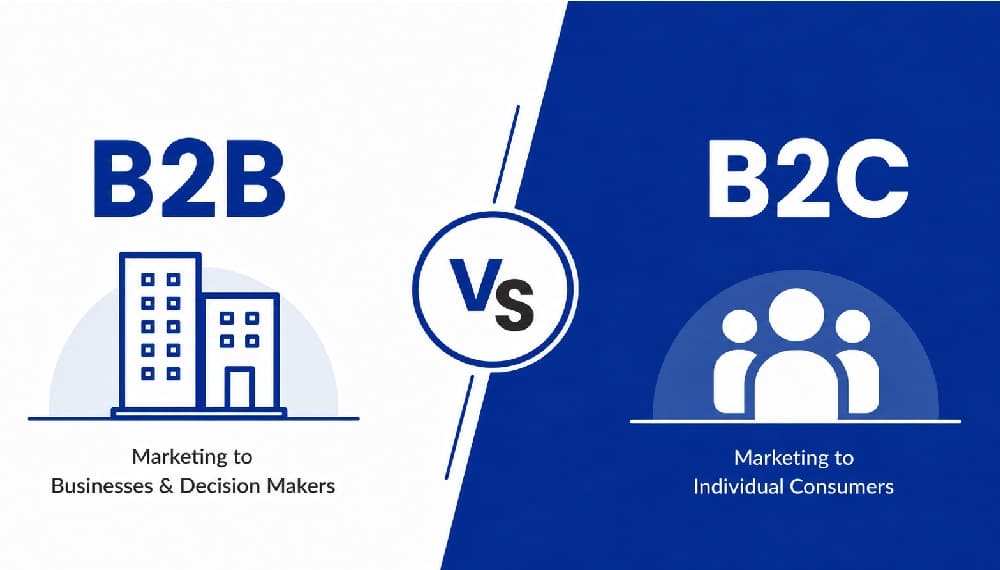
B2B vs B2C Marketing — Are They Really That Different?
A plain-English breakdown of two very different marketing worlds, with real numbers and real examples.
Setting the Stage
Two Buyers. Two Completely Different Brains.
Imagine you sell office chairs. One customer is Rahul — he works from home and wants something comfortable for under ₹8,000. He sees an Instagram ad, reads a few reviews, and places an order in 20 minutes. Done.
Now imagine your other customer is a 500-person IT company that needs 200 chairs for a new office. Their procurement team gets three quotes, their finance head reviews the budget, their HR team checks ergonomic standards, and their admin manager finally signs off — six weeks later.
Same product. Completely different marketing game. That’s B2B versus B2C in a nutshell.
“Marketing to a business isn’t just marketing to more people — it’s marketing to a different kind of decision altogether.”
B2C (Business-to-Consumer) means you’re selling directly to individuals. B2B (Business-to-Business) means your customer is another company. Both need great marketing — but the playbook is genuinely different. Let’s break it down clearly.
Marketing by the Numbers
Three statistics that tell you why this distinction matters.
77%
of B2B buyers say their last purchase was very complex or difficult, involving multiple stakeholders
Source: Gartner
6–10
people are involved in a typical B2B purchase decision — compared to usually just 1 in B2C
Source: Gartner B2B Buying Report
70%
of B2C buying decisions are influenced by emotion, not logic — the exact opposite of most B2B decisions
Source: Harvard Business Review
Core Differences
The 5 Big Differences — Explained Simply
Let’s go through the real differences without the jargon. Each one matters for how you write, where you advertise, and what you say.
Decision Logic
B2C buyers feel, then think. B2B buyers think, then think some more. Emotion drives a B2C purchase; ROI justifies a B2B one.
Time to Buy
B2C can be minutes. B2B can be months. Enterprise software deals routinely take 6–18 months from first contact to contract.
Who Decides
B2C: one person with a credit card. B2B: a committee — sometimes a very large one. You need to convince multiple people with different priorities.
Language & Tone
B2C language is emotional, punchy, and personal. B2B language is credible, data-driven, and professional — though never boring.
Where You Market
B2C thrives on Instagram, influencers, and TV. B2B lives on LinkedIn, case studies, whitepapers, and webinars.
Deal Size
B2C deals are small but numerous. B2B deals are bigger, longer in value, but require far more relationship-building to win.
Visualised Data
Where Marketing Budgets Go — B2B vs B2C
See how the two types of businesses allocate their marketing budgets across channels. The difference is stark.
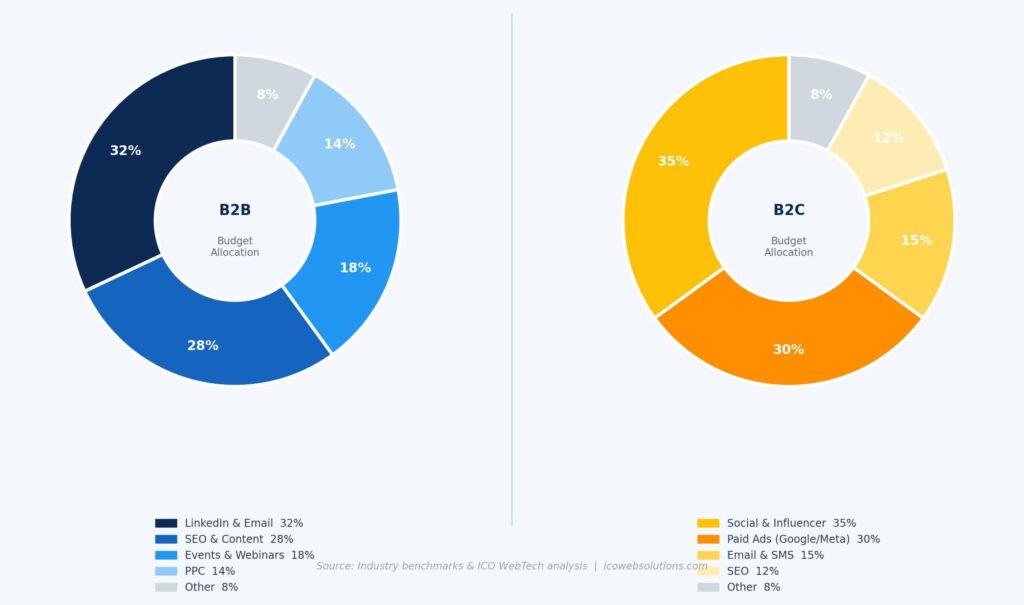
Representative averages based on industry benchmarks. Actual allocations vary by sector and business size.
Real-World Examples
The Same Product, Two Completely Different Pitches
Let’s use cloud storage software as our example. Same product. Totally different marketing approach depending on who’s buying.
B2B Example
Selling to a Manufacturing Company
Your ad headline: “Reduce document retrieval time by 40%. SOC-2 certified. Integrates with SAP.”
You follow up with a product demo, a security whitepaper, a pricing proposal, and a case study from a similar manufacturer. The IT head, CFO, and COO all weigh in before signing.
B2C Example
Selling to an Individual User
Your Instagram ad says: “Never lose a photo again. ₹99/month. Free 30-day trial.”
The user clicks, signs up, adds a credit card. Total time from ad to purchase: 4 minutes. The decision was about peace of mind, not procurement policy.
Both are marketing cloud storage. But notice how different the messaging is. B2B focuses on ROI, compliance, and integration. B2C focuses on feeling, simplicity, and value. Neither is better — they’re just designed for entirely different buyers.
“In B2C, you’re writing for a person’s heart. In B2B, you’re writing for a committee’s spreadsheet — and sometimes, for both.”
Here’s another quick example closer to our world at ICO. When we’re pitching a website design project to a fashion brand (B2C company), their founders want to see stunning visuals and a portfolio of beautiful sites. When we’re pitching to a logistics firm (B2B company), they want to know about lead generation, SEO, and how the site will be found by the businesses who need their services. Same deliverable. Completely different conversation.
Comparing the Two
Key Metrics: B2B vs B2C Side by Side
A visual comparison of how the two models perform across five important marketing metrics.
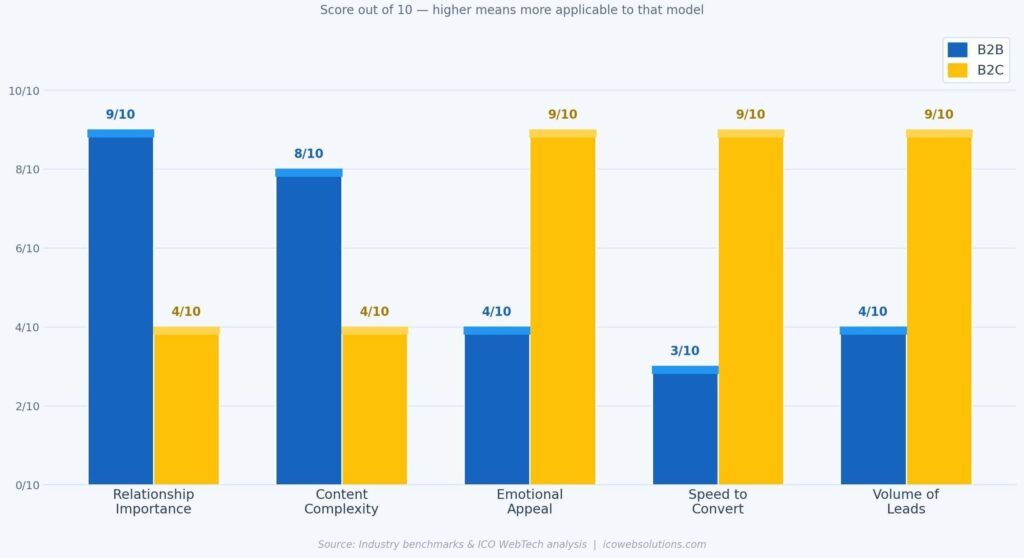
Illustrative relative scores based on industry patterns. Not absolute measurements.
Quick Reference
B2B vs B2C — The Full Picture
A side-by-side table that covers everything from audience to average sale cycle. Bookmark this.
| Factor | B2B | B2C |
|---|---|---|
| Audience | Companies, procurement teams, decision committees | Individual consumers |
| Decision Driver | ROI, efficiency, risk reduction | Emotion, aspiration, value |
| Sales Cycle | Weeks to months (sometimes years) | Minutes to days |
| Number of Buyers | 6–10 stakeholders on average | Usually 1 person |
| Content Type | Case studies, whitepapers, demos, webinars | Ads, influencers, reviews, videos |
| Primary Channels | LinkedIn, email, SEO, events | Instagram, YouTube, Google Ads, TV |
| Relationship Depth | Long-term partnerships, account management | Transactional, loyalty programs |
| Price Sensitivity | Less price-sensitive if ROI is proven | Highly price-sensitive |
| Brand vs Product | Trust and credibility of brand matter most | Product appeal and lifestyle fit matter most |
The Real Answer
So — Are They Really That Different?
Yes and no. They are different in execution — channels, tone, timelines, and metrics all change. But at their core, both B2B and B2C marketing are about the same thing: understanding what a person (or a group of people) truly needs, and showing them — clearly and convincingly — that you can provide it.
The mistake many businesses make is treating B2B as if emotions don’t matter, or treating B2C as if there’s no logic involved. A CFO approving a ₹50 lakh software purchase still wants to feel confident and respected. A consumer buying a luxury watch still wants data on durability and service warranties.
Great marketers in both worlds ask the same question: Who is making this decision, and what do they need to feel — and know — before they say yes?
At ICO WebTech, we work with both B2B and B2C clients. Our SEO strategies look different for a manufacturing exporter versus a fashion label. Our web design conversations are different for a logistics company versus an online store. But the discipline — understanding the buyer deeply and building your marketing around that understanding — is identical.
Not Sure Which Strategy Is Right for Your Business?
Whether you’re a B2B company looking to generate better leads or a B2C brand aiming for more conversions — we’ll help you build a marketing plan that actually fits your buyer.
Published by ICO WebTech — Digital Marketing & Web Design Company in Delhi, India | Since 2011
SEO · PPC · Web Design · B2B Marketing · B2C Marketing · Content Strategy
State of B2B Websites: Survey Report
Global Market Intelligence
State of B2B Websites: 2026 Global Survey Report
A deep global analysis of technical architecture, speed thresholds, and conversion frameworks across 2,500+ enterprise platforms.
Median Conversion Baseline
The worldwide average conversion baseline across B2B spaces, revealing major traffic drop-offs in corporate funnels [3].
Content-Driven Velocity
High-growth organizations identifying clear, hyper-targeted content alignment as their main pipeline expansion tool [2].
Relationship Adapters
The largest cohort of modern buyers, requiring immediate visual consensus and clear case studies before shortlisting a vendor [1].
1. Technical Architecture & Speed Thresholds
The data collected across thousands of international domains shows a direct link between server speed and business revenue. Many enterprise sites fail to realize that a slow load time acts as a major roadblock to buyer engagement. When Largest Contentful Paint (LCP) exceeds 3.8 seconds, drop-off rates jump significantly.
To retain high-intent decision-makers, companies must move away from heavy, over-engineered themes. Transitioning to streamlined infrastructure via custom B2B web design services ensures clean code structure and rapid asset delivery. Investing in professional enterprise website development allows brands to consistently hit sub-1.5-second thresholds, laying a stable foundation for the entire conversion funnel.
Look, here is something most brands miss. B2B decision-makers aren’t just sitting at desktops anymore. In 2026, over 55% of corporate procurement research happens on mobile devices during commutes or off-site meetings. If your smartphone experience feels like an afterthought, you’re bleeding pipeline velocity. It’s not just about shrinking your desktop view to fit a smaller screen; it’s about engineering a lightning-fast mobile flow. A sluggish mobile layout forces users to wait, pinch, and zoom—leading to a massive bounce rate. This makes executing a thorough, modern mobile responsive web design approach non-negotiable. Furthermore, your server response metrics must be flawlessly aligned. If your backend isn’t optimized, database calls stall under heavy corporate firewalls. Resolving these performance lags requires a dedicated emphasis on professional WordPress speed optimization. By stripping out heavy, unused scripts and implementing clean, minified styling, you can instantly secure those critical sub-2-second mobile load times.
2. Content Relevance & Information Mapping
According to the Content Marketing Institute’s latest updates, 65% of leading brands prioritize descriptive depth over simple cosmetic upgrades [2]. Buyers do not browse sites to admire visual patterns; they look for answers to concrete integration, budgeting, and scaling challenges.
This reality makes thin, generic copy a substantial vulnerability. To establish category authority, enterprise platforms must deploy a structured B2B content strategy that aligns with specific buyer journeys. Pairing this framework with professional high-authority content writing services allows you to replace thin product descriptions with detailed white papers, technical guides, and clear case studies that systematically address executive pain points.
The 2026 Strategic Inflection Point
“What used to be labeled progressive digital experimentation has now matured into baseline operational survival. With omnichannel purchasers looking for integrated buyer pathways, websites must simultaneously optimize for raw browser speeds and AI-driven engine visibility.” — McKinsey Global B2B Analysis [1].
3. The Search Evolution: Moving from SEO to GEO
Traditional search engine optimization is undergoing a major shift. While basic keyword optimization remains a standard requirement, the rise of AI-driven search engines (like Perplexity and Gemini) demands updated visibility techniques.
Modern visibility requires mastering Generative Engine Optimization (GEO). AI engines do not rely on simple keyword density; they analyze entity networks, schema data, and conversational expertise. To stay discoverable, brands need customized, AI-ready machine content stacks that serve clean JSON-LD relationships directly to search bots. Securing a trusted partner for professional SEO consulting ensures your platform stays visible across both traditional search and AI discovery models.
4. Trust Architecture & Conversion Design
The median global conversion rate rests at an underwhelming 2.9% [3]. This means out of every 1,000 corporate visitors, 971 exit without completing an action. This loss stems directly from fragmented navigation layouts and hidden client validation signals.
High-converting websites bridge this gap by weaving logos, partner proof, and performance data contextually throughout key product pages. Transitioning to advanced search engine optimization packages that integrate Conversion Rate Optimization (CRO) helps turn passive web visitors into active sales leads.
5. Interactive Lead Captures & Frictionless CRO
The days of relying solely on static “Contact Us” forms are officially dead. Today’s B2B buyers don’t want to wait 24 to 48 hours for a generic sales callback. They want immediate, customized answers tailored directly to their current operational bottlenecks. Market leaders are scaling their customer acquisition by embedding interactive tools—like ROI calculators, self-scoping wizards, and diagnostic assessments—directly into their core layout.
This is where modern, data-backed conversion rate optimization services truly show their value. When you give a user an interactive module that calculates their exact savings or performance gaps in real-time, you’re not just asking for an email address; you’re trading genuine structural value for their contact details. This simple shift completely changes your acquisition metrics. By combining these interactive micro-assets with a clean, programmatic follow-up flow, you can scale your organic, high-intent B2B lead generation without inflating your daily ad spend. It transforms your website from a passive digital brochure into an active, 24/7 consultative asset that validates your authority before a sales rep even jumps on an introductory call.
Performance Correlation Matrix: Leaders vs Laggards
| Structural Metric | Market Laggards (Bottom 60%) | Market Leaders (Top 15%) |
|---|---|---|
| Core Web Vitals (LCP) | Greater than 3.8 Seconds | Under 1.5 Seconds [3] |
| Value Proposition Style | Feature & Specification Lists | Outcome-Focused Messaging |
| Social Proof Integration | Isolated Testimonial Subpage | Contextually Distributed Logos/Cases |
| Search Architecture | Basic Keyword Repetition | AI Visibility & GEO Optimized |
Strategic Takeaway for Growing Enterprise Brands
Winning enterprise buyers requires an active pivot away from dense, self-centered product text toward clean, highly scannable layouts backed by rock-solid performance metrics. By engineering platforms around user intent, distributing trusted client proof across core solution areas, and polishing technical speeds to elite levels, B2B brands can unlock immediate, measurable pipeline velocity.
Sources
- McKinsey & Company. (2026, January 15). Global B2B Pulse Survey: The Omnichannel Imperative. McKinsey Insights. mckinsey.com/business-functions/growth-marketing-and-sales/our-insights/global-b2b-pulse
- Content Marketing Institute. (2026, February 10). B2B Content Marketing Benchmarks, Budgets, and Trends. Content Marketing Institute. contentmarketinginstitute.com/b2b-research/b2b-content-marketing-trends-research
- Patel, N. (2026, April 04). How Modern B2B Web Performance Impacts Pipeline Velocity. Neil Patel Digital. neilpatel.com/blog/b2b-web-performance-conversion-rates

Cracking the B2B Market: How ICO WebTech Builds High-ROI Content Engines
Imagine your sales team sitting down every morning, opening up a fresh list of scraped enterprise leads, and firing off hundreds of personalized emails into the digital abyss. They adjust the subject lines, test the value propositions, and follow up with religious persistence. Yet, the response rate hovers at a depressing, near-invisible fraction of a percent. The phone lines are no better; gatekeepers have evolved into ironclad fortresses, and corporate decision-makers have developed a psychological blindness to uninvited pitches.
This is the grueling reality of the modern B2B sales pipeline. For decades, the standard playbook for business-to-business growth relied heavily on sheer outbound volume. If you knocked on enough virtual doors, someone would eventually open. But in today’s sophisticated enterprise landscape, that engine isn’t just sputtering—it is completely broken. B2B companies are finding themselves caught in a vicious cycle: they struggle to build genuine industry authority, consistently fail to educate key stakeholders during long procurement cycles, and find themselves entirely dependent on hyper-expensive cold outreach or soaring paid ad platforms just to keep their pipelines on life support.
The core of the issue lies in a fundamental shift in how modern enterprise buyers make decisions. A modern B2B buying committee now averages between six and ten stakeholders. These individuals are highly risk-averse, technically literate, and intensely busy. They don’t want to be “sold” to through an aggressive slide deck or an unexpected phone call. Instead, they conduct up to 70% of their research independently online before they ever agree to speak with a sales representative. If your brand doesn’t show up during that silent research phase with undeniable intellectual depth, you don’t just lose the deal—you aren’t even invited to the table.
Cracking the B2B market requires a radical departure from volume-based noise. It demands the construction of an intentional, data-driven High-ROI Content Engine. This isn’t about churning out generic 500-word blog posts or superficial top-10 lists to appease search engine crawlers. It is about building an automated, authoritative content asset ecosystem that systematically educates buyers, dismantles objections, and turns anonymous traffic into qualified inbound enterprise leads. Let’s explore how ICO WebTech architects these high-converting engines to transition your brand from an aggressive hunter to an irresistible market authority.
—
The Trust Deficit: Decoding the Enterprise Buyer’s Mindset
To build a marketing framework that actually converts corporate buyers, you must first empathize with the intense pressure felt by a B2B decision-maker. Unlike consumer purchases, where a bad buying decision results in a minor personal inconvenience, an incorrect enterprise procurement move can paralyze an entire department, waste millions in corporate capital, or even cost someone their career. “Nobody ever got fired for buying IBM” remains one of the most profound truths in business history because it underscores a universal truth: enterprise buyers choose the safest, most authoritative option available.
When a B2B company relies solely on outward sales pitches, they encounter a massive trust deficit. A cold email inherently carries a transactional bias—the recipient knows you want their money. To bypass this defense mechanism, your digital presence must shift from a pitch to a masterclass. Your content needs to demonstrate that you understand their operational bottlenecks, their regulatory compliance headaches, and their industry’s macroeconomic pressures better than anyone else on the market.
The Golden Rule of Enterprise Marketing: He who defines the problem most accurately in the mind of the buyer is automatically perceived as the one most qualified to solve it.
If your digital channels are filled with shallow, self-promotional content, you actively signal to the market that you lack deep technical expertise. Conversely, when you systematically break down complex industry challenges through data-backed insights, you build an invisible bridge of credibility. ICO WebTech’s approach focuses on dismantling this trust deficit by replacing superficial marketing copy with authoritative, highly educational material that speaks directly to the c-suite, the procurement specialist, and the technical end-user simultaneously.
—
The Anatomy of a High-ROI Content Engine: The ICO WebTech Framework
A successful content engine cannot operate on guesswork or creative whims. It must be treated as a rigorous piece of software architecture. At ICO WebTech, we build these engines around three core content pillars, each meticulously engineered to serve a distinct phase of the complex enterprise buying journey.
1. Deep-Dive Industry Whitepapers: The Ultimate Authority Builders
If you want to capture the attention of a Chief Information Officer or a VP of Operations, standard marketing material will not cut it. These stakeholders require intellectual rigor. Deep-dive industry whitepapers serve as the crown jewels of your content engine. They are comprehensive, research-heavy documents that address overarching industry shifts, emerging regulatory threats, or complex structural changes.
ICO WebTech avoids the trap of aggregating easily found public knowledge. Instead, our research methodology uncovers proprietary insights, interviews internal subject matter experts, and incorporates hard market data. A well-constructed whitepaper doesn’t just state what your product does; it maps out the future of your entire sector. When an enterprise executive downloads a 15-page manual that perfectly diagnoses their operational inefficiencies and provides a clear, vendor-neutral framework for the future, your brand stops being a mere software vendor. You become a trusted advisor.
2. SEO-Optimized Case Studies: The Empirical Proof Engines
Every B2B software or service company claims they can save time, reduce costs, and increase efficiency. To an enterprise buyer, these claims quickly blend into a background noise of marketing fluff. To cut through this skepticism, you need hard, indisputable evidence. This is where SEO-optimized case studies come into play.
A classic mistake in B2B case studies is writing them like dry, self-congratulatory press releases. ICO WebTech transforms these assets into cinematic, narrative-driven problem-solving templates. We utilize a highly effective “Before-After-Bridge” storytelling structure. We detail the exact messy operational reality the client faced, quantify the negative business impacts, and then systematically break down how your solution served as the bridge to success. Crucially, these are heavily optimized for search engines based on specific bottom-of-funnel keyword variants (e.g., “[Competitor Name] alternatives for enterprise” or “[Industry] inventory management implementation strategy”), ensuring you catch buyers when their intent to purchase is highest.
3. High-Value Educational Blog Hubs: The Continuous Catchment Area
While whitepapers capture executive attention and case studies close the deal, your educational blog hub is the foundational net that captures daily industry search volume. Modern search engines like Google no longer rank websites based on isolated, keyword-stuffed articles. They evaluate your platform’s holistic Topical Authority—meaning you must comprehensively cover a topic from every conceivable angle to be deemed a reliable search result.
ICO WebTech designs educational blog hubs as structured, intuitively organized content ecosystems. We map out high-value content clusters that answer every foundational, intermediate, and advanced question your buyers might type into a search bar. By providing clear, actionable answers completely devoid of aggressive sales pitches, these hubs build continuous engagement, pulling organic web traffic into your ecosystem and subtly directing them toward deeper, gated assets like whitepapers and live product demonstrations.
—
The Blueprint: How ICO WebTech Constructs a High-ROI Content Engine
Building a scalable, revenue-generating content pipeline is an exact science that requires deep integration between data analysis, technical SEO, and elite-level editorial production. Here is the step-by-step methodology ICO WebTech deploys to turn your digital footprint into an automated inbound sales channel:
Step 1: Deep Stakeholder and Intent Mapping
We do not begin by looking at a keyword research tool. We begin by interviewing your sales team, your customer success managers, and your existing clients. We map out every single friction point, common sales objection, and recurring misunderstanding that occurs in the real world. We then translate these real-world insights into search intent vectors, categorizing keywords based on whether the searcher is seeking basic education, actively evaluating solutions, or ready to execute a purchase contract.
Step 2: Technical SEO Architecture and Topical Graph Alignment
Even the most brilliant article will fail to generate an ROI if your target audience cannot find it. Our engineering teams review your website’s core technical infrastructure. We ensure impeccable site architecture, clean schema markup, ultra-fast mobile loading metrics, and a logical internal linking strategy that distributes PageRank smoothly across your entire content ecosystem. We build clear semantic connections between your articles so search engines recognize your site as an undisputed industry authority.
Step 3: Elite SME-Infused Editorial Production
B2B audiences can spot generic, shallow copywriting from a mile away. ICO WebTech pairs professional enterprise journalists with your internal Subject Matter Experts (SMEs). We extract your company’s unique, hard-earned operational insights through structured, efficient interviews and translate that raw technical brilliance into highly readable, humanized, and compelling narratives. Every piece of content is engineered to feature a distinct brand voice—polished, authoritative, yet approachable and engaging.
Step 4: Omni-Channel Amplification and Distribution
The “build it and they will come” philosophy is a guaranteed recipe for digital silence. A high-ROI content engine requires an assertive distribution strategy. We systematically repurpose every major content asset into multi-channel campaigns. A single comprehensive whitepaper is carefully dismantled and transformed into a 5-part educational blog series, a sequence of high-engagement LinkedIn thought-leadership native text posts for your executives, and targeted nurture emails for your marketing automation workflows.
—
Realized Success: The 40% Ad Spend Reduction Blueprint
To understand the transformative financial power of this approach, look no further than a real-world execution engineered by ICO WebTech for an enterprise B2B technology firm. This organization was trapped in a common tech-sector bottleneck: they were spending tens of thousands of dollars every month on highly competitive Google and LinkedIn paid ads to secure demo bookings. The moment they paused their ad budgets, their inbound lead volume dropped straight to zero. Furthermore, their sales team was burning valuable hours executing cold outreach campaigns that yielded microscopic conversion rates.
ICO WebTech stepped in to completely redesign their digital growth strategy from the ground up, implementing our data-driven B2B content framework over a meticulous 9-month roadmap:
- The Diagnostic Phase: We discovered that while their competitors were targeting broad, hyper-expensive industry keywords, nobody was providing concrete, step-by-step guides addressing the complex backend migration issues their target technical directors faced daily.
- The Execution: We built three comprehensive, highly technical industry whitepapers that directly addressed these migration bottlenecks. Simultaneously, we deployed twenty SEO-optimized, deeply detailed customer case studies and launched an educational blog hub containing over fifty tightly clustered, high-intent articles.
- The Semantic Network: We hyper-linked these blog clusters directly to the whitepapers, creating a seamless, natural progression from raw informational curiosity to high-value lead capture.
The operational results were staggering. Within two quarters, the company established absolute topical authority across their core niche categories. Their domain began ranking on the first page of Google for hundreds of high-value, highly commercial search phrases completely organically. The steady, predictable stream of inbound enterprise leads allowed them to safely reduce their paid advertising spend by a massive 40% without sacrificing their monthly revenue growth. More importantly, the leads coming through the organic content engine were fundamentally pre-educated; they arrived at sales conversations already understanding the firm’s unique methodology, reducing the corporate sales cycle duration by over 30%.
—
Measuring What Matters: Content Engine Metrics vs. Outbound Noise
When shifting from an outbound sales model to an inbound content engine, your internal tracking metrics must evolve accordingly. Traditional sales teams look purely at activity metrics: dials made, emails sent, and pitches delivered. A high-ROI content engine focuses squarely on long-term capital efficiency and compounding brand equity. Let’s look at how the two models contrast across critical operational indicators:
—
The Long-Game Advantage: Owning Your Audience and Market Space
Every dollar you spend on paid search platforms or cold database lists is a temporary rental. The moment you stop feeding those platforms with cash, your visibility disappears, your lead pipelines freeze up, and your sales team is left stranded. Relying entirely on rented attention is an incredibly risky, highly stressful way to scale an enterprise brand.
Investing in a custom content marketing engine built by ICO WebTech is the digital equivalent of moving out of a rented apartment and purchasing prime commercial real estate. You are creating permanent, intellectual property assets that sit on your balance sheet, continuously appreciating in economic value. Every authoritative whitepaper, every conversion-optimized case study, and every strategically linked blog post adds another layer of defense around your market share, making it increasingly difficult for newer competitors to displace you.
The modern B2B buyer has made their preferences undeniably clear: they will buy from the brands that educate them, respect their autonomy, and prove their operational value transparently online. By pairing deep technical SEO execution with elite, humanized thought-leadership production, ICO WebTech provides your brand with the architecture required to dominate search results, earn executive trust, and build a highly predictable inbound growth engine that fuels your corporate revenue for years to come.
Bento Grid Layouts vs. The Asymmetric Hero Section: Which Visual Hierarchy Wins the B2B Conversion Battle?
In the highly competitive world of digital enterprise marketing, a website’s above-the-fold real estate serves as a digital handshake, a product demonstration, and a sales funnel all at once. For years, the standard layout template for business-to-business (B2B) landing pages followed a highly predictable blueprint: a centered headline, a brief paragraph of subtext, a primary call-to-action (CTA) button, and perhaps a stock image or product screenshot floating to the right. However, design demands have evolved. Modern user interfaces now lean heavily on two dominant, visually striking layout philosophies: the structured modularity of the Bento Grid Layout and the editorial punch of the Asymmetric Hero Section.
This structural evolution isn’t just about aesthetics. In a landscape where the average B2B buyer guides themselves through 70% of the purchasing journey before ever engaging a sales representative, layout structures act as silent navigators. The way an interface structures its content directly governs cognitive load, dictates reading patterns, and ultimately decides whether a user scrolls downward or leaves the page entirely. Selecting the wrong visual model can quietly tank lead generation metrics, while selecting the right framework can dramatically accelerate path-to-conversion velocities. This is exactly where the analytical capabilities of a specialized B2B website designing company become essential, helping brands match visual hierarchy with actual user psychology.
To determine which layout structure wins the B2B conversion battle, we must look past superficial design trends and analyze the underlying mechanics of user interaction, cognitive processing costs, and cross-device performance optimization.
The Anatomy of the Contenders
Before testing these frameworks against hard conversion goals, we need to clarify exactly how these layout structures function at a code and structural level.
1. The Bento Grid Layout
Inspired by the traditional Japanese lunchbox and popularized by Apple’s hardware product landing pages, the Bento Grid is a modular design framework that chunks information into distinct, rounded rectangles arranged within a rigid CSS Grid layout. Each card or compartment within the grid operates as an independent content container, holding a specific product feature, data point, customer testimonial, or interactive graphic.
The core objective of the Bento Grid is to present multi-faceted data sets in a visually clean, scannable format. Rather than forcing users through a long vertical scroll of text, it maps out several distinct concepts simultaneously within a single, unified view, using variable tile sizes to indicate the relative importance of each point.
2. The Asymmetric Hero Section
In stark contrast to the structured, compartmentalized nature of the Bento Grid, the Asymmetric Hero Section deliberately avoids uniformity. It leverages intentional visual imbalances, off-center focal points, non-standard text placements, and overlapping layout elements to guide the user’s eye through a highly curated narrative sequence.
Asymmetry breaks traditional grid-alignment rules to create visual tension and dynamic movement. Instead of dividing a reader’s attention across multiple equal-weight containers, an asymmetric hero relies on a single dominant visual element—such as a bold cropped typography layout, an oversized product render, or an unusual geometric mask—balanced by strategic whitespace and minimalist type scales on the opposing side.
Cognitive Load and User Psychology in B2B Environments
To evaluate these layouts through a conversion lens, we have to look at how B2B buyers process information. Unlike business-to-consumer (B2C) shoppers, who often buy impulsively based on emotion, B2B buyers are looking to mitigate risk. They are searching for specific solutions to operational problems, analyzing technical specs, and trying to justify costs to an internal purchasing committee.
Consequently, the primary enemy of B2B conversions is cognitive friction. If a webpage forces a buyer’s brain to work too hard to understand what a company offers, they will close the tab. Human reading patterns also vary wildly depending on the structural layout they encounter. When users view an asymmetric hero section, their eyes typically follow a classic F-Shape or Z-Shape scanning pattern. They read the dominant headline from left to right, drop down to capture the subtext, and swing back to lock onto the primary conversion point. The journey is linear, controlled, and predictable.
When confronted with a Bento Grid, however, the scanning mechanism shifts to a pattern known as Grid Grazing. The eye darts around the page, drawn by the contrasting visual weights of different compartments. The user chooses their own adventure, processing data fragments non-linearly. When an enterprise brand partners with an experienced B2B website designing company, the primary goal is to engineer a layout that keeps this visual complexity low while still delivering enough meaningful value propositions to qualify the lead.
Bento Grid Layouts: The Case for Modular Data Presentation
The Bento Grid layout excels at managing multi-dimensional data without letting the screen degenerate into visual chaos. For certain B2B business models, this layout approach offers substantial conversion advantages.
The Advantages: Why Bento Wins for Complex Product Ecosystems
- High Information Density Above the Fold: If your product features an intricate mix of software dashboards, real-time analytics, and developer integrations, a Bento layout lets you show off all three value pillars simultaneously without cluttering the page.
- Natural Visual Hierarchy: By making a primary feature tile twice as large as the secondary integration or review tiles, you create a built-in hierarchy that guides the reader’s attention from big-picture value down to granular proof points.
- Perfect Integration of Social Proof: Bento grids allow you to place a G2 crowd rating badge or a recognizable client logo matrix right alongside technical feature highlights, building trust inline without requiring dedicated sub-sections.
The Conversion Roadblocks: When Bento Implodes
Despite its visual appeal, the Bento Grid can backfire if it is used to tell a sequential story. Because the layout divides focus among multiple containers, it can trigger analysis paralysis. If an analytical tile, an animated product loop, a customer testimonial, and a CTA chip are all competing for attention at the same time, the primary conversion action can easily get lost in the shuffle.
This is why a professional B2B website designing company advises against using Bento grids for long-form conceptual services. If your product requires deep education or a mindset shift before a buyer is ready to convert, chopping your narrative into four or five separate boxes will break the persuasive flow and hurt your conversion rates.
The Asymmetric Hero Section: The Case for a Singular, High-Impact Narrative
Where the Bento Grid spreads out focus across a collection of data points, the Asymmetric Hero Section concentrates energy into a single, high-impact brand statement.
The Advantages: Why Asymmetry Drives Enterprise Conversions
- Uncompromised Focus on the Primary CTA: By surrounding your headline and conversion form with generous whitespace and shifting the primary visual asset off-center, you eliminate competing distractions. The user’s eye has fewer places to go, making them much more likely to read your copy and click the form.
- Premium Brand Signaling: Asymmetric layouts feel intentional, custom-crafted, and highly editorial. For enterprise consultancies, high-ticket cybersecurity firms, or boutique technical vendors, this layout signals premium positioning and justifies a higher price point.
- Strict Narrative Control: You dictate the exact order in which the buyer consumes your message. First, they absorb the disruptive hook headline, then they parse the supporting value prop, and finally, they hit the primary lead form.
The Conversion Roadblocks: When Asymmetry Fails
Asymmetric layouts live and die by the quality of their creative assets and typography. If your headline copy is vague or your custom imagery doesn’t immediately illustrate the product, the layout will look unfinished and confusing rather than artistic and premium.
Additionally, asymmetry requires precise spatial balance. If a designer over-indexes on white space or pushes elements too far off-center, it can create an unpolished user experience that degrades brand credibility among more conservative enterprise procurement officers.
The Mobile Responsiveness Reality Check
A web design layout is only as good as its performance on mobile devices. In the B2B sector, mobile traffic accounts for over 50% of initial research actions. Executives browse solutions on their phones between meetings or during commutes, meaning your desktop layouts must translate perfectly to small screens.
This is where the two design approaches diverge dramatically from a development perspective. Bento grids are highly programmatic. Because they are built on CSS Grid architectures, collapsing a desktop Bento layout down for mobile devices is straightforward: you simply set your CSS grid template columns to a single flex column. The compartments effortlessly stack into a uniform, vertical stream of cards. While this changes the experience from a multi-directional layout into a linear vertical scroll, it preserves readability and content integrity with zero layout distortion.
Asymmetric heroes, however, require a lot more manual optimization at smaller breakpoints. Because asymmetry relies on precise visual weight distributions, overlapping elements, and specific whitespace ratios, simply stacking components vertically can quickly ruin the design. If elements aren’t carefully repositioned via CSS media queries, text blocks can easily overlap images, background shapes can distort, and your primary CTA can end up pushed far down below the fold. This responsive adaptation challenge is exactly where an experienced B2B website designing company earns its keep, ensuring that complex layout structures remain flawless across every screen size.
The Final Verdict: Strategic Mapping for Your Business Model
When choosing between a Bento Grid and an Asymmetric Hero layout, your decision shouldn’t be based on what looks trendiest on design showcases. Instead, your choice should be dictated by the structural complexity of your product and the buying behavior of your target audience.
The Bento Grid is your clear winner if: You run a self-serve B2B SaaS platform, a high-volume developer tool, or a product with highly visual dashboard interfaces. If your buyers are eager to inspect your app’s UI, check out integration options, and verify feature checklists right above the fold, the Bento structure packages those diverse details into a neat, organized home screen.
The Asymmetric Hero Section is your clear winner if: You sell enterprise software platforms, high-end professional services, or complex custom integrations that carry long sales cycles and high contract values. In these business spaces, your biggest hurdle is establishing immediate domain authority and delivering a single, clear value proposition. The asymmetric approach provides the clean focus and premium feel needed to capture executive attention and drive them toward your sales team.
Ultimately, high-converting B2B web design is about eliminating friction and directing focus. Partnering with a specialized team ensures your visual layouts align perfectly with your core lead-generation targets. Whether you choose the modular organization of the Bento Grid or the bold narrative clarity of an Asymmetric layout, the goal remains the same: clear the path for your buyers, highlight your core value, and make your conversion path completely undeniable.


Building a Stronger Brand Through Strategic B2B Web Design
In today’s highly competitive digital landscape, your website is more than an online brochure—it is the face of your business, your most reliable sales representative, and often the first impression potential clients have of your company. For B2B companies, where purchasing decisions are thoughtful, research-driven, and often involve multiple stakeholders, a strong website can significantly influence trust, credibility, and conversions.
That is why strategic web design has become a critical component of brand building. Businesses that invest in professional design are not simply improving aesthetics—they are creating a digital experience that supports long-term growth. Partnering with a B2B website design agency can help companies transform their websites into powerful branding and lead-generation tools.
This article explores how strategic B2B web design strengthens your brand, builds authority, improves customer trust, and drives measurable business results.
Why Branding Matters in the B2B Space
Many businesses still believe branding is something mainly meant for B2C companies that sell products directly to consumers. They often associate branding with flashy advertisements, catchy slogans, or emotional marketing campaigns. However, branding is just as important—if not more important—in the B2B world.
In business-to-business markets, buyers are rarely making quick or impulsive decisions. They are investing company budgets, evaluating long-term partnerships, and choosing vendors who may directly impact their growth, operations, or reputation. Because of this, trust and confidence play a major role in every decision they make.
Unlike many consumer purchases, B2B buying journeys are often longer and more complex. Decision-making can involve multiple people such as business owners, procurement teams, managers, and stakeholders. Before reaching out, these decision-makers usually research a company online, compare competitors, read reviews, and explore websites in detail.
This means your brand is often being evaluated long before the first conversation ever happens.
When a potential client lands on your website, they instantly begin forming opinions about your company. Within seconds, they may judge your business based on factors such as:
- Professionalism – Does your company appear established, organized, and serious about its work?
- Industry Expertise – Do you look like specialists who understand the market and customer challenges?
- Reliability – Can clients depend on you to deliver consistent results?
- Innovation – Does your business feel modern, forward-thinking, and adaptable?
- Trustworthiness – Do you appear honest, credible, and transparent?
- Stability – Does your company look strong enough to support long-term business relationships?
These impressions are formed quickly, often before a visitor reads much of your content. Design, layout, messaging, speed, visuals, and overall user experience all contribute to how people perceive your brand.
If your website looks outdated, cluttered, confusing, or inconsistent, potential clients may assume the same issues exist within your business operations. They may wonder if your processes are inefficient, if communication will be difficult, or if your company is behind the times.
On the other hand, a polished and strategically designed website sends a very different message. It shows that your company values quality, pays attention to detail, and understands the importance of presenting itself professionally. It helps visitors feel more comfortable trusting you with their time, budget, and business goals.
Strong branding in the B2B space is not about being flashy—it is about creating confidence. It reassures potential clients that they are dealing with a capable and credible organization. Over time, that confidence can become one of the key reasons they choose your business over a competitor.
In a crowded market where many companies offer similar services, branding often becomes the deciding factor. Businesses don’t just buy services—they buy trust, reputation, and the confidence that they are making the right decision.
Your Website Is the Core of Your Digital Brand
In today’s digital-first business environment, your website is far more than just an online presence. It is often the heart of your brand identity and the place where potential clients go to learn who you are, what you do, and whether your company is worth trusting. For many businesses, the website becomes the first real interaction a prospect has with the brand.
No matter how someone discovers your company, they will usually visit your website before making a decision or reaching out. They may find you through search engines while researching solutions, come across your business on LinkedIn, click through from an email campaign, hear about you through a referral, or arrive through a paid advertisement. In nearly every case, your website becomes the next step in their journey.
This is why your website plays such an important role in shaping brand perception. It acts as a digital storefront, a sales representative, a credibility builder, and an information hub all at the same time. If the experience feels professional, clear, and trustworthy, visitors are more likely to move forward. If it feels outdated or confusing, they may leave without ever contacting you.
Your site should consistently communicate your brand message across every page. From the homepage to service pages, blogs, case studies, and contact forms, every section should reflect your company’s voice, values, and expertise. Consistency creates familiarity, and familiarity helps build trust.
A professionally designed B2B website should quickly answer the questions every potential client is already thinking about:
- Who are you? Visitors want to know the story behind your business, your experience, and what kind of company they are dealing with.
- What problems do you solve? Businesses are searching for solutions, not just services. Your website should clearly explain how you help clients overcome challenges and achieve goals.
- Why should clients trust you? Trust is essential in B2B buying decisions. Testimonials, case studies, certifications, results, and client logos can all reinforce credibility.
- What makes you different? Many industries are crowded with competitors offering similar services. Your website should highlight your unique strengths, approach, or expertise.
- How can someone contact you? If a visitor is ready to take the next step, the path should be simple and obvious. Easy-to-find contact forms, calls-to-action, phone numbers, and consultation options matter.
When these answers are difficult to find, visitors often lose interest quickly. People do not want to dig through multiple pages trying to understand what a company does. They want clarity, confidence, and a reason to stay.
That is where thoughtful strategy becomes so valuable. A skilled B2B website design agency understands how to combine content, layout, branding, and user experience in a way that makes information easy to absorb. They know how to guide visitors naturally through the site while building trust at every stage.
Instead of overwhelming people with unnecessary clutter, strong B2B web design focuses on simplicity, relevance, and conversion. Clear messaging, clean visuals, intuitive navigation, and persuasive calls-to-action all work together to create a better user experience.
Your website should not simply exist—it should actively represent your business, strengthen your reputation, and help turn interest into opportunity. When built strategically, it becomes one of the most valuable assets your brand owns.
The Link Between Strategic Web Design and Brand Strength
Many businesses think branding begins and ends with a logo, a color palette, or a catchy tagline. While those elements are important, they are only one part of the bigger picture. Real brand strength is built through the experiences people have with your business. Every interaction shapes perception, and in today’s digital world, your website is often one of the most influential touchpoints.
When potential clients visit your website, they are not only looking at your services—they are evaluating your professionalism, attention to detail, reliability, and overall credibility. Within moments, they begin forming opinions about whether your company feels modern, trustworthy, experienced, and capable of solving their problems.
This is where strategic web design becomes so valuable. It goes beyond creating a site that simply looks attractive. Strategic design combines visual identity, user experience, messaging, structure, and performance to create a complete brand experience that leaves a lasting impression.
A strong website makes visitors feel confident in your business. A weak website can create doubt, even if your services are excellent. That is why design and branding are deeply connected.
1. Professional Visual Identity
Visual design plays a powerful role in how people perceive your brand. Before visitors read a single sentence, they notice your colors, typography, imagery, icons, spacing, and layout. These elements quietly communicate who you are and what your company stands for.
Strategic web design ensures that every visual detail supports your brand personality and business goals. Instead of random design choices, each element is selected intentionally to create the right impression.
For example:
- Clean and minimal layouts often communicate efficiency, clarity, sophistication, and modern thinking.
- Bold colors and dynamic visuals may suggest creativity, confidence, innovation, and energy.
- Structured corporate styling can imply reliability, trust, experience, and long-term stability.
- Warm imagery and approachable design may help humanize technical or professional services.
When all pages follow a consistent design language, visitors begin to recognize your brand more easily. Consistency creates familiarity, and familiarity builds trust. If every page looks disconnected or uses different styles, it can make the business feel disorganized.
A polished visual identity tells visitors that your company values quality and pays attention to detail.
2. Clear Messaging
Even the most beautiful website will fail if visitors cannot quickly understand what your business does. Design and content must work together. Great visuals may attract attention, but clear messaging is what turns attention into interest.
Many B2B websites make the mistake of using vague language, complex jargon, or overly technical explanations. This often confuses visitors rather than helping them. Strategic design solves this by presenting information clearly and logically.
Your website should immediately communicate:
- Who you help
- What problems you solve
- What services you provide
- Why clients should choose you
- What action visitors should take next
Strong headlines, concise service descriptions, benefit-focused copy, and visible calls-to-action all play an important role. Visitors should never have to guess what your business offers.
When messaging is clear, your brand feels more confident, more professional, and easier to trust.
3. User Experience
User experience is one of the most overlooked parts of branding. Many companies focus only on visuals while ignoring how the site actually feels to use. However, people remember frustration just as much as they remember design.
If a website is slow, difficult to navigate, cluttered, or confusing, visitors often associate those negative feelings with the brand itself. They may assume working with the company will be equally frustrating.
Strategic web design creates a smooth and enjoyable experience by focusing on:
- Easy-to-use navigation menus
- Fast loading pages
- Logical content flow
- Mobile responsiveness
- Readable text and clean layouts
- Simple forms and contact options
- Clear next steps on every page
When visitors can find information quickly and move through the website effortlessly, they feel more comfortable engaging with the brand. A seamless experience reflects professionalism, competence, and respect for the user’s time.
Good user experience is not just functional—it strengthens trust.
4. Credibility Signals
In B2B industries, trust is everything. Buyers are often making decisions that involve significant budgets, long-term partnerships, or mission-critical services. They need reassurance that they are choosing the right company.
Your website should provide proof, not just promises.
Strategic web design highlights credibility signals that help visitors feel confident, such as:
- Case studies showing measurable results for real clients
- Testimonials that demonstrate satisfaction and positive experiences
- Client logos that show respected businesses already trust you
- Certifications and accreditations that validate expertise
- Awards and recognitions that strengthen authority
- Statistics and performance data that support your claims
- Team profiles that put real faces behind the company
These elements reduce uncertainty and help move prospects closer to a decision. Without them, visitors may hesitate, even if your services are excellent.
Trust grows when people can clearly see evidence of your success.
Brand Strength Is Built Through Every Detail
A strong brand is not created by one single element. It is built through the combination of visuals, messaging, usability, and credibility. When these areas work together, your website becomes more than a marketing tool—it becomes a reflection of the quality of your business.
Strategic web design helps companies create positive first impressions, memorable experiences, and stronger emotional confidence with potential clients. Over time, these experiences shape how people remember your business and whether they choose to work with you.
That is the true link between web design and brand strength: people trust brands that feel professional, clear, reliable, and easy to engage with.
How Strategic B2B Web Design Builds Trust
Trust is one of the most valuable assets in the B2B world. Unlike many consumer purchases, business decisions usually involve larger budgets, longer commitments, and greater risk. A company choosing a service provider, technology partner, consultant, or agency is not simply buying a product—they are investing in a relationship that can directly affect performance, growth, reputation, and results.
Because of this, trust becomes the foundation of every B2B sale. Before a prospect schedules a demo, requests a quote, books a consultation, or signs a contract, they want to feel confident they are making the right decision.
In many cases, your website is where that confidence begins.
Potential clients often research businesses online long before making contact. They compare websites, read case studies, browse service pages, and look for signs that a company is credible, experienced, and reliable. Even if your sales team is excellent, many prospects will form their first impression before speaking to anyone.
This means your website should do more than look attractive—it should actively build trust at every stage of the visitor journey.
Strategic B2B web design helps achieve this by combining clarity, professionalism, proof, and security into one seamless experience.
Transparent Communication
One of the fastest ways to build trust is through clear and honest communication. Business buyers appreciate transparency because it reduces uncertainty and helps them make informed decisions.
If your website is vague about services, pricing structures, timelines, or processes, visitors may hesitate. They may wonder what working with your company is really like, what hidden costs may exist, or whether expectations will be unclear later.
Strategic web design presents information in a way that feels open, simple, and helpful. This can include:
- Clear descriptions of services and deliverables
- Who your solutions are best suited for
- Step-by-step explanations of your process
- Expected timelines or onboarding stages
- Pricing models when appropriate
- Frequently asked questions
- Straightforward contact options
When prospects feel informed, they feel more comfortable moving forward. Transparency shows confidence in your own business and respect for the client’s time.
People trust companies that communicate clearly.
Modern Design Standards
Design strongly influences perception, especially in the first few seconds of a visit. Even if your company offers excellent services, an outdated or poorly maintained website can create the wrong impression.
Visitors may assume that if the website feels neglected, the business itself may be disorganized, slow to adapt, or behind industry standards.
Modern web design helps prevent this by showing that your company is active, current, and invested in quality. A professionally designed website often includes:
- Clean and uncluttered layouts
- Responsive mobile-friendly pages
- Fast loading speeds
- Modern typography and visuals
- Easy navigation
- Consistent branding across pages
- Accessible and user-friendly interfaces
These details may seem small, but together they send a powerful message: your company pays attention to quality, embraces progress, and values user experience.
Modern design creates confidence because it reflects a business that evolves with the market rather than falling behind it.
Proof of Results
Claims alone rarely build trust in B2B markets. Nearly every company says it delivers quality, expertise, or excellent service. Buyers want evidence.
This is why proof of results is so important. Real examples of success help visitors move from curiosity to confidence. They show that your company has delivered value for others and can likely do the same again.
Strategic web design highlights proof in ways that are easy to notice and easy to trust, such as:
- Detailed case studies with measurable outcomes
- Client testimonials with authentic feedback
- Before-and-after project examples
- Recognizable client logos
- Performance statistics and growth numbers
- Industry awards or certifications
- Long-term client relationships
For example, saying “we help businesses grow” is less persuasive than showing how you increased leads by 40% or improved conversion rates for a client.
Results speak louder than promises. When visitors see real outcomes, trust grows naturally.
Secure Website Infrastructure
Trust is not only emotional—it is also technical. Businesses want to know their information will be handled responsibly, especially when submitting contact forms, requesting consultations, or sharing sensitive details.
A secure website sends strong signals that your company takes professionalism and data protection seriously.
Important trust-building elements include:
- SSL certificates and secure HTTPS connections
- Reliable website hosting with strong uptime
- Secure forms for inquiries and lead capture
- Privacy policies and data handling information
- Cookie consent tools where required
- Regular software and plugin updates
- Spam protection and security monitoring
If a website appears unsafe, loads with browser warnings, or looks poorly maintained, visitors may leave immediately. Security issues can damage credibility faster than almost anything else.
On the other hand, a secure and well-maintained site reassures prospects that your company is responsible, dependable, and serious about protecting information.
Trust Is Built Through the Full Experience
Many companies think trust comes only from sales conversations, but in reality, trust begins much earlier. It starts when someone visits your website and asks themselves a simple question: “Does this company feel reliable enough to work with?”
Every part of your website helps answer that question. The design, messaging, speed, navigation, proof, and security all contribute to the final impression.
When these elements work together, prospects feel more comfortable taking the next step—whether that means requesting a quote, scheduling a call, or beginning a partnership.
Why Expert Guidance Matters
Building trust online is not accidental. It requires thoughtful planning and a clear understanding of how buyers think. A trusted B2B website design agency knows how to structure a website so that visitors feel confident from the moment they arrive.
From visual presentation and messaging strategy to performance optimization and credibility placement, the right agency ensures trust-building elements are woven into every part of the site.
In competitive B2B markets, trust often becomes the deciding factor. A strategically designed website helps make sure your business earns it.
Strategic Design Supports Longer B2B Buying Journeys
One of the biggest differences between B2B and B2C marketing is the way buying decisions are made. Many consumer purchases happen quickly. A person may see a product, like the price, and buy it within minutes. B2B decisions are rarely that simple.
In the business world, purchases often involve larger budgets, greater risk, longer commitments, and more careful evaluation. A company choosing a service provider, software platform, consultant, or agency is making a decision that can directly impact revenue, operations, productivity, or long-term growth.
Because of this, B2B buyers usually take their time. The buying journey may last weeks, months, or even longer depending on the size of the investment. During that time, prospects research options, compare competitors, ask internal questions, request approvals, and gather information before moving forward.
In many cases, more than one person is involved in the final decision. A manager may evaluate functionality, a finance team may review cost, leadership may assess risk, and another stakeholder may focus on implementation or long-term value.
This means your website is not speaking to just one person—it may be influencing an entire group of decision-makers.
That is why strategic web design matters so much in B2B markets. Your website should not only look professional; it should support buyers at every stage of their journey. Different visitors arrive with different questions, different concerns, and different levels of readiness.
A strategically designed website helps guide them naturally from first interest to final decision while continuously reinforcing your credibility and brand authority.
The Awareness Stage
At the awareness stage, prospects are just beginning to recognize a challenge or opportunity. They may not be searching for a specific provider yet. Instead, they are trying to understand their problem, learn about possible solutions, and gather early insights.
At this point, visitors are often asking questions like:
- Why is this issue happening?
- What solutions are available?
- How are other companies solving it?
- What should we consider before making a change?
Your website should help educate rather than immediately sell. Valuable awareness-stage content can include:
- Helpful blog articles
- Industry insights
- Problem-focused guides
- Trend reports
- Checklists and resources
- Frequently asked questions
- Introductory videos or explainers
This type of content positions your company as knowledgeable and helpful. Even if a visitor is not ready to buy today, they begin to remember your brand as a trusted source of information.
That early trust often influences who they contact later.
The Consideration Stage
Once buyers clearly understand their problem, they move into the consideration stage. Now they are actively comparing solutions and evaluating which providers may be the best fit.
At this stage, they are asking more focused questions such as:
- Which company has the right expertise?
- What services are included?
- How does one solution compare to another?
- Can this provider handle our specific needs?
- What makes this company different?
Your website should make answers easy to find. Strong consideration-stage content often includes:
- Detailed service pages
- Industry-specific solutions
- Comparison pages
- Process explanations
- Technology capabilities
- Case examples
- Clear value propositions
This is where thoughtful structure becomes important. Visitors should be able to navigate quickly, understand benefits clearly, and see why your business stands out.
If information is confusing, hidden, or overly technical, prospects may move to a competitor whose website makes the decision easier.
The Decision Stage
By the decision stage, buyers are narrowing options and preparing to choose a provider. They may already like what they see, but they still need reassurance before committing.
At this point, trust and confidence become critical. Buyers often want proof that your company can deliver results and provide a smooth working relationship.
Decision-stage website elements may include:
- Client testimonials
- In-depth case studies
- Consultation booking forms
- Live demos or discovery calls
- Proposal request pages
- Pricing guidance where relevant
- Guarantees, certifications, or credentials
The easier it is for prospects to take the next step, the more likely they are to convert. Strong calls-to-action, simple forms, and reassuring proof help reduce hesitation.
This stage is where many deals are won—or lost.
Multiple Decision-Makers Need Different Information
One challenge unique to B2B buying journeys is that different people care about different things. A technical manager may want features and integrations. A finance leader may focus on ROI and costs. Executives may prioritize reliability, scalability, and strategic value.
Your website should serve all of them.
Strategic design organizes information so each stakeholder can quickly find what matters most. Instead of forcing everyone through the same generic message, the site can present layered content that appeals to multiple priorities.
This creates a smoother internal buying process for your prospects and makes your business easier to justify internally.
Your Website Should Guide, Not Confuse
Many businesses lose opportunities because their website does not match the buyer journey. They push for contact too early, fail to answer common questions, or hide valuable proof deep inside the site.
Strategic design solves this by guiding visitors naturally from one step to the next. Helpful blog readers can be directed to service pages. Interested service-page visitors can be led to case studies. Ready buyers can be guided toward consultations or proposals.
This creates momentum instead of friction.
Authority Grows Throughout the Journey
Every page a prospect visits shapes how they view your brand. Helpful content builds credibility. Clear explanations build confidence. Case studies build trust. Professional design builds reassurance.
When all these elements work together, your website does more than inform—it consistently reinforces your authority at every stage of the buying process.
By the time a prospect contacts you, they often already feel familiar with your business and more confident in your expertise.
Why Strategic Design Matters
A well-designed B2B website is not just a brochure. It is a digital sales tool built to support longer, more thoughtful buying journeys. It educates early-stage prospects, helps active buyers compare options, and gives decision-makers the confidence to move forward.
That is the real value of strategic design: it meets buyers where they are, answers the right questions at the right time, and helps turn interest into long-term business relationships.
SEO and Brand Visibility Go Hand in Hand
A visually impressive website can create a strong first impression, but design alone is not enough. No matter how polished, modern, or professionally written your website may be, it has limited value if potential clients never find it. In the digital world, visibility is just as important as appearance.
This is where search engine optimization becomes essential. SEO helps your business appear when potential customers are actively searching for the products, services, or solutions you provide. Instead of interrupting people with ads, SEO allows your brand to show up at the exact moment someone is looking for help.
That makes SEO one of the most powerful ways to attract high-intent B2B traffic.
When decision-makers search online, they often use Google and other search engines to compare providers, research problems, evaluate options, and shortlist companies. If your business appears consistently in those search results, you gain more than clicks—you gain visibility, trust, and brand recognition.
Over time, people begin to remember companies they repeatedly see online. Even if they do not contact you immediately, familiarity starts to grow. And in B2B markets, familiarity often leads to credibility.
This is why SEO and brand visibility go hand in hand. The more visible your business becomes, the more authority your brand can build.
A Beautiful Website Needs Traffic
Many companies invest heavily in design but overlook discoverability. They launch a sleek new website, then wonder why leads do not increase. The reason is simple: if the right people are not reaching the site, design cannot do its job.
Your website needs qualified visitors—people who are already interested in solving a problem or finding a provider. SEO helps bring those people in organically.
When combined with strong branding and smart web design, SEO becomes a long-term growth engine rather than a short-term traffic tactic.
Strategic B2B Web Design Creates SEO-Friendly Foundations
Effective SEO is not only about keywords or blog posts. It begins with the technical and structural foundation of the website itself. Strategic B2B web design ensures your site is built in a way that search engines can understand and users can enjoy.
Important SEO-friendly foundations include:
- Clean code structure – Well-built code helps search engines crawl and index your site more efficiently while supporting better performance.
- Mobile responsiveness – Search engines prioritize mobile-friendly experiences, and many business users browse on phones or tablets.
- Fast load speed – Slow websites frustrate visitors and can negatively impact rankings. Speed improves both SEO and user experience.
- Optimized headings – Clear heading structures help search engines understand page topics while making content easier for users to scan.
- Internal linking – Strategic links between pages help distribute authority and guide visitors deeper into your website.
- Keyword-focused service pages – Dedicated pages targeting relevant search terms help attract buyers looking for specific services.
- Schema markup – Structured data can help search engines better understand your business and improve how listings appear in results.
- Secure HTTPS setup – Website security supports trust and is also a recognized ranking factor.
These elements work behind the scenes, but they play a major role in how visible your brand becomes online.
Visibility Builds Familiarity
People often trust names they recognize. When potential clients repeatedly see your company appearing in search results for relevant topics, your brand becomes more familiar over time.
For example, a prospect may first discover your blog while researching a problem. Later, they may see your service page when comparing providers. A few weeks after that, they may encounter one of your case studies while evaluating options.
Even before direct contact, your brand has already built presence in their mind.
This repeated exposure is powerful because B2B decisions are rarely made in a single visit. Buyers often research multiple times over a long period. Every appearance in search results gives your business another chance to build recognition and trust.
Authority Grows With Consistent Search Presence
High rankings do more than increase traffic—they often influence perception. Many users naturally associate top search results with authority, relevance, and market leadership.
If your business consistently ranks well for important industry searches, prospects may view your company as established and credible.
This does not happen overnight. It is built through ongoing optimization, quality content, strong website structure, and a positive user experience. But over time, search visibility can significantly strengthen brand authority.
SEO Supports the Entire Buyer Journey
Another advantage of SEO is that it can reach prospects at every stage of the buying process.
- Awareness Stage: Educational articles and guides attract people researching challenges.
- Consideration Stage: Service pages, comparisons, and solution-focused content help active evaluators.
- Decision Stage: Case studies, testimonials, and branded searches support final decisions.
This means SEO does not just generate traffic—it supports the full sales funnel while strengthening your brand at each stage.
Why Design and SEO Should Work Together
Some businesses treat SEO and design as separate projects, but the strongest results happen when they work together from the beginning.
A site that ranks well but looks outdated may lose trust. A beautiful site with no visibility may attract no leads. Success comes from combining discoverability with strong user experience.
That is why many companies choose a B2B website design agency that understands both branding and SEO. The right partner can create a website that not only looks professional but also attracts qualified traffic and converts visitors into opportunities.
Long-Term Value for Your Brand
Paid advertising can create quick visibility, but it usually stops when the budget stops. SEO, by contrast, can continue generating traffic and brand exposure over time.
Every optimized page, helpful article, and technical improvement becomes part of a long-term digital asset that keeps working for your business.
When prospects can find you easily, trust your website, and remember your brand, growth becomes much easier to sustain.
That is why SEO and brand visibility are inseparable in modern B2B marketing. If people cannot find you, they cannot choose you.
Mobile Experience Matters More Than Ever
There was a time when many businesses assumed B2B buyers only researched vendors from desktop computers in an office setting. That is no longer the reality. Today’s decision-makers are constantly connected, and mobile devices have become an important part of how business research happens.
Executives, managers, procurement teams, and business owners often browse websites on smartphones and tablets throughout the day. They may review suppliers while commuting, compare solutions between meetings, check service providers while traveling, browse websites at industry events, or continue research after office hours from home.
In many cases, the first interaction someone has with your brand may happen on a mobile screen rather than a desktop monitor.
This shift means mobile experience is no longer optional—it is essential.
If your website looks great on desktop but performs poorly on mobile, you risk losing valuable opportunities before the conversation even begins. A slow, cluttered, or difficult-to-use mobile site can frustrate visitors within seconds. Most users will not struggle through a bad experience when competitors are only one search away.
That is why mobile usability now plays a direct role in both lead generation and brand perception.
How B2B Buyers Use Mobile Devices
Business buyers often move through long decision-making journeys, and mobile browsing fits naturally into that process. They may not complete every step on a phone, but they frequently use mobile devices to gather information, revisit providers, or take the next small step.
Examples include:
- Reading a blog article during travel time
- Checking your services after seeing a LinkedIn post
- Reviewing your case studies during lunch
- Opening an email campaign link from a phone
- Looking up your contact details after a referral
- Comparing vendors while attending conferences or trade shows
- Submitting an inquiry outside office hours
These moments matter. If your mobile site performs well, prospects stay engaged. If it does not, interest can disappear quickly.
First Impressions Happen Fast
Mobile users are often in a hurry. They expect websites to load quickly, display properly, and make information easy to access. When that does not happen, frustration builds almost immediately.
If visitors need to pinch and zoom to read text, struggle to tap buttons, wait for slow pages, or hunt through confusing menus, many will simply leave.
Unfortunately, they may not just leave the website—they may leave with a weaker impression of your brand.
People often associate digital experience with business quality. A frustrating mobile experience can make a company seem outdated, inefficient, or disconnected from modern user expectations.
Responsive Web Design Creates Better Experiences
Responsive web design allows your website to automatically adapt to different screen sizes and devices. Instead of forcing a desktop layout onto a phone screen, the content rearranges itself to remain usable and visually appealing.
This helps ensure that every visitor receives a professional experience, no matter what device they are using.
Responsive design ensures:
- Text is readable – Visitors should be able to read content comfortably without zooming or straining.
- Buttons are clickable – Calls-to-action, menus, and links need enough space for easy tapping.
- Menus are easy to use – Navigation should remain clear, simple, and intuitive on smaller screens.
- Pages load efficiently – Optimized images and clean coding help mobile pages load faster.
- Forms work properly – Contact forms, quote requests, and lead capture tools should be easy to complete on mobile devices.
These basics may seem simple, but they have a major impact on whether visitors stay engaged or abandon the site.
Mobile Experience Influences Conversions
Many businesses assume prospects only convert on desktop, but mobile often plays a critical role in the conversion path. Someone may first discover your company on mobile, return later from desktop, and eventually become a lead.
Others may take direct action immediately by:
- Calling your business
- Submitting a contact form
- Booking a consultation
- Downloading a brochure
- Saving your details for later
- Sharing your website internally with decision-makers
If mobile friction gets in the way, these opportunities can be lost before they begin.
Mobile Experience Also Impacts SEO
Search engines place strong importance on mobile usability. A poor mobile experience can affect rankings, especially if users quickly leave your site due to frustration.
That means improving mobile performance can support both user engagement and search visibility at the same time.
In other words, mobile optimization is not only good for visitors—it is good for growth.
Brand Perception Is Built on Convenience
Modern buyers appreciate businesses that make life easier. A smooth mobile experience sends a message that your company understands convenience, values efficiency, and respects the user’s time.
When someone can quickly browse your services, understand your expertise, and contact you from their phone without hassle, it creates a positive emotional response toward your brand.
That positive feeling matters more than many companies realize.
The Competitive Advantage of Mobile Readiness
In competitive B2B markets, many companies still underinvest in mobile experience. This creates an opportunity for brands willing to do better.
A fast, responsive, mobile-friendly website can immediately set you apart from competitors with outdated or difficult mobile sites. Even small improvements in usability can influence whether a prospect chooses to stay with you or continue searching elsewhere.
Why It Matters More Than Ever
Business decisions no longer happen only at desks during office hours. They happen everywhere—on trains, in airports, at conferences, between meetings, and at home after dinner.
Your website needs to be ready for those moments.
A positive mobile experience strengthens trust, increases engagement, improves conversions, and reinforces your reputation as a modern, reliable business. In today’s market, mobile experience is not a secondary feature—it is a core part of your brand.
Content Presentation Shapes Authority
Many B2B companies have something incredibly valuable: real expertise. They understand their industry, solve complex problems, and have years of practical experience helping clients achieve results. However, having knowledge and communicating that knowledge effectively online are two very different things.
This is where many businesses struggle.
Some companies know their field inside and out, yet their websites fail to reflect that expertise. Important insights are buried in long paragraphs, service pages feel vague, case studies are difficult to find, and useful resources are presented in a way that few people actually engage with.
As a result, visitors may never realize how capable the business truly is.
In the digital world, expertise must be visible, clear, and easy to understand. If your knowledge is hidden behind poor formatting, cluttered layouts, confusing navigation, or weak presentation, prospects may move on to a competitor that appears more authoritative—even if they are less experienced.
That is why content presentation matters so much. Strategic web design helps transform valuable knowledge into persuasive digital content that builds trust, demonstrates authority, and supports buying decisions.
Knowledge Alone Is Not Enough
Today’s B2B buyers are busy. They often skim before they read. They compare multiple providers, gather information quickly, and expect websites to make learning easy.
Even excellent content can be ignored if it feels overwhelming or difficult to consume.
Large blocks of text, outdated layouts, poor readability, and weak structure create friction. Visitors may leave before discovering the value you offer.
Strategic design solves this by organizing information in a way that feels clear, engaging, and professional. It turns expertise into an experience people actually want to explore.
What Strategic Content Presentation Includes
Different types of content help build authority in different ways. A strong B2B website should present knowledge assets clearly and intentionally, such as:
- Whitepapers – In-depth resources that demonstrate advanced understanding of industry challenges, trends, or solutions.
- Industry guides – Educational content that helps prospects navigate common problems and make smarter decisions.
- Blog articles – Regular thought leadership content that answers questions, improves SEO, and keeps your brand visible.
- Case studies – Real examples showing how your business delivered measurable results for clients.
- Service frameworks – Clear explanations of your process, methodology, or delivery model that make your approach easier to trust.
- Team expertise – Profiles, credentials, and experience that put knowledgeable people behind the brand.
- FAQs – Practical answers that reduce uncertainty and remove hesitation from the buying journey.
When presented properly, each of these assets becomes more than content—they become trust signals.
Design Helps People Absorb Information
Good design is not decoration. It helps people understand and retain information faster.
Strategic content presentation may include:
- Clear headings and subheadings
- Short readable paragraphs
- Bullet points for quick scanning
- Strong visual hierarchy
- Helpful icons or graphics
- Highlighted key takeaways
- Easy navigation between related topics
- Calls-to-action placed naturally within content
These elements make your expertise easier to consume, especially for busy professionals who may only have a few minutes to review your site.
When information feels simple to access, prospects are more likely to stay longer, read deeper, and trust more.
Authority Is Built Through Clarity
Many companies assume sounding complex makes them appear more expert. In reality, clarity often creates stronger authority than complexity.
When a business can explain difficult topics in a simple, confident, and useful way, it signals genuine expertise. It shows that the company understands the subject deeply enough to make it understandable for others.
This is especially important in technical, financial, healthcare, manufacturing, or specialized B2B sectors where prospects may already feel overwhelmed.
A website that educates clearly becomes valuable. A valuable website becomes memorable.
Case Studies Create Confidence
One of the most powerful forms of authority-building content is the case study. Prospects want to know whether you have solved similar problems before.
Well-presented case studies should clearly show:
- The client challenge
- Your solution
- The process used
- Results achieved
- Relevant metrics or outcomes
When these stories are visually clean and easy to follow, they become persuasive proof rather than hidden website pages no one reads.
Your Team Is Part of the Content
In many B2B industries, people buy from people. Showing the experience, credentials, and personality of your team can significantly strengthen authority.
Professional team pages, leadership bios, certifications, and specialist profiles help visitors feel they are dealing with real experts—not a faceless company.
This human element can be especially valuable when services involve trust, consulting, strategy, or long-term relationships.
Good Content Also Supports SEO
Well-structured content does more than build authority with people—it also helps search engines understand your expertise.
Guides, blog posts, FAQs, and service pages can attract organic traffic when optimized properly. This means great content presentation supports both visibility and trust at the same time.
Prospects find you through search, then stay because your content proves your value.
Why Visitors Judge Expertise Quickly
People often make fast decisions online. If your website feels polished, informative, and easy to navigate, visitors are more likely to assume your business is knowledgeable and capable.
If it feels cluttered, outdated, or unclear, they may question your professionalism—even if your real expertise is exceptional.
This may not seem fair, but it is how digital perception works.
From Information to Influence
The goal of content is not simply to fill pages. It is to guide perception, answer questions, remove doubt, and position your business as the right choice.
When content is well-organized, visually appealing, and strategically structured, visitors are more likely to engage with it and see your company as a knowledgeable partner worth trusting.
That is how content presentation shapes authority: it turns expertise into influence.
Lead Generation Through Smart Design
Strong branding helps people remember your business, trust your expertise, and feel confident about your company. But branding alone is not the final goal. A professionally designed B2B website should also create real business opportunities.
Your website should not simply attract visitors and look impressive—it should guide qualified prospects toward meaningful action. That action may be requesting a quote, booking a consultation, downloading a resource, joining your email list, or starting a conversation with your team.
In other words, great web design should turn attention into leads.
This is where smart design becomes incredibly valuable. Strategic design focuses on how visitors move through your website, what questions they have, what objections they may feel, and what next step feels natural at each stage of their journey.
Rather than forcing conversions, smart websites make engagement feel easy, helpful, and timely.
Your Website Should Work Like a Sales Asset
Many B2B companies treat their website like a digital brochure—something that explains the business but does little else. Modern buyers expect more than that.
Your website should function as an active sales asset available 24/7. It should educate prospects, build trust, answer questions, and create opportunities even while your team is offline.
That means every important page should be designed with purpose. Visitors should always know what to do next if they are interested.
Without clear pathways to action, even highly interested prospects may leave and never return.
Effective Lead Generation Features
Strong B2B websites often include conversion tools that make it simple for prospects to take the next step. Depending on your business model, these may include:
- Contact forms – Clean, simple forms that allow visitors to ask questions or start a conversation without friction.
- Quote request pages – Dedicated pages where prospects can share project details and request pricing or proposals.
- Consultation booking tools – Calendars or scheduling systems that let visitors instantly book discovery calls or strategy sessions.
- Downloadable resources – Guides, checklists, whitepapers, or case studies offered in exchange for contact information.
- Newsletter signups – Opportunities for prospects to stay connected until they are ready to buy.
- Live chat integration – Real-time or automated chat tools that answer quick questions and capture interest immediately.
- Sticky calls-to-action – Visible buttons or banners that remain accessible as users browse the site.
Each of these tools can support lead generation when implemented thoughtfully.
Different Buyers Need Different Paths
Not every visitor arrives ready to contact you immediately. Some are just researching. Others are comparing vendors. Some may need internal approval before reaching out.
That is why a strategic website offers multiple ways to engage based on readiness.
For example:
- An early-stage visitor may download a guide.
- A mid-stage prospect may read case studies and join your newsletter.
- A decision-stage buyer may request a consultation or quote.
When your site supports different intent levels, you capture more opportunities instead of relying on one single call-to-action.
Calls-to-Action Should Feel Natural
One common mistake businesses make is treating conversion like pressure. Aggressive popups, constant interruptions, autoplay prompts, or overwhelming banners may create short-term clicks, but they often damage trust.
This is especially true in B2B markets, where buyers value professionalism and thoughtful communication.
Strategic calls-to-action should feel helpful rather than pushy. They should appear at moments when visitors are naturally ready for the next step.
Examples include:
- After explaining a service, invite users to request a quote.
- After a valuable blog article, offer a related guide.
- After showcasing results, suggest booking a consultation.
- On high-intent pages, make contact options clearly visible.
Good design respects timing. It asks when the visitor is ready—not before.
Trust and Conversion Must Work Together
Many websites either focus too heavily on branding or too heavily on lead capture. The strongest B2B sites balance both.
If a website looks beautiful but offers no clear next steps, opportunities are lost. If it pushes too hard for leads without building credibility first, visitors may become skeptical.
Smart design blends trust-building and conversion strategy together by using:
- Testimonials near inquiry forms
- Case studies near consultation offers
- Clear messaging before quote requests
- Professional visuals around calls-to-action
- Simple forms with low friction
This combination helps prospects feel comfortable enough to engage.
Reduce Friction, Increase Results
Sometimes small design issues can quietly reduce leads. Long forms, confusing buttons, hidden contact details, unclear page structure, or too many required fields can stop conversions.
Strategic web design removes these obstacles by making the next step simple and obvious.
For example:
- Shorter forms often improve completion rates.
- Clear button text improves clicks.
- Visible phone numbers increase direct inquiries.
- Faster pages reduce abandonment.
- Mobile-friendly forms capture on-the-go leads.
Often, better results come from making engagement easier rather than louder.
Lead Generation Happens Across the Whole Website
Lead generation is not limited to the contact page. Every page can contribute.
Your homepage can create interest. Service pages can build intent. Blog content can attract search traffic. Case studies can remove doubt. FAQs can answer objections. Landing pages can convert campaigns.
When each section plays a role, your website becomes a complete lead generation ecosystem rather than a static collection of pages.
Measure and Improve Over Time
Smart design also means using data. Businesses can track which pages generate leads, where users drop off, which forms convert best, and which calls-to-action perform strongest.
This allows continuous improvement over time.
Small adjustments in layout, wording, button placement, or page structure can create meaningful increases in conversions when tested strategically.
Why It Matters
Traffic alone does not grow a business. Opportunities do.
A well-designed B2B website should help turn visitors into conversations, conversations into qualified leads, and leads into long-term clients.
That is the true purpose of lead generation through smart design: combining professionalism, trust, and strategic action so your website becomes one of the hardest-working assets in your business.
Consistency Across Every Touchpoint
Strong brands feel connected, recognizable, and reliable wherever people encounter them. Whether someone visits your website, opens an email, sees a social media post, receives a brochure, or watches a sales presentation, the experience should feel like it comes from the same company.
That sense of consistency matters more than many businesses realize. Buyers are constantly exposed to messages from different brands, and when your communication feels fragmented or inconsistent, it can create confusion. When it feels unified, it creates trust.
Your website should align with every major touchpoint your audience interacts with, including:
- Social media presence – Your visuals, tone, and messaging on platforms like LinkedIn should feel connected to your website experience.
- Email marketing – Newsletters, campaigns, and automated emails should reflect the same professionalism and voice visitors see on your site.
- Sales presentations – Pitch decks and proposals should carry the same brand story, style, and confidence.
- Advertising campaigns – Paid ads should match the landing page experience so prospects feel continuity after clicking.
- Printed materials – Brochures, business cards, catalogs, and event materials should reinforce the same identity.
- Customer onboarding documents – Welcome packs, contracts, guides, and follow-up materials should continue the same branded experience after the sale.
When all these touchpoints feel aligned, your business becomes easier to remember and easier to trust. Prospects feel reassured because everything appears intentional, organized, and professional.
Consistency Builds Familiarity
People naturally trust what feels familiar. If a prospect sees one tone on social media, another in emails, and a completely different message on your website, they may feel uncertain about who your company really is.
However, when your brand consistently uses the same colors, typography, tone of voice, messaging style, and core promises, familiarity grows with every interaction.
Over time, that familiarity becomes recognition—and recognition often becomes preference.
Consistency Reduces Friction
Imagine clicking an ad that promises premium expertise, only to land on a cluttered website that feels outdated. Or receiving a polished proposal from a company whose website looks neglected. These disconnects create doubt.
Consistency removes those gaps. It reassures people that what they saw first is what they can expect throughout the relationship.
That smooth continuity is especially important in B2B buying journeys, where multiple people may interact with your brand in different ways before making a decision.
Internal Benefits of Brand Consistency
Consistency is not only valuable externally—it also helps your internal team. Clear brand standards make it easier for sales, marketing, customer service, and leadership teams to communicate with confidence.
Everyone becomes aligned around the same message, tone, and visual identity. This creates stronger execution and a more professional market presence.
Why Expert Guidance Helps
Many growing businesses create touchpoints over time without a clear system. Social media evolves separately from the website, sales materials are created ad hoc, and emails follow a different style altogether.
An experienced B2B website design agency often helps businesses bring these pieces together. By creating a consistent digital foundation, they ensure your website becomes the central brand reference point that supports every other marketing channel.
When all touchpoints feel connected, your brand becomes stronger, clearer, and more memorable.
What Makes a High-Performing B2B Website?
Every business has unique goals, audiences, and services. However, the most effective B2B websites tend to share several core characteristics. They are not only visually appealing—they are built to attract the right visitors, create trust, and turn interest into real opportunities.
A high-performing B2B website works as a digital salesperson, brand ambassador, and lead generation tool all at once.
Clear Value Proposition
When someone lands on your website, they should quickly understand what you offer, who you help, and why it matters.
Visitors should not need to scroll endlessly or decode vague language to figure out what your company does. A strong value proposition immediately communicates:
- The problem you solve
- The type of clients you help
- The benefit of working with you
- What makes you different
Clarity builds confidence. If people understand your value quickly, they are more likely to stay engaged.
Simple Navigation
Even excellent content loses impact if visitors cannot find it. Navigation should feel intuitive and effortless.
Important pages such as services, industries served, case studies, about pages, and contact information should be easy to access.
Simple navigation helps users move through the buying journey naturally. It also reduces frustration and keeps attention focused on your message rather than on figuring out where to click next.
Fast Performance
Speed matters. Modern users expect websites to load quickly on desktop and mobile devices alike.
Slow pages can increase bounce rates, reduce trust, and lower conversions. In many cases, people will leave before even seeing your offer.
Fast performance creates a smoother experience and signals professionalism. It also supports SEO, making it easier for prospects to find you in search engines.
Compelling Copywriting
Design attracts attention, but words close the gap between curiosity and action.
Strong B2B copywriting focuses less on generic claims and more on real client needs. It should speak to pain points, goals, risks, and desired outcomes.
Effective messaging answers questions such as:
- Why should I care?
- Can this company solve my problem?
- Do they understand my industry?
- What happens next?
When content feels relevant and persuasive, visitors are more likely to trust your expertise.
Social Proof
Business buyers want reassurance before making decisions. Social proof helps remove uncertainty by showing that others already trust your company.
Common trust-building elements include:
- Testimonials
- Client reviews
- Recognizable client logos
- Case studies
- Awards or certifications
- Success metrics
These signals create confidence and make prospects feel safer taking the next step.
Strong CTAs
Visitors should always know what action to take next. Whether it is requesting a quote, booking a consultation, downloading a guide, or contacting your team, the next step should feel clear and easy.
Strong calls-to-action do not need to be aggressive. They simply need to be visible, relevant, and well-timed.
Without clear CTAs, interested visitors may leave without converting.
Analytics Tracking
The best websites are not built once and forgotten. They improve over time using real data.
Analytics tracking helps businesses understand:
- Which pages attract the most traffic
- Where users leave the site
- Which content drives leads
- How mobile users behave
- Which calls-to-action perform best
This insight allows continuous optimization based on evidence rather than guesswork.
High Performance Is a Combination of Many Factors
No single feature creates a successful B2B website. Strong performance comes from the combination of clarity, usability, trust, speed, messaging, and ongoing improvement.
When these elements work together, your website becomes more than an online presence—it becomes a valuable growth asset that supports sales, strengthens branding, and helps convert visitors into long-term clients.
Common Mistakes That Weaken a Brand
Many B2B companies unintentionally damage brand perception with poor website decisions.
- Outdated visuals
- Generic stock imagery
- Slow loading pages
- Confusing navigation
- Weak messaging
- No clear CTA
- Broken links or errors
- Inconsistent branding
- Low-quality mobile experience
- Thin content
These issues create doubt and reduce conversions.
Why DIY Websites Often Fall Short
Template builders may appear affordable, but B2B businesses often need more than a basic online presence.
Challenges with DIY sites include:
- Limited customization
- Weak SEO foundations
- Generic branding
- Poor scalability
- Lower performance
- Minimal conversion strategy
For businesses serious about growth, investing in expert support often delivers stronger long-term ROI.
How a B2B Website Design Agency Adds Value
Building an effective B2B website involves much more than choosing a template, adding a few service pages, and publishing content. A high-performing website must attract the right audience, communicate value clearly, build trust quickly, and turn interest into real business opportunities.
That is why many companies choose to work with specialists rather than treating their website as a basic design project.
A professional B2B website design agency understands the unique psychology of business buyers. They know that B2B visitors are usually making thoughtful decisions, comparing multiple options, involving stakeholders, and looking for confidence before taking action.
Unlike many consumer-focused websites, B2B websites need to balance professionalism, strategy, clarity, proof, and performance all at the same time.
A specialized agency brings the experience and structure needed to make that happen.
They Understand the B2B Buying Journey
B2B purchases often involve longer sales cycles and multiple decision-makers. A marketing manager may care about results, an operations lead may care about implementation, and leadership may care about ROI and long-term value.
An experienced agency knows how to build a website that speaks to these different priorities. They structure pages and content so each visitor can quickly find the information most relevant to them.
This creates a smoother path from first visit to inquiry.
What a Qualified Agency Typically Provides
A strong B2B website design agency usually offers far more than visual design. Their role is to create a complete digital growth platform.
- Brand discovery workshops – Sessions that uncover your positioning, audience, strengths, voice, and unique value proposition.
- Competitor analysis – Research into how others in your market present themselves, where gaps exist, and how your brand can stand out.
- Custom UX strategy – Planning how visitors move through the site so information feels logical, helpful, and conversion-friendly.
- SEO architecture – Structuring the website for search visibility through smart page hierarchy, keyword targeting, technical setup, and crawlability.
- Conversion-focused copy guidance – Messaging support that helps pages speak to buyer pain points, objections, and desired outcomes.
- Responsive design – Creating a seamless experience across desktop, mobile, and tablet devices.
- Development and integrations – Building the site properly while connecting CRMs, forms, automation tools, chat systems, calendars, or analytics platforms.
- Analytics setup – Tracking user behavior, traffic sources, leads, and conversion performance.
- Ongoing optimization – Refining the website after launch based on real data and changing business goals.
Each of these areas contributes directly to growth, not just aesthetics.
They Save Time and Costly Mistakes
Many businesses attempt to manage web projects internally without the right expertise. This often leads to delays, unclear messaging, poor user experience, weak SEO structure, or expensive rebuilds later.
A specialist agency helps avoid those common mistakes by following a proven process from the beginning.
Instead of guessing what works, they apply tested strategies based on experience.
They Build With Growth in Mind
The best agencies do not just think about launch day. They think about where your company will be in one year, three years, or five years.
That means creating websites that can scale with new services, new content, additional landing pages, integrations, campaigns, and future optimization.
Your website becomes a long-term business asset rather than a short-term project.
More Than Pages—A Revenue Asset
Anyone can build pages. What creates real value is building a website that consistently attracts qualified traffic, builds trust, supports sales conversations, and generates leads.
That is why the right agency does not simply design a site—they create a digital growth asset that works for your business every day.
Measuring Success After Launch
Launching a new website is an important milestone, but it is not the finish line. In many ways, it is the beginning.
The most successful B2B websites continue improving after launch through testing, analysis, and ongoing refinements. Markets evolve, buyer behavior changes, competitors improve, and new opportunities emerge. Your website should evolve too.
That is why measurement matters so much.
What Success Really Looks Like
A website should be judged by business impact, not just design opinions. It is possible to have a beautiful site that underperforms, or a simple site that generates excellent results.
Key metrics often include:
- Organic traffic growth – More relevant visitors arriving through search engines.
- Bounce rate reduction – Fewer users leaving immediately, often signaling stronger relevance and better user experience.
- Time on site – Visitors spending longer engaging with your content and exploring solutions.
- Lead volume – Increased inquiries, form submissions, calls, or consultations.
- Conversion rate – A higher percentage of visitors taking meaningful action.
- Qualified inquiries – Better-fit leads rather than just more leads.
- Keyword rankings – Improved visibility for important service and industry search terms.
- Demo bookings – More direct opportunities for your sales team.
Use Data to Improve Continuously
Analytics reveal what visitors actually do—not what we assume they do.
You may discover that one service page converts strongly while another needs clearer messaging. You may find mobile users dropping off at a certain step. You may notice blog content driving high-quality leads.
These insights help prioritize improvements that create real impact.
Small Changes Can Create Big Gains
Often, performance improvements do not require a full redesign. Simple changes such as stronger headlines, shorter forms, better CTAs, faster loading speed, or clearer navigation can significantly improve results.
Regular updates based on analytics keep your website effective, relevant, and competitive.
Future Trends in B2B Web Design
The digital landscape continues to evolve quickly. Buyer expectations rise, technology advances, and brands that adapt early often gain an edge in both perception and performance.
Forward-thinking businesses use their websites not only to keep up—but to lead.
Emerging Trends Shaping B2B Websites
- AI-assisted personalization – Showing more relevant content, recommendations, or messaging based on visitor behavior or industry type.
- Interactive calculators and tools – ROI calculators, pricing estimators, assessments, and planners that engage users while generating leads.
- Video-first messaging – Explainer videos, founder messages, product demos, and client stories that communicate trust faster than text alone.
- Accessibility-first design – Websites built to be usable by all visitors, including those with disabilities, while also improving usability overall.
- Advanced automation integrations – Smarter CRM workflows, lead nurturing systems, chat automations, and behavior-triggered follow-up.
- Headless CMS solutions – More flexible content systems that improve performance, scalability, and omnichannel publishing.
- Conversational lead capture – Chat-based forms, guided qualification flows, and AI-powered assistants that make inquiry processes easier.
Why Early Adoption Matters
Businesses that modernize early often appear more innovative, responsive, and customer-focused. That perception alone can influence buying decisions.
At the same time, newer technologies can improve conversion rates, user experience, and operational efficiency.
Stay Strategic, Not Trendy
Not every trend is right for every company. The goal is not to chase every new tool—it is to adopt the innovations that genuinely help your audience and strengthen your business goals.
Smart brands evaluate trends through the lens of user value, performance, and long-term relevance.
The Future Belongs to Adaptable Brands
B2B buyers increasingly expect the same smooth, personalized, and fast digital experiences they receive elsewhere online.
Companies that continue improving their websites, embracing useful innovation, and responding to user behavior will remain more competitive than those that stand still.
In the years ahead, your website will become even more central to branding, lead generation, and growth. Businesses that invest wisely now will be better positioned to win tomorrow.
Final Thoughts
Your website is one of the most influential assets your business owns. It shapes first impressions, communicates expertise, supports long sales cycles, and drives lead generation around the clock.
Strategic B2B web design goes beyond visuals. It blends branding, user experience, SEO, trust-building, and conversion strategy into one cohesive platform.
If your current site feels outdated, underperforms in search, or fails to generate quality inquiries, now may be the ideal time to invest in improvement. Working with an experienced B2B website design agency can help you build a stronger brand, attract better prospects, and position your company for sustainable growth.
In the B2B world, trust wins business—and your website is where that trust often begins.

5 Essential Features Every High-Converting B2B Website Needs
A business-to-business (B2B) website isn’t just a digital storefront — it’s a crucial part of the sales funnel. A well-designed B2B website can significantly boost conversions, establish trust, and help your business stand out in a competitive market. But what makes a B2B website truly effective?
In this article, we’ll dive into the five essential features every high-converting B2B website needs. Whether you’re working with a B2B website design agency or building your site in-house, these features are non-negotiable for success.
1. Clear Value Proposition and Messaging
Your Website’s Homepage: The Gateway to First Impressions
Your website’s homepage is often the first interaction potential clients have with your business. It sets the tone for your brand and provides visitors with an initial understanding of your offerings. This critical space must immediately convey your value proposition — the unique promise of value your business delivers.
According to research by Nielsen Norman Group, users typically decide within 10-20 seconds whether to stay on a webpage or leave. This narrow window underscores the importance of clear and compelling messaging. If visitors can’t quickly grasp what your business offers and how it benefits them, they’ll likely bounce, heading straight to your competitors.
A strong value proposition isn’t just about grabbing attention — it’s about connecting with your audience’s needs and motivating them to explore further.
How to Craft a Strong Value Proposition
- Know Your Audience:
Understanding your audience is the foundation of effective messaging. Dive into the specific pain points, challenges, and goals of your target B2B clients. For example:- Are they looking to streamline their operations?
- Are they struggling with inefficiencies in their current systems?
- Are they seeking cost-effective, scalable solutions?
By aligning your value proposition with their needs, you position yourself as a solution provider, not just another vendor.
- Focus on Benefits, Not Features:
While it’s tempting to highlight the features of your product or service, decision-makers care more about outcomes. Instead of saying:
“Our software has advanced reporting features,”
say:
“Our software helps you identify cost-saving opportunities with real-time analytics.”This shift from features to benefits makes your message more compelling and relatable. - Use Power Words:
Certain words resonate strongly with B2B decision-makers. Terms like “efficient,” “customized,” “scalable,” “proven,” and “innovative” evoke confidence and trust. These words demonstrate value and help your business stand out. - Leverage Visual Hierarchy:
The design of your homepage plays a vital role in reinforcing your messaging. Use design elements strategically:- Bold Fonts: Highlight key points to grab attention immediately.
- Contrasting Colors: Make your text and CTAs stand out against the background.
- White Space: Avoid overcrowding; a clean layout helps visitors focus on your message.
Example of an Effective Value Proposition
If you’re a B2B website design agency, your value proposition might read:
“We build conversion-focused websites that drive growth for B2B companies.”
This message immediately communicates the outcome (growth) and the method (conversion-focused websites), making it far more compelling than a generic statement like:
“We design websites.”
Why This Works:
- It focuses on the client’s goal (growth).
- It uses action-oriented language (“build,” “drive”).
- It positions your agency as a strategic partner, not just a service provider.
Pro Tip: A/B Testing Your Value Proposition
Even with a strong value proposition, there’s always room for optimization. Different audiences respond to messaging in unique ways. Conduct A/B tests to determine what resonates most effectively.
Tools for A/B Testing:
- Google Optimize: Allows you to test variations of headlines, subheadings, and layouts.
- Hotjar: Provides heatmaps and session recordings to see how users interact with your page.
- Optimizely: Offers advanced testing and personalization capabilities for tailored experiences.
For example, test whether a value proposition like:
“Boost Sales by 30% with Custom B2B Website Design”
performs better than:
“Transform Your Online Presence with Our B2B Website Solutions.”
Small tweaks in wording or layout can lead to significant improvements in user engagement and conversion rates.
Additional Tips to Enhance Your Homepage Messaging
- Incorporate Visuals:
Support your value proposition with visuals that reinforce your message, such as images of satisfied clients, product screenshots, or animations demonstrating your services. - Add Supporting Statistics:
Numbers build credibility. For instance:
“Our websites increase conversion rates by an average of 40%.” - Use Social Proof:
Include testimonials, awards, or logos of well-known clients to build trust. - Keep It Concise:
Avoid overwhelming users with excessive text. Aim for brevity while maintaining clarity.
Your homepage is the digital equivalent of a firm handshake and a warm introduction. A clear and compelling value proposition ensures that you make a strong first impression, encouraging visitors to explore further. Whether you’re working with the best B2B website design agency or managing your site internally, investing time and effort into refining your homepage messaging will pay dividends in lead generation and conversions.
By understanding your audience, focusing on benefits, and leveraging design and testing tools, you can craft a value proposition that not only captures attention but also inspires action.
2. Intuitive Navigation and User Experience (UX)
Bad navigation is one of the quickest ways to frustrate website visitors and increase bounce rates. When users can’t easily find the information they’re looking for, they’re likely to leave your website and turn to competitors. According to research by HubSpot, 76% of users say ease of finding information is the most important feature of a website. This makes intuitive and well-organized navigation a cornerstone of effective website design, especially for B2B businesses where decision-making processes are often complex.
Navigation is more than just a menu bar—it’s the roadmap that guides users through your site, ensuring they can access key information effortlessly. Poorly structured navigation can lead to confusion, missed opportunities, and lost leads, while effective navigation enhances the user experience (UX), builds trust, and drives conversions.
Best Practices for UX Design in Navigation
1. Limit Main Navigation to 5-7 Items
Too many options can overwhelm users, a phenomenon known as the paradox of choice. A streamlined menu helps users focus on the most important sections of your site, such as “Solutions,” “Industries,” “Resources,” and “Contact Us.”
Why It Works:
- A cleaner menu reduces cognitive load, making it easier for users to decide where to click.
- Fewer options keep the focus on your primary calls-to-action (CTAs).
Example:
Adobe’s website uses a compact navigation bar that categorizes its offerings into simple, clear sections, making it easy for users to find relevant solutions.
2. Use Descriptive Labels
Avoid generic terms like “Resources” or “Services.” Instead, use specific and descriptive labels that clearly communicate the content behind the link. For example:
- Replace “Resources” with “Case Studies” or “Ebooks.”
- Replace “Products” with “Marketing Automation Tools” or “Cloud Solutions.”
Why It Works:
- Clear labels improve user understanding and reduce the time spent searching for information.
- They enhance SEO by incorporating relevant keywords directly into the navigation.
3. Include Mega Menus for Complex Sites
If your B2B business offers multiple products, services, or industry-specific solutions, a mega menu can simplify navigation. Mega menus display all subcategories at a glance, helping users find what they need without excessive clicking.
Best Practices for Mega Menus:
- Use headings to group related items.
- Include icons or visuals to make the menu more engaging.
- Avoid overcrowding by limiting the number of subcategories per group.
Example:
IBM’s website is a perfect example of effective mega menu usage. It categorizes its offerings by industry, solution, and technology, allowing users to navigate seamlessly to their area of interest.
4. Optimize Internal Linking
Navigation doesn’t stop at the main menu. Internal links within your website guide users to related content, keeping them engaged and reducing bounce rates. For example:
- Include links to related blog posts or case studies within your articles.
- Use CTAs like “Learn More,” “Explore Solutions,” or “Download the Report” to direct users to valuable resources.
Why It Works:
- Internal links improve the user journey by connecting relevant content.
- They boost SEO by increasing page authority through strategic linking.
Example:
HubSpot’s blog uses contextual internal links to direct readers to tools, guides, or service pages, ensuring a seamless flow of information.
Statistics That Highlight the Importance of Navigation
- 94% of first impressions are related to a website’s design, with navigation being a critical component.
- Websites with clear navigation see a 50% higher conversion rate compared to those with cluttered or confusing menus.
- 88% of online consumers are less likely to return to a site after a bad user experience, often caused by poor navigation.
These numbers demonstrate how navigation can make or break your website’s performance.
Pro Tip: Conduct Usability Testing
Even with the best practices in place, the only way to ensure your navigation truly works for your audience is through usability testing.
How to Conduct Usability Tests:
- Recruit Real Users: Invite participants who represent your target audience.
- Set Tasks: Ask users to complete specific tasks, like finding a product page or downloading a whitepaper.
- Observe and Analyze: Use tools like Hotjar or Crazy Egg to track user behavior and identify bottlenecks.
Why Work with a Web Design Agency?
A professional web design agency can run these tests for you, using their expertise to identify issues and implement actionable improvements. They’ll ensure your navigation is not only user-friendly but also aligned with your business objectives.
Additional Tips for Optimizing Navigation
- Sticky Navigation Bars:
Keep your navigation bar visible as users scroll. This improves accessibility and reduces frustration, especially on long pages. - Mobile-Friendly Navigation:
Ensure your navigation works seamlessly on mobile devices, where space is limited. Use collapsible menus or hamburger icons to maintain functionality without cluttering the screen. - Breadcrumb Navigation:
Include breadcrumbs to help users keep track of their location within your site. This is especially useful for content-heavy websites. - Regular Testing and Updates:
User behavior evolves, so it’s important to regularly revisit and optimize your navigation based on analytics and feedback.
Navigation is the backbone of your website’s user experience. Clear, intuitive, and well-structured navigation not only reduces frustration but also increases engagement and conversion rates. By implementing these best practices and working with a professional web design agency, you can create a navigation system that guides users effortlessly, showcasing your offerings and driving them toward action.
Remember, a great navigation system isn’t just about aesthetics—it’s about functionality and creating a seamless journey for your visitors. Invest in your navigation, and you’ll see the rewards in user satisfaction and business growth.
3. Lead Capture Mechanisms
For B2B businesses, lead generation isn’t just a metric—it’s the foundation of sustainable growth. A website without effective lead capture mechanisms is like a storefront with no checkout counter. It may attract visitors, but it fails to convert them into actionable prospects. By implementing strategic lead capture techniques, your website can transform from a passive digital presence into a powerful sales engine.
Driving traffic is only half the battle; converting that traffic into qualified leads is where the real challenge lies. Effective lead generation strategies combine thoughtful design, compelling content, and strategic calls-to-action (CTAs) to create a seamless path from visitor to prospect.
Best Practices for Lead Capture
1. Above-the-Fold CTAs
Placing CTAs or lead capture forms above the fold ensures they’re visible without requiring users to scroll. This is critical because users often make split-second decisions about whether to engage with a webpage.
Why It Works:
- It immediately captures attention.
- Reduces friction by making the next step obvious and accessible.
Example:
A prominent “Request a Quote” button on a homepage or product page can significantly improve lead conversion rates.
2. Exit-Intent Popups
Exit-intent technology detects when users are about to leave your website and triggers a targeted popup to re-engage them. This is an excellent opportunity to capture leads from visitors who might otherwise leave without taking action.
Use Cases:
- Offer a discount code or free resource to encourage users to stay or sign up.
- Highlight a limited-time offer to create urgency.
Example Tools:
- OptinMonster
- Sleeknote
- Sumo
3. Personalized CTAs
Generic CTAs can be effective, but personalized CTAs take engagement to the next level. Using tools like HubSpot or Marketo, you can tailor CTAs based on a visitor’s behavior, demographics, or stage in the buyer’s journey.
Examples of Personalization:
- A returning visitor sees: “Welcome back! Download our latest industry report.”
- A visitor browsing pricing pages sees: “Need help deciding? Contact us for a custom solution.”
Why It Works:
- Personalization makes visitors feel understood and valued.
- Tailored messaging aligns better with user intent, increasing the likelihood of conversion.
High-Converting Gated Content Ideas
Gated content—valuable resources that users can access in exchange for their contact information—is a proven lead generation tool. Offering content that directly addresses your target audience’s pain points can encourage users to share their details.
1. Industry Whitepapers
Data-driven insights or trend analyses specific to your industry can attract decision-makers looking for authoritative information.
Example:
- “The Future of Supply Chain Management: 2024 Trends and Insights.”
2. ROI Calculators
Interactive tools that let users estimate the potential value of your solutions are highly engaging and useful.
Example:
- A B2B website design agency might offer: “Calculate How Much a High-Converting Website Can Increase Your Sales.”
3. Case Study Downloads
Nothing convinces prospects like proof of success. Provide downloadable case studies that highlight measurable results achieved for similar clients.
Example:
- “How XYZ Corp Increased Lead Conversions by 45% with Our Services.”
Key Statistics Highlighting Lead Capture Effectiveness
- Companies using gated content generate 2-3x more leads than those relying solely on ungated resources.
- Adding a CTA to blog posts can increase conversions by 121% (HubSpot).
- Businesses that use personalized CTAs report a 202% improvement in lead-to-customer conversion rates.
These numbers emphasize the tangible impact of a well-thought-out lead generation strategy.
Example: Salesforce’s Strategic Approach
Salesforce serves as a benchmark for effective lead capture on B2B websites. It integrates strategically placed CTAs across its platform, including:
- A “Request a Demo” button on every product page.
- Gated content like eBooks and webinars promoted via popups and banners.
- Personalized offers based on user behavior and browsing history.
This approach ensures that Salesforce captures leads at multiple touchpoints, maximizing conversion opportunities.
Pro Tip: Mobile Optimization for Lead Capture
With over 50% of web traffic now coming from mobile devices, it’s crucial to optimize lead capture forms and CTAs for mobile users.
Tips for Mobile Optimization:
- Use responsive design to ensure forms look great on any screen size.
- Simplify forms to require only essential information (e.g., name and email).
- Use tap-friendly buttons that are easy to click on small screens.
- Avoid intrusive popups that cover the entire screen and frustrate mobile users.
Lead generation is a critical component of a successful B2B website, and capturing leads effectively requires a combination of strategic design, compelling content, and optimized CTAs. By implementing these best practices—such as above-the-fold CTAs, personalized messaging, and gated content—you can transform website traffic into a steady stream of qualified leads.
Whether you’re working with a B2B website design agency or managing your website in-house, focusing on lead generation strategies will ensure your website is a dynamic tool for driving business growth. Remember, every visitor represents a potential client, and with the right approach, you can turn casual browsers into loyal customers.
4. Trust-Building Elements
Trust is the bedrock of the B2B sales cycle. Unlike impulsive consumer purchases, B2B transactions involve higher stakes, longer decision-making cycles, and multiple stakeholders. Decision-makers invest considerable time researching vendors, comparing solutions, and seeking validation before committing. A website that effectively builds trust can become a powerful tool for conversion and long-term client relationships.
Establishing trust on your website means demonstrating expertise, reliability, and transparency. By incorporating trust signals strategically, you can reassure potential clients that your business is the right choice.
Must-Have Trust Signals
1. Video Testimonials
Video testimonials from satisfied clients are one of the most compelling trust signals. They humanize your brand, provide authentic insights, and create an emotional connection with potential customers.
Why They Work:
- Videos are more engaging than text, holding attention longer.
- They convey tone, emotion, and body language, making testimonials feel genuine.
- Prospects can relate to real-world success stories shared by others in similar roles or industries.
Example:
A B2B website design agency might feature a video where a client says, “Our website redesign led to a 50% increase in qualified leads, thanks to their expertise.”
2. Accreditation Badges
Displaying certifications, awards, and partner logos immediately signals credibility. These badges showcase your compliance with industry standards, quality assurance, and professional recognition.
Popular Accreditations:
- ISO Certifications: For quality management or environmental standards.
- BBB Ratings: To highlight a strong reputation for ethical business practices.
- Partnerships and Alliances: Google Partner badges, Microsoft Certified logos, or memberships in industry associations.
Why They Work:
- They provide third-party validation.
- They show that your company meets recognized benchmarks for quality and professionalism.
Placement Tip:
Include badges prominently on your homepage, “About Us” page, or near CTAs to reinforce trust when visitors are deciding to engage.
3. Transparent Pricing (When Applicable)
While some B2B companies may hesitate to display pricing due to the complexity of offerings, providing even a pricing range or tiered packages can build trust by demonstrating openness.
Why It Works:
- Transparency reduces uncertainty and eliminates friction during the decision-making process.
- Prospects can quickly assess if your services align with their budget, saving time for both parties.
Example:
Instead of hiding costs, a B2B web design agency might showcase:
“Website design packages starting at $5,000. Custom solutions available for enterprise needs.”
Pro Tip:
If pricing isn’t feasible to display, offer a downloadable pricing guide or a “Get a Custom Quote” option to engage visitors without deterring them.
The Power of Social Proof
Social proof is a psychological phenomenon where people look to the behavior or experiences of others to guide their decisions. In the context of B2B websites, social proof reduces perceived risk and validates your authority.
Key Statistics That Highlight Its Effectiveness:
- 84% of B2B buyers begin the purchasing process with a referral.
- Websites featuring client logos or testimonials experience a 34% increase in conversions.
- Case studies are considered one of the top three content formats influencing purchasing decisions.
Examples of Social Proof in Action
Client Logos
Displaying the logos of well-known clients establishes credibility instantly. Visitors are more likely to trust your business if they see that reputable companies already do.
Placement Tip:
Include a “Trusted By” section on your homepage or below key CTAs. Use a grid layout with client logos to keep it clean and visually appealing.
Case Studies
Detailed case studies that outline the challenges faced by a client, the solutions you provided, and the results achieved are invaluable. They not only demonstrate expertise but also highlight measurable outcomes.
Example:
A case study might showcase how your agency helped a client achieve:
- 150% growth in website traffic
- 45% increase in qualified leads
- 30% reduction in bounce rates
Testimonials
Showcasing client testimonials—especially with specific outcomes—can significantly boost credibility.
Example Format:
“Working with [Agency Name] transformed our online presence. Within six months, we saw a 40% increase in sales-qualified leads.”
– Jane Doe, Marketing Director at ABC Corp
Example in Practice: The Best B2B Website Design Agency
The top-performing B2B website design agencies understand the importance of trust. They often include a dedicated “Our Clients” or “Case Studies” page that features:
- Recognizable brand logos to highlight established partnerships.
- Video and written testimonials emphasizing client success stories.
- Downloadable case studies showcasing measurable results.
For example, a website might include a section like:
“Trusted by industry leaders like Microsoft, IBM, and HubSpot to deliver high-converting websites.”
Pro Tip: Keep Trust Signals Fresh
Trust is not a one-and-done effort. Updating your trust-building elements regularly ensures they remain relevant and impactful.
How to Keep Trust Signals Updated:
- Rotate Testimonials: Showcase recent client successes or new industries served.
- Add Recent Accolades: Include awards, certifications, or partnerships earned in the last year.
- Highlight New Case Studies: Replace older ones with recent examples to reflect your current expertise.
- Use Analytics: Identify which trust signals resonate most with users and prioritize their placement.
In the competitive B2B space, trust is more than a nice-to-have—it’s a necessity. By integrating credibility-boosting elements like video testimonials, accreditation badges, and social proof, you can establish authority and create confidence in your offerings.
Whether you’re a B2B website design agency or another type of service provider, investing in trust signals can make the difference between a casual visitor and a committed prospect. Remember, trust isn’t just built—it’s earned and maintained through consistency, transparency, and proof of your value.
5. Performance Optimization for Speed and SEO
In the digital landscape, performance is no longer just a technical metric—it’s a direct driver of user experience, conversions, and search engine visibility. Slow-loading websites frustrate users, decrease engagement, and ultimately hurt your bottom line. Research by Google underscores the critical importance of speed: a one-second delay in page load time can lead to a 7% reduction in conversions, potentially costing businesses millions in lost revenue annually.
For B2B websites, where decision-makers demand efficiency and precision, optimizing performance is not optional; it’s essential.
The Business Impact of Performance Optimization
User Expectations and Behavior
- 53% of mobile users abandon a site that takes longer than 3 seconds to load.
- Websites on Google’s first page of search results boast an average page load speed of under 2.5 seconds.
These statistics highlight a simple truth: if your website is slow, you risk losing potential leads to competitors whose websites perform better.
SEO and Rankings
Page speed is a known ranking factor for Google. Faster websites not only provide a better user experience but also enjoy improved visibility on search engine results pages (SERPs).
For B2B websites that depend on organic traffic to attract decision-makers, poor performance could mean losing out on critical business opportunities.
Tips for Speed Optimization
To ensure your B2B website delivers lightning-fast performance, implement these proven strategies:
1. Use a Content Delivery Network (CDN)
A CDN distributes your website’s content across multiple servers located in different regions. When a user visits your site, the CDN serves content from the server nearest to them, reducing latency and load times.
Benefits:
- Faster content delivery across geographies.
- Improved reliability during traffic surges.
Popular CDN Providers:
- Cloudflare
- Akamai
- AWS CloudFront
2. Compress Images
High-quality images often come with large file sizes, which can slow down page loading. Tools like TinyPNG, ImageOptim, or built-in compression features in CMS platforms like WordPress can reduce image file sizes without compromising visual quality.
Additional Tips:
- Use modern formats like WebP for better compression without quality loss.
- Resize images to the exact dimensions needed on your site to avoid unnecessary file bloat.
3. Enable Lazy Loading
Lazy loading ensures that images and videos load only when they are about to appear in the user’s viewport. This reduces the initial load time and improves the user experience, especially on image-heavy pages.
Why It’s Useful for B2B Websites:
- Many B2B websites feature galleries, infographics, and video content. Lazy loading ensures these don’t slow down the experience unnecessarily.
4. Minify CSS and JavaScript Files
Minification involves removing unnecessary characters from your CSS, JavaScript, and HTML files—such as spaces, line breaks, and comments—without affecting functionality.
Tools for Minification:
- UglifyJS for JavaScript.
- CSSNano or CleanCSS for CSS.
- Plugins like WP Rocket for WordPress sites.
Result:
Smaller files lead to faster download times, improving overall performance.
SEO Best Practices for Performance
Website performance and search engine optimization (SEO) go hand in hand. Speed isn’t just about user satisfaction—it’s a core component of SEO rankings.
1. Target Long-Tail Keywords
B2B buyers often search for niche terms that reflect specific challenges or goals. Using long-tail keywords improves your chances of ranking for highly relevant queries, driving qualified traffic to your site.
Example:
Instead of targeting “website design,” focus on “best B2B website design agency for SaaS companies.”
2. Leverage Schema Markup
Schema markup helps search engines understand your content better, leading to enhanced rich results like FAQs, reviews, or product details in SERPs.
Common Schema Types for B2B Websites:
- Organization Schema: Highlight company details like name, logo, and contact information.
- Review Schema: Showcase client reviews directly in search results.
- FAQ Schema: Provide quick answers to commonly searched questions.
3. Regularly Update Content
Fresh content signals relevance and authority to search engines, boosting rankings over time.
Examples of Fresh Content Updates:
- Publish new blog posts addressing industry trends.
- Update older pages with current statistics, case studies, or client testimonials.
- Create seasonal landing pages targeting specific campaigns or events.
The Role of Performance in Conversion Rates
Why Speed Drives Conversions
Faster websites don’t just rank better—they convert better. Users are more likely to engage with and trust websites that load quickly.
Statistics:
- Amazon famously reported that a 100ms delay in page speed cost them 1% in sales.
- A 2-second delay increases bounce rates by 103%.
For B2B companies, where each lead represents significant revenue potential, the stakes are even higher.
Real-World Example: Amazon Web Services (AWS)
Amazon Web Services (AWS) serves as a prime example of a B2B platform that excels in performance optimization. Here’s why AWS stands out:
- Lightning-Fast Performance: AWS’s global network ensures rapid load times for users worldwide.
- In-Depth Technical Content: The site offers extensive documentation, case studies, and tutorials tailored to its tech-savvy audience.
- Seamless Navigation: Optimized UX design ensures users can quickly find the information or services they need.
Pro Tip: Use Performance Analysis Tools
Regularly monitor your website’s performance to identify areas for improvement. Tools like these can help:
- Google PageSpeed Insights: Provides insights into your site’s speed and actionable recommendations.
- GTmetrix: Offers detailed reports on load times, page sizes, and bottlenecks.
- Pingdom Website Speed Test: Tests speed from different global locations.
Website performance is not just a technical concern—it’s a critical factor in driving conversions, enhancing user satisfaction, and improving SEO rankings. For B2B companies, where competition is fierce and decision-makers demand efficiency, optimizing performance is a must.
By implementing speed optimization techniques, following SEO best practices, and leveraging tools for analysis, you can ensure your website delivers a fast, seamless experience that keeps users engaged and boosts conversions. Whether you’re working with a B2B website design agency or managing your site in-house, prioritizing performance will set you apart in the digital marketplace.
Conclusion
Building a high-converting B2B website requires a balance of design, functionality, and strategy. By incorporating these five essential features, you’ll not only enhance the user experience but also drive meaningful business results.
Whether you’re redesigning your site or building it from scratch, partnering with the best B2B website design agency can streamline the process. Such agencies bring expertise in crafting tailored solutions that align with your goals, ensuring every element of your site contributes to conversions.
Remember: A great B2B website isn’t just a brochure—it’s a 24/7 salesperson working to grow your business.
