TL;DR: Most B2B companies are still fighting over search traffic that stopped converting years ago. Zero-click results, AI Overviews, and 10-month buying cycles have quietly rewritten the rules of B2B search engine marketing. The businesses pulling ahead in 2026 aren’t the ones publishing more blog posts or bidding on more keywords. They’re the ones running what we call the Compound Visibility Loop — a three-part system that stacks paid intent capture, AI citation, and account-based retargeting into one engine instead of three disconnected budgets. This article breaks down exactly how it works, backed by current research, and shows you how to build it for your own pipeline.
In This Blog:
- Why traditional B2B SEM is quietly losing its grip — and the real data behind it
- The Compound Visibility Loop: our proprietary 3-part framework for 2026 search visibility
- Way #1: Bidding on bottom-funnel intent instead of chasing volume
- Way #2: Structuring content so AI engines cite you (and why this multiplies your ad performance)
- Way #3: Retargeting the buying committee, not the browser
- A controversial but accurate take on where B2B ad budgets should actually go in 2026
- A practical starting checklist you can run this quarter
Here’s a number that should make every B2B marketing leader sit up: 74% of high-intent B2B research searches now end without a single click, and when Google slots an AI Overview above the results, that number climbs to 83% (Onely, 2026; LinkedIn/ie.linkedin.com, 2026). Read that again. Roughly eight out of every ten searches your ideal customer runs about a problem you solve never turn into a visit to your website. Not because they’re not interested. Because the answer got handed to them before they had a reason to click.
If your search strategy hasn’t changed in the last eighteen months, you are almost certainly bidding on keywords, writing content, and reporting on click-through rates the way everyone did in 2022. And that’s the real problem this article is here to solve. Not with fear, because panic never grew a pipeline. With a framework you can actually run, starting this week, that treats search as one connected system instead of three separate budgets fighting for the same buyer’s attention.
Why “More Keywords, More Budget” Stopped Working
For a long time, B2B search engine marketing was a fairly simple game. You picked keywords your buyers typed into Google, you wrote a landing page, you bid on the terms, and you counted the leads. That game still exists, but the board has changed shape underneath it. Search behavior has fragmented across ChatGPT, Perplexity, Google’s AI Overviews, and traditional blue links, and the buyer who used to click ten links before picking up the phone now often gets a synthesized answer and moves on with barely a trace left in your analytics dashboard.
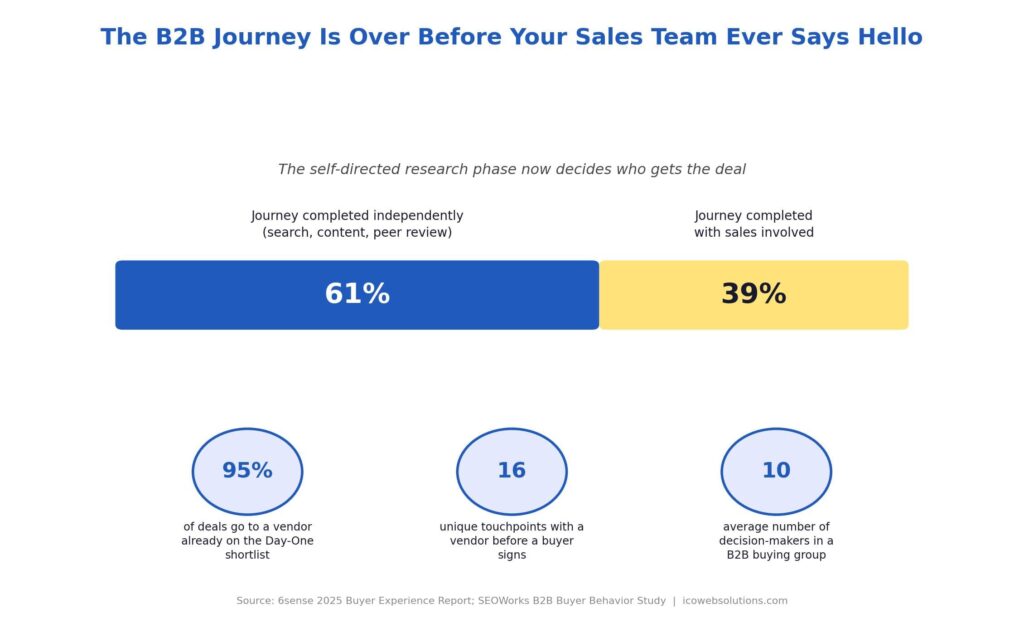
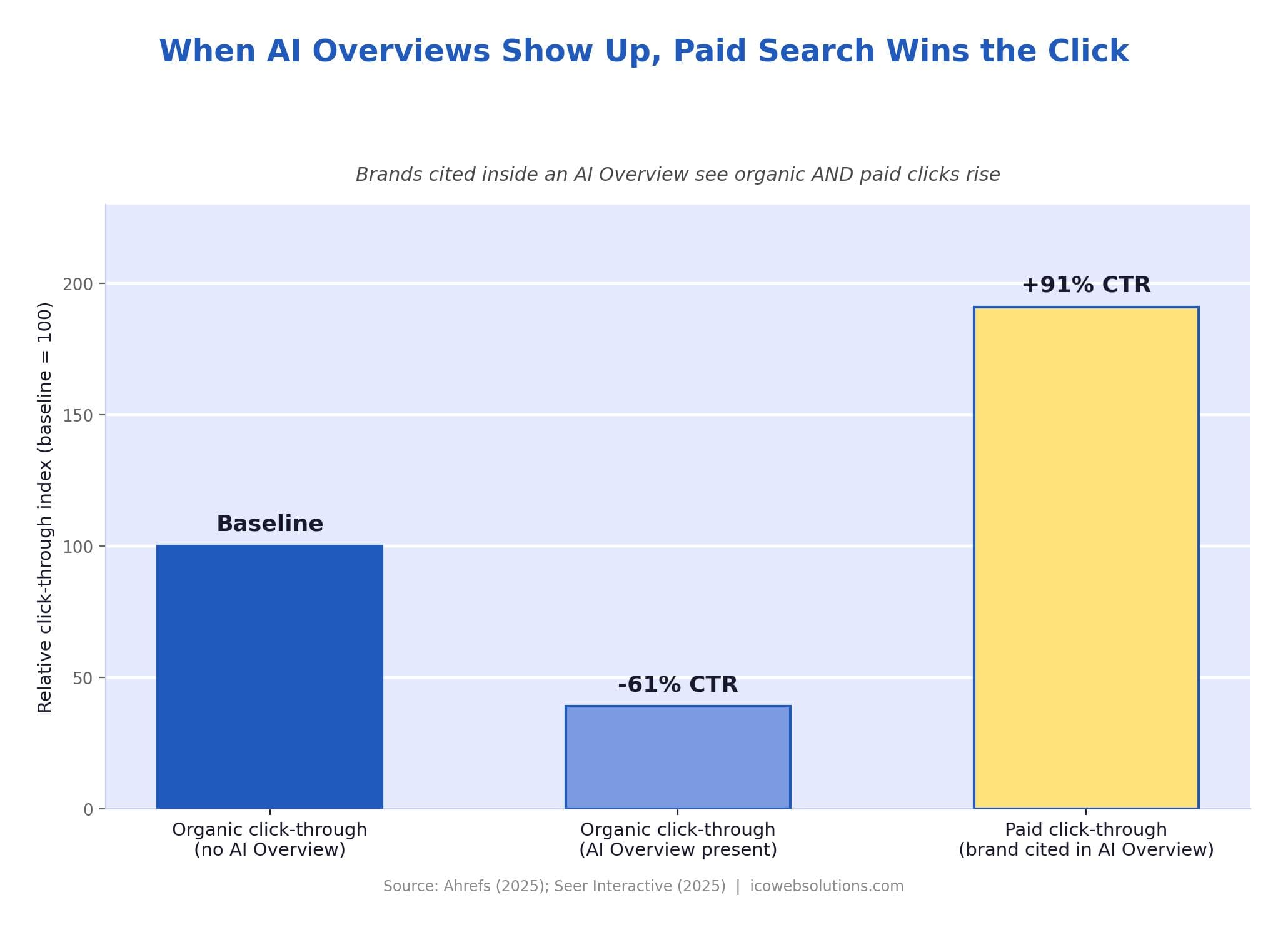
The scale of this shift is genuinely surprising once you look at the research directly. Google’s AI Overviews now show up on a large share of informational queries, and when they appear, organic click-through rates fall by around 61% according to Seer Interactive’s 2025 study (WhiteHat SEO, 2026). At the same time, the buying journey itself has compressed. The 2025 6sense Buyer Experience Report, based on more than 4,000 buyers across North America, EMEA, and APAC, found that the split between independent research and seller engagement has moved from a 70/30 balance to 60/40, and that average buying cycles shortened from about eleven months to ten (Business Wire, 2025). Buyers are deciding earlier. They’re doing it with less visible search behavior. And they’re doing it across more devices and assistants than a single campaign can realistically track.
None of this means B2B search engine marketing is dead. It means the old scoreboard — rankings, impressions, raw click volume — no longer tells you the truth about whether you’re winning. That’s exactly where our framework comes in.
Our Take: Stop Treating SEO and PPC as Two Different Budgets
Here’s the part of this article most agencies won’t say out loud, because it’s a little uncomfortable for anyone selling “SEO packages” and “PPC management” as separate line items. In B2B, search engine optimization and paid search are no longer two channels. They are two hands doing the same job, and treating them as competitors for budget is quietly costing you pipeline.
The evidence for this is stronger than most marketers realize. Research from Ahrefs found that brands cited inside an AI Overview see paid clicks increase by roughly 91%, and organic clicks increase by about 35%, compared to brands that don’t earn a citation (WhiteHat SEO, 2026). In other words, the same piece of content that gets you cited by an AI engine also makes your paid ads perform better, because the buyer has already seen your name once before they see your ad. Visibility compounds. It doesn’t sit in silos.
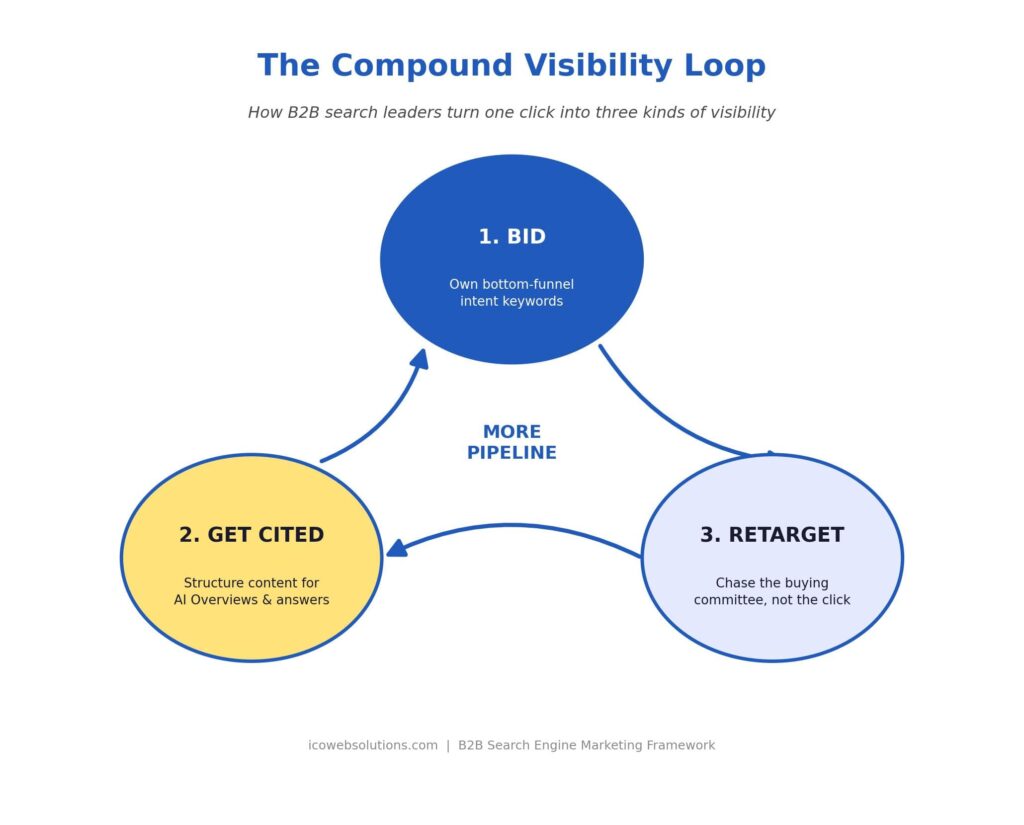
This is the idea behind what we call the Compound Visibility Loop — a framework built specifically for how B2B buyers actually behave in 2026, not how they behaved when most SEM playbooks were written. It has three connected moves, and each one makes the next one cheaper and more effective. Let’s walk through all three.
Way #1: Bid on Bottom-Funnel Intent, Not Search Volume
Most B2B paid search accounts we review are still built around volume. Big, broad keywords with a lot of monthly searches, because volume feels safe and easy to report on. But volume is exactly the part of search that’s disappearing into zero-click results and AI summaries. The clicks that remain, and remain valuable, are the ones tied to real buying intent: comparison terms, “vs” searches, pricing questions, category-specific software or service terms, and branded competitor searches from people actively shortlisting vendors.
This matters because the research shows something reassuring buried inside the scary zero-click headlines. Zero-click behavior is eating the shallow, informational end of search — the “what is” and “how does X work” queries that were never going to convert well anyway. High-stakes, high-consideration B2B decisions still involve real digging, because no AI Overview is going to get a procurement director to sign off on a six-figure contract based on a two-sentence summary (Redevolution, 2026). That’s your opening. Bottom-funnel B2B search intent is exactly the kind of search that still results in a genuine click, a genuine visit, and a genuine conversation with your sales team.
Cost per click across Google Ads has climbed to an average of $5.26, up from $4.66 the year before, and conversion rates have actually improved to around 7.5% to 8.2% as advertisers get smarter about targeting (Search Engine Land, 2025). That tells you cheap, broad traffic is genuinely going away, but advertisers who tighten their targeting are converting better than ever. The lesson isn’t to spend less. It’s to spend on the 20% of searches that were always going to close deals, instead of the 80% that were always going to bounce.
A few practical shifts make this real:
- Redirect budget away from broad, top-of-funnel keywords and into comparison, alternative, and pricing-intent terms where your buyer has already done the education phase
- Bid aggressively on your own branded terms and your top two or three competitors’ branded terms, since 92% of B2B buyers start research with a specific vendor already in mind and you want to be the alternative they consider (SEOWorks, 2026)
- Build landing pages for each intent cluster instead of sending every click to the same generic homepage, since specificity is what turns a click into a form fill
- Track cost per qualified lead, not cost per click, as your primary success metric going forward
None of this is about abandoning awareness-stage marketing altogether. It’s about being honest with yourself that awareness-stage paid search, in a world of AI Overviews and 61% CTR drops, is often lighting money on fire. Bottom-funnel intent is where B2B SEM still earns its budget line, and it’s the first move in the Compound Visibility Loop.
Also read: LinkedIn Thought Leadership for B2B Founders: The Framework That Turns Posts into Pipeline
Way #2: Get Cited by AI Engines, Not Just Ranked by Google
Here’s where most B2B marketing teams are behind, and it’s genuinely not their fault, because this shift happened fast. Ranking on page one of Google used to be the finish line. Now it’s just one of several places your buyer might encounter your brand, alongside ChatGPT, Perplexity, and Google’s own AI Overview panel. Being cited as a source inside those AI-generated answers is quickly becoming more valuable than holding the number one organic position, because that citation is what plants your brand name in a buyer’s head before they’ve clicked anything at all.
The mechanics of earning that citation are different from classic SEO, and this is genuinely good news, because it rewards clarity over cleverness. Content that answers a question directly in the first paragraph, uses clean definitions, comparison tables, and FAQ-style structure, gets cited far more often than dense, keyword-stuffed articles written primarily to rank. One industry analysis found that restructuring content into these semantic answer fragments increased share-of-answer visibility by roughly 40% (GrackerAI, 2026). Another cross-account study across 250-plus B2B SaaS companies found that campaigns built around answer-first, conversational content saw 47% higher visibility inside AI search engines compared to traditional keyword-first content (Triple Dart, 2026).
And here’s the part that ties this back to your ad spend directly: getting cited doesn’t just help your organic presence. It makes your paid search dollars work harder too. Remember that 91% lift in paid click-through rate for brands cited in AI Overviews. That’s not a coincidence. When a buyer sees your name in an AI-generated answer and then sees your ad ten minutes later on a comparison search, you’re no longer a stranger asking for a click. You’re a name they already half-recognize, which is exactly the kind of familiarity B2B buyers say they want before they’ll engage with a vendor at all.
Practical ways to start earning AI citations this quarter:
- Rewrite your most important service and comparison pages so the direct answer appears in the first two sentences, before any preamble
- Add FAQ sections with FAQPage schema markup to your highest-intent pages, since structured data is what AI crawlers use to extract clean answers
- Build genuine comparison content (you vs competitor, category A vs category B) instead of only “what is” explainer content, since comparison queries are where B2B buyers are still clicking through
- Earn mentions on LinkedIn, Reddit, and industry publications, since roughly a third of AI citations trace back to traditional search visibility while a meaningful share also comes from social platforms and press coverage (SyncGTM, 2026)
This is not a replacement for paid search. It’s fuel for it. Treat your content and your ad accounts as one team working toward the same citation, and you’ll see both channels get cheaper and more effective at the same time.
Way #3: Retarget the Buying Committee, Not Just the Browser
This is the move most B2B companies skip entirely, and it’s arguably the one with the highest return, because it acknowledges a simple truth about B2B buying: the person who clicked your ad is rarely the only person who needs to say yes. The average B2B buying group now involves around ten unique decision-maker functions, and buyers report an average of sixteen distinct interactions with a vendor before they finally sign (SEOWorks, 2026). A single click from a single stakeholder was never going to be enough, and treating it as the end goal of your SEM campaign is leaving pipeline on the table.
The good news is that this compression of the buying journey, while it looks intimidating in the aggregate statistics, is actually an opportunity if you build for it deliberately. Ninety-five percent of the time, the vendor that eventually wins the deal was already on the buyer’s day-one shortlist, and the first-choice vendor on that list wins roughly 80% of the time (SEOWorks, 2026). That means the goal of your search engine marketing isn’t just “get a click.” It’s “become impossible to forget across every stakeholder who touches this decision,” so that when the shortlist gets written, you’re already on it.
Retargeting built for a committee, rather than an individual, looks different from a standard remarketing campaign. It’s less about chasing one visitor around the internet with the same banner ad, and more about layering sequential messages that speak to different roles across the buying group over the following weeks. A technical evaluator needs proof points and integration detail. A finance stakeholder needs cost-of-inaction framing. An executive sponsor needs a fast, confident summary. Feeding all three the same generic “come back and buy” ad wastes the budget you just spent earning that first visit.
- Build LinkedIn retargeting audiences segmented by job function, not just by page visited, so a technical buyer and a finance buyer see genuinely different follow-up messaging
- Sequence your display and LinkedIn ads over a three-to-four week window rather than showing the same static ad on a loop, matching the pace of a real evaluation cycle
- Layer in account-based display advertising for named target accounts once they show research intent, so multiple stakeholders inside the same company see consistent, coordinated messaging
- Feed your sales team a simple visibility report of which accounts are engaging across search, LinkedIn, and your site, so outreach happens while interest is warm, not weeks after it’s gone cold
Put together, these three moves are what we mean by the Compound Visibility Loop. Bidding on real intent gets you the first click. Getting cited by AI engines makes that click cheaper and more trusted. Retargeting the full committee turns one click into the sixteen touches it actually takes to close a B2B deal. Run all three together, consistently, and you’re not just optimizing a channel. You’re building a visibility system that keeps paying you back long after the individual ad has stopped running.
Also read: State of B2B Websites: Survey Report
Building a Stronger Brand Through Strategic B2B Web Design
What This Actually Means for Your Budget This Quarter
If you take one thing away from this article, let it be this: the businesses that will win B2B search visibility in 2026 are not the ones spending the most. They’re the ones spending on the right 20%, structuring content so machines can quote them accurately, and following through with every stakeholder in a deal instead of stopping at the first click. That’s genuinely encouraging news if you’ve been feeling like your search budget has gotten less effective lately. It’s not that the game got harder in some unbeatable way. It’s that the scoreboard changed, and most competitors haven’t noticed yet.
That gap is your advantage, and it won’t stay open forever. Every month that passes, more B2B marketing teams read this same research and start rebuilding their search strategy around it. The companies moving now, while a lot of their competitors are still bidding on the same broad keywords they used in 2022, are the ones who’ll own the AI citations, the bottom-funnel bids, and the retargeting sequences that quietly decide who makes the shortlist a year from now.
If you’d rather not rebuild this alone, that’s exactly what our team at ICO WebTech does for B2B companies every day. We audit your current search accounts and content, map out where you’re losing visibility to AI Overviews and zero-click results, and build a Compound Visibility Loop strategy specific to your buying committee and your sales cycle. Book a free 30-minute B2B search visibility audit with our team today, and we’ll show you exactly which keywords, pages, and audiences are costing you pipeline right now — no generic template, just a plan built around your numbers.
A Quick Checklist to Start This Week
Before you go, here’s a short, honest checklist you can run through this week without waiting for a full strategy overhaul. Pull your last 90 days of Google Ads data and flag which keywords are broad, top-of-funnel terms rather than comparison or pricing-intent terms, then shift ten percent of that spend toward the intent-driven terms and watch what happens to your cost per qualified lead.
Open your three highest-traffic service pages and check whether the direct answer to the page’s main question appears in the first two sentences; if it’s buried in paragraph four, that’s costing you AI citations.
And finally, look at your retargeting audiences and ask honestly whether you’re speaking to one persona or several, because if every visitor sees the same ad regardless of role, you’re leaving most of the buying committee cold.
None of these three moves require a bigger budget. They require a different lens on the budget you already have. That’s the whole point of the Compound Visibility Loop, and it’s the exact system we’d love to help you put in place.
Sources
- Business Wire. (2025, November 12). The timeline for influencing B2B buyers is shrinking: Insights from 6sense’s 2025 Buyer Experience Report. https://www.businesswire.com/news/home/20251112018032/en
- Focus Digital. (2025, July). Average Google Ads cost per click by industry: 2025 report. https://focus-digital.co/?p=6055
- GrackerAI. (2026). GEO: Winning zero-click AI search. https://gracker.ai/static/GEO%20Winning%20Zero-Click%20AI%20Search.DrChv2D-.pdf
- Onely. (2026). Zero-click dominates: The new reality for B2B SEO strategy. https://onely.com/blog/proven-b2b-seo-strategies
- Redevolution. (2026). Zero-click search: What 68% really means for B2B marketers. https://www.redevolution.com/blog/zero-click-search-what-68-really-means-for-b2b-marketers
- Search Engine Land. (2025). Google Ads costs keep rising, but conversion rates improved in 2025. https://searchengineland.com/google-ads-costs-keep-rising-but-conversion-rates-improved-in-2025-477927
- SEOWorks. (2026). B2B buyer behavior statistics. https://www.seoworks.co.uk/downloads/b2b-buyer-behavior-statistics/
- SyncGTM. (2026). How AI influences organic search traffic and lead gen: Key insights for B2B teams (2026). https://syncgtm.com/blog/how-does-ai-influence-organic-search-traffic-and-lead-gen
- Triple Dart. (2026). AI in SEO. https://tripledart.com/b2b-seo/ai-in-seo
- WhiteHat SEO. (2026). Embracing AI in SEO. https://whitehat-seo.co.uk/blog/embracing-ai-in-seo



Related items

A practical, step-by-step walkthrough of the process we actually run with clients, includi


The Quick Take: Most B2B companies aren’t struggling to generate leads — they’re strugglin


You can have the best-looking website, the smoothest checkout, and a product worth buying