
Search engine optimization is entering a new era of transparency. Google has officially launched dedicated AI visibility reports within Google Search Console, alongside new AI blocking controls—marking the most significant shift in search analytics since the advent of mobile tracking.
For over a year, webmasters, publishers, and SEO professionals have operated in the dark. Content surfaced inside Google’s AI Overviews and AI Mode was completely bundled into traditional organic search metrics. There was no clear way to separate standard “blue link” traffic from AI-driven citations.
This data blackout ends today. The new Search Generative AI performance report introduces a standalone measurement layer, giving creators clear insights into exactly how Google’s AI models choose, display, and interact with their content.
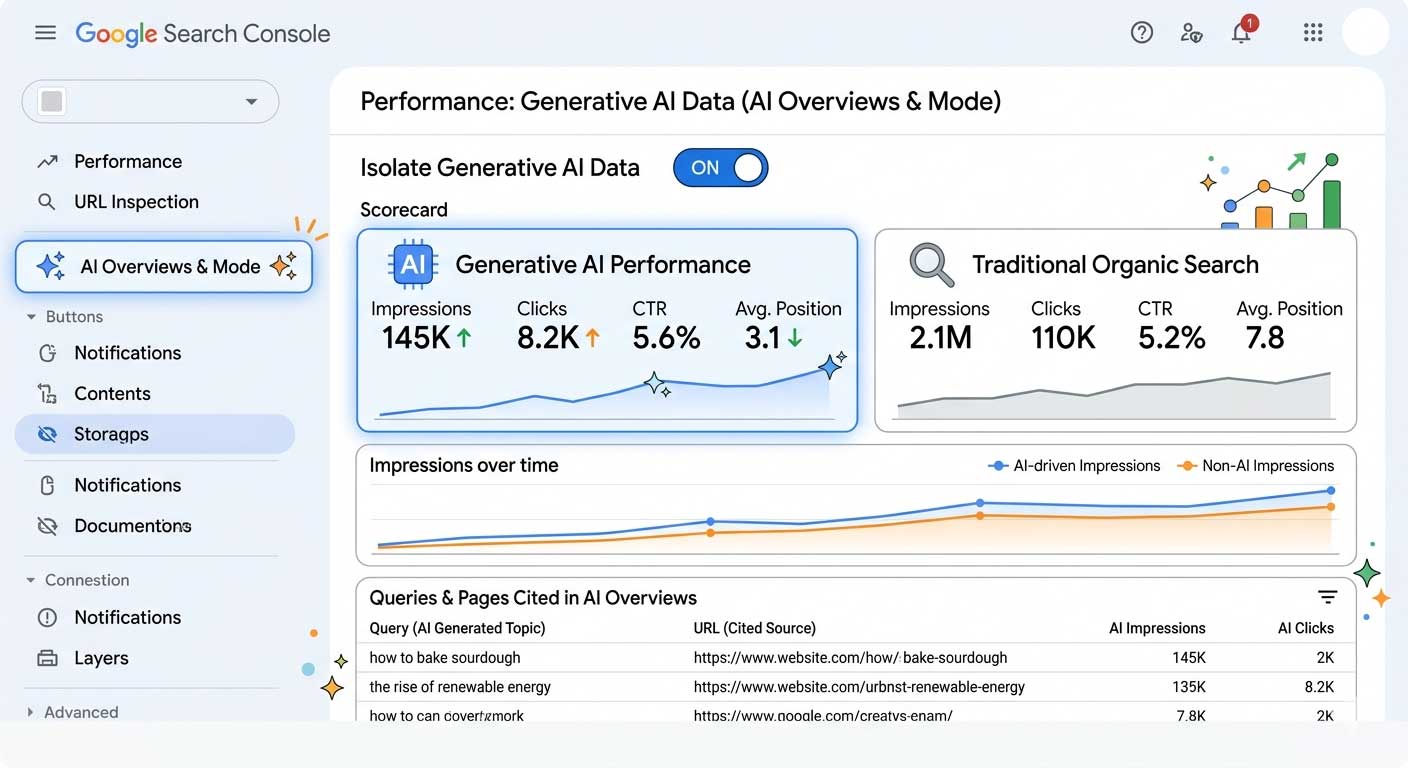
Google’s new Search Console dashboard isolates generative AI metrics from traditional organic data.
Inside the AI Visibility Report: What Metrics Are Tracked?
The new dashboard isolates exposure data across AI-powered search environments, including Google Search and Google Discover. In its launch state, the report focuses heavily on top-of-funnel exposure. While query-level keywords and click data are noticeably absent, webmasters can analyze performance using a structured set of metrics and dimensions:
| Metric / Dimension | Granular Data Tracked |
|---|---|
| Impressions | Tracks how often URLs from your domain are cited as foundational sources or “grounding data” within generative AI elements. |
| Pages | Identifies the exact URLs selected by Google’s algorithms to back up AI-generated responses. |
| Countries | Provides a geographical breakdown to trace where your AI presence is strongest globally. |
| Devices | Categorizes exposure by Mobile, Desktop, and Tablet to pinpoint user environments. |
| Dates | Offers historical timeline trends, with precision data available down to the hour. |
Addressing the lack of click data, Google clarified that the initial release is optimized for visibility tracking. However, the company plans to introduce deeper engagement metrics, including user clicks, in upcoming iterations based on direct publisher feedback.
The AI Opt-Out Switch: Granular Control for Site Owners
Simultaneously, Google is introducing a major infrastructure update: a dedicated Search Generative AI control toggle directly inside Search Console settings.
This feature functions as a master kill-switch for AI inclusion. Flipping the toggle completely blocks Google’s large language models from sourcing, summarizing, or citing your content within live generative features like AI Overviews.
“Opting out of Search Generative AI features will have zero impact on your traditional organic search rankings.”
— Official Google Documentation Summary
Crucially, Google confirmed that choosing to opt out will not harm your traditional organic SEO rankings. If you turn off AI accessibility, your pages will still rank normally in the standard “blue link” organic results. However, your site will immediately stop receiving any impressions or downstream referral traffic generated by Google’s AI interface.
Why Now? Regulatory Pressures Force Google’s Hand
This structural change wasn’t purely an internal product upgrade; it was driven by global regulators. The rollout stems from a direct mandate by the UK’s Competition and Markets Authority (CMA). Regulators have increasingly pushed for tech giants to give publishers explicit, granular choices regarding how their intellectual property is handled for AI fine-tuning and real-time summaries.
Due to the targeted nature of this regulatory framework, Google is testing both the report and the opt-out toggle with a limited subset of UK website owners first. This localized rollout gives Google time to monitor publisher response, optimize data processing, and iron out bugs before deploying the features to a broader global audience.
Strategic Takeaways: How SEOs Should Adapt
The introduction of separate AI analytics demands a shift in content strategy. The industry is rapidly moving from purely optimizing for traditional CTR (Click-Through Rate) to optimizing for LLM Grounding Authority.
For creators and brands, a high volume of AI impressions combined with low baseline clicks should no longer be viewed as a failure. Instead, it indicates that Google’s models view your domain as a primary source of truth. The strategy must adapt: treat highly-cited informational pages as top-of-funnel conversion mechanisms. By strategically inserting high-value internal links and distinct call-to-actions (CTAs) within those heavily-cited informational hubs, you can capitalize on the visibility, routing that authority directly into your conversion funnels.



Related items
Google’s fourth spam update of 2026 is live. The pattern across all four says more than th


New offering combines GEO, AEO, and AI SEO to help brands appear in ChatGPT, Gemini, Perpl

As artificial intelligence (AI) continues to advance, one of the burning questions in the