Artificial intelligence has moved from a futuristic concept to an everyday business tool faster than most of us anticipated. Your marketing team probably uses AI-powered writing assistants, your analytics dashboard runs on machine learning, and your customer service might be handled partly by chatbots. These tools complement the foundation of expert-led digital marketing services that drive growth for most businesses today.
But lately, a new term has entered the conversation: AGI.
Industry leaders, researchers, and tech giants are pouring billions into AGI development. Headlines swing between promises of revolutionary breakthroughs and warnings about existential risks. For digital marketing professionals and business owners, cutting through the noise matters—understanding what AGI actually is, how it differs from the AI tools you’re already using, and what it might mean for your strategy in the years ahead.
This guide breaks down the distinction between AI and AGI, explains where we currently stand, and offers a practical perspective on what marketers should actually be paying attention to.
What Is Artificial Intelligence?
Before we can understand AGI, we need to be precise about what “AI” means in practice today.
Artificial intelligence is a broad term describing computer systems designed to perform tasks that typically require human intelligence. These tasks include recognizing speech, identifying images, making predictions, translating languages, and generating text or visuals.
The AI systems powering your marketing tools fall into a category called narrow AI (sometimes called weak AI or ANI—Artificial Narrow Intelligence). These systems are engineered to excel at specific, well-defined tasks within predetermined boundaries.
How Narrow AI Works
Narrow AI operates by analyzing massive datasets to identify patterns, then applying those patterns to new inputs. A recommendation engine studies purchase histories to suggest products. A language model learns from billions of text examples to generate coherent sentences. A computer vision system trains on labeled images to recognize objects.
The key characteristic: these systems are specialists.
A spam filter that’s remarkably accurate at catching phishing emails can’t suddenly pivot to writing ad copy or analyzing customer sentiment. Each task requires its own model, its own training data, and its own optimization.
Examples of Narrow AI in Marketing
- Content generation tools that draft blog posts, social media captions, or email subject lines
- Programmatic advertising platforms that optimize ad placements and bidding in real time
- Customer segmentation systems that group audiences based on behavior patterns
- Chatbots that handle routine customer inquiries
- Predictive analytics that forecast campaign performance or customer lifetime value
- Image and video generation for creative assets
- SEO tools that analyze search intent and suggest keyword strategies
These tools are genuinely useful—they save time, reduce costs, and often outperform humans at their specific tasks. But they share a fundamental limitation: they operate within the boundaries of their training. They don’t understand context the way humans do, can’t transfer knowledge between unrelated domains, and require human oversight to ensure outputs make sense.
This type of AI supports marketers by enhancing efficiency, especially when integrated into strategies like content marketing, SEO optimization, and PPC management.
What Is Artificial General Intelligence?
Artificial General Intelligence (AGI) represents something fundamentally different.
AGI refers to a hypothetical AI system capable of performing any intellectual task that a human can—learning, reasoning, and applying knowledge flexibly across domains without being specifically programmed or retrained for each new challenge.
Where narrow AI is a specialist, AGI would be a generalist.
It wouldn’t just recognize patterns in data; it would understand concepts, form abstractions, and apply insights from one area to completely unrelated problems.
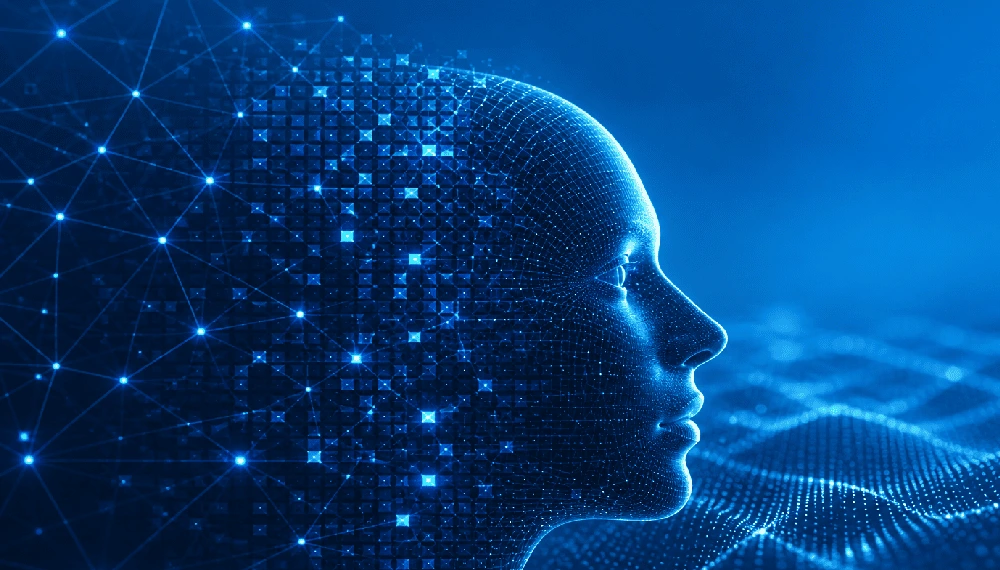
A conceptual visualization of artificial general intelligence, showing a human-like digital form emerging from interconnected data and intelligent systems.
The Defining Characteristics of AGI
Flexible reasoning across domains. A true AGI system could take principles learned in one context and apply them to novel situations. Understanding physics might help it reason about both engineering problems and sports strategy—the same way a human physicist might also be a competent chess player or cook.
Common-sense understanding. Current AI struggles with knowledge humans take for granted: that dropped objects fall, that people have intentions, and that context changes meaning. AGI would possess this intuitive grasp of how the world works.
Autonomous learning. Rather than requiring carefully curated training data for each task, AGI would learn continuously from raw experience—much like humans pick up knowledge through observation and interaction.
Transfer learning at scale. Someone who knows how to drive a car can usually figure out how to operate a boat or tractor without starting from scratch. AGI would make similar cognitive leaps, applying abstract principles across domains.
Self-directed goal pursuit. AGI wouldn’t just respond to prompts—it would set objectives, develop strategies, and adjust its approach based on feedback, all without constant human guidance.
The Critical Distinction
The difference between AI and AGI isn’t merely one of degree—it’s a difference in kind.
Current AI systems, no matter how impressive, are essentially sophisticated pattern-matching machines. They identify statistical regularities in training data and extrapolate from those patterns. They don’t truly understand what they’re doing; they don’t know why certain patterns exist or what they mean in a broader context.
AGI would involve genuine comprehension.
It would build causal models of the world, understand abstract concepts, and reason about situations it has never encountered. The gap between today’s most advanced language models and true AGI is analogous to the gap between a calculator performing complex equations and a mathematician understanding what those equations represent.
AI vs. AGI: A Side-by-Side Comparison
| Dimension | Narrow AI (Current) | Artificial General Intelligence |
|---|---|---|
| Scope | Excels at specific, predefined tasks | Handles any intellectual task across domains |
| Learning | Requires task-specific training with labeled data | Learns flexibly from experience, transfers knowledge |
| Reasoning | Pattern recognition within training distribution | Abstract reasoning, causal understanding |
| Adaptability | Struggles with novel situations outside training | Adapts to unfamiliar problems like humans |
| Autonomy | Operates within programmed constraints | Sets and pursues goals independently |
| Understanding | Statistical correlation without comprehension | Genuine conceptual understanding |
| Current status | Widely deployed and improving | Theoretical; does not yet exist |
Where Are We Now? The Current State of AGI Development
As of mid-2026, no true AGI system exists. Despite breathless headlines and ambitious claims from tech executives, we remain firmly in the era of narrow AI—albeit increasingly capable narrow AI.
Recent Progress
The AI field has advanced remarkably since 2023:
- Large language models like GPT-5 (released August 2025) demonstrate impressive performance across many language tasks, from coding to legal analysis to creative writing
- Reasoning-focused models like OpenAI’s o1 series show improved step-by-step problem-solving
- Multimodal systems can process and generate text, images, audio, and video
- Agentic AI frameworks allow AI systems to break down complex tasks and execute multi-step workflows
These capabilities are impressive and commercially valuable. But they don’t constitute AGI.
Why Current Systems Aren’t AGI
Even the most advanced language models share fundamental limitations:
They don’t truly understand. These systems predict statistically likely outputs based on training patterns. They can produce confident but incorrect responses (hallucinations) because they lack genuine comprehension of facts and concepts.
They can’t transfer knowledge flexibly. A model trained on medical literature can’t automatically apply that knowledge to legal reasoning without separate fine-tuning. True domain-general intelligence remains elusive.
They lack common sense. Ask a language model about unusual physical situations or social dynamics, and gaps in intuitive understanding become apparent.
They require human oversight. For any high-stakes application, these systems need human verification—because they can’t reliably distinguish between correct and plausible-sounding outputs.
Expert Predictions on AGI Timeline
Timelines vary enormously depending on who you ask:
- Some researchers believe AGI could emerge between 2027 and 2035, citing rapid recent progress
- Others argue we’re decades away, pointing to fundamental unsolved problems in reasoning and knowledge representation
- A significant contingent believes AGI may never be achievable, or that the concept itself is poorly defined
The honest answer: no one knows. The path from current capabilities to human-level general intelligence may require incremental improvements to existing approaches, or it may demand entirely new paradigms we haven’t discovered yet. Source
What AGI Would Mean for Digital Marketing
While AGI doesn’t exist today, thinking through its implications helps clarify both long-term strategic considerations and the trajectory of nearer-term AI development.
Potential Transformations
Truly autonomous campaign management. Today’s AI can optimize ad bids or suggest content tweaks. AGI could potentially handle end-to-end campaign strategy—identifying opportunities, creating assets, managing execution, analyzing results, and adjusting approach—all with minimal human input.
Deep personalization at scale. Current personalization relies on segmentation and behavioral patterns. AGI might understand individual customers holistically, crafting genuinely tailored experiences that account for context, psychology, and relationship history.
Creative strategy, not just execution. AI tools help produce content; AGI might genuinely strategize about brand positioning, market opportunities, and creative direction in ways that require human-level judgment today.
Cross-functional integration. AGI could potentially connect marketing with product development, customer success, and operations in ways that current siloed tools cannot.
Implications for Marketing Professionals
This isn’t a reason for alarm—it’s a reason for thoughtful preparation:
Human judgment remains essential. Even if AGI emerges, brand voice, ethical considerations, relationship-building, and strategic vision involve distinctly human elements. The marketers who thrive will be those who cultivate these capabilities.
AI literacy becomes non-negotiable. Understanding what AI can and can’t do—and how to work effectively with AI tools—is already a core professional competency. This only intensifies as capabilities advance.
Focus on unique value. The tasks most likely to be automated are routine, well-defined, and pattern-based. The tasks that remain distinctly human are creative, strategic, relational, and judgment-intensive. Lean into those.
Even so, human creativity, empathy, and judgment will remain anchors of brand identity—supported, not replaced, by future technologies. And strong digital foundations like website development, UI/UX design, and customer experience architecture will still matter.
What Marketers Should Focus on Today
Rather than worrying about hypothetical AGI, digital marketers can take concrete steps to prepare for an AI-enhanced future:
1. Master the Current Tools
The narrow AI available right now offers a genuine competitive advantage. Teams that effectively integrate AI into content creation, analytics, customer engagement, and workflow automation will outperform those who don’t. The learning curve is real, but the payoff is substantial.
2. Develop Judgment and Oversight Skills
AI tools require human direction and verification. The ability to craft effective prompts, evaluate AI outputs critically, and catch errors before they reach customers is increasingly valuable.
3. Invest in Data Infrastructure
Advanced AI—whether narrow or eventually general—runs on data. Organizations with clean, connected, accessible data will be positioned to leverage new capabilities as they emerge. Those with fragmented, siloed information will struggle to keep pace.
4. Stay Informed, Stay Skeptical
The AI landscape changes rapidly. Follow developments, but maintain healthy skepticism about inflated claims. Understanding genuine progress versus marketing hype helps you invest resources wisely.
5. Prioritize Human Connection
As AI handles more routine communication, authentic human connection becomes more valuable, not less. Brands that maintain genuine voice, real relationships, and ethical practices will differentiate themselves in an increasingly automated landscape.
This is also a good time to ensure your public-facing digital ecosystem is optimized. Whether refining your SEO strategy, tightening your social media presence, or improving your website performance, each step helps build resilience and adaptability.
The Bottom Line
AI is here now, transforming how we work, create, and connect with customers. These narrow AI systems are powerful tools for specific tasks—and they’re improving rapidly.
AGI remains theoretical. No system today can reason, learn, and adapt across domains with human-like flexibility. The gap between current capabilities and true general intelligence is substantial, and the timeline for bridging it is genuinely uncertain.
For digital marketers, the practical takeaway is clear: focus on mastering the AI tools available today while building the distinctly human capabilities that will remain valuable regardless of what comes next.
The professionals who combine AI leverage with human judgment, creativity, and strategic vision will be positioned to thrive—whether AGI arrives in five years, fifty years, or never.
The future of marketing isn’t human versus machine. It’s humans equipped with increasingly capable tools, directing that capability toward goals that matter. That’s worth preparing for.



Related items

A practical, step-by-step walkthrough of the process we actually run with clients, includi
The traditional SEO playbook is facing an evolutionary crisis. For over two decades, the o


AI SEO architecture is the way you organize, name, link, and label your pages so search en
