
A 30-minute product page audit: score your store for AI shopping
Baymard Institute’s 2026 benchmark found that 52% of desktop sites and 62% of mobile sites have product page experiences rated mediocre or worse (Scott, 2026). Adobe’s analysis of retail sites adds a second angle: about 34% of product pages could not be properly accessed by AI (Perez, 2026). Both findings describe one opportunity. Product pages are where stores win or lose, and most have room to improve.
Our companion guide, AI can recommend your product, but only your product page can sell it, explains why product pages matter so much in AI shopping. This guide is the hands-on follow-up. In about 30 minutes, you will score your own pages, find the weakest spot, and decide what to fix first.
You will get the five-P scorecard with a simple scoring rubric, an example that shows what is on the page and what sits behind it, a worked audit, an impact and effort map for choosing fixes, and a short monthly habit. Everything is written for owners and marketers who are new to this, so no technical background is needed.
A note on transparency: the scorecard is a self-assessment tool, and the example numbers are illustrative. AI shopping also changes quickly, so we point to Google’s documentation, Baymard’s research, and Adobe’s data, and we flag where details may change.
The quick version
Choose five product pages. Score each on five Ps: product facts, pictures, proof, promise, and path. Use the rubric to rate each P from 1 to 5, then fix the lowest score first, because a page is only as persuasive as its weakest P. Use the impact and effort map to pick quick wins before bigger projects, and repeat a short check every month.
What is in this guide
- Key terms in plain English
- Why an audit beats guessing
- The five-P checklist
- The scoring rubric
- How to run the audit, step by step
- Reading your scorecard
- On the page and behind the page
- A worked example
- The weakest-link rule
- Fix first: the impact and effort map
- Technical checks behind the page
- A 15-minute monthly habit
- Quick answers to common questions
Key terms in plain English
These words appear throughout the guide:
- Product page audit: a structured check of how clear, complete, and trustworthy a product page is.
- Product feed: a regularly updated file listing your products and their details for platforms such as Google.
- Structured data: hidden labels on a page, such as price and availability, that help machines read it accurately.
- Merchant Center: Google’s free tool for sharing product data across Google.
- Conversion rate: the share of visitors who buy. If 100 people visit and 3 buy, the rate is 3%.
Why an audit beats guessing
When sales feel slow, owners often reach for a redesign, a new app, or an AI tool. Those can all help, and each is easier to choose well once you know which part of the page is holding you back. An audit gives you a baseline, a ranked list of fixes, and a way to show progress.
The stakes are real. Baymard’s research puts the average documented cart abandonment rate at about 70%, which means roughly seven in ten shoppers who add something to a cart leave without buying (Baymard Institute, 2026). Product pages sit upstream of that moment, since shoppers decide whether they trust a product long before they reach checkout. TechCrunch’s report on the Adobe data describes the incentive for stores clearly:
“retailers are incentivized to make their sites AI-friendly”
Perez (2026)
The encouraging part is that the basics do most of the work. Google describes optimizing for its generative AI features as part of SEO, and it recommends keeping product and business details accurate through tools such as Merchant Center (Google Search Central, 2026). A careful audit puts exactly those basics in front of you.
The five-P checklist
Each P answers a question that shoppers and AI assistants both ask. For each one, here is what to look for on your page.
Product facts
Ask: what exactly is this? Look for a specific name that includes brand, model, and the one or two attributes people search for, plus a complete description with materials, sizes, variants, and what comes in the box. Selection should be easy too, and Baymard found that 57% of sites do not use buttons for size selection (Scott, 2026), so clear variant buttons are a simple upgrade.
Pictures
Ask: what does it look like in real life? Look for several angles, zoom, and at least one image that shows scale or the product in use. Short captions can answer questions that photos alone leave open, such as size, weight, or fit.
Proof
Ask: can I trust this? Look for genuine reviews and ratings, answers to common questions, and credentials such as certifications. Google lists review ratings among the details that can appear with product results (Google Search Central, 2025b), so visible, honest reviews help both shoppers and search.
Promise
Ask: what will I get, and when? Look for price, stock status, delivery time, shipping cost, and the return window, all near the buy button. Google notes that sharing shipping costs, especially free shipping, helps shoppers understand the total cost, and that return information can also appear in results (Google Search Central, 2025b).
Path
Ask: can people and machines reach this page easily? Look for standard links from menus and categories, a fast and mobile-friendly layout, structured data, and a smooth route to checkout. Google’s ecommerce guidance recommends linking menus to categories and categories to products, and it notes that Googlebot generally does not use a site’s search box (Google Search Central, 2025a).
The scoring rubric
Use this table to rate each P from 1 to 5. Score 1 means the information is missing or unclear, 3 means it is present but thin, and 5 means it is complete and clear. Pick the description that is closest to your page and avoid rounding up.
| The P | Score 1: missing or unclear | Score 3: present but thin | Score 5: complete and clear |
|---|---|---|---|
| Product facts | Code or vague name, short description | Clear name, basic description | Specific name, full details, variants, and what is included |
| Pictures | One small image | Several images, limited zoom | Multiple angles, zoom, scale, and captions |
| Proof | No reviews or questions answered | A few reviews, hard to find | Visible reviews and ratings with answers to common questions |
| Promise | Price or policies appear only at checkout | Policies linked from the footer | Price, stock, shipping, and returns beside the buy button |
| Path | Slow, hard to reach, or hard to read on a phone | Works, with some speed or link gaps | Fast, crawlable, structured data in place, smooth checkout |
How to run the audit, step by step
The whole audit fits in about 30 minutes. Set a timer, open a spreadsheet with one row per page, and follow these steps:
- Choose five pages (2 minutes). Pick your best sellers, plus one product that gets plenty of visits and few sales.
- View each page on a phone and a computer (5 minutes). Note anything slow, cramped, or confusing.
- Score the five Ps with the rubric (10 minutes). Write the number and one sentence of evidence for each.
- Check behind the page (8 minutes). Compare price and stock on the page with your product feed and checkout, and test the page with Google’s Rich Results Test or URL Inspection tool.
- Circle the lowest P on each page (3 minutes). That is your starting point.
- Rank the fixes (2 minutes). Use the impact and effort map later in this guide to pick quick wins first.
Be kind to yourself and honest at the same time. The goal is a clear picture of where each page stands today, since a realistic score is the most useful one.
Reading your scorecard
Plot your five scores on the radar chart below. A wide, even shape means your page is balanced, and a dent shows the P that needs attention. The chart compares an illustrative strong page with a typical page, so you can see how the shapes differ.
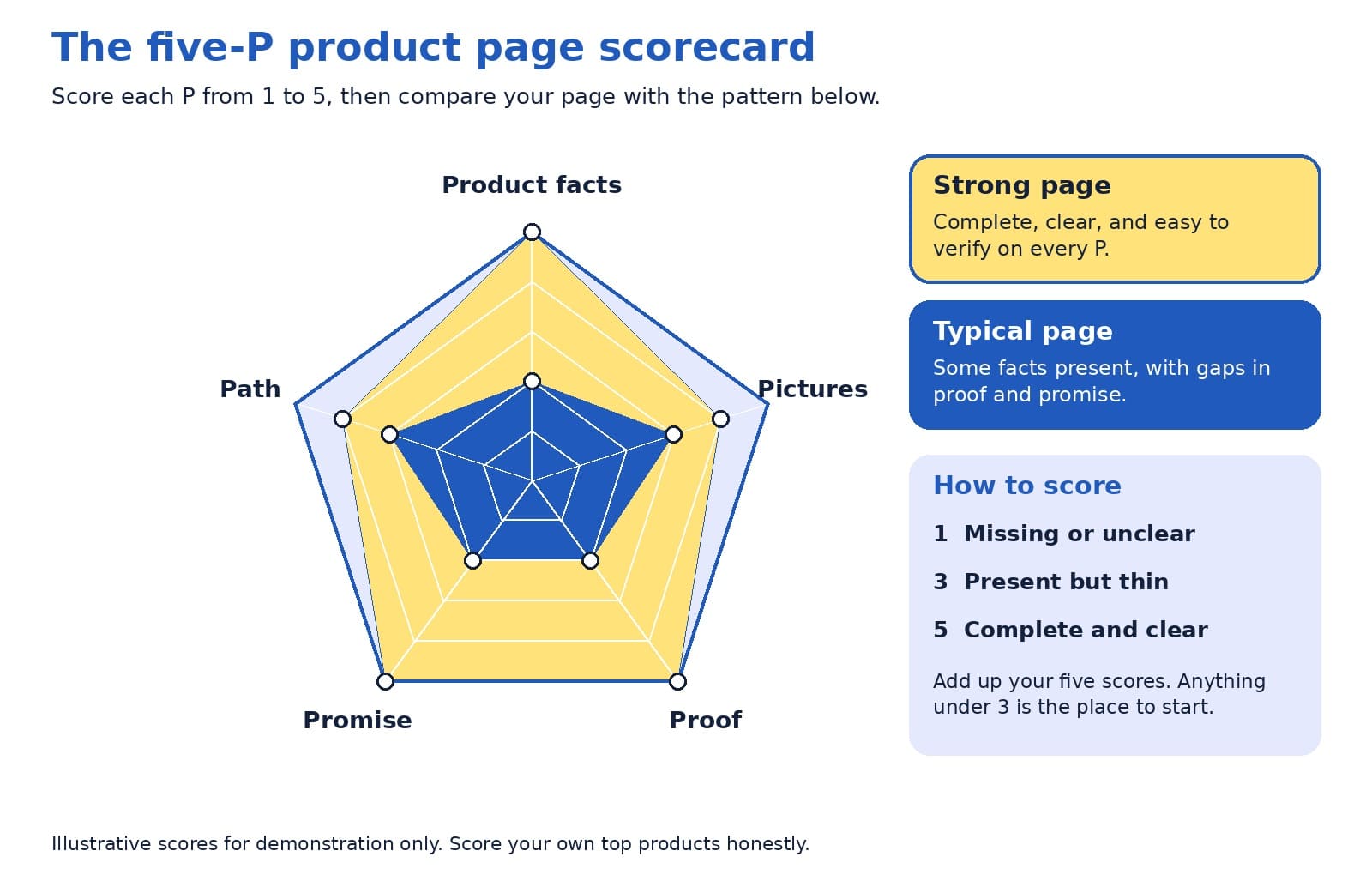
Look at the lowest point first, then at the pattern across your five pages. If the same P is low everywhere, such as proof or promise, the fix probably lives in your page template, and one change can lift every product at once.
On the page and behind the page
Shoppers read what is on the page. AI assistants and search engines also read the data behind it, through structured data and product feeds. The two should always match, since a mismatch creates doubt for people and for machines.
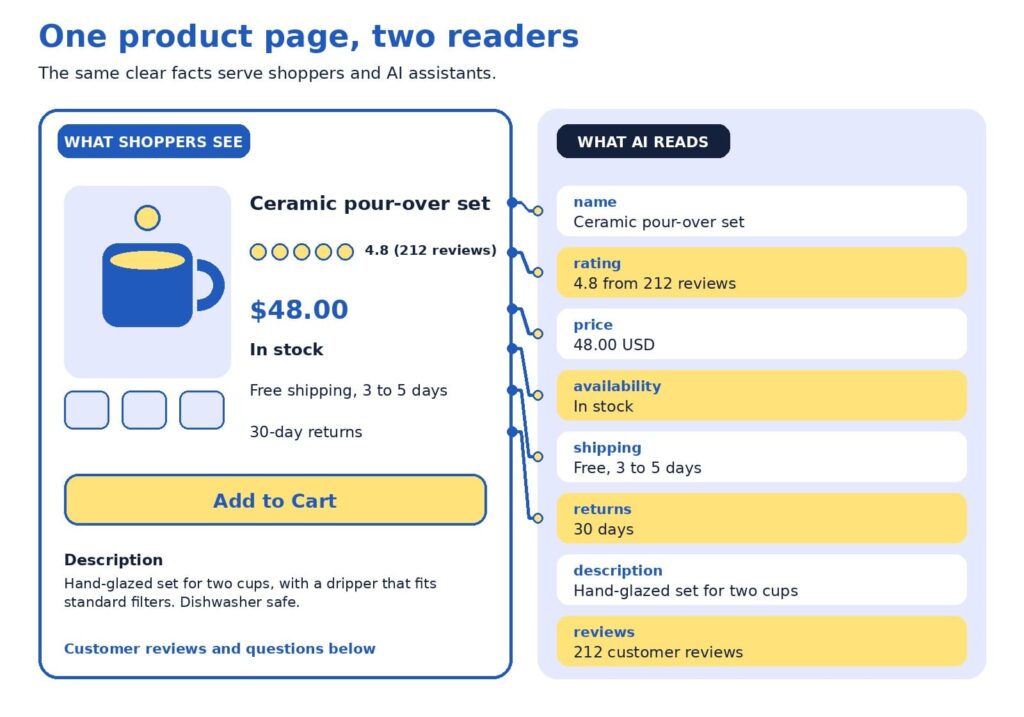
The example uses a fictional ceramic coffee set. Here is how to read it:
- The name is specific. “Ceramic pour-over set” says more than a code such as Set 02.
- The rating shows proof. A score with the number of reviews gives shoppers confidence.
- The price matches. The same number appears on the page and in the data.
- Stock status is current. Google lists availability among the details used for shopping results (Google Search Central, 2025b).
- Shipping is stated plainly. Delivery time and cost sit where shoppers decide.
- Returns are clear. A visible return window reduces hesitation.
Google’s guidance for structured data offers a helpful rule of thumb for this layer:
“as much rich product information as available”
Google Search Central (2025b)
A worked example
Here is how an audit might look for one product. The table shows a starting point and a stronger version of the same fictional coffee set.
| Page element | Starting point | Stronger version |
|---|---|---|
| Title | Set 02 | Ceramic pour-over coffee set for two, hand-glazed |
| Description | Great quality. Order today. | Size, materials, what is included, care instructions, and who it suits |
| Price and stock | Price appears at checkout | Price and stock status on the page, kept current automatically |
| Shipping and returns | See our policy page | Delivery time, cost, and return window near the buy button |
| Proof | No reviews yet | Reviews with ratings, plus answers to common questions |
Scored with the rubric, the starting page might receive 2 for product facts, 3 for pictures, 2 for proof, 2 for promise, and 3 for path. The lowest scores are proof and promise, so that is where to begin. Moving shipping and return details beside the buy button takes minutes, and inviting recent buyers to leave reviews builds proof steadily over the following weeks. After those two fixes, a clearer title and description lift the product facts score, and the page moves toward the strong pattern without a redesign.
The weakest-link rule
Here is a perspective that surprises some owners: your lowest score matters more than your average. A page with beautiful photos, a rich description, and no visible return policy may feel strong on paper, and a hesitant shopper still reads the gap. The same is true for machines, since one missing or conflicting fact, such as a price that differs between page and feed, can reduce confidence in everything else.
A product page is only as persuasive as its weakest P.
For that reason, we suggest raising your lowest P to a 3 on every top page before polishing any P to a 5. Once all five Ps reach at least a 3, tracking how assistants describe your products becomes a worthwhile next step, and our AI visibility and GEO services are designed for that stage. After that, AI-powered predictive analytics can help you decide which products to stock and promote.
Fix first: the impact and effort map
An audit usually produces a long list, so it helps to rank it. The map below sorts common fixes by impact and effort. Start with the top-left group, which delivers meaningful gains for modest work, then plan the top-right group as projects.
Placement on the map depends on your store. A shop with an automated feed may find that matching price and stock takes minutes, and a store with a custom checkout may find that mobile speed is a bigger project. Use the map as a conversation starter with your team, and move items to where they truly sit for you.
Technical checks behind the page
Structured data and product feeds
Google describes two kinds of product markup: product snippets for pages where people cannot buy directly, and merchant listings for pages where they can. It also recommends adding return policy information nested under your organization markup and marking up product variants, and it notes that providing both structured data and a Merchant Center feed maximizes eligibility (Google Search Central, 2025b).
ChatGPT’s commerce documentation describes product feeds in a similar way, as the route for sharing structured catalog data so products can be indexed and presented accurately (OpenAI, n.d.). Programs in this area change often, so check current documentation. Setup is usually a one-time job for a developer or a SEO company in Delhi.
Links, speed, and mobile
Search engines discover products by following links, so menus and category pages should link to products with standard links. Speed and mobile layout matter too, and Baymard’s 2026 benchmark shows the mobile bar is high, with 62% of mobile sites rated mediocre or worse for product pages (Scott, 2026). If app-like mobile shopping interests you, our guide to progressive web apps for ecommerce explains when they are worth the investment.
Modern storefronts
If your store runs on a headless setup, confirm that product details are visible when search engines load the page. Google suggests deploying a few pages with structured data and using the URL Inspection tool to see how Google views them (Google Search Central, 2025b). Our article on headless ecommerce explains when this approach suits smaller stores.
Trust and security
Trust includes a safe checkout. Secure connections, regular updates, and careful handling of payments protect customers and your reputation. For practical steps, read our guide to ecommerce security practices and our overview of AI-powered cybersecurity for ecommerce stores.
A 15-minute monthly habit
Product pages change as prices, stock, and policies change, so a short routine keeps them healthy. Once a month, set aside 15 minutes for these checks:
- Open your top five pages on a phone and confirm that price, stock, and shipping details are correct.
- Read the newest reviews and questions, and add answers to the page.
- Compare the page, feed, and checkout for any mismatch in price or availability.
- Re-score your lowest P and note whether it improved.
If you would like a second opinion, send us your top product pages. We will score them with the five-P rubric and return a short, ranked list of fixes.
Quick answers to common questions
How many pages should I audit? Five is enough to spot patterns without taking long. Include your best sellers and one product with plenty of visits and few sales, since that product often reveals what needs fixing.
How often should I re-run the audit? A full audit every quarter works well for many stores, with the 15-minute check each month. Re-run it after a redesign, a platform change, or a change to shipping or return policies.
Who should score the pages? Ideally, two people: someone who knows the product well, and someone who has never seen it. The newcomer’s questions often point straight at the thinnest P.
What if I have no reviews yet? Start by inviting recent buyers to share honest feedback, and answer the questions customers ask most on the page. A short, clear answers section builds proof while reviews grow.
What score is good enough? A 3 on every P is a solid foundation, and a 4 or 5 on the Ps that matter most to your customers is a strong goal. Apparel shoppers may care most about pictures and sizing, while buyers of technical products may care most about product facts.
Is this worth doing for a small store? Yes. A smaller catalog means you can bring every page up to a strong standard, and clear pages help shoppers and search tools alike.
One weak spot at a time
A product page audit turns a vague worry into a short, ranked to-do list. Score the five Ps, fix the lowest one first, match what is on the page with the data behind it, and repeat a small check every month. Each improvement helps shoppers decide and gives AI assistants and search engines clearer facts to work with.
Want help putting the scorecard to work? Our team handles ecommerce website design that builds the five Ps into every product page, and as a website design company in Delhi we create stores that are fast, clear, and easy to buy from. Our SEO company in Delhi specialists help those pages get found, and our AI visibility and GEO services help your products appear in AI answers.
References
Baymard Institute. (2026). Average documented online shopping cart abandonment rate. https://baymard.com/lists/cart-abandonment-rate
Google Search Central. (2025a, December 10). Help Google understand your ecommerce website structure. Google for Developers. https://developers.google.com/search/docs/specialty/ecommerce/help-google-understand-your-ecommerce-site-structure
Google Search Central. (2025b, December 10). Introduction to Product structured data. Google for Developers. https://developers.google.com/search/docs/appearance/structured-data/product
Google Search Central. (2026, July 10). Optimizing your website for generative AI features on Google Search. Google for Developers. https://developers.google.com/search/docs/fundamentals/ai-optimization-guide
OpenAI. (n.d.). Agentic commerce: Full documentation. https://developers.openai.com/commerce/llms-full.txt
Perez, S. (2026, April 16). AI traffic to US retailers rose 393% in Q1, and it’s boosting their revenue too. TechCrunch. https://techcrunch.com/2026/04/16/ai-traffic-to-us-retailers-rose-393-in-q1-and-its-boosting-their-revenue-too/
Scott, E. (2026). Product page UX 2026: 10 pitfalls and best practices. Baymard Institute. https://baymard.com/research-articles/current-state-ecommerce-product-page-ux

AI Can Recommend Your Product, but Only Your Product Page Can Sell It
Depending on which 2026 survey you read, somewhere between 34% and 77% of US shoppers have already used AI to help them buy something, yet the most common amount people said they would let an AI spend for them on its own was $0 (TechWyse, 2026; Supermarket News, 2026). Read that again, because it holds the whole opportunity: shoppers are happy to let AI build the shortlist, but they still want to see the product with their own eyes before they pay. That moment of looking is your product page, and it has quietly become the most valuable real estate in your store.
If you run an online store, this is good news. You do not need to chase every new AI feature to benefit from this shift. You need product pages that a machine can understand in a second and a human can trust in five, and that is a problem we know how to solve.
TL;DR
- AI assistants are now part of how people find products, but shoppers still make the final call on your product page.
- Every product page has two readers: a machine that checks your facts and a person who decides whether to trust you.
- Strong basics (accurate product data, clear photos, honest answers, fast loading) beat clever tricks.
- Fix your product pages first, then spend on anything labeled “AI optimization.”
In this blog
- The comfortable truth about AI shopping
- How an AI shopping answer finds your product
- The Two-Reader Product Page
- Reader one: make the machine’s job easy
- Reader two: make the human’s decision easy
- The take few agencies will say out loud
- The ten-point scorecard
- The foundation under the page
- Freelancer, agency, or in-house team?
- A 30-day plan you can start this week
- Quick answers
The comfortable truth about AI shopping
It is easy to read the headlines and conclude that AI is about to swallow online shopping whole, with bots comparing prices, picking winners, and checking out without a human anywhere in sight. The data tells a calmer and, for store owners, a more encouraging story. A Semrush-owned research platform surveyed 1,009 US consumers and found that 77.6% had used AI to help with a shopping decision in the previous six months, while the most common spending limit they would authorize for fully autonomous AI purchases was zero dollars (TechWyse, 2026).
Forrester’s March 2026 community survey points the same direction: people who regularly use answer engines said that finishing a purchase inside the chat was their least-adopted use, far behind asking general questions and researching product rankings (TechWyse, 2026).
Trust is the reason, and it shows up in other studies too. McKinsey’s State of the Consumer 2026 report found that 26% of consumers use generative AI for shopping, which makes shopping the top use of the technology, yet shoppers still place more trust in personal recommendations, experts, traditional search engines, and online stores than in AI-generated answers (Modaes, 2026).
Acosta Group’s study found that only 22% of shoppers who use AI for shopping trust agents to make purchases for them (Supermarket News, 2026), and Omnisend reports that a significant share of consumers worry AI favors sponsored or paid products (Omnisend, 2026).
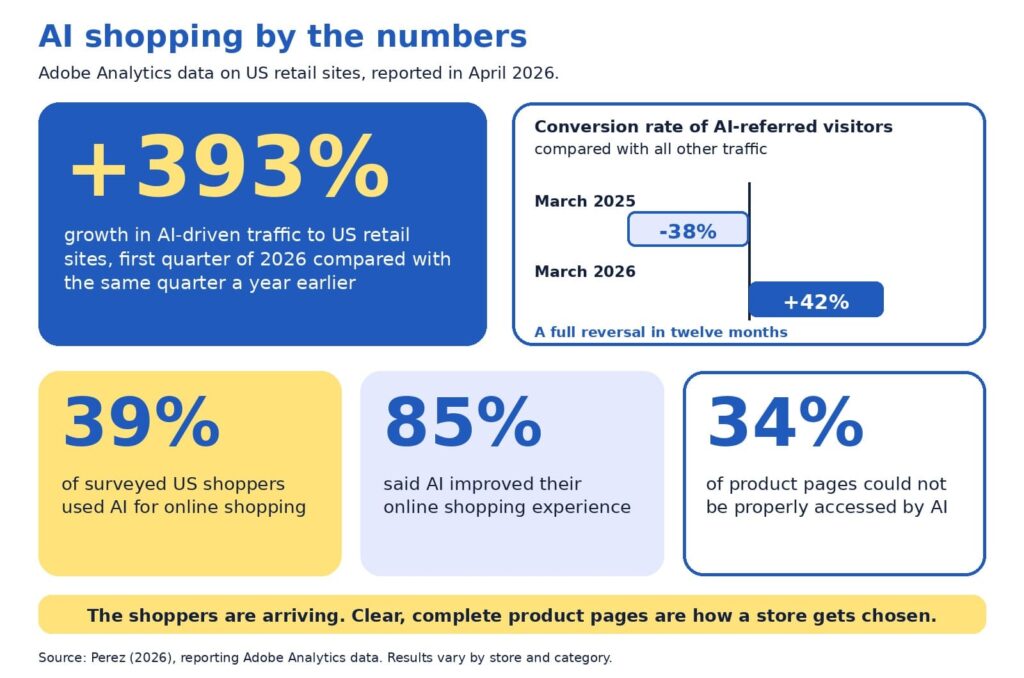
Put those findings side by side and a clear picture forms. AI is becoming the front door to product discovery, but people still walk through your door to buy, and when they arrive they are better informed and more demanding than a typical browser. Adobe’s numbers show how quickly that has changed. In early 2025, visitors arriving from generative AI sources were 9% less likely to convert than other traffic (Adobe, 2025).
By the 2025 holiday season, Adobe measured AI referrals converting 31% better than other sources, with visitors 33% less likely to leave right away, and traffic to retail sites from AI tools up 693% year over year (Pandya, n.d.). Those visitors arrive with a short list and a purpose, which means your page has less room for vague copy and more reason to shine.
How an AI shopping answer finds your product
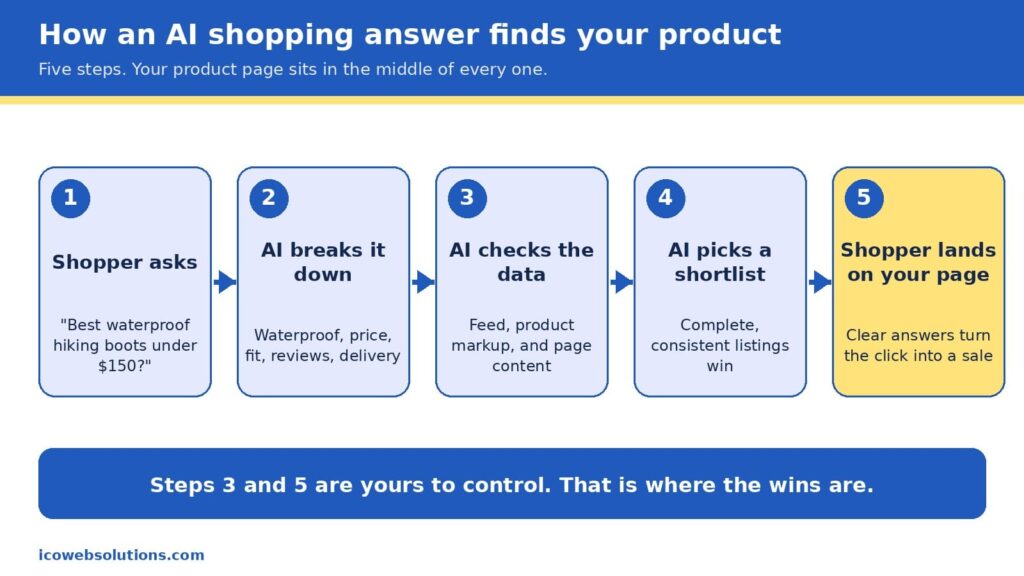
When a shopper types something like “best waterproof hiking boots under $150 that ship by Friday,” the assistant does not browse the web the way a person would. It breaks the request into pieces (waterproof, price ceiling, delivery date, fit, reviews), then looks for products whose data matches every piece. In Google’s case, that data comes from the Shopping Graph, a product database that, according to reporting on Google’s own figures, holds more than 50 billion listings, with about 2 billion updated every hour (Channable, n.d.). The graph is filled by the product feeds merchants submit and by the product markup on their pages, which is the hidden labeling that tells machines what a page is selling, what it costs, and whether it is in stock.
It is worth being precise here, because plenty of vendors are not. Google has not confirmed that Merchant Center data works as a direct ranking signal in AI Mode, but the product graph that feed data builds is shared infrastructure behind several of its shopping surfaces, so accurate and consistent data helps in both places (Alhena, n.d.). There is also no secret “AI schema” to install. The same product markup that has helped pages earn rich results for years is what machines read today, and the real difference is that AI systems tolerate gaps and contradictions far less than a human shopper skimming a page.
That is why the phrase “AI shopping is built on the basics” is more than a slogan. The assistant is choosing from what you have published, so the quality of your product title, price, availability, images, reviews, and return policy decides whether you make the shortlist at all. Once you do make it, the shopper clicks through and your page has to confirm what the assistant promised. In other words, the machine opens the door and the page closes the sale, which is exactly why we think of every product page as having two readers.
The Two-Reader Product Page
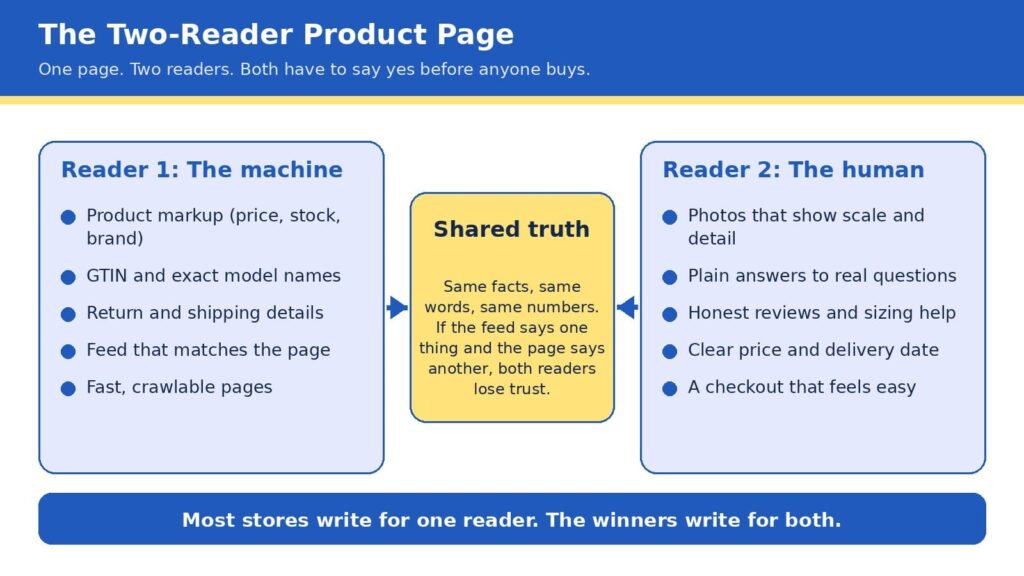
Here is the framework we use with ecommerce clients at ICO Web Solutions, and it is simple enough to remember in five seconds: every product page is read twice, once by a machine and once by a human, and it only sells when both say yes. The machine asks whether your facts are complete, consistent, and easy to verify. The human asks whether you are believable, whether the product fits their situation, and whether buying will be easy. Most stores are written for one of these readers. Some are crammed with keywords and markup but read like a spec sheet, while others are beautiful and persuasive but invisible to anything that cannot see the design.
The bridge between the two is what we call shared truth, meaning the same facts, the same words, and the same numbers everywhere they appear. If your feed says a jacket is in stock, your page says it ships in two weeks, and your reviews mention a different color, then a machine sees a conflict and a person feels a doubt, and both of them move on to the next listing. Shared truth is not glamorous work, but it is the closest thing to a free advantage in ecommerce right now, because most of your competitors have not done it.
Reader one: make the machine’s job easy
Machines are literal, patient, and unforgiving, so the best way to help them is to remove every reason to guess. Start with the basics a product page must state clearly: an exact product name that includes brand, model, and the attributes people search for, the current price and currency, availability, the barcode number (known as a GTIN) where one exists, and clear shipping and return terms. Then make sure those same details appear in your product markup, not just in the visible copy, because that markup is what many systems read first. Return policy information has also been required for Google merchant listings since 2025, so this is one of those details that has moved from nice to have into required territory (Xictron, 2026).
The next step is consistency across systems. Your store platform, your Merchant Center feed, your marketplace listings, and your on-page markup should all pull from a single source of truth, ideally a product information system or at least one carefully maintained spreadsheet that feeds everything else. A feed that disagrees with the page is one of the most common reasons good products underperform, and it is also one of the cheapest to fix. If you are rebuilding or replatforming, this is the ideal time to get it right, and our team handles it as part of ecommerce website design and development so that structured data is built into the templates rather than patched on later.
Finally, give machines something worth quoting. AI assistants tend to favor pages that answer real questions in plain language, so a short section covering what the product is best for, who it is not for, how it compares with the obvious alternative, and what customers most often ask will serve both readers at once. If you want help seeing how your catalog currently appears in AI answers,our AI visibility and GEO services can show you how your catalog appears today, and our SEO company in Delhi team makes sure the traditional search foundations are just as strong.
Reader two: make the human’s decision easy
People decide quickly, and they decide with their eyes first. In Baymard Institute’s large-scale product page testing, 56% of users began by exploring the product images, even in cases where reading the description would have been faster (Baymard Institute, n.d.-b). The same research found that 52% of sites do not add descriptive text or graphics to the images of their top-selling products, which leaves shoppers guessing about scale, weight, material, or fit. That gap is an opportunity, since a few well-chosen captions, a size comparison, or a close-up of the stitching can answer a question before it becomes a reason to leave.
Speed is the other half of the human experience, and it is more forgiving to fix than most owners expect. Google’s research found that as mobile page load time goes from one second to three seconds, the probability of a visitor bouncing rises by 32%, and from one second to ten seconds it rises by 123% (Think with Google, n.d.). Heavy images, bloated apps, and unnecessary scripts are the usual culprits, and trimming them tends to lift every other metric on the page. If your store feels slow on a phone, a fresh look from a website design company in Delhi that builds with performance in mind can pay for itself quickly.
Trust is the third piece. Honest reviews (including a few critical ones), clear sizing help, visible return terms, and a price and delivery date that never change between the search result and the cart all tell a shopper that you mean what you say. This matters even more now, because the shopper arriving from an AI answer has often already been told your product is a good fit and is simply looking for a reason to believe it. Baymard’s benchmark of leading US and European sites found that 44% had mediocre or worse product page experiences in one update (Baymard Institute, n.d.-a), so a store that gets these details right stands out quickly.
The take few agencies will say out loud
Here is the part that may make some of our own industry uncomfortable: if your product pages are thin, inconsistent, or slow, you should not buy an “AI optimization” package yet. Every month a new vendor promises to make your brand visible to chatbots, and some of them offer real value, but none of them can compensate for a catalog with missing sizes, mismatched prices, and photos that do not show the product. AI systems prioritize products with complete, structured data over products backed by bigger marketing budgets, and that rewards the patient work of cleaning up the basics over any shortcut (Xictron, 2026).
We say this as an agency that sells AI visibility work, and we say it because it is true and because it builds better long-term relationships. Acosta Group’s advisors reached a similar conclusion in their 2026 shopper study, recommending that brands begin with what they call the brilliant basics of retailer readiness before layering on AI discoverability and experiments (Supermarket News, 2026). The sequence matters: fix the page, align the data, then amplify. Reverse that order and you pay to send more visitors to a page that is not ready for them.
The ten-point scorecard
Before you spend another dollar, open your top five best-selling product pages and check each one against this list. Every yes is worth roughly a point, and anything under eight tells you where to start.
- The product title includes brand, model, and the one or two attributes shoppers actually search for.
- Price, currency, and availability match across your page, feed, and markup.
- Product markup is present and passes a rich results test.
- The barcode number (GTIN) and brand are filled in wherever they exist.
- Shipping time and return terms are visible without scrolling or clicking.
- Photos show scale, detail, and the product in use, with captions where words help.
- A short “best for, not for” section answers the top three customer questions.
- Reviews are visible, recent, and include honest critical feedback.
- The page loads in about three seconds or less on a mid-range phone.
- Checkout is reachable in two taps from the product page.
The foundation under the page
A great product page sits on top of technology, and three parts of that foundation deserve attention because they quietly shape both readers’ experience. The first is security. Shoppers who arrive from an AI recommendation are trusting someone else’s judgment, and one warning screen or suspicious checkout can undo that trust instantly. If you want a practical overview, our guides on how top brands keep their sites safe and AI-powered cybersecurity for ecommerce stores walk through the habits that protect revenue and reputation together.
The second is architecture. Flexible, fast storefronts make it far easier to keep data clean and pages light, which is one reason we have seen that headless ecommerce is no longer just for big brands, and why progressive web apps for ecommerce deserve a fair look if your shoppers are mostly on phones. Neither is right for every store, so the honest answer is to match the build to your catalog size, team, and budget rather than chase the trend.
The third is learning from your own numbers. Once the basics are in place, AI-powered predictive analytics can show you which products are about to trend, which pages leak the most visitors, and where a small fix would lift sales most. Used in that order (basics first, prediction second), the technology amplifies a strong page instead of masking a weak one.
Freelancer, agency, or in-house team?
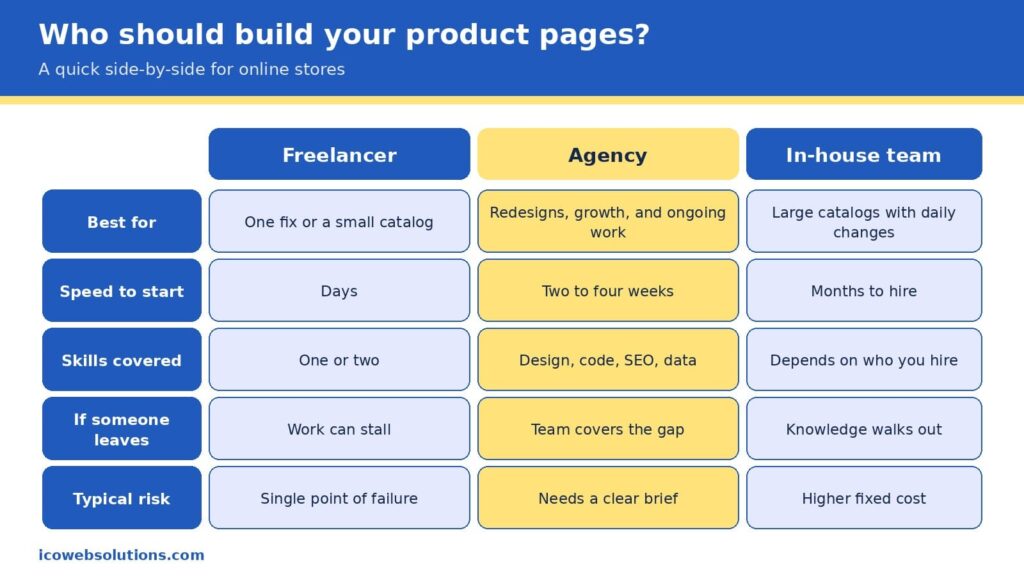
Once you know what your pages need, the practical question becomes who should do the work, and the honest answer depends on the size of the job and how long it will last. A freelancer is often the fastest and most affordable way to fix one specific problem, such as rewriting a batch of product descriptions or cleaning up markup on a small catalog, and a great one can be a joy to work with. The risk is concentration, since one person carries the design, code, search, and data knowledge in a single head, so a sick day, a new client, or a career change can stall your project right when it matters.
An in-house team gives you the deepest knowledge of your products and the tightest day-to-day control, which is ideal for large catalogs that change every day. It also brings the highest fixed cost, a hiring timeline measured in months, and the challenge of keeping specialists current in fields that change quickly. Many in-house teams do their best work when they have a partner to lend extra capacity and fresh perspective during redesigns and launches.
An agency sits in the middle by covering design, development, search, and data under one roof, so the work moves in parallel, and the knowledge does not live in one person. The trade-off is that you need to give a clear brief and choose a partner who understands ecommerce rather than websites in general. Our view is simple: pick the smallest option that can fully own the outcome. If you have a single contained fix, hire a freelancer. If you run a large operation with steady needs, build in-house. If you are redesigning, replatforming, or trying to grow visibility across search and AI at the same time, an agency usually gets you there faster and with fewer surprises.
Read more: Freelancer vs Agency vs In-House: How to Choose the Marketing Team That Fits Your Business Right Now
A 30-day plan you can start this week
You do not need a six-month roadmap to make progress, and a focused month can change how both readers experience your best products. In the first week, run the scorecard on your top five pages and write down every mismatch between your page, feed, and markup, because that list becomes your repair queue. In the second week, fix the facts: titles, prices, availability, barcode numbers, and return details, in the single source your systems share. In the third week, upgrade the human experience with better photos and captions, a short “best for, not for” section, and a speed pass that removes anything the page does not need.
In the final week, measure and expand. Compare conversion, bounce rate, and revenue per visit on the updated pages with the ones you have not touched yet, then roll the winning pattern to the rest of the catalog. By the end of the month you will have a repeatable template, evidence of what works for your customers, and a clean foundation that makes any later AI visibility work far more effective.
Quick answers
Do I need special markup for AI shopping?
No special AI-only markup exists. The standard product markup used for search and Google Shopping is what machines read, so the priority is making it complete, accurate, and consistent with your feed and page.
Will AI shopping replace my product pages?
The data suggests not soon. Shoppers are comfortable letting AI research and compare, but most are not ready to let it complete purchases, so your page remains the place where the decision is confirmed.
How long does it take to see results?
Fixes to speed, photos, and on-page answers can influence conversion within weeks, while changes to how search and AI systems understand your catalog tend to build over a longer period as the data is recrawled and refreshed.
Ready to make your product pages work for both readers?
If you would like a second set of eyes on your store, the ICO Web Solutions team can walk through your top product pages with you using the Two-Reader framework and help you turn the findings into a short, prioritized fix list, whether you build it with us or on your own. Start by telling us about your store on our ecommerce website design and development page and we will suggest clear next steps. Your shoppers are already asking AI for recommendations, and with the right product pages you can be the answer they click.
References
- Adobe. (2025, March 17). Adobe Analytics: Traffic to U.S. retail websites from generative AI sources jumps 1,200 percent. Adobe Blog. https://blog.adobe.com/en/publish/2025/03/17/adobe-analytics-traffic-to-us-retail-websites-from-generative-ai-sources-jumps-1200-percent
- Alhena. (n.d.). Two feeds, one shopper: How Google Shopping and AI visibility converge in 2026. https://alhena.ai/blog/google-shopping-ai-visibility-convergence/
- Baymard Institute. (n.d.-a). Product page UX. https://www.baymard.com/research/product-page
- Baymard Institute. (n.d.-b). Product page UX: Include descriptive text or graphics for some product images (52% don’t). https://baymard.com/research-articles/product-images-descriptive-text
- Channable. (n.d.). Google AI Mode for shopping: How it works and what merchants need to do. https://www.channable.com/blog/google-shopping-ai-mode
- Modaes. (2026). One in four consumers uses AI to shop, with Gen Z leading the way. https://www.modaes.com/global/markets/one-in-four-consumers-uses-ai-to-shop-gen-z-is-leading-the-way
- Omnisend. (2026). AI shopping report. https://www.omnisend.com/resources/reports/ai-shopping-report/
- Pandya, V. (n.d.). Adobe: AI-driven traffic surges across industries with retail experiencing biggest gains. Adobe for Business. https://business.adobe.com/blog/ai-driven-traffic-surges-across-industries
- Supermarket News. (2026, September 18). AI is becoming a shopping channel: Report. https://www.supermarketnews.com/grocery-technology/ai-is-becoming-a-shopping-channel-report
- Think with Google. (n.d.). Find out how you stack up to new industry benchmarks for mobile page speed. https://thinkwithgoogle.com/marketing-strategies/app-and-mobile/mobile-page-speed-new-industry-benchmarks/
- TechWyse. (2026). 77% of US consumers now use AI to shop, but most won’t let it spend their money. https://www.techwyse.com/news/ai-search/ai-shopping-adoption-consumer-distrust-autonomous-spending-2026
- Xictron. (2026). Product data AI optimization: Structured data 2026. https://www.xictron.com/en/blog/product-data-ai-optimization-structured-data-2026/

The Agent-Ready Website: What Changes When AI Agents Start Using Websites for Users
Websites were built around a human operating the interface. A visitor reads the page, compares information, chooses an option, fills in a form, and receives a visual confirmation when the task is complete. That operating model is becoming less exclusive. AI agents can already search for information, interpret product and service details, interact with forms, manage shopping carts, and perform parts of a transaction on a user’s behalf.
The change is no longer theoretical. On September 28, 2026, Shopify added WebMCP support for checkout, allowing browser agents to read and update checkout information and submit a purchase after buyer confirmation. Shopify’s existing storefront and cart tools mean an agent can now participate across much more of the shopping process rather than simply reading a product page.
For website owners and developers, that introduces a different engineering problem. The question is no longer only whether a page can be found and understood by search systems. A website increasingly needs to make its information, actions, permissions, and resulting state clear enough for software to use without taking control away from the person it is assisting.
SEO Still Matters, But It Is Not the Whole Problem
It would be a mistake to treat agent-ready development as a replacement for SEO.
Google’s current guidance for AI Overviews and AI Mode says the existing foundations of SEO remain relevant. Google does not require special AI markup or a separate machine-readable file for a page to be eligible for those search experiences; crawlability, internal linking, textual content, page experience, and accurate structured data remain important.
The difference appears when the task moves from finding information to completing an action. A search system may need to determine what a product is, whether a page is relevant, and what information supports the answer. An agent asked to purchase that product has additional requirements. It needs to identify the correct product and variant, understand available actions, provide the right inputs, preserve the transaction state, and determine whether the purchase was actually completed.
A website can therefore be technically healthy for search while still being difficult for an agent to operate. For example, consider an appointment-booking website. A human user can choose a service, select a time from a visual calendar, enter contact details, submit the form, and recognize the confirmation message. An agent-ready workflow needs those same steps to be explicit: the available services and time slots must be identifiable, required inputs must be clearly defined, the booking action must produce a predictable result, and the system must indicate whether the appointment was confirmed, is pending, or failed.
That distinction becomes easier to understand when separating the two requirements:
- Search accessibility: Can systems discover, crawl, interpret, and retrieve the website’s information?
- Agent usability: Can software identify an appropriate action, provide the necessary inputs, and determine what happened afterward?
- Operational control: Can the website restrict what the agent is allowed to read or change?
Traditional SEO addresses much of the first requirement. Agent-ready architecture extends the second and third.
AI Visibility Is Not the Same as Agent Readiness
AI visibility and agent readiness are related, but they solve different problems. AI visibility focuses on whether AI systems can discover, understand, and surface information from a website. Agent readiness focuses on whether software can use that information to interact with the website and complete a permitted task.
The distinction becomes clearer when separating the two requirements:
- AI visibility: Can AI systems understand and retrieve the website’s information?
- Agent readiness: Can an AI agent identify the appropriate action, provide the required inputs, and determine what happened after the action?
Consider a service website that clearly explains its consultation options, pricing, availability, and location. An AI system may be able to use that information to answer a user’s question about the service. An agent asked to book an appointment has additional requirements.
It needs to:
- Identify the service: Determine which consultation the user wants.
- Check availability: Retrieve valid appointment dates and times.
- Provide inputs: Submit the required customer and booking information.
- Execute the action: Complete the booking within its permitted scope.
- Verify the outcome: Determine whether the appointment was confirmed, is still pending, or failed.
This creates an important difference between being understandable to AI and being operable by AI. The two areas still share several foundations. Clear textual content, consistent terminology, accurate structured data, semantic markup, and well-defined information can help AI systems interpret a website. Agent readiness extends those foundations into the website’s interactive and transactional layers.
For website teams, the practical question therefore changes from:
“Can AI understand this website?” to:
“Can authorized software safely use its information and perform its important actions?”
That distinction becomes particularly important when websites move from presenting information to supporting bookings, purchases, enquiries, account changes, and other user tasks.
Pages Need Clearer Meaning
Human users are remarkably good at filling in gaps. A customer can look at a service page, infer that a blue button opens an appointment form, understand which field expects a company name, and recognize that a confirmation message means the request was accepted.
Software has less room for inference when it is responsible for performing the task correctly.
This makes semantic HTML, consistent naming, accessible labels, visible textual information, and accurate structured data more important at the implementation level. Google already recommends that important content be available in textual form and that structured data accurately reflect what users can see on the page. The goal is not to add unnecessary markup to every element. It is to remove ambiguity from the parts of the website that carry business meaning.
For example, a product page should make the following information easy to identify:
- Product name, model, and variant
- Price, currency, and current availability
- Delivery or service conditions
- Relevant policies and restrictions
- Actions available to the user
A service website has a similar requirement. A consultation page should distinguish its description from the scheduling process, identify required information, and make the confirmation state unambiguous. A clearer interface helps humans too. Agent compatibility is therefore often an extension of good information architecture rather than a completely separate discipline.
Important Actions Need Defined Interfaces
The larger architectural change comes when an agent has to operate rather than simply read a page.
Chrome’s WebMCP project is designed around this problem. WebMCP is a proposed web standard for exposing structured tools to AI agents, including through JavaScript and annotated HTML forms. Its declarative API, updated in September 2026, can turn a standard HTML form into a structured tool by defining its name, description, and input fields.
This matters because agents should not have to discover every business action by imitating a human mouse click. A reservation form, for example, may require a date, location, party size, and contact details. A structured interface can define those inputs explicitly, reducing the need for an agent to infer what each field means from surrounding page content.
Chrome’s WebMCP guidance recommends clear tool descriptions, semantic HTML, defined input schemas, reliable outputs, and testing. That is closer to API design than to traditional page optimization. When reviewing important website actions, developers should look for:
- Explicit inputs: Required values should be identifiable without relying on visual placement.
- Clear constraints: Valid ranges, formats, and available choices should be defined.
- Predictable outputs: The system should return a meaningful result rather than forcing the agent to infer success from a page change.
- Recoverable failures: Invalid or incomplete requests should return enough information for the next step to be understood.
Not every website needs WebMCP immediately. Chrome currently describes it as a proposed standard and notes limitations around browser support, tool discovery, and complex interfaces.
The broader lesson is already useful: important website actions should have explicit, predictable interfaces whether those interfaces are delivered through WebMCP, conventional APIs, forms, or another implementation.
Successful Actions Need Verifiable State
An agent cannot reliably complete a task simply by sending an instruction; it also needs to know what happened afterward.
That requirement becomes obvious in commerce. An order may be submitted successfully, rejected by a payment provider, held for additional verification, or accepted with a different delivery estimate. A human can often resolve such situations by reading the interface. An agent needs a structured and unambiguous representation of the resulting state. Google’s Universal Commerce Protocol reflects this direction by providing standardized operations for areas such as identity linking, cart building, checkout, and order management. Its documentation also addresses booking, order status, and related machine-to-machine interactions across supported experiences.
The principle applies beyond ecommerce.
A lead form should return a meaningful status rather than merely changing the page. A support workflow should distinguish between “request received,” “information required,” “escalated,” and “resolved.” An appointment system should make the confirmed time and booking reference available in a form that software can reliably interpret.
For critical workflows, teams should therefore define:
- Successful completion: What exact state confirms that the task is finished?
- Pending state: What tells the agent that the system is still processing the request?
- Failure state: What information explains why the requested operation did not complete?
- Next action: What should happen when additional user input or human intervention is required?
This is an important distinction between a website that contains actions and one that can support reliable task completion.
| Website layer | Human-oriented implementation | Agent-ready consideration |
| Information | Text, images, navigation | Clear entities, fields, relationships, and current values |
| Actions | Buttons, menus, forms | Explicit operations with defined inputs |
| State | Visual confirmation | Structured success, pending, and failure states |
| Access | User login and session | Scoped authorization and permission checks |
| Measurement | Traffic and conversion | Task completion, failure, and handoff monitoring |
The underlying website architecture may remain familiar. What changes is the level of precision expected from each layer.
Authentication Becomes Part of the Interface
Giving an agent the ability to operate a website also creates a permissions problem. An authenticated user may have access to invoices, account settings, personal information, or payment details. That does not mean an agent should be allowed to perform every available action without additional controls.
Chrome’s security guidance for WebMCP specifically addresses the risks of agents operating within authenticated browser sessions. It warns about malicious instructions embedded in tool definitions and contaminated outputs from third-party content, and recommends signals such as readOnlyHint, consequentialHint, and untrustedContentHint to distinguish lower-risk operations from actions that require greater scrutiny.
That creates a useful engineering distinction between access and authority.
A website can allow an agent to retrieve an order status while requiring confirmation before cancelling an order. It can allow an agent to read account information while requiring a separate authorization step before changing billing details. For sensitive workflows, the control model should account for:
- Read-only versus state-changing permissions
- User confirmation for consequential operations
- Scoped and time-limited authorization
- Separation of financial and account-management privileges
- Logging of agent-initiated actions
- Clear human escalation paths
The same principle applies to payments, account deletion, permission changes, and other irreversible operations. Security therefore cannot be added after the agent interface is designed. The permissions model has to be part of the action model from the beginning.
Websites Will Need to Measure Agent Tasks Differently
Traditional analytics tell a business who visited, which pages were viewed, where users dropped out, and which sessions converted. Agent interactions produce different failure points.
An agent can find the correct product but select the wrong variant. It can understand the requested service but fail to submit the form because an input was ambiguous. It can complete an operation but receive an unclear confirmation and remain uncertain about whether the task succeeded. Those failures can disappear inside conventional page analytics.
The tooling emerging around WebMCP already reflects the need for more precise testing. Chrome DevTools can inspect WebMCP tools, invoke them, and examine their inputs, outputs, and errors during development.
For sites supporting agent-operated workflows, teams may eventually need to monitor:
- Task-completion rate
- Tool or API invocation failures
- Authentication and authorization failures
- Human handoff rate
- Repeated attempts
- Average actions required to finish a task
- Percentage of tasks ending with a verifiable outcome
The important metric is not whether an agent visited the site. It is whether the site allowed the agent to complete the intended task accurately and safely.
The Web Is Starting to Expose Capabilities, Not Just Content
The scale of the change remains uncertain, and adoption is still early. Cloudflare’s 2026 analysis of 200,000 of the most visited domains found established mechanisms such as robots.txt to be widespread, while newer agent-oriented mechanisms remained extremely rare. The company found MCP Server Cards and API Catalogs on fewer than 15 sites in that dataset.
That is not evidence that every website needs to implement every emerging standard immediately. It shows that the technical conventions for software-operated websites are still being established.
This matters for developers because infrastructure decisions made now can either preserve flexibility or create another layer of technical debt later. A site that separates business logic from presentation, exposes clean APIs, maintains accurate structured data, uses semantic markup, and treats authorization as a first-class concern has more options as agent interfaces mature.
A site whose important actions depend entirely on visual inference, undocumented state changes, brittle client-side behavior, or broad session permissions will have more work to do.
What Website Teams Should Test Now
The first step is not adding an agent-specific feature for its own sake. It is reviewing the site’s most important user tasks and asking whether their requirements are explicit at the machine level.
For each critical workflow, a team should be able to answer four practical questions.
Can the agent find the required information?
Important facts should be available in clear text, with accurate relationships between products, services, prices, policies, accounts, and other entities.
Can the agent identify the correct action?
Forms, buttons, APIs, and tools should expose clear names, inputs, constraints, and outputs.
Can the agent determine the result?
Success, failure, pending status, and required follow-up should be represented clearly enough for software to act on them.
Can the site limit what the agent is allowed to do?
Read access, state-changing operations, sensitive actions, and user confirmation should have deliberately different permission requirements.
A practical review can also examine the website through five implementation areas:
- Content: Are important facts present in text and consistently named?
- Interaction: Are high-value actions explicit and predictable?
- State: Can software identify what happened after an action?
- Security: Are permissions narrow enough for the task being performed?
- Observability: Can the development team identify where an agent workflow failed?
These checks can be performed without redesigning an entire website.
They also make the concept of agent readiness more concrete. Instead of asking whether a site has “AI features,” a development team can evaluate whether its core customer journeys remain understandable and controllable when software performs part of the work.
The Website Is Becoming an Operating Surface
Markntel Advisor projects the AI agent market to grow from $10.9 billion in 2026 to $110.5 billion by 2032. This growth highlights the need for websites to support secure, reliable agent-driven tasks.
The more useful question for website teams is not whether they should “prepare for AI” in the abstract.
It is whether their most important digital workflows are sufficiently clear, structured, secure, and observable for another software system to operate them reliably on behalf of a user. Search engines made websites compete for discoverability. Agent-based systems introduce another requirement: the site must also make its information and capabilities usable by software without creating uncertainty about permissions or outcomes.
The next generation of websites will still need good content, accessible interfaces, fast performance, and strong search foundations. They will also need to expose their important information and actions with enough precision that both people and software can use them safely.
The shift is not from websites to AI. It is from websites that primarily display information to websites that can support reliable tasks.
Sources/References:
- Shopify — WebMCP support for checkout
https://shopify.dev/changelog/posts/webmcp-support-for-checkout - Chrome for Developers — WebMCP
https://developer.chrome.com/docs/ai/webmcp - Chrome for Developers — WebMCP Declarative API
https://developer.chrome.com/docs/ai/webmcp/declarative-api - Chrome for Developers — WebMCP Best Practices
https://developer.chrome.com/docs/ai/webmcp/best-practices - Chrome for Developers — Agent Security Considerations for WebMCP
https://developer.chrome.com/docs/agents/security - Chrome DevTools — Debug WebMCP Tools
https://developer.chrome.com/docs/devtools/application/webmcp - Universal Commerce Protocol — Official Specification
https://ucp.dev/specification/overview - Cloudflare — Introducing the Agent Readiness Score
https://blog.cloudflare.com/agent-readiness - Google Search Central — AI Features and Your Website
https://developers.google.com/search/docs/appearance/ai-features - Google Search Central — Optimizing for Generative AI Features on Google Search
https://developers.google.com/search/docs/fundamentals/ai-optimization-guide - Markntel Advisor — AI Agent Market Research Report
https://www.marknteladvisors.com/research-library/ai-agent-market.html - Universal Commerce Protocol — Lodging Booking Capability
https://ucp.dev/draft/specification/lodging/booking

Before You Move Your SEO Budget to GEO, Read This
It is Monday morning, and a new proposal has landed in your inbox. It includes a fresh line item called GEO. A few paragraphs later, the SEO retainer is slightly smaller. Nobody planned a trick. The market moved quickly, and the paperwork followed.
The urgency behind that proposal is real. Pew Research Center (2025) found that Google users clicked a traditional search result in 8% of visits when an AI summary appeared, compared with 15% of visits when none appeared. Fewer clicks make any owner or marketing lead ask the same thing: should money move from SEO to generative engine optimization, or GEO?
Here is the short answer. Some of it may move, and the share is often smaller than a proposal first suggests, because a good portion of GEO is work that a healthy SEO plan already covers. The longer answer takes about fifteen minutes to read, and it ends with a five-minute method for reviewing any GEO line item you receive. We will also point out where the work is truly new, since that is where fresh budget earns its place.
In 60 Seconds
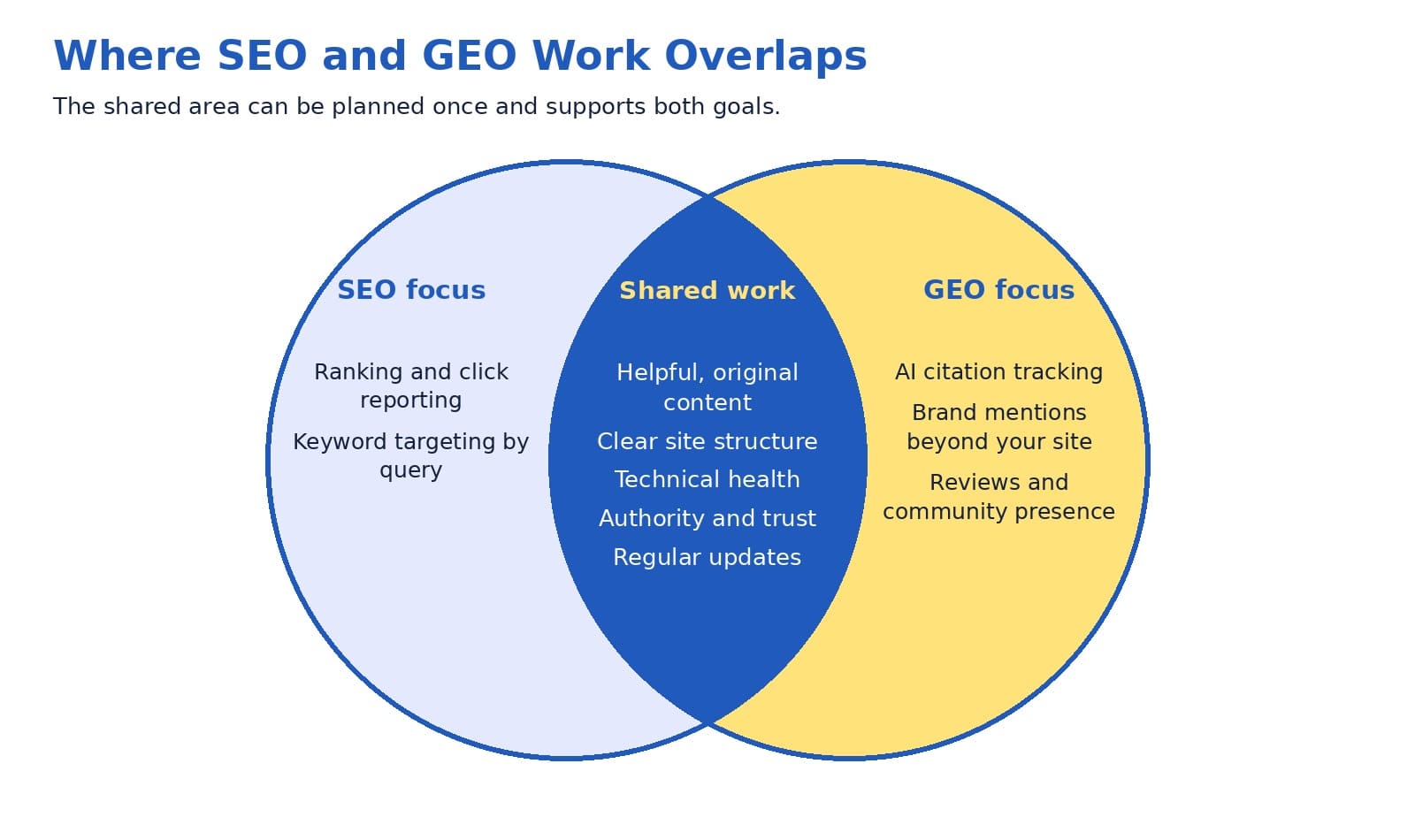
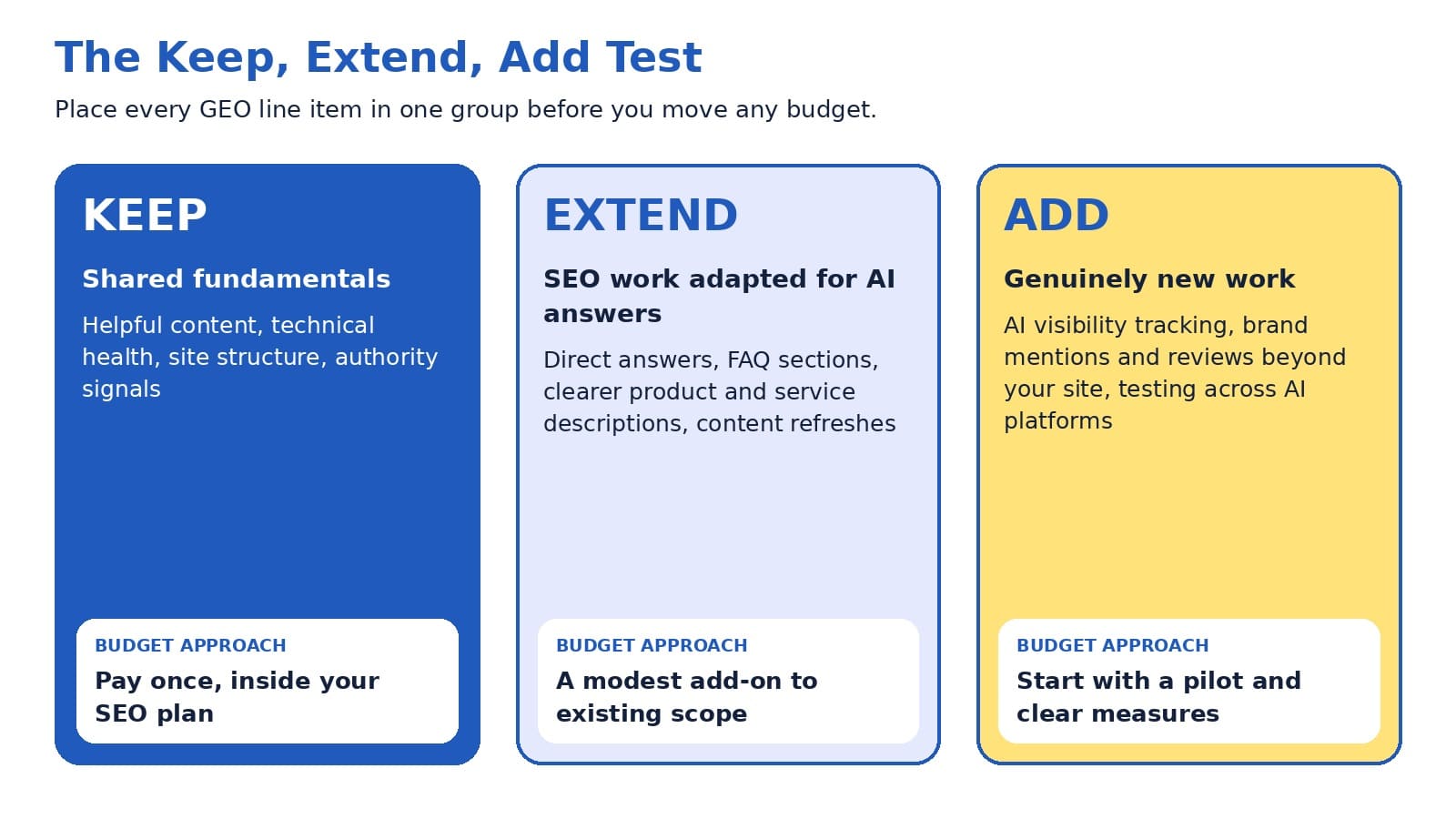
Google says optimizing for its AI features is part of SEO, and most marketers surveyed by Semrush agree. A smaller slice of GEO is new: measuring AI answers, building your reputation beyond your own website, and testing across AI platforms. The Keep, Extend, Add Test sorts each line item into shared work you pay for once, light adjustments that deserve a modest add-on, and new activities that deserve a pilot with a clear measure.
Where We Are Headed
- Why everyone is suddenly talking about GEO
- GEO in one minute
- What Google says, in its own guide
- Do marketers see it the same way?
- The Keep, Extend, Add Test
- Where the new work really is
- Your proposal review in five minutes
- Questions owners ask before moving budget
- A bolder idea: fix the foundation first
- What changes for B2B and B2C
- A 90-day starter plan
- The decision in plain terms
Why Everyone Is Suddenly Talking About GEO
Three forces arrived at the same time. The first is behavior. AI summaries now answer many questions at the top of the results page, and Pew Research Center (2025) found that people clicked a link inside the summary itself in only 1% of visits. When fewer people reach your pages, every reporting dashboard feels different.
The second force is budget. Gartner’s 2025 CMO Spend Survey put marketing budgets at 7.7% of company revenue, flat for the year, and 59% of CMOs said their budgets could not fully support their strategy (Gartner, 2025). When the total stays level, a new priority has to be funded from an existing line. SEO is the most common donor.
The third force is momentum. In Digiday’s reporting on a Scribewise survey of 205 marketing leaders, 55% said they already had dollars set aside for GEO, and agency executives described moving part of existing SEO budgets in that direction (McCoy, 2026). That is a lot of activity around a term many teams met only recently, so a careful look before moving money is time well spent.
GEO in One Minute
SEO helps your pages appear when people search on Google, Bing, and similar engines. GEO helps your business appear inside answers written by AI systems such as Google’s AI Overviews and AI Mode, ChatGPT, and Perplexity. You may also see the term answer engine optimization, or AEO, used for the same idea. Both serve one business goal: the right buyer finds you at the moment of need, then calls, books, or buys.
- Who needs it: businesses whose customers research with AI assistants as well as search engines.
- How it works: AI systems retrieve pages and other sources, summarize them, and name the ones that look relevant and reliable.
- Why it matters: a mention inside an answer can shape a buyer’s shortlist before anyone visits your website.
What Google Says, in Its Own Guide
Google Search Central published a dedicated guide in 2026, titled Optimizing your website for generative AI features on Google Search, and updated it in July. It describes how AI Overviews and AI Mode work. Google’s systems retrieve relevant pages from the search index to ground each answer, a technique called retrieval-augmented generation, and they run several related searches at once, a technique called query fan-out (Google Search Central, 2026). In other words, the AI layer sits on top of the same index and quality systems that SEO has always served.
The guide addresses the acronyms directly. From Google’s perspective, optimizing for generative AI search is still SEO (Google Search Central, 2026). It then lists tactics that are not required for Google’s AI features:
- LLMs.txt files and similar special files.
- Splitting content into very small pieces for AI.
- Rewriting pages in a special style for AI systems.
- Collecting mentions that are not authentic.
- Special schema markup, although structured data continues to help with rich results.
What does the guide recommend instead?
Original, helpful pages that offer a point of view readers cannot find everywhere else, a clear technical structure, a good page experience, and accurate business details in tools such as Merchant Center and Google Business Profiles. It even offers a one-line test for any page: would a visitor find this satisfying? You can already check your own results in the Generative AI performance report inside Search Console.
One caution keeps the picture honest. The guide describes Google. ChatGPT, Perplexity, and other assistants run their own retrieval systems, so a portion of GEO reaches beyond what Google covers. We will get to that portion shortly.
Do Marketers See It the Same Way?
Mostly, yes.
A Semrush survey of 481 marketers, business owners, and SEO professionals found that 77% describe AI search as part of SEO, while 15% treat it as a separate channel (Loktionova, 2026). The more interesting result concerns execution.
Only 22% of respondents ran SEO and AI search fully integrated across strategy, execution, and reporting. Teams that ran the two as one integrated effort were far more likely to report AI-driven traffic or leads: 81%, against 36% of teams working in separate tracks (Loktionova, 2026). Semrush sells search software, so it helps to read the survey as one informed perspective, and it points the same way as Google’s guide.
Digiday’s reporting adds some history.
SEO veterans quoted there compared GEO with earlier waves such as AMP and featured snippets, which were once presented as separate disciplines and later turned out to be extensions of familiar search logic.
One agency chief executive estimated that about 80% of GEO is fundamental SEO. Others pointed out that retrieval systems and presence across platforms are new territory, and one expert argued that AI search may eventually earn its own dedicated team, the way social media did (Guaglione, 2026). That 80% figure is a professional estimate, not a measured result, so treat it as a handy rule of thumb.
When you line these sources up, three points stand out:
- Strong SEO foundations lift visibility in AI answers.
- A real, smaller set of GEO activities is new.
- Outcomes in AI platforms vary by prompt, so pilots with clear measures make sense.
The Keep, Extend, Add Test
Proposals tend to arrive as a single line that says GEO. The Keep, Extend, Add Test turns that one line into three honest groups, and each group gets its own budget logic.
- Keep: shared fundamentals such as helpful content, technical health, site structure, and authority building. They support search results and AI answers alike, so you fund them once, inside the SEO plan.
- Extend: SEO work adapted for AI answers, such as direct answers near the top of a page, richer FAQ sections, clearer service descriptions, and refreshed older content. These usually justify a modest add-on.
- Add: new activities such as tracking your visibility in AI answers, earning reviews and mentions beyond your site, and testing how each AI platform describes you. These fit a pilot.
Here is Extend in action. Picture an accounting firm with a page about small business tax planning. The page already exists, so the team adds a short opening summary that says who the service helps, what it includes, and what a client can expect.
Then it answers the four questions prospects ask most, updates the details, and adds a clear next step. One edit helps searchers on Google and gives AI systems clean, relevant passages to draw from. Nobody built a new page, and nobody needed a new retainer.
Now picture the Add side. A regional home services company decides to pilot. It picks a short list of questions homeowners ask before hiring, such as how to choose a contractor and what a repair should cost. Each month, the team checks how the major AI assistants answer those questions, notes whether the company is named, and compares that with calls and form submissions.
At the same time, it asks recent customers for honest reviews. The pilot has a small budget, a named owner, and a review date, so the learning arrives before the larger spend does.
The test also gives owners and marketers a shared vocabulary. Owners see which parts of a proposal overlap with work already funded. Marketers show where fresh effort is required. Providers explain what is new with confidence, because the framework makes the case on its own.
Where the New Work Really Is
A fair review gives credit to the new parts of GEO, because that is where fresh budget has the best case. The Semrush survey and Digiday’s reporting point to four areas:
- Your reputation beyond your website. AI answers draw on reviews, community discussions, video, and press coverage. Yet only 8% of surveyed marketers used digital PR for AI visibility, 9% managed online reviews, and 11% built mentions through communities and social platforms (Loktionova, 2026). That is an open field.
- Access and readability for AI systems. Which AI crawlers may reach your content, and how easily they can read your pages, are decisions worth making on purpose.
- Measurement. Answers vary by prompt and platform, and many tracking tools estimate results from simulated prompts instead of real user queries (Guaglione, 2026). In the Semrush survey, 49% of marketers named the effect of AI on pipeline or revenue as a leading measurement challenge, and 40% relied mainly on manual spot checks in ChatGPT.
- Platform differences. Each assistant may retrieve and cite differently, so results from one platform may need confirming on another.
What about traffic? AI platforms currently send a small share of visits to many publishers. Similarweb data cited by Digiday showed less than 1% of overall traffic for the news outlets it examined, while one publisher reported a markedly higher subscription conversion rate among visitors arriving from AI platforms (Guaglione, 2026).
Small volume with strong intent is a classic reason to run a pilot first, measure leads and revenue, and scale what works.
Your Proposal Review in Five Minutes
Take the GEO proposal on your desk and read each line item against two questions. Is it already part of the current SEO scope? Does it adapt something you already have? Anything left over is new, and new work deserves a pilot with an owner, a measure, and a review date.
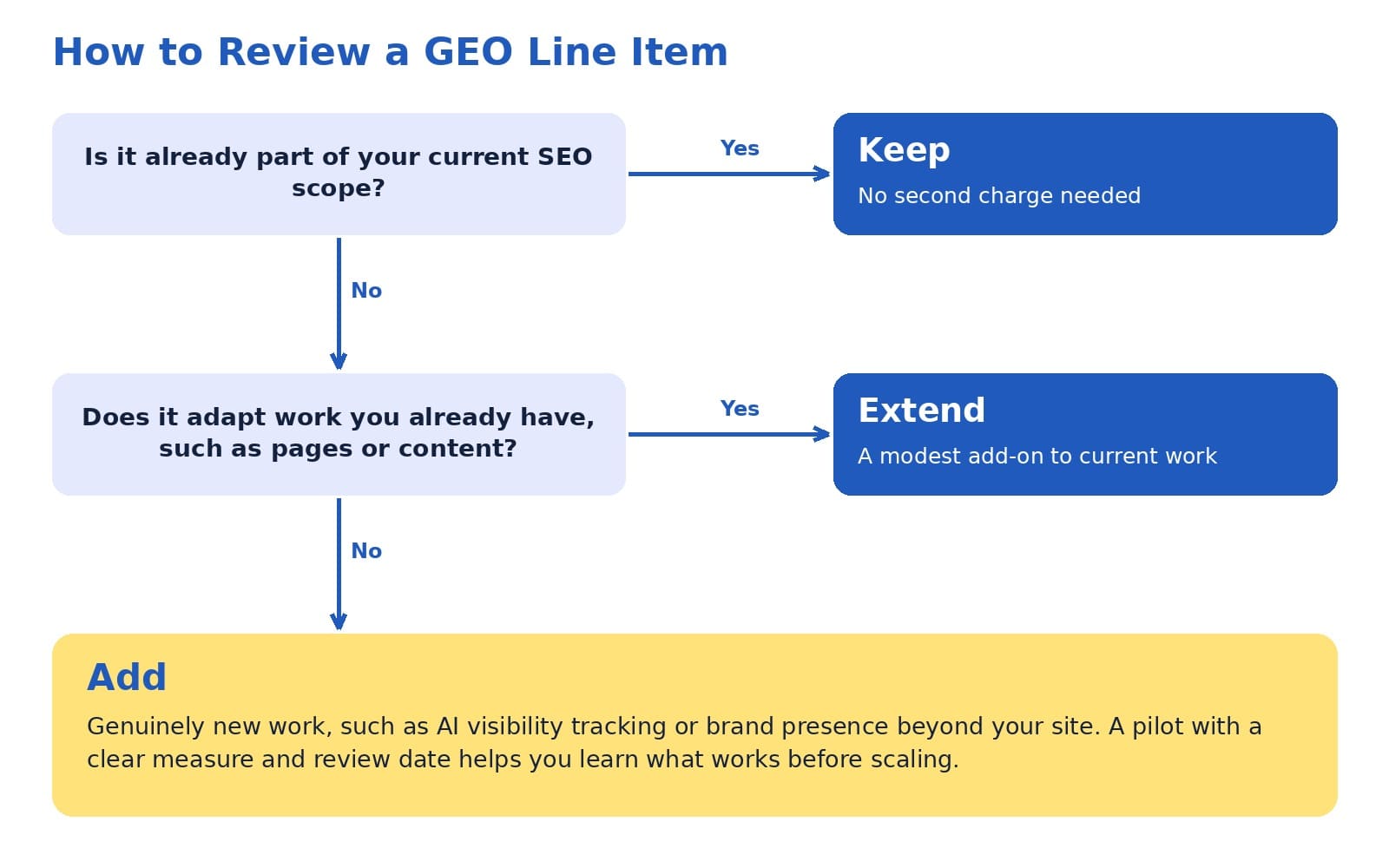
Bring these questions to the conversation with any provider, whether an agency, a freelancer, or an internal teammate:
- Which part of this work already sits inside our current SEO scope?
- Which pages or technical items will change, and how will we confirm it?
- What counts as success: qualified leads, calls, form submissions, revenue, or AI mentions?
- How long does the pilot run, and when do we review it together?
- What do we own at the end, including content, reports, and data?
- Will SEO and GEO appear in one report with one baseline?
Good answers build trust quickly. They also give you a tidy summary to share with a colleague who missed the meeting.
Questions Owners Ask Before Moving Budget
Should we pause SEO to fund GEO? A pause removes the work that GEO builds on. Google’s guide ties AI feature eligibility to the same indexing and quality systems that SEO serves (Google Search Central, 2026), so most teams do better by keeping the foundation funded and adding a pilot on top.
How much should a GEO budget be? No universal figure exists. In the Scribewise survey reported by Digiday, 70% of marketers with GEO dollars said it made up 11 to 20% of that budget (McCoy, 2026). Treat that range as one data point from one survey. A pilot sized to what your team can measure and manage is a sound starting point.
How will we know it works? Set a baseline before anything changes. Track leads, conversion rate, and branded search alongside AI visibility, and use the Generative AI performance report in Search Console for Google’s features. When AI mentions rise and qualified leads follow, you have found a pattern worth funding.
A Bolder Idea: Fix the Foundation First
Here is a thought that rarely appears in budget meetings. For many businesses, the highest-return GEO investment is an SEO repair. Google’s guide states that a page must be indexed and eligible to appear in Search with a snippet before it can be shown in AI features (Google Search Central, 2026). A page that search systems struggle to find or understand has little to offer an AI answer, whatever name appears on the invoice.
So the order of spending matters. Start by confirming that your core pages are crawlable, indexed, and clear about who you serve and what you sell. Next, extend the strongest pages with direct answers and current details. Then fund a defined pilot for the new activities, drawn from a modest slice of the search line and expanded when the evidence supports it. We call this protect the base, pilot the extension.
Moving a large share of SEO budget before any pilot has produced results may weaken the very foundation that AI visibility relies on. A steadier path keeps leads flowing today and gives you your own data for tomorrow. Since AI visibility is still measured imperfectly across the industry, learning at a measured pace is a competitive advantage.
What Changes for B2B and B2C
The Keep, Extend, Add mix shifts with your audience. B2B buyers often research a purchase through many questions over several weeks, and an AI assistant may help build their shortlist along the way. Clear service pages, case studies, and consistent descriptions of your offer carry extra weight in that journey.
B2C and local businesses may find accurate business details matter most. Google notes that Merchant Center and Google Business Profiles help products and services appear in AI responses and other search results (Google Search Central, 2026).
Reviews and customer feedback add another layer, because AI answers can draw on them. In both cases, the first move is the same: learn the questions your best customers ask, answer them clearly on your own site, and keep your details accurate everywhere they appear. Those tasks live in Keep and Extend, which is why the Add budget may come out smaller than expected.
A 90-Day Starter Plan
You can run this plan inside most existing engagements, and each step produces something you can show your team:
- Weeks 1 and 2, baseline: review indexing, site structure, your top pages by leads, and the Generative AI performance report in Search Console.
- Weeks 3 to 6, extend: add direct answers, FAQ sections, current service details, customer proof, and accurate business profiles to priority pages.
- Weeks 6 to 12, pilot: choose a focused list of customer questions, record how AI platforms answer them each month, and begin earning reviews and credible mentions.
- End of quarter, decide: compare leads, conversion rate, and AI mentions with your baseline, then set the next budget.
By day ninety, you hold real evidence from your own business. That makes the next budget conversation shorter and a lot more confident.
The Decision in Plain Terms
AI search is a genuine opportunity, and exploring it is a smart move. The evidence from Google, Semrush, and Digiday tells one consistent story: most of GEO stands on SEO, and a smaller set of activities is new. Keep what is shared, extend what can be adapted, and pilot what is new. When you follow that order, each dollar has a clear job, and every stage aims at leads and sales you can count.
Ready to see where your own budget stands? Share your current SEO scope and any GEO proposal you have received, and we will map every line to Keep, Extend, or Add in a one-page summary for your team.
Want to see how the pieces fit before you decide? Explore the work of our website design company team, the programs from our SEO agency specialists, and the planning behind our digital marketing agency services.
References
Gartner, Inc. (2025, May 12). Gartner 2025 CMO spend survey reveals marketing budgets have flatlined at 7.7% of overall company revenue [Press release]. https://www.gartner.com/en/newsroom/press-releases/2025-05-12-gartner-2025-cmo-spend-survey-reveals-marketing-budgets-have-flatlined-at-seven-percent-of-overall-company-revenue
Google Search Central. (2026, July 10). Optimizing your website for generative AI features on Google Search. Google for Developers. https://developers.google.com/search/docs/fundamentals/ai-optimization-guide
Guaglione, S. (2026, March 10). GEO hype busted: How it differs (and how it doesn’t) from SEO. Digiday. https://digiday.com/media/geo-hype-busted-experts-call-it-more-seo-than-new-discipline/
Loktionova, M. (2026, June 3). Only 22% of marketers have fully integrated AI search and SEO. They’re pulling ahead. [Study]. Semrush Blog. https://www.semrush.com/blog/the-operational-gap-ai-seo-study/
McCoy, K. (2026, March 25). Marketers shift growing shares of search spending to GEO. Digiday. https://digiday.com/marketing/marketers-shift-growing-shares-of-search-spending-to-geo/
Pew Research Center. (2025, July 22). Google users are less likely to click on links when an AI summary appears in the results. https://www.pewresearch.org/short-reads/2025/07/22/google-users-are-less-likely-to-click-on-links-when-an-ai-summary-appears-in-the-results/


How We Build an SEO Content Roadmap That Actually Works in the AI Search Era
A practical, step-by-step walkthrough of the process we actually run with clients, including where AI Overviews change the decisions we make and where they don’t.
Most SEO content roadmaps fail for a boring reason. Not because the writing was bad or the keyword research was sloppy, but because the plan was built to chase visibility instead of the thing that visibility was supposed to lead to.
A ranking or a spike in impressions feels like progress, and it can be, right up until you look at the pipeline six months later and realize none of it turned into actual leads or revenue. AI Overviews have made this problem worse, not better, because now a page can rank well and still get almost no clicks if an AI-generated summary is sitting above it answering the question for free.
So when we build a content roadmap for a client now, the AI search layer isn’t an add-on step at the end. It’s built into the plan from the first decision we make. Below is the process itself, walked through with a real kind of example so you can see how each step actually plays out, not just what it’s called.
To keep things concrete, I’ll use a composite example throughout: a mid-size commercial HVAC equipment distributor that sells to contractors and facility managers, not homeowners.
It’s a good example because the buying decision is relationship-driven and technical, which means a wrong keyword priority can waste months of content production on traffic that was never going to turn into a sales conversation.
Step 1: Get Specific About What the Content Is Actually For
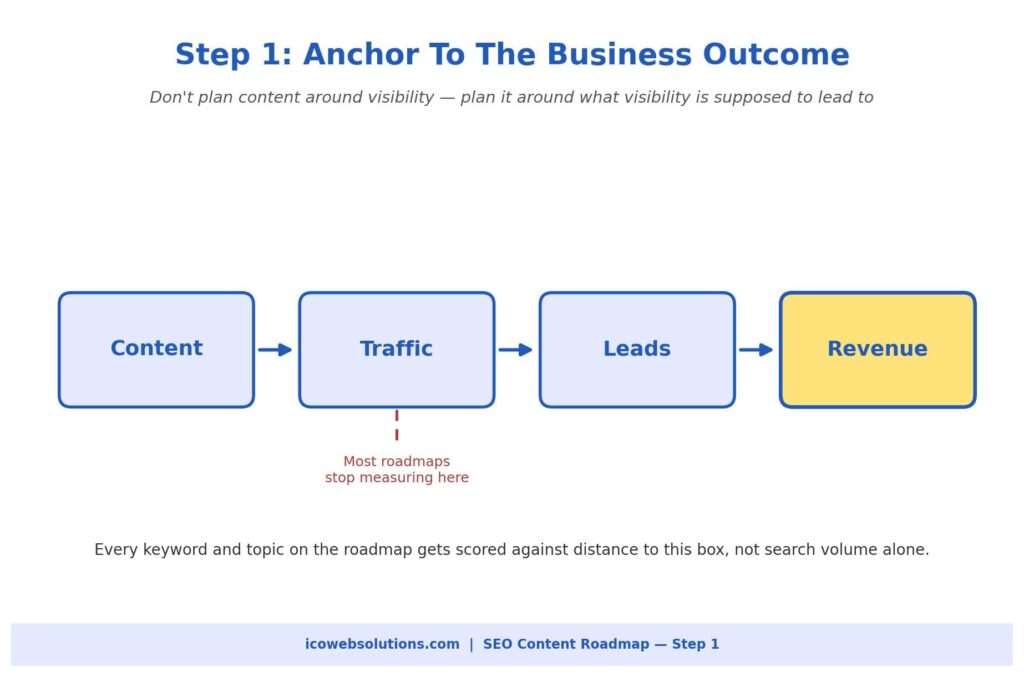
Before any keyword research happens, we force a conversation that sounds simple but gets skipped constantly: what does a “win” actually look like for this content, in terms the business already tracks? Not traffic.
Not rankings. The thing after that.
For our HVAC distributor, a win isn’t someone reading a blog post about ventilation standards. It’s that person filling out a quote request form, and that form eventually turning into a signed equipment contract worth tens of thousands of dollars.
This matters because it changes what “good” means for every decision downstream. If you skip this step, you end up with a roadmap optimized for a vague idea of relevance instead of the specific outcome the business actually needs.
A media company selling ad impressions genuinely wants raw traffic and pageviews, and that’s a fine goal for them. Almost nobody else should be optimizing for that. If your business model depends on booked meetings, signed contracts, or completed purchases, every keyword you consider should get measured against how close it sits to that outcome, not how many people search for it.
For the HVAC distributor, this meant writing down plainly that we were chasing contractors and facility managers with a real, current need, not general curiosity about HVAC systems. That single sentence ended up ruling out a surprising number of high-volume topics later in the process, including some that would have looked great in a traffic report and done nothing for the sales team.
It’s worth being honest about how uncomfortable this step can feel the first time you do it properly. Marketing teams are used to defending their work with traffic and ranking numbers, because those numbers are easy to produce quickly.
Tying every topic back to pipeline or revenue means some of your favorite ideas, the ones that would clearly perform well in search, have to get cut or deprioritized because they don’t actually move the business forward.
That’s a harder conversation to have internally, but skipping it just moves the hard conversation to six months later, when the roadmap is finished and the numbers don’t add up to anything the leadership team cares about.
Step 2: Build the Full Keyword List, Then Find What You’re Actually Missing
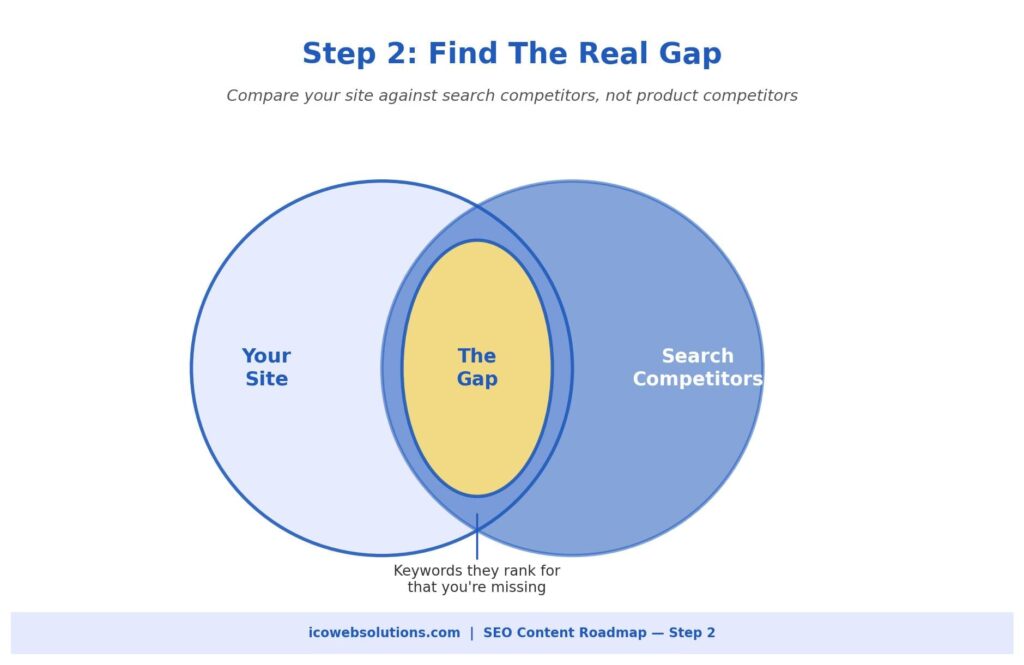
With the goal nailed down, the next step is mapping out every term your buyers might realistically search, and then comparing that against which of those terms you already show up for.
We use a standard SEO research tool for this part, something like Ahrefs or Semrush works fine, by pulling our own domain alongside three or four competitors who we know we’re actually losing visibility to in search, not just competitors the sales team talks about internally.
Those two lists are often different, and conflating them wastes time chasing SEO fights you were never actually in.
The output at this stage is messy on purpose. You’ll get a long list of keyword opportunities, a decent chunk of which will be irrelevant, branded, or far too broad to be useful. That’s expected. The real work here is in the filtering.
For the HVAC distributor, the obvious head term was something like “commercial HVAC equipment,” a huge, broad, expensive-to-rank-for phrase. But sitting right next to it were much more specific, much more winnable terms like “rooftop HVAC unit replacement for commercial buildings” and “HVAC equipment financing for contractors,” both with a fraction of the search volume but an enormous amount more buying intent behind them.
- Pick search competitors based on who you actually compete with in results, not who sales considers a rival
- Expect most of the raw keyword export to be noise, and budget real time for manually trimming it
- Specific, narrower terms with clear intent are usually worth more than broad terms with bigger volume
Step 3: Look at the Actual Search Results Page, Not Just the Keyword Numbers
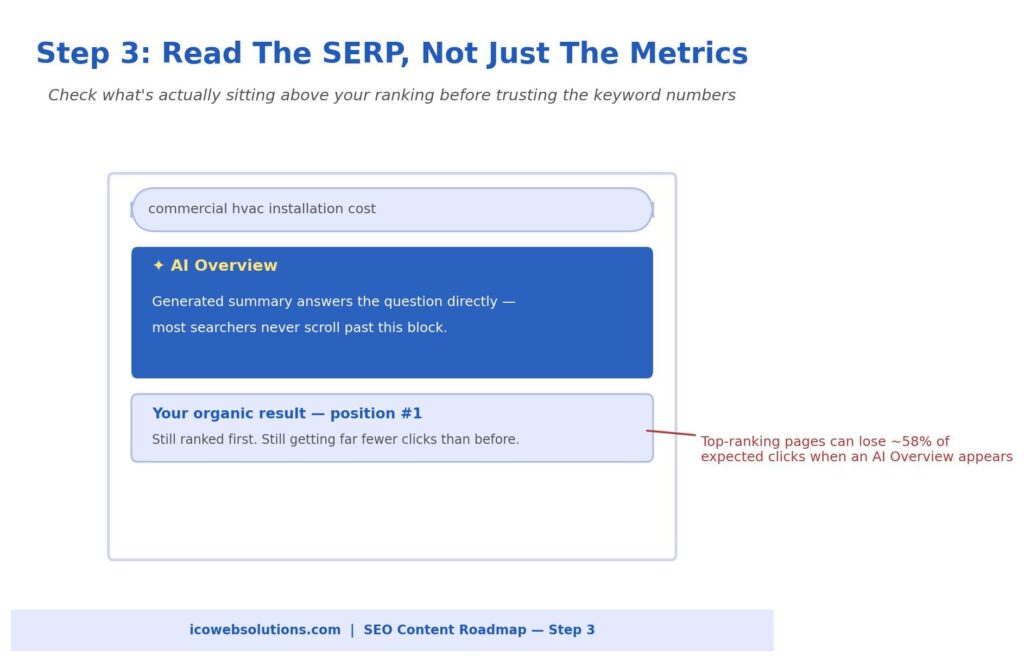
This is the step that didn’t exist in quite the same form a few years ago, and it’s the one most roadmaps still skip. Search volume and keyword difficulty tell you whether you can rank. They don’t tell you what that ranking is actually worth anymore, because the page itself might look completely different depending on whether an AI Overview, a shopping carousel, or a stack of ads sits above the organic results.
Ahrefs has published research showing that the top-ranking organic result can lose roughly 58% of its expected clicks when an AI Overview appears on that search page.
That’s a massive difference, and it means two keywords with identical volume and difficulty scores can be worth wildly different amounts depending on what else is occupying that results page.
So at this stage, we manually check the SERP for every shortlisted keyword, not just the metrics report, and note which ones already trigger an AI Overview, a People Also Ask block, or heavy ad placement.
This isn’t automatically a reason to avoid a keyword. It’s a reason to decide, deliberately, what you’re actually trying to win there.
For our HVAC distributor, nearly every broad, informational term, things like “how commercial HVAC systems work”, triggered an AI Overview that fully answered the question without anyone needing to click through.
We didn’t abandon those topics entirely, because getting cited inside that AI summary still has brand value, but we stopped expecting them to drive form fills, and we shifted our click-focused effort toward the narrower, more technical, bottom-of-funnel terms where AI Overviews were far less dominant.
Step 4: Group Keywords Into Topics the Way a Buyer Actually Thinks
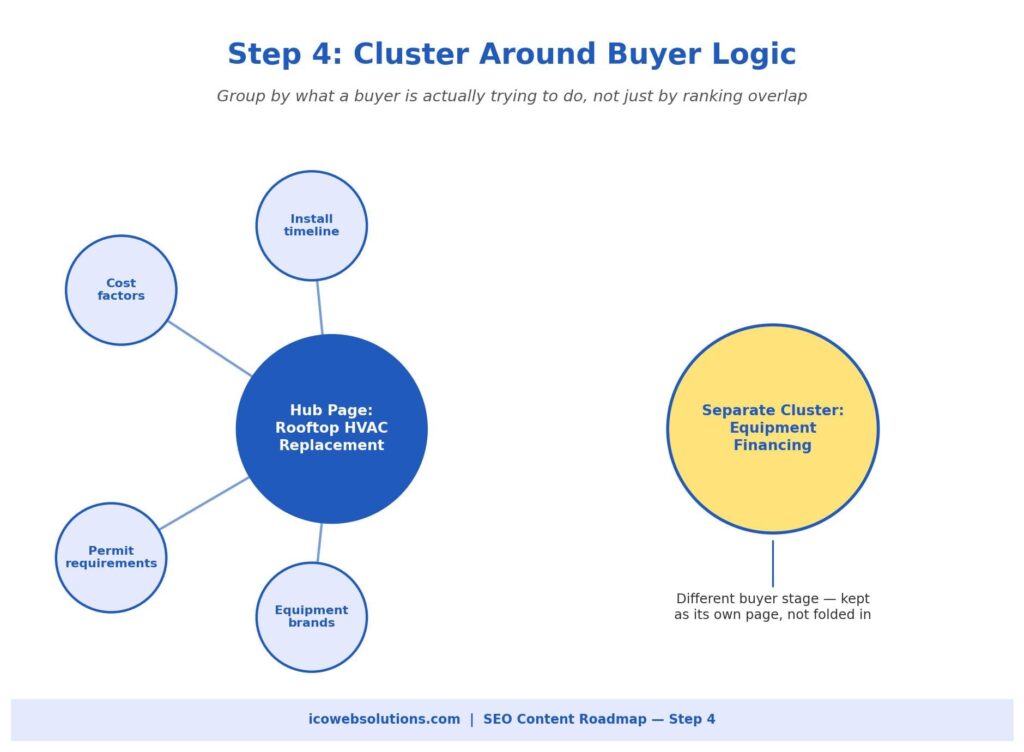
A spreadsheet full of individual keywords isn’t a plan, it’s just a longer list. The next step is organizing those keywords into topic clusters, groups of related terms that can realistically be served by one well-built page, or that clearly need separate pages because they represent different stages of the buying journey.
Most research tools will suggest a clustering based on which pages currently rank for overlapping terms, and that’s a useful starting point, but it’s not the final word.
The judgment call here is making sure the clusters reflect how a real buyer thinks, not just how a crawler groups similar phrases. In the HVAC example, a tool-based clustering initially lumped general commercial HVAC terms together with equipment financing terms, because there was some ranking overlap between them.
But those are genuinely different buyer situations. Someone researching how commercial HVAC systems work is early and exploring. Someone searching for equipment financing options has already decided what they need and is now trying to figure out how to pay for it.
We split those into two separate clusters with two separate pages, because treating them as one topic would have buried a high-intent, close-to-purchase audience inside a general awareness page.
Step 5: Decide What Gets Built First, Using More Than One Filter
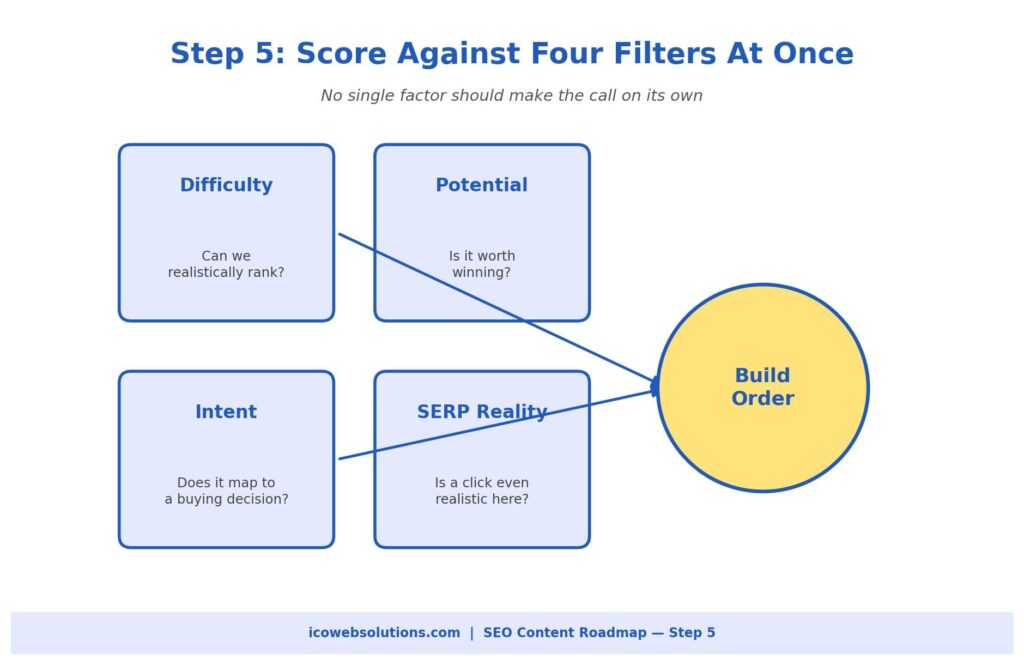
Once the clusters exist, you still have to decide what order to build them in, and this is where a lot of roadmaps quietly go wrong by picking the biggest, most tempting keyword first instead of the smartest one. We score every cluster against four things at once: how difficult it would be to rank, how much it’s genuinely worth if we win it, how close the searcher’s intent sits to an actual purchase decision, and what we learned in Step 3 about whether a click there is even realistic.
No single one of those four factors should make the decision alone. A term can have huge volume and still be a poor first choice if it’s dominated by an AI Overview and sits at the very top of the awareness stage. A term with modest volume can jump to the front of the line if it’s realistically winnable and sits one step away from someone filling out a form.
For the HVAC distributor, that meant pushing the broad “commercial HVAC equipment” topic further down the roadmap, even though it had the biggest search volume by far, and prioritizing “rooftop HVAC unit replacement” and the equipment financing cluster first, because both were realistically winnable, clearly tied to a buying decision already in motion, and far less crowded out by AI-generated summaries.
- Score clusters on difficulty, potential value, buyer intent, and SERP reality together, not one at a time
- Be willing to deprioritize your biggest, most obvious keyword if it’s dominated by an AI Overview and sits too early in the buying journey
- Let a cluster’s closeness to an actual purchase decision outweigh raw search volume when the two conflict
Step 6: Turn the Priority List Into Briefs Built to Be Found and Quoted
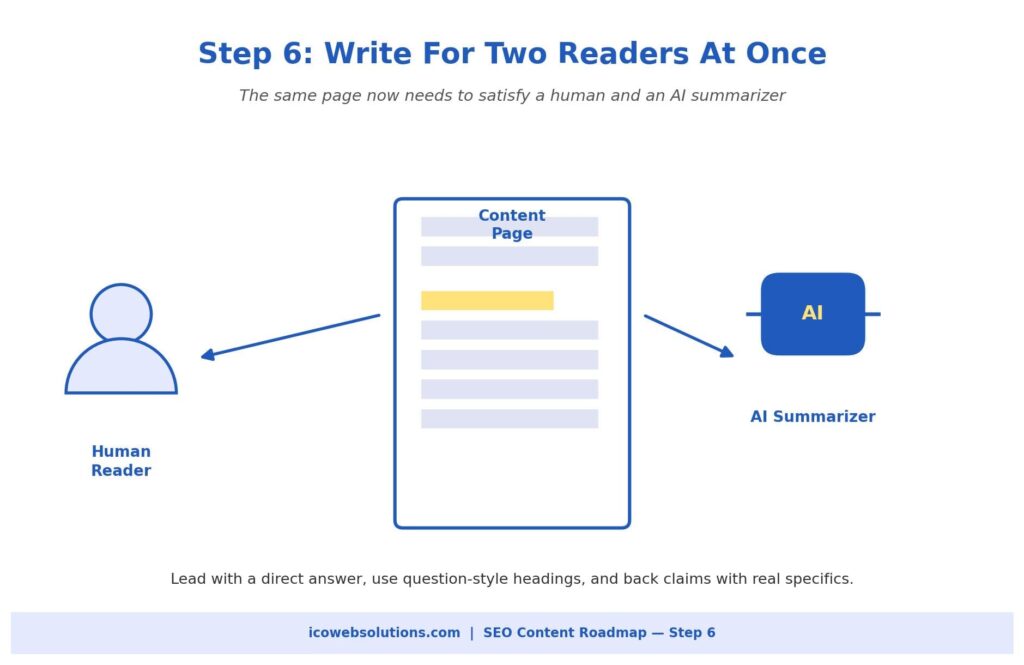
A roadmap only matters once it turns into content someone can actually read, and by this point we know enough to write a genuinely useful brief instead of a vague topic assignment. Each brief includes the primary keyword, the supporting terms from that cluster, where the buyer sits in their decision process, what we learned about the SERP for that term, and a specific angle the piece needs to take to stand out.
The writing itself needs to work for two audiences at once now: the human reader and the AI system that might lift a chunk of it into a summary somewhere else.
In practice, that means answering the core question directly within the first sentence or two of each section rather than building up to it slowly, using headings phrased the way someone would actually ask the question out loud, and backing claims with real, specific detail rather than vague generalities.
For the HVAC distributor’s financing page, that meant opening with a direct, plain explanation of how equipment financing actually works for commercial HVAC purchases, then supporting it with real numbers and terms, rather than easing into the topic with a long introduction before getting to the useful part.
This is also where genuine expertise becomes a real advantage rather than a nice-to-have. AI systems and careful human readers both tend to notice the difference between a page written by someone who clearly understands the subject and a page that’s technically correct but generic. Specific numbers, named standards, real customer situations, and a clear point of view are much harder for a rushed competitor to copy quickly, which is exactly the kind of advantage a content roadmap should be protecting.
Why We Still Write for Topics an AI Overview Will Swallow Whole
One objection comes up almost every time we walk a client through this process: if a topic is clearly going to get answered by an AI Overview before anyone reaches the organic results, why bother writing about it at all? It’s a fair question, and the honest answer is that we still write those pieces, just with a different goal attached to them and a different way of measuring whether they worked.
Getting cited as a source inside an AI Overview isn’t nothing, even without the click. It puts your brand name in front of someone at the exact moment they’re asking the question your business answers for a living, and repeated exposure like that builds a kind of familiarity that shows up later when they’re ready to actually buy.
There’s also a practical reason to keep showing up on these broader topics: the clustering from Step 4 only works if the awareness-stage content exists to link into the bottom-of-funnel pages, since a hub page with no supporting content around it tends to carry less authority than one surrounded by a genuinely useful cluster.
For the HVAC distributor, the broad educational pages stayed in the roadmap, just later in the build order and measured by brand visibility and assisted conversions rather than direct form fills.
What This Looks Like Once It’s Running
Once a roadmap like this is built, it’s tempting to feel like the hard part is over, but there are two things worth doing immediately rather than filing it away. The first is capturing an honest baseline: your current rankings, your current organic traffic, and ideally your current click-through rates on the terms that matter most, before you start making changes.
AI Overviews and SERP layouts keep shifting, and without a clear “before” snapshot, it becomes very hard to prove later whether the work actually moved anything. This is particularly important for businesses investing in emerging areas such as AI search, where visibility increasingly depends on how clearly a brand, its expertise, and its content can be understood by generative search systems.
The second is resisting the urge to overhaul every piece of content at once. Pick one cluster, run it through this exact process, publish it, and give it a few weeks to settle before comparing its performance against content you built the old way.
That comparison is genuinely more useful than any amount of planning, because it tells you, with your own real data, whether this approach is actually earning more qualified attention for your specific business, not just in theory but in practice. The same principle applies whether you’re working with an in-house team or a content marketing agency: the goal is not simply to produce more content, but to understand which content contributes to meaningful business outcomes.
It’s also worth revisiting the whole roadmap on a regular schedule rather than treating it as a one-time document. Search results keep shifting, AI Overviews expand into new categories of queries every few months, and a cluster that was a smart priority six months ago might already be crowded out by competitors who went through a similar process after watching you succeed.
Building in a quarterly check-in, even a short one, to re-run the SERP checks from Step 3 and confirm the priority order from Step 5 still makes sense keeps the roadmap from quietly going stale while everyone’s attention moves on to the next project. If your website, content architecture, or technical foundation also needs attention, this is often the right point to assess whether improvements from a specialist in website design in Delhi could support the broader search strategy rather than treating design and SEO as separate initiatives.
None of this requires a massive team or an enormous budget to start. It requires picking a real business outcome, being disciplined about checking what the search results actually look like before committing to a topic, and being willing to build the less exciting, narrower pages first if that’s genuinely where the buyers already are.
That discipline is really the whole difference between a content roadmap that produces a nice-looking report and one that produces an actual pipeline of people ready to talk to your sales team.
If you’d rather have a second set of eyes build this roadmap with you, or run it on your behalf from the keyword research through the finished, publish-ready briefs, that’s exactly the kind of work our team takes on at ICO WebTech. We can also help businesses adapt their broader organic strategy for the changing search landscape as an AI search company, combining content strategy, SEO, website expertise, and AI visibility into one practical roadmap. We’re happy to walk through what a first roadmap would look like for your specific business before you commit to anything.

The Citations Race: How to Force Your Brand Into AI-Generated Search Summaries
The traditional SEO playbook is facing an evolutionary crisis. For over two decades, the objective of search engine optimization was clear: optimize for keywords, build domain authority, and secure a spot within the coveted “ten blue links” on the first page of search results. If you ranked in the top three organic slots, you were guaranteed a steady stream of click-through traffic. Strategy was measured in clicks, impressions, and keyword positions.
Today, that classic user pipeline is fragmenting. The rise of AI search engines, conversational answer engines, and LLM-driven platform overlays has introduced a new paradigm: the zero-click, synthesized search summary. Whether a user is querying Google’s AI Overviews, Perplexity, or OpenAI’s native search tools, they are increasingly greeted by a comprehensive, multi-paragraph response that answers their question directly on the interface. The user no longer needs to click through to three different blogs to piece together an answer; the machine does it for them.
Does this mean organic brand visibility is dead? Far from it. But the battlefield has shifted. The new gold standard of digital optimization is not merely ranking—it is securing the **in-text citation**. When an AI engine synthesizes a summary, it acts as an automated research assistant, backing up its factual assertions with hyperlinked footnotes and inline references. To survive this shift, brands must move past traditional ranking metrics and learn exactly how to force their content into the retrieval pipelines of modern AI engines. Winning the citation race requires a deep understanding of Retrieval-Augmented Generation (RAG), precise semantic data structuring, and programmatic entity authority.
1. Under the Hood: How AI Search Engines Choose Source Material
To trick or persuade an AI engine into citing your brand, you must first demystify how these platforms assemble responses in real time. Traditional search engines use inverted indexes to match keyword strings to web documents. AI answer engines, by contrast, rely on a architectural framework known as **Retrieval-Augmented Generation (RAG)**—a process that combines a static, pre-trained Large Language Model (LLM) with a real-time web retrieval system.
When a user types a complex query into an AI search engine, the system does not simply feed that prompt directly to the LLM. Instead, the process unfolds through a highly coordinated real-time pipeline:
- **Query Vectorization:** The user’s natural language prompt is translated into a vector embedding (a long string of numbers representing the mathematical definition and semantic intent of the words).
- **Live Web Retrieval:** The system runs a lightning-fast parallel search across the web to pull a cluster of highly relevant, topically fresh source documents based on vector similarity.
- **Chunking and Reranking:** The retrieval engine breaks those web pages down into smaller text fragments or “chunks” (usually 100 to 300 words each). A secondary machine learning model reranks these chunks based on factual density, contextual alignment, and source trustworthiness.
- **LLM Synthesis and Citation Footnoting:** The highest-scoring text chunks are injected directly into the LLM’s temporary operational memory (the context window). The LLM reads these web fragments, synthesizes a cohesive natural language summary, and automatically places a citation anchor back to the exact source chunk it used to formulate each sentence.
Understanding this pipeline reveals a critical truth: an AI engine will never cite a page simply because it has a high backlink count or contains a high density of exact-match keywords. It selects sources based on how neatly a specific text chunk answers a fragmented part of the user’s broader intent mapping.
2. Reverse-Engineering Semantic Phrasing for LLM Retrieval
Traditional web writing often relies on stylistic introductions, narrative filler, and corporate jargon designed to pad out word counts. While this might keep a human reading for an extra minute, it actively breaks the parsing capabilities of AI scraper bots. To force your content into the top tiers of a RAG reranking model, your writing style must adapt to meet the structural preferences of machine learning systems.
Embracing Subject-Predicate-Object (SPO) Triplets
AI models process data most efficiently when it is presented in clear, unambiguous semantic structures known as **Subject-Predicate-Object (SPO) triplets**. Instead of burying a core factual asset within a convoluted, poetic paragraph, state your insights using declarative, authoritative axioms. Consider the following structural evolution:
*Weak (Traditional Marketing Copy):* “When it comes to scaling enterprise software platforms, our innovative cloud management framework helps businesses unlock incredible cost efficiencies while simultaneously supercharging deployment velocities across global regions.”
*Strong (AI-Optimized Semantic Phrasing):* “Enterprise cloud software scaling requires three operational constraints: latency isolation, database sharding, and regional compute distribution. Our cloud management framework reduces global deployment latency by 42% by automating multi-region edge synchronization.”
The optimized variant provides an immediate, high-density factual chunk. It explicitly defines the constraints and delivers a quantifiable metrics statement. When an AI search engine is looking for a concise source chunk to back up a synthesized sentence about *enterprise cloud scaling challenges*, the second option is mathematically far more attractive to the reranking algorithm.
The Micro-Summary Optimization Technique
To maximize your citation capture rate across long-form guides or technical articles, implement an internal layout strategy called **Micro-Summary Clustering**. At the top of every major conceptual heading, include a standalone, visually isolated box containing a two-sentence, ultra-dense summary of the underlying section.
Structure the first sentence as a direct, definitive answer to the core question implied by the heading. Structure the second sentence as a data-anchored explanation of *why* or *how*. By providing these pre-chunked, hyper-focused text blocks, you make it incredibly easy for an AI crawler to extract your text and use it as an explicit, quoted reference node within its summary engine.
3. The Advanced Structured Data Blueprint for AI Bots
While semantic phrasing optimizes your visible text for the LLM synthesis phase, structured data markup optimizes your underlying code for the initial retrieval and entity-mapping phase. Basic Schema.org tags like `Article` or `Organization` are no longer sufficient to stand out. To anchor your brand within an AI search engine’s permanent knowledge base, you must deploy advanced structured data frameworks that explicitly define relationship models.
Leveraging SameAs Entity Bridging
AI search engines do not look at the web as a collection of isolated pages; they view it as a massive, interconnected **Knowledge Graph** composed of distinct real-world entities (people, places, concepts, organizations, and products). When an AI crawls your site, it wants to know exactly where your brand fits within that global web of established facts.
You can force these connections by using the `sameAs` property within your JSON-LD schema blocks. This tag tells the search engine’s entity parser that a concept or organization mentioned on your site is identical to an entity already validated on highly authoritative repositories like Wikidata, Wikipedia, or official industry registries. Below is an architectural blueprint for a deeply connected entity schema:
<script type="application/ld+json">
{
  "@context": "https://schema.org",
  "@type": "TechArticle",
  "headline": "The Citations Race: How to Force Your Brand Into AI-Generated Search Summaries",
  "about": [
    {
      "@type": "Thing",
      "name": "Retrieval-Augmented Generation",
      "sameAs": "https://en.wikipedia.org/wiki/Retrieval-augmented_generation"
    },
    {
      "@type": "Thing",
      "name": "Large Language Model",
      "sameAs": "https://en.wikipedia.org/wiki/Large_language_model"
    }
  ],
  "author": {
    "@type": "Organization",
    "name": "Enterprise Search Institute",
    "sameAs": "https://www.wikidata.org/wiki/Q11487"
  }
}
</script>
By explicitly linking your content nodes to verified Wikipedia or Wikidata entries via the `about` and `sameAs` properties, you eliminate any semantic ambiguity. The AI engine instantly understands the precise conceptual coordinates of your article, dramatically increasing the likelihood that your site will be pulled into the retrieval window when a user queries those specific entity structures.
4. Third-Party Validation: Engineering a Distributed Footprint
One of the most profound shifts in AI-driven search optimization is that your own website is no longer the sole source of truth regarding your brand’s authority. When an AI search engine evaluates whether to trust your data chunk enough to display it as a cited footnote, it cross-references its broader training dataset and real-time secondary indexes to see if *other* authoritative nodes validate your claims.
If your website makes bold claims about a proprietary technology or service methodology, but your brand name is completely absent from industry forums, independent repositories, open-source documentation, and public discussion spaces, the AI model’s trust score for your domain will drop. It will view your site as an isolated, unverified island of data.
Building Multi-Channel Semantic Mentions
To build a bulletproof entity footprint, your brand must be woven into the broader digital fabric where AI models look for community consensus and real-world validation:
- **Niche Discussions and Forums:** Platforms like Reddit, StackOverflow, Quora, and specialized industry sub-communities are heavily prioritized by AI search engines for real-world user perspective queries. Securing natural, un-spammed mentions of your proprietary insights, frameworks, or brand solutions within these discussions builds semantic validation.
- **Open-Source Data & Public Repositories:** If your brand operates within technical spaces, maintaining active contributions, public documentation sets, or data tables on platforms like GitHub or Hugging Face provides highly structured, clean data feeds that AI models frequently ingest during update cycles.
- **Digital PR and External Expert Citations:** Securing editorial references, case study reviews, and quotes across verified trade publications and regional business networks creates the external validation loop required to confirm your organization’s entity authority.
Orchestrating an advanced, distributed entity validation strategy across disparate digital channels requires a deep understanding of localized market variations and technical deployment scaling. For enterprise organizations looking to engineer a highly authoritative web presence across competitive global markets, collaborating with a progressive, technically sophisticated SEO company in India can provide the precise combination of scalable asset creation, semantic mapping expertise, and multi-channel distribution infrastructure needed to anchor a brand firmly within the retrieval grids of international search models.
5. The AI Citation Monitoring and Auditing Framework
You cannot optimize what you do not measure. Unfortunately, traditional tracking suites like Google Search Console or standard analytics platforms are poorly equipped to measure your visibility within conversational summaries. They record the raw click-through traffic if a user selects your footnote, but they offer zero native visibility into the thousands of impressions where your brand was read by an AI, integrated into a summary, but *not* clicked.
To maintain control over your digital visibility, optimization teams must build custom **AI Citation Auditing Frameworks**. This involves shifting your primary key performance indicators (KPIs) away from keyword rankings and toward **Share of Voice inside Summaries (SoVS)**.
| Metrics Tier | Traditional Metric (Legacy SEO) | AI Search Equivalence (Modern Metric) | Operational Optimization Strategy |
|---|---|---|---|
| Visibility Measurement | Keyword Ranking Position | Citation Share of Voice (SoVS) | Programmatically tracking how often your URL appears as a footnote across a seed list of 500 core conversational prompts. |
| Content Relevance | On-Page Keyword Density | Vector Semantic Alignment Score | Refining text blocks using Subject-Predicate-Object frameworks to maximize factual density scores during RAG chunking. |
| Authority Validation | Domain Authority / Backlinks | Entity Association Index | Using deep JSON-LD schema mappings and distributed third-party platform mentions to connect your brand to validated industry nodes. |
To execute this audit practically, optimization teams use programmatic script wrappers to query modern conversational APIs systematically. By running regular automated prompt checks across variations of your niche’s core transactional and informational queries, you can isolate exactly when your brand is being integrated as an authoritative reference, which specific text fragments are being pulled, and which competitor sites are stealing your citation market share.
Conclusion: The Ultimate Moat is Proprietary Truth
The transition from the classic blue-link index to the AI-driven citation economy is not a passing trend; it is a permanent architectural restructuring of the internet. As consumers grow increasingly accustomed to receiving immediate, synthesized answers to their daily inquiries, the traffic premium will flow exclusively to the brands that serve as the underlying factual source material for those summaries.
Forcing your brand into AI-generated search summaries requires walking away from the superficial optimization tricks of the past. You cannot keyword-stuff or backlink-manipulate your way into an LLM’s context window. To win the citation race, your digital footprint must be built on a foundation of undeniable, highly structured, and programmatically accessible truth. By transforming your web pages into high-density data utilities, styling your prose for seamless machine ingestion, and anchoring your digital presence within advanced relational schema graphs, you ensure that when the world’s most powerful AI models search the web for an answer they can trust, they cite your brand every single time.


SEO Architecture for AI Search Visibility: How Website Structure Helps Search Engines and AI Systems Understand a Brand
AI SEO architecture is the way you organize, name, link, and label your pages so search engines and AI answer engines can tell what your brand is, what each page does, and which source to cite. Call it SEO architecture for AI search visibility. It is site-level work, and page-level tactics will only carry you so far without it. A great page on a confused site still underperforms.
Most advice on this skips the part that counts. It treats AI visibility as something you bolt onto finished pages: write the content, then optimize it for AI. I think that is backwards. AI does not read pages. It reads structure. And you set that structure before you publish, which means the ceiling on your AI visibility is mostly fixed before you have written a word.
Google has started saying a version of this out loud. Its guidance on generative AI features tells site owners to skip the AEO and GEO tricks, content chunking and llms.txt files, and put the effort into foundational SEO and a clear technical structure instead.
I’d put it more bluntly than Google does. Structure is the work. The rest is decoration.
Visibility is decided before you publish
After three decades building search strategies, I kept seeing the same thing. Most long-term visibility problems traced back to a decision made before anyone wrote the first page. A URL structure that boxed the site in. Pages built to compete with each other. A homepage that never came out and said what the company actually did. By the time it showed up in the numbers, the fix was a rebuild.
So I flipped the order and started treating architecture as the first deliverable instead of the last. I call that phase Zero Page SEO: the decisions you make at zero pages, before page one exists. AI visibility is a pre-production problem, not an optimization problem.
The four R’s of AI citation
To plan that layer well, it helps to know what an AI system actually does before it cites you. Four steps, in order.
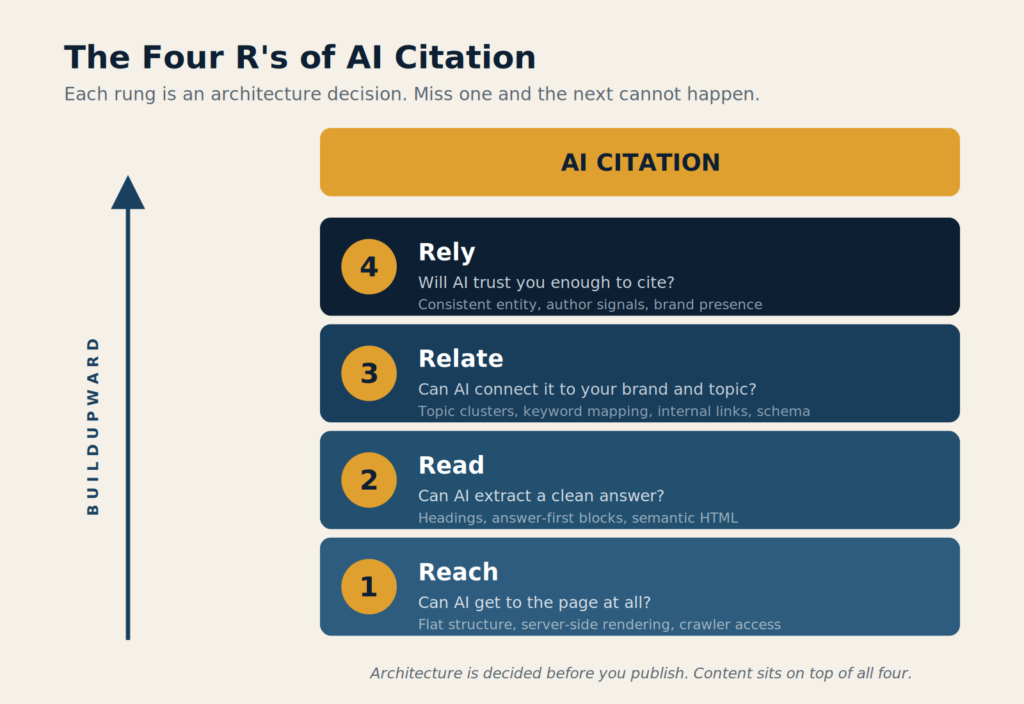
| Step | The question | The architecture that answers it |
| Reach | Can AI get to the page? | Flat structure, server-side rendering, crawler access |
| Read | Can AI extract a clean answer? | Headings, answer-first blocks, semantic HTML |
| Relate | Can AI connect it to your brand and topic? | Topic clusters, keyword mapping, internal links, schema |
| Rely | Will AI trust you enough to cite? | Consistent entity, author signals, brand presence |
Each step rides on the one below it. Miss a rung and the next one cannot happen, however good the writing is.
Reach: can AI get to the page?
If a crawler cannot reach a page, nothing else on this list matters. Two decisions settle it.
The first is rendering, and it catches people off guard. Most AI crawlers do not run JavaScript. Vercel and Merj went through more than 500 million GPTBot fetches and found no JavaScript execution at all, with the same result for Anthropic’s ClaudeBot and PerplexityBot. So a page that looks fine to Googlebot can land at an AI crawler as an empty shell. If your content only shows up after the scripts run, the crawler reads nothing. Server-side rendering or static generation handles it, and that is a call you make during the build. Google’s Gemini crawler is the one exception, since it borrows Googlebot’s rendering. Build for the crawlers that cannot render and you have covered the rest.
The second is simpler: can the crawler get in at all. Block AI bots at the CDN or in robots.txt and every page vanishes at once. Plenty of sites now block by default after their edge provider changed its policy, and most owners have no idea. Worth a look.
Crawl efficiency only enters the picture on large sites. Google says crawl budget mostly affects sites past ten thousand pages, or ones that change constantly. If that is you, a flat structure and a clean sitemap keep crawlers on the pages that earn their keep. If your site is smaller, do not lose sleep over it, though flat structure still pays off on every rung above this one.
Read: can AI extract a clean answer?
Reaching a page and understanding it are different things. Once the crawler is in, it goes looking for a clean, quotable answer, and your structure decides how hard that is to find. Google’s own AI guidance lands in the same place: organize content with clear headings and sections people can follow.
A few habits do most of the work:
- One H1, with descriptive H2s and H3s. Headings are the outline AI follows.
- Answer-first blocks. Put the direct answer in the first line of a section, then expand. AI lifts the short answer and leaves the rest for humans.
- Short paragraphs, lists, and tables. Scannable structure is extractable structure.
- Semantic HTML. Real headings, lists, and tables tell AI what each block is, instead of leaving it to guess from styled containers.
This is where a lot of strong content quietly loses. The answer is right there on the page. The structure just buries it.
Relate: can AI connect the page to your brand and topic?
A page the crawler can reach and read is still stranded until your architecture connects it to everything else. This is the rung where most sites fall down, and it is the one that is easiest to see in a picture.
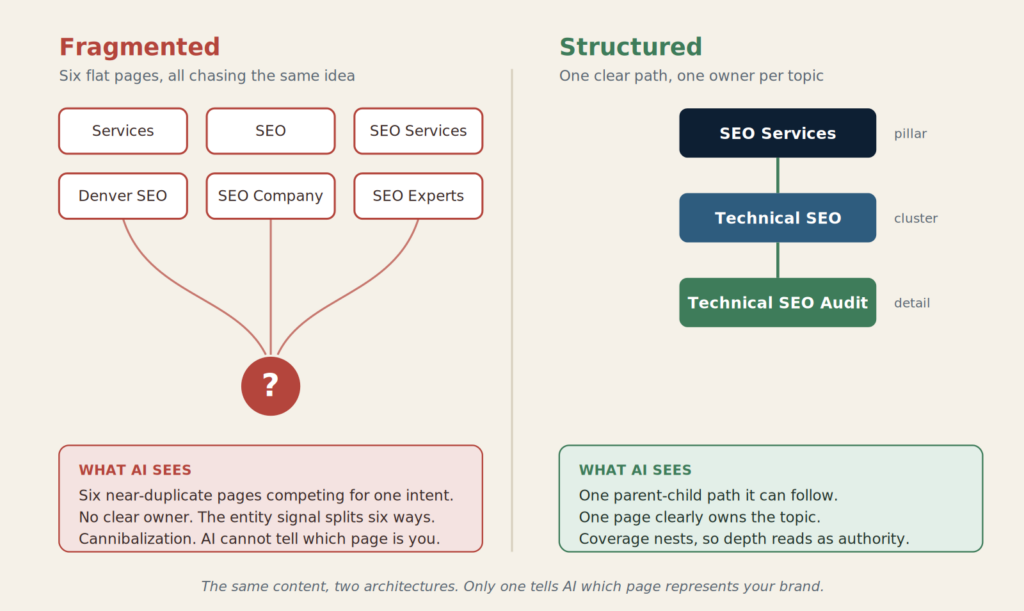
Take the same SEO content, organized two ways.
One way: Services, SEO, SEO Services, Denver SEO, SEO Company, SEO Experts. Six flat pages, all circling the same idea.
The other: SEO Services at the top, Technical SEO under it, Technical SEO Audit under that. A single path.
With the first setup, AI runs into six near-duplicate pages fighting over one intent. It has no way to tell which one is the real you, so the entity signal splits six ways. That is keyword cannibalization, and it is a particular problem for AI: a retrieval system has to pick one page to represent the topic, and six near-duplicates give it no clean way to choose. With the second, AI follows a parent and child path. It knows which page owns the topic and how the rest hangs off it.
Pull a cluster of competing pages like that first group into one clean hierarchy and two things happen together. The cannibalization goes away, and AI finally has a single page to pin the topic to. Down the line that tends to show up as cleaner crawl coverage and steadier citations.
Four moves build the structured version:
Topic hierarchy. Use hub-and-spoke. One pillar page per core topic, supporting pages linking up to it, the pillar linking back down. Google’s AI guidance points the same way, toward topic clusters and pillar pages.
Keyword mapping. Assign one primary intent to one URL before you write. That heads off the cannibalization above. Doing it first costs far less than merging live pages later.
Internal links. Your anchor text is a label for the page you point to. “Technical SEO audit” tells AI what the target covers. “Click here” tells it nothing. Link supporting pages up to pillars, pillars across to related pillars, and keep the pattern steady.
Schema and entity definition. Schema labels your content so AI does not have to guess. Google says it uses structured data, including the sameAs property, to understand the people and companies a page describes. Use Organization, Person, Article, FAQPage, and BreadcrumbList, and tie them together with sameAs and canonical @id values so your brand, authors, and pages read as one entity rather than scattered blocks. Then say who you are in plain words. “We build brands that matter” tells AI nothing. “Rank Outlaw is a Denver SEO consultancy specializing in SEO architecture and AI search visibility” tells it exactly what to file away.
One caveat. Schema is support, not a shortcut. Google is clear that structured data is not required for AI features and there is no magic markup that gets you in. It removes ambiguity. It does not buy a citation.
Rely: will AI trust you enough to cite?
The last step is trust, and trust is partly a structural thing. AI cites sources it reads as credible, and a fair amount of that read comes from how your site is built.
AI leans on existing rankings as a stand-in for judgment. It does not have the budget to weigh every page’s authority on its own, so it borrows Google’s. Rankings still count: studies of AI Overviews show most of them cite at least one page from the top of the organic results. But ranking gets you considered, not chosen. The overlap between top-ten rankings and AI citations slid from around 76% in mid-2025 to roughly 38% by early 2026 as the engines started reaching wider.
What climbed instead is brand. Ahrefs looked at 75,000 brands and found that mentions of a brand across the web track AI visibility more closely than backlinks do. Consistency feeds that. One brand name, one entity description, connected schema across the site, and AI reads you as a single recognized source instead of a handful of loosely related pages. Name your authors and give them Person schema. Google’s own line fits here: it favors content with a real point of view over commodity rewrites.
Build the ladder before you write
The point of the four R’s is the order. Reach feeds Read, Read feeds Relate, Relate feeds Rely, and your content sits on top of all of it. Weak architecture puts a lid on everything above it. That is the whole argument for settling structure first, at zero pages.
Give your developer the architecture before anyone builds a template:
- Reach: flat URLs, server-side rendering, clean sitemap, crawler access
- Read: heading templates, answer-first content blocks, semantic HTML
- Relate: pillar and cluster map, one intent per URL, internal linking rules, schema per template
- Rely: consistent entity statements, connected @id schema, author profiles
Score your site: the four R’s audit
Score your own site. Zero to three on each line, thirty at the top. Under twenty, and you have a roadmap. Whichever rung scores lowest is where you start.
| Rung | Check | Score (0-3) |
| Reach | Main content renders without JavaScript | |
| Reach | Important pages sit within 3 to 4 clicks of the homepage | |
| Reach | AI crawlers are not blocked in robots.txt or at the CDN | |
| Read | One H1, with descriptive H2s and H3s per page | |
| Read | Direct answers appear in the first lines of sections | |
| Read | Content uses real lists, tables, and semantic HTML | |
| Relate | One keyword intent maps to one URL, with no competing pages | |
| Relate | Pillar and cluster links run in both directions | |
| Relate | Organization, Person, and page schema connect via sameAs and @id | |
| Rely | Brand name and entity statement stay consistent sitewide |
None of this is exotic. It is mostly the discipline to settle the dull structural questions first, while they are still cheap to change. Do that, and the content you publish later has something solid to stand on. Skip it, and you spend next year rewriting.
Frequently asked questions
What are the four R’s of AI citation?
The four R’s are Reach, Read, Relate, and Rely. They describe what an AI system does before it cites a site: reach the page, read a clean answer, relate the page to your brand and topic, and rely on you enough to quote you. Each step depends on an architecture decision.
What is AI SEO architecture?
AI SEO architecture is how your website is organized, named, linked, and labeled so search engines and AI can understand it. It covers URL structure, topic hierarchy, internal linking, and structured data. It works at the site level, not on a single page.
Does site structure affect AI search visibility?
Yes. AI systems break your site into entities and topics, then build a picture of your brand from the whole structure. A clear structure helps AI reach, read, relate, and trust your pages. A confused one gets skipped.
How do you structure a website for AI search?
Use a flat structure with important pages within three to four clicks of the homepage. Render content without JavaScript. Group content into pillar and cluster topics. Map one keyword intent per URL. Add connected schema and a clear entity statement.
Why is AI visibility a pre-production problem?
Because architecture sets a ceiling on visibility, and architecture is decided before content exists. Reach, Read, Relate, and Rely all depend on structure. Once pages are built on a weak structure, content cannot lift them past that ceiling. Fixing it later means rebuilding.
Sources
- Google Search Central, Guide to Optimizing for Generative AI Features.
- Google Search Central, AI Features and Your Website.
- Google Search Central, Intro to How Structured Data Markup Works.
- Google Search Central, Crawl Budget Management for Large Sites.
- Vercel and Merj, The Rise of the AI Crawler.
- Onely, Optimizing for AI Search: Why Classic SEO Principles Still Apply.
- seoClarity, The Overlap Between AI Overviews and Organic Rankings.
- Ahrefs, AI Overview Citations and Organic Rankings.


Are ChatGPT results and Google rankings related?
Every digital marketer is asking the same question right now: if I rank #1 on Google, does that mean ChatGPT will recommend my brand? The answer — backed by multiple large-scale studies — is nuanced, surprising, and strategically important for every business investing in online visibility.
In this deep-dive, we break down what the data actually says about the relationship (or lack thereof) between Google rankings and ChatGPT citations, what factors ChatGPT uses instead, and what it means for your digital marketing strategy going into the second half of 2026.
Table of Contents
- The Scale Gap: Google vs ChatGPT in Numbers
- What the Studies Actually Found: Correlation Data
- How Google and ChatGPT Work Differently
- What Signals Does ChatGPT Actually Use?
- Where Google Rankings DO Help
- The Rise of GEO: Generative Engine Optimization
- How ICO WebTech Can Help You Win Both
- Conclusion
1. The Scale Gap: Google vs ChatGPT in Numbers
Before diving into correlation, it helps to understand where both platforms stand in terms of reach. The difference is enormous — but ChatGPT’s growth curve is equally striking.
Google’s global search market share (2025)
Source: Datos / SparkToro, March 2025
Google searches processed per day
Source: Datos / SparkToro, March 2025
ChatGPT monthly visits (August 2025)
Source: Similarweb, 2025
ChatGPT year-over-year growth (late 2024)
Source: Similarweb, 2024
Sources: Advanced Web Ranking · OneLittleWeb 24-Month Study
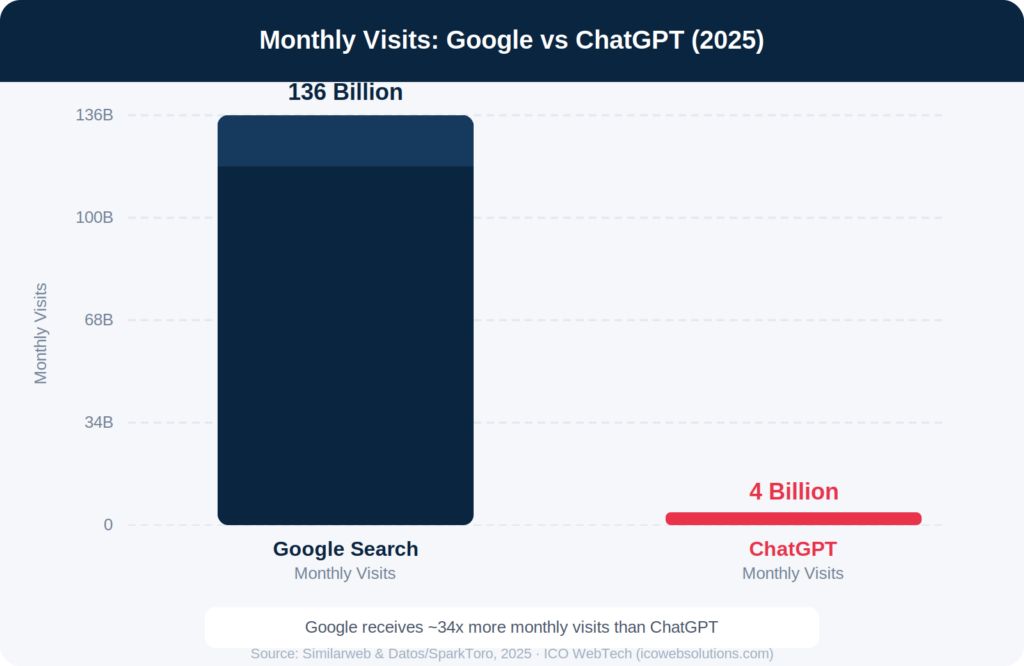
Despite ChatGPT’s explosive growth, Google remains overwhelmingly dominant. Yet the important insight is that 95% of ChatGPT users still also use Google — meaning both platforms are complementary, not competing, in how your audience discovers information.
“ChatGPT functions as a complement rather than a substitute for Google — but being invisible in either one is a strategic blind spot your competitors will exploit.”
— Advanced Web Ranking, 2025
2. What the Studies Actually Found: The Correlation Data
Multiple independent research organisations have now studied whether Google rankings predict ChatGPT citations. The results are surprising — and game-changing for SEO strategy.
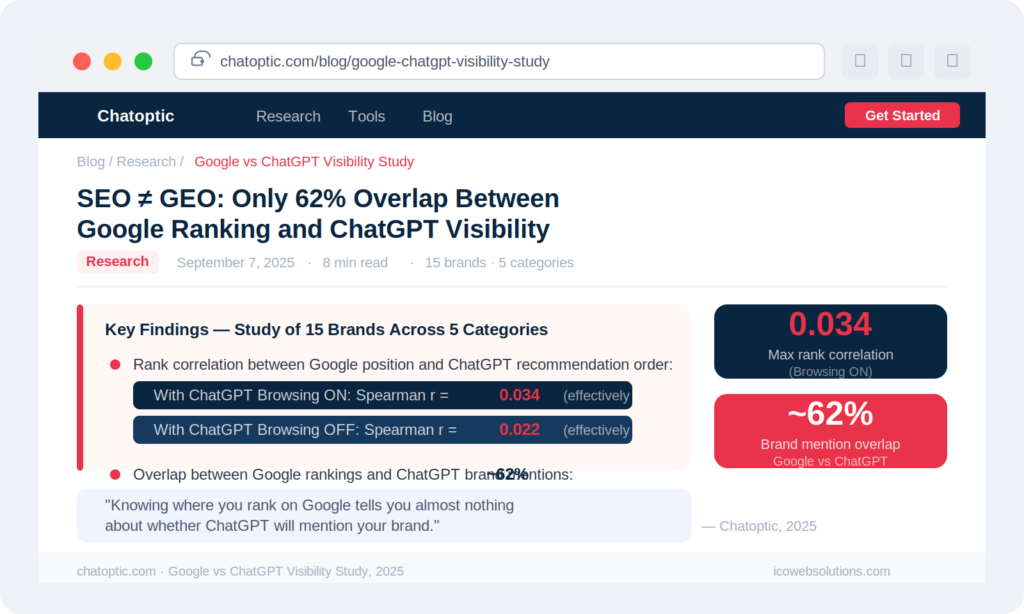
Key Finding from Chatoptic’s 2025 Study (15 brands, 5 categories):
Rank correlation between Google position and ChatGPT recommendation order:
- With ChatGPT Browsing ON: Spearman r = 0.034
- With ChatGPT Browsing OFF: Spearman r = 0.022
- Overlap between Google rankings and ChatGPT mentions: ~62%
In statistical terms, a correlation of ~0.03 is essentially zero — knowing your Google rank tells you almost nothing about your ChatGPT visibility.
Source: Chatoptic.com — SEO ≠ GEO Study, 2025
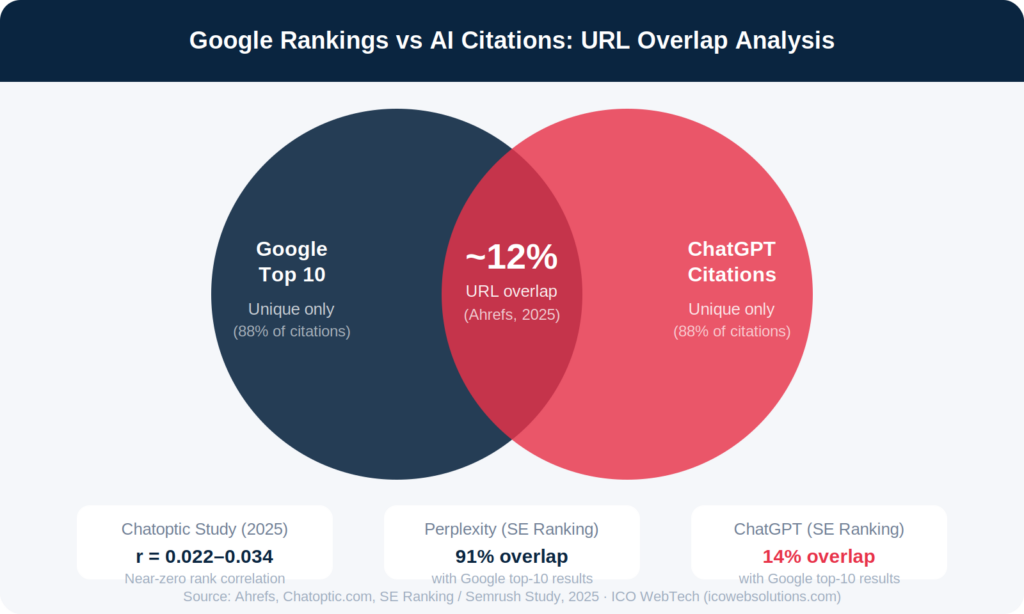
Note: Perplexity overlaps with Google top-10 rankings 91% of the time vs. ChatGPT at ~12–14%
Source: Ahrefs, SE Ranking / Semrush Study, 2025
Key Research Findings at a Glance
| Study | Key Finding | Source |
|---|---|---|
| Ahrefs Analysis (2025) | Only 12% of links cited by AI assistants (ChatGPT, Gemini, Copilot, Perplexity) appear in Google’s top 10 for the same query | Ahrefs via Beamtrace |
| Chatoptic Study (2025) | Rank correlation between Google position & ChatGPT order: r = 0.022–0.034 (effectively zero) | Chatoptic.com |
| BrightEdge Research (Oct 2025) | 54.5% of AI Overview citations match top organic URLs (up from 32% in 2024) — Google’s own AI leans on its index | PragoMedia / BrightEdge |
| SE Ranking / Semrush (2025) | Perplexity cites Google top-10 results 91% of the time; ChatGPT only 14% | PragoMedia |
| SE Ranking (2025) | Sites with 32,000+ referring domains are 3.5x more likely to be cited by ChatGPT | Yotpo / SE Ranking |
⚡ ICO WebTech Insight
The data is clear: ranking #1 on Google does not guarantee visibility in ChatGPT. But completely separate strategy isn’t the answer either — the two platforms share foundational trust signals. The winning approach is an integrated SEO + GEO strategy.
3. How Google and ChatGPT Work Differently
The root cause of the divergence is architectural. These two systems have fundamentally different goals and processes.
| Aspect | Google Search | ChatGPT |
|---|---|---|
| Core Task | Match your query to existing web documents and rank them by relevance | Generate a synthesised, conversational answer by predicting the most likely response |
| Primary Signal | 200+ ranking factors: backlinks, keywords, page speed, E-E-A-T | Brand authority patterns in training data, authoritative list mentions, and third-party citations |
| Output | A ranked list of 10 blue links (plus AI Overviews) | One synthesised answer mentioning a smaller “aristocracy” of sources |
| Freshness | Near real-time index crawling | Training data cutoff + optional Bing/web search plugin (when browsing is ON) |
| Citation Logic | Keyword + authority match for each document | Pattern recognition: brands consistently mentioned by trusted sources in training data |
| Risk Aversion | Long-tail content can still rank with moderate authority | Strongly prefers high-authority domains; “trust cliff” around 32,000+ referring domains |
How Each System Processes a Query
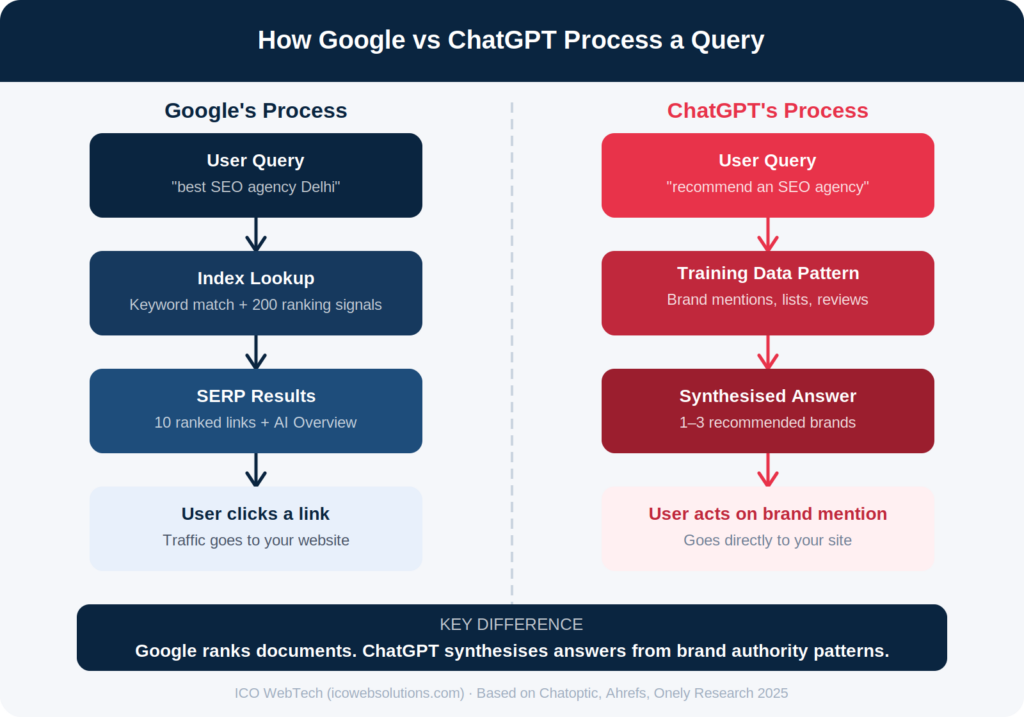
4. What Signals Does ChatGPT Actually Use?
If Google rankings barely predict ChatGPT citations, what does ChatGPT actually use to decide which brands to recommend? Research from Onely, SE Ranking, and Brand24 has reverse-engineered the key factors:
Authoritative List Mentions (41%)
Being featured in industry “best of” lists, expert roundups, and rankings is the single biggest driver. Think Forbes lists, G2 comparisons, Clutch.co rankings.
Awards & Accreditations (18%)
Recognition from established institutions signals credibility. Industry awards, certifications, and verified partnerships all contribute to ChatGPT’s trust model.
Online Reviews (16%)
Third-party validation from customers on platforms like Google, Trustpilot, and Clutch. Brands with an online review score below 70% are significantly less likely to be recommended.
Wikipedia & Reference Sites
Wikipedia accounts for approximately 40% of ChatGPT citations. Crunchbase, LinkedIn, and other authoritative reference platforms matter enormously.
Statistical & Data-Rich Content
Articles with 19+ statistical data points averaged 5.4 citations vs. low-data articles. ChatGPT prefers content it can confidently attribute to a clear source.
Domain Authority (Trust Cliff)
Sites with 32,000+ referring domains are 3.5x more likely to be cited. There is a non-linear trust threshold — authority matters, but differently to Google.
Reddit & Community Mentions
Domains with over 10 million Reddit mentions average 7 ChatGPT citations vs. 1.8 for brands with minimal Reddit presence. Community discussion matters.
Content Freshness
71% of ChatGPT citations come from 2023–2025 content. Regularly publishing authoritative, date-stamped content keeps your brand in the training and retrieval window.
Sources: Onely.com · Chatbeat / Brand24 · Medium / GEO Report
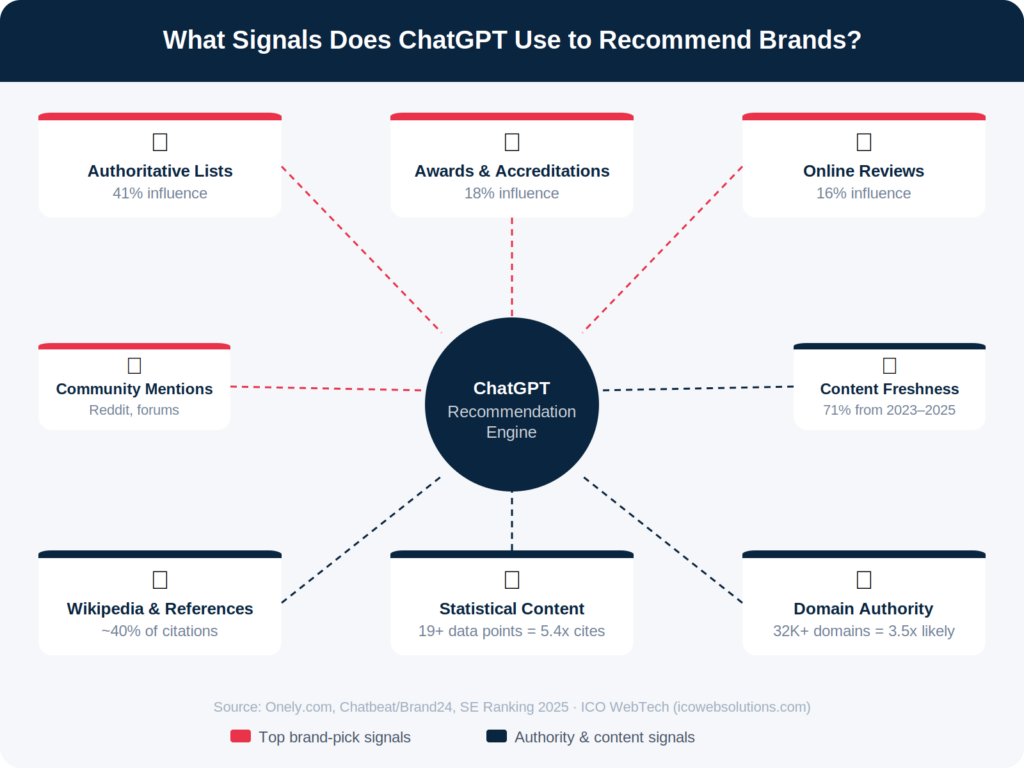
5. Where Google Rankings DO Help
It’s not a zero-sum game. There is meaningful overlap — especially when looking at Google’s own AI features and foundational authority signals.
76% of Google AI Overview cited pages rank in Google’s own top 10Ahrefs, 2025
54.5% AI Overview citations now match top organic URLs (up from 32% in 2024)BrightEdge, Oct 2025
0.664 Spearman correlation — brand mentions & Google AI Overview citationsAhrefs GAIO Study, 2025
Sources: Chatbeat.com · PragoMedia
The key insight: Google’s own AI Overviews DO correlate strongly with top organic rankings — but third-party AI platforms like ChatGPT operate on separate logic. This creates a two-tier AI visibility landscape:
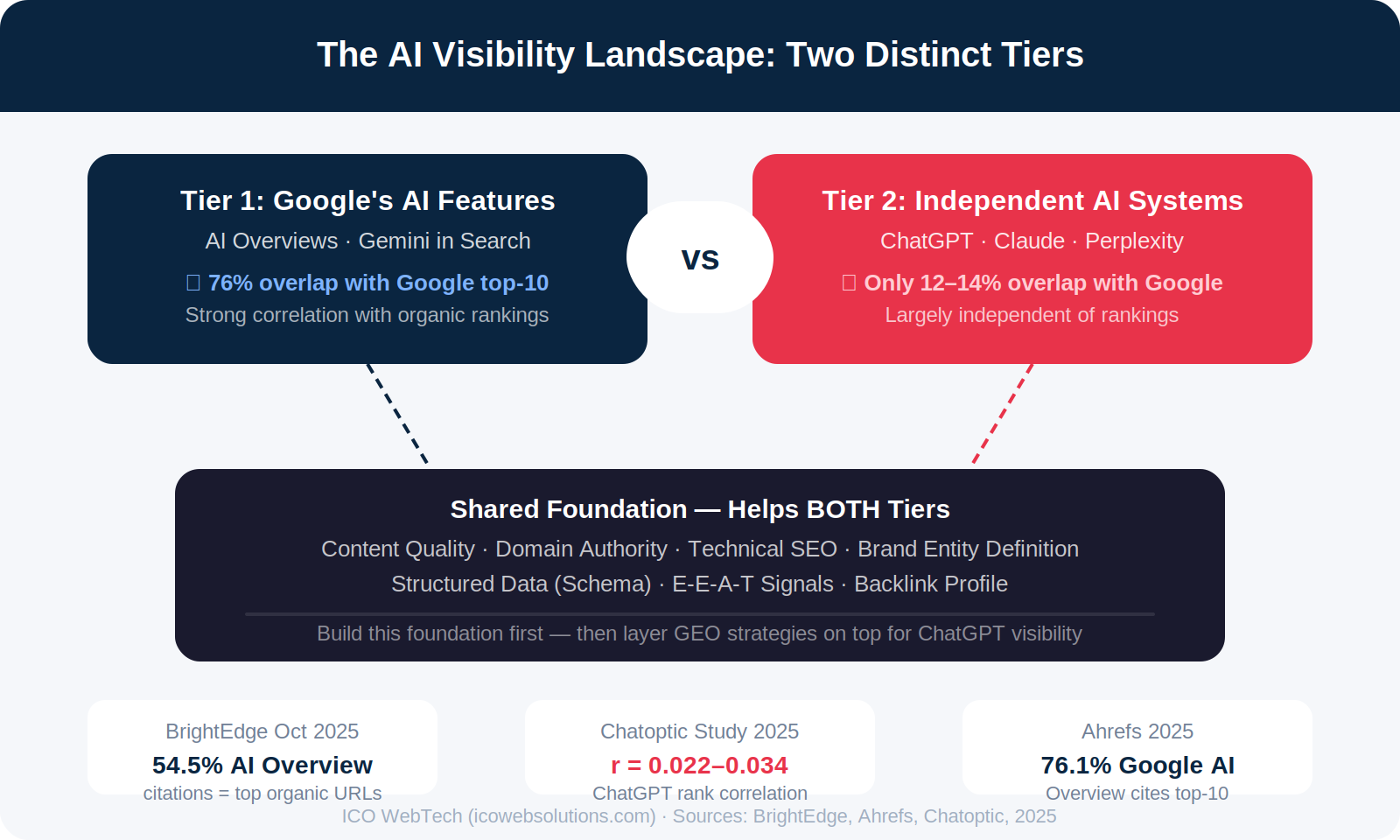
Strong SEO still matters — but it’s the foundation, not the ceiling. Winning in ChatGPT requires additional, targeted strategies beyond traditional rank-building.
6. The Rise of GEO: Generative Engine Optimization
The emerging discipline designed to address this gap is Generative Engine Optimization (GEO) — formally defined in academic research from Princeton, Georgia Tech, and IIT Delhi in 2024, and now entering mainstream marketing practice.
“I care less about Google rankings and more about whether AI tools like ChatGPT or Perplexity mention the brands I work with.”
— Relato’s 2026 GEO Analysis: the new operating reality for performance-driven marketers
SEO vs GEO: Key Differences
| Dimension | Traditional SEO | GEO (Generative Engine Optimization) |
|---|---|---|
| Goal | Rank in top 10 Google results | Get cited/recommended by AI systems |
| Primary Currency | Backlinks + keyword relevance | Authoritative brand mentions + entity recognition |
| Content Focus | Target keywords, search intent pages | Conversational Q&A, statistical content, entity-rich articles |
| Measurement | Rankings, organic traffic, CTR | AI citation rate, brand mention frequency, AI referral traffic |
| Key Platforms | Google Search Console, Ahrefs, Semrush | Conductor, Profound, Semrush AI Toolkit, Search Party |
| Timeline | 3–12 months typically | Ongoing — AI models re-train and update citation patterns |
Source: Enrich Labs — GEO Complete Guide 2026 · ALM Corp — ChatGPT Conversion Study
💡 Why GEO Matters for Conversions
ChatGPT referral traffic converts 31% higher than non-branded organic search — because users who arrive via an AI recommendation have already been pre-sold on your brand’s credibility. The volume is smaller, but the quality is exceptional.
Source: ALM Corp, 2025 Data Analysis — ChatGPT Traffic Converts 31% Higher
7 Steps to Improve ChatGPT Visibility (GEO Checklist)
- Get Listed in Authoritative “Best Of” Lists
Target Clutch, G2, Capterra, Forbes, and industry-specific directories. List placement is the #1 factor (41%) in ChatGPT recommendations. - Publish Data-Rich, Citable Content
Create original studies, surveys, and statistics. Aim for 19+ data points per article. Give AI something concrete to attribute to your brand. - Build Your Brand’s Wikipedia & Knowledge Graph Presence
Wikipedia drives ~40% of ChatGPT citations. Update entries on Wikipedia, Crunchbase, and Wikidata without self-promotion. Ensure NAP consistency everywhere. - Earn Third-Party Media Coverage
Digital PR, podcast appearances, and contributions to industry publications. AI models treat a Forbes mention as far more credible than your own blog. - Maintain Structured Data (Schema Markup)
Implement FAQ, HowTo, Review, and Organization schema. AI crawlers rely heavily on structured data to understand entity relationships. - Build Genuine Reviews on Trusted Platforms
Brands below a 70% positive review rate are significantly less likely to be recommended by ChatGPT. Focus on Google, Trustpilot, and niche review sites. - Track AI Visibility as a Separate KPI
Use tools like Semrush AI Toolkit, Conductor, or Profound to monitor your brand’s citation rate in ChatGPT, Gemini, and Perplexity. Rankings alone no longer tell the full story.
How ICO WebTech Can Help You Win Both Google & ChatGPT
Since 2011, we’ve helped businesses grow through every major algorithm shift. The AI visibility era is the most significant change since Google’s inception — and we’re ready to help you lead it.
AI Visibility (GEO) Service
We audit your current ChatGPT & Gemini citation footprint, identify gaps, and build a systematic GEO strategy covering authoritative mentions, structured data, and entity optimisation.
SEO + GEO Integration
We don’t treat SEO and GEO as separate silos. Our integrated approach builds domain authority and brand entity signals that strengthen your visibility across Google rankings AND AI recommendations simultaneously.
AI Visibility Reporting
We track your brand’s mention frequency in ChatGPT, Perplexity, and Google AI Overviews — giving you a complete picture of your digital visibility beyond traditional rank tracking.
Authoritative Content Creation
Our content team creates data-rich, citable articles, original research, and expert guides designed specifically to meet the citation criteria used by large language models.
Conclusion: Two Rankings, One Integrated Strategy
The data is unambiguous: Google rankings and ChatGPT citations operate largely independently. A rank correlation of near zero (r = 0.022–0.034) means your position on Google’s search results tells ChatGPT almost nothing about whether to recommend your brand. Only 12% of URLs cited by ChatGPT appear in Google’s top 10 for the same query.
But this doesn’t mean SEO is dead. Strong technical SEO, content quality, and domain authority remain the foundation — they’re just no longer the ceiling for AI visibility. Google’s own AI Overviews strongly favour top-ranking pages (76% correlation), making SEO essential for Tier 1 AI visibility.
Winning in 2026 and beyond requires a dual approach:
| To Win in Google Rankings | To Win in ChatGPT / AI Answers |
|---|---|
| Technical SEO excellence | Authoritative “best of” list placements |
| Keyword-targeted content | Data-rich, citable content with clear attribution |
| Quality backlink acquisition | Third-party brand mentions & digital PR |
| Page speed & Core Web Vitals | Wikipedia, Crunchbase & knowledge graph presence |
| E-E-A-T signals | Verified reviews & reputation management |
| Schema markup | Structured data & FAQ schema for AI parsing |

A list of 10 specific “Strategic Questions” a website must answer to be cited by AI
How to get your company cited as the “top recommendation” by an AI assistant
A strong website does not try to say everything; it focuses on answering the questions that matter most to a potential buyer. These questions revolve around the problem you solve, the audience you serve, the results you deliver, and the clarity of your approach. When your website answers these consistently and with specificity, it becomes easier for users to understand your value, trust your expertise, and move toward a decision with confidence.
Table of contents
- What exact problem do you solve—and when does it become relevant?
- Who is your ideal customer—and where do you focus your expertise?
- What results have you delivered—and how can they be understood in context?
- How do you approach your work in practice?
- What makes your approach distinct in a meaningful way?
- In which situations do you deliver the strongest results?
- How deeply do you understand the challenges you address?
- Is your content structured in a way that is easy to understand?
- Do you present a consistent message across your website?
- What makes you the right choice at the decision stage?
Introduction
Most websites aim to describe services, but the ones that perform best are designed to support decision-making.
When someone lands on your website, they are not looking for more information; they are looking for clarity. They want to understand whether your business fits their situation, whether you can deliver results, and whether you are the right choice compared to other options.
A well-structured website anticipates these questions and answers them clearly, reducing hesitation and making the next step feel natural.
1. What exact problem do you solve, and when does it become relevant?
A strong website begins by clearly defining the problem it solves, rather than listing services in isolation. This helps the reader immediately recognize whether your offering applies to their situation.
For example, instead of a broad statement about services, a focused message might look like this:
- B2B: We help B2B tech companies turn inconsistent lead flow into a predictable pipeline.
- D2C: We help women with acne-prone skin reduce breakouts in 30 days using dermatologist-backed skincare routines.
- Local business: We help homeowners fix recurring plumbing leaks quickly without repeated repair costs.
2. Who is your ideal customer, and where do you focus your expertise?
Clarity of audience strengthens trust because it signals focus and experience. When your website defines who you work with, it helps users quickly determine whether there is a fit.
- B2B: We work with mid-market and enterprise B2B tech companies with established sales teams and complex buying cycles.
- D2C: Our products are designed for women aged 18–35 dealing with hormonal acne and sensitive skin.
- Local business: We serve homeowners in Delhi NCR who need reliable, on-time plumbing services for urgent or recurring issues.
3. What results have you delivered, and how can they be understood in context?
Results become meaningful when they are specific and grounded in real scenarios. A website that presents measurable outcomes helps potential clients assess credibility more effectively.
- B2B: Increased qualified leads by 42% in 90 days for a SaaS company expanding into APAC.
- D2C: Helped over 10,000 customers achieve visibly clearer skin within 4 weeks of consistent use.
- Local business: Resolved over 95% of repeat leakage complaints permanently within a single service visit.
4. How do you approach your work in practice?
Explaining your process helps potential clients understand what working with you will look like. A structured approach reduces uncertainty and builds confidence.
- B2B: We audit your funnel, rebuild your paid media strategy, optimize landing pages, and continuously refine campaigns based on performance data.
- D2C: We combine dermatologist-approved formulations with a step-by-step skincare routine tailored for acne-prone skin.
- Local business: We inspect the root cause of the leak, replace faulty components, and test the system to ensure long-term reliability.
5. What makes your approach distinct in a meaningful way?
Differentiation becomes effective when it reflects how your work is actually carried out. A clear distinction helps users understand why your approach stands out.
- B2B: We localize campaigns for each APAC market instead of applying a single global strategy.
- D2C: Our formulations focus on barrier repair alongside acne treatment, reducing irritation and long-term damage.
- Local business: We fix the underlying issue instead of offering temporary repairs, which reduces repeat service calls.
6. In which situations do you deliver the strongest results?
Every company performs best under certain conditions. Clearly describing these scenarios helps users assess whether your strengths align with their needs.
- B2B: We perform best when companies are entering new markets and need localized demand generation.
- D2C: Our products work best for customers who have tried multiple solutions but struggle with recurring breakouts.
- Local business: We are most effective in homes with recurring plumbing issues caused by poor initial installations.
7. How deeply do you understand the challenges you address?
Demonstrating expertise involves showing a deeper understanding of how problems actually occur and how they should be approached.
- B2B: We understand that lead generation is not just about traffic but aligning campaigns with long B2B buying cycles.
- D2C: We recognize that acne is often linked to skin barrier damage, not just excess oil, which changes how treatment should work.
- Local business: We know that most recurring leaks are caused by pressure imbalance or poor fittings, not just surface damage.
8. Is your content structured in a way that is easy to understand?
Clarity of structure ensures that your message is easy to absorb. A well-organized page allows users to quickly identify key points and understand your offering.
For example, a website might break content into sections such as problem, approach, and outcome, use simple language, and present information in a logical sequence. This improves readability and engagement.
9. Do you present a consistent message across your website?
Consistency reinforces trust by ensuring that your positioning remains aligned across all pages.
A B2B company may consistently focus on pipeline growth, a D2C brand may reinforce its focus on acne care, and a local service provider may maintain messaging around reliability and service quality. This alignment creates a cohesive experience and builds credibility.
An SEO company in Delhi, for example, may consistently position itself around technical expertise, local search visibility, content strategy, and measurable business growth across every major page of the website.
10. What makes you the right choice at the decision stage?
At the final stage, potential clients are looking for a clear reason to choose one option over another. Your website should bring together your strengths in a way that simplifies this decision.
- B2B: We combine regional expertise with performance marketing to deliver measurable pipeline growth in complex markets.
- D2C: We offer a complete, science-backed acne solution that delivers visible results without damaging the skin.
- Local business: We provide long-term fixes, transparent pricing, and dependable service, so customers don’t face the same issue again.
Why this matters in AI-powered search
Search behavior is changing rapidly. People are no longer relying only on traditional search engine results to evaluate businesses. Increasingly, users are asking platforms like ChatGPT, Gemini, Perplexity, and Google AI Overviews for recommendations, comparisons, and explanations before making decisions.
In these AI-driven environments, visibility is influenced not just by rankings, but by how clearly a website communicates expertise, positioning, audience focus, and credibility.
Websites that explain:
- the exact problems they solve,
- the industries they specialize in,
- the outcomes they deliver,
- and the way they approach their work
are easier for AI systems to understand, summarize, and recommend.
For example, a website design agency in India that clearly explains its process, expertise, and business outcomes provides stronger contextual signals than a website built around generic service descriptions alone.
This shift is also changing how businesses should think about content. Instead of creating pages only for keywords, companies now need structured, experience-driven content that answers meaningful questions with clarity and specificity.
Strong positioning, logical content structure, consistent messaging, and real examples help AI systems better interpret a business and connect it with relevant user queries.
As AI-powered search continues to influence how people discover and evaluate companies, websites that prioritize clarity, expertise, and decision-focused content will have a stronger advantage in both visibility and trust.
Final Thoughts
A well-structured website does more than present information; it supports decision-making by answering the right questions with clarity and consistency.
When these questions are addressed effectively, your website becomes easier to understand, more credible, and more aligned with user needs. This is what ultimately moves a business from being one of many options to being a preferred choice.
Frequently Asked Questions
What makes a good business website?
A good business website clearly communicates what the company does, who it serves, the problems it solves, and the outcomes it delivers. It should be easy to navigate, structured logically, optimized for user experience, and designed to support decision-making rather than simply present information.
How do buyers evaluate a website design agency?
Buyers typically evaluate a website design agency based on its portfolio, user experience standards, clarity of messaging, industry understanding, website performance, and ability to create websites that support conversions and business goals rather than focusing only on visual design.
Why is website messaging important for SEO?
Website messaging helps search engines and AI systems understand the purpose, expertise, and relevance of a business. Clear messaging improves topical relevance, supports keyword context, strengthens user engagement, and increases the likelihood of appearing in search results for meaningful queries.
How does website structure affect AI search visibility?
AI-powered search systems rely heavily on structured, well-organized content to understand and summarize information accurately. Websites with logical hierarchy, clear headings, focused topics, and contextual explanations are easier for AI systems to interpret and recommend.
What should businesses look for in an SEO company in Delhi?
Businesses should look for an SEO agency that demonstrates technical expertise, a strong understanding of search intent, transparent processes, measurable results, quality content strategy, and the ability to adapt to evolving search trends, including AI-driven search experiences.
How do buyers evaluate a website design or SEO agency?
Most buyers evaluate agencies based on how clearly they communicate expertise, process, specialization, and results. Businesses often review the agency’s own website, content quality, case studies, consistency in messaging, and ability to explain complex challenges in a structured and understandable way before making a decision.

The Rise of Zero-Click Search and What Brands Must Do Next
For years, businesses invested heavily in ranking on Google because clicks meant opportunity. More clicks meant more traffic, more leads, and ultimately more revenue. SEO strategies were built around one central idea: get users to visit your website.
But search behavior is changing rapidly.
Today, users are increasingly getting answers directly on the search results page without clicking any website at all. Google displays AI-generated summaries, featured snippets, knowledge panels, maps, FAQs, shopping carousels, and instant answers before users ever reach a brand’s website.
This shift is called zero-click search, and it is redefining the future of SEO.
For brands, publishers, ecommerce businesses, and service providers, the implications are massive. Traditional SEO is no longer enough. Ranking #1 alone does not guarantee traffic anymore. Visibility, authority, entity recognition, and brand trust are becoming equally important.
The rise of AI Overviews and generative search experiences has accelerated this transformation even further. Search engines are evolving from “directories of websites” into “answer engines.”
Businesses that adapt early will dominate visibility in this new environment. Those that rely solely on outdated keyword tactics may slowly disappear from search relevance.
Table of content
-
- What zero-click search really means
- Why Zero-Click Searches Are Growing So Fast
- The Impact of AI Overviews on SEO
- SEO Is Shifting from Keywords to Context
- Featured Snippets Are the New Front Page
- The Growing Importance of Entity SEO
- Branding Is Becoming a Core SEO Factor
- Why Clicks Are No Longer the Only SEO KPI
- How Content Strategy Must Change
- Video SEO Is Becoming Critical
- Why Technical SEO Still Matters
- Schema Markup Is More Valuable Than Ever
- Local SEO Is Also Changing
- The Role of AI-Optimized Content
- What Brands Must Do Next
- The Role of a Modern SEO Company in India
- Why Human Content Still Matters
What Is Zero-Click Search?
A zero-click search happens when a user gets the information they need directly from the search results page without clicking any website.
Google has been moving toward this model for years.
When someone searches:
- “What is the capital of Australia?”
- “Weather in Delhi”
- “How many calories in a banana?”
- “Best time to visit Japan”
Google often provides the answer immediately.
The user receives value instantly, which improves convenience and user experience.
However, for website owners, this creates a new challenge.
Even if your content powers the answer, users may never visit your website.
This means businesses can no longer rely solely on traditional click-through traffic models.
Why Zero-Click Searches Are Growing So Fast
Zero-click search did not appear overnight. It is the result of years of evolution in how people use the internet and how search engines deliver information.
Users today expect speed, convenience, and instant answers. They no longer want to open five different tabs just to find a simple piece of information. Search engines understand this behavior very well, and platforms like Google are redesigning the search experience around immediacy.
The modern search engine is slowly transforming from a “website finder” into a complete “answer engine.”
Instead of simply showing links, Google now tries to solve the user’s query directly within the search results page itself. This is exactly why zero-click searches are growing at such a rapid pace.
Several major trends are accelerating this shift.
1. AI Overviews Are Changing the Entire Search Experience
One of the biggest reasons behind the rise of zero-click search is the introduction of AI Overviews.
Google now uses artificial intelligence to generate summarized answers directly inside search results. Instead of forcing users to visit multiple websites and compare information manually, Google attempts to provide a complete response instantly.
For users, this feels incredibly convenient.
Imagine someone searching for:
- “Best SEO strategies for ecommerce websites”
- “How to improve website loading speed”
- “What is entity SEO?”
Previously, users would need to click several articles, read different opinions, and gather information themselves.
Now, AI Overviews often combine insights from multiple sources into one summarized answer displayed right at the top of the results page.
This dramatically changes user behavior.
Many people now get enough information without clicking any website at all.
For businesses and publishers, this creates both a challenge and an opportunity. While clicks may decrease, visibility inside AI-generated answers becomes incredibly valuable for branding and authority building.
Brands that consistently produce high-quality, trustworthy, and well-structured content are more likely to be referenced or cited within these AI experiences.
This is why modern SEO is no longer only about rankings. It is also about becoming a trusted source that search engines feel confident using inside AI-generated responses.
2. Mobile Search Has Created a Culture of Instant Answers
The rise of smartphones has fundamentally changed how people search online.
Mobile users behave very differently compared to desktop users from a decade ago.
Today’s users are constantly searching while:
- Traveling
- Shopping
- Working
- Watching videos
- Talking with friends
- Visiting stores
- Eating at restaurants
In many cases, these searches happen in moments of urgency or immediate curiosity.
People want fast answers, not long research sessions.
For example, when someone searches:
- “Nearest coffee shop”
- “Weather today”
- “Restaurant closing time”
- “How many calories in an apple”
They usually expect an instant answer within seconds.
Google understands this behavior and prioritizes convenience heavily in mobile search results.
This is why search results now include:
- Maps
- Business hours
- Reviews
- Directions
- Quick definitions
- Instant calculations
- Direct summaries
The goal is to reduce friction for users.
As mobile usage continues to dominate internet traffic globally, zero-click search behavior naturally increases alongside it.
For brands, this means mobile optimization is no longer optional. Businesses must ensure that their content is structured clearly, loads quickly, and delivers value immediately.
3. Voice Search Naturally Reduces Website Clicks
Voice search has also played a major role in the growth of zero-click behavior.
When users interact with voice assistants like Google Assistant, Siri, or Alexa, they are usually looking for one quick answer — not a list of websites.
Unlike traditional search results that display multiple links, voice assistants often provide only a single spoken response.
For example, if someone asks:
“What is technical SEO?”
The voice assistant will typically read one summarized answer aloud.
The user may never even look at a webpage.
This fundamentally changes how visibility works.
Brands now compete not only for rankings but also for “answer ownership.”
The websites most likely to be selected for voice search responses are usually those that:
- Provide clear answers
- Use structured formatting
- Demonstrate authority
- Have strong SEO foundations
- Use schema markup properly
Voice search also aligns perfectly with changing user habits.
People increasingly use voice search while:
- Driving
- Cooking
- Walking
- Working
- Using smart devices
In these situations, convenience becomes more important than browsing websites.
This continues to push search behavior toward zero-click experiences.
4. Featured Snippets Dominate Attention in Search Results
Featured snippets have become one of the most powerful visibility elements in modern SEO.
These highlighted answer boxes appear above traditional organic results and are designed to answer questions immediately.
They often include:
- Definitions
- Lists
- Steps
- Tables
- Short explanations
Because featured snippets appear at the very top of search results, they attract enormous attention.
Users frequently get the information they need directly from the snippet itself without clicking any link.
For example, if someone searches:
“How to optimize images for SEO”
Google may display a numbered list summarizing the steps instantly.
The user receives immediate value without visiting a webpage.
This behavior contributes significantly to zero-click searches.
However, featured snippets still offer major branding advantages.
Even if users do not click, they repeatedly see your brand associated with expertise and authority. Over time, this builds trust and recognition.
In many cases, users remember the brand name and return later when they are ready to take action.
This is why modern SEO strategies increasingly focus on snippet optimization, not just traditional rankings.
5. Knowledge Panels and Entity-Based Search Are Reshaping SEO
Google’s understanding of the internet has become far more sophisticated over the years.
Instead of viewing webpages simply as collections of keywords, Google now understands relationships between people, brands, companies, products, places, and topics.
These are known as entities.
Entity-based search allows Google to organize information in a much smarter and more contextual way.
This is why users now frequently see:
- Knowledge panels
- Brand summaries
- Company information
- People profiles
- Product details
- FAQs
- Related searches
directly within search results.
For example, when users search for a well-known company, Google may instantly display:
- Founding date
- CEO name
- Social profiles
- Reviews
- Locations
- Services
- Popular products
Users often get enough information without needing to click the official website.
This is another major reason zero-click searches continue to grow rapidly.
Entity-based search also means branding now plays a much bigger role in SEO success.
Google increasingly rewards brands that demonstrate:
- Authority
- Consistency
- Trustworthiness
- Industry relevance
- Strong online presence
This is why businesses today must think beyond keywords alone.
Modern SEO involves building a recognizable digital identity that search engines can confidently understand and trust.
As AI-powered search continues evolving, entity recognition and brand authority will likely become even more important in determining visibility across search ecosystems.
The Impact of AI Overviews on SEO
AI Overviews are arguably the most disruptive change to search engines since Google introduced mobile-first indexing.
For years, search worked in a relatively predictable way. A user typed a query into Google, the search engine displayed a list of blue links, and users clicked through websites to find the information they needed.
That model is now evolving rapidly.
Google is no longer acting only as a gateway to websites. It is increasingly becoming an answer engine powered by artificial intelligence.
With AI Overviews, Google can now generate detailed summaries directly within search results by combining information from multiple sources across the web.
Instead of showing users ten separate links and asking them to do the research themselves, Google attempts to provide a complete, conversational answer instantly.
This dramatically changes how people interact with search.
For users, the experience feels faster and more convenient.
For businesses, publishers, marketers, and SEO professionals, it completely changes the rules of visibility.
Traditional SEO was largely built around one primary objective: getting clicks.
Brands focused heavily on ranking higher because higher rankings usually meant more traffic.
Previously, SEO strategies revolved around areas like:
- Keyword optimization
- Backlink acquisition
- Technical SEO
- On-page optimization
- Search rankings
These elements still matter today. They remain important foundations of SEO.
However, AI-powered search introduces an entirely new layer of complexity.
Modern search engines are no longer simply matching keywords to webpages. They are trying to understand meaning, intent, expertise, context, and trust.
As a result, AI search is placing much greater importance on factors such as:
- Authority
- Trustworthiness
- Brand recognition
- Semantic relevance
- Entity relationships
- Content clarity
SEO Is No Longer Just About Ranking
One of the biggest mindset shifts businesses must understand is that modern SEO is no longer purely about ranking positions.
Visibility itself is changing.
In the past, appearing as the first blue link was often enough to drive traffic.
Today, users may never even reach the traditional organic listings because AI Overviews dominate the top portion of search results.
When someone searches for:
- “How does technical SEO work?”
- “Best ways to improve website speed”
- “What is entity SEO?”
Google may instantly generate an AI-powered explanation before users ever scroll down to websites.
This creates a major shift in user behavior.
Many searchers now get immediate answers without needing to visit multiple pages.
That means brands can no longer depend entirely on traditional click-through traffic models.
Instead, businesses must focus on becoming part of the AI-generated conversation itself.
AI Systems Prefer Content They Can Easily Understand
AI search systems work differently from traditional ranking algorithms.
They are designed to process huge amounts of information quickly and generate accurate summaries for users.
Because of this, AI models naturally prefer content that is:
- Well-structured
- Clear and readable
- Factually accurate
- Semantically organized
- Trustworthy
- Contextually rich
Messy, confusing, overly promotional, or poorly structured content becomes much harder for AI systems to interpret confidently.
On the other hand, content that clearly explains topics, answers questions directly, and demonstrates expertise is far more likely to be referenced inside AI-generated summaries.
This is one reason why content quality matters more today than ever before.
Businesses can no longer rely on thin articles created solely to target keywords.
AI systems are becoming increasingly effective at distinguishing genuinely useful content from low-value SEO content.
The Shift from Keywords to Meaning
Traditional SEO often emphasized exact-match keywords heavily.
Many websites tried to rank simply by repeating phrases multiple times throughout a page.
But AI-powered search engines are becoming much more sophisticated.
They now understand:
- User intent
- Topic relationships
- Contextual meaning
- Semantic connections
- Brand associations
This means Google no longer depends entirely on exact keyword matches to determine relevance.
For example, a high-quality article about “AI-driven SEO strategies” may rank for searches related to:
- Future of SEO
- AI search optimization
- Generative search
- Semantic SEO
- Modern search trends
even if every phrase is not repeated word-for-word.
Search engines are becoming increasingly capable of understanding the broader meaning behind content.
This is why semantic relevance is now critical.
Brands must build topic depth instead of focusing only on isolated keywords.
Authority and Trust Are Becoming Core Ranking Signals
One of the biggest impacts of AI Overviews is the growing importance of trust.
AI-generated answers create a major responsibility for search engines.
If Google presents inaccurate or misleading information inside AI summaries, user trust can decline quickly.
Because of this, search engines increasingly prioritize content from sources they consider reliable and authoritative.
This means businesses must work harder to establish credibility online.
Modern SEO success now depends heavily on signals such as:
- Industry expertise
- Brand reputation
- Author authority
- Quality backlinks
- Positive user engagement
- Consistent publishing
- Transparent information
Google wants confidence that the information it surfaces through AI systems is accurate and trustworthy.
This is why branding and SEO are becoming deeply interconnected.
Brand Recognition Is Now an SEO Advantage
Well-known brands often have a significant advantage in AI-driven search environments.
Search engines naturally trust brands that already demonstrate strong digital authority.
If users frequently search for a brand, mention it online, engage with its content, and recognize it within an industry, Google interprets those signals positively.
This is why modern SEO is increasingly connected to:
- Digital PR
- Thought leadership
- Social visibility
- Content marketing
- Community engagement
- Online reputation management
Businesses that invest in long-term brand building are often more likely to perform well in AI-powered search results.
In many ways, SEO is evolving from pure technical optimization into broader digital authority optimization.
Entity Relationships Are Reshaping Search Visibility
AI-powered search also relies heavily on entity understanding.
Google increasingly interprets brands, people, locations, products, and concepts as connected entities within a larger knowledge graph.
This helps search engines understand context far more intelligently.
For example, if a company is consistently associated with topics like:
- Technical SEO
- AI optimization
- Website performance
- Digital marketing strategy
Google begins recognizing that brand as an authoritative entity within those subject areas.
This strengthens visibility across both traditional search results and AI-generated responses.
Entity SEO is becoming one of the most important long-term strategies for brands that want to remain visible in future search ecosystems.
Content Clarity Matters More Than Ever
AI systems are designed to summarize information quickly.
That means content clarity has become incredibly important.
Articles that are confusing, poorly structured, or overloaded with unnecessary filler become harder for AI systems to process.
Clear formatting now provides a major advantage.
Brands should focus on:
- Simple language
- Logical structure
- Clear headings
- Short paragraphs
- Direct answers
- Well-organized sections
- Easy readability
This not only improves user experience but also helps AI systems extract and summarize information more effectively.
In many ways, writing for AI-powered search actually encourages better writing overall.
The focus shifts away from manipulative SEO tactics and toward genuinely useful communication.
The Future of SEO Is AI-Aware Content Strategy
The rise of AI Overviews signals that SEO is entering a completely new era.
Businesses can no longer create content only for search engine crawlers or ranking algorithms.
They must now create content that works effectively for:
- Human readers
- AI summarization systems
- Voice assistants
- Featured snippets
- Knowledge graphs
- Entity-based search systems
This requires a more sophisticated approach to digital marketing.
Brands must focus on building authority, creating genuinely valuable content, strengthening semantic relevance, and developing strong digital identities.
The companies that adapt to this AI-driven shift early will likely dominate visibility in the years ahead.
The businesses that continue relying on outdated SEO shortcuts may struggle to remain competitive.
Ultimately, AI Overviews are not simply changing how search results look.
They are fundamentally changing what it means to succeed in SEO.
SEO Is Shifting from Keywords to Context
For many years, SEO was heavily focused on keywords.
Businesses researched high-volume search terms, inserted them repeatedly into webpages, and optimized content primarily around exact-match phrases.
If a company wanted to rank for “best digital marketing agency,” the common strategy was often simple: repeat the phrase as many times as possible across headings, paragraphs, metadata, image alt text, and URLs.
In the early days of search engines, this approach worked surprisingly well.
Google relied more heavily on keyword matching to understand what a webpage was about. The more frequently a phrase appeared, the more relevant a page was assumed to be.
But search engines have evolved dramatically since then.
Today, AI-driven search is far more intelligent, contextual, and human-like in the way it interprets information.
Google no longer looks only at isolated keywords. It tries to understand the complete meaning behind a search query.
This represents one of the biggest shifts in modern SEO.
Search engines are moving away from simple keyword matching and toward deeper contextual understanding.
Google Now Understands Intent, Not Just Words
Modern search algorithms are designed to understand why a user is searching — not just what words they typed.
This is known as user intent.
For example, if someone searches:
“Best ecommerce SEO strategies for fashion brands”
Google no longer depends only on pages that repeat that exact phrase multiple times.
Instead, it tries to understand the broader purpose behind the search.
The algorithm recognizes that the user is probably looking for:
- Advanced ecommerce SEO advice
- Fashion industry optimization strategies
- Ways to improve online store visibility
- Technical SEO insights
- Content and product page optimization tips
- Practical strategies backed by expertise
This allows Google to surface content that best satisfies the actual need behind the query — even if the exact wording is slightly different.
That is a huge change from traditional SEO.
Search Engines Now Understand Topic Relationships
AI-powered search engines are becoming increasingly skilled at understanding how topics connect to one another.
Instead of treating keywords as isolated terms, Google now evaluates semantic relationships between concepts.
For example, if an article discusses:
- Product page optimization
- Category page SEO
- Structured data
- Site architecture
- Core Web Vitals
- Fashion ecommerce trends
- User experience optimization
Google can recognize that the content is highly relevant to ecommerce SEO — even if every exact keyword variation is not repeated constantly.
This contextual understanding allows search engines to evaluate content more intelligently.
Instead of rewarding pages that simply repeat keywords, Google increasingly rewards pages that comprehensively cover a topic.
This is why topical depth matters more today than keyword density.
Semantic Meaning Is Replacing Exact-Match Optimization
Modern SEO is increasingly driven by semantic search.
Semantic search focuses on meaning, context, and relationships between words rather than exact phrase matching alone.
For example, Google understands that terms like:
- Online store optimization
- Ecommerce visibility
- Digital retail SEO
- Product search optimization
- Shopping search rankings
are all semantically related.
This means content no longer needs to sound robotic or repetitive to perform well.
In fact, natural language often performs better because it improves readability and user experience.
AI systems are becoming increasingly capable of interpreting content the way humans do.
They can identify themes, context, relationships, and meaning even when exact keywords are not repeated excessively.
This is one reason why many older SEO tactics are becoming less effective.
Brand Authority Is Becoming a Powerful Ranking Signal
Another major shift in modern SEO is the growing importance of brand authority.
Google now evaluates not only what the content says but also who is publishing it.
Search engines increasingly prefer sources that demonstrate:
- Industry expertise
- Credibility
- Trustworthiness
- Consistent quality
- Strong online reputation
For example, if two websites publish similar articles about ecommerce SEO, Google may favor the brand that:
- Has stronger industry recognition
- Earns high-quality backlinks
- Receives positive user engagement
- Demonstrates subject expertise
- Publishes authoritative content consistently
This is especially important in the age of AI Overviews and zero-click search.
Google wants confidence that the information it surfaces is trustworthy and accurate.
As a result, brand building is becoming deeply connected to SEO success.
Contextual Relevance Matters More Than Keyword Frequency
One of the biggest misconceptions in outdated SEO is the belief that repeating a keyword more times automatically improves rankings.
Modern algorithms are much more sophisticated than that.
Today, Google evaluates whether content truly fits the broader context of a search query.
It analyzes:
- The depth of information
- The structure of the content
- The semantic relevance of related topics
- The expertise demonstrated
- The usefulness for readers
- The overall quality of the experience
This means a well-written, deeply informative article can outperform a poorly written page that simply repeats keywords unnaturally.
Context has become more important than raw keyword usage.
AI Search Evaluates Expertise More Carefully
AI-driven search systems are increasingly designed to identify genuine expertise.
When evaluating content, Google now looks beyond basic optimization techniques.
It tries to determine:
- Whether the content genuinely demonstrates knowledge
- Whether the information feels reliable
- Whether the topic is covered comprehensively
- Whether the author appears experienced
- Whether users would likely trust the source
This means shallow content created only for search rankings is becoming far less effective.
Modern SEO rewards content that provides real value.
Businesses must now focus on educating, informing, and helping users rather than simply targeting keywords.
Why Keyword Stuffing Is Becoming Ineffective
Keyword stuffing was once a common SEO tactic.
Some websites overloaded pages with repeated phrases in an attempt to manipulate rankings.
This often created awkward, unnatural content that was unpleasant to read.
Today, those tactics are increasingly ineffective — and sometimes even harmful.
AI-powered algorithms can easily recognize unnatural optimization patterns.
Instead of rewarding keyword repetition, modern search engines prioritize:
- Content quality
- Clarity
- User experience
- Semantic richness
- Natural language
- Authority
- Topical relevance
This is why many low-quality SEO pages are gradually losing visibility.
Search engines are becoming better at distinguishing between content created for humans and content created purely for algorithms.
The Future of SEO Is Topic-Centric, Not Keyword-Centric
The future of SEO is moving toward comprehensive topic authority.
Instead of creating dozens of isolated pages targeting slight keyword variations, brands should focus on building strong content ecosystems around important subjects.
For example, an ecommerce-focused brand could create interconnected content covering:
- Technical ecommerce SEO
- Product page optimization
- Fashion SEO strategies
- Core Web Vitals
- AI-powered search optimization
- Schema markup
- User experience optimization
This creates deeper semantic relevance and stronger topical authority.
Google increasingly rewards websites that demonstrate broad expertise within a subject area.
This shift also creates a better experience for users because the content becomes more educational, useful, and comprehensive.
Modern SEO Requires Human-Centered Content
Ironically, as AI becomes more advanced, successful SEO is becoming more human-focused.
Search engines are trying to prioritize content that genuinely helps people.
This means businesses should focus less on manipulating algorithms and more on creating meaningful experiences.
The best-performing content today is often content that:
- Answers real questions
- Provides practical insights
- Demonstrates expertise
- Feels authentic
- Uses natural language
- Offers genuine value
Modern SEO is no longer about chasing keywords mechanically.
It is about understanding people, understanding intent, and creating content that fits naturally within the broader context of what users actually need.
In the AI-driven search era, context is becoming more powerful than keywords alone ever were.
Featured Snippets Are the New Front Page
In today’s search landscape, featured snippets have become some of the most powerful visibility opportunities on Google.
They are no longer just an “extra SEO feature.” In many cases, they have become the new front page of search.
Featured snippets appear at the very top of Google’s search results, often above traditional organic listings. Because of their prominent placement, they immediately capture user attention before people even scroll down to standard results.
These snippets are designed to answer questions quickly and directly.
Instead of forcing users to click through multiple websites, Google extracts information from webpages and presents it in a simplified, easy-to-read format.
This can include:
- Short definitions
- Step-by-step instructions
- Bullet point lists
- Tables
- FAQs
- Quick summaries
For users, this creates a faster and more convenient search experience.
For brands, it creates a completely new kind of competition.
Businesses are no longer competing only for rankings — they are competing for immediate visibility and “answer ownership.”
Why Featured Snippets Matter More Than Ever
In the era of zero-click search and AI-powered search experiences, featured snippets have become incredibly important.
Users increasingly expect instant answers.
When Google can provide the information directly on the results page, many users never feel the need to click a website at all.
This means the search result itself is becoming the experience.
As a result, featured snippets often receive the highest visibility on the page.
They dominate valuable screen space, especially on mobile devices where screen size is limited.
In many cases, the snippet becomes the first and only thing users read.
That level of exposure is extremely powerful for branding.
Even if users do not immediately click your website, they still repeatedly see your brand associated with expertise and authority.
Over time, this creates familiarity and trust.
That visibility can influence future purchasing decisions, brand recognition, and customer confidence.
In many ways, featured snippets function like mini digital billboards positioned at the top of Google.
Featured Snippets Influence User Trust
Users naturally assume that information highlighted by Google is trustworthy.
When your content appears inside a featured snippet, it sends a subtle psychological signal:
“Google considers this source valuable enough to showcase directly.”
This creates instant credibility.
For businesses trying to establish authority in competitive industries, this can be incredibly valuable.
Appearing consistently in featured snippets helps brands position themselves as experts within their niche.
This is especially important for industries like:
- SEO
- Healthcare
- Finance
- Technology
- Legal services
- Ecommerce
- Digital marketing
where trust plays a major role in user decisions.
Featured Snippets Are Closely Connected to Voice Search
Another reason snippets matter so much is their relationship with voice search.
Voice assistants like Google Assistant, Siri, and Alexa often rely heavily on featured snippet content when answering spoken queries.
For example, if someone asks:
“How does technical SEO work?”
the voice assistant may read information pulled directly from a featured snippet.
In this situation, your content effectively becomes the spoken answer.
This dramatically increases brand exposure across voice-based search experiences.
As voice search continues growing through smartphones, cars, smart speakers, and wearable devices, snippet optimization becomes even more important.
Featured Snippets Increase Brand Recall
One common misconception is that snippets are only valuable if they generate clicks.
That is not entirely true.
Even when users do not visit your website immediately, repeated exposure still has branding value.
People remember brands they see consistently.
If users repeatedly encounter your company name at the top of search results whenever they search industry-related questions, your brand gradually becomes associated with expertise.
This phenomenon is known as brand recall.
Over time, users begin recognizing your business as a trusted authority even before they become customers.
Later, when they are ready to make a purchase or hire a service provider, they are far more likely to remember the brand they have already seen multiple times.
In the modern SEO landscape, visibility itself has become a major competitive advantage.
Featured Snippets Support Zero-Click Branding Strategies
Zero-click search has changed how businesses measure SEO success.
Traffic is still important, but visibility and authority are now equally valuable.
Featured snippets help brands remain highly visible even when user behavior changes.
In many cases, the goal is no longer simply to earn a click.
The goal is to:
- Own visibility
- Build trust
- Establish authority
- Strengthen brand recognition
- Become the default industry reference
Featured snippets play a major role in achieving those objectives.
How to Optimize for Featured Snippets
Winning featured snippets requires more than simply publishing content.
Google prefers content that is structured clearly and easy to extract into quick answers.
Content formatting has become just as important as the information itself.
Brands should focus on creating content that is both highly valuable and highly organized.
Answer Questions Clearly and Directly
One of the most effective ways to optimize for snippets is to answer questions immediately and clearly.
When users search for a question, Google wants concise answers that provide instant value.
For example, instead of writing long introductory paragraphs before addressing the topic, brands should provide a direct explanation early in the content.
Simple, straightforward answers are easier for Google to extract and display inside snippets.
Use Structured Headings
Well-organized content performs significantly better in modern search.
Using clear heading structures helps search engines understand the hierarchy and context of your information.
Headings also improve readability for users.
Content should be logically divided into sections using:
- H2 headings
- H3 subheadings
- Clear topic separation
- Question-based headings
This structure helps Google identify which sections are most relevant for snippet extraction.
Create FAQ Sections
FAQ sections are highly effective for snippet optimization because they mirror the way people naturally search online.
Users increasingly type conversational queries into search engines, such as:
- “What is entity SEO?”
- “How do AI Overviews work?”
- “Why is technical SEO important?”
Well-written FAQ sections directly answer these types of questions in a format Google can easily understand.
FAQ schema markup can further improve visibility opportunities.
Use Concise Definitions
Featured snippets often favor short, clean definitions that explain concepts quickly.
Brands should create concise introductory explanations for important topics.
For example:
“Entity SEO is the process of optimizing a brand, person, or concept so search engines can better understand its relationships and authority.”
Simple definitions like this are highly snippet-friendly because they provide immediate clarity.
Include Numbered Steps and Bullet Points
Google frequently displays list-style snippets for tutorials, guides, and processes.
Content that includes:
- Step-by-step instructions
- Bullet point summaries
- Ordered lists
- Process breakdowns
is often easier for Google to feature directly in search results.
This formatting also improves readability and user engagement.
Improve Content Readability
Readable content performs better for both users and AI systems.
Modern search engines increasingly prioritize content that is easy to consume.
Brands should focus on:
- Short paragraphs
- Simple sentence structures
- Clear explanations
- Logical formatting
- Natural language
Content that feels clean and understandable is far more likely to appear inside snippets.
Use Schema Markup
Schema markup helps search engines interpret your content more effectively.
Structured data provides additional context about your pages and improves your chances of appearing in rich search features.
Important schema types for snippet optimization include:
- FAQ schema
- How-to schema
- Article schema
- Organization schema
- Review schema
Schema markup does not guarantee snippets, but it strengthens Google’s understanding of your content.
Content Structure Is Now as Important as Content Quality
One of the biggest lessons from modern SEO is that great information alone is no longer enough.
Content must also be structured in ways that search engines and AI systems can easily interpret.
In the past, many websites focused only on publishing long articles packed with keywords.
Today, clarity, organization, readability, and semantic structure play an enormous role in visibility.
The best-performing content is often content that:
- Answers questions naturally
- Provides immediate value
- Uses logical formatting
- Feels easy to scan
- Demonstrates expertise clearly
Featured snippets represent the future direction of search.
Search engines increasingly want to deliver information instantly, efficiently, and conversationally.
Brands that understand how to structure content for this new environment will gain a major visibility advantage in the AI-driven search era.
The Growing Importance of Entity SEO
One of the biggest shifts happening in modern SEO is the move from simple keyword recognition to entity understanding.
For years, search engines mainly focused on crawling webpages, analyzing keywords, and matching content to search queries.
Today, Google has evolved far beyond that.
It is no longer just indexing pages.
It is trying to understand the real-world entities behind those pages and how they connect to people, industries, topics, products, and concepts across the internet.
This evolution is changing the foundation of SEO itself.
Modern search engines are becoming increasingly focused on understanding context, relationships, authority, and meaning rather than simply matching words.
This is where entity SEO becomes extremely important.
What Is an Entity in SEO?
In simple terms, an entity is something that search engines can recognize, define, and understand independently.
An entity can be:
- A person
- A company
- A brand
- A product
- A place
- An event
- A concept
For example:
- A global company like Apple
- A city like New York
- A public figure
- A software product
- A restaurant
- A digital marketing agency
- A topic like technical SEO
These are all entities because Google can identify them as distinct things with relationships, attributes, and contextual meaning.
Instead of seeing the internet only as pages filled with text, Google increasingly sees it as a connected network of entities and relationships.
Google’s Knowledge Graph Changed SEO Forever
One of the biggest developments behind entity SEO is Google’s Knowledge Graph.
The Knowledge Graph is essentially Google’s massive database of interconnected entities and information.
It helps search engines understand:
- Who people are
- What companies do
- How topics connect
- Which brands belong to certain industries
- How concepts relate to one another
This allows Google to interpret searches much more intelligently.
For example, if someone searches for:
“best SEO company for ecommerce brands”
Google is no longer looking only for pages containing those exact words repeatedly.
Instead, it evaluates:
- Which companies are strongly associated with SEO
- Which brands have authority in ecommerce optimization
- Which websites consistently publish relevant expertise
- Which entities are trusted within the digital marketing industry
This contextual understanding is powered heavily by entity relationships.
Search Engines Now Understand Relationships
One of the most powerful aspects of entity SEO is that Google can understand how different entities connect to each other.
For example, if a digital marketing company consistently publishes content related to:
- Technical SEO
- AI search optimization
- Website performance
- Content strategy
- Ecommerce SEO
Google begins associating that company with those topics.
Over time, the search engine starts recognizing the brand as an authoritative entity within those subject areas.
This is extremely important because AI-driven search systems rely heavily on contextual understanding.
Search engines no longer want to simply rank webpages.
They want to surface the most trustworthy and contextually relevant entities.
Entity SEO Is Replacing Old-School Keyword Thinking
Traditional SEO often focused heavily on exact-match keywords.
Businesses created separate pages targeting slightly different keyword variations in hopes of ranking for more searches.
But modern search algorithms are becoming much smarter.
Google now understands semantic meaning, topic relationships, and contextual relevance far more effectively than before.
This means simply repeating keywords is no longer enough.
Search engines increasingly evaluate:
- Who is publishing the content
- Whether the brand demonstrates expertise
- How the brand is discussed online
- Whether users trust the source
- How strongly the brand is associated with a topic
In many ways, SEO is shifting from “keyword optimization” toward “entity optimization.”
This represents a major evolution in how visibility works online.
Why Entity SEO Matters
Entity SEO helps search engines recognize your brand as a legitimate authority within your industry.
Instead of relying only on keywords to determine relevance, Google increasingly evaluates broader signals connected to your brand identity.
This includes:
- Brand mentions
- Online reputation
- Author expertise
- Industry relevance
- Semantic associations
- Content consistency
These signals help Google determine whether your brand is genuinely knowledgeable and trustworthy within a particular topic area.
This becomes especially important in AI-generated search environments where search engines need confidence in the information they present.
Brand Mentions Build Entity Recognition
One major component of entity SEO is brand mentions across the web.
Google pays attention when your business is discussed on:
- Industry blogs
- News websites
- Social media platforms
- Forums
- Podcasts
- Review websites
- Professional directories
Even unlinked mentions can help strengthen your entity presence.
If your company is consistently referenced in conversations related to SEO, AI marketing, or website optimization, Google begins associating your brand with those topics naturally.
This creates stronger semantic relationships around your entity.
Online Reputation Matters More Than Ever
Search engines increasingly evaluate reputation as part of authority assessment.
Google wants to understand whether users trust your business.
Positive signals can include:
- Customer reviews
- Industry recognition
- Expert contributions
- Positive mentions
- Strong engagement
- Professional credibility
Brands with stronger reputations are often more likely to perform well in AI-powered search experiences.
This is because search engines want to minimize misinformation and surface reliable sources.
Author Expertise Strengthens Entity Authority
Google increasingly pays attention to the people behind content.
Author expertise has become a critical part of modern SEO.
If your content is written or reviewed by experienced professionals, it strengthens trust signals significantly.
This is especially important in industries involving:
- Finance
- Healthcare
- Technology
- Legal services
- Digital marketing
Search engines want evidence that the content comes from knowledgeable sources.
Strong author profiles, professional credentials, and transparent expertise help build stronger entity recognition.
Semantic Associations Help Google Understand Your Brand
Semantic associations refer to the topics, concepts, and ideas that search engines connect with your brand.
For example, if your company is frequently associated with:
- Digital marketing
- Technical SEO
- AI SEO strategies
- Website optimization
Google gradually builds a stronger understanding of your entity within those subject areas.
The more consistently these relationships appear across your website and the wider internet, the stronger your topical authority becomes.
This is one reason why consistent branding and content strategy are so important today.
Consistency Across the Web Builds Stronger Entities
Search engines look for consistency when evaluating entities.
If your company presents conflicting information across different platforms, it becomes harder for Google to confidently understand your brand identity.
Businesses should maintain consistency in areas like:
- Brand messaging
- Business descriptions
- Contact information
- Author bios
- Social profiles
- Industry positioning
- Content themes
Consistency strengthens entity clarity.
It helps search engines connect all digital signals together into one recognizable and trustworthy brand identity.
Entity SEO Is Critical for AI-Powered Search
AI-generated search experiences depend heavily on entity understanding.
When Google creates AI Overviews or generative search responses, it pulls information from sources it considers authoritative and contextually relevant.
Strong entity recognition increases the likelihood that your brand may appear within those AI-generated answers.
This is becoming increasingly valuable in the zero-click search era.
Even if users do not click immediately, appearing as a recognized authority inside AI-generated search results builds enormous visibility and trust.
The Future of SEO Belongs to Strong Digital Entities
Entity SEO is not just another temporary SEO trend.
It represents a fundamental evolution in how search engines understand the internet.
Google is moving toward a world where understanding relationships, expertise, authority, and context matters more than simple keyword repetition.
Brands that invest in building strong digital entities will have a major advantage in future search ecosystems.
This requires businesses to think beyond traditional SEO tactics.
Success now depends on:
- Building authority
- Creating consistent expertise-driven content
- Strengthening brand recognition
- Developing semantic relevance
- Earning trust across the web
In the AI-driven future of search, the brands that become recognized entities will be the brands that dominate visibility.
Branding Is Becoming a Core SEO Factor
For a long time, businesses treated branding and SEO as two completely separate marketing strategies.
Branding was often seen as something emotional and creative — focused on logos, colors, messaging, and public perception.
SEO, on the other hand, was viewed as a technical process centered around keywords, rankings, backlinks, and search traffic.
But the digital landscape has changed dramatically.
Today, branding and SEO are deeply interconnected, and the line between them is becoming increasingly blurred.
Modern search engines are no longer focused only on webpages and keywords. They are trying to understand which brands users trust, recognize, and engage with consistently.
This shift is becoming even more important in the age of AI-powered search.
AI-driven search engines prioritize trusted and recognizable brands because trust helps reduce the risk of misinformation.
When search engines generate AI summaries or answer user questions directly, they want confidence that the information comes from reliable sources.
As a result, strong branding is no longer just a marketing advantage.
It is becoming a major SEO advantage as well.
Why Branding Matters More in Modern Search
Search engines today evaluate far more than keywords and backlinks.
They increasingly analyze broader trust and authority signals connected to your brand.
This includes:
- How often your brand is mentioned online
- Whether users search for your company directly
- How people engage with your content
- Your online reputation
- Your industry credibility
- Your visibility across multiple platforms
Google wants to surface brands that users genuinely recognize and trust.
This becomes especially important in zero-click search environments where users may see your brand name long before they ever visit your website.
Even when users interact primarily with AI-generated summaries, snippets, or knowledge panels, recognizable brands still stand out.
People naturally feel more comfortable trusting brands they have seen repeatedly.
Strong Branding Now Influences SEO Performance
Brand strength increasingly affects how businesses perform across modern search ecosystems.
Today, strong branding can directly influence:
- Search visibility
- Click-through rates
- AI citations
- User trust
- Engagement signals
- Conversion rates
These factors are becoming deeply connected.
For example, if users consistently recognize your company name in search results, they are more likely to click your content over unfamiliar competitors.
Higher click-through rates send positive engagement signals to search engines.
Similarly, if users trust your brand, they are more likely to spend time on your website, engage with your content, share your articles, and convert into customers.
All of these behaviors strengthen your overall digital authority.
This creates a powerful cycle where branding supports SEO, and SEO further strengthens branding.
AI Search Is Increasingly Favoring Recognizable Brands
AI-generated search experiences are accelerating the importance of branding even further.
When Google creates AI Overviews or generative summaries, it prefers pulling information from sources it considers authoritative and trustworthy.
Recognizable brands often have an advantage because they already demonstrate strong digital signals across the web.
Search engines evaluate:
- Brand mentions
- Reputation
- Topical authority
- User engagement
- Industry presence
- Content consistency
If your brand is consistently associated with expertise in a specific field, Google becomes more confident using your content within AI-generated responses.
This means branding now directly influences your chances of appearing in AI-powered search results.
Recognition Creates Instant Trust
One of the most powerful effects of branding is familiarity.
People naturally trust what feels familiar.
When users recognize your brand name, they are more likely to believe your content is credible — even before reading it fully.
This psychological advantage becomes extremely valuable in crowded search environments.
Imagine a user searching for:
“Best technical SEO strategies for ecommerce websites”
If they see content from a brand they already recognize, they are much more likely to engage with it.
Even in AI-generated search summaries, recognizable brands create stronger confidence.
Users may not consciously realize it, but branding heavily influences perception.
That trust often leads to:
- Higher engagement
- Better conversions
- More return visits
- Stronger loyalty
- Increased word-of-mouth visibility
In many ways, branding acts as a trust shortcut for users.
Brand Searches Matter More Than Ever
One of the clearest signals of brand strength is branded search behavior.
Google pays close attention when users specifically search for:
- Your company name
- Your products
- Your services
- Your founders
- Your brand-related keywords
These branded searches signal real-world relevance and user awareness.
When people actively search for your brand, it tells Google that your business has recognition and demand beyond generic keyword targeting.
This is incredibly important in modern SEO.
Brands with strong branded search volume often perform better because search engines interpret those searches as indicators of trust and authority.
For example, if users frequently search directly for a specific SEO company in India, Google may view that company as a more established and recognized entity within the SEO industry.
This can positively influence visibility across broader search terms as well.
SEO Alone Is No Longer Enough
In the past, some businesses relied almost entirely on technical SEO tactics to gain visibility.
But modern search ecosystems are far more complex.
Brands can no longer depend only on rankings and keyword optimization.
To build long-term search authority, businesses must invest beyond SEO alone.
They need to build an actual brand presence across the digital world.
This includes:
- Thought leadership
- PR visibility
- Social authority
- Industry credibility
- Community engagement
- Consistent branding
These broader signals help search engines understand that your business is not simply another website trying to rank for keywords.
They help establish your company as a legitimate authority within your industry.
Thought Leadership Builds Search Authority
Thought leadership has become incredibly important for modern SEO.
Businesses that publish original insights, expert opinions, research, and valuable educational content naturally build stronger authority signals.
Search engines increasingly reward brands that contribute meaningful expertise to their industries.
Thought leadership can include:
- Industry blogs
- Case studies
- Webinars
- Podcasts
- Conference speaking
- Research reports
- Expert interviews
The more your brand becomes associated with expertise, the stronger your digital authority becomes.
PR Visibility Strengthens Brand Signals
Digital PR is now closely connected to SEO success.
When reputable websites mention your business, it strengthens both brand recognition and search authority.
These mentions help search engines understand that your company is relevant and respected within its industry.
PR visibility also increases the likelihood of earning:
- High-quality backlinks
- Brand mentions
- Social discussions
- Industry recognition
- Audience trust
In modern SEO, visibility across the broader web matters far more than before.
Social Authority Supports Brand Recognition
Social media itself may not directly determine rankings, but strong social presence can indirectly strengthen SEO performance.
Brands that consistently engage audiences across platforms often generate:
- Higher visibility
- More brand searches
- Increased sharing
- Greater audience trust
- Broader digital reach
Social platforms also help brands become recognizable entities across the internet.
The more users encounter your brand in different environments, the stronger your overall digital presence becomes.
Consistency Builds Trust Across Every Platform
One of the most important elements of branding is consistency.
Search engines prefer brands that present clear, unified signals across the web.
This includes consistency in:
- Brand messaging
- Visual identity
- Content quality
- Tone of voice
- Industry positioning
- Business information
Consistency helps both users and search engines understand exactly who you are and what your brand represents.
Over time, this strengthens recognition and trust.
The Future of SEO Belongs to Strong Brands
Modern SEO is evolving beyond pure technical optimization.
The future belongs to businesses that successfully combine:
- SEO expertise
- Brand authority
- Thought leadership
- Content quality
- User trust
- Digital visibility
Search engines increasingly want to surface brands that users genuinely value and recognize.
This means businesses must stop thinking about SEO and branding as separate departments or isolated strategies.
They are now deeply connected parts of the same digital ecosystem.
In the AI-driven era of search, the brands that build trust, recognition, and authority will be the brands that dominate visibility.
Why Clicks Are No Longer the Only SEO KPI
For many years, SEO success was measured primarily by one metric: traffic.
The logic was simple.
Higher rankings led to more clicks, more clicks led to more website visitors, and more visitors created more opportunities for leads and sales.
Because of this, traditional SEO reporting focused heavily on metrics like:
- Organic traffic growth
- Keyword rankings
- Click-through rates
- Session counts
- Pageviews
Traffic became the central definition of SEO success.
But search behavior is changing rapidly.
In the era of AI-powered search, featured snippets, AI Overviews, knowledge panels, and zero-click results, traffic alone no longer tells the complete story.
Today, users often interact with brands directly inside search results without ever clicking a website.
This represents a major shift in how visibility works online.
Modern SEO is no longer only about driving clicks.
It is increasingly about building visibility, authority, recognition, and trust across the entire search ecosystem.
The Search Results Page Has Become the Experience
One of the biggest reasons clicks are becoming less dominant as an SEO KPI is because Google itself is changing.
Search engines are no longer simply directing users toward websites.
They are increasingly trying to answer questions directly within the search results page.
Today, users frequently receive information through:
- AI Overviews
- Featured snippets
- Knowledge panels
- People Also Ask sections
- Local business profiles
- Shopping results
- Maps
- Instant answers
In many cases, users get exactly what they need without ever visiting a webpage.
This creates a completely different search environment compared to traditional SEO.
The search results page itself has become a destination.
That means visibility inside search results is now just as important as website traffic itself.
Traffic Alone No Longer Reflects Brand Influence
One of the biggest problems with relying only on traffic metrics is that they often fail to capture the true influence of a brand.
A user may interact with your brand multiple times before ever clicking your website.
For example, someone might:
- See your brand inside a featured snippet
- Notice your company name in an AI Overview
- Read your business profile in a knowledge panel
- Encounter your content repeatedly in search results
- Watch your videos on YouTube
- See your insights quoted across the web
Even if they never click immediately, those impressions still shape perception.
Over time, repeated exposure builds familiarity, trust, and recognition.
Eventually, when the user is ready to make a decision, your brand may already feel familiar and credible.
This is why visibility itself now has enormous value.
Modern SEO Requires New Performance Metrics
Because search behavior has evolved, businesses must also evolve how they measure SEO success.
Modern SEO reporting should go far beyond simple traffic numbers.
Brands now need to monitor broader visibility and authority signals such as:
- Search visibility
- Brand impressions
- SERP dominance
- Featured snippet ownership
- AI Overview mentions
- Knowledge panel visibility
- Brand recall
These metrics provide a much deeper understanding of how users encounter and perceive your brand across search ecosystems.
Search Visibility Is Becoming More Important Than Rankings Alone
Traditional SEO often focused narrowly on ranking positions.
Businesses celebrated reaching the #1 spot for competitive keywords.
But modern search results are far more complex than a simple list of blue links.
Today, visibility can come from many different search features.
A brand might appear in:
- AI-generated summaries
- Featured snippets
- Video carousels
- Knowledge panels
- Local packs
- FAQ sections
- Image results
In some cases, a brand ranking lower organically may still dominate user attention because it owns multiple search features.
This is why overall search visibility is becoming more meaningful than rankings alone.
Brand Impressions Build Long-Term Recognition
Impressions are becoming one of the most underrated SEO metrics.
Every time users see your brand in search results, it strengthens familiarity.
Even if they do not click immediately, those repeated exposures still influence future decisions.
Think about how people naturally make purchasing choices.
Users rarely buy from a brand they have never seen before.
Instead, trust is often built gradually through repeated exposure.
If your company consistently appears whenever users search industry-related topics, your brand slowly becomes associated with expertise and authority.
That visibility compounds over time.
In many ways, modern SEO functions similarly to digital brand advertising.
The more visible your brand becomes, the more trusted it often feels.
SERP Dominance Creates Competitive Advantage
Search Engine Results Page dominance is becoming a major SEO goal.
Instead of trying to earn only one organic listing, brands increasingly aim to occupy multiple areas of the search results page simultaneously.
This may include:
- Featured snippets
- FAQ results
- Video results
- AI citations
- Knowledge panels
- Image results
- Organic listings
The more space your brand occupies on the search page, the more authority and trust you project.
This also reduces visibility opportunities for competitors.
In crowded industries, SERP dominance can create a major competitive advantage.
Featured Snippet Ownership Is a Visibility Asset
Featured snippets are now some of the most valuable pieces of search real estate.
When your content appears in a featured snippet, users immediately associate your brand with expertise.
Even if they never click your website, your brand still benefits from:
- Increased visibility
- Authority positioning
- Trust reinforcement
- Voice search exposure
- Higher recognition
Owning featured snippets repeatedly across important industry topics can significantly strengthen your digital authority over time.
AI Overview Mentions Are Becoming a New SEO Metric
As AI-generated search experiences continue expanding, brands will increasingly need to monitor their visibility inside AI Overviews.
This is becoming one of the newest forms of SEO visibility.
If Google’s AI systems regularly reference your content, it signals that your brand is considered authoritative and trustworthy.
Appearing inside AI-generated summaries may become just as important as traditional organic rankings in the future.
Businesses that ignore AI visibility may struggle to understand how users are truly discovering information online.
Knowledge Panel Visibility Builds Instant Credibility
Knowledge panels have become powerful trust signals in modern search.
When users search for your business and immediately see:
- Company details
- Reviews
- Social profiles
- Industry information
- Services
- Brand descriptions
it strengthens legitimacy instantly.
Knowledge panel visibility helps establish your business as a recognized entity within Google’s ecosystem.
This contributes heavily to long-term authority building.
Brand Recall Is Becoming a Critical SEO Outcome
One of the most valuable outcomes of modern SEO is brand recall.
Brand recall refers to how easily users remember your company after encountering it online.
In the zero-click search era, users may interact with your brand many times before they ever become customers.
For example, they may:
- Read your snippet today
- See your AI citation next week
- Watch your video later
- Search your brand directly months afterward
Every interaction contributes to recognition.
This long-term visibility creates cumulative trust.
Eventually, users begin viewing your brand as a familiar authority in your industry.
That recognition often plays a major role in purchasing decisions.
SEO Is Becoming a Visibility and Authority Game
The future of SEO is much broader than simple traffic generation.
Modern search optimization is increasingly focused on:
- Visibility
- Authority
- Trust
- Recognition
- Presence across search ecosystems
Traffic still matters, of course.
But clicks are no longer the only measure of influence.
A brand that dominates search visibility may significantly impact customer perception even before users ever visit the website.
This is especially true in AI-powered search environments where users increasingly consume information directly inside search interfaces.
The Businesses That Adapt Early Will Win
Businesses that continue measuring SEO only through traffic reports may miss the bigger picture entirely.
The brands that succeed in the future will be the ones that understand how modern search behavior is evolving.
They will focus not only on attracting clicks but also on becoming visible, recognizable, and authoritative across every stage of the search experience.
In the AI-driven future of search, SEO success will increasingly belong to brands that dominate attention — not just traffic.
How Content Strategy Must Change
The way businesses create content is undergoing one of the biggest transformations in the history of SEO.
For many years, content marketing was heavily driven by search volume and keyword targeting.
Brands often published large numbers of articles designed primarily to rank for specific phrases.
The strategy was simple:
- Find keywords with high search volume
- Create separate pages for slight keyword variations
- Publish content at scale
- Focus heavily on rankings and traffic
In many cases, quantity mattered more than quality.
This led to the rise of shallow, repetitive, and overly optimized content across the internet.
Thousands of websites began publishing articles that sounded almost identical because they were written primarily for search engines rather than for real people.
But search engines are becoming much smarter.
AI-powered systems can now evaluate content quality, context, expertise, clarity, and usefulness far more effectively than before.
As a result, the old “publish as much content as possible” strategy is becoming increasingly outdated.
Modern search engines are rewarding depth, expertise, originality, and trust instead of mass-produced keyword pages.
This means businesses must fundamentally rethink how they approach content strategy.
Shallow Keyword Content Is Losing Effectiveness
Five years ago, many websites could rank successfully simply by creating basic keyword-focused articles.
Even low-quality pages sometimes performed well if they targeted the right search terms and had enough backlinks.
Today, that approach is becoming far less sustainable.
AI-driven search engines are increasingly capable of identifying:
- Thin content
- Generic information
- Keyword stuffing
- Low originality
- Weak expertise
- Mass-produced AI content
Search engines now want content that genuinely helps users solve problems.
They are prioritizing quality over volume.
This is why many websites built around shallow SEO tactics are losing visibility.
Publishing hundreds of weak articles no longer guarantees success.
In fact, it can sometimes dilute a brand’s authority rather than strengthen it.
Modern Content Must Deliver Real Value
Today’s content strategies must focus on usefulness first.
Modern SEO is increasingly aligned with user experience.
The best-performing content is often content that genuinely educates, informs, guides, or solves a problem effectively.
AI systems are becoming increasingly sophisticated at identifying content that demonstrates real value.
This means modern content must be:
- Comprehensive
- Human-focused
- Experience-driven
- Well-structured
- Semantically rich
- Trustworthy
- Original
Each of these qualities is becoming increasingly important in the AI-driven search era.
Comprehensive Content Performs Better
Search engines increasingly favor content that covers topics deeply and thoroughly.
Instead of publishing multiple thin articles around closely related keywords, brands should focus on creating comprehensive resources that fully address user intent.
For example, instead of creating separate short pages for:
- “What is technical SEO?”
- “Technical SEO checklist”
- “Technical SEO tips”
- “Technical SEO best practices”
it is often more effective to create one highly detailed, authoritative guide that covers the entire topic comprehensively.
Comprehensive content improves:
- User satisfaction
- Semantic relevance
- Topical authority
- AI understanding
- Search visibility
Depth now matters far more than simply targeting isolated keywords.
Human-Focused Content Wins Long-Term
One of the most important changes in modern SEO is the shift toward human-centered content.
Search engines increasingly reward content that feels natural, useful, and authentic.
Content should no longer be written only to satisfy algorithms.
It should be written to genuinely help people.
This means businesses must focus on:
- Clear communication
- Practical insights
- Helpful explanations
- Emotional connection
- Real-world usefulness
Ironically, as AI becomes more advanced, authenticity becomes even more valuable.
Users are becoming overwhelmed with generic content.
Brands that sound genuinely human will increasingly stand out.
Experience-Driven Content Builds Trust
Search engines are placing greater importance on real-world experience.
Content created from firsthand knowledge often performs better because it feels more credible and insightful.
For example, an article written by someone who has personally optimized ecommerce websites provides stronger value than generic rewritten advice copied from existing content online.
Experience-driven content can include:
- Personal insights
- Real examples
- Case studies
- Practical lessons
- Industry observations
- Real results
This type of content creates stronger trust with both users and search engines.
It also becomes harder for competitors to replicate.
Structure Matters More Than Ever
Modern content must also be easy to understand and navigate.
AI systems prefer content that is clearly organized and logically structured.
Good structure improves both readability and search interpretation.
Well-structured content typically includes:
- Clear headings
- Short paragraphs
- Bullet points
- FAQ sections
- Logical topic flow
- Easy-to-scan formatting
Search engines increasingly extract information directly from content for featured snippets, AI summaries, and voice search responses.
Clean structure helps AI systems process information more efficiently.
Semantic Richness Improves Contextual Understanding
Modern SEO is heavily influenced by semantic search.
This means search engines analyze contextual meaning rather than just exact keywords.
Semantically rich content naturally includes:
- Related concepts
- Supporting terminology
- Connected topics
- Contextual explanations
- Industry language
For example, a strong article about technical SEO may naturally discuss:
- Core Web Vitals
- Schema markup
- Crawlability
- Indexation
- Site architecture
- Page speed
This helps search engines understand the broader context of the topic.
Semantic richness improves topical authority and AI comprehension significantly.
Originality Is Becoming a Competitive Advantage
As AI-generated content becomes more common, originality becomes more valuable.
The internet is increasingly flooded with repetitive information that says the same thing in slightly different ways.
Search engines are working hard to prioritize unique perspectives and genuinely useful insights.
Original content stands out because it offers something new.
This may include:
- Unique opinions
- Industry research
- Data analysis
- Custom frameworks
- Fresh perspectives
- Real experiences
Brands that create original value are far more likely to build long-term authority.
Content Should Solve Problems, Not Just Target Keywords
One of the most important mindset shifts businesses must make is understanding that content should exist to solve user problems — not simply target search terms.
In the past, many articles were created mainly because a keyword had high search volume.
But modern search engines increasingly evaluate whether the content genuinely satisfies user intent.
The best content today often answers:
- What users actually want to know
- What problems they need solved
- What decisions they are trying to make
- What information they genuinely need
When content prioritizes usefulness over manipulation, it naturally performs better in modern search environments.
EEAT Is More Important Than Ever
Google increasingly emphasizes a framework known as EEAT:
- Experience
- Expertise
- Authoritativeness
- Trustworthiness
This framework plays a major role in how modern search systems evaluate content quality.
It is especially important in AI-driven search environments where Google wants confidence in the accuracy and reliability of information.
EEAT strongly influences:
- Search rankings
- AI Overview visibility
- Featured snippets
- Knowledge panel trust
- User confidence
Brands that demonstrate stronger EEAT signals are often more likely to perform well in modern search ecosystems.
Experience Makes Content More Credible
Google increasingly values firsthand experience.
Content written from real-world involvement often feels more trustworthy and practical.
For example, an SEO professional sharing actual campaign insights provides more credibility than generic theoretical advice.
Experience helps content feel authentic rather than artificially generated.
Expertise Builds Search Confidence
Search engines want evidence that content creators genuinely understand their topics.
This is why expertise matters so much today.
Brands should demonstrate expertise through:
- Detailed explanations
- Professional insights
- Industry-specific knowledge
- Advanced analysis
- Practical guidance
Expertise increases both user trust and algorithmic confidence.
Authority Is Earned Through Consistency
Authoritativeness develops over time.
It is built through consistent high-quality publishing, industry recognition, positive mentions, backlinks, and audience trust.
Brands become authoritative when they repeatedly provide valuable expertise within their niche.
Authority cannot be manufactured overnight.
It must be earned gradually through real contribution and credibility.
Trustworthiness Is the Foundation of Modern SEO
Trust has become one of the most important factors in AI-driven search.
Google wants to minimize misinformation and surface reliable sources.
Brands can strengthen trustworthiness through:
- Transparent authorship
- Accurate information
- Secure websites
- Clear business details
- Reliable sourcing
- Positive reputation
Trust influences both user behavior and search visibility.
Brands Must Demonstrate Real Expertise
In modern SEO, simply claiming expertise is no longer enough.
Brands must actively demonstrate it.
This can be done through:
- Case studies
- Original research
- Expert insights
- Detailed analysis
- Transparent authorship
These elements show both users and search engines that your content is grounded in genuine knowledge and experience.
As AI-powered search continues evolving, the brands that create the most trustworthy, insightful, and experience-driven content will gain the strongest long-term visibility.
The future of content strategy belongs to businesses that prioritize quality, authority, and real human value over shortcuts and mass production.
Video SEO Is Becoming Critical
The way people consume information online is changing rapidly, and video is now at the center of that transformation.
Users today increasingly prefer watching content instead of reading long blocks of text. Whether they want to learn a skill, compare products, understand a concept, or research a service, many people now search for videos first.
This shift in user behavior is having a massive impact on SEO.
Video content is no longer just an optional marketing asset.
It is becoming one of the most powerful visibility tools in modern search ecosystems.
As AI-powered search continues evolving, video SEO is becoming increasingly critical for brands that want to remain discoverable online.
Search Engines Are Prioritizing Rich Media Experiences
Modern search engines are designed to improve user experience as much as possible.
Google increasingly prioritizes content formats that keep users engaged, satisfied, and interacting longer.
Video naturally performs extremely well in this environment.
Compared to plain text, videos often provide:
- Faster understanding
- Higher engagement
- Better emotional connection
- Stronger storytelling
- More memorable experiences
This is one reason why Google frequently displays video results directly inside search pages.
Today, users commonly encounter:
- YouTube carousels
- Video snippets
- Short-form video previews
- How-to video results
- Product demonstration videos
before even reaching traditional website listings.
Video is becoming deeply integrated into the search experience itself.
Video Performs Exceptionally Well in AI-Powered Search
AI-driven search systems are increasingly focused on delivering content in formats users prefer most.
Video content often aligns perfectly with this goal because it combines:
- Visual explanation
- Audio communication
- Human expression
- Practical demonstration
- High engagement potential
For many topics, videos provide a more efficient learning experience than text alone.
For example, users often prefer watching videos for:
- SEO tutorials
- Website optimization guides
- Product walkthroughs
- Software demonstrations
- Marketing strategies
- Technical problem solving
AI-powered search engines recognize this behavior.
As a result, video content is increasingly being surfaced across search results, AI summaries, and recommendation systems.
Videos Improve User Engagement Significantly
One of the biggest reasons video SEO matters is engagement.
Videos naturally capture attention more effectively than plain text.
They combine motion, visuals, sound, and storytelling, which makes them highly engaging for users.
Strong engagement signals can positively influence overall SEO performance.
Video content often increases:
- Time spent on page
- User interaction
- Content consumption
- Social sharing
- Return visits
When users spend more time interacting with your content, it signals value and relevance.
Search engines increasingly pay attention to these behavioral signals.
High engagement often indicates that users are finding the content useful and satisfying.
Dwell Time Matters More in Modern Search
Dwell time refers to how long users stay engaged with content after clicking through from search results.
Video content can dramatically improve dwell time because users naturally spend longer watching videos compared to skimming text.
For example, a well-produced 8-minute tutorial video can keep users engaged far longer than a short article alone.
This extended engagement helps strengthen overall user experience signals.
Even when videos are embedded inside blog content, they can significantly increase session duration and interaction.
Modern SEO increasingly rewards content experiences that keep users genuinely engaged.
Video Builds Trust Faster Than Text Alone
One of the most underrated benefits of video SEO is trust building.
Videos allow users to:
- See real people
- Hear real voices
- Watch demonstrations
- Observe expertise directly
- Connect emotionally with a brand
This creates a level of authenticity that text alone often struggles to achieve.
For example, if a digital marketing agency publishes video explainers, case studies, or strategy breakdowns, users can directly experience the team’s communication style and expertise.
This helps humanize the brand.
In industries where trust strongly influences purchasing decisions, video becomes extremely valuable.
Users are far more likely to trust brands they can see and hear.
Video Improves Cross-Platform Discoverability
Modern search is no longer limited to Google alone.
Users now discover content across multiple platforms including:
- YouTube
- TikTok
- X (Twitter)
Video content performs exceptionally well across nearly all of these platforms.
This gives brands far greater discoverability compared to relying only on traditional blog content.
A single video can generate visibility through:
- Google search results
- YouTube recommendations
- Social media sharing
- Short-form clips
- Embedded blog content
- AI-generated recommendations
This multi-platform visibility is becoming increasingly important in modern digital marketing.
YouTube Is a Massive Search Engine
Many businesses still underestimate the power of YouTube SEO.
But YouTube is not simply a video platform.
It is the world’s second-largest search engine.
Millions of users search YouTube every day for:
- Tutorials
- Reviews
- Product comparisons
- Educational content
- Business advice
- Industry insights
In many industries, users now search YouTube before they search Google.
This is especially true for younger audiences who increasingly prefer visual learning over traditional text-based research.
Businesses that ignore YouTube SEO are potentially missing enormous visibility opportunities.
Video Results Are Dominating More SERPs
Google increasingly integrates videos directly into search engine results pages.
For many search queries, video carousels appear prominently near the top of the results.
This means video content is now competing directly alongside traditional organic pages.
In some cases, videos may receive more visibility than standard website listings.
For example, searches related to:
- How-to guides
- Product tutorials
- Software setup
- Marketing strategies
- Technical fixes
- Educational topics
often display video-heavy search results.
Brands without video content may struggle to capture visibility in these search environments.
AI Search Systems Prefer Multi-Format Content
AI-powered search systems increasingly favor content ecosystems rather than isolated webpages.
Brands that publish across multiple formats often appear more authoritative.
This includes:
- Articles
- Videos
- Podcasts
- Infographics
- Webinars
- Interactive content
Video plays a major role in this multi-format strategy because it strengthens semantic relevance and engagement signals across platforms.
AI systems increasingly analyze broader digital presence when evaluating authority.
Brands with strong video ecosystems often appear more established and trustworthy.
Video SEO Requires Optimization Too
Simply uploading videos is not enough.
Video content also requires proper optimization to maximize discoverability.
Important video SEO elements include:
- Keyword-rich titles
- Detailed descriptions
- Transcripts
- Captions
- Thumbnail optimization
- Structured playlists
- Engaging watch time
- Strong retention rates
Search engines need context to understand video content properly.
Optimized metadata helps platforms categorize and recommend videos more effectively.
Short-Form Video Is Influencing Search Behavior
The rise of short-form content on platforms like TikTok, Instagram Reels, and YouTube Shorts is also reshaping search behavior.
Many users now prefer quick, visually engaging content for learning and discovery.
This trend is influencing how people interact with information online.
Search engines are adapting accordingly.
Google increasingly indexes and surfaces short-form video content within search results.
Brands that understand this shift can gain visibility across rapidly growing content formats.
Video Humanizes Brands in the AI Era
As AI-generated content becomes more widespread, human connection becomes increasingly valuable.
Video helps brands feel more real, authentic, and relatable.
Users can:
- See real expertise
- Hear real explanations
- Observe personality
- Build emotional familiarity
- Develop stronger trust
This emotional connection becomes a major competitive advantage in crowded digital markets.
Video allows businesses to stand out in ways that purely text-based content often cannot.
Brands That Ignore Video SEO Risk Falling Behind
The future of search is becoming increasingly visual, interactive, and multimedia-driven.
Brands that rely only on traditional text content may gradually lose visibility as search behavior evolves.
Video is no longer just a supporting content format.
It is becoming a core component of modern SEO strategy.
Businesses that invest early in video SEO can gain significant advantages in:
- Visibility
- Engagement
- Trust building
- Cross-platform reach
- AI-powered search discoverability
As search engines continue prioritizing richer and more engaging experiences, video content will likely become even more important in the years ahead.
The brands that adapt early will be the brands that dominate future search ecosystems.
Why Technical SEO Still Matters
Even though AI is transforming search, technical SEO remains essential.
Search engines still need to crawl, interpret, and understand your content efficiently.
Important Technical SEO Areas Include:
- Website speed
- Mobile responsiveness
- Structured data
- Schema markup
- Core Web Vitals
- Indexation optimization
- Internal linking
- Clean architecture
AI systems rely heavily on structured understanding.
Well-organized websites perform better because they provide clearer signals.
Schema Markup Is More Valuable Than Ever
As search engines become more advanced, one thing is becoming increasingly clear:
Google does not just want content.
It wants understanding.
Modern search engines are no longer simply scanning pages for keywords. They are trying to interpret meaning, relationships, context, and intent with much greater accuracy.
This is exactly why schema markup and structured data have become so important in modern SEO.
Schema markup acts like a translation layer between your website and search engines.
It helps Google understand exactly what your content represents rather than forcing algorithms to guess based only on visible text.
In many ways, schema markup helps organize information in a language search engines can process far more efficiently.
As AI-powered search continues evolving, this structured understanding is becoming even more valuable.
What Is Schema Markup?
Schema markup is a form of structured data added to a webpage’s code that helps search engines understand the content more clearly.
Instead of leaving interpretation entirely to algorithms, schema provides explicit information about what different elements on a page actually mean.
For example, schema can tell Google:
- This is a product
- This is a review
- This is an author
- This is a business location
- This is an FAQ
- This is an event
- This is a recipe
- This is an organization
Without structured data, search engines must rely more heavily on assumptions and contextual interpretation.
With schema markup, the information becomes much clearer and easier to process.
Search Engines Are Becoming More Entity-Driven
Modern search is increasingly built around entities, relationships, and contextual understanding.
Google wants to understand not only what words appear on a page but also:
- Who created the content
- What the business represents
- What products are being discussed
- How topics connect
- What users should expect
Schema markup helps provide these signals directly.
It strengthens Google’s ability to interpret your website accurately within its broader knowledge graph and entity ecosystem.
This is becoming especially important in AI-powered search environments where clarity and structured understanding matter more than ever.
Structured Data Helps Search Engines Interpret Content More Effectively
One of the biggest advantages of schema markup is improved interpretation.
Search engines crawl billions of webpages constantly.
Structured data helps them process content faster and more accurately.
For example, if a page contains:
- Customer ratings
- Product prices
- Business details
- Author information
- FAQs
schema markup helps Google identify those elements immediately.
This improves contextual understanding significantly.
In AI-powered search systems, structured data acts like a roadmap that helps algorithms organize information efficiently.
Schema Markup Supports Rich Results
One of the most visible benefits of schema markup is its ability to improve eligibility for rich results.
Rich results enhance standard search listings with additional information and visual elements.
These enhanced results often attract far more attention than traditional blue links.
Schema markup can improve visibility for:
- FAQs
- Products
- Reviews
- Organizations
- Articles
- Events
- Authors
- Local businesses
These search enhancements help listings stand out visually and provide users with more information before they even click.
In crowded search environments, this extra visibility can make a major difference.
FAQ Schema Helps Capture Informational Searches
FAQ schema has become especially valuable for informational content.
Users increasingly search using conversational questions such as:
- “What is entity SEO?”
- “How do AI Overviews work?”
- “Why is schema markup important?”
FAQ schema helps search engines understand question-and-answer content more effectively.
This can improve visibility within:
- Featured snippets
- People Also Ask sections
- AI-generated summaries
- Voice search results
Well-structured FAQs also improve user experience because they provide direct, organized answers.
Product Schema Strengthens Ecommerce Visibility
For ecommerce websites, product schema is becoming increasingly important.
Structured product data helps search engines understand:
- Product names
- Pricing
- Availability
- Ratings
- Reviews
- Descriptions
This information can enhance search listings with rich product details directly inside results pages.
As Google increasingly integrates shopping experiences into search, structured product information becomes even more valuable.
Brands without proper product schema may lose visibility opportunities compared to competitors with stronger structured data implementation.
Review Schema Builds Trust Instantly
Reviews strongly influence user decisions online.
Review schema helps search engines display ratings and review information directly within search results.
Those visible star ratings often improve:
- User trust
- Click-through rates
- Brand credibility
- Conversion potential
Even before users visit your website, visible review information helps create stronger confidence in your brand.
In many industries, this trust advantage can significantly influence purchasing behavior.
Organization Schema Strengthens Entity Recognition
Organization schema helps search engines understand your business identity more clearly.
This can include:
- Company name
- Logo
- Website
- Social profiles
- Contact details
- Business descriptions
Organization schema strengthens entity clarity and helps search engines connect your brand across different digital platforms.
This is especially important in modern entity-based SEO where Google increasingly evaluates businesses as interconnected digital entities.
Author Schema Supports EEAT Signals
Google increasingly values transparency and expertise in content creation.
Author schema helps search engines understand who created or contributed to a piece of content.
This supports EEAT signals related to:
- Experience
- Expertise
- Authority
- Trustworthiness
Clear authorship becomes particularly important for industries involving:
- Finance
- Healthcare
- Technology
- Marketing
- Legal services
Search engines want confidence that information comes from knowledgeable and credible sources.
Local Business Schema Improves Local Search Visibility
For local businesses, structured data plays a major role in visibility.
Local business schema helps search engines understand:
- Business locations
- Operating hours
- Services
- Contact information
- Geographic relevance
This information supports local search features such as:
- Google Maps
- Local packs
- Business profiles
- Voice search queries
Accurate structured data improves consistency and strengthens local entity recognition.
Schema Markup Is Becoming Essential for AI Search
AI-powered search systems rely heavily on structured understanding.
When Google generates AI Overviews or summarized answers, it needs confidence in the information it extracts.
Structured data helps reduce ambiguity.
It provides clearer signals about:
- What the content means
- Which entities are involved
- How information should be categorized
- What relationships exist between topics
This structured clarity becomes incredibly valuable in AI-generated search environments.
The better Google understands your content, the more likely it may be included within:
- AI summaries
- Featured snippets
- Knowledge panels
- Voice search answers
- Rich results
Schema Helps Build Semantic Relevance
Modern SEO increasingly revolves around semantic understanding.
Search engines now evaluate context, meaning, and relationships rather than just keywords.
Schema markup strengthens semantic clarity by helping search engines connect your content to broader topic ecosystems.
This improves:
- Entity understanding
- Topical relevance
- Knowledge graph associations
- AI interpretation
As AI search evolves, semantic clarity will likely become even more important.
Most Websites Still Underutilize Schema
Despite its growing importance, many websites still fail to implement structured data properly.
This creates a major opportunity for businesses willing to invest in technical SEO improvements.
Websites with strong schema implementation often gain visibility advantages because they provide cleaner and more organized signals to search engines.
In competitive industries, these advantages can become increasingly valuable over time.
Schema Markup Is No Longer Optional
In the early days of SEO, schema markup was often viewed as a technical enhancement or optional optimization.
Today, it is becoming far more important than that.
As search engines move toward AI-driven experiences, entity understanding, and contextual interpretation, structured data is becoming a foundational part of modern SEO.
Businesses that ignore schema markup risk falling behind in search visibility as AI-powered search ecosystems continue evolving.
The brands that invest in structured clarity today will likely have a stronger advantage in the future of search.
Local SEO Is Also Changing
The rise of zero-click search is not only transforming global SEO strategies — it is also dramatically reshaping local SEO.
For local businesses, this shift is especially important because users now interact with businesses directly inside Google’s ecosystem more than ever before.
In many cases, customers no longer need to visit a company’s website to make decisions.
Instead, they gather information directly from Google search results, Google Maps, and Google Business Profiles.
This represents a major change in how local discovery works online.
Today, when users search for:
- “Best coffee shop near me”
- “SEO company in India”
- “Dentist open now”
- “Website designer nearby”
- “Restaurant near me”
Google often provides immediate business information directly inside search results.
Users can quickly view:
- Business hours
- Reviews
- Directions
- Phone numbers
- Photos
- Services
without ever opening the actual website.
This is one of the clearest examples of zero-click behavior in action.
Google Business Profiles Are Becoming the New Homepage
For many local businesses, the Google Business Profile is now functioning almost like a second homepage — and sometimes even the primary customer touchpoint.
Users often make decisions directly from what they see in the local search results.
For example, a customer searching for a local service provider may decide:
- Whether the business looks trustworthy
- Whether the reviews are positive
- Whether the location is convenient
- Whether the business appears active
- Whether the photos look professional
- Whether the company seems credible
all before ever visiting the website.
This means local businesses must now optimize not only their websites but also their entire local search presence.
Visibility inside Google’s local ecosystem has become incredibly important.
Local Search Is Becoming More Immediate and Intent-Driven
One reason local SEO is changing so quickly is because local searches often carry very high intent.
When someone searches for a nearby business, they are frequently ready to take action immediately.
They may want to:
- Call a business
- Visit a location
- Book an appointment
- Request a quote
- Read reviews
- Get directions
Because of this, Google prioritizes speed and convenience heavily in local search results.
The search engine wants users to complete actions quickly without unnecessary friction.
This is why local search results increasingly focus on direct interaction rather than website browsing.
Reviews Are Becoming One of the Strongest Local SEO Signals
Customer reviews now play an enormous role in local SEO success.
Reviews influence both:
- User decisions
- Search engine trust signals
Positive reviews help businesses appear more trustworthy, credible, and active.
In many cases, users decide which business to contact based primarily on review quality and quantity.
For example, if two businesses offer similar services, users will often choose the one with:
- More positive reviews
- Higher ratings
- Recent customer feedback
- Responsive business interactions
Google also pays attention to these engagement signals.
Businesses with strong review profiles often perform better in local rankings because reviews help reinforce trust and relevance.
Photos and Visual Presence Matter More Than Ever
Visual content is becoming increasingly important in local SEO.
Users want to see what businesses actually look like before making decisions.
Photos help create transparency and trust.
Businesses that regularly upload high-quality images often appear more active and professional.
This may include:
- Office photos
- Team images
- Products
- Storefronts
- Completed projects
- Customer experiences
Strong visual presence can significantly influence local customer behavior.
In many cases, photos become a major factor in whether users choose to engage with a business.
Local SEO Is No Longer Just About Rankings
Traditional local SEO often focused heavily on map rankings and local keyword optimization.
While rankings still matter, modern local SEO is becoming much broader.
Today, businesses must optimize the complete local customer experience.
This includes:
- Visibility
- Trust
- Reputation
- Engagement
- Accuracy
- User experience
Local SEO now overlaps heavily with branding, customer service, and reputation management.
The businesses that appear most trustworthy often gain the strongest visibility.
Google Business Profile Optimization Is Essential
One of the most important local SEO priorities today is Google Business Profile optimization.
An incomplete or outdated profile can significantly reduce visibility and trust.
Businesses should ensure their profiles include:
- Accurate business information
- Updated hours
- Professional photos
- Relevant categories
- Service descriptions
- Regular updates
- Contact details
Google wants to provide users with accurate and reliable information.
Businesses that maintain complete and active profiles often perform better in local search results.
Review Management Has Become a Core SEO Activity
Review management is no longer just a customer service task.
It has become a major part of local SEO strategy.
Businesses should actively encourage satisfied customers to leave reviews while also responding professionally to feedback.
Review activity signals engagement and authenticity.
Google increasingly favors businesses that demonstrate:
- Customer interaction
- Responsiveness
- Active reputation management
- Consistent feedback
Ignoring reviews can weaken both visibility and customer trust.
Local Citations Still Matter
Local citations remain an important part of local SEO.
A citation refers to any online mention of your business information, including:
- Business name
- Address
- Phone number
Search engines use citations to verify business legitimacy and consistency.
Strong citation presence across trusted directories helps reinforce local authority.
Important citation platforms may include:
- Business directories
- Industry listings
- Review websites
- Local directories
- Social profiles
Consistent citations strengthen Google’s confidence in your business information.
Consistent NAP Information Builds Trust
NAP stands for:
- Name
- Address
- Phone number
Consistency across all platforms is extremely important.
If different websites display conflicting business details, search engines may become less confident about your information.
Inconsistent NAP data can negatively affect local visibility.
Businesses should ensure their contact information remains identical across:
- Websites
- Directories
- Social platforms
- Google Business Profiles
- Review platforms
Consistency helps strengthen local entity recognition and trust signals.
Localized Content Improves Relevance
Localized content is becoming increasingly valuable in modern local SEO.
Search engines want to understand geographic relevance clearly.
Businesses should create content connected to:
- Local areas
- Regional services
- Community topics
- Location-specific expertise
- Nearby customer needs
This helps search engines associate the business more strongly with specific locations.
Localized content also feels more relevant and personal to nearby users.
Reputation Management Is Now a Visibility Factor
Reputation is becoming deeply connected to local search performance.
Google increasingly evaluates whether businesses appear trustworthy and credible.
This includes analyzing:
- Reviews
- Ratings
- Mentions
- Customer feedback
- Engagement patterns
Businesses with stronger reputations often gain advantages in both rankings and user trust.
In many ways, modern local SEO is becoming reputation-driven SEO.
Mobile Search Is Accelerating Local SEO Changes
Most local searches now happen on mobile devices.
Users frequently search while:
- Traveling
- Shopping
- Driving
- Exploring cities
- Looking for immediate services
This creates a strong demand for instant answers and frictionless experiences.
Google increasingly prioritizes businesses that provide fast, accurate, and user-friendly local information.
Mobile behavior continues pushing local SEO further into the zero-click search world.
Local SEO Is Becoming More AI-Driven
AI-powered search experiences are beginning to reshape local discovery as well.
Search engines increasingly summarize local information automatically, recommend businesses contextually, and personalize local search experiences.
This means businesses must focus on building:
- Structured data
- Strong entity signals
- Accurate profiles
- Positive reputation
- Consistent information
AI systems rely heavily on trustworthy data when recommending local businesses.
The businesses with stronger digital signals will likely gain greater visibility in future local search ecosystems.
The Future of Local SEO Is Trust and Visibility
Local SEO is no longer simply about ranking higher on a map pack.
It is becoming a broader strategy centered around:
- Trust
- Reputation
- Convenience
- Engagement
- Entity clarity
- User experience
Businesses that actively manage their local presence, reputation, and visibility will have a major advantage as search continues evolving.
In the zero-click and AI-driven search era, the businesses that provide the clearest, most trustworthy, and most engaging local experiences will dominate local visibility.
The Role of AI-Optimized Content
The rise of AI-powered search is changing not only how people search for information, but also how content itself needs to be created.
For years, SEO content was often written primarily for algorithms.
Many websites focused heavily on:
- Keyword repetition
- Search volume targeting
- Exact-match phrases
- Ranking-focused formatting
In many cases, the content felt mechanical, repetitive, and overly optimized.
But modern AI-driven search systems are evolving rapidly.
Today, search engines are becoming much better at understanding meaning, quality, context, expertise, and user satisfaction.
This means content must now work effectively for both:
- Human readers
- AI interpretation systems
However, this does not mean businesses should start writing robotic content.
In fact, the opposite is true.
One of the biggest misconceptions about AI-optimized content is the belief that it should sound highly technical or machine-oriented.
Modern AI systems increasingly prioritize content that feels:
- Natural
- Authentic
- Useful
- Trustworthy
- Insightful
- Human-centered
Search engines are trying to deliver the best possible user experience.
That means they increasingly favor content that genuinely helps people rather than content designed purely to manipulate rankings.
AI Systems Are Becoming Better at Understanding Human Language
Modern AI search systems no longer rely only on exact keyword matching.
They are increasingly capable of understanding:
- User intent
- Contextual meaning
- Topic relationships
- Natural language patterns
- Semantic relevance
- Conversational phrasing
This is a major shift from older search algorithms.
Previously, SEO often revolved around inserting target keywords repeatedly throughout content.
Today, AI systems can understand broader meaning even when exact phrases are not constantly repeated.
This allows businesses to write more naturally while still maintaining strong search visibility.
In many ways, modern SEO is becoming closer to effective communication than technical manipulation.
AI-Optimized Content Must Feel Human
Ironically, as AI becomes more advanced, human authenticity becomes even more valuable.
The internet is increasingly flooded with low-quality AI-generated content that sounds generic and repetitive.
Search engines are actively trying to identify content that offers genuine value instead of mass-produced filler.
As a result, successful AI-optimized content often feels:
- Conversational
- Helpful
- Insightful
- Experience-driven
- Emotionally intelligent
- Easy to understand
Users are far more likely to engage with content that feels relatable and authentic.
Search engines increasingly recognize these positive engagement signals as indicators of quality.
Clear Structure Helps AI Systems Understand Content Better
One of the most important characteristics of AI-friendly content is structure.
AI systems process information more efficiently when content is organized clearly.
Well-structured content improves both:
- User experience
- Search engine interpretation
Modern AI-friendly content should include:
- Clear headings
- Logical sections
- Short paragraphs
- Bullet points
- FAQ sections
- Easy-to-scan formatting
This structure helps search engines identify key topics, extract direct answers, and understand contextual relationships more accurately.
It also improves readability for users who increasingly skim content quickly.
Natural Language Performs Better in Modern Search
Natural language is becoming one of the strongest SEO advantages in AI-driven search.
Modern search engines are increasingly trained on conversational patterns and human communication.
This means content no longer needs to sound overly optimized or unnatural.
In fact, robotic writing often creates a poor user experience.
Natural language improves:
- Readability
- User trust
- Engagement
- Semantic understanding
- Voice search compatibility
Content should sound like it was written by a knowledgeable human expert — not generated purely for search algorithms.
This shift is especially important as voice search and conversational AI continue growing.
Semantic Relevance Is More Important Than Keyword Density
Modern AI systems analyze semantic meaning rather than simply counting keywords.
Semantic relevance refers to how well content naturally covers related concepts, topics, and contextual ideas.
For example, a strong article about technical SEO may naturally discuss:
- Site speed
- Core Web Vitals
- Schema markup
- Indexation
- Crawlability
- Internal linking
These related concepts help search engines understand the depth and completeness of the topic coverage.
AI systems increasingly reward comprehensive contextual understanding rather than repetitive keyword usage.
Expert Insights Help Content Stand Out
As AI-generated content becomes more widespread, expertise becomes a major differentiator.
Search engines increasingly prefer content that demonstrates:
- Real knowledge
- Industry understanding
- Practical experience
- Unique perspectives
- Original thinking
Generic content that simply rewrites existing information often struggles to stand out.
Expert-driven insights provide something far more valuable: authenticity and authority.
Brands should focus on adding:
- Professional analysis
- Real examples
- Case studies
- Industry observations
- Practical lessons
This makes content both more useful for users and more valuable for AI interpretation systems.
Direct Answers Improve AI Visibility
AI-powered search systems increasingly favor content that answers questions directly and clearly.
This is especially important for:
- Featured snippets
- Voice search
- AI Overviews
- Conversational search results
Users today expect fast answers.
Search engines want to provide those answers immediately.
Content that quickly addresses user questions has a stronger chance of being surfaced inside AI-generated search experiences.
This is why modern content strategies often include:
- Question-based headings
- Clear summaries
- Short definitions
- FAQ sections
- Step-by-step explanations
Directness improves both usability and AI comprehension.
Contextual Depth Builds Authority
AI systems increasingly reward content that explores topics deeply rather than superficially.
Shallow articles that barely explain a subject are becoming less effective.
Modern search engines want to understand whether content genuinely satisfies user intent.
This means strong content should provide:
- Detailed explanations
- Broader context
- Supporting insights
- Related subtopics
- Practical guidance
Contextual depth helps search engines view your content as authoritative and comprehensive.
It also improves user satisfaction because readers feel their questions are fully answered.
Strong Readability Improves User Experience
Readability is becoming increasingly important in AI-driven search.
Users want content that is easy to consume quickly.
AI systems also prefer content that is clearly written and logically organized.
Strong readability includes:
- Simple sentence structures
- Short paragraphs
- Logical formatting
- Clear explanations
- Scannable layouts
Readable content performs better because it improves:
- User engagement
- Retention
- Understanding
- Accessibility
- Search extraction potential
Modern SEO increasingly rewards content experiences that feel smooth and user-friendly.
Content Must Anticipate User Intent
One of the biggest shifts in AI-optimized content strategy is moving from reactive keyword targeting to proactive intent understanding.
Traditional SEO often focused on reacting to keywords users typed into search engines.
Modern AI search goes much deeper.
Search engines increasingly try to predict:
- What users truly want
- What follow-up questions they may ask
- What context they need
- What problems they are trying to solve
As a result, effective content should anticipate user needs rather than merely responding to isolated keywords.
For example, if someone searches:
“How to improve ecommerce SEO”
they may also need information about:
- Technical optimization
- Product page SEO
- Site speed
- Schema markup
- User experience
- AI search visibility
Strong content anticipates these related needs naturally.
This creates a more satisfying and complete experience for users.
The Future of Content Is Human + AI Collaboration
The future of SEO content is not about choosing between humans and AI.
It is about creating content that works effectively for both.
AI systems are becoming increasingly skilled at evaluating:
- Quality
- Context
- Trust
- Readability
- Authority
- User satisfaction
At the same time, users still crave authenticity, emotional connection, and real expertise.
The brands that succeed in the future will be the ones that combine:
- Human insight
- Strategic structure
- Semantic clarity
- Real expertise
- Excellent user experience
AI-optimized content is not about sounding robotic.
It is about communicating so clearly, naturally, and intelligently that both humans and AI systems can instantly recognize its value.
What Brands Must Do Next
The rise of zero-click search is not the end of SEO.
It is the evolution of SEO.
Brands that adapt strategically can still grow significantly.
However, they must evolve beyond outdated SEO thinking.
1. Build Brand Authority
Brand authority is becoming one of the strongest ranking signals.
Businesses should invest in:
- Thought leadership
- PR campaigns
- Industry partnerships
- Expert-led content
- Podcast appearances
- Video content
- Social engagement
The goal is to become a recognizable entity within your industry.
2. Focus on Topic Authority
Instead of publishing disconnected keyword articles, brands should build topical depth.
Create content ecosystems around core subjects.
This improves semantic authority.
For example, a digital marketing brand should comprehensively cover:
- Technical SEO
- Content marketing
- AI SEO
- Local SEO
- Ecommerce SEO
- Analytics
- Conversion optimization
Google increasingly rewards topical expertise.
3. Optimize for Entities, Not Just Keywords
Modern SEO requires entity optimization.
Brands should:
- Maintain consistent brand mentions
- Use structured data
- Improve author profiles
- Earn quality mentions across trusted sites
- Build semantic relevance
The goal is to help search engines fully understand your brand identity.
4. Create Snippet-Friendly Content
Content should be structured for easy extraction.
Use:
- Short answer paragraphs
- FAQs
- Tables
- Lists
- Definitions
- How-to steps
This increases visibility inside featured snippets and AI summaries.
5. Invest in Multimedia Content
Search is becoming increasingly visual and interactive.
Brands should expand into:
- Videos
- Infographics
- Podcasts
- Interactive tools
- Webinars
These formats improve discoverability across modern search ecosystems.
6. Improve Trust Signals
Trust matters enormously in AI search.
Brands should strengthen:
- Author transparency
- Case studies
- Testimonials
- Industry certifications
- Customer reviews
- Data-backed insights
Search engines increasingly evaluate credibility signals.
7. Monitor AI Visibility
Businesses must begin tracking visibility inside AI-generated search experiences.
This includes:
- AI Overview mentions
- Featured snippets
- Knowledge panels
- Voice search results
- Brand sentiment
SEO reporting must evolve beyond traditional ranking metrics.
The Role of a Modern SEO Company in India
The SEO industry is going through one of the biggest transformations in its history.
Search engines are becoming more AI-driven, user-focused, entity-based, and context-aware than ever before.
As a result, businesses can no longer rely on outdated SEO tactics built purely around keyword stuffing, low-quality backlinks, or mass-produced content.
The future of SEO now demands a far more sophisticated approach.
Brands need strategies that combine:
- Technical precision
- AI adaptability
- Content expertise
- Brand authority
- Semantic optimization
- User experience
This is why choosing the right SEO partner has become more important than ever.
Businesses today need agencies that understand where search is going — not agencies still relying on strategies from ten years ago.
A modern SEO company in India can play a major role in helping businesses adapt successfully to this evolving digital landscape.
India Has Become a Global SEO Powerhouse
Over the past decade, India has emerged as one of the world’s leading hubs for advanced SEO and digital marketing services.
Initially, many global businesses outsourced SEO work to India primarily because of cost advantages.
But today, the value goes far beyond affordability.
India now has a massive ecosystem of highly skilled SEO professionals, strategists, developers, technical experts, content specialists, and digital marketers who work with businesses across virtually every industry.
Many Indian agencies are now competing globally not just on pricing — but on expertise, innovation, scalability, and strategic thinking.
This evolution has positioned India as a major force in the future of SEO.
Modern SEO Requires More Than Basic Optimization
The definition of SEO itself is changing.
In the past, SEO campaigns often focused mainly on:
- Keyword rankings
- Backlink quantity
- Meta tags
- Traffic growth
While those elements still matter, modern search ecosystems are becoming much more complex.
Today, successful SEO requires understanding:
- AI-generated search experiences
- Entity-based search
- Semantic relevance
- User intent
- Search behavior patterns
- Brand authority
- Content ecosystems
Businesses need SEO partners that can think strategically across all these areas simultaneously.
This is where experienced Indian SEO agencies are increasingly making a global impact.
Indian SEO Agencies Are Adapting Quickly to AI Search
One major advantage of many modern Indian SEO companies is adaptability.
The digital marketing industry evolves extremely quickly, and agencies in India often work across highly competitive global markets where staying updated is essential.
As AI-driven search continues transforming SEO, many Indian agencies are already integrating modern strategies such as:
- AI-driven optimization
- Entity SEO
- Semantic content structuring
- Schema implementation
- EEAT-focused content strategy
- Technical SEO automation
- AI visibility analysis
This allows businesses to prepare for the future of search rather than simply reacting to algorithm updates after they happen.
Technical Expertise Is Becoming Essential
Modern SEO is increasingly technical.
As search engines become more sophisticated, businesses need websites that are:
- Fast
- Well-structured
- Mobile-friendly
- Easy to crawl
- Schema optimized
- Technically stable
Many Indian SEO agencies now combine strong technical SEO expertise with development and website optimization capabilities.
This is especially valuable for:
- Ecommerce businesses
- Large enterprise websites
- Headless websites
- WooCommerce stores
- International SEO campaigns
Technical SEO is no longer optional in the AI-driven search era.
Search engines increasingly reward websites that provide clean, fast, and structured user experiences.
Content Strategy Has Become a Core SEO Service
Modern SEO success depends heavily on content quality.
But content today is about much more than publishing blogs.
Businesses need content strategies that build:
- Authority
- Trust
- Semantic relevance
- Topic depth
- Brand recognition
Many advanced Indian SEO agencies now provide highly strategic content services that focus on:
- Topical authority
- AI-friendly content
- Long-form educational content
- Conversion-focused copywriting
- EEAT optimization
- Semantic SEO
This helps businesses build stronger digital ecosystems rather than isolated keyword-targeted pages.
Entity SEO Is Becoming a Major Competitive Advantage
As Google increasingly shifts toward entity-based search, modern SEO agencies must understand how to strengthen digital entity recognition.
Many forward-thinking SEO companies in India are now focusing heavily on:
- Brand entity building
- Knowledge graph optimization
- Structured data implementation
- Semantic associations
- Authority signal development
This is especially important in AI-generated search environments where search engines rely heavily on trusted entities.
Businesses that fail to strengthen their digital entity presence may struggle to remain competitive in future search ecosystems.
Data Analysis Is Becoming More Important Than Rankings Alone
Modern SEO requires much deeper analysis than simply tracking keyword positions.
Businesses now need to understand:
- User behavior
- Search intent
- Engagement patterns
- SERP visibility
- AI Overview presence
- Brand search growth
- Conversion journeys
Many modern Indian agencies are investing heavily in analytics and data-driven SEO strategies.
This allows businesses to make smarter optimization decisions based on real behavioral insights rather than assumptions alone.
Branding and SEO Are No Longer Separate
One of the biggest shifts in modern SEO is the growing connection between branding and search visibility.
Search engines increasingly prioritize recognizable and trustworthy brands.
As a result, many SEO agencies in India are expanding beyond traditional SEO services into:
- Brand strategy
- Digital PR
- Content authority building
- Social visibility
- Online reputation management
This integrated approach helps businesses build stronger long-term visibility across AI-powered search ecosystems.
Scalability Is a Major Advantage
Another reason businesses worldwide increasingly work with Indian SEO agencies is scalability.
Many Indian firms have built large, highly specialized teams capable of handling:
- Enterprise SEO
- Large content operations
- Technical optimization projects
- International SEO campaigns
- Ecommerce SEO
- Multi-location SEO
This allows businesses to scale their digital growth efforts much more efficiently.
For growing brands, having access to scalable SEO expertise can become a major competitive advantage.
What Businesses Should Look for in an SEO Partner
Not all SEO providers are prepared for the future of search.
Some agencies still rely heavily on outdated tactics focused only on rankings and keyword manipulation.
But modern SEO requires a much broader and more strategic skill set.
Businesses should look for agencies that genuinely understand:
- AI search optimization
- Semantic SEO
- Technical SEO
- Entity building
- Content strategy
- Digital PR
- Brand authority development
These areas are becoming essential for long-term search visibility.
AI Search Optimization Is Becoming Essential
Search engines are rapidly integrating generative AI into search experiences.
This means SEO agencies must understand how AI systems:
- Interpret content
- Generate summaries
- Select trusted sources
- Understand entities
- Evaluate authority
Businesses should work with agencies that are actively adapting to these changes instead of relying only on traditional ranking tactics.
Semantic SEO Reflects the Future of Search
Modern search engines increasingly evaluate context and meaning rather than isolated keywords.
Semantic SEO focuses on:
- Topic relationships
- User intent
- Content depth
- Entity connections
- Contextual relevance
Agencies that understand semantic SEO can help brands build stronger topical authority and broader search visibility.
Technical SEO Remains the Foundation
No matter how advanced AI becomes, technical SEO still matters enormously.
Search engines need websites that are:
- Fast
- Structured
- Secure
- Mobile-friendly
- Easy to crawl
- Easy to interpret
Businesses should look for SEO partners with strong technical capabilities, especially for complex websites and ecommerce platforms.
Digital PR and Authority Building Matter More Than Ever
Modern SEO increasingly overlaps with digital PR.
Search engines pay attention to:
- Brand mentions
- Industry recognition
- Media visibility
- Thought leadership
- Public trust
Agencies that understand authority building can help brands strengthen both SEO visibility and overall reputation simultaneously.
The Future of SEO Requires Broader Strategic Thinking
The future of SEO is no longer limited to optimizing webpages.
It now involves building complete digital ecosystems centered around:
- Authority
- Trust
- Visibility
- Entity recognition
- User experience
- Brand strength
This requires agencies that can think beyond rankings alone.
The most successful SEO companies in the future will be those that combine:
- Technical excellence
- AI adaptability
- Content intelligence
- Brand strategy
- Data analysis
- Long-term growth thinking
As search engines continue evolving, businesses will increasingly need SEO partners capable of navigating a much more intelligent, AI-driven, and authority-focused search landscape.
In this new era of search, a modern SEO company in India can become far more than a service provider.
It can become a long-term strategic growth partner helping brands build visibility, trust, and authority in the future of digital search.
Why Human Content Still Matters
One of the most interesting realities of the AI era is this:
The more artificial intelligence grows, the more valuable authentic human content becomes.
At first glance, this may sound contradictory.
After all, AI can now generate articles, summaries, captions, product descriptions, social media posts, and even long-form blogs within seconds.
The internet is being flooded with content faster than ever before.
But that massive increase in content volume is creating a new problem:
Much of it feels repetitive, generic, emotionally empty, and interchangeable.
Users are beginning to notice the difference.
People are becoming overwhelmed with shallow AI-generated content that often says the same things in slightly different ways.
As a result, audiences are increasingly searching for something far more valuable:
- Real expertise
- Authentic opinions
- Practical experiences
- Unique insights
- Trustworthy guidance
This shift is changing the future of content marketing and SEO in a very important way.
AI can generate information quickly.
But human experience still creates meaning.
People Crave Authenticity More Than Ever
Modern internet users consume enormous amounts of content every single day.
They scroll through:
- Articles
- Videos
- Social posts
- AI summaries
- News feeds
- Marketing campaigns
Because people are exposed to so much information constantly, they have become much better at recognizing content that feels artificial or generic.
Users can often sense when content lacks:
- Real experience
- Original thinking
- Emotional depth
- Human perspective
- Authenticity
This is one reason why many purely AI-generated articles feel forgettable.
They may be technically correct, but they often lack personality, lived experience, nuance, and emotional intelligence.
Human content stands out because it feels real.
It reflects actual thinking, genuine experiences, and meaningful perspectives that cannot easily be replicated through automation alone.
Experience Creates Trust
One of the strongest advantages human-created content has over generic AI output is firsthand experience.
People trust advice more when it comes from someone who has genuinely done the work, solved the problem, or lived through the experience.
For example:
- An SEO expert sharing lessons from real campaigns
- A business owner discussing actual growth challenges
- A developer explaining technical issues they personally solved
- A marketer analyzing strategies based on real results
This kind of content feels more credible because it is grounded in reality.
Users increasingly value practical insights over theoretical information.
They want guidance from people who truly understand the subject — not just content assembled from existing information online.
This is also why Google’s emphasis on EEAT continues growing.
Search engines increasingly prioritize content that demonstrates genuine expertise and experience.
Human Perspectives Make Content Memorable
AI can summarize facts efficiently.
But memorable content often comes from human perspective.
What makes an article truly impactful is not always the information itself.
It is often:
- The storytelling
- The insight
- The opinion
- The emotion
- The personal experience
- The unique angle
These human elements create emotional connection.
They make content feel alive rather than manufactured.
For example, two businesses may write about the same SEO topic.
But the article that includes:
- Real client experiences
- Practical mistakes
- Lessons learned
- Industry observations
- Honest analysis
will usually feel far more engaging and trustworthy.
That emotional authenticity is difficult for generic AI-generated content to replicate consistently.
Original Thinking Is Becoming a Competitive Advantage
The internet already contains enormous amounts of recycled information.
AI systems are often trained on publicly available content, which means many AI-generated outputs naturally resemble existing material.
This creates a growing demand for originality.
Brands that contribute genuinely fresh thinking will increasingly stand out.
Originality can come from:
- Unique opinions
- Industry predictions
- Research findings
- Case studies
- Creative frameworks
- Personal experiences
- Contrarian perspectives
Users are far more likely to remember brands that offer something distinctive instead of repeating the same generic advice found everywhere else.
As AI-generated content becomes more common, originality becomes more valuable.
Trustworthy Guidance Matters in an AI-Flooded Internet
One major challenge of the AI era is information overload.
Users are constantly exposed to massive amounts of content, but not all of it is reliable.
This creates uncertainty.
People increasingly want guidance from sources they can genuinely trust.
Trustworthy content often includes:
- Transparent authorship
- Real expertise
- Accurate information
- Balanced analysis
- Practical examples
- Clear explanations
Brands that consistently produce reliable content gradually build stronger authority and audience loyalty.
Trust becomes even more important in industries involving:
- Finance
- Healthcare
- Technology
- Marketing
- Business consulting
where users depend heavily on accurate and credible guidance.
Human Content Creates Emotional Connection
One thing AI still struggles to fully replicate is genuine emotional understanding.
Humans connect deeply through:
- Stories
- Emotion
- Empathy
- Humor
- Personality
- Shared experiences
These emotional elements make content more engaging and memorable.
Users often remember how content made them feel — not just the information it contained.
This emotional connection becomes a major competitive advantage for brands.
Businesses that communicate with authenticity and personality often build stronger long-term relationships with audiences.
Search Engines Are Also Prioritizing Human Value
Modern search engines are becoming increasingly sophisticated at evaluating content quality.
Google’s AI systems increasingly analyze signals related to:
- Usefulness
- Originality
- Experience
- Authority
- User satisfaction
- Engagement
This means purely mass-produced content may struggle over time.
Search engines want to surface content that genuinely helps people.
As AI-generated spam increases across the web, authentic human expertise becomes even more important for maintaining search quality.
Ironically, AI itself is helping increase the value of human-driven content.
Quality Is Replacing Quantity
For many years, some businesses focused heavily on publishing large amounts of content as quickly as possible.
But modern SEO is moving away from quantity-driven strategies.
The future does not belong to businesses that simply publish the most content.
It belongs to businesses that create the most meaningful content.
One exceptional article with genuine insight can now outperform dozens of shallow keyword-focused pages.
This is because modern search engines increasingly reward:
- Depth
- Expertise
- Trustworthiness
- User satisfaction
- Original value
Businesses that prioritize thoughtful, experience-driven content will build stronger authority over time.
Human + AI Collaboration Is the Real Future
The future of content is not about humans competing against AI.
It is about humans using AI intelligently while still contributing uniquely human value.
AI can help with:
- Research
- Idea generation
- Content organization
- Efficiency
- Automation
But human expertise remains essential for:
- Strategy
- Creativity
- Original thinking
- Emotional intelligence
- Real-world insight
- Authentic storytelling
The strongest brands in the future will likely combine both effectively.
They will use AI as a tool — not as a replacement for genuine expertise and meaningful communication.
Meaningful Content Builds Long-Term Authority
In the AI-driven search era, businesses must think beyond simply ranking pages.
The real goal is building trust, recognition, and long-term authority.
Brands that consistently publish deeply useful, insightful, and authentic content will gradually become recognized authorities within their industries.
Users remember brands that genuinely help them.
Search engines increasingly reward those brands as well.
As the internet becomes more automated, authentic human value becomes rarer — and therefore far more powerful.
That is why human content still matters so much.
Not because AI is weak, but because authenticity remains something people will always value.
Final Thoughts
The rise of zero-click search is not a temporary trend.
It is the future of search.
AI Overviews, featured snippets, entity-based indexing, and generative search experiences are permanently changing how users interact with information online.
For businesses, this requires a major mindset shift.
Success will depend on far more than ranking for keywords.
Brands must become trusted entities.
They must build authority across multiple platforms, create genuinely useful content, and establish stronger digital identities.
Businesses that adapt early will gain a significant competitive advantage.
Those that continue relying on outdated SEO tactics may gradually lose visibility in the AI-powered search landscape.
The future belongs to brands that understand one simple truth:
Modern SEO is no longer just about getting clicks. It is about becoming the answer.
