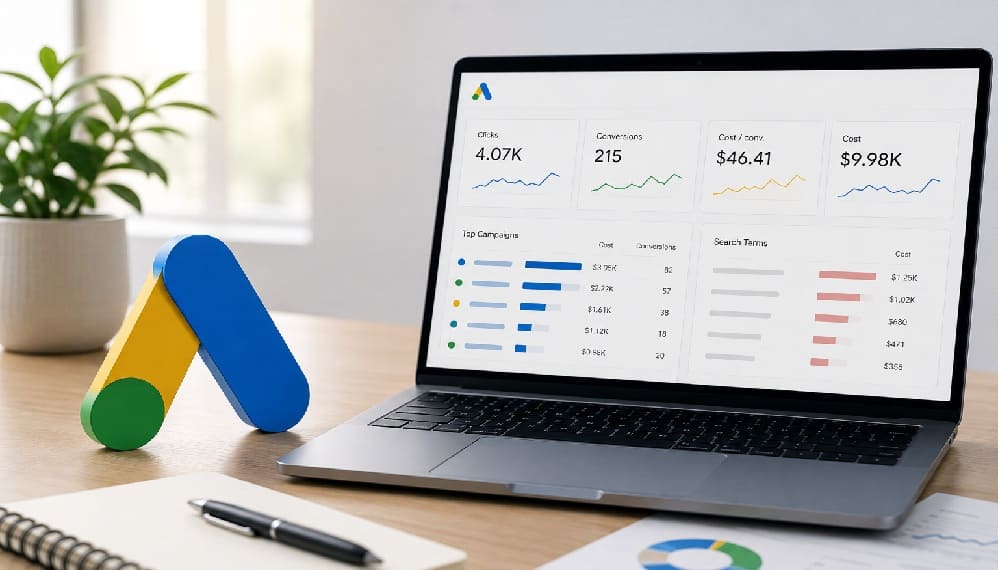
Burning Cash on Google Ads? Stop Your Paid Search Budget Leaks
Your Google Ads Budget May Not Be the Problem
Here’s a number worth paying attention to: the average Google Ads conversion rate across industries was 7.52% in WordStream’s 2025 benchmark data, while the average cost per click was $5.26. In other words, every click has a price, and most clicks still do not become conversions.
That does not mean Google Ads is broken. Quite the opposite. Paid search works because it puts your business in front of people who are already looking for something you sell. The problem starts when you pay for the wrong searches, the wrong people, or the wrong kind of intent.
And those leaks rarely look dramatic.
They look like a few irrelevant clicks here. A broad-match search there. A campaign spending heavily outside your best locations. A landing page that gets traffic but barely converts. A keyword that has been “learning” for three months while quietly eating your budget.
Individually, these may not look dangerous. Together, they can turn a healthy PPC campaign into an expensive traffic generator.
Here’s the uncomfortable part: you may not need a bigger Google Ads budget. You may need to stop wasting the budget you already have.
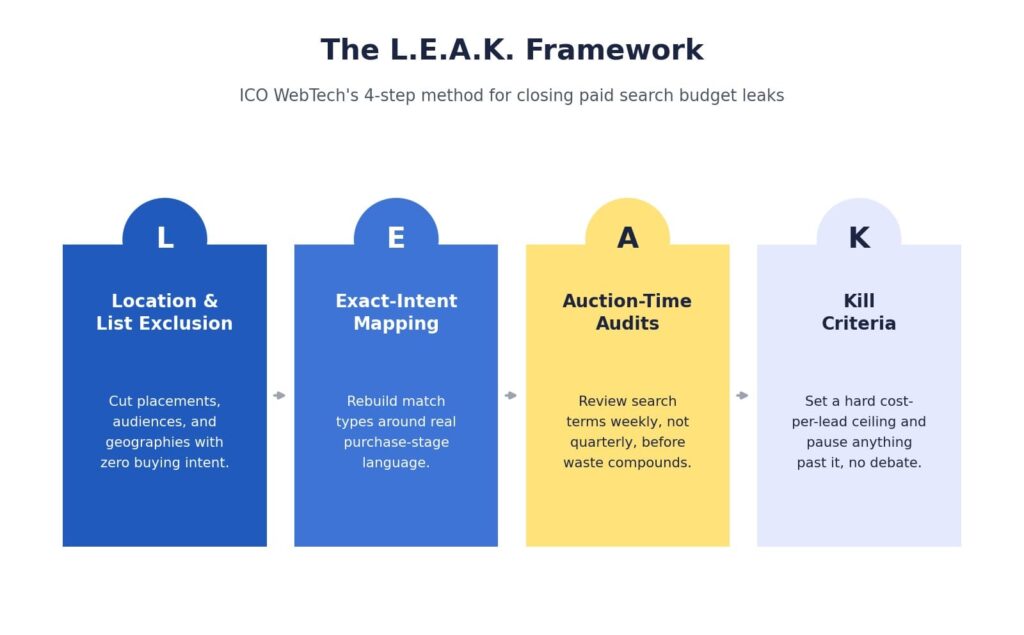
That is the idea behind this article and our L.E.A.K. framework. Instead of treating PPC as a machine for buying more clicks, we look at it as a system for buying the right intent, filtering out waste, and putting more money behind the searches that can actually become customers.
Before We Get Into It
Most Google Ads problems do not begin with the budget. They begin with what the budget is being allowed to buy.
Your ads can appear for searches that are only loosely related to your offer. Broad match can expand beyond the words you originally entered. Poor location settings can put ads in front of people you cannot serve. Weak negative-keyword hygiene can allow the same irrelevant searches to return again and again. And a landing page that does not match the promise of the ad can turn an expensive click into a bounce.
Google itself explains that broad match can show ads for searches related to a keyword, including searches that do not contain the direct meaning of the keyword. It is also the default match type for keywords.
That reach can be incredibly useful when it is controlled properly. It can also become expensive when nobody is checking what the account is actually buying.
Our answer is simple: find the leaks, remove the waste, protect the budget, and then scale what works.
The L.E.A.K. framework gives that process four steps:
- L — Location & List Exclusion: Remove people, places, audiences, and traffic sources that should not receive your budget.
- E — Exact-Intent Mapping: Connect keywords and campaigns to the actual intent behind the search.
- A — Auction-Time Audits: Review what is triggering your ads regularly instead of discovering problems months later.
- K — Kill Criteria: Decide what gets paused before emotion and sunk costs take over.
The goal is not to spend less for the sake of spending less.
The goal is to make more of your existing spend work toward leads and revenue.
In This Blog
- Why your Google Ads budget may be leaking even when the campaign looks healthy
- How Google’s default settings can expand your reach — and your spend
- The most common places paid search budget disappears
- Why irrelevant search queries are more dangerous than a high CPC
- How the L.E.A.K. framework protects your PPC budget
- Why location and audience exclusions deserve more attention
- How to map keywords to genuine buyer intent
- Why weekly search-term reviews beat occasional account cleanups
- How kill criteria prevent bad keywords from becoming permanent budget drains
The Real Reason Your Google Ads Budget Keeps Leaking
Let’s clear up one thing first: Google Ads is not broken.
It is one of the most measurable advertising channels available to a business. You can see what people searched, which ad they interacted with, what they did on your website, and — with proper conversion and CRM tracking — whether those interactions eventually turned into business.
The problem is the gap between what you think you are buying and what your campaign is actually buying.
You might add the keyword commercial cleaning services because it perfectly describes your service. But the searches behind that keyword can reveal a much messier picture. People may be looking for cleaning jobs. They may want a cleaning course. They may be researching how to start a cleaning business. They may be searching for a free checklist.
The keyword looked right. The intent was wrong. That distinction is where a lot of PPC waste begins.
Google’s Search Terms Report exists precisely because the keywords in your account are not necessarily the same as the searches people actually type. The report shows the searches that triggered your ads and helps advertisers identify which queries are relevant, which are not, and which match types are producing useful traffic.
So if you are managing Google Ads by looking only at the keyword column, you are looking at the plan.
The Search Terms Report shows you what actually happened.
That is why we prefer to think of PPC optimization as a form of budget forensics.
We are not asking, “Which keywords should we add?” We are asking:
- Where did the money go?
- What searches caused that spend?
- Did those searches reflect buying intent?
- Did the resulting visitors become leads?
- Did those leads become qualified opportunities?
- And which parts of the account deserve more of the budget?
This changes the entire conversation.
A keyword that generates 500 clicks is not automatically a winner. A keyword that generates 20 clicks and two excellent sales opportunities may be far more valuable.
And a campaign with a higher CPC can sometimes be the better campaign if its traffic has stronger commercial intent.
Cheap traffic is not the objective. Valuable traffic is.
The Uncomfortable Truth About Google’s Defaults
Here is where PPC gets interesting.
Google has invested heavily in automation, machine learning, broad matching, Smart Bidding, and campaign systems designed to help advertisers find more opportunities. That is not inherently a bad thing. In fact, these systems can be extremely powerful when they have good conversion data and sensible guardrails.
But there is a difference between automation and autopilot.
And too many advertisers treat them as the same thing.
Broad match is Google’s default keyword match type. Google explains that broad match can reach searches related to your keyword and can use signals such as recent searches, landing-page content, assets, and other keywords in the ad group to understand intent.
That is useful if your goal is to discover relevant demand.
But it means you cannot assume that the phrase you entered is the only thing you are paying to appear against.
Then there are automatically applied recommendations. Google allows advertisers to choose certain recommendations to apply automatically, while also providing controls to review and manage which recommendations are enabled. Google recommends reviewing the Recommendations page regularly because the available recommendations can change over time.
None of this means Google is trying to waste your money.
It means something much simpler:
Google’s system is built to find opportunities. Your business still has to decide which opportunities are worth buying.
That distinction matters enormously for a small or mid-sized business.
You have a finite budget. You may serve a specific geography. You may sell a specialized service. You may need ten qualified leads rather than 10,000 visitors.
So a recommendation that makes sense for a large ecommerce advertiser with thousands of conversions may not make sense for a B2B company spending $5,000 a month.
The mistake is not using automation.
The mistake is using automation without guardrails.
Think of it like cruise control. It is incredibly useful on the right road. You still need to know where you are going, what speed you can afford, and when to take the wheel.
Where the Money Disappears
Paid search waste rarely arrives as one giant, obvious mistake. It usually arrives in small pieces.
A search that sounds relevant but has no commercial intent. A location that should have been excluded. A device that generates clicks but almost no leads. A landing page that makes visitors work too hard. A negative keyword that should have been added three weeks ago.
And because each leak looks harmless, the account can continue running for months without anyone realizing how much the small leaks add up to.
Irrelevant Search Queries
This is the classic leak. Your keyword is relevant enough for Google to consider a search, but the searcher is not relevant enough for your business.
Someone searching for “SEO jobs” does not need an SEO agency. Someone searching for “free PPC course” is not necessarily looking for PPC management. Someone searching “how to do SEO yourself” may be interested in learning, not buying.
Those searches can generate perfectly legitimate clicks. They are still the wrong clicks.
Broad-Match Drift
Broad match is designed to expand reach beyond exact and phrase matching. Google describes this as a way to discover additional relevant searches and give Smart Bidding more data.
The opportunity is real. So is the responsibility.
If you use broad match, you need to know what it is discovering for you. Otherwise, you are effectively asking Google to define relevance on your behalf without giving your business enough boundaries.
Weak Geographic Targeting
If you only serve customers in California, paying for clicks from someone searching in another state is not “reach.” It is leakage.
The same applies to businesses with city-specific service areas, regional franchises, local professional services, and companies that cannot legally or practically serve certain markets.
Geographic targeting should reflect your actual sales territory, not an abstract idea of where you would like to be visible.
Weak Device Performance
Not every device deserves equal budget simply because every device can generate a click.
If mobile traffic converts poorly because your form is difficult to use, your page loads slowly, or your CTA is buried below the fold, the problem is not necessarily “mobile traffic.” The problem may be the experience you are giving mobile visitors.
Before cutting a device, diagnose the reason for the performance gap.
Thin or Mismatched Landing Pages
This is where many advertisers lose money after doing everything else correctly. The ad says one thing. The landing page says something vaguely related.
The visitor has to figure out what the company actually offers, why it is different, and what they are supposed to do next. That is a costly moment to introduce confusion.
Your paid search visitor has already told you what they want through their search. Your landing page should continue that conversation rather than starting a completely different one.
Also read:
Why Businesses Lose Leads Due to UX
Why and how to use Google Ads for your brand?
Weak Negative-Keyword Hygiene
Some advertisers add negative keywords during setup and then never touch the list again.
That is like cleaning your house once and deciding you are done forever.
Search behavior changes. New queries appear. Campaigns evolve. New products and services get added. Your negative keyword strategy needs to evolve with them.
Google specifically recommends using search-term data to identify irrelevant searches and refine keyword targeting.
Automation Without Guardrails
Performance Max, broad match, Smart Bidding, and other automated features can be valuable parts of a modern Google Ads strategy.
But “Google will optimize it” is not a strategy.
Automation needs a useful conversion signal, sensible exclusions, accurate tracking, appropriate targeting, and regular human review.
The more control you hand to an algorithm, the more important it becomes to define what “good” actually means.
The L.E.A.K. Framework
Most PPC advice starts with keywords. We think that is backwards.
Before you obsess over bidding strategies, ad variations, or another 50 keywords to add to the account, ask a more basic question:
Are we allowing our budget to reach people we never wanted in the first place?
That is why our framework starts with exclusion and control before optimization and expansion.
L.E.A.K. stands for Location & List Exclusion, Exact-Intent Mapping, Auction-Time Audits, and Kill Criteria.
It is deliberately simple. The point is not to create another complicated PPC methodology that requires a 40-page spreadsheet.
The point is to create a repeatable system that protects the budget before you try to scale it.
L — Location & List Exclusion
First, stop paying for people who should never have been in your campaign.
That starts with geography.
If you serve three cities, your campaign should not casually spend money trying to find customers in 30. If you operate nationwide but have certain regions you cannot serve profitably, those areas need to be treated differently.
Then look at audience and customer exclusions.
If your campaign is designed to acquire new customers, do you really want to keep paying to advertise to people who already bought from you?
Maybe you do. Maybe you do not.
The important thing is that the decision should be intentional.
Also examine placements and other sources of traffic where relevant to your campaign type. The goal is straightforward: remove traffic that has no realistic path to becoming valuable business.
Think of this step as closing the front door before worrying about how beautifully you decorate the living room.
E — Exact-Intent Mapping
Once you have stopped obvious waste, get serious about intent.
Not every search containing your keyword deserves the same treatment.
Consider the difference between:
- “what is PPC advertising”
- “how does PPC work”
- “PPC advertising agency”
- “hire PPC agency for B2B”
These searches sit at different points in the buyer journey. The first search may be educational.
The last one is much closer to a commercial decision. Your campaigns should understand that difference.
That does not mean informational searches are worthless. They may be valuable for content and organic search. But if your goal is immediate lead generation, you should know exactly how much of your paid budget is going toward education versus purchase intent.
Map your keywords to the intent you actually want to buy.
Use tighter targeting where precision matters. Use broader matching where discovery creates value. Then let your conversion data tell you whether the expansion is producing customers rather than merely producing more traffic.
The keyword is not the strategy. Intent is.
A — Auction-Time Audits
This is the habit almost everyone skips. They launch a campaign, check it after a few days, check it again at the end of the month. Then they wonder why an irrelevant search has already spent $400.
Your Google Ads account is not static. New searches enter the auction. Search behavior changes. Competition changes. Performance changes.
That means optimization cannot be a quarterly ritual.
The Search Terms Report gives you visibility into the searches that actually triggered your ads and lets you examine how those searches relate to your keywords.
Use that information regularly.
A weekly review does not need to take hours. Start with the highest-spend queries and the queries that generated conversions. Look for patterns rather than obsessing over every individual search.
You are looking for three things:
- Block: Searches that clearly do not belong.
- Keep: Searches showing strong relevance and commercial intent.
- Investigate: Searches that could be valuable but need more data.
That simple classification can turn your search-term report from a forgotten dashboard into a budget-control mechanism.
K — Kill Criteria
This may be the most uncomfortable part of the framework.
Decide when something gets cut before you become emotionally attached to it.
Every PPC manager has done it.
“This keyword has spent a lot, but maybe the next few clicks will convert.”
“This ad group has been slow, but let’s give it another month.”
“We already spent $800 on it, so we shouldn’t pause it yet.”
That last one is the sunk-cost fallacy wearing a Google Ads dashboard as a disguise.
The money you already spent is gone. It should not determine whether you spend the next dollar. Instead, establish your criteria in advance.
For example, you might decide that a keyword, ad group, or campaign deserves review when it reaches a certain level of spend without a qualified conversion, or when its cost per qualified lead consistently exceeds your acceptable acquisition range.
The exact threshold will vary by business, margin, sales cycle, and customer value.
What matters is having one. Because when the rule is decided before the money is spent, the decision becomes analytical instead of emotional.
And that is the entire point of L.E.A.K.
Exclude first. Map intent second. Audit continuously. Cut decisively.
Only after those four things are working should you start asking the more exciting question:
“Where should we put more money?”
The 7 Most Expensive Google Ads Leaks
Most Google Ads waste does not come from one spectacular mistake. It comes from ordinary decisions that seem harmless when viewed one at a time.
A keyword attracts clicks but very little buying intent. A campaign spends outside your service area. A broad-match term keeps finding searches you would never deliberately target. Your homepage receives hundreds of paid visitors but gives them too many places to go. Your conversion tracking counts every form interaction as a lead, even when sales considers only a fraction of them qualified.
None of these problems looks dramatic in isolation.
Together, they can quietly turn a profitable advertising channel into a very expensive source of website traffic.
Here are the seven leaks we would investigate before recommending that you increase your Google Ads budget.
1. Irrelevant Search Queries
This is the leak most advertisers know about but surprisingly few monitor consistently.
You bid on a keyword because it sounds relevant. Google matches your ad to a search that is related enough to qualify. Someone clicks. You pay.
Then you discover the person was looking for a job, a tutorial, a free resource, a definition, a competitor, or something else entirely.
The keyword was not necessarily wrong. The search intent was.
That distinction matters because Google Ads can operate at a much more granular level than the keyword list suggests. The Search Terms Report shows the actual queries that triggered your ads, giving you the evidence needed to decide which searches deserve more budget and which should be excluded.
If you have not reviewed your search terms recently, do not assume your keyword list tells the whole story.
Your keyword list is what you intended to buy. Your search-term data tells you what you actually bought.
2. Broad-Match Drift
Broad match is not the villain here. Used properly, it can help advertisers discover valuable searches and give Google’s automated bidding systems more data to work with.
The problem is treating broad match like a set-and-forget feature.
Google says broad match can match searches related to the meaning of a keyword and can use contextual signals such as the user’s recent searches, the landing page, assets and other keywords in the ad group. That makes broad match powerful, but it also means the advertiser needs to pay attention to what the system is discovering.
Think of broad match as a fishing net. A larger net can catch more fish. It can also catch things you never wanted.
If you are using broad match, your negative keyword strategy, conversion tracking and search-term reviews need to be strong enough to tell Google what a valuable catch looks like.
3. Geographic and Audience Leakage
Here is an easy question that can expose a surprisingly expensive problem:
Can every person your campaign reaches actually become your customer?
If the answer is no, you need to know why those people are receiving your ads.
A remodeling company serving three Michigan cities does not need to pay for someone searching from a state it does not serve. A B2B software company selling only to enterprise organizations may not want to spend the same amount reaching students or job seekers. A business focused on new customer acquisition may not want to keep paying to advertise to existing customers without a specific reason.
Geographic targeting and audience exclusions are not glamorous PPC work. They are budget protection.
And that is exactly why they are easy to overlook.
Start with the areas and audiences that genuinely matter to the business, then examine where the campaign is actually spending. If your targeting settings and your sales territory tell two different stories, fix that before you touch your bidding strategy.
4. Weak or Mismatched Landing Pages
You can get the targeting right, the keyword right and the ad right — and still lose the lead after the click.
This happens when the landing page does not continue the conversation started by the search.
Someone searches for “PPC management for B2B companies.” Your ad talks about B2B PPC. They click.
Then they land on your homepage. Now they see SEO. Web design. Social media. Content marketing. Branding. About us. Careers. Blog posts. Six different buttons. A slider. A newsletter popup.
They came looking for one thing. You gave them a website. Those are not the same thing.
Google itself recommends matching the landing page closely to the ad and keywords and making sure the landing page reflects the call to action promised in the ad. Google also identifies landing-page experience as one of the diagnostic components of Quality Score. :contentReference[oaicite:0]{index=0}
Your landing page does not need to be complicated. It needs to answer the visitor’s immediate questions:
- Am I in the right place?
- Does this company offer what I searched for?
- Why should I trust them?
- What happens if I take the next step?
- How do I contact them?
If your paid traffic is healthy but your conversion rate is disappointing, do not automatically blame the keywords.
The leak may be happening after Google has already done its job.
5. Conversion Tracking That Counts the Wrong Things
This is one of the most dangerous leaks because it can make a bad campaign look successful.
Imagine your Google Ads account reports 80 conversions. That sounds great. Then your sales team tells you only 12 were genuine leads. Suddenly, the campaign does not look nearly as impressive.
This is why conversion tracking should not simply answer, “Did somebody do something on the website?” It should answer, “Did somebody do something that matters to the business?”
A page view may be useful for analysis. A button click may tell you something about user behavior. A brochure download can indicate interest.
But none of those necessarily equals a sales lead.
Google explains that conversion actions marked as Primary can be used for bidding and appear in the main “Conversions” column, while secondary actions can be tracked without being used directly for bidding optimization. Google also recommends ensuring conversion tracking is set up correctly before relying on conversion-focused Smart Bidding. :contentReference[oaicite:1]{index=1}
That distinction is crucial.
If you tell Google that a low-value action is your success signal, the system can optimize toward more of that action. And it may do exactly what you asked. It just may not be what your sales team wanted.
For lead generation, your measurement should ideally move further down the funnel:
- Lead
- Qualified lead
- Sales opportunity
- Customer
- Revenue
The closer your advertising data gets to actual business value, the more useful your optimization becomes.
6. Set-and-Forget Campaigns
Google Ads is not a crockpot.
You cannot turn it on, walk away and expect the same recipe to taste good six months later.
Search behavior changes. Competitors enter and leave auctions. Costs move. New search terms appear. Your website changes. Your offers change. Your customers change.
And the account itself can change as new recommendations, automation and campaign features become available.
The source material behind this framework makes an important point: the accounts that stay efficient are not necessarily the ones that received one brilliant audit. They are the ones that have a repeatable review cadence.
That is why a campaign that performed well in January can be quietly leaking money in August. The campaign did not necessarily “break.”
You simply stopped checking what changed.
7. Optimizing for Cheap Metrics Instead of Expensive Outcomes
This is the leak that hides behind a beautiful dashboard.
Your CPC is down. Your CTR is up. Your conversion rate looks healthy. Everyone is happy. Except sales. Because the leads are terrible.
Clicks, impressions, CTR and CPC are useful metrics. But they are not the same thing as business performance.
Google provides conversion value and conversion-value-per-cost metrics specifically to help advertisers move beyond simply counting conversions and understand the business value generated by advertising.
That is a much healthier way to think about PPC.
If Campaign A generates 100 leads at $30 each but only two become customers, while Campaign B generates 25 leads at $80 each and eight become customers, which campaign would you rather fund?
The answer is obvious once you stop looking at CPL in isolation.
The cheapest lead is not necessarily the cheapest customer.
And that brings us to the bigger question: what happens when you keep the budget exactly the same but remove the leaks?
Same Budget, Different Outcome
Let’s make this concrete.
The following is an illustrative example, not a client case study. The point is to show what can happen when the same advertising budget is managed differently.
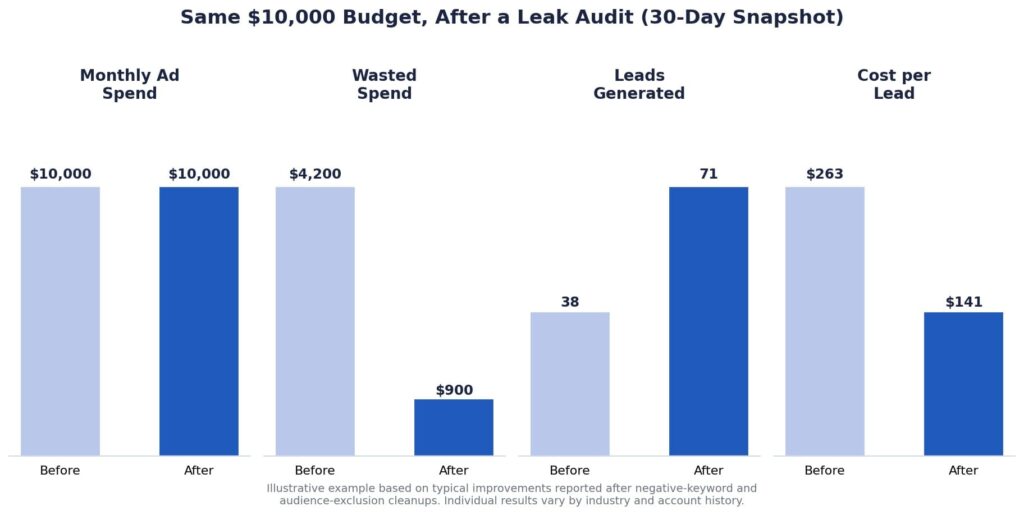
Imagine a company spending $10,000 per month on Google Ads.
Before the cleanup, the account has irrelevant searches, weak exclusions, poorly matched landing pages and conversion tracking that counts several low-value actions. The campaign generates traffic, but the business is not getting enough qualified leads from that traffic.
Now apply the L.E.A.K. approach.
- Remove irrelevant search queries.
- Tighten geographic and audience targeting.
- Strengthen negative keyword coverage.
- Separate high-intent searches from broader discovery traffic.
- Improve the landing-page experience.
- Clean up conversion actions.
- Set clear rules for when underperforming areas should be paused.
The monthly budget stays at $10,000.
The strategy changes.
That distinction matters. The source material behind this framework uses the same kind of illustrative before-and-after: the budget remains unchanged while wasted spend falls, qualified leads increase and cost per lead improves.
The lesson is not that every business will magically double its leads after an audit. That would be a ridiculous promise.
The lesson is that budget efficiency is itself a growth lever.
Before asking for another $5,000 in ad spend, ask whether the first $10,000 is being allocated intelligently.
Sometimes the fastest route to more leads is not buying more clicks.
It is getting more value from the clicks you already buy.
Why Your Homepage Is Probably Killing Your PPC ROI
We are going to say something that may annoy a few website owners:
Your homepage is probably one of the worst places to send highly specific paid-search traffic.
Not because your homepage is bad. Because it has too much to do.
Your homepage needs to introduce the brand. It needs to serve multiple audiences. It needs to explain your company. It needs to showcase your services. It needs to support navigation. It may need to rank organically. It may need to help existing customers. It may need to answer questions from people who have never heard of you.
A PPC visitor usually has a much narrower reason for arriving.
They searched for something. Your ad promised something. They clicked because they wanted that thing. Now give them that thing.
If someone searches for “Google Ads management services,” the landing page should make the relationship obvious. If someone searches for “SEO services for B2B companies,” they should not have to navigate through your entire website to find the SEO offering.
Google’s own guidance recommends sending users to landing pages that closely match the ad and keywords and says a relevant, useful landing page improves the chances of conversion. :contentReference[oaicite:5]{index=5}
There is another problem with sending paid traffic to a generic homepage: you lose the ability to control the conversation.
A dedicated landing page can focus the headline, proof, benefits, objections and CTA around one search intent.
Your homepage cannot realistically do that for every visitor.
So if your Google Ads campaign has a healthy click-through rate but disappointing conversion rate, look beyond the ad account. Open the landing page. Read it as if you just searched the keyword.
Then ask: “Does this page give me exactly what I thought I was clicking for?” If the answer is “sort of,” you have found a leak.
Your Conversion Tracking May Be Lying to You
Let’s make this one very practical. Open your Google Ads conversion actions.
Now ask what each one actually means to your business.
- Is a form submission a qualified lead?
- Is every phone call valuable?
- Does a brochure download have the same commercial value as a consultation request?
- Is a “thank you” page firing when somebody simply refreshes it?
- Are duplicate conversions being counted?
- Are micro-actions being included alongside genuine lead actions?
If your answer to some of these is “I’m not sure,” your campaign may be optimizing against a blurry definition of success.
Google’s conversion framework allows advertisers to distinguish between primary actions used for bidding and secondary actions that remain available for observation. That gives you a way to separate meaningful business goals from useful-but-secondary interactions. :contentReference[oaicite:6]{index=6}
There is another step worth taking: assign conversion values when you can.
Google says conversion values help advertisers understand the business impact of conversions and can be used to optimize toward conversion value rather than simply conversion volume. :contentReference[oaicite:7]{index=7}
For example, suppose a business knows that:
- A newsletter signup is worth very little.
- A content download is worth more.
- A qualified consultation is worth significantly more.
- A sales opportunity is worth even more.
Treating all four as identical conversions throws away useful information.
Your advertising platform can only optimize toward the signals you give it.
Bad tracking does not just create bad reports. It can influence where your future budget goes.
The 15-Minute Weekly PPC Audit
You do not need to spend half your Monday inside Google Ads.
You do need to look regularly.
The source material behind the L.E.A.K. framework recommends a weekly search-term review because waste accumulates while campaigns are running, not when your quarterly review finally arrives. :contentReference[oaicite:8]{index=8}
Here is a practical 15-minute version.
Minutes 1–5: Check Search Terms
Open the Search Terms Report and sort your attention toward the searches that spent the most money or generated conversions.
Look for obvious mismatches.
Ask:
- Would I actually want this person as a customer?
- Does this search show buying intent?
- Should this query become a negative keyword?
- Did we discover a valuable search theme worth building around?
Minutes 6–8: Check Spend Without Results
Find keywords, ad groups or campaigns that are spending but have not produced meaningful conversions.
Do not automatically pause everything. Look at intent, spend level, historical performance and the economics of the offer.
The question is not “Has it converted yet?” The better question is:
“Has this spent enough that we should expect evidence by now?”
Minutes 9–11: Check the Big Segments
Look at location and device performance. You are not searching for tiny statistical differences. You are looking for obvious anomalies.
Is one location consuming a disproportionate share of the budget?
Is one device generating lots of clicks but almost no meaningful action?
Has a particular segment suddenly become much more expensive?
Minutes 12–13: Check Conversion Quality
Look beyond the conversion number.
Are the conversions actual leads? Are they qualified? Are they reaching sales? Is the CRM showing something very different from Google Ads?
If Google says the campaign is improving but the sales pipeline says otherwise, investigate the gap.
Minutes 14–15: Make One Decision
This is important. Do not finish the audit with a giant list of 37 things you might change someday. Make one meaningful decision.
- Pause the obvious waste.
- Add the negative keyword.
- Flag the landing page.
- Move budget toward the stronger campaign.
- Investigate the suspicious conversion action.
Small decisions made consistently beat massive cleanups performed once a year.
Warning Signs Your Account Is Leaking
You do not need to be a PPC expert to spot the early warning signs.
In fact, some of them are painfully simple.
- Your clicks are increasing, but qualified leads are not.
- Your cost per lead has been creeping upward for several months.
- You cannot remember the last time anyone reviewed the Search Terms Report.
- Most of your spend runs through broad match, but your negative keyword list is thin.
- You are spending heavily in locations your sales team does not prioritize.
- Your ads send most paid traffic to the homepage.
- Your conversion count looks impressive, but sales says the lead quality is poor.
- You are optimizing toward form fills without knowing how many become opportunities.
- You have accepted Google recommendations without understanding what changed.
- You keep increasing the budget even though the underlying conversion economics have not improved.
The source material identifies several of these same warning signs, including healthy click volume without corresponding conversion growth, stale search-term reviews, heavy broad-match reliance with weak negative lists, rising CPL and unchecked automated recommendations. :contentReference[oaicite:9]{index=9}
One warning sign does not prove your account is leaking. Several together should get your attention.
And here is the encouraging part: these are not mysterious problems that require rebuilding your entire marketing operation. They are usually visible once someone looks in the right places.
What to Measure Instead of Just CTR and CPC
CTR and CPC are useful. They are just not enough. Think of them as dashboard lights rather than the destination.
A high CTR tells you that people are responding to the ad. A low CPC tells you that you are buying clicks relatively cheaply. Neither tells you whether those clicks are creating profitable customers.
For lead generation, your reporting should move progressively closer to the business outcome.
Start With These Metrics
- Cost: How much are we spending?
- Clicks: How much traffic are we buying?
- CTR: Are people responding to the ad?
- CPC: What are we paying for that traffic?
- Conversion rate: How often does traffic produce the defined conversion?
- Cost per conversion: What does each tracked conversion cost?
Then go deeper.
- Qualified lead rate: What percentage of conversions are actually worth sending to sales?
- Cost per qualified lead: What does a meaningful lead really cost?
- Opportunity rate: How many qualified leads enter the pipeline?
- Cost per opportunity: How much advertising spend produces a genuine sales opportunity?
- Customer acquisition cost: What does it cost to acquire a customer?
- Conversion value: What economic value are the conversions producing?
- Conversion value / cost: How much conversion value are you generating relative to advertising spend?
Google defines conversion value per cost as conversion value divided by advertising cost, providing an estimate of return on investment. :contentReference[oaicite:10]{index=10}
That is much closer to the question a business owner actually cares about.
Not: “Did our CTR improve?”
But: “Did our advertising produce enough valuable business to justify what we spent?”
And there is one final distinction worth remembering.
Do not confuse a reporting metric with a business objective.
- CTR can tell you something about your ad.
- CPC can tell you something about the auction.
- Conversion rate can tell you something about the post-click experience.
- Qualified leads can tell you something about demand quality.
- Revenue can tell you something about the business.
The closer your measurement gets to revenue, the harder it becomes for a pretty PPC dashboard to hide an ugly business result.
That is exactly where your optimization should eventually lead.
What to Measure Instead of Just CTR and CPC
CTR and CPC are useful metrics. They are just not enough.
Think of them as dashboard lights rather than the destination.
A high CTR tells you that people are responding to the ad. A low CPC tells you that you are buying clicks relatively cheaply. Neither tells you whether those clicks are creating profitable customers.
For lead generation, your reporting should move progressively closer to the business outcome.
Start With the Basics
- Cost: How much are we spending?
- Clicks: How much traffic are we buying?
- CTR: Are people responding to the ad?
- CPC: What are we paying for that traffic?
- Conversion rate: How often does traffic produce the defined conversion?
- Cost per conversion: What does each tracked conversion cost?
Then go deeper.
- Qualified lead rate: What percentage of conversions are actually worth sending to sales?
- Cost per qualified lead: What does a meaningful lead really cost?
- Opportunity rate: How many qualified leads enter the pipeline?
- Cost per opportunity: How much advertising spend produces a genuine sales opportunity?
- Customer acquisition cost: What does it cost to acquire a customer?
- Conversion value: What economic value are the conversions producing?
- Conversion value / cost: How much conversion value are you generating relative to advertising spend?
Google defines conversion value per cost as conversion value divided by advertising cost, providing an estimate of return on investment. :contentReference[oaicite:0]{index=0}
That is much closer to the question a business owner actually cares about.
Not:
“Did our CTR improve?”
But:
“Did our advertising produce enough valuable business to justify what we spent?”
And there is one final distinction worth remembering.
Do not confuse a reporting metric with a business objective.
CTR can tell you something about your ad.
CPC can tell you something about the auction.
Conversion rate can tell you something about the post-click experience.
Qualified leads can tell you something about demand quality.
Revenue can tell you something about the business.
The closer your measurement gets to revenue, the harder it becomes for a pretty PPC dashboard to hide an ugly business result.
The Controversial Take: Don’t Increase Your Budget Yet
Here is the advice you probably did not expect from a digital marketing agency:
Do not increase your Google Ads budget just because you want more leads.
Not yet.
If your current campaigns are leaking money, adding more money simply gives the leaks a larger pipe.
Imagine you are spending $5,000 a month and getting disappointing results. Your first instinct might be to increase the budget to $8,000 because “we need more volume.”
But what if the problem is not volume?
What if 20% of the current spend is going toward irrelevant searches? What if another portion is going to locations you do not serve? What if your conversion tracking is counting low-value actions? What if your landing page converts poorly because the visitor has to hunt for the offer?
In that situation, more budget does not solve the underlying problem.
It scales the problem.
This is one of the biggest mistakes we see in paid search: treating insufficient results as proof that the campaign needs more money.
Sometimes it does. But sometimes the campaign needs better economics before it needs more fuel.
Think about it this way. If you have a bucket with a hole in it, pouring in more water does not make the bucket more efficient.
You fix the hole. Then you pour in more water. Google Ads deserves the same logic.
When Should You Actually Increase the Budget?
Increase spending when you have evidence that additional budget can buy more of what is already working.
That usually means you have:
- Reliable conversion tracking
- A clear definition of a qualified lead
- Search terms that consistently show commercial intent
- Acceptable cost per qualified lead or customer
- Landing pages that convert reasonably well
- Strong geographic and audience targeting
- A clear understanding of which campaigns deserve additional spend
- Enough conversion data to make informed optimization decisions
Then increasing the budget becomes a growth decision rather than a rescue attempt. And that is a very different conversation.
The Better Question to Ask
Instead of asking:
“How much more should we spend?”
Ask:
“If I gave this campaign another $2,000, where exactly would that money go?”
If the answer is clear — more high-intent searches, more qualified locations, more profitable campaigns — you may have a case for scaling.
If the answer is “Google will find more people,” slow down.
That is not enough. We want to know which people, which searches, which campaigns and which business outcomes.
That is how you turn paid search from a monthly expense into a controllable acquisition channel.
How ICO WebTech Can Plug the Leaks
At ICO WebSolutions, we do not believe PPC success starts with “let’s run some ads.”
It starts with understanding where the money should go — and where it should not.
Our approach is built around the same principle running through this article: protect the budget before trying to scale it.
That means looking at the entire path from search to lead, rather than treating Google Ads as an isolated dashboard.
We Start With the Account, Not a Sales Pitch
A useful PPC audit should tell you something you can act on.
We examine campaign structure, keyword targeting, search intent, search terms, negative keywords, geographic targeting, audiences, bidding, conversion tracking, ad relevance and landing-page experience.
The objective is not to produce a 50-page report filled with screenshots.
The objective is to identify where your budget is being diluted and what should happen next.
We Connect Paid Search to the Website
A Google Ads campaign can only do so much if the page receiving the traffic is not built for the visitor’s intent.
That is why PPC and landing-page optimization should not live in separate rooms.
Our landing page optimization approach focuses on reducing friction between the ad click and the action you want the visitor to take.
The message needs to line up. The offer needs to be clear. The proof needs to be credible. The CTA needs to make sense.
And the page needs to give the visitor a reason to act now rather than another reason to open a new browser tab.
We Treat SEO and PPC as Complementary Channels
Paid search should not exist in a vacuum.
If the same high-intent topic is producing paid clicks and organic search demand, there may be opportunities to make both channels stronger.
Our SEO services focus on building sustainable search visibility, while PPC can provide immediate access to demand that already exists.
That combination can be particularly useful when you want to understand which topics, services and search intents are producing commercial interest before investing heavily in long-term organic content.
We Measure Leads, Not Vanity Numbers
Clicks are useful. Traffic is useful. But if the goal is lead generation, we ultimately care about the quality and business value of those leads.
That means looking beyond CTR and CPC and asking whether paid traffic is producing opportunities your sales team can actually work with.
Because a campaign that generates 200 cheap leads can be less valuable than one generating 40 expensive but highly qualified opportunities.
We Look for the Leaks Before Asking for More Money
This is probably the biggest difference in philosophy. We do not want to tell you to spend more simply because spending more is easy advice. We want to know whether your current budget is being used efficiently first.
Sometimes the answer will be, “Yes — you should increase the budget.”
Great. Now we have a reason. Other times the answer will be, “No — let’s fix these three leaks first.” That is also a win.
Because the goal is not to make your Google Ads account bigger.
The goal is to make it more profitable.
If your paid search campaigns are generating clicks but not enough qualified leads, talk to ICO WebSolutions. We can help identify where your PPC budget is leaking and build a clearer path from search intent to conversion.
FAQs
What is a Google Ads budget leak?
A Google Ads budget leak is spending that does not contribute meaningfully to your advertising objective. It can come from irrelevant search queries, poor targeting, weak negative keywords, inefficient landing pages, inaccurate conversion tracking, poor campaign structure or spending on traffic that has little chance of becoming a valuable customer.
How do I know if my Google Ads budget is being wasted?
Start with the Search Terms Report. Look at the searches that are consuming the most spend and ask whether those searches represent people you actually want as customers. Then compare Google Ads conversions with qualified leads in your CRM or sales process. A high number of conversions with poor lead quality is a strong warning sign.
Is broad match bad for Google Ads?
No. Broad match can be useful for discovering relevant searches and expanding reach, particularly when paired with Smart Bidding and reliable conversion data. The problem is using broad match without regular search-term reviews, appropriate exclusions and clear conversion signals.
Should I use exact match instead of broad match?
There is no universal answer. Exact match can provide greater control over the intent you are targeting, while broad match can help uncover additional relevant demand. The right approach depends on your goals, conversion volume, account maturity and ability to monitor search quality. The important thing is to manage match types based on business outcomes rather than choosing one because it is supposed to be “better.”
How often should I review Google Ads search terms?
For actively spending campaigns, a weekly review is a strong practical baseline. Higher-spend accounts or campaigns with significant search-volume changes may warrant more frequent checks. The important part is consistency. A search-term review is far more useful when it happens continuously than when it happens once every few months.
Why are my Google Ads clicks increasing but leads are not?
Several things could be happening. Your traffic may have become less relevant, your landing page may not match the search intent, your offer may not be compelling, your conversion tracking may be inaccurate, or the additional clicks may simply be lower-intent traffic. Look at search terms, landing-page behavior and lead quality together before changing the bidding strategy.
Should Google Ads send traffic to my homepage?
It can, but a dedicated landing page is often better when the campaign targets a specific service, product or commercial intent. A homepage has to serve many audiences and objectives. A focused landing page can continue the exact conversation started by the search and ad, reducing friction and making the next step clearer.
What is a good Google Ads conversion rate?
There is no single conversion rate that qualifies as “good” for every account. Conversion rates vary significantly by industry, offer, traffic source, search intent, landing page, sales process and conversion definition. More importantly, a high conversion rate is not automatically valuable if the conversions are low quality.
Should I increase my Google Ads budget if I need more leads?
Not automatically. First determine whether your existing budget is producing leads at an acceptable cost and whether those leads are becoming qualified opportunities. If the campaign is efficient and additional demand is available, increasing the budget can make sense. If the account is leaking, fix the leaks before adding fuel.
What should I measure besides CTR and CPC?
For lead generation, look at conversion rate, cost per conversion, qualified lead rate, cost per qualified lead, opportunity rate, cost per opportunity, customer acquisition cost, conversion value and conversion value per cost. The closer your measurement gets to actual revenue, the more useful your PPC optimization becomes.
Can PPC optimization reduce wasted ad spend without reducing leads?
It can. Removing irrelevant traffic does not necessarily mean reducing useful traffic. In many cases, the objective is to redirect spend from low-value clicks toward searches, audiences and campaigns with stronger commercial intent. The actual result will depend on the account, market and quality of the underlying demand.
References
Google. (n.d.). About keyword matching options. Google Ads Help. https://support.google.com/google-ads/answer/7478529
Google. (n.d.). About the search terms report. Google Ads Help. https://support.google.com/google-ads/answer/2472708
Google. (n.d.). About conversion tracking. Google Ads Help. https://support.google.com/google-ads/answer/1722022
Google. (n.d.). About conversion values. Google Ads Help. https://support.google.com/google-ads/answer/13405059
Google. (n.d.). About conversion value rules. Google Ads Help. https://support.google.com/google-ads/answer/6167130
Google. (n.d.). About landing page experience. Google Ads Help. https://support.google.com/google-ads/answer/6238826
Google. (n.d.). About automatically applied recommendations. Google Ads Help. https://support.google.com/google-ads/answer/10279006
Google. (n.d.). About conversion goals. Google Ads Help. https://support.google.com/google-ads/answer/10995153
WordStream. (2025). Google Ads benchmarks by industry. WordStream. https://www.wordstream.com/blog/2025-google-ads-benchmarks


How to Scale a Search Campaign Without Blowing Up Your Cost Per Lead
Why a winning small-budget test doesn’t guarantee a winning big-budget campaign — and the pricing mechanics every advertiser should understand before pushing more spend into search, social, or display.
In this article
- The trap: judging a campaign by its smallest, cheapest phase
- Why campaigns almost always look good at small spend
- The ad inventory supply curve: the mechanic behind scaling
- The myth: “test small, then scale it”
- The campaign scaling S-curve
- The strategic fix: scale to your max CPL, not past it
- What it means if you can’t hit volume at your max CPL
- A practical scaling playbook
- Key takeaways
The trap: judging a campaign by its smallest, cheapest phase
One of the most common mistakes we see advertisers make, whether they’re running Google Search, Meta, LinkedIn, or programmatic display campaigns, is drawing big conclusions from a small amount of spend. A campaign launches, the first few hundred dollars go out the door, the cost per lead (CPL) looks fantastic, and the natural next move feels obvious: pour more budget in and watch the results multiply.
That instinct is understandable. It’s also, in a large share of cases, wrong. The purpose of this article is to explain why it’s wrong — not just as a rule of thumb, but as a consequence of how digital ad inventory is actually priced. Once you understand the underlying market mechanics, scaling stops being guesswork and becomes a strategic, defensible process.
Also read: Why Digital Advertising Costs Rise Even When Your Campaign Hasn’t Changed
Why campaigns almost always look good at small spend
There are two separate reasons early results are unreliable, and it’s worth separating them clearly.
First, statistical noise. A small number of clicks or conversions is a small sample, and such samples are inherently volatile. Marketing analysts widely note that testing with too few data points can yield results driven by random chance rather than a real underlying effect, and that this risk diminishes as the sample size grows[1][2]. A campaign that converts three out of five clicks in its first day hasn’t proven anything about its true conversion rate — it has produced a data point with a very wide margin of error.
Second, and more specific to paid media, is a pricing effect: at low spend, a campaign is only buying the cheapest, easiest-to-win slice of available ad inventory. This is the mechanism most advertisers overlook, and it’s the real subject of this article.
The ad inventory supply curve: the mechanic behind scaling
Every paid channel — Google Search, Meta, LinkedIn, programmatic display sells access to a finite pool of ad inventory for any given audience at any given moment. On real-time bidding exchanges, each individual ad placement is auctioned off the instant a user loads a page or opens an app, with the highest qualifying bid winning the impression[3][4].
Search auctions and social ad auctions work on the same underlying logic: advertisers compete for a limited number of eligible placements, and price is set by that competition rather than by a fixed rate card[5].
This has a direct consequence for scaling.
Not all inventory within a targeted audience is equally cheap. Some of it, the users most likely to convert, at the moments with the least competing demand, is cheap to win. The rest of it is more expensive, either because it’s contested by more advertisers or because it’s a lower-quality match for your targeting.
A small budget only needs to buy a small slice of inventory, so it naturally buys the cheapest slice available. A large budget has to buy much more of the available pool, which means reaching further into the expensive end of it.
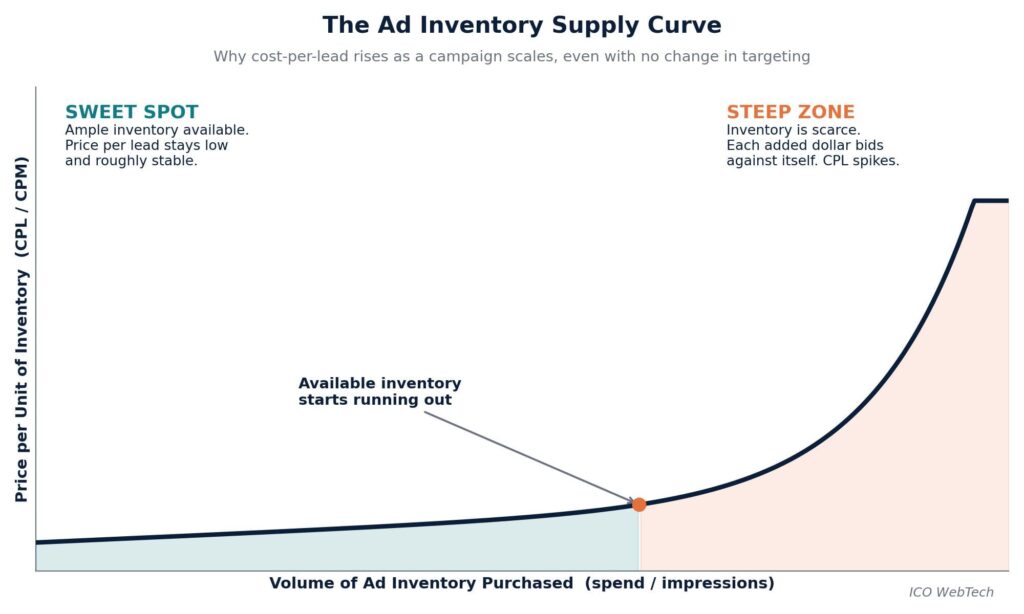
This is exactly the pattern paid media practitioners observe in the field. Analysis of scaled Meta campaigns has found that at lower budgets, ads reach the most responsive audience first; as spend increases, the platform is forced to bid for less qualified segments of its own auction, which drives cost up[6].
Independent case data tells the same story: one documented account saw CPL rise 80% after daily spend was scaled from roughly $500 to $4,000, with the later dollars far less efficient than the earlier ones[7].
The myth: “test small, then scale it”
The myth: “We tested this campaign at $50/day and it performed brilliantly. Let’s scale it to $2,000/day and expect similar returns.”
This logic assumes ad inventory behaves like a product with unlimited stock at a fixed price; buy more, get proportionally more, at the same cost. That assumption doesn’t hold. Because inventory is limited and priced by competitive demand, scaling isn’t a linear multiplication of your test results.
It’s a walk further along the supply curve in Figure 1, and depending on how much headroom exists in that specific audience, on that specific platform, at that specific moment, the walk can be short and cheap, or it can hit a wall very quickly.
This isn’t only a display/social-auction phenomenon.
Google’s own reporting acknowledges the same constraint for Search: the “Lost Impression Share (Budget)” metric exists specifically to show advertisers how much additional traffic is available at their current bids before they’d need to pay more to win additional volume[8] — a direct, built-in admission that available inventory at a given price is limited.
The campaign scaling S-curve
Put the pricing mechanic on a timeline, and it produces a recognizable pattern that paid media analysts refer to as the campaign S-curve, a non-linear relationship between spend and CPL that unfolds in three broad phases[9].
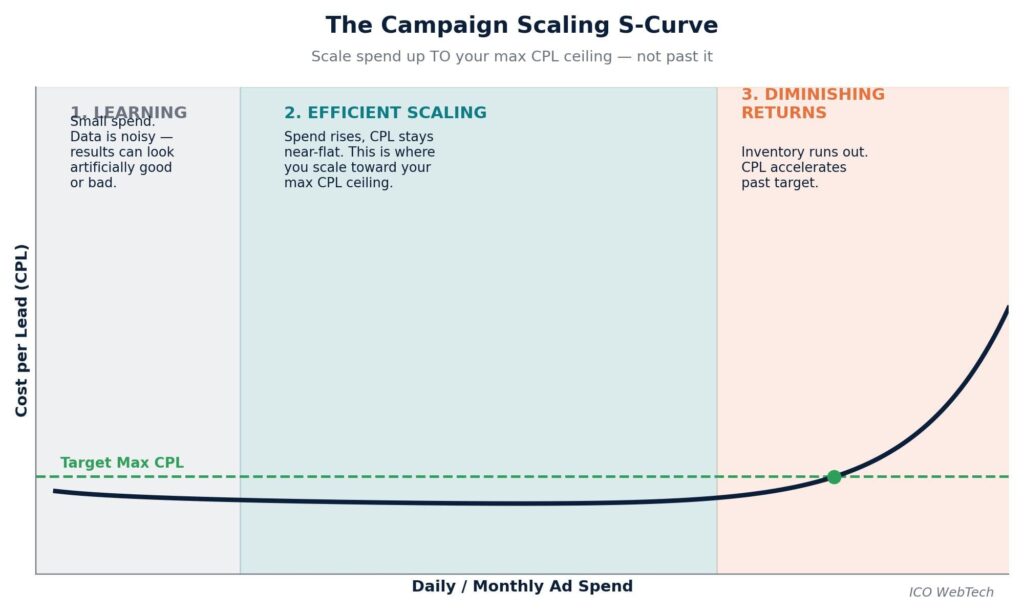
- Learning. Spend is low, data is thin, and results can look better or worse than they’ll ultimately be simply due to sample-size noise[1].
- Efficient scaling. The campaign has found its footing. Increasing budget produces a roughly proportional increase in leads, and CPL holds close to flat. This is genuinely the “golden zone” for scaling[9].
- Diminishing returns. The readily available, cheap inventory has been exhausted. Cost per click or cost per lead begins rising faster than spend, click-through rate tends to soften, and conversion rate on the newer, lower-intent traffic often declines[9].
Warning sign to watch for: a rapidly rising cost per click or cost per lead is typically the earliest, clearest signal that a campaign has crossed from Phase 2 into Phase 3 — auction pressure and audience saturation showing up in the numbers before anything else does[9].
The strategic fix: scale to your max CPL, not past it
This is the strategic takeaway for ICO WebTech clients: define your maximum acceptable CPL before you scale, not after. Without that ceiling set in advance, there’s no way to know when a campaign has reached its efficient sweet spot versus when it has been pushed past it.
You end up scaling reactively, watching CPL rise, and only stopping once it’s already uncomfortable — instead of scaling deliberately, toward a number you decided on with your margins and business goals in mind.
In practice, that means:
- Set the ceiling first. Work backward from your acceptable cost of customer acquisition to a maximum CPL you’re willing to pay.
- Scale in increments, not leaps. Documented case data shows that aggressive single-day jumps in budget (for example, quadrupling spend overnight) tend to push campaigns into unstable, inefficient territory, while gradual increases of roughly 10–20% every few days let the auction adjust without a shock to cost[10][6].
- Judge by marginal CPL, not average CPL. Your blended, account-level CPL can still look healthy even after scaling has gone inefficient, because it’s averaging the cheap early leads with the expensive later ones. The number that tells the truth is the marginal cost — what the most recent increment of spend cost to convert[11].
- Give a scale-up time to settle before judging it. Algorithmic ad platforms typically need a short adjustment window after a budget change; evaluating results too early repeats the same small-sample problem discussed above[12].
What it means if you can’t hit volume at your max CPL
Suppose you scale spend all the way to your predefined max CPL ceiling, and the campaign still isn’t generating enough leads to hit your goal. That outcome is itself useful information; it tells you something specific about the market you’re in, not that paid media “doesn’t work.” There are three likely explanations, and each points to a different fix.
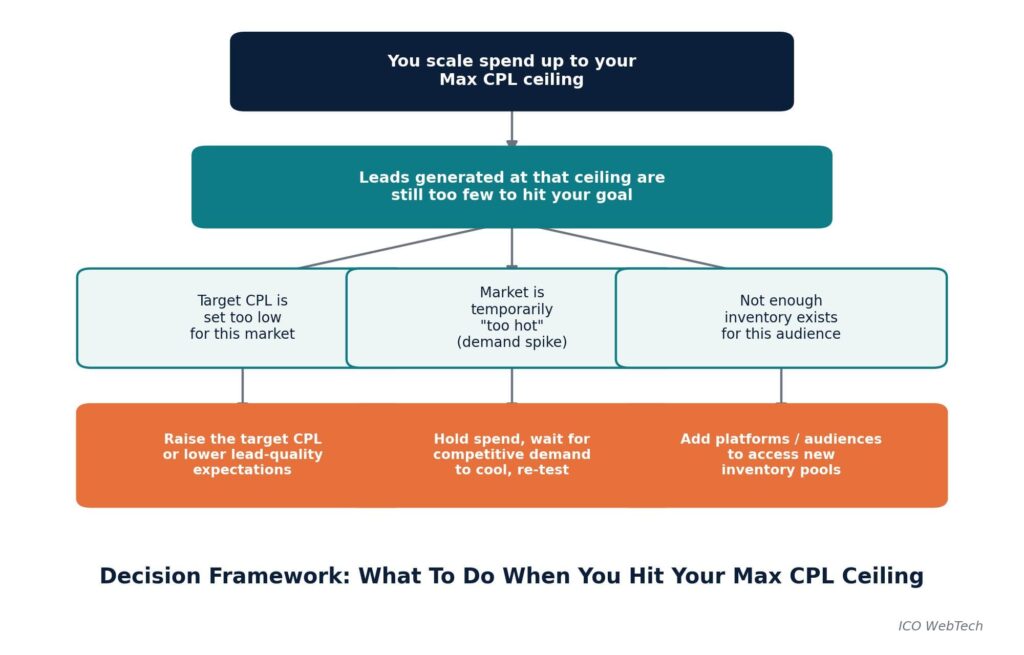
| Diagnosis | What’s happening | What to do |
|---|---|---|
| Target CPL is too low for the market | Your ceiling was set without reference to what this specific audience actually costs to reach right now. | Revisit the ceiling against realistic market pricing, or adjust lead-quality expectations. |
| The market is temporarily “too hot” | A spike in competitive demand, seasonal (e.g. Q4 retail), a competitor’s new campaign, or a category trend — is inflating prices across the board, not just for you. | Hold spend at the sustainable level, monitor, and re-test scaling once demand cools. |
| Not enough inventory exists for this audience | The addressable pool for this targeting, on this platform, is structurally too small to support the volume you need. | Expand to adjacent platforms or audience segments to access new inventory pools, rather than continuing to push price on a shrinking one. |
A note on seasonality and timing
Because price is set by competitive demand, the same audience can have very different headroom depending on when you test it. Scaling decisions made during a demand peak (holiday retail periods are the classic example) will show inflated costs that don’t reflect the account’s normal economics, while decisions made during unusually quiet periods can understate the true cost of scaling once competition returns to normal[9]. Where possible, validate scaling decisions during a representative, average-demand period rather than an extreme one.
A practical scaling playbook
- Run the learning phase long enough to trust the data — resist reacting to day-one or day-two results.
- Set a maximum CPL ceiling before scaling, based on your actual acquisition economics, not on the number your test happened to produce.
- Scale in moderate increments (roughly 10–20% every few days) rather than large jumps, and give each increment 2–3 weeks to stabilize before judging it[10][13].
- Track marginal CPL, not just average CPL, so you catch inefficiency before it’s buried in a healthy-looking blended number.
- If you hit your ceiling short of your volume goal, diagnose before you panic — is the target unrealistic, is demand temporarily elevated, or is the inventory pool structurally too small?
- Expand horizontally when a pool is saturated — new platforms, adjacent audiences, or additional creative variants — rather than continuing to push price on an audience that has run out of cheap supply[10].
Key takeaways
1. Early campaign performance is unreliable both because of small-sample statistical noise and because low spend only buys the cheapest slice of available ad inventory.
2. Ad inventory is priced by an auction, and it is finite for any given audience — which means CPL is not fixed as spend increases, and cost naturally rises once the cheapest supply is exhausted.
3. The strategic fix is to set a maximum acceptable CPL before scaling, and scale spend up to that ceiling — treating it as a deliberate target rather than discovering it by accident after costs have already spiked.
4. If you reach your ceiling without hitting your lead-volume goal, that’s diagnostic information — either your target CPL, the current market conditions, or the size of the addressable inventory pool needs to change.
Not sure where your campaign’s sweet spot ends?
ICO WebTech’s paid media team models the supply curve for your specific audiences before we scale a single dollar of client budget.
References
- “What Is Statistical Significance in A/B Testing?” MetricsWatch. Retrieved 2026. metricswatch.com
- “Statistical significance does not imply a real effect.” National Center for Biotechnology Information (NCBI). ncbi.nlm.nih.gov
- “YourAdvalue: Measuring Advertising Price Dynamics without Bankrupting User Privacy.” arXiv. arxiv.org
- “Scalable Bid Landscape Forecasting in Real-time Bidding.” arXiv. arxiv.org
- “Real-Time Bidding Explained: How Digital Ads Are Sold.” The Digital Bunch. thedigitalbunch.com
- “Meta ads scaling framework breaks at $5k spend.” Elite Brands. elitebrands.org
- “Diminishing Returns.” Saxifrage Blog. saxifrage.xyz
- “When to Increase Your Ad Budget: Signals That Tell You It’s Time to Scale.” Stackmatix. stackmatix.com
- “Diminishing Returns on Ad Spend: When to Scale and When to Stop.” Stackmatix. stackmatix.com
- “Scaling Ads Without Losing Profit: A Complete Guide.” Cometly. cometly.com
- “Meta Ads Optimization: Marginal CPA vs Average CPA Guide.” Get Ryze. get-ryze.ai
- “The Real Reason Your CPA Spikes at Scale and How to Fix It.” Aden’s Lab. adenslab.com
- “Diminishing Returns: Accounting for Channel Saturation.” Recast. getrecast.com


How ICO Measures PPC Performance When AI Controls The Auction
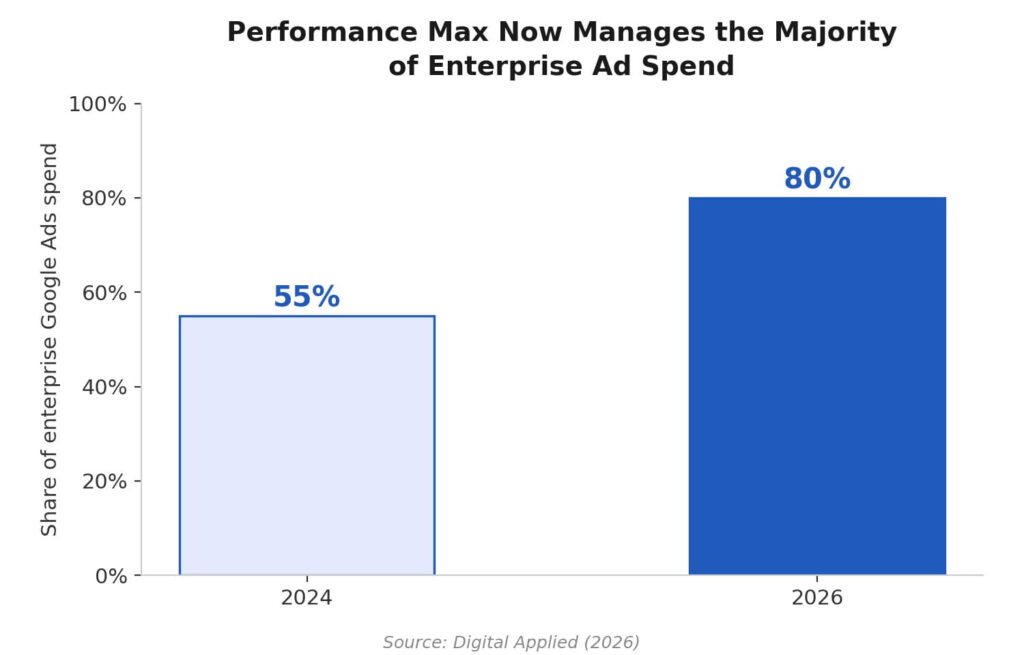
Performance Max now manages more than 80% of ad spend for the median enterprise Google Ads account, up from 55% just two years ago [1]. Smart Bidding handles 78% of all Google Ads spend across the platform [2]. Put plainly: the auction that decides whether your ad wins a click is no longer being run by a person. It’s being run by a model, in milliseconds, weighing more than 200 signals per query [3], and it’s making the bid decision your PPC manager used to make by hand.
It isn’t only bidding that’s changed hands. Google’s newer AI Max feature matches ads to queries an advertiser never typed into a keyword list at all, evaluating context and intent instead [8].
A campaign built around “trail running shoes” can now legitimately win an auction for “durable hiking running hybrids,” a query that was never targeted, was never tested, and doesn’t map cleanly back to any keyword report you’d have pulled two years ago.
Most of the industry has responded to that shift by getting better at feeding the machine. Fewer have stopped to ask a more uncomfortable question: if the algorithm is choosing the bid, the placement, and increasingly the creative combination, what exactly are we measuring when we report on CPC, CTR, or position?
Those numbers used to describe a marketer’s skill. Today they mostly describe the algorithm’s decision. Reporting on them as if they still reflect strategy is a little like grading a passenger on how well they steered a self-driving car.
This is the question we sit with on every account at ICO WebTech, and it’s the reason our reporting looks different. Below is the actual thinking, laid out plainly, along with the two frameworks we use to keep measurement honest when the thing doing the bidding isn’t a person anymore.
The metric you’re staring at might be the algorithm’s decision, not your strategy
Here’s the part that catches experienced marketers off guard. A campaign can post an 8x or 9x return on ad spend inside the platform and still be quietly underperforming the business goal it exists to serve.
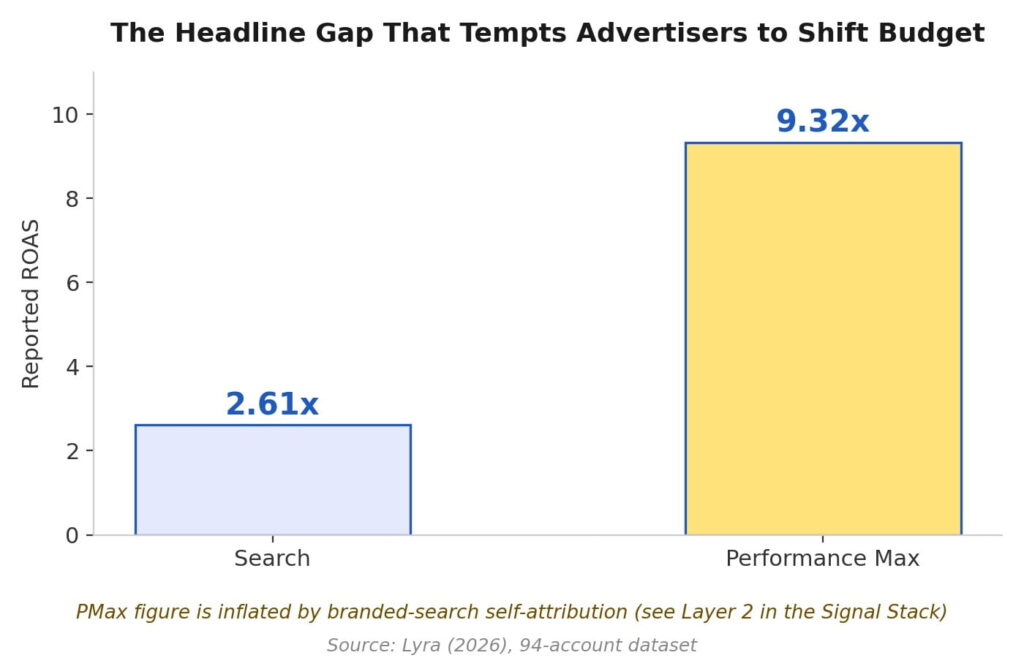
Performance Max campaigns have been shown to rely heavily on branded search queries, in which users are already typing a company’s name into Google [4]. Those clicks convert easily, because the person was already headed toward a purchase. The platform happily counts that conversion as a PMax win, and the reported ROAS climbs, even though the ad arguably contributed nothing beyond what would have happened anyway.
A recent audit of 94 live Google Ads accounts found Performance Max posting a 9.32x ROAS against Search’s 2.61x, a gap so large it would tempt almost any advertiser to shift budget wholesale into PMax [5].
But the same analysis noted the headline number hides real confounds, branded self-attribution chief among them. That’s not a knock on Performance Max as a tool. It’s a reminder that a platform-reported metric and a true incremental result are not the same thing, and treating them as interchangeable is how businesses end up congratulating an algorithm for selling to customers who were already sold.
Google has made real progress on transparency here, and it’s worth acknowledging. Channel-level reporting, search term insights, and asset-level data have all arrived over the past two years in direct response to advertiser pressure [6]. The old “black box” complaint isn’t entirely fair anymore. But visibility isn’t the same as action, and most teams still don’t use the data that’s now sitting right there in front of them. As one recent industry analysis put it, the problem has shifted from a lack of visibility to a lack of know-how [6]. The reports exist. Almost nobody is reading them the right way.
The Signal Stack: a framework for what to actually measure
We use a simple mental model with every client to sort out what’s actually worth watching, and we call it the Signal Stack. It has three layers, and the uncomfortable truth about it is that most reporting decks only ever show you the layer you control the least.
At the top sits Layer 3, business outcomes: cost per acquisition, ROAS, pipeline value. These are the numbers that show up in board decks and monthly reports, and they’re genuinely important. They’re also lagging indicators, and as the branded-search example above shows, they can be inflated by the very algorithm generating them.
Layer 2, in the middle, is auction behavior: impression share, search term composition, channel and placement splits. This layer is now visible thanks to Google’s reporting updates, but almost nobody looks here first, because it takes more effort to interpret than a single ROAS figure.
Layer 1, at the bottom, is your inputs: the quality of your conversion data, the audience signals you feed the algorithm, your creative assets, your exclusions. This is the only layer you fully control, and it’s where Google’s own guidance says the real competitive advantage now lives, since “the platform receives enough context to distinguish between high-quality and low-quality outcomes” only when the input data is clean [7].
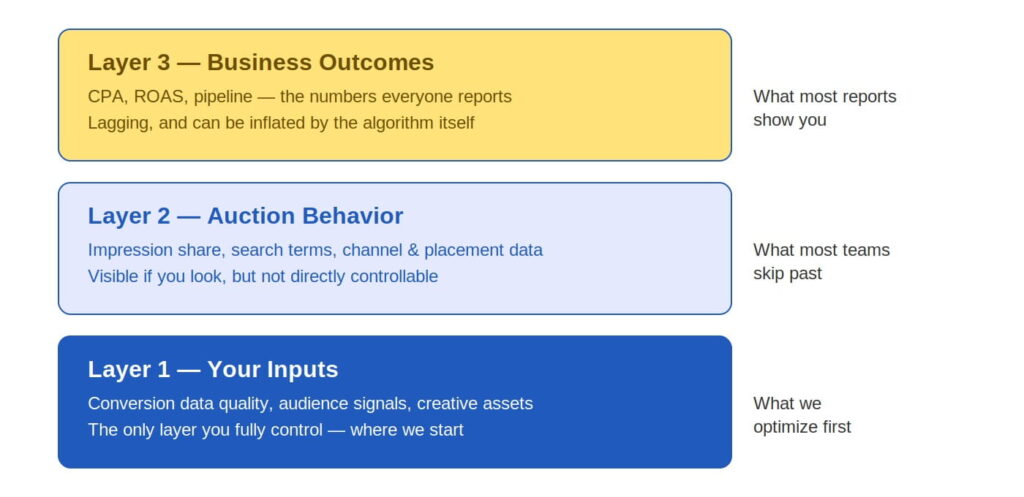
Most agencies report almost exclusively from Layer 3, because it’s the fastest layer to summarize in a slide. We start every account review at Layer 1, because that’s the layer where a genuine mistake or a genuine improvement actually originates. By the time a problem shows up in Layer 3, it’s already cost you weeks of spend.
The Black Box Audit: how we test what the algorithm is actually doing
Knowing where to look doesn’t automatically tell you what’s causing a shift in performance. Smart Bidding systems adjust dozens of variables simultaneously, which makes ordinary before-and-after comparisons nearly useless.
If you change your audience signals and your ROAS moves three weeks later, you have no way of knowing whether that shift came from your change, from a competitor’s bid adjustment, from a seasonal swing, or from the algorithm’s own ongoing learning process. So we run a disciplined, repeatable process instead of a guess, and we call it the Black Box Audit.
The process is deliberately unglamorous.
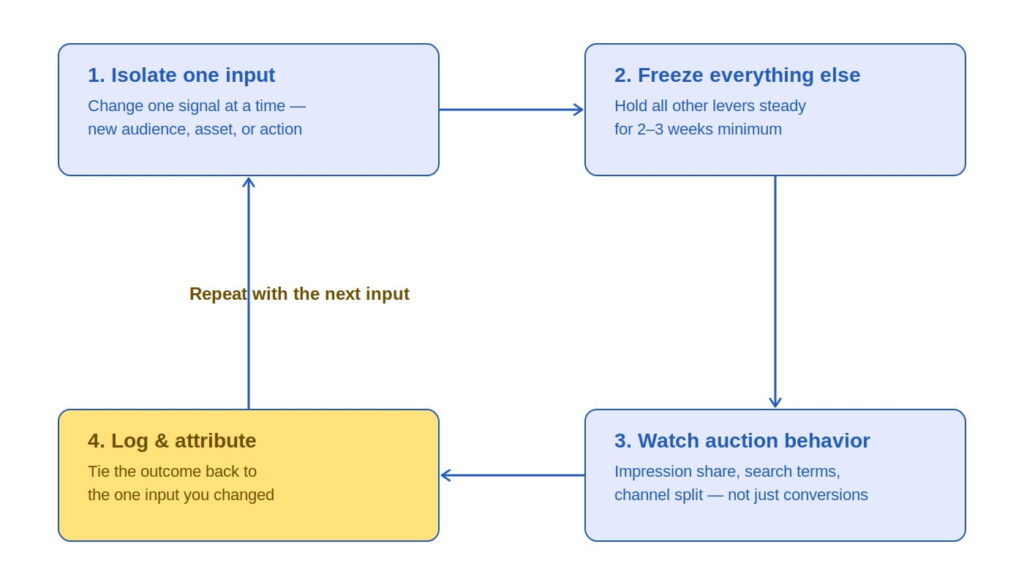
First, isolate a single input, one new conversion action, one new audience signal, or one new asset group, and change nothing else.
Second, freeze every other lever for a fixed learning window, typically two to three weeks, since Smart Bidding needs a consistent runway to relearn a pattern.
Third, and this is the step almost everyone skips, compare auction behavior rather than just the outcome. Did impression share shift? Did the search term mix change? Did the channel split move?
Fourth, log the result and attribute it specifically to the one input you changed, then move to the next variable. It’s slower than making five changes at once and hoping for the best. It’s also the only approach that lets you say, with any confidence, why a number moved.
Formal incrementality testing, geo holdouts, and branded-search suppression windows used to be out of reach for anything but the largest accounts. That’s changing. Google recently lowered the minimum spend required to run incrementality tests inside the platform to just $5,000 [8], which makes structured testing realistic for accounts that could never have justified it before. If you’ve been putting off finding out whether your conversions are incremental or just well-timed, the cost of finding out just dropped substantially.
Watching this play out with a B2B account
To make this concrete, here’s a composite example built from the patterns we see repeatedly across B2B accounts, not a single client’s exact figures, but an honest picture of how this plays out in practice. A mid-sized B2B manufacturer of industrial filtration equipment came to us with a Performance Max campaign reporting an 8x ROAS, a number their leadership team was, understandably, thrilled with. Sales, meanwhile, was asking a quieter and more pointed question: why hadn’t the volume of qualified engineering leads actually grown?
Running the Signal Stack, we moved past Layer 3’s flattering ROAS and into Layer 2. The search term insights report told a different story: nearly 40% of the campaign’s “high-performing” conversions were coming from branded queries, people already searching for the company by name, exactly the self-attribution pattern the industry has been flagging in Performance Max [4].
The algorithm wasn’t doing anything wrong by its own logic. It was simply optimizing toward the easiest conversions available to it, which happened to be existing brand awareness rather than new demand.
We ran a Black Box Audit against a single input: we added a tight negative-brand keyword list and rebuilt the audience signals around actual job titles and firmographics in procurement and engineering roles, then froze everything else for three weeks.
The reported ROAS dropped on paper, from 8x down to roughly 5x, which is exactly the kind of number that makes a client nervous during a monthly call. But sales-qualified leads from genuinely new accounts rose over the same period, because the budget was now finding people who’d never heard of the company instead of re-billing the company for people who already had.
The platform’s number got less impressive. The business result got considerably better. That gap is precisely why Layer 3 alone can’t be trusted as the whole story.
What this means if you’re the one signing off on the ad budget
None of this is an argument against automation. Advertisers using Smart Bidding report meaningfully better performance than manual bidding across nearly every recent benchmark, with some studies showing conversion lifts in the 20 to 40% range [3]. The algorithm is genuinely good at its job. The argument here is narrower and, we think, more useful: the algorithm’s job and your job are not the same job anymore, and your reporting needs to reflect that split honestly.
A few things follow from that, and they’re worth asking whoever manages your PPC account directly:
- Ask to see Layer 2 data, not just the ROAS summary. If your agency can’t show you search term composition or channel splits, they’re reporting on the algorithm’s press release, not its actual behavior.
- Ask when the last single-variable test was run on your account, and what changed as a result. If every optimization happens in a bundle of five changes at once, nobody can actually tell you what worked.
- Ask whether your reported ROAS has been checked against branded search volume. A high number driven mostly by your own brand name isn’t growth, it’s your existing reputation being counted twice.
- Ask what’s happening in your conversion data itself. Google’s own guidance is blunt about this: incomplete or inflated conversion signals teach the algorithm to optimize toward outcomes that look good but don’t reflect real business value [7].
The businesses getting the most out of AI-run auctions right now aren’t the ones spending the most. They’re the ones who’ve stopped treating the platform’s dashboard as the finish line and started treating it as one layer of a bigger picture, with the discipline to test what’s actually driving it rather than admire what it reports.
If your PPC reporting stops at ROAS and you’d like a second opinion on what’s really happening underneath it, our team at ICO WebTech will run a Signal Stack review on your account and show you exactly where the number is coming from. Book a free PPC audit here and see what’s actually driving your auction, not just what it’s reporting.
References
- Digital Applied. (2026). AI Google Ads bidding: PMax automation strategy 2026. https://www.digitalapplied.com/blog/ai-google-ads-bidding-automation-pmax-2026
- Digital Applied. (2026). PPC statistics 2026: 150+ paid search data points guide. https://www.digitalapplied.com/blog/ppc-statistics-2026-paid-search-data-points
- Get-Ryze.ai. (2026). Advanced Google Ads bidding strategies with AI 2026. https://www.get-ryze.ai/blog/advanced-google-ads-bidding-strategies-ai
- Search Engine Land. (2025). PMax and the illusion of trust: “I’m Google, what could go wrong?” https://searchengineland.com/google-pmax-trust-illusion-459833
- Lyra. (2026). State of Google Ads optimization 2026. https://www.lyrappc.com/reports/state-of-google-ads-2026/
- Smarter Ecommerce. (2026). 4 reasons why Google is no longer a “black box” (+ 4 problems that still exist). https://smarter-ecommerce.com/blog/en/google-ads/4-reasons-why-google-is-no-longer-a-black-box-and-4-problems-that-still-exist/
- Y77.ai. (2026). Google Ads trends 2026: AI Max, Demand Gen, PMax and what is actually changing. https://www.y77.ai/blogs/google-ads-trends-and-predictions-2026
- Osmundson, B. (2026). How to measure PPC performance when AI controls the auction. Search Engine Journal. https://www.searchenginejournal.com/how-to-measure-ppc-performance-when-ai-controls-the-auction/570184/
Why Digital Advertising Costs Rise Even When Your Campaign Hasn’t Changed
Key Takeaways
- Digital advertising prices are shaped primarily by auction dynamics, not fixed platform pricing.
- Rising CPCs and CPLs do not always indicate poor campaign performance. In many cases, they reflect increasing competition within the market itself.
- High-intent advertising inventory is naturally limited because it depends on real user behavior and audience availability.
- Advertiser demand often grows faster than available inventory, especially in high-value B2B industries where customer acquisition carries significant long-term revenue potential.
- External economic factors such as investor activity, currency movement, seasonal budget surges, and industry expansion can significantly influence auction pressure.
- Businesses that respond strategically rather than emotionally to rising advertising costs are often better positioned for long-term growth.
- Modern digital advertising success increasingly depends on broader strategic strengths including brand positioning, conversion optimization, SEO, GEO, content marketing, and audience trust.
- The future of performance marketing will favor businesses that understand both the technical and economic realities of digital advertising ecosystems.
Many business leaders have experienced this unsettling shift. A campaign that was delivering efficient results just a few months earlier suddenly begins demanding significantly higher investment to generate the same outcome. Cost-per-click rises steadily, cost-per-lead becomes increasingly difficult to control, and performance that once felt predictable starts showing signs of pressure.
The immediate reaction is usually tactical analysis. Teams begin auditing targeting settings, reviewing creatives, examining bidding strategies, and questioning whether platform algorithms have changed. Was the audience narrowed too aggressively? Has the messaging lost relevance? Is campaign fatigue setting in? Did something inside the account break without notice?
While these factors can certainly influence performance, they are often only part of the picture. In many cases, the deeper explanation is far more structural and far more important to understand:
The market itself changed.
Digital advertising does not operate within a fixed-price ecosystem where costs remain stable over time. It functions more like a live economic marketplace where pricing continuously fluctuates based on competitive demand, audience availability, platform inventory, user behavior, and broader market conditions.
Every impression, every click, and every advertising opportunity exists within a dynamic auction environment. As more businesses compete for the same audience, the same keywords, and the same buyer attention, pricing pressure naturally increases. In other words, rising advertising costs are not always the result of poor campaign execution. Quite often, they reflect increasing competition within the market itself.
This distinction matters because it fundamentally changes how businesses should interpret performance marketing.
Without understanding the economics behind digital advertising, companies often react emotionally to rising costs by making rushed tactical changes, reducing budgets prematurely, or assuming campaign inefficiency. However, marketers who understand how supply, demand, and auction pressure shape digital advertising costs are able to evaluate performance more strategically and respond with greater clarity.
Because in performance marketing, success is not determined solely by what happens inside the campaign dashboard. It is also shaped by what is happening across the wider market, among competitors, within industries, and across digital platforms, where attention itself has become one of the most competitive assets in modern business.
Digital advertising is built on real-time auctions
One of the most important realities many businesses overlook is that digital advertising platforms do not operate on fixed pricing models. Unlike traditional media buying, where advertisers once purchased ad placements at predetermined rates, modern digital advertising functions through continuous real-time auctions.
Every time a user performs a search on Google, scrolls through LinkedIn, watches a video on YouTube, opens Instagram, or visits a website in the display network, an advertising opportunity is created instantly. Behind the scenes, platforms evaluate multiple advertisers competing for that exact moment of user attention.
What ultimately determines which ad appears is not simply the highest bid.
Platforms such as Google Ads, Meta Ads, and LinkedIn Ads assess a combination of factors including bid value, ad relevance, expected engagement rates, landing page quality, historical campaign performance, and overall user experience signals. Their objective is not only to maximize advertising revenue, but also to maintain a platform experience that users continue engaging with.
However, regardless of how sophisticated these systems become, the underlying economic principle remains remarkably simple: when more advertisers compete for the same audience, prices rise.
This is why advertising costs can increase even when a company changes absolutely nothing inside its campaign.
The targeting may remain identical. The creative may still perform well. Conversion rates may remain stable. Yet if additional competitors enter the auction aggressively, begin allocating larger budgets, or start bidding more heavily on the same audience segments, the overall cost of participating in that auction naturally increases.
In many ways, digital advertising behaves like any highly competitive marketplace. The value of inventory is shaped not only by its availability, but by how many businesses are attempting to acquire it at the same time.
Consider a B2B software category where only a handful of companies were advertising aggressively a year ago. CPCs may have remained relatively manageable because competition was limited. Now imagine that the category begins receiving significant investor attention, new startups enter the space, established competitors expand budgets, and demand for market share accelerates.
Almost immediately, auction pressure intensifies.
The number of available searches may not increase dramatically. The number of qualified enterprise buyers may remain relatively fixed. But the number of companies attempting to capture those buyers rises sharply. As a result, advertising costs begin climbing across the industry.
This is one of the defining characteristics of modern digital advertising. Pricing is fluid, competition-driven, and continuously influenced by market participation.
Businesses that understand this dynamic are often better positioned to make rational, long-term marketing decisions. Instead of interpreting every increase in cost as campaign failure, they recognize that performance exists within a larger competitive ecosystem where external market forces frequently shape outcomes just as much as campaign settings themselves.
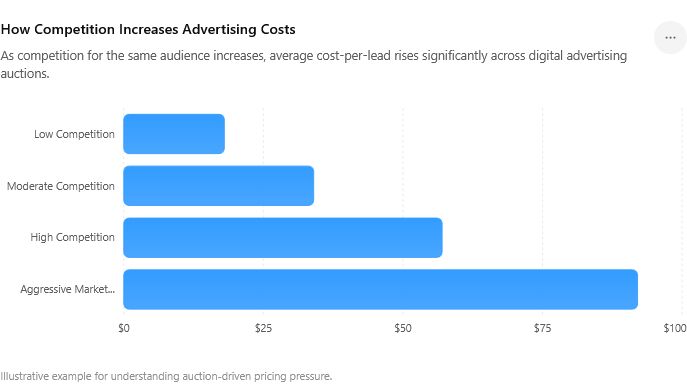
The supply side of digital advertising is more limited than most businesses realize
One of the most overlooked aspects of digital advertising is the concept of inventory supply. While many businesses focus heavily on campaign settings, bidding strategies, and creative optimization, far fewer consider the underlying availability of advertising opportunities themselves.
In digital advertising, inventory is not manufactured artificially at unlimited scale. It is created through real user activity.
Every search performed on Google, every LinkedIn session, every YouTube video view, every Instagram scroll, and every visit to a website within an advertising network contributes to the supply of available impressions and clicks. In simple terms, advertising platforms can only sell attention that genuinely exists.
This becomes especially important in high-intent markets.
For example, there may only be a limited number of enterprise decision-makers searching each day for highly specific B2B terms such as “cloud compliance software,” “enterprise procurement automation,” or “industrial cybersecurity solutions.” These searches are extremely valuable because they often signal real buying intent. However, the volume itself may remain relatively small.
Now consider what happens when a growing number of companies begin targeting that same audience.
The available supply of qualified searches does not suddenly double overnight. The number of relevant buyers may remain relatively stable, yet advertiser demand increases aggressively. As more companies compete for the same limited inventory, pricing pressure intensifies across the auction ecosystem.
This is one of the defining economic realities of digital advertising: high-quality inventory is finite.
Platforms can certainly expand overall inventory over time through user growth, increased engagement, or new advertising placements. However, the most commercially valuable audiences are often naturally constrained. There are only so many enterprise buyers, high-intent searches, or decision-makers available within a given market at any moment.
In many ways, this resembles prime commercial real estate. A high-traffic retail location in a major business district commands higher pricing not because the building itself changed, but because demand for that location exceeds available space. Digital advertising operates in a remarkably similar manner. Premium audience attention becomes more expensive as more advertisers attempt to access it simultaneously.
Emerging technology trends may also influence supply dynamics in the years ahead.
As AI-driven interfaces and conversational search experiences become more common, user behavior may gradually shift away from traditional search patterns. If users increasingly receive direct answers from AI systems instead of performing multiple searches, the total volume of searchable advertising inventory could evolve significantly over time.
This does not necessarily reduce the importance of digital advertising, but it may reshape where and how advertising opportunities are created.
For businesses and marketers, understanding the supply side of digital advertising provides critical strategic perspective. Rising costs are not always caused by inefficient campaigns. In many cases, they reflect a simple market reality: more advertisers are competing for a limited pool of valuable audience attention.
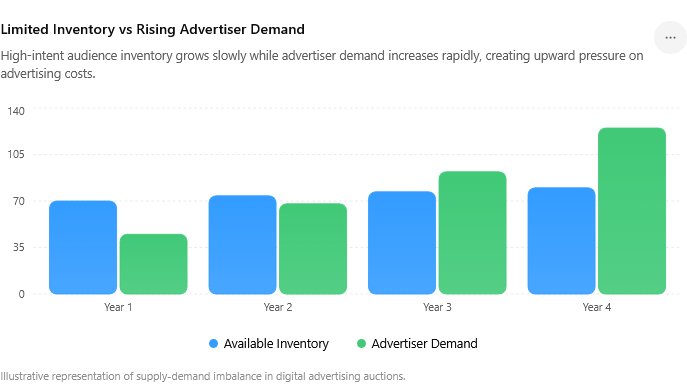
Demand is the real force that pushes advertising costs higher
While advertising inventory typically grows gradually, advertiser demand can increase very quickly. This imbalance is one of the primary reasons digital advertising costs often rise faster than many businesses expect.
In simple terms, supply in digital advertising is constrained by user activity, but demand is driven by business ambition.
Every time more companies enter a market, expand budgets, launch new products, pursue aggressive growth targets, or increase customer acquisition efforts, auction competition intensifies. The result is greater pressure on the same pool of available audience attention.
This dynamic becomes especially visible in high-value B2B industries where each qualified lead may represent substantial long-term revenue.
Consider categories such as:
- Enterprise software
- Cybersecurity solutions
- Cloud infrastructure services
- Procurement platforms
- AI technology products
- Financial technology solutions
In these industries, companies are not simply competing for clicks. They are competing for access to highly specific decision-makers who may influence contracts worth thousands or even millions of dollars.
As a result, businesses are often willing to bid aggressively because the potential return justifies the investment.
This creates a powerful economic effect inside advertising auctions. Even a moderate increase in advertiser demand can produce disproportionately large increases in CPCs and CPLs when the available audience remains relatively fixed.
For example, imagine there are only 5,000 highly qualified enterprise buyers actively researching procurement software within a particular market each month. If ten companies compete for that audience, pricing may remain relatively sustainable. But if thirty companies begin targeting the same buyers while increasing budgets simultaneously, competition escalates rapidly.
The audience itself may not have grown significantly. However, the number of advertisers attempting to capture that audience has increased dramatically.
This is where many businesses misunderstand digital advertising economics.
Platforms are not arbitrarily raising prices. Instead, the market itself is becoming more competitive because more advertisers are placing higher value on the same audience.
In many ways, this resembles financial markets or commercial real estate. When multiple buyers compete aggressively for a limited asset, prices naturally rise. Digital advertising behaves similarly because user attention has become one of the most valuable commercial assets in the modern economy.
This is also why certain industries experience persistently high advertising costs regardless of platform optimizations. The stronger the commercial value of a customer, the more aggressively businesses are willing to compete for acquisition.
For marketers, this understanding is essential because it changes how campaign performance should be evaluated.
When acquisition costs rise, the issue is not always campaign inefficiency. Sometimes the business is simply operating inside a market where advertiser demand has accelerated faster than available audience supply.
Recognizing this distinction allows companies to respond more strategically by focusing on positioning, conversion efficiency, brand trust, and audience quality rather than assuming every increase in cost represents campaign failure.
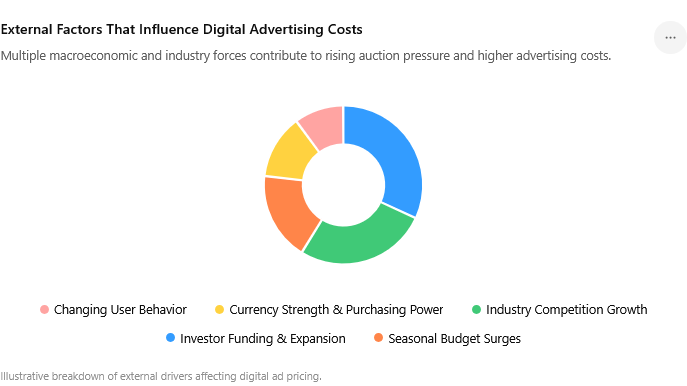
Why rising advertising costs should be interpreted strategically, not emotionally
One of the most common mistakes businesses make in performance marketing is assuming that rising advertising costs automatically indicate campaign failure.
When CPCs increase, or lead acquisition becomes more expensive, the immediate response is often reactive. Teams begin changing creatives aggressively, resetting targeting structures, switching bidding strategies, or reducing budgets prematurely in an attempt to regain short-term efficiency.
While optimization is an essential part of digital marketing, reacting too quickly without understanding the broader market context can sometimes create even greater instability inside campaigns.
This is because digital advertising performance does not exist in isolation.
Campaigns operate within a larger competitive ecosystem influenced by advertiser demand, auction pressure, audience saturation, economic conditions, and shifting user behavior. When these external conditions change, advertising costs may rise even if campaign execution remains fundamentally strong.
Understanding this distinction is critical for making better strategic decisions.
For example, if an industry experiences rapid growth and multiple competitors suddenly begin increasing budgets aggressively, higher acquisition costs may reflect stronger market competition rather than declining campaign quality.
In this situation, continuously rebuilding campaigns may not solve the underlying issue because the pressure is originating from the market itself.
Instead, businesses often benefit more from focusing on areas such as:
- Improving landing page conversion rates
- Strengthening brand positioning
- Enhancing creative differentiation
- Increasing audience trust
- Improving lead quality rather than lead volume
- Building stronger organic demand generation channels
These strategic improvements help businesses compete more effectively even when advertising markets become more expensive.
Consider two companies operating within the same increasingly competitive B2B market.
The first company reacts to rising CPCs by constantly changing campaigns, pausing ads frequently, and reducing spend unpredictably. Performance becomes inconsistent because optimization decisions are driven primarily by short-term fluctuations.
The second company recognizes that auction competition across the industry has intensified. Instead of reacting impulsively, it focuses on improving messaging clarity, strengthening conversion experiences, refining targeting quality, and investing in brand authority.
Over time, the second company often develops greater resilience because its strategy adapts to market conditions rather than fighting against them.
This is one of the most important mindset shifts in modern performance marketing.
Successful digital advertising is not simply about lowering costs at all times. It is about understanding the economics of the market, interpreting performance accurately, and building systems that remain effective even as competition evolves.
In highly competitive industries, rising advertising costs are often a sign that markets themselves are becoming more valuable. More businesses are competing because customer acquisition opportunities are commercially important.
Viewed from this perspective, higher costs are not always negative signals. They are often indicators of increasing market demand and growing competitive intensity.
The businesses that succeed long-term are usually not the ones reacting most aggressively to short-term volatility. They are the ones that understand how digital advertising markets function beneath the surface and respond with clarity, patience, and strategic precision.
Digital advertising is becoming more competitive, but also more strategic
As digital advertising markets mature, one trend is becoming increasingly clear: success is no longer determined simply by who spends the most money.
In earlier stages of digital marketing, many businesses could achieve strong performance through relatively straightforward campaign execution. Competition was lower, audiences were less saturated, and advertising platforms still offered large volumes of underpriced inventory.
Today, the environment is fundamentally different.
Most industries now operate within highly competitive advertising ecosystems where multiple businesses target similar audiences using increasingly sophisticated strategies. Platforms have evolved, audiences have become more selective, and acquisition costs have risen across many categories.
As a result, digital advertising is becoming less of a purely tactical exercise and more of a strategic discipline.
The companies achieving long-term success are typically those that understand how multiple business functions influence marketing performance simultaneously.
Strong campaigns today are often supported by:
- Clear market positioning
- High-quality creative strategy
- Effective landing page experiences
- Strong brand perception
- Audience trust and credibility
- Efficient sales processes
- Accurate audience segmentation
- Consistent demand generation efforts
In other words, modern digital advertising performance increasingly reflects the overall strength of the business itself, not just the technical setup of campaigns.
This shift is particularly visible in B2B markets where buyers often conduct extensive research before making purchasing decisions.
Enterprise buyers rarely convert because of a single advertisement alone. They evaluate credibility, expertise, positioning, content quality, social proof, website experience, and long-term trust before engaging seriously with a company.
This means businesses that invest only in paid media while neglecting broader brand and demand-generation strategies often face growing efficiency challenges over time.
On the other hand, companies that build strong market presence across multiple channels frequently experience stronger advertising performance because audiences already recognize and trust them before the click even occurs.
This is why digital advertising increasingly works best when integrated with broader growth systems such as:
- SEO and organic visibility
- Content marketing
- Generative Engine Optimization (GEO)
- Social media positioning
- Email nurturing
- Brand storytelling
- Thought leadership
- Conversion rate optimization
Together, these elements reduce acquisition friction and improve the efficiency of paid campaigns over time.
Another important reality is that platforms themselves are evolving rapidly.
Artificial intelligence is changing how users discover information. Search behavior is shifting. Audience attention is fragmenting across platforms. Privacy regulations continue reshaping targeting capabilities. Attribution models are becoming more complex.
All of this means businesses can no longer rely solely on short-term campaign tactics as sustainable competitive advantages.
The future of digital advertising will likely belong to companies that combine performance marketing expertise with strong strategic foundations.
That includes businesses capable of understanding customer psychology, building trust at scale, creating differentiated positioning, and adapting intelligently as markets evolve.
For marketers, this creates both a challenge and an opportunity.
Competition may continue increasing, but businesses that understand the deeper economics and strategic dynamics of digital advertising are often better positioned to navigate change successfully.
Because ultimately, the goal is not simply to buy traffic.
The goal is to build sustainable demand, meaningful market presence, and long-term growth within increasingly competitive digital ecosystems.
Final thoughts: the future of digital advertising belongs to strategic businesses
Digital advertising is becoming more competitive, more sophisticated, and more economically complex with every passing year. Rising acquisition costs are no longer isolated platform issues. They are often the result of deeper market forces involving competition, audience scarcity, investor activity, shifting user behavior, and evolving digital ecosystems.
Businesses that understand these dynamics are far better positioned to make intelligent marketing decisions.
Instead of reacting impulsively to short-term fluctuations, they evaluate performance within the broader context of market conditions, competitive pressure, and long-term growth strategy. They recognize that sustainable performance marketing is not simply about lowering CPCs or generating cheaper leads. It is about building stronger positioning, higher trust, better conversion systems, and resilient demand-generation engines that continue performing even as markets evolve.
As digital advertising platforms become increasingly crowded, competitive advantage will belong to businesses that combine performance marketing expertise with strategic clarity.
That means understanding not only how campaigns function technically, but also how digital markets behave economically.
At ICO WebTech, we help businesses navigate this evolving landscape through performance-driven digital marketing strategies designed around long-term growth, intelligent positioning, and measurable business outcomes.
From SEO, GEO, and paid media to conversion optimization, content strategy, and demand generation, our focus is not simply on generating traffic — it is on helping businesses compete more effectively in increasingly competitive digital markets.
Because successful digital marketing today is not about chasing algorithms.
It is about understanding markets, understanding audiences, and building sustainable systems that create long-term business value.

Ad Fatigue and Attention Spans: How to Stand Out in 2025’s Crowded Digital Landscape
Today capturing and holding attention is harder than ever. Consumers are bombarded with ads on every platform—social media, websites, search engines, and even streaming services. This constant exposure leads to ad fatigue, where users become desensitized to advertisements, scrolling past them without a second thought.
At the same time, attention spans are shrinking due to the rise of short-form content like TikTok videos, Instagram Reels, and YouTube Shorts. In 2025, brands must rethink their advertising strategies to break through the clutter, engage audiences, and drive conversions.
This article explores the impact of ad fatigue, the decline in attention spans, and practical strategies for brands to stand out in an oversaturated digital space.
Understanding Ad Fatigue: Why Your Ads Are Getting Ignored (And How to Fix It)
Imagine scrolling through your favorite social media platform, only to see the same ad—again. And again. And again. At first, you might have clicked out of curiosity. But by the tenth time? You’re swiping past it without a second thought.
This is ad fatigue, and it’s one of the biggest challenges facing digital marketers today. When audiences see the same or similar ads too frequently, they lose interest, engagement drops, and brands end up spending more for fewer results.
How to Spot Ad Fatigue Before It Hurts Your Campaigns
Not sure if your audience is experiencing ad fatigue? Watch for these warning signs:
- Lower Click-Through Rates (CTR): If fewer people are clicking on your ad, they’re likely tired of seeing it.
- Higher Cost-Per-Click (CPC): Platforms like Google and Facebook charge more when engagement decreases, making your ads more expensive.
- Decreased Return on Ad Spend (ROAS): When your ads stop converting, your overall return on investment (ROI) takes a hit.
- Increased Ad Blindness: Even if your ad is still being shown, users may subconsciously ignore it because it no longer feels relevant or fresh.
Ignoring these signs could mean wasting money on ads that no one cares about. So, what’s causing this problem in the first place?
The Biggest Causes of Ad Fatigue
Understanding what triggers ad fatigue is the first step to avoiding it. Here are the most common culprits:
Overexposure to the Same Ad
Repetition might work in branding, but when an audience sees the same creative too many times, it starts to backfire. If your ad keeps popping up without any variation, users will mentally tune it out—or worse, develop a negative association with your brand.
Fix It: Refresh your ad creatives every 7-10 days to keep content engaging. Try different images, videos, and messaging to keep things fresh.
Lack of Personalization
Generic, one-size-fits-all ads are a surefire way to lose engagement. Today’s consumers expect ads tailored to their preferences, behaviors, and interests. If your message isn’t relevant to them, they’ll ignore it.
Fix It: Use AI-powered dynamic ads that adapt to user behavior, preferences, and demographics. Segment your audience to deliver highly targeted content instead of blasting the same message to everyone.
Irrelevant Messaging
Even a great ad can flop if it’s shown to the wrong audience. If your messaging doesn’t align with a user’s needs or intent, it’s just another interruption.
Fix It: Leverage data-driven targeting to ensure your ads reach the right audience at the right time. A/B test different messages and CTAs to see what resonates best.
Ad Saturation
When every platform is flooded with ads, users become desensitized. If people see multiple ads in a short time—especially from the same brand—it creates a feeling of digital overload.
Fix It: Use frequency capping to limit how often a user sees your ad. Experiment with native advertising that blends naturally into the content they consume.
The Bottom Line
Ad fatigue is real, and it’s costing businesses millions in wasted ad spend. But with smart audience targeting, fresh creatives, and a personalized approach, you can keep your campaigns performing at their best.
Don’t let your ads become background noise—keep them fresh, relevant, and engaging!
The Shrinking Attention Span Problem: Why You Have Only 3 Seconds to Make an Impact
In today’s digital world, grabbing and holding attention is like catching lightning in a bottle. Studies show that the average human attention span has dropped significantly, with many users engaging with content for just a few seconds before scrolling away.
Blame it on information overload, multi-tasking, or the rise of short-form content—whatever the reason, brands now have less time than ever to make an impression.
Why Are Attention Spans Getting Shorter?
Several factors contribute to this rapid decline in focus, making it harder for ads to stand out:
1. The TikTok & Reels Effect
Platforms like TikTok, Instagram Reels, and YouTube Shorts have conditioned users to consume content in bite-sized bursts of 3-15 seconds. If a video doesn’t hook them instantly, they’re on to the next.
For advertisers, this means long-winded intros and slow-build storytelling won’t work anymore—you need to capture attention immediately or risk getting ignored.
2. Multi-Screen Behavior
Ever watched Netflix while scrolling Instagram? Checked your email during a Zoom meeting? You’re not alone.
With smartphones, tablets, and smart TVs all competing for attention, users are constantly dividing their focus. A single ad has to work even harder to break through the noise.
3. Information Overload & Instant Filtering
The average person encounters over 10,000 ads daily—from social media feeds to search results and in-app promotions.
To cope, the brain has developed “auto-filtering” mechanisms, instantly recognizing and discarding anything that doesn’t seem relevant or interesting. If your ad looks like just another sales pitch, it’s getting ignored.
How to Win in the Age of Short Attention Spans
With users scrolling faster than ever, brands must rethink their approach to digital advertising. Here’s how to make an impact before they swipe away:
1. Capture Attention in the First 2-3 Seconds
Those first few seconds are critical. Whether it’s a bold visual, a shocking statement, or an intriguing question, your ad must hook viewers immediately.
Example: Instead of starting a video with “Introducing our new product,” try “This secret could double your sales in 30 days.”
2. Keep It Short, Snappy, and Visual
Forget long paragraphs—opt for eye-catching visuals, bold headlines, and quick cuts. Short-form video, GIFs, and motion graphics work far better than static images.
Think fast, dynamic storytelling that delivers the message without requiring too much effort from the viewer.
3. Make It Interactive
Passive content gets ignored—interactive content keeps people engaged. Polls, quizzes, swipe-up features, and clickable elements encourage participation and extend attention.
Example: Instead of “Buy Now,” try “Swipe to see the magic happen.”
4. Personalize for Relevance
Generic ads are the easiest to ignore. Use AI-powered targeting to ensure your content is hyper-relevant to each user. Personalized ads that align with interests and behavior will always outperform one-size-fits-all messaging.
5. Optimize for Multi-Platform Viewing
Your audience isn’t just on one platform—they’re bouncing between Instagram, YouTube, LinkedIn, and Google. Ensure your ad format works across multiple devices and platforms, from mobile-first designs to vertical video formats.
The Bottom Line
In 2025, attention is the new currency—and brands that fail to adapt will be left behind. To survive in this hyper-fast digital landscape, your ads must be instant, engaging, and impossible to ignore.
You have 3 seconds—make them count!
How to Overcome Ad Fatigue and Capture Attention in 2025
In today’s hyper-connected world, advertising is everywhere—on social media, search engines, streaming platforms, and even in our inboxes. But here’s the problem: people are tuning out.
With ad fatigue on the rise and shrinking attention spans, brands need to rethink their approach to digital advertising. If your ads aren’t fresh, engaging, and personalized, they’ll be ignored—or worse, actively disliked.
So, how do you break through the noise? By being bold, creative, and strategic. Let’s dive into the most effective ways to combat ad fatigue and capture attention in 2025.
1. Diversify Ad Creatives Regularly
One of the biggest reasons for ad fatigue is repetition. If your audience sees the same creative over and over again, they’ll start ignoring it—or even develop negative associations with your brand.
How to Keep Your Ads Fresh:
- Rotate ad creatives every 7-10 days to prevent overexposure.
- Use multiple variations of your ads with different visuals, headlines, and CTAs.
- Leverage Dynamic Creative Optimization (DCO): This AI-driven feature automatically tests different combinations of creatives and optimizes for the best-performing ones.
💡 Pro Tip: Use seasonal and event-based creatives to stay relevant. Ads that align with current events, holidays, or trends tend to perform better.
2. Use Hyper-Personalization
Generic ads are dead. Today’s consumers expect ads that are tailored to their interests, behaviors, and needs.
How to Make Ads Personal:
- Leverage AI-driven targeting to deliver highly relevant ads based on user data.
- Create ad sequences that guide users through different stages of the buying journey.
- Use location-based, behavior-based, and interest-based targeting to improve engagement.
💡 Example: Instead of showing a generic fitness product ad, deliver a workout plan ad based on the user’s past searches, location, or activity level.
3. Make Ads Interactive
Static ads are boring. If you want people to engage with your brand, give them something to interact with.
Ways to Make Ads Interactive:
- Polls & Quizzes: Let users participate and influence the content.
- Gamification: Reward engagement with points, discounts, or exclusive content.
- Augmented Reality (AR): Try-on filters, 3D product previews, and interactive experiences.
💡 Example: A makeup brand can use AR filters that let users “try on” different lipstick shades before purchasing.
4. Leverage Short-Form, High-Impact Content
People don’t have time for long-winded ads. The faster you can deliver your message, the better.
How to Maximize Short-Form Ads:
- Prioritize short video ads (6-15 seconds) optimized for TikTok, Instagram Reels, and YouTube Shorts.
- Use text overlays and subtitles to grab attention instantly—even when the sound is off.
- Start with a strong hook in the first 2-3 seconds (e.g., a bold question, surprising fact, or emotional trigger).
💡 Example: Instead of saying, “Our new sneaker is here!”, start with “Would you wear a sneaker made from recycled ocean plastic?”
5. Adopt Storytelling and Emotional Appeal
People remember stories, not sales pitches. If your ads don’t create an emotional connection, they won’t be memorable.
Ways to Add Emotion to Your Ads:
- Tell a relatable or inspiring story instead of pushing features.
- Use real testimonials and user-generated content to build trust.
- Leverage humor, suspense, or controversy to keep viewers engaged.
💡 Example: Instead of a generic car commercial, tell the story of a father teaching his daughter how to drive—ending with a message about safety and reliability.
6. Use AI for Smart Ad Delivery
With so much competition, smart ad delivery is key to staying ahead. AI can help optimize placements, targeting, and messaging in real time.
How AI Can Improve Your Ads:
- Predictive analytics helps determine when and where ads should appear for maximum impact.
- AI-driven platforms like Meta and Google optimize ad placements based on engagement trends.
- Automated ad copy generation prevents repetitive messaging and keeps ads fresh.
💡 Example: AI can adjust ad spend in real-time based on user behavior, automatically shifting budget to high-performing campaigns.
7. Prioritize Native and Organic-Looking Ads
People have ad blindness—they instinctively scroll past anything that looks too much like an ad. The solution? Blend in.
How to Make Ads Feel More Organic:
- Use native advertising—ads that look and feel like regular content.
- Avoid overly polished, traditional ads. Instead, use user-generated content (UGC) for a more natural feel.
- Leverage influencer marketing to amplify ad reach with trusted voices.
💡 Example: Instead of a scripted product ad, showcase a real customer review video that looks like a regular social media post.
8. Optimize for Multi-Platform and Omnichannel Experiences
Your audience isn’t just on one platform. They’re moving between Instagram, YouTube, LinkedIn, and email—your ads should move with them.
How to Optimize for Multi-Platform Success:
- Ensure ad messaging is consistent across social media, search, video, email, and in-app ads.
- Use retargeting strategies to reconnect with users across different touchpoints.
- Integrate ads with chatbots, WhatsApp, and SMS for personalized follow-ups.
💡 Example: A user sees your Instagram ad, visits your website, but doesn’t buy. A retargeting ad on YouTube later reminds them to complete their purchase.
Final Thoughts: The Future of Attention-Grabbing Ads
In 2025, standing out in the digital ad space means being creative, adaptive, and data-driven. It’s not just about getting noticed—it’s about keeping attention.
Rotate and personalize your creatives.
Make ads interactive, emotional, and short-form.
Leverage AI for smarter ad placements.
Ensure your ads feel natural and blend into content.
With the right strategies, tools, and mindset, your brand can beat ad fatigue, capture attention, and drive real engagement.
The Future of Digital Advertising in 2025
As technology advances, brands must be more adaptive and creative to remain competitive. Some emerging trends include:
✅ AI-Powered Ad Creation: AI will generate video ads, copy, and graphics in real time.
✅ Voice Search Ads: Optimizing for voice search (Siri, Alexa) will create new advertising opportunities.
✅ Metaverse and Immersive Ads: Virtual reality (VR) and 3D advertising will shape the future.
✅ Privacy-First Targeting: With increased privacy regulations, contextual targeting will replace traditional cookie-based tracking.
In 2025, standing out in a crowded digital landscape requires innovation, personalization, and adaptability. Brands that embrace short-form content, AI-driven targeting, engaging storytelling, and omnichannel strategies will not only combat ad fatigue but also maximize attention and conversions.
The key takeaway? Think less about ads and more about engagement. The brands that connect meaningfully with their audiences will thrive in the evolving digital world.
Are your ads ready for the future?


Surviving the Surge in AI-Powered Ads: Strategies for Authentic Brand Voice
As artificial intelligence (AI) continues to revolutionize advertising, businesses are experiencing both unprecedented opportunities and significant challenges. AI-powered ads, characterized by their precision targeting, dynamic personalization, and real-time optimization, are reshaping how brands connect with consumers. While these advancements offer immense potential, they also come with a risk: losing an authentic brand voice in the race for efficiency. Here are strategies to ensure your brand remains genuine and relatable amidst the surge in AI-powered advertising.
1. Define Your Core Brand Identity
Before diving into AI-driven advertising tools, it’s crucial to solidify your brand’s core identity. AI systems rely on data inputs to generate content, so providing clear guidelines ensures your brand’s essence isn’t diluted. Taking the time to define your brand’s personality, tone, and values creates a strong foundation for all AI-generated content.
- Develop Brand Guidelines: Create comprehensive documentation detailing your brand’s tone, voice, values, and visual elements. Specify whether your tone is formal or conversational, professional or playful, and ensure your visual identity—including color schemes, logos, and design elements—is clearly outlined. These guidelines serve as the blueprint for maintaining consistency across all AI-generated outputs.
- Articulate Your Mission and Vision: Your mission and vision define the core purpose of your brand and where you aspire to go. AI tools should amplify these ideals, not overshadow them. For example, if sustainability is central to your mission, ensure your campaigns emphasize this value consistently. This clarity ensures your messaging aligns with your overarching goals and resonates with your target audience.
- Set Boundaries for AI Outputs: Clearly define the types of language, imagery, and messaging that align with your brand’s personality. For instance, specify whether humor is appropriate, outline sensitive topics to avoid, and determine the level of formality required. Providing these boundaries ensures AI-generated content reflects your brand’s unique character and avoids missteps that could harm your reputation.
By solidifying your core brand identity, you create a roadmap for AI tools to follow, ensuring that efficiency and innovation go hand-in-hand with authenticity.
2. Humanize Your AI-Generated Content
While AI is remarkable for its ability to quickly generate large volumes of content based on data, it can sometimes miss the nuances of human emotion, creativity, and culture. Without a thoughtful human touch, AI-generated content may come across as robotic, impersonal, or disconnected from your target audience. To bridge this gap and create more authentic, relatable content, it’s essential to combine AI’s efficiency with human insight and creativity.
Review and Edit AI Outputs: AI can produce content that is technically accurate and efficient, but it often lacks the ability to truly capture your brand’s unique voice or emotional tone. A human editor should always review AI-generated content to ensure that it aligns with your brand values, tone, and messaging. This review process can refine the language, enhance emotional resonance, and add cultural relevance, ensuring that your content doesn’t just inform but also engages your audience on a deeper level.
Incorporate Storytelling: AI can analyze data to identify patterns in audience preferences, but storytelling requires empathy, imagination, and an understanding of human experience. A human touch is necessary to craft narratives that resonate emotionally with your audience. By blending AI’s data-driven insights with human creativity, you can create stories that foster genuine connections, inspire action, and build trust. Whether you’re sharing a customer success story or presenting your brand’s mission, ensure the narrative feels real and relatable.
Highlight Real Voices: One of the most powerful ways to humanize your content is by showcasing the voices of real people. This could include customer testimonials, user-generated content, or behind-the-scenes stories from your team members. When you include authentic experiences and perspectives, it adds credibility and relatability to your message. These voices ground your content in reality and make your brand feel more accessible, trustworthy, and human. By integrating real stories and experiences, you not only humanize your campaigns but also foster a stronger emotional connection with your audience.
3. Prioritize Data Ethics and Transparency
As consumers become more conscious of how their data is collected and used, brands must adopt responsible data practices that prioritize transparency and ethical considerations. Trust is a cornerstone of any successful relationship with your audience, and when it comes to AI, consumers want to know how their information is being utilized. By adhering to strong ethical guidelines and clearly communicating your data usage policies, you can foster trust and create long-term loyalty.
Be Transparent About AI Usage: It’s essential to openly communicate with your audience about the role AI plays in your campaigns. Whether you’re using AI for personalized ads, chatbots, or content generation, informing consumers about AI’s involvement allows them to make informed decisions about their engagement. Transparency about AI usage not only builds trust but also demonstrates that your brand values honesty and openness. For example, if a customer is interacting with a chatbot or receiving personalized recommendations, make it clear that these experiences are powered by AI. This transparency helps to humanize AI technologies and ensures consumers aren’t left wondering how decisions are made behind the scenes.
Focus on Privacy: Consumer privacy is a critical concern in the digital age. It’s essential for brands to ensure their data collection and usage practices comply with relevant privacy laws and regulations such as the General Data Protection Regulation (GDPR) or the California Consumer Privacy Act (CCPA). By adhering to these regulations, you demonstrate a commitment to safeguarding your customers’ personal information. Go beyond compliance by communicating your dedication to protecting privacy in all of your marketing materials. Provide clear explanations of how consumer data is collected, used, and stored, and give users control over their information. This helps establish a relationship built on trust and security.
Avoid Over-Personalization: While AI enables hyper-targeted advertising, excessive personalization can sometimes cross the line into invasiveness, making consumers feel uncomfortable or stalked. While personalized ads can be effective, it’s important to strike a balance and respect users’ boundaries. Over-targeting based on a user’s data, especially without their explicit consent, can feel intrusive. Ensure that your personalization strategies are thoughtful and focused on providing value to your audience, rather than making them feel like their every move is being tracked. By giving consumers control over how much data they share and how they are targeted, you can maintain a positive relationship and avoid alienating potential customers.
4. Adapt to Changing Consumer Expectations
Consumer behavior is constantly evolving, and as the digital landscape shifts, so too must your marketing strategies. AI can help you stay ahead of these changes, but its effectiveness relies heavily on the quality of the data and insights it uses. To remain relevant, brands must stay in tune with shifts in consumer expectations and tailor their messaging accordingly. This not only ensures that campaigns remain impactful, but also that they resonate with audiences on a deeper level, fostering genuine connections and long-term loyalty.
Leverage Social Listening: AI tools are powerful in helping brands monitor and analyze social media conversations, enabling you to stay updated on how your audience perceives your brand and the broader industry landscape. Social listening allows you to track emerging trends, consumer sentiment, and feedback in real time. By monitoring conversations across platforms like Twitter, Instagram, and forums, you can gain valuable insights into what your customers are saying, how they feel, and what issues they care about. Armed with this information, you can adjust your campaigns to respond quickly to trends, address concerns, and capitalize on new opportunities before competitors do. This proactive approach demonstrates your brand’s agility and attentiveness, keeping you relevant in a fast-paced digital environment.
Focus on Value-Driven Campaigns: Today’s consumers are not just looking for products or services; they are increasingly seeking brands that align with their values. Whether it’s sustainability, social justice, or ethical business practices, people want to connect with companies that share their beliefs and principles. AI can help you identify key priorities within your target audience by analyzing demographic data, browsing behaviors, and social media interactions. Use this insight to craft value-driven campaigns that speak to your audience’s deeper concerns. For example, if your customers are passionate about environmental sustainability, highlight your brand’s eco-friendly practices in your advertising. This value-centered approach not only fosters stronger connections but also differentiates your brand in a competitive market, showing that you understand what truly matters to your audience.
Engage in Two-Way Conversations: AI is often used for automating customer interactions, but it’s important to ensure these exchanges feel personalized and meaningful rather than transactional. Consumers increasingly expect brands to engage with them in a way that feels human and genuine. AI can be a powerful tool for facilitating dynamic two-way communication, such as through chatbots or social media interactions, but it should be used in a way that enhances, rather than replaces, human connection. Personalize responses, acknowledge feedback, and engage with empathy to create a conversational experience that fosters trust and loyalty. Make sure your AI tools are equipped to recognize the nuances of each interaction, offering solutions or responses that feel tailored to the individual. When customers feel heard and valued, they are more likely to remain loyal to your brand and advocate for it within their networks.
5. Maintain Consistency Across Channels
In the age of omnichannel marketing, AI provides the ability to reach your audience across a multitude of platforms, from social media and websites to email campaigns and display ads. However, one of the biggest challenges is maintaining consistency in tone, messaging, and visuals. Inconsistent communication across channels can confuse your audience, weaken brand recognition, and diminish trust. To uphold authenticity and ensure a seamless customer experience, it’s essential to maintain a unified brand presence no matter where your audience interacts with you.
Centralize Brand Management: One of the most effective ways to maintain consistency is by centralizing brand management through AI-powered tools. These platforms can help you manage campaigns across multiple channels and ensure that every touchpoint aligns with your brand’s identity. By using integrated campaign management systems, you can streamline content creation, approval processes, and distribution, ensuring that all your messaging, visuals, and calls-to-action are consistent. Centralized tools also allow you to monitor brand performance in real-time and make adjustments across all platforms from a single dashboard. This unified approach minimizes the risk of inconsistencies and allows you to maintain a clear and cohesive brand presence, whether your audience engages with you on Instagram, email, or your website.
Audit Campaigns Regularly: AI can automate many aspects of campaign management, but it’s still crucial to regularly audit your campaigns to ensure they stay aligned with your overarching brand strategy. Periodic reviews allow you to assess whether your AI-driven content remains consistent in tone, language, and imagery across different platforms. Regular audits help identify any inconsistencies that may have slipped through the cracks, such as mismatched visuals or mixed messaging. This process also provides an opportunity to evaluate whether your campaigns are effectively communicating your brand’s values, mission, and key selling points. By consistently reviewing your ads and adjusting as needed, you can ensure that your brand remains authentic and relevant over time.
Tailor Content for Each Platform: While consistency in your core messaging is critical, it’s also important to adapt your content to the unique characteristics of each platform. AI can help identify platform-specific nuances, allowing you to tweak your messaging to better resonate with the audience on that platform. For instance, a Facebook post might focus on a community-centered approach, while a LinkedIn post could highlight professional achievements or thought leadership. Similarly, Instagram content might prioritize visual storytelling, while an email campaign could focus more on detailed product benefits or personalized offers. By tailoring your content to each platform’s style and audience preferences, you can engage users more effectively while maintaining an overall consistent brand voice. AI can help you analyze which types of content perform best on each platform, guiding you in crafting messaging that’s both platform-appropriate and cohesive with your broader brand strategy.
6. Test, Learn, and Iterate
AI is a powerful tool for improving marketing strategies, but its true potential is unlocked when brands embrace a continuous cycle of testing, learning, and iterating. By constantly analyzing data and refining your campaigns, you can optimize your messaging, targeting, and creative assets, ensuring they stay relevant and engaging to your audience. This iterative process allows your brand to remain agile in a rapidly changing digital landscape while keeping your core brand voice and values intact.
A/B Test Campaigns: One of the most effective ways to fine-tune your campaigns is through A/B testing, where you create variations of ad copy, visuals, or calls-to-action and test them against each other. AI tools can automate and optimize this process by quickly generating multiple versions of an ad and analyzing their performance in real-time. For instance, you can test different headlines to see which one garners more attention, or experiment with various visual elements to determine which one resonates more with your audience. By analyzing the performance of these variations, you gain valuable insights into what types of messaging, visuals, or designs resonate best with different segments of your audience. A/B testing empowers you to refine your approach and drive better results while ensuring your brand voice remains consistent across iterations.
Monitor Performance Metrics: AI excels in gathering and analyzing vast amounts of data, making it easier than ever to track key performance metrics such as engagement rates, click-through rates (CTR), conversion rates, and customer feedback. By continuously monitoring these metrics, you can identify which elements of your campaigns are performing well and which ones may need improvement. For example, if an ad has a low conversion rate, you can dive into the data to identify whether the issue lies in the messaging, the design, or the targeting. AI tools can also track sentiment and identify patterns in customer behavior, giving you a deeper understanding of what drives conversions and engagement. Regularly assessing these performance metrics allows you to adapt quickly and make informed decisions to enhance future campaigns.
Incorporate Feedback Loops: To truly optimize your campaigns, it’s essential to integrate both AI-driven insights and direct customer feedback into your process. AI analytics provide a wealth of data on customer behavior, engagement, and preferences, but it’s also important to pay attention to what your customers are saying directly. Customer reviews, social media comments, and surveys can offer qualitative insights that may not be immediately evident from the numbers alone. Incorporating feedback loops into your campaign optimization process means taking the time to listen to both data and customers. You can use this information to fine-tune future campaigns, adjusting your approach based on what your audience values most. For example, if you notice customer feedback highlighting a desire for more educational content, you can tweak your ad copy to provide greater value or incorporate customer testimonials to boost authenticity. By continually refining your campaigns based on both data and customer insights, you ensure your marketing efforts stay fresh, relevant, and aligned with your audience’s evolving needs.
7. Invest in the Right AI Tools
AI offers a wide range of tools and platforms that can significantly enhance your marketing efforts, but not all of them are built the same. The key to maximizing the value of AI in your campaigns lies in selecting the right tools that not only meet your brand’s specific needs but also align with your core values. With the growing number of AI solutions available, making the right choice is essential to ensuring both effectiveness and consistency in your marketing efforts.
Look for Customization Options: One of the most important features to consider when choosing AI tools is the level of customization they offer. Every brand has its own unique voice, style, and messaging guidelines. Select AI tools that allow you to input these guidelines and tailor the generated outputs to suit your brand’s identity. Customization options can include adjusting tone, style, and visual elements, ensuring that AI-generated content or campaigns feel authentic and cohesive with your overall branding. Whether you’re automating ad creation, content generation, or customer interactions, having the ability to modify AI outputs ensures they stay aligned with your brand’s values and ensures a more personalized touch.
Prioritize User-Friendly Interfaces: While AI tools can be powerful, their effectiveness is diminished if your team struggles to navigate or manage them. The right AI platforms should be easy to use and intuitive, allowing your marketing team to implement and oversee campaigns without extensive training or technical expertise. Look for tools with clean, simple interfaces that enable quick adjustments, campaign tracking, and seamless integrations with other systems. A user-friendly interface helps ensure that your team can focus on strategic decisions and creative refinement rather than wrestling with complicated technology. This also enhances the efficiency of your AI-powered campaigns, allowing for quicker iterations, faster deployment, and better results.
Seek Tools with Robust Analytics: For AI tools to truly benefit your marketing efforts, they must provide detailed insights into campaign performance and audience behavior. Robust analytics capabilities are crucial for understanding what works and what doesn’t in your campaigns. Platforms that offer comprehensive reporting on metrics such as engagement rates, customer sentiment, conversion rates, and audience demographics allow you to monitor how your AI-driven content is performing across channels. With these insights, you can make data-informed decisions that fine-tune your campaigns and ensure they resonate with your target audience. Look for AI tools that provide actionable data in real-time, helping you stay agile and adjust your campaigns as necessary. These tools not only give you a deeper understanding of what drives results but also help maintain your brand’s relevance and authenticity by ensuring that your messaging is consistently aligned with audience expectations and preferences.
Conclusion
The surge in AI-powered advertising presents an exciting frontier for brands looking to scale their reach and efficiency. However, success in this new era requires more than just technological adoption. By defining your core identity, humanizing AI outputs, prioritizing ethical practices, and staying adaptable, your brand can thrive while maintaining its authentic voice. With the right strategies, AI can become a powerful ally in creating meaningful, impactful connections with your audience.


Top Google Ads Strategies to Attract New Patients to Your Dental Clinic
Introduction: Why Google Ads Matter for Dental Clinics
In today’s digital landscape, dental clinics face increasing competition for attracting new patients. With more than 63,000 searches on Google every second, the potential for dental practices to connect with prospective patients has never been greater. Google Ads for dental clinics stands out as a powerful tool to reach individuals actively searching for dental services. By utilizing targeted advertising, dental clinics can place their services in front of the right audience at the right time, significantly enhancing their chances of attracting new patients.
Google Ads allows clinics to create targeted campaigns that showcase their offerings, such as general dentistry, cosmetic procedures, or emergency services. These campaigns can be customized to address the specific needs of various patient demographics, ensuring that the most relevant ads are presented to potential patients. Moreover, the platform provides robust analytics, enabling dental clinics to track the performance of their ads and make data-driven decisions to refine their marketing strategies.
As patients increasingly turn to online resources for their healthcare needs, having a strong presence on Google is essential. The convenience of searching for a nearby dentist and the ability to compare services and prices can greatly influence a patient’s decision-making process. In this context, Google Ads not only drives traffic to a dental clinic’s website but also fosters trust and credibility in the eyes of potential patients.
In this article, we will delve into advanced strategies for maximizing the potential of Google Ads for dentists. We will cover essential tactics like keyword targeting, crafting compelling ad copy, utilizing ad extensions, implementing retargeting techniques, and optimizing landing pages. Each of these strategies plays a critical role in attracting new patients and ensuring that dental clinics remain competitive in a crowded market.
By understanding and effectively employing these Google Ads strategies, dental practices can increase their visibility, improve their online reputation, and ultimately grow their patient base. Whether you’re a small practice or a large dental office, the following insights will help you harness the power of Google Ads to achieve your business goals.
1. Keyword Targeting: Building the Foundation of Your Google Ads Strategy
Understanding Keyword Types
Keyword targeting is one of the most critical components of a successful Google Ads campaign. For dental clinics, selecting the right keywords ensures that ads reach users who are most likely to convert into patients. There are three primary types of keyword matches that clinics should be aware of: broad match, phrase match, and exact match.
- Broad Match: This keyword type allows ads to show for searches that include related terms or variations. While it can cast a wide net, it may also attract irrelevant traffic.
- Phrase Match: This option shows ads for searches that contain the exact phrase, along with any additional words before or after. It strikes a balance between reach and relevance.
- Exact Match: Ads only appear when the exact keyword is searched. This method is beneficial for targeting high-intent search terms, such as “dentist near me” or “emergency dental services.”
Choosing the right match type for each keyword is crucial in controlling which searches trigger your ads. For dental clinics, focusing on exact match keywords can significantly enhance ad relevance, driving more qualified traffic to the website.
Long-Tail Keywords: A Game-Changer for Dentists
Long-tail keywords, which typically consist of three or more words, have become increasingly important in digital marketing. These keywords may have lower search volumes, but they are more specific, often resulting in higher conversion rates. For instance, phrases like “affordable teeth whitening in [City Name]” cater to users searching for specific services, allowing clinics to connect with potential patients ready to make a decision.
Examples of effective long-tail keywords for dentists include:
- “Best family dentist in [City Name]”
- “Emergency dental services near me”
- “Affordable dental implants in [City Name]”
By targeting these long-tail keywords, dental clinics can reach a more specific audience, ultimately reducing ad spend on generic keywords that face higher competition.
Negative Keywords: Preventing Wasted Ad Spend
In addition to choosing the right keywords, utilizing negative keywords is vital for maximizing the effectiveness of Google Ads. Negative keywords prevent ads from appearing for irrelevant searches, which saves budget and improves ad relevance.
For example, adding “free,” “cheap,” or “dental assistant” as negative keywords can help avoid clicks from users searching for low-cost or non-relevant services. By focusing your budget on high-quality leads, clinics can significantly enhance their return on investment.
In conclusion, keyword targeting is the backbone of any successful Google Ads strategy for dental clinics.
By understanding different keyword types, utilizing long-tail keywords, and implementing negative keywords, clinics can create effective campaigns that attract qualified leads and convert them into loyal patients.
2. Crafting Compelling Ad Copy for Dental Clinics
Creating ad copy that captures attention and drives conversions is crucial for maximizing the impact of Google Ads for dentists. Effective ad copy should include relevant keywords, unique selling points (USPs), and a clear call to action (CTA).
Ad Headline Tips for Dental Clinics
The headline is the first element users notice in an ad, making it essential to craft engaging and relevant headlines. Incorporating keywords such as “dentist near me,” “emergency dental services,” or “cosmetic dentist” can enhance relevance and click-through rates.
Examples of compelling headlines include:
- “Top-Rated Dentist in [City Name] – Book Your Appointment Today!”
- “Emergency Dental Services – Open Late, Call Now!”
- “Get a Brighter Smile – Teeth Whitening Specials Available!”
These headlines not only include keywords but also emphasize immediate benefits to the reader, prompting them to take action.
Incorporating Unique Selling Points (USPs)
Highlighting USPs in your ad copy can set your clinic apart from competitors. These are the qualities that make your practice unique and valuable to potential patients. Consider including aspects such as:
- Experience: “20+ Years of Dental Expertise”
- Convenience: “Same-Day Appointments Available”
- Special Offers: “New Patient Discounts!”
By presenting these USPs in your ad copy, you resonate with what patients seek in dental care, increasing the likelihood that they will click through to learn more about your services.
Adding a Strong Call-to-Action (CTA)
A well-crafted CTA encourages users to take immediate action. Use action-oriented language to prompt users to engage with your ad, such as:
- “Book Your Appointment Today”
- “Call Now for a Free Consultation”
- “Schedule Your Smile Makeover”
These CTAs should create a sense of urgency and highlight the benefits of taking action, making it clear what the next step is for potential patients.
In summary, crafting compelling ad copy is vital for the success of Google Ads for dental clinics. By focusing on engaging headlines, unique selling points, and strong calls to action, clinics can effectively capture the attention of potential patients and drive them to schedule appointments, ultimately increasing patient acquisition and practice growth.
3. Utilizing Ad Extensions to Enhance Visibility and Engagement
Ad extensions are powerful tools that provide additional information and options in your Google Ads, making them more informative and enticing for potential patients. For dental clinics, utilizing ad extensions can significantly enhance the visibility of ads and improve user engagement. Below are some effective ad extensions for Google Ads for dentists.
Location Extensions
For dental clinics, adding a location extension is crucial, particularly when targeting local patients. This extension displays your clinic’s address, phone number, and even a map, simplifying the process for potential patients to find and contact you. By highlighting your location, you increase the likelihood of attracting patients who are searching for dental services in their immediate area.
Call Extensions
Call extensions allow users to call your clinic directly from the ad, which is particularly valuable for patients seeking immediate assistance, such as emergency dental services. This extension can drive direct engagement, making it easy for potential patients to reach out and book an appointment. Including a call extension can lead to more conversions, as users are often more likely to contact a clinic when they can do so with a single click.
Sitelink Extensions
Sitelink extensions provide additional links to specific pages on your website, enhancing user experience by guiding users to relevant content. For dental clinics, consider adding links to:
- Services (e.g., “Teeth Whitening,” “Dental Implants”)
- About Us (e.g., “Meet Our Dentists”)
- Patient Reviews (e.g., “Read Our Reviews”)
By offering these links, you improve user experience and help convert visitors more effectively, as they can quickly navigate to the information they seek.
Review Extensions
Showcasing positive reviews or ratings in your ads through review extensions can significantly enhance trust and credibility. Potential patients are likely to value the experiences of others when making healthcare decisions. Displaying good reviews prominently builds trust and attracts potential patients who are looking for reassurance about their choice of dental provider.
In conclusion, utilizing ad extensions is an effective way to enhance the visibility and engagement of Google Ads for dental clinics. By implementing location, call, sitelink, and review extensions, clinics can provide potential patients with valuable information that encourages them to take action, ultimately leading to more appointments and practice growth.
4. Retargeting: Bringing Back Potential Patients
Retargeting is a powerful strategy to engage users who have previously visited your website but did not make an appointment. This approach helps keep your dental clinic top-of-mind for users who may need more time to decide. For Google Ads for dental clinics, retargeting can be invaluable, particularly for patients considering services that require more thought, such as cosmetic or orthodontic procedures.
Setting Up Retargeting Campaigns
To set up a successful retargeting campaign, dental clinics can utilize Google’s Display Network or YouTube ads. Retargeting ads appear on other websites that users visit, reminding them of your services and increasing the likelihood of converting them into patients. By staying present in the digital landscape, clinics can capture users’ attention at critical moments in their decision-making process.
Personalizing Retargeting Ads
Creating specific ads tailored to patients who have shown interest in particular services can significantly enhance relevance. For example, if a user visited the teeth whitening page on your website, displaying retargeting ads that highlight discounts or promotions for teeth whitening can encourage users to reconsider booking an appointment. Personalized ads resonate better with users, increasing the chances of conversion.
Ad Frequency and Timing
While retargeting can be highly effective, it’s essential to manage ad frequency to avoid overwhelming users. Striking a balance ensures that potential patients are reminded of your services without feeling bombarded. Additionally, timing is critical; if a patient visited the emergency dental services page, consider displaying ads immediately afterward for a few days to reinforce the urgency and relevance of your services.
In summary, retargeting is a strategic approach to re-engage potential patients who may need more time to make a decision. By setting up effective retargeting campaigns, personalizing ads, and managing frequency and timing, dental clinics can enhance their conversion rates and increase patient acquisition.
5. Geo-Targeting: Focusing on Local Patients
Geo-targeting is a feature that allows ads to appear for users in specific geographic areas, making it particularly useful for dental clinics aiming to attract local patients. By focusing on users within a reasonable distance from the clinic, dental practices can improve ad performance and return on investment (ROI).
Setting a Radius Around Your Clinic
Using a radius targeting strategy can ensure your ads reach people within a certain distance of your clinic. For instance, a radius of 10-15 miles around the clinic can help attract patients who are most likely to visit. This approach not only enhances ad relevance but also optimizes budget by focusing on local leads.
Targeting by City or Zip Code
For dental clinics located in larger cities, consider targeting specific neighborhoods or zip codes. This strategy allows clinics to create hyper-local ads that resonate with nearby residents. Phrases like “Best Dentist in [Neighborhood]” can attract attention and make the ad feel more personalized, ultimately increasing the chances of engagement.
Excluding Areas to Focus Budget
To maximize your budget, it’s essential to exclude areas outside your service area where users are less likely to visit your clinic. By refining your location settings, you improve ad relevance and ROI. For example, if your clinic serves only specific neighborhoods, excluding ads from distant areas can help ensure that your marketing budget is spent effectively.
In conclusion, geo-targeting is a vital strategy for dental clinics looking to connect with local patients. By setting a radius around the clinic, targeting by city or zip code, and excluding irrelevant areas, clinics can enhance ad performance, reduce costs, and attract more patients.
6. Bidding Strategies to Optimize Budget
Google Ads offers various bidding strategies designed to maximize your ad budget for Google Ads for dentists. Choosing the right bidding strategy is crucial for driving clicks and conversions, even when working with a limited budget.
Maximize Clicks for Traffic Generation
The Maximize Clicks bidding strategy is beneficial when the primary goal is to drive more traffic to your website. This option works well for general awareness campaigns and attracting patients who may be exploring various dental services. By focusing on maximizing clicks, dental clinics can increase their visibility and reach a broader audience.
Target CPA (Cost Per Acquisition) for Conversions
For clinics seeking to generate appointments or inquiries within a defined budget, the Target CPA bidding strategy is ideal. This approach allows Google’s algorithm to optimize bids to achieve conversions at or below a specified cost. By setting a target CPA, clinics can ensure that their budget is used effectively to generate patient inquiries.
Target ROAS (Return on Ad Spend) for High ROI
For dental clinics with an established online presence and a solid understanding of their ad performance, the Target ROAS bidding strategy can be highly effective. This strategy focuses on maximizing revenue from each click, making it particularly suitable for high-value services such as cosmetic dentistry. By targeting a specific return on ad spend, clinics can ensure that their marketing efforts yield profitable results.
In summary, selecting the appropriate bidding strategy is essential for optimizing your budget in Google Ads for dentists. By leveraging options like Maximize Clicks, Target CPA, and Target ROAS, dental clinics can effectively manage their advertising expenses while maximizing patient acquisition and practice growth.
7. Landing Page Optimization for Higher Conversion Rates
Driving traffic to your dental clinic’s website is only part of the equation; ensuring that users convert once they arrive is equally important. Well-designed and optimized landing pages are critical for enhancing conversion rates.
Creating Service-Specific Landing Pages
For optimal results, each ad should direct users to a specific landing page relevant to their search. For example, if the ad promotes dental implants, link to a dedicated page that provides detailed information about that service. This targeted approach improves user experience and increases the likelihood that visitors will take action, such as scheduling an appointment.
Clear Call-to-Action (CTA) on Landing Pages
A prominent CTA, such as “Book Your Appointment Today” or “Schedule a Free Consultation,” encourages users to take immediate action. The CTA should stand out visually and be placed above the fold to ensure maximum visibility. By providing clear and compelling CTAs, clinics can guide potential patients toward taking the next step in their dental care journey.
Fast Page Loading and Mobile Responsiveness
Google prioritizes mobile-friendly and fast-loading websites, which is vital for retaining users. Ensuring that your landing pages load quickly and display well on mobile devices can significantly reduce bounce rates and improve user experience. A seamless experience is crucial for converting visitors into patients, as users are more likely to engage with a website that is easy to navigate and quick to load.
In conclusion, landing page optimization is a key component of any successful Google Ads campaign for dental clinics. By creating service-specific landing pages, implementing clear CTAs, and ensuring fast loading times and mobile responsiveness, clinics can enhance their conversion rates and effectively turn visitors into loyal patients.
Conclusion: Achieving Success with Google Ads for Dentists
Implementing the strategies outlined in this article helps ensure that Google Ads for dental clinics not only attract more visitors but convert them into loyal patients. By investing in precise keyword targeting, compelling ad copy, effective ad extensions, retargeting, and landing page optimization, dental clinics can maximize their return on investment and remain competitive in a crowded market.
Whether your goal is to fill your appointment book or grow your practice, Google Ads offers powerful tools to attract, engage, and convert potential patients in your area. As the dental industry continues to evolve, embracing these digital marketing strategies will position clinics for long-term success in attracting new patients and fostering a thriving practice.


Role of Digital Marketing Company in Growing Your Business!
As a business owner, you want to thrive and not only survive, right? Sure, you must be familiar with the differences between surviving and thriving. However, do you know how much difference digital marketing can have on your business?
Now, if you talk to our website design India experts, they will explain that when you’re breaking even, your business is surviving. On the other hand, you can claim your business is thriving when your revenues rise significantly.
Among the factors that contribute to either your business surviving or thriving is digital marketing. As such, in today’s times, ignoring the importance of digital marketing is detrimental to your business.
Of course, both small and medium enterprises are going all out to grab the online space. Our expert team at Online Marketing Delhi India will also vouch that several brick-and-mortar enterprises are transforming their business models to online ones. Or, they seem to be romping up with digital marketing strategies for getting more business.
Besides attracting your target group, our SEO company India Pros also helps to convert leads into loyal customers.
Let’s move on to, what constitutes digital marketing and its various benefits and types.
Types of digital marketing
Using digital marketing channels, our Marketing specialist team facilitates contact with users online. The different ways of engaging with prospects and customers via digital marketing channels are detailed below:
- Social Media
Our India Digital Marketing Services professional team uses the most popular social media platforms such as Snapchat, Twitter, LinkedIn, Facebook, and Instagram. We rely heavily on social media channels to promote brands via sponsored content and paid ads.
- Influencer Marketing
Through influencer marketing, our India Digital Marketing Agency collaborates with celebrities and other famous personalities to reach their target groups.
- Email Marketing
Email marketing campaigns include remaining connected with clients and prospects by sending them customized newsletters and new offers via email. Our team of SEM agency India experts target prospective clients via their brand engagements and shopping history.
- Content Marketing
Content marketing is all about guiding prospects throughout the buying process. By producing videos and content, marketing teams help consumers decide on the products or services that are best suited to their needs.
- Search Engine Optimization (SEO) Marketing
Marketing companies strive to be among the top ranks in the SERPs. By doing so, they can establish online brand authority and this helps to inspire confidence among users about the superior quality of your products and services.
- Pay-per-click
Marketing teams also opt for PPC and paid ad campaigns to get traffic on their websites.
- Affiliate Marketing
Under affiliate marketing, companies work with individuals to promote their offerings on online platforms. The affiliates earn a commission for every sale that they contribute to.
Benefits of digital marketing
Here are some benefits of including digital marketing strategies as part of your overall marketing plans.
- Offers a level-playing field
Digital marketing provides a level playing field for small and medium companies to compete with large corporations.
- Highly affordable
The cost-effectiveness of digital marketing channels is another reason why our SME clients approach our e-commerce website design India panel. In other words, because digital marketing channels are affordable, business owners can compete, benefit from higher traffic numbers, and increase their ROI.
- Raises your conversion rate
With digital marketing campaigns, our India SEO specialists can convert incoming traffic into subscribers, leads, and sales – all of which are hallmarks of any successful business.
- Earns you more revenue
Our Web Development India expert team can help you reap more revenues by increasing your conversion rate. So, you can expand your business both locally and internationally.
- Facilitates interaction with online users
An important benefit of digital marketing is that the medium facilitates engagement and interaction with your targeted audience. However, the way you handle such interactions determines the success or failure of your business.
How to do digital marketing
Digital marketers are appointed by companies for brand awareness and lead generation. Such professionals use digital channels – including both free and paid platforms – to market the various company products and services.
Among the list of digital channels that our India Digital marketing Agency adopts include email marketing, search engines, social media, and company blog, among others.
Our digital marketing professionals are also familiar with the various KPIs (key performance indicators) of each channel and this helps them to measure the performance of the different mediums.
For instance, our SMM services India digital marketer who is responsible for SEO has to be well-versed in measuring the ‘organic traffic’ that the company website attracts. Organic traffic originates from search engine searches after the user submits a query.
Approach the digital marketing experts to benefit from greater business revenue today!
Whether you’re running a small, medium, or large business, you can count on our website designing company in India. With our support, you can exploit the varied digital marketing mediums and augment your overall marketing efforts.
For small-scale businesses, you can opt for a generalist who oversees all your digital marketing channels. In contrast, larger organizations have numerous specialists, with each of them focusing on a particular digital channel of a brand.
Are you ready to take your business from surviving to thriving in the digital world?
Our team at ICO WebTech, a leading web design and development company in India, is here to help you unlock the full potential of digital marketing.
Whether you’re a small, medium, or large business, we have the expertise to tailor digital marketing strategies to your specific needs. From SEO and social media to email marketing and web design, our experienced professionals can elevate your online presence and drive results.
Don’t miss out on the incredible benefits of digital marketing, such as reaching a wider audience, boosting your conversion rates, and increasing your revenue. It’s time to engage with your target audience and grow your business like never before.
Contact ICO WebTech today, and let’s start your journey towards business success through digital marketing. Your thriving future awaits!

How To Add Negative Keywords To AdWords?
Negative Keywords in AdWords
Setting up campaigns in Google AdWords is easy, optimizing it is equally complicated and difficult. Optimization of Google AdWords Campaigns leaves many AdWords experts banging their heads.
It is the most important aspect of running and managing a successful AdWords or any PPC campaigns. Though many AdWords experts start with Broad Match Keywords and general display setting but we never recommend going for broad match.
Recomended: Essentials of Google AdWords Campaign Management.
It is important that you keep a track of how and where your ads are showing. Many times it happens that your ad appears for totally irrelevant search terms, which is a sheer waste of your money. It usually happens when you go for broad match. You can check search term reports in your Google AdWords account.
The question is ‘How do I add negative keywords to AdWords’ campaign.
To overcome these type of situations you should use proper keywords match types and set up negative keywords intelligently.
What are Negative Keywords?
Negative keywords are those search terms for which you do not want your ads to display when users use them.
For example if you have added “free” or “cheap” as your negative keywords then you are telling the AdWord not to display your ad for a search query with these two words.
You should never ignore negative keywords because these can eat up your complete AdWords budget.
These negative keywords should be added to your PPC Campaigns so that Google knows when not to trigger your ad.
How to Add Negative Keywords to Google AdWords campaign?
There are three ways to add negative keywords to your campaign.
- Add from the build menu.
- From the search term report.
- Bulk add from the shared library
I will explain these three steps in detail one by one.
#1. Add negative keywords from the ‘Build’ menu
Go to the ‘Build’ Tab of your campaign.
In the ‘build’ tab choose the ‘Negative Keywords’ tab. Here you can add negative keywords to your campaign.
#2. From the search term report
To access the search term report in your campaign,
click ‘keywords’ tab
click ‘search terms’ tab
Click ‘Negative Keywords’ tab
It will display a list of checkboxes with the search terms.
Select the check box next to the terms you want to eliminate from your keywords list.
Click +KEYWORDS
#3. Add Bulk negative keywords from the shared library
Select any of your campaigns
Click ‘Keywords and Targeting’
Click ‘keywords, Negative’
Click ‘make multiple changes’
If you have prepared a list of negative keywords in the form of a sheet ,
Then select ‘My data includes columns for campaigns and/or ad groups‘
Do not forget to assign match type to the negative keywords.
To add negative keywords at campaign level you need to add two columns in your data naming ‘Campaign’ and ‘Keywords’ respectively.
To assign negative keywords to ad groups then you need to ad additional column to specify the ad group.
You can also manually select your campaigns or ad groups. You need to select ‘use selected destinations’ for this.
From the top ‘Bulk Change Action’ select ‘add or update’
Paste the keywords from your sheet to the ‘Keywords’ column
Now Click on ‘Process’
You will now be directed to the new window showing summary of the changes.
If you want to make any changes to the ones previously done then you can click on ‘Revert and Cancel’
Alternatively you can click on ‘Finish and Review Changes’
If everything seems fine then you can click ‘Keep’ else click ‘Reject’ from the top.
Now since you know the three ways to add negative keywords to your AdWords, we would also like to tell you a fourth way where you will get a peace of mind and now juggling with keywords list and all that irritating stuff.
The fourth step is take the help of professional Google AdWords Campaign Management Company. Contact us now.
Google AdWords Management Essentials
Google AdWords Management is much more than just selecting a set of keywords, fixing a budget and boom with your credit card info. Great! But this might be good for Google, not for you. You will also loose your hardearned money to your competitors.
Ideal Google AdWords campaign should be focused on driving quality traffic to your website landing pages. If you want to achieve this then you must have proper systems in place before you even think of putting in your money in Google AdWords or any other PPC campaign.
As a leading Google AdWords Management company in Delhi, NCR, India, we often get mismanaged AdWords campaigns which are setup without any analysis or research. By the time people realize this they have lost a lot of money.
Lets first understand few things about Google AdWords
What do Google Adwords do?
Google AdWords is an advertising platform from our very own Google where advertisers have to bid on keywords they choose so that their ads appear in Google’s search results. When users click on these ads then you have to pay Google for those clicks.
Simple, Right?
No it is not. You need to be very very careful right from selecting keywords and setting up the complete AdWords campaign.
What is optimization in Google AdWords?
This is the tricky part. Selecting keywords and setting up the campaign is not enough if you do not want your money go waste. Optimizing the Google AdWords Campaigns is the most complex part of managing it.
For example, your ad content should be relevant to the keywords you have bid.
In our 10 years of experience as a Google AdWords Management Service provider company we have developed our bang on strategy to optimize the Google AdWords Campaigns.
Contact us to know more.
Are Google Ads Worth Money?
Google AdWords is a CPC (Cost Per Click Advertising) or PPC(Pay Per Click Advertising) where you pay Google if someone clicks your ad.
Now the catch is you have to pay Google even if the user who clicked your ad then landed on your website but you didn’t get a sale.
That may sound scary.
But if your landing pages are good enough on your website to capture leads coming from Google and molding visitors to sales then you need not worry.
So, generating revenue from Google AdWords campaign is more than just setting up a nice campaign and optimizing it. You should have enough tools on your website landing pages to convert those leads into sales.
Learn more about how Google AdWords or PPC can help your business.
It is always good to hire a professional PPC management company which has proven results but still if you want to do it yourself then it is of utmost importance that you keep these Google AdWords essentials in mind right when you think of starting your own AdWords campaign.
Google AdWords Management Essentials
#1. How Google Displays Your Ads
There are a number of factors which Google takes into account in order to display your ads. Daily Budget, Cost Per Click(CPC), maximum CPC of your competitors and many more. Quality Score is another major factor in how Google shows your ad.
Quality score depends on the relevance of the keyword in the ad group, the CTR (Click Through rate). Your CPC is multiplied by your maximum bid to determine the rank of your ad in the process of Auction.
#2. Never Send All Visitors to Home Page of Your Website
Your website’s home page includes everything about all your services with a little bit of other information etc. However, in Google AdWords users search for specific service of product or information.
If you send all your visitors to your homepage they may leave your website if they cannot find exactly what they are looking for. It is always good to create specific landing pages which are unique. This way users will land on the page which has relevant information and increase the chances of a sale or sign up.
Landing pages are extremely important for Google and the “Landing Page Experience” is also included in the Quality Score rating.
#3. Totally Avoid Long and Generic Keywords
Bidding for long generic keywords is always expensive. With increase awareness internet users do not use very long search terms when they look for something on Google. If you choose long generic keywords the traffic you get on your landing pages may not be good.
The overall ROI may get down. You need to bid on your keywords wisely if you want your Google AdWords campaign to work for you.
#4. Right Distribution of Keywords into Ad Groups
It is extremely important to have keywords well distributed within the ad content. Since the keywords are most relevant to the search terms, they make your ad relevant to the user’s search queries.
Organizing keywords well increases the CTR which is the main objective of your AdWords campaign. Higher the CTR, hire the Quality score which lowers the click cost of your ad and benefits the ROI.
#5. Match Type Settings
Specifying match type for every keyword is very important. It determines when and how Google will show your ad.
If the match type is not specified in match type settings then Google will specify the default Broad Match which never works for your AdWords campaign.
#6. Negative Keywords Are Important Too
Negative keywords are those which prevent your ad being triggered when they are used in some search terms or queries.
The role of negative keywords is not to display your ads when the audience is not interested. These can be added at a campaign or the ad group level. The main benefits of negative keywords are:
- The irrelevant traffic is excluded.
- It helps in reducing the average CPC.
- It improves the overall CTR.
Recommended: How to add negative keywords in Google AdWords
#7. Keep Your Budget Exclusively For Search
By default Google sets your campaign for both search and display ads. It is important to opt out manually from displaying your ads on Google’s Display Network.
This will help you to use your entire budget only for search terms which are more specific for users search queries. It is also recommended to create separate ad campaigns for mobile users.
#8. Importance of Free Conversion Tracking
To keep a check on your spending you need to use conversion tracking. Otherwise you will never come to know where all your money went. In a blink of an eye you may spend all your monthly budget without any conversions.
It is not at all good for your Adwords campaign. To get better insights always use Google’s Conversion tracking. It is free from Google.
#9. Test All Versions of Your Ads
Initially when you set up the Adwords Campaign you really don’t know which ad will perform the most and will attract the audience. You should check different versions of your ads with different content.
For the first week you should run at least 3 to 4 tests for each ad groups. So keep the best performing ads and delete the useless once. This part of optimizing your overall campaign.
#10. Drop Under-performing Keywords
There are certain keywords which produce more clicks than conversions. They may look important when you see the clicks produced by them. But slowly they will consume all your budget without producing any conversions.
You should keep checking for such keywords and keep deleting them and replacing them with better ones.
#11. Utilize Ad Extensions
Now Google provides you to put more than 90 characters for your overall text in your ad. You need to know about these Ad Extensions to make the most of it.
With the help of these ad extensions you can even showcase your products, provide locations and even put additional links with your actual ad.
#12. Link Your Google Adwords to Google Analytics Account
It is good to connect your AdWords account to google analytics account. By doing so you can view the performance of your AdWords campaign right from your Google analytics dashboard along with other traffic on your website.
You cannot afford to miss any of these Google AdWords Management Essentials in order to run and manage a successful Google AdWords campaign.