
Do Content Hubs Still Work in an AI-Search World? Testing the Evidence
Zero-click search is real. AI Overviews now touch roughly half of all Google queries. So we pulled the 2026 data to answer a simple question: does building a content hub still pay off — or is it a 2019 tactic limping through 2026?
The short answer
Yes, content hubs still work. But why they work has quietly changed, and if you’re building one using a 2021 playbook, you’re optimizing for a search engine that increasingly answers the question before your page ever gets a click. Below, we walk through the actual mechanics of how AI search retrieves and cites content, what the traffic data says, and a practical framework for building a hub that earns visibility in both classic SERPs and AI-generated answers.
1. Quick refresher: what a content hub actually is
A content hub (also called a topic cluster or hub-and-spoke model) is a group of interlinked pages built around one core subject:
- A pillar page — a comprehensive overview of the broad topic
- Cluster pages — narrower articles covering subtopics, comparisons, how-tos, and definitions
- Internal links — a two-way link structure connecting every cluster page back to the pillar, and the pillar out to each cluster
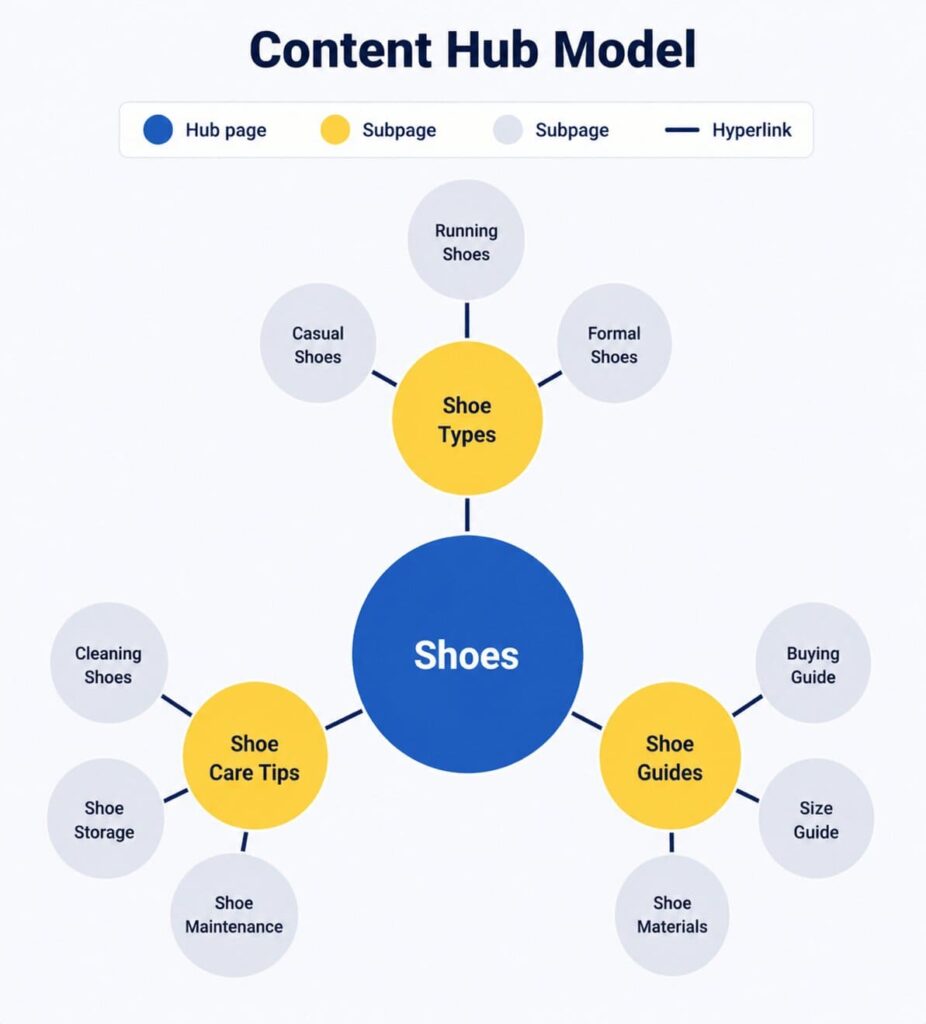
The pillar page is deliberately broad. It’s meant to be the page someone lands on when they search a general, high-volume term — “content marketing,” “email deliverability,” “employee onboarding” — and it answers the question at a summary level while pointing to deeper resources for every subtopic it touches. It doesn’t try to be the definitive word on any single subtopic; it tries to be the definitive map of the whole topic.
Cluster pages do the opposite job. Each one goes narrow and deep on a single facet of the topic — a specific comparison, a step-by-step process, a definition, an edge case, an objection a buyer might raise. Because each cluster page targets a distinct search intent, a single hub can realistically rank for hundreds of long-tail variations that a standalone pillar page never could on its own.
The internal linking is what turns a pile of related articles into an actual hub. Every cluster page links up to the pillar (so a reader — and a crawler — can always find their way back to the overview), and the pillar links out to every cluster (so nothing in the structure is more than one click from the center). This is what search engines read as topical depth: not just that you’ve written about a subject once, but that you’ve built out every corner of it and connected the pieces on purpose.
The idea, popularized by HubSpot around 2017, was straightforward: instead of publishing isolated blog posts that each fight for a single keyword, you build a body of interconnected content that signals topical depth to search engines.
That part of the theory hasn’t changed. What’s changed is who’s reading the signal.
2. What actually changed: the zero-click shift
Before testing whether hubs still work, it’s worth being precise about what they’re now competing against.
| Metric | Figure | Source |
|---|---|---|
| Share of Google searches with an AI Overview (2026) | ~47–64% of queries | eSEOspace / industry AI Overview tracking |
| Google searches ending with zero clicks to any site | Roughly two-thirds of searches | SparkToro/Datos clickstream study, 2026 |
| Click drop on the #1 result when an AI Overview appears | 30–50% average CTR decline | Ahrefs, eSEOspace |
| Zero-click rate inside Google’s AI Mode | 93% across 25.1M impressions studied | Seer Interactive |
| B2B site traffic decline attributed to AI-assisted buyer research | 10–40% over the past year | Forrester |
The takeaway isn’t “SEO is dead.” It’s that a growing share of searches now get answered without a visit to your site at all — which raises the real question this post is testing: in a world where the destination often doesn’t matter, does the hub-and-spoke structure still move the needle, or is it optimizing for a click that increasingly doesn’t happen?
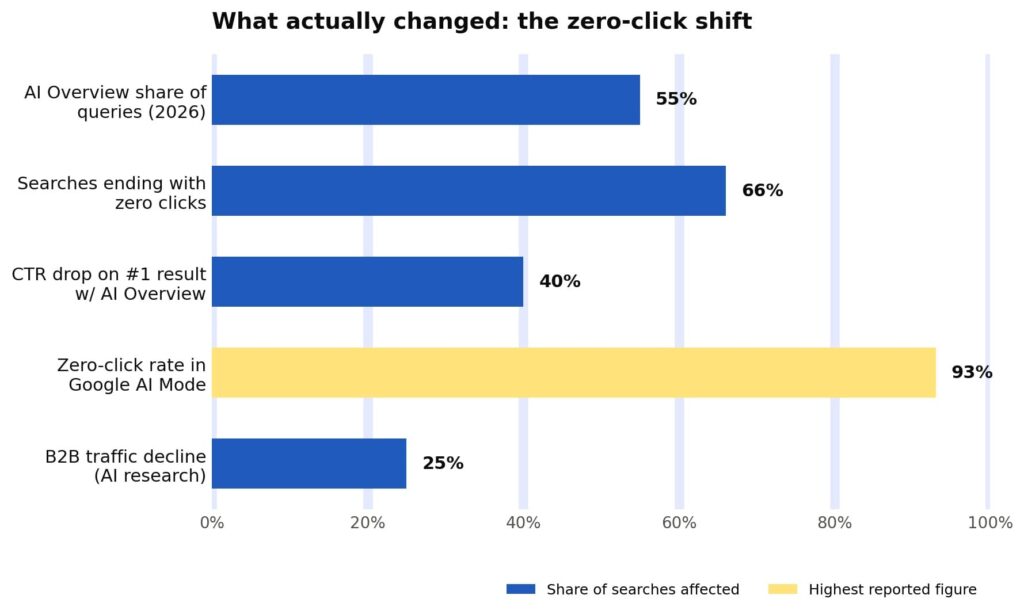
The proportion of Google searches ending without a click has risen sharply since AI Overviews expanded in 2025–2026.
3. How AI engines actually choose what to cite
This is the part most “is SEO dead” takes skip, and it’s the part that determines whether a content hub helps or does nothing. Each AI search system sources and cites content differently — treating them as one undifferentiated “AI search” misses the strategy entirely.
Framework: How the major AI answer engines source content
| Platform | Primary source logic | What it favors | Citation behavior |
|---|---|---|---|
| Google AI Overviews | Re-ranks Google’s existing organic index | Pages already ranking well, with clear structured answers near the top of sections and consistent schema markup | ~97% of citations come from pages already in the top 20 organic results |
| ChatGPT | Static training data + Bing-powered retrieval layer | Wikipedia (up to ~48% of top-10 citations), major reference media, high-authority editorial sources | Mentions brands roughly 3x more often than it links to them |
| Perplexity | Real-time web crawl on every query | Fresh, recently published content; citation-first by design | Cites ~22 sources per answer on average; new content can appear within hours |
| Claude | Blended retrieval, leans toward established journalism | The New York Times, The Atlantic, The Economist and similar outlets | Lower overlap with ChatGPT’s source set than you’d expect |
The critical number here: independent studies from Ahrefs, Averi, and Whitehat SEO — using three different methodologies — all converged on the same finding. Only around 11–12% of domains cited by ChatGPT also get cited by Perplexity. The set of pages Google’s AI Overview cites overlaps with ChatGPT’s citations at a similarly low rate. These are not one search engine with different skins. They’re separate visibility surfaces with almost entirely different rulebooks.
That single fact is why a hub built purely for classic Google ranking signals is now working against a fragmented, multi-engine reality — not a unified one.
How to rank your website on ChatGPT
4. Testing the evidence: do hubs actually outperform scattered content?
This is the part that actually settles the argument. Not opinions, not vendor case studies with cherry-picked clients — third-party benchmarking, stacked up and stress-tested against what AI search now rewards. And the deeper you go, the more the case builds.
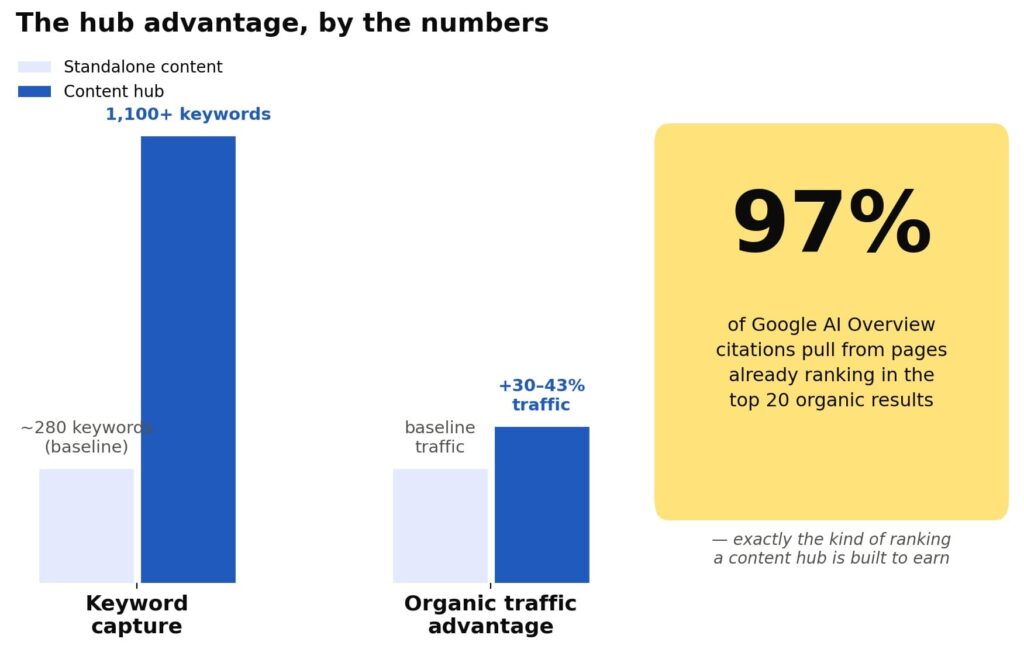
Keyword capture. Start with reach. A single well-built content hub doesn’t just rank for one thing — it ranks for everything adjacent to it. Cluster pages are reported to collectively capture over 1,000 keyword variations versus a few hundred for an isolated post, because each cluster piece targets a distinct intent (definition, comparison, how-to) while feeding authority back to the pillar. A standalone article fights one battle. A hub shows up on a thousand fronts at once.
Traffic advantage. That reach converts. HubSpot’s own benchmarking, cited widely across the industry, puts the organic traffic advantage of connected topic clusters over unconnected, one-off content at roughly 30–43%. Same content investment, meaningfully more traffic — just from linking it together on purpose.
Ranking stability. Now the part that matters when the algorithm shifts under your feet. Hubs show lower volatility during algorithm updates. When a search engine reweights how it evaluates a topic, a page embedded in a cluster of related, internally linked content tends to hold position better than an isolated page with no supporting context — because the site’s topical signal survives even if one page’s ranking shifts. Scattered content has nothing to fall back on. A hub does.
AI citation eligibility. And here’s where it stops being a nice-to-have and becomes the whole game. 97% of Google AI Overview citations pull from pages that already rank in the top 20 organically. A hub’s core advantage — better organic rankings across a wider keyword set — directly increases the number of pages eligible to be cited in AI Overviews. A hub doesn’t just rank more. It puts more surface area into the exact pool AI Overviews are pulling citations from.
Where hubs don’t automatically win: here’s the catch. ChatGPT and Perplexity draw much more heavily from third-party sources — Wikipedia, Reddit, major news outlets — than from brand-owned pages. One 2026 study found owned brand pages were “systematically underweighted” in favor of earned, third-party coverage across multiple AI systems. A content hub improves your position in Google’s ecosystem far more reliably than it guarantees a citation inside ChatGPT.
Verdict
Content hubs still work — but they now do two separate jobs that used to be one job:
- They still build the topical depth and internal-linking signal that improves classic organic rankings (proven, consistent with pre-AI data).
- They increasingly function as citation inventory for AI Overviews specifically, because AI Overviews draw almost exclusively from already-ranking pages.
What they no longer reliably do on their own is earn citations inside ChatGPT or Perplexity, which weight earned media and freshness far more heavily than owned-site architecture.
5. The AI-ready content hub: a practical framework
Given all that, here’s how the hub-building framework needs to change for 2026.
Framework: Building a hub for both classic SEO and AI citation
| Step | Classic hub practice | What to add for AI search |
|---|---|---|
| 1. Topic selection | Pick a topic with search volume and business relevance | Also check if the topic already generates AI Overviews or shows up in ChatGPT/Perplexity answers — test the queries manually before you build |
| 2. Pillar page | 4,000–6,000 words, comprehensive overview | Lead each major section with a direct, quotable answer in the first 1–2 sentences; AI systems evaluate relevance heavily from the opening of a section |
| 3. Cluster pages | 2,000–3,000 words per subtopic | Include original data, first-party research, or a proprietary framework — case studies and data-backed pages are the highest-leverage content type for AI citation across all three major platforms |
| 4. Structure & markup | Standard headings, internal links | Add FAQPage, HowTo, and Article schema; use short, extractable answer blocks under each H2/H3 |
| 5. E-E-A-T signals | Author bio, publish date | Named author with visible credentials, cited primary sources, and a “last updated” date refreshed quarterly — this is treated as close to a binary eligibility filter for AI citation |
| 6. Distribution | Internal linking, backlinks | Get the topic discussed on Reddit, Wikipedia-eligible reference sites, and industry publications — earned mentions matter more to ChatGPT and Perplexity than anything on your own domain |
| 7. Measurement | Search Console, GA4 | Add AI-visibility tracking (Semrush AI toolkit, Ahrefs Brand Radar, or a dedicated GEO monitoring tool) alongside standard rank tracking — the two numbers move independently now |
6. Where teams are getting it wrong
A few recurring mistakes show up across the case studies and benchmarking data:
- Treating AI Overview visibility and ChatGPT visibility as the same goal. They pull from almost entirely different source pools (roughly 11–12% domain overlap between platforms). A hub strategy optimized only for Google won’t automatically earn ChatGPT citations.
- Skipping the freshness cycle. Perplexity crawls in near real time; stale hub content — even if comprehensive — loses ground to competitors who republish quarterly.
- Under-investing in earned media. Since third-party, high-authority sources dominate AI citations, a hub with zero PR or community presence is fighting with one hand tied behind its back.
- Measuring only clicks. With two-thirds of searches now ending without a click, a hub that’s cited inside an AI Overview or ChatGPT answer but generates no visit is still doing brand-building and demand-generation work — traditional last-click attribution will make that look like the hub “isn’t working” when it’s actually earning trust and branded search lift.
7. Bottom line
The evidence doesn’t support “content hubs are obsolete” — but it doesn’t support building one exactly the way the industry did in 2019 either. Hubs still win on the metrics that were always true: wider keyword capture, better ranking stability, and a 30–43% organic traffic advantage over disconnected content. What’s new is that hubs have picked up a second job — becoming the inventory search engines and AI systems pull citations from — and that job comes with new requirements: first-party data, structured extractable answers, author credibility, and a presence beyond your own domain.
Build for both jobs, and a content hub remains one of the highest-leverage structures in content strategy. Build for only the first one, and you’ll keep ranking in a results page fewer people are clicking through.
Sources referenced
Ahrefs · SparkToro/Datos clickstream study · Seer Interactive · Forrester · HubSpot content benchmarking · eSEOspace AI Overview tracking · Averi AI citation analysis · Whitehat SEO · Semrush topical authority research

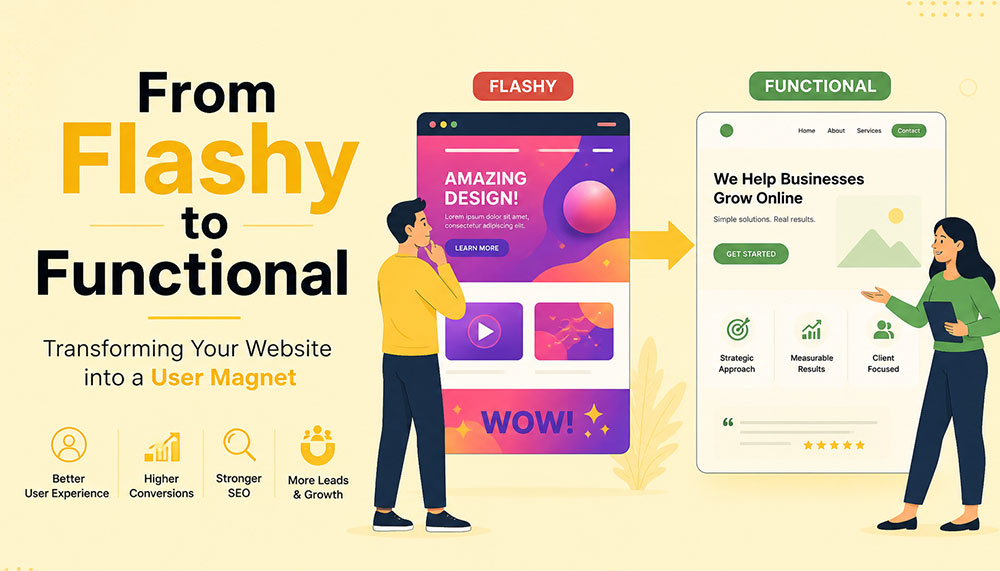
From Flashy to Functional: Transforming Your Website into a User Magnet
In the early days of the internet, a flashy website was often enough to impress visitors. Bright colors, animations, auto-playing media, and complex layouts were seen as signs of creativity and innovation. But times have changed. Today’s users are smarter, faster, and far less patient. A visually overloaded website is no longer impressive—it’s exhausting.
If your website looks stunning but fails to convert visitors into customers, then it’s not doing its job. The modern approach to web design focuses on functionality, usability, speed, and experience. Businesses that understand this shift are the ones that win.
This article explores how to transform your website from merely flashy to genuinely functional—and ultimately turn it into a powerful user magnet.
The Problem with “Flashy” Websites
At first glance, a flashy website can feel impressive. Bright visuals, animations, sliders, and interactive effects often give the illusion of sophistication and creativity. But here’s the reality—what looks exciting to a designer can quickly become frustrating for a user.
Today’s internet users are not browsing casually—they’re searching with intent. They want answers, solutions, and clarity within seconds. If your website slows them down or overwhelms them, they won’t admire the design—they’ll abandon it.
Flashy websites often prioritize aesthetics over usability. While they may look appealing initially, they tend to create friction in the user journey. And in the digital world, even small friction points can lead to big losses in engagement and conversions.
Let’s take a closer look at the common problems:
- Slow loading times: Heavy animations, large images, auto-playing videos, and complex scripts can significantly slow down your website. Users today expect pages to load almost instantly. Even a delay of a few seconds can cause frustration and increase bounce rates.
- Confusing navigation structures: Over-designed menus, hidden navigation elements, or too many options can leave users unsure of where to go next. When visitors feel lost, they rarely try to figure things out—they simply exit.
- Distracting visual elements: Too many moving parts—sliders, pop-ups, flashing banners—can shift attention away from what actually matters: your message. Instead of guiding users, these elements overwhelm them.
- Poor mobile responsiveness: A design that looks great on a desktop may completely break on a mobile device if not optimized properly. With the majority of users browsing on smartphones, this is a critical flaw.
- Low accessibility: Flash-heavy designs often ignore accessibility standards. Poor contrast, unreadable fonts, or non-intuitive layouts can make it difficult for users with different abilities to interact with your website.
Think about your own browsing habits. When you land on a website that takes too long to load or feels complicated, what do you do? Most likely, you hit the back button. That’s exactly what your visitors are doing too.
Modern users expect instant gratification. They want fast, smooth, and effortless experiences. If your website fails to deliver that within the first few seconds, you’ve already lost their attention—and potentially their business.
This is why businesses today are shifting their focus from “looking impressive” to “working effectively.” A professional Website Designing company in India understands this balance. Instead of adding unnecessary elements, they focus on creating clean, user-friendly designs that guide visitors naturally and help businesses achieve real results.
Because in the end, a website isn’t meant to just impress—it’s meant to perform.
Understanding the Shift: From Design to Experience
There was a time when website design was judged almost entirely by how it looked. If it was visually appealing, colorful, and “different,” it was considered successful. But that definition has evolved—dramatically.
Today, design alone is not enough. A website can look stunning and still fail miserably if it doesn’t deliver a smooth, intuitive experience. This is where the shift happens—from design-centric thinking to experience-centric thinking.
In simple terms, it’s no longer just about how your website looks. It’s about how it feels to use.
When a user lands on your website, they are not there to admire your design skills. They are there with a purpose—maybe to learn something, compare options, or make a purchase. The faster and easier you help them achieve that goal, the more successful your website becomes.
This is why User Experience (UX) and User Interface (UI) design have become the backbone of modern websites. These disciplines focus on understanding user behavior, removing friction, and creating seamless interactions.
Instead of asking “Does it look good?”, businesses now need to ask deeper, more practical questions:
- Is it easy to use? Can a first-time visitor navigate your website without confusion, or do they have to think too much before taking action?
- Can users find what they need quickly? In a world where attention spans are shrinking, every second matters. If users have to dig through multiple pages to find basic information, they won’t stick around.
- Does it guide users toward action? A good website doesn’t just present information—it gently leads users toward the next step, whether that’s filling out a form, making a purchase, or contacting your team.
- Does it work seamlessly on all devices? Your audience is browsing on phones, tablets, laptops, and everything in between. A consistent and smooth experience across all devices is no longer optional.
Think of your website like a physical store. A beautifully designed store with confusing layouts, hard-to-find products, and unhelpful staff will struggle to make sales. On the other hand, a clean, well-organized store that makes shopping easy will naturally attract and retain customers.
The same principle applies online.
Functionality doesn’t mean sacrificing beauty—it means giving beauty a purpose. Every design element, from colors to typography to spacing, should support usability rather than distract from it.
This is where experienced professionals, such as a Website Designing company in India, bring real value. They don’t just design for visual appeal—they design for human behavior, ensuring that every click, scroll, and interaction feels natural and meaningful.
Because at the end of the day, users don’t remember how “cool” your website looked. They remember how easy it was to use—and whether it helped them get what they came for.
Key Elements of a Functional Website
A functional website doesn’t happen by accident—it’s the result of thoughtful planning, user understanding, and smart design decisions. Every element on your website should have a purpose. When all these elements work together, they create an experience that feels smooth, intuitive, and satisfying for the user.
Let’s break down the core elements that truly make a website functional—not just visually appealing, but genuinely effective.
1. Clear and Intuitive Navigation
Your website should feel effortless to explore. A visitor should land on your homepage and instantly understand where to go next—without thinking too hard. The moment users feel confused, they start losing trust.
Think of navigation as a roadmap. If the directions aren’t clear, people won’t keep wandering—they’ll simply leave and find another destination.
A well-structured navigation system includes:
- Simple menus with clear labels: Avoid clever or vague naming. “Services,” “About,” and “Contact” may sound basic, but they work because users instantly recognize them.
- Logical page hierarchy: Your pages should be organized in a way that makes sense. Important information should never be buried deep within multiple clicks.
- Easy access to key pages: High-priority pages like pricing, services, or contact information should always be easy to find—preferably within one or two clicks.
If users get lost, they leave. It’s that simple. Good navigation doesn’t draw attention to itself—it just works seamlessly in the background.
2. Fast Loading Speed
Speed is one of the most critical factors in user experience. No matter how beautiful your website is, if it takes too long to load, users won’t wait around to see it.
We live in a world of instant results. A delay of even one second can feel like an eternity—and that’s often enough to lose a potential customer.
To improve your website’s speed:
- Optimize images: Large, uncompressed images are one of the biggest causes of slow websites. Proper optimization keeps quality high while reducing load time.
- Use efficient code: Clean, streamlined coding reduces unnecessary load on your website.
- Leverage caching: Caching helps store data so returning users can access your site faster.
- Choose reliable hosting: Your hosting provider plays a major role in your website’s performance. A slow server means a slow website—no matter what you do.
A skilled Website Designing company in India understands that performance is not an afterthought. They build speed optimization into the foundation of your website from the very beginning.
3. Mobile Responsiveness
Take a moment to think about how often you use your phone to browse the internet. Now imagine your website being viewed on that small screen. Does it still look clean? Is it easy to navigate? Can users interact with it comfortably?
With mobile users now dominating web traffic, your website must perform flawlessly across all screen sizes. A responsive design ensures that your website adapts automatically—no matter what device is being used.
This includes:
- Content that adjusts smoothly: Images, text, and layouts should resize and rearrange themselves for different screen sizes.
- Tap-friendly buttons: Buttons should be large enough and spaced properly so users can easily tap them without frustration.
- Readable text: Users shouldn’t have to zoom in just to read your content. Proper font sizing is essential.
A mobile-first approach is no longer optional—it’s the standard. If your website doesn’t work well on mobile, you’re likely losing a significant portion of your audience.
4. Strong Visual Hierarchy
When users land on your website, they don’t read every word—they scan. Your design should guide their eyes naturally, helping them understand what’s important within seconds.
This is where visual hierarchy comes in. It’s the art of organizing content in a way that leads users through your website effortlessly.
You can achieve this through:
- Proper use of headings: Headlines should stand out and clearly communicate key messages.
- Contrasting colors: Important elements like call-to-action buttons should be visually distinct.
- Whitespace: Giving elements room to breathe makes your website easier to read and less overwhelming.
- Strategic placement: Key information should be positioned where users naturally look first.
A clean, well-structured layout often outperforms a cluttered design. Simplicity doesn’t mean boring—it means effective.
5. Compelling and Clear Content
Design might bring users in, but content is what keeps them there—and ultimately convinces them to take action.
Your messaging should speak directly to your audience. It should answer their questions, address their concerns, and clearly explain how you can help them.
Effective website content is:
- Clear and concise: Avoid unnecessary jargon or long-winded explanations. Get to the point quickly.
- User-focused: Instead of talking only about your business, focus on what the user gains.
- Easy to scan: Use short paragraphs, bullet points, and headings to make content digestible.
Within a few seconds of landing on your website, visitors should understand exactly what you offer and why it matters to them. If they have to guess, you’ve already lost them.
When all these elements come together—navigation, speed, responsiveness, hierarchy, and content—you don’t just have a website. You have a powerful user experience that attracts, engages, and converts.
Why Functionality Drives Conversions
At the end of the day, your website has a job to do. Whether it’s generating leads, selling products, or encouraging inquiries—everything comes down to conversions. And here’s the truth many businesses overlook: people don’t convert because your website looks good… they convert because it feels easy.
A functional website removes friction from the user journey. It makes every step—from landing on the page to taking action—feel natural and effortless. When users don’t have to struggle, think too much, or second-guess their decisions, they are far more likely to move forward.
Think of it like walking into a well-organized store. You can quickly find what you need, understand the pricing, and check out without confusion. Compare that to a cluttered store where nothing is clearly labeled—you’d probably walk out. The same psychology applies to your website.
Functionality builds trust. And trust is the foundation of every conversion.
When users can easily navigate your website, find relevant information, and complete actions without frustration, they begin to feel confident in your brand. On the other hand, even small issues—like a confusing layout or a slow-loading page—can create doubt and push them away.
A conversion-focused website is intentionally designed to guide users toward action. It doesn’t leave things to chance. Every element plays a role in helping users take the next step.
Here’s what that looks like in practice:
- Clear call-to-action (CTA) buttons: Your CTAs should stand out and communicate exactly what users need to do next—whether it’s “Get a Quote,” “Book a Demo,” or “Buy Now.” There should be no confusion or hesitation.
- Minimal distractions: Too many pop-ups, animations, or competing elements can overwhelm users and dilute your message. A clean, focused design keeps attention where it matters most.
- Trust signals: People are naturally cautious online. Reviews, testimonials, case studies, certifications, and client logos help reassure users that they’re making the right choice.
- Simplified forms and checkout processes: The more steps you add, the more users you lose. Shorter forms, fewer fields, and a smooth checkout experience can significantly increase conversions.
It’s important to understand that users don’t want to “work” to interact with your website. The easier you make things for them, the more likely they are to take action.
This is why businesses increasingly partner with a Website Designing company in India that focuses on performance-driven design. Instead of adding unnecessary features, they refine the user journey—removing obstacles and guiding users toward meaningful actions.
Every element on your website should have a clear purpose. If something doesn’t contribute to the user experience or support conversions, it’s likely doing more harm than good.
Because in the digital world, simplicity isn’t just a design choice—it’s a competitive advantage.
The Role of User Psychology
Behind every click, scroll, and decision on your website, there’s a human mind at work. And that mind doesn’t behave randomly—it follows patterns. Understanding these patterns is what separates an average website from one that truly connects with users.
One of the biggest misconceptions in web design is assuming that users carefully read everything on a page. In reality, they don’t. People scan. They skim through headings, glance at visuals, and look for familiar cues that help them quickly understand what to do next.
This means your website isn’t just a collection of pages—it’s an experience shaped by human behavior. The more you align your design with how people naturally think and interact, the more effective your website becomes.
Let’s explore some key psychological principles that influence user behavior:
- Familiarity: Users feel comfortable with what they already recognize. This is why most successful websites follow certain standard patterns—like having a logo at the top left, navigation at the top, and contact information easily accessible. When you stick to familiar structures, users don’t have to “learn” how to use your website—they already know.
- Clarity: The human brain prefers simplicity. When a website is cluttered or overly complex, it increases cognitive load—meaning users have to work harder to process information. And when things feel difficult, people tend to give up. Clean layouts, simple messaging, and clear pathways reduce this mental effort and keep users engaged.
- Trust: First impressions happen in seconds. A clean, professional-looking website instantly builds credibility, while a messy or outdated design raises doubts. Elements like consistent branding, high-quality visuals, testimonials, and secure browsing indicators all contribute to building trust.
- Urgency: People are more likely to take action when they feel a sense of urgency. Strategic prompts like limited-time offers, countdowns, or phrases such as “Only a few spots left” can encourage users to act sooner rather than later. When used thoughtfully, urgency can significantly improve conversions without feeling pushy.
Think about your own online behavior. When you visit a website, you instinctively look for certain things—clear headings, easy navigation, and quick answers. If those elements are missing, frustration builds almost instantly.
This is why understanding user psychology isn’t optional—it’s essential. A website that aligns with human behavior feels intuitive, trustworthy, and easy to use.
A modern Website Designing company in India doesn’t just focus on visuals or code—they dive deeper into how users think, what motivates them, and what stops them from taking action. By combining design expertise with behavioral insights, they create websites that don’t just look good—they feel right.
Because when your website speaks the language of your users’ minds, engagement and conversions naturally follow.
Common Mistakes to Avoid
Sometimes, the biggest problems on a website aren’t what’s missing—they’re what’s unnecessarily added. Many businesses invest time and money into their websites, yet unknowingly make decisions that hurt performance instead of improving it.
The tricky part? These mistakes often come from good intentions—trying to impress users, add more information, or stand out from competitors. But in reality, they end up doing the opposite.
Let’s break down some of the most common website mistakes and why they matter:
- Overusing animations and effects: Animations can enhance a website when used sparingly, but too many moving elements can overwhelm users. Sliders, pop-ups, hover effects, and auto-playing media can quickly turn from engaging to distracting. Instead of focusing on your message, users get caught up in visual noise—and often leave before taking any action.
- Ignoring mobile users: This is one of the most costly mistakes today. A website that works perfectly on desktop but feels clunky on mobile is guaranteed to lose a large portion of its audience. Tiny buttons, misaligned content, and slow mobile performance create frustration and drive users away almost instantly.
- Cluttering pages with too much information: It’s tempting to put everything on one page—every service, every feature, every detail. But more information doesn’t always mean better communication. When pages are overcrowded, users don’t know where to focus. Instead of reading more, they end up reading nothing at all.
- Using unclear or generic CTAs: Call-to-action buttons like “Click Here” or “Submit” don’t tell users what they’re getting. Strong CTAs are specific and action-driven—like “Get Your Free Quote” or “Book a Consultation.” Clarity here can make a huge difference in conversion rates.
- Neglecting SEO fundamentals: A beautiful website is useless if no one can find it. Ignoring SEO basics—like proper headings, meta tags, keyword optimization, and page speed—limits your visibility on search engines. Without traffic, even the best-designed website won’t deliver results.
If you look closely, all these mistakes have one thing in common: they prioritize business preferences over user needs. And that’s where things start to go wrong.
The good news is that these issues are completely fixable. In fact, addressing even a few of them can lead to noticeable improvements in user engagement, time on site, and conversions.
This is why many businesses turn to an experienced Website Designing company in India to audit and refine their websites. With a fresh perspective and user-focused approach, they can identify hidden issues and transform your website into something far more effective.
Because sometimes, improving your website isn’t about adding more—it’s about removing what’s getting in the way.
Balancing Aesthetics and Functionality
There’s a common misconception in web design—that you have to choose between a website that looks beautiful and one that works well. In reality, the most successful websites don’t pick one over the other. They strike a balance.
Visual appeal matters. It creates the first impression, sets the tone for your brand, and captures attention. But if that visual appeal comes at the cost of usability, it quickly loses its value. On the other hand, a purely functional website that lacks personality can feel dull and forgettable.
The real goal is to bring both together—where design enhances functionality, not competes with it.
Think of your website like a well-designed workspace. It should look inviting and professional, but more importantly, everything should be placed exactly where it’s needed. Nothing should feel out of place, unnecessary, or confusing.
Here are some practical ways to achieve that balance:
- Using a consistent color palette: Colors play a huge role in how users perceive your brand. A consistent palette creates a sense of harmony and professionalism. It also helps guide user attention—for example, using a specific color for buttons makes them instantly recognizable.
- Choosing readable fonts: Stylish typography can enhance your design, but readability should always come first. If users have to strain their eyes to read your content, they won’t stick around. Clean, simple fonts with proper spacing make a big difference in user comfort.
- Maintaining visual consistency: Consistency builds familiarity and trust. When elements like buttons, headings, spacing, and layouts follow a uniform style across your website, users feel more comfortable navigating it. Inconsistency, on the other hand, creates confusion and disrupts the experience.
- Using images purposefully: Images should support your message—not just fill space. High-quality visuals can enhance storytelling, explain concepts, and create emotional connections. But irrelevant or excessive images can slow down your website and distract users from your core message.
It’s also important to remember that simplicity is powerful. A clean design with thoughtful spacing and focused content often feels more premium than a cluttered, over-designed layout.
This is where experienced professionals, such as a Website Designing company in India, truly make a difference. They understand how to blend creativity with usability—ensuring that every design choice serves a purpose and contributes to the overall experience.
At its core, design is not the end goal—it’s a tool. A tool to communicate, guide, and engage your users. When used wisely, it doesn’t just make your website look better—it makes it work better.
And that’s the kind of balance that turns visitors into loyal users.
How SEO and Functionality Work Together
SEO and website functionality are often treated as two separate things—but in reality, they are deeply connected. You can’t build a strong online presence by focusing on just one. The websites that perform best today are the ones where SEO and user experience work hand in hand.
Search engines like Google are no longer just scanning your website for keywords. They are analyzing how users interact with it. Do people stay on your site? Do they explore multiple pages? Or do they leave within seconds? These behaviors send powerful signals about the quality of your website.
In simple terms, search engines want to recommend websites that users actually enjoy using. And that’s exactly where functionality comes into play.
A functional website naturally supports SEO because it creates a better experience for users—and when users are happy, search engines take notice.
Here’s how functionality directly impacts your SEO performance:
- Improving page speed: Fast-loading websites not only keep users engaged but are also favored by search engines. Speed is a ranking factor, and even small improvements can make a noticeable difference in your visibility.
- Enhancing mobile usability: With mobile-first indexing, search engines prioritize how your website performs on mobile devices. A responsive, mobile-friendly design ensures that your site ranks better and reaches a wider audience.
- Reducing bounce rates: When users land on your website and immediately leave, it signals that something isn’t working—whether it’s slow speed, poor design, or irrelevant content. A functional website keeps users engaged and encourages them to stay longer.
- Encouraging longer session durations: When your website is easy to navigate and provides valuable content, users naturally spend more time exploring it. This increased engagement sends positive signals to search engines about your site’s relevance and quality.
It’s important to understand that SEO is no longer just about ranking—it’s about retention. Getting users to your website is only half the battle. Keeping them there is what truly makes the difference.
This is why businesses are increasingly working with a Website Designing company in India that understands both SEO and user experience. Instead of treating them as separate strategies, they integrate them into a unified approach—building websites that are not only easy to find but also enjoyable to use.
When your website is fast, intuitive, and user-friendly, visitors stay longer, interact more, and trust your brand. And when that happens consistently, search engines recognize your website as valuable—and reward it with better rankings.
Because in today’s digital landscape, the formula is simple: when users love your website, search engines do too.
Steps to Transform Your Website
Transforming your website from flashy to functional isn’t about making random changes—it’s about taking a structured, thoughtful approach. The goal is to create a website that not only looks better, but works better for your users and your business.
Think of it as a continuous improvement process rather than a one-time redesign. Every step you take should bring you closer to a smoother, more effective user experience.
1. Audit Your Current Website
Before making any changes, you need to understand where you currently stand. A website audit helps you uncover what’s working well and what’s holding you back.
Start by looking at real user data:
- User behavior: How do visitors interact with your site? Which pages do they visit most? Where do they drop off?
- Bounce rates: Are users leaving quickly after landing on certain pages? If yes, those pages may have usability or content issues.
- Conversion data: Which pages are driving results, and which ones are not?
You can also review your website from a user’s perspective. Try navigating it as if you were a first-time visitor. Is everything clear and easy to find? Or does it feel confusing?
This step lays the foundation for everything that follows.
2. Simplify the Design
Once you know what’s not working, the next step is to simplify. Many websites try to do too much—and end up overwhelming users.
Simplification doesn’t mean removing value—it means removing distractions.
Focus on:
- Eliminating unnecessary animations and visual clutter
- Reducing the number of competing elements on each page
- Highlighting key messages and actions
Ask yourself: “Does this element help the user, or does it just look nice?” If it doesn’t serve a purpose, it probably doesn’t belong.
A clean, focused design makes it easier for users to understand your website—and take action.
3. Improve Performance
Performance is a critical part of functionality. Even the best-designed website will fail if it’s slow or unresponsive.
Improving performance involves both technical and design-related optimizations:
- Speed optimization: Compress images, minimize code, and use caching to reduce load times.
- Responsive design: Ensure your website works smoothly across all devices and screen sizes.
- Technical improvements: Fix broken links, optimize server response times, and ensure clean coding practices.
This is often where working with a Website Designing company in India can make a big difference. Their technical expertise ensures that your website performs efficiently without compromising on design.
4. Enhance Content Strategy
Your website’s content is what communicates your value to users. If your messaging is unclear or unfocused, even the best design won’t help.
Shift your content strategy from “what we want to say” to “what users need to hear.”
Effective content should:
- Address user problems and offer solutions
- Be easy to read and scan
- Clearly explain your services or products
- Guide users toward the next step
Every page should have a purpose—and every piece of content should support that purpose.
5. Test and Optimize Continuously
Your website is never truly “finished.” User behavior evolves, trends change, and new opportunities emerge. That’s why ongoing testing and optimization are essential.
Use tools and techniques like:
- A/B testing: Compare different versions of a page to see what performs better
- Analytics: Track user behavior, engagement, and conversions
- Heatmaps: Understand where users click, scroll, and focus their attention
Small improvements over time can lead to significant results. Even minor tweaks—like changing a button color or simplifying a form—can have a noticeable impact on conversions.
The key is to stay curious, keep testing, and continuously refine your website based on real data.
When you follow these steps, you’re not just redesigning your website—you’re transforming it into a powerful tool that attracts users, engages them, and drives meaningful results.
The Importance of Professional Expertise
Transforming a website isn’t just about changing colors, adding new sections, or updating a layout—it’s a much deeper process. It requires a careful balance of design, technology, user psychology, and marketing strategy. And this is exactly where many businesses struggle when trying to handle everything on their own.
A website today is not just a digital brochure—it’s a performance-driven asset. It needs to attract visitors, engage them, guide them, and ultimately convert them. Achieving all of that requires more than creativity—it requires expertise.
This is why many businesses choose to partner with a professional Website Designing company in India. Instead of relying on guesswork or trial-and-error, they gain access to a team that understands how to build websites that actually work.
Let’s look at what such expertise brings to the table:
- Industry experience: Professionals who have worked across different industries understand what works and what doesn’t. They’ve seen trends evolve, tested strategies, and know how to avoid common pitfalls. This experience helps them make informed decisions that save time and deliver better results.
- Technical expertise: From coding and performance optimization to responsiveness and integrations, there’s a lot happening behind the scenes of a functional website. A skilled team ensures that everything runs smoothly—so users never have to think about the technical side at all.
- Strategic thinking: A great website isn’t built randomly—it’s planned. Professionals approach design with a clear strategy in mind, aligning your website with your business goals. Every element, from layout to content placement, is designed to support conversions and user engagement.
- Cost-effective solutions: While hiring experts may seem like an added expense, it often saves money in the long run. Avoiding mistakes, reducing redesigns, and getting things right the first time leads to better ROI and fewer ongoing issues.
Another key advantage is perspective. When you’re deeply involved in your own business, it’s easy to overlook usability issues or assume things are “obvious” to users. A professional team brings an outside perspective—seeing your website the way your visitors do.
They don’t just ask, “Does this look good?” They ask, “Does this work?”
And that shift in thinking makes all the difference.
The result is a website that doesn’t just impress visually—it performs consistently. It loads faster, guides users better, communicates clearly, and converts more effectively.
Because in today’s competitive digital space, a good-looking website is no longer enough. You need a website that delivers results—and that’s exactly what professional expertise helps you achieve.
Real-World Impact of Functional Design
When businesses shift their focus from flashy visuals to functional design, the results are not just noticeable—they’re measurable. This isn’t about subjective opinions like “it looks better” or “it feels smoother.” It’s about real, data-driven improvements that directly affect how your website performs and how your business grows.
A functional website doesn’t just change how your site looks—it transforms how users interact with it. And when user behavior improves, everything else follows.
Here’s what businesses typically experience when they make this shift:
- Higher conversion rates: When users can easily navigate your website, understand your offering, and take action without confusion, conversions naturally increase. Whether it’s filling out a form, making a purchase, or booking a service—simplicity leads to action.
- Lower bounce rates: A well-structured, fast-loading, and user-friendly website encourages visitors to stay instead of leaving immediately. When users find what they’re looking for quickly, they’re far more likely to explore further rather than exit.
- Increased user engagement: Functional design keeps users interested. They spend more time on your site, visit multiple pages, and interact with your content. This deeper engagement not only improves user experience but also strengthens your brand connection.
- Better search rankings: Search engines pay close attention to how users behave on your website. Lower bounce rates, longer session durations, and improved usability all contribute to better rankings—bringing in even more organic traffic.
But beyond the metrics, there’s a bigger picture.
A functional website builds confidence. It makes your business feel reliable, professional, and easy to work with. Users don’t just visit—they trust. And when trust is established, conversions become a natural outcome rather than a forced action.
Many businesses notice that after optimizing functionality, they don’t need to push as hard with aggressive marketing. Their website starts doing the heavy lifting—guiding users, answering questions, and encouraging decisions organically.
This is why working with a Website Designing company in India that focuses on performance-driven design can be a game-changer. Instead of chasing trends or adding unnecessary features, they focus on what truly impacts user behavior and business outcomes.
Because in the real world, success isn’t measured by how impressive your website looks—it’s measured by how effectively it works.
And when your website works seamlessly, growth isn’t just possible—it becomes predictable.
Future Trends in Website Design
Website design is constantly evolving—but one thing is becoming clearer every year: the future belongs to websites that truly understand and serve their users. Trends may change, technologies may advance, but the core focus remains the same—creating seamless, meaningful, and human-centered experiences.
What’s exciting is that the next wave of web design isn’t just about looking modern—it’s about becoming smarter, more intuitive, and more inclusive. Businesses that adapt early will not only stand out but also build stronger, long-lasting connections with their audiences.
Let’s explore some of the key trends shaping the future of website design:
- Minimalistic design approaches: The shift toward simplicity is only getting stronger. Clean layouts, ample whitespace, and focused content are replacing cluttered, over-designed pages. Minimalism isn’t about doing less—it’s about doing what matters most. By removing distractions, websites can guide users more effectively and create a calmer, more enjoyable browsing experience.
- AI-driven personalization: Websites are becoming smarter and more adaptive. With the help of artificial intelligence, websites can now tailor content, recommendations, and user journeys based on individual behavior. Imagine a website that understands what a visitor is looking for and adjusts its content accordingly—this level of personalization can significantly improve engagement and conversions.
- Voice and gesture-based interactions: As technology evolves, the way users interact with websites is also changing. Voice search and voice commands are becoming more common, especially with the rise of smart devices. Gesture-based interactions, particularly on mobile and touch devices, are also shaping how users navigate and engage with content. Designing for these interactions means thinking beyond clicks and taps.
- Accessibility-first design: Inclusivity is no longer optional—it’s essential. Future-ready websites are built to be accessible to everyone, including users with disabilities. This includes better color contrast, keyboard navigation, screen reader compatibility, and clear content structure. Accessibility doesn’t just expand your audience—it also improves overall usability for all users.
Another important shift is the growing expectation for speed, privacy, and trust. Users want websites that load instantly, respect their data, and provide a smooth, secure experience. These factors will continue to influence design decisions moving forward.
For businesses, this means one thing: staying static is not an option. A website that works well today may feel outdated tomorrow if it doesn’t evolve with user expectations.
This is where partnering with a forward-thinking Website Designing company in India becomes valuable. Such teams stay updated with emerging technologies and user trends, ensuring your website doesn’t just keep up—but stays ahead.
Because in the digital world, success isn’t just about where you are today—it’s about how prepared you are for what’s coming next.
And the future? It belongs to websites that are not only functional—but intelligent, inclusive, and deeply user-focused.
Conclusion
A flashy website might capture attention—but a functional website captures users.
In today’s competitive digital landscape, success depends on how well your website serves your audience. By focusing on usability, performance, and clarity, you can create an experience that not only attracts visitors but keeps them coming back.
Whether you’re revamping an existing site or building a new one, the goal should always be the same: create a website that works for your users.
And when done right, your website doesn’t just become a digital presence—it becomes your most powerful business asset.


7 Blog Post Formats That Drive Traffic: A Content Marketing Guide for 2025
In the ever-changing world of digital marketing, content is still king, but not all content performs equally. The formats you choose for your blog posts can dramatically impact your traffic, engagement, and conversions. Whether you’re a small business, a startup, or an enterprise, knowing which blog post formats drive traffic is critical to a successful content marketing strategy.
This guide will explore seven blog post formats proven to get more clicks and shares, how to use them effectively, and why incorporating these strategies can help your business thrive — especially when working with an SEO company in India to optimize your content for global and local audiences.
Why Blog Post Formats Matter
Content marketing isn’t just about writing — it’s about how you present your content. Readers have different needs, attention spans, and intentions, and blog formats allow you to cater to each one.
Here’s why formats matter:
- Boost Engagement: Certain formats encourage readers to spend more time on your site, reducing bounce rates.
- Encourage Sharing: Visually engaging or list-based content is more likely to be shared on social media.
- Optimize for SEO: Structured formats with headings, lists, and multimedia improve search engine indexing.
- Cater to Different User Intent: Some users want quick answers, while others prefer in-depth guides.
Working with an SEO company in India can help you tailor each format for maximum search visibility, ensuring that every blog post aligns with on-page SEO, keyword optimization, and structured data.
-
List Posts: The Classic Click-Driver
Format: Numbered or bulleted lists, often with titles like “10 Tips,” “7 Ways,” or “5 Strategies.”
Why it works:
- Easy to scan and digest.
- Provides a clear value proposition upfront.
- Encourages sharing because lists are visually appealing.
Example:
“7 Blog Post Formats That Drive Traffic” — yes, even this article is a list post!
Tips for creating list posts:
- Keep the list manageable: 5–15 items is ideal.
- Include a brief description or actionable tip for each item.
- Use visuals, screenshots, or infographics to break up the text.
SEO benefit: List posts naturally include long-tail keywords (“blog post formats that drive traffic”), improving ranking potential.
Pro Tip: Partner with an SEO company in India to research trending long-tail keywords and ensure your list posts target high-intent queries.
-
How-To Guides: Step-by-Step Instructions
Format: Instructional posts that teach the reader how to do something.
Why it works:
- Provides high value to readers actively seeking solutions.
- Generates backlinks as authoritative resources.
- Often ranks well in Google’s “featured snippets” or AI summaries.
Example:
“How to Create a Content Marketing Plan That Boosts Traffic in 30 Days”
Tips for creating how-to guides:
- Break instructions into clear, numbered steps.
- Include examples, screenshots, or video tutorials.
- Target action-oriented long-tail keywords, e.g., “how to optimize blog posts for SEO in India.”
SEO benefit: How-to guides align with search intent, increasing dwell time and click-through rates.
Pro Tip: An SEO company in India can audit your guide for structured data markup, improving visibility in rich results.
-
Case Studies: Showcasing Real Results
Format: In-depth analysis of a real project, campaign, or client success story.
Why it works:
- Builds credibility and trust.
- Demonstrates tangible results your audience can relate to.
- Attracts industry backlinks and social proof.
Example:
“Case Study: How Our Blog Optimization Increased Organic Traffic by 120% in 3 Months”
Tips for creating case studies:
- Include data, charts, and measurable outcomes.
- Highlight challenges, strategies, and results.
- Feature quotes or testimonials for authenticity.
SEO benefit: Case studies often target conversion-focused long-tail keywords, like “SEO case study India” or “content marketing ROI examples,” driving both traffic and leads.
Pro Tip: Collaborating with an SEO company in India can help structure case studies to attract international and local audiences simultaneously.
-
Opinion/Thought Leadership Posts
Format: Articles that express insights, predictions, or expert opinions.
Why it works:
- Establishes your brand as an authority.
- Encourages discussion and social shares.
- Appeals to readers who value expertise and unique perspectives.
Example:
“Why AI Will Redefine Content Marketing in 2025”
Tips for creating opinion posts:
- Base your opinions on data, trends, or personal experience.
- Include actionable takeaways for readers.
- Invite discussion with questions or prompts at the end.
SEO benefit: Opinion posts can rank for thought leadership keywords like “top SEO trends India” or “content marketing predictions 2025,” boosting authority and trust.
Pro Tip: An SEO company in India can optimize your post with relevant schema, author markup, and link-building strategies to enhance credibility.
-
Curated Content: Aggregating Value
Format: Posts that compile insights, tools, or resources from multiple sources.
Why it works:
- Saves readers time by aggregating valuable content.
- Encourages backlinking from sources featured.
- Positions your brand as a resource hub.
Example:
“Top 10 Tools Every Content Marketer Should Use in 2025”
Tips for creating curated posts:
- Credit original sources with proper links.
- Add your own commentary or insights to add unique value.
- Organize content clearly with headings or categories.
SEO benefit: Curated posts often target comparison or resource-related long-tail keywords, like “best SEO tools India 2025.”
Pro Tip: Work with an SEO company in India to identify trending resources and optimize for rich snippets.
-
Infographic Posts: Visual Storytelling
Format: Posts centered around visually-rich infographics.
Why it works:
- Highly shareable on social media.
- Makes complex information easy to digest.
- Encourages backlinks as other websites embed your infographic.
Example:
“Content Marketing Stats 2025: Infographic Guide to Driving Traffic”
Tips for creating infographic posts:
- Keep graphics clear, simple, and visually appealing.
- Include data sources and references for credibility.
- Optimize images for SEO and page speed.
SEO benefit: Infographics improve engagement metrics and can rank in image search results, attracting extra traffic.
Pro Tip: An SEO company in India can ensure your infographics are optimized for ALT tags, file names, and mobile responsiveness.
-
Listicles With a Twist: Entertaining or Interactive Lists
Format: Fun or interactive list-based content, sometimes including quizzes, polls, or calculators.
Why it works:
- Encourages participation and sharing.
- Increases dwell time through interactive elements.
- Stands out in crowded content spaces.
Example:
“Which Content Marketing Strategy Fits Your Business? Take the Quiz!”
Tips for creating twist listicles:
- Add interactive elements like polls, quizzes, or sliders.
- Make content fun but informative, balancing entertainment with value.
- Include clear calls-to-action to guide readers toward conversion.
SEO benefit: Interactive listicles often generate high engagement metrics, which Google may interpret as quality signals, improving ranking potential.
Pro Tip: Partner with an SEO company in India to integrate schema markup for quizzes, surveys, and polls for rich search results.
Bonus Tip: Combining Formats for Maximum Impact
Many successful blogs combine multiple formats in a single post. For example:
- Start with a how-to guide, include statistics in infographic form, and end with a case study or testimonial.
- Integrating formats keeps readers engaged, improves shareability, and maximizes SEO impact.
How an SEO Company in India Can Help
Creating traffic-driving blog posts isn’t just about writing — it’s about strategy, keyword research, optimization, and analytics. Partnering with an SEO company in India offers multiple advantages:
- Keyword Strategy: Identifying trending long-tail keywords and high-intent searches.
- On-Page SEO: Optimizing meta tags, headings, URLs, and internal linking.
- Technical SEO: Ensuring fast-loading, mobile-friendly, and crawlable pages.
- Analytics & Reporting: Monitoring performance, engagement, and conversions for continuous improvement.
- Global Reach: Localizing content for multiple regions while targeting international search trends.
With the right expertise, your blog can attract more clicks, shares, and qualified leads, turning content marketing into a growth engine.
Tips for Implementing These Blog Post Formats
- Understand Your Audience: Analyze demographics, behavior, and pain points to choose the best format.
- Align With Search Intent: Each post should target a specific stage in the buyer journey.
- Optimize for SEO: Include keywords naturally, structure content clearly, and use multimedia.
- Promote Actively: Share on social media, newsletters, and relevant online communities.
- Measure & Iterate: Track metrics like traffic, engagement, and conversion to refine your strategy.
Conclusion
Not all blog posts are created equal. The format you choose can be the difference between a post that gets ignored and one that drives massive traffic, engagement, and conversions.
From list posts and how-to guides to case studies, opinion pieces, and interactive content, these seven formats have proven to work in real-world content marketing campaigns.
By combining high-quality content with strategic SEO practices, and working with an SEO company in India, your blog can:
- Attract high-intent visitors
- Improve user engagement and social shares
- Rank higher in search results globally and locally
- Boost conversions and ROI
Start experimenting with these formats today, track your results, and create a content marketing strategy that works for 2025 and beyond.

The Power of Content Marketing: Why Every Business Should Use It
Are you looking for a powerful way to reach and engage your target audience? Look no further than content marketing.
By creating and sharing high-quality content that resonates with your audience, you can establish your brand as a trusted authority in your industry, attract new customers, and build long-term loyalty.
In this article, we’ll explore the key benefits of content marketing and how you can develop an effective strategy that delivers results.
So let’s dive in!
What is Content Marketing?
At its core, content marketing is about creating and sharing valuable, relevant, and consistent content to attract and retain a clearly defined audience – and ultimately, to drive profitable customer action.
Unlike traditional marketing, which is often focused on promoting products or services directly, content marketing is about providing value to your audience through helpful, informative, and entertaining content that solves their problems or answers their questions.
The Benefits of Content Marketing
So why should your business use content marketing? Here are some of the key benefits:
- Build Brand Awareness
By creating high-quality content that provides value to your target audience, you can increase your brand’s visibility and build awareness of your products or services. Whether you’re creating blog posts, videos, social media content, or other types of content, you have the opportunity to showcase your expertise and establish your brand as a thought leader in your industry.
- Establish Thought Leadership
Content marketing allows you to demonstrate your expertise in your industry and establish your brand as a trusted authority. By providing helpful and informative content, you can position your brand as the go-to resource for your target audience. This can help you attract new customers, build loyalty, and drive long-term success. (Xanax)
- Drive Website Traffic
Creating and sharing high-quality content on your website can help you attract more visitors and drive more traffic to your site. This can lead to more leads and conversions, and help you achieve your business goals. By using search engine optimization (SEO) techniques to optimize your content for search engines, you can increase your website’s visibility and attract even more traffic.
- Improve Search Engine Rankings
Creating high-quality, keyword-rich content can help improve your website’s search engine rankings and make it easier for potential customers to find you online. By targeting the right keywords and providing valuable content that satisfies user intent, you can improve your website’s visibility and attract more organic traffic.
Developing an Effective Content Marketing Strategy
Now that we’ve explored the benefits of content marketing, let’s talk about how you can develop an effective strategy that delivers results.
Here are some tips and best practices to keep in mind:
- Define Your Goals
Before you begin creating content, it’s important to define your goals and what you hope to achieve through your content marketing efforts. Are you looking to drive more website traffic? Generate more leads? Increase brand awareness? Whatever your goals, be sure to define them upfront and develop a strategy that aligns with your overall business objectives.
- Identify Your Target Audience
To create content that resonates with your audience, you need to know who they are, what they’re interested in, and what challenges they’re facing. Conduct market research and develop buyer personas to better understand your target audience and what motivates them. This will help you create content that speaks to their needs and interests.
- Create High-Quality Content
To succeed with content marketing, you need to create content that provides value to your audience and stands out from the competition. This means investing in high-quality writing, graphics, and multimedia content that engages and informs your audience. Be sure to use a variety of content formats and experiment with different types of content to see what works best for your audience.
- Promote Your Content
Creating great content is only half the battle – you also need to promote it effectively to reach your target audience. Use social media, email marketing, influencer outreach, and other channels to distribute your content and reach new audiences. And don’t be afraid to repurpose your content in different formats to maximize its impact.
- Measure and Analyze Your Results
To ensure that your content marketing strategy is delivering results, you need to track and analyze your performance metrics. Use tools like Google Analytics to monitor website traffic, engagement, and conversion rates, and adjust your strategy as needed based on what’s working best.
Final Thoughts
Content marketing is a powerful way to establish your brand as a thought leader, attract new customers, and drive long-term success. By creating high-quality content that resonates with your audience and aligns with your business goals, you can achieve meaningful results and grow your business over time.
So if you’re not already using content marketing, now is the time to start. Invest in creating high-quality content that provides value to your audience, promote it effectively across multiple channels, and measure your results to refine your strategy and achieve even greater success over time.
How Can ICO WebTech Help: Why You Should Hire a Digital Marketing Agency in India for Content Marketing Needs
In today’s digital age, content marketing has become an essential component of any successful business strategy. However, creating high-quality content that resonates with your audience and drives real results can be a challenge, particularly if you lack the necessary expertise or resources.
That’s where a digital marketing agency in India like ICO WebTech can help. As a leading website designing company in Delhi, we have extensive experience in creating and executing effective content marketing strategies that deliver real results for our clients.
Here are just a few of the reasons why you should consider hiring a digital marketing agency in Delhi for your content marketing needs:
- Access to Expertise
When you hire a digital marketing agency like ICO WebTech, you gain access to a team of experts who specialize in all aspects of content marketing. From content creation and distribution to analytics and optimization, our team has the knowledge and experience to create and execute a winning content marketing strategy that drives results for your business.
- More Efficient Use of Resources
Outsourcing your content marketing needs to a digital marketing agency allows you to focus on other aspects of your business while still reaping the benefits of a robust content marketing strategy. By leveraging the expertise and resources of a dedicated team, you can achieve better results with less time and effort.
- Cost-Effective Solution
Hiring an in-house team to manage your content marketing can be expensive, particularly for small businesses. By outsourcing to a digital marketing agency in India like ICO WebTech, you can achieve high-quality results at a fraction of the cost of building an in-house team.
At ICO WebTech, we offer a range of content marketing services tailored to meet the unique needs of our clients. Whether you need help with content creation, distribution, or analytics, our team has the expertise and resources to deliver results that drive your business forward.
So if you’re looking for a website designing company in India that can help you achieve your content marketing goals, look no further than ICO WebTech.
Contact us today to learn more about how we can help your business succeed through effective content marketing strategies.

5 Leading Trends That Will Drive Content Marketing In 2023
There is nothing called stagnation in content marketing. Individuals, brands and marketers either fall behind or drive ahead. It all depends upon getting hold of the latest trends and adapting smartly to them in time. Significant developments in content marketing bring new challenges and limitless possibilities ahead.
What is Content Marketing?
The meaning of digital marketing terms stretch until it breaks into two. Thanks to the dynamism of the web world! Until recently, content strategy and content marketing could be used interchangeably.
It is no more so!
These two areas have now diverged in their meaning and practice, though they remain complementary.
Let’s see what content marketing means in 2023.
In simplest terms;
content marketing is the creation, publication, and distribution of reliable and valuable content. Selling is not its direct, but ultimate aim.
It is geared towards educating and informing consumers. So, its immediate purpose is to attract organic traffic by spreading transparent and honest information through different channels.
Why content marketing agency would require new strategies in 2023?
Content marketing strategy is the homework that a content marketing agency does before setting out for content creation. It is intended to drive product and service sales. Basically, it revolves around the following questions:
- For what is the content to be created?
- What should be the different marketing mediums and channels used?
- What should be the content types?
- Where the content should be published and distributed?
- How should the informational and promotional content be linked and integrated?
Content strategists would have to adjust to new realities in 2023 depending upon where they stood in 2022. Technological improvements, fiercer competition, and changing content consumption trends are the main reasons for it. In fact, these three factors feed into each other, demanding greater creativity from content marketers.
Before we delve into the technical details, let’s take an overview of how the content marketing environment has changed.
- Firstly, the web world has become dominantly visual. To be precise, the importance of video content is rising swiftly.
- Secondly, technological developments have changed the way people search information, products and services. Content consumption preferences and overall user attitudes have also changed.
- Thirdly, Data is revolutionizing everything around us. Content marketing is not untouched by these massive changes.
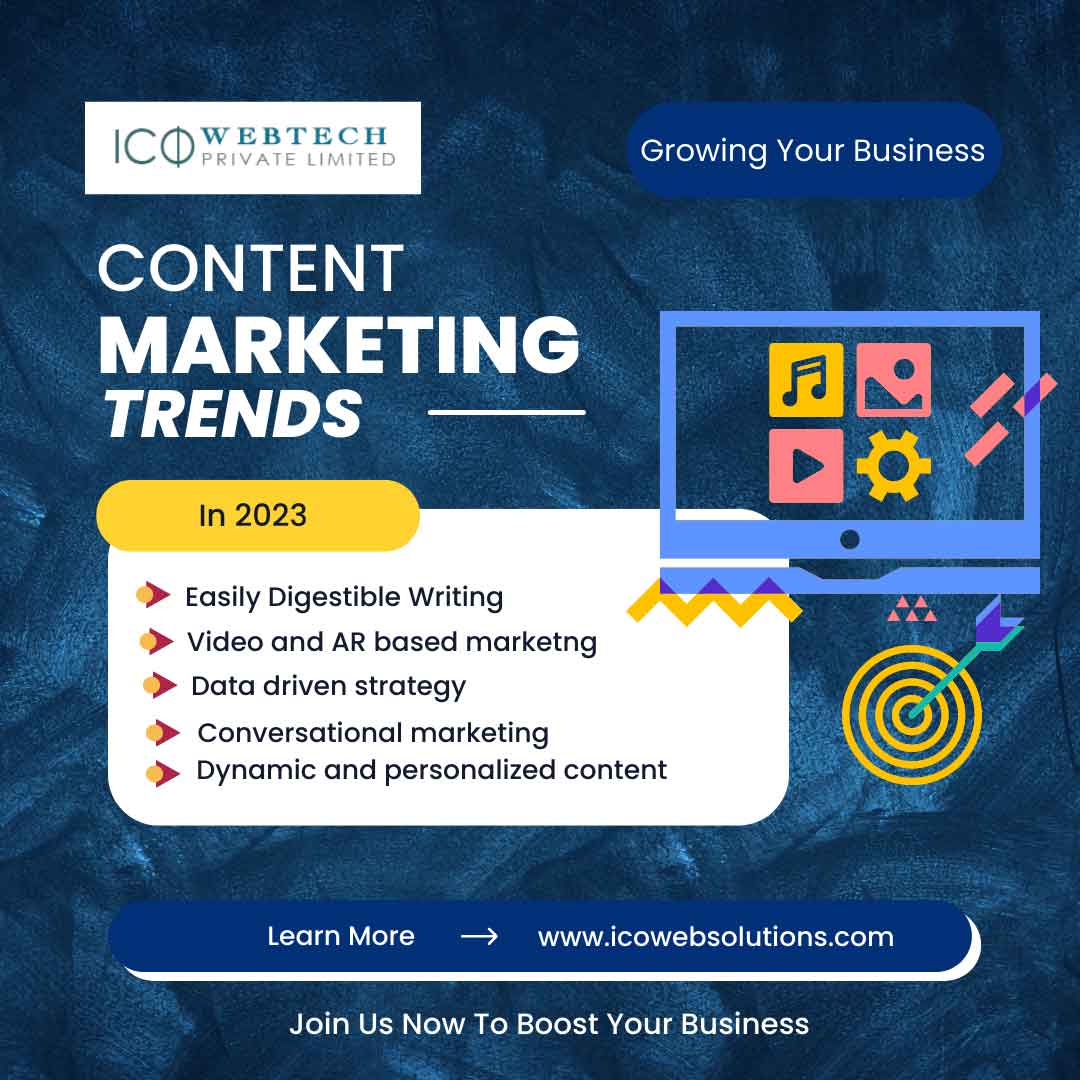
So here’s the list of top 5 content marketing trends for 2023.
-
Writing that is Easily Digestible
Content Writing has evolved. Partly owing to the changes in consumer attitudes, and partly to the competition from other content forms.
Nevertheless, blog posts remain the most popular marketing channels.
Each leading content writing company in Delhi is set to focus on:
- Facilitating user experience: As more users are shifting to mobile phones, content that is easy to consume on a smaller screen boosts organic traffic. This can be achieved by:
- Use of short paragraphs.
- Use of sizeable proportion of short sentences.
- Breaking down the article with headings and sub-headings.
- Engaging and Informative Content: A blog post dryly stuffed with information will not help. It should be written in an engaging and friendly style. The written content should interest the reader down to the very end or ‘the call to action’ part. This becomes all the more important as we are gradually entering into the age of long-form content.
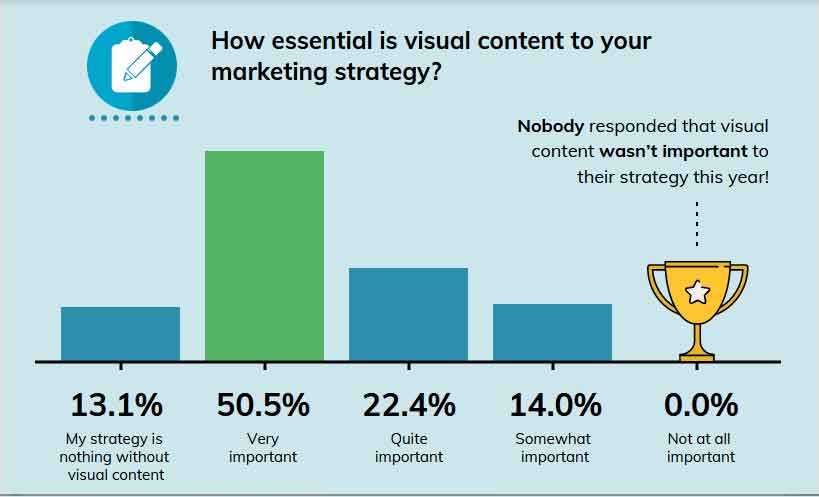
- Images and Infographics: Visuals grab 90% of reader’s attention on screen. Text supported by infographics increases the retention rate by 50%. Infographics added merely for the sake could work negatively. They should help the text in a natural way. They can be used to highlight certain points, summarize information, demonstrate comparisons, explain processes and present data, etc.Images contribute to the visual appeal of the text and help its meaning and feel.
 https://infograph.venngage.com/ps/BclJnjUr8NE/content-marketing-statistics
- User Intent-based Content: There are 4 types of searches that users make. Informational, navigational, investigational and transactional. Google directs the search results depending upon the type of search made. Ideally, textual content should take into account each type of query. Every reliable content writing company in Delhi is fine-tuning its content strategy for user intent-based content. Read Content Writing Tips.
-
Videos, Livestreaming and AR-backed Videos are Transforming the Content Marketing Landscape
To say that visual medium is transforming the digital marketing world would be a slight understatement. Much of it has already undergone a radical makeover. However, it is still not late to catch-up! Let’s take a closer look.
- Videos: Videos have become a norm in content strategy. They offer maximum audience engagement time amongst different content types. 80% of audiences would prefer video over blog post if they convey the same information.
Informational videos from experts and educational videos from leaders can boost content marketing efforts. However, it is the video reviews from customers that can do wonders. The trend of publishing videos on platforms like Instagram and LinkedIn is gaining momentum. Snapchat and Tik-tok videos can also be creatively integrated into online marketing strategies.
- Livestreaming: This is soon to become a norm. Audiences prefer live-videos amongst all varieties of video content. Over the last 3 years, there has been a 60% increase in live-video consumption time across the globe. It will rise further as better technologies hit the markets. The benefits of live-streaming in marketing strategy are multi-dimensional.
- Many Content Forms: Live videos can take several forms. Webinars, interviews and Q&A sessions can provide insights to audiences. Behind-the-scenes videos evoke intrigue and interest. Demos of latest products can be really impactful.
- Ready-made Video Content: Recordings of live-streamed videos can be edited and added to the video content repository.
- Audio of the live-streamed video can serve as a by-product for marketing.
- AR-backed Visuals: Use of Augmented Reality is gradually gaining a foothold.
AR allows users a taste of the real world from their mobile phones. It induces a fresh and emotional touch to marketing, backed by a bit of surprise. It is projected to be the next big thing in the user/customer engagement. It has the potential to lead the information seekers towards sales and customers towards brand loyalty quicker than any medium. Those with mobile-centric marketing strategies can benefit immensely from it. It is a relatively untapped medium, and thus the possibilities are endless. These uses of AR are sure to impact marketing in 2020.
- Virtual Tours
- Dynamic Sales Presentation for B2B
- Virtual Assistance
- Product Demos
- Branding materials augmentation
- Try before you Buy
-
Let Data drive Marketing Strategy
Underestimating the utility of Data in deciding content strategy would be risky. Data-driven mentality has to become an essential attribute of content marketers in 2020.
Data-driven insights can be crucial in understanding trending topics, audience preferences, competing influencers and user attitudes. Data brings greater accuracy into marketing content by taking out marketer’s intuition and replacing it with consumer expectations.
User expectations, audience preferences and consumer behaviors change rapidly. Data ensures their continuous tracking. This means higher value and relevant content for a targeted audience that ensures engagement. Choosing the relevant Data metrics is more important now. Integrating the Data insights into content strategy is now essential to design user-centric market campaigns.
-
Conversational Marketing has Grown
This is a step ahead of Data-driven hints regarding ‘knowing the audience’. Conversational marketing is about real engagement with the audience. Email marketing and Facebook conversation marketing are now conventional. The most important development is that Chatbots are gradually replacing live humans in terms of engagement.
Technologies driven by Artificial Intelligence are revolutionizing the content marketing space. AI-driven Chatbots and virtual assistants have already beaten humans on friendliness parameters. AI companies are working hard towards infusing greater depth and variations to conversational experience.
To make the most out of AI-driven technologies in 2020, marketers will have to focus on:
- Creating scripts that carry the brand voice, quality information and great conversational flow.
- Stronger Chatbot library of data.
- Real-time simulation of conversations.
- Greater integration of Chatbot with content.
-
Dynamic and Personalized Content is going to Next Level
People are increasingly looking for personalized experience. Dynamic content means that all users are not presented with the same set of content. Instead, they see and receive content that is relevant for them depending upon their needs and interests.
Dynamic content tools will become more complex but more productive for content marketers in 2020. Their influence will deepen and expand throughout the marketing channels. This will lead towards the automation of content development and delivery of high-quality content for each individual content consumer.
Dynamic content is not just about delivering the information that the consumer wants. It is about encouraging and persuading consumers to take the next step towards becoming a buyer!
Content marketing can be highly challenging but equally rewarding this year
These are just the 5 major trends that will shape online marketing in 2023. By no means is the list exhaustive! Closely related to these trends is the use of voice search optimization which marketers are still adapting to. Micro-moments visuals can make a huge difference too. Designing content that speaks in a distinct brand voice could also help in outdoing the competitors.
However, paying heed to these developments would be a sure pathway to online marketing success in 2020.
Hire our content marketing company in India to boost organic results.
Our Digital Marketing company in Delhi has over a decade of experience in website designing, SEO, Content Marketing; basically everything you need to get your business online.
Content Writing Best Practices 2020
The fact that Google tweaks its search algorithms periodically is no secret. In turn, adjusting to new game rules poses challenges for copywriters and SEO agencies. Now, the question arises that with the changing rules, how can one compile a winsome strategy?
Luckily, the basic rules of SEO copywriting will remain the same. Surely, you must learn to adapt. Even so, notwithstanding how important flexibility is, you can find comfort knowing that some aspects of website content writing will not change.
So, what is content writing anyway?
“Content writing is the creative process of planning, writing and editing web content, usually for digital marketing purposes. It can include writing blogs and articles, scripts for videos and podcasts, as well as content for specific platforms, such as Facebook, Twitter and the same.”
Here are 5 content writing tips that can help you learn more about content writing, and improve the reader experience, for sailing through the year 2020.
-
Pay attention to the experience
As part of your best content writing services, you must not merely increase the frequency of your blogs. Rather the challenge is to stand-out among your peers. To achieve the desired results, you must focus on improving the content experience. As such, the content you’re dishing out should not only be valuable but also enhance the user experience.
The term ‘Content Experience’ is a cross between content marketing and UX. It’s about assessing how to improve your content and your approach to get your readers to spend more time on your posts.
You can improve your content experience in the following ways:
- Examine the mobile version of your website
- Keep your paragraphs short so your content can be easily read on mobiles
- Increase the ‘readability’ of your content by adding images and subheadings
- Check your loading speed
- Work towards personalizing your site and content
You can hire a well-known content writing company in India to revamp your content experience in 2020.
-
Visual data helps
In addition to improving the reading experience, visual content also helps your main data become noticeable. With infographics, you can not only summarize the main points visually but also record more shares for your posts.
Plus, a website content writer in Delhi opines that you must use visual quotes to convey your standpoint in a manner that attracts the readers’ attention. More so, you can add videos on your site as an alternative content format.
Under SaaS marketing, you can also include GIFs to promote your product, for the readers then easily understand what you’re trying to say.
Nowadays, several brands are going with GIFs and videos to present their content in a simple way.
You can avail the services of a popular content writing agency if you’re looking to experiment with various visual storytelling formats to know about what your readers are responding more to.
-
Post long-form content
In 2020, the focus remains on creating long-term content; and in the below-listed pointers, you can know the reasons why this is so.
- Maintains trust with your readers
- Displays your style of writing and overall personality
- Helps to go in-depth on the subjects you’re covering
- Enhances your SEO
Long-form content also helps to improve your search ranking. More so, you get to cover topics in detail and, thus, can assert your authority over them.
Besides, the general recommendation is to not keep your posts overly long; only a few pieces should be over 1000 words.
By availing the services of content writing company in Delhi, you can explore the potential of long-form content handsomely.
-
Try reading your content aloud
If you’re looking to improve your content writing, then you might want to start reading your content out loud. Then, you can know whether your writing sounds natural or not. Moreover, your content should feel more conversational. Only then, your readers will get to enjoy your content and you can expand your readership base over time.
By reading your content out loud, you can examine how you’re getting across your message too. All the same, you can improve your writing and the reader’s experience.
A reputed content writing company in Delhi will also advise you to read out your content loud before you publish to know the difference it makes.
-
Focus on smarter SEO practices
The year 2020 also calls for smarter SEO Content Writing. At first, you should try bringing about changes that leave a long-term impact.
- Rather than focusing on the most popular keyword, you must opt for long-tail keywords
- Your focus should be on improving your content and not only stuffing with focus keywords
- Make SEO easier by investing in the tools that help to give the desired results
- Instead of working towards increasing your SERP ranks, you must discover newer ways (such as featured snippets and visual ranking) for your content to get noticed
- Maintain the ‘conversational’ tone in your content, for that raises your chances of coming in the question boxes and featured snippets
If you talk to any content writing service provider, they will also suggest that you start thinking of SEO as one more element of your content writing strategy for addressing your readers’ needs. Your emphasis should not only be limited to winning high ranks in the search results but also extend to delivering an enjoyable experience to the readers.
Summing up
All content marketing trends are not revolutionary. At times, even simple changes help to achieve success.
Study your current content marketing strategy and review what worked in recent years. Look for areas that need improvement and implement the requisite changes.
These five trends help to understand the simple changes you should focus upon to live up to your audience’s expectations.

Top 5 Restaurant Digital Marketing tips in 2020
The restaurant business grapples with uncertainty. Small business owners face several challenges and data suggests that close to 50% fail within the initial years of starting operations. To keep ahead of your peers in the restaurant business, you must focus on the key areas.
These include
- menu customization,
- premium customer service,
- digital marketing for restaurants, and
- general restaurant management.
Now, to take your digital marketing efforts several notches above, we have listed some tips. These effective restaurant marketing ideas and trends via digital means can help you to not only obtain more orders but also strengthen the ties with your client base.
#1. Leverage the potential of social media
Have a restaurant social media marketing strategy in place – if you want to be successful as a restaurateur. And, NO, merely having a social media account does not suffice, rather you have to stay active across the board.
Social media marketing offers opportunities to attract people who can become repeat customers while increasing your networking capabilities. Besides, you can avail the benefit of various free and paid advertising campaigns via social media channels.
Start with identifying the social media channels that are a hit for you. Follow by posting content regularly, along with customers’ dine-in photographs, on your social media handles for heightening your restaurant visibility.
Some of the best social media practices include:
- Keeping your audiences engaged by posting online polls
- Putting up recipes and fun food concepts
- Sharing valuable content from your blog
- Holding contests on social media channels
- Affixing popular hashtags
To derive optimum benefit from social media, be sure to post regularly. For managing your social media presence, you should consider hiring social media experts. A Digital Marketing Company in Delhi can help to maximize your reach via social media.
#2. Use online reviews to your advantage
In addition to restaurant social media marketing, you must keep in mind that people need assurances when they’re investing in any kind of service. The same rule applies to their dining experiences.
When users research restaurants on the Internet, they want to know about other people’s opinions. Herein lies an opportunity for you to take advantage of online reviews. So, you may want to encourage customers to post a review about their experience with your restaurant.
A good way of driving customers to post reviews is by offering a sizeable discount on their subsequent meal after posting a review.
#3. Focus on your website
As the owner of a local restaurant, you must know that your storefront is not the face of your company anymore. Because over 80% of customers rely on online sources for researching products and services, and they evaluate the credibility of your business via your website. And if your website is not attractive enough, chances are that they will not dine at your restaurant.
To drive customers to your restaurant, you must make sure your website is appealing, user-friendly, and more importantly, functional. Moreover, many customers use smartphones to browse the web for restaurants, and optimizing your website for mobiles helps to connect with them.
The experts at the website designing company in Delhi come with many years of experience in developing websites. They can help to make your website easy for users to navigate.
#4. Opt for SEO
Optimizing your website for Google is most important. Because most customer searches are conducted on this popular search engine. So, go ahead and hire a SEO Agency in Delhi, for they can build your online presence and advertise your restaurant to prospective customers.
To get started with your SEO, you will have to have a regular website or go for ecommerce website development for a more comfortable and viable approach. Because eCommerce has a booming future in India, particularly in these current pandemic times.
#5. Post Valuable Website Content
Bill Gates once rightly said ‘Content is King’. Quality content is a powerful tool for building your brand, connecting with more people, and solidifying ties with your clientele. And you can present content on your website in myriad ways – including via emails, newsletters, videos, social media posts, eBooks, among others.
Contact the SEO experts to help you differentiate between quality content and poor content. More so, you can call upon them for any of your eCommerce website designing for restaurants requirements.
FINAL THOUGHTS
With more and more customers choosing to go online for searching restaurants and ordering food during recent years, restaurant owners must not undermine the importance of website and digital marketing. The medium allows people to search your restaurant online for both dining in and placing orders.
Need help with your Restaurant Digital Marketing or Website Designing? ICO WebTech is happy to help. We have a decade of experience and are an award winning website designing company in Delhi.
Get in touch with us to get your business ahead of your competitors.
Whatsapp/Call- 8447380262
Email: inquiry@icowebsolutions.com

5 Leading Trends That Will Drive Content Marketing In 2020
There is nothing called stagnation in content marketing. Individuals, brands and marketers either fall behind or drive ahead. It all depends upon getting hold of the latest trends and adapting smartly to them in time. Significant developments in content marketing bring new challenges and limitless possibilities ahead.
What is Content Marketing in 2020?
The meaning of digital marketing terms stretch until it breaks into two. Thanks to the dynamism of the web world! Until recently, content strategy and content marketing could be used interchangeably.
It is no more so!
These two areas have now diverged in their meaning and practice, though they remain complementary.
Let’s see what content marketing means in 2020.
In simplest terms;
content marketing is the creation, publication, and distribution of reliable and valuable content. Selling is not its direct, but ultimate aim.
It is geared towards educating and informing consumers. So, its immediate purpose is to attract organic traffic by spreading transparent and honest information through different channels.
Why content marketing agency would require new strategies in 2020?
Content marketing strategy is the homework that a content marketing service provider does before setting out for content creation. It is intended to drive product and service sales. Basically, it revolves around the following questions:
- For what is the content to be created?
- What should be the different marketing mediums and channels used?
- What should be the content types?
- Where the content should be published and distributed?
- How should the informational and promotional content be linked and integrated?
Content strategists would have to adjust to new realities in 2020 depending upon where they stood in 2019. Technological improvements, fiercer competition, and changing content consumption trends are the main reasons for it. In fact, these three factors feed into each other, demanding greater creativity from content marketers.
Before we delve into the technical details, let’s take an overview of how the content marketing environment has changed.
- Firstly, the web world has become dominantly visual. To be precise, the importance of video content is rising swiftly.
- Secondly, technological developments have changed the way people search information, products and services. Content consumption preferences and overall user attitudes have also changed.
- Thirdly, Data is revolutionizing everything around us. Content marketing is not untouched by these massive changes.
So here’s the list of top 5 content marketing trends for 2020.
-
Writing that is Easily Digestible
Content Writing has evolved. Partly owing to the changes in consumer attitudes, and partly to the competition from other content forms.
Nevertheless, blog posts remain the most popular marketing channels.
Each leading content writing company is set to focus on:
- Facilitating user experience: As more users are shifting to mobile phones, content that is easy to consume on a smaller screen boosts organic traffic. This can be achieved by:
- Use of short paragraphs.
- Use of sizeable proportion of short sentences.
- Breaking down the article with headings and sub-headings.
- Engaging and Informative Content: A blog post dryly stuffed with information will not help. It should be written in an engaging and friendly style. The written content should interest the reader down to the very end or ‘the call to action’ part. This becomes all the more important as we are gradually entering into the age of long-form content.
- Images and Infographics: Visuals grab 90% of reader’s attention on screen. Text supported by infographics increases the retention rate by 50%. Infographics added merely for the sake could work negatively. They should help the text in a natural way. They can be used to highlight certain points, summarize information, demonstrate comparisons, explain processes and present data, etc.Images contribute to the visual appeal of the text and help its meaning and feel.
- User Intent-based Content: There are 4 types of searches that users make. Informational, navigational, investigational and transactional. Google directs the search results depending upon the type of search made. Ideally, textual content should take into account each type of query. Every reliable content writing company in Delhi is fine-tuning its content strategy for user intent-based content.
-
Videos, Livestreaming and AR-backed Videos are Transforming the Content Marketing Landscape
To say that visual medium is transforming the digital marketing world would be a slight understatement. Much of it has already undergone a radical makeover. However, it is still not late to catch-up! Let’s take a closer look.
- Videos: Videos have become a norm in content strategy. They offer maximum audience engagement time amongst different content types. 80% of audiences would prefer video over blog post if they convey the same information.
Informational videos from experts and educational videos from leaders can boost content marketing efforts. However, it is the video reviews from customers that can do wonders. The trend of publishing videos on platforms like Instagram and LinkedIn is gaining momentum. Snapchat and Tik-tok videos can also be creatively integrated into online marketing strategies.
- Livestreaming: This is soon to become a norm. Audiences prefer live-videos amongst all varieties of video content. Over the last 3 years, there has been a 60% increase in live-video consumption time across the globe. It will rise further as better technologies hit the markets. The benefits of live-streaming in marketing strategy are multi-dimensional.
- Many Content Forms: Live videos can take several forms. Webinars, interviews and Q&A sessions can provide insights to audiences. Behind-the-scenes videos evoke intrigue and interest. Demos of latest products can be really impactful.
- Readymade Video Content: Recordings of live-streamed videos can be edited and added to the video content repository.
- Audio of the live-streamed video can serve as a by-product for marketing.
- AR-backed Visuals: Use of Augmented Reality is gradually gaining a foothold.
AR allows users a taste of the real world from their mobile phones. It induces a fresh and emotional touch to marketing, backed by a bit of surprise. It is projected to be the next big thing in the user/customer engagement. It has the potential to lead the information seekers towards sales and customers towards brand loyalty quicker than any medium. Those with mobile-centric marketing strategies can benefit immensely from it. It is a relatively untapped medium, and thus the possibilities are endless. These uses of AR are sure to impact marketing in 2020.
- Virtual Tours
- Dynamic Sales Presentation for B2B
- Virtual Assistance
- Product Demos
- Branding materials augmentation
- Try before you Buy
-
Let Data drive Marketing Strategy
Underestimating the utility of Data in deciding content strategy would be risky. Data-driven mentality has to become an essential attribute of content marketers in 2020.
Data-driven insights can be crucial in understanding trending topics, audience preferences, competing influencers and user attitudes. Data brings greater accuracy into marketing content by taking out marketer’s intuition and replacing it with consumer expectations.
User expectations, audience preferences and consumer behaviours change rapidly. Data ensures their continuous tracking. This means higher value and relevant content for a targeted audience that ensures engagement. Choosing the relevant Data metrics is more important now. Integrating the Data insights into content strategy is now essential to design user-centric market campaigns.
-
Conversational Marketing has Grown
This is a step ahead of Data-driven hints regarding ‘knowing the audience’. Conversational marketing is about real engagement with the audience. Email marketing and Facebook conversation marketing are now conventional. The most important development is that Chatbots are gradually replacing live humans in terms of engagement.
Technologies driven by Artificial Intelligence are revolutionizing the content marketing space. AI-driven Chatbots and virtual assistants have already beaten humans on friendliness parameters. AI companies are working hard towards infusing greater depth and variations to conversational experience.
To make the most out of AI-driven technologies in 2020, marketers will have to focus on:
- Creating scripts that carry the brand voice, quality information and great conversational flow.
- Stronger Chatbot library of data.
- Real-time simulation of conversations.
- Greater integration of Chatbot with content.
-
Dynamic and Personalized Content is going to Next Level
People are increasingly looking for personalized experience. Dynamic content means that all users are not presented with the same set of content. Instead, they see and receive content that is relevant for them depending upon their needs and interests.
Dynamic content tools will become more complex but more productive for content marketers in 2020. Their influence will deepen and expand throughout the marketing channels. This will lead towards the automation of content development and delivery of high-quality content for each individual content consumer.
Dynamic content is not just about delivering the information that the consumer wants. It is about encouraging and persuading consumers to take the next step towards becoming a buyer!
Content marketing can be highly challenging but equally rewarding this year
These are just the 5 major trends that will shape online marketing in 2020. By no means is the list exhaustive! Closely related to these trends is the use of voice search optimization which marketers are still adapting to. Micro-moments visuals can make a huge difference too. Designing content that speaks in a distinct brand voice could also help in outdoing the competitors.
However, paying heed to these developments would be a sure pathway to online marketing success in 2020.
Hire our content marketing company to boost organic results.
Drive more traffic through customer-targeted content
If we ask to any of the business owner what they like the most, they will probably say “more customers”.
What does a business wishes apart from customers and sales?
The answer is more of traffic to their site.
To boost this site traffic we need to look after many strategies, tactics, and hacks which are built on the foundation of your content on your blog. If that basic lifeblood of your blog or website isn’t targeting your customers specifically, then no amount of promotional efforts matters.
Understand your customers by creating buyers personas at the lower level because you want your content to reach the right people. Buyer personas help you to understand your customers better. This makes it easier for you to tailor your content, messaging, product development, and services to the different groups. The strongest buyers’ personas are based on market researches as well as insights.
Ways through which you can boost your traffic:
Get in touch with social media
It’s not enough to get a good and great content and hope that people find it. You have to be proactive. One of the best way to increase traffic to your website is to use social media marketing channels to promote your content.
For instance, Twitter is most suitable for short links, while Google My Business promotion can help your site to show up in organic search results. Moreover it is particularly effective in B2B companies. If you are a B2C company, you can find good communication on Pinterest and Instagram.
Give more attention to On-Page SEO
Optimizing your content for search engines is still a valuable practice. Are you creating internal links? What about meta descriptions? What about alt text?
Are you making the most of the on page SEO? It could help you to boost your organic search traffic.
Make sure you have a responsive website
In today’s world more people use mobile devices to access the web. Make sure that your website is easily loaded and comfortably viewed across a wide range of devices with varied screen sizes.
This should include small smart phones, tablets, I-phones, etc. World is getting advance day by day then why our website should be kept behind. Website optimization is crucial for improved performance in 2019, and mobile friendly website designing is an important part of it.
Focus on long-tail keywords
If your popular keywords bases are covered, then it’s time to target and get long-tail keywords. Long-tail keyword covers for a majority of web searches.
It’s good to have keywords but long-tails covers more than half of the search of maximum of search engines.
Research about your competition
Keep an eye on your competition, use different software to check out what your competitors are up to. It gives out the aggregate of social performance of specific sites and content to provide at-a- glance view about what are the topics the readers are interested in, and importantly making a rounds on social media.
Find out what are their mind wants to read and talk about, and then emulate that kind of content to bring more traffic to your website. In short, leverage competitor analysis for better results of your SEO efforts.
Some final thoughts
You need to know about what your customers are looking for in your content, and try to connect with them on an emotional level through their shared beliefs and post. This is the key to increase traffic and having a lasting success through customer targeted content.
The above information can be overwhelming. Therefore, if you are looking for SEO experts India then we can serve your requirement with success. We are a website designing company in Delhi serving our client for all their web design and Digital Marketing needs in India and abroad.
Contact us if you have any questions.

Why your website desperately needs a professional content writer
In our experience as a website designing company in Delhi we have worked with hundreds of clients in Delhi NCR and hundred across the globe. We have noticed that every client agrees to the fact that content is the king, with all the articles and tutorials available online. But when it comes to developing their website, a handful think about professionally written content.
It is because the focus remains limited to the beauty of the website.
The website should look way better than the competitors.
The website should have mind blowing effects which competitors can’t even think about.
In this beautification the most important part of the website, ‘the content’ takes a back seat.
Then when you realize that you are not getting results from your website as you wanted, it gets late.
We give you top three reason why your website needs a professional content writer.
As business owner you have too much to handle on your plate. If you take content writing on then with all the other responsibilities you might not get enough time to write quality content yourself.
This is one of the major reasons in delay of your website launch. Read about how to eliminate delays in your website launch.
However with a very little investment you can rid of delays in your website launch and get quality content written by a professional content writer.
Below are the benefits of hiring a professional content writer with us.
Our content writers will get your website content ready much before your website launch
Getting the website content ready on time is most important to launch a website on time. Our professional content writers work on one project at a time. This is the reason why we guarantee that we will never delay your website content and the website is launched on time.
Our content writers ensure quality and consistency
Consistency in content writing is very important for the growth of your business. It helps you build your brand gradually. Our content writing team produces high quality and engaging content with consistency which impacts your customers’ decision making more than any other strategy.
Our content writers will produce SEO oriented content
Apart from quality and consistency, our professional content writers focus on search engine while producing the content for your website. We make sure search engines like Google, Bing, Yahoo etc love your website content and rank it in front of your customers.
For consultation on professional content writing for your website or any other use reach us at +91-8447380262
