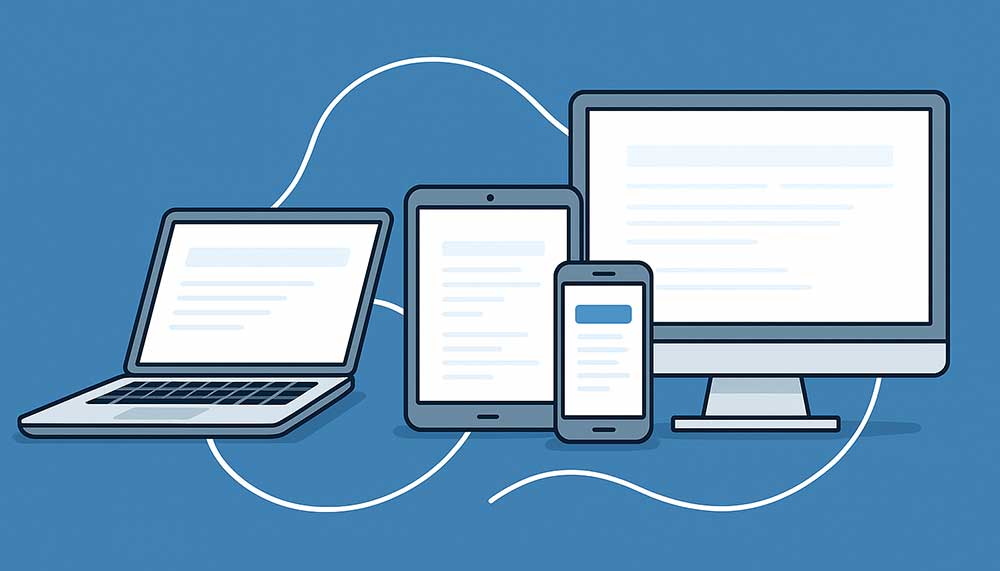
In today’s digital-first world, the average consumer doesn’t just browse on one screen. They might research a product on their phone, read reviews on a laptop, and make the final purchase on a tablet. This seamless shift between devices defines the new normal of user behavior — and for businesses, mastering cross-device engagement is no longer optional.
Whether you’re a web development company in Delhi creating responsive websites, an SEO expert in India optimizing user journeys, or a web design agency refining UI for consistency — understanding how to connect with users across multiple platforms is essential to building trust, loyalty, and conversions.
This article explores the strategies, technologies, and creative best practices that ensure your brand remains recognizable and effective — no matter what screen your customers are using.
1. Understanding the Multi-Device User Journey
The first step toward building a strong cross-device connection is understanding how users behave across platforms. Studies show that users interact with at least three devices every day — smartphones, laptops, and tablets — and often switch between them mid-task.
For example, a potential client searching for a website development company in Delhi may first discover your brand via a Google search on mobile, explore your portfolio on a desktop, and later submit an inquiry from a tablet. Each step in that journey must feel continuous, intuitive, and personal.
Failing to maintain that continuity — through inconsistent design, confusing navigation, or poor optimization — can break the connection and cause users to abandon your brand entirely.
Key Takeaways:
- Map your customer journey across all devices and identify drop-off points.
- Use analytics to track how users transition between mobile, desktop, and tablet sessions.
- Ensure branding, messaging, and navigation remain consistent across platforms.
2. Responsive Design: The Foundation of Multi-Device Success
A responsive website is the backbone of any cross-device strategy. It ensures your site automatically adjusts its layout and elements based on the screen size, orientation, and resolution. For a web design company in Delhi, this isn’t just a design requirement — it’s a business imperative.
Responsive design improves user experience, boosts SEO rankings, and aligns perfectly with Google’s mobile-first indexing policies. Websites that aren’t mobile-friendly risk losing visibility, traffic, and credibility.
Best Practices for Responsive Design:
- Use fluid grids and flexible images: Design layouts that adapt to all screen sizes without distortion.
- Prioritize readability: Ensure text is legible without zooming and CTA buttons are large enough for touch navigation.
- Test frequently: Check how your site behaves on different devices and browsers, especially on lower-end phones common in emerging markets like India.
Leading website development companies in India are now adopting frameworks like Bootstrap, Tailwind, and React for seamless responsiveness and performance across screens.
3. Unified Branding Across All Touchpoints
Your brand identity — colors, tone, visuals, and personality — should remain uniform whether the user interacts via a smartphone ad, desktop website, or social post. Inconsistency creates confusion and weakens brand recall.
For instance, if your web design agency in Delhi runs a Google Ad promoting “Custom Website Design Services” with a minimalist tone, but your landing page looks overly corporate, the user experience disconnects instantly.
Consistency builds trust — and in digital marketing, trust is everything.
Tips for Unified Branding:
- Develop a brand style guide covering fonts, colors, tone, and imagery for all platforms.
- Use the same logo placement and navigation structure across devices.
- Keep messaging short, adaptable, and consistent in voice across web, app, and email.
4. Mobile Optimization Beyond Design
Being mobile-optimized goes beyond responsive layouts. It’s about delivering speed, simplicity, and intent-driven experiences. For a website development company targeting leads, mobile is often where conversions either happen or die.
Mobile users expect instant gratification. Every second of delay reduces conversion rates significantly. Google’s Core Web Vitals have made this even more critical by factoring page experience into ranking signals.
Mobile Optimization Techniques:
- Use AMP (Accelerated Mobile Pages) where appropriate to improve load speed.
- Minimize scripts and optimize image formats (WebP preferred).
- Prioritize vertical scrolling and thumb-friendly interfaces.
- Implement click-to-call and map integrations for local users searching for services like “web development company in Delhi”.
Remember, mobile users aren’t browsing — they’re acting. Optimize for micro-moments: when users want to know, go, do, or buy something instantly.
5. Personalization Across Devices
In a world of algorithms and AI, personalization is the differentiator that turns visitors into loyal customers. The challenge lies in maintaining personalization across multiple devices.
For example, if a user browses a website development company in India on desktop and later revisits the site on mobile, they should see tailored suggestions or saved progress — not start from scratch.
To achieve this, brands are integrating cross-device identifiers and unified analytics to recognize returning users, track preferences, and deliver personalized experiences consistently.
Personalization Strategies:
- Use customer data platforms (CDPs) to unify user data across devices.
- Leverage dynamic content — such as location-based offers for users searching “web design agency near me.”
- Use retargeting campaigns that adapt creatives based on device type and past interactions.
6. Cross-Platform Analytics and Attribution
Tracking performance across devices is one of the toughest challenges in modern marketing. Users may click an ad on mobile, explore your services on desktop, and convert days later on a tablet. Without accurate tracking, you’ll never understand what truly drives conversions.
Web development companies in India increasingly use advanced analytics tools like Google Analytics 4 (GA4), which support cross-device user tracking through event-based data models and AI-driven attribution.
This allows marketers to analyze complete customer journeys, identify key touchpoints, and allocate budgets more effectively.
Best Practices for Cross-Device Analytics:
- Set up cross-device user IDs for consistent tracking.
- Use GA4’s event tracking to follow actions, not just sessions.
- Integrate CRM and ad data to understand offline-to-online conversions.
- Test attribution models to see how different devices contribute to the final conversion.
7. Multi-Channel Consistency for Lead Generation
For any lead generation strategy to succeed, consistency across channels is crucial. Your SEO, paid ads, social media, and email campaigns should tell one coherent story — no matter the device.
Imagine a user finds your web design company in Delhi through an Instagram ad, clicks through on mobile, and later receives a remarketing email on desktop. Each interaction should feel like a natural continuation of the previous one — not a disconnected sales pitch.
This holistic approach improves brand recall, boosts conversion rates, and enhances overall ROI.
Multi-Channel Engagement Tips:
- Use consistent visuals and tone across paid, organic, and social content.
- Segment audiences by device usage and behavior for targeted campaigns.
- Implement responsive email templates and mobile-optimized landing pages.
8. The Role of SEO in Cross-Device Engagement
SEO isn’t just about ranking — it’s about relevance and accessibility. A SEO expert in India understands that today’s optimization strategies must serve multiple screens simultaneously.
Google’s algorithms now prioritize mobile usability, content relevance, and user intent across devices. If your content performs poorly on mobile, it affects your desktop ranking as well.
SEO Best Practices for Cross-Device Optimization:
- Optimize metadata and structured data for mobile and desktop alike.
- Use responsive design instead of separate mobile URLs.
- Ensure your content structure supports voice and mobile search queries.
- Build backlinks from responsive, reputable websites to strengthen domain authority.
For businesses like web development companies in Delhi, cross-device SEO ensures that every click — from mobile to desktop — leads users toward the same consistent experience and message.
9. The Future: Cross-Device Engagement Meets AI
The future of user engagement lies at the intersection of AI, machine learning, and predictive analytics. These technologies enable websites to anticipate user needs, automate personalization, and deliver seamless transitions between devices.
Imagine this: a potential client browsing your website development company portfolio on mobile later sees a personalized desktop homepage showcasing services they viewed earlier. That’s AI-driven continuity — smart, subtle, and incredibly effective.
From smart notifications to adaptive design systems, AI ensures brands stay one step ahead, no matter how users switch between devices.
Conclusion
Cross-device engagement isn’t a design choice — it’s a strategic necessity. In a world where attention spans are divided across screens, your ability to maintain consistency, speed, and relevance defines your digital success.
Whether you’re a web design company in Delhi building user-centric experiences, a website development company in India focusing on performance, or an SEO expert fine-tuning content for multiple screens — the key lies in unity. Every pixel, word, and click should tell the same story, no matter the device.
The brands that master this art aren’t just connecting devices — they’re connecting human experiences.



Related items

Somewhere in the multiverse, right between a collapsing timeline and a slightly delayed po

Search engine optimization is no longer a “nice-to-have.” It is the backbone of sustainabl


Your 404 page is suffering. It is confused. It is lost. It is questioning its purpose, its
