
OpenAI officially flipped the switch on advertising on February 9, 2026. This move was driven by a projected $14–$17 billion “burn rate” in compute costs.
Key deployment facts
Availability: Currently limited to U.S. users (logged-in adults). Expansion to the UK, Australia, and India is expected by Q3 2026.
Target Tiers: Ads appear only for Free and ChatGPT Go ($8/mo) users. Plus, Pro, and Enterprise tiers remain ad-free.
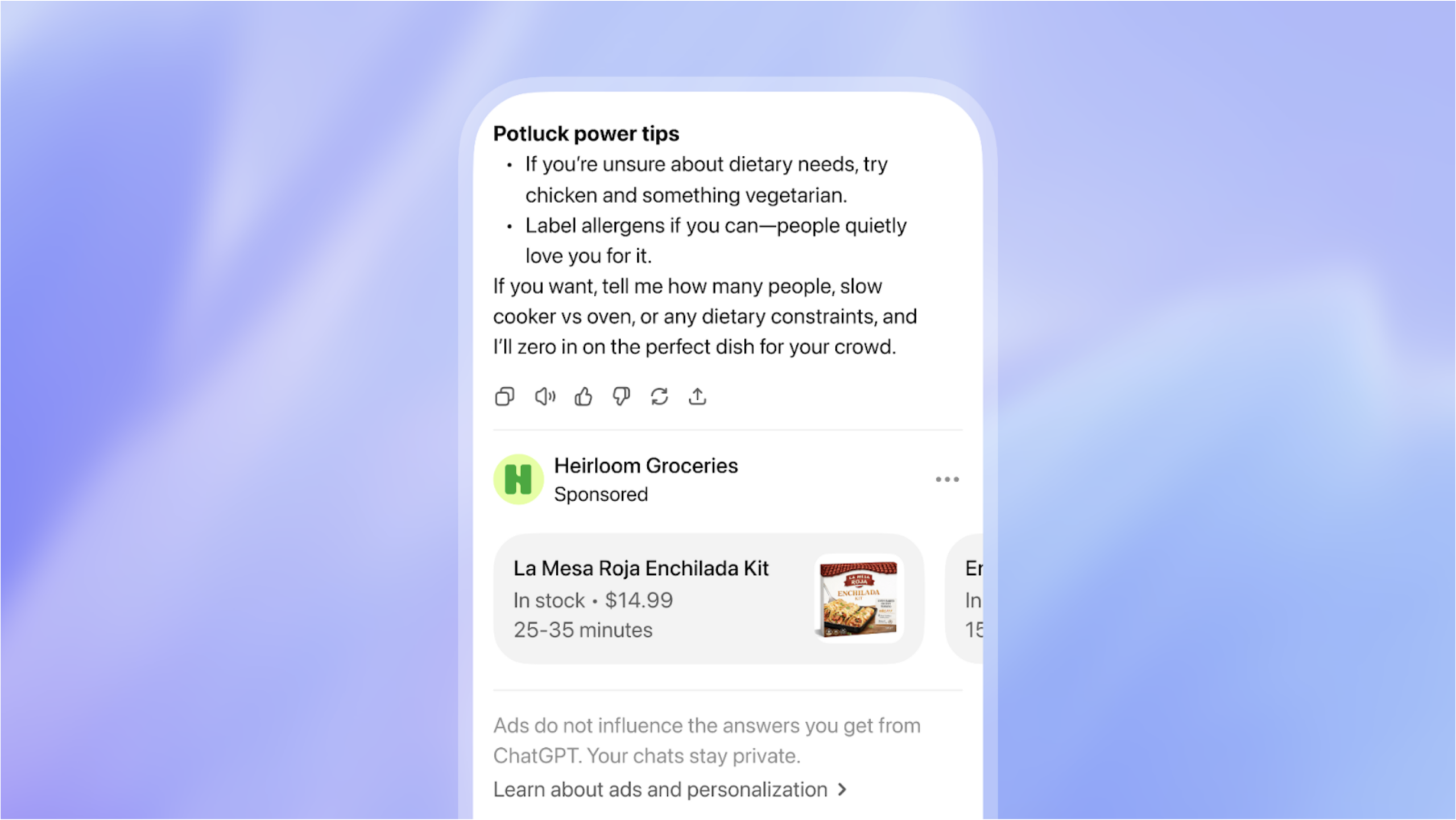
Format: Ads are “Sponsored Recommendations” clearly labeled at the bottom of a response. Crucially, they do not live inside the AI’s generated text yet—they are visually separated to maintain user trust.
Cost: Early programmatic pilots (via partners like Criteo) show a premium CPM of approximately $60, roughly 3x the average Meta rate.
The shift from search results to direct answers
For a long time, marketing followed a simple rule: show up on page one, get the click, win the customer.
It worked because people searched in a certain way. They typed a few words, scanned a list of links, opened a few tabs, and figured things out on their own.
That behavior is changing.
Today, people are asking complete questions. They expect clear answers. And increasingly, they get those answers from tools like ChatGPT—without needing to visit multiple websites.
This doesn’t mean search is going away. It means the search experience is evolving.
Instead of navigating options, users are moving toward decisions faster. They describe their problem, add context, and expect a response that understands what they mean—not just what they typed.
For businesses, this changes what visibility looks like.
It is no longer only about where you rank. It is about whether your business shows up as a relevant, trusted answer when someone is ready to act.
And that shift—from being one of many options to being part of the answer—is what defines marketing in this next phase.
What ChatGPT ads are and why they matter
As people start asking AI tools for answers, a new kind of visibility is emerging.
ChatGPT ads—often called sponsored recommendations—appear within responses when a user is looking for a solution. They are not separate banners or distractions. They are part of the conversation.
This is what makes them different.
Instead of interrupting the user, these recommendations show up when the user is already thinking through a problem. The context is clear, and the intent is strong.
For example, someone might ask how to manage leads for a small business or how to improve website conversions. At that moment, a relevant product or service can be introduced naturally as part of the answer.
This creates a different kind of interaction.
The user is not browsing. They are deciding.
And because the recommendation is aligned with the question, it feels useful rather than promotional.
For businesses, this means visibility is no longer just about being seen. It is about being relevant at the exact moment someone is looking for help.
What early ChatGPT ads are showing us
Recent observations from the Adthena team, shared by their CMO Ashley Fletcher, offer one of the first real glimpses into how ChatGPT ads are actually working.
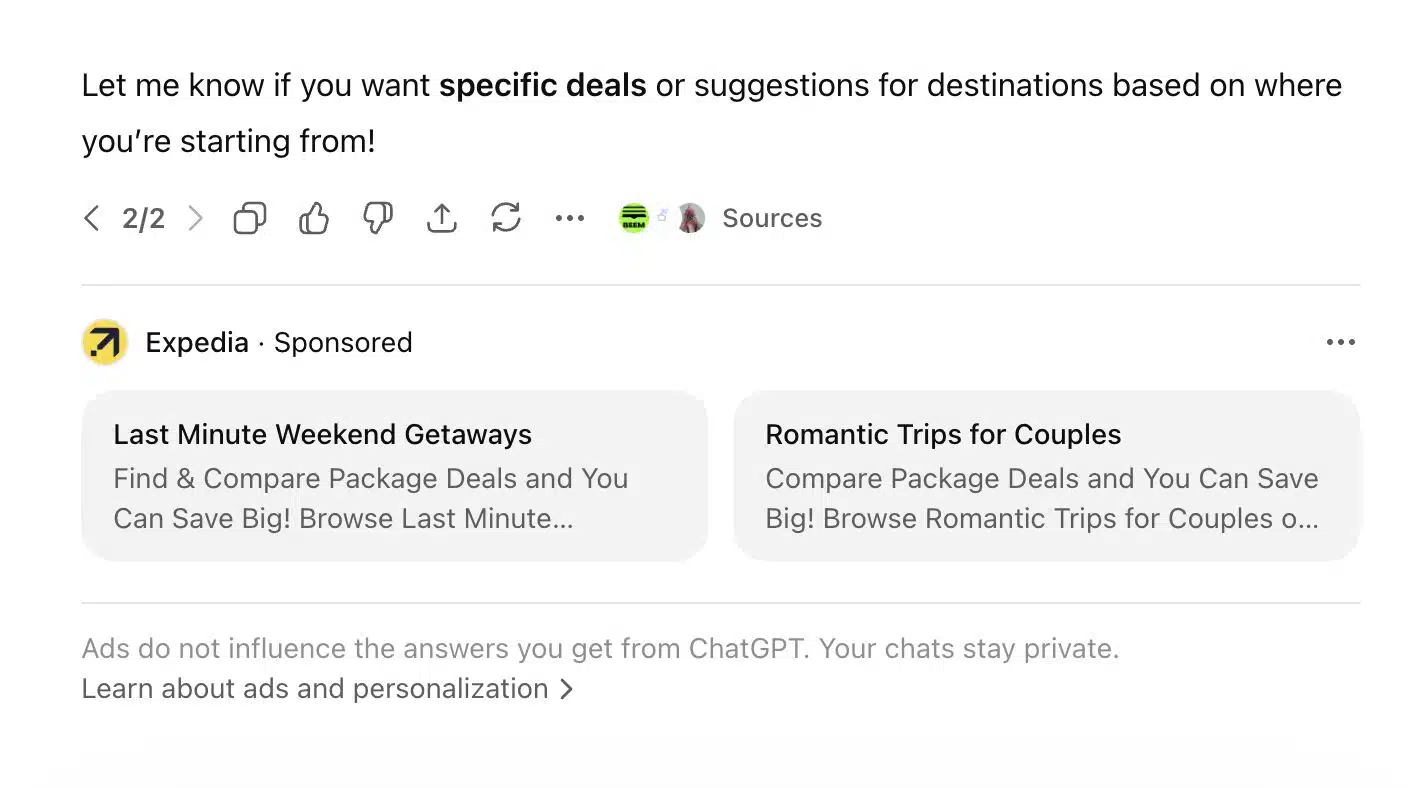
The initial assumption was that ads would appear later in a conversation, after multiple interactions. But early examples show something different.
Ads are appearing immediately—within the first response to a user’s prompt.
In one case, a simple question about booking a weekend trip triggered sponsored recommendations right away, placed directly within the answer.
This detail matters.
It shows that AI platforms are treating a single, well-formed prompt as high intent. The user does not need multiple steps to signal interest. The intent is already clear from the way the question is asked.
It also changes how we think about visibility.
You are no longer waiting for a user to refine their search. You have one moment—one prompt—where your brand can appear as a relevant solution.
That makes alignment with intent more important than ever.
If your messaging, content, or offering does not match the user’s exact need, you are unlikely to be included in that moment.
And if it does, you are no longer competing for attention. You are part of the answer.
Why ChatGPT ads perform differently
At first glance, ChatGPT ads may seem similar to traditional search ads. But the way they work and the way users interact with them is fundamentally different.
The difference comes down to context, intent, and attention.
They understand context, not just keywords
Search engines typically respond to a few words. AI tools respond to full questions, including the context behind them.
This means the platform understands not just what the user is asking, but why they are asking it. The recommendation that follows is shaped by that deeper understanding.
They appear at higher-intent moments
Users who turn to AI are often looking for solutions, not just information. Their questions are more specific, more detailed, and closer to a decision.
When a recommendation appears in that moment, it aligns with an active need rather than a passive search.
They reduce distraction
Traditional search results present multiple options at once. Users compare, evaluate, and often delay decisions.
In a conversational response, the experience is more focused. The recommendation is part of a guided answer, which simplifies decision-making.
They feel more like guidance than promotion
Because the recommendation is integrated into the response, it feels less like an interruption and more like a helpful suggestion.
This shift—from being one of many options to being part of a relevant answer—is what makes ChatGPT ads more aligned with how people now discover and choose solutions.
The strategy: from search engine marketing to answer-driven marketing
As user behavior shifts, marketing strategies need to evolve with it.
Traditional search engine marketing focuses on keywords and visibility. The goal is to appear when someone searches for a term.
Answer-driven marketing takes a different approach. It focuses on understanding the user’s situation and aligning your message with their intent.
This requires a shift in how you think about targeting, content, and messaging.
Intent-based targeting
Instead of targeting broad keywords, focus on real user problems and scenarios. Understand what the user is trying to solve and where they are in the decision process.
For example, a search for “CRM software” is broad. A question like “how do I manage leads for a small team” reflects a clear need and context.
Targeting this level of intent helps you reach users who are more likely to convert.
Answer-aligned landing pages
When a user clicks through from an AI recommendation, they expect clarity. The landing page should directly address the question that brought them there.
This means clear headlines, relevant content, and no unnecessary friction. The experience should feel like a continuation of the conversation, not a reset.
Conversational messaging
Messaging should focus on being helpful and specific. Instead of pushing urgency or promotions, explain how your product or service solves the user’s problem.
Simple, clear language works better than generic claims. The goal is to build trust by being useful at the moment it matters.
Together, these elements create a system that aligns with how people now search, ask, and decide.
High-intent queries in the AI era
As search behavior evolves, the way people ask questions is changing. Instead of short keywords, users are now writing full, detailed queries that reflect their exact situation.
These are often called natural language queries. More importantly, they reveal intent clearly.
Understanding these queries helps you align your content and ads with what users are actually trying to solve.
Comparison queries
Users compare options based on specific needs, not just features. For example, they may ask which tool works better for a particular use case or business size.
Pain-point queries
These questions focus on solving a problem. The user is looking for a way to fix something, improve performance, or reduce inefficiencies.
Solution-seeking queries
Here, the user is actively looking for recommendations. The question often includes context such as location, budget, or specific requirements.
These types of queries signal strong intent. They also provide more context, making it easier to deliver relevant answers.
For businesses, this means moving beyond keyword lists and focusing on real-world questions your audience is asking.
Measuring performance in AI-driven marketing
As marketing shifts toward AI-driven discovery, performance measurement also needs to evolve. Traditional metrics still matter, but they no longer tell the full story.
To understand what is working, you need to look at both outcomes and user behavior.
Track how effectively your traffic turns into leads or customers. High-intent traffic from AI platforms often results in stronger conversion performance.
Measure whether the leads you generate are relevant and aligned with your offering. Better targeting should result in more qualified inquiries.
Look at how users interact after arriving on your site. Time on page, navigation patterns, and repeat visits can indicate how well your content matches their intent.
AI-driven discovery may not always lead to immediate conversions. Track how it contributes across the customer journey, including return visits and multi-channel interactions.
Over time, these metrics help you understand not just visibility, but how effectively your marketing supports decision-making.
What does this mean for marketing strategy
This shift is not limited to one channel. It affects how your entire marketing system works.
SEO, your website, and campaigns can no longer operate separately. They need to align around user intent and work together as a connected system.
SEO needs to focus on real questions
Content should be built around the actual problems your audience is trying to solve, not just keywords. This improves both visibility and relevance in AI-driven discovery.
Your website needs to respond clearly
When users land on your site, they expect direct answers. Clear structure, focused messaging, and strong alignment with intent help improve conversions.
Campaigns need continuous optimization
Performance should be reviewed and refined regularly. This ensures your targeting, messaging, and spend remain aligned with what is working.
Together, these elements create a system that adapts to how users search, ask, and make decisions.
Businesses that build this alignment are better positioned to generate consistent leads and long-term growth.
Where this is heading
The way people discover and choose solutions is changing. Users are asking clearer questions and expecting direct answers.
This creates an opportunity for businesses that align with intent and respond with clarity.
By focusing on answer-driven marketing, you can improve how your SEO, website, and campaigns work together. This helps you reach users at the right moment and guide them toward a decision.
Over time, this approach builds a more reliable system for generating leads and driving growth.


Related items

Many businesses invest in SEO, ads, and websites, but still struggle to generate consisten


Keyword research has always been one of the most methodical parts of SEO. Traditionally, i

Search engine optimization is no longer a “nice-to-have.” It is the backbone of sustainabl
