How Many Pages Does a Business Website Really Need?
If you are new to websites, deciding how many pages to build can feel surprisingly high-stakes. Ask five web designers and you may hear five different numbers: five, ten, fifty, or the classic “it depends.” Each answer holds a grain of truth, and none of them tells you what to build first.
Here is why the answer matters now. A Clutch (2025) survey found that 83% of small businesses have a website, up from 64% in 2018. When most businesses are online, simply having a website no longer sets you apart. What sets a website apart is its structure: which pages it has, how they are organized, and how visitors move from one to the next.
This guide explains all of that in plain English. You will learn a starting page count for three common business types, two simple tools for choosing your pages, and what a well-organized site structure looks like, with a worked example you can adapt. The advice rests on Google’s own documentation and usability research.
One note on transparency: we found no official page-count target in the guidance we reviewed. The ranges below come from our planning experience at ICO WebTech, so please treat them as starting points that you adapt to your own customers.
The quick answer
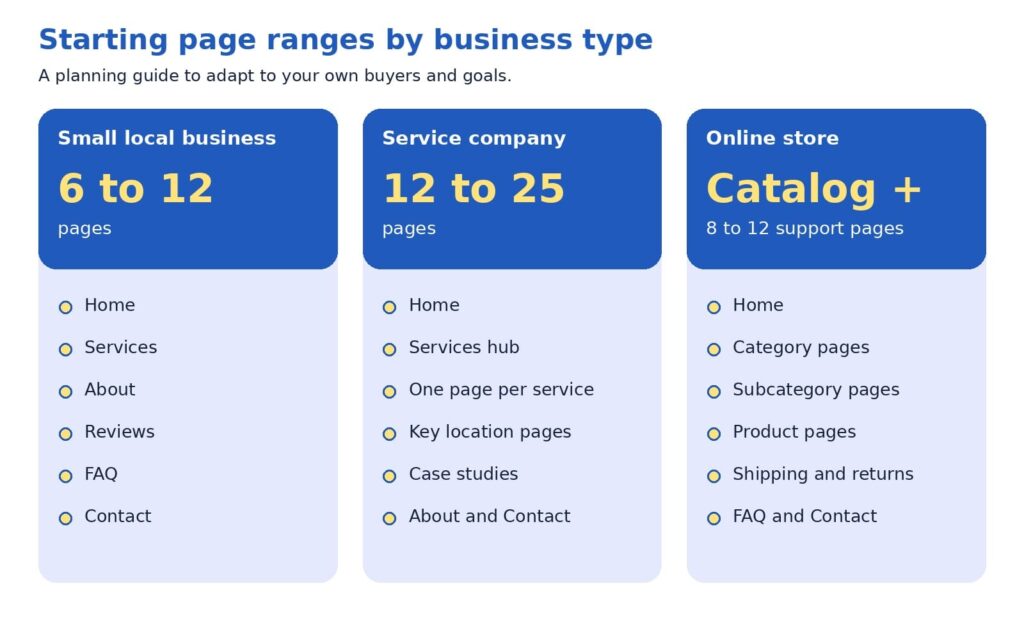
Most small local businesses start well with roughly 6 to 12 pages. A service company with several offerings and service areas often lands between 12 and 25. An online store builds around its catalog, plus about 8 to 12 supporting pages such as shipping, returns, and contact. The better question is which questions your customers ask before they call or buy, because every page should answer one of them clearly.
Inside this guide
- Key terms in plain English
- Why the number feels hard to pin down
- What Google and usability research say
- The core, proof, growth blueprint
- The page job test
- What a good site structure looks like
- Pages for each type of business
- The three business types at a glance
- A bolder view: let customer questions set the count
- Common questions from beginners
- A 30-day page plan
Key terms in plain English
A few words come up again and again when people talk about website pages. Here is what they mean, so the rest of the guide feels comfortable.
- Site structure: how your pages are organized and connected, like a table of contents for your business.
- Navigation menu: the row of links near the top of a site that leads to the main sections.
- Internal link: a link from one page of your site to another.
- URL: the web address of a single page, such as example.com/services.
- Breadcrumbs: small links such as Home > Services > Repair that show visitors where they are.
- Hub page: a page that introduces a group of related pages and links to each.
- Call to action: the next step you invite a visitor to take, such as requesting a quote.
Why the number feels hard to pin down
Most owners worry about two opposite outcomes. A site with only a few pages may look small to a new customer. A site with dozens of pages may feel heavy to build, costly to maintain, and hard to navigate. Both worries are reasonable, and both lead to the same answer: choose each page on purpose.
Advice about search engines adds another layer. A search engine is a tool like Google that finds and lists web pages, and many guides suggest that more pages bring more visitors. Google’s SEO Starter Guide takes a calmer view. It says creating compelling, useful content will likely influence your presence in search more than any other suggestion in the guide, and it adds that existing sites can improve their structure gradually, since search engines will likely understand your pages as they are today (Google Search Central, 2025b).
What Google and usability research say
Two kinds of evidence help here: how search engines read a website, and how real people use one.
On the search side, Google’s guidance favors clarity over volume. It recommends content that is unique, easy to read, and kept current, and it advises keeping each topic at one web address, because two pages with the same information can leave visitors wondering which one is correct (Google Search Central, 2025b). On the question of how long a page should be, the guide is direct:
“there’s no magical word count target, minimum or maximum”
Google Search Central (2025b)
That is good news for beginners. A page needs to be as long as it takes to answer the visitor’s question well.
On the usability side, the Nielsen Norman Group studied a popular belief called the three-click rule. It says visitors will give up if they cannot reach a page within three clicks of the home page. Laubheimer (2019) explains that no published study supports it, and he describes the rule this way:
“an arbitrary rule of thumb that is not backed by data”
Laubheimer (2019), on the three-click rule
The same article cites research by Joshua Porter showing that visitors did not abandon tasks more often, or feel less satisfied, when a task took more than three clicks. What helps instead are clear link labels, signs that show where visitors are, fast page loading, and hub pages that group related links.
For you, this means three things:
- Useful, unique pages matter more than a high page count.
- One topic belongs at one web address.
- Clear labels help visitors more than counting clicks.
The core, proof, growth blueprint
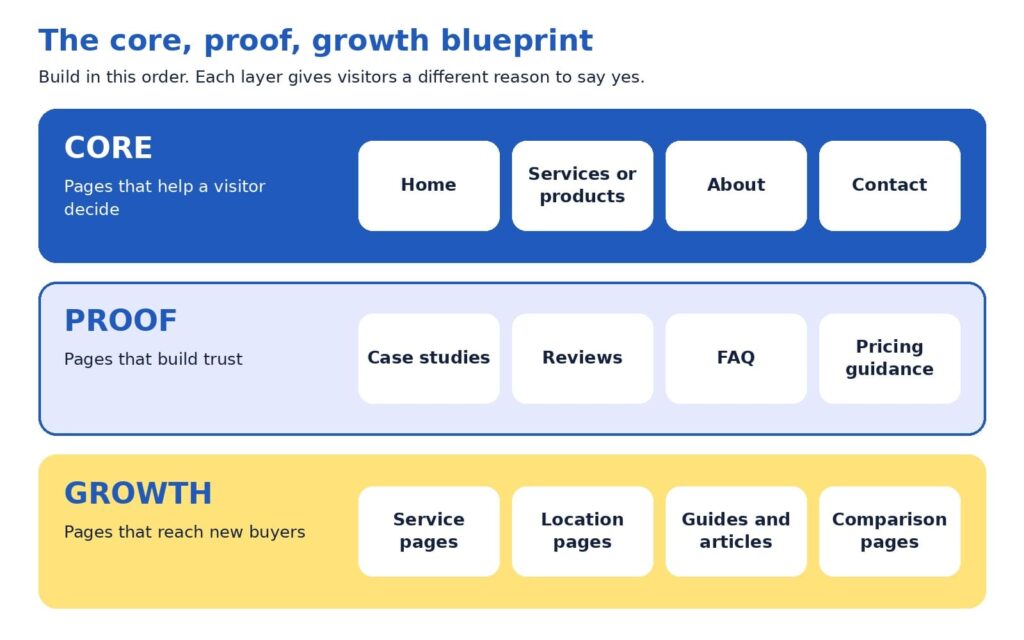
If page count is a poor starting point, what is a better one? We suggest thinking in layers. The core, proof, growth blueprint sorts pages by the job each one does for a visitor.
- Core pages help a visitor decide. Home, services or products, about, and contact answer three basic questions: who you are, what you offer, and how to reach you. Every business needs them.
- Proof pages build trust. Case studies, reviews, a frequently asked questions page (FAQ), and pricing guidance give visitors reasons to believe your claims. Many buyers look here before they pick up the phone.
- Growth pages reach new buyers. Individual service pages, location pages, guides, and comparison pages meet people at the moment they search for something specific.
Build in that order. A site with strong core and proof pages can turn visitors into inquiries right away, and growth pages then widen the audience, since each one targets something different that people search for.
The page job test
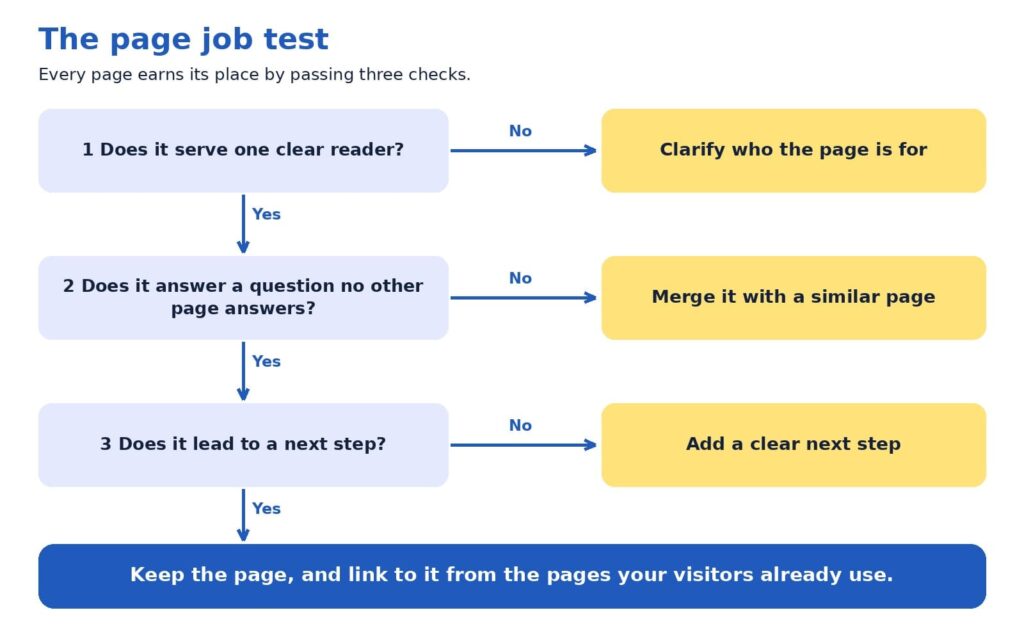
A page earns its place by doing a job. The page job test turns that idea into three checks, and each check has a simple fix.
- One clear reader. Can you name who the page is for? When the answer is “everyone,” narrowing the focus usually sharpens the message, and the headline often writes itself.
- A distinct question. Does the page answer something that no other page answers? When two pages cover the same ground, merging them tends to create one stronger page.
- A next step. Does the page lead somewhere, such as a phone call, a form, a quote request, or a related page? A page with a next step keeps the visit moving.
Try it with a simple spreadsheet that lists your current pages. Many sites turn up a few pages to merge and some gaps where a customer’s question has no page at all. Those gaps often become the plan for the next quarter.
What a good site structure looks like
So far we have talked about which pages to have. Site structure is about where those pages sit and how they connect. A clear structure helps visitors find things, and Google says organizing a site logically helps both people and search engines understand how pages relate to the rest of the site (Google Search Central, 2025b).
Good structures tend to follow five habits:
- One home page, a handful of main sections, and supporting pages beneath them.
- One obvious parent for every page, so a visitor always knows where a page belongs.
- Plain names for sections, such as Services, About, and Contact.
- Related pages grouped together, such as all services under one Services section.
- Important pages linked from the home page, because Google uses links between pages to judge which ones matter most (Google Search Central, 2025a).
If a stranger can guess where a page lives before clicking, your structure is working.
The diagram below shows these habits in action for a fictional local service company, such as a heating and cooling contractor. It has 14 pages and three levels. The colors match the blueprint you just learned: blue for core pages, light blue for proof pages, and yellow for growth pages.
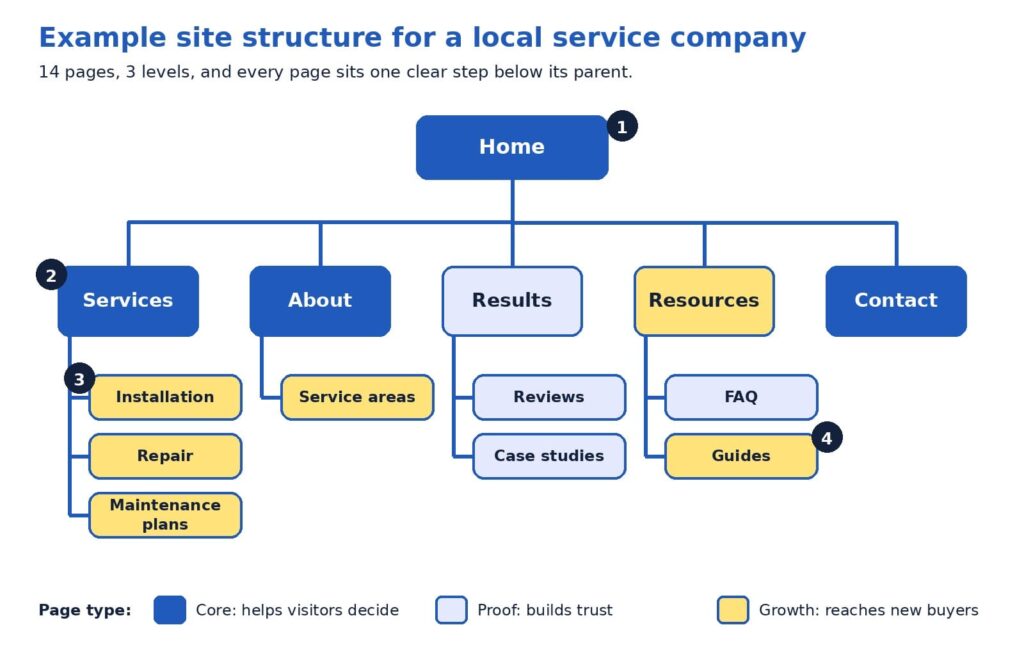
Here is how to read the diagram, following the numbers:
- The home page is the starting point. It links to every main section, so no important page is hidden. Think of it as the front door that points to every room.
- Level one holds the main sections. Services, About, Results, Resources, and Contact use plain, familiar names, and together they usually form the navigation menu. Contact stays at this level so it is one click away from anywhere.
- Level two pages each have one parent. Installation, Repair, and Maintenance plans sit under Services. A visitor who reads one can easily find the others, and the breadcrumbs read naturally: Home > Services > Repair.
- Every page is within two clicks of the home page. The reason this works is clarity. Each label tells visitors what they will find, which Nielsen Norman Group calls strong information scent (Laubheimer, 2019).
Notice how the web addresses can mirror the structure. An address like example.com/services/repair tells a visitor where they are, and Google notes that descriptive URLs help people judge whether a result will be useful (Google Search Central, 2025b).
Picture a visitor named Maria who searches for “furnace repair” and lands on the Repair page. She reads about the process, spots the breadcrumbs, and clicks Services to see the company also offers maintenance plans. She opens Reviews, feels reassured, and requests a quote. Nobody had to explain the website to her, because the structure answered each question in turn. Larger businesses add more levels, and the same habits still apply.
Pages for each type of business
Small local business
For a small local business, a first website often works well with 6 to 12 pages. Picture a neighborhood physiotherapy clinic. Its core pages are Home, Services, About with team credentials, and Contact. Its proof pages are Reviews or Results, a FAQ that covers insurance and first-visit questions, and a short page on pricing and booking. That adds up to roughly eight pages, and each one answers a question a new patient asks before calling.
Growth can follow as the clinic learns what people search for. A page for sports injuries, another for post-surgery rehabilitation, and a short guide to choosing a physiotherapist would each serve a different need. A quick check for any small site is whether it answers three visitor questions: who are you and can I trust you, what do you offer and what will it cost, and what happens next.
Service company
A service company with several offerings and service areas has more questions to answer, so the count often lands between 12 and 25 pages. The example diagram above is a good model. Add a pricing page, more case studies, and pages for the cities that bring in the most calls, and the site grows while keeping the same shape.
The word to watch is distinct. A location page earns its place when it contains something specific to that area, such as local project examples, neighborhood details, and reviews from nearby customers. Six near-identical pages that swap only the city name repeat the same information six times, which can confuse visitors (Google Search Central, 2025b). A useful test: if you can write three honest, specific sentences that belong only to a location page, the page is likely worth building. Otherwise, a short section on the services page may serve that city well.
Service pages also benefit from a consistent layout: who the service helps, how the process works, proof such as a case study or review, answers to common questions, and a clear next step such as requesting a quote.
Online store
An online store follows a different logic, because the catalog sets the number of pages. Every product has a page, and products are grouped into categories, which are pages that list related products, such as Women’s shoes or Kitchen tools. Supporting pages such as shipping, returns, size guidance, FAQ, and contact reassure shoppers at the moment of decision. We suggest budgeting for roughly 8 to 12 supporting pages beyond the catalog.
Structure matters more as the catalog grows. Google’s guidance for online stores recommends linking menus to category pages, category pages to subcategory pages, and subcategory pages to every product, so that Google’s crawlers, the programs that visit pages so they can be listed in search, can reach everything by following links. It adds that Googlebot generally does not use a site’s search box, so products reachable only through search may be missed. It also suggests linking best-selling products from the home page (Google Search Central, 2025a).
Usability research points the same way. Baymard Institute’s 2025 benchmark found that 58% of desktop and 67% of mobile sites among leading US and European online stores had mediocre-to-poor homepage and category navigation. Baymard advises dividing categories into subcategories at about 10, and aiming for at least 10 products in the deepest categories (Baymard Institute, 2025). Clear categories can be a real advantage even for modest stores.
In practice, that means the menu links to every main category, each category page links to its products, best sellers appear on the home page, and support pages are reachable from the footer and from product pages.
The three business types at a glance
The summary below puts the starting ranges side by side. Every business has its own mix of customers, offers, and goals, so use it as a planning aid and let your customers’ questions shape the final list.
A bolder view: let customer questions set the count
Here is a perspective some web teams may hesitate to share, since a larger site means a larger project: page count is an output, never a goal. The number of pages your site needs equals the number of distinct customer questions you can answer well, grouped sensibly.
Try this exercise. List every question your last twenty prospects asked on calls, emails, and chats, and add the questions customers ask after they buy. Group similar questions together. Each group becomes a page or a clearly labeled section. A group of two questions may fit inside a services page, while a group of ten, such as pricing for a complex offer, may deserve its own page. When you finish, the page count appears on its own, and each page has a reason to exist.
This approach tends to protect budgets and results at the same time. A five-page site that answers the right questions may generate more inquiries than a fifty-page site that repeats itself, because visitors find what they need faster. It also makes growth easy to plan, since each new customer question suggests a new page or an update.
Common questions from beginners
Do we need a blog? A blog is a growth format, so it fits best after your core and proof pages are in place. It earns its keep when each article answers a real customer question and links to the relevant service page, in line with Google’s call for helpful, people-first content (Google Search Central, 2025b).
Should every service have its own page? When a service has its own customers, process, and questions, a dedicated page usually serves visitors better than a paragraph on a general page. Smaller offers that share the same customer can share a page, with clear headings for each.
How often should we revisit our page count? Once a year works well for many businesses, and launching a new service or location is another natural moment. Google’s guide encourages updating published content as needed (Google Search Central, 2025b).
A 30-day page plan
You can put all of this to work in one month. The plan below fits most small teams:
- Week 1, collect: gather customer questions from sales calls, emails, reviews, and the search queries report in Google Search Console, a free tool that shows how your site appears in Google.
- Week 2, map: sort the questions into core, proof, and growth, and mark which ones already have a page.
- Week 3, build or merge: apply the page job test, combine overlapping pages, and write the missing ones.
- Week 4, connect: update menus, add internal links, check mobile speed, and set up inquiry tracking.
Then give the changes time to work. Google’s guide suggests waiting a few weeks to assess the effect (Google Search Central, 2025b). Track inquiries, calls, form submissions, and the pages visitors view before they reach out, since those numbers show which pages are pulling their weight.
Before the new structure goes live, check that:
- Every page has a descriptive title and at least one link pointing to it.
- Each page offers a clear next step and loads quickly on a phone.
- Old addresses that were merged redirect to the new page.
- Contact details match across the site.
If you would like a second set of eyes on your current structure, send us your page list. We will run the page job test with you and return a one-page map of what to keep, merge, and add.
Your website, one question at a time
The right number of pages is the number that answers your customers’ questions clearly, and the starting ranges simply give you a place to begin. Build core pages first, add proof pages to earn trust, and let growth pages widen your reach. Give every page one parent, a plain name, and a next step, then review the results after a few weeks.
Ready to turn the plan into a site? Our website design agency in Delhi team builds page structures around customer questions, our SEO agency in Delhi specialists help those pages get found, and our digital marketing agency services keep new leads arriving.
References
Baymard Institute. (2025). Homepage and category navigation UX 2025: 67% of mobile sites have mediocre-to-poor performance. https://baymard.com/research-articles/ecommerce-navigation-best-practice
Clutch. (2025, August 21). Clutch report: No-code tools fuel website growth, yet 17% of small businesses are still offline [Press release]. Business Wire. https://www.businesswire.com/news/home/20250821848152/en/Clutch-Report-No-Code-Tools-Fuel-Website-Growth-Yet-17-of-Small-Businesses-are-Still-Offline
Google Search Central. (2025a, December 10). Help Google understand your ecommerce website structure. Google for Developers. https://developers.google.com/search/docs/specialty/ecommerce/help-google-understand-your-ecommerce-site-structure
Google Search Central. (2025b, December 10). Search engine optimization (SEO) starter guide. Google for Developers. https://developers.google.com/search/docs/fundamentals/seo-starter-guide
Laubheimer, P. (2019, August 11). The 3-click rule for navigation is false. Nielsen Norman Group. https://www.nngroup.com/articles/3-click-rule/


Popups Are Driving Visitors Away — Here’s How One Publisher Doubled Sign-Ups Without Annoying Anyone
You’ve felt it yourself. You land on an article, start reading the first line, and before your eyes even adjust — bam. A full-screen popup slams down asking for your email, blocking the entire page behind a translucent grey wall. You hunt for the tiny “X” hidden in the corner, usually the size of a pixel, half-annoyed and half-impressed by how deliberately hard it is to find. Then you leave. Maybe not that page — the whole site.
Now flip the script: you’re the site owner. That same popup you just closed in frustration is sitting on your own homepage right now, and it’s probably costing you more visitors than it’s converting into leads.
This is the quiet contradiction at the center of most lead capture strategies — the tactic marketers reach for to grow their list is often the exact thing pushing people out the door before they ever get the chance to subscribe. The good news is that the fix isn’t “stop using popups.” It’s building smarter ones.
The Problem With the Popups Everyone Still Uses
Full-screen, immediate-load popups were everywhere for years because, in isolation, they worked — they’re impossible to ignore, so of course some percentage of visitors converts. But that short-term win comes with long-term costs that rarely get measured in the same dashboard.
They tank the user experience
A visitor arrives with intent — to read an article, compare a product, find an answer — and instead they’re met with an interruption before they’ve had a chance to decide if your content is even worth their time. That’s a terrible first impression, and first impressions on the web are unforgiving. Most people don’t get annoyed and stay anyway; they get annoyed and leave.
They can trigger Google penalties
This one surprises a lot of marketers. Google has explicitly penalized intrusive interstitials — the full-screen kind that cover the main content immediately on mobile — in its search rankings. A page that looks great in your CMS preview can be actively working against your SEO the moment Google’s crawler sees a wall of popup covering your content on a mobile screen.
They spike bounce rate, especially on mobile
On a small screen, a full-screen popup isn’t a small interruption — it’s the entire experience. There’s no scrolling past it, no glancing around it. Mobile visitors, who often have less patience and more competing tabs open than desktop users, bounce out at a noticeably higher rate when they’re met with an aggressive overlay before they’ve even scrolled once.
They train visitors to distrust your site
Beyond the immediate bounce, there’s a compounding trust cost. A visitor who gets ambushed by a popup on their first visit is primed to leave immediately on their second visit too — even if you’ve since toned things down. First impressions on the web don’t just affect a single session; they shape whether someone gives you a second chance at all.
Also read:
UX & Conversion Optimization
Website Speed and Conversion Relationship
So Why Do So Many Sites Still Use Them?
Mostly inertia. A lot of popup implementations are “set it and forget it” — someone installed a plugin years ago, set it to trigger immediately on page load, and nobody has revisited it since, even as the traffic mix shifted heavily toward mobile and Google’s rules changed. The tool didn’t fail; it just never got upgraded to match how people actually browse today.
The other reason is a mismeasurement problem. Teams look at “popup conversion rate” as a standalone metric and it looks great — 3%, 5%, sometimes higher. What they don’t see in that same report is the bounce rate spike, the SEO ranking dip, or the visitors who left annoyed and never came back to convert through any channel at all. A popup can win on one metric and quietly lose on three others.
The Smarter Alternative: Behavior-Triggered Overlays
The fix isn’t removing lead capture — it’s changing when and how it shows up. Instead of interrupting every single visitor the instant they land, smart popups wait for a signal that the visitor is actually engaged, then ask at a moment when saying yes feels natural rather than intrusive.
Scroll-depth triggers
Instead of firing on page load, the popup waits until a visitor has scrolled 50%, 70%, or 90% down the page. By that point, they’ve demonstrated real interest in the content — they’re no longer a stranger deciding whether to stay, they’re an engaged reader who might genuinely want more of what you’re offering. Asking for an email at that moment feels like a natural next step, not an ambush.
Time-on-page triggers
Similar logic, different signal. If a visitor has been on the page for 30, 45, or 60 seconds, they’re clearly reading, not bouncing. A popup that waits for this threshold respects the fact that the first few seconds of a visit are for orientation, not conversion.
Exit-intent triggers
This is the cleverest of the three. Exit-intent detection tracks cursor movement on desktop (or scroll-up behavior and back-button presses on mobile) to predict when someone is about to leave, and shows the offer at that exact moment. The logic is simple but powerful: if they were going to leave anyway, a well-timed offer costs nothing in terms of user experience — you’re not interrupting a reader mid-flow, you’re catching someone on their way out the door.
Lightweight code structures
Beyond timing, the technical build matters just as much. Bloated popup scripts slow down page load, which independently hurts both user experience and SEO. A well-built overlay uses lightweight, asynchronous-loading code that doesn’t compete with the core content for load priority, doesn’t block rendering, and disappears cleanly without leaving background scripts running. This is exactly the kind of performance-first thinking a good web development company in Delhi builds into a site from the ground up, rather than bolting on after the fact. The goal is an overlay that feels instant and unobtrusive, not one more thing the browser has to fight through before the page becomes usable.
What This Looked Like for One B2B Publisher
Here’s where theory meets results. A B2B publisher running a content-heavy site was using a traditional immediate-load, full-screen popup for newsletter sign-ups — the kind that appeared the second a visitor landed, regardless of device or engagement level. Sign-up numbers were decent, but mobile bounce rate was creeping upward, and organic rankings on key articles had quietly started slipping.
The fix wasn’t a redesign of the offer itself — the newsletter pitch stayed largely the same. What changed was the delivery mechanism. The full-screen interstitial was replaced with a scroll-triggered slide-in that appeared only after a visitor hit roughly 60% scroll depth, paired with an exit-intent trigger for desktop visitors who showed signs of leaving before reaching that point. The new popup was also rebuilt with a lighter script, load-tested specifically for mobile performance.
The results were the kind that get a marketing team’s attention in a single meeting: newsletter sign-up rate doubled, and mobile bounce rate dropped by 18% in the same period. Two metrics that are usually assumed to trade off against each other — more aggressive lead capture versus better user experience — moved in the same direction at once. The lesson wasn’t “popups don’t work.” It was “badly-timed popups don’t work, and well-timed ones do double duty.”
How to Rebuild Your Own Popup Strategy
If your current setup is a full-screen, immediate-load popup, here’s a practical path to something smarter.
1. Audit what you actually have live
Check every popup currently running on your site — including ones a plugin might be running by default that nobody actively configured. Note the trigger type, the device behavior, and whether it’s blocking content on mobile specifically, since that’s where Google’s interstitial penalties bite hardest.
2. Pick a trigger that matches visitor intent
Scroll depth works well for content-heavy pages where reading time matters. Time-on-page works well for product or service pages where visitors browse rather than scroll linearly. Exit-intent works everywhere but only on desktop, since mobile browsers don’t expose the same cursor-movement signals — mobile needs a scroll-based or back-button-based equivalent instead.
3. Rebuild with mobile-first performance in mind
Test the popup on an actual mobile connection speed, not just a desktop preview. Check that it doesn’t cover the full viewport, doesn’t block the ability to close it easily, and doesn’t slow down the page’s core load time. If your site’s overall mobile experience feels dated beyond just the popup, it might be worth a broader look — a experienced website design agency in Delhi can audit the whole mobile journey, not just the overlay sitting on top of it.
4. Make the offer worth the interruption
Even a perfectly timed popup underperforms if the offer behind it is generic. “Sign up for our newsletter” converts worse than a specific, tangible reason tied to what the visitor is already reading — a related guide, a checklist, a relevant discount, or early access to something useful.
5. Measure the full picture, not just the popup conversion rate
Track bounce rate, average session duration, and organic ranking movement alongside sign-up numbers. A popup redesign that improves lead capture while quietly protecting — or improving — the rest of your site health metrics is the actual win, not just the sign-up count in isolation.
The Bigger Picture
Lead capture and user experience don’t have to be in conflict. The publishers and brands getting this right have simply stopped treating popups as a blunt, one-size-fits-all interruption and started treating them as a piece of on-site content that deserves the same thought as anything else a visitor sees — right message, right moment, right device.
The instinct to interrupt every visitor immediately comes from a fear that if you wait, you’ll miss the chance to convert them. In practice, the opposite tends to be true: waiting for the right signal — engagement, intent to leave, meaningful time on page — produces an offer that feels earned rather than forced, and visitors respond to that difference even if they couldn’t articulate why.
If your current popup setup hasn’t been touched since it was first installed, there’s a good chance it’s quietly working against the very goals it was built to support. A short audit and a smarter trigger strategy is often all it takes to turn an annoyance into an asset — and it’s exactly the kind of conversion-focused fix a full-service digital marketing agency or a SEO agency can handle alongside the rest of your growth strategy.

How to Scale a Search Campaign Without Blowing Up Your Cost Per Lead
Why a winning small-budget test doesn’t guarantee a winning big-budget campaign — and the pricing mechanics every advertiser should understand before pushing more spend into search, social, or display.
In this article
- The trap: judging a campaign by its smallest, cheapest phase
- Why campaigns almost always look good at small spend
- The ad inventory supply curve: the mechanic behind scaling
- The myth: “test small, then scale it”
- The campaign scaling S-curve
- The strategic fix: scale to your max CPL, not past it
- What it means if you can’t hit volume at your max CPL
- A practical scaling playbook
- Key takeaways
The trap: judging a campaign by its smallest, cheapest phase
One of the most common mistakes we see advertisers make, whether they’re running Google Search, Meta, LinkedIn, or programmatic display campaigns, is drawing big conclusions from a small amount of spend. A campaign launches, the first few hundred dollars go out the door, the cost per lead (CPL) looks fantastic, and the natural next move feels obvious: pour more budget in and watch the results multiply.
That instinct is understandable. It’s also, in a large share of cases, wrong. The purpose of this article is to explain why it’s wrong — not just as a rule of thumb, but as a consequence of how digital ad inventory is actually priced. Once you understand the underlying market mechanics, scaling stops being guesswork and becomes a strategic, defensible process.
Also read: Why Digital Advertising Costs Rise Even When Your Campaign Hasn’t Changed
Why campaigns almost always look good at small spend
There are two separate reasons early results are unreliable, and it’s worth separating them clearly.
First, statistical noise. A small number of clicks or conversions is a small sample, and such samples are inherently volatile. Marketing analysts widely note that testing with too few data points can yield results driven by random chance rather than a real underlying effect, and that this risk diminishes as the sample size grows[1][2]. A campaign that converts three out of five clicks in its first day hasn’t proven anything about its true conversion rate — it has produced a data point with a very wide margin of error.
Second, and more specific to paid media, is a pricing effect: at low spend, a campaign is only buying the cheapest, easiest-to-win slice of available ad inventory. This is the mechanism most advertisers overlook, and it’s the real subject of this article.
The ad inventory supply curve: the mechanic behind scaling
Every paid channel — Google Search, Meta, LinkedIn, programmatic display sells access to a finite pool of ad inventory for any given audience at any given moment. On real-time bidding exchanges, each individual ad placement is auctioned off the instant a user loads a page or opens an app, with the highest qualifying bid winning the impression[3][4].
Search auctions and social ad auctions work on the same underlying logic: advertisers compete for a limited number of eligible placements, and price is set by that competition rather than by a fixed rate card[5].
This has a direct consequence for scaling.
Not all inventory within a targeted audience is equally cheap. Some of it, the users most likely to convert, at the moments with the least competing demand, is cheap to win. The rest of it is more expensive, either because it’s contested by more advertisers or because it’s a lower-quality match for your targeting.
A small budget only needs to buy a small slice of inventory, so it naturally buys the cheapest slice available. A large budget has to buy much more of the available pool, which means reaching further into the expensive end of it.
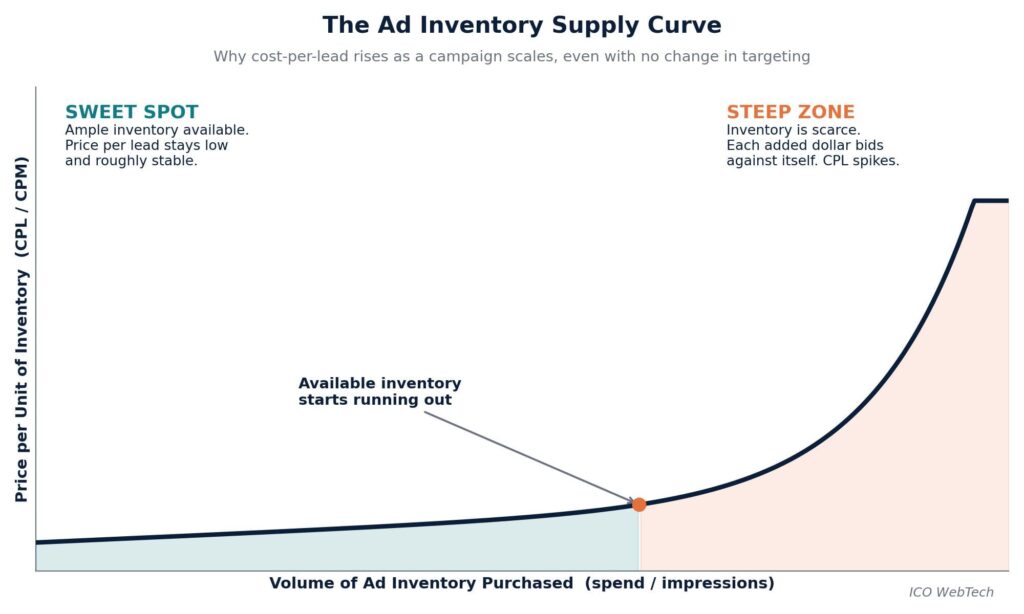
This is exactly the pattern paid media practitioners observe in the field. Analysis of scaled Meta campaigns has found that at lower budgets, ads reach the most responsive audience first; as spend increases, the platform is forced to bid for less qualified segments of its own auction, which drives cost up[6].
Independent case data tells the same story: one documented account saw CPL rise 80% after daily spend was scaled from roughly $500 to $4,000, with the later dollars far less efficient than the earlier ones[7].
The myth: “test small, then scale it”
The myth: “We tested this campaign at $50/day and it performed brilliantly. Let’s scale it to $2,000/day and expect similar returns.”
This logic assumes ad inventory behaves like a product with unlimited stock at a fixed price; buy more, get proportionally more, at the same cost. That assumption doesn’t hold. Because inventory is limited and priced by competitive demand, scaling isn’t a linear multiplication of your test results.
It’s a walk further along the supply curve in Figure 1, and depending on how much headroom exists in that specific audience, on that specific platform, at that specific moment, the walk can be short and cheap, or it can hit a wall very quickly.
This isn’t only a display/social-auction phenomenon.
Google’s own reporting acknowledges the same constraint for Search: the “Lost Impression Share (Budget)” metric exists specifically to show advertisers how much additional traffic is available at their current bids before they’d need to pay more to win additional volume[8] — a direct, built-in admission that available inventory at a given price is limited.
The campaign scaling S-curve
Put the pricing mechanic on a timeline, and it produces a recognizable pattern that paid media analysts refer to as the campaign S-curve, a non-linear relationship between spend and CPL that unfolds in three broad phases[9].
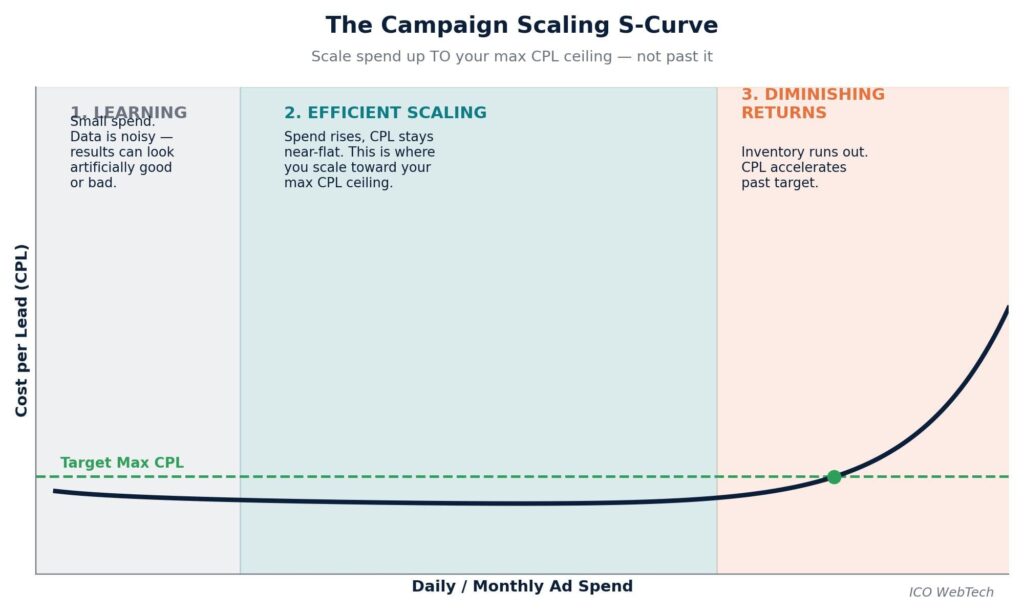
- Learning. Spend is low, data is thin, and results can look better or worse than they’ll ultimately be simply due to sample-size noise[1].
- Efficient scaling. The campaign has found its footing. Increasing budget produces a roughly proportional increase in leads, and CPL holds close to flat. This is genuinely the “golden zone” for scaling[9].
- Diminishing returns. The readily available, cheap inventory has been exhausted. Cost per click or cost per lead begins rising faster than spend, click-through rate tends to soften, and conversion rate on the newer, lower-intent traffic often declines[9].
Warning sign to watch for: a rapidly rising cost per click or cost per lead is typically the earliest, clearest signal that a campaign has crossed from Phase 2 into Phase 3 — auction pressure and audience saturation showing up in the numbers before anything else does[9].
The strategic fix: scale to your max CPL, not past it
This is the strategic takeaway for ICO WebTech clients: define your maximum acceptable CPL before you scale, not after. Without that ceiling set in advance, there’s no way to know when a campaign has reached its efficient sweet spot versus when it has been pushed past it.
You end up scaling reactively, watching CPL rise, and only stopping once it’s already uncomfortable — instead of scaling deliberately, toward a number you decided on with your margins and business goals in mind.
In practice, that means:
- Set the ceiling first. Work backward from your acceptable cost of customer acquisition to a maximum CPL you’re willing to pay.
- Scale in increments, not leaps. Documented case data shows that aggressive single-day jumps in budget (for example, quadrupling spend overnight) tend to push campaigns into unstable, inefficient territory, while gradual increases of roughly 10–20% every few days let the auction adjust without a shock to cost[10][6].
- Judge by marginal CPL, not average CPL. Your blended, account-level CPL can still look healthy even after scaling has gone inefficient, because it’s averaging the cheap early leads with the expensive later ones. The number that tells the truth is the marginal cost — what the most recent increment of spend cost to convert[11].
- Give a scale-up time to settle before judging it. Algorithmic ad platforms typically need a short adjustment window after a budget change; evaluating results too early repeats the same small-sample problem discussed above[12].
What it means if you can’t hit volume at your max CPL
Suppose you scale spend all the way to your predefined max CPL ceiling, and the campaign still isn’t generating enough leads to hit your goal. That outcome is itself useful information; it tells you something specific about the market you’re in, not that paid media “doesn’t work.” There are three likely explanations, and each points to a different fix.
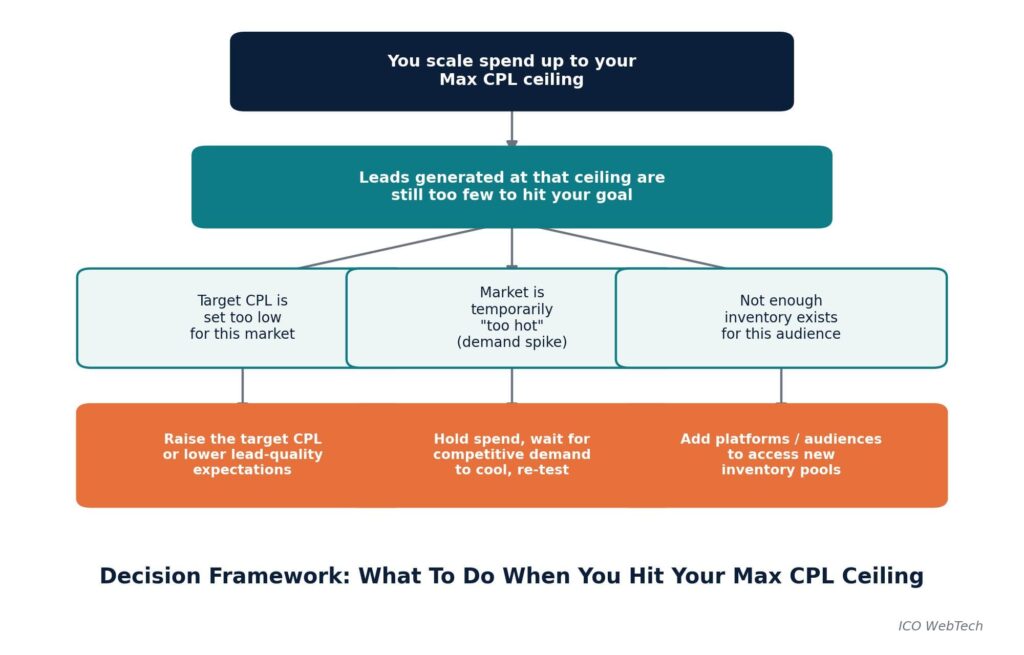
| Diagnosis | What’s happening | What to do |
|---|---|---|
| Target CPL is too low for the market | Your ceiling was set without reference to what this specific audience actually costs to reach right now. | Revisit the ceiling against realistic market pricing, or adjust lead-quality expectations. |
| The market is temporarily “too hot” | A spike in competitive demand, seasonal (e.g. Q4 retail), a competitor’s new campaign, or a category trend — is inflating prices across the board, not just for you. | Hold spend at the sustainable level, monitor, and re-test scaling once demand cools. |
| Not enough inventory exists for this audience | The addressable pool for this targeting, on this platform, is structurally too small to support the volume you need. | Expand to adjacent platforms or audience segments to access new inventory pools, rather than continuing to push price on a shrinking one. |
A note on seasonality and timing
Because price is set by competitive demand, the same audience can have very different headroom depending on when you test it. Scaling decisions made during a demand peak (holiday retail periods are the classic example) will show inflated costs that don’t reflect the account’s normal economics, while decisions made during unusually quiet periods can understate the true cost of scaling once competition returns to normal[9]. Where possible, validate scaling decisions during a representative, average-demand period rather than an extreme one.
A practical scaling playbook
- Run the learning phase long enough to trust the data — resist reacting to day-one or day-two results.
- Set a maximum CPL ceiling before scaling, based on your actual acquisition economics, not on the number your test happened to produce.
- Scale in moderate increments (roughly 10–20% every few days) rather than large jumps, and give each increment 2–3 weeks to stabilize before judging it[10][13].
- Track marginal CPL, not just average CPL, so you catch inefficiency before it’s buried in a healthy-looking blended number.
- If you hit your ceiling short of your volume goal, diagnose before you panic — is the target unrealistic, is demand temporarily elevated, or is the inventory pool structurally too small?
- Expand horizontally when a pool is saturated — new platforms, adjacent audiences, or additional creative variants — rather than continuing to push price on an audience that has run out of cheap supply[10].
Key takeaways
1. Early campaign performance is unreliable both because of small-sample statistical noise and because low spend only buys the cheapest slice of available ad inventory.
2. Ad inventory is priced by an auction, and it is finite for any given audience — which means CPL is not fixed as spend increases, and cost naturally rises once the cheapest supply is exhausted.
3. The strategic fix is to set a maximum acceptable CPL before scaling, and scale spend up to that ceiling — treating it as a deliberate target rather than discovering it by accident after costs have already spiked.
4. If you reach your ceiling without hitting your lead-volume goal, that’s diagnostic information — either your target CPL, the current market conditions, or the size of the addressable inventory pool needs to change.
Not sure where your campaign’s sweet spot ends?
ICO WebTech’s paid media team models the supply curve for your specific audiences before we scale a single dollar of client budget.
References
- “What Is Statistical Significance in A/B Testing?” MetricsWatch. Retrieved 2026. metricswatch.com
- “Statistical significance does not imply a real effect.” National Center for Biotechnology Information (NCBI). ncbi.nlm.nih.gov
- “YourAdvalue: Measuring Advertising Price Dynamics without Bankrupting User Privacy.” arXiv. arxiv.org
- “Scalable Bid Landscape Forecasting in Real-time Bidding.” arXiv. arxiv.org
- “Real-Time Bidding Explained: How Digital Ads Are Sold.” The Digital Bunch. thedigitalbunch.com
- “Meta ads scaling framework breaks at $5k spend.” Elite Brands. elitebrands.org
- “Diminishing Returns.” Saxifrage Blog. saxifrage.xyz
- “When to Increase Your Ad Budget: Signals That Tell You It’s Time to Scale.” Stackmatix. stackmatix.com
- “Diminishing Returns on Ad Spend: When to Scale and When to Stop.” Stackmatix. stackmatix.com
- “Scaling Ads Without Losing Profit: A Complete Guide.” Cometly. cometly.com
- “Meta Ads Optimization: Marginal CPA vs Average CPA Guide.” Get Ryze. get-ryze.ai
- “The Real Reason Your CPA Spikes at Scale and How to Fix It.” Aden’s Lab. adenslab.com
- “Diminishing Returns: Accounting for Channel Saturation.” Recast. getrecast.com

Is Your Website a Legal Liability? Mastering ADA Web Accessibility Compliance
Imagine a modern, multi-story corporate headquarters located in the heart of a major financial district. The building features an elegant glass facade, state-of-the-art security systems, and beautifully designed presentation rooms. Now imagine that the front entrance only features a steep flight of concrete stairs, with absolutely no wheelchair ramp, no automated doors, and no tactile paving for visually impaired visitors.
In the physical world, this scenario would instantly trigger public outrage, massive regulatory fines, and immediate legal action under civil rights legislation. Yet, in the digital landscape, thousands of corporate enterprises launch beautifully designed, multi-million dollar web platforms every single day that contain the exact digital equivalent of those concrete stairs. They build websites that completely shut out individuals with visual, auditory, motor, or cognitive disabilities, leaving their organizations wide open to devastating legal consequences.
For a long time, web accessibility was treated by corporate leadership as a minor, optional checkbox—a niche project left entirely to the discretion of junior developers. Those days are officially over. In the modern digital economy, digital accessibility has evolved into a critical legal and operational battleground. Organizations that neglect accessibility are finding themselves caught in a high-stakes web of legal liabilities, facing expensive class-action lawsuits, suffering brand damage, and alienating a massive, highly loyal segment of the global consumer market.
The High Cost of Exclusion: Lawsuits, Liabilities, and Lost Markets
To understand the urgency behind web accessibility, one must look closely at the rapidly shifting legal climate. Regulatory frameworks worldwide—such as the Americans with Disabilities Act (ADA) Title III in the United States, the European Accessibility Act (EAA) in Europe, and corresponding civil rights mandates internationally—have made it clear that public websites, mobile applications, and digital portals are considered “places of public accommodation.”
The legal risk is no longer a theoretical threat; it is a booming industry for specialized litigation firms. Tens of thousands of website accessibility lawsuits are filed annually against businesses of all sizes, from small e-commerce shops to Fortune 500 giants. What makes these legal threats particularly challenging is that intent does not matter. You cannot defend your organization by claiming you didn’t mean to exclude disabled users, or that your internal engineering team was simply unaware of the guidelines. If a user with a disability cannot navigate your online catalog, submit a contact form, or download an invoice, your platform is a documented legal liability.
However, focusing exclusively on the fear of litigation misses a profound commercial opportunity. Beyond the legal risk lies a massive case of market alienation. According to global health metrics, approximately 15% of the world’s population lives with some form of disability. This represents more than one billion people globally who control billions of dollars in disposable income. When your website fails to accommodate screen readers, lacks proper keyboard controls, or features inaccessible checkout flows, you aren’t just protecting yourself from a lawsuit by fixing it—you are actively turning away 15% of your potential customer base directly into the arms of your compliant competitors.
From an engineering perspective, this systemic exclusion can be traced back to a failure to meet the globally recognized benchmark for digital inclusion: the Web Content Accessibility Guidelines (WCAG). These technical guidelines are organized around four core principles, often abbreviated as POUR:
- Perceivable: Information and user interface components must be presented to users in ways they can perceive (it cannot be invisible to all their senses).
- Operable: User interface components and navigation must be operable (the interface cannot require interaction that a user cannot perform).
- Understandable: Information and the operation of the user interface must be understandable (the content or operation cannot be beyond their comprehension).
- Robust: Content must be robust enough that it can be interpreted reliably by a wide variety of user agents, including assistive technologies like screen readers.
Four Technical Pillars of an Accessible Web Infrastructure
Transitioning an enterprise digital platform from a compliance hazard into an inclusive, high-performing asset requires a systematic engineering approach. True accessibility cannot be achieved by dropping a cheap, third-party JavaScript “accessibility widget” onto your site. These superficial overlays often worsen the user experience for disabled individuals and fail to protect companies from legal scrutiny. Instead, compliance must be woven directly into the core code architecture through four foundational pillars.
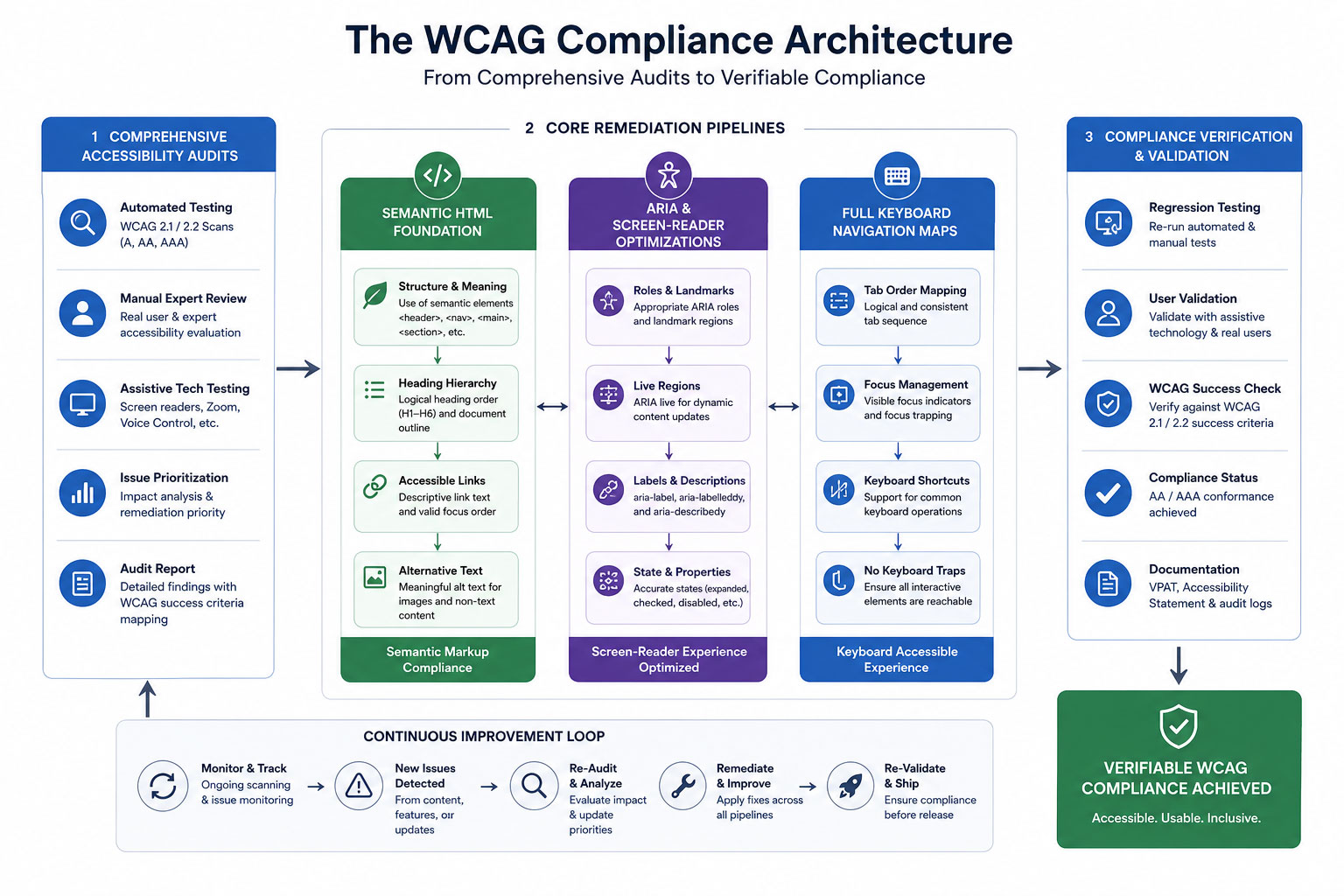
A structured flowchart demonstrating how Comprehensive Accessibility Audits feed directly into core remediation pipelines: combining Semantic HTML, ARIA Screen-Reader Optimizations, and Full Keyboard Navigation Maps to achieve verifiable compliance status.
1. Comprehensive Accessibility Audits
You cannot fix what you do not know is broken. The remediation process begins with an exhaustive, dual-layered accessibility audit. This involves pairing automated testing software with real-world manual testing. Automated scanners are excellent for catching high-volume technical errors, such as missing form labels, broken link structures, and incorrect color contrast ratios.
However, automated tools can only catch roughly 30% to 40% of accessibility barriers. The critical remaining errors must be uncovered through manual testing conducted by experienced QA engineers who navigate your platform using actual assistive tools, simulating the exact lived experiences of users with diverse physical and cognitive challenges.
2. Screen-Reader Optimizations via Semantic HTML and ARIA
Visually impaired users rely heavily on sophisticated software called screen readers (such as NVDA, JAWS, or VoiceOver) to translate visual on-screen layouts into spoken words. If your web application code consists of unstructured, non-semantic building blocks, a screen reader will voice a confusing jumble of meaningless elements.
To solve this, developers must build platforms using semantic HTML tags (such as <main>, <nav>, <header>, and <article>) that naturally define the structural hierarchy of a page. For complex, dynamic interface components like interactive dropdown menus, modal windows, or live data charts, engineers must deploy Accessible Rich Internet Applications (ARIA) attributes. These specialized code attributes act as invisible road signs, explicitly telling the screen reader software what a component does, what state it is currently in (e.g., `aria-expanded=”true”`), and how it relates to the rest of the layout.
3. Full Keyboard Navigation Setups
Many users with motor disabilities, tremors, or paralysis cannot operate a traditional computer mouse. Instead, they navigate the web exclusively using a keyboard, relying on the Tab key to move forward, Shift+Tab to move backward, and the Enter key to activate links and buttons.
An accessible website must feature a completely seamless, logical keyboard navigation map. This means ensuring that a visible, highly distinct “focus indicator” bounding box appears around any element a user highlights. Furthermore, code must be engineered to prevent “keyboard traps”—errors where a user tabs into a specific field or pop-up window but cannot tab back out without using a mouse. A compliant platform also features a hidden “Skip to Main Content” shortcut at the very top of the DOM structure, allowing keyboard users to bypass bloated header navigation links on every page refresh.
4. Accurate Alternative Text (Alt-Text) Frameworks
Images, infographics, and graphical banners play a major role in modern web storytelling. For a screen-reader user, however, an image without alternative text is completely blank, or worse, read aloud as a messy, unoptimized file name like “IMG_98432_FINAL.png.”
Implementing an accurate alt-text framework requires editorial discipline and structural standards. Alt-text shouldn’t be treated as a dump for SEO keyword stuffing. Instead, it must offer a concise, highly descriptive summary of the visual information or functional purpose of the image. If an infographic contains a chart mapping market trends, the alt-text or surrounding body copy must outline those specific data insights. Conversely, purely decorative elements like background shapes or design flourishes should be explicitly hidden from assistive tools using an empty `alt=””` attribute, preventing unnecessary audio clutter.
The Role of Technical Partners: Sourcing Expertise From a Website Development Company in India
Re-engineering an enterprise-grade digital ecosystem to meet strict WCAG 2.1 or 2.2 AA compliance standards is a highly technical challenge. It touches every layer of your digital stack, from raw backend server architecture and API data delivery to front-end layout styling and content entry systems. For organizations running vast product catalogs, complex client dashboards, or continuous content feeds, executing this remediation internally without specialized talent can quickly turn into an expensive, trial-and-error nightmare.
To navigate these complexities efficiently, global enterprises frequently look to establish strategic technical partnerships with an experienced website development company in India. The Indian tech ecosystem has matured into a powerhouse of certified accessibility specialists, front-end engineers, and compliance experts who understand the nuances of international digital law. By collaborating with an offshore development partner, enterprises can deploy scalable engineering teams dedicated to systematically cleaning up legacy source code, writing robust ARIA matrices, and running continuous integration accessibility testing. This strategic approach allows brands to completely eliminate their legal liability vulnerabilities swiftly and securely, while maintaining highly efficient capital allocation.
Comparative Strategy: The Structural Shift to Compliance
To fully understand why proper code remediation is essential for protecting your organization and improving usability, let’s contrast a non-compliant, high-risk web ecosystem against a fully accessible, compliance-first architecture:
Case Study: Eliminating Liability and Unlocking Market Potential
To evaluate the clear, measurable business returns of digital inclusion, let’s examine the operational transformation of a prominent multi-national financial services corporation. This institution operated a wide array of digital portals, customer dashboards, and online application channels. Over time, their various platforms had grown highly fragmented, built by multiple internal teams and external freelancers without unified code standards.
The turning point arrived when the firm received a formal legal demand letter from a civil rights law firm, detailing multiple severe WCAG violations that prevented blind users from completing loan applications. Recognizing the immense legal, financial, and reputational risk, the corporate leadership paused all standard product updates and authorized a complete accessibility overhaul of their entire digital infrastructure.
The remediation strategy was structured into a rigorous execution roadmap:
- The Core Rebuild: The development team systematically replaced complex, non-semantic custom scripts with native semantic HTML architectures.
- Assistive Mapping: They built complete ARIA navigation maps across their customer account dashboards, ensuring complex data tables were fully readable by assistive tools.
- Quality Assurance Expansion: They integrated automated accessibility testing scripts directly into their code deployment pipeline, preventing non-compliant updates from ever reaching the live production server.
The Operational Results: The impact of this architectural transformation went far beyond simply resolving the initial legal dispute. By implementing a fully compliant, highly accessible digital environment, the institution completely eliminated its exposure to regulatory fines and predatory web accessibility lawsuits.
More impressively, the brand observed a sudden, sustained surge in user engagement metrics across all entry funnels. Within two quarters post-launch, their digital application completion rate climbed sharply, effectively expanding their active market reach to an additional 15% of the digital population that had previously been locked out by structural code barriers. The brand transformation was absolute: a system that was once a dangerous legal liability had been re-engineered into a highly inclusive, market-expanding asset.
The Long-Game Advantage: Future-Proofing and Sustainable Inclusion
In a rapidly changing digital landscape, accessibility is no longer a static milestone you can reach once and forget about. Technology evolves continuously—new operating systems roll out, browsers update their rendering engines, and assistive devices become more sophisticated. At the same time, user expectations continue to rise, and international accessibility regulations are steadily growing stricter and more comprehensive.
Treating web accessibility as a foundational, core engineering requirement is the ultimate way to future-proof your digital presence. When you construct platforms using clean, semantic HTML code patterns, strict keyboard layouts, and verified ARIA matrices, you aren’t just protecting your business from current legal trends. You are building a flexible, highly stable digital infrastructure that effortlessly adapts to future technological shifts, voice search interfaces, and screen configurations without needing expensive, emergency redesigns.
Ultimately, making your website fully accessible is simply the right thing to do—both for your brand’s ethical integrity and its bottom-line performance. By prioritizing digital accessibility, your organization actively chooses to build a more equitable, open internet. You respect the autonomy of all users, welcome a massive community of loyal consumers, and turn your digital home into a secure, risk-free asset that drives sustainable corporate growth for decades to come.
Is Your Corporate Platform Holding Secret Legal Risks?
Hidden code issues, unlabelled forms, and low-contrast elements can leave your enterprise exposed to major web accessibility lawsuits. Our expert development and certified compliance teams can run an exhaustive WCAG audit to pinpoint and fix your digital accessibility gaps before they cause legal headaches.

Bento Grid Layouts vs. The Asymmetric Hero Section: Which Visual Hierarchy Wins the B2B Conversion Battle?
In the highly competitive world of digital enterprise marketing, a website’s above-the-fold real estate serves as a digital handshake, a product demonstration, and a sales funnel all at once. For years, the standard layout template for business-to-business (B2B) landing pages followed a highly predictable blueprint: a centered headline, a brief paragraph of subtext, a primary call-to-action (CTA) button, and perhaps a stock image or product screenshot floating to the right. However, design demands have evolved. Modern user interfaces now lean heavily on two dominant, visually striking layout philosophies: the structured modularity of the Bento Grid Layout and the editorial punch of the Asymmetric Hero Section.
This structural evolution isn’t just about aesthetics. In a landscape where the average B2B buyer guides themselves through 70% of the purchasing journey before ever engaging a sales representative, layout structures act as silent navigators. The way an interface structures its content directly governs cognitive load, dictates reading patterns, and ultimately decides whether a user scrolls downward or leaves the page entirely. Selecting the wrong visual model can quietly tank lead generation metrics, while selecting the right framework can dramatically accelerate path-to-conversion velocities. This is exactly where the analytical capabilities of a specialized B2B website designing company become essential, helping brands match visual hierarchy with actual user psychology.
To determine which layout structure wins the B2B conversion battle, we must look past superficial design trends and analyze the underlying mechanics of user interaction, cognitive processing costs, and cross-device performance optimization.
The Anatomy of the Contenders
Before testing these frameworks against hard conversion goals, we need to clarify exactly how these layout structures function at a code and structural level.
1. The Bento Grid Layout
Inspired by the traditional Japanese lunchbox and popularized by Apple’s hardware product landing pages, the Bento Grid is a modular design framework that chunks information into distinct, rounded rectangles arranged within a rigid CSS Grid layout. Each card or compartment within the grid operates as an independent content container, holding a specific product feature, data point, customer testimonial, or interactive graphic.
The core objective of the Bento Grid is to present multi-faceted data sets in a visually clean, scannable format. Rather than forcing users through a long vertical scroll of text, it maps out several distinct concepts simultaneously within a single, unified view, using variable tile sizes to indicate the relative importance of each point.
2. The Asymmetric Hero Section
In stark contrast to the structured, compartmentalized nature of the Bento Grid, the Asymmetric Hero Section deliberately avoids uniformity. It leverages intentional visual imbalances, off-center focal points, non-standard text placements, and overlapping layout elements to guide the user’s eye through a highly curated narrative sequence.
Asymmetry breaks traditional grid-alignment rules to create visual tension and dynamic movement. Instead of dividing a reader’s attention across multiple equal-weight containers, an asymmetric hero relies on a single dominant visual element—such as a bold cropped typography layout, an oversized product render, or an unusual geometric mask—balanced by strategic whitespace and minimalist type scales on the opposing side.
Cognitive Load and User Psychology in B2B Environments
To evaluate these layouts through a conversion lens, we have to look at how B2B buyers process information. Unlike business-to-consumer (B2C) shoppers, who often buy impulsively based on emotion, B2B buyers are looking to mitigate risk. They are searching for specific solutions to operational problems, analyzing technical specs, and trying to justify costs to an internal purchasing committee.
Consequently, the primary enemy of B2B conversions is cognitive friction. If a webpage forces a buyer’s brain to work too hard to understand what a company offers, they will close the tab. Human reading patterns also vary wildly depending on the structural layout they encounter. When users view an asymmetric hero section, their eyes typically follow a classic F-Shape or Z-Shape scanning pattern. They read the dominant headline from left to right, drop down to capture the subtext, and swing back to lock onto the primary conversion point. The journey is linear, controlled, and predictable.
When confronted with a Bento Grid, however, the scanning mechanism shifts to a pattern known as Grid Grazing. The eye darts around the page, drawn by the contrasting visual weights of different compartments. The user chooses their own adventure, processing data fragments non-linearly. When an enterprise brand partners with an experienced B2B website designing company, the primary goal is to engineer a layout that keeps this visual complexity low while still delivering enough meaningful value propositions to qualify the lead.
Bento Grid Layouts: The Case for Modular Data Presentation
The Bento Grid layout excels at managing multi-dimensional data without letting the screen degenerate into visual chaos. For certain B2B business models, this layout approach offers substantial conversion advantages.
The Advantages: Why Bento Wins for Complex Product Ecosystems
- High Information Density Above the Fold: If your product features an intricate mix of software dashboards, real-time analytics, and developer integrations, a Bento layout lets you show off all three value pillars simultaneously without cluttering the page.
- Natural Visual Hierarchy: By making a primary feature tile twice as large as the secondary integration or review tiles, you create a built-in hierarchy that guides the reader’s attention from big-picture value down to granular proof points.
- Perfect Integration of Social Proof: Bento grids allow you to place a G2 crowd rating badge or a recognizable client logo matrix right alongside technical feature highlights, building trust inline without requiring dedicated sub-sections.
The Conversion Roadblocks: When Bento Implodes
Despite its visual appeal, the Bento Grid can backfire if it is used to tell a sequential story. Because the layout divides focus among multiple containers, it can trigger analysis paralysis. If an analytical tile, an animated product loop, a customer testimonial, and a CTA chip are all competing for attention at the same time, the primary conversion action can easily get lost in the shuffle.
This is why a professional B2B website designing company advises against using Bento grids for long-form conceptual services. If your product requires deep education or a mindset shift before a buyer is ready to convert, chopping your narrative into four or five separate boxes will break the persuasive flow and hurt your conversion rates.
The Asymmetric Hero Section: The Case for a Singular, High-Impact Narrative
Where the Bento Grid spreads out focus across a collection of data points, the Asymmetric Hero Section concentrates energy into a single, high-impact brand statement.
The Advantages: Why Asymmetry Drives Enterprise Conversions
- Uncompromised Focus on the Primary CTA: By surrounding your headline and conversion form with generous whitespace and shifting the primary visual asset off-center, you eliminate competing distractions. The user’s eye has fewer places to go, making them much more likely to read your copy and click the form.
- Premium Brand Signaling: Asymmetric layouts feel intentional, custom-crafted, and highly editorial. For enterprise consultancies, high-ticket cybersecurity firms, or boutique technical vendors, this layout signals premium positioning and justifies a higher price point.
- Strict Narrative Control: You dictate the exact order in which the buyer consumes your message. First, they absorb the disruptive hook headline, then they parse the supporting value prop, and finally, they hit the primary lead form.
The Conversion Roadblocks: When Asymmetry Fails
Asymmetric layouts live and die by the quality of their creative assets and typography. If your headline copy is vague or your custom imagery doesn’t immediately illustrate the product, the layout will look unfinished and confusing rather than artistic and premium.
Additionally, asymmetry requires precise spatial balance. If a designer over-indexes on white space or pushes elements too far off-center, it can create an unpolished user experience that degrades brand credibility among more conservative enterprise procurement officers.
The Mobile Responsiveness Reality Check
A web design layout is only as good as its performance on mobile devices. In the B2B sector, mobile traffic accounts for over 50% of initial research actions. Executives browse solutions on their phones between meetings or during commutes, meaning your desktop layouts must translate perfectly to small screens.
This is where the two design approaches diverge dramatically from a development perspective. Bento grids are highly programmatic. Because they are built on CSS Grid architectures, collapsing a desktop Bento layout down for mobile devices is straightforward: you simply set your CSS grid template columns to a single flex column. The compartments effortlessly stack into a uniform, vertical stream of cards. While this changes the experience from a multi-directional layout into a linear vertical scroll, it preserves readability and content integrity with zero layout distortion.
Asymmetric heroes, however, require a lot more manual optimization at smaller breakpoints. Because asymmetry relies on precise visual weight distributions, overlapping elements, and specific whitespace ratios, simply stacking components vertically can quickly ruin the design. If elements aren’t carefully repositioned via CSS media queries, text blocks can easily overlap images, background shapes can distort, and your primary CTA can end up pushed far down below the fold. This responsive adaptation challenge is exactly where an experienced B2B website designing company earns its keep, ensuring that complex layout structures remain flawless across every screen size.
The Final Verdict: Strategic Mapping for Your Business Model
When choosing between a Bento Grid and an Asymmetric Hero layout, your decision shouldn’t be based on what looks trendiest on design showcases. Instead, your choice should be dictated by the structural complexity of your product and the buying behavior of your target audience.
The Bento Grid is your clear winner if: You run a self-serve B2B SaaS platform, a high-volume developer tool, or a product with highly visual dashboard interfaces. If your buyers are eager to inspect your app’s UI, check out integration options, and verify feature checklists right above the fold, the Bento structure packages those diverse details into a neat, organized home screen.
The Asymmetric Hero Section is your clear winner if: You sell enterprise software platforms, high-end professional services, or complex custom integrations that carry long sales cycles and high contract values. In these business spaces, your biggest hurdle is establishing immediate domain authority and delivering a single, clear value proposition. The asymmetric approach provides the clean focus and premium feel needed to capture executive attention and drive them toward your sales team.
Ultimately, high-converting B2B web design is about eliminating friction and directing focus. Partnering with a specialized team ensures your visual layouts align perfectly with your core lead-generation targets. Whether you choose the modular organization of the Bento Grid or the bold narrative clarity of an Asymmetric layout, the goal remains the same: clear the path for your buyers, highlight your core value, and make your conversion path completely undeniable.

Why Most SEO Strategies Fail Because They Ignore Human Psychology
For years, SEO has been treated as a technical game.
Businesses obsess over rankings, backlinks, keywords, algorithms, and traffic charts. Entire marketing strategies are often built around trying to “please Google.”
But here is the uncomfortable truth many brands fail to realize:
Google is not your real customer.
Humans are.
And this is exactly where most SEO strategies begin to fail.
Many companies spend months optimizing websites for search engines while completely ignoring the psychology of the people actually visiting those websites.
They focus on clicks but ignore emotions.
They focus on rankings but ignore trust.
They focus on traffic but ignore behavior.
As a result, they may attract visitors but fail to create engagement, loyalty, conversions, or meaningful brand growth.
Modern SEO is no longer just about algorithms.
It is deeply connected to human psychology.
Search engines themselves are increasingly designed around understanding human behavior, user satisfaction, emotional relevance, and intent.
This means businesses that ignore psychology are not only failing users — they are also failing modern SEO.
The future of search belongs to brands that understand how people think, feel, decide, trust, and engage online.
Table Of content
SEO Was Never Really About Search Engines Alone
Traffic Means Nothing Without Human Connection
Human Attention Is the Real SEO Battlefield
The Psychology of First Impressions
Trust Is One of the Biggest Ranking Factors
People Search Emotionally, Not Just Logically
Why Keyword Stuffing Fails Psychologically
Storytelling Is an SEO Superpower
Cognitive Overload Is Killing Engagement
The Psychology of Social Proof
Why Authority Matters Psychologically
Modern SEO Is About Reducing Anxiety
The Future of SEO Is Emotional Intelligence
Why Human-Centered SEO Wins Long Term
The Role of a Modern SEO Company in India
SEO Was Never Really About Search Engines Alone
One of the biggest misconceptions in digital marketing is the belief that SEO is primarily about pleasing search engines.
For years, businesses have treated Google almost like a machine that simply needs the “right technical formula” to reward websites with rankings.
This mindset created an entire generation of SEO tactics focused heavily on:
- Keyword density
- Backlink quantity
- Meta tags
- Algorithm manipulation
- Technical loopholes
And while technical SEO absolutely matters, many businesses forgot something much more important:
Search engines were never the real audience.
Humans were.
At its core, SEO has always been connected to human behavior, human psychology, and human satisfaction.
Search engines exist for one fundamental reason:
To help people find the most useful, trustworthy, and relevant information possible.
That has always been the true purpose behind Google’s evolution.
Google’s Success Depends on Human Trust
Google’s entire business model relies on user trust.
If people consistently received poor-quality search results, they would eventually stop using the platform.
And if users stopped trusting Google, the entire ecosystem would collapse.
This means Google’s survival depends on one thing above all else:
Delivering satisfying experiences to human users.
Every major algorithm update over the years has moved toward this exact goal.
Google constantly tries to improve its ability to understand:
- What users truly want
- Which content feels valuable
- Which pages solve problems effectively
- Which websites appear trustworthy
- Which experiences create satisfaction
In many ways, Google’s algorithm is really a massive system designed to interpret human preferences and behavior.
That means SEO has always been deeply psychological — even if many businesses failed to realize it.
Search Engines Are Trying to Understand Human Intent
Modern search engines are no longer simple keyword-matching systems.
Google now invests enormous resources into understanding human intent.
When someone searches online, the algorithm is not just analyzing words.
It is trying to understand the meaning and motivation behind the search.
For example, if someone searches:
“Why is my website traffic dropping?”
Google understands this is probably not just an informational search.
The user may also be experiencing:
- Confusion
- Concern
- Frustration
- Anxiety
- Urgency
The search engine wants to provide results that not only contain information but also create reassurance and clarity.
This is why content that genuinely helps users often performs better over time.
Search engines increasingly reward pages that satisfy human needs psychologically, not just technically.
Google’s Mission Has Always Been Psychological
At a deeper level, Google’s algorithms are constantly attempting to answer very human questions such as:
- What does the user actually want?
- What content feels trustworthy?
- What result creates satisfaction?
- Which pages solve problems effectively?
- Which brands appear credible?
Notice how none of these questions are purely technical.
They are all connected to human perception, behavior, trust, and decision-making.
Search engines increasingly evaluate signals that reflect real human experiences.
This includes:
- Engagement patterns
- User satisfaction
- Brand trust
- Content quality
- Behavioral interaction
- Authority perception
Modern SEO is moving closer and closer to understanding people rather than simply optimizing pages.
SEO Is Becoming More Human-Centered Every Year
One of the clearest trends in SEO is the gradual shift away from mechanical optimization and toward human-centered experiences.
Google’s updates increasingly reward websites that:
- Provide real value
- Demonstrate expertise
- Offer strong user experiences
- Build trust
- Create helpful content
At the same time, low-quality manipulative tactics are becoming less effective.
This is not accidental.
It reflects Google’s larger goal of aligning search rankings with human satisfaction.
In other words, the more useful your content feels to real people, the more likely modern search engines are to reward it.
Many Businesses Still Approach SEO Mechanically
Despite these changes, many businesses still treat SEO as a purely technical process.
They focus heavily on:
- Keyword repetition
- Ranking reports
- Traffic numbers
- Mass content production
- Algorithm chasing
But they often ignore the human experience entirely.
As a result, their content may technically rank for certain keywords while still failing to:
- Build trust
- Create engagement
- Influence decisions
- Generate loyalty
- Deliver emotional connection
This creates one of the biggest disconnects in modern SEO.
Businesses optimize for visibility but forget to optimize for people.
Producing Content for Bots Creates Weak Experiences
Content written only for algorithms often feels obvious to users.
It may contain:
- Awkward keyword repetition
- Generic explanations
- Artificial phrasing
- Shallow information
- Emotionless writing
Even if users cannot explain exactly why, they often sense when content lacks authenticity.
Human psychology naturally reacts negatively to content that feels manipulative or robotic.
This reduces:
- Trust
- Engagement
- Emotional connection
- Perceived expertise
Modern SEO increasingly rewards content that feels genuinely useful and naturally human.
Human Decision-Making Is Emotional
One major reason mechanical SEO strategies fail is because human decision-making is not purely logical.
People do not engage with brands based only on information.
They also respond to:
- Emotion
- Confidence
- Familiarity
- Trust
- Psychological comfort
- Perceived credibility
For example, two websites may offer similar information.
But users will often choose the brand that:
- Feels more trustworthy
- Communicates more clearly
- Looks more professional
- Feels more authentic
- Creates emotional reassurance
This is deeply connected to psychology.
And modern search engines increasingly recognize these human preferences indirectly through user behavior.
Search Engines Observe Human Behavior Constantly
Google may not “feel emotions,” but it observes behavioral patterns connected to human satisfaction.
Search engines increasingly analyze signals such as:
- Click-through rates
- Dwell time
- Bounce behavior
- User engagement
- Search refinement patterns
These signals help Google understand whether users found content valuable or disappointing.
For example:
- If users quickly leave a page, it may suggest dissatisfaction.
- If users stay engaged longer, it may suggest the content solved their problem effectively.
- If users search again immediately, it may suggest the first result failed.
In many ways, Google is constantly learning from human psychology at scale.
The Rise of AI Search Makes Human Understanding Even More Important
AI-powered search is accelerating this human-centered shift even further.
Modern AI systems increasingly evaluate:
- Content clarity
- Contextual relevance
- Authority
- Trustworthiness
- User value
- Semantic meaning
These are all closely connected to human communication and human understanding.
As search becomes more AI-driven, content that genuinely helps people will likely perform even better.
Search engines are becoming more sophisticated at identifying authentic value versus manipulative optimization.
SEO Is Ultimately About Solving Human Problems
At its highest level, SEO is not really about rankings.
It is about solving human problems effectively.
Every search query represents a person trying to:
- Find information
- Reduce uncertainty
- Solve a challenge
- Make a decision
- Learn something important
Brands that understand this deeper human context create stronger content experiences.
Instead of asking:
“How do we rank for this keyword?”
the better question becomes:
“How do we genuinely help this person?”
That mindset shift changes everything.
The Future of SEO Belongs to Human-Centered Brands
The businesses that succeed in future search ecosystems will not necessarily be the ones using the most aggressive SEO tactics.
They will be the brands that understand people best.
Modern SEO increasingly rewards:
- Authenticity
- Trust
- Clarity
- Expertise
- Emotional relevance
- User satisfaction
This means businesses must stop viewing SEO as purely technical manipulation.
SEO is becoming a blend of:
- Technology
- Communication
- Behavioral psychology
- User experience
- Trust building
Search engines may use algorithms.
But those algorithms increasingly exist to understand humans better.
And the brands that recognize this reality will build far stronger visibility, authority, and long-term growth in the years ahead.
Traffic Means Nothing Without Human Connection
One of the biggest misconceptions in the SEO industry is the belief that more traffic automatically means more business success.
For years, businesses have been taught to treat traffic as the ultimate goal.
Monthly visitor numbers became the primary metric many companies obsessed over.
SEO reports focused heavily on:
- Organic traffic growth
- Keyword rankings
- Pageviews
- Search impressions
- Clicks
And while visibility absolutely matters, traffic alone is not what builds successful brands.
A website can attract thousands — sometimes even millions — of visitors and still struggle to:
- Generate leads
- Create trust
- Build authority
- Convert customers
- Retain audiences
This happens far more often than many businesses realize.
Some websites generate impressive traffic numbers but produce very little actual business growth.
Why?
Because human behavior is emotional, not purely logical.
And SEO strategies that ignore emotional psychology often fail to create meaningful engagement.
Traffic Is Only Attention — Not Trust
Traffic simply means someone visited your website.
It does not automatically mean:
- They trust your brand
- They believe your expertise
- They feel emotionally connected
- They are ready to buy
- They will return later
This is one of the most important psychological realities businesses must understand.
Visibility creates opportunity.
But trust creates conversion.
Many SEO strategies focus entirely on attracting users while completely ignoring what happens emotionally after those users arrive.
That creates a major disconnect.
Humans Do Not Make Decisions Purely Rationally
One reason traffic alone is unreliable is because humans do not make decisions based only on logic.
People often believe they make rational choices, but psychology tells a very different story.
Most decisions online are heavily influenced by emotions, subconscious perception, and psychological comfort.
For example, users may leave a website because:
- It feels untrustworthy
- The design looks outdated
- The messaging feels generic
- The content lacks emotional connection
- The brand feels unfamiliar
Even if the information itself is technically correct, emotional discomfort can still destroy engagement.
This is why human psychology plays such a major role in modern SEO success.
People Respond Emotionally Before They Respond Logically
Human brains process emotions incredibly quickly.
Before users consciously analyze your services or information, they often subconsciously evaluate:
- How the brand feels
- Whether the website appears trustworthy
- Whether the experience feels safe
- Whether the content feels authentic
- Whether the business appears credible
These emotional reactions happen almost instantly.
This means SEO success is no longer just about bringing users to a webpage.
It is also about shaping how users emotionally experience that page.
Many businesses ignore this completely.
They optimize for clicks but forget to optimize for feelings.
Emotion Strongly Influences Online Behavior
People do not buy products or hire services based only on features and information.
They respond to emotional triggers such as:
- Trust
- Confidence
- Relief
- Excitement
- Security
- Belonging
For example, someone searching for an SEO company in India is not just comparing technical services.
They may also be asking themselves:
- Can I trust this company?
- Will they understand my business?
- Will they waste my money?
- Do they seem experienced?
- Do they feel reliable?
These are emotional and psychological evaluations.
Businesses that fail to address these concerns often struggle to convert traffic into actual customers.
Trust Is the Bridge Between Traffic and Conversion
Trust is one of the most powerful psychological forces in digital marketing.
Without trust, traffic has very little value.
Users may visit a website briefly and leave without taking action.
Trust influences whether people:
- Read further
- Submit forms
- Book consultations
- Purchase products
- Return later
- Recommend the brand
Modern SEO increasingly revolves around building trust signals.
This includes:
- Professional design
- Authentic messaging
- Expert content
- Testimonials
- Case studies
- Transparent communication
These elements psychologically reassure users that the brand is legitimate and credible.
Perception Shapes User Behavior
One of the most overlooked aspects of SEO is perception.
Users do not respond only to objective information.
They respond to how information is presented.
For example:
- A clean design creates professionalism.
- Clear messaging creates confidence.
- Good storytelling creates emotional connection.
- Strong branding creates familiarity.
- Positive reviews create reassurance.
Perception shapes trust.
And trust shapes behavior.
Two websites may offer similar services, but users will often choose the brand that psychologically feels more credible.
This is why branding and SEO are becoming deeply connected.
Psychological Comfort Influences Engagement
People naturally avoid uncertainty online.
Users constantly look for signals that help them feel psychologically comfortable.
This includes:
- Clear navigation
- Easy readability
- Professional appearance
- Transparent pricing
- Human-centered language
- Visible expertise
When websites create confusion, friction, or uncertainty, users often leave quickly.
Human brains instinctively prefer simplicity and clarity.
This is why user experience has become such an important SEO factor.
Search engines increasingly reward websites that create smoother, more satisfying human experiences.
Social Proof Reduces Psychological Risk
One reason reviews and testimonials matter so much is because humans are heavily influenced by social proof.
People feel more comfortable making decisions when they see evidence that others had positive experiences.
Social proof helps reduce uncertainty and perceived risk.
This is especially important online because users cannot physically interact with businesses before making decisions.
Strong social proof may include:
- Customer testimonials
- Google reviews
- Case studies
- Media mentions
- Industry recognition
- Client success stories
These elements create psychological reassurance that encourages deeper engagement.
Authority Creates Psychological Confidence
Humans naturally trust perceived experts.
This is deeply rooted in behavioral psychology.
When users believe a business demonstrates expertise, they feel safer engaging with it.
This is why authority-focused SEO performs so well.
Authority can be built through:
- Educational content
- Thought leadership
- Detailed insights
- Industry expertise
- Real-world experience
People are far more likely to trust brands that appear knowledgeable and experienced.
Search engines increasingly reward these authority signals as well.
Engagement Is an Emotional Signal
Metrics like:
- Time on page
- Bounce rate
- User interaction
- Repeat visits
are not just technical analytics.
They often reflect emotional engagement.
When users stay longer on a website, it usually means:
- The content feels valuable
- The experience feels enjoyable
- The brand feels trustworthy
- The information feels relevant
Search engines increasingly use these behavioral patterns to evaluate content quality.
This means emotional connection indirectly influences SEO performance itself.
Modern SEO Is About Human Experience
One of the biggest shifts happening in SEO is the movement away from pure technical optimization toward human-centered optimization.
Modern search engines increasingly prioritize:
- User satisfaction
- Trustworthiness
- Content quality
- Engagement
- Experience
These are all deeply connected to psychology.
Businesses that focus only on attracting traffic often overlook the bigger challenge:
Creating meaningful human connection.
And without that connection, traffic becomes shallow and temporary.
The Real Goal Is Emotional Resonance
The strongest brands online are not simply the ones with the highest traffic numbers.
They are the brands that create emotional resonance.
They make users feel:
- Understood
- Confident
- Safe
- Inspired
- Supported
- Connected
This emotional experience builds loyalty and trust over time.
People remember brands that make them feel something meaningful.
That emotional memory often influences future buying decisions far more than isolated information alone.
SEO Success Now Depends on Human Psychology
In the modern digital landscape, SEO can no longer be separated from behavioral psychology.
Traffic generation is only the beginning.
The real challenge is influencing:
- Perception
- Trust
- Confidence
- Emotional comfort
- User satisfaction
Businesses that understand these psychological dynamics create far stronger long-term growth.
Because in the end, rankings may bring visitors.
But human connection is what turns those visitors into loyal customers.
Human Attention Is the Real SEO Battlefield
One of the biggest changes happening in digital marketing today is not just technological.
It is psychological.
The internet has become overwhelmingly crowded.
Every single day, users are exposed to an endless stream of:
- Articles
- Videos
- Advertisements
- Emails
- Social media posts
- Short-form content
- AI-generated information
- Notifications
People consume more information now in a single day than previous generations consumed in weeks.
This constant flood of content has created one of the biggest challenges in modern SEO:
Attention scarcity.
Human attention is becoming one of the most valuable and limited resources online.
And this is changing SEO completely.
The Internet Is Fighting for Human Attention Constantly
Every website, social platform, app, video creator, and brand is competing for the same thing:
The user’s attention.
This competition is intense.
Users now scroll through massive amounts of content extremely quickly.
Most people no longer read websites slowly from top to bottom.
Instead, they:
- Skim headlines
- Scan layouts
- Glance at visuals
- Judge pages instantly
- Switch tabs rapidly
Human behavior online has become faster, more selective, and more impatient.
This is not because users are careless.
It is because their brains are overloaded.
People simply do not have enough mental energy to deeply process everything they encounter online.
People Have Limited Cognitive Energy
Human attention is not unlimited.
Our brains constantly try to conserve mental energy.
Psychologists often describe attention as a limited cognitive resource.
This means users subconsciously filter information very aggressively.
They make extremely fast decisions about:
- What deserves attention
- What feels valuable
- What can be ignored
- What appears trustworthy
In many cases, these decisions happen within seconds.
Sometimes even milliseconds.
This creates enormous pressure on modern websites and content creators.
You are no longer competing only against direct competitors.
You are competing against every distraction on the internet.
Attention Is Deeply Psychological
One reason many SEO strategies fail is because they treat attention like a technical issue instead of a psychological one.
But attention is heavily influenced by human emotions, instincts, and perception.
Users are constantly asking themselves subconscious questions such as:
- Does this feel relevant to me?
- Can I trust this website?
- Is this worth my time?
- Does this feel useful or generic?
- Should I continue reading?
These judgments happen incredibly quickly.
And they strongly influence whether users stay engaged or leave immediately.
This means SEO is no longer just about getting users onto a page.
It is about capturing and holding human attention once they arrive.
Users Make Snap Judgments Instantly
Human brains are wired to evaluate environments rapidly.
Online, users form impressions almost instantly based on factors such as:
- Visual design
- Readability
- Content structure
- Branding
- Page speed
- Emotional tone
If something feels confusing, overwhelming, outdated, or untrustworthy, users often leave before reading deeply.
This is one reason why first impressions matter so much in SEO.
Even highly optimized pages can fail if they create poor psychological experiences.
People do not consciously analyze every detail.
Their brains make fast emotional evaluations automatically.
Confusion Destroys Attention Quickly
One of the biggest enemies of user attention is confusion.
Human brains naturally avoid complexity and uncertainty.
If a webpage feels difficult to navigate or mentally exhausting, users often abandon it quickly.
Common attention-killing problems include:
- Huge walls of text
- Cluttered layouts
- Poor formatting
- Aggressive popups
- Slow loading speed
- Unclear messaging
Even strong information can fail if users feel overwhelmed before consuming it.
This is why modern SEO increasingly overlaps with user experience psychology.
Search engines want to reward pages that create smoother, easier, and more satisfying experiences.
Boredom Is Also a Visibility Problem
Many businesses focus so heavily on technical SEO that they forget a simple truth:
Humans get bored easily.
Generic content rarely holds attention for long.
Today’s users are exposed to enormous amounts of repetitive information.
They quickly lose interest in content that feels:
- Predictable
- Emotionless
- Overly corporate
- AI-generated
- Lacking originality
This is why engaging communication matters so much.
Content that includes:
- Storytelling
- Human perspective
- Emotional relevance
- Clear examples
- Authentic insights
often performs far better because it stimulates curiosity and emotional engagement.
Attention is not maintained through keywords alone.
It is maintained through psychological interest.
Trust Determines Whether Users Stay
Attention and trust are deeply connected.
If users do not trust a page quickly, they often leave immediately.
Human brains constantly scan for signals of credibility.
This includes:
- Professional design
- Clear branding
- Expert language
- Social proof
- Author credibility
- Transparent messaging
Users may not consciously think about all these factors individually.
But psychologically, they strongly influence perceived trustworthiness.
Modern SEO increasingly depends on creating these positive trust signals quickly.
Attention Retention Is the New SEO Challenge
Traditional SEO focused heavily on attracting clicks.
But modern SEO increasingly depends on what happens after the click.
Getting visibility is only the first battle.
The bigger challenge is keeping users engaged.
This is why metrics such as:
- Dwell time
- Bounce rate
- User engagement
- Interaction patterns
- Scroll behavior
have become increasingly important.
These signals help search engines understand whether users found the experience valuable.
In many ways, attention retention is becoming one of the strongest indicators of content quality.
Search Engines Are Studying Human Behavior
Google’s algorithms are increasingly built around understanding human behavior.
Search engines constantly analyze patterns such as:
- What users click
- How long they stay
- Whether they return to search results
- What content satisfies them
- What experiences create frustration
This means SEO is becoming increasingly psychological.
Search engines are not simply rewarding keyword optimization anymore.
They are rewarding content experiences that humans genuinely value.
Modern Content Must Earn Attention
Because attention is scarce, modern content must work much harder to earn engagement.
Strong SEO content today usually includes:
- Compelling headlines
- Clear formatting
- Strong readability
- Emotional relevance
- Human-centered language
- Authentic expertise
Users should immediately understand:
- Why the content matters
- How it helps them
- Why they should trust it
- Why it deserves their attention
If content fails to communicate value quickly, users often move on.
Attention Scarcity Is Changing User Behavior
As content overload grows, users are becoming more selective about where they spend time.
People increasingly prefer:
- Clear communication
- Fast understanding
- Concise explanations
- High-value insights
- Authentic expertise
This does not mean long-form content is dying.
It means long-form content must remain engaging throughout the experience.
Depth alone is not enough anymore.
Content must sustain psychological interest.
AI Content Is Intensifying the Attention Battle
The rise of AI-generated content is making attention scarcity even more severe.
The internet is being flooded with enormous volumes of content created rapidly at scale.
Much of it sounds similar.
This creates fatigue for users.
As a result, authenticity and originality are becoming far more valuable.
Brands that create genuinely human, insightful, and emotionally engaging content will increasingly stand out in crowded search environments.
Attention is becoming harder to earn — but more valuable than ever.
The Future of SEO Belongs to Brands That Hold Attention
Many SEO strategies fail because they focus only on visibility.
They successfully attract clicks but fail to maintain engagement.
But visibility without attention retention creates shallow results.
The future of SEO belongs to brands that understand how human attention actually works.
The strongest websites will not simply rank well.
They will:
- Capture curiosity
- Build trust quickly
- Reduce friction
- Create emotional relevance
- Maintain engagement
- Deliver satisfying experiences
Because in the modern digital world, attention is no longer just a marketing metric.
It is the true battlefield of SEO.
The Psychology of First Impressions
Human beings form impressions incredibly fast.
Long before users carefully analyze your services, read your content, or compare your pricing, their brains are already making subconscious judgments about your website.
And these judgments happen almost instantly.
Multiple behavioral studies consistently show that users evaluate websites within just a few seconds of landing on them.
In many cases, the emotional reaction happens before users even consciously realize it.
This is one of the most important psychological realities modern SEO strategies often ignore.
People do not experience websites purely rationally.
They experience them emotionally first.
That emotional response heavily influences:
- Trust
- Engagement
- Attention
- Comfort
- Decision-making
Which means first impressions can quietly determine whether users stay, engage, or leave immediately.
The Human Brain Is Designed for Rapid Judgment
Psychologically, humans are wired to make fast evaluations.
Our brains constantly scan environments for signals related to:
- Safety
- Trustworthiness
- Clarity
- Relevance
- Quality
This instinct originally evolved as a survival mechanism.
Today, those same mental patterns influence digital behavior.
When users land on a website, their brains instantly begin asking subconscious questions such as:
- Does this website look trustworthy?
- Does this brand feel professional?
- Is this information worth my time?
- Does this page feel safe and credible?
- Should I continue exploring?
These evaluations happen almost automatically.
Users may not consciously analyze every design element individually, but psychologically, those details strongly shape perception.
First Impressions Are Emotional Before They Are Logical
One of the biggest mistakes businesses make is assuming users carefully evaluate websites logically from the beginning.
In reality, emotional reactions usually happen first.
Before reading deeply, users subconsciously react to:
- Design quality
- Visual clarity
- Brand professionalism
- Readability
- Emotional tone
These elements instantly shape how users feel about a brand.
And feelings heavily influence behavior.
For example:
- A clean design may create confidence.
- A cluttered layout may create stress.
- A modern interface may create trust.
- An outdated website may create skepticism.
- Clear messaging may create comfort.
- Confusing navigation may create frustration.
Even when users cannot explain their reactions precisely, those emotional impressions strongly affect engagement.
Design Quality Influences Trust Instantly
Design is not just visual decoration.
It is psychological communication.
Users often associate good design with:
- Professionalism
- Competence
- Reliability
- Credibility
Meanwhile, poor design can unconsciously signal:
- Low quality
- Inexperience
- Neglect
- Untrustworthiness
This happens because humans naturally use visual cues to judge credibility.
For example, if someone searches for an SEO company in India and lands on a poorly designed website filled with clutter, inconsistent branding, and confusing structure, they may leave immediately — even if the company actually provides excellent services.
The emotional first impression overrides the technical value.
This is why website design has become deeply connected to SEO performance.
Visual Clarity Reduces Cognitive Stress
Human brains prefer simplicity and clarity.
When users encounter visually overwhelming websites, their brains must work harder to process information.
This creates cognitive friction.
And cognitive friction often leads to disengagement.
Users are far more likely to stay on websites that feel:
- Easy to scan
- Well organized
- Visually balanced
- Clean and readable
Clear layouts help users feel psychologically comfortable.
They reduce mental effort.
And when experiences feel mentally easier, engagement improves naturally.
This is one reason modern UX design strongly influences SEO outcomes.
Readability Shapes Perceived Intelligence and Trust
Readability is far more important than many businesses realize.
If content feels difficult to read, users often perceive it as less valuable — even when the information itself is strong.
Human brains instinctively prefer communication that feels:
- Simple
- Clear
- Organized
- Easy to understand
Large walls of text, tiny fonts, poor spacing, and overly complicated language create psychological fatigue.
Users quickly lose patience when content requires too much mental effort.
This is why modern SEO content performs better when it prioritizes:
- Short paragraphs
- Clear headings
- Logical structure
- Readable formatting
- Natural language
Good readability improves both user satisfaction and attention retention.
Emotional Tone Influences Engagement
Every website communicates an emotional tone — even unintentionally.
Some websites feel:
- Welcoming
- Helpful
- Professional
- Trustworthy
- Human-centered
Others feel:
- Aggressive
- Cold
- Overly sales-focused
- Spammy
- Emotionally disconnected
These emotional signals strongly influence user behavior.
People naturally prefer brands that make them feel psychologically comfortable.
This is especially important in industries where trust matters heavily, such as:
- SEO
- Finance
- Healthcare
- Technology
- Consulting
If users feel emotionally uneasy, they often leave quickly regardless of technical optimization.
Clutter Creates Psychological Overload
One of the biggest reasons users abandon websites quickly is cognitive overload.
Human attention is limited.
When websites contain:
- Too many distractions
- Aggressive popups
- Excessive animations
- Confusing navigation
- Chaotic layouts
users often feel mentally exhausted.
The brain instinctively avoids environments that feel stressful or overwhelming.
This is why minimalism and clarity have become increasingly important in modern web design.
Simple experiences often create stronger emotional comfort and better engagement.
Outdated Websites Damage Credibility
Users subconsciously associate outdated websites with outdated businesses.
Even if the information itself is valuable, an old-fashioned appearance can create negative assumptions such as:
- The business may not be active.
- The company may lack professionalism.
- The brand may not be trustworthy.
- The services may be outdated.
These judgments happen rapidly and emotionally.
This is why visual modernization has become increasingly important for SEO success.
User trust often begins with appearance.
No Amount of Keywords Can Fix a Bad Experience
One of the biggest flaws in outdated SEO thinking is the assumption that rankings alone guarantee success.
But even if a page ranks highly, users may still leave instantly if the experience feels poor.
No amount of:
- Keyword optimization
- Meta tags
- Backlinks
- Technical SEO
can fully overcome a weak emotional first impression.
This is because SEO ultimately depends on human behavior.
If users consistently dislike the experience, engagement suffers.
And search engines increasingly recognize those behavioral signals.
SEO and UX Are Becoming Inseparable
Modern SEO is no longer just about visibility.
It is about creating satisfying user experiences.
This is why SEO and UX are becoming deeply interconnected.
Search engines increasingly track signals related to:
- User engagement
- Bounce behavior
- Dwell time
- Interaction patterns
- Content satisfaction
These signals reflect real human behavior.
Google wants to rank websites that users genuinely enjoy interacting with.
This means successful SEO now requires understanding both:
- Search engine optimization
- Human psychology
The technical side gets users to the page.
The emotional experience determines whether they stay.
Modern SEO Is About Emotional Comfort
At a deeper level, successful websites create psychological comfort.
Users want experiences that feel:
- Clear
- Trustworthy
- Simple
- Helpful
- Professional
- Human
When websites achieve this emotional balance, users naturally engage more deeply.
They stay longer.
They trust more.
They convert more easily.
This is why first impressions matter so much in modern SEO.
Because before users read your content fully, compare your pricing, or analyze your services, they are already deciding how your brand makes them feel.
And those emotional reactions quietly shape almost every online behavior that follows.
Trust Is One of the Biggest Ranking Factors
Many businesses still think of trust as something that belongs only to branding or customer service.
They often separate SEO and trust into two completely different conversations.
But in reality, trust has become one of the most powerful invisible forces behind modern search engine optimization.
In many ways, modern SEO is increasingly a system for identifying which websites people are most likely to trust.
This shift is happening because search engines are evolving around human behavior.
Google’s ultimate goal is not simply to rank pages with the most keywords.
Its real goal is to provide users with results that feel:
- Reliable
- Credible
- Authoritative
- Transparent
- Experience-driven
Why?
Because human beings naturally prefer trusted sources.
And Google knows that trust directly influences user satisfaction.
Humans Naturally Avoid Uncertainty
One of the most important principles in psychology is that people instinctively avoid uncertainty.
Human brains are constantly scanning environments for signs of safety and reliability.
Online, this psychological behavior becomes even stronger.
Users cannot physically see businesses.
They cannot shake hands with companies.
They cannot immediately verify expertise in person.
This means people rely heavily on trust signals when making online decisions.
Before users engage with a website, they subconsciously ask themselves questions such as:
- Can I trust this business?
- Does this brand seem legitimate?
- Do these people know what they are talking about?
- Is this information reliable?
- Will I regret engaging with this company?
These emotional evaluations happen very quickly.
And they strongly influence behavior.
This is why trust has become such an important part of modern SEO.
Google Is Increasingly Optimizing for Trust
Google’s algorithm updates over the years reveal a clear pattern:
The search engine increasingly prioritizes credibility and trustworthiness.
Modern search systems now evaluate signals connected to:
- Authority
- Experience
- Transparency
- Reputation
- User satisfaction
This is closely connected to Google’s EEAT framework:
- Experience
- Expertise
- Authoritativeness
- Trustworthiness
Trustworthiness is not just a branding concept anymore.
It has become deeply integrated into how search engines evaluate website quality.
Google increasingly wants to rank websites users feel confident relying on.
Trust Directly Influences User Behavior
One reason trust matters so much is because it heavily shapes human behavior online.
Users are far more likely to:
- Stay on a website longer
- Read content carefully
- Submit inquiries
- Make purchases
- Share information
- Return later
when they trust the brand.
Without trust, engagement becomes shallow and temporary.
Users may visit a website briefly but leave without taking meaningful action.
This is why many websites struggle despite generating strong traffic.
Visibility alone does not create confidence.
Trust does.
People Trust Brands That Feel Credible
Human beings constantly use mental shortcuts to judge credibility.
Users often evaluate trust based on signals such as:
- Professional appearance
- Clear communication
- Visible expertise
- Social proof
- Consistency
- Transparency
These elements create psychological reassurance.
For example, if someone searches for an SEO company in India, they are usually not only comparing technical services.
They are also evaluating:
- Which company feels trustworthy
- Which agency appears experienced
- Which brand communicates clearly
- Which website feels credible
- Which business reduces uncertainty
Trust heavily influences which company users ultimately contact.
Reviews Create Psychological Reassurance
Reviews are one of the strongest trust signals online because humans naturally rely on social validation.
People feel safer making decisions when they see evidence that others had positive experiences.
This is called social proof.
Positive reviews help reduce psychological risk.
They reassure users that:
- The business is legitimate
- Customers had good experiences
- The company delivers results
- The brand can likely be trusted
This is why users respond so strongly to:
- Google reviews
- Client testimonials
- Ratings
- Public feedback
Even before reading detailed content, users often scan reviews to assess credibility quickly.
Testimonials Humanize Trust
Testimonials are powerful because they create emotional relatability.
Users psychologically connect more deeply with real human experiences than with marketing claims.
Strong testimonials help potential customers imagine themselves achieving similar results.
This reduces uncertainty and increases emotional confidence.
Authentic testimonials often communicate:
- Problem-solving ability
- Professionalism
- Reliability
- Positive outcomes
- Customer satisfaction
These emotional signals strongly influence trust perception.
Case Studies Demonstrate Real Experience
Case studies are especially effective because they provide evidence.
They move trust from abstract promises into visible proof.
Users are far more likely to trust businesses that demonstrate:
- Real results
- Real challenges solved
- Real strategies applied
- Real client outcomes
Case studies psychologically strengthen authority because they show competence through action rather than claims alone.
In many industries, practical evidence creates far more confidence than general marketing language.
Professional Design Influences Credibility Instantly
Visual presentation strongly affects trust.
Human brains quickly associate design quality with business quality.
A professional website subconsciously signals:
- Competence
- Stability
- Investment
- Legitimacy
Meanwhile, outdated or poorly designed websites can trigger negative assumptions such as:
- The business may not be active
- The company may lack expertise
- The service quality may be poor
- The brand may not be trustworthy
These psychological reactions happen almost instantly.
This is why trust begins visually long before users fully analyze content.
Author Credibility Strengthens Trust Signals
People naturally trust identifiable experts more than anonymous content.
Users feel psychologically safer when they know:
- Who created the content
- Why that person is qualified
- What experience they have
- Whether expertise appears genuine
This is one reason author transparency has become increasingly important in SEO.
Search engines also increasingly evaluate expertise signals connected to authorship and authority.
Content written by credible professionals often creates much stronger trust and engagement.
Clear Messaging Reduces Psychological Friction
Confusion damages trust quickly.
Human brains prefer clarity because uncertainty creates discomfort.
Users are far more likely to trust businesses that communicate:
- Clearly
- Simply
- Directly
- Honestly
Websites filled with vague claims, overly complicated language, or aggressive marketing often create skepticism.
Clear messaging creates psychological ease.
It helps users feel:
- Informed
- Comfortable
- Confident
- In control
These emotional reactions strongly influence conversions and engagement.
Trust Reduces Decision Anxiety
Every online decision involves some level of risk.
Users constantly wonder:
- Will this company waste my money?
- Will this solution actually work?
- Am I making the right choice?
- Can I rely on this information?
Trust helps reduce these anxieties.
The more psychologically comfortable users feel, the more likely they are to engage deeply.
This is why trust-building elements often improve:
- Conversions
- Lead generation
- Retention
- User engagement
- Brand loyalty
Trust is not just emotional.
It directly impacts measurable business outcomes.
Search Engines Observe Trust-Related Behavior
Google increasingly monitors behavioral patterns connected to user satisfaction.
This includes signals such as:
- Dwell time
- Engagement
- Repeat visits
- Bounce behavior
- Brand searches
Trusted websites often perform better behaviorally because users engage with them more confidently.
Over time, these engagement patterns help reinforce search visibility.
This means trust indirectly strengthens SEO performance itself.
SEO Strategies That Ignore Trust Often Fail Long Term
Some businesses still focus almost entirely on rankings while ignoring psychological trust factors.
They may improve visibility temporarily but still struggle to:
- Convert visitors
- Retain audiences
- Build loyalty
- Create authority
- Generate meaningful engagement
This happens because SEO without trust creates shallow relationships.
Users may visit the site but feel emotionally disconnected or uncertain.
And uncertainty weakens engagement.
Modern SEO increasingly rewards businesses that create genuine confidence and credibility.
The Future of SEO Is Built on Trust
As AI-driven search continues evolving, trust will likely become even more important.
Search engines increasingly want to surface:
- Reliable information
- Credible brands
- Experienced experts
- Transparent businesses
- Helpful content
This means the future of SEO is not just technical optimization.
It is trust optimization.
The brands that succeed long term will be the ones that consistently make users feel:
- Safe
- Confident
- Informed
- Supported
- Reassured
Because in the end, search engines may rank websites.
But trust is what makes people stay, engage, and convert.
People Search Emotionally, Not Just Logically
One of the biggest mistakes businesses make in SEO is assuming that users search online purely for information.
At first glance, search behavior may appear highly logical.
People type questions into Google, compare options, read articles, and make decisions.
But underneath that surface behavior is something much deeper:
Human emotion.
In reality, most searches are not driven only by logic.
They are also driven by feelings.
Behind nearly every search query is a human emotional state influencing what users click, trust, read, and believe.
This is one of the most overlooked psychological dimensions of modern SEO.
Every Search Represents a Human Need
People do not search randomly.
Search behavior usually begins because someone wants to:
- Solve a problem
- Reduce uncertainty
- Find reassurance
- Gain confidence
- Avoid risk
- Relieve stress
- Improve a situation
These motivations are deeply emotional.
For example, when someone searches:
“how to grow ecommerce sales”
they may not simply be seeking marketing information.
They may actually feel:
- Frustrated because sales are declining
- Stressed about business performance
- Anxious about revenue goals
- Pressured by financial uncertainty
- Fearful of falling behind competitors
The search query itself looks informational.
But emotionally, the user may be seeking clarity, confidence, and hope.
This emotional context matters enormously in SEO.
Search Queries Often Hide Emotional Anxiety
Many searches are actually expressions of uncertainty.
People search because they do not fully feel in control.
For example:
- A customer searching “why website traffic dropped” may feel panic or confusion.
- A startup founder searching “best SEO company in India” may fear making the wrong investment.
- A business owner searching “how to improve Google rankings” may feel frustrated after months of poor performance.
In each case, the emotional layer strongly influences how users interact with content.
People are not just consuming information mechanically.
They are looking for emotional reassurance.
They want to feel:
- Understood
- Guided
- Supported
- Confident
- Less uncertain
Content that ignores these emotional realities often feels cold, generic, and disconnected.
Human Decision-Making Is Deeply Emotional
Psychology consistently shows that humans make decisions emotionally first and rationally second.
Even when people believe they are making purely logical choices, emotions heavily influence:
- Attention
- Trust
- Risk perception
- Confidence
- Decision-making
This applies strongly to online search behavior.
For example, when users compare service providers, they often choose the brand that:
- Feels more trustworthy
- Communicates more clearly
- Reduces anxiety
- Feels more relatable
- Creates emotional comfort
Logic helps justify decisions later.
But emotional perception often drives the initial engagement.
People Search for Reassurance as Much as Information
Many users are not simply looking for answers.
They are looking for reassurance.
For example, someone searching for:
“best SEO company in India”
is probably not just comparing technical services.
They may also be wondering:
- Who can I trust with my business?
- Which company understands my challenges?
- Who feels reliable and experienced?
- Who will actually deliver results?
- How do I avoid wasting money?
These concerns are emotional and psychological.
This is why businesses that communicate empathy, expertise, and transparency often perform better.
They reduce emotional friction.
Emotion Influences What Users Click
Even click behavior is heavily emotional.
Users are more likely to engage with content that:
- Feels relevant
- Addresses fears
- Promises clarity
- Offers confidence
- Creates curiosity
- Feels emotionally relatable
For example, a headline such as:
“Why Your Ecommerce Sales May Be Falling — And How to Recover”
often creates stronger engagement than a purely technical title because it connects emotionally with the user’s concern.
It acknowledges the emotional reality behind the search.
This psychological connection increases attention and trust.
Empathy Creates Stronger Engagement
One of the most powerful qualities in modern SEO content is empathy.
Empathy means understanding how users feel — not just what they search for.
Content performs better when it recognizes:
- User frustration
- Confusion
- Fear
- Curiosity
- Goals
- Aspirations
When users feel emotionally understood, they engage more deeply.
This is because empathy creates psychological connection.
It signals that the brand genuinely understands the user’s situation rather than simply trying to rank for keywords.
Many businesses overlook this entirely.
They optimize for search volume while ignoring emotional context.
Generic Content Often Feels Emotionally Empty
One major problem with mass-produced SEO content is that it often lacks emotional intelligence.
It may technically answer questions, but it feels:
- Cold
- Generic
- Mechanical
- Disconnected
- Emotionally flat
Users increasingly recognize this.
As AI-generated content becomes more common, emotional authenticity becomes even more important.
People naturally engage more with content that feels:
- Human
- Thoughtful
- Supportive
- Insightful
- Experience-driven
Psychological connection is becoming a major competitive advantage in SEO.
Helpful Content Reduces Emotional Friction
One reason genuinely helpful content performs so well is because it reduces emotional stress.
Strong SEO content helps users feel:
- More informed
- More confident
- Less confused
- More in control
- More optimistic
This emotional relief strongly influences engagement and trust.
For example, a detailed guide explaining why traffic dropped and how to recover can psychologically calm a worried business owner.
That emotional reassurance creates a far stronger connection than generic surface-level advice.
People Remember Emotional Experiences More Than Information
Human memory is strongly connected to emotion.
People often forget facts quickly.
But they remember how experiences made them feel.
This is why emotionally intelligent content creates stronger long-term brand impact.
Users are more likely to remember brands that made them feel:
- Supported
- Encouraged
- Understood
- Empowered
- Confident
Emotional connection increases:
- Brand recall
- Trust
- Loyalty
- Repeat visits
- Conversions
Modern SEO increasingly depends on creating these meaningful human experiences.
Search Intent Is Often Emotional Intent
SEO professionals frequently discuss “search intent.”
But many businesses interpret intent too narrowly.
They focus only on informational, transactional, or navigational categories.
In reality, there is often emotional intent beneath the search itself.
Users may be seeking:
- Confidence
- Security
- Hope
- Relief
- Validation
- Guidance
Brands that understand this emotional layer create much stronger content experiences.
They communicate with people more naturally because they understand what users are truly feeling.
Modern SEO Is Becoming More Human-Centered
Search engines themselves are increasingly rewarding content that creates positive human experiences.
Google’s systems continue evolving toward understanding:
- User satisfaction
- Content helpfulness
- Trustworthiness
- Engagement quality
- Emotional relevance
This means SEO is becoming less about mechanical optimization and more about meaningful communication.
Brands that understand people psychologically often outperform brands focused only on technical SEO tactics.
The Future of SEO Belongs to Emotionally Intelligent Brands
The businesses that succeed in future search ecosystems will not simply be the ones publishing the most content.
They will be the brands that best understand human behavior.
Modern SEO increasingly rewards businesses that:
- Communicate empathetically
- Reduce uncertainty
- Create trust
- Offer emotional reassurance
- Deliver genuine value
Because behind every keyword is a real human being experiencing emotions, pressures, goals, fears, and hopes.
And the brands that recognize those emotional realities create much stronger psychological engagement.
In the end, people may search with words.
But they engage through emotion.
Why Keyword Stuffing Fails Psychologically
For many years, keyword stuffing was one of the most common SEO tactics on the internet.
Businesses believed that repeating target keywords as many times as possible would help search engines understand relevance more clearly.
As a result, countless websites created content that sounded unnatural, repetitive, and heavily optimized.
Pages were often filled with awkward keyword repetition designed primarily for algorithms rather than for actual people.
At the time, these tactics sometimes worked because early search engines relied heavily on keyword frequency to determine relevance.
But search behavior — and search technology — has evolved dramatically since then.
Today, keyword stuffing is not only ineffective for modern algorithms.
It is also psychologically unpleasant for human users.
And that psychological discomfort is one of the biggest reasons older SEO tactics continue losing effectiveness.
Humans Instinctively Recognize Artificial Communication
Human beings are naturally sensitive to communication patterns.
Our brains constantly evaluate whether language feels:
- Natural
- Authentic
- Trustworthy
- Emotionally genuine
- Easy to understand
When content is overloaded with repetitive keywords, users often subconsciously detect that something feels “off.”
Even if they cannot explain it technically, the content creates psychological friction.
Over-optimized pages often feel:
- Artificial
- Manipulative
- Repetitive
- Difficult to read
- Emotionally disconnected
This reaction happens because human communication is naturally varied and conversational.
When language becomes excessively repetitive, it stops feeling human.
Keyword Stuffing Breaks Natural Reading Flow
One major reason keyword stuffing feels unpleasant is because it disrupts reading rhythm.
Human brains prefer smooth and natural communication.
People instinctively enjoy content that flows conversationally and feels easy to process mentally.
But excessive keyword repetition interrupts that experience.
For example, content that constantly repeats phrases unnaturally may sound robotic or forced.
Instead of focusing on the message itself, users become subconsciously distracted by the repetition.
This creates cognitive irritation.
The reading experience starts feeling mechanical instead of engaging.
And once users feel friction, attention begins dropping rapidly.
People Trust Human-Sounding Content More
Trust is deeply connected to communication style.
Users naturally trust content that sounds like it was written by a knowledgeable human being.
Authentic communication tends to feel:
- Conversational
- Clear
- Natural
- Helpful
- Emotionally intelligent
Meanwhile, keyword-stuffed content often feels overly optimized for search engines rather than written to genuinely help readers.
This creates psychological skepticism.
Users may subconsciously think:
- This feels spammy.
- This sounds automated.
- This content seems manipulative.
- This brand feels less trustworthy.
Even if the information itself is technically accurate, the communication style damages credibility.
Keyword Stuffing Reduces Emotional Connection
Human engagement depends heavily on emotional connection.
People connect more deeply with content that feels:
- Personal
- Empathetic
- Thoughtful
- Authentic
- Experience-driven
Keyword-stuffed content often removes these human qualities.
It prioritizes algorithmic repetition over meaningful communication.
As a result, the content may technically target keywords while emotionally failing users completely.
This emotional disconnect weakens:
- Trust
- Engagement
- Memorability
- User satisfaction
- Brand perception
Modern SEO increasingly depends on strengthening these psychological connections rather than weakening them.
Users Instinctively Resist Manipulation
One important psychological principle is that humans dislike feeling manipulated.
When content appears overly optimized or unnaturally repetitive, users often sense that the primary goal is ranking rather than helping.
This creates subtle resistance.
People psychologically prefer brands that feel transparent and genuine.
Keyword stuffing can create the opposite effect.
It may signal that the business is trying too hard to “game” search engines rather than provide real value.
This reduces emotional trust.
And trust is one of the most important drivers of engagement online.
Modern Users Are More Sensitive to Low-Quality Content
Internet users today are far more experienced than they were a decade ago.
People consume enormous amounts of digital content daily.
As a result, users have become better at identifying:
- Spammy writing
- Generic content
- Manipulative SEO tactics
- Low-quality articles
- AI-generated repetition
Users increasingly prefer content that feels genuinely useful and human-centered.
This is one reason why many old SEO strategies are becoming ineffective.
The internet is moving toward authenticity.
Keyword Stuffing Increases Cognitive Fatigue
Repetitive language creates mental exhaustion.
Human brains naturally seek variety and flow during reading.
When users repeatedly encounter the same phrases unnaturally, reading becomes mentally tiring.
This creates cognitive fatigue.
And cognitive fatigue often leads to:
- Higher bounce rates
- Lower engagement
- Reduced retention
- Weaker emotional connection
Modern SEO increasingly rewards content experiences that feel psychologically smooth and enjoyable.
Keyword stuffing creates the opposite experience.
Search Engines Are Becoming More Human-Centered
One of the biggest reasons keyword stuffing is dying is because search engines themselves are becoming more aligned with human behavior.
Modern algorithms increasingly evaluate:
- Readability
- User satisfaction
- Engagement
- Content quality
- Semantic relevance
- Behavioral patterns
Search engines no longer depend heavily on raw keyword repetition.
AI-driven systems can now understand:
- Context
- Intent
- Semantic meaning
- Topic relationships
- Natural language
This means content no longer needs excessive keyword repetition to establish relevance.
In fact, overly optimized writing may now create negative user experiences that indirectly weaken SEO performance.
Semantic SEO Is Replacing Mechanical Optimization
Modern SEO increasingly revolves around semantic understanding rather than keyword density.
Search engines now analyze broader contextual meaning.
For example, a strong article about digital marketing may naturally discuss:
- Branding
- Content strategy
- User behavior
- Conversion psychology
- Technical SEO
without needing to repeat the exact same keyword unnaturally dozens of times.
This shift allows businesses to write more naturally while still maintaining strong relevance.
Human-centered communication now aligns much better with how modern search systems work.
Natural Language Improves Psychological Comfort
Humans psychologically prefer communication that feels effortless to understand.
Natural language creates:
- Comfort
- Trust
- Flow
- Clarity
- Engagement
When content feels conversational and authentic, users relax mentally.
They become more willing to continue reading, trust the information, and engage with the brand.
This emotional comfort strongly influences:
- Dwell time
- User satisfaction
- Conversions
- Brand perception
Keyword stuffing disrupts that comfort by making communication feel unnatural.
Authenticity Is Becoming a Competitive Advantage
As AI-generated content becomes more widespread, authentic communication becomes even more valuable.
Users are increasingly overwhelmed by repetitive, generic content online.
Brands that communicate naturally and genuinely stand out more strongly.
Modern audiences increasingly prefer:
- Real expertise
- Clear explanations
- Thoughtful insights
- Human perspective
- Emotionally intelligent communication
This is why authenticity is becoming a major competitive advantage in SEO.
Positive Human Experience Is the New SEO Foundation
Modern search engines increasingly reward content that creates positive user experiences.
Google’s systems continue evolving toward identifying:
- Helpful content
- Natural language
- Trustworthy communication
- User satisfaction
- Emotional engagement
This means SEO is no longer just about inserting keywords.
It is about communicating effectively with real human beings.
The strongest content today sounds natural because it prioritizes:
- Clarity
- Usefulness
- Readability
- Trust
- Authenticity
And those qualities create far stronger psychological engagement than keyword repetition ever could.
The Future of SEO Belongs to Human Communication
The future of SEO is moving away from mechanical optimization and toward meaningful communication.
Search engines increasingly reward brands that understand people rather than simply manipulating algorithms.
Businesses that continue relying on outdated keyword stuffing tactics may still generate some visibility temporarily.
But long-term success now depends on creating content that feels genuinely human.
Because in the end, search engines are increasingly trying to rank the content people actually enjoy reading.
And humans naturally trust communication that feels authentic, intelligent, and real.
Storytelling Is an SEO Superpower
One of the biggest reasons many SEO articles fail is surprisingly simple:
They provide information, but they fail to create emotional connection.
The internet is already overloaded with facts, tips, tutorials, and generic advice.
Users scroll through endless streams of content every single day.
Most of it is quickly forgotten.
Why?
Because information alone is rarely memorable.
Human beings are not emotionally wired to remember isolated facts very well.
But stories are different.
Stories capture attention.
Stories create emotion.
Stories build trust.
Stories stay in memory.
This is why storytelling has become one of the most powerful psychological tools in modern SEO.
Humans Are Naturally Wired for Stories
Storytelling is deeply connected to human psychology.
Long before the internet existed, humans shared knowledge through stories.
Stories helped people:
- Understand experiences
- Learn lessons
- Build emotional bonds
- Pass down knowledge
- Create meaning
Our brains naturally process stories differently than raw information.
When people hear a story, they become emotionally engaged.
They mentally visualize situations.
They empathize with experiences.
They emotionally connect with outcomes.
This psychological immersion makes stories far more memorable than plain informational content.
Information Alone Often Feels Emotionally Empty
Many SEO-focused articles are written almost entirely around keywords and information delivery.
They may technically answer questions, but they often feel:
- Cold
- Mechanical
- Generic
- Emotionally disconnected
- Difficult to remember
Users may read the content briefly and forget it minutes later.
This happens because human memory is strongly tied to emotion.
Facts without emotional context rarely leave lasting impressions.
Stories create emotional meaning.
And emotional meaning dramatically improves engagement and recall.
Stories Create Emotional Resonance
One reason storytelling works so well is because it creates emotional resonance.
People connect more deeply with content when they emotionally relate to it.
For example, imagine two articles discussing SEO challenges.
The first article simply lists technical advice.
The second article shares:
- A business owner’s struggle after losing traffic
- The emotional stress behind declining sales
- The strategy used to recover visibility
- The lessons learned from the experience
Which one feels more engaging?
The second example feels human.
It creates emotional connection because users can psychologically relate to the experience.
This emotional resonance makes content far more impactful.
Stories Build Trust Faster
Trust is one of the most important psychological drivers behind SEO and digital marketing.
Stories help build trust because they feel authentic and personal.
People naturally trust real experiences more than abstract marketing claims.
For example, users are often far more influenced by:
- Real client journeys
- Case studies
- Personal lessons
- Behind-the-scenes experiences
- Honest challenges and outcomes
than by generic promotional language.
Stories reduce emotional distance between brands and audiences.
They help businesses feel more human and relatable.
This psychological familiarity strengthens trust significantly.
Storytelling Increases Engagement
Human attention naturally follows narrative structure.
Stories create curiosity because people instinctively want to know:
- What happened?
- What problem occurred?
- What was the outcome?
- What lesson was learned?
This narrative tension keeps users emotionally engaged.
Instead of passively consuming information, readers become psychologically invested in the journey.
As a result, storytelling often improves:
- Time on page
- User interaction
- Scroll depth
- Content retention
- Emotional engagement
These engagement signals increasingly matter in modern SEO because search engines prioritize satisfying user experiences.
Stories Improve Dwell Time Naturally
One major challenge in SEO is holding user attention.
Stories naturally help solve this problem.
When content follows a compelling narrative flow, users often stay longer because they want to continue reading.
This increases dwell time organically.
Unlike forced engagement tactics, storytelling feels psychologically natural.
People genuinely enjoy consuming stories because stories stimulate curiosity and emotional involvement.
This is one reason why story-driven content often performs better behaviorally than purely informational articles.
Stories Make Brands More Memorable
Most information online is forgotten quickly.
But stories tend to stay in memory much longer.
This happens because stories activate emotional and visual processing inside the brain.
People remember:
- Experiences
- Emotions
- Journeys
- Transformations
- Human struggles
far more easily than isolated facts.
For example, users may forget a list of SEO statistics.
But they may strongly remember a story about how a struggling ecommerce business recovered after improving its content strategy.
This memorability strengthens:
- Brand recall
- Authority
- Trust
- Audience connection
And stronger recall often influences future purchasing decisions.
Case Studies Are Powerful Psychological Tools
Case studies work extremely well in SEO content because they combine:
- Storytelling
- Evidence
- Emotion
- Practical insight
They help users see real-world application instead of abstract theory.
For example, a case study showing how an SEO company in India helped a business recover traffic creates far more emotional impact than simply listing SEO services.
Users can psychologically visualize the transformation.
They begin imagining similar success for themselves.
This emotional imagination strongly influences trust and engagement.
Personal Experiences Feel More Authentic
People increasingly crave authenticity online.
Generic content is everywhere.
But personal experiences feel unique and real.
When businesses share:
- Real lessons learned
- Mistakes made
- Industry insights
- Challenges faced
- Honest perspectives
content becomes far more emotionally compelling.
Users often connect more deeply with brands that feel transparent and human.
Authenticity creates psychological comfort.
And psychological comfort builds trust.
Customer Journeys Create Relatability
One reason customer stories perform so well is because they help users emotionally relate to situations.
People naturally compare their own experiences to the stories they read.
For example, if a business owner reads about another company struggling with declining traffic and eventually solving the problem, they may feel:
- Hope
- Reassurance
- Motivation
- Confidence
This emotional relatability creates stronger psychological engagement than generic informational content alone.
Stories Humanize Brands
Many businesses unintentionally sound overly corporate online.
Their content feels formal, distant, and emotionally disconnected.
Storytelling changes that.
Stories make brands feel:
- Human
- Approachable
- Authentic
- Emotionally relatable
- Trustworthy
This is especially important in modern SEO because users increasingly prefer businesses that feel real rather than purely transactional.
Humanized brands often create stronger loyalty and long-term audience relationships.
AI Content Makes Human Storytelling More Valuable
As AI-generated content becomes more common, storytelling becomes even more important.
AI can generate information quickly.
But deeply personal experiences, emotional nuance, and authentic human perspective remain far harder to replicate meaningfully.
The internet is increasingly flooded with generic AI-generated articles that sound similar.
Stories help brands stand out.
They create originality, personality, and emotional depth.
This emotional uniqueness is becoming a major competitive advantage in SEO.
Search Engines Increasingly Reward Human Engagement
Modern search engines increasingly prioritize content that users genuinely engage with.
Stories naturally improve:
- Engagement
- Dwell time
- User satisfaction
- Content memorability
- Emotional connection
These behavioral signals help search engines identify content that creates positive experiences.
This means storytelling is no longer just a branding strategy.
It is becoming a powerful SEO advantage as well.
The Future of SEO Belongs to Emotionally Engaging Content
The future of SEO is not just about delivering information.
It is about creating meaningful human experiences.
Brands that understand storytelling psychology can create content that:
- Captures attention
- Builds trust
- Creates emotional connection
- Improves memorability
- Strengthens engagement
Because in the end, people rarely remember isolated facts alone.
They remember experiences.
They remember emotions.
They remember stories.
And the brands that tell the most meaningful stories often build the strongest long-term visibility, authority, and audience loyalty online.
Cognitive Overload Is Killing Engagement
One of the biggest reasons many websites struggle with engagement today has nothing to do with keywords, backlinks, or even rankings.
The real problem is psychological exhaustion.
The modern internet overwhelms people constantly.
Users are already mentally overloaded before they even land on your website.
Every single day, people process:
- Emails
- Notifications
- Ads
- Social media feeds
- Videos
- News updates
- AI-generated content
- Work-related information
Human attention is under enormous pressure.
This means users now have far less patience for experiences that feel mentally difficult or exhausting.
And this is exactly where many SEO-focused websites fail.
They may technically contain useful information, but the experience itself feels overwhelming.
As soon as users feel mentally exhausted, they leave.
The Human Brain Constantly Tries to Conserve Energy
One of the most important principles in psychology is that the brain naturally tries to conserve mental energy.
Humans instinctively prefer experiences that feel:
- Simple
- Clear
- Organized
- Easy to process
This is because thinking deeply requires cognitive effort.
When websites demand too much mental processing, users subconsciously experience friction.
That friction creates discomfort.
And discomfort quickly reduces engagement.
In many cases, users leave websites not because the information is bad, but because consuming it feels mentally tiring.
Cognitive Overload Happens Faster Than Most Businesses Realize
Cognitive overload occurs when users are forced to process too much information or too much complexity at once.
This can happen because of:
- Huge walls of text
- Cluttered layouts
- Too many distractions
- Complicated navigation
- Aggressive popups
- Poor readability
- Chaotic design structures
When users encounter these experiences, their brains begin working harder just to understand the page itself.
That mental effort creates fatigue very quickly.
And once users feel mentally drained, attention disappears rapidly.
People Do Not Read Websites the Way Businesses Expect
Many businesses assume users carefully read every word on a page.
In reality, most users scan first.
They quickly evaluate:
- Whether the content feels easy to consume
- Whether key information is easy to find
- Whether the page feels organized
- Whether the experience feels overwhelming
Human attention online is selective.
People naturally avoid content that looks difficult to process.
This means even excellent information may fail if the presentation creates cognitive stress.
Walls of Text Create Psychological Resistance
One of the most common engagement killers is large, dense blocks of text.
Even when the content itself is valuable, huge paragraphs can feel intimidating.
Users often subconsciously interpret dense text as:
- Time-consuming
- Mentally exhausting
- Difficult to understand
- Hard to navigate
This psychological reaction often causes users to abandon pages before reading deeply.
Shorter paragraphs improve engagement because they reduce perceived mental effort.
They create breathing space for the brain.
Content feels lighter, more approachable, and easier to process.
Cluttered Layouts Increase Mental Stress
Human brains naturally prefer order and simplicity.
When websites contain excessive visual noise, users often feel overwhelmed.
Common examples include:
- Too many banners
- Excessive animations
- Aggressive advertisements
- Distracting sidebars
- Competing calls-to-action
These distractions force users to divide attention constantly.
This increases cognitive load.
The experience becomes mentally chaotic rather than enjoyable.
Modern SEO increasingly depends on reducing these friction points.
Complicated Navigation Creates Frustration
People expect digital experiences to feel intuitive.
When users struggle to find information, frustration rises quickly.
Human brains instinctively dislike uncertainty and confusion.
Complex navigation structures often create:
- Decision fatigue
- Confusion
- Mental strain
- Loss of attention
Users should never have to “work hard” to understand a website.
The easier the experience feels, the more psychologically comfortable users become.
This comfort strongly influences engagement and trust.
Too Many Popups Destroy Focus
Many websites unintentionally sabotage engagement by aggressively interrupting users.
Excessive popups, autoplay elements, and intrusive banners create constant cognitive interruptions.
Every interruption forces the brain to refocus attention.
This increases mental fatigue significantly.
Users often react emotionally to these interruptions because they feel disruptive and manipulative.
Instead of creating engagement, excessive interruptions frequently create irritation.
And irritation weakens trust quickly.
Readable Formatting Reduces Psychological Friction
One reason modern content formatting matters so much is because readability directly affects mental effort.
Content that feels easy to read creates psychological comfort.
This is why strong SEO content increasingly prioritizes:
- Clear structure
- Readable formatting
- Short paragraphs
- Logical flow
- Easy scanning
These formatting choices reduce cognitive friction.
They help users process information with less mental strain.
And when experiences feel easier, users naturally stay engaged longer.
Human Brains Prefer Predictable Structure
People psychologically feel more comfortable when information follows clear patterns.
Well-structured content helps users mentally organize information more efficiently.
Strong structure creates:
- Clarity
- Predictability
- Flow
- Reduced confusion
This is why headings, spacing, bullet points, and logical sequencing are so important.
They guide the user’s attention naturally.
Instead of forcing users to “search” for meaning, structured content helps information feel effortless to consume.
Easy Scanning Improves Attention Retention
Modern users rarely consume content line by line initially.
Most people scan pages quickly before deciding whether deeper reading feels worthwhile.
Users often look for:
- Headings
- Key points
- Highlighted ideas
- Visual clarity
- Logical organization
If scanning feels easy, users become more willing to stay engaged.
If scanning feels overwhelming, attention drops quickly.
This is why scannability has become such a major factor in modern content performance.
Cognitive Simplicity Builds Trust
One overlooked aspect of psychology is that simplicity often increases perceived trustworthiness.
Clear communication feels more confident and credible.
Meanwhile, overly complicated experiences may create subconscious skepticism.
For example, if someone visits the website of an SEO company in India and encounters confusing navigation, cluttered layouts, and overwhelming information, they may unconsciously question the professionalism of the business itself.
Psychologically, users often associate simplicity with competence.
Clear experiences feel safer.
And safety strongly influences trust.
Decision Fatigue Weakens Engagement
Every additional choice or distraction increases mental workload.
When users face too many options simultaneously, decision fatigue can occur.
This psychological effect reduces attention, patience, and engagement.
Websites overloaded with competing actions often confuse users instead of guiding them.
Strong UX and SEO increasingly depend on simplifying decision paths.
Users should feel guided, not overwhelmed.
Modern SEO Is About Reducing Mental Effort
One of the biggest shifts in SEO today is the growing importance of user experience psychology.
Search engines increasingly reward websites that create smooth, satisfying experiences.
This means SEO is no longer only about visibility.
It is also about reducing friction.
Strong modern SEO focuses on creating content experiences that feel:
- Easy
- Comfortable
- Natural
- Helpful
- Mentally efficient
The less cognitive strain users experience, the more likely they are to:
- Stay engaged
- Trust the brand
- Read deeply
- Convert
- Return later
Search Engines Increasingly Measure Human Satisfaction
Google increasingly analyzes behavioral signals connected to user satisfaction.
This includes:
- Bounce behavior
- Dwell time
- Engagement patterns
- Interaction quality
- User retention
These signals indirectly reflect cognitive experience.
If users consistently leave quickly, it may indicate the page created friction or dissatisfaction.
Search engines increasingly want to rank websites that users genuinely enjoy interacting with.
This makes psychological usability an important part of modern SEO success.
The Future of SEO Belongs to Simplicity
As the internet becomes more crowded and attention becomes more limited, simplicity will become even more valuable.
The brands that succeed in future SEO ecosystems will not simply be the ones producing the most content.
They will be the ones creating the easiest and most satisfying experiences for human minds.
Because in the end, users do not want to fight through content.
They want experiences that feel clear, effortless, and genuinely helpful.
And modern SEO increasingly rewards the brands that understand this psychological truth best.
The Psychology of Social Proof
Human beings are deeply influenced by the opinions, behaviors, and experiences of other people.
This psychological principle is known as social proof.
It plays an enormous role in modern SEO, branding, digital marketing, and online decision-making.
In simple terms, people feel safer trusting something when they see that others trust it too.
This behavior is deeply rooted in human psychology.
Our brains naturally look for signals from other people when making decisions, especially in uncertain situations.
And the internet is filled with uncertainty.
Users cannot physically interact with businesses online.
They cannot instantly verify expertise or reliability face to face.
As a result, people subconsciously rely on social proof to reduce risk and gain confidence before engaging with brands.
Humans Naturally Follow Collective Signals
Psychologically, humans are social creatures.
We often use the behavior of others as a shortcut for determining what is trustworthy, safe, or valuable.
This instinct developed long before digital marketing existed.
Historically, following group behavior often improved survival and reduced uncertainty.
Today, those same psychological patterns influence online behavior.
When users encounter a brand online, they immediately look for validation signals such as:
- Positive reviews
- Customer testimonials
- Media mentions
- Industry recognition
- Strong engagement
These signals help users feel psychologically reassured.
They reduce the emotional risk involved in making decisions.
People Fear Making Bad Decisions
One major reason social proof is so powerful is because people naturally fear uncertainty.
Online decisions often involve emotional questions such as:
- Can I trust this business?
- Will this product or service actually work?
- Am I wasting my money?
- What if I make the wrong choice?
These concerns create psychological tension.
Social proof helps relieve that tension.
When users see evidence that others had positive experiences, they feel safer moving forward.
This emotional reassurance strongly influences engagement and conversion behavior.
Positive Reviews Create Immediate Trust
Reviews are one of the strongest forms of social proof because they represent collective public opinion.
Users often trust reviews because they feel more authentic and unbiased than direct marketing claims.
For example, if someone searches for an SEO company in India, they are unlikely to rely only on the company’s own website messaging.
They will often immediately check:
- Google reviews
- Ratings
- Client feedback
- Public reputation
Why?
Because reviews help answer the emotional question:
“Can I trust this company?”
Strong positive reviews reduce psychological risk.
They reassure users that others already had successful experiences.
This creates emotional comfort.
Testimonials Feel Personal and Relatable
Customer testimonials are powerful because they humanize trust.
Instead of abstract marketing claims, testimonials provide real experiences from real people.
This makes them emotionally relatable.
Users psychologically imagine themselves achieving similar results.
For example, a testimonial explaining how a business improved traffic or sales creates much stronger emotional impact than simply stating:
“We provide excellent SEO services.”
Stories feel believable because they create human connection.
And emotional connection strongly strengthens trust.
Media Mentions Increase Perceived Authority
Humans often trust brands more when they are associated with respected external sources.
Media mentions psychologically signal legitimacy.
Users subconsciously think:
- This company must be credible.
- Others recognize this brand.
- The business appears established.
- The company may be an industry authority.
Even subtle external validation can significantly strengthen perceived trustworthiness.
This is one reason PR and SEO are becoming increasingly interconnected.
Brand reputation now influences search visibility more than ever.
Industry Recognition Builds Confidence
Awards, certifications, partnerships, and professional recognition also function as powerful trust signals.
These forms of social proof psychologically communicate:
- Competence
- Expertise
- Professionalism
- Credibility
Users often feel more comfortable engaging with businesses that appear respected within their industry.
Recognition reduces uncertainty by signaling that others already trust or validate the brand.
This psychological reassurance strongly influences buying decisions.
Strong Engagement Signals Popularity
People are naturally drawn toward businesses that appear popular or widely trusted.
Strong engagement often creates subconscious assumptions such as:
- This brand must be valuable.
- People seem interested in this company.
- The business appears active and trusted.
- This content must be worth attention.
Visible engagement can include:
- Social media interaction
- Comments
- Shares
- Community activity
- Audience participation
These signals create social validation.
Users often feel psychologically safer engaging with brands that already appear trusted by others.
Social Proof Reduces Decision Anxiety
Every online decision involves some level of emotional risk.
Whether users are purchasing products, hiring agencies, or reading advice, they constantly worry about making mistakes.
Social proof helps reduce this anxiety.
It provides emotional reassurance that:
- Others had positive experiences
- The business delivers results
- The company appears trustworthy
- The decision feels safer
This reduction in uncertainty is one of the strongest psychological drivers behind conversions.
People are far more likely to act when they feel emotionally confident.
Humans Trust Collective Validation More Than Self-Promotion
One reason social proof works so well is because users naturally trust third-party validation more than direct advertising.
Businesses will almost always claim they are excellent.
But when other people independently confirm positive experiences, trust becomes much stronger psychologically.
This is why:
- Reviews
- Testimonials
- Case studies
- External mentions
- User-generated content
often influence decisions far more than promotional messaging alone.
Social proof feels more objective and believable.
Search Engines Also Indirectly Recognize Trust Signals
Modern search engines increasingly evaluate signals connected to trust and authority.
While Google may not directly “read emotions,” it analyzes patterns associated with user confidence and brand reputation.
This includes:
- Brand mentions
- User engagement
- Behavioral patterns
- Authority signals
- Reputation indicators
Brands with stronger reputations often perform better because users engage with them more confidently.
Higher trust can lead to:
- Longer dwell time
- More clicks
- Better engagement
- Stronger brand searches
- Higher retention
These behavioral signals indirectly support SEO performance.
Social Proof Strengthens Brand Memory
People tend to remember brands that appear widely trusted.
Repeated exposure to positive social signals gradually strengthens:
- Brand familiarity
- Perceived credibility
- Emotional confidence
- Long-term trust
Over time, this creates psychological momentum.
Users become increasingly comfortable with the brand because they repeatedly encounter validation from others.
This familiarity strongly influences future decision-making.
Negative Social Signals Also Influence Psychology
Just as positive social proof builds trust, negative signals can damage credibility quickly.
Users often become hesitant when they encounter:
- Poor reviews
- Public complaints
- Low engagement
- Inconsistent reputation
- Lack of visible trust signals
Human brains naturally pay close attention to negative information because avoiding bad outcomes is psychologically important.
This means reputation management has become a major part of modern SEO and branding strategy.
Social Proof Creates Emotional Momentum
One reason social proof is so effective is because it creates emotional momentum.
Users begin feeling:
- More confident
- More comfortable
- Less uncertain
- More trusting
- More willing to engage
This emotional shift strongly influences:
- Lead generation
- Purchasing behavior
- User retention
- Brand loyalty
- Engagement quality
Modern SEO increasingly depends on creating these positive emotional experiences.
The Future of SEO Is Strongly Connected to Reputation
As AI-driven search evolves, trust and reputation will likely become even more important.
Search engines increasingly want to surface businesses that appear:
- Reliable
- Trusted
- Well-reviewed
- Recognized
- Experience-driven
This means social proof is no longer just a marketing tactic.
It is becoming a foundational part of long-term SEO success.
The brands that build strong reputations and visible trust signals will likely perform better across both human psychology and search visibility.
Because in the end, people may search individually.
But they often decide collectively.
Why Authority Matters Psychologically
Human beings naturally trust experts.
This behavior is deeply rooted in psychology.
From childhood onward, people are conditioned to rely on knowledgeable figures for guidance, safety, and decision-making.
Whether it is doctors, teachers, engineers, financial advisors, or industry specialists, humans instinctively feel more comfortable following people who appear experienced and credible.
This same psychological pattern strongly influences online behavior.
When users believe a brand demonstrates genuine expertise, they become far more likely to:
- Trust recommendations
- Consume content
- Stay engaged
- Make purchases
Authority creates emotional confidence.
And confidence heavily shapes human decision-making online.
This is one of the biggest reasons authority building has become central to modern SEO.
People Psychologically Seek Guidance from Experts
The internet contains an overwhelming amount of information.
Users are constantly exposed to:
- Conflicting opinions
- Generic advice
- AI-generated content
- Marketing claims
- Questionable information
This creates uncertainty.
And when humans feel uncertain, they naturally look for authoritative guidance.
People psychologically prefer sources that appear:
- Experienced
- Knowledgeable
- Reliable
- Confident
- Established
Authority helps users feel emotionally safer when making decisions.
It reduces the fear of making mistakes.
Authority Reduces Psychological Risk
Every online decision involves some level of perceived risk.
Users constantly wonder:
- Can I trust this information?
- Does this company actually know what they are doing?
- Will this advice help me or waste my time?
- Am I making the right decision?
Authority helps reduce this emotional uncertainty.
When a brand demonstrates expertise clearly, users feel more psychologically comfortable engaging with it.
This comfort strongly influences:
- Trust
- Attention
- Engagement
- Conversions
- Loyalty
Authority is not just about appearing intelligent.
It is about making users feel safe enough to trust your guidance.
Humans Use Expertise as a Mental Shortcut
Psychologically, humans often rely on mental shortcuts when making decisions.
This is especially true online because users are exposed to enormous amounts of information every day.
People do not have the time or mental energy to deeply verify every source they encounter.
Instead, the brain quickly evaluates credibility signals such as:
- Professional presentation
- Visible expertise
- Industry recognition
- Experience indicators
- Thought leadership
These signals help users quickly decide whether a source appears trustworthy.
Authority simplifies decision-making.
It reduces cognitive effort by helping users feel:
“This brand seems credible enough to trust.”
Authority Creates Stronger Engagement
Users naturally engage more deeply with content that appears authoritative.
When people perceive expertise, they become more willing to:
- Read longer articles
- Follow recommendations
- Share content
- Subscribe to updates
- Return for future guidance
This happens because authority increases perceived value.
Users psychologically assume expert guidance is more likely to help them achieve positive outcomes.
As a result, authoritative brands often create much stronger engagement patterns over time.
Google’s EEAT Framework Reflects Human Psychology
Google’s EEAT framework strongly mirrors how humans naturally evaluate trust and expertise.
EEAT stands for:
- Experience
- Expertise
- Authoritativeness
- Trustworthiness
Notice how these factors are not purely technical.
They are psychological.
Google increasingly wants to rank content users feel confident trusting.
This is because search engines ultimately aim to improve human satisfaction.
And people naturally prefer guidance from:
- Experienced professionals
- Recognized experts
- Trusted brands
- Transparent businesses
Modern SEO increasingly rewards websites that demonstrate these authority signals clearly.
Experience Creates Emotional Credibility
One of the strongest forms of authority is demonstrated experience.
Users trust advice more when it comes from someone who has genuinely done the work, solved the problem, or achieved real results.
For example, a business owner searching for an SEO company in India will often feel more confident working with an agency that shares:
- Case studies
- Real client results
- Industry insights
- Long-term experience
- Practical expertise
Experience creates emotional reassurance because it signals competence through real-world proof.
People trust demonstrated expertise far more than vague promises.
Recognized Experts Feel Safer to Follow
Humans naturally feel safer following recognized authorities.
This is why public credibility matters so much online.
Recognition may come from:
- Media mentions
- Industry speaking
- Published research
- Professional certifications
- Strong online reputation
These external signals strengthen perceived authority.
Users psychologically interpret recognition as validation.
They assume:
- Others trust this expert.
- This brand must be legitimate.
- The company likely knows what it is doing.
This collective validation strongly increases trust.
Authority Helps Users Feel Emotionally Secure
One of the hidden psychological benefits of authority is emotional security.
People feel less anxious when guided by someone who appears experienced and knowledgeable.
This is especially important in industries involving complexity or risk, such as:
- SEO
- Finance
- Healthcare
- Technology
- Business consulting
Users often feel overwhelmed by uncertainty in these fields.
Authority helps simplify that uncertainty.
It reassures users that they are receiving guidance from someone capable and informed.
Authority Increases Persuasion Power
Psychologically, authority strongly influences persuasion.
People are far more likely to follow recommendations when they come from sources perceived as credible.
This is why authoritative brands often achieve:
- Higher conversions
- Stronger engagement
- Greater influence
- Higher customer retention
- Better brand loyalty
Authority increases the perceived reliability of recommendations.
Users psychologically assume:
“If this expert recommends something, it is probably trustworthy.”
Transparent Businesses Build Stronger Authority
Modern authority is not only about appearing knowledgeable.
Transparency also matters enormously.
Users increasingly distrust businesses that feel:
- Overly secretive
- Overly promotional
- Vague
- Manipulative
Strong authority today often comes from brands that communicate openly and honestly.
Transparency may include:
- Clear authorship
- Honest insights
- Real experiences
- Detailed explanations
- Authentic communication
These qualities make expertise feel more believable and human.
Authority Improves Brand Memory
People tend to remember authoritative brands more easily.
Why?
Because authority creates stronger mental associations.
When users repeatedly encounter a brand associated with expertise, the brain gradually begins categorizing that brand as a trusted source.
Over time, this strengthens:
- Brand recall
- Familiarity
- Trust
- Emotional confidence
This long-term psychological positioning becomes incredibly valuable in competitive industries.
Search Engines Observe Authority Signals Indirectly
Google increasingly evaluates signals connected to expertise and authority.
This includes factors such as:
- Brand mentions
- Reputation
- Backlink quality
- Content depth
- User engagement
- Expert credibility
Authoritative brands often perform better behaviorally because users engage with them more confidently.
People are more likely to:
- Click trusted brands
- Stay longer on their websites
- Return later
- Search for them directly
These behavioral patterns indirectly strengthen SEO performance over time.
Weak Authority Creates Psychological Hesitation
Businesses that fail to establish authority often struggle with trust and engagement.
Even if they rank well temporarily, users may still hesitate because the brand lacks visible credibility signals.
Without authority, users may subconsciously think:
- Who are these people?
- Can I trust this advice?
- Why should I believe this brand?
- Do they actually have experience?
This hesitation weakens engagement and conversions significantly.
The Future of SEO Belongs to Trusted Authorities
As AI-generated content continues flooding the internet, authority will likely become even more valuable.
Users increasingly want guidance from sources that feel:
- Experienced
- Authentic
- Credible
- Recognized
- Trustworthy
This means future SEO success will depend heavily on authority building.
Brands that invest in expertise, transparency, thought leadership, and trust will likely dominate future search ecosystems.
Because in the end, people do not just search for information.
They search for guidance they feel confident believing.
Human Curiosity Drives Click Behavior
One of the most underestimated psychological forces in SEO is curiosity.
People are naturally driven by the desire to discover, understand, solve, and explore.
This instinct strongly influences how users behave inside search results.
Every click is not just a technical action.
It is a psychological decision.
And that decision often happens within seconds.
When users scroll through Google results, they are constantly making rapid subconscious judgments about:
- What feels relevant
- What feels valuable
- What feels emotionally compelling
- What deserves attention
This is why click-through rates are heavily psychological.
People rarely click links randomly.
They click content that emotionally or mentally pulls them toward curiosity.
Search Results Are an Attention Competition
Modern search results are extremely competitive.
Users are exposed to:
- Ads
- Featured snippets
- AI overviews
- Videos
- Knowledge panels
- Organic listings
Every result competes for limited human attention.
This means ranking on page one alone is no longer enough.
The listing itself must psychologically attract interest.
If a title feels bland, generic, or emotionally flat, users may ignore it entirely — even if it ranks highly.
This is one reason why many pages struggle with poor click-through rates despite having strong search visibility.
Humans Are Naturally Curious Creatures
Curiosity is deeply wired into human psychology.
Our brains are naturally drawn toward incomplete information, unanswered questions, and intriguing possibilities.
Psychologists often refer to this as the “curiosity gap.”
When people sense a gap between what they know and what they want to know, they feel psychological tension.
And humans naturally seek to resolve that tension.
This is exactly why curiosity-driven headlines perform so well.
They create a mental pull that encourages users to click.
For example, titles that hint at:
- Unexpected insights
- Hidden mistakes
- Unusual strategies
- Emotional outcomes
- Contrarian ideas
often generate stronger engagement because they activate curiosity psychologically.
Curiosity Gaps Trigger Attention
Curiosity gaps work because human brains dislike incomplete understanding.
When users feel there is valuable information they do not yet know, attention increases automatically.
For example, a title such as:
“Why Most SEO Strategies Fail Without Anyone Realizing It”
creates stronger curiosity than:
“SEO Strategy Guide for Businesses”
The second title is informational.
The first title creates psychological tension.
It makes users wonder:
- What are these hidden failures?
- Am I making these mistakes too?
- What important insight am I missing?
This emotional curiosity often increases clicks dramatically.
Emotion Strongly Influences Click Decisions
People do not click only because content appears relevant.
They also click because something emotionally resonates.
For example, users are often more drawn toward titles that create:
- Curiosity
- Hope
- Urgency
- Fear of missing out
- Excitement
- Relief
Human attention naturally prioritizes emotionally charged information.
This is because emotional signals help the brain decide what deserves focus.
Titles that feel emotionally meaningful tend to stand out more in crowded search results.
Emotional Tension Captures Attention
One reason emotionally charged titles perform so well is because they create tension.
Tension stimulates curiosity.
For example, a title such as:
“The SEO Mistake Quietly Destroying Your Traffic”
creates emotional discomfort and curiosity simultaneously.
Users immediately want to know:
- What is the mistake?
- Could this be affecting me?
- How do I fix it?
This psychological tension encourages clicks because people want resolution.
Human brains naturally seek closure when emotional uncertainty is introduced.
Practical Promise Increases Perceived Value
Users are also highly motivated by perceived usefulness.
People naturally pay attention to content that promises clear practical value.
Titles that communicate specific benefits often perform strongly because they answer the subconscious question:
“What will I gain from clicking this?”
For example:
- “How to Recover Lost Organic Traffic Fast”
- “7 SEO Psychology Tactics That Increase Conversions”
- “Why Users Ignore Most Websites Instantly”
These titles communicate immediate value and relevance.
Users feel the click may help solve a problem or improve a situation.
This practical promise increases psychological motivation.
Clear Benefits Reduce Decision Friction
Human brains prefer clarity.
When titles clearly communicate value, users experience less mental friction deciding whether to click.
Confusing or vague headlines often underperform because users cannot immediately understand:
- Why the content matters
- What benefit they will receive
- Whether the click is worth their time
Clear benefit-driven titles reduce uncertainty.
And reducing uncertainty strongly improves engagement behavior.
Bland Titles Fail Psychologically
Many SEO titles fail because they are technically optimized but emotionally weak.
They may contain keywords, but they lack psychological appeal.
For example, titles that feel:
- Generic
- Overly corporate
- Emotionless
- Predictable
- Too broad
often struggle to attract clicks.
Even strong rankings cannot fully overcome low emotional engagement.
Users ignore listings that fail to capture attention psychologically.
This is why modern SEO requires understanding both algorithms and human curiosity.
Users Scan Search Results Emotionally
People rarely analyze search results deeply.
Instead, users scan quickly and react emotionally.
Within seconds, they subconsciously evaluate:
- Which title feels most useful
- Which result feels trustworthy
- Which content feels emotionally relevant
- Which listing stands out visually or psychologically
These reactions happen incredibly fast.
This means titles must immediately communicate relevance and emotional value.
Otherwise, users move on instantly.
Curiosity Improves Engagement Beyond Clicks
Curiosity does not only influence click-through rates.
It also improves engagement after users land on the page.
When content maintains curiosity throughout the experience, users often:
- Stay longer
- Read more deeply
- Continue scrolling
- Consume more content
This is because curiosity creates psychological momentum.
People naturally continue engaging when they feel emotionally or intellectually invested.
Strong storytelling and structured information often help sustain this engagement.
The Best Titles Balance Curiosity and Clarity
One important mistake many marketers make is creating overly vague clickbait headlines.
While curiosity is powerful, users still want clarity and trust.
The strongest SEO titles usually balance:
- Curiosity
- Emotional relevance
- Clear value
- Trustworthiness
For example, titles should hint at meaningful insight without feeling deceptive or manipulative.
Modern users are highly sensitive to misleading clickbait.
Trust still matters enormously.
Brand Familiarity Also Influences Click Psychology
Users are more likely to click brands they recognize or trust.
This is because familiarity reduces uncertainty psychologically.
For example, if a well-known SEO company in India consistently publishes valuable insights, users may become more likely to click its content repeatedly.
Over time, strong branding strengthens click behavior because users associate the brand with trustworthy information.
This demonstrates how branding and SEO psychology increasingly overlap.
Modern SEO Is About Winning Attention First
In the modern search landscape, ranking alone is no longer the ultimate goal.
The real challenge is earning human attention.
Every search result must compete psychologically against dozens of alternatives.
The brands that succeed are often the ones that best understand:
- Curiosity
- Emotion
- Attention psychology
- User motivation
- Perceived value
Because visibility alone does not guarantee clicks.
The listing itself must emotionally and psychologically motivate users to engage.
The Future of SEO Belongs to Emotionally Intelligent Communication
As AI-generated content increases across the internet, human attention will become even harder to capture.
Users will increasingly ignore generic or emotionally flat content.
The strongest SEO strategies in the future will likely focus not only on ranking, but also on understanding how humans psychologically respond to information.
Brands that master emotionally intelligent communication will create:
- Higher click-through rates
- Stronger engagement
- Better retention
- Deeper trust
- Long-term authority
Because in the end, search engines may display results.
But human curiosity is what actually drives the click.
Modern SEO Is About Reducing Anxiety
One of the most overlooked truths in digital marketing is that most online decisions are emotionally stressful.
Even simple searches often involve uncertainty, hesitation, and subconscious anxiety.
People rarely talk about this openly, but emotionally, users are constantly evaluating risk when browsing online.
Every click, every form submission, every purchase, and every inquiry involves a psychological question:
“Can I trust this enough to move forward?”
This is why modern SEO is no longer just about visibility.
It is increasingly about reducing emotional friction and psychological uncertainty.
The websites that perform best today are often the ones that make users feel:
- Safe
- Confident
- Informed
- Guided
- Reassured
Because when anxiety decreases, engagement naturally increases.
Most Online Decisions Involve Hidden Fear
Many businesses assume users make decisions logically online.
But human behavior is far more emotional than most brands realize.
Behind almost every search query is some level of uncertainty.
For example, when someone searches for:
- “best SEO company in India”
- “how to recover lost traffic”
- “which marketing strategy works best”
- “how to choose a web design agency”
they are often not just seeking information.
They may also be experiencing:
- Stress
- Confusion
- Fear of making mistakes
- Financial anxiety
- Pressure to succeed
- Uncertainty about outcomes
This emotional context strongly influences how users behave online.
People do not simply search with logic.
They search with emotional concerns in the background.
Users Constantly Evaluate Risk
Every interaction online involves perceived risk.
Users subconsciously ask themselves questions such as:
- Can I trust this brand?
- Will this solve my problem?
- Am I making the right decision?
- Is this worth my time or money?
These questions are psychological, not technical.
They reflect emotional uncertainty.
And uncertainty is one of the biggest barriers to engagement and conversion.
Human brains naturally avoid situations that feel risky or unclear.
This means websites that fail to create emotional reassurance often struggle — even if they generate strong traffic.
Anxiety Quietly Shapes Online Behavior
Many businesses underestimate how strongly anxiety influences user behavior.
For example, users may leave websites quickly because:
- The brand feels unfamiliar
- The messaging feels vague
- The design looks unprofessional
- The content lacks credibility
- The experience feels confusing
Even if users do not consciously recognize these emotional reactions, their brains respond automatically.
When people feel uncertain, they often disengage rather than continue exploring.
This is why emotional reassurance has become so important in modern SEO and UX design.
Great SEO Content Reduces Emotional Friction
Strong SEO content does more than answer questions.
It helps users feel emotionally comfortable.
The best content reduces anxiety by providing:
- Clarity
- Transparency
- Guidance
- Confidence
- Reassurance
These qualities create psychological safety.
They help users feel more certain about what they are reading and who they are engaging with.
This emotional comfort strongly influences trust and engagement.
Clarity Reduces Mental Stress
Confusion creates anxiety.
Human brains naturally dislike uncertainty and complexity.
When websites communicate unclearly, users often feel mentally uncomfortable.
This is why clarity is so powerful psychologically.
Clear content helps users quickly understand:
- What the business offers
- How it helps
- Why it matters
- What steps to take next
When information feels organized and understandable, users experience less cognitive strain.
And lower mental strain usually leads to higher engagement.
Transparency Builds Emotional Trust
People feel safer when businesses appear transparent.
Modern users are increasingly skeptical of vague marketing language and exaggerated claims.
They prefer brands that communicate openly and honestly.
Transparency may include:
- Clear pricing
- Visible authorship
- Real case studies
- Honest explanations
- Authentic communication
These elements reduce suspicion and emotional hesitation.
Users psychologically trust brands more when they feel the business has nothing to hide.
Guidance Reduces Decision Fatigue
The internet presents users with endless choices.
This often creates decision fatigue.
People become mentally exhausted trying to evaluate:
- Different services
- Conflicting advice
- Competing businesses
- Complex options
Strong SEO content helps simplify this experience.
Instead of overwhelming users, it guides them clearly.
Helpful guidance makes users feel:
- More informed
- More confident
- Less overwhelmed
- More in control
This emotional relief improves engagement dramatically.
Confidence Increases Conversion Probability
People rarely convert when they feel uncertain.
Confidence is one of the strongest psychological drivers behind online action.
Users are far more likely to:
- Submit forms
- Book consultations
- Make purchases
- Contact businesses
- Return later
when they feel emotionally confident in the decision.
This confidence often comes from trust-building elements such as:
- Professional design
- Positive reviews
- Detailed content
- Authority signals
- Transparent messaging
Modern SEO increasingly depends on creating these confidence-building experiences.
Reassurance Is a Powerful Psychological Trigger
One of the most effective forms of content is reassurance-driven communication.
Users often want to feel:
- They are not alone
- Their problem can be solved
- Their situation is understandable
- There is a clear path forward
Content that reassures users emotionally often creates stronger engagement because it reduces stress and uncertainty.
For example, a business owner worried about declining traffic may feel calmer after reading a detailed guide explaining:
- Why rankings dropped
- What caused the issue
- How recovery works
- What realistic expectations look like
This emotional reassurance builds trust much more effectively than generic surface-level advice.
Many Websites Focus Only on Visibility
One major problem in SEO is that many businesses focus entirely on rankings and traffic while ignoring emotional experience.
They obsess over:
- Keywords
- Search volume
- Traffic charts
- Ranking positions
But they forget the emotional reality of the user journey.
Users are not robots.
They arrive on websites carrying:
- Questions
- Fears
- Goals
- Frustrations
- Uncertainty
If content fails to emotionally support users, engagement often suffers regardless of rankings.
Trust and Anxiety Are Closely Connected
Trust is essentially the psychological opposite of anxiety.
The more users trust a brand, the less emotional uncertainty they feel.
This is why trust-building has become so central to SEO.
Elements such as:
- Case studies
- Reviews
- Professional branding
- Expert content
- Transparent communication
all help reduce anxiety psychologically.
They reassure users that the brand is legitimate and capable.
Modern SEO Is Becoming Emotion-Centered
Search engines increasingly prioritize experiences that users find satisfying and trustworthy.
This means SEO is gradually becoming more aligned with human psychology.
Google’s systems increasingly reward websites that create:
- Positive experiences
- Trust
- Clarity
- Helpful guidance
- User satisfaction
These qualities all reduce emotional friction.
And reducing friction strongly improves engagement and retention.
The Best Brands Make Users Feel Safe
Ultimately, the strongest websites today are often the ones that create emotional safety.
Users want experiences that feel:
- Reliable
- Comfortable
- Helpful
- Transparent
- Trustworthy
Brands that successfully reduce anxiety build much stronger long-term relationships with audiences.
Because when people feel emotionally safe, they become more willing to:
- Trust
- Engage
- Convert
- Return
- Recommend the brand to others
This is why modern SEO is no longer only about attracting attention.
It is about creating emotional confidence after the click.
And the businesses that understand this psychological reality will build far stronger authority and long-term growth in the future of search.
Behavioral Signals Are Becoming More Important
One of the biggest shifts happening in modern SEO is the growing importance of behavioral signals.
Search engines are no longer focused only on keywords, backlinks, and technical optimization.
They are increasingly trying to understand something much deeper:
How real human beings interact with content.
This is a major evolution in search.
Because at its core, Google’s mission has always been connected to user satisfaction.
The search engine succeeds only if people consistently find results that feel useful, trustworthy, and engaging.
As a result, modern search systems increasingly analyze behavioral patterns such as:
- Engagement
- Dwell time
- Bounce behavior
- User interaction
- Content satisfaction
These signals matter because they reflect real human psychology.
They reveal how users emotionally and mentally respond to content after clicking.
Search Engines Want to Understand Human Satisfaction
Traditional SEO relied heavily on static ranking factors.
Search engines primarily analyzed:
- Keywords
- Backlinks
- Metadata
- Page structure
- Technical optimization
While these factors still matter, they do not fully explain whether users actually enjoy the experience.
Modern search engines increasingly want to understand:
- Did users find the content useful?
- Did they stay engaged?
- Did the page solve their problem?
- Did the experience feel satisfying?
Behavioral signals help answer these questions indirectly.
And these behaviors are deeply connected to psychology.
Human Behavior Reveals Emotional Reactions
Every interaction on a website reflects some form of emotional or psychological response.
For example:
- If users stay engaged for a long time, the content likely feels valuable.
- If users leave immediately, the experience may feel confusing or disappointing.
- If users continue exploring multiple pages, trust may be increasing.
- If users bounce quickly, expectations may not have been met.
These behaviors are not random.
They are emotional reactions expressed through digital actions.
This is why behavioral signals are becoming increasingly important in SEO.
They help search engines evaluate how people truly experience content.
Dwell Time Reflects Engagement and Interest
Dwell time refers to how long users remain engaged with content after clicking from search results.
Longer dwell time often suggests that users:
- Found the content useful
- Felt engaged
- Continued reading
- Experienced value
Psychologically, this usually means the content successfully captured and maintained attention.
Strong dwell time often comes from content that feels:
- Interesting
- Clear
- Relevant
- Emotionally engaging
- Helpful
When users stay longer voluntarily, it signals positive experience quality.
Bounce Behavior Often Reflects Dissatisfaction
If users consistently leave a page quickly, it may suggest the content failed to meet expectations.
This can happen for many psychological reasons, including:
- Poor readability
- Confusing structure
- Lack of trust
- Weak relevance
- Cognitive overload
- Emotionally disconnected content
Users abandon experiences that feel mentally exhausting, irrelevant, or disappointing.
Search engines increasingly analyze these behavioral patterns because they provide clues about user satisfaction.
High bounce behavior does not always mean failure, but persistent negative engagement patterns often reveal underlying experience problems.
Engagement Signals Reflect Attention Quality
Modern search engines increasingly care about engagement quality rather than simple visibility.
Engagement may include:
- Scrolling behavior
- Time spent reading
- Interaction with content
- Exploration of additional pages
- Repeat visits
These actions indicate whether users feel psychologically invested in the experience.
Content that creates emotional connection, curiosity, trust, or practical value often generates stronger engagement naturally.
This is why human-centered content increasingly outperforms purely mechanical SEO writing.
Behavioral Signals Reveal Trust Levels
User behavior often reflects trust.
When users feel comfortable and confident with a brand, they are more likely to:
- Stay longer
- Read more pages
- Return later
- Interact more deeply
- Convert more easily
Trust reduces emotional resistance.
And reduced resistance improves behavioral engagement.
This means psychological trust patterns indirectly influence SEO performance itself.
Content Satisfaction Is Becoming Central
One of Google’s biggest long-term goals is understanding content satisfaction.
The search engine increasingly wants to identify whether content genuinely solves user problems.
Content satisfaction depends on multiple psychological factors such as:
- Clarity
- Relevance
- Trustworthiness
- Emotional resonance
- Ease of consumption
If users consistently feel satisfied, engagement signals often improve naturally.
This creates stronger long-term SEO performance.
Human Psychology Now Shapes Search Rankings
One of the most fascinating changes in SEO is that human psychology increasingly influences rankings directly.
Search engines are gradually becoming better at analyzing how people emotionally respond to content experiences.
This means factors such as:
- Attention
- Trust
- Curiosity
- Emotional comfort
- Satisfaction
now play a much larger role in SEO success than many businesses realize.
Modern SEO is no longer just technical optimization.
It is increasingly behavioral optimization.
Low-Quality Content Often Creates Weak Behavioral Signals
Generic or shallow content often struggles behaviorally because it fails to create meaningful engagement.
Users quickly lose attention when content feels:
- Repetitive
- Artificial
- Emotionally flat
- Poorly structured
- Unhelpful
As AI-generated content floods the internet, users are becoming even more sensitive to low-quality experiences.
This makes behavioral satisfaction increasingly important.
Content that genuinely helps users often produces stronger engagement patterns naturally.
Behavioral SEO Rewards Human-Centered Experiences
The rise of behavioral signals is pushing SEO toward a more human-centered future.
Successful websites increasingly focus on creating experiences that feel:
- Easy to consume
- Emotionally engaging
- Trustworthy
- Helpful
- Clear
This shift aligns SEO much more closely with psychology and user experience.
Businesses can no longer rely only on ranking tactics.
They must also understand how users feel during interactions.
Attention Retention Is Becoming a Competitive Advantage
Modern users are constantly distracted.
Attention spans are under pressure from:
- Social media
- Notifications
- AI content overload
- Advertising
- Infinite scrolling environments
This means retaining attention has become extremely valuable.
Websites that successfully hold attention often create stronger behavioral signals.
And stronger behavioral signals may increasingly support long-term visibility.
This is why storytelling, readability, emotional relevance, and psychological engagement matter so much today.
Behavioral Patterns Help Search Engines Improve Results
Google’s ultimate goal is to continuously improve search quality.
Behavioral data helps search systems identify:
- Which pages users enjoy
- Which content creates frustration
- Which experiences satisfy intent
- Which results users trust
In many ways, human behavior acts like real-world feedback for search engines.
Users collectively help train search systems through their engagement patterns.
This means psychology increasingly influences how search evolves.
Brand Familiarity Improves Behavioral Signals
Users often engage more deeply with brands they already recognize or trust.
For example, a well-known SEO company in India may naturally achieve better engagement because users already associate the brand with credibility and expertise.
Brand familiarity reduces uncertainty.
And reduced uncertainty often improves:
- Click-through rates
- Dwell time
- User confidence
- Repeat visits
This demonstrates how branding and behavioral SEO increasingly overlap.
The Future of SEO Is Deeply Human
The growing importance of behavioral signals reveals something very important about the future of search:
SEO is becoming increasingly human-centered.
Search engines are moving closer toward evaluating content the way people experience it psychologically.
This means future SEO success will depend heavily on creating content that:
- Captures attention
- Builds trust
- Reduces friction
- Maintains engagement
- Creates satisfaction
Because in the end, search engines are not just ranking pages anymore.
They are increasingly trying to rank positive human experiences.
The Future of SEO Is Emotional Intelligence
For many years, SEO was treated primarily as a technical discipline.
Businesses focused heavily on:
- Keywords
- Backlinks
- Metadata
- Search rankings
- Algorithm updates
And while those factors still matter, the future of SEO is evolving in a much more human direction.
The brands that will dominate future search ecosystems are not necessarily the ones with the largest content libraries or the highest number of backlinks.
They will be the brands that best understand people.
This is one of the most important transformations happening in digital marketing today.
Search engines are increasingly moving toward understanding human behavior, human satisfaction, and human emotion.
That means emotional intelligence is becoming one of the most valuable competitive advantages in SEO.
SEO Is Becoming More Human-Centered
Modern search engines are no longer focused only on matching keywords.
AI-driven systems increasingly analyze:
- User intent
- Behavioral patterns
- Engagement quality
- Content satisfaction
- Trust signals
This shift reflects a deeper reality:
Google’s ultimate goal is understanding what humans truly value.
Search engines increasingly want to surface content that users genuinely find:
- Helpful
- Trustworthy
- Clear
- Relevant
- Emotionally satisfying
This means SEO is becoming less mechanical and more psychological.
Understanding human behavior is no longer optional.
It is becoming foundational.
Emotional Intelligence Creates Better User Experiences
Emotional intelligence is the ability to understand and respond to human emotions effectively.
In SEO and digital marketing, this means understanding:
- What users feel
- What they fear
- What motivates them
- What creates trust
- What reduces anxiety
- What captures attention
Brands with strong emotional intelligence create content experiences that feel more human and psychologically engaging.
Instead of simply targeting keywords, they communicate with empathy, clarity, and emotional awareness.
This creates stronger relationships with audiences.
Authenticity Is Becoming More Valuable
The internet is increasingly flooded with generic AI-generated content.
Much of it sounds repetitive, emotionally flat, and disconnected from real human experience.
As a result, authenticity is becoming far more valuable.
Users increasingly prefer brands that feel:
- Real
- Transparent
- Experience-driven
- Human
- Trustworthy
Authenticity creates emotional credibility.
People naturally trust communication that feels genuine rather than overly optimized or artificial.
This is why authentic storytelling, real experiences, and honest insights are becoming so important in modern SEO.
Clarity Reduces Psychological Friction
Human brains naturally prefer simplicity and clarity.
When websites communicate clearly, users feel:
- More comfortable
- Less confused
- More confident
- More willing to engage
Clear communication reduces cognitive overload and emotional friction.
This is one reason why readability, structure, and straightforward messaging increasingly influence SEO performance.
Search engines want to rank experiences users can consume easily and enjoy naturally.
Clarity is no longer just a UX preference.
It is becoming an SEO advantage.
Empathy Improves Psychological Connection
One of the strongest forms of emotional intelligence is empathy.
Empathy means understanding the emotional reality behind user behavior.
For example, someone searching for:
- “why my traffic dropped”
- “best SEO company in India”
- “how to grow ecommerce sales”
may not simply want information.
They may also feel:
- Frustrated
- Confused
- Anxious
- Overwhelmed
- Uncertain
Brands that recognize these emotional states create much stronger engagement.
Empathetic content makes users feel:
- Understood
- Supported
- Guided
- Reassured
This emotional connection builds trust far more effectively than generic informational content alone.
Trust Will Continue Dominating Search
As AI-generated misinformation increases online, trust will likely become even more important in search ecosystems.
Search engines increasingly want to prioritize:
- Reliable information
- Recognized expertise
- Transparent businesses
- Helpful content
- Authoritative brands
This aligns closely with human psychology.
People naturally avoid uncertainty and prefer trusted guidance.
Brands that consistently create trust through:
- Clear communication
- Real expertise
- Authentic experiences
- Transparent messaging
will likely gain long-term visibility advantages.
Emotional Resonance Improves Memorability
People rarely remember generic content.
But they do remember content that creates emotional impact.
Emotional resonance increases:
- Attention
- Engagement
- Brand recall
- User loyalty
- Trust
This is why storytelling, human experiences, and emotionally intelligent communication are becoming increasingly powerful in SEO.
Content that emotionally connects with users often creates much deeper and longer-lasting engagement.
User Satisfaction Is Becoming the Ultimate SEO Goal
Google’s long-term direction is becoming increasingly clear:
The search engine wants to maximize user satisfaction.
Behavioral signals such as:
- Dwell time
- Engagement
- Bounce behavior
- Interaction quality
all help search systems understand whether users enjoyed the experience.
And enjoyment is deeply psychological.
People stay longer with content that feels:
- Useful
- Interesting
- Clear
- Emotionally engaging
- Trustworthy
This means emotional intelligence increasingly shapes measurable SEO outcomes.
AI Search Is Becoming More Human, Not Less
Many people assume AI-driven search will make SEO more robotic.
Ironically, the opposite is happening.
Modern AI systems are becoming increasingly focused on understanding human behavior and intent more deeply.
AI search systems now analyze:
- Context
- Meaning
- User satisfaction
- Behavioral patterns
- Semantic relationships
The goal is not simply to understand keywords.
The goal is understanding what users truly want and value.
This makes emotional intelligence even more important in future SEO strategies.
Mechanical SEO Alone Will Become Less Effective
Older SEO tactics often focused heavily on manipulation and mechanical optimization.
Businesses tried to rank through:
- Keyword stuffing
- Mass-produced content
- Low-quality backlinks
- Algorithm loopholes
But modern search systems increasingly reward genuine user satisfaction instead.
Content that feels emotionally empty, manipulative, or artificial often struggles because users disengage quickly.
Human-centered experiences are becoming far more important than purely technical tricks.
The Strongest Brands Understand Human Psychology
The future winners in SEO will likely be brands that deeply understand:
- Human attention
- Trust psychology
- Emotional motivation
- User anxiety
- Decision-making behavior
- Content satisfaction
These brands will create experiences that feel psychologically comfortable and emotionally valuable.
Instead of simply chasing rankings, they will focus on creating meaningful human connection.
And search engines increasingly reward exactly that.
SEO and Branding Are Becoming More Connected
Modern SEO can no longer be separated from branding and emotional perception.
Users increasingly engage more confidently with brands they:
- Recognize
- Trust
- Feel emotionally connected to
- Perceive as credible
This means future SEO success will depend heavily on building:
- Authority
- Reputation
- Authenticity
- Thought leadership
- Trust
Technical optimization alone will not be enough.
The Future of SEO Belongs to Human Understanding
At its core, SEO is increasingly becoming the science of understanding people.
The strongest brands in future search ecosystems will not simply optimize for algorithms.
They will optimize for human experience.
They will understand how users think, feel, trust, hesitate, engage, and decide.
Because the future of search is not moving away from humanity.
It is moving closer toward understanding humanity more deeply than ever before.
And that is why emotional intelligence is no longer just a marketing skill.
It is becoming the foundation of modern SEO success.
Why Human-Centered SEO Wins Long Term
One of the biggest lessons in the history of SEO is that manipulative tactics rarely survive forever.
For years, many businesses focused heavily on trying to “beat” search engines rather than genuinely help users.
They relied on tactics such as:
- Keyword stuffing
- Low-quality backlinks
- Thin content
- Mass-produced articles
- Clickbait experiences
- Algorithm loopholes
Some of these strategies produced temporary ranking improvements.
But over time, many eventually collapsed as search engines evolved.
Why?
Because modern search systems are increasingly designed around human satisfaction.
Google’s long-term goal has always been improving the user experience.
And that means strategies focused purely on manipulation become less effective as search engines grow more sophisticated.
Meanwhile, SEO strategies rooted in genuine human value tend to survive and strengthen over time.
This is why human-centered SEO increasingly wins long term.
Search Engines Continuously Move Toward Human Satisfaction
Every major evolution in search has moved in a similar direction:
Toward understanding people better.
Modern search engines increasingly analyze:
- User intent
- Content quality
- Behavioral signals
- Trustworthiness
- Engagement patterns
- User satisfaction
These are all deeply human-centered concepts.
Search engines no longer simply evaluate whether a page contains keywords.
They increasingly evaluate whether users actually find the experience valuable.
This shift fundamentally changes what sustainable SEO looks like.
Manipulative SEO Often Ignores Human Experience
Many outdated SEO strategies focused almost entirely on algorithms while ignoring psychology and user experience.
The content was often designed to:
- Rank quickly
- Generate traffic artificially
- Exploit search patterns
- Increase keyword density
But these approaches frequently created poor experiences for actual users.
Content often felt:
- Artificial
- Repetitive
- Generic
- Emotionally empty
- Unhelpful
Users may have clicked initially, but long-term engagement often remained weak because the content failed to create genuine value.
Search engines increasingly recognize these weak experiences through behavioral and quality signals.
Human-Centered SEO Focuses on Real People
Human-centered SEO starts from a very different mindset.
Instead of asking:
“How do we manipulate rankings?”
it asks:
“How do we genuinely help users?”
This creates a much stronger long-term foundation.
Human-centered SEO focuses on:
- Helping users genuinely
- Creating trust
- Reducing friction
- Building emotional connection
- Delivering meaningful value
These qualities align naturally with where modern search engines are heading.
Helping Users Creates Sustainable Value
At its core, successful SEO increasingly depends on usefulness.
People search because they want to:
- Solve problems
- Reduce uncertainty
- Learn something valuable
- Make better decisions
- Improve situations
Content that genuinely helps users tends to create stronger engagement naturally.
Users are more likely to:
- Stay longer
- Share content
- Return later
- Trust the brand
- Recommend the business
These positive behavioral patterns strengthen long-term visibility much more sustainably than manipulative tactics ever could.
Trust Is a Long-Term SEO Asset
Trust compounds over time.
Brands that consistently create honest, helpful, and reliable experiences gradually build stronger authority and audience loyalty.
Users begin associating the brand with:
- Credibility
- Expertise
- Consistency
- Reliability
This emotional trust becomes extremely valuable in competitive search environments.
For example, a trusted SEO company in India that consistently publishes insightful, transparent, and experience-driven content may gradually build stronger brand recognition and audience confidence than competitors relying purely on aggressive optimization tactics.
Trust creates lasting relationships.
And lasting relationships often lead to stronger SEO performance over time.
Reducing Friction Improves User Satisfaction
Human-centered SEO also focuses heavily on reducing friction.
Friction refers to anything that makes the experience feel mentally difficult, confusing, or frustrating.
This may include:
- Poor readability
- Cluttered layouts
- Confusing navigation
- Slow loading speed
- Weak content structure
Human brains naturally prefer experiences that feel smooth and easy.
When websites reduce cognitive friction, users often feel:
- More comfortable
- More engaged
- More trusting
- More satisfied
Search engines increasingly reward these positive experiences because they align with user satisfaction goals.
Emotional Connection Strengthens Engagement
People do not connect deeply with brands that feel cold or mechanical.
Human-centered SEO recognizes that emotional connection matters enormously.
Content that feels:
- Empathetic
- Authentic
- Relatable
- Experience-driven
- Emotionally intelligent
often creates stronger audience engagement.
Users naturally trust brands more when they feel psychologically understood.
This emotional resonance improves:
- Attention retention
- Brand recall
- User loyalty
- Content memorability
These factors increasingly influence long-term SEO success.
Meaningful Value Creates Long-Term Authority
Search engines increasingly reward depth, usefulness, and originality.
Content that delivers meaningful value tends to outperform shallow content over time because users genuinely benefit from it.
Meaningful content often includes:
- Real insights
- Detailed explanations
- Practical guidance
- Experience-driven advice
- Original perspectives
Users engage more deeply with content that feels genuinely valuable rather than created solely for ranking purposes.
This deeper engagement strengthens authority naturally.
Human-Centered SEO Adapts Better to Algorithm Changes
One major advantage of human-centered SEO is long-term adaptability.
Manipulative strategies often depend heavily on exploiting temporary algorithm weaknesses.
When search engines update, those tactics may collapse quickly.
But strategies rooted in genuine user value tend to remain resilient because they align with the broader direction of search evolution.
Search engines consistently move toward:
- Better quality detection
- Improved user understanding
- Higher trust standards
- More sophisticated behavioral analysis
Human-centered SEO naturally aligns with these improvements.
AI Search Is Accelerating This Shift
The rise of AI-driven search is making human-centered SEO even more important.
AI systems increasingly prioritize:
- Contextual relevance
- Clear communication
- Trustworthy sources
- Semantic understanding
- User-focused content
Generic, low-quality, or manipulative content becomes easier for advanced systems to identify.
Meanwhile, authentic expertise and meaningful value become more important.
This means the future of SEO increasingly favors businesses that genuinely help people.
Human Psychology Is Becoming Central to SEO
Modern SEO is no longer just technical optimization.
It increasingly involves understanding:
- Attention
- Trust
- Curiosity
- User anxiety
- Decision-making behavior
- Emotional engagement
Brands that understand these psychological realities create much stronger user experiences.
And stronger experiences increasingly lead to stronger search performance.
Human psychology is no longer separate from SEO.
It is becoming deeply integrated into how search systems evaluate quality.
The Best SEO Strategies Feel Natural
One sign of strong human-centered SEO is that it feels natural rather than manipulative.
The content flows naturally.
The communication feels authentic.
The experience feels helpful.
Users feel guided rather than pressured.
This emotional comfort creates stronger trust and engagement.
And search engines increasingly reward these positive human experiences.
The Future of SEO Belongs to Brands That Truly Help People
The future of SEO is moving toward deeper alignment with human value.
Search engines increasingly want to surface content that:
- Helps users genuinely
- Builds trust
- Creates satisfaction
- Reduces friction
- Improves experiences
This means businesses focused only on short-term ranking manipulation may continue struggling long term.
Meanwhile, brands that invest in genuine audience value will likely continue strengthening over time.
Because in the end, search engines evolve constantly.
But one thing remains consistent:
People always prefer experiences that feel helpful, trustworthy, and genuinely human.
The Role of a Modern SEO Company in India
The world of SEO is changing rapidly.
Search is no longer driven only by keywords, backlinks, and technical optimization.
Modern search engines are increasingly becoming more human-centered.
They analyze:
- User behavior
- Content satisfaction
- Trust signals
- Engagement quality
- Behavioral patterns
- Search intent
This means businesses now need SEO strategies that combine both technology and psychology.
And that is why the role of a modern SEO company in India has evolved significantly.
Today’s leading agencies are no longer simply optimizing websites for algorithms.
They are helping brands understand how humans think, trust, engage, and make decisions online.
This shift is transforming the entire SEO industry.
Modern SEO Requires More Than Technical Optimization
Traditional SEO often focused heavily on technical tasks such as:
- Keyword targeting
- Metadata optimization
- Link building
- Site structure
- Indexing improvements
While these elements still matter, they are no longer enough on their own.
Search engines now increasingly reward experiences that users genuinely value.
This means modern SEO requires a much broader understanding of:
- Human psychology
- User behavior
- Content engagement
- Trust building
- Brand perception
The strongest SEO agencies today recognize that optimization is no longer purely technical.
It is also emotional and behavioral.
Behavioral Psychology Is Becoming Central to SEO
Modern search engines increasingly analyze behavioral signals such as:
- Dwell time
- User interaction
- Bounce behavior
- Engagement quality
- Content satisfaction
These signals are deeply connected to psychology.
They reflect how users emotionally respond to websites and content experiences.
A modern SEO agency must therefore understand:
- What captures attention
- What builds trust
- What reduces anxiety
- What keeps users engaged
- What influences decision-making
This psychological understanding is becoming increasingly important in future-focused SEO strategies.
Content Strategy Now Requires Emotional Intelligence
Modern content strategy is no longer simply about publishing large volumes of articles.
Today’s successful content must:
- Address real user intent
- Create emotional connection
- Reduce confusion
- Provide genuine value
- Build trust naturally
The best SEO agencies increasingly combine:
- Search data
- Behavioral psychology
- Audience understanding
- Brand storytelling
to create content experiences that feel genuinely human.
This is especially important as AI-generated content continues flooding the internet.
Businesses now need content that feels:
- Authentic
- Experience-driven
- Emotionally intelligent
- Trustworthy
Modern SEO agencies must help brands create this deeper level of communication.
Technical SEO Still Matters Deeply
Even though psychology and behavior are becoming more important, technical SEO remains a critical foundation.
Human-centered experiences still require strong technical performance.
Users naturally disengage from websites that feel:
- Slow
- Broken
- Confusing
- Difficult to navigate
This means modern SEO agencies must combine behavioral understanding with technical expertise.
A strong SEO strategy still depends on:
- Site speed optimization
- Mobile usability
- Crawlability
- Structured data
- Technical health
- Core Web Vitals
The difference today is that technical optimization is increasingly viewed through the lens of user experience and psychological comfort.
Brand Authority Is Becoming a Major Ranking Advantage
Search engines increasingly prioritize brands that appear trustworthy and authoritative.
This means modern SEO agencies must help businesses build:
- Industry credibility
- Thought leadership
- Reputation
- Brand recognition
- Trust signals
Authority is no longer built only through backlinks.
It is increasingly built through:
- Expert content
- Consistent branding
- Positive reputation
- Real expertise
- Public visibility
Search engines increasingly want to rank businesses users genuinely trust.
This is why branding and SEO are becoming deeply interconnected.
User Experience Optimization Is Now Essential
Modern SEO success increasingly depends on how users feel while interacting with a website.
If users feel:
- Confused
- Overwhelmed
- Distracted
- Frustrated
engagement usually suffers.
Modern SEO agencies must therefore think beyond rankings.
They must also optimize:
- Readability
- Navigation flow
- Content structure
- Attention retention
- Emotional comfort
This psychological layer of optimization is becoming increasingly important in AI-driven search environments.
AI-Driven Search Is Changing SEO Completely
The rise of AI-powered search experiences is accelerating the shift toward human-centered optimization.
Modern AI systems increasingly analyze:
- Context
- Semantic meaning
- User intent
- Behavioral patterns
- Trustworthiness
This means SEO can no longer rely on mechanical keyword repetition alone.
Modern optimization requires:
- Contextual relevance
- Clear communication
- Authority signals
- Experience-driven content
- Semantic depth
The best SEO agencies are already adapting to this future.
They understand that AI search systems increasingly reward content designed for humans first.
India Has Become a Global SEO Hub
India has emerged as one of the world’s leading hubs for advanced SEO services.
This growth has happened for several important reasons.
Many Indian agencies now combine:
- Strong technical expertise
- Strategic thinking
- Content specialization
- Data-driven analysis
- AI-focused optimization
- Behavioral understanding
Instead of approaching SEO mechanically, many agencies now focus on building long-term digital growth strategies.
This evolution has made India highly competitive in the global SEO market.
Modern Indian SEO Agencies Are Becoming More Strategic
The strongest agencies no longer focus only on rankings.
They increasingly help businesses improve:
- User trust
- Brand perception
- Audience engagement
- Content quality
- Conversion performance
- Long-term visibility
This broader strategic approach reflects the future direction of SEO itself.
Optimization today is no longer isolated from branding, psychology, UX, and content experience.
Everything is becoming interconnected.
The Best SEO Agencies Understand Human Perception
One of the most valuable qualities in a modern SEO agency is understanding human perception.
Successful optimization increasingly depends on understanding:
- What users trust
- What captures attention
- What reduces anxiety
- What creates emotional engagement
- What influences decisions
This is where psychology becomes incredibly important.
The best SEO agencies recognize that rankings alone do not create business growth.
User perception and emotional experience matter just as much.
SEO Is Becoming a Visibility + Trust Strategy
Modern SEO is no longer simply about getting traffic.
It is increasingly about:
- Building authority
- Creating trust
- Strengthening brand recognition
- Improving user experience
- Influencing audience perception
The businesses that succeed long term will often be the ones that create the strongest emotional confidence among users.
This requires a much more sophisticated approach than traditional SEO alone.
The Future of SEO Requires Multidisciplinary Thinking
The future of SEO sits at the intersection of:
- Technology
- Psychology
- Branding
- User experience
- Content strategy
- AI optimization
This means businesses increasingly need SEO partners that understand all these areas together.
Modern optimization is no longer just about gaming algorithms.
It is about understanding how humans think, search, trust, engage, and decide online.
The Best SEO Companies Help Brands Build Human Connection
Ultimately, the strongest SEO agencies today are not simply improving rankings.
They are helping businesses build meaningful human connection at scale.
They understand that modern search success increasingly depends on creating experiences users genuinely value emotionally and psychologically.
Because the future of SEO is not just technical.
It is deeply human.
The Future of SEO Belongs to Brands That Understand People
The biggest shift happening in SEO today is simple but profound:
Search is becoming more human.
Search engines increasingly reward websites that:
- Feel trustworthy
- Provide meaningful value
- Create positive experiences
- Understand user intent deeply
- Build emotional confidence
This means businesses must stop thinking of SEO as purely technical optimization.
At its highest level, SEO is really about understanding people.
It is about understanding:
- Attention
- Trust
- Emotion
- Behavior
- Decision-making
- Psychological comfort
The brands that master these human elements will build stronger authority, deeper engagement, and longer-lasting visibility.
Because in the end, algorithms may rank pages.
But humans build businesses.

Leveraging ChatGPT Ads for High-Conversion Digital Marketing
OpenAI officially flipped the switch on advertising on February 9, 2026. This move was driven by a projected $14–$17 billion “burn rate” in compute costs.
Key deployment facts
Availability: Currently limited to U.S. users (logged-in adults). Expansion to the UK, Australia, and India is expected by Q3 2026.
Target Tiers: Ads appear only for Free and ChatGPT Go ($8/mo) users. Plus, Pro, and Enterprise tiers remain ad-free.
Format: Ads are “Sponsored Recommendations” clearly labeled at the bottom of a response. Crucially, they do not live inside the AI’s generated text yet—they are visually separated to maintain user trust.
Cost: Early programmatic pilots (via partners like Criteo) show a premium CPM of approximately $60, roughly 3x the average Meta rate.
The shift from search results to direct answers
For a long time, marketing followed a simple rule: show up on page one, get the click, win the customer.
It worked because people searched in a certain way. They typed a few words, scanned a list of links, opened a few tabs, and figured things out on their own.
That behavior is changing.
Today, people are asking complete questions. They expect clear answers. And increasingly, they get those answers from tools like ChatGPT—without needing to visit multiple websites.
This doesn’t mean search is going away. It means the search experience is evolving.
Instead of navigating options, users are moving toward decisions faster. They describe their problem, add context, and expect a response that understands what they mean—not just what they typed.
For businesses, this changes what visibility looks like.
It is no longer only about where you rank. It is about whether your business shows up as a relevant, trusted answer when someone is ready to act.
And that shift—from being one of many options to being part of the answer—is what defines marketing in this next phase.
What ChatGPT ads are and why they matter
As people start asking AI tools for answers, a new kind of visibility is emerging.
ChatGPT ads—often called sponsored recommendations—appear within responses when a user is looking for a solution. They are not separate banners or distractions. They are part of the conversation.
This is what makes them different.
Instead of interrupting the user, these recommendations show up when the user is already thinking through a problem. The context is clear, and the intent is strong.
For example, someone might ask how to manage leads for a small business or how to improve website conversions. At that moment, a relevant product or service can be introduced naturally as part of the answer.
This creates a different kind of interaction.
The user is not browsing. They are deciding.
And because the recommendation is aligned with the question, it feels useful rather than promotional.
For businesses, this means visibility is no longer just about being seen. It is about being relevant at the exact moment someone is looking for help.
What early ChatGPT ads are showing us
Recent observations from the Adthena team, shared by their CMO Ashley Fletcher, offer one of the first real glimpses into how ChatGPT ads are actually working.
The initial assumption was that ads would appear later in a conversation, after multiple interactions. But early examples show something different.
Ads are appearing immediately—within the first response to a user’s prompt.
In one case, a simple question about booking a weekend trip triggered sponsored recommendations right away, placed directly within the answer.
This detail matters.
It shows that AI platforms are treating a single, well-formed prompt as high intent. The user does not need multiple steps to signal interest. The intent is already clear from the way the question is asked.
It also changes how we think about visibility.
You are no longer waiting for a user to refine their search. You have one moment—one prompt—where your brand can appear as a relevant solution.
That makes alignment with intent more important than ever.
If your messaging, content, or offering does not match the user’s exact need, you are unlikely to be included in that moment.
And if it does, you are no longer competing for attention. You are part of the answer.
Why ChatGPT ads perform differently
At first glance, ChatGPT ads may seem similar to traditional search ads. But the way they work and the way users interact with them is fundamentally different.
The difference comes down to context, intent, and attention.
They understand context, not just keywords
Search engines typically respond to a few words. AI tools respond to full questions, including the context behind them.
This means the platform understands not just what the user is asking, but why they are asking it. The recommendation that follows is shaped by that deeper understanding.
They appear at higher-intent moments
Users who turn to AI are often looking for solutions, not just information. Their questions are more specific, more detailed, and closer to a decision.
When a recommendation appears in that moment, it aligns with an active need rather than a passive search.
They reduce distraction
Traditional search results present multiple options at once. Users compare, evaluate, and often delay decisions.
In a conversational response, the experience is more focused. The recommendation is part of a guided answer, which simplifies decision-making.
They feel more like guidance than promotion
Because the recommendation is integrated into the response, it feels less like an interruption and more like a helpful suggestion.
This shift—from being one of many options to being part of a relevant answer—is what makes ChatGPT ads more aligned with how people now discover and choose solutions.
The strategy: from search engine marketing to answer-driven marketing
As user behavior shifts, marketing strategies need to evolve with it.
Traditional search engine marketing focuses on keywords and visibility. The goal is to appear when someone searches for a term.
Answer-driven marketing takes a different approach. It focuses on understanding the user’s situation and aligning your message with their intent.
This requires a shift in how you think about targeting, content, and messaging.
Intent-based targeting
Instead of targeting broad keywords, focus on real user problems and scenarios. Understand what the user is trying to solve and where they are in the decision process.
For example, a search for “CRM software” is broad. A question like “how do I manage leads for a small team” reflects a clear need and context.
Targeting this level of intent helps you reach users who are more likely to convert.
Answer-aligned landing pages
When a user clicks through from an AI recommendation, they expect clarity. The landing page should directly address the question that brought them there.
This means clear headlines, relevant content, and no unnecessary friction. The experience should feel like a continuation of the conversation, not a reset.
Conversational messaging
Messaging should focus on being helpful and specific. Instead of pushing urgency or promotions, explain how your product or service solves the user’s problem.
Simple, clear language works better than generic claims. The goal is to build trust by being useful at the moment it matters.
Together, these elements create a system that aligns with how people now search, ask, and decide.
High-intent queries in the AI era
As search behavior evolves, the way people ask questions is changing. Instead of short keywords, users are now writing full, detailed queries that reflect their exact situation.
These are often called natural language queries. More importantly, they reveal intent clearly.
Understanding these queries helps you align your content and ads with what users are actually trying to solve.
Comparison queries
Users compare options based on specific needs, not just features. For example, they may ask which tool works better for a particular use case or business size.
Pain-point queries
These questions focus on solving a problem. The user is looking for a way to fix something, improve performance, or reduce inefficiencies.
Solution-seeking queries
Here, the user is actively looking for recommendations. The question often includes context such as location, budget, or specific requirements.
These types of queries signal strong intent. They also provide more context, making it easier to deliver relevant answers.
For businesses, this means moving beyond keyword lists and focusing on real-world questions your audience is asking.
Measuring performance in AI-driven marketing
As marketing shifts toward AI-driven discovery, performance measurement also needs to evolve. Traditional metrics still matter, but they no longer tell the full story.
To understand what is working, you need to look at both outcomes and user behavior.
Track how effectively your traffic turns into leads or customers. High-intent traffic from AI platforms often results in stronger conversion performance.
Measure whether the leads you generate are relevant and aligned with your offering. Better targeting should result in more qualified inquiries.
Look at how users interact after arriving on your site. Time on page, navigation patterns, and repeat visits can indicate how well your content matches their intent.
AI-driven discovery may not always lead to immediate conversions. Track how it contributes across the customer journey, including return visits and multi-channel interactions.
Over time, these metrics help you understand not just visibility, but how effectively your marketing supports decision-making.
What does this mean for marketing strategy
This shift is not limited to one channel. It affects how your entire marketing system works.
SEO, your website, and campaigns can no longer operate separately. They need to align around user intent and work together as a connected system.
SEO needs to focus on real questions
Content should be built around the actual problems your audience is trying to solve, not just keywords. This improves both visibility and relevance in AI-driven discovery.
Your website needs to respond clearly
When users land on your site, they expect direct answers. Clear structure, focused messaging, and strong alignment with intent help improve conversions.
Campaigns need continuous optimization
Performance should be reviewed and refined regularly. This ensures your targeting, messaging, and spend remain aligned with what is working.
Together, these elements create a system that adapts to how users search, ask, and make decisions.
Businesses that build this alignment are better positioned to generate consistent leads and long-term growth.
Where this is heading
The way people discover and choose solutions is changing. Users are asking clearer questions and expecting direct answers.
This creates an opportunity for businesses that align with intent and respond with clarity.
By focusing on answer-driven marketing, you can improve how your SEO, website, and campaigns work together. This helps you reach users at the right moment and guide them toward a decision.
Over time, this approach builds a more reliable system for generating leads and driving growth.

WordPress Security Release 6.9.4: Fixing Issues Left Behind by 6.9.2
Highlights
- WordPress 6.9.2 was released to patch ten security vulnerabilities.
- After the update, some websites displayed a blank or white screen.
- The issue was linked to unusual template loading methods used by certain themes.
- WordPress 6.9.3 followed shortly to restore functionality on affected sites.
- WordPress later released 6.9.4 after finding that some security fixes were incomplete.
A rapid series of WordPress security updates
WordPress recently released version 6.9.4, a follow-up security update designed to complete fixes introduced in earlier releases.
The update comes after WordPress 6.9.2, which attempted to resolve ten security vulnerabilities within the platform. Shortly after deployment, however, some website owners reported that their sites stopped displaying content and instead showed a blank or white screen.
Although users could still access the WordPress dashboard and manage content, the website’s front end failed to load properly.
To address the issue quickly, the WordPress development team released version 6.9.3, which restored functionality for affected sites. After further review, the WordPress Security Team identified that some vulnerabilities had not been fully patched, which led to the release of WordPress 6.9.4.
Because this update contains additional security fixes, WordPress has advised website owners to update their installations as soon as possible.
Some WordPress sites crashed after the update
After the release of WordPress 6.9.2, several website owners reported that their sites suddenly stopped displaying content. In many cases, the pages appeared completely blank, often referred to as the “white screen” issue. Despite this, administrators were still able to log into the WordPress dashboard and access their content.
Discussions quickly appeared across developer forums and hosting communities as users tried to understand what caused the problem. Initial speculation suggested the security update itself might be responsible for breaking websites.
Further investigation by the WordPress development team revealed that the issue was related to how certain themes handled template file loading. Some themes relied on a non-standard technique using “stringable objects” to pass template paths. However, WordPress expects the template_include filter to receive a simple string representing the template file path.
When the security patch in version 6.9.2 changed internal behavior, these unsupported implementations caused a conflict, leading to the front end of affected websites failing to render properly.
Although this coding method is not officially supported in WordPress, the development team still moved quickly to release a fix so that affected websites could return to normal operation.
WordPress 6.9.3: a quick bug fix release
To resolve the issues caused by the earlier update, the WordPress team released version 6.9.3 shortly after the reports of broken websites began to surface. This update focused specifically on restoring compatibility with themes that were affected by the changes introduced in version 6.9.2.
The problem occurred because certain themes were using an unconventional method to load template file paths. While this approach is not officially supported within WordPress, the change introduced in the security update unintentionally disrupted those implementations.
In response, WordPress engineers released version 6.9.3 as a fast follow-up update to prevent affected websites from remaining inaccessible. Once installed, the update allowed websites that experienced the white screen issue to return to normal operation.
This quick response demonstrated the WordPress community’s ability to identify issues rapidly and release fixes to maintain platform stability.
Security vulnerabilities identified by researchers
Security researchers also analyzed the vulnerabilities addressed in the WordPress updates. WordPress security company Wordfence published technical details for four of the vulnerabilities, rating them as medium severity with CVSS scores ranging from 4.3 to 6.5.
These vulnerabilities require authentication, meaning an attacker must first obtain some level of user access before attempting to exploit them. Depending on the issue, the required permission level ranges from subscriber accounts to administrator privileges.
One of the most significant issues involved an XML External Entity (XXE) vulnerability in the getID3 media processing library used by WordPress. Under certain conditions, this flaw could allow an authenticated user to read sensitive files from the server by uploading specially crafted media files containing XML metadata.
Other vulnerabilities addressed in the update included authorization issues, stored cross-site scripting (XSS), and weaknesses in specific API and AJAX endpoints. While these issues were rated as moderate in severity, they still represent potential security risks if left unpatched.
WordPress core is vulnerable to XML External Entity (XXE) injection via the bundled getID3 library in versions up to 6.9.1, which could allow authenticated users to read arbitrary files from the server when processing media files containing XML metadata.
Full list of security issues addressed
Across versions 6.9.2, 6.9.3, and 6.9.4, WordPress addressed a total of ten security vulnerabilities affecting different parts of the platform. These issues ranged from authorization weaknesses to cross-site scripting vulnerabilities and library-level security flaws.
While some of the vulnerabilities required authenticated access to exploit, they still represent potential risks for websites that are not properly maintained or updated. Security patches are therefore released quickly to reduce the chances of exploitation.
The vulnerabilities addressed in these updates include the following:
- A blind Server-Side Request Forgery (SSRF) vulnerability
- A POP-chain weakness in the HTML API and Block Registry
- A regular expression denial-of-service (ReDoS) issue related to numeric character references
- A stored cross-site scripting (XSS) vulnerability in navigation menus
- An authorization bypass affecting the
query-attachmentsAJAX endpoint - A stored XSS issue through the
data-wp-binddirective - An XSS vulnerability allowing client-side template overrides in the admin area
- A path traversal vulnerability in the PclZip library
- An authorization bypass affecting the Notes feature
- An XML External Entity (XXE) vulnerability in the external getID3 media library
Together, these fixes improve the overall security posture of WordPress and help prevent attackers from exploiting weaknesses within the core platform.
WordPress Recommends Updating Immediately
Although several of the vulnerabilities identified in these updates are rated as medium severity and require authenticated access, the WordPress Security Team still recommends that website owners install the latest version as soon as possible.
Security vulnerabilities can sometimes be chained together with other weaknesses, allowing attackers to escalate privileges or gain deeper access to a website. Applying updates promptly helps reduce the risk of such exploitation.
WordPress has therefore advised site administrators to update their installations to WordPress 6.9.4, which contains the complete set of security fixes along with the bug fixes introduced in version 6.9.3.
Because this is a security release, WordPress recommends that site owners update their installations immediately to ensure their websites remain protected.
Regular updates are one of the most effective ways to maintain a secure and stable WordPress website. In addition to updating the core platform, website owners should also keep themes and plugins up to date and follow best practices for WordPress security.
What this means for WordPress website owners
The recent sequence of WordPress updates highlights how important it is for website owners to maintain their WordPress installations properly. Security patches, compatibility fixes, and bug updates are released regularly, and delaying updates can leave websites exposed to known vulnerabilities.
At the same time, the incident also shows why websites should rely on properly coded themes and plugins. Non-standard development practices can sometimes create compatibility issues when the WordPress core introduces security or structural changes.
For businesses that depend on their websites for lead generation, marketing, or online sales, ensuring that WordPress updates are applied correctly is essential for both security and performance.
Working with an experienced WordPress development company can help ensure that updates, theme compatibility, and security monitoring are handled properly, reducing the risk of downtime or vulnerabilities.
Final thoughts
The release of WordPress versions 6.9.2, 6.9.3, and 6.9.4 within a short period demonstrates how actively the WordPress community responds to security concerns and platform stability issues.
While the original security update addressed several vulnerabilities, it also exposed compatibility problems with certain themes and required additional fixes to fully resolve all security concerns.
For website owners, the key takeaway is clear: keeping WordPress updated is essential for maintaining a secure and reliable website. Updating to the latest version ensures that all known vulnerabilities are patched and the website continues to function smoothly.
Need help maintaining WordPress website?
Keeping WordPress updated is essential, but managing updates, security patches, theme compatibility, and performance monitoring can become complex for many website owners. A poorly handled update can sometimes lead to downtime, broken functionality, or security risks.
At ICO WebTech, we provide professional WordPress website maintenance services to ensure your website remains secure, updated, and running smoothly. Our team monitors WordPress core updates, manages plugin and theme compatibility, performs regular security checks, and optimizes website performance.
Whether you run a business website, an eCommerce store, or a content-driven platform, our WordPress experts help keep your site protected and performing at its best.
What if Marvel Superheroes Hired a Web Design Agency in Delhi?
Somewhere in the multiverse, right between a collapsing timeline and a slightly delayed post-credit scene, Nick Fury stares at a cracked laptop screen and says:
“We saved the universe, but our website bounce rate is 92%.”
That’s when it happens.
The Avengers—yes, those Avengers—decide to hire a web design agency in Delhi to finally fix their digital presence. Because fighting aliens is one thing, but converting traffic into action?
That requires professionals.
The Avengers’ Real Problem: A Website From Phase One
Let’s be honest. The Avengers’ website is a mess.
- Homepage opens with a blurry skyline and the headline: “Saving the World Since Forever.”
- No clear CTA. Just vibes.
- Broken links to “Join the Avengers” (404 page has been crying for years).
- Mobile experience? Hulk-sized buttons smashing the layout.
Tony Stark built nano-tech suits, but somehow outsourced the website to his intern in 2012.
This is when a calm, strategic SEO company in Delhi enters the picture.
Iron Man Meets the Web Design Team
Tony Stark loves the agency immediately.
Why?
Because they speak his language:
- Performance metrics
- Speed optimization
- Scalable architecture
- Clean UI with futuristic aesthetics
The agency audits the site and politely says the most dangerous sentence in digital history:
“This can be improved.”
Tony nods. He respects honesty.
The website development company in Delhi proposes:
- Headless architecture
- Lightning-fast load times
- AI-powered dashboards
- Dark mode that actually works
Tony immediately asks if the site can glow slightly.
The answer is yes—but tastefully.
Captain America vs. Modern UX
Steve Rogers hates the old website.
Not because it’s broken—but because it’s dishonest.
“It doesn’t stand for anything,” he says.
The web design agency agrees.
They redesign the homepage with:
- Clear messaging
- Strong values
- A mission statement that doesn’t sound like a recruitment poster from 1943
The new hero section reads:
“When the world needs protection, we respond.”
Captain America finally smiles.
Conversion rate goes up 18%.
Thor Discovers Brand Voice
Thor wants the website to sound… thunderous.
Every sentence should feel like it was yelled from a mountain.
The agency gently explains brand tone.
They compromise.
- Thor gets epic section headers.
- Normal humans get readable copy.
Result?
A balanced brand voice—powerful, confident, but not shouting at users like they forgot their hammer.
This is where the SEO company in India shines: optimizing heroic language without sacrificing clarity or keywords.
Hulk Teaches Everyone About Mobile Optimization
Hulk hates the old mobile site.
Why?
Because it makes him angry.
Buttons too small. Pages too slow. Forms too long.
The agency rebuilds everything mobile-first:
- Big, tap-friendly CTAs
- Clean layouts
- Fast-loading assets
- Zero rage clicks
Hulk happy.
Mobile conversions increase dramatically.
No smashing required.
Black Widow and the Art of Trust Signals
Natasha Romanoff reviews the site and says nothing.
That’s when the agency knows something is wrong.
She points out the obvious:
- No testimonials
- No case studies
- No proof the Avengers actually exist (besides the alien invasion footage)
The SEO expert in India suggests:
- Verified mission logs
- Public success stories
- Media mentions
- Clear credibility markers
Trust increases.
Bounce rate decreases.
Natasha approves silently.
Doctor Strange Fixes Site Structure (Literally)
The old site architecture is a multiverse of chaos.
- Three “About Us” pages
- Infinite redirects
- Time loops in the navigation
Doctor Strange steps in.
But the real magic comes from the SEO company in Delhi, which restructures:
- Clean URLs
- Logical internal linking
- Topic clusters
- Proper schema markup
Search engines finally understand the Avengers.
Reality stabilizes.
Spider-Man Learns Lead Generation
Peter Parker is fascinated by analytics.
He watches heatmaps like they’re superhero footage.
The agency teaches him lead generation fundamentals:
- Short forms
- Clear CTAs
- Contextual offers
- Non-annoying pop-ups
The Avengers site finally has:
- “Report a Threat” forms
- “Request Help” landing pages
- Conversion funnels that actually work
Peter calls it “friendly neighborhood UX.”
Nick Fury Reviews the SEO Report
Nick Fury doesn’t care about fonts.
He cares about results.
The SEO company in India presents:
- Organic traffic growth
- Improved keyword rankings
- Higher engagement
- Better lead quality
Nick removes his eyepatch.
That means approval.
The Final Outcome: A Website Worth Saving
The Avengers didn’t just get a new website.
They got:
- A clear digital identity
- A scalable platform
- A search-optimized presence
- A conversion-focused experience
And they got it by trusting a skilled web design agency in Delhi backed by a strategic SEO company in Delhi.
The lesson is simple.
You don’t need superpowers to fix your website.
You need:
- Clear strategy
- Strong design
- Solid development
- Smart SEO
Because if even the Avengers need professional help with their website, maybe—just maybe—it’s okay if you do too.
After all, the real hero of the internet isn’t the cape.
It’s the experience.
The Secret SEO Techniques Hidden in Taylor Swift’s Lyrics
If you think Taylor Swift only writes about exes, friendships, and glittering revenge arcs, you’re missing something big: her lyrics are basically live SEO training modules in disguise.
Somewhere between the bridges, easter eggs, and re-recordings, Taylor has quietly laid out an entire playbook for ranking on Google. And once you start listening through the ears of a strategist at an SEO company in Delhi or a data-obsessed SEO company in India, you can’t un-hear it.
This is not a normal article. This is a deep dive into the Swiftian Search Engine Universe — where heartbreak becomes keyword research, re-recordings become content refreshes, and every era is basically an SEO campaign with a better budget.
1. “Era Strategy” = Long-Term SEO Strategy
Every Taylor Swift era has:
- A distinct visual identity
- A defined emotional theme
- A consistent story arc
That’s exactly what a long-term SEO strategy should look like.
When a serious SEO company in Delhi takes on a new client, they don’t jump straight into random blogs and half-baked landing pages. They define:
- The era (brand position): Are you in your Fearless era (bold and youthful), Reputation era (comeback + dominance), or Folklore era (mature storytelling)?
- The theme (keyword cluster): What topics will you own relentlessly?
- The audience (search intent): Who are you speaking to and what are they desperate to find?
Taylor doesn’t confuse eras. She doesn’t mix Reputation visuals with Lover messaging. In SEO terms, she doesn’t dilute topical authority.
Takeaway: Pick an era for your website, own a theme, and stay consistent long enough for Google (and your audience) to understand it.
2. Easter Eggs: Internal Linking, But Make It Cinematic
Taylor is famous for hiding details: colors, numbers, outfits, secret messages. Fans dig for connections; entire forums exist just to decode her hints.
That’s exactly how strong internal linking works on a website.
How Taylor’s Easter Eggs = Internal Links
- Her music videos reference old songs and eras → Your blog posts should reference older posts and key service pages.
- She plants clues that reward hardcore fans → Your site should reward engaged visitors with deeper, related content.
- Nothing is random; everything points somewhere → Same with links: every link should signal topical relationships to Google.
A top-tier SEO company in India doesn’t just publish stand-alone pages. They build ecosystems where each page gives hints about another — just like a Swiftie theory thread, but with schema markup.
Takeaway: Turn your site into a universe of interconnected “easter eggs” where every article, guide, and case study links into a bigger story.
3. “Reputation Management” Is Literally an Album
When Taylor’s public image took a hit, she didn’t disappear. She dropped an album that basically screamed, “You misread the narrative. Let me rewrite it for you.”
That’s ruthless, elite-level online reputation management.
Reputation Lessons For Brands
- Control the story: When negative reviews or press appear, you publish stronger content that reframes the conversation.
- Own your name: Make sure your brand name, founder name, and variation keywords have positive, optimized content attached to them.
- Respond with strategy, not panic: Just like she rolled out an entire visual + sonic world for “Reputation,” your brand should respond with an intentional content campaign, not random apologetic posts.
Takeaway: If your search results are messy, don’t vanish. Drop your own Reputation era: articles, PR, testimonials, case studies, and optimized pages that push up the truth.
4. Re-Recording Albums = Content Refreshing for Massive SEO Wins
When Taylor started re-recording her albums, people thought it was just about ownership. It was also a brilliant strategy in digital discoverability.
New versions of old songs meant:
- New streams for existing hits
- Fresh buzz around familiar content
- Reclaiming traffic from old versions
Now translate that into SEO:
- Updating old blogs with new data and insights
- Improving headlines, meta descriptions, and internal links
- Re-publishing improved versions rather than constantly writing from scratch
This is why experienced strategists at any serious SEO company in India obsess over content audits. Your “back catalog” is full of potential—just like an artist’s early albums.
Takeaway: Stop ignoring old blogs that still get impressions. Re-record them. Give them a “(Your Brand’s Version)” treatment and reclaim rankings.
5. The Bridge Sections Are Basically Advanced On-Page SEO
Swift bridges are where songs go from “oh this is nice” to “I will be screaming this in my car at 1:37 a.m. forever.”
They:
- Shift perspective
- Raise emotional stakes
- Make the whole track unforgettable
On a page, your “bridge” is where you:
- Address objections (“But does this really work for me?”)
- Show proof (testimonials, data, case studies)
- Reframe the problem in a way that hits emotionally, not just logically
Most landing pages move from heading → benefits → features → CTA and skip the emotional build. Taylor never skips the bridge. Your copy shouldn’t either.
Takeaway: If your page has a great intro and a great CTA but no emotional bridge in the middle, you’re leaving conversions on the floor.
6. The “Anti-Hero” Principle: Acknowledge Your Flaws Before Google Does
There’s a certain song where Taylor openly points the finger at herself in the chorus. That honesty is magnetic.
For brands, that’s the equivalent of:
- Answering negative questions before someone else does
- Having honest FAQ sections (“Who is this SEO company in Delhi not right for?”)
- Publishing case studies where things didn’t go perfectly—but you fixed it
Google loves trustworthy, transparent content. People do too. When you admit what you’re not, you become more believable about what you are.
Takeaway: Use content to acknowledge the “ghosts in the room.” Objections, fears, doubts—address them head-on like the main character of your own narrative.
7. Fan Theories = User-Generated Content and Engagement Signals
Swifties build entire careers out of analyzing outfit colors, dates, and line breaks. The fandom doesn’t just consume content; it collaborates with it.
From an SEO POV, that’s:
- Comments on blogs
- Reddit threads and Quora questions about your brand
- Social media discussions linking back to your articles
- People making reaction videos to your content
A strong SEO company in India doesn’t just “push” content. It designs content that invites conversation and speculation:
- Open-ended questions
- Polls, quizzes, challenges
- Interactive tools that people share and argue about
Takeaway: Don’t chase silent traffic. Aim for noisy, opinionated, engaged visitors who create secondary content around your brand.
8. Collaboration Tracks = Strategic Backlink Building
When Taylor collaborates with another artist, it’s never random. Each feature introduces her to a slightly different audience, chart, or mood.
Backlinks work the same way.
- Guest posts on niche blogs
- Interviews on relevant podcasts
- Quoted mentions in industry roundups
- Co-created resources with complementary brands
If you’re working with an SEO company in Delhi, they’ll treat link building more like feature collabs than mindless directory submissions. It’s about finding the right “featuring…” moments, not spamming.
Takeaway: Your domain authority isn’t built in isolation. Collaborate with quality sites the way artists collaborate with other artists—strategically and creatively.
9. Tracklists = Site Architecture
Look at any Taylor album tracklist and you’ll notice:
- Openers that set the tone
- Closers that emotionally land the story
- Careful pacing between high-energy and slower tracks
Your website structure needs the same intentional architecture:
- Home page: Your big opener; sets expectations.
- Service pages: The core tracks that do the emotional and commercial lifting.
- Case studies / About / Contact: The closing tracks that leave trust and resonance.
Every experienced SEO company in India knows that how you arrange your content is almost as important as the content itself.
Takeaway: Don’t dump pages at random. Curate a tracklist for your domain.
10. The “Never Going Out of Style” Rule: Keyword Durability
Taylor doesn’t just chase trends. Her biggest songs age well — they’re replayable, quotable, and adaptable to new contexts.
That’s what your content should do with keywords.
Instead of chasing only short-lived topics (“algorithm change this week!!!”), balance them with evergreen assets:
- Beginner guides
- Glossaries
- How-to frameworks
- FAQ resources
A smart SEO company in Delhi builds a library of “never going out of style” pages that keep earning traffic while more experimental content comes and goes.
Takeaway: Let some of your URLs be bangers. Songs people never skip. Queries people search every month for years.
11. Swift-Level Obsession = Analytics Discipline
Taylor is notorious for caring about details: lighting, fonts, track order, bridge timing, fan reactions. That level of obsession is exactly how you should approach analytics.
For each piece of content, ask:
- Where are users dropping off?
- Which lines or sections keep them scrolling?
- Which CTAs get real clicks?
- Which keywords are actually driving conversions—not just impressions?
Any serious SEO company in India lives inside tools like Search Console, Analytics, and heatmaps — the way Swifties live inside lyric breakdown videos.
Takeaway: Data isn’t boring if you treat it like a fandom treats hidden meanings. Study your site like it’s your favorite album.
Final Chorus: Your SEO Strategy as a Taylor-Style Era
If Taylor Swift secretly audited your website, she’d probably ask:
- What era are you in—and does your content reflect it?
- Do you have easter eggs (internal links) that reward deep fans?
- Are you re-recording your old content to reclaim visibility?
- Is your reputation (search results) under your control or someone else’s?
- Are you telling a story—or just posting paragraphs?
The truth is, Taylor’s career is one long masterclass in narrative control, strategic reinvention, and obsessive detail — exactly what SEO demands when done properly.
So the next time you hit play on your favorite album, try listening as a marketer. Somewhere between the bridges and the easter eggs, you may hear your next brilliant ranking idea whispering back at you.
And if it feels overwhelming? Well, that’s what a well-tuned SEO company in India is for — the people who treat your domain like an era, your content like a tracklist, and your rankings like a chart they fully intend to dominate.
Because in the end, great SEO and great pop songwriting want the same thing:
To get stuck in people’s heads — and stay there.