Before You Move Your SEO Budget to GEO, Read This
It is Monday morning, and a new proposal has landed in your inbox. It includes a fresh line item called GEO. A few paragraphs later, the SEO retainer is slightly smaller. Nobody planned a trick. The market moved quickly, and the paperwork followed.
The urgency behind that proposal is real. Pew Research Center (2025) found that Google users clicked a traditional search result in 8% of visits when an AI summary appeared, compared with 15% of visits when none appeared. Fewer clicks make any owner or marketing lead ask the same thing: should money move from SEO to generative engine optimization, or GEO?
Here is the short answer. Some of it may move, and the share is often smaller than a proposal first suggests, because a good portion of GEO is work that a healthy SEO plan already covers. The longer answer takes about fifteen minutes to read, and it ends with a five-minute method for reviewing any GEO line item you receive. We will also point out where the work is truly new, since that is where fresh budget earns its place.
In 60 Seconds
Google says optimizing for its AI features is part of SEO, and most marketers surveyed by Semrush agree. A smaller slice of GEO is new: measuring AI answers, building your reputation beyond your own website, and testing across AI platforms. The Keep, Extend, Add Test sorts each line item into shared work you pay for once, light adjustments that deserve a modest add-on, and new activities that deserve a pilot with a clear measure.
Where We Are Headed
- Why everyone is suddenly talking about GEO
- GEO in one minute
- What Google says, in its own guide
- Do marketers see it the same way?
- The Keep, Extend, Add Test
- Where the new work really is
- Your proposal review in five minutes
- Questions owners ask before moving budget
- A bolder idea: fix the foundation first
- What changes for B2B and B2C
- A 90-day starter plan
- The decision in plain terms
Why Everyone Is Suddenly Talking About GEO
Three forces arrived at the same time. The first is behavior. AI summaries now answer many questions at the top of the results page, and Pew Research Center (2025) found that people clicked a link inside the summary itself in only 1% of visits. When fewer people reach your pages, every reporting dashboard feels different.
The second force is budget. Gartner’s 2025 CMO Spend Survey put marketing budgets at 7.7% of company revenue, flat for the year, and 59% of CMOs said their budgets could not fully support their strategy (Gartner, 2025). When the total stays level, a new priority has to be funded from an existing line. SEO is the most common donor.
The third force is momentum. In Digiday’s reporting on a Scribewise survey of 205 marketing leaders, 55% said they already had dollars set aside for GEO, and agency executives described moving part of existing SEO budgets in that direction (McCoy, 2026). That is a lot of activity around a term many teams met only recently, so a careful look before moving money is time well spent.
GEO in One Minute
SEO helps your pages appear when people search on Google, Bing, and similar engines. GEO helps your business appear inside answers written by AI systems such as Google’s AI Overviews and AI Mode, ChatGPT, and Perplexity. You may also see the term answer engine optimization, or AEO, used for the same idea. Both serve one business goal: the right buyer finds you at the moment of need, then calls, books, or buys.
- Who needs it: businesses whose customers research with AI assistants as well as search engines.
- How it works: AI systems retrieve pages and other sources, summarize them, and name the ones that look relevant and reliable.
- Why it matters: a mention inside an answer can shape a buyer’s shortlist before anyone visits your website.
What Google Says, in Its Own Guide
Google Search Central published a dedicated guide in 2026, titled Optimizing your website for generative AI features on Google Search, and updated it in July. It describes how AI Overviews and AI Mode work. Google’s systems retrieve relevant pages from the search index to ground each answer, a technique called retrieval-augmented generation, and they run several related searches at once, a technique called query fan-out (Google Search Central, 2026). In other words, the AI layer sits on top of the same index and quality systems that SEO has always served.
The guide addresses the acronyms directly. From Google’s perspective, optimizing for generative AI search is still SEO (Google Search Central, 2026). It then lists tactics that are not required for Google’s AI features:
- LLMs.txt files and similar special files.
- Splitting content into very small pieces for AI.
- Rewriting pages in a special style for AI systems.
- Collecting mentions that are not authentic.
- Special schema markup, although structured data continues to help with rich results.
What does the guide recommend instead?
Original, helpful pages that offer a point of view readers cannot find everywhere else, a clear technical structure, a good page experience, and accurate business details in tools such as Merchant Center and Google Business Profiles. It even offers a one-line test for any page: would a visitor find this satisfying? You can already check your own results in the Generative AI performance report inside Search Console.
One caution keeps the picture honest. The guide describes Google. ChatGPT, Perplexity, and other assistants run their own retrieval systems, so a portion of GEO reaches beyond what Google covers. We will get to that portion shortly.
Do Marketers See It the Same Way?
Mostly, yes.
A Semrush survey of 481 marketers, business owners, and SEO professionals found that 77% describe AI search as part of SEO, while 15% treat it as a separate channel (Loktionova, 2026). The more interesting result concerns execution.
Only 22% of respondents ran SEO and AI search fully integrated across strategy, execution, and reporting. Teams that ran the two as one integrated effort were far more likely to report AI-driven traffic or leads: 81%, against 36% of teams working in separate tracks (Loktionova, 2026). Semrush sells search software, so it helps to read the survey as one informed perspective, and it points the same way as Google’s guide.
Digiday’s reporting adds some history.
SEO veterans quoted there compared GEO with earlier waves such as AMP and featured snippets, which were once presented as separate disciplines and later turned out to be extensions of familiar search logic.
One agency chief executive estimated that about 80% of GEO is fundamental SEO. Others pointed out that retrieval systems and presence across platforms are new territory, and one expert argued that AI search may eventually earn its own dedicated team, the way social media did (Guaglione, 2026). That 80% figure is a professional estimate, not a measured result, so treat it as a handy rule of thumb.
When you line these sources up, three points stand out:
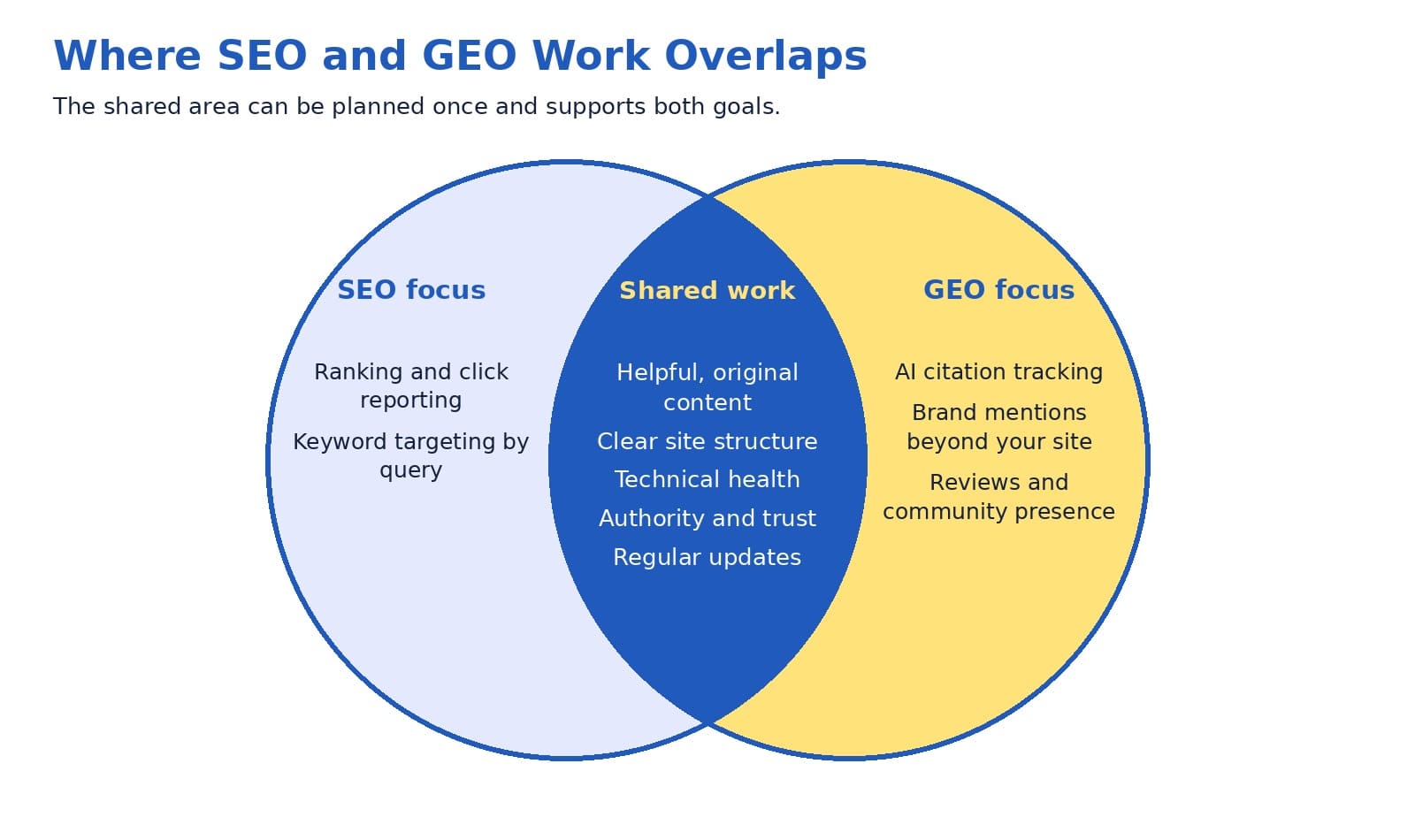
- Strong SEO foundations lift visibility in AI answers.
- A real, smaller set of GEO activities is new.
- Outcomes in AI platforms vary by prompt, so pilots with clear measures make sense.
The Keep, Extend, Add Test
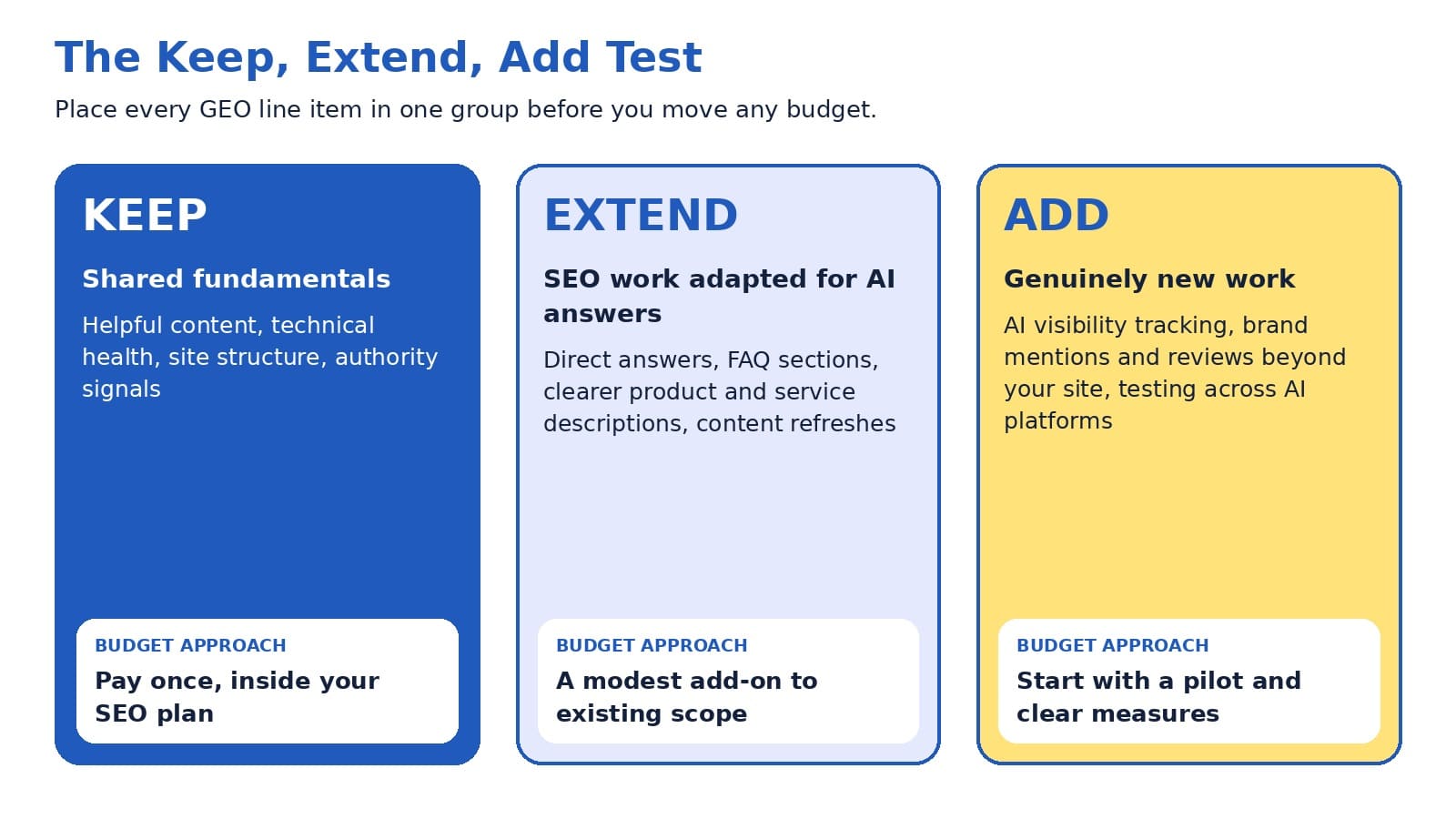
Proposals tend to arrive as a single line that says GEO. The Keep, Extend, Add Test turns that one line into three honest groups, and each group gets its own budget logic.
- Keep: shared fundamentals such as helpful content, technical health, site structure, and authority building. They support search results and AI answers alike, so you fund them once, inside the SEO plan.
- Extend: SEO work adapted for AI answers, such as direct answers near the top of a page, richer FAQ sections, clearer service descriptions, and refreshed older content. These usually justify a modest add-on.
- Add: new activities such as tracking your visibility in AI answers, earning reviews and mentions beyond your site, and testing how each AI platform describes you. These fit a pilot.
Here is Extend in action. Picture an accounting firm with a page about small business tax planning. The page already exists, so the team adds a short opening summary that says who the service helps, what it includes, and what a client can expect.
Then it answers the four questions prospects ask most, updates the details, and adds a clear next step. One edit helps searchers on Google and gives AI systems clean, relevant passages to draw from. Nobody built a new page, and nobody needed a new retainer.
Now picture the Add side. A regional home services company decides to pilot. It picks a short list of questions homeowners ask before hiring, such as how to choose a contractor and what a repair should cost. Each month, the team checks how the major AI assistants answer those questions, notes whether the company is named, and compares that with calls and form submissions.
At the same time, it asks recent customers for honest reviews. The pilot has a small budget, a named owner, and a review date, so the learning arrives before the larger spend does.
The test also gives owners and marketers a shared vocabulary. Owners see which parts of a proposal overlap with work already funded. Marketers show where fresh effort is required. Providers explain what is new with confidence, because the framework makes the case on its own.
Where the New Work Really Is
A fair review gives credit to the new parts of GEO, because that is where fresh budget has the best case. The Semrush survey and Digiday’s reporting point to four areas:
- Your reputation beyond your website. AI answers draw on reviews, community discussions, video, and press coverage. Yet only 8% of surveyed marketers used digital PR for AI visibility, 9% managed online reviews, and 11% built mentions through communities and social platforms (Loktionova, 2026). That is an open field.
- Access and readability for AI systems. Which AI crawlers may reach your content, and how easily they can read your pages, are decisions worth making on purpose.
- Measurement. Answers vary by prompt and platform, and many tracking tools estimate results from simulated prompts instead of real user queries (Guaglione, 2026). In the Semrush survey, 49% of marketers named the effect of AI on pipeline or revenue as a leading measurement challenge, and 40% relied mainly on manual spot checks in ChatGPT.
- Platform differences. Each assistant may retrieve and cite differently, so results from one platform may need confirming on another.
What about traffic? AI platforms currently send a small share of visits to many publishers. Similarweb data cited by Digiday showed less than 1% of overall traffic for the news outlets it examined, while one publisher reported a markedly higher subscription conversion rate among visitors arriving from AI platforms (Guaglione, 2026).
Small volume with strong intent is a classic reason to run a pilot first, measure leads and revenue, and scale what works.
Your Proposal Review in Five Minutes
Take the GEO proposal on your desk and read each line item against two questions. Is it already part of the current SEO scope? Does it adapt something you already have? Anything left over is new, and new work deserves a pilot with an owner, a measure, and a review date.
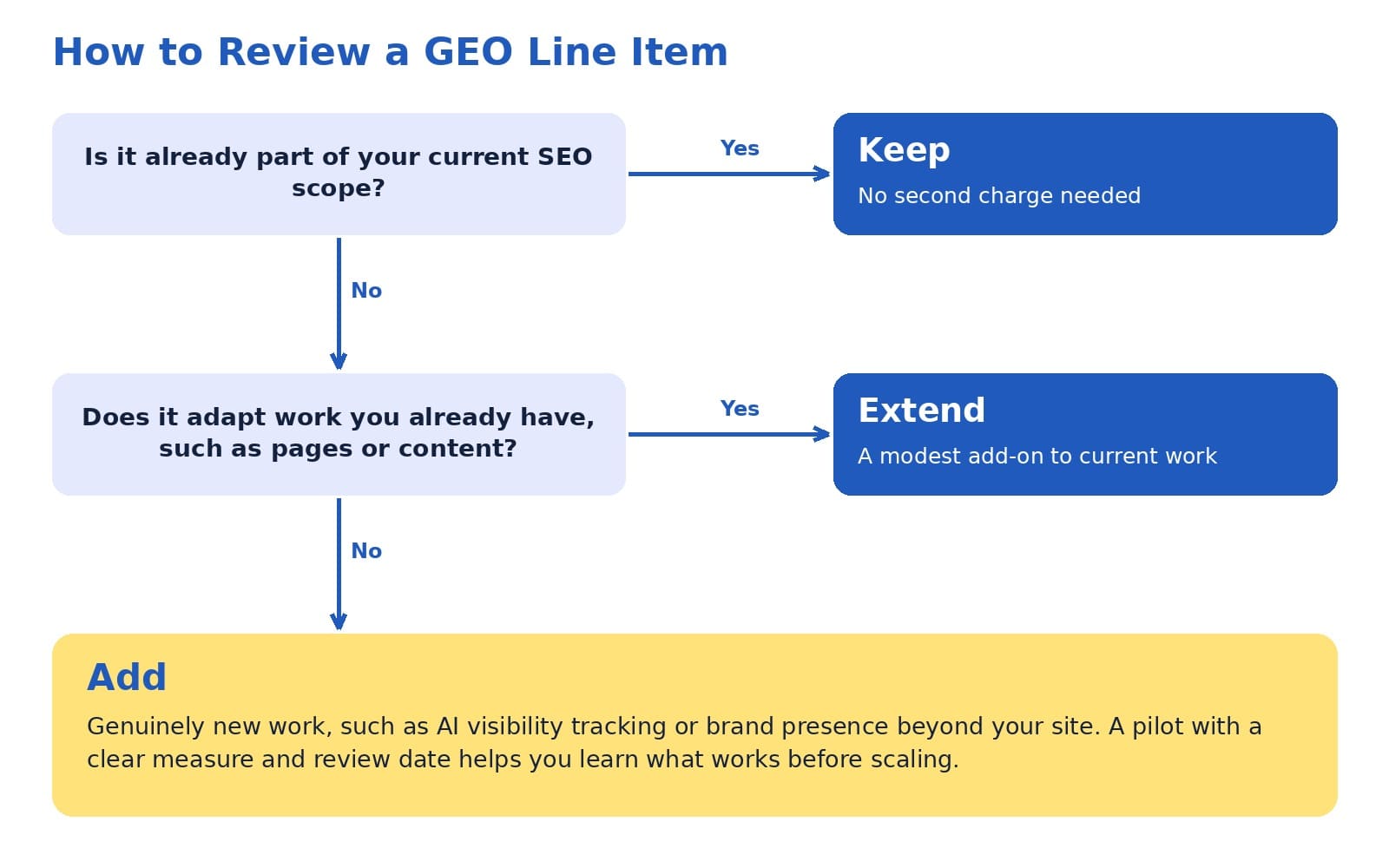
Bring these questions to the conversation with any provider, whether an agency, a freelancer, or an internal teammate:
- Which part of this work already sits inside our current SEO scope?
- Which pages or technical items will change, and how will we confirm it?
- What counts as success: qualified leads, calls, form submissions, revenue, or AI mentions?
- How long does the pilot run, and when do we review it together?
- What do we own at the end, including content, reports, and data?
- Will SEO and GEO appear in one report with one baseline?
Good answers build trust quickly. They also give you a tidy summary to share with a colleague who missed the meeting.
Questions Owners Ask Before Moving Budget
Should we pause SEO to fund GEO? A pause removes the work that GEO builds on. Google’s guide ties AI feature eligibility to the same indexing and quality systems that SEO serves (Google Search Central, 2026), so most teams do better by keeping the foundation funded and adding a pilot on top.
How much should a GEO budget be? No universal figure exists. In the Scribewise survey reported by Digiday, 70% of marketers with GEO dollars said it made up 11 to 20% of that budget (McCoy, 2026). Treat that range as one data point from one survey. A pilot sized to what your team can measure and manage is a sound starting point.
How will we know it works? Set a baseline before anything changes. Track leads, conversion rate, and branded search alongside AI visibility, and use the Generative AI performance report in Search Console for Google’s features. When AI mentions rise and qualified leads follow, you have found a pattern worth funding.
A Bolder Idea: Fix the Foundation First
Here is a thought that rarely appears in budget meetings. For many businesses, the highest-return GEO investment is an SEO repair. Google’s guide states that a page must be indexed and eligible to appear in Search with a snippet before it can be shown in AI features (Google Search Central, 2026). A page that search systems struggle to find or understand has little to offer an AI answer, whatever name appears on the invoice.
So the order of spending matters. Start by confirming that your core pages are crawlable, indexed, and clear about who you serve and what you sell. Next, extend the strongest pages with direct answers and current details. Then fund a defined pilot for the new activities, drawn from a modest slice of the search line and expanded when the evidence supports it. We call this protect the base, pilot the extension.
Moving a large share of SEO budget before any pilot has produced results may weaken the very foundation that AI visibility relies on. A steadier path keeps leads flowing today and gives you your own data for tomorrow. Since AI visibility is still measured imperfectly across the industry, learning at a measured pace is a competitive advantage.
What Changes for B2B and B2C
The Keep, Extend, Add mix shifts with your audience. B2B buyers often research a purchase through many questions over several weeks, and an AI assistant may help build their shortlist along the way. Clear service pages, case studies, and consistent descriptions of your offer carry extra weight in that journey.
B2C and local businesses may find accurate business details matter most. Google notes that Merchant Center and Google Business Profiles help products and services appear in AI responses and other search results (Google Search Central, 2026).
Reviews and customer feedback add another layer, because AI answers can draw on them. In both cases, the first move is the same: learn the questions your best customers ask, answer them clearly on your own site, and keep your details accurate everywhere they appear. Those tasks live in Keep and Extend, which is why the Add budget may come out smaller than expected.
A 90-Day Starter Plan
You can run this plan inside most existing engagements, and each step produces something you can show your team:
- Weeks 1 and 2, baseline: review indexing, site structure, your top pages by leads, and the Generative AI performance report in Search Console.
- Weeks 3 to 6, extend: add direct answers, FAQ sections, current service details, customer proof, and accurate business profiles to priority pages.
- Weeks 6 to 12, pilot: choose a focused list of customer questions, record how AI platforms answer them each month, and begin earning reviews and credible mentions.
- End of quarter, decide: compare leads, conversion rate, and AI mentions with your baseline, then set the next budget.
By day ninety, you hold real evidence from your own business. That makes the next budget conversation shorter and a lot more confident.
The Decision in Plain Terms
AI search is a genuine opportunity, and exploring it is a smart move. The evidence from Google, Semrush, and Digiday tells one consistent story: most of GEO stands on SEO, and a smaller set of activities is new. Keep what is shared, extend what can be adapted, and pilot what is new. When you follow that order, each dollar has a clear job, and every stage aims at leads and sales you can count.
Ready to see where your own budget stands? Share your current SEO scope and any GEO proposal you have received, and we will map every line to Keep, Extend, or Add in a one-page summary for your team.
Want to see how the pieces fit before you decide? Explore the work of our website design company team, the programs from our SEO agency specialists, and the planning behind our digital marketing agency services.
References
Gartner, Inc. (2025, May 12). Gartner 2025 CMO spend survey reveals marketing budgets have flatlined at 7.7% of overall company revenue [Press release]. https://www.gartner.com/en/newsroom/press-releases/2025-05-12-gartner-2025-cmo-spend-survey-reveals-marketing-budgets-have-flatlined-at-seven-percent-of-overall-company-revenue
Google Search Central. (2026, July 10). Optimizing your website for generative AI features on Google Search. Google for Developers. https://developers.google.com/search/docs/fundamentals/ai-optimization-guide
Guaglione, S. (2026, March 10). GEO hype busted: How it differs (and how it doesn’t) from SEO. Digiday. https://digiday.com/media/geo-hype-busted-experts-call-it-more-seo-than-new-discipline/
Loktionova, M. (2026, June 3). Only 22% of marketers have fully integrated AI search and SEO. They’re pulling ahead. [Study]. Semrush Blog. https://www.semrush.com/blog/the-operational-gap-ai-seo-study/
McCoy, K. (2026, March 25). Marketers shift growing shares of search spending to GEO. Digiday. https://digiday.com/marketing/marketers-shift-growing-shares-of-search-spending-to-geo/
Pew Research Center. (2025, July 22). Google users are less likely to click on links when an AI summary appears in the results. https://www.pewresearch.org/short-reads/2025/07/22/google-users-are-less-likely-to-click-on-links-when-an-ai-summary-appears-in-the-results/


10 Expert-Approved B2B Lead Generation Strategies That Actually Fill Your Pipeline
The Quick Take: Most B2B companies aren’t struggling to generate leads — they’re struggling to generate leads that actually turn into revenue. The ten strategies below, from account-based marketing to live chat to referral programs, are the ones backed by real 2025-2026 data for consistently producing leads sales teams actually want to talk to. Pick two or three that fit your sales cycle, do them well, and you’ll likely see more pipeline than trying to run all ten at once.
What’s Inside This Guide:
- 1. Account-Based Marketing (ABM)
- 2. LinkedIn Thought Leadership and Social Selling
- 3. SEO-Driven Content and Gated Lead Magnets
- 4. Personalized Email Nurture Sequences
- 5. Webinars and Virtual Events
- 6. Formal Referral and Partner Programs
- 7. Live Chat and Conversational Marketing
- 8. Video Marketing
- 9. Retargeting and Intent-Based Paid Ads
- 10. Sales Intelligence and Intent Data
- Bringing It All Together
Here’s a number worth sitting with before you spend another dollar on lead generation: 79% of marketing leads never turn into a sale, largely because of weak follow-up and nurturing, not because the leads were bad to begin with (Salesforce, as cited in G2, 2026). That statistic alone explains why so many B2B marketing teams feel like they’re constantly filling a bucket with a hole in the bottom.
Generating a name and an email address was never really the hard part. Turning that name into a qualified conversation with sales, and eventually into a closed deal, is where most strategies quietly fall apart.
The good news is that the B2B lead generation strategies actually working right now aren’t secret or complicated. They’re well documented, backed by solid research, and used by real companies generating real pipeline. What separates the teams getting results from the teams spinning their wheels usually isn’t the tactic itself, it’s how consistently and thoughtfully it gets executed. Below are ten strategies that consistently show up in current data as genuinely effective, along with what the research says about why each one works and how to put it to use.
1. Account-Based Marketing (ABM)
Account-based marketing flips the traditional funnel on its head. Instead of casting a wide net and hoping the right people notice, ABM starts by identifying a focused list of high-value target accounts and then builds personalized campaigns aimed specifically at the decision-makers inside those companies. It’s a slower, more deliberate approach, but for B2B companies selling complex or high-ticket products, it tends to outperform broader tactics by a wide margin.
The numbers back this up convincingly. Companies running ABM programs report boosting revenue by as much as 208% over three years, and 76% of marketers say ABM delivers a higher return than other marketing strategies they run (Saffron Edge, 2026). Personalized ABM campaigns also outperform generic ones according to 87% of B2B marketers, and companies with strong sales-and-marketing alignment, something ABM naturally forces, grow revenue 32% faster than those without it (Saffron Edge, 2026). If your average deal size is large enough to justify custom outreach, and your buying committee typically includes more than one decision-maker, this is very likely the single highest-leverage strategy on this list.
- Start with a short list of 20 to 50 dream accounts rather than trying to run ABM at scale immediately
- Involve sales in building the account list so marketing and sales agree on what a “good fit” actually looks like
- Personalize the message to the account’s specific industry and pain points, not just their first name
2. LinkedIn Thought Leadership and Social Selling
LinkedIn has become the closest thing B2B marketing has to a home turf, and the data leaves little room for debate. LinkedIn now drives 80% of all B2B social media leads, and 89% of B2B professionals use it specifically to generate business (Martal Group, as cited in SHNO, 2026). Leads from LinkedIn also convert at roughly double the rate of other social platforms, according to 2026 HubSpot research (Searchlab, 2026). That’s not a small edge. It suggests that time spent building a presence on LinkedIn is simply more productive than the same time spent almost anywhere else in social media.
The strategy that works best isn’t running LinkedIn ads in isolation, though those help too. It’s a combination of consistent thought leadership content from real people at your company, genuine engagement in the comments of your prospects’ posts, and a sales team that treats LinkedIn as a relationship-building tool rather than a place to blast cold pitches. Buyers can tell the difference between someone building credibility over months and someone trying to close a deal in a single DM, and they respond very differently to each.
3. SEO-Driven Content and Gated Lead Magnets
Content marketing remains one of the most reliable, compounding ways to generate B2B leads, and the research keeps confirming it. According to a 2025 study, content marketing generates roughly three times more leads than outbound marketing while costing 62% less to run (Demand Metric, as cited in SHNO, 2026). And 87% of B2B marketers say content marketing successfully generates leads for their business, an increase of eleven percentage points in just a couple of years (Email Vendor Selection, 2025, as cited in SHNO, 2026).
SEO deserves special mention here because of how differently it performs over time compared to paid channels. B2B companies that consistently invest in SEO see a 5.7 times higher return on investment after twelve months compared to running paid search alone (BrightEdge, as cited in Searchlab, 2026). Paid ads stop working the moment you stop paying for them. A well-ranked blog post or resource page keeps generating leads for years with no ongoing spend, which is exactly why SEO tends to be underrated by teams looking for quick wins and underrated no more once they see a year-two comparison. As an SEO agency in Delhi working with B2B clients across long sales cycles, this is consistently the pattern we see: businesses willing to be patient with SEO end up with the cheapest, most durable lead source on this list.
Gated content, meaning guides, templates, or reports that visitors trade an email address to access, still plays an important role here too, though it’s worth using selectively. Gated assets convert two to five times better than ungated ones, but ungated content drives roughly three times more traffic overall (Demand Gen Report, as cited in Searchlab, 2026).
A smart approach uses both: plenty of open, freely accessible content to build organic traffic and authority, with a smaller number of genuinely valuable gated resources reserved for your highest-intent visitors.
- Build content around the specific questions your sales team hears most often on discovery calls
- Reserve gating for your best assets, not every blog post, since over-gating quietly kills your organic traffic
- Treat SEO as a twelve-month investment, not a campaign you evaluate after six weeks
4. Personalized Email Nurture Sequences
Email still holds one of the best returns of any B2B marketing channel, with the average campaign delivering a striking 36 to 1 return on investment (Litmus, as cited in Searchlab, 2026). But the era of generic, one-size-fits-all newsletters blasted to an entire list is largely over. Personalized emails see a 14% improvement in click-through rates and a 10% lift in conversions compared to generic sends (Gartner research, as cited in Biteable, n.d.), and nurtured leads go on to make purchases that are 47% larger on average than leads that never received any nurturing at all (as cited in ReferralRock, n.d.).
The strategic shift worth making here is moving away from a single generic drip sequence and toward multiple nurture tracks based on where a lead actually is in their buying journey. A visitor who just downloaded an introductory guide needs a very different email than someone who’s already requested a demo and gone quiet. Segmenting your list this way takes more setup work upfront, but it’s a major part of why 79% of leads currently fail to convert. Most of them simply weren’t nurtured in a way that matched where they actually were.
5. Webinars and Virtual Events
Webinars have quietly become one of the highest-quality lead sources available to B2B marketers, and 73% of B2B marketers now call webinars their number one source of high-quality leads (ZoomInfo, as cited in Hubilo, 2025). The cost efficiency is hard to ignore too. Webinars generate leads at roughly $72 each, compared to over $800 for a trade show and around $198 for a conference (SHNO, 2026). Companies typically see 20% to 40% of webinar attendees enter the sales pipeline as genuinely qualified leads, and webinars with a clear, specific call to action can convert as much as 47% of attendees into leads (SHNO, 2026).
What makes webinars particularly valuable compared to a downloadable PDF or blog post is the built-in qualification. Someone willing to block out 30 to 45 minutes of their calendar to attend a live session on a specific topic has already told you a lot about how seriously they’re considering a solution like yours. That single behavioral signal, attendance itself, is often a stronger indicator of intent than a dozen anonymous page views.
- Pick topics narrow enough to attract genuinely interested prospects rather than a broad general audience
- Send the replay within 24 hours, since on-demand viewing can account for nearly half of total views
- End with one specific next step, not a vague “let us know if you have questions” close
6. Formal Referral and Partner Programs
If there’s one strategy on this list that’s dramatically underused relative to how well it performs, it’s referrals. Roughly 84% of B2B decision-makers start their buying process with a referral (Edelman Trust Barometer, as cited in GrowSurf, n.d.), and companies with formal referral programs report a 70% higher conversion rate on referral leads compared to leads sourced any other way (Heinz Marketing, as cited in GrowSurf, n.d.). Referred leads also close roughly 69% faster than non-referred leads, and companies with structured referral programs saw 86% revenue growth over two years, compared to 75% for companies without one (Heinz Marketing, as cited in ReferralRock, n.d.).
Despite results like these, only around 30% of B2B companies have a formal referral program in place at all (Influitive, as cited in ReferralRock, n.d.), which means most companies are leaving one of their highest-converting lead sources almost entirely up to chance. A referral program doesn’t need to be complicated to work. It needs a clear ask, an easy way for happy customers to make an introduction, and a reason for them to bother, whether that’s a financial incentive, early access to new features, or simply genuine appreciation delivered consistently.
7. Live Chat and Conversational Marketing
Adding live chat to a B2B website tends to produce results that surprise teams who assumed it was mainly a retail or customer-support tool. Website visitors who chat with a company in real time are 82% more likely to convert into customers, and they go on to spend 13% more than visitors who never chat at all (Intercom, n.d.). Even a modest exchange makes a measurable difference. Just one reply to a visitor’s message makes them 50% more likely to convert, and a short six-message conversation can make them up to 250% more likely to convert (Intercom, n.d.). Broader industry data backs this up too, with live chat linked to a 20% average increase in conversion rate and a reported 305% return on investment (American Marketing Association, as cited in SmartBug Media, 2017).
The reason this works is almost embarrassingly simple: speed. A prospect with a question who has to fill out a contact form and wait a day for a reply has plenty of time to lose interest, get distracted, or check out a competitor instead. A prospect who gets a helpful answer in under a minute is still standing at your door, so to speak, ready to keep the conversation going. For B2B sites with any meaningful traffic, live chat is one of the fastest and least expensive improvements you can make to your conversion rate.
8. Video Marketing
Video has moved from “nice to have” to genuinely essential in B2B marketing. 78% of businesses report increased website traffic after adding video to their content strategy, 69% generate more leads because of it, and 54% see increased sales as a direct result (as cited in SwellAI, n.d.). Perhaps most tellingly, B2B marketers who use video grow revenue 49% faster than those who don’t (as cited in SwellAI, n.d.), and landing pages that include video can see conversion increases of 86% or more (as cited in MediaPost, n.d.).
Personalized video, where a salesperson records a short, specific message for an individual prospect rather than sending a generic pitch, is proving especially effective in outbound efforts. Video email campaigns show five times higher open rates and eight times higher open-to-reply rates in prospecting compared to plain text emails (as cited in Sagefrog, n.d.). You don’t need studio-quality production for this to work. A well-lit laptop camera and a genuinely useful, specific message tends to outperform a polished but generic video every time, because the personalization is what actually earns the reply.
- Use short explainer videos on high-traffic landing pages where visitors are deciding whether to convert
- Have sales reps send brief personalized videos instead of another templated cold email
- Repurpose webinar recordings into shorter clips for social and email rather than letting them sit unused after the live event
9. Retargeting and Intent-Based Paid Ads
Most visitors to a B2B website will never convert on their first visit, no matter how good your page is, simply because B2B buying decisions usually involve multiple stakeholders and take weeks or months to finalize. Retargeting exists specifically to solve that problem by keeping your brand visible to people who’ve already shown interest. Retargeting through display ads has been shown to influence a striking 70% of website visitors toward eventually making a purchase (as cited in MediaPost, n.d.), and personalized exit-intent offers, shown right as a visitor is about to leave your site, can boost leads and conversions by as much as 200% (as cited in MediaPost, n.d.).
The key to making retargeting feel helpful rather than intrusive is relevance. Someone who read a blog post about your product’s pricing should see a different retargeting ad than someone who only viewed your careers page. Segmenting your retargeting audiences by the specific page or content they engaged with, rather than running one generic ad to everyone who’s ever visited your site, is usually the difference between retargeting that converts and retargeting that just feels like being followed around the internet.
10. Sales Intelligence and Intent Data
The final strategy worth building into your lead generation approach isn’t really a channel at all, it’s a layer of intelligence that makes every other channel work better. Intent data tracks the buying signals companies give off before they ever fill out a form, things like researching competitor comparisons, visiting review sites, or spending unusual amounts of time on certain topics. Combined with personalization, this kind of targeting has real financial impact. Gartner has projected that B2B companies using personalization in digital commerce can see revenue increases of up to 15% (as cited in SaleFuel, n.d.).
This strategy also directly addresses one of the biggest structural problems in B2B marketing right now: 85% of B2B marketers admit they struggle to connect their marketing performance to actual business outcomes (G2, 2026), and 41% report difficulty getting marketing-generated leads to meet sales’ expectations for quality (G2, 2026). Intent data helps close that gap by giving both teams a shared, objective signal for which leads are actually ready for a conversation, rather than relying on gut feeling or an arbitrary lead score that sales has learned to ignore.
Bringing It All Together
Reading through ten strategies at once can feel like a lot, and that’s exactly the trap worth avoiding. Trying to launch all ten simultaneously is a fast way to execute all of them poorly. The stronger approach is to look honestly at your sales cycle, your average deal size, and where your current pipeline is actually breaking down, then choose two or three strategies from this list that most directly address that specific gap. A company selling a $500 monthly subscription probably gets more out of SEO content and email nurturing than a full ABM program. A company selling $200,000 enterprise contracts almost certainly should be running ABM alongside LinkedIn thought leadership, with live chat catching the inbound interest both of those generate.
Whichever combination fits your business, the underlying principle stays the same across every strategy on this list: the leads that convert aren’t the ones you generated the most of, they’re the ones you followed up with the fastest, personalized the most thoughtfully, and nurtured with genuine relevance until they were actually ready to buy. That’s not a flashy insight, but it’s the one the data keeps confirming over and over again.
If your pipeline has been feeling unpredictable, or your marketing and sales teams keep disagreeing about what counts as a “good lead,” it might be less about needing a new tactic and more about needing the right systems, tracking, and website experience to support the strategies you’re already running. That’s exactly the kind of work our team handles at ICO WebTech, a website designing agency in Delhi that builds high-converting landing pages and sets up the live chat, tracking, and personalization infrastructure that turns these strategies from theory into a predictable pipeline.
Talk to ICO WebTech About Your Lead Generation Strategy
References
Biteable. (n.d.). Create next-level B2B marketing campaigns with personalized videos. https://biteable.com/blog/personalized-video-marketing-for-b2b/
G2. (2026). Lead generation statistics for 2026: Key marketing data. https://learn.g2.com/lead-generation-statistics
GrowSurf. (n.d.). B2B referral marketing statistics. https://growsurf.com/statistics/b2b-referral-marketing-statistics/
Hubilo. (2025). Webinar marketing statistics and benchmarks for 2025. https://www.hubilo.com/blog/webinar-marketing-statistics-benchmarks
Intercom. (n.d.). From first touch to qualified lead: How to use live chat for sales. https://www.intercom.com/blog/
MediaPost. (n.d.). Stats and snippets on B2B email: Why it’s the most valuable channel. https://www.mediapost.com/publications/article/346495/
ReferralRock. (n.d.). B2B referral marketing statistics. https://referralrock.com/blog/b2b-referral-marketing-statistics/
Saffron Edge. (2026). 45+ account-based marketing statistics for 2026 B2B marketing strategy. https://www.saffronedge.com/blog/account-based-marketing-statistics/
SaleFuel. (n.d.). B2B companies using personalization in digital commerce to see up to 15% increase in revenue. https://salesfuel.com/b2b-companies-using-personalization-digital-commerce-see-15-increase-revenue/
Sagefrog. (n.d.). Start more conversations with leads in 2020 with personalized video emails. https://www.sagefrog.com/blog/start-more-conversations-leads-2020-personalized-video-emails/
Searchlab. (2026). B2B marketing statistics 2026. https://searchlab.nl/en/statistics/b2b-marketing-statistics-2026
SHNO. (2026). B2B lead generation statistics for 2026: Channels, costs, conversion rates, and trends. https://www.shno.co/marketing-statistics/b2b-lead-generation-statistics
SHNO. (2026). Content-led lead generation statistics. https://www.shno.co/marketing-statistics/content-led-lead-generation-statistics
SHNO. (2026). Webinar marketing statistics for 2026. https://www.shno.co/marketing-statistics/webinar-marketing-statistics
SmartBug Media. (2017). 4 powerful ways live chat on your website improves B2B inbound sales. https://www.smartbugmedia.com/blog/live-chat-on-your-website-improves-b2b-inbound-sales
SwellAI. (n.d.). B2B video marketing statistics. https://www.swellai.com/blog/b2b-video-marketing-statistics

Captured by the Zero-Click Trend? How ICO Can Help You Win Google’s Featured Snippets
Search no longer sends the same traffic it used to. Here’s how to earn visibility and clicks even in a zero-click world.
If you’ve watched your organic traffic plateau or dip even as your rankings held steady, you’re not imagining it. Google’s search results page has quietly become a destination in itself — and for most searches, users never leave it. This is the zero-click era, and it’s rewriting the rules of SEO.
At ICO, we’ve spent the last few quarters helping brands adapt to exactly this shift — not by fighting the zero-click trend, but by getting inside it. The single most effective lever for doing that today is winning Featured Snippets, the answer boxes that sit at “Position Zero,” above even the #1 organic result. This guide breaks down the data, the mechanics, and a real optimization case study so you can see exactly how it’s done.
The Zero-Click Reality, By the Numbers
Multiple independent studies converge on the same uncomfortable truth: the majority of Google searches now end without a single click to any website. The exact figure varies by source and methodology, but the direction is unanimous.
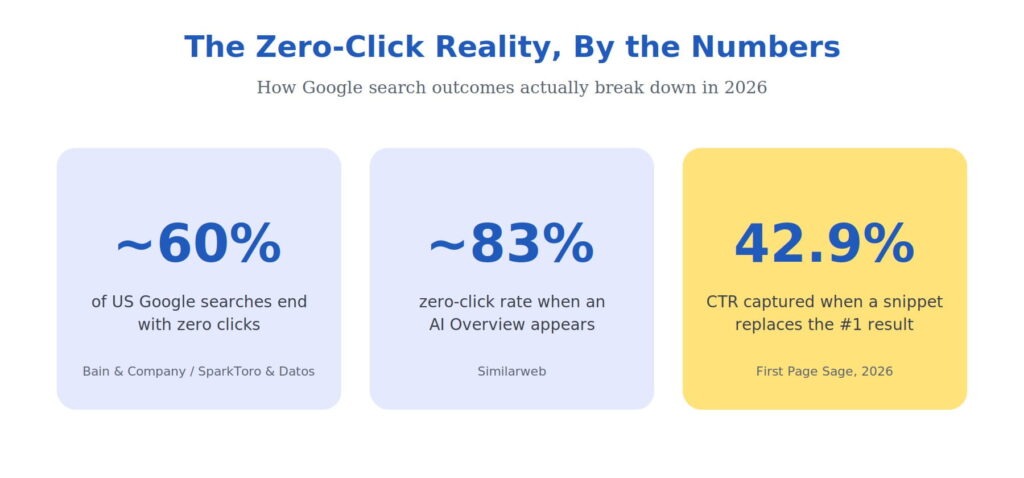
Bain & Company’s research found that 80% of consumers now rely on AI-generated results for at least 40% of their searches, with organic traffic declining an estimated 15–25% across many sectors as a direct result. The takeaway isn’t that SEO is dead. It’s that the destination has changed — if your brand is named and recommended inside the answer itself, you still reach the customer at the exact moment they decide.
Why this matters for you: Whether you run an e-commerce store, or a SaaS product competing for local visibility, the brands winning today aren’t just chasing blue links — they’re engineering their content to live inside Google’s answer boxes.
What Exactly Is a Featured Snippet?
A featured snippet is a short, extracted answer that Google pulls from a ranking page and displays in a highlighted box above the #1 organic result — hence the nickname “Position Zero.” It includes the answer text, the page title, and the URL, giving you a branded presence even when the user never clicks through.
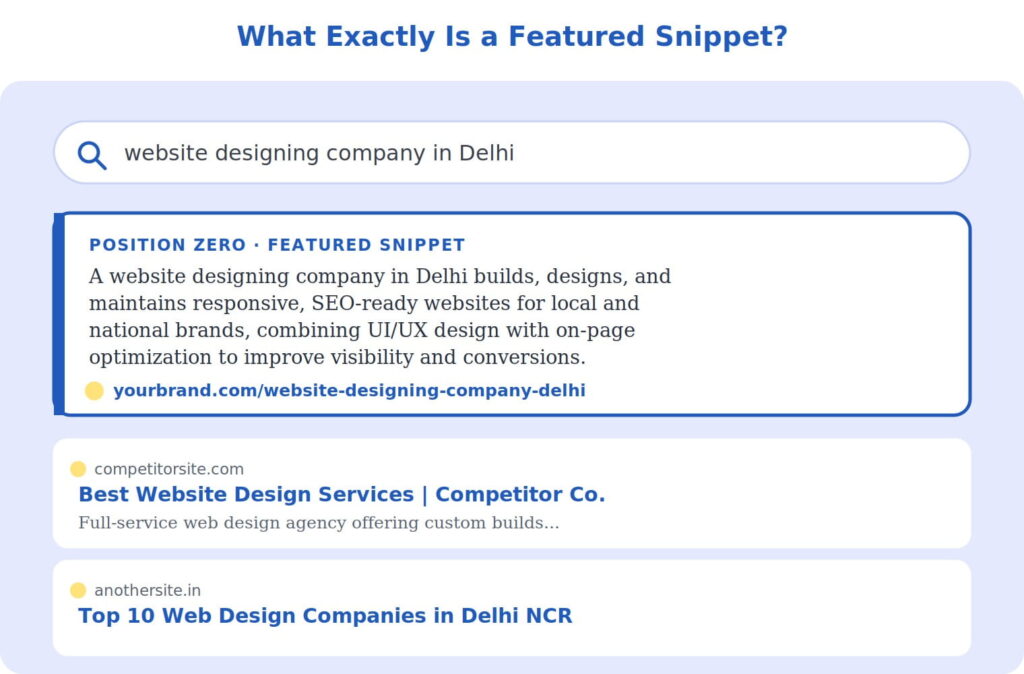
Illustrative mockup: a featured snippet occupies “Position Zero” — above the #1 organic result — complete with a highlighted answer box, source URL, and brand attribution.
The Four Core Snippet Types
Google displays four core featured snippet types as of 2026, each with different triggers, formats, and optimization requirements. Knowing which one your target query pulls determines exactly how you should structure your content.
| Snippet Type | Best For | Ideal Format | Share of Snippets |
|---|---|---|---|
| Paragraph | “What is,” “why,” definition queries | 40–60 word direct answer | ~60–65% |
| List | “How to,” step-by-step, ranked queries | Numbered/bulleted, 5–8 items | ~25–30% |
| Table | Comparisons, specs, pricing data | 3–5 columns, 5–6 rows | ~8% |
| Video | Tutorials, demos, repairs, recipes | Timestamped YouTube segment | ~5–8% |
Websites that consistently earn featured snippets report meaningful downstream gains: higher organic click-through rates, improved brand recognition, and stronger voice search visibility. That’s the real prize; snippets don’t just capture a click; they build the authority signals that compound over time.
Why Snippets Still Matter in the Age of AI Overviews
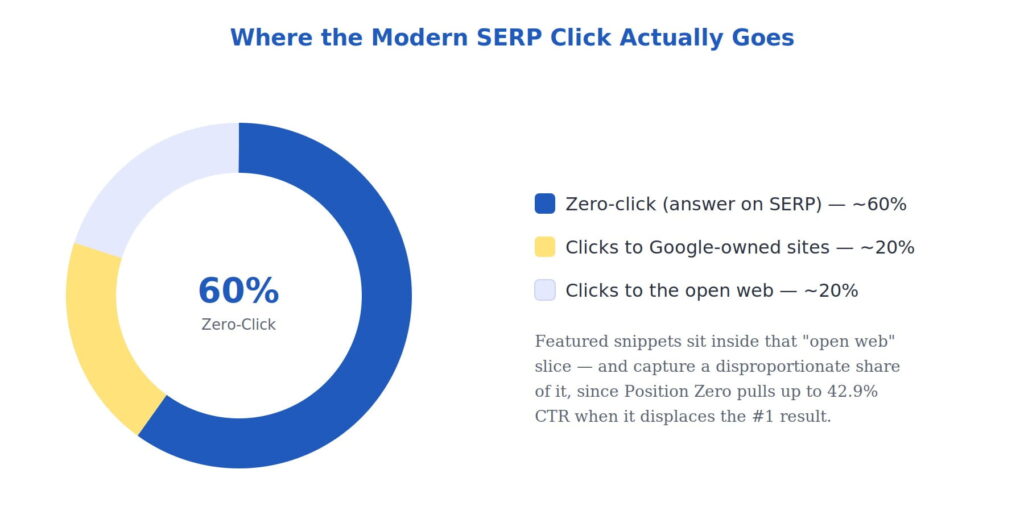
It’s tempting to assume AI Overviews have made traditional snippets irrelevant. The data says otherwise. Featured snippets now serve a dual purpose: they capture direct SERP real estate and simultaneously feed the AI Overview engine with citation-worthy signals, so content structured for one format typically earns visibility in the other.
The strategic nuance in 2026 is knowing which query types still trigger traditional snippets versus which have shifted almost entirely to AI Overviews — and redirecting optimization effort toward the how-to and commercial queries where snippets still appear reliably. This is precisely where a structured, ICO-led content audit pays off.
How ICO Approaches Featured Snippet Optimization
Winning Position Zero isn’t a lucky content accident — it’s a repeatable process. Here’s the exact framework ICO runs for every client, whether it’s a national e-commerce brand or a website designing company in Delhi trying to outrank larger competitors in local search.
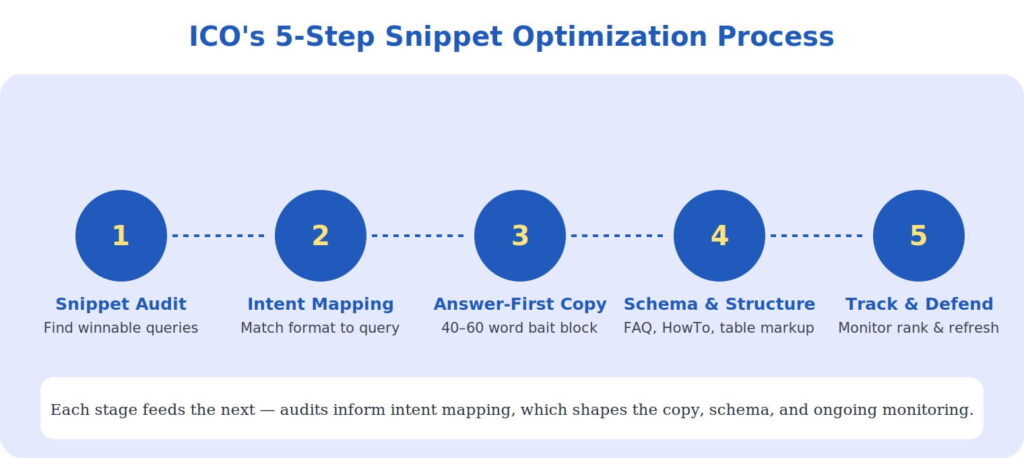
Step-by-step, in plain terms:
- Snippet audit: We audit all page-one rankings to identify queries where a competitor currently owns a snippet that we can plausibly displace — usually queries where the client already ranks in positions 2–10.
- Intent mapping: We classify each target query by the snippet type it’s most likely to trigger — paragraph, list, or table — since matching content format to query intent (definitions to paragraphs, procedures to numbered lists, comparisons to tables) is the foundation of an effective position-zero strategy.
- Answer-first copywriting: We rewrite the page so the direct answer sits immediately under the relevant heading, because Google’s extraction algorithm looks at the text immediately following headings — if the answer is buried in paragraph three, the snippet goes to whoever puts it in paragraph one.
- Schema and structure: We implement FAQ, HowTo, and table schema, and convert prose into scannable lists and tables where the query calls for it.
- Track and defend: Snippets shift ownership constantly. We monitor snippet volatility monthly and refresh content before a competitor can take the box back.
Case Study: How ICO Helped a Delhi-Based Web Agency Win Position Zero
Client Snapshot
Our client, a mid-sized website designing company in Delhi, was ranking on page one for several commercial keywords but was consistently losing the featured snippet — and the associated click share — to larger national competitors and directory sites.
The Challenge
Page-1 rankings for 40+ commercial queries but zero snippet ownership. Organic CTR was well below expected benchmarks for their ranking positions.
The Approach
ICO ran a full snippet audit, identified 34 winnable queries, restructured service pages with answer-first blocks under 60 words, converted process explanations into numbered lists, and added comparison tables for “custom vs template website design.”
Headline results from ICO’s 90-day featured snippet optimization engagement.Headline results from ICO’s 90-day featured snippet optimization engagement.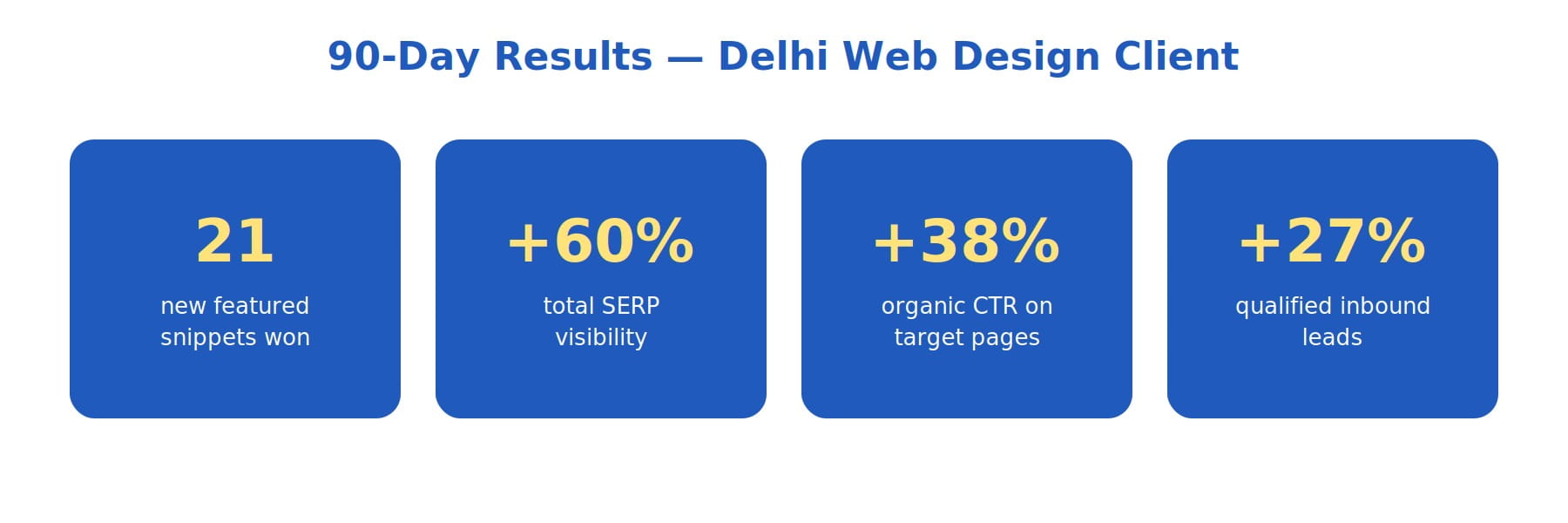
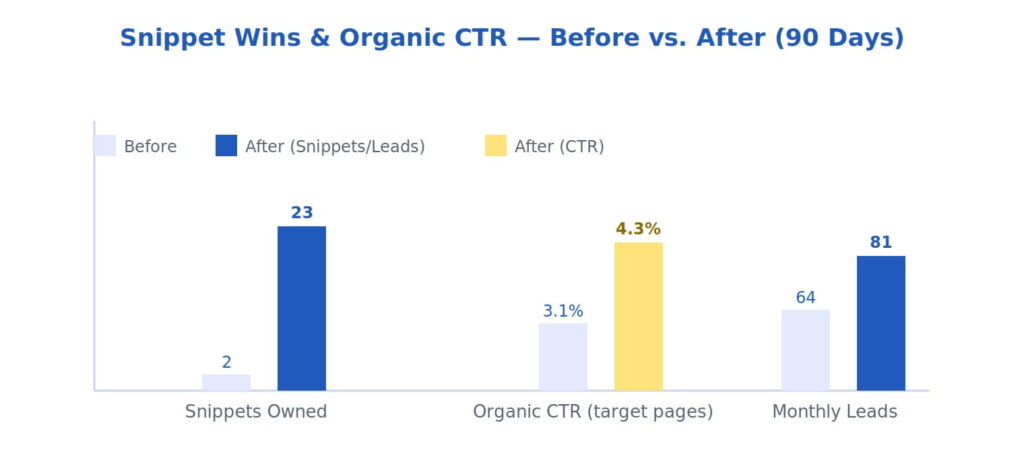 Before/after results from ICO’s 90-day featured snippet optimization engagement.
“We were already ranking well, but we were invisible in the box that actually gets clicked. ICO didn’t just chase rankings — they reformatted our content to win the answer itself.” — Client testimonial, paraphrased from project feedback
Commercial Queries Where This Strategy Pays Off Fastest
Snippet optimization isn’t equally valuable across every keyword. It compounds fastest on commercial and local-intent queries where buyers are actively comparing options — for example, terms like website designing company in Delhi, best SEO company in India, digital marketing agency near me, ecommerce website development services, SEO services for small business, and website redesign agency. These queries sit in exactly the zone where traditional snippets still appear reliably, rather than being displaced by AI Overviews.
Getting Started: A Quick Checklist
- Pull your Search Console data and filter for queries ranking positions 2–10 — these are your highest-probability snippet targets.
- Classify each query by intent: definition, process, or comparison.
- Rewrite the first 40–60 words after the relevant heading as a direct, self-contained answer.
- Add FAQ, HowTo, or Table schema markup where applicable.
- Track snippet ownership monthly — Position Zero is contested real estate, and it changes hands often.
Ready to Win Position Zero?
ICO helps brands turn the zero-click trend from a threat into a visibility advantage.
Sources referenced:
Data points, statistics, and optimization guidance referenced in this article were drawn from the following sources. Figures are aggregated industry estimates as of 2026 and may vary by methodology.
- Click Vision, 50+ Zero Click Search Statistics for 2026: Trends & Impact — click-vision.com/zero-click-search-statistics
- Arfadia, Zero-Click Search Statistics 2026: Sourced & Updated — arfadia.com/blog/zero-click-search-statistics-2026
- Digital Applied, Zero-Click Search Statistics 2026: Complete Data Guide — digitalapplied.com/blog/zero-click-search-statistics-2026-complete-data
- Strategyc, Zero Click Search Statistics 2026: The Complete Data Behind Search’s Biggest Shift — strategyc.io/blog/zero-click-search-statistics
- Omnibound, Zero-Click Search Statistics (2026): 52+ Data Points — omnibound.ai/blog/zero-click-search-statistics (citing Bain & Company, Goodbye Clicks, Hello AI, Feb 2025)
- Nightwatch, How to Optimize for Featured Snippets (+Examples & Tips) — nightwatch.io/blog/optimize-for-featured-snippets
- Stackmatix, Featured Snippet Optimization in 2026: How to Win Position Zero — stackmatix.com/blog/featured-snippets-optimization-2026
- SEOctopus, Featured Snippet Optimization — The Complete Guide to Position Zero (2026) — seoctopus.io/en/blog/featured-snippet-optimization-guide-2026
- Digital Applied, Featured Snippets in the AI Overview Era: 2026 Guide — digitalapplied.com/blog/featured-snippets-ai-overview-era-optimization-2026
- CodeX Guru, How To Get Featured Snippets In 2026 — codexguruu.com/how-to-get-featured-snippets-in-2026
- IT in DFW, Featured Snippets in 2026: The Ultimate Guide to Position 0 — itindfw.com/blog/featured-snippets
- Scale Growth Digital, How to Optimize for Featured Snippets (2026) — scalegrowth.digital/resources/seo/how-to-optimize-featured-snippets (citing First Page Sage, 2026)
- YoGrow Solutions, How to Win the Featured Snippet: The 2026 SEO Formatting Guide — yogrowsolutions.com/how-to-win-the-featured-snippet
- SERPexa, Featured Snippet Types & How to Win Each: Complete Guide [2026] — serpexa.com/featured-snippet-types-how-to-win-each-complete-guide-2026

The Citations Race: How to Force Your Brand Into AI-Generated Search Summaries
The traditional SEO playbook is facing an evolutionary crisis. For over two decades, the objective of search engine optimization was clear: optimize for keywords, build domain authority, and secure a spot within the coveted “ten blue links” on the first page of search results. If you ranked in the top three organic slots, you were guaranteed a steady stream of click-through traffic. Strategy was measured in clicks, impressions, and keyword positions.
Today, that classic user pipeline is fragmenting. The rise of AI search engines, conversational answer engines, and LLM-driven platform overlays has introduced a new paradigm: the zero-click, synthesized search summary. Whether a user is querying Google’s AI Overviews, Perplexity, or OpenAI’s native search tools, they are increasingly greeted by a comprehensive, multi-paragraph response that answers their question directly on the interface. The user no longer needs to click through to three different blogs to piece together an answer; the machine does it for them.
Does this mean organic brand visibility is dead? Far from it. But the battlefield has shifted. The new gold standard of digital optimization is not merely ranking—it is securing the **in-text citation**. When an AI engine synthesizes a summary, it acts as an automated research assistant, backing up its factual assertions with hyperlinked footnotes and inline references. To survive this shift, brands must move past traditional ranking metrics and learn exactly how to force their content into the retrieval pipelines of modern AI engines. Winning the citation race requires a deep understanding of Retrieval-Augmented Generation (RAG), precise semantic data structuring, and programmatic entity authority.
1. Under the Hood: How AI Search Engines Choose Source Material
To trick or persuade an AI engine into citing your brand, you must first demystify how these platforms assemble responses in real time. Traditional search engines use inverted indexes to match keyword strings to web documents. AI answer engines, by contrast, rely on a architectural framework known as **Retrieval-Augmented Generation (RAG)**—a process that combines a static, pre-trained Large Language Model (LLM) with a real-time web retrieval system.
When a user types a complex query into an AI search engine, the system does not simply feed that prompt directly to the LLM. Instead, the process unfolds through a highly coordinated real-time pipeline:
- **Query Vectorization:** The user’s natural language prompt is translated into a vector embedding (a long string of numbers representing the mathematical definition and semantic intent of the words).
- **Live Web Retrieval:** The system runs a lightning-fast parallel search across the web to pull a cluster of highly relevant, topically fresh source documents based on vector similarity.
- **Chunking and Reranking:** The retrieval engine breaks those web pages down into smaller text fragments or “chunks” (usually 100 to 300 words each). A secondary machine learning model reranks these chunks based on factual density, contextual alignment, and source trustworthiness.
- **LLM Synthesis and Citation Footnoting:** The highest-scoring text chunks are injected directly into the LLM’s temporary operational memory (the context window). The LLM reads these web fragments, synthesizes a cohesive natural language summary, and automatically places a citation anchor back to the exact source chunk it used to formulate each sentence.
Understanding this pipeline reveals a critical truth: an AI engine will never cite a page simply because it has a high backlink count or contains a high density of exact-match keywords. It selects sources based on how neatly a specific text chunk answers a fragmented part of the user’s broader intent mapping.
2. Reverse-Engineering Semantic Phrasing for LLM Retrieval
Traditional web writing often relies on stylistic introductions, narrative filler, and corporate jargon designed to pad out word counts. While this might keep a human reading for an extra minute, it actively breaks the parsing capabilities of AI scraper bots. To force your content into the top tiers of a RAG reranking model, your writing style must adapt to meet the structural preferences of machine learning systems.
Embracing Subject-Predicate-Object (SPO) Triplets
AI models process data most efficiently when it is presented in clear, unambiguous semantic structures known as **Subject-Predicate-Object (SPO) triplets**. Instead of burying a core factual asset within a convoluted, poetic paragraph, state your insights using declarative, authoritative axioms. Consider the following structural evolution:
*Weak (Traditional Marketing Copy):* “When it comes to scaling enterprise software platforms, our innovative cloud management framework helps businesses unlock incredible cost efficiencies while simultaneously supercharging deployment velocities across global regions.”
*Strong (AI-Optimized Semantic Phrasing):* “Enterprise cloud software scaling requires three operational constraints: latency isolation, database sharding, and regional compute distribution. Our cloud management framework reduces global deployment latency by 42% by automating multi-region edge synchronization.”
The optimized variant provides an immediate, high-density factual chunk. It explicitly defines the constraints and delivers a quantifiable metrics statement. When an AI search engine is looking for a concise source chunk to back up a synthesized sentence about *enterprise cloud scaling challenges*, the second option is mathematically far more attractive to the reranking algorithm.
The Micro-Summary Optimization Technique
To maximize your citation capture rate across long-form guides or technical articles, implement an internal layout strategy called **Micro-Summary Clustering**. At the top of every major conceptual heading, include a standalone, visually isolated box containing a two-sentence, ultra-dense summary of the underlying section.
Structure the first sentence as a direct, definitive answer to the core question implied by the heading. Structure the second sentence as a data-anchored explanation of *why* or *how*. By providing these pre-chunked, hyper-focused text blocks, you make it incredibly easy for an AI crawler to extract your text and use it as an explicit, quoted reference node within its summary engine.
3. The Advanced Structured Data Blueprint for AI Bots
While semantic phrasing optimizes your visible text for the LLM synthesis phase, structured data markup optimizes your underlying code for the initial retrieval and entity-mapping phase. Basic Schema.org tags like `Article` or `Organization` are no longer sufficient to stand out. To anchor your brand within an AI search engine’s permanent knowledge base, you must deploy advanced structured data frameworks that explicitly define relationship models.
Leveraging SameAs Entity Bridging
AI search engines do not look at the web as a collection of isolated pages; they view it as a massive, interconnected **Knowledge Graph** composed of distinct real-world entities (people, places, concepts, organizations, and products). When an AI crawls your site, it wants to know exactly where your brand fits within that global web of established facts.
You can force these connections by using the `sameAs` property within your JSON-LD schema blocks. This tag tells the search engine’s entity parser that a concept or organization mentioned on your site is identical to an entity already validated on highly authoritative repositories like Wikidata, Wikipedia, or official industry registries. Below is an architectural blueprint for a deeply connected entity schema:
<script type="application/ld+json">
{
  "@context": "https://schema.org",
  "@type": "TechArticle",
  "headline": "The Citations Race: How to Force Your Brand Into AI-Generated Search Summaries",
  "about": [
    {
      "@type": "Thing",
      "name": "Retrieval-Augmented Generation",
      "sameAs": "https://en.wikipedia.org/wiki/Retrieval-augmented_generation"
    },
    {
      "@type": "Thing",
      "name": "Large Language Model",
      "sameAs": "https://en.wikipedia.org/wiki/Large_language_model"
    }
  ],
  "author": {
    "@type": "Organization",
    "name": "Enterprise Search Institute",
    "sameAs": "https://www.wikidata.org/wiki/Q11487"
  }
}
</script>
By explicitly linking your content nodes to verified Wikipedia or Wikidata entries via the `about` and `sameAs` properties, you eliminate any semantic ambiguity. The AI engine instantly understands the precise conceptual coordinates of your article, dramatically increasing the likelihood that your site will be pulled into the retrieval window when a user queries those specific entity structures.
4. Third-Party Validation: Engineering a Distributed Footprint
One of the most profound shifts in AI-driven search optimization is that your own website is no longer the sole source of truth regarding your brand’s authority. When an AI search engine evaluates whether to trust your data chunk enough to display it as a cited footnote, it cross-references its broader training dataset and real-time secondary indexes to see if *other* authoritative nodes validate your claims.
If your website makes bold claims about a proprietary technology or service methodology, but your brand name is completely absent from industry forums, independent repositories, open-source documentation, and public discussion spaces, the AI model’s trust score for your domain will drop. It will view your site as an isolated, unverified island of data.
Building Multi-Channel Semantic Mentions
To build a bulletproof entity footprint, your brand must be woven into the broader digital fabric where AI models look for community consensus and real-world validation:
- **Niche Discussions and Forums:** Platforms like Reddit, StackOverflow, Quora, and specialized industry sub-communities are heavily prioritized by AI search engines for real-world user perspective queries. Securing natural, un-spammed mentions of your proprietary insights, frameworks, or brand solutions within these discussions builds semantic validation.
- **Open-Source Data & Public Repositories:** If your brand operates within technical spaces, maintaining active contributions, public documentation sets, or data tables on platforms like GitHub or Hugging Face provides highly structured, clean data feeds that AI models frequently ingest during update cycles.
- **Digital PR and External Expert Citations:** Securing editorial references, case study reviews, and quotes across verified trade publications and regional business networks creates the external validation loop required to confirm your organization’s entity authority.
Orchestrating an advanced, distributed entity validation strategy across disparate digital channels requires a deep understanding of localized market variations and technical deployment scaling. For enterprise organizations looking to engineer a highly authoritative web presence across competitive global markets, collaborating with a progressive, technically sophisticated SEO company in India can provide the precise combination of scalable asset creation, semantic mapping expertise, and multi-channel distribution infrastructure needed to anchor a brand firmly within the retrieval grids of international search models.
5. The AI Citation Monitoring and Auditing Framework
You cannot optimize what you do not measure. Unfortunately, traditional tracking suites like Google Search Console or standard analytics platforms are poorly equipped to measure your visibility within conversational summaries. They record the raw click-through traffic if a user selects your footnote, but they offer zero native visibility into the thousands of impressions where your brand was read by an AI, integrated into a summary, but *not* clicked.
To maintain control over your digital visibility, optimization teams must build custom **AI Citation Auditing Frameworks**. This involves shifting your primary key performance indicators (KPIs) away from keyword rankings and toward **Share of Voice inside Summaries (SoVS)**.
| Metrics Tier | Traditional Metric (Legacy SEO) | AI Search Equivalence (Modern Metric) | Operational Optimization Strategy |
|---|---|---|---|
| Visibility Measurement | Keyword Ranking Position | Citation Share of Voice (SoVS) | Programmatically tracking how often your URL appears as a footnote across a seed list of 500 core conversational prompts. |
| Content Relevance | On-Page Keyword Density | Vector Semantic Alignment Score | Refining text blocks using Subject-Predicate-Object frameworks to maximize factual density scores during RAG chunking. |
| Authority Validation | Domain Authority / Backlinks | Entity Association Index | Using deep JSON-LD schema mappings and distributed third-party platform mentions to connect your brand to validated industry nodes. |
To execute this audit practically, optimization teams use programmatic script wrappers to query modern conversational APIs systematically. By running regular automated prompt checks across variations of your niche’s core transactional and informational queries, you can isolate exactly when your brand is being integrated as an authoritative reference, which specific text fragments are being pulled, and which competitor sites are stealing your citation market share.
Conclusion: The Ultimate Moat is Proprietary Truth
The transition from the classic blue-link index to the AI-driven citation economy is not a passing trend; it is a permanent architectural restructuring of the internet. As consumers grow increasingly accustomed to receiving immediate, synthesized answers to their daily inquiries, the traffic premium will flow exclusively to the brands that serve as the underlying factual source material for those summaries.
Forcing your brand into AI-generated search summaries requires walking away from the superficial optimization tricks of the past. You cannot keyword-stuff or backlink-manipulate your way into an LLM’s context window. To win the citation race, your digital footprint must be built on a foundation of undeniable, highly structured, and programmatically accessible truth. By transforming your web pages into high-density data utilities, styling your prose for seamless machine ingestion, and anchoring your digital presence within advanced relational schema graphs, you ensure that when the world’s most powerful AI models search the web for an answer they can trust, they cite your brand every single time.