
Tired of Website Downtime? How ICO WebTech Ensures 99.9% Uptime
Your website is often the first place prospects, customers, and partners engage with your business. When it’s unavailable, even briefly, the impact can extend beyond lost traffic to missed opportunities, disrupted customer experiences, and reduced trust in your brand.
Yet website downtime remains one of the most overlooked operational risks. Whether caused by server issues, security incidents, software conflicts, or unexpected traffic spikes, outages can affect revenue, lead generation, and business continuity.
In this guide, we’ll explore the true cost of website downtime, the most common causes behind it, and the strategies businesses use to maintain reliable performance. We’ll also look at how ICO WebTech’s hosting, monitoring, and maintenance services help clients achieve 99.9% uptime, supported by a real-world client success story.
Table of Contents
The Real Cost of Website Downtime
Why Do Websites Go Down? Common Causes
99.9% Uptime, Decoded: What the Number Actually Means
How Downtime Quietly Damages Your SEO and Brand
How ICO WebTech Keeps You at 99.9% Uptime
Success Story: Sonic Badminton Academy
How to Choose a Hosting Partner You Can Actually Trust
The Real Cost of Website Downtime
Website downtime is any period when your site is unreachable or fails to function correctly for visitors and search engines alike. It sounds like a minor technical hiccup until you put a number next to it. Industry research tracking IT outages has shown the average cost of downtime climbing sharply over the past decade — large enterprises now estimate losses well into the tens of thousands of dollars per hour, and analysts tracking Global 2000 companies have linked unplanned outages to hundreds of billions of dollars in lost revenue every year.
Smaller businesses are not exempt — they simply feel it differently. A modest e-commerce store or lead-generation site can lose 100% of its digital revenue for the entire duration of an outage. Even a conservative calculation for a micro-SMB puts hourly downtime costs in the thousands of dollars once you add idle staff time and emergency recovery work. The financial hit is only the visible part of the iceberg.
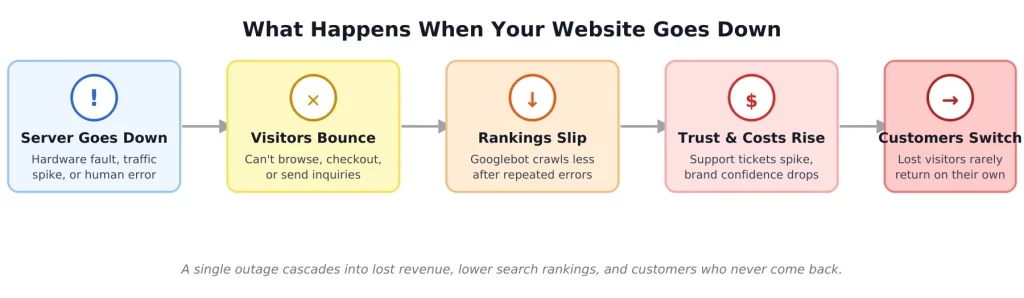
That cascading effect is why downtime is rarely “just an IT problem.” It touches sales, marketing spend, support headcount, and long-term brand trust all at once — which is exactly why hosting reliability deserves the same strategic attention as your website design or SEO strategy.
Why Do Websites Go Down? Common Causes
Most outages trace back to a short, predictable list of culprits. Understanding them is the first step toward preventing them:
- Server & hardware failures — ageing infrastructure, disk failures, or overloaded shared servers buckling under load.
- Unplanned traffic spikes — a viral post, a successful ad campaign, or a flash sale that overwhelms under-provisioned resources.
- Security incidents — DDoS attacks, malware infections, or brute-force login attempts that destabilise a server or trigger a provider-side suspension.
- Software & plugin conflicts — especially common on WordPress sites where an untested theme or plugin update breaks core functionality.
- DNS, domain, or SSL issues — an expired certificate or a missed domain renewal can take an otherwise healthy site fully offline.
- Human error — a misconfigured setting or an untested deployment pushed straight to a live server.
- Third-party service outages — payment gateways, CDNs, or external APIs failing and dragging dependent features down with them.
Almost every item on that list is preventable with disciplined hosting practices: redundant infrastructure, proactive monitoring, regular backups, and a team that tests changes before pushing them live. That discipline is the difference between a generic hosting provider and a true managed web hosting partner.
99.9% Uptime, Decoded: What the Number Actually Means
“99.9% uptime” sounds close enough to perfect that it’s easy to gloss over — but the gap between uptime tiers is larger than it looks, and chasing the next decimal point gets exponentially more expensive. Here is what each commonly advertised tier allows in actual downtime over a full year:
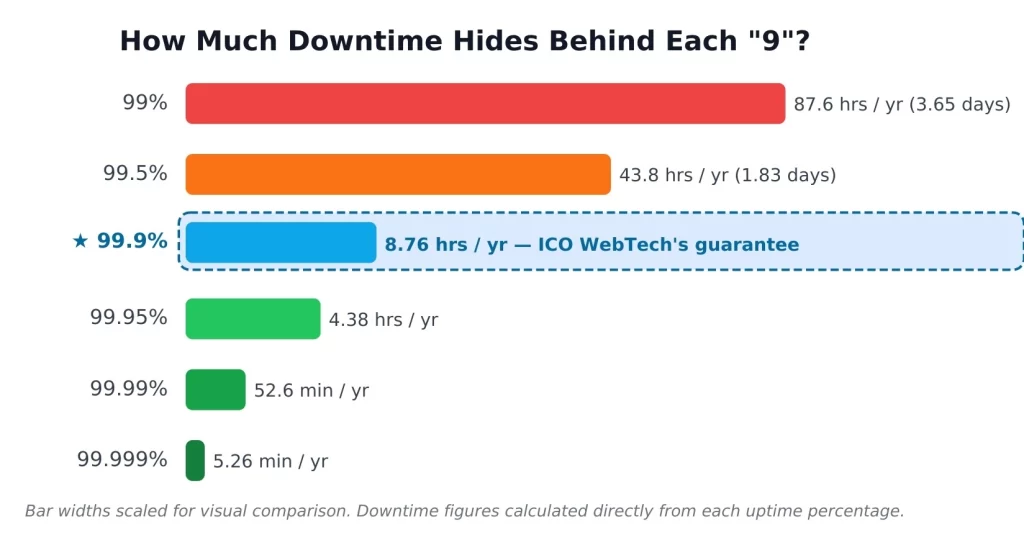
Notice how dramatically the curve flattens after 99.9%. Moving from 99% to 99.9% eliminates roughly 79 hours of potential downtime per year — a massive, business-changing improvement. Going all the way to “five nines” (99.999%) only removes another 8.7 hours, at a hosting cost reserved for global enterprises running mission-critical infrastructure across multiple data centres. For the vast majority of business websites, e-commerce stores, and lead-generation sites, 99.9% is the realistic, sustainable, well-engineered benchmark — which is exactly the figure ICO WebTech documents as its track record across all hosted client sites.
Also read: Shared Hosting vs VPS: Time to Upgrade Your Server?
How Downtime Quietly Damages Your SEO and Brand
Downtime does not just frustrate the humans who land on your site mid-outage — it is visible to Google too. When Googlebot crawls a page and receives a server error instead of content, it treats that the same way a real visitor would: as a bad experience.
Google’s John Mueller has publicly confirmed that a brief, isolated outage is unlikely to dent your rankings, Googlebot simply retries the next day.
[Source: Search Engine Journal]
But repeated server errors, or an outage stretching across several days, can lead Google to reduce how often it crawls your site — and in extended cases, to begin dropping affected pages from its index entirely.
Recovering lost rankings and re-establishing crawl frequency after that kind of event can take weeks, which is a costly, avoidable detour if your hosting had simply stayed online.
The brand-side damage compounds the SEO damage. A visitor who hits an error page during a purchase or inquiry rarely files a complaint — they simply leave, often for a competitor, and the loss shows up later as a quiet dip in retention rather than an obvious support ticket. That is precisely why uptime, site speed, and search visibility should be treated as one connected discipline rather than three separate line items.
How ICO WebTech Keeps You at 99.9% Uptime
ICO WebTech approaches uptime as an engineering commitment, not a marketing slogan. Here is what is actually behind the number:
Verified, Enterprise-Grade Hosting Infrastructure
As a verified reseller of GoDaddy, ICO WebTech hosts client websites on a genuine, secure, high-speed network — not the overloaded budget shared servers that quietly throttle performance at the worst possible times. Hosting is available across India, the USA, Australia, and Canada, and clients can choose between Windows-based and Linux-based servers depending on their technology stack. Full details live on the web hosting services page.
A Documented 99.9% Uptime Track Record
ICO WebTech maintains a publicly stated record of 99.9% uptime across every website it hosts. Even short outages put a meaningful share of potential customers at risk, which is why uptime is treated as a core deliverable rather than a background consideration.
Proactive Monitoring & Always-On Support
An in-house support team actively monitors hosted sites and is on call for emergencies — including incidents that occur on national holidays when many budget providers go dark. The faster an issue is caught, the shorter the outage, and the smaller the business impact.
Maintenance, Security & Performance, Bundled In
Hosting alone is not enough. Outages are just as often caused by outdated plugins, unpatched vulnerabilities, or bloated, slow-loading pages as they are by server hardware. ICO WebTech pairs hosting with ongoing website maintenance — security patching, regular updates, and backups — alongside dedicated website speed optimisation, so reliability and performance are managed together rather than treated as separate problems billed separately.
Professional Email Hosting, Included
Hosting plans include email hosting with industry-standard spam and virus filtering, full compatibility with Outlook, Thunderbird, and webmail clients, and IMAP support so your mailbox stays in sync across every device. A branded address such as inquiry@yourcompany.com also presents considerably more credibility to prospects than a free webmail account.
Built on a Solid Foundation From Day One
Reliability starts before launch. Sites built through ICO WebTech’s WordPress development and website design services are engineered with clean code and current best practices, reducing the odds of plugin conflicts, bloat, and technical debt that cause downtime down the line — whether the project is a fresh build, a website redesign, or an e-commerce platform handling live transactions.
The bottom line: 99.9% uptime is not one feature — it is the combined result of solid infrastructure, active monitoring, disciplined maintenance, and a support team that actually answers when something goes wrong. That is the model ICO WebTech runs for every hosted client.
Success Story
How to Choose a Hosting Partner You Can Actually Trust
Most hosting providers claim “reliable hosting” somewhere on their homepage — the language alone tells you very little. Before signing a contract, look for evidence of each of these specifics:
- A documented uptime track record the provider is willing to state in writing, not just a vague promise in the footer.
- Redundant infrastructure across data centres or regions, so a single point of failure does not take your whole site down.
- Active, ongoing monitoring rather than a “set it and forget it” server that is only checked when something breaks.
- Maintenance and security bundled in — updates, patches, and backups handled proactively, not billed as a costly emergency afterthought.
- Real human support that responds quickly during an actual incident, including outside standard business hours.
- Room to scale as your traffic grows, so a successful campaign does not become the thing that crashes your own site.
- Transparent, predictable pricing with no surprise charges for basics like email hosting or SSL certificates.
That is the standard ICO WebTech holds its own hosting plans to. You can see how the agency positions itself more broadly on the why choose us page, or browse the full client portfolio for real examples across industries.
FAQs About Website Uptime & Hosting
What does “99.9% uptime” actually mean in practice?
It means a website is expected to be accessible for all but roughly 8.76 hours across an entire year. That is a far stricter standard than it sounds — most of those allowed minutes are typically used for brief, planned maintenance rather than unplanned failures.
Can a short period of downtime really hurt my Google rankings?
A brief, one-off outage of a few hours is unlikely to cause lasting ranking damage, since Google’s crawler simply retries the next day. The risk grows meaningfully with repeated or extended outages, which can reduce crawl frequency and, in severe cases, lead to pages being temporarily removed from the index.
What is the difference between web hosting and website maintenance?
Hosting is the infrastructure that keeps your site physically online — the servers, bandwidth, and network. Website maintenance is the ongoing work that keeps it secure and functional over time: software updates, security patches, backups, and performance monitoring. ICO WebTech bundles both so neither is left as a gap.
How quickly does ICO WebTech respond to an outage?
An in-house support team monitors hosted sites and is available for emergencies — including incidents that occur on national holidays, a level of responsiveness most budget hosting providers simply do not offer.
Is 99.9% uptime sufficient for an e-commerce website?
For the large majority of e-commerce stores and lead-generation sites, yes. “Five nines” (99.999%) hosting is engineered for mission-critical, global-scale infrastructure and carries a cost most businesses do not need to justify. 99.9%, combined with proactive monitoring and fast incident response, covers the realistic risk profile of most online businesses reliably and cost-effectively.
Final Thoughts: Stop Losing Business to Downtime
Downtime is rarely dramatic in the moment — a few error pages, a handful of abandoned carts — but its real cost shows up later in dented search rankings, support backlogs, and customers who quietly never come back. The good news is that almost all of it is preventable with the right combination of infrastructure, monitoring, and maintenance working together.
That is the model ICO WebTech has built its hosting plans around: a documented 99.9% uptime track record, proactive monitoring, bundled maintenance and security, and a support team that actually answers when something goes wrong. It is the same setup that has kept Sonic Badminton Academy‘s website fast, secure, and online since its March 2026 launch.
Tired of crossing your fingers every time your site gets real traffic?
Let ICO WebTech’s hosting, monitoring & maintenance team take it off your plate.


Shared Hosting vs VPS: Time to Upgrade Your Server?
Imagine launching a gorgeous brick-and-mortar retail storefront in the heart of a bustling commercial district. You spend months perfecting the interior design, sourcing premium inventory, and hiring a highly trained sales staff. But there is a massive catch: you accidentally leased a building with a decaying foundation, a front door that randomly jams shut, and an electrical grid that cuts out entirely whenever the restaurant next door runs its industrial blenders. No matter how incredible your products are or how hard your staff works, customers will walk out the moment they encounter physical resistance.
In the digital realm, your web hosting provider is that foundational building. It is the invisible infrastructure supporting your entire online presence. Every line of code, every high-resolution product image, every secure payment gateway, and every single customer interaction relies entirely on the server hardware you choose to rent. Yet, all too often, businesses treat hosting as a minor utility expense—a tiny technical checkbox to be ticked as cheaply as possible during launch week.
This structural oversight quickly catches up to growing brands. As your digital marketing strategies take root and begin to deliver organic traffic, your site can suddenly buckle under the weight of its own success. Pages slow down to a sluggish crawl, checkout forms hang indefinitely, and visitors bounce back to Google before your homepage even finishes rendering. When a website goes down or stalls out, it isn’t just a minor technical glitch; it is an active destruction of your marketing ROI, your brand equity, and your daily corporate revenue.
If you are currently evaluating your website setup or preparing for a new digital deployment, you will inevitably find yourself standing at a classic infrastructure crossroads: Shared Hosting vs. Virtual Private Server (VPS) Hosting. Both options serve vital functions in the modern web ecosystem, but they are engineered for completely different business realities, scaling thresholds, and technical capacities. Choosing incorrectly can either drain your startup capital on unnecessary resources or bottleneck your brand’s growth potential. Let’s pull back the curtain on server architecture and explore exactly which option aligns with your commercial objectives.
Demystifying Shared Hosting: The Digital Apartment Complex
To understand Shared Hosting, look no further than a traditional, high-density apartment complex. When you sign up for a shared hosting plan, you are renting a single room inside a massive building. You share the overall framework, the central plumbing, the electrical grid, the entrance hallways, and the main lobby with hundreds of other tenants—which, in this scenario, are completely unrelated websites owned by other individuals and companies.
From a resource standpoint, all websites residing on a shared server draw from the exact same central pool of Central Processing Unit (CPU) cores, Random Access Memory (RAM), and physical Solid-State Drive (SSD) storage space. The system operating system allocates these resources dynamically as requests come in from across the globe.
The Advantages of Shared Hosting
- Unmatched Cost Efficiency: Because the overall operating, maintenance, and hardware expenses of the server are split among hundreds of distinct clients, the cost per individual user is remarkably low. You can easily host a starter website for the price of a couple of premium coffees per month. This makes it a fantastic sandbox for testing new concepts without financial risk.
- Zero Server Administration Overhead: Shared environments are fully managed by the hosting provider’s internal system engineers. You don’t need to know how to configure a Linux terminal, patch server-side security vulnerabilities, or manage Apache or Nginx web servers. The hosting company takes care of the backend maintenance, giving you a clean, user-friendly control panel (like cPanel) to manage your domain and files.
- Instant, One-Click Deployments: Most modern shared environments come tightly integrated with automated script installers. Deploying a fresh instance of WordPress, Joomla, or a standard content management system takes less than two minutes, requiring absolute zero coding proficiency.
The Disadvantages: The “Bad Neighbor” Effect
While the apartment lifestyle is highly affordable, it comes with inherent structural vulnerabilities. The most prominent risk is known in technical engineering circles as the “Bad Neighbor” effect. Because resources are not strictly isolated, if a completely unrelated website on your shared server experiences a massive, unexpected traffic surge, or runs a poorly optimized database script that creates an endless loop, it can consume 95% of the entire server’s processing power.
The consequence? Your website—which did absolutely nothing wrong—suddenly runs out of memory and crashes. Furthermore, if a neighbor’s site gets compromised by malware or flags the server’s shared IP address for spamming operations, your business emails might start getting blacklisted by global email providers, destroying your daily corporate communication pipelines.
Demystifying VPS Hosting: The Digital Condominium
Virtual Private Server (VPS) hosting represents a massive evolutionary step forward in digital infrastructure. To maintain our structural analogy, moving from shared hosting to a VPS is the exact equivalent of moving out of a crowded apartment room and purchasing your own private condominium or townhouse.
Physically, your site is still technically sharing a physical server machine with a few other tenants. However, the architectural magic lies in a specialized technology layer called a Hypervisor. The hypervisor executes advanced hardware-level virtualization, slicing the massive physical server into completely distinct, strictly isolated virtual compartments. When you buy a VPS plan that promises 4 CPU cores and 8GB of RAM, those resources are digitally locked down exclusively for your website. Even if every other tenant on the server experiences a monumental traffic surge, your resources remain completely untouched, pristine, and ready to serve your visitors instantly.
The Advantages of VPS Hosting
- Guaranteed Resource Allocation: Your baseline performance remains incredibly stable. You no longer have to worry about the resource consumption of external entities. Your site enjoys consistent Time to First Byte (TTFB) metrics, fast database lookups, and incredibly snappy page render speeds.
- Absolute Root Control and Customization: A VPS grants you full root access to the virtual server instance. You can select your exact preferred operating system flavor (Ubuntu, CentOS, Debian), install custom server-side caching systems (like Redis, Memcached, or Varnish), alter execution limits, and optimize server firewalls to match the precise operational blueprints of your application.
- Isolated Security Environment: Because your virtual environment is completely containerized, its file system is invisible to other users on the machine. If another tenant’s site on the physical rack falls victim to a catastrophic SQL injection attack or a ransomware script, the infection cannot breach the hypervisor wall to compromise your business data.
- Seamless Scalability: Scaling a VPS is incredibly clean. If your brand is preparing for a major television feature or a massive Black Friday marketing blitz, you don’t need to physically migrate your files to a new machine. With a simple click inside your cloud console, you can dynamically scale up your allocated RAM and CPU allocations on the fly to process incoming customer volume.
The Disadvantages of VPS Hosting
The principal tradeoff of a VPS centers around cost and technical complexity. A VPS commands a higher monthly financial commitment than a basic shared package. Additionally, if you select an unmanaged VPS plan, you are fully responsible for the health of the operating system. If a server update breaks a critical database dependency, or if you misconfigure an Nginx configuration file, your site will drop offline, and it is entirely up to your technical staff to log in via SSH and fix the issue manually. (Though many hosts offer “Managed VPS” plans to mitigate this, they do come at a premium).
The Technical Head-to-Head: A Five-Point Comparison
To make an informed choice for your enterprise capital, we must examine how these two hosting paradigms execute under core operational stress. Let’s evaluate their performance across five foundational performance vectors.
1. Raw Performance, Processing Power, and Speed
Website load speed directly dictates your digital survival. Google treats mobile page performance as a primary organic ranking signal, and consumers systematically abandon platforms that exhibit even minor rendering lag. In a shared framework, your page delivery speeds fluctuate constantly throughout the day depending on global server load. During peak hours, your site can feel heavy and unresponsive. A VPS delivers consistent execution speed. Because its processing cycles are dedicated solely to your database execution, your site processes modern dynamic applications, complex product filters, and interactive media modules instantly.
2. Security Defenses and Threat Isolation
A breach of customer information can trigger profound legal vulnerabilities and permanently destroy consumer trust in your brand. In shared setups, the risk of cross-contamination is always present. If an amateur user on your server uploads an unpatched, vulnerable WordPress plugin, hackers can gain unauthorized access to the shared directory layer. A VPS provides robust containerization. Your file system, data structures, and incoming traffic pathways are heavily shielded from the rest of the physical infrastructure, providing an enterprise-grade posture for brands handling sensitive client credentials or payment details.
3. Server Administration and Operational Control
If your digital roadmap only requires a basic, standard blogging platform or a simple informational landing page, the automated, plug-and-play nature of shared hosting is exceptionally convenient. You don’t want to spend your weekends updating Linux kernels. However, if your business model features custom web software, specialized APIs, or proprietary databases, the configuration limitations of shared hosting will rapidly become a restrictive bottleneck. A VPS treats you as the absolute master of your operating system, granting you the architectural freedom to build custom server environments.
4. Scaling Capability Under Traffic Surges
Imagine your marketing team successfully orchestrates a viral campaign, causing thousands of eager buyers to flood your platform simultaneously. On a shared plan, this sudden spike will trigger automated resource-limiter alarms. To protect the other tenants, the hosting provider’s automated firewalls will temporarily throttle your bandwidth or serve your visitors a frustrating “503 Service Unavailable” error page. A VPS is designed to handle elasticity. It absorbs traffic spikes gracefully, and if you approach your threshold, cloud resources can be instantly expanded with near-zero service downtime.
5. Total Cost of Ownership (TCO) and Return on Investment
While shared hosting wins the upfront cost battle, it can cost you significantly more in lost conversions if your business model demands high performance. If a cheaper hosting plan causes your e-commerce checkout page to lag, resulting in a 5% drop in completed transactions, that cheap plan is actually draining your corporate profits. A VPS requires a larger upfront line item in your monthly operational budget, but it protects your marketing investments by ensuring your user experience remains fast, reliable, and secure under commercial pressure.
The Hosting Architecture Matrix
To summarize the core differences between these two solutions, let’s look at a side-by-side technical matrix comparing their operational boundaries:
Making the Final Decision: Which Model Fits Your Business?
Now that we have stripped away the marketing jargon, it’s time to map these hosting tiers directly to your current operational reality. There is no single universal “winner” in this matchup; the right choice is a direct reflection of your business stage, internal technical capability, and growth velocity.
When Shared Hosting Is Genuinely the Smarter Move
Shared hosting shouldn’t be dismissed as a substandard product; it is a highly engineered, exceptionally convenient solution when deployed for the right use case. It is the optimal choice for:
- Early-Stage Solopreneurs and Local Small Businesses: If you are launching a local service brand (like a plumbing business, a boutique consulting firm, or a neighborhood bakery) where your site primarily serves as a digital business card, shared hosting is ideal. Your traffic patterns will be modest, predictable, and easily sustained by a shared environment.
- Personal Portfolios and Creative Showcases: If you are a graphic designer, portrait artist, or writer seeking a polished online space to showcase your historical work, shared hosting provides a frictionless, highly economical foundation.
- Concept Testing and Content Blogs: If you are launching a brand-new content publication or testing a business hypothesis, shared hosting allows you to validate your idea with absolute minimal financial exposure. You can always migrate to higher tiers once your community expands.
When VPS Hosting Becomes an Absolute Business Imperative
Conversely, under-investing in server architecture can severely bottleneck an enterprise that is ready to scale. You should immediately prioritize a VPS if your brand falls into any of the following categories:
- Active E-Commerce Platforms: If your website utilizes WooCommerce, Magento, or any dynamic shopping cart system, shared hosting is a massive gamble. Processing credit card transactions, maintaining real-time inventory counts, and serving thousands of concurrent product query variants requires high processing power. A VPS ensures your checkout funnel stays fast, protecting your transaction completion rates.
- B2B Lead Generation and High-Traffic Media Portals: If your revenue engine relies heavily on constant inbound paid traffic, inbound landing pages, or high-volume publishing schedules, a single instance of server downtime can waste thousands of dollars in active ad spend. A VPS provides the stable runtime environment needed to capture every single lead safely.
- Custom Web Applications and SaaS Startups: If you are launching a proprietary web application, a secure member portal, or a customer software dashboard, you will require unique script packages, custom server daemons, and strict data containerization. A VPS provides the foundational framework and root configuration authority required to power custom digital products.
The Strategic Takeaway: Invest in Your Digital Future
When finalizing your operating decisions, try to avoid viewing web hosting merely as a dry, technical line-item expense. Instead, view it as a critical strategic asset within your broader customer experience apparatus. Your digital infrastructure directly influences your site speed, your search engine optimization authority, your data defenses, and your ultimate consumer retention metrics.
If you are just getting started, keeping costs low with a premium shared hosting plan is a perfectly rational, highly practical strategy. But as your brand builds momentum, expands its digital footprint, and accelerates its audience acquisition pipelines, do not hesitate to upgrade to a robust Virtual Private Server. Providing your business with dedicated cloud computing muscle ensures your digital storefront remains accessible, safe, and lightning-fast for every single customer who taps on your link.
Stop letting a slow server cost you customers.
If your business is growing, your website needs room to breathe. Switch to a lightning-fast, secure Virtual Private Server today and experience guaranteed resource allocation, ironclad data protection, and seamless scaling.
