
Summary
Marketing has long relied on dashboards to interpret performance, guide decisions, and measure impact, creating a sense of clarity through structured data such as traffic sources, referral paths, and conversion metrics. At the same time, the way people discover, evaluate, and share content has evolved toward more private, selective interactions that do not always translate into visible attribution within these systems.
The scale of private sharing
A growing body of research highlights the scale of this shift.
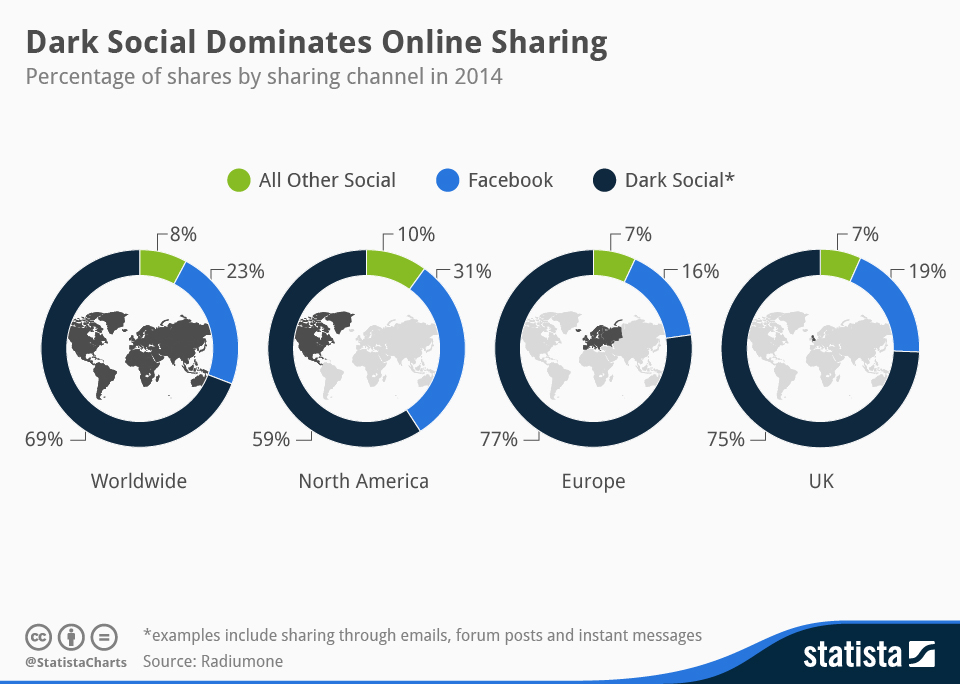
Statista reports that up to 84% of content sharing now takes place through private channels such as messaging apps and email, while other analyses show that dark social consistently represents around 60–70% of global sharing activity.
Attribution gap
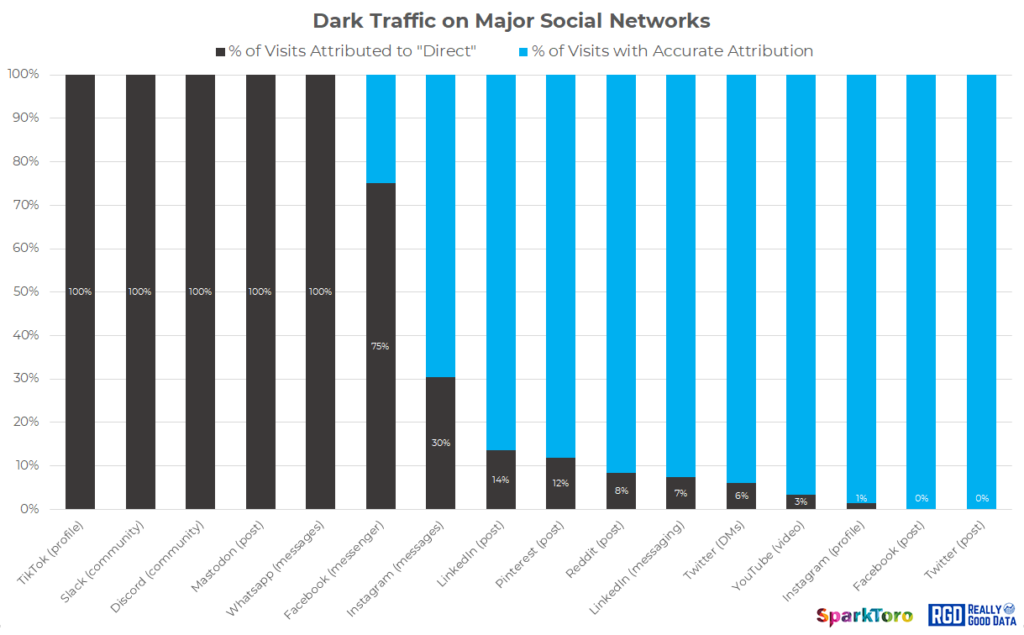
Experiments from SparkToro reveal something more unsettling: traffic from platforms like WhatsApp, Slack, and Discord is often recorded as 100% “direct,” with no referral data at all. In other words, what looks like someone intentionally navigating to your site… often isn’t.
What the data reveals about dark social
A closer look at platform behavior shows a consistent pattern: a significant portion of traffic arrives without clear attribution, even when it originates from social or messaging platforms.
Key summary points
- A large share of traffic from platforms like TikTok, Slack, Discord, Mastodon, and WhatsApp is consistently recorded as “direct” due to the absence of referral data.
- Messaging platforms such as Facebook Messenger also contribute significantly to unattributed traffic, with a majority of visits lacking clear source information.
- Partial attribution exists on platforms like Instagram DMs, LinkedIn, and Pinterest, though a noticeable percentage of referral data is still lost.
- Even platforms traditionally associated with trackable sharing—such as Reddit, LinkedIn messages, and Twitter DMs—contribute to misattributed “direct” traffic.
- In contrast, sources like YouTube, public social posts, and profile links tend to retain referral data more reliably.
- As a result, “direct traffic” in analytics often includes a substantial volume of visits originating from private sharing environments.
- This reinforces the role of dark social as a significant and ongoing factor shaping how content is distributed and discovered.
- For marketers, this highlights the importance of interpreting analytics as a directional view rather than a complete representation of performance.
Beyond what analytics can see
Within this environment, content often travels through conversations that are intentional, contextual, and grounded in trust. A link may be shared with a colleague, circulated in a WhatsApp group focused on a specific topic, or forwarded internally among stakeholders evaluating a decision. Each of these interactions carries meaning, relevance, and influence, even as they remain outside conventional tracking frameworks.
This layer of activity, commonly referred to as dark social, accounts for a significant share of how modern digital engagement works. It reflects a broader behavioral pattern in which individuals choose to share information within smaller, more relevant networks, where the value of content is shaped not only by what is said but also by who shares it and in what context.
As a result, the data available in analytics platforms provides a structured view of performance, while the full journey of how content is discovered and shared extends beyond what is immediately visible. Understanding dark social, therefore, allows marketers to align more closely with how information actually flows today—through trusted interactions, contextual sharing, and networks that operate with intention rather than visibility.
What is dark social (and what it is not)
Dark social refers to the sharing of content through private or semi-private channels where referral data is not passed to analytics platforms. As a result, visits generated through these interactions are often grouped under “direct traffic,” even though they originate from social or conversational contexts.
These channels include messaging platforms such as WhatsApp, Slack, and Facebook Messenger, as well as email, direct messages on social networks, and simple copy-paste link sharing. While each of these environments plays a different role in how people communicate, they share a common characteristic: they prioritize privacy, context, and relevance over visibility.
It is useful to clarify what dark social is not. It is not a specific platform, nor is it a new channel that can be added to a media plan. Instead, it represents a mode of distribution—one that operates alongside public channels but follows a different logic.
Where public social media is built around broadcasting and discoverability, dark social is shaped by intentional sharing within defined networks. The difference is not just technical, but behavioral. Content shared publicly is often designed to reach many; content shared privately is selected for someone.
This distinction matters. It explains why dark social is difficult to measure, yet highly influential. It also reframes how marketers think about distribution—not only in terms of reach, but in terms of relevance and trust.
Dark social is not a platform. It is a way content moves.
Why dark social exists
Dark social is not simply the result of tracking limitations. It reflects a broader shift in how people communicate, shaped by both technological changes and evolving user behavior.
On the technical side, much of today’s digital interaction happens within environments that are designed to protect user privacy. Secure browsing protocols, mobile applications, and closed messaging platforms often limit or remove referral data by default. As content moves through these ecosystems, attribution becomes secondary to user experience, resulting in traffic that arrives without a clear source.
At the same time, user behavior has moved toward more intentional and context-driven sharing. Messaging platforms, email, and private groups offer a level of relevance that public channels cannot always provide. Instead of broadcasting content widely, individuals choose to share selectively—based on who will find it useful, timely, or meaningful.
This shift is also influenced by the nature of modern communication. Conversations increasingly happen in smaller, focused networks where information is exchanged with purpose. A shared link often carries an implicit recommendation, shaped by trust and familiarity rather than visibility.
Together, these factors create an environment where content flows efficiently but quietly. Dark social emerges not as an exception but as a natural outcome of a digital landscape that prioritizes privacy, relevance, and trusted interactions.
Dark social changes how marketing performance is understood.
When a significant share of content distribution happens outside measurable channels, the picture presented by analytics platforms becomes directional rather than complete.
One of the most immediate implications is attribution. Traffic categorized as “direct” often includes visits that originate from private sharing environments, making it difficult to accurately assess which channels or pieces of content are driving engagement. As a result, high-performing assets may appear less impactful than they actually are.
This also influences how return on investment is evaluated. Channels such as content marketing, newsletters, and social media may contribute more to outcomes than attribution models suggest, particularly when their influence extends into private conversations where decisions take shape.
In many cases, the role of content is not limited to initial discovery. It becomes part of internal discussions, shared among teams, and revisited during evaluation stages. These interactions contribute to decision-making in ways that remain largely invisible, yet materially significant.
This requires a shift in perspective. Performance cannot be assessed solely based on what is easily measurable. Instead, it involves recognizing patterns, understanding behavior, and interpreting signals that indicate how content moves and influences outcomes beyond tracked channels.
Dark social, therefore, expands the scope of marketing from measurable reach to meaningful impact, encouraging a more holistic view of how value is created and communicated.
Dark Social vs Dark Funnel
Dark social and the dark funnel are closely related concepts, yet they describe different parts of the same underlying reality. Understanding the distinction helps clarify how content is distributed and how decisions are ultimately made.
Dark social refers to where content is shared. It includes private and semi-private channels such as messaging platforms, email, and direct communication, where links are exchanged without passing referral data. It is primarily a distribution layer, shaping how information moves between individuals and groups.
The dark funnel, by contrast, refers to how decisions are formed outside visible tracking systems. It encompasses the research, discussions, comparisons, and internal evaluations that take place before a measurable action occurs. These activities are not tied to a single channel; instead, they represent the broader decision-making process that remains largely invisible to marketers.
The connection between the two is direct. Dark social feeds the dark funnel by introducing content into private environments where it can be discussed, validated, and contextualized. A shared article or resource becomes part of a larger conversation, influencing how options are understood and evaluated over time.
This relationship explains why traditional funnel models often appear incomplete. While measurable touchpoints—such as clicks, visits, and conversions—provide useful signals, they capture only a portion of the journey. The interactions that shape intent and preference frequently occur in parallel, within spaces that are not reflected in analytics data.
The implication is clear. An effective strategy requires not only optimizing visible channels, but also creating content that can travel through and contribute to these less visible layers. Recognizing the role of both dark social and the dark funnel allows for a more accurate understanding of how influence is built and decisions are made.
| Aspect | Dark Social | Dark Funnel |
|---|---|---|
| Definition | Private sharing of content through channels that do not pass referral data | Invisible decision-making process that occurs before measurable actions |
| Primary Role | Distribution layer | Decision-making layer |
| Where It Happens | Messaging apps, email, DMs, copy-paste sharing | Internal discussions, research, comparisons, stakeholder conversations |
| Visibility in Analytics | Appears as “direct” or unattributed traffic | Not visible at all until a measurable action occurs |
| Function | Moves content between individuals or groups | Shapes opinions, preferences, and final decisions |
| Trigger | Content is shared privately | Content is evaluated and discussed |
| Relationship | Feeds the dark funnel by introducing content | Uses that content to inform and influence decisions |
| Example | A blog link shared in a WhatsApp group | Team discussing that blog before shortlisting a vendor |
How to identify dark social traffic
Dark social cannot be tracked directly in the same way as traditional channels, but it can be identified through patterns and signals within analytics data. The goal is not exact measurement, but informed interpretation.
One of the most common indicators is the presence of “direct traffic” to pages that are unlikely to be accessed through manual navigation. When users land on deep pages—such as blog posts, reports, or resource pages—without a clear referral source, it often suggests that the link was shared through a private channel.
Another signal is the appearance of traffic spikes without corresponding activity in known channels. If a piece of content experiences increased visits without support from campaigns, social media, or search trends, it may indicate circulation within private networks.
Device and usage patterns can also provide context. Dark social activity is frequently associated with mobile traffic, where messaging apps and in-app browsers are commonly used for sharing and consuming content.
While these indicators do not provide precise attribution, they help build a directional understanding of how content is being distributed. Over time, consistent patterns across multiple pieces of content can reveal which formats, topics, or assets are more likely to travel through private channels.
This approach shifts the focus from exact tracking to pattern recognition. By combining analytics data with an understanding of user behavior, it becomes possible to account for dark social as an active and meaningful component of overall performance.
How to measure dark social (practically)
Measuring dark social requires a different approach from traditional channel tracking. Since a large portion of activity occurs without referral data, the objective is not precise attribution, but a more informed and structured approximation of how content is shared.
One of the most effective methods is the use of structured links with tracking parameters. By adding UTM tags to links distributed through controlled channels—such as newsletters, campaigns, or owned social posts—marketers can separate known sources from traffic that appears as direct, improving overall visibility.
Another practical approach involves enabling intentional sharing mechanisms. Features such as “share via WhatsApp” or “email this page” buttons can guide users toward trackable interactions, creating clearer signals around how content is being distributed.
Copy-link tracking can also provide useful insights. Monitoring how often users copy a URL, when combined with traffic patterns, helps indicate whether content is likely being shared privately, even if the destination of that sharing remains unknown.
In addition to behavioral data, self-reported attribution offers valuable context. Asking users how they discovered a piece of content—through forms, surveys, or conversations—can reveal sources that are not captured in analytics platforms.
Finally, analyzing performance at a content level rather than a channel level allows for better interpretation. Pages that consistently receive unexplained direct traffic, particularly when combined with engagement signals, often indicate strong circulation within private networks.
Taken together, these methods do not eliminate uncertainty, but they reduce blind spots. They enable marketers to account for dark social as a meaningful component of distribution, while maintaining a realistic understanding of what can and cannot be measured.
What content performs in dark social
Not all content moves effectively through private channels. Dark social favors content that is relevant within a specific context, easy to share, and valuable to a defined audience. The decision to share is often intentional, shaped by whether the content adds clarity, solves a problem, or contributes meaningfully to a conversation.
Insight-driven content tends to perform well because it offers a perspective that can be discussed or validated within a group. When a piece of content introduces a clear idea or reframes a familiar problem, it becomes more likely to be shared as part of an ongoing exchange.
Practical and utility-focused formats also travel effectively. Guides, frameworks, and concise explanations are easy to forward and apply, making them suitable for professional environments where information is often shared with a specific purpose.
Relevance plays an equally important role. Content that speaks directly to a niche audience or a defined use case is more likely to be shared within smaller networks where that context is understood. In these environments, specificity increases shareability.
Structure and clarity further influence distribution. Content that is easy to scan, well-organized, and clearly articulated can be quickly evaluated and passed along without additional explanation, supporting its movement across conversations.
Underlying these patterns is a consistent principle: people share content that reflects well on them and benefits others. When content aligns with this dynamic, it becomes more likely to move through private channels, contributing to influence that extends beyond measurable engagement.
Dark social and the future of search (GEO & AEO)
As search evolves, the signals that determine visibility are expanding beyond traditional metrics such as keywords, backlinks, and on-page optimization. Increasingly, content is evaluated based on its ability to provide clear, relevant, and contextually useful information—qualities that also influence how it is shared within private networks.
Dark social plays a subtle but important role in this shift. Content that circulates through private channels is often selected because it answers a specific question, offers clarity, or contributes to a meaningful discussion. These characteristics align closely with how generative engines and answer-driven systems identify and surface useful information.
In the context of Generative Engine Optimization (GEO), content that demonstrates depth, structure, and relevance is more likely to be referenced, summarized, or incorporated into AI-generated responses. While the pathways between private sharing and machine visibility are not directly observable, both are shaped by similar signals of quality and usefulness.
Answer Engine Optimization (AEO) further reinforces this connection. Content that is concise, well-structured, and designed to address specific queries can move effectively within private conversations and also align with how answers are extracted and presented across platforms.
This convergence highlights a broader pattern. Content that performs well in dark social environments—because it is trusted, relevant, and easy to understand—often exhibits the same characteristics that improve its visibility in emerging search ecosystems.
This creates an opportunity to align content strategy across both human and machine discovery. By focusing on clarity, structure, and contextual value, it becomes possible to create content that travels effectively within private networks while also positioning itself for broader visibility in the evolving landscape of search.
A shift in how marketing is understood
Dark social brings into focus a broader change in how digital marketing operates. While analytics platforms continue to provide valuable structure, they represent only part of how content is distributed and how decisions are influenced. A significant portion of this activity unfolds through interactions that prioritize relevance, context, and trust over visibility.
This does not reduce the importance of measurable channels; instead, it expands the perspective through which performance is evaluated. Metrics remain essential, but they are complemented by an understanding of how content moves beyond tracked environments and contributes to conversations that shape outcomes.
As content becomes part of private exchanges—shared among colleagues, discussed within teams, and revisited during decision-making—it takes on a role that extends beyond initial engagement. Its value is reflected not only in clicks or sessions, but in how it supports understanding, alignment, and action.
This shift encourages a more integrated marketing approach. Rather than focusing solely on visibility or attribution, it emphasizes the importance of creating content that is clear, relevant, and meaningful within real-world contexts. When content aligns with how people naturally share and communicate, it becomes more effective across both visible and less visible channels.
Understanding dark social, therefore, is not about uncovering every hidden interaction. It is about recognizing the full landscape in which content operates and aligning strategy with how information actually flows—through networks built on trust, shaped by context, and driven by purposeful sharing.
Marketing is no longer defined only by what can be measured, but by what can be meaningfully shared.



Related items

A practical, step-by-step walkthrough of the process we actually run with clients, includi


The Quick Take: Most B2B companies aren’t struggling to generate leads — they’re strugglin


You can have the best-looking website, the smoothest checkout, and a product worth buying