
Have you ever wondered how ChatGPT decides who to recommend?
When someone asks it to “list the top 10 ad agencies in India” or find the “leading sports shoes supplier in Delhi,” how does it decide who makes the cut?
Does it just make things up? Or is there a specific formula it follows?
If you think this doesn’t matter to your business, the data says otherwise.
According to a study by Adobe, 77% of people now use ChatGPT as a search engine.
Even more interesting—24% go to ChatGPT first, before they even touch Google. And over 36% say they’ve discovered a new product or brand directly through AI-generated answers.
This is the discovery layer of the internet.
If your business isn’t showing up here, you’re invisible to a growing share of your audience.
To understand how ChatGPT actually recommends companies, we didn’t rely on generic explanations. Instead, our team at ICO WebTech put it to the test.
We analyzed 100 real-world prompts that people use when searching for businesses, suppliers, and solutions.
We looked for patterns. And what we found will change the way you think about SEO.
We’ve seen this shift firsthand.
At ICO WebTech, we work with a global B2B supplier management company, where we handle content optimization and digital visibility.
Over the past few months, something interesting started happening.
A growing number of inbound leads weren’t coming from traditional search.
They were coming from AI platforms.
What stood out even more was the quality of these leads.
Prospects reached out already knowing what the company does, who it serves, and how it compares to competitors.
In many cases, they had already shortlisted the company before even visiting the website.
Because they had asked AI tools questions like:
- “Best supplier management solutions for enterprises”
- “Top vendor management platforms”
- “Tools for supplier performance management”
And the company showed up in those answers. This is the real shift.
Users are no longer discovering companies first. They are getting recommendations first—and then validating them.
In other words, AI is becoming the first touchpoint, not Google.
Once a brand is recommended, users may still search for it, visit the website, and evaluate credibility.
But the direction of the decision has already been shaped.
If your brand is not being recommended by AI, you are not even entering the consideration set. And that is a much bigger problem than ranking lower on Google.
Analysis of ChatGPT’s Response
When we asked:
“What B2B website design company would you recommend in India?”
ChatGPT didn’t just return a random list.
It generated a structured response where each company was positioned differently, mapped to a specific strength, and tied to a particular use case.
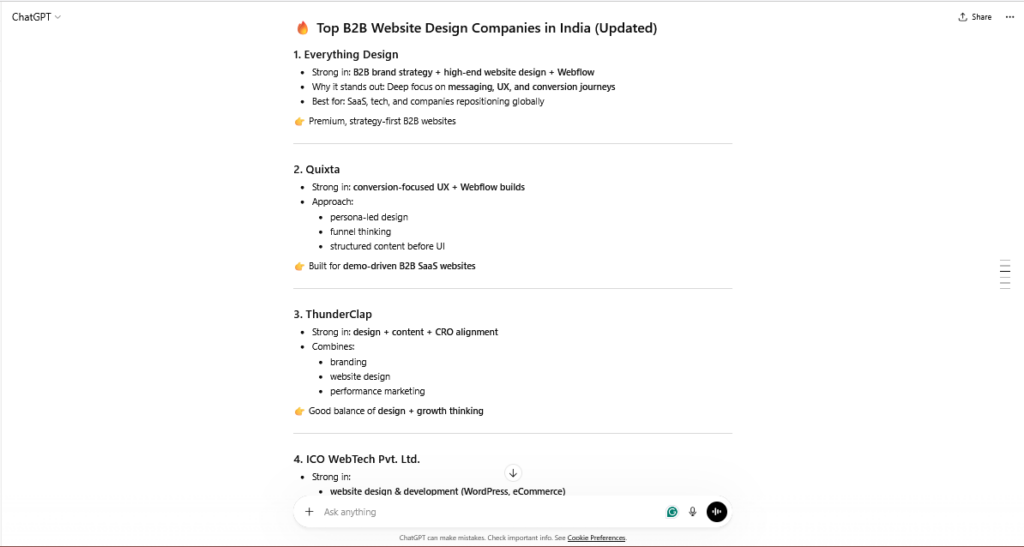
At first glance, this feels intelligent. Even strategic. But when you step back, a few clear patterns emerge.
It didn’t rank; it segmented.
Instead of identifying a clear “best” company, ChatGPT grouped agencies into categories.
Some were positioned as strategy-first, others as execution-focused, and some as enterprise-scale providers. Each company was given a role rather than a rank.
This matters.
Because when ChatGPT lacks high confidence, it avoids making definitive choices. Instead, it organizes options in a way that feels useful.
ChatGPT doesn’t always rank—it restructures the problem.
If you look closely at how each company is described, the language isn’t random.
Phrases like “conversion-focused UX,” “enterprise-grade builds,” or “end-to-end execution” reflect how these brands are already talked about across the internet.
ChatGPT didn’t create this positioning.
It mirrored it. It doesn’t define your brand—it reflects how your brand is already defined online.
When ICO WebTech appeared in the response, it was associated with end-to-end execution, SEO integration, cost-effective delivery, and high project volume.
That’s not accidental.
It shows that ChatGPT is picking up on repeated signals tied to the brand across different sources.
Not internal messaging, awards, and claims. But consistent external associations. Inclusion isn’t just about capability—it’s about consistency of perception.
It mixed fundamentally different types of companies
One of the most revealing parts of the response was the mix itself.
The list included design-focused agencies, full-service digital partners, and enterprise-scale companies.
These aren’t directly comparable. Yet they were presented together as viable options.
This highlights a key limitation.
ChatGPT is not strictly filtering for category precision. It prioritizes relevance and visibility over exact fit. If your brand is visible enough, you can appear even in loosely matched categories.
The final section of the response, where ChatGPT simplifies the decision, feels especially convincing.
But it’s not based on verified comparisons or real evaluation frameworks.
It’s constructed. A clean, logical summary built from patterns, not structured validation. ChatGPT doesn’t validate decisions—it makes them easier to understand.
When you step back, the pattern becomes clear.
ChatGPT is not evaluating companies the way a human buyer would.
It is reconstructing how the internet collectively talks about them.
It aggregates, simplifies, and reframes—but it does not independently verify.
If your brand isn’t consistently mentioned, clearly positioned, or present across third-party platforms, ChatGPT has nothing reliable to work with.
And if it can’t reconstruct your presence, it won’t recommend you.
ChatGPT doesn’t choose the best companies—it chooses the most recognizable patterns about them.
What happened when we asked specific questions?
After the initial response, we pushed further. We didn’t stop at a generic question. We refined the intent to see how the AI would adapt.
Here is what we asked next:
“I want a B2B website design company that also helps with SEO and drives pipeline.”
The response didn’t just change. It transformed. ChatGPT stopped behaving like a search engine and started behaving like a high-priced consultant.
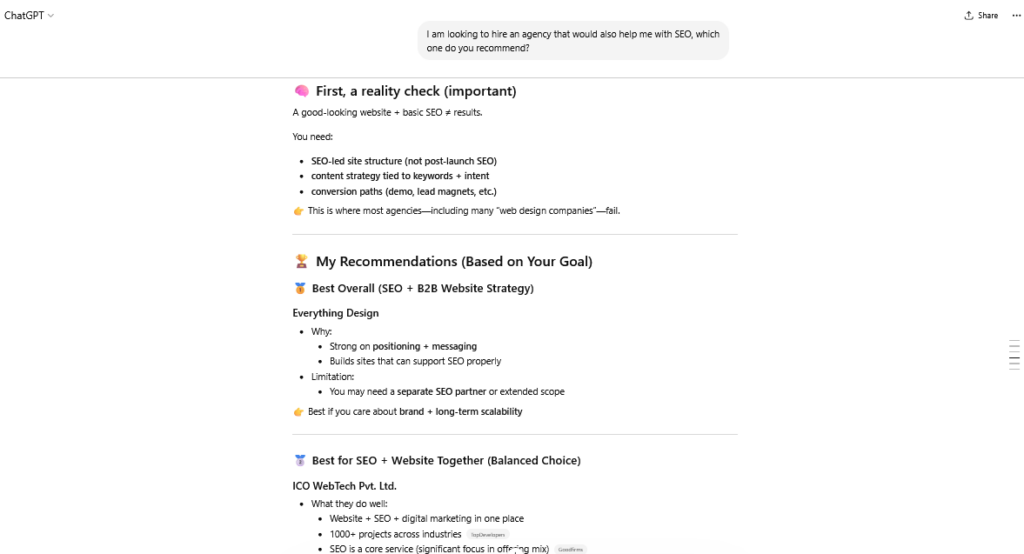
It opened with a strong, punchy hook: A good-looking website + basic SEO ≠ results.
Then, it laid out what actually matters—SEO-led structure, content strategy, and conversion paths. It categorized agencies based on specific strengths and narrowed it down to final recommendations. On the surface, this feels incredibly reliable. But when you look closer, the same patterns emerge.
In the earlier response, ChatGPT gave us a directory. Here, it gave us direction. It didn’t just say “these are the options.” It laid out a playbook for how to think about the decision itself.
As intent becomes clearer, ChatGPT becomes significantly more confident and prescriptive. It stops answering questions and starts giving advice.
Compared to the first response, company positioning became way more specific. For example, ICO WebTech was no longer just a general option. It was framed as a practical, execution-focused partner for businesses that want website and SEO handled together.
This shift didn’t come from new data. It came from better alignment between the query and existing brand associations. ChatGPT adapts positioning based on intent; it doesn’t change the data, it changes how it uses it.
The comparison felt structured—but wasn’t
The response included a comparison table that looked highly authoritative. It had clear categories, clean scoring, and made decision-making feel easy.
But it wasn’t based on a real audit or measurable benchmarks. It was constructed using general web perception and existing content. ChatGPT creates the illusion of structured evaluation using unstructured data.
What this means for your brand
To consistently win in these specific, high-intent searches, showing up is no longer enough. Your brand needs to optimize for the AI’s “advisor” mode by focusing on three core areas:
Outcome-based association: You must be clearly linked to specific business results like “lead generation” or “B2B growth” across the web, not just keywords.
Visible proof signals: ChatGPT pulls in ratings, project counts, and case references to build credibility. If these aren’t highly visible on third-party sites, the AI cannot use them to back up its advice.
Narrative alignment: Since the AI builds a story using available patterns, the more consistent your digital PR is, the more reliably the AI can slot you into its arguments.
If your expertise isn’t visible, structured, and repeated across the web, AI systems simply have nothing to work with.
This interaction reveals something deeper. ChatGPT doesn’t just reflect information; it actively shapes decisions. It frames the problem, defines what matters, and guides the outcome based entirely on the digital consensus it finds.
Ultimately, if visibility gets you included in the chat, positioning is what determines whether you actually get recommended.
What happens when ChatGPT explains its reasoning?
We didn’t stop at recommendations. We pushed further and asked ChatGPT to explain how it arrived at those suggestions.
Instead of sources, it gave a structured framework. It talked about goals, capabilities, positioning, trade-offs, and even validation criteria.
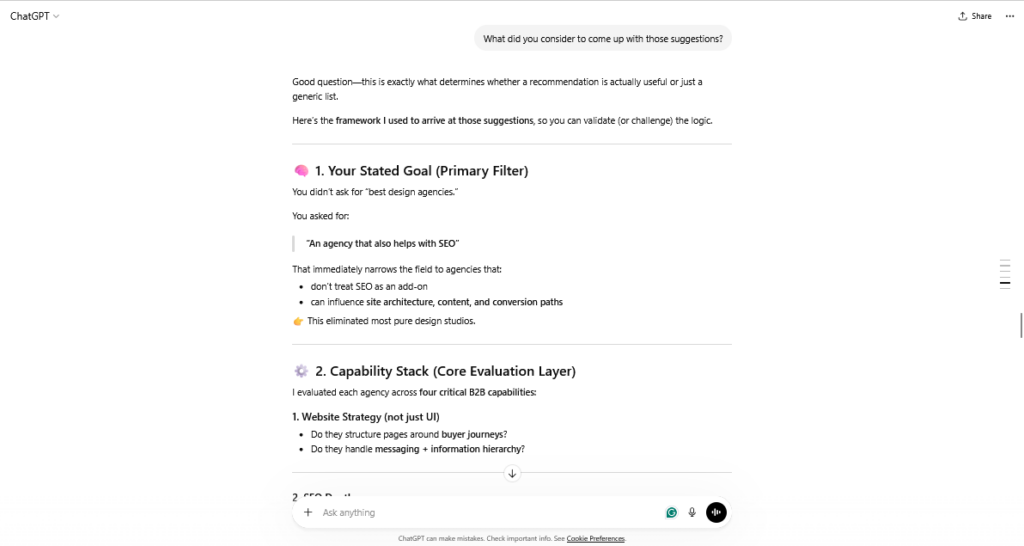
At first glance, it felt like a consultant walking us through a decision. But when we analyzed it closely, something important emerged.
ChatGPT introduced concepts like SEO depth, conversion thinking, B2B readiness, and integration capability.
All of these are valid ways to evaluate an agency. But there is no evidence that it actually measured companies against these criteria in a structured way.
It didn’t audit websites, compare standardized data, or validate performance. It constructed a logical explanation after generating the answer. ChatGPT doesn’t follow a strict evaluation model—it explains decisions using one.
The framework sounds convincing because it is built on widely accepted best practices.
For example, the idea that SEO should influence site architecture or that B2B requires structured messaging is correct.
But these are general truths. They are not proof that each company was evaluated using those standards. ChatGPT uses familiar logic to make answers feel reliable—even when they are not deeply validated.
Positioning is still driven by perception
Even within the framework, each company was described in a very specific way.
Some were positioned as execution-heavy, others as strategy-first, and others as SEO-led.
This wasn’t newly derived insight.
It was consistent with how those brands are already talked about across the web. Even in “analysis mode,” ChatGPT relies on existing narratives—not fresh evaluation.
When we asked how these agencies were validated, ChatGPT pointed to reviews, ratings, case studies, project counts, and client logos.
This adds a layer of credibility. But none of it is deeply verified. It simply pulls what is publicly available.
ChatGPT doesn’t verify credibility—it assembles it from visible signals.
Metrics like “60% increase in engagement” or “30% increase in demo requests” appeared in the explanation.
These numbers feel persuasive. But they are not standardized or independently validated.
They exist because they are published somewhere online. In AI-driven responses, documented numbers often matter more than verified accuracy.
ChatGPT also explained what it “doesn’t trust,” such as agencies with no reviews or no measurable results.
This feels like common sense. But it is based on general heuristics, not actual filtering systems. ChatGPT applies human-like judgment patterns—not rigorous validation systems.
When you put all of this together, a deeper pattern emerges.
ChatGPT doesn’t just generate answers. It generates confidence.
It does this by structuring information, using familiar frameworks, and layering in visible proof—even when that proof is incomplete.
What this means for businesses
To consistently show up and be recommended, three things now matter.
Your brand needs to be visible, clearly positioned, and supported by documented proof across the web.
Because if your expertise isn’t visible, structured, and repeated, AI systems have nothing to work with. If it’s not documented, it doesn’t exist in AI search.
Final insight
ChatGPT doesn’t just give answers—it builds a story that makes the answer feel right.
So what should companies do to get recommended by ChatGPT?
By now, the pattern is clear. ChatGPT is not evaluating your business the way a human would.
It is relying on what it can see, recognize, and connect across the internet.
That means if you want to show up in AI-driven recommendations, you need to optimize for a different kind of visibility.
Not just rankings.
Recognition.
Be consistently associated with your category
It’s not enough to define what you do on your website.
Your brand needs to be repeatedly linked to specific terms across the web.
If you want to be recommended for categories like “B2B website design” or “supplier management software,” those associations need to exist beyond your own platform.
Across blogs, directories, listicles, and third-party mentions. If your brand is not consistently associated with a category, ChatGPT cannot confidently place you in it.
Build visibility beyond your own website
Traditional SEO focuses heavily on your website.
AI discovery goes wider.
ChatGPT pulls from a distributed layer of content—articles, reviews, comparisons, and mentions across the internet.
This means your presence needs to extend beyond owned media.
You need to appear where conversations are already happening. The more surfaces your brand appears on, the stronger your chances of being recognized.
Strengthen third-party validation
Reviews, ratings, and case studies play a critical role.
Not just because they build trust with users, but because they act as signals for AI systems.
Platforms like review sites, directories, and industry listings become part of how your credibility is constructed.
And in many cases, they influence whether you are included at all. If your proof is not visible, it does not contribute to your discoverability.
Align content with intent, not just keywords
One of the biggest shifts we observed is how strongly ChatGPT responds to intent.
Generic content rarely surfaces in meaningful recommendations.
But content aligned with real queries—like “best tools,” “top companies,” or “solutions for a specific use case”—appears far more frequently.
This is where traditional SEO and AI visibility intersect.
You still need keywords.
But more importantly, you need to match how people actually ask questions. In AI search, relevance is defined by intent—not just keywords.
Create structured, referenceable content
ChatGPT favors content that is easy to interpret and reuse.
This includes clear positioning, comparison-style content, use-case pages, and well-structured explanations.
If your content is vague, overly branded, or difficult to interpret, it becomes harder for AI to extract and reuse. If your content cannot be easily understood, it cannot be easily recommended.
Think beyond SEO—this is a visibility ecosystem
This is not just about ranking higher on Google.
It’s about shaping how your brand exists across the internet.
Because ChatGPT is not pulling from one source.
It is reconstructing a view based on multiple signals.
The stronger and more consistent those signals are, the more likely you are to appear. AI visibility is not a channel—it’s an ecosystem.
The shift: from SEO to GEO
This is where a new approach begins to take shape.
Traditional SEO focuses on ranking pages.
What we’re seeing now is different.
It’s about optimizing how your brand is understood, referenced, and surfaced by AI systems.
This is what we call Generative Engine Optimization (GEO).
It’s not a replacement for SEO. It’s an evolution of it.
One that focuses on visibility across the entire digital ecosystem—not just search engines.
Final thought
The companies that win in this new landscape are not just the ones that build great products or services.
They are the ones that are consistently visible, clearly positioned, and widely referenced.
Because in AI-driven discovery:
If your brand is not part of the data, it is not part of the decision.
So the real question is:
If someone asked ChatGPT about your category today, would your brand be part of the answer?



Related items

Baymard Institute’s 2026 benchmark found that 52% of desktop sites and 62% of mobile sites


Depending on which 2026 survey you read, somewhere between 34% and 77% of US shoppers have

Websites were built around a human operating the interface. A visitor reads the page, comp
