
Every digital marketer is asking the same question right now: if I rank #1 on Google, does that mean ChatGPT will recommend my brand? The answer — backed by multiple large-scale studies — is nuanced, surprising, and strategically important for every business investing in online visibility.
In this deep-dive, we break down what the data actually says about the relationship (or lack thereof) between Google rankings and ChatGPT citations, what factors ChatGPT uses instead, and what it means for your digital marketing strategy going into the second half of 2026.
Table of Contents
- The Scale Gap: Google vs ChatGPT in Numbers
- What the Studies Actually Found: Correlation Data
- How Google and ChatGPT Work Differently
- What Signals Does ChatGPT Actually Use?
- Where Google Rankings DO Help
- The Rise of GEO: Generative Engine Optimization
- How ICO WebTech Can Help You Win Both
- Conclusion
1. The Scale Gap: Google vs ChatGPT in Numbers
Before diving into correlation, it helps to understand where both platforms stand in terms of reach. The difference is enormous — but ChatGPT’s growth curve is equally striking.
Google’s global search market share (2025)
Source: Datos / SparkToro, March 2025
Google searches processed per day
Source: Datos / SparkToro, March 2025
ChatGPT monthly visits (August 2025)
Source: Similarweb, 2025
ChatGPT year-over-year growth (late 2024)
Source: Similarweb, 2024
Sources: Advanced Web Ranking · OneLittleWeb 24-Month Study
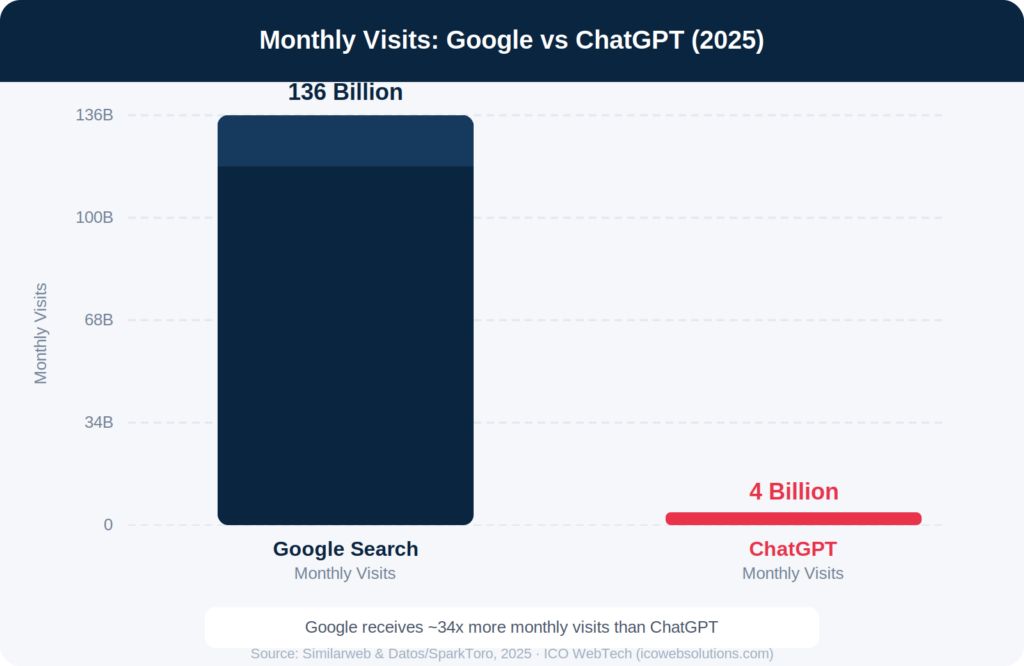
Despite ChatGPT’s explosive growth, Google remains overwhelmingly dominant. Yet the important insight is that 95% of ChatGPT users still also use Google — meaning both platforms are complementary, not competing, in how your audience discovers information.
“ChatGPT functions as a complement rather than a substitute for Google — but being invisible in either one is a strategic blind spot your competitors will exploit.”
— Advanced Web Ranking, 2025
2. What the Studies Actually Found: The Correlation Data
Multiple independent research organisations have now studied whether Google rankings predict ChatGPT citations. The results are surprising — and game-changing for SEO strategy.
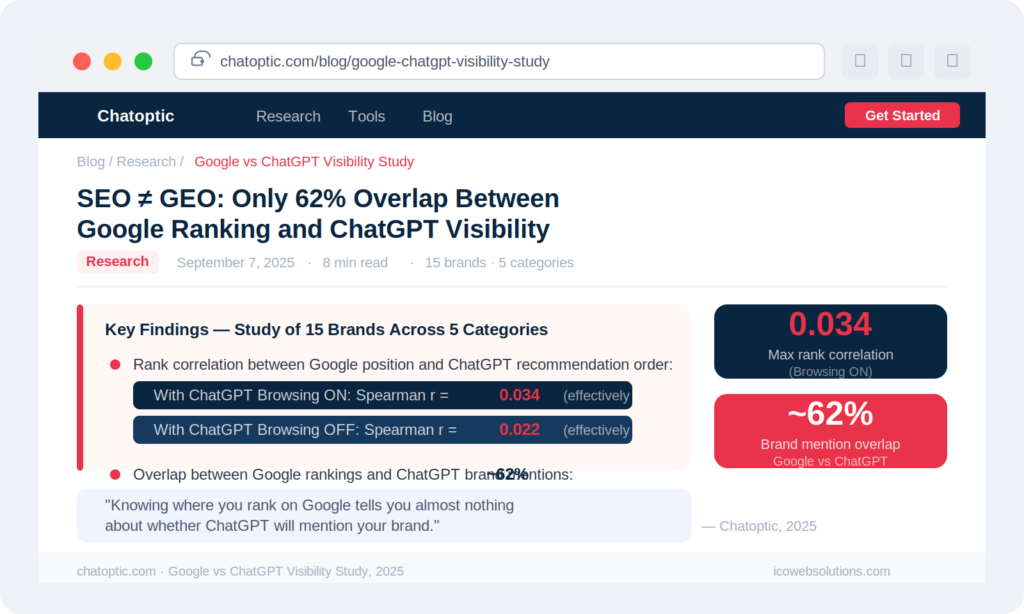
Key Finding from Chatoptic’s 2025 Study (15 brands, 5 categories):
Rank correlation between Google position and ChatGPT recommendation order:
- With ChatGPT Browsing ON: Spearman r = 0.034
- With ChatGPT Browsing OFF: Spearman r = 0.022
- Overlap between Google rankings and ChatGPT mentions: ~62%
In statistical terms, a correlation of ~0.03 is essentially zero — knowing your Google rank tells you almost nothing about your ChatGPT visibility.
Source: Chatoptic.com — SEO ≠ GEO Study, 2025
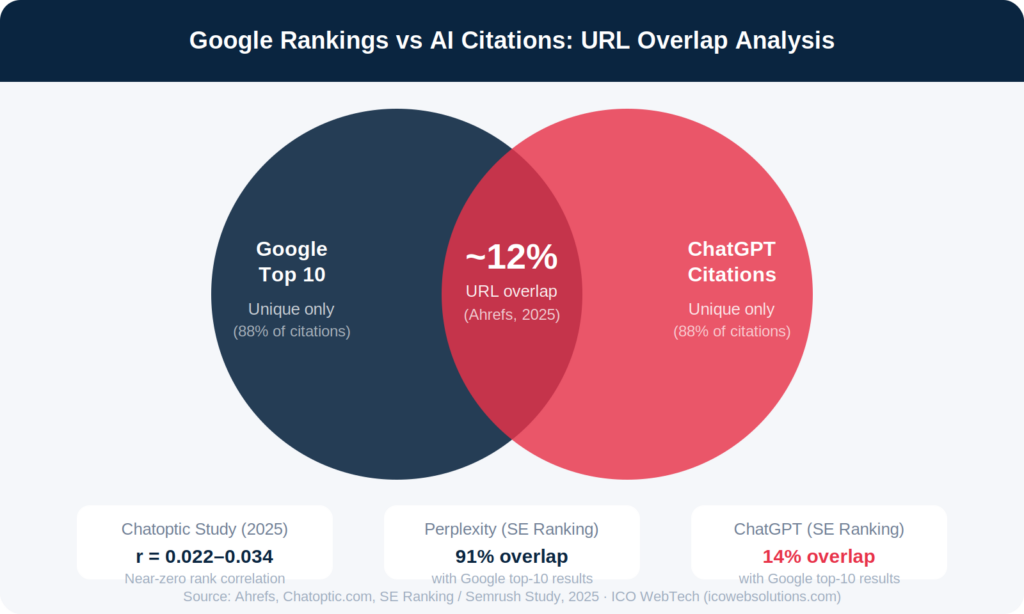
Note: Perplexity overlaps with Google top-10 rankings 91% of the time vs. ChatGPT at ~12–14%
Source: Ahrefs, SE Ranking / Semrush Study, 2025
Key Research Findings at a Glance
| Study | Key Finding | Source |
|---|---|---|
| Ahrefs Analysis (2025) | Only 12% of links cited by AI assistants (ChatGPT, Gemini, Copilot, Perplexity) appear in Google’s top 10 for the same query | Ahrefs via Beamtrace |
| Chatoptic Study (2025) | Rank correlation between Google position & ChatGPT order: r = 0.022–0.034 (effectively zero) | Chatoptic.com |
| BrightEdge Research (Oct 2025) | 54.5% of AI Overview citations match top organic URLs (up from 32% in 2024) — Google’s own AI leans on its index | PragoMedia / BrightEdge |
| SE Ranking / Semrush (2025) | Perplexity cites Google top-10 results 91% of the time; ChatGPT only 14% | PragoMedia |
| SE Ranking (2025) | Sites with 32,000+ referring domains are 3.5x more likely to be cited by ChatGPT | Yotpo / SE Ranking |
⚡ ICO WebTech Insight
The data is clear: ranking #1 on Google does not guarantee visibility in ChatGPT. But completely separate strategy isn’t the answer either — the two platforms share foundational trust signals. The winning approach is an integrated SEO + GEO strategy.
3. How Google and ChatGPT Work Differently
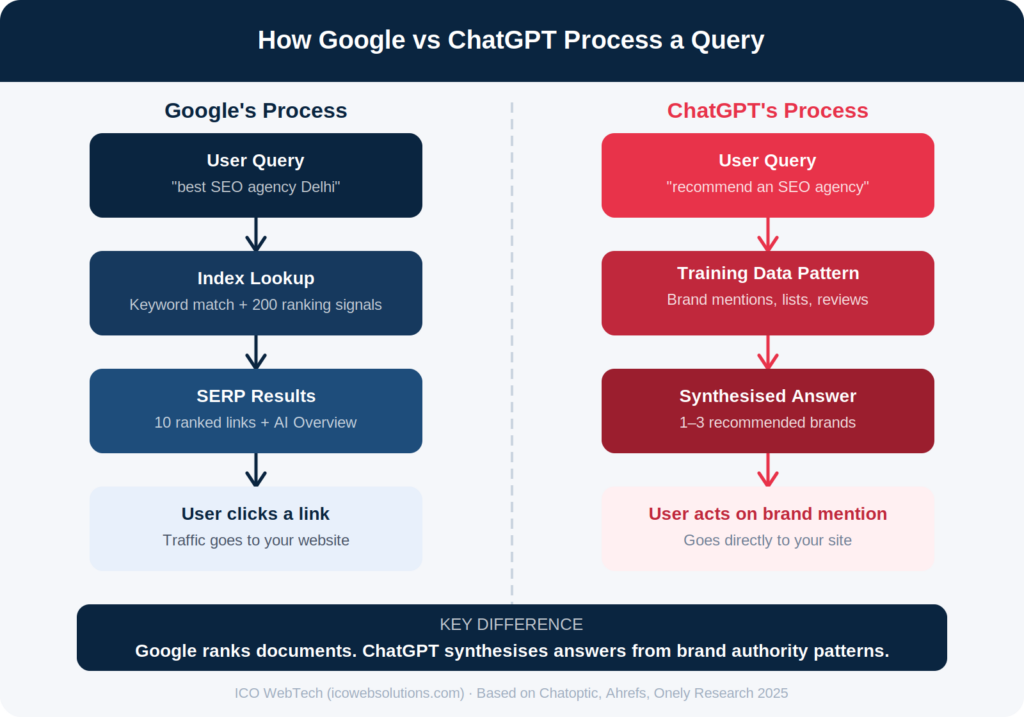
The root cause of the divergence is architectural. These two systems have fundamentally different goals and processes.
| Aspect | Google Search | ChatGPT |
|---|---|---|
| Core Task | Match your query to existing web documents and rank them by relevance | Generate a synthesised, conversational answer by predicting the most likely response |
| Primary Signal | 200+ ranking factors: backlinks, keywords, page speed, E-E-A-T | Brand authority patterns in training data, authoritative list mentions, and third-party citations |
| Output | A ranked list of 10 blue links (plus AI Overviews) | One synthesised answer mentioning a smaller “aristocracy” of sources |
| Freshness | Near real-time index crawling | Training data cutoff + optional Bing/web search plugin (when browsing is ON) |
| Citation Logic | Keyword + authority match for each document | Pattern recognition: brands consistently mentioned by trusted sources in training data |
| Risk Aversion | Long-tail content can still rank with moderate authority | Strongly prefers high-authority domains; “trust cliff” around 32,000+ referring domains |
How Each System Processes a Query
4. What Signals Does ChatGPT Actually Use?
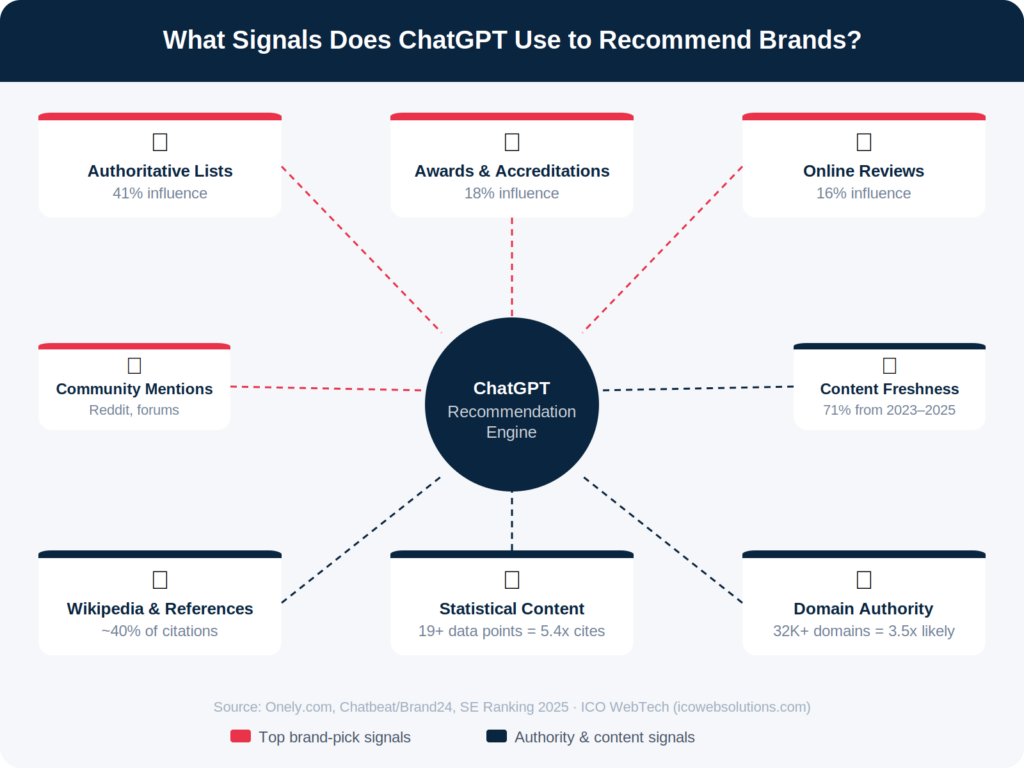
If Google rankings barely predict ChatGPT citations, what does ChatGPT actually use to decide which brands to recommend? Research from Onely, SE Ranking, and Brand24 has reverse-engineered the key factors:
Authoritative List Mentions (41%)
Being featured in industry “best of” lists, expert roundups, and rankings is the single biggest driver. Think Forbes lists, G2 comparisons, Clutch.co rankings.
Awards & Accreditations (18%)
Recognition from established institutions signals credibility. Industry awards, certifications, and verified partnerships all contribute to ChatGPT’s trust model.
Online Reviews (16%)
Third-party validation from customers on platforms like Google, Trustpilot, and Clutch. Brands with an online review score below 70% are significantly less likely to be recommended.
Wikipedia & Reference Sites
Wikipedia accounts for approximately 40% of ChatGPT citations. Crunchbase, LinkedIn, and other authoritative reference platforms matter enormously.
Statistical & Data-Rich Content
Articles with 19+ statistical data points averaged 5.4 citations vs. low-data articles. ChatGPT prefers content it can confidently attribute to a clear source.
Domain Authority (Trust Cliff)
Sites with 32,000+ referring domains are 3.5x more likely to be cited. There is a non-linear trust threshold — authority matters, but differently to Google.
Reddit & Community Mentions
Domains with over 10 million Reddit mentions average 7 ChatGPT citations vs. 1.8 for brands with minimal Reddit presence. Community discussion matters.
Content Freshness
71% of ChatGPT citations come from 2023–2025 content. Regularly publishing authoritative, date-stamped content keeps your brand in the training and retrieval window.
Sources: Onely.com · Chatbeat / Brand24 · Medium / GEO Report
5. Where Google Rankings DO Help
It’s not a zero-sum game. There is meaningful overlap — especially when looking at Google’s own AI features and foundational authority signals.
76% of Google AI Overview cited pages rank in Google’s own top 10Ahrefs, 2025
54.5% AI Overview citations now match top organic URLs (up from 32% in 2024)BrightEdge, Oct 2025
0.664 Spearman correlation — brand mentions & Google AI Overview citationsAhrefs GAIO Study, 2025
Sources: Chatbeat.com · PragoMedia
The key insight: Google’s own AI Overviews DO correlate strongly with top organic rankings — but third-party AI platforms like ChatGPT operate on separate logic. This creates a two-tier AI visibility landscape:
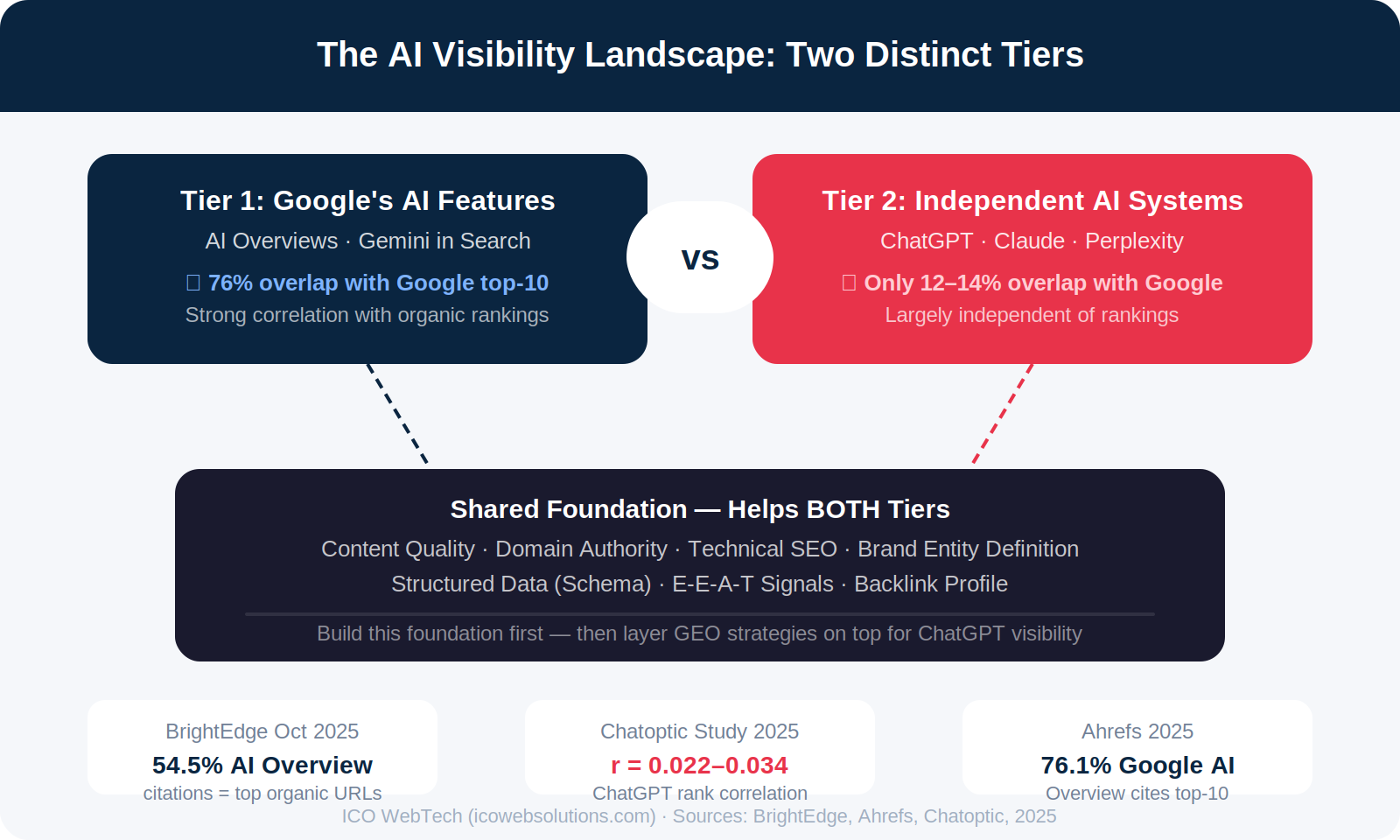
Strong SEO still matters — but it’s the foundation, not the ceiling. Winning in ChatGPT requires additional, targeted strategies beyond traditional rank-building.
6. The Rise of GEO: Generative Engine Optimization
The emerging discipline designed to address this gap is Generative Engine Optimization (GEO) — formally defined in academic research from Princeton, Georgia Tech, and IIT Delhi in 2024, and now entering mainstream marketing practice.
“I care less about Google rankings and more about whether AI tools like ChatGPT or Perplexity mention the brands I work with.”
— Relato’s 2026 GEO Analysis: the new operating reality for performance-driven marketers
SEO vs GEO: Key Differences
| Dimension | Traditional SEO | GEO (Generative Engine Optimization) |
|---|---|---|
| Goal | Rank in top 10 Google results | Get cited/recommended by AI systems |
| Primary Currency | Backlinks + keyword relevance | Authoritative brand mentions + entity recognition |
| Content Focus | Target keywords, search intent pages | Conversational Q&A, statistical content, entity-rich articles |
| Measurement | Rankings, organic traffic, CTR | AI citation rate, brand mention frequency, AI referral traffic |
| Key Platforms | Google Search Console, Ahrefs, Semrush | Conductor, Profound, Semrush AI Toolkit, Search Party |
| Timeline | 3–12 months typically | Ongoing — AI models re-train and update citation patterns |
Source: Enrich Labs — GEO Complete Guide 2026 · ALM Corp — ChatGPT Conversion Study
💡 Why GEO Matters for Conversions
ChatGPT referral traffic converts 31% higher than non-branded organic search — because users who arrive via an AI recommendation have already been pre-sold on your brand’s credibility. The volume is smaller, but the quality is exceptional.
Source: ALM Corp, 2025 Data Analysis — ChatGPT Traffic Converts 31% Higher
7 Steps to Improve ChatGPT Visibility (GEO Checklist)
- Get Listed in Authoritative “Best Of” Lists
Target Clutch, G2, Capterra, Forbes, and industry-specific directories. List placement is the #1 factor (41%) in ChatGPT recommendations. - Publish Data-Rich, Citable Content
Create original studies, surveys, and statistics. Aim for 19+ data points per article. Give AI something concrete to attribute to your brand. - Build Your Brand’s Wikipedia & Knowledge Graph Presence
Wikipedia drives ~40% of ChatGPT citations. Update entries on Wikipedia, Crunchbase, and Wikidata without self-promotion. Ensure NAP consistency everywhere. - Earn Third-Party Media Coverage
Digital PR, podcast appearances, and contributions to industry publications. AI models treat a Forbes mention as far more credible than your own blog. - Maintain Structured Data (Schema Markup)
Implement FAQ, HowTo, Review, and Organization schema. AI crawlers rely heavily on structured data to understand entity relationships. - Build Genuine Reviews on Trusted Platforms
Brands below a 70% positive review rate are significantly less likely to be recommended by ChatGPT. Focus on Google, Trustpilot, and niche review sites. - Track AI Visibility as a Separate KPI
Use tools like Semrush AI Toolkit, Conductor, or Profound to monitor your brand’s citation rate in ChatGPT, Gemini, and Perplexity. Rankings alone no longer tell the full story.
How ICO WebTech Can Help You Win Both Google & ChatGPT
Since 2011, we’ve helped businesses grow through every major algorithm shift. The AI visibility era is the most significant change since Google’s inception — and we’re ready to help you lead it.
AI Visibility (GEO) Service
We audit your current ChatGPT & Gemini citation footprint, identify gaps, and build a systematic GEO strategy covering authoritative mentions, structured data, and entity optimisation.
SEO + GEO Integration
We don’t treat SEO and GEO as separate silos. Our integrated approach builds domain authority and brand entity signals that strengthen your visibility across Google rankings AND AI recommendations simultaneously.
AI Visibility Reporting
We track your brand’s mention frequency in ChatGPT, Perplexity, and Google AI Overviews — giving you a complete picture of your digital visibility beyond traditional rank tracking.
Authoritative Content Creation
Our content team creates data-rich, citable articles, original research, and expert guides designed specifically to meet the citation criteria used by large language models.
Conclusion: Two Rankings, One Integrated Strategy
The data is unambiguous: Google rankings and ChatGPT citations operate largely independently. A rank correlation of near zero (r = 0.022–0.034) means your position on Google’s search results tells ChatGPT almost nothing about whether to recommend your brand. Only 12% of URLs cited by ChatGPT appear in Google’s top 10 for the same query.
But this doesn’t mean SEO is dead. Strong technical SEO, content quality, and domain authority remain the foundation — they’re just no longer the ceiling for AI visibility. Google’s own AI Overviews strongly favour top-ranking pages (76% correlation), making SEO essential for Tier 1 AI visibility.
Winning in 2026 and beyond requires a dual approach:
| To Win in Google Rankings | To Win in ChatGPT / AI Answers |
|---|---|
| Technical SEO excellence | Authoritative “best of” list placements |
| Keyword-targeted content | Data-rich, citable content with clear attribution |
| Quality backlink acquisition | Third-party brand mentions & digital PR |
| Page speed & Core Web Vitals | Wikipedia, Crunchbase & knowledge graph presence |
| E-E-A-T signals | Verified reviews & reputation management |
| Schema markup | Structured data & FAQ schema for AI parsing |



Related items

A practical, step-by-step walkthrough of the process we actually run with clients, includi
Google’s fourth spam update of 2026 is live. The pattern across all four says more than th
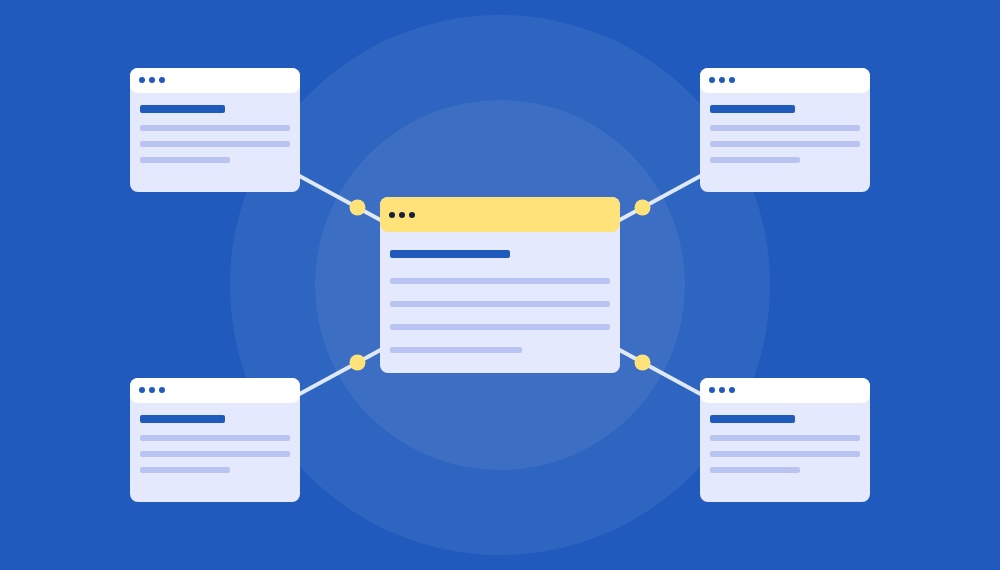
What internal links are, how to plan them, and how to find and fix the problems already on