
Take a look at your website analytics right now. If your digital footprint matches global user behavior patterns, your “About Us” or “Company Profile” page is likely the second or third most visited URL on your entire domain. When prospects are on the verge of making a purchasing decision, signing a retainer, or partnering on an enterprise project, they click away from your features page and deliberately seek out your identity. They want to know who you are, what you stand for, and whether you can be trusted.
Yet, for the vast majority of corporate websites, this critical junction is where the relationship dies a quiet death. Instead of encountering an inspiring vision, visitors are greeted by a barren wasteland of dry corporate text, static stock imagery of people shaking hands in generic boardrooms, and a laundry list of technical milestones that read more like a legal compliance filing than a living, breathing organization. The result? Sky-high bounce rates, immediate drop-offs, and squandered conversion opportunities.
Your “About Us” page should not be an archival storage bin for corporate ego. It is a strategic sales enablement asset. By transitioning away from rigid, jargon-heavy descriptions and embracing the principles of strategic brand storytelling, you can transform this passive page into an active engine for emotional engagement and commercial conversion. Let’s explore how to dismantle boring corporate copy and build a narrative that hooks visitors from the very first paragraph.
The Corporate Ego Trap: Why Technical Jargon Kills Engagement
Why do so many brilliant, innovative companies end up with staggeringly dull corporate profiles? The root cause is almost always the “Corporate Ego Trap.” When writing about themselves, organizations instinctively default to self-defense mechanisms: institutional language, defensive credentialing, and over-indexing on technical jargon. They write to impress their competitors or their board of directors, completely forgetting the human being sitting on the other side of the screen.
Consider this standard piece of B2B corporate copy:
“We are a premier, vertically integrated provider of enterprise-grade, end-to-end technological paradigms. Leveraging our proprietary cutting-edge architectures and synergized operational methodologies, we optimize supply-chain efficiencies to drive robust ROI for global stakeholders.”
This paragraph says absolutely nothing. It is a collection of empty buzzwords engineered to mask a lack of clear identity. It creates immediate cognitive friction. When a reader encounters words like synergized, paradigms, or vertically integrated, their brain has to work harder to decode the meaning. In the digital space, cognitive friction equals an immediate bounce.
Human beings are biologically wired to reject institutional abstractions and embrace narratives. From an evolutionary perspective, our brains process stories differently than raw data or clinical descriptions. When reading data points, only the language processing parts of the brain (Broca’s and Wernicke’s areas) are activated. But when we read a compelling story, our sensory cortexes light up. We visualize the struggle, empathize with the characters, and internalize the message as if it were our own experience. If your page focuses solely on dry technical specifications, you are speaking exclusively to a rational brain that is looking for reasons to filter you out. When you tell a story, you speak to the emotional core where long-term trust is forged.
The Architecture of an Engaging Brand Narrative
To break free from the jargon trap, you must understand how to construct a proper corporate narrative arc. Every great story in human history—from ancient epics to modern cinematic blockbusters—follows a foundational structural rhythm. Your brand story should be no different. You are not writing an autobiography; you are mapping a purposeful journey where your customer ultimately wins.
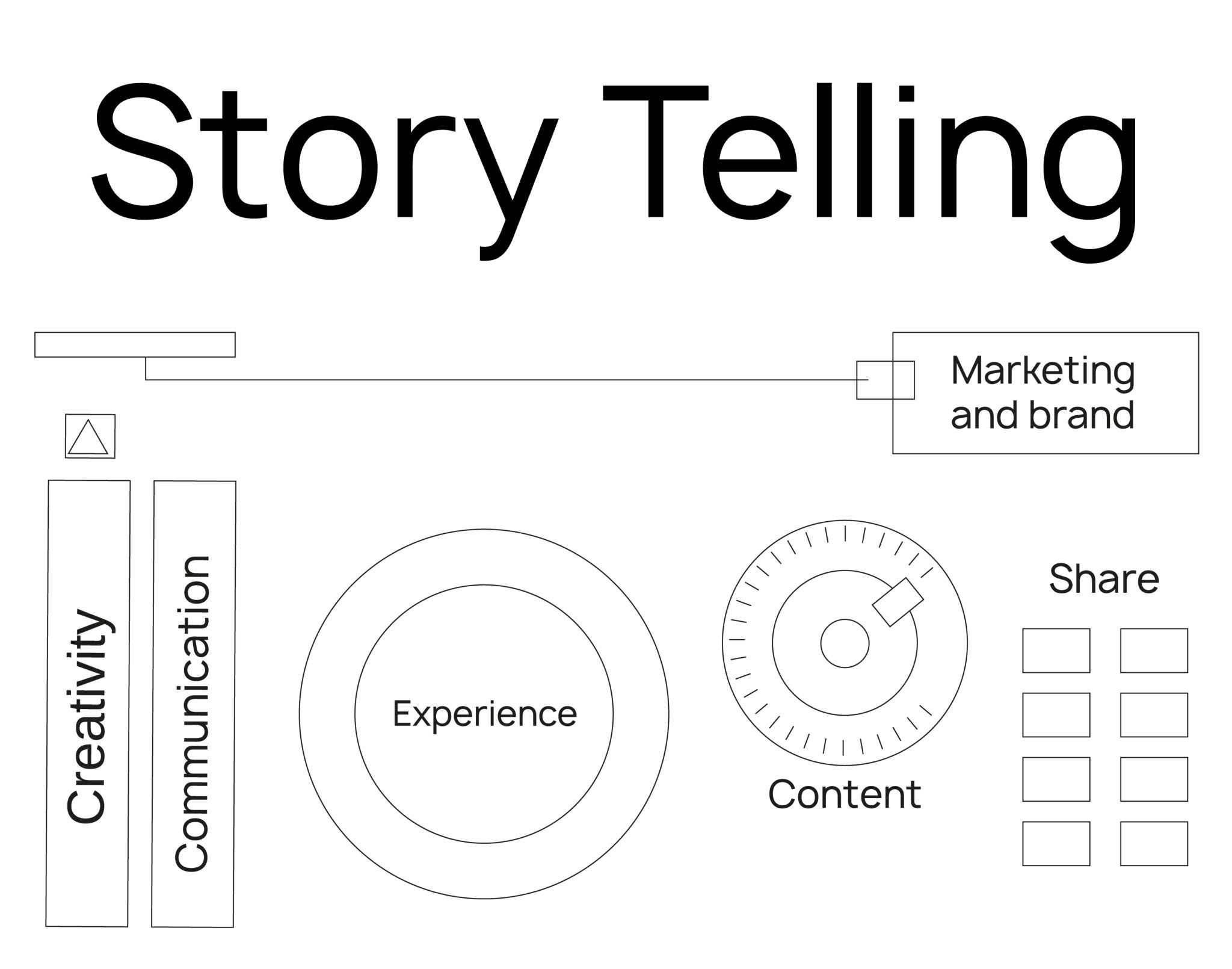
A high-converting brand story requires four distinct phases:
- The Status Quo & Inciting Incident: Every story begins with a normal world that gets disrupted. What was the exact moment your company’s founders realized the existing market options were fundamentally broken? What was the frustration, the market gap, or the injustice that forced your company into existence?
- The Struggle (The Valley of Fire): A story without conflict is just a lecture. Share the early challenges. Did you build 14 failed prototypes in a garage? Did the industry tell you that your model was impossible? This vulnerability humanizes your organization and makes your eventual success feel earned rather than arrogant.
- The Breakthrough & Discovery: This is the moment where your unique methodology, proprietary technology, or core philosophy was born. It explains the “Eureka!” moment that sets your services apart from every other competitor offering similar deliverables.
- The Shared Future (The Guide and the Hero): This is the most crucial pivot. The climax of your story must transfer the spotlight from your company to your customer. You are not Luke Skywalker in this narrative; you are Obi-Wan Kenobi. Your role is that of the trusted, experienced guide who provides the tool, the strategy, or the software that empowers the customer (the true hero) to conquer their challenges.
Contrast in Action: From Functional to Emotional
Let’s see how a simple shift in copywriting perspective alters the entire emotional resonance of an organization’s profile:
| Before: Dry Institutional Copy | After: Humanized Storytelling |
|---|---|
| “Established in 2014, our cybersecurity firm specializes in network infrastructure vulnerability assessments and cloud-based threat mitigation protocols for mid-market logistics corporations.” | “In 2014, our founder watched a local family business collapse overnight after a single ransomware attack wiped out their logistics grid. We realized that enterprise-level security shouldn’t just belong to Fortune 500 giants. We built this firm to give growing businesses the ironclad digital defense they deserve.” |
Designing for the Digital Skimmer: Timelines & Scannable Layouts
Even the most brilliant brand story will fail if it is presented as an impenetrable wall of text. Modern internet users do not read web pages linearly; they skim them in an “F-shaped” pattern, hunting for visual anchors, bold headings, and bite-sized pieces of data before committing to a deep read. Your copy must work in perfect tandem with layout psychology.
When engineering an engaging “About Us” experience, your visual structure needs to break long-form history down into clean, digestible elements. One of the most effective ways to do this is by implementing a visually scannable timeline. Rather than forcing a reader to wade through paragraphs of historical context, a timeline allows them to scroll through your corporate evolution in a matter of seconds, absorbing key achievements effortlessly.
This is where technical execution meets creative design. If you look at how an elite website designing company in India approaches high-performing corporate profiles, they don’t just paste text onto a page. They map user journeys using micro-interactions, clean vertical or horizontal grid systems, and strategic typography that guides the eye naturally down the page. Balancing compelling narrative copy with optimized visual hierarchy ensures that both emotional readers and analytical skimmers find exactly what they need to build trust.
Anatomy of a High-Converting “About Us” Page Layout
To maximize dwell time and reduce bounce rates, consider structuring your page components using this proven layout sequence:
1. The Hook (Above the Fold)
A single, provocative headline that states your core belief or the massive problem you solve. Avoid saying “Welcome to Our Company Page.” Use an emotional statement.
2. The Narrative Core (The Story)
2 to 3 short, punchy paragraphs explaining your origin, the struggle, and the breakthrough. Keep paragraphs under four lines to maximize readability on mobile devices.
3. Interactive Milestones (The Timeline)
A clean, visual timeline tracking your growth. Highlight human milestones (e.g., “Moved into our first real office”) alongside commercial ones (e.g., “Served our 500th client”).
4. The Mission & Values (The Alignment)
A dedicated section illustrating what you stand for. Do not list generic values like “Integrity” or “Excellence”—specify how you live those values in daily operations.
5. The Human Elements (Faces & Voices)
High-quality, authentic photography of your leadership team and frontline staff. Include short, quirky quotes or bios that highlight their personalities beyond their job descriptions.
Case Study: How a B2B Consulting Firm Tripled Page Dwell Time
To understand the true commercial impact of converting a dry profile into a narrative powerhouse, let us look at Apex Vanguard (name changed for confidentiality), an boutique operational consulting firm specializing in mid-market manufacturing efficiency.
For five years, Apex Vanguard’s “Company Overview” page was a classic example of an academic boring page. It was written by senior partners with backgrounds in operational theory, and it read like a textbook. It focused heavily on their “Six Sigma implementation matrix” and “synergistic resource deployment models.” Despite getting thousands of clicks from targeted LinkedIn campaigns, the bounce rate on that page hovered at a devastating 78%. The average user spent a mere 22 seconds on the page before leaving, and consultation bookings originating from the profile page were virtually non-existent.
Recognizing the leak in their sales funnel, the firm underwent a comprehensive digital and copy transformation. They completely stripped out the academic posturing and re-anchored the page around a deeply humanized brand story.
The Strategic Redesign Strategy
- The New Headline: They replaced “About Apex Vanguard: Strategic Operational Partners” with a bold emotional hook: “We built our firm because we couldn’t stand watching brilliant factories close down over fixable supply bottlenecks.”
- The Origin Narrative: They highlighted a true story from the lead partner’s past: how his own family’s manufacturing business went under in the early 2000s because they didn’t have access to modern data tools. This instant vulnerability built immediate empathy with mid-market business owners facing similar pressures.
- The Structural Timeline: They collaborated with a professional digital agency to implement a clean, scannable timeline that balanced business milestones with cultural moments, proving they were a vibrant, evolving team rather than a stagnant corporate entity.
The Direct Business Outcomes
Within ninety days of launching the revised, story-driven page, the analytics data revealed a staggering transformation in user behavior:
Increase in Dwell Time (From 22s to 1m 11s)
Reduction in Page Bounce Rate
Surge in Direct Consultation Inquiries
By moving away from clinical, cold positioning and stepping boldly into their authentic story, Apex Vanguard stopped being a commoditized service provider and became an empathetic partner. Prospects weren’t just reading a resume; they were connecting with a mission they wanted to be a part of.
The Complete Blueprint: How to Rewrite Your “About Us” Page This Week
If you are ready to audit and revolutionize your own company profile, follow this practical, step-by-step rewrite guide to breathe life, emotion, and conversion power back into your brand copy.
Step 1: Conduct a Jargon Audit
Print out your current “About Us” page. Take a red pen and highlight every instance of the following words: industry-leading, premier, cutting-edge, synergy, optimized, paradigm, end-to-end, world-class, and innovative. Once highlighted, challenge yourself to delete or replace every single one of them. If you claim you are “innovative,” delete the word and write a sentence describing the exact invention or process that proves it.
Step 2: Answer the Three Core Origin Questions
Gather your leadership team or your founders and interview them using these three non-negotiable narrative prompts:
- “What made you so angry or frustrated about the current state of your industry that you risked your financial stability to build this company?” (This uncovers your Inciting Incident).
- “What was the single hardest moment in our first two years of operation, and how did we survive it?” (This uncovers your humanizing Struggle).
- “If our company ceased to exist tomorrow, what unique value would our clients lose that no one else in the market could replace?” (This isolates your Core Mission).
Step 3: Define Your Corporate Mission with Accountability
A mission statement is completely useless if it is just a string of pleasant moral concepts. Turn your mission into an active promise. Instead of writing, “Our mission is to provide exceptional customer satisfaction through quality engineering,” try writing, “We believe that no client should ever have to wait more than two hours for an emergency support ticket. Everything we build is designed to honor that timeline.” Specificity builds trust; platitudes invite skepticism.
Step 4: Execute a Scannability Check
Open your website on a mobile device and scroll through the page rapidly within five seconds. Can you instantly grasp what the company does, who they serve, and why they care? If your eye doesn’t land on clear headings, icon matrices, or a highly structured chronological timeline, your layout is failing your copy. Ensure your development team builds clean visual dividers, alternating background tones, and bold callout boxes to hold the attention of digital skimmers.
Stop Documenting. Start Connecting.
The internet does not suffer from a shortage of businesses offering functional services. Whatever your industry—whether you run an enterprise software firm, an operational consultancy, or a creative studio—there are thousands of competitors who can match your technical capabilities, feature for feature, price point for price point.
You cannot win a long-term competitive advantage purely on technical functionality or dry corporate credentials. You win by building a psychological moat around your brand. You win by making your target audience feel understood, valued, and safe. Your “About Us” page is the digital front door where that critical connection is forged. Stop treating it like a boring legal archive. Ditch the cold corporate jargon, lean into the vulnerable realities of your origin story, structure your content for the modern visual skim, and transform your company profile from a forgotten link into your most persuasive brand ambassador.



Related items

Websites were built around a human operating the interface. A visitor reads the page, comp

In a Harvard Business Review audit of 2,241 US companies, only 37% answered an online inqu

If you are new to websites, deciding how many pages to build can feel surprisingly high-st
