There was a time, not too long ago, when entering the world of online retail followed a predictable, rigid playbook. You signed up for an all-in-one platform, picked a pre-designed theme, uploaded your product catalog, plugged in a payment gateway, and hit launch. For years, this “monolithic” approach worked wonderfully. It democratized retail, allowing millions of small and mid-sized businesses to stake their claim in the digital marketplace.
But digital commerce has evolved at a breakneck pace. Today’s consumers aren’t just shopping from desktop browsers or basic mobile screens. They are browsing on smart watches, voice assistants, social media feeds, interactive digital kiosks, and within augmented reality applications. They expect websites to load instantaneously—not in three seconds, but in milliseconds. They demand experiences tailored perfectly to their context, location, and past behavior.
When emerging brands try to force these modern, multi-channel, ultra-fast experiences into a traditional, monolithic commerce system, they quickly run into an invisible brick wall. Every small layout update requires touching complex database code. A plugin added to improve the checkout experience accidentally breaks the homepage layout. A sudden surge in holiday traffic slows down the administrative dashboard to a painful crawl.
Enter headless ecommerce. For a long time, this architectural shift was viewed as an elite luxury—something reserved exclusively for Fortune 500 giants with million-dollar development budgets, massive engineering operations, and complex global supply chains. But the tide has turned. Today, due to an explosion of modern tools, standardized APIs, and accessible development expertise, headless ecommerce is no longer just for big brands. It has become a viable, strategic, and highly accessible choice for growing, ambitious mid-market enterprises.
Understanding the Architecture: What Does “Headless” Actually Mean?
To understand why headless commerce has become so accessible, we first need to demystify what it actually is, free from confusing developer jargon.
In a traditional, monolithic system, the “head” (the frontend user interface that the customer sees, clicks, and interacts with) is permanently welded to the “body” (the backend database, business logic, checkout engine, and inventory management system). They share the same code environment, the same server infrastructure, and the same database schemas.
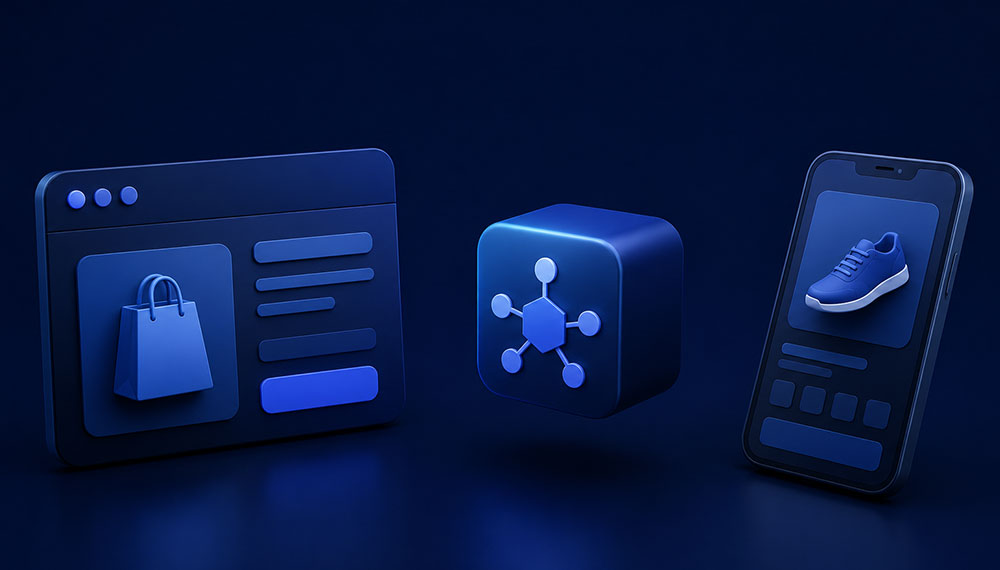
Headless architecture simply cuts the head off from the body. It completely decouples the frontend presentation layer from the backend commerce engines.
Instead of relying on a single platform to handle both the look of the store and the processing of orders, a headless setup separates these responsibilities into two independent environments:
- The Backend: This functions as your silent operational engine. It doesn’t care what your website looks like. Its only job is to securely manage product data, calculate taxes, process checkout logic, handle user accounts, and track inventory.
- The Frontend: This is the beautiful, highly optimized interface your customer interacts with. It can be built using ultra-fast modern web frameworks like Next.js, Nuxt.js, or Remix.
- The Bridge (APIs): The frontend and backend talk to each other through Application Programming Interfaces (APIs). When a user clicks “Add to Cart,” the fast frontend sends a lightweight API request to the backend engine, which updates the cart status instantly and returns the data back to the screen.
The Monolithic Trap: Why Growing Brands Are Feeling the Pinch
For a growing business generating seven or eight figures in annual revenue, monolithic platforms begin to feel less like a helpful framework and more like a restrictive straightjacket. Here is why the traditional approach is breaking down for scaling retailers:
1. The Heavy Performance Penalty
Traditional platforms carry immense structural baggage. Because they must be everything to everyone, they load heavy libraries of code, bloated database architectures, and dozens of third-party plugins just to execute a single page load. Every time you add a marketing pixel, a customer review widget, or an upsell tool, your site’s time-to-first-byte (TTFB) drops, core web vitals suffer, and your conversion rate takes a direct hit. In digital retail, a one-second delay can mean a double-digit drop in revenue.
2. Total Creative Dependency
Want to change the layout of your product detail page to optimize for a new marketing campaign? In a monolithic system, your design team must work within the constraints of the platform’s rigid templating engine. Often, making a change to the visual presentation requires modifying the backend structure, forcing your designers to rely heavily on full-stack developers. This creates costly operational bottlenecks and slows down your go-to-market speed significantly.
3. The Nightmare of Upgrades and Dependency Hell
Every business owner who has managed a legacy open-source or monolithic store knows the sheer panic of clicking “Update Plugin.” Because everything is interconnected, updating your shipping module can mysteriously break your search functionality. Merchants find themselves locked into old, insecure versions of platforms out of fear that an upgrade will bring down their entire storefront for hours, costing them thousands in lost sales.
Why Headless Was Historically Out of Reach
If headless architecture is so incredible, why wasn’t everyone using it from the start? Historically, building a decoupled storefront required a massive, capital-intensive engineering project.
A few years ago, going headless meant your company had to build everything from scratch. You had to provision and maintain your own cloud infrastructure on AWS or Google Cloud. You had to write thousands of lines of custom code to bridge your front-end framework to your commerce database. You had to build custom content management systems so your marketing team could edit text on pages without writing code.
This required an in-house engineering team of multiple full-stack developers, DevOps specialists, and dedicated system architects. For any business making less than $50 million a year, the total cost of ownership (TCO) and organizational complexity made headless a completely impractical and risky choice.
The Democratization Shift: What Changed for Mid-Market Brands?
Today, the landscape looks completely different. We have entered the era of the “packaged third-party ecosystem” and specialized global agencies. The entry barriers to headless implementation have plummeted, opening up enterprise-grade capabilities to growing regional businesses. Here are the core drivers of this democratization:
1. The Evolution of Frontend Deployment Platforms
Platforms like Vercel, Netlify, and Cloudflare Pages have completely removed the complex DevOps requirements from the equation. These platforms are purpose-built to host modern, decoupled frontend frameworks. They distribute your storefront across global Edge networks, meaning your website is cached fractions of a millimeter away from your end-users. There are no servers for your team to manage, no scaling configurations to monitor, and no security vulnerabilities to patch at the infrastructure layer.
2. Composable SaaS and Headless-Native Platforms
Major, accessible commerce engines have embraced API-first methodologies. Shopify launched Hydrogen and Oxygen, its dedicated headless framework and hosting environment. BigCommerce has built deep, seamless integrations with modern frontends. Specialized, hyper-nimble API-first commerce platforms like Commerce Layer, Medusa, and Swell offer robust backends out-of-the-box for nominal monthly subscription fees. You no longer need to write custom database code; you simply connect to these robust cloud backends via clean APIs.
3. The Rise of Specialized International Agencies
Building an advanced digital storefront no longer requires hiring an expensive, hard-to-find local engineering team. Mid-market brands now routinely partner with a specialized ecommerce website development company in India to build bespoke, world-class headless architectures at a fraction of Western development costs. These offshore tech partners possess deep expertise in modern JavaScript frameworks, API integrations, and cloud infrastructure, allowing mid-sized brands to execute complex digital transformations smoothly, predictably, and highly cost-effectively.
Key Takeaway for Decision Makers
The decision to shift to headless is no longer a financial or technical impossibility for growing brands. By combining turnkey cloud commerce engines, optimized frontend hosting, and capable global engineering talent, the total cost of ownership for a headless storefront has dropped by over 70% compared to five years ago.
The Concrete Business Benefits of Going Headless Today
Making an architectural shift shouldn’t just be about pursuing shiny new technical trends. It must deliver measurable, bottom-line business value. For mid-market brands, transitioning to a headless architecture unlocks four transformative business advantages:
| Business Metric | Traditional Monolithic Setup | Modern Headless Architecture |
|---|---|---|
| Page Load Speed & Core Web Vitals | Slow to moderate. Heavily impacted by heavy code, plugins, database queries, and server location. | Blazing fast. Pre-rendered, static HTML delivered instantly from global Edge networks. |
| Omnichannel Flexibility | Extremely difficult. Content and products are locked tightly within the web-centric database. | Native. Centralized API feeds content flawlessly to web, mobile apps, social, IoT, and retail displays. |
| Marketing Agility | Slow. Code deployments are required for layout shifts, creating heavy reliance on IT teams. | Instant. Marketers use headless CMS tools to change frontend layouts without touching code. |
| Security & Scalability | Vulnerable. High traffic spikes can strain databases, slowing down or crashing the store. | Immense. Storefront is decoupled from backend; traffic surges never impact core transaction databases. |
1. Blazing Fast Speed and Unshakable Core Web Vitals
In modern e-commerce, speed isn’t merely a convenience feature—it is a direct driver of profitability. Search engines explicitly prioritize websites that demonstrate exceptional performance, penalizing slow-loading stores in search rankings.
With a headless setup, your frontend is compiled into lightweight, static HTML and JavaScript files before a user even requests them. When a customer lands on your store, there are no heavy, real-time database queries running on a distant server. The page loads nearly instantly. This dramatic performance jump improves your conversion rates, lowers shopping cart abandonment, and boosts organic search visibility almost overnight.
2. Unmatched Omni-channel Delivery
A headless architecture treats your product catalog as a clean, structured stream of data, completely separate from its visual presentation. This means you can distribute that exact same data feed to any device or channel seamlessly.
Want to launch a native iOS or Android mobile application? You don’t need to build a second inventory backend. Want to display products on smart digital signage inside a physical pop-up shop? Or perhaps sell directly via smart wearables? Your engineering team can hook into the exact same API backend. Your content, stock levels, and pricing remain perfectly unified, regardless of where the transaction takes place.
3. Absolute Creative Freedom and Faster Marketing Experiments
When you break the link between your frontend design and backend code, you unlock total design freedom for your marketing and branding teams. Designers are no longer forced to work within the rigid box structures of generic themes. They can build highly immersive, narrative-driven landing pages, interactive product finders, and rich, dynamic storytelling elements that would be technically impossible to execute on a traditional platform.
Furthermore, by utilizing a Headless Content Management System (such as Contentful, Strapi, or Sanity), your marketing team can edit copy, launch promotional banners, and rearrange landing page layouts autonomously. They can deploy changes instantly through an intuitive visual dashboard without needing a developer to run a single line of code or risk breaking the checkout engine.
4. Bulletproof Security and Seamless Scalability
During major peak traffic events like Black Friday, Cyber Monday, or a viral social media promotion, traditional monolithic websites often buckle under the sudden surge of users. The server strains to process frontend page requests and backend transaction data simultaneously, leading to slowed performance or catastrophic crashes.
In a headless configuration, your public-facing storefront is hosted entirely on a global content delivery network, meaning it can absorb millions of concurrent visits without breaking a sweat. Because users interact with static assets on the frontend, your sensitive backend database remains hidden securely behind a protective layer of APIs. This drastically reduces your vulnerability to malicious distributed denial-of-service (DDoS) attacks and data breaches.
Is Headless Right for Your Brand? A Decision Matrix
Despite its clear, powerful advantages, headless commerce is not a universal magic bullet that fits every single online business. It introduces an element of architectural complexity that smaller, resource-constrained merchants might not be ready to handle.
To determine whether your growing business should invest in making the transition, review the following operational checklists:
You are an ideal candidate for Headless if:
- Your current store’s loading speed is sluggish, and your development team has exhausted all standard optimization options within your monolithic platform.
- Your unique brand identity requires an immersive, custom user experience that generic pre-made themes simply cannot accommodate.
- You are actively executing or planning a multi-channel growth strategy, such as selling via mobile apps, social platforms, and brick-and-mortar retail alongside your core website.
- You want to expand into international markets, requiring robust support for multiple localized currencies, languages, and regional fulfillment logic from a single backend.
- You have established access to qualified developer support, either via an internal technology team or through an experienced ecommerce website development company in India.
You should stick with a Traditional Monolithic platform if:
- Your annual e-commerce revenue is under $1 million, and your immediate business priority is minimizing overhead costs rather than maximizing advanced customization.
- Your store relies heavily on a massive, ever-changing ecosystem of simple third-party app plugins for basic everyday operational tasks.
- Your team does not include any technical personnel, and you prefer managing your entire digital operation through a single, basic administrative panel.
How to Transition to Headless Without Ruining Your Business
If you have decided that headless architecture is the correct path forward for your brand, the prospect of migration can still feel highly intimidating. The key to a successful, stress-free transition lies in adopting a gradual, modular approach rather than a risky “grand re-platforming” project.
Phase 1: Conduct a Comprehensive Technical Audit
Begin by mapping out your existing e-commerce ecosystem. Document every single integration, from your enterprise resource planning (ERP) systems and customer relationship management (CRM) tools to minor shipping and review widgets. Identify which systems must be kept as part of your backend engine and which frontend elements can be replaced by specialized API microservices.
Phase 2: Choose Your Modern Tech Stack Wisely
Select components that align with your team’s internal capabilities and long-term business goals. A highly reliable, popular tech stack for mid-market brands migrating to headless includes:
- Backend Engine: Shopify Plus or BigCommerce (leveraging their robust, stable API layers).
- Frontend Framework: Next.js or Remix (for unmatched speed, rendering flexibility, and search optimization).
- Headless CMS: Sanity, Strapi, or Contentful (giving your marketing team full layout autonomy).
- Hosting & Deployment: Vercel or Netlify (for secure, lightning-fast edge delivery).
Phase 3: Partner with Proven Development Experts
Building a robust, decoupled ecosystem requires precise engineering, clean API routing, and a forward-thinking deployment strategy. To ensure a smooth transition without exceeding your budget, it is highly recommended to collaborate with an established, technically proficient ecommerce website development company in India. Partnering with an expert offshore team allows you to leverage seasoned engineering talent who can architect a clean, scalable system while ensuring your project remains highly cost-effective.
Phase 4: Execute a Phased, Progressive Migration
Never attempt to flip a switch overnight and launch an entirely new headless site all at once. Instead, adopt a strategy known as the “Strangler Fig Pattern.” Build your new headless frontend and route a tiny, isolated portion of your traffic—such as your blog pages or high-intent landing pages—to the new decoupled system first.
Monitor performance, analyze user behavior, and test order routing meticulously. Once you have validated the stability of the headless infrastructure, progressively migrate your main category listings, product detail pages, and eventually your entire checkout funnel over several weeks. This protects your ongoing revenue and guarantees business continuity throughout the transition.
The Future of Modern Retail: Composable Commerce is the Goal
As you look toward the future, headless architecture is merely the foundational first step toward a larger, highly powerful retail philosophy known as Composable Commerce.
In a composable business environment, your brand is never locked into any single technology vendor’s ecosystem. If your shipping provider falls behind on features, you simply unplug their API and connect a better alternative. If a superior, AI-powered search tool emerges on the market, you can integrate it into your decoupled frontend within days, without rebuilding your core product database.
By breaking down the monolith today, you are future-proofing your business for whatever digital innovations arrive tomorrow. You gain the agility to pivot instantly, scale your operations seamlessly, and deliver the hyper-fast, memorable shopping experiences that modern consumers expect.
Conclusion: The Playing Field Has Been Leveled
The digital commerce arena has fundamentally transformed. Speed, creative flexibility, and omni-channel responsiveness are no longer luxury competitive advantages reserved solely for global conglomerates with endless capital. They have become foundational requirements for any brand serious about surviving and thriving in a crowded marketplace.
Headless ecommerce has officially matured. The emergence of accessible cloud infrastructure, composable SaaS platforms, and world-class offshore development partnerships has effectively leveled the playing field. Mid-market and scaling retail brands now possess an unprecedented opportunity to build custom, lightning-fast, highly resilient digital storefronts that can easily outperform enterprise giants.
The question is no longer whether your brand can afford to go headless—it is whether you can afford to remain anchored to a rigid, slow, monolithic past while your competition races into an agile, decoupled future.



Related items

Depending on which 2026 survey you read, somewhere between 34% and 77% of US shoppers have

For years, the e-commerce playbook was as simple as it was reliable: build clean product p
The digital checkout is the most volatile, high-stakes environment in the entire digital e
