
A practical, step-by-step walkthrough of the process we actually run with clients, including where AI Overviews change the decisions we make and where they don’t.
Most SEO content roadmaps fail for a boring reason. Not because the writing was bad or the keyword research was sloppy, but because the plan was built to chase visibility instead of the thing that visibility was supposed to lead to.
A ranking or a spike in impressions feels like progress, and it can be, right up until you look at the pipeline six months later and realize none of it turned into actual leads or revenue. AI Overviews have made this problem worse, not better, because now a page can rank well and still get almost no clicks if an AI-generated summary is sitting above it answering the question for free.
So when we build a content roadmap for a client now, the AI search layer isn’t an add-on step at the end. It’s built into the plan from the first decision we make. Below is the process itself, walked through with a real kind of example so you can see how each step actually plays out, not just what it’s called.
To keep things concrete, I’ll use a composite example throughout: a mid-size commercial HVAC equipment distributor that sells to contractors and facility managers, not homeowners.
It’s a good example because the buying decision is relationship-driven and technical, which means a wrong keyword priority can waste months of content production on traffic that was never going to turn into a sales conversation.
Step 1: Get Specific About What the Content Is Actually For
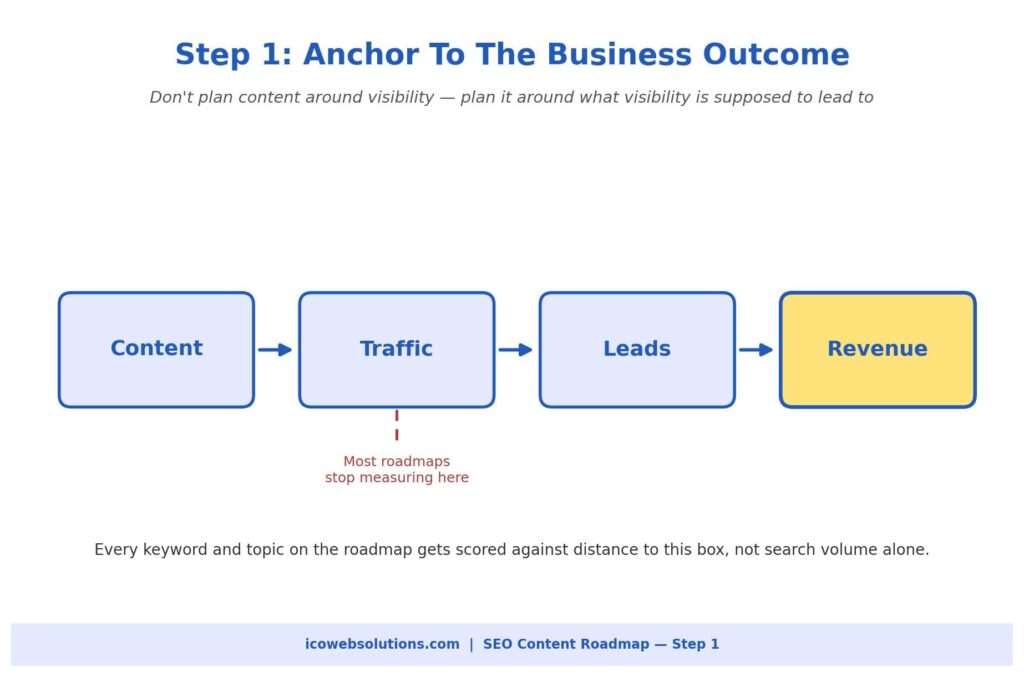
Before any keyword research happens, we force a conversation that sounds simple but gets skipped constantly: what does a “win” actually look like for this content, in terms the business already tracks? Not traffic.
Not rankings. The thing after that.
For our HVAC distributor, a win isn’t someone reading a blog post about ventilation standards. It’s that person filling out a quote request form, and that form eventually turning into a signed equipment contract worth tens of thousands of dollars.
This matters because it changes what “good” means for every decision downstream. If you skip this step, you end up with a roadmap optimized for a vague idea of relevance instead of the specific outcome the business actually needs.
A media company selling ad impressions genuinely wants raw traffic and pageviews, and that’s a fine goal for them. Almost nobody else should be optimizing for that. If your business model depends on booked meetings, signed contracts, or completed purchases, every keyword you consider should get measured against how close it sits to that outcome, not how many people search for it.
For the HVAC distributor, this meant writing down plainly that we were chasing contractors and facility managers with a real, current need, not general curiosity about HVAC systems. That single sentence ended up ruling out a surprising number of high-volume topics later in the process, including some that would have looked great in a traffic report and done nothing for the sales team.
It’s worth being honest about how uncomfortable this step can feel the first time you do it properly. Marketing teams are used to defending their work with traffic and ranking numbers, because those numbers are easy to produce quickly.
Tying every topic back to pipeline or revenue means some of your favorite ideas, the ones that would clearly perform well in search, have to get cut or deprioritized because they don’t actually move the business forward.
That’s a harder conversation to have internally, but skipping it just moves the hard conversation to six months later, when the roadmap is finished and the numbers don’t add up to anything the leadership team cares about.
Step 2: Build the Full Keyword List, Then Find What You’re Actually Missing
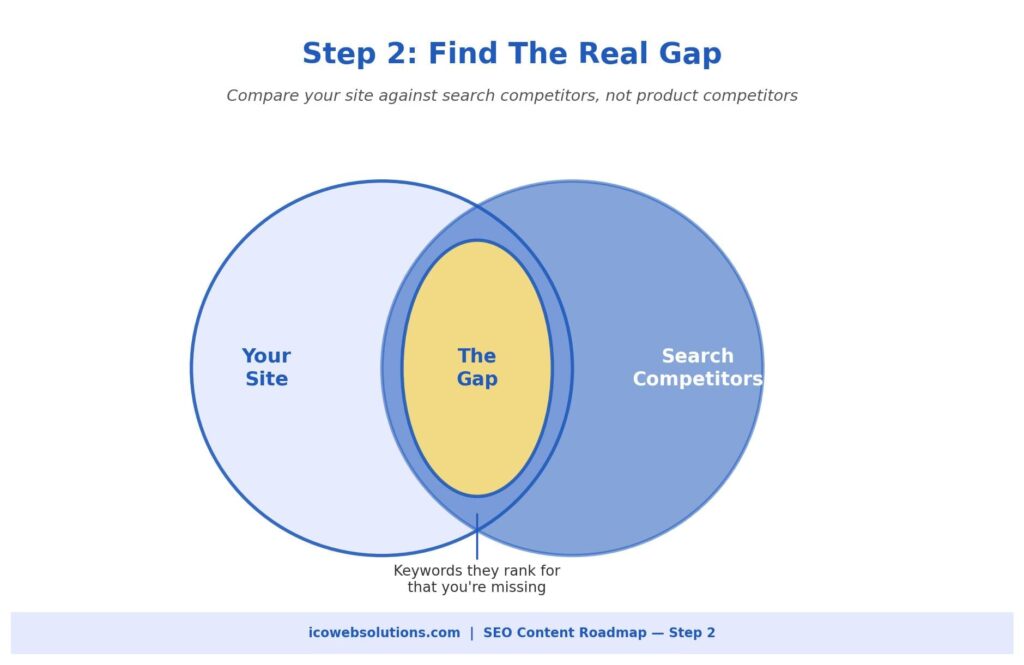
With the goal nailed down, the next step is mapping out every term your buyers might realistically search, and then comparing that against which of those terms you already show up for.
We use a standard SEO research tool for this part, something like Ahrefs or Semrush works fine, by pulling our own domain alongside three or four competitors who we know we’re actually losing visibility to in search, not just competitors the sales team talks about internally.
Those two lists are often different, and conflating them wastes time chasing SEO fights you were never actually in.
The output at this stage is messy on purpose. You’ll get a long list of keyword opportunities, a decent chunk of which will be irrelevant, branded, or far too broad to be useful. That’s expected. The real work here is in the filtering.
For the HVAC distributor, the obvious head term was something like “commercial HVAC equipment,” a huge, broad, expensive-to-rank-for phrase. But sitting right next to it were much more specific, much more winnable terms like “rooftop HVAC unit replacement for commercial buildings” and “HVAC equipment financing for contractors,” both with a fraction of the search volume but an enormous amount more buying intent behind them.
- Pick search competitors based on who you actually compete with in results, not who sales considers a rival
- Expect most of the raw keyword export to be noise, and budget real time for manually trimming it
- Specific, narrower terms with clear intent are usually worth more than broad terms with bigger volume
Step 3: Look at the Actual Search Results Page, Not Just the Keyword Numbers
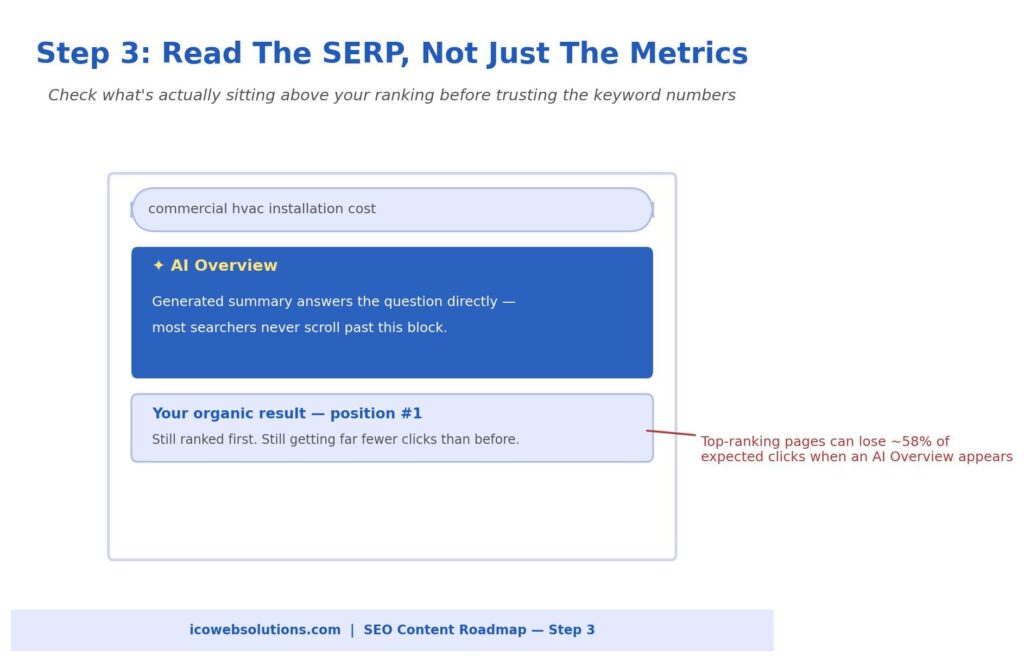
This is the step that didn’t exist in quite the same form a few years ago, and it’s the one most roadmaps still skip. Search volume and keyword difficulty tell you whether you can rank. They don’t tell you what that ranking is actually worth anymore, because the page itself might look completely different depending on whether an AI Overview, a shopping carousel, or a stack of ads sits above the organic results.
Ahrefs has published research showing that the top-ranking organic result can lose roughly 58% of its expected clicks when an AI Overview appears on that search page.
That’s a massive difference, and it means two keywords with identical volume and difficulty scores can be worth wildly different amounts depending on what else is occupying that results page.
So at this stage, we manually check the SERP for every shortlisted keyword, not just the metrics report, and note which ones already trigger an AI Overview, a People Also Ask block, or heavy ad placement.
This isn’t automatically a reason to avoid a keyword. It’s a reason to decide, deliberately, what you’re actually trying to win there.
For our HVAC distributor, nearly every broad, informational term, things like “how commercial HVAC systems work”, triggered an AI Overview that fully answered the question without anyone needing to click through.
We didn’t abandon those topics entirely, because getting cited inside that AI summary still has brand value, but we stopped expecting them to drive form fills, and we shifted our click-focused effort toward the narrower, more technical, bottom-of-funnel terms where AI Overviews were far less dominant.
Step 4: Group Keywords Into Topics the Way a Buyer Actually Thinks
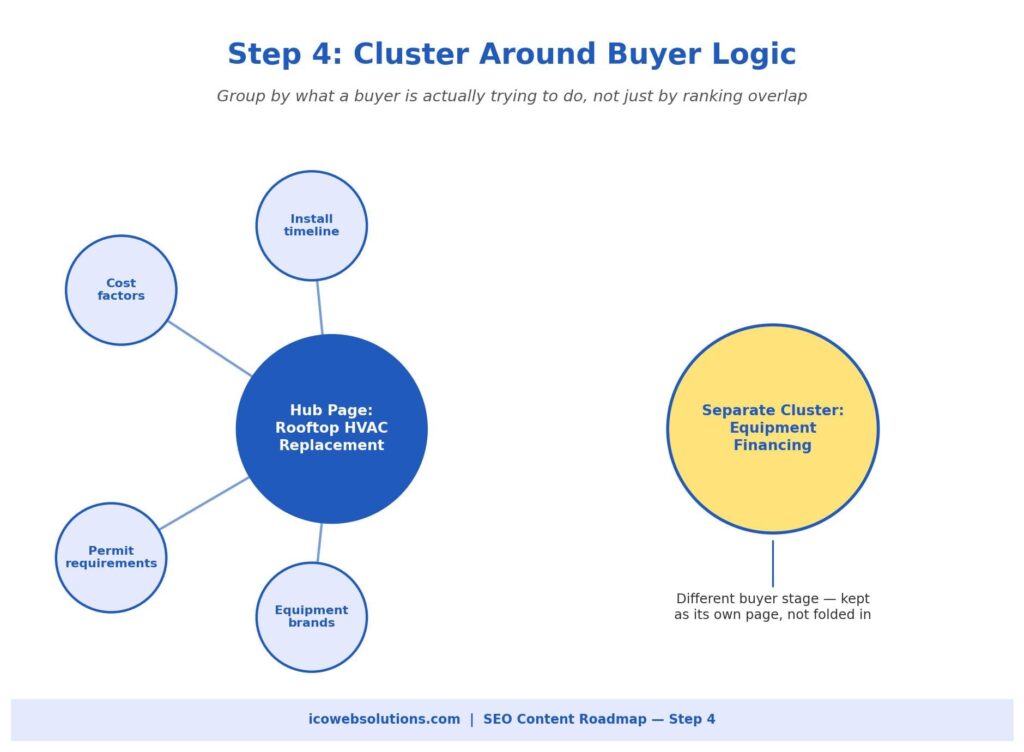
A spreadsheet full of individual keywords isn’t a plan, it’s just a longer list. The next step is organizing those keywords into topic clusters, groups of related terms that can realistically be served by one well-built page, or that clearly need separate pages because they represent different stages of the buying journey.
Most research tools will suggest a clustering based on which pages currently rank for overlapping terms, and that’s a useful starting point, but it’s not the final word.
The judgment call here is making sure the clusters reflect how a real buyer thinks, not just how a crawler groups similar phrases. In the HVAC example, a tool-based clustering initially lumped general commercial HVAC terms together with equipment financing terms, because there was some ranking overlap between them.
But those are genuinely different buyer situations. Someone researching how commercial HVAC systems work is early and exploring. Someone searching for equipment financing options has already decided what they need and is now trying to figure out how to pay for it.
We split those into two separate clusters with two separate pages, because treating them as one topic would have buried a high-intent, close-to-purchase audience inside a general awareness page.
Step 5: Decide What Gets Built First, Using More Than One Filter
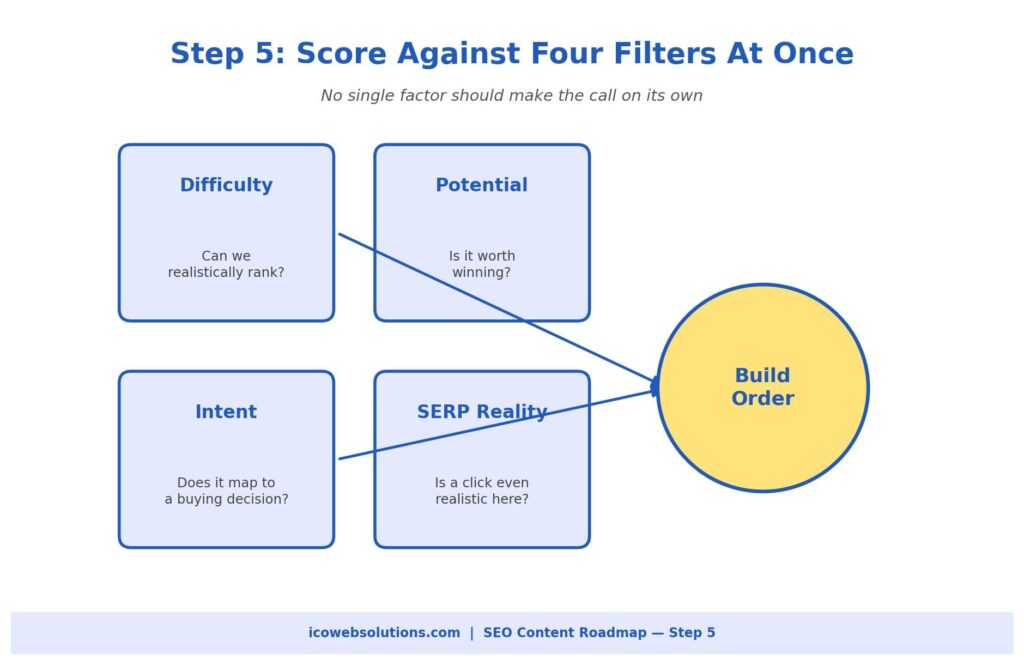
Once the clusters exist, you still have to decide what order to build them in, and this is where a lot of roadmaps quietly go wrong by picking the biggest, most tempting keyword first instead of the smartest one. We score every cluster against four things at once: how difficult it would be to rank, how much it’s genuinely worth if we win it, how close the searcher’s intent sits to an actual purchase decision, and what we learned in Step 3 about whether a click there is even realistic.
No single one of those four factors should make the decision alone. A term can have huge volume and still be a poor first choice if it’s dominated by an AI Overview and sits at the very top of the awareness stage. A term with modest volume can jump to the front of the line if it’s realistically winnable and sits one step away from someone filling out a form.
For the HVAC distributor, that meant pushing the broad “commercial HVAC equipment” topic further down the roadmap, even though it had the biggest search volume by far, and prioritizing “rooftop HVAC unit replacement” and the equipment financing cluster first, because both were realistically winnable, clearly tied to a buying decision already in motion, and far less crowded out by AI-generated summaries.
- Score clusters on difficulty, potential value, buyer intent, and SERP reality together, not one at a time
- Be willing to deprioritize your biggest, most obvious keyword if it’s dominated by an AI Overview and sits too early in the buying journey
- Let a cluster’s closeness to an actual purchase decision outweigh raw search volume when the two conflict
Step 6: Turn the Priority List Into Briefs Built to Be Found and Quoted
A roadmap only matters once it turns into content someone can actually read, and by this point we know enough to write a genuinely useful brief instead of a vague topic assignment. Each brief includes the primary keyword, the supporting terms from that cluster, where the buyer sits in their decision process, what we learned about the SERP for that term, and a specific angle the piece needs to take to stand out.
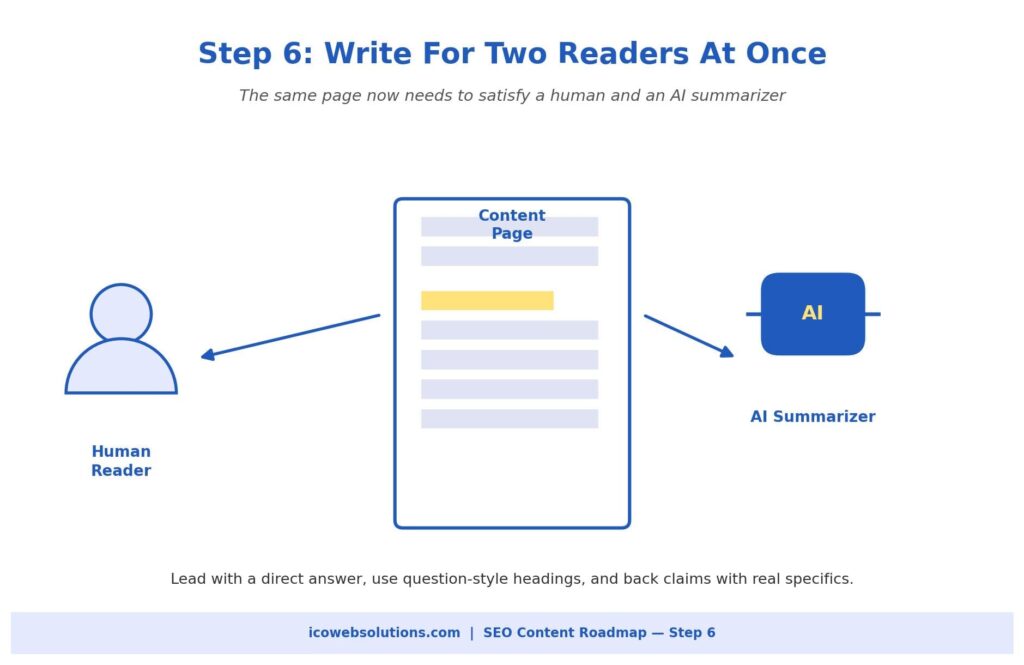
The writing itself needs to work for two audiences at once now: the human reader and the AI system that might lift a chunk of it into a summary somewhere else.
In practice, that means answering the core question directly within the first sentence or two of each section rather than building up to it slowly, using headings phrased the way someone would actually ask the question out loud, and backing claims with real, specific detail rather than vague generalities.
For the HVAC distributor’s financing page, that meant opening with a direct, plain explanation of how equipment financing actually works for commercial HVAC purchases, then supporting it with real numbers and terms, rather than easing into the topic with a long introduction before getting to the useful part.
This is also where genuine expertise becomes a real advantage rather than a nice-to-have. AI systems and careful human readers both tend to notice the difference between a page written by someone who clearly understands the subject and a page that’s technically correct but generic. Specific numbers, named standards, real customer situations, and a clear point of view are much harder for a rushed competitor to copy quickly, which is exactly the kind of advantage a content roadmap should be protecting.
Why We Still Write for Topics an AI Overview Will Swallow Whole
One objection comes up almost every time we walk a client through this process: if a topic is clearly going to get answered by an AI Overview before anyone reaches the organic results, why bother writing about it at all? It’s a fair question, and the honest answer is that we still write those pieces, just with a different goal attached to them and a different way of measuring whether they worked.
Getting cited as a source inside an AI Overview isn’t nothing, even without the click. It puts your brand name in front of someone at the exact moment they’re asking the question your business answers for a living, and repeated exposure like that builds a kind of familiarity that shows up later when they’re ready to actually buy.
There’s also a practical reason to keep showing up on these broader topics: the clustering from Step 4 only works if the awareness-stage content exists to link into the bottom-of-funnel pages, since a hub page with no supporting content around it tends to carry less authority than one surrounded by a genuinely useful cluster.
For the HVAC distributor, the broad educational pages stayed in the roadmap, just later in the build order and measured by brand visibility and assisted conversions rather than direct form fills.
What This Looks Like Once It’s Running
Once a roadmap like this is built, it’s tempting to feel like the hard part is over, but there are two things worth doing immediately rather than filing it away. The first is capturing an honest baseline: your current rankings, your current organic traffic, and ideally your current click-through rates on the terms that matter most, before you start making changes.
AI Overviews and SERP layouts keep shifting, and without a clear “before” snapshot, it becomes very hard to prove later whether the work actually moved anything. This is particularly important for businesses investing in emerging areas such as AI search, where visibility increasingly depends on how clearly a brand, its expertise, and its content can be understood by generative search systems.
The second is resisting the urge to overhaul every piece of content at once. Pick one cluster, run it through this exact process, publish it, and give it a few weeks to settle before comparing its performance against content you built the old way.
That comparison is genuinely more useful than any amount of planning, because it tells you, with your own real data, whether this approach is actually earning more qualified attention for your specific business, not just in theory but in practice. The same principle applies whether you’re working with an in-house team or a content marketing agency: the goal is not simply to produce more content, but to understand which content contributes to meaningful business outcomes.
It’s also worth revisiting the whole roadmap on a regular schedule rather than treating it as a one-time document. Search results keep shifting, AI Overviews expand into new categories of queries every few months, and a cluster that was a smart priority six months ago might already be crowded out by competitors who went through a similar process after watching you succeed.
Building in a quarterly check-in, even a short one, to re-run the SERP checks from Step 3 and confirm the priority order from Step 5 still makes sense keeps the roadmap from quietly going stale while everyone’s attention moves on to the next project. If your website, content architecture, or technical foundation also needs attention, this is often the right point to assess whether improvements from a specialist in website design in Delhi could support the broader search strategy rather than treating design and SEO as separate initiatives.
None of this requires a massive team or an enormous budget to start. It requires picking a real business outcome, being disciplined about checking what the search results actually look like before committing to a topic, and being willing to build the less exciting, narrower pages first if that’s genuinely where the buyers already are.
That discipline is really the whole difference between a content roadmap that produces a nice-looking report and one that produces an actual pipeline of people ready to talk to your sales team.
If you’d rather have a second set of eyes build this roadmap with you, or run it on your behalf from the keyword research through the finished, publish-ready briefs, that’s exactly the kind of work our team takes on at ICO WebTech. We can also help businesses adapt their broader organic strategy for the changing search landscape as an AI search company, combining content strategy, SEO, website expertise, and AI visibility into one practical roadmap. We’re happy to walk through what a first roadmap would look like for your specific business before you commit to anything.



Related items

Baymard Institute’s 2026 benchmark found that 52% of desktop sites and 62% of mobile sites


Depending on which 2026 survey you read, somewhere between 34% and 77% of US shoppers have

Websites were built around a human operating the interface. A visitor reads the page, comp
