AI SEO architecture is the way you organize, name, link, and label your pages so search engines and AI answer engines can tell what your brand is, what each page does, and which source to cite. Call it SEO architecture for AI search visibility. It is site-level work, and page-level tactics will only carry you so far without it. A great page on a confused site still underperforms.
Most advice on this skips the part that counts. It treats AI visibility as something you bolt onto finished pages: write the content, then optimize it for AI. I think that is backwards. AI does not read pages. It reads structure. And you set that structure before you publish, which means the ceiling on your AI visibility is mostly fixed before you have written a word.
Google has started saying a version of this out loud. Its guidance on generative AI features tells site owners to skip the AEO and GEO tricks, content chunking and llms.txt files, and put the effort into foundational SEO and a clear technical structure instead.
I’d put it more bluntly than Google does. Structure is the work. The rest is decoration.
Visibility is decided before you publish
After three decades building search strategies, I kept seeing the same thing. Most long-term visibility problems traced back to a decision made before anyone wrote the first page. A URL structure that boxed the site in. Pages built to compete with each other. A homepage that never came out and said what the company actually did. By the time it showed up in the numbers, the fix was a rebuild.
So I flipped the order and started treating architecture as the first deliverable instead of the last. I call that phase Zero Page SEO: the decisions you make at zero pages, before page one exists. AI visibility is a pre-production problem, not an optimization problem.
The four R’s of AI citation
To plan that layer well, it helps to know what an AI system actually does before it cites you. Four steps, in order.
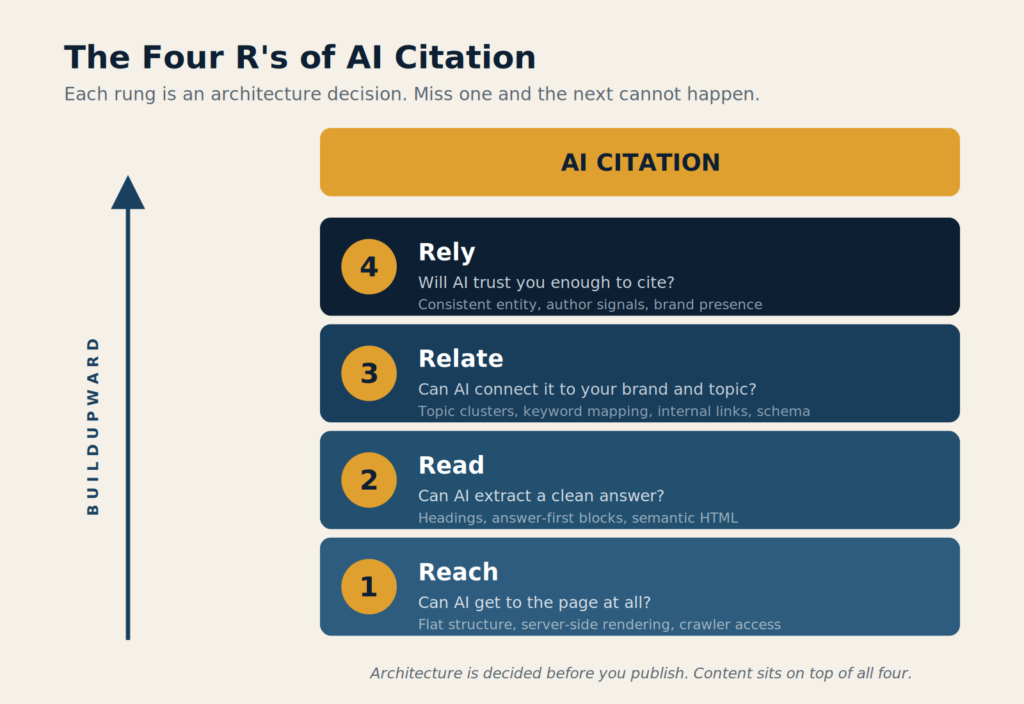
| Step | The question | The architecture that answers it |
| Reach | Can AI get to the page? | Flat structure, server-side rendering, crawler access |
| Read | Can AI extract a clean answer? | Headings, answer-first blocks, semantic HTML |
| Relate | Can AI connect it to your brand and topic? | Topic clusters, keyword mapping, internal links, schema |
| Rely | Will AI trust you enough to cite? | Consistent entity, author signals, brand presence |
Each step rides on the one below it. Miss a rung and the next one cannot happen, however good the writing is.
Reach: can AI get to the page?
If a crawler cannot reach a page, nothing else on this list matters. Two decisions settle it.
The first is rendering, and it catches people off guard. Most AI crawlers do not run JavaScript. Vercel and Merj went through more than 500 million GPTBot fetches and found no JavaScript execution at all, with the same result for Anthropic’s ClaudeBot and PerplexityBot. So a page that looks fine to Googlebot can land at an AI crawler as an empty shell. If your content only shows up after the scripts run, the crawler reads nothing. Server-side rendering or static generation handles it, and that is a call you make during the build. Google’s Gemini crawler is the one exception, since it borrows Googlebot’s rendering. Build for the crawlers that cannot render and you have covered the rest.
The second is simpler: can the crawler get in at all. Block AI bots at the CDN or in robots.txt and every page vanishes at once. Plenty of sites now block by default after their edge provider changed its policy, and most owners have no idea. Worth a look.
Crawl efficiency only enters the picture on large sites. Google says crawl budget mostly affects sites past ten thousand pages, or ones that change constantly. If that is you, a flat structure and a clean sitemap keep crawlers on the pages that earn their keep. If your site is smaller, do not lose sleep over it, though flat structure still pays off on every rung above this one.
Read: can AI extract a clean answer?
Reaching a page and understanding it are different things. Once the crawler is in, it goes looking for a clean, quotable answer, and your structure decides how hard that is to find. Google’s own AI guidance lands in the same place: organize content with clear headings and sections people can follow.
A few habits do most of the work:
- One H1, with descriptive H2s and H3s. Headings are the outline AI follows.
- Answer-first blocks. Put the direct answer in the first line of a section, then expand. AI lifts the short answer and leaves the rest for humans.
- Short paragraphs, lists, and tables. Scannable structure is extractable structure.
- Semantic HTML. Real headings, lists, and tables tell AI what each block is, instead of leaving it to guess from styled containers.
This is where a lot of strong content quietly loses. The answer is right there on the page. The structure just buries it.
Relate: can AI connect the page to your brand and topic?
A page the crawler can reach and read is still stranded until your architecture connects it to everything else. This is the rung where most sites fall down, and it is the one that is easiest to see in a picture.
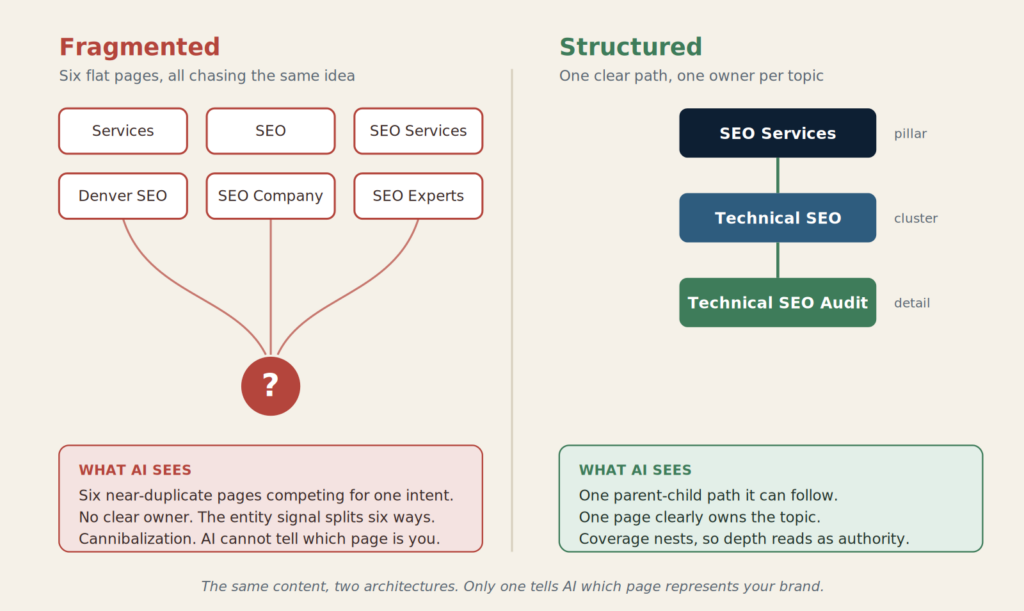
Take the same SEO content, organized two ways.
One way: Services, SEO, SEO Services, Denver SEO, SEO Company, SEO Experts. Six flat pages, all circling the same idea.
The other: SEO Services at the top, Technical SEO under it, Technical SEO Audit under that. A single path.
With the first setup, AI runs into six near-duplicate pages fighting over one intent. It has no way to tell which one is the real you, so the entity signal splits six ways. That is keyword cannibalization, and it is a particular problem for AI: a retrieval system has to pick one page to represent the topic, and six near-duplicates give it no clean way to choose. With the second, AI follows a parent and child path. It knows which page owns the topic and how the rest hangs off it.
Pull a cluster of competing pages like that first group into one clean hierarchy and two things happen together. The cannibalization goes away, and AI finally has a single page to pin the topic to. Down the line that tends to show up as cleaner crawl coverage and steadier citations.
Four moves build the structured version:
Topic hierarchy. Use hub-and-spoke. One pillar page per core topic, supporting pages linking up to it, the pillar linking back down. Google’s AI guidance points the same way, toward topic clusters and pillar pages.
Keyword mapping. Assign one primary intent to one URL before you write. That heads off the cannibalization above. Doing it first costs far less than merging live pages later.
Internal links. Your anchor text is a label for the page you point to. “Technical SEO audit” tells AI what the target covers. “Click here” tells it nothing. Link supporting pages up to pillars, pillars across to related pillars, and keep the pattern steady.
Schema and entity definition. Schema labels your content so AI does not have to guess. Google says it uses structured data, including the sameAs property, to understand the people and companies a page describes. Use Organization, Person, Article, FAQPage, and BreadcrumbList, and tie them together with sameAs and canonical @id values so your brand, authors, and pages read as one entity rather than scattered blocks. Then say who you are in plain words. “We build brands that matter” tells AI nothing. “Rank Outlaw is a Denver SEO consultancy specializing in SEO architecture and AI search visibility” tells it exactly what to file away.
One caveat. Schema is support, not a shortcut. Google is clear that structured data is not required for AI features and there is no magic markup that gets you in. It removes ambiguity. It does not buy a citation.
Rely: will AI trust you enough to cite?
The last step is trust, and trust is partly a structural thing. AI cites sources it reads as credible, and a fair amount of that read comes from how your site is built.
AI leans on existing rankings as a stand-in for judgment. It does not have the budget to weigh every page’s authority on its own, so it borrows Google’s. Rankings still count: studies of AI Overviews show most of them cite at least one page from the top of the organic results. But ranking gets you considered, not chosen. The overlap between top-ten rankings and AI citations slid from around 76% in mid-2025 to roughly 38% by early 2026 as the engines started reaching wider.
What climbed instead is brand. Ahrefs looked at 75,000 brands and found that mentions of a brand across the web track AI visibility more closely than backlinks do. Consistency feeds that. One brand name, one entity description, connected schema across the site, and AI reads you as a single recognized source instead of a handful of loosely related pages. Name your authors and give them Person schema. Google’s own line fits here: it favors content with a real point of view over commodity rewrites.
Build the ladder before you write
The point of the four R’s is the order. Reach feeds Read, Read feeds Relate, Relate feeds Rely, and your content sits on top of all of it. Weak architecture puts a lid on everything above it. That is the whole argument for settling structure first, at zero pages.
Give your developer the architecture before anyone builds a template:
- Reach: flat URLs, server-side rendering, clean sitemap, crawler access
- Read: heading templates, answer-first content blocks, semantic HTML
- Relate: pillar and cluster map, one intent per URL, internal linking rules, schema per template
- Rely: consistent entity statements, connected @id schema, author profiles
Score your site: the four R’s audit
Score your own site. Zero to three on each line, thirty at the top. Under twenty, and you have a roadmap. Whichever rung scores lowest is where you start.
| Rung | Check | Score (0-3) |
| Reach | Main content renders without JavaScript | |
| Reach | Important pages sit within 3 to 4 clicks of the homepage | |
| Reach | AI crawlers are not blocked in robots.txt or at the CDN | |
| Read | One H1, with descriptive H2s and H3s per page | |
| Read | Direct answers appear in the first lines of sections | |
| Read | Content uses real lists, tables, and semantic HTML | |
| Relate | One keyword intent maps to one URL, with no competing pages | |
| Relate | Pillar and cluster links run in both directions | |
| Relate | Organization, Person, and page schema connect via sameAs and @id | |
| Rely | Brand name and entity statement stay consistent sitewide |
None of this is exotic. It is mostly the discipline to settle the dull structural questions first, while they are still cheap to change. Do that, and the content you publish later has something solid to stand on. Skip it, and you spend next year rewriting.
Frequently asked questions
What are the four R’s of AI citation?
The four R’s are Reach, Read, Relate, and Rely. They describe what an AI system does before it cites a site: reach the page, read a clean answer, relate the page to your brand and topic, and rely on you enough to quote you. Each step depends on an architecture decision.
What is AI SEO architecture?
AI SEO architecture is how your website is organized, named, linked, and labeled so search engines and AI can understand it. It covers URL structure, topic hierarchy, internal linking, and structured data. It works at the site level, not on a single page.
Does site structure affect AI search visibility?
Yes. AI systems break your site into entities and topics, then build a picture of your brand from the whole structure. A clear structure helps AI reach, read, relate, and trust your pages. A confused one gets skipped.
How do you structure a website for AI search?
Use a flat structure with important pages within three to four clicks of the homepage. Render content without JavaScript. Group content into pillar and cluster topics. Map one keyword intent per URL. Add connected schema and a clear entity statement.
Why is AI visibility a pre-production problem?
Because architecture sets a ceiling on visibility, and architecture is decided before content exists. Reach, Read, Relate, and Rely all depend on structure. Once pages are built on a weak structure, content cannot lift them past that ceiling. Fixing it later means rebuilding.
Sources
- Google Search Central, Guide to Optimizing for Generative AI Features.
- Google Search Central, AI Features and Your Website.
- Google Search Central, Intro to How Structured Data Markup Works.
- Google Search Central, Crawl Budget Management for Large Sites.
- Vercel and Merj, The Rise of the AI Crawler.
- Onely, Optimizing for AI Search: Why Classic SEO Principles Still Apply.
- seoClarity, The Overlap Between AI Overviews and Organic Rankings.
- Ahrefs, AI Overview Citations and Organic Rankings.



Related items
It is Monday morning, and a new proposal has landed in your inbox. It includes a fresh lin


A practical, step-by-step walkthrough of the process we actually run with clients, includi
Google’s fourth spam update of 2026 is live. The pattern across all four says more than th