Link building isn’t dead; it’s just gotten pickier. 94% of published content earns zero backlinks (DemandSage, 2026), which means most people are still throwing effort at tactics that stopped paying off years ago. The links that move rankings in 2026 come from digital PR, original data, real relationships, and content worth citing, not directories, not link exchanges, not mass guest posting.
Below, you’ll get all 17 white-hat tactics that are actually working right now, grouped inside a simple framework we call the Link Equity Pyramid, plus the exact order to tackle them in.
In This Blog
- Why link building changed and what’s actually working in 2026
- The Link Equity Pyramid: our framework for prioritizing your link building hours
- Tier 1: Foundational Trust Signals (Strategies 1–4)
- Tier 2: Content-Driven Earned Links (Strategies 5–9)
- Tier 3: Relationship-Based Placements (Strategies 10–13)
- Tier 4: Digital PR and Media Authority (Strategies 14–17)
- A quadrant chart showing where to spend your time first
- The anchor text mix that keeps you out of trouble
- Common mistakes that quietly tank your E-E-A-T
- FAQs and next steps
Here’s a number that should make you rethink your entire link-building to-do list: 94% of web content never earns a single backlink, and 95% of all pages sit at zero referring domains (DemandSage, 2026). Only about 2.2% of published pages ever pull in a link from anywhere else. So when someone tells you “link building doesn’t work anymore,” what they usually mean is that the tactics they tried didn’t work, because they were fishing in the same overcrowded pond as everyone else. The other side of that stat is the good news: if you’re one of the few sites doing this correctly, you’re competing against almost nobody.
We’ve spent years building links for B2B and B2C brands at ICO WebTech’s SEO link building services, and the pattern is consistent. The businesses that win aren’t the ones sending the most outreach emails. They’re the ones who understand which tactics actually build authority in a search landscape where Google’s ranking system weighs backlinks alongside hundreds of other factors (Heroic Rankings, 2026), and where AI search tools like ChatGPT and Google’s AI Overviews are starting to care just as much about brand mentions as they do about links.
What Actually Changed in Link Building for 2026
Link building used to be a numbers game. Get as many links as possible, from wherever you could get them, and rankings would follow.
That approach is dead, and it’s been dying for a while.
What replaced it is a quality-first mindset where SEO teams evaluate authority, relevance, and trust before they evaluate volume (Heroic Rankings, 2026).
Editorial links, meaning links that a writer or editor chose to include because your content genuinely helped their story, now carry the bulk of the ranking weight. In fact, 92.2% of first-page backlinks are editorial, while directories account for just 6.8% and resource pages a mere 1.1% (Arvow, 2026).
That shift shows up in the money, too. The average cost of a single high-quality backlink now sits around $509, and over 76% of SEO professionals pay at least $300 per placement (DemandSage, 2026).
Budgets are climbing right alongside it. 58% of SEOs increased their link building budgets in 2026, even as Google keeps publicly downplaying the importance of links as a ranking factor (Arvow, 2026). Nobody’s actually buying that downplaying, and for good reason. When Ahrefs ran a controlled study by disavowing links on live pages, traffic dropped between 13.3% and 18%.
When they restored those same links, pages recovered almost all of that lost traffic (QuickSEO, 2026). Whatever Google says publicly, links still move the needle.
There’s a newer wrinkle worth understanding before you read another word of this article: generative engines.
73.2% of SEO experts now believe backlinks influence whether a brand shows up in AI Overviews and similar AI-generated answers (QuickSEO, 2026). But the correlation data tells a more nuanced story. Brand mentions correlate with AI Overview visibility at 0.66 to 0.71, while backlinks correlate at just 0.22 to 0.33 (Arvow, 2026).
In plain terms, being talked about matters nearly three times more than being linked to when it comes to showing up inside an AI answer. That’s exactly why digital PR, guest expert commentary, and podcast mentions belong on this list right alongside traditional link building. If you want a deeper look at how that world works, our team breaks it down in our AI Visibility (GEO) services.
Our POV: The Link Equity Pyramid (And Why Half the “Best Practices” Lists Are Wrong)
Most link building articles hand you a flat list of 17, 30, or 50 tactics with no sense of which ones actually deserve your time. That’s not useful, and honestly it’s a little lazy.
Here’s our take, and it’s a bit contrarian: directories, sponsorships, and citation-style links are not dead, but they will never move your rankings on their own. Anyone selling you a “link building package” built mostly around these tactics is selling you volume, not value. Use them for trust and brand consistency, not for ranking power.
To make this easier to act on, we built a simple framework called the Link Equity Pyramid. It sorts every link-building tactic into four tiers based on how much authority it actually transfers, and how much effort it takes to earn. The base is wide because foundational trust signals are easy to get and useful in bulk. The tip is narrow because digital PR and true media authority take real work, but the payoff per link is enormous. Every one of the 17 strategies below sits somewhere on this pyramid, and we’ll tell you exactly where.
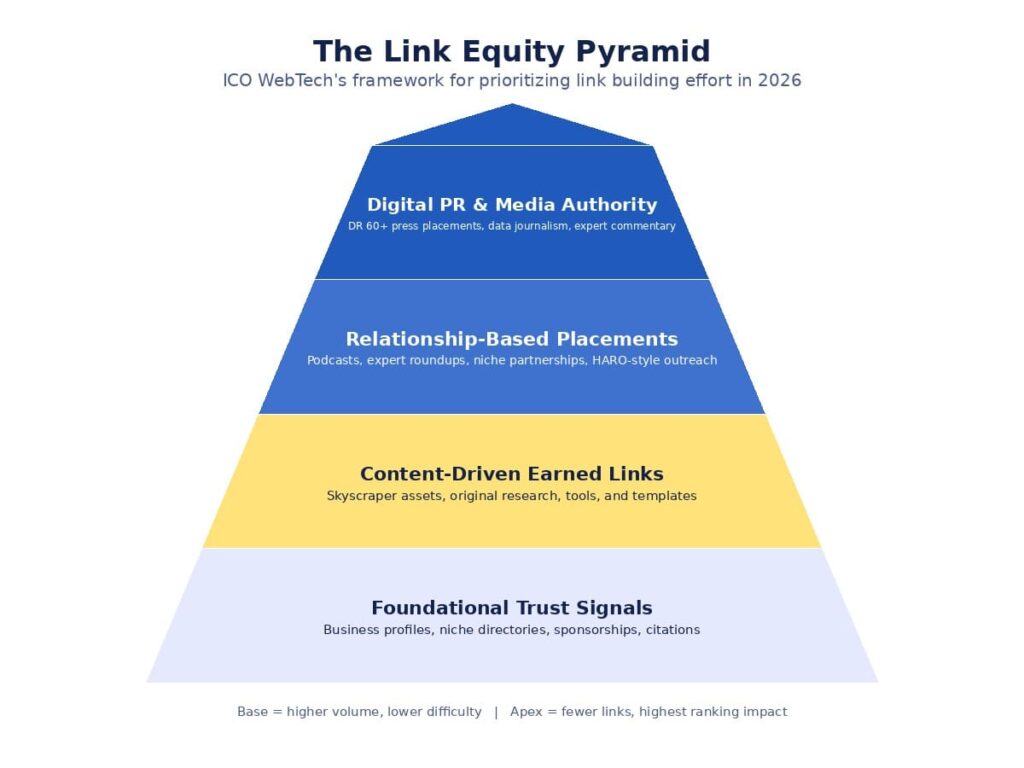
The Link Equity Pyramid: our framework for deciding where to spend your link building hours in 2026.
Tier 1: Foundational Trust Signals (Strategies 1–4)
These links build a baseline of credibility without doing much for your rankings on their own. Think of this tier as table stakes. Skipping it entirely can actually look suspicious to search engines and to real customers checking you out before they buy, but stacking your whole strategy on it will leave you stuck.
1. Niche directory and association listings. Forget generic web directories from 2012. What still works are listings inside your actual industry: trade associations, chamber of commerce sites, professional licensing boards, and vertical-specific directories your buyers already trust. These build entity recognition and consistent NAP (name, address, phone) data, which matters for local and B2B trust even if the SEO lift per link is small.
2. Digital sponsorships. Sponsoring a local sports team, an industry conference, a scholarship, or a community event usually earns you a link on their partners or sponsors page. Do this because it’s genuinely good for your brand and community standing, not purely to farm links, and pick sponsorships that overlap with your actual audience.
3. Supplier, partner, and vendor page links. If you buy software, materials, or services from other companies, ask if you can be featured as a client or case study on their site. B2B companies especially overlook this one, and it’s often just a matter of asking a account manager you already talk to regularly.
4. Customer success story co-marketing. When you publish a case study about a client’s results, many will happily link back to it from their own site, especially if you make it easy by sending them a ready-to-use blurb and the link. It’s a favor exchange, not a pitch, which is why it converts so well.
Tier 2: Content-Driven Earned Links (Strategies 5–9)
This is where link building starts to compound. Instead of asking for a link directly, you build something genuinely useful enough that other sites want to cite it on their own. It takes more upfront work than Tier 1, but each asset keeps earning links for years without you lifting a finger.
5. The skyscraper technique, modernized. The original idea still holds: find a piece of content that’s already earning links, then build something clearly better, and reach out to the sites linking to the original. What’s changed is the bar. “Better” in 2026 usually means original data, sharper visuals, and up-to-date examples, not just a longer word count. Thin, padded “skyscraper” posts get ignored now, because editors have seen a thousand of them.
6. Original research and data studies. This is one of the highest-leverage plays on this entire list. Survey your customers, mine your own product data, or aggregate public datasets into something nobody else has published. Journalists and bloggers need numbers to back up their stories, and if you’re the original source, you become the citation. This tactic sits near the top of our pyramid for a reason.
7. Free tools, calculators, and templates. A useful calculator, checklist, or template earns links passively because people bookmark and reference it, and other writers embed it in their own “best tools” roundups. These are some of the most durable linkable assets because they solve an ongoing problem rather than answering a one-time question.
8. Ultimate guides and resource hubs. A genuinely comprehensive guide on a topic your audience searches for becomes the page other content creators link to instead of writing their own explainer. The keyword is genuine. A guide stitched together from other articles doesn’t earn links; a guide built from real experience and original examples does. Our content marketing team builds these as part of a broader content strategy so they support both SEO and lead generation at the same time.
9. Custom visual assets. Well-designed infographics, comparison charts, and diagrams get embedded and cited far more than plain text, because they save the next writer time. If you’re publishing research or a process breakdown, turn it into something visual before you promote it. It’s a small extra step that noticeably increases pickup rates.
Tier 3: Relationship-Based Placements (Strategies 10–13)
This tier depends less on what you build and more on who you know, or who you’re willing to get to know. It moves slower than content-driven tactics, but the links tend to be higher authority because a real person is vouching for you.
10. Journalist request platforms. HARO shut down its old free model, but platforms like Qwoted, Featured, and Connectively fill the same role: journalists post requests for expert quotes, and you respond with a genuinely useful answer tied to your expertise. Personalization is everything here. AI-assisted outreach is getting a 4.19% response rate compared to 2.6% for generic pitches, a 61% lift, but editorial rejection rates have also climbed 33% as inboxes fill with lower-effort AI pitches (Arvow, 2026). Write like a human who actually read the request, and you’ll stand out.
11. Strategic guest posting. Guest posting isn’t dead, but the version that worked in 2015 is. Mass guest posting on low-quality “write for us” sites is a fast way to get penalized. What still works is contributing genuinely useful, non-duplicated content to publications your actual audience reads, with an editor who reviews submissions rather than a site that publishes anything for a fee. Our content writing team vets every placement against this exact standard before pitching a single word.
12. Podcast guesting and expert roundups. Getting interviewed on a niche podcast, or contributing a quote to an expert roundup post, usually earns a link in the show notes or the article, plus something more valuable long term: a relationship with a host or blogger who might feature you again. These placements also feed directly into the brand-mention signal that AI search tools increasingly reward.
13. Broken link building. Find dead links on resource pages in your niche using a tool like Ahrefs or Screaming Frog, then let the site owner know, and offer your own relevant page as a replacement. It’s a genuine favor, since you’re helping them fix a broken page, which is exactly why it still converts well when done thoughtfully instead of at mass-email scale.
Tier 4: Digital PR and Media Authority (Strategies 14–17)
Welcome to the top of the pyramid. These strategies take the most planning and the longest lead time, but they produce the backlinks that actually shift rankings, the ones from publications with real domain authority. 48.6% of SEO professionals now rate digital PR as the single most effective link-building tactic available, well ahead of guest posting at 16% (Editorial.Link, 2026).
14. Digital PR and newsjacking campaigns. Build a genuinely newsworthy story, a data angle, a survey, a trend analysis, then pitch it directly to journalists covering that beat. When it lands, you get coverage from a publication with real authority, and the backlink comes along naturally as a byproduct of the story, not as the ask itself. This is the strategy with the highest ceiling on this entire list.
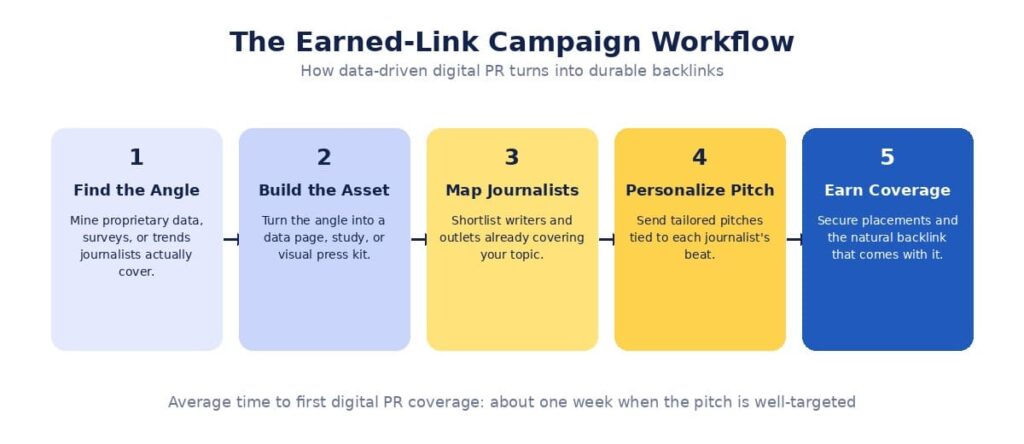
The basic shape of every successful digital PR campaign, from data angle to earned coverage.
15. Commissioned data journalism partnerships. Instead of pitching a finished story, partner directly with a journalist or outlet to co-create one using your data. You provide the raw numbers or access; they provide the platform and the byline. This works especially well for B2B and SaaS companies sitting on proprietary usage data nobody outside the company has seen.
16. Executive thought leadership and bylines. Getting your founder or a senior expert published as a contributing writer on an industry publication builds both a backlink and a personal brand that compounds over time. Editors are far more likely to accept a pitch tied to a named expert with real experience than an anonymous “company blog” submission, which lines up neatly with how Google evaluates E-E-A-T today.
17. Unlinked mention reclamation and competitor gap analysis. Two tactics, one habit: set up alerts for every time your brand is mentioned online without a link, then politely ask for one to be added. Separately, run your top three competitors’ backlink profiles through a tool like Ahrefs or Semrush and find sites linking to them but not to you. Both are quick wins because you’re not creating anything new, you’re recovering value that’s already sitting on the table.
Where To Actually Spend Your Time First
Seventeen strategies is a lot to juggle at once, so here’s how we’d sequence them for a typical business starting from zero. Start with the quick wins that need real effort but pay off fast, like broken link building and journalist request platforms. Layer in the strategic bets, original research, and digital PR as soon as you have the bandwidth, because those compound the longest. Treat directories and mass guest posting as background maintenance, not your main strategy.
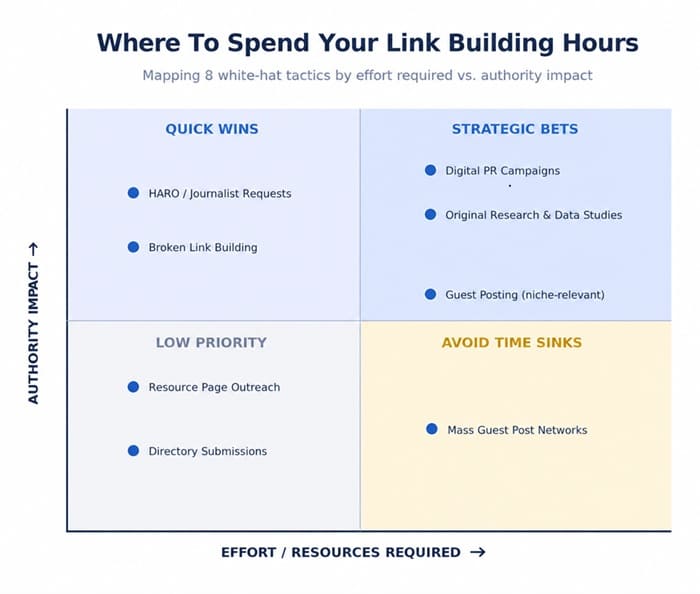
Effort versus impact for eight of the tactics above. Notice how little authority mass guest posting and directory submissions actually buy you.
A useful benchmark while you’re planning: 57.1% of SEOs expect to see measurable results within one to three months of consistent effort (Arvow, 2026), and 81% of digital PR teams land their first piece of coverage within a week of pitching (Arvow, 2026). If you’re three months into a campaign with nothing to show, it’s worth auditing whether you’re actually running Tier 3 and Tier 4 tactics, or quietly stuck in Tier 1.
Get Your Anchor Text Mix Right (Or Risk an Over-Optimization Penalty)
None of the above matters if you sabotage it with sloppy anchor text. Google can spot an unnatural pattern of exact-match anchors from a mile away, and it’s one of the fastest ways to trigger a manual action. The good news is that the healthy mix is well documented by the industry at this point, and it’s easy to follow once you know the target.
Partial-match and branded anchors should make up the bulk of your profile, especially on links you have any control over.
Partial-match anchor text, phrases that include your target keyword naturally within a longer phrase, is the top choice for 41.7% of link builders surveyed, followed by exact-match at 25.1% and branded anchors at 20.5% (Editorial.Link, 2026).
A practical rule of thumb: on links you actually control, like guest posts and digital PR pitches, keep exact-match anchors well under 10%, and lean heavily on branded and partial-match instead. On editorial links you don’t control, like a journalist citing your research, don’t worry about the anchor text at all. That’s exactly the kind of organic variation Google wants to see.
Here’s what that looks like in practice. Say you’re earning links back to a page about link building services. A natural, healthy spread of anchors pointing at that one page might read like this:
- Partial-match: “ICO WebTech’s guide to link building strategy”
- Branded: “ICO WebTech”
- Exact-match: “link building services” (used sparingly)
- Naked URL / generic: “icowebsolutions.com” or “read more here”
Notice that only one of those four leans on the exact keyword. If every single link pointing at that page used “link building services” as the anchor, it would look manufactured, because in the real world, nobody links to the same page with the same three words every time. Mix it up the way people actually write, and the anchor profile takes care of itself.
Mistakes That Quietly Damage Your E-E-A-T
Most link building damage isn’t dramatic. It’s not one obvious black-hat move; it’s a slow accumulation of shortcuts that erode trust with both search engines and readers. A few things worth watching closely:
- Buying links in bulk from marketplaces, even “white label” ones that promise they’re safe. 91.89% of SEOs believe their competitors are buying links, and 89% see spammy outbound links as the single biggest red flag when evaluating a site for placement (Editorial.Link, 2026).
- Guest posting on sites that will publish anything literally for a fee, since these sites tend to get deindexed in waves, taking your links down with them.
- Ignoring link rot. Roughly 1.3% of links die every week, and Ahrefs’ long-term study found that 66.5% of links across 2 million sites had decayed since 2013 (QuickSEO, 2026). If you’re not periodically checking which of your earned links still resolve, you’re likely overestimating your own authority.
- Treating anchor text as a lever to pull hard instead of a natural byproduct of good writing.
If you’re not sure where your current backlink profile stands, or you suspect a past agency left you with a pile of risky links, it’s worth getting an audit before you build anything new on top of it. Our toxic backlink removal service exists specifically for that cleanup work, so your new link-building effort isn’t fighting against your old one.
Frequently Asked Questions
Is link building still worth it in 2026? Yes. Backlinks remain a foundational ranking signal even as Google weighs hundreds of other factors, and controlled studies continue to show that removing links causes measurable traffic drops (Heroic Rankings, 2026; QuickSEO, 2026). What’s changed is which tactics work, not whether the discipline itself matters.
How many backlinks do I actually need? It depends entirely on your competition. Low-competition, long-tail keywords can rank with as few as five to ten backlinks, while competitive commercial terms often require hundreds of referring domains (Searchlab, 2026). Quality and relevance matter more than hitting any specific number.
How long until link building shows results? Most SEOs report seeing measurable movement within one to three months of consistent activity (Arvow, 2026), though digital PR campaigns can land individual placements within a week. Rankings tied to those links typically take longer to stabilize.
Should I still do guest posting? Selectively, yes. The version that still works is contributing genuinely useful content to relevant, editorially reviewed publications, not mass submissions to any site that will take a fee. Guest posting ranks well behind digital PR in effectiveness surveys, but it still has a place in a diversified strategy (Arvow, 2026).
Do backlinks matter for showing up in AI search tools like ChatGPT? They help, but brand mentions matter more. Mentions correlate with AI Overview visibility roughly three times more strongly than backlinks do (Arvow, 2026), which is why digital PR and expert commentary belong in any 2026 strategy, not just traditional outreach.
Turn This Into a Working Link Building System
Reading through 17 strategies is one thing. Actually running them, week after week, while also handling content creation, technical SEO, and everything else on a marketing team’s plate, is another. That’s the gap most in-house teams hit around month two, right when digital PR and original research campaigns need consistent attention to start paying off.
This is exactly what our team handles day to day. At ICO WebTech, we build link acquisition programs around the same Link Equity Pyramid you just read about, prioritizing the tactics that actually move your rankings instead of padding a monthly report with directory submissions. If you want a second set of eyes on your current backlink profile, or you’re ready to build a real digital PR pipeline for your brand, our SEO team is happy to walk through where you stand today and what the fastest path forward looks like.
Get in touch with ICO WebTech to build your 2026 link building strategy →
Sources
Arvow. (2026). Link building statistics 2026: The complete data report. https://arvow.com/blog/link-building-statistics-2026
DemandSage. (2026). 55 link building statistics 2026 [Cost, trends & market size]. https://www.demandsage.com/link-building-statistics/
Editorial.Link. (2026). Link building statistics based on a survey of 518 SEO experts. https://editorial.link/link-building-statistics/
Heroic Rankings. (2026). Link building statistics: How the industry is changing in 2026. https://heroicrankings.com/seo/linkbuilding/link-building-statistics-2026/
QuickSEO. (2026). Link building statistics 2026: 70+ data points (including AI search). https://quickseo.ai/blog/link-building-statistics-2026-70-data-points-including-ai-search
Searchlab. (2026). Link building statistics 2026 | 80+ backlink data & benchmarks. https://searchlab.nl/en/statistics/link-building-statistics-2026



Related items

Baymard Institute’s 2026 benchmark found that 52% of desktop sites and 62% of mobile sites

Depending on which 2026 survey you read, somewhere between 34% and 77% of US shoppers have
Ahrefs studied one million random web pages and found that only 1.74% of newly published p
