A plain-English breakdown of two very different marketing worlds, with real numbers and real examples.
Setting the Stage
Two Buyers. Two Completely Different Brains.
Imagine you sell office chairs. One customer is Rahul — he works from home and wants something comfortable for under ₹8,000. He sees an Instagram ad, reads a few reviews, and places an order in 20 minutes. Done.
Now imagine your other customer is a 500-person IT company that needs 200 chairs for a new office. Their procurement team gets three quotes, their finance head reviews the budget, their HR team checks ergonomic standards, and their admin manager finally signs off — six weeks later.
Same product. Completely different marketing game. That’s B2B versus B2C in a nutshell.
“Marketing to a business isn’t just marketing to more people — it’s marketing to a different kind of decision altogether.”
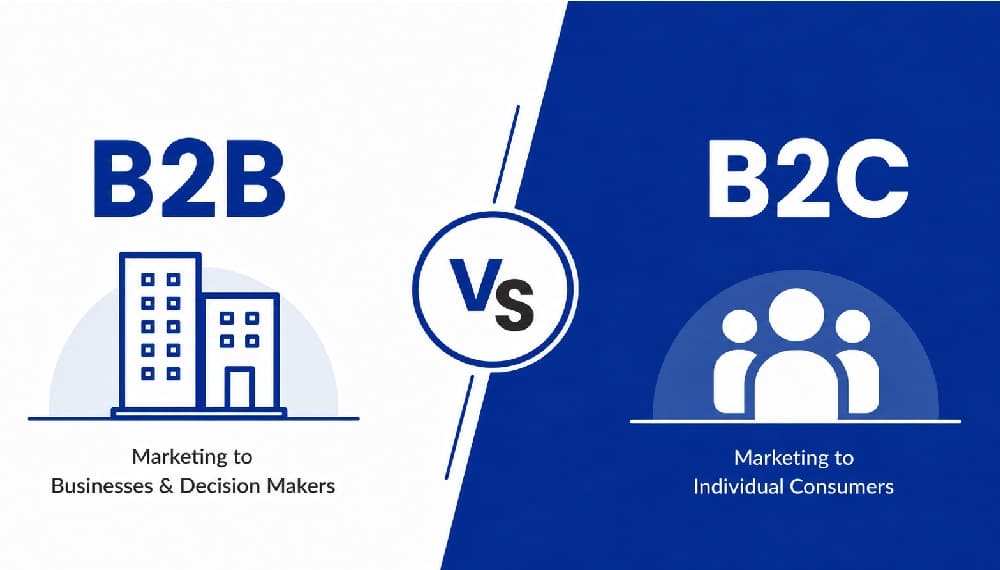
B2C (Business-to-Consumer) means you’re selling directly to individuals. B2B (Business-to-Business) means your customer is another company. Both need great marketing — but the playbook is genuinely different. Let’s break it down clearly.
Marketing by the Numbers
Three statistics that tell you why this distinction matters.
77%
of B2B buyers say their last purchase was very complex or difficult, involving multiple stakeholders
Source: Gartner
6–10
people are involved in a typical B2B purchase decision — compared to usually just 1 in B2C
Source: Gartner B2B Buying Report
70%
of B2C buying decisions are influenced by emotion, not logic — the exact opposite of most B2B decisions
Source: Harvard Business Review
Core Differences
The 5 Big Differences — Explained Simply
Let’s go through the real differences without the jargon. Each one matters for how you write, where you advertise, and what you say.
Decision Logic
B2C buyers feel, then think. B2B buyers think, then think some more. Emotion drives a B2C purchase; ROI justifies a B2B one.
Time to Buy
B2C can be minutes. B2B can be months. Enterprise software deals routinely take 6–18 months from first contact to contract.
Who Decides
B2C: one person with a credit card. B2B: a committee — sometimes a very large one. You need to convince multiple people with different priorities.
Language & Tone
B2C language is emotional, punchy, and personal. B2B language is credible, data-driven, and professional — though never boring.
Where You Market
B2C thrives on Instagram, influencers, and TV. B2B lives on LinkedIn, case studies, whitepapers, and webinars.
Deal Size
B2C deals are small but numerous. B2B deals are bigger, longer in value, but require far more relationship-building to win.
Visualised Data
Where Marketing Budgets Go — B2B vs B2C
See how the two types of businesses allocate their marketing budgets across channels. The difference is stark.
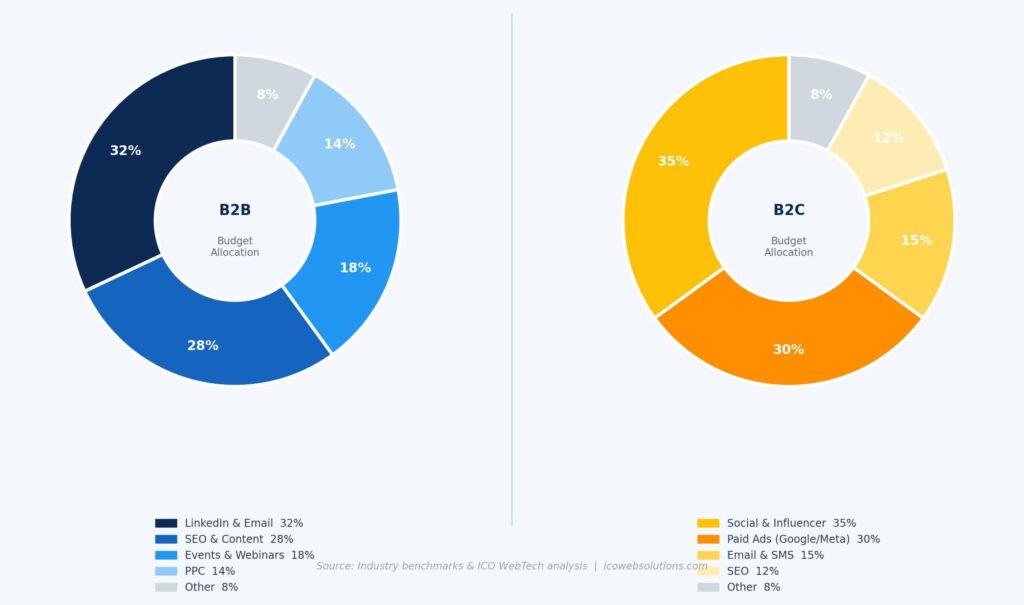
Representative averages based on industry benchmarks. Actual allocations vary by sector and business size.
Real-World Examples
The Same Product, Two Completely Different Pitches
Let’s use cloud storage software as our example. Same product. Totally different marketing approach depending on who’s buying.
B2B Example
Selling to a Manufacturing Company
Your ad headline: “Reduce document retrieval time by 40%. SOC-2 certified. Integrates with SAP.”
You follow up with a product demo, a security whitepaper, a pricing proposal, and a case study from a similar manufacturer. The IT head, CFO, and COO all weigh in before signing.
B2C Example
Selling to an Individual User
Your Instagram ad says: “Never lose a photo again. ₹99/month. Free 30-day trial.”
The user clicks, signs up, adds a credit card. Total time from ad to purchase: 4 minutes. The decision was about peace of mind, not procurement policy.
Both are marketing cloud storage. But notice how different the messaging is. B2B focuses on ROI, compliance, and integration. B2C focuses on feeling, simplicity, and value. Neither is better — they’re just designed for entirely different buyers.
“In B2C, you’re writing for a person’s heart. In B2B, you’re writing for a committee’s spreadsheet — and sometimes, for both.”
Here’s another quick example closer to our world at ICO. When we’re pitching a website design project to a fashion brand (B2C company), their founders want to see stunning visuals and a portfolio of beautiful sites. When we’re pitching to a logistics firm (B2B company), they want to know about lead generation, SEO, and how the site will be found by the businesses who need their services. Same deliverable. Completely different conversation.
Comparing the Two
Key Metrics: B2B vs B2C Side by Side
A visual comparison of how the two models perform across five important marketing metrics.
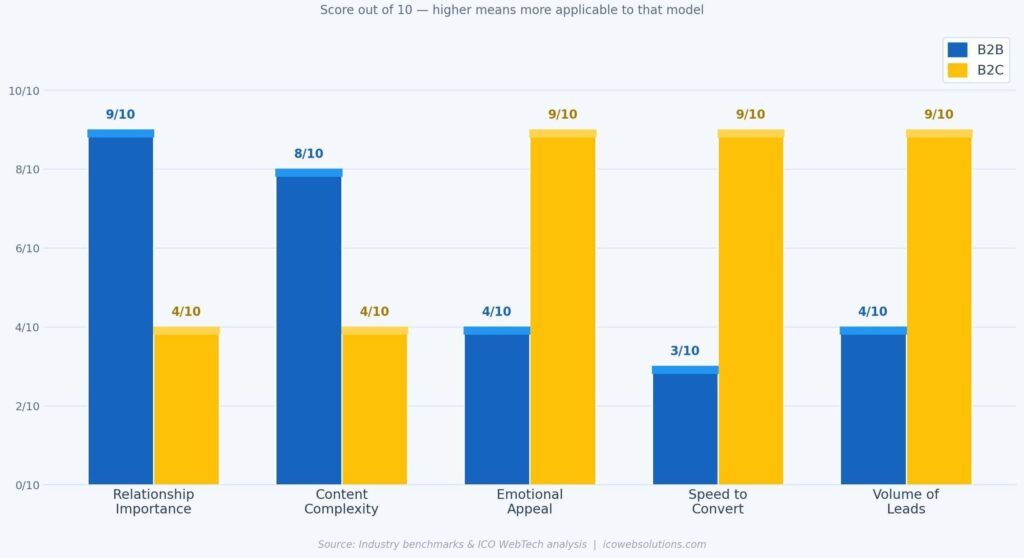
Illustrative relative scores based on industry patterns. Not absolute measurements.
Quick Reference
B2B vs B2C — The Full Picture
A side-by-side table that covers everything from audience to average sale cycle. Bookmark this.
| Factor | B2B | B2C |
|---|---|---|
| Audience | Companies, procurement teams, decision committees | Individual consumers |
| Decision Driver | ROI, efficiency, risk reduction | Emotion, aspiration, value |
| Sales Cycle | Weeks to months (sometimes years) | Minutes to days |
| Number of Buyers | 6–10 stakeholders on average | Usually 1 person |
| Content Type | Case studies, whitepapers, demos, webinars | Ads, influencers, reviews, videos |
| Primary Channels | LinkedIn, email, SEO, events | Instagram, YouTube, Google Ads, TV |
| Relationship Depth | Long-term partnerships, account management | Transactional, loyalty programs |
| Price Sensitivity | Less price-sensitive if ROI is proven | Highly price-sensitive |
| Brand vs Product | Trust and credibility of brand matter most | Product appeal and lifestyle fit matter most |
The Real Answer
So — Are They Really That Different?
Yes and no. They are different in execution — channels, tone, timelines, and metrics all change. But at their core, both B2B and B2C marketing are about the same thing: understanding what a person (or a group of people) truly needs, and showing them — clearly and convincingly — that you can provide it.
The mistake many businesses make is treating B2B as if emotions don’t matter, or treating B2C as if there’s no logic involved. A CFO approving a ₹50 lakh software purchase still wants to feel confident and respected. A consumer buying a luxury watch still wants data on durability and service warranties.
Great marketers in both worlds ask the same question: Who is making this decision, and what do they need to feel — and know — before they say yes?
At ICO WebTech, we work with both B2B and B2C clients. Our SEO strategies look different for a manufacturing exporter versus a fashion label. Our web design conversations are different for a logistics company versus an online store. But the discipline — understanding the buyer deeply and building your marketing around that understanding — is identical.
Not Sure Which Strategy Is Right for Your Business?
Whether you’re a B2B company looking to generate better leads or a B2C brand aiming for more conversions — we’ll help you build a marketing plan that actually fits your buyer.
Published by ICO WebTech — Digital Marketing & Web Design Company in Delhi, India | Since 2011
SEO · PPC · Web Design · B2B Marketing · B2C Marketing · Content Strategy



Related items
It is Monday morning, and a new proposal has landed in your inbox. It includes a fresh lin
Freelancer vs Agency vs In-House: How to Choose the Marketing Team That Fits Your Business Right Now
Gartner’s 2025 CMO Spend Survey found that marketing budgets average 7.7% of company reven
Driving traffic to your ecommerce store is only half the job. The harder part is getting t
