
Get Your Website Problem Fixed Fast
Need Something Fixed on Your Website?
Send us your website. We’ll take a quick look and tell you exactly what’s wrong, no long forms, no sales pitch, just a straight answer.
Send Us Your Website on WhatsApp
or email us your website link instead
What Kind of Problem Are You Dealing With?
If it’s on this list, there’s a good chance we’ve already fixed it for someone else.
- WordPress errors
- Slow website
- Hacked website
- WooCommerce problems
- SSL / DNS issues
- PHP errors
- Google indexing problems
- Hosting migration
Don’t see your issue listed? Send it over anyway, there’s a good chance we can still help.
How It Works
1. Send us your website — just the link and a quick line about what’s going wrong.
2. We take a look — usually within a few hours, not days.
3. We tell you straight — what’s broken, what it’ll take to fix, and what it’ll cost.
No commitment. If it’s a five-minute fix, we’ll just tell you how.
Or Fill the Form Below

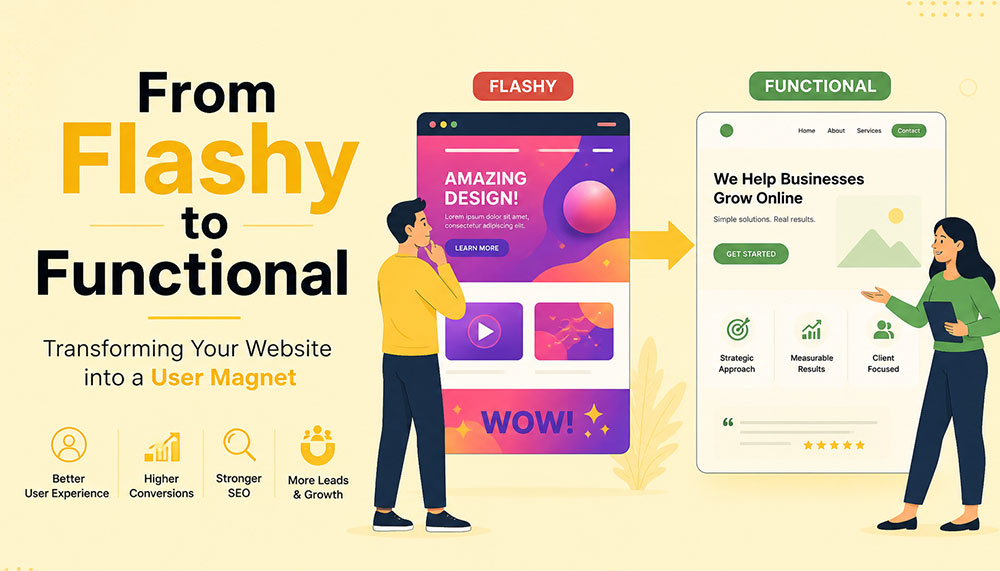
From Flashy to Functional: Transforming Your Website into a User Magnet
In the early days of the internet, a flashy website was often enough to impress visitors. Bright colors, animations, auto-playing media, and complex layouts were seen as signs of creativity and innovation. But times have changed. Today’s users are smarter, faster, and far less patient. A visually overloaded website is no longer impressive—it’s exhausting.
If your website looks stunning but fails to convert visitors into customers, then it’s not doing its job. The modern approach to web design focuses on functionality, usability, speed, and experience. Businesses that understand this shift are the ones that win.
This article explores how to transform your website from merely flashy to genuinely functional—and ultimately turn it into a powerful user magnet.
The Problem with “Flashy” Websites
At first glance, a flashy website can feel impressive. Bright visuals, animations, sliders, and interactive effects often give the illusion of sophistication and creativity. But here’s the reality—what looks exciting to a designer can quickly become frustrating for a user.
Today’s internet users are not browsing casually—they’re searching with intent. They want answers, solutions, and clarity within seconds. If your website slows them down or overwhelms them, they won’t admire the design—they’ll abandon it.
Flashy websites often prioritize aesthetics over usability. While they may look appealing initially, they tend to create friction in the user journey. And in the digital world, even small friction points can lead to big losses in engagement and conversions.
Let’s take a closer look at the common problems:
- Slow loading times: Heavy animations, large images, auto-playing videos, and complex scripts can significantly slow down your website. Users today expect pages to load almost instantly. Even a delay of a few seconds can cause frustration and increase bounce rates.
- Confusing navigation structures: Over-designed menus, hidden navigation elements, or too many options can leave users unsure of where to go next. When visitors feel lost, they rarely try to figure things out—they simply exit.
- Distracting visual elements: Too many moving parts—sliders, pop-ups, flashing banners—can shift attention away from what actually matters: your message. Instead of guiding users, these elements overwhelm them.
- Poor mobile responsiveness: A design that looks great on a desktop may completely break on a mobile device if not optimized properly. With the majority of users browsing on smartphones, this is a critical flaw.
- Low accessibility: Flash-heavy designs often ignore accessibility standards. Poor contrast, unreadable fonts, or non-intuitive layouts can make it difficult for users with different abilities to interact with your website.
Think about your own browsing habits. When you land on a website that takes too long to load or feels complicated, what do you do? Most likely, you hit the back button. That’s exactly what your visitors are doing too.
Modern users expect instant gratification. They want fast, smooth, and effortless experiences. If your website fails to deliver that within the first few seconds, you’ve already lost their attention—and potentially their business.
This is why businesses today are shifting their focus from “looking impressive” to “working effectively.” A professional Website Designing company in India understands this balance. Instead of adding unnecessary elements, they focus on creating clean, user-friendly designs that guide visitors naturally and help businesses achieve real results.
Because in the end, a website isn’t meant to just impress—it’s meant to perform.
Understanding the Shift: From Design to Experience
There was a time when website design was judged almost entirely by how it looked. If it was visually appealing, colorful, and “different,” it was considered successful. But that definition has evolved—dramatically.
Today, design alone is not enough. A website can look stunning and still fail miserably if it doesn’t deliver a smooth, intuitive experience. This is where the shift happens—from design-centric thinking to experience-centric thinking.
In simple terms, it’s no longer just about how your website looks. It’s about how it feels to use.
When a user lands on your website, they are not there to admire your design skills. They are there with a purpose—maybe to learn something, compare options, or make a purchase. The faster and easier you help them achieve that goal, the more successful your website becomes.
This is why User Experience (UX) and User Interface (UI) design have become the backbone of modern websites. These disciplines focus on understanding user behavior, removing friction, and creating seamless interactions.
Instead of asking “Does it look good?”, businesses now need to ask deeper, more practical questions:
- Is it easy to use? Can a first-time visitor navigate your website without confusion, or do they have to think too much before taking action?
- Can users find what they need quickly? In a world where attention spans are shrinking, every second matters. If users have to dig through multiple pages to find basic information, they won’t stick around.
- Does it guide users toward action? A good website doesn’t just present information—it gently leads users toward the next step, whether that’s filling out a form, making a purchase, or contacting your team.
- Does it work seamlessly on all devices? Your audience is browsing on phones, tablets, laptops, and everything in between. A consistent and smooth experience across all devices is no longer optional.
Think of your website like a physical store. A beautifully designed store with confusing layouts, hard-to-find products, and unhelpful staff will struggle to make sales. On the other hand, a clean, well-organized store that makes shopping easy will naturally attract and retain customers.
The same principle applies online.
Functionality doesn’t mean sacrificing beauty—it means giving beauty a purpose. Every design element, from colors to typography to spacing, should support usability rather than distract from it.
This is where experienced professionals, such as a Website Designing company in India, bring real value. They don’t just design for visual appeal—they design for human behavior, ensuring that every click, scroll, and interaction feels natural and meaningful.
Because at the end of the day, users don’t remember how “cool” your website looked. They remember how easy it was to use—and whether it helped them get what they came for.
Key Elements of a Functional Website
A functional website doesn’t happen by accident—it’s the result of thoughtful planning, user understanding, and smart design decisions. Every element on your website should have a purpose. When all these elements work together, they create an experience that feels smooth, intuitive, and satisfying for the user.
Let’s break down the core elements that truly make a website functional—not just visually appealing, but genuinely effective.
1. Clear and Intuitive Navigation
Your website should feel effortless to explore. A visitor should land on your homepage and instantly understand where to go next—without thinking too hard. The moment users feel confused, they start losing trust.
Think of navigation as a roadmap. If the directions aren’t clear, people won’t keep wandering—they’ll simply leave and find another destination.
A well-structured navigation system includes:
- Simple menus with clear labels: Avoid clever or vague naming. “Services,” “About,” and “Contact” may sound basic, but they work because users instantly recognize them.
- Logical page hierarchy: Your pages should be organized in a way that makes sense. Important information should never be buried deep within multiple clicks.
- Easy access to key pages: High-priority pages like pricing, services, or contact information should always be easy to find—preferably within one or two clicks.
If users get lost, they leave. It’s that simple. Good navigation doesn’t draw attention to itself—it just works seamlessly in the background.
2. Fast Loading Speed
Speed is one of the most critical factors in user experience. No matter how beautiful your website is, if it takes too long to load, users won’t wait around to see it.
We live in a world of instant results. A delay of even one second can feel like an eternity—and that’s often enough to lose a potential customer.
To improve your website’s speed:
- Optimize images: Large, uncompressed images are one of the biggest causes of slow websites. Proper optimization keeps quality high while reducing load time.
- Use efficient code: Clean, streamlined coding reduces unnecessary load on your website.
- Leverage caching: Caching helps store data so returning users can access your site faster.
- Choose reliable hosting: Your hosting provider plays a major role in your website’s performance. A slow server means a slow website—no matter what you do.
A skilled Website Designing company in India understands that performance is not an afterthought. They build speed optimization into the foundation of your website from the very beginning.
3. Mobile Responsiveness
Take a moment to think about how often you use your phone to browse the internet. Now imagine your website being viewed on that small screen. Does it still look clean? Is it easy to navigate? Can users interact with it comfortably?
With mobile users now dominating web traffic, your website must perform flawlessly across all screen sizes. A responsive design ensures that your website adapts automatically—no matter what device is being used.
This includes:
- Content that adjusts smoothly: Images, text, and layouts should resize and rearrange themselves for different screen sizes.
- Tap-friendly buttons: Buttons should be large enough and spaced properly so users can easily tap them without frustration.
- Readable text: Users shouldn’t have to zoom in just to read your content. Proper font sizing is essential.
A mobile-first approach is no longer optional—it’s the standard. If your website doesn’t work well on mobile, you’re likely losing a significant portion of your audience.
4. Strong Visual Hierarchy
When users land on your website, they don’t read every word—they scan. Your design should guide their eyes naturally, helping them understand what’s important within seconds.
This is where visual hierarchy comes in. It’s the art of organizing content in a way that leads users through your website effortlessly.
You can achieve this through:
- Proper use of headings: Headlines should stand out and clearly communicate key messages.
- Contrasting colors: Important elements like call-to-action buttons should be visually distinct.
- Whitespace: Giving elements room to breathe makes your website easier to read and less overwhelming.
- Strategic placement: Key information should be positioned where users naturally look first.
A clean, well-structured layout often outperforms a cluttered design. Simplicity doesn’t mean boring—it means effective.
5. Compelling and Clear Content
Design might bring users in, but content is what keeps them there—and ultimately convinces them to take action.
Your messaging should speak directly to your audience. It should answer their questions, address their concerns, and clearly explain how you can help them.
Effective website content is:
- Clear and concise: Avoid unnecessary jargon or long-winded explanations. Get to the point quickly.
- User-focused: Instead of talking only about your business, focus on what the user gains.
- Easy to scan: Use short paragraphs, bullet points, and headings to make content digestible.
Within a few seconds of landing on your website, visitors should understand exactly what you offer and why it matters to them. If they have to guess, you’ve already lost them.
When all these elements come together—navigation, speed, responsiveness, hierarchy, and content—you don’t just have a website. You have a powerful user experience that attracts, engages, and converts.
Why Functionality Drives Conversions
At the end of the day, your website has a job to do. Whether it’s generating leads, selling products, or encouraging inquiries—everything comes down to conversions. And here’s the truth many businesses overlook: people don’t convert because your website looks good… they convert because it feels easy.
A functional website removes friction from the user journey. It makes every step—from landing on the page to taking action—feel natural and effortless. When users don’t have to struggle, think too much, or second-guess their decisions, they are far more likely to move forward.
Think of it like walking into a well-organized store. You can quickly find what you need, understand the pricing, and check out without confusion. Compare that to a cluttered store where nothing is clearly labeled—you’d probably walk out. The same psychology applies to your website.
Functionality builds trust. And trust is the foundation of every conversion.
When users can easily navigate your website, find relevant information, and complete actions without frustration, they begin to feel confident in your brand. On the other hand, even small issues—like a confusing layout or a slow-loading page—can create doubt and push them away.
A conversion-focused website is intentionally designed to guide users toward action. It doesn’t leave things to chance. Every element plays a role in helping users take the next step.
Here’s what that looks like in practice:
- Clear call-to-action (CTA) buttons: Your CTAs should stand out and communicate exactly what users need to do next—whether it’s “Get a Quote,” “Book a Demo,” or “Buy Now.” There should be no confusion or hesitation.
- Minimal distractions: Too many pop-ups, animations, or competing elements can overwhelm users and dilute your message. A clean, focused design keeps attention where it matters most.
- Trust signals: People are naturally cautious online. Reviews, testimonials, case studies, certifications, and client logos help reassure users that they’re making the right choice.
- Simplified forms and checkout processes: The more steps you add, the more users you lose. Shorter forms, fewer fields, and a smooth checkout experience can significantly increase conversions.
It’s important to understand that users don’t want to “work” to interact with your website. The easier you make things for them, the more likely they are to take action.
This is why businesses increasingly partner with a Website Designing company in India that focuses on performance-driven design. Instead of adding unnecessary features, they refine the user journey—removing obstacles and guiding users toward meaningful actions.
Every element on your website should have a clear purpose. If something doesn’t contribute to the user experience or support conversions, it’s likely doing more harm than good.
Because in the digital world, simplicity isn’t just a design choice—it’s a competitive advantage.
The Role of User Psychology
Behind every click, scroll, and decision on your website, there’s a human mind at work. And that mind doesn’t behave randomly—it follows patterns. Understanding these patterns is what separates an average website from one that truly connects with users.
One of the biggest misconceptions in web design is assuming that users carefully read everything on a page. In reality, they don’t. People scan. They skim through headings, glance at visuals, and look for familiar cues that help them quickly understand what to do next.
This means your website isn’t just a collection of pages—it’s an experience shaped by human behavior. The more you align your design with how people naturally think and interact, the more effective your website becomes.
Let’s explore some key psychological principles that influence user behavior:
- Familiarity: Users feel comfortable with what they already recognize. This is why most successful websites follow certain standard patterns—like having a logo at the top left, navigation at the top, and contact information easily accessible. When you stick to familiar structures, users don’t have to “learn” how to use your website—they already know.
- Clarity: The human brain prefers simplicity. When a website is cluttered or overly complex, it increases cognitive load—meaning users have to work harder to process information. And when things feel difficult, people tend to give up. Clean layouts, simple messaging, and clear pathways reduce this mental effort and keep users engaged.
- Trust: First impressions happen in seconds. A clean, professional-looking website instantly builds credibility, while a messy or outdated design raises doubts. Elements like consistent branding, high-quality visuals, testimonials, and secure browsing indicators all contribute to building trust.
- Urgency: People are more likely to take action when they feel a sense of urgency. Strategic prompts like limited-time offers, countdowns, or phrases such as “Only a few spots left” can encourage users to act sooner rather than later. When used thoughtfully, urgency can significantly improve conversions without feeling pushy.
Think about your own online behavior. When you visit a website, you instinctively look for certain things—clear headings, easy navigation, and quick answers. If those elements are missing, frustration builds almost instantly.
This is why understanding user psychology isn’t optional—it’s essential. A website that aligns with human behavior feels intuitive, trustworthy, and easy to use.
A modern Website Designing company in India doesn’t just focus on visuals or code—they dive deeper into how users think, what motivates them, and what stops them from taking action. By combining design expertise with behavioral insights, they create websites that don’t just look good—they feel right.
Because when your website speaks the language of your users’ minds, engagement and conversions naturally follow.
Common Mistakes to Avoid
Sometimes, the biggest problems on a website aren’t what’s missing—they’re what’s unnecessarily added. Many businesses invest time and money into their websites, yet unknowingly make decisions that hurt performance instead of improving it.
The tricky part? These mistakes often come from good intentions—trying to impress users, add more information, or stand out from competitors. But in reality, they end up doing the opposite.
Let’s break down some of the most common website mistakes and why they matter:
- Overusing animations and effects: Animations can enhance a website when used sparingly, but too many moving elements can overwhelm users. Sliders, pop-ups, hover effects, and auto-playing media can quickly turn from engaging to distracting. Instead of focusing on your message, users get caught up in visual noise—and often leave before taking any action.
- Ignoring mobile users: This is one of the most costly mistakes today. A website that works perfectly on desktop but feels clunky on mobile is guaranteed to lose a large portion of its audience. Tiny buttons, misaligned content, and slow mobile performance create frustration and drive users away almost instantly.
- Cluttering pages with too much information: It’s tempting to put everything on one page—every service, every feature, every detail. But more information doesn’t always mean better communication. When pages are overcrowded, users don’t know where to focus. Instead of reading more, they end up reading nothing at all.
- Using unclear or generic CTAs: Call-to-action buttons like “Click Here” or “Submit” don’t tell users what they’re getting. Strong CTAs are specific and action-driven—like “Get Your Free Quote” or “Book a Consultation.” Clarity here can make a huge difference in conversion rates.
- Neglecting SEO fundamentals: A beautiful website is useless if no one can find it. Ignoring SEO basics—like proper headings, meta tags, keyword optimization, and page speed—limits your visibility on search engines. Without traffic, even the best-designed website won’t deliver results.
If you look closely, all these mistakes have one thing in common: they prioritize business preferences over user needs. And that’s where things start to go wrong.
The good news is that these issues are completely fixable. In fact, addressing even a few of them can lead to noticeable improvements in user engagement, time on site, and conversions.
This is why many businesses turn to an experienced Website Designing company in India to audit and refine their websites. With a fresh perspective and user-focused approach, they can identify hidden issues and transform your website into something far more effective.
Because sometimes, improving your website isn’t about adding more—it’s about removing what’s getting in the way.
Balancing Aesthetics and Functionality
There’s a common misconception in web design—that you have to choose between a website that looks beautiful and one that works well. In reality, the most successful websites don’t pick one over the other. They strike a balance.
Visual appeal matters. It creates the first impression, sets the tone for your brand, and captures attention. But if that visual appeal comes at the cost of usability, it quickly loses its value. On the other hand, a purely functional website that lacks personality can feel dull and forgettable.
The real goal is to bring both together—where design enhances functionality, not competes with it.
Think of your website like a well-designed workspace. It should look inviting and professional, but more importantly, everything should be placed exactly where it’s needed. Nothing should feel out of place, unnecessary, or confusing.
Here are some practical ways to achieve that balance:
- Using a consistent color palette: Colors play a huge role in how users perceive your brand. A consistent palette creates a sense of harmony and professionalism. It also helps guide user attention—for example, using a specific color for buttons makes them instantly recognizable.
- Choosing readable fonts: Stylish typography can enhance your design, but readability should always come first. If users have to strain their eyes to read your content, they won’t stick around. Clean, simple fonts with proper spacing make a big difference in user comfort.
- Maintaining visual consistency: Consistency builds familiarity and trust. When elements like buttons, headings, spacing, and layouts follow a uniform style across your website, users feel more comfortable navigating it. Inconsistency, on the other hand, creates confusion and disrupts the experience.
- Using images purposefully: Images should support your message—not just fill space. High-quality visuals can enhance storytelling, explain concepts, and create emotional connections. But irrelevant or excessive images can slow down your website and distract users from your core message.
It’s also important to remember that simplicity is powerful. A clean design with thoughtful spacing and focused content often feels more premium than a cluttered, over-designed layout.
This is where experienced professionals, such as a Website Designing company in India, truly make a difference. They understand how to blend creativity with usability—ensuring that every design choice serves a purpose and contributes to the overall experience.
At its core, design is not the end goal—it’s a tool. A tool to communicate, guide, and engage your users. When used wisely, it doesn’t just make your website look better—it makes it work better.
And that’s the kind of balance that turns visitors into loyal users.
How SEO and Functionality Work Together
SEO and website functionality are often treated as two separate things—but in reality, they are deeply connected. You can’t build a strong online presence by focusing on just one. The websites that perform best today are the ones where SEO and user experience work hand in hand.
Search engines like Google are no longer just scanning your website for keywords. They are analyzing how users interact with it. Do people stay on your site? Do they explore multiple pages? Or do they leave within seconds? These behaviors send powerful signals about the quality of your website.
In simple terms, search engines want to recommend websites that users actually enjoy using. And that’s exactly where functionality comes into play.
A functional website naturally supports SEO because it creates a better experience for users—and when users are happy, search engines take notice.
Here’s how functionality directly impacts your SEO performance:
- Improving page speed: Fast-loading websites not only keep users engaged but are also favored by search engines. Speed is a ranking factor, and even small improvements can make a noticeable difference in your visibility.
- Enhancing mobile usability: With mobile-first indexing, search engines prioritize how your website performs on mobile devices. A responsive, mobile-friendly design ensures that your site ranks better and reaches a wider audience.
- Reducing bounce rates: When users land on your website and immediately leave, it signals that something isn’t working—whether it’s slow speed, poor design, or irrelevant content. A functional website keeps users engaged and encourages them to stay longer.
- Encouraging longer session durations: When your website is easy to navigate and provides valuable content, users naturally spend more time exploring it. This increased engagement sends positive signals to search engines about your site’s relevance and quality.
It’s important to understand that SEO is no longer just about ranking—it’s about retention. Getting users to your website is only half the battle. Keeping them there is what truly makes the difference.
This is why businesses are increasingly working with a Website Designing company in India that understands both SEO and user experience. Instead of treating them as separate strategies, they integrate them into a unified approach—building websites that are not only easy to find but also enjoyable to use.
When your website is fast, intuitive, and user-friendly, visitors stay longer, interact more, and trust your brand. And when that happens consistently, search engines recognize your website as valuable—and reward it with better rankings.
Because in today’s digital landscape, the formula is simple: when users love your website, search engines do too.
Steps to Transform Your Website
Transforming your website from flashy to functional isn’t about making random changes—it’s about taking a structured, thoughtful approach. The goal is to create a website that not only looks better, but works better for your users and your business.
Think of it as a continuous improvement process rather than a one-time redesign. Every step you take should bring you closer to a smoother, more effective user experience.
1. Audit Your Current Website
Before making any changes, you need to understand where you currently stand. A website audit helps you uncover what’s working well and what’s holding you back.
Start by looking at real user data:
- User behavior: How do visitors interact with your site? Which pages do they visit most? Where do they drop off?
- Bounce rates: Are users leaving quickly after landing on certain pages? If yes, those pages may have usability or content issues.
- Conversion data: Which pages are driving results, and which ones are not?
You can also review your website from a user’s perspective. Try navigating it as if you were a first-time visitor. Is everything clear and easy to find? Or does it feel confusing?
This step lays the foundation for everything that follows.
2. Simplify the Design
Once you know what’s not working, the next step is to simplify. Many websites try to do too much—and end up overwhelming users.
Simplification doesn’t mean removing value—it means removing distractions.
Focus on:
- Eliminating unnecessary animations and visual clutter
- Reducing the number of competing elements on each page
- Highlighting key messages and actions
Ask yourself: “Does this element help the user, or does it just look nice?” If it doesn’t serve a purpose, it probably doesn’t belong.
A clean, focused design makes it easier for users to understand your website—and take action.
3. Improve Performance
Performance is a critical part of functionality. Even the best-designed website will fail if it’s slow or unresponsive.
Improving performance involves both technical and design-related optimizations:
- Speed optimization: Compress images, minimize code, and use caching to reduce load times.
- Responsive design: Ensure your website works smoothly across all devices and screen sizes.
- Technical improvements: Fix broken links, optimize server response times, and ensure clean coding practices.
This is often where working with a Website Designing company in India can make a big difference. Their technical expertise ensures that your website performs efficiently without compromising on design.
4. Enhance Content Strategy
Your website’s content is what communicates your value to users. If your messaging is unclear or unfocused, even the best design won’t help.
Shift your content strategy from “what we want to say” to “what users need to hear.”
Effective content should:
- Address user problems and offer solutions
- Be easy to read and scan
- Clearly explain your services or products
- Guide users toward the next step
Every page should have a purpose—and every piece of content should support that purpose.
5. Test and Optimize Continuously
Your website is never truly “finished.” User behavior evolves, trends change, and new opportunities emerge. That’s why ongoing testing and optimization are essential.
Use tools and techniques like:
- A/B testing: Compare different versions of a page to see what performs better
- Analytics: Track user behavior, engagement, and conversions
- Heatmaps: Understand where users click, scroll, and focus their attention
Small improvements over time can lead to significant results. Even minor tweaks—like changing a button color or simplifying a form—can have a noticeable impact on conversions.
The key is to stay curious, keep testing, and continuously refine your website based on real data.
When you follow these steps, you’re not just redesigning your website—you’re transforming it into a powerful tool that attracts users, engages them, and drives meaningful results.
The Importance of Professional Expertise
Transforming a website isn’t just about changing colors, adding new sections, or updating a layout—it’s a much deeper process. It requires a careful balance of design, technology, user psychology, and marketing strategy. And this is exactly where many businesses struggle when trying to handle everything on their own.
A website today is not just a digital brochure—it’s a performance-driven asset. It needs to attract visitors, engage them, guide them, and ultimately convert them. Achieving all of that requires more than creativity—it requires expertise.
This is why many businesses choose to partner with a professional Website Designing company in India. Instead of relying on guesswork or trial-and-error, they gain access to a team that understands how to build websites that actually work.
Let’s look at what such expertise brings to the table:
- Industry experience: Professionals who have worked across different industries understand what works and what doesn’t. They’ve seen trends evolve, tested strategies, and know how to avoid common pitfalls. This experience helps them make informed decisions that save time and deliver better results.
- Technical expertise: From coding and performance optimization to responsiveness and integrations, there’s a lot happening behind the scenes of a functional website. A skilled team ensures that everything runs smoothly—so users never have to think about the technical side at all.
- Strategic thinking: A great website isn’t built randomly—it’s planned. Professionals approach design with a clear strategy in mind, aligning your website with your business goals. Every element, from layout to content placement, is designed to support conversions and user engagement.
- Cost-effective solutions: While hiring experts may seem like an added expense, it often saves money in the long run. Avoiding mistakes, reducing redesigns, and getting things right the first time leads to better ROI and fewer ongoing issues.
Another key advantage is perspective. When you’re deeply involved in your own business, it’s easy to overlook usability issues or assume things are “obvious” to users. A professional team brings an outside perspective—seeing your website the way your visitors do.
They don’t just ask, “Does this look good?” They ask, “Does this work?”
And that shift in thinking makes all the difference.
The result is a website that doesn’t just impress visually—it performs consistently. It loads faster, guides users better, communicates clearly, and converts more effectively.
Because in today’s competitive digital space, a good-looking website is no longer enough. You need a website that delivers results—and that’s exactly what professional expertise helps you achieve.
Real-World Impact of Functional Design
When businesses shift their focus from flashy visuals to functional design, the results are not just noticeable—they’re measurable. This isn’t about subjective opinions like “it looks better” or “it feels smoother.” It’s about real, data-driven improvements that directly affect how your website performs and how your business grows.
A functional website doesn’t just change how your site looks—it transforms how users interact with it. And when user behavior improves, everything else follows.
Here’s what businesses typically experience when they make this shift:
- Higher conversion rates: When users can easily navigate your website, understand your offering, and take action without confusion, conversions naturally increase. Whether it’s filling out a form, making a purchase, or booking a service—simplicity leads to action.
- Lower bounce rates: A well-structured, fast-loading, and user-friendly website encourages visitors to stay instead of leaving immediately. When users find what they’re looking for quickly, they’re far more likely to explore further rather than exit.
- Increased user engagement: Functional design keeps users interested. They spend more time on your site, visit multiple pages, and interact with your content. This deeper engagement not only improves user experience but also strengthens your brand connection.
- Better search rankings: Search engines pay close attention to how users behave on your website. Lower bounce rates, longer session durations, and improved usability all contribute to better rankings—bringing in even more organic traffic.
But beyond the metrics, there’s a bigger picture.
A functional website builds confidence. It makes your business feel reliable, professional, and easy to work with. Users don’t just visit—they trust. And when trust is established, conversions become a natural outcome rather than a forced action.
Many businesses notice that after optimizing functionality, they don’t need to push as hard with aggressive marketing. Their website starts doing the heavy lifting—guiding users, answering questions, and encouraging decisions organically.
This is why working with a Website Designing company in India that focuses on performance-driven design can be a game-changer. Instead of chasing trends or adding unnecessary features, they focus on what truly impacts user behavior and business outcomes.
Because in the real world, success isn’t measured by how impressive your website looks—it’s measured by how effectively it works.
And when your website works seamlessly, growth isn’t just possible—it becomes predictable.
Future Trends in Website Design
Website design is constantly evolving—but one thing is becoming clearer every year: the future belongs to websites that truly understand and serve their users. Trends may change, technologies may advance, but the core focus remains the same—creating seamless, meaningful, and human-centered experiences.
What’s exciting is that the next wave of web design isn’t just about looking modern—it’s about becoming smarter, more intuitive, and more inclusive. Businesses that adapt early will not only stand out but also build stronger, long-lasting connections with their audiences.
Let’s explore some of the key trends shaping the future of website design:
- Minimalistic design approaches: The shift toward simplicity is only getting stronger. Clean layouts, ample whitespace, and focused content are replacing cluttered, over-designed pages. Minimalism isn’t about doing less—it’s about doing what matters most. By removing distractions, websites can guide users more effectively and create a calmer, more enjoyable browsing experience.
- AI-driven personalization: Websites are becoming smarter and more adaptive. With the help of artificial intelligence, websites can now tailor content, recommendations, and user journeys based on individual behavior. Imagine a website that understands what a visitor is looking for and adjusts its content accordingly—this level of personalization can significantly improve engagement and conversions.
- Voice and gesture-based interactions: As technology evolves, the way users interact with websites is also changing. Voice search and voice commands are becoming more common, especially with the rise of smart devices. Gesture-based interactions, particularly on mobile and touch devices, are also shaping how users navigate and engage with content. Designing for these interactions means thinking beyond clicks and taps.
- Accessibility-first design: Inclusivity is no longer optional—it’s essential. Future-ready websites are built to be accessible to everyone, including users with disabilities. This includes better color contrast, keyboard navigation, screen reader compatibility, and clear content structure. Accessibility doesn’t just expand your audience—it also improves overall usability for all users.
Another important shift is the growing expectation for speed, privacy, and trust. Users want websites that load instantly, respect their data, and provide a smooth, secure experience. These factors will continue to influence design decisions moving forward.
For businesses, this means one thing: staying static is not an option. A website that works well today may feel outdated tomorrow if it doesn’t evolve with user expectations.
This is where partnering with a forward-thinking Website Designing company in India becomes valuable. Such teams stay updated with emerging technologies and user trends, ensuring your website doesn’t just keep up—but stays ahead.
Because in the digital world, success isn’t just about where you are today—it’s about how prepared you are for what’s coming next.
And the future? It belongs to websites that are not only functional—but intelligent, inclusive, and deeply user-focused.
Conclusion
A flashy website might capture attention—but a functional website captures users.
In today’s competitive digital landscape, success depends on how well your website serves your audience. By focusing on usability, performance, and clarity, you can create an experience that not only attracts visitors but keeps them coming back.
Whether you’re revamping an existing site or building a new one, the goal should always be the same: create a website that works for your users.
And when done right, your website doesn’t just become a digital presence—it becomes your most powerful business asset.

WordPress Security Release 6.9.4: Fixing Issues Left Behind by 6.9.2
Highlights
- WordPress 6.9.2 was released to patch ten security vulnerabilities.
- After the update, some websites displayed a blank or white screen.
- The issue was linked to unusual template loading methods used by certain themes.
- WordPress 6.9.3 followed shortly to restore functionality on affected sites.
- WordPress later released 6.9.4 after finding that some security fixes were incomplete.
A rapid series of WordPress security updates
WordPress recently released version 6.9.4, a follow-up security update designed to complete fixes introduced in earlier releases.
The update comes after WordPress 6.9.2, which attempted to resolve ten security vulnerabilities within the platform. Shortly after deployment, however, some website owners reported that their sites stopped displaying content and instead showed a blank or white screen.
Although users could still access the WordPress dashboard and manage content, the website’s front end failed to load properly.
To address the issue quickly, the WordPress development team released version 6.9.3, which restored functionality for affected sites. After further review, the WordPress Security Team identified that some vulnerabilities had not been fully patched, which led to the release of WordPress 6.9.4.
Because this update contains additional security fixes, WordPress has advised website owners to update their installations as soon as possible.
Some WordPress sites crashed after the update
After the release of WordPress 6.9.2, several website owners reported that their sites suddenly stopped displaying content. In many cases, the pages appeared completely blank, often referred to as the “white screen” issue. Despite this, administrators were still able to log into the WordPress dashboard and access their content.
Discussions quickly appeared across developer forums and hosting communities as users tried to understand what caused the problem. Initial speculation suggested the security update itself might be responsible for breaking websites.
Further investigation by the WordPress development team revealed that the issue was related to how certain themes handled template file loading. Some themes relied on a non-standard technique using “stringable objects” to pass template paths. However, WordPress expects the template_include filter to receive a simple string representing the template file path.
When the security patch in version 6.9.2 changed internal behavior, these unsupported implementations caused a conflict, leading to the front end of affected websites failing to render properly.
Although this coding method is not officially supported in WordPress, the development team still moved quickly to release a fix so that affected websites could return to normal operation.
WordPress 6.9.3: a quick bug fix release
To resolve the issues caused by the earlier update, the WordPress team released version 6.9.3 shortly after the reports of broken websites began to surface. This update focused specifically on restoring compatibility with themes that were affected by the changes introduced in version 6.9.2.
The problem occurred because certain themes were using an unconventional method to load template file paths. While this approach is not officially supported within WordPress, the change introduced in the security update unintentionally disrupted those implementations.
In response, WordPress engineers released version 6.9.3 as a fast follow-up update to prevent affected websites from remaining inaccessible. Once installed, the update allowed websites that experienced the white screen issue to return to normal operation.
This quick response demonstrated the WordPress community’s ability to identify issues rapidly and release fixes to maintain platform stability.
Security vulnerabilities identified by researchers
Security researchers also analyzed the vulnerabilities addressed in the WordPress updates. WordPress security company Wordfence published technical details for four of the vulnerabilities, rating them as medium severity with CVSS scores ranging from 4.3 to 6.5.
These vulnerabilities require authentication, meaning an attacker must first obtain some level of user access before attempting to exploit them. Depending on the issue, the required permission level ranges from subscriber accounts to administrator privileges.
One of the most significant issues involved an XML External Entity (XXE) vulnerability in the getID3 media processing library used by WordPress. Under certain conditions, this flaw could allow an authenticated user to read sensitive files from the server by uploading specially crafted media files containing XML metadata.
Other vulnerabilities addressed in the update included authorization issues, stored cross-site scripting (XSS), and weaknesses in specific API and AJAX endpoints. While these issues were rated as moderate in severity, they still represent potential security risks if left unpatched.
WordPress core is vulnerable to XML External Entity (XXE) injection via the bundled getID3 library in versions up to 6.9.1, which could allow authenticated users to read arbitrary files from the server when processing media files containing XML metadata.
Full list of security issues addressed
Across versions 6.9.2, 6.9.3, and 6.9.4, WordPress addressed a total of ten security vulnerabilities affecting different parts of the platform. These issues ranged from authorization weaknesses to cross-site scripting vulnerabilities and library-level security flaws.
While some of the vulnerabilities required authenticated access to exploit, they still represent potential risks for websites that are not properly maintained or updated. Security patches are therefore released quickly to reduce the chances of exploitation.
The vulnerabilities addressed in these updates include the following:
- A blind Server-Side Request Forgery (SSRF) vulnerability
- A POP-chain weakness in the HTML API and Block Registry
- A regular expression denial-of-service (ReDoS) issue related to numeric character references
- A stored cross-site scripting (XSS) vulnerability in navigation menus
- An authorization bypass affecting the
query-attachmentsAJAX endpoint - A stored XSS issue through the
data-wp-binddirective - An XSS vulnerability allowing client-side template overrides in the admin area
- A path traversal vulnerability in the PclZip library
- An authorization bypass affecting the Notes feature
- An XML External Entity (XXE) vulnerability in the external getID3 media library
Together, these fixes improve the overall security posture of WordPress and help prevent attackers from exploiting weaknesses within the core platform.
WordPress Recommends Updating Immediately
Although several of the vulnerabilities identified in these updates are rated as medium severity and require authenticated access, the WordPress Security Team still recommends that website owners install the latest version as soon as possible.
Security vulnerabilities can sometimes be chained together with other weaknesses, allowing attackers to escalate privileges or gain deeper access to a website. Applying updates promptly helps reduce the risk of such exploitation.
WordPress has therefore advised site administrators to update their installations to WordPress 6.9.4, which contains the complete set of security fixes along with the bug fixes introduced in version 6.9.3.
Because this is a security release, WordPress recommends that site owners update their installations immediately to ensure their websites remain protected.
Regular updates are one of the most effective ways to maintain a secure and stable WordPress website. In addition to updating the core platform, website owners should also keep themes and plugins up to date and follow best practices for WordPress security.
What this means for WordPress website owners
The recent sequence of WordPress updates highlights how important it is for website owners to maintain their WordPress installations properly. Security patches, compatibility fixes, and bug updates are released regularly, and delaying updates can leave websites exposed to known vulnerabilities.
At the same time, the incident also shows why websites should rely on properly coded themes and plugins. Non-standard development practices can sometimes create compatibility issues when the WordPress core introduces security or structural changes.
For businesses that depend on their websites for lead generation, marketing, or online sales, ensuring that WordPress updates are applied correctly is essential for both security and performance.
Working with an experienced WordPress development company can help ensure that updates, theme compatibility, and security monitoring are handled properly, reducing the risk of downtime or vulnerabilities.
Final thoughts
The release of WordPress versions 6.9.2, 6.9.3, and 6.9.4 within a short period demonstrates how actively the WordPress community responds to security concerns and platform stability issues.
While the original security update addressed several vulnerabilities, it also exposed compatibility problems with certain themes and required additional fixes to fully resolve all security concerns.
For website owners, the key takeaway is clear: keeping WordPress updated is essential for maintaining a secure and reliable website. Updating to the latest version ensures that all known vulnerabilities are patched and the website continues to function smoothly.
Need help maintaining WordPress website?
Keeping WordPress updated is essential, but managing updates, security patches, theme compatibility, and performance monitoring can become complex for many website owners. A poorly handled update can sometimes lead to downtime, broken functionality, or security risks.
At ICO WebTech, we provide professional WordPress website maintenance services to ensure your website remains secure, updated, and running smoothly. Our team monitors WordPress core updates, manages plugin and theme compatibility, performs regular security checks, and optimizes website performance.
Whether you run a business website, an eCommerce store, or a content-driven platform, our WordPress experts help keep your site protected and performing at its best.


Worried About Cybersecurity? Here’s How ICO WebTech Protects Your Website and Data
In today’s hyper-connected digital world, cybersecurity is no longer optional—it’s a non-negotiable part of doing business online. Whether you’re running a simple informational website or a high-traffic eCommerce store, the threats lurking in the digital shadows are real. From automated bots scanning the internet for vulnerabilities to sophisticated hackers trying to steal customer data, every website—regardless of size—faces risks.
At ICO WebTech, we’ve seen this firsthand. As a leading web design and development company with over 14 years of experience, we understand how crucial it is for businesses to operate with confidence. And that confidence starts with security. If you’re worried about cyberattacks, hacking attempts, data leaks, or the safety of your customers’ information—you’re not alone. Thousands of business owners share the same concerns every day.
But here’s the good news: you don’t have to tackle these threats alone.
This article dives deep into the cybersecurity challenges online businesses face today and shows exactly how ICO WebTech protects your website, data, customers, and brand reputation. We’ll also share the real-life success story of Coverwell India, a fast-growing Indian eCommerce brand, and how they successfully avoided a major cyber threat by partnering with us.
The Rising Concern: Why Cybersecurity Matters More Today Than Ever Before
Cybersecurity was once a term only tech giants and government organizations cared about. But those days are long gone. Today, hackers aren’t targeting just multinational companies—they’re attacking small and medium-sized businesses because:
- They often lack advanced security.
- They use outdated software or weak passwords.
- They don’t perform regular security audits.
- They underestimate cyber threats altogether.
According to multiple global cybersecurity reports, more than 43% of cyberattacks target small businesses. The worst part? Most business owners realize this only after they’ve already been attacked.
Here are the most common cyber threats affecting businesses today:
- Malware attacks: harmful software injected into websites.
- Ransomware: hackers lock your data and demand payment.
- Brute-force attacks: continuous login attempts to guess passwords.
- SQL injection: injecting malicious queries into your database.
- Cross-site scripting (XSS): injecting scripts to steal user information.
- Phishing: tricking users into revealing sensitive data.
- DDoS attacks: overwhelming your server to force downtime.
If your website handles sensitive customer information—names, emails, phone numbers, addresses, or payment details—the risk becomes even greater. A single security flaw can lead to:
- Data theft
- Loss of customer trust
- Severe brand damage
- Financial penalties
- Lawsuits
- Website blacklisting by Google
For any business operating online, cybersecurity is not just about protection—it’s about survival.
How ICO WebTech Protects Your Website and Data
At ICO WebTech, security is built into everything we do. We don’t just design beautiful, high-performing websites—we design secure digital environments where your business can grow without interruption.
Here’s exactly how we safeguard your online presence.
1. Industry-Standard SSL Certificates (HTTPS Security)
If your website still uses “HTTP” instead of “HTTPS,” your data is vulnerable. SSL certificates protect the communication between your website and your users.
We provide and configure strong SSL certificates that ensure:
- Encrypted data transfer
- Protection against middle-man attacks
- Trust signals for customers
- Better SEO rankings (Google prefers HTTPS websites)
Without SSL, hackers can intercept sensitive information entered on your website. With ICO WebTech, your website is immediately upgraded to a secure connection.
2. Advanced Firewall Protection
Firewalls act as virtual security guards that monitor every incoming request to your website. They block suspicious activity, malware, bots, and harmful code before it ever reaches your server.
Our firewall solutions include:
- Application-level firewalls for website protection
- Server-level firewalls for hosting environments
- Real-time threat detection
- IP blocking for spam and malicious users
- Rate limiting to prevent bot attacks
With firewall protection, your website stays shielded 24/7—even while you sleep.
3. Regular Security Audits & Vulnerability Scans
The biggest mistake business owners make is believing their website is safe simply because it has never been hacked. In reality, vulnerabilities can exist silently for months or years before an attack happens.
We perform:
- Monthly security audits
- Server health checks
- Plugin/theme vulnerability scans
- Malware scanning & removal
- Database security checks
These proactive measures ensure that risks are detected and resolved long before they can cause damage.
4. Secure Server Configurations
A website is only as secure as the server it runs on. Whether you’re using shared hosting, VPS, or cloud hosting, we make sure your server is protected with optimal configurations.
This includes:
- Hardening the server against attacks
- Disabling unnecessary ports and services
- Installing security modules
- Regular server-level backups
- Real-time malware monitoring
Our secure hosting configurations reduce hacking attempts by up to 80%.
5. Backup & Disaster Recovery System
Even with the best security systems, unexpected events can happen. That’s why we implement a complete backup and recovery system that ensures your data is never lost.
Our backup features include:
- Daily automatic backups
- Offsite cloud backups
- Multiple restore points
- One-click full website restore
This means that even in the worst-case scenario, your website can be restored within minutes—not days.
6. Malware Protection & Hack Recovery
If your website ever gets hacked (or even if we suspect an attempted attack), our team performs an immediate deep-cleaning and restores your website to a safe state.
We provide:
- Malware scanning and removal
- File integrity monitoring
- Blacklist removal assistance
- Reinforcing weak access points
Your business gets peace of mind knowing experts are watching your back.
7. Secure Development Practices
Every website we build follows industry-leading security standards. Our development practices include:
- Secure coding techniques
- Sanitized database queries
- Escaped output to prevent XSS
- Hardened forms to block spam
- Security patches & updates
We don’t just fix vulnerabilities—we prevent them from happening in the first place.
8. Ongoing Monitoring & Support
Cybersecurity is not a one-time fix. It requires continuous monitoring, updates, and supervision. That’s why ICO WebTech offers long-term support to keep your website secure all year round.
Our support includes:
- 24/7 monitoring
- Instant alert systems
- Emergency support
- Regular performance & security reports
Your website stays fast, protected, and stable—always.
Success Story: How Coverwell India Avoided a Major Cybersecurity Breach
One of our recent clients, Coverwell India (https://coverwellindia.in/), is a rapidly growing online store offering premium device protection covers. As their traffic increased, so did their exposure to cyber threats.
Before partnering with ICO WebTech, their team noticed unusual activity, including:
- Suspicious login attempts
- Sudden slowdowns in their website
- Random spikes in bot traffic
- Failed checkout sessions
These were early warning signs of a potential data breach.
Once Coverwell India approached us, our cybersecurity team conducted a deep security audit. What we found confirmed their concerns—there were active brute-force attempts, and hackers were trying to exploit unpatched plugins.
Here’s what we did immediately:
- Installed an enterprise-level firewall
- Patched all outdated plugins
- Enabled CAPTCHA on login pages
- Secured their database
- Configured an SSL certificate properly
- Hardened server-level security
- Set up daily automated backups
Within 48 hours, Coverwell India’s website was fully secured and optimized. The hacking attempts stopped, bot attacks were blocked, and their website performance improved dramatically.
Most importantly, they avoided a possible data breach that could have leaked customer details and financial information.
Today, their online store runs smoothly, safely, and confidently—thanks to our ongoing security management.
Why Businesses Trust ICO WebTech for Cybersecurity
With 14+ years in the industry, ICO WebTech has helped hundreds of businesses secure their digital assets. Our clients trust us because:
- We provide customized security solutions
- We stay updated with the latest cybersecurity trends
- We offer rapid support during emergencies
- We focus on long-term protection, not temporary fixes
- We combine design, development, and security under one roof
Your business deserves more than a website. It deserves a secured digital ecosystem.
Final Thoughts: Your Website Security Is Not an Expense—It’s an Investment
Cyber threats are becoming smarter, stronger, and more aggressive every year. But with the right team protecting your digital presence, you can focus on running your business instead of worrying about hackers.
ICO WebTech is here to ensure your website, data, customers, and brand reputation stay completely safe. From SSL setup to firewall implementation, from security audits to hack recovery—we protect your business like it’s our own.
If you’re serious about keeping your website secure, now is the time to act.
Ready to secure your website and protect your business?
Contact ICO WebTech today and let us build a strong, future-proof cybersecurity foundation for your digital success.
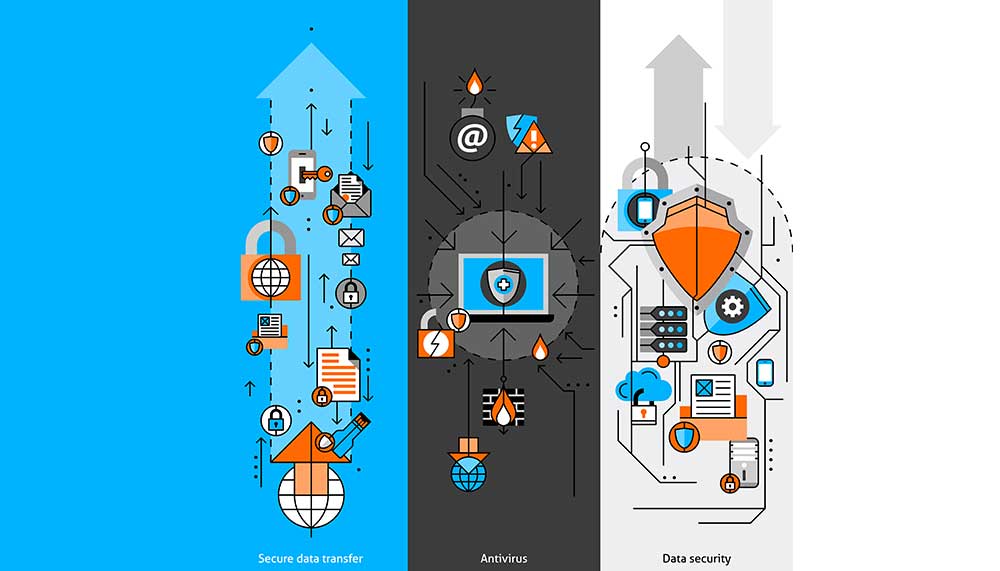
Cybersecurity Essentials for Website Owners: Protect Your Website and Your Business
Let’s face it—your website isn’t just a digital business card anymore. It’s the heart of your business. Whether you run an online store, a blog, or a service-based website, your site handles some of your most valuable assets: customer information, payment details, and sensitive business data. And unfortunately, all of that makes it a prime target for cybercriminals.
Here’s the thing: cybersecurity isn’t optional—it’s a must. One single breach can damage your reputation, shake your customers’ trust, and cost you big—both financially and professionally.
The good news? You don’t have to be a tech wizard to protect your website. With the right security measures in place, you can dramatically lower your risk and keep your digital presence safe. Think of it as locking the doors to your online business before any trouble even arrives.
Why Cybersecurity Matters for Website Owners
You might be thinking, “Do I really need to worry about cybersecurity?” The answer is a big yes—especially if your website is the lifeline of your business. Hackers aren’t picky; they target sites of all sizes, and even small vulnerabilities can have big consequences.
Here’s why website security should be at the top of your priority list:
-
Protect Sensitive Data: Your site likely stores customer information, payment details, and maybe even proprietary business info. A breach could expose all of it.
-
Maintain Your Reputation: Trust is everything online. One security incident can make customers lose faith in your brand, and rebuilding that trust is tough.
-
Avoid Financial Loss: Cyber attacks can lead to downtime, costly fixes, and even legal penalties, depending on the data compromised.
-
Keep Your SEO Healthy: Search engines don’t like unsafe websites. If your site gets flagged for malware, your rankings and traffic can take a hit.
In short, cybersecurity isn’t just a tech issue—it’s a business issue. Protecting your website safeguards your customers, your reputation, and your bottom line.
Key Cybersecurity Essentials for Your Website
Protecting your website doesn’t have to feel overwhelming. Think of cybersecurity as a set of smart habits and tools that make it harder for hackers to get in and easier for you to keep everything running smoothly. Here are the essentials every website owner should know:
1. Keep Software and Plugins Updated
Outdated software is like leaving the front door unlocked. Whether it’s your CMS, themes, or plugins, make sure everything is up to date. Regular updates patch vulnerabilities and prevent hackers from exploiting old weaknesses.
2. Use Strong Passwords and Multi-Factor Authentication (MFA)
Weak passwords are a hacker’s best friend. Use long, unique passwords for every account and add multi-factor authentication wherever possible. It’s an extra step for you, but a huge barrier for anyone trying to break in.
3. Install an SSL Certificate
An SSL certificate encrypts data between your website and your visitors. Not only does this keep sensitive information safe, but it also signals trust to users—and Google gives a boost to HTTPS sites in search rankings.
4. Regular Backups
Even the best security can’t prevent every problem. Regularly backing up your website ensures that if something goes wrong, you can restore your site quickly and minimize disruption. Keep backups in a separate, secure location—ideally offsite.
5. Use a Web Application Firewall (WAF)
A WAF acts like a security guard for your website. It filters out malicious traffic, blocks suspicious activity, and stops attacks like SQL injections or cross-site scripting before they reach your site.
6. Scan for Malware and Vulnerabilities
Regularly check your website for malware and weak spots. Many hosting providers and security plugins offer automated scanning and alerts, so you’ll know immediately if something looks off.
7. Limit User Access
Not everyone on your team needs full admin privileges. Restrict access to essential users and regularly review permissions. This reduces the risk of accidental or intentional damage to your site.
8. Educate Yourself and Your Team
Cybersecurity isn’t just about technology—it’s about awareness. Learn the basics of phishing, social engineering, and safe website management. A little knowledge goes a long way in preventing breaches.
Additional Tips for Enhanced Security
Even after covering the essentials, a few extra steps can give your website an added layer of protection:
-
Choose a Secure Hosting Provider: Your website’s security starts with reliable hosting. Look for providers with strong security measures, regular updates, and real-time monitoring.
-
Use Security Plugins or Tools: Many platforms, like WordPress, offer plugins that actively monitor, block, and report suspicious activity. They act like a digital security team for your site.
-
Limit Login Attempts: Protect against brute-force attacks by restricting how many times someone can try to log in.
-
Monitor Analytics for Unusual Activity: Sudden traffic spikes or strange patterns can be signs of hacking attempts. Keeping an eye on analytics helps you act fast if something seems off.
These additional measures, combined with the core essentials, create a strong, multi-layered defense for your website.
Conclusion
Running a website comes with incredible opportunities—but it also comes with responsibilities. Cybersecurity isn’t just a technical concern; it’s a key part of protecting your business, your customers, and your reputation.
By keeping software updated, using strong passwords, installing SSL, backing up your site, and staying vigilant, you can dramatically reduce the risk of cyber attacks. Remember, a secure website builds trust, keeps visitors safe, and ensures your business can thrive online without unexpected setbacks.
Think of cybersecurity as locking the doors to your digital storefront before trouble even arrives. With the right measures in place, your website can be a safe, reliable, and trusted space for both you and your customers.
