
Zero-click search is real. AI Overviews now touch roughly half of all Google queries. So we pulled the 2026 data to answer a simple question: does building a content hub still pay off — or is it a 2019 tactic limping through 2026?
The short answer
Yes, content hubs still work. But why they work has quietly changed, and if you’re building one using a 2021 playbook, you’re optimizing for a search engine that increasingly answers the question before your page ever gets a click. Below, we walk through the actual mechanics of how AI search retrieves and cites content, what the traffic data says, and a practical framework for building a hub that earns visibility in both classic SERPs and AI-generated answers.
1. Quick refresher: what a content hub actually is
A content hub (also called a topic cluster or hub-and-spoke model) is a group of interlinked pages built around one core subject:
- A pillar page — a comprehensive overview of the broad topic
- Cluster pages — narrower articles covering subtopics, comparisons, how-tos, and definitions
- Internal links — a two-way link structure connecting every cluster page back to the pillar, and the pillar out to each cluster
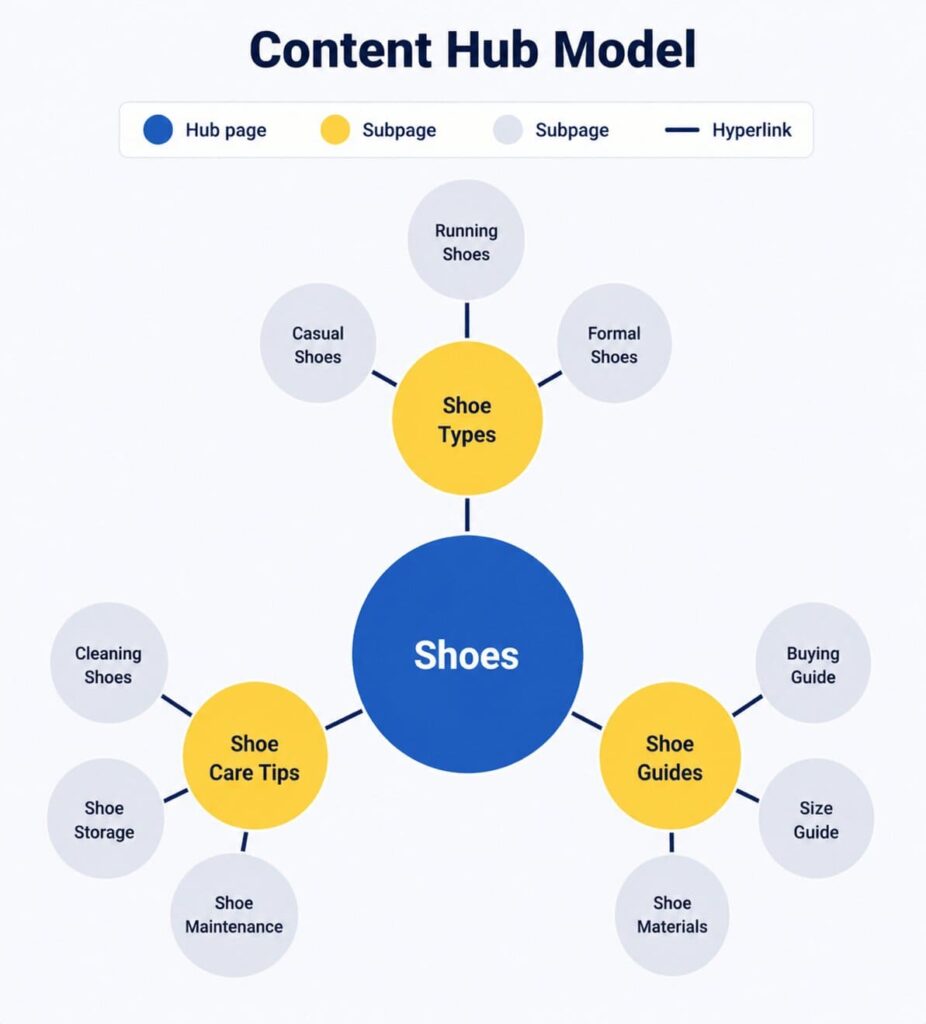
The pillar page is deliberately broad. It’s meant to be the page someone lands on when they search a general, high-volume term — “content marketing,” “email deliverability,” “employee onboarding” — and it answers the question at a summary level while pointing to deeper resources for every subtopic it touches. It doesn’t try to be the definitive word on any single subtopic; it tries to be the definitive map of the whole topic.
Cluster pages do the opposite job. Each one goes narrow and deep on a single facet of the topic — a specific comparison, a step-by-step process, a definition, an edge case, an objection a buyer might raise. Because each cluster page targets a distinct search intent, a single hub can realistically rank for hundreds of long-tail variations that a standalone pillar page never could on its own.
The internal linking is what turns a pile of related articles into an actual hub. Every cluster page links up to the pillar (so a reader — and a crawler — can always find their way back to the overview), and the pillar links out to every cluster (so nothing in the structure is more than one click from the center). This is what search engines read as topical depth: not just that you’ve written about a subject once, but that you’ve built out every corner of it and connected the pieces on purpose.
The idea, popularized by HubSpot around 2017, was straightforward: instead of publishing isolated blog posts that each fight for a single keyword, you build a body of interconnected content that signals topical depth to search engines.
That part of the theory hasn’t changed. What’s changed is who’s reading the signal.
2. What actually changed: the zero-click shift
Before testing whether hubs still work, it’s worth being precise about what they’re now competing against.
| Metric | Figure | Source |
|---|---|---|
| Share of Google searches with an AI Overview (2026) | ~47–64% of queries | eSEOspace / industry AI Overview tracking |
| Google searches ending with zero clicks to any site | Roughly two-thirds of searches | SparkToro/Datos clickstream study, 2026 |
| Click drop on the #1 result when an AI Overview appears | 30–50% average CTR decline | Ahrefs, eSEOspace |
| Zero-click rate inside Google’s AI Mode | 93% across 25.1M impressions studied | Seer Interactive |
| B2B site traffic decline attributed to AI-assisted buyer research | 10–40% over the past year | Forrester |
The takeaway isn’t “SEO is dead.” It’s that a growing share of searches now get answered without a visit to your site at all — which raises the real question this post is testing: in a world where the destination often doesn’t matter, does the hub-and-spoke structure still move the needle, or is it optimizing for a click that increasingly doesn’t happen?
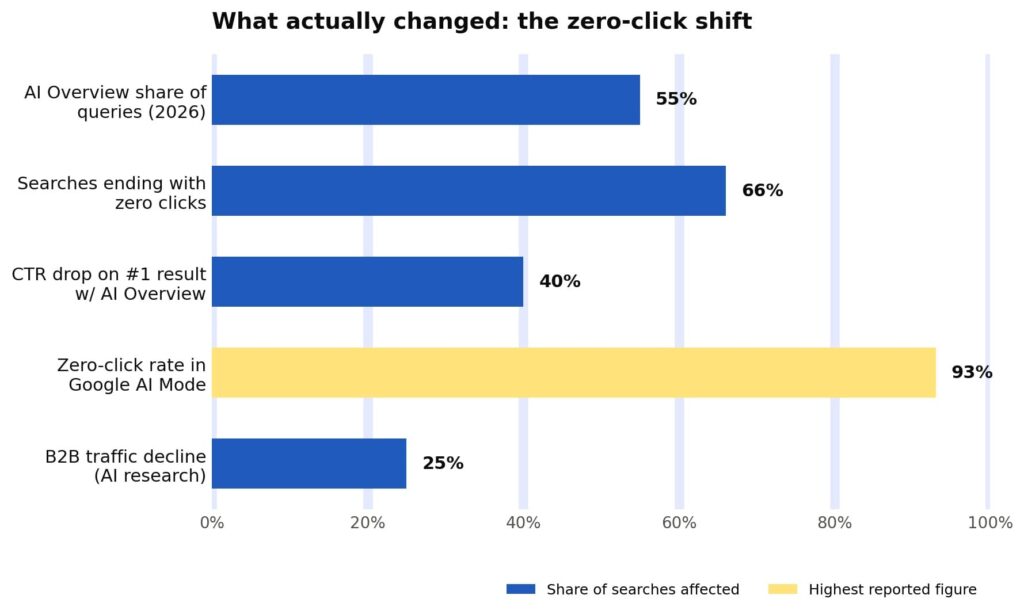
The proportion of Google searches ending without a click has risen sharply since AI Overviews expanded in 2025–2026.
3. How AI engines actually choose what to cite
This is the part most “is SEO dead” takes skip, and it’s the part that determines whether a content hub helps or does nothing. Each AI search system sources and cites content differently — treating them as one undifferentiated “AI search” misses the strategy entirely.
Framework: How the major AI answer engines source content
| Platform | Primary source logic | What it favors | Citation behavior |
|---|---|---|---|
| Google AI Overviews | Re-ranks Google’s existing organic index | Pages already ranking well, with clear structured answers near the top of sections and consistent schema markup | ~97% of citations come from pages already in the top 20 organic results |
| ChatGPT | Static training data + Bing-powered retrieval layer | Wikipedia (up to ~48% of top-10 citations), major reference media, high-authority editorial sources | Mentions brands roughly 3x more often than it links to them |
| Perplexity | Real-time web crawl on every query | Fresh, recently published content; citation-first by design | Cites ~22 sources per answer on average; new content can appear within hours |
| Claude | Blended retrieval, leans toward established journalism | The New York Times, The Atlantic, The Economist and similar outlets | Lower overlap with ChatGPT’s source set than you’d expect |
The critical number here: independent studies from Ahrefs, Averi, and Whitehat SEO — using three different methodologies — all converged on the same finding. Only around 11–12% of domains cited by ChatGPT also get cited by Perplexity. The set of pages Google’s AI Overview cites overlaps with ChatGPT’s citations at a similarly low rate. These are not one search engine with different skins. They’re separate visibility surfaces with almost entirely different rulebooks.
That single fact is why a hub built purely for classic Google ranking signals is now working against a fragmented, multi-engine reality — not a unified one.
How to rank your website on ChatGPT
4. Testing the evidence: do hubs actually outperform scattered content?
This is the part that actually settles the argument. Not opinions, not vendor case studies with cherry-picked clients — third-party benchmarking, stacked up and stress-tested against what AI search now rewards. And the deeper you go, the more the case builds.
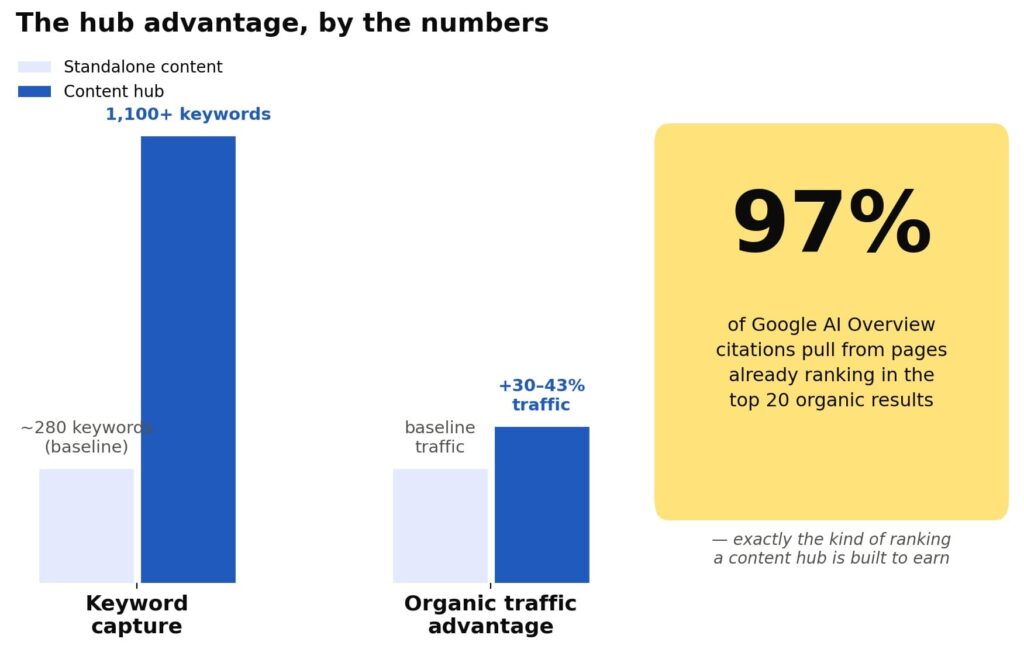
Keyword capture. Start with reach. A single well-built content hub doesn’t just rank for one thing — it ranks for everything adjacent to it. Cluster pages are reported to collectively capture over 1,000 keyword variations versus a few hundred for an isolated post, because each cluster piece targets a distinct intent (definition, comparison, how-to) while feeding authority back to the pillar. A standalone article fights one battle. A hub shows up on a thousand fronts at once.
Traffic advantage. That reach converts. HubSpot’s own benchmarking, cited widely across the industry, puts the organic traffic advantage of connected topic clusters over unconnected, one-off content at roughly 30–43%. Same content investment, meaningfully more traffic — just from linking it together on purpose.
Ranking stability. Now the part that matters when the algorithm shifts under your feet. Hubs show lower volatility during algorithm updates. When a search engine reweights how it evaluates a topic, a page embedded in a cluster of related, internally linked content tends to hold position better than an isolated page with no supporting context — because the site’s topical signal survives even if one page’s ranking shifts. Scattered content has nothing to fall back on. A hub does.
AI citation eligibility. And here’s where it stops being a nice-to-have and becomes the whole game. 97% of Google AI Overview citations pull from pages that already rank in the top 20 organically. A hub’s core advantage — better organic rankings across a wider keyword set — directly increases the number of pages eligible to be cited in AI Overviews. A hub doesn’t just rank more. It puts more surface area into the exact pool AI Overviews are pulling citations from.
Where hubs don’t automatically win: here’s the catch. ChatGPT and Perplexity draw much more heavily from third-party sources — Wikipedia, Reddit, major news outlets — than from brand-owned pages. One 2026 study found owned brand pages were “systematically underweighted” in favor of earned, third-party coverage across multiple AI systems. A content hub improves your position in Google’s ecosystem far more reliably than it guarantees a citation inside ChatGPT.
Verdict
Content hubs still work — but they now do two separate jobs that used to be one job:
- They still build the topical depth and internal-linking signal that improves classic organic rankings (proven, consistent with pre-AI data).
- They increasingly function as citation inventory for AI Overviews specifically, because AI Overviews draw almost exclusively from already-ranking pages.
What they no longer reliably do on their own is earn citations inside ChatGPT or Perplexity, which weight earned media and freshness far more heavily than owned-site architecture.
5. The AI-ready content hub: a practical framework
Given all that, here’s how the hub-building framework needs to change for 2026.
Framework: Building a hub for both classic SEO and AI citation
| Step | Classic hub practice | What to add for AI search |
|---|---|---|
| 1. Topic selection | Pick a topic with search volume and business relevance | Also check if the topic already generates AI Overviews or shows up in ChatGPT/Perplexity answers — test the queries manually before you build |
| 2. Pillar page | 4,000–6,000 words, comprehensive overview | Lead each major section with a direct, quotable answer in the first 1–2 sentences; AI systems evaluate relevance heavily from the opening of a section |
| 3. Cluster pages | 2,000–3,000 words per subtopic | Include original data, first-party research, or a proprietary framework — case studies and data-backed pages are the highest-leverage content type for AI citation across all three major platforms |
| 4. Structure & markup | Standard headings, internal links | Add FAQPage, HowTo, and Article schema; use short, extractable answer blocks under each H2/H3 |
| 5. E-E-A-T signals | Author bio, publish date | Named author with visible credentials, cited primary sources, and a “last updated” date refreshed quarterly — this is treated as close to a binary eligibility filter for AI citation |
| 6. Distribution | Internal linking, backlinks | Get the topic discussed on Reddit, Wikipedia-eligible reference sites, and industry publications — earned mentions matter more to ChatGPT and Perplexity than anything on your own domain |
| 7. Measurement | Search Console, GA4 | Add AI-visibility tracking (Semrush AI toolkit, Ahrefs Brand Radar, or a dedicated GEO monitoring tool) alongside standard rank tracking — the two numbers move independently now |
6. Where teams are getting it wrong
A few recurring mistakes show up across the case studies and benchmarking data:
- Treating AI Overview visibility and ChatGPT visibility as the same goal. They pull from almost entirely different source pools (roughly 11–12% domain overlap between platforms). A hub strategy optimized only for Google won’t automatically earn ChatGPT citations.
- Skipping the freshness cycle. Perplexity crawls in near real time; stale hub content — even if comprehensive — loses ground to competitors who republish quarterly.
- Under-investing in earned media. Since third-party, high-authority sources dominate AI citations, a hub with zero PR or community presence is fighting with one hand tied behind its back.
- Measuring only clicks. With two-thirds of searches now ending without a click, a hub that’s cited inside an AI Overview or ChatGPT answer but generates no visit is still doing brand-building and demand-generation work — traditional last-click attribution will make that look like the hub “isn’t working” when it’s actually earning trust and branded search lift.
7. Bottom line
The evidence doesn’t support “content hubs are obsolete” — but it doesn’t support building one exactly the way the industry did in 2019 either. Hubs still win on the metrics that were always true: wider keyword capture, better ranking stability, and a 30–43% organic traffic advantage over disconnected content. What’s new is that hubs have picked up a second job — becoming the inventory search engines and AI systems pull citations from — and that job comes with new requirements: first-party data, structured extractable answers, author credibility, and a presence beyond your own domain.
Build for both jobs, and a content hub remains one of the highest-leverage structures in content strategy. Build for only the first one, and you’ll keep ranking in a results page fewer people are clicking through.
Sources referenced
Ahrefs · SparkToro/Datos clickstream study · Seer Interactive · Forrester · HubSpot content benchmarking · eSEOspace AI Overview tracking · Averi AI citation analysis · Whitehat SEO · Semrush topical authority research



Related items
Baymard Institute’s 2026 benchmark found that 52% of desktop sites and 62% of mobile sites

Depending on which 2026 survey you read, somewhere between 34% and 77% of US shoppers have

Ahrefs studied one million random web pages and found that only 1.74% of newly published p