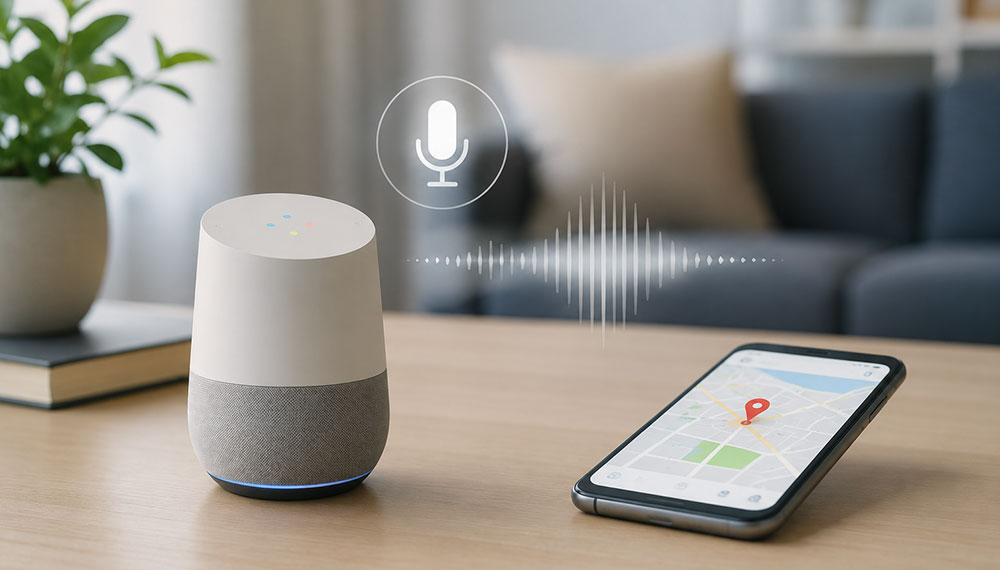
Think about the last time you needed a quick answer while cooking, driving, or walking through a busy street. You didn’t pull out your phone, open a browser, type a fragmented phrase into a search bar, and patiently scroll through ten blue links. You simply raised your wrist, tapped your smart speaker, or spoke directly into your phone: “Hey Google, find an emergency mechanic near me that’s open right now.”
Within seconds, a calm, simulated voice gave you a single, definitive answer. No browsing, no reading, no filtering. Just a direct solution to an immediate problem.
This isn’t a futuristic luxury anymore; it is the default behavior of the modern consumer. Millions of people interact daily with voice-enabled AI assistants—Google Assistant, Apple Siri, and Amazon Alexa. Yet, while businesses spend thousands of dollars optimizing their websites for traditional desktop and mobile text searches, they are completely invisible to this massive wave of vocal consumers. If your digital asset is structured exclusively to catch short, fragmented typed keywords, you are bleeding high-intent leads who speak their needs into existence.
The Fragmented Keyword is Dead: Understanding Spoken Intent
To understand why your current search visibility might be failing in the era of smart speakers and mobile assistants, we have to look closely at the profound psychological and structural differences between how humans type and how they talk. Typed search is unnatural. It is a learned behavior where we compress our complex thoughts into rigid, robotic fragments to please a search engine algorithm.
When someone sits at a laptop looking for corporate accounting services, they might type: "B2B accounting firm tax compliance." But when that same professional is driving home and talking to their smartphone, the query transforms into a full sentence: "Hey Google, who is the best corporate accountant in the area who can help with an unexpected audit?"
The Contrast: Text Queries vs. Spoken Commands
Spoken queries are fundamentally longer, full of conversational nuances, and almost always phrased as direct questions containing who, what, where, why, or how.
| Traditional Text Search (The Past) | Conversational Voice Search (The Present) |
|---|---|
| “best Italian restaurant” | “Hey Google, what’s a highly-rated Italian place near me that has outdoor seating?” |
| “replace car battery cost” | “Siri, how much should I expect to pay to change a battery for a 2018 Honda Civic?” |
| “SEO strategies 2026” | “Alexa, what are the most critical updates I need to make to my website for search visibility this year?” |
When businesses partner with an experienced SEO company in India, the first conversation often revolves around changing keyword dynamics. Traditional optimization strategies that target cold, two-word phrases are no longer sufficient. Voice search requires a deep embrace of long-tail, natural-sounding phrases because voice engines do not rank a list of options—they select a single, clear snippet to read aloud to the user. If your content doesn’t match the conversational rhythm of the spoken question, you don’t just drop to page two; you cease to exist in that search universe entirely.
The Technical Pillar: Structuring Data for Virtual Assistants
Voice assistants are highly sophisticated, but they are also incredibly busy. They do not have the time or cognitive patience to read through your beautifully written 3000-word blog post to find your business hours, pricing patterns, or service locations. They rely on micro-data built directly into your website’s code to confirm that your business matches the user’s vocal criteria.
This machine-readable layer is called Schema Markup (structured data). Think of it as an explicit cheat sheet provided directly to search engine crawlers. While regular text on a page says “We are located in downtown Mumbai and open at 9 AM,” schema code explicitly translates that information into standardized values that tell Google’s voice algorithm: "latitude: 18.9226, longitude: 72.8343, openingHours: Mo-Fr 09:00."
To capture the voice search ecosystem, your site needs to deploy three critical variants of schema markup:
1. LocalBusiness Schema
Crucial for physical brick-and-mortar storefronts and regional service providers. It hardcodes your physical address, geocoordinates, precise operating hours, and localized service offerings directly into the page source code.
2. FAQ Schema
By mapping explicit question-and-answer pairs within your code, you tell search engines exactly which snippet of text answers a specific user inquiry, drastically increasing your chances of becoming a spoken featured snippet.
3. Speakable Schema (Beta/Evolving)
This advanced markup allows website administrators to explicitly flag specific sections of an article or webpage that are optimized for text-to-speech conversion, telling smart speakers exactly which lines are best suited to be read aloud.
Implementing these advanced, nested technical code blocks can quickly become overwhelming for internal marketing teams. Collaborating with a professional SEO company in India can bridge the gap between technical code and humanized search, ensuring your backend architecture is flawlessly formatted for search engine web crawlers while your frontend text remains beautifully engaging for real human visitors.
The Content Pillar: Engineering the Long-Tail FAQ Engine
Once your technical code layer is secure, you must address your content strategy. The most efficient and bulletproof method to align your website with voice queries is to build comprehensive, hyper-targeted Frequently Asked Questions (FAQ) frameworks across your entire domain.
Don’t fall into the trap of writing defensive, clinical FAQs that read like insurance policies. To win the voice search war, your FAQs must mirror real human conversations. This means structuring your questions using the exact phrases your target customers say out loud when they are stressed, curious, or ready to buy.
When engineering your content engine, use a strict three-part formula for every question and answer block you create:
- The Natural Question (The Trigger):
- Write the header using the exact conversational question format. Instead of
"Shipping Policies,"write"How long does it take to ship a custom couch to Chicago?" - The Spoken Punchline (The First 29 Words):
- Voice assistant responses are notoriously short. The average voice answer is roughly 29 words long. Your first sentence must answer the question directly, concisely, and cleanly. Avoid introductory filler like “That’s a wonderful question, let us explain…” Get straight to the answer so the voice algorithm can read it effortlessly.
- The Contextual Deep Dive (The Follow-up):
- Below your initial concise answer, provide the deeper context, secondary options, or a clear call-to-action for users who are reading the page traditionally on a desktop or mobile layout.
Real-World Execution: Transforming Static Text to Conversational Content
“Our regional plumbing enterprise provides leak detection and pipe restoration services across the greater metropolitan area utilizing premium sonic wave identification technology.”
Q: How do you find a hidden water leak inside a wall?
“We find hidden water leaks inside walls using specialized sonic wave detectors that listen for acoustic vibrations, allowing us to pinpoint the exact broken pipe without tearing down your drywall.”
Local Intent Optimization: Winning the “Near Me” Battleground
Over half of all voice search queries are deeply tied to local intent. When people speak to their devices, they are frequently hunting for immediate, physical solutions in their immediate geographic vicinity. They want a grocery store, a dental clinic, a digital marketing consultant, or a legal advisor within a 15-minute driving radius.
Any forward-thinking SEO company in India will tell you that local visibility is no longer just about static text links on a search page. Voice search engines pull local data directly from prominent directory ecosystems, most notably your Google Business Profile (formerly Google My Business), Apple Maps, and Bing Places. If your profiles across these directories are neglected, unverified, or display conflicting information, your website will be completely bypassed by voice assistants, regardless of how well-written your blog posts are.
To secure your local voice presence, follow this strict verification protocol:
Step 1: Enforce Absolute NAP ConsistencyYour Name, Address, and Phone number (NAP) must be identical across every corner of the internet. If your address is spelled “Suite 400” on your website but “Ste. 400” on your Google Profile or “Suite 4” on Yelp, the voice search algorithm views this minor discrepancy as an information conflict, drops your trust score, and looks for a clearer competitor.
Step 2: Dominate Conversational Local ReviewsVoice assistants frequently sort options by rating metrics. When a user asks for the “best” service provider, the algorithm filters out businesses with ratings below four stars. Encourage your loyal clients to write descriptive, keyword-rich reviews that use natural phrasing (e.g., “They fixed my leaky roof in Delhi within two hours”) rather than just leaving a silent five-star rating.
Step 3: Keep Real-Time Operating Data UpdatedIf a voice assistant routes a customer to your store on a national holiday only to find your doors locked because you forgot to update your seasonal hours, that user will leave a highly damaging one-star review. Constantly sync your operating calendars, holiday closures, and contact touchpoints across all platforms.
Case Study: How a Local Service Chain Generated a 110% Surge in Inbound Calls
Let’s analyze the tangible business impact of shifting a web asset from traditional text-only placement into a voice-optimized powerhouse. Consider the case of Radiant Home Services, a regional home repair and maintenance chain operating multiple locations across a busy metropolitan market.
Radiant Home Services possessed an established website that ranked decently for standard keywords like “HVAC repair” or “clogged drain solutions.” However, as consumer habits evolved, their analytics team noticed a troubling trend: mobile conversions were plateauing, and direct organic phone call volume from their web pages was slowly declining. When they dug into user behavior, they discovered that an increasing percentage of their target demographic—busy homeowners and working parents—were relying entirely on voice commands to find home assistance in real-time emergency situations.
The company rolled out an intensive four-month voice readiness optimization strategy across their entire digital presence.
The Strategic Blueprint Implemented
- Complete Schema Restructure: They integrated deeply descriptive LocalBusiness and structured FAQ schemas across every location page, explicitly defining service areas, geocoordinates, and phone numbers.
- Vocal FAQ Redesign: They completely redesigned their service descriptions, adding natural question-and-answer drop-downs that addressed immediate, panicky customer pain points using short, 25-word conversational answers.
- Directory Synchronization: They audited thousands of citations across the web to ensure their business details were perfectly uniform, and executed an automated review collection campaign focusing on descriptive, conversational feedback.
Four-Month Operational Results
The transformation was swift, proving that optimizing for vocal intent yields immediate, measurable commercial dividends:
Increase in Direct Inbound Calls from Voice Queries
Growth in Featured Snippet Spoken Placements
Drop in Page Exit Rates on Service Landing Pages
Radiant Home Services didn’t buy more advertising space or cut their prices. They simply changed the linguistic framework of their website to meet consumers exactly where they were already speaking. By providing direct, unbloated answers to urgent questions, they became the default recommendation chosen by Google Assistant and Siri across their entire service territory.
The Voice Readiness Checklist: Is Your Business Listening?
The transition toward conversational AI, smart devices, and spoken commands is accelerating. To ensure your company isn’t left behind in a silent corner of the web, execute this practical audit checklist over the coming week:
| Action Item | Implementation Strategy | Priority Level |
|---|---|---|
| Audit Spoken Phrases | Use tools to find questions starting with “How do I,” “Where is the closest,” or “How much does it cost to fix.” Build your content calendar around these natural phrases. | Critical |
| Deploy Schema Blocks | Inject error-free JSON-LD FAQ and LocalBusiness schema into your site’s header templates. Test using Google’s Rich Results Test tool. | Critical |
| Optimize Page Speeds | Voice search engines require rapid loading times. If your site takes longer than two seconds to load, voice engines will skip you to fetch a faster alternative. | High |
| Verify Your Listings | Claim, lock down, and audit your profiles on Google Business, Apple Maps, and Bing Places. Enforce absolute address formatting consistency. | Critical |
The Future belongs to Those Who Speak Human
For decades, businesses forced consumers to speak the language of machines. We built directories, memorized short keyword patterns, and spent our lives filtering through endless search links to discover small fragments of truth. But the technological tables have turned. Algorithms are finally smart enough to speak the language of humans.
Voice search optimization isn’t a fleeting trend or a niche trick for early adopters. It represents the permanent normalization of how humanity interacts with data. By shifting your digital asset away from rigid, robotic text blocks and embracing conversational schema, long-tail query structures, and flawless local citation profiles, you ensure your business remains visible, audible, and highly profitable in an increasingly hands-free world. Stop forcing your customers to type. Start optimizing your site to listen.



Related items

Ahrefs studied one million random web pages and found that only 1.74% of newly published p

If you are new to websites, deciding how many pages to build can feel surprisingly high-st


It is Monday morning, and a new proposal has landed in your inbox. It includes a fresh lin