
The Death of the Traditional CTR: Surviving the Zero-Click SERP Landscape
For over a decade, the primary goal of search engine optimization was straightforward: rank in the top three blue links for a high-volume target keyword, watch your organic click-through rate (CTR) climb toward double digits, and harvest that traffic onto a conversion-focused landing page. It was a predictable, linear model. But if you have opened a search engine layout recently, you know that this classic digital ecosystem is undergoing a massive structural shift.
Today, the modern Search Engine Results Page (SERP) is no longer a simple directory of links. It has evolved into a dynamic interface dominated by immersive, AI-driven components. Between AI Overviews, rich snippets, interactive Knowledge Graphs, and visual media carousels, the traditional organic links are being pushed further and further down the page. Among these rich elements, one feature has quietly grown to become the most ubiquitous and influential real estate on the web: the People Also Ask (PAA) accordion system.
According to continuous data tracking across billions of queries, PAA boxes now appear in over 90% of all high-intent search results. They are no longer a minor sidebar element; they are a fundamental component of the modern discovery journey. Furthermore, search engines have begun rolling out advanced “Vector Carousels”—horizontally scrollable, machine-learning-driven blocks that group dynamically extracted informational segments together based on contextual relationship mapping.
This reality has triggered a crisis for standard content creators, but it has opened up an incredible tactical opportunity for advanced technical teams. By exploiting what internal groups call the **PAA Loophole**, you can reverse-engineer your code and text architecture to feed search engines perfectly pre-parsed answers. This allows your brand to hijack conversational search real estate directly from established competitors—even if their overall domain authority is vastly higher than yours. Let’s break down the exact operational blueprint to build, structure, and code data fragments that claim these high-value spaces.
—
The Mechanics of the Loophole: How Search Vectors Identify “Answers”
To intercept a PAA box or a vector carousel, you have to stop thinking about keywords and start thinking about semantic data relationships. Modern search algorithms do not simply look for an exact match between a user’s query and a phrase on your webpage. Instead, they process your entire page through dense vector spaces using advanced machine learning architectures.
When a user inputs a conversational question, the search engine assigns that query a specific mathematical coordinate in a multi-dimensional semantic map. It then scans its index for the content fragments that reside closest to those exact coordinates. The algorithm evaluates text based on high-level patterns: **entities** (people, places, concepts), **attributes** (definitions, steps, costs), and **relations** (how those entities connect).
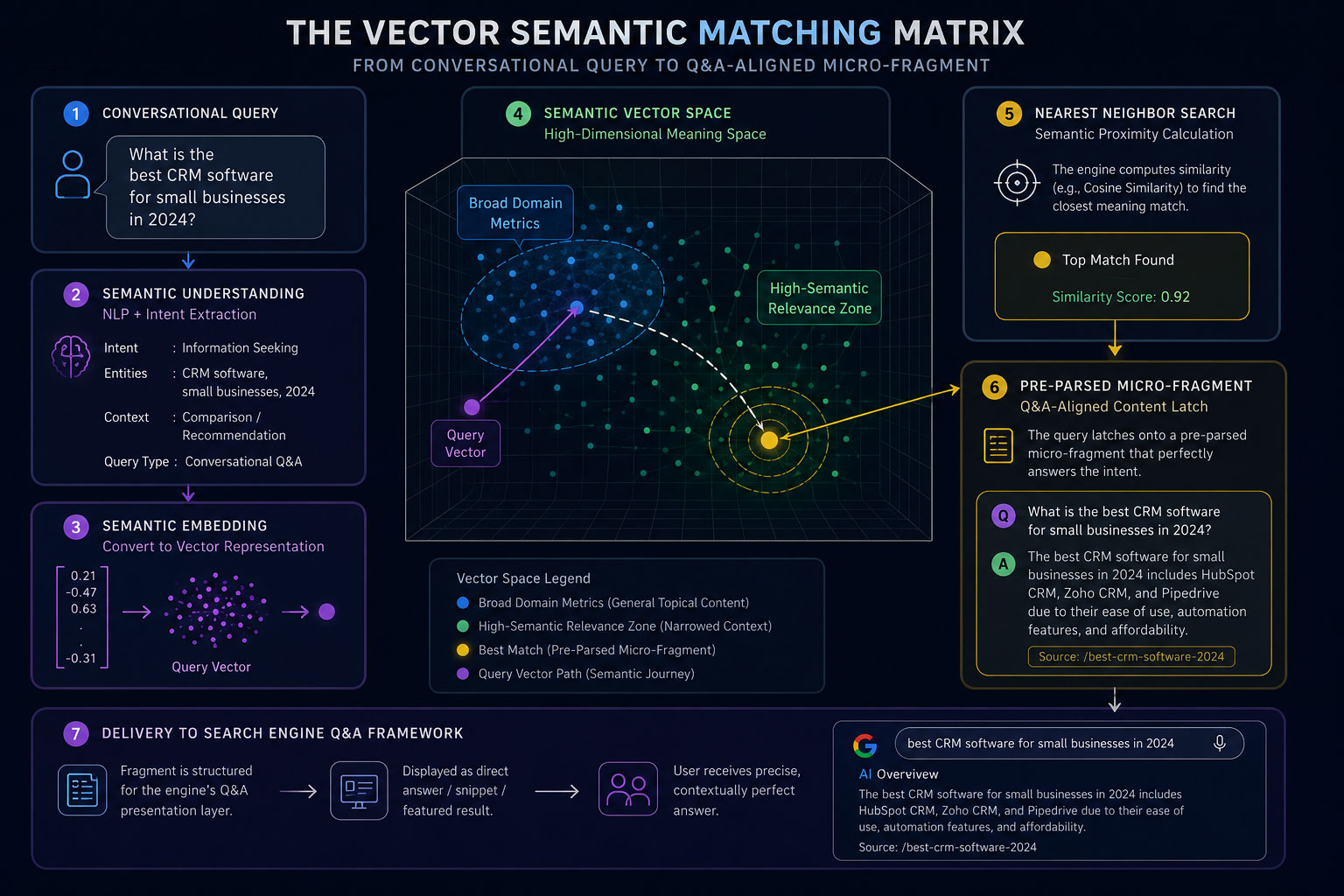
A technical layout visualizing how a conversational query travels through a semantic vector space, passing broad domain metrics to latch directly onto a Pre-Parsed Micro-Fragment that matches the search engine’s Q&A framework.
The “loophole” exists because search engines prioritize structural clarity and immediate utility over domain size when filling PAA accordions. The algorithm needs a fragment that can be extracted cleanly without bringing along unnecessary surrounding layout clutter. If your multi-million dollar competitor writes a sprawling, beautifully written 5,000-word guide but buries the answers inside dense, decorative paragraphs, the algorithm will pass them over. If you provide a tightly coded, explicit text fragment that fits the exact structural blueprint the model expects, you win the real estate.
The Operational Blueprint: Coding Precise Q&A Data Fragments
Winning this conversational real estate is a deliberate engineering process. You must build your content as a series of modular, self-contained data modules. Here is the technical framework required to design fragments that search engines can easily parse and extract.
1. The Proximity Rule: Synchronizing Headers and Paragraphs
The relationship between your question header and the answering body copy must be completely immediate. The target question must be wrapped in a semantic heading tag (typically an `<h3>` or `<h4>`), and the definitive answer must begin on the *very next line* within a standard `<p>` paragraph tag. Do not place images, decorative divider lines, ad banners, or introductory filler phrases between the header and the paragraph. The algorithm looks for high structural proximity; breaking that physical link in your HTML tree disrupts the parser’s pattern matching.
2. The Micro-Copy Formula: Writing for the Parser
The first sentence of your answering paragraph determines whether your fragment will be extracted or ignored. You must use what engineers call an explicit Is-A / Definition linguistic framework. You must repeat the core noun or entity from the question immediately, followed by a clarifying linking verb (such as “is,” “consists of,” “requires,” or “applies when”).
Incorrect (Too Conversational): “If you have been wondering about how corporate cross-linking works, there are a few things to keep in mind first…”
Correct (Optimized for Extraction): “Corporate cross-linking is an advanced internal SEO architecture where two or more distinct web properties share contextual links to distribute topical authority…”
3. Stringent Character and Token Boundaries
Search engines have strict physical limitations regarding how much text can be displayed inside an accordion fold or a carousel card before it must truncate the text. If your answering fragment is too long, it will be discarded in favor of a cleaner option. To optimize your text for extraction, your primary answer paragraph must fit within the following strict boundaries:
$$\text{Optimal Length} = 40 \text{ to } 55 \text{ Words} \quad \left(\sim 280 \text{ to } 350 \text{ Characters}\right)$$
Every single word within this block must deliver high semantic value. Eliminate filler adverbs, conversational jokes, and repetitive phrasing. Treat this space like premium code real estate where efficiency is paramount.
—
Advanced Engineering: Deploying Microdata Schema for Vector Carousels
While organizing your visible text layers correctly is vital, you can drastically improve your extraction success rate by explicitly labeling your content layers behind the scenes using structured microdata. By implementing specialized **JSON-LD Schema**, you eliminate all algorithm guesswork, allowing your team to define exactly where a question ends and where an answer begins within your code database.
To signal a clear conversational matrix to search spiders, embed a dedicated `FAQPage` script block directly into the header or footer of your WordPress page architecture. Here is the exact, production-ready code structure you should deploy:



Related items

Baymard Institute’s 2026 benchmark found that 52% of desktop sites and 62% of mobile sites


Depending on which 2026 survey you read, somewhere between 34% and 77% of US shoppers have

Ahrefs studied one million random web pages and found that only 1.74% of newly published p
