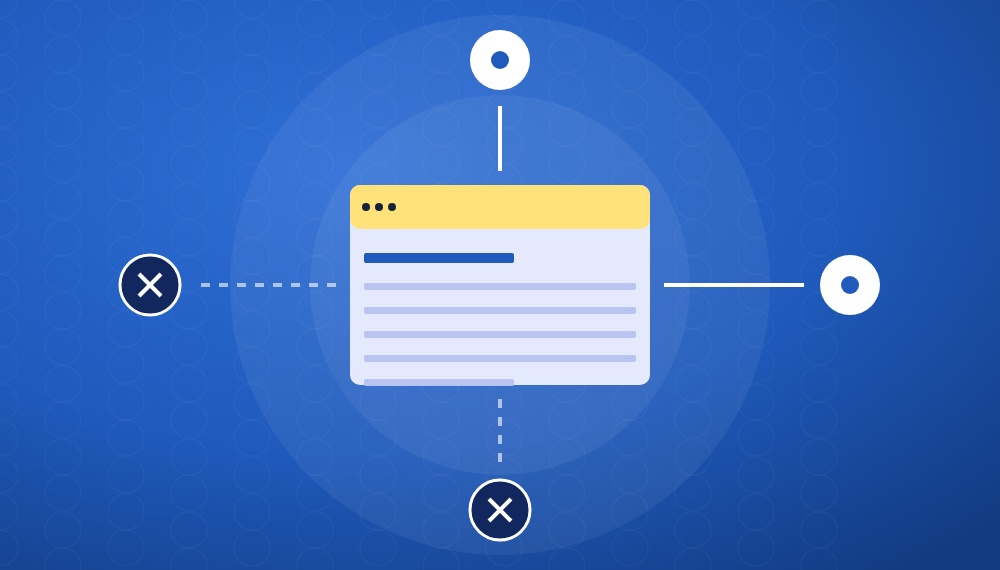
Content earns citations. Maintenance decides whether your site is even eligible for them.
Most advice on AI search visibility starts with content: write clearer answers, add structure, earn mentions elsewhere. All of it assumes something that rarely gets checked: that the AI system can actually use your website.
Maintenance decides whether it can. That makes it a visibility issue, not a housekeeping one.
For a website maintenance company in Delhi, or anywhere else, this changes the brief. The job used to end at updates, backups and uptime. Keeping a site eligible for search engines and AI tools is now part of it.
Maintenance cannot buy you a citation. It decides whether you are eligible for one.
The four gates between a prompt and a citation
When someone asks an AI assistant a question that needs current information, the system searches, fetches pages, reads them and writes an answer from the sources it trusts. Your page has to pass four gates in order: reach, read, trust and cite.

Three of the four gates depend on the condition of your website. Only the last is decided by your content and reputation. That is why the order matters: a failure at an early gate cannot be repaired at a later one. The best-written page on the internet scores nothing if the crawler receives an error.
Gate 1: Reach
Before anything is read, the crawler has to get a response. The server must answer quickly, without errors, and without demanding proof that the visitor is human. Slow shared hosting, a database overloaded after an update, an expired SSL certificate or a redirect that loops each end the visit before it begins. Retrieval systems work under time limits and have plenty of other sources to try, so they move on.
Gate 2: Read
Reaching a page is not the same as reading it. The system needs clean, extractable text: headings, paragraphs, prices, contact details. Content that appears only after scripts run, text baked into images and layouts broken by a theme update all leave the crawler with less than a human visitor sees. Consent walls and login prompts that hide the content until someone clicks can leave it with an empty page.
Gate 3: Trust
A system that quotes a source puts its own credibility behind it, so it has reason to avoid pages that look unsafe or unreliable. Security warnings, injected spam and details that disagree with each other all lower a page’s standing. Trust is the gate where a neglected site fails slowly, one unpatched plugin at a time.
Gate 4: Cite
Only here do the quality of your writing, the originality of your insight and the reputation of your brand matter. This gate is competitive: several eligible pages may answer the same question, and the system picks among them. Maintenance gets you into that group. It has no say in who is chosen from it.
The invisible outage
The most damaging maintenance failures are the ones the owner never sees. The owner opens the homepage in a browser, often logged in, often from a cached session, and it loads. A crawler makes a fresh request from a data-centre address with an unfamiliar user agent. These are different requests, and they can get different answers.
Security plugins, CDN rules, and hosting firewalls are tightened during updates, and bot protection exists to block unfamiliar automated traffic. Unless AI crawlers are deliberately allowed, a site can turn away the exact visitors it wants to attract, and nothing on the website announces it.

Here is how it happens in practice. A security plugin is updated and switches on stricter bot rules. The homepage is checked afterwards and looks fine. Weeks later, crawlers are still being challenged or rate-limited, and every failed request is a missed chance to be used. The other causes are just as ordinary: a CDN setting that treats unknown user agents as threats, a rule that blocks data-centre IP ranges, a rate limit set too low, or a robots.txt file copied over from a staging site that blocks everything.
Some businesses block AI crawlers on purpose, and that is a legitimate decision. The failure is blocking them by accident. Uptime monitoring that only loads the homepage will never catch it, because the homepage is up. It is a maintenance question, and it belongs to whoever looks after the server.
Six ways neglect removes a site from consideration

Firewall or security rules. Rules that protect a site from attacks cannot tell a hostile bot from a helpful one unless they are told which is which. Every rule added or tightened during an update is a chance to block legitimate crawlers, and the change is rarely tested from a crawler’s side.
Slow or unstable hosting. A server that answers in a few hundred milliseconds today can take seconds after a database grows, a plugin adds queries or a hosting plan is oversold. Intermittent 5xx errors are worse than a clean outage, because they pass casual checks but fail when a crawler arrives at the wrong moment.
Redirect chains and broken links. Every redesign, URL change and removed product leaves old addresses behind. Chains of redirects waste a crawler’s patience, and broken internal links leave whole sections of a site undiscovered. Our internal linking guide covers the mechanics of both.
Content that needs JavaScript. Many AI crawlers fetch raw HTML and do not run JavaScript, so a page that builds its text in the browser can look empty to them. A theme or plugin update that moves content into scripts changes what machines can read, and often nobody re-checks.
Hacked pages and stale details. A hacked site can carry injected spam links or malware warnings, which is exactly the kind of signal that makes a source unsafe to cite. And when your pricing, address or services are correct on one page and stale on another, a system has to choose between contradicting sources. Consistency is a maintenance outcome.
None of the six is dramatic. Each begins as a small deferred task. Together they decide which gate the site stops at.
Why content-first AI visibility work stalls
Content is written once and then left alone. Eligibility decays continuously. Every plugin update, hosting change, and security rule alters the conditions the content depends on, so treating AI visibility as a publishing project leaves the site exposed to the one kind of failure publishing cannot fix.
Consider a business that commissions a dozen well-researched service pages. Six months later, a routine update changes a firewall rule, a theme change pushes the main text into scripts, and the contact page still lists an old phone number. The pages have not changed, yet they are less usable than on the day they went live. The money spent on content is intact. The return on it is not.
The sequence matters. Secure eligibility first, then invest in content. Doing it the other way round means paying to produce pages that machines cannot fetch.
What maintenance cannot do?
The fourth gate belongs to other work. Clear content, original insight, genuine authority, and mentions elsewhere on the web decide whether an eligible page is the one an assistant cites. No maintenance plan changes that, and no provider can guarantee citations. Maintenance clears the way. It does not choose the destination.
A plan that updates plugins and takes backups keeps a site running. It does not keep it eligible. That distinction is easy to miss, because both kinds of plans produce the same monthly report: updates applied, backups taken, uptime at 99.9%. None of those numbers say anything about what an AI crawler received when it last requested a page. A plan built for AI search has to check for that directly, and it does so by answering five questions.
The standard a maintenance plan should now meet
Does monitoring test pages the way a crawler requests them?
A browser check proves the site works for people. A request with a crawler user agent, from outside your own network, proves it works for machines. These are not the same test, because a browser carries a logged-in session, cached files and a familiar IP address, while a crawler arrives as a stranger. A maintenance plan built for this sends a plain HTTP request, with a known crawler user agent such as GPTBot or PerplexityBot, from an outside server, on a regular schedule, and records the status code and response time it gets back. Anything other than a clean 200 response is a finding, not background noise.
Are firewall, CDN and robots rules reviewed after every update?
Updates are when rules change. A security plugin update, a new CDN feature or a theme change can silently add a bot-blocking rule, and a short review after each one catches accidental blocks before they run for weeks. In practice this means checking three things every time something changes on the server: the robots.txt file, for a line that quietly blocks more than intended; the firewall or security plugin’s bot-management settings, for a rule switched on by default; and the CDN’s bot-protection dashboard, for anything set to “block” rather than “monitor” for crawlers you want to allow. Five minutes after each update is enough, but it has to happen every time, not only when something looks wrong.
Are error rates for automated visitors read from server logs?
Logs show what crawlers actually received, including errors no browser check would ever reveal. A browser-based uptime check only ever sees the homepage, loaded the way a browser loads it. Server logs show every request from every visitor, including the ones identifying themselves as AI crawlers, and the status code each one got. Filtering logs by known crawler user agents and watching for a rise in 403, 429 or 5xx responses turns an invisible outage into a visible one. This is the single most direct way to know whether a site is reachable by the systems it needs to reach, and most maintenance plans never look at it.
Is the rendered HTML compared before and after theme or plugin changes?
If the text a machine can read shrinks after an update, a comparison shows it. A screenshot never will, because a screenshot only captures what a browser renders after running every script, while a crawler that skips JavaScript sees the raw HTML underneath. Saving a copy of a page’s rendered HTML before a theme, plugin or page-builder update, and diffing it against the same page afterwards, shows exactly what content moved into scripts, what text disappeared, and what markup broke. This turns a subjective “does it look fine” check into a specific, checkable difference.
Is business information kept consistent across pages and profiles?
Prices, hours, addresses and service names should match everywhere they appear, including the website, Google Business Profile, directory listings and social profiles. A system weighing several sources against each other treats agreement between them as a signal of accuracy, and disagreement as a reason for caution. A short quarterly pass that checks contact details, pricing and service descriptions against each source they appear on catches the drift that builds up naturally as pages are edited at different times by different people.
Answering yes to all five takes more than a checklist ticked once. Reach and consistency can drift within weeks of the last review, so these checks belong in the maintenance schedule itself, alongside updates and backups, not in a one-off audit. Until a plan can answer yes to these on an ongoing basis, it maintains a website. It does not maintain visibility.
Choosing a website maintenance company in Delhi
If you are comparing providers, judge them on the five questions above, not only on price. Ask how they monitor, what they review after each update, and what they report back. Fast response, regular backups and clear reporting are the baseline, not the pitch.
The real difference is whether a provider treats your site’s ability to be found as part of the job. A company that only keeps plugins current will keep the site running. One that also checks what crawlers receive will keep it eligible.
Is your website eligible?
Looking for a website maintenance company in Delhi that treats visibility as part of the job? ICO WebTech can review whether your site can be reached, read, and trusted by search engines and AI tools.
Related from ICO WebTech: website maintenance, website design agency, AI visibility (GEO), how to rank your website on ChatGPT, and internal linking for SEO.



Related items
Freelancer vs Agency vs In-House: How to Choose the Marketing Team That Fits Your Business Right Now
Gartner’s 2025 CMO Spend Survey found that marketing budgets average 7.7% of company reven
A website redesign is one of the few marketing projects that can lower your traffic on the

A WordPress site rarely breaks all at once. It drifts. A plugin update here, a new image l
