
Every website designing company in Delhi will tell you about the clients they’ve kept for years. Almost none of them will talk about the clients who left, and why. We think that’s the more useful conversation, because if you’re currently choosing a website designing company in Delhi, the mistakes other business owners already made are far more instructive than another list of services and buzzwords.
So we did something simple: we talked to business owners across Delhi and NCR who had switched web design agencies at least once, and asked them, plainly, why they left the previous one. What follows are their reasons, grouped into patterns, with the details anonymized at their request (a few asked us not to name their old agency, which we’ve respected throughout). If you’re currently evaluating who to hire, treat this as a list of questions to ask upfront, before you’re the next case study.
Table of Contents
- How We Gathered These Stories
- The Patterns at a Glance
- “They Disappeared After the Invoice Cleared”
- “Every Small Change Was a New Bill”
- “The Site Looked Great and Ranked Nowhere”
- “Nobody Told Us We Didn’t Own Our Own Site”
- “They Sold Us Features We Never Used”
- “Six Months to Launch a Five-Page Site”
- “Our Store Broke During Our Biggest Sale”
- “They Built for Themselves, Not for Us”
- “Great References, Terrible Reality”
- How Long Before They Left
- A Note on Vetting References and Portfolios
- What to Ask Before You Sign
- What a Healthy Agency Relationship Actually Looks Like
- FAQs
- Final Thoughts
How We Gathered These Stories
We reached out to business owners in our own network, past prospects who’d mentioned a bad prior experience during a sales call, and a few contacts through local Delhi business groups. In total, ten agreed to share their story on the condition of partial anonymity, meaning we’re using their industry and a first name only, and we’ve deliberately left out anything that would make the old agency identifiable, since the point here is the pattern, not naming and shaming a specific competitor.
This isn’t a scientific sample, and we’re not claiming every website design agency in Delhi behaves this way; plenty don’t. What we can say is that these ten conversations surfaced the same handful of complaints, independently, without us prompting for them, which is usually a sign the pattern is real rather than a coincidence. We’ve also intentionally left out any story that felt like a one-off misunderstanding rather than a genuine, repeatable pattern, since the goal here is to help you spot warning signs that generalize, not to relitigate a single bad match between one client and one agency.
The Patterns at a Glance
Before the individual stories, here’s the short version of what came up across the ten conversations:
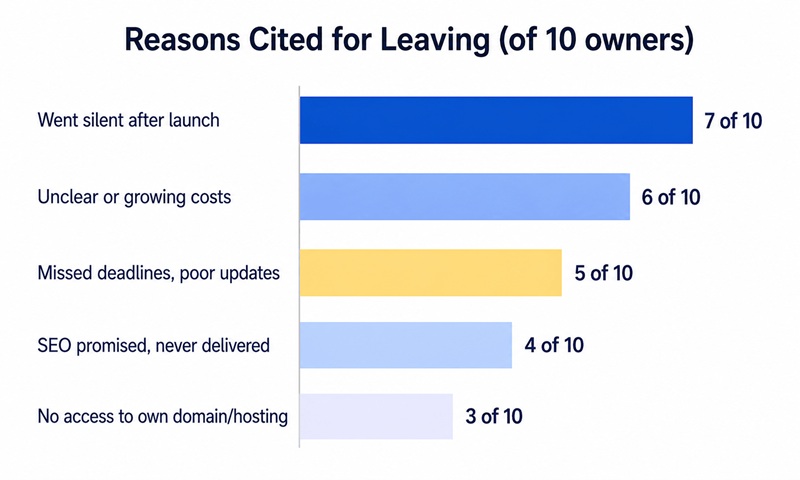
- Post-launch abandonment was the single most common complaint, cited by 7 of 10 owners in some form.
- Unclear or expanding costs after the initial quote came up in 6 of 10 conversations.
- Poor communication and missed deadlines appeared in 5 of 10 stories.
- No ownership or access to their own site’s backend, domain, or hosting came up in 3 of 10, and was often the most frustrating to resolve.
- SEO promises that went nowhere came up in 4 of 10, usually paired with a site that looked polished but never ranked.
Now, the stories themselves.
“They Disappeared After the Invoice Cleared” (Retail, Lajpat Nagar)
Priya runs a small home decor retail business out of Lajpat Nagar. She hired a local website designing company in Delhi to build her online store, paid the full amount on launch as agreed, and assumed ongoing support was implied since it had been mentioned loosely during the sales pitch.
“The site went live on a Friday. By the following Wednesday I had a product image that wasn’t uploading correctly, and I couldn’t reach anyone. Calls went to voicemail, WhatsApp messages were read and not answered for days. It took almost three weeks and a threat to leave a public review before someone finally fixed a five-minute problem.”
Her takeaway, which she now asks every prospective agency directly: what does support look like after launch, in writing, not verbally implied during the pitch.
“Every Small Change Was a New Bill” (Consulting, Gurgaon)
Rohit runs a small consulting firm and hired an agency for what he thought was a complete package. What he didn’t realize until later was that “complete” only covered the initial build; every edit afterward, including fixing a typo or swapping a headshot, was billed separately, often at rates that weren’t clearly disclosed upfront.
“I understand paying for genuinely new work. What frustrated me was that nothing about the ongoing cost structure was explained clearly at the start. I found out by getting a bill for something I assumed was routine maintenance.”
He switched to a website developer company in Delhi that includes a defined number of monthly edit hours in its retainer, specifically because the previous experience made him ask for that in writing before signing anywhere again.
“The Site Looked Great and Ranked Nowhere” (Boutique Fitness Studio, Vasant Kunj)
Ananya’s fitness studio had, by her own account, one of the best-looking websites among her local competitors. It just never showed up when potential clients searched for anything related to her services in her own neighborhood.
“I was told SEO was included. What that actually meant was a few basic meta tags filled in and nothing else. No one ever explained page speed, no one looked at what people were actually searching for, and eighteen months later we were still invisible while a competitor with a far plainer site was ranking above us for every relevant term.”
She eventually moved to an SEO agency that showed her actual search ranking data monthly, which she now considers non-negotiable in any web design relationship.
“Nobody Told Us We Didn’t Own Our Own Site” (Educational Institute, Rohini)
This is the story that came up in our research the least often, but hit hardest when it did. Vikram’s institute had its site built by a small freelance-style operation. When they later wanted to switch agencies, they discovered the domain was registered under the original developer’s personal account, and the hosting login had never been shared.
“We effectively had to negotiate to get access to our own domain name. It wasn’t malicious exactly, I think it was just how they always set things up, but it cost us weeks and real leverage in the negotiation, simply because we never asked who owned what at the start.”
This is now the first question we’d recommend any business ask before a project even begins: confirm in writing that the domain, hosting account, and all admin credentials will be registered in the business’s own name, not the agency’s.
“They Sold Us Features We Never Used” (Logistics Startup, Okhla)
Karan’s logistics startup was sold an elaborate package including a client portal, live chat integration, and a custom quote calculator, most of which sat unused because the sales pitch focused on impressive features rather than what the business actually needed at its stage.
“Looking back, a much simpler site would have served us just as well for the first year, at a fraction of the cost and timeline. I don’t think they were dishonest exactly, I think bigger packages are simply easier to sell than telling a client ‘you don’t need most of this yet.'”
He now recommends asking directly: what’s the minimum version of this project that would actually serve my business right now, and what can reasonably wait.
“Six Months to Launch a Five-Page Site” (Interior Design Studio, South Extension)
Meera’s interior design studio needed a relatively simple five-page portfolio site. The agency she hired quoted four weeks. It took closer to six months, with repeated delays blamed on “the developer,” “the previous revision round,” and eventually, vaguely, “internal issues.”
“What frustrated me most wasn’t even the delay itself; businesses understand things slip sometimes. It was the lack of any real communication about why, or a revised, honest timeline I could actually plan around.”
She now asks for a written project timeline with named milestones before starting anything, specifically so any slippage is visible and explainable rather than vague.
“Our Store Broke During Our Biggest Sale” (Fashion Ecommerce, Karol Bagh)
Sanjay runs an online fashion business and had chosen what he thought was an ecommerce website designing company in Delhi with solid experience. The site performed fine under normal traffic, but crashed during a festival sale when traffic spiked, costing him a full day of sales at the exact moment they mattered most.
“Nobody had ever tested how the site handled a real traffic surge before we needed it to. When I asked afterward, it became clear load testing simply hadn’t been part of their process at all.”
He switched to a team that explicitly load-tests ecommerce builds before major sale periods, something he now considers essential rather than a nice-to-have for any serious online store.
“They Built for Themselves, Not for Us” (Dental Clinic, Pitampura)
Dr. Neha’s dental clinic hired an agency that had genuinely impressive design sensibilities, but the finished site prioritized visual flair over the things her actual patients needed, like a clear way to book an appointment or find the clinic’s location on a map.
“It won compliments from other business owners at networking events, which honestly felt nice at first. But my actual patients, mostly older, mostly just trying to book a cleaning, found it confusing. Nobody at the agency ever asked who our real visitors were or what they’d be trying to do on the site.”
Her replacement agency started the project with a short conversation about her actual patient demographics before designing a single page, which she now says should have been the very first step from day one, not an afterthought.
“Great References, Terrible Reality” (Event Management, Mayur Vihar)
Arjun did his homework before hiring his first agency, checking their portfolio and reading testimonials on their site. What he didn’t do was actually contact any of those referenced clients directly, and he later found out that two of the flagship portfolio pieces were projects the agency had barely touched, mostly minor updates to sites originally built by someone else.
“The testimonials were real people, I later confirmed, but they weren’t necessarily describing the specific scope of work I was hiring them for. I’d assumed a testimonial meant they built the whole thing from scratch. That’s not always what it means.”
He now insists on speaking directly to at least one referenced client by phone, and asks specifically what portion of the visible work that agency was actually responsible for.
How Long Before They Left
One pattern worth visualizing on its own: how long into the relationship did these ten business owners typically stick it out before switching agencies?
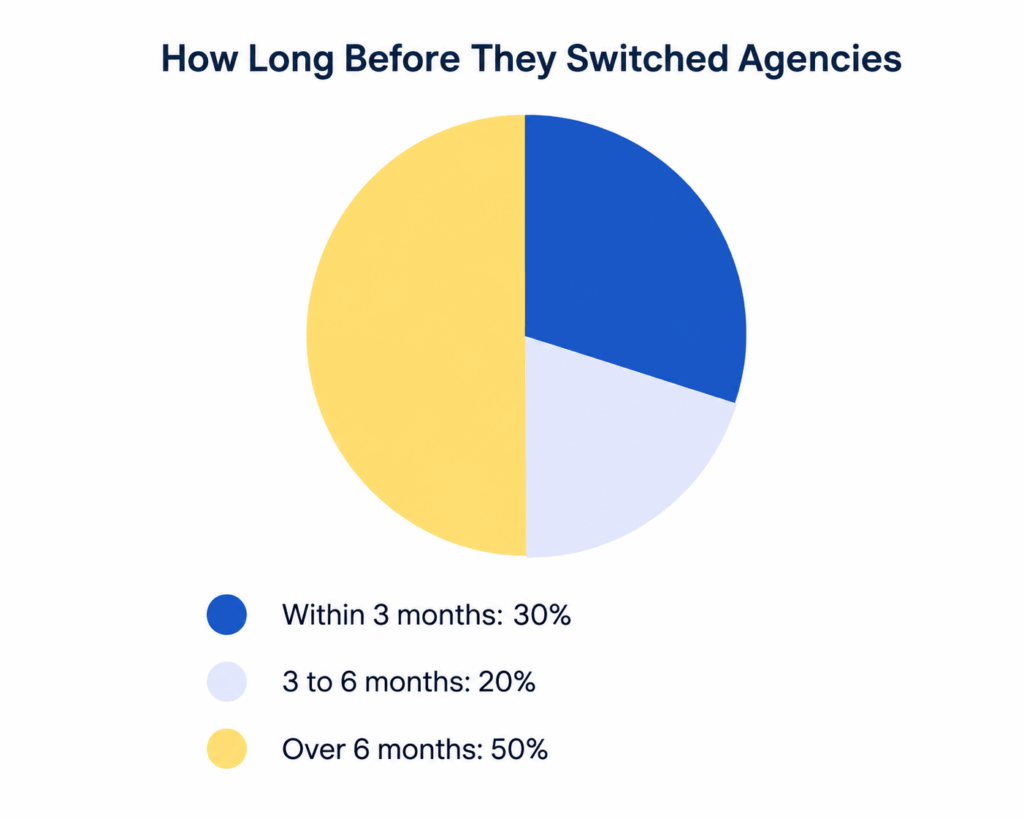
Half of the owners we spoke to stuck it out for more than six months before finally switching, usually because they kept hoping the next fix or the next promise would resolve things. In hindsight, most said they wished they’d trusted their early instincts sooner rather than waiting for a pattern to fully confirm itself.
Looking at what specifically pushed them over the edge, here’s how the final straw broke down:
A Note on Vetting References and Portfolios
Arjun’s story above is worth dwelling on for a moment, because it’s an easy mistake to repeat. A portfolio link and a testimonial both feel like proof, but neither confirms the actual scope of work an agency did. A “client” might be a full custom build, a template with minor tweaks, or a small fix on someone else’s existing site, and the marketing page rarely distinguishes between the three.
Before hiring any website designing company in Delhi, it’s worth doing two simple things that take less than fifteen minutes combined: ask at least one referenced client directly what portion of the visible work the agency actually handled, and check whether the portfolio site still looks and performs the way it’s presented, rather than trusting a screenshot that might be outdated. Both checks are free, quick, and would have caught several of the problems described above well before any contract was signed.
What to Ask Before You Sign
Every one of these stories traces back to a question that wasn’t asked clearly enough at the start. Here’s the list we’d now hand to anyone evaluating a website designing company in Delhi, based directly on these ten conversations:
- “What does support look like after launch, and is it written into the contract?” Verbal assurances during a sales pitch aren’t the same as a documented support scope.
- “What counts as a billable change versus routine maintenance?” Get specific examples, not a vague category.
- “Will the domain, hosting, and admin access be registered in my business’s name?” Confirm this in writing before the project starts, not after.
- “What does ‘SEO included’ actually mean in practice, and how will I see results?” Ask for a specific description of the work, and how progress will be reported.
- “What’s the realistic minimum version of this project for where my business is right now?” Be wary of packages that feel bigger than your current stage needs.
- “Can I get a written timeline with milestones, not just a final delivery date?” This makes any delay visible and explainable early, rather than a surprise at month five.
- “If I expect high traffic events, has this kind of build been load-tested before?” Especially relevant if you’re hiring an ecommerce website designing company in Delhi for anything with seasonal sales spikes.
What a Healthy Agency Relationship Actually Looks Like
It’s easy for a post like this to leave the impression that hiring any website designing company in Delhi is a minefield. That’s not the intent, and it’s worth balancing the stories above with what the healthier relationships we’ve seen actually have in common, since several of these ten owners eventually found exactly that on their second attempt.
- A written scope document that spells out what’s included, what counts as extra, and what post-launch support actually covers, agreed before any work starts.
- Regular, proactive updates during the build, rather than the client having to chase for status every week.
- Full ownership handed over at launch, meaning the domain, hosting, and admin credentials are in the business’s own name from day one, not something to negotiate for later.
- Honest scoping that recommends the right-sized project for the business’s current stage, rather than the biggest package available.
- Measurable reporting for anything sold as SEO or growth work, so progress is visible rather than taken on faith.
None of this is complicated or unusual to ask for. It’s simply rarely offered upfront, which is exactly why it’s worth asking for directly rather than assuming it’s included.
FAQs
Is it normal to switch website design agencies at least once?
It’s common enough that none of the owners we spoke to felt embarrassed about it. What matters more is catching the warning signs earlier next time, using a list like the one above before signing.
How do I find a website designing company in Delhi that won’t disappear after launch?
Ask for the support scope in writing, and ask to speak with a current client who’s been past the launch stage for at least six months, not just a client from the sales pitch stage.
Should I always own my own domain and hosting account?
Yes. A reputable web designing company in Delhi will register these in your business’s name as standard practice. Treat any hesitation here as a serious red flag, not a minor detail.
What’s a reasonable amount of post-launch support to expect included in a project?
This varies, but most healthy agency relationships include at least a defined window (commonly 30 to 90 days) of bug fixes and minor adjustments at no extra charge, with a clear, disclosed rate for anything beyond that. Anything vaguer than that is worth clarifying before you sign.
Is it worth paying more for an established website developer company in Delhi versus a cheaper freelancer?
Not automatically; price alone isn’t the signal that matters. What mattered far more in these ten stories was clear scope, honest communication, and proper ownership handover, all of which exist at multiple price points. A higher price doesn’t guarantee any of those, and a lower one doesn’t rule them out either.
What should I do if I’m already stuck in one of these situations right now?
Start by requesting your domain registrar and hosting login access in writing, even if the relationship is ending badly. That single step resolves the most damaging issue described above (story four) and gives you real leverage and flexibility for whatever you decide to do next.
Final Thoughts
None of these ten business owners regret having a website built. Every one of them still believes in working with a professional rather than doing it entirely alone. What they’d all do differently is ask sharper questions before signing, rather than discovering the gaps after the invoice was paid and the relationship had already gone quiet.
If you’re currently comparing an ecommerce website designing company in Delhi for an online store, use the questions above as your actual evaluation checklist, not just the portfolio and the price. Most of what went wrong in these stories was never really about design skill, it was about clarity, ownership, and communication set at the very start of the relationship, and every one of those things is checkable in a single conversation if you know what to ask.
At ICO WebTech, we’d genuinely rather answer these questions honestly upfront than have you find the answers the hard way six months in.



Related items

Depending on which 2026 survey you read, somewhere between 34% and 77% of US shoppers have


Websites were built around a human operating the interface. A visitor reads the page, comp

In a Harvard Business Review audit of 2,241 US companies, only 37% answered an online inqu
