Key Takeaways
- Digital advertising prices are shaped primarily by auction dynamics, not fixed platform pricing.
- Rising CPCs and CPLs do not always indicate poor campaign performance. In many cases, they reflect increasing competition within the market itself.
- High-intent advertising inventory is naturally limited because it depends on real user behavior and audience availability.
- Advertiser demand often grows faster than available inventory, especially in high-value B2B industries where customer acquisition carries significant long-term revenue potential.
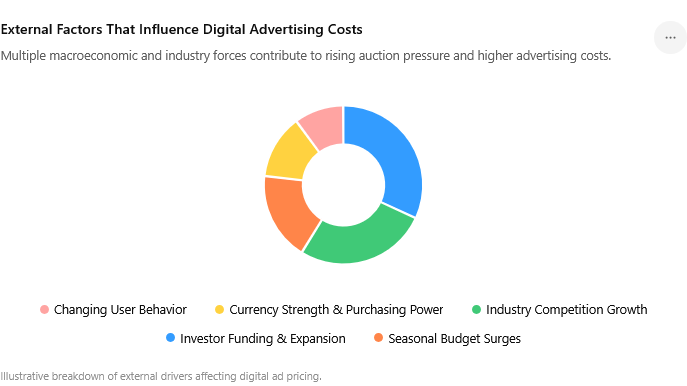
- External economic factors such as investor activity, currency movement, seasonal budget surges, and industry expansion can significantly influence auction pressure.
- Businesses that respond strategically rather than emotionally to rising advertising costs are often better positioned for long-term growth.
- Modern digital advertising success increasingly depends on broader strategic strengths including brand positioning, conversion optimization, SEO, GEO, content marketing, and audience trust.
- The future of performance marketing will favor businesses that understand both the technical and economic realities of digital advertising ecosystems.
Many business leaders have experienced this unsettling shift. A campaign that was delivering efficient results just a few months earlier suddenly begins demanding significantly higher investment to generate the same outcome. Cost-per-click rises steadily, cost-per-lead becomes increasingly difficult to control, and performance that once felt predictable starts showing signs of pressure.
The immediate reaction is usually tactical analysis. Teams begin auditing targeting settings, reviewing creatives, examining bidding strategies, and questioning whether platform algorithms have changed. Was the audience narrowed too aggressively? Has the messaging lost relevance? Is campaign fatigue setting in? Did something inside the account break without notice?
While these factors can certainly influence performance, they are often only part of the picture. In many cases, the deeper explanation is far more structural and far more important to understand:
The market itself changed.
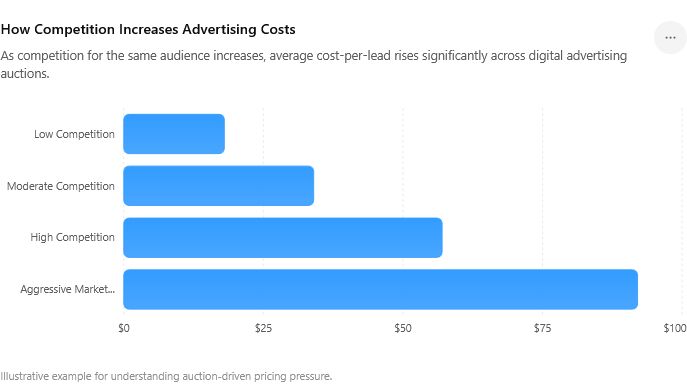
Digital advertising does not operate within a fixed-price ecosystem where costs remain stable over time. It functions more like a live economic marketplace where pricing continuously fluctuates based on competitive demand, audience availability, platform inventory, user behavior, and broader market conditions.
Every impression, every click, and every advertising opportunity exists within a dynamic auction environment. As more businesses compete for the same audience, the same keywords, and the same buyer attention, pricing pressure naturally increases. In other words, rising advertising costs are not always the result of poor campaign execution. Quite often, they reflect increasing competition within the market itself.
This distinction matters because it fundamentally changes how businesses should interpret performance marketing.
Without understanding the economics behind digital advertising, companies often react emotionally to rising costs by making rushed tactical changes, reducing budgets prematurely, or assuming campaign inefficiency. However, marketers who understand how supply, demand, and auction pressure shape digital advertising costs are able to evaluate performance more strategically and respond with greater clarity.
Because in performance marketing, success is not determined solely by what happens inside the campaign dashboard. It is also shaped by what is happening across the wider market, among competitors, within industries, and across digital platforms, where attention itself has become one of the most competitive assets in modern business.
Digital advertising is built on real-time auctions
One of the most important realities many businesses overlook is that digital advertising platforms do not operate on fixed pricing models. Unlike traditional media buying, where advertisers once purchased ad placements at predetermined rates, modern digital advertising functions through continuous real-time auctions.
Every time a user performs a search on Google, scrolls through LinkedIn, watches a video on YouTube, opens Instagram, or visits a website in the display network, an advertising opportunity is created instantly. Behind the scenes, platforms evaluate multiple advertisers competing for that exact moment of user attention.
What ultimately determines which ad appears is not simply the highest bid.
Platforms such as Google Ads, Meta Ads, and LinkedIn Ads assess a combination of factors including bid value, ad relevance, expected engagement rates, landing page quality, historical campaign performance, and overall user experience signals. Their objective is not only to maximize advertising revenue, but also to maintain a platform experience that users continue engaging with.
However, regardless of how sophisticated these systems become, the underlying economic principle remains remarkably simple: when more advertisers compete for the same audience, prices rise.
This is why advertising costs can increase even when a company changes absolutely nothing inside its campaign.
The targeting may remain identical. The creative may still perform well. Conversion rates may remain stable. Yet if additional competitors enter the auction aggressively, begin allocating larger budgets, or start bidding more heavily on the same audience segments, the overall cost of participating in that auction naturally increases.
In many ways, digital advertising behaves like any highly competitive marketplace. The value of inventory is shaped not only by its availability, but by how many businesses are attempting to acquire it at the same time.
Consider a B2B software category where only a handful of companies were advertising aggressively a year ago. CPCs may have remained relatively manageable because competition was limited. Now imagine that the category begins receiving significant investor attention, new startups enter the space, established competitors expand budgets, and demand for market share accelerates.
Almost immediately, auction pressure intensifies.
The number of available searches may not increase dramatically. The number of qualified enterprise buyers may remain relatively fixed. But the number of companies attempting to capture those buyers rises sharply. As a result, advertising costs begin climbing across the industry.
This is one of the defining characteristics of modern digital advertising. Pricing is fluid, competition-driven, and continuously influenced by market participation.
Businesses that understand this dynamic are often better positioned to make rational, long-term marketing decisions. Instead of interpreting every increase in cost as campaign failure, they recognize that performance exists within a larger competitive ecosystem where external market forces frequently shape outcomes just as much as campaign settings themselves.
The supply side of digital advertising is more limited than most businesses realize
One of the most overlooked aspects of digital advertising is the concept of inventory supply. While many businesses focus heavily on campaign settings, bidding strategies, and creative optimization, far fewer consider the underlying availability of advertising opportunities themselves.
In digital advertising, inventory is not manufactured artificially at unlimited scale. It is created through real user activity.
Every search performed on Google, every LinkedIn session, every YouTube video view, every Instagram scroll, and every visit to a website within an advertising network contributes to the supply of available impressions and clicks. In simple terms, advertising platforms can only sell attention that genuinely exists.
This becomes especially important in high-intent markets.
For example, there may only be a limited number of enterprise decision-makers searching each day for highly specific B2B terms such as “cloud compliance software,” “enterprise procurement automation,” or “industrial cybersecurity solutions.” These searches are extremely valuable because they often signal real buying intent. However, the volume itself may remain relatively small.
Now consider what happens when a growing number of companies begin targeting that same audience.
The available supply of qualified searches does not suddenly double overnight. The number of relevant buyers may remain relatively stable, yet advertiser demand increases aggressively. As more companies compete for the same limited inventory, pricing pressure intensifies across the auction ecosystem.
This is one of the defining economic realities of digital advertising: high-quality inventory is finite.
Platforms can certainly expand overall inventory over time through user growth, increased engagement, or new advertising placements. However, the most commercially valuable audiences are often naturally constrained. There are only so many enterprise buyers, high-intent searches, or decision-makers available within a given market at any moment.
In many ways, this resembles prime commercial real estate. A high-traffic retail location in a major business district commands higher pricing not because the building itself changed, but because demand for that location exceeds available space. Digital advertising operates in a remarkably similar manner. Premium audience attention becomes more expensive as more advertisers attempt to access it simultaneously.
Emerging technology trends may also influence supply dynamics in the years ahead.
As AI-driven interfaces and conversational search experiences become more common, user behavior may gradually shift away from traditional search patterns. If users increasingly receive direct answers from AI systems instead of performing multiple searches, the total volume of searchable advertising inventory could evolve significantly over time.
This does not necessarily reduce the importance of digital advertising, but it may reshape where and how advertising opportunities are created.
For businesses and marketers, understanding the supply side of digital advertising provides critical strategic perspective. Rising costs are not always caused by inefficient campaigns. In many cases, they reflect a simple market reality: more advertisers are competing for a limited pool of valuable audience attention.
Demand is the real force that pushes advertising costs higher
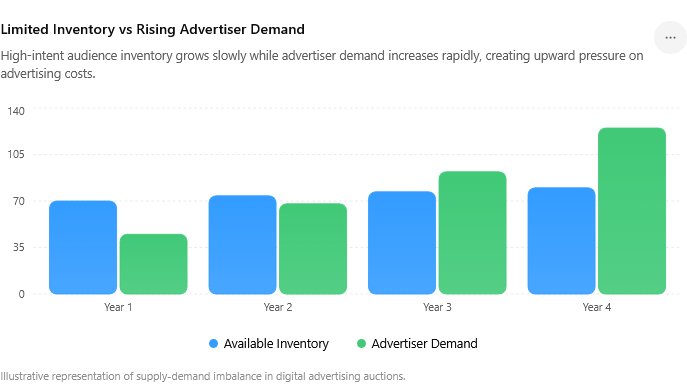
While advertising inventory typically grows gradually, advertiser demand can increase very quickly. This imbalance is one of the primary reasons digital advertising costs often rise faster than many businesses expect.
In simple terms, supply in digital advertising is constrained by user activity, but demand is driven by business ambition.
Every time more companies enter a market, expand budgets, launch new products, pursue aggressive growth targets, or increase customer acquisition efforts, auction competition intensifies. The result is greater pressure on the same pool of available audience attention.
This dynamic becomes especially visible in high-value B2B industries where each qualified lead may represent substantial long-term revenue.
Consider categories such as:
- Enterprise software
- Cybersecurity solutions
- Cloud infrastructure services
- Procurement platforms
- AI technology products
- Financial technology solutions
In these industries, companies are not simply competing for clicks. They are competing for access to highly specific decision-makers who may influence contracts worth thousands or even millions of dollars.
As a result, businesses are often willing to bid aggressively because the potential return justifies the investment.
This creates a powerful economic effect inside advertising auctions. Even a moderate increase in advertiser demand can produce disproportionately large increases in CPCs and CPLs when the available audience remains relatively fixed.
For example, imagine there are only 5,000 highly qualified enterprise buyers actively researching procurement software within a particular market each month. If ten companies compete for that audience, pricing may remain relatively sustainable. But if thirty companies begin targeting the same buyers while increasing budgets simultaneously, competition escalates rapidly.
The audience itself may not have grown significantly. However, the number of advertisers attempting to capture that audience has increased dramatically.
This is where many businesses misunderstand digital advertising economics.
Platforms are not arbitrarily raising prices. Instead, the market itself is becoming more competitive because more advertisers are placing higher value on the same audience.
In many ways, this resembles financial markets or commercial real estate. When multiple buyers compete aggressively for a limited asset, prices naturally rise. Digital advertising behaves similarly because user attention has become one of the most valuable commercial assets in the modern economy.
This is also why certain industries experience persistently high advertising costs regardless of platform optimizations. The stronger the commercial value of a customer, the more aggressively businesses are willing to compete for acquisition.
For marketers, this understanding is essential because it changes how campaign performance should be evaluated.
When acquisition costs rise, the issue is not always campaign inefficiency. Sometimes the business is simply operating inside a market where advertiser demand has accelerated faster than available audience supply.
Recognizing this distinction allows companies to respond more strategically by focusing on positioning, conversion efficiency, brand trust, and audience quality rather than assuming every increase in cost represents campaign failure.
Why rising advertising costs should be interpreted strategically, not emotionally
One of the most common mistakes businesses make in performance marketing is assuming that rising advertising costs automatically indicate campaign failure.
When CPCs increase, or lead acquisition becomes more expensive, the immediate response is often reactive. Teams begin changing creatives aggressively, resetting targeting structures, switching bidding strategies, or reducing budgets prematurely in an attempt to regain short-term efficiency.
While optimization is an essential part of digital marketing, reacting too quickly without understanding the broader market context can sometimes create even greater instability inside campaigns.
This is because digital advertising performance does not exist in isolation.
Campaigns operate within a larger competitive ecosystem influenced by advertiser demand, auction pressure, audience saturation, economic conditions, and shifting user behavior. When these external conditions change, advertising costs may rise even if campaign execution remains fundamentally strong.
Understanding this distinction is critical for making better strategic decisions.
For example, if an industry experiences rapid growth and multiple competitors suddenly begin increasing budgets aggressively, higher acquisition costs may reflect stronger market competition rather than declining campaign quality.
In this situation, continuously rebuilding campaigns may not solve the underlying issue because the pressure is originating from the market itself.
Instead, businesses often benefit more from focusing on areas such as:
- Improving landing page conversion rates
- Strengthening brand positioning
- Enhancing creative differentiation
- Increasing audience trust
- Improving lead quality rather than lead volume
- Building stronger organic demand generation channels
These strategic improvements help businesses compete more effectively even when advertising markets become more expensive.
Consider two companies operating within the same increasingly competitive B2B market.
The first company reacts to rising CPCs by constantly changing campaigns, pausing ads frequently, and reducing spend unpredictably. Performance becomes inconsistent because optimization decisions are driven primarily by short-term fluctuations.
The second company recognizes that auction competition across the industry has intensified. Instead of reacting impulsively, it focuses on improving messaging clarity, strengthening conversion experiences, refining targeting quality, and investing in brand authority.
Over time, the second company often develops greater resilience because its strategy adapts to market conditions rather than fighting against them.
This is one of the most important mindset shifts in modern performance marketing.
Successful digital advertising is not simply about lowering costs at all times. It is about understanding the economics of the market, interpreting performance accurately, and building systems that remain effective even as competition evolves.
In highly competitive industries, rising advertising costs are often a sign that markets themselves are becoming more valuable. More businesses are competing because customer acquisition opportunities are commercially important.
Viewed from this perspective, higher costs are not always negative signals. They are often indicators of increasing market demand and growing competitive intensity.
The businesses that succeed long-term are usually not the ones reacting most aggressively to short-term volatility. They are the ones that understand how digital advertising markets function beneath the surface and respond with clarity, patience, and strategic precision.
Digital advertising is becoming more competitive, but also more strategic
As digital advertising markets mature, one trend is becoming increasingly clear: success is no longer determined simply by who spends the most money.
In earlier stages of digital marketing, many businesses could achieve strong performance through relatively straightforward campaign execution. Competition was lower, audiences were less saturated, and advertising platforms still offered large volumes of underpriced inventory.
Today, the environment is fundamentally different.
Most industries now operate within highly competitive advertising ecosystems where multiple businesses target similar audiences using increasingly sophisticated strategies. Platforms have evolved, audiences have become more selective, and acquisition costs have risen across many categories.
As a result, digital advertising is becoming less of a purely tactical exercise and more of a strategic discipline.
The companies achieving long-term success are typically those that understand how multiple business functions influence marketing performance simultaneously.
Strong campaigns today are often supported by:
- Clear market positioning
- High-quality creative strategy
- Effective landing page experiences
- Strong brand perception
- Audience trust and credibility
- Efficient sales processes
- Accurate audience segmentation
- Consistent demand generation efforts
In other words, modern digital advertising performance increasingly reflects the overall strength of the business itself, not just the technical setup of campaigns.
This shift is particularly visible in B2B markets where buyers often conduct extensive research before making purchasing decisions.
Enterprise buyers rarely convert because of a single advertisement alone. They evaluate credibility, expertise, positioning, content quality, social proof, website experience, and long-term trust before engaging seriously with a company.
This means businesses that invest only in paid media while neglecting broader brand and demand-generation strategies often face growing efficiency challenges over time.
On the other hand, companies that build strong market presence across multiple channels frequently experience stronger advertising performance because audiences already recognize and trust them before the click even occurs.
This is why digital advertising increasingly works best when integrated with broader growth systems such as:
- SEO and organic visibility
- Content marketing
- Generative Engine Optimization (GEO)
- Social media positioning
- Email nurturing
- Brand storytelling
- Thought leadership
- Conversion rate optimization
Together, these elements reduce acquisition friction and improve the efficiency of paid campaigns over time.
Another important reality is that platforms themselves are evolving rapidly.
Artificial intelligence is changing how users discover information. Search behavior is shifting. Audience attention is fragmenting across platforms. Privacy regulations continue reshaping targeting capabilities. Attribution models are becoming more complex.
All of this means businesses can no longer rely solely on short-term campaign tactics as sustainable competitive advantages.
The future of digital advertising will likely belong to companies that combine performance marketing expertise with strong strategic foundations.
That includes businesses capable of understanding customer psychology, building trust at scale, creating differentiated positioning, and adapting intelligently as markets evolve.
For marketers, this creates both a challenge and an opportunity.
Competition may continue increasing, but businesses that understand the deeper economics and strategic dynamics of digital advertising are often better positioned to navigate change successfully.
Because ultimately, the goal is not simply to buy traffic.
The goal is to build sustainable demand, meaningful market presence, and long-term growth within increasingly competitive digital ecosystems.
Final thoughts: the future of digital advertising belongs to strategic businesses
Digital advertising is becoming more competitive, more sophisticated, and more economically complex with every passing year. Rising acquisition costs are no longer isolated platform issues. They are often the result of deeper market forces involving competition, audience scarcity, investor activity, shifting user behavior, and evolving digital ecosystems.
Businesses that understand these dynamics are far better positioned to make intelligent marketing decisions.
Instead of reacting impulsively to short-term fluctuations, they evaluate performance within the broader context of market conditions, competitive pressure, and long-term growth strategy. They recognize that sustainable performance marketing is not simply about lowering CPCs or generating cheaper leads. It is about building stronger positioning, higher trust, better conversion systems, and resilient demand-generation engines that continue performing even as markets evolve.
As digital advertising platforms become increasingly crowded, competitive advantage will belong to businesses that combine performance marketing expertise with strategic clarity.
That means understanding not only how campaigns function technically, but also how digital markets behave economically.
At ICO WebTech, we help businesses navigate this evolving landscape through performance-driven digital marketing strategies designed around long-term growth, intelligent positioning, and measurable business outcomes.
From SEO, GEO, and paid media to conversion optimization, content strategy, and demand generation, our focus is not simply on generating traffic — it is on helping businesses compete more effectively in increasingly competitive digital markets.
Because successful digital marketing today is not about chasing algorithms.
It is about understanding markets, understanding audiences, and building sustainable systems that create long-term business value.



Related items
Your Google Ads Budget May Not Be the Problem Here’s a number worth paying attention to: t

Why a winning small-budget test doesn’t guarantee a winning big-budget campaign — and the


Performance Max now manages more than 80% of ad spend for the median enterprise Google Ads