
Are ChatGPT results and Google rankings related?
Every digital marketer is asking the same question right now: if I rank #1 on Google, does that mean ChatGPT will recommend my brand? The answer — backed by multiple large-scale studies — is nuanced, surprising, and strategically important for every business investing in online visibility.
In this deep-dive, we break down what the data actually says about the relationship (or lack thereof) between Google rankings and ChatGPT citations, what factors ChatGPT uses instead, and what it means for your digital marketing strategy going into the second half of 2026.
Table of Contents
- The Scale Gap: Google vs ChatGPT in Numbers
- What the Studies Actually Found: Correlation Data
- How Google and ChatGPT Work Differently
- What Signals Does ChatGPT Actually Use?
- Where Google Rankings DO Help
- The Rise of GEO: Generative Engine Optimization
- How ICO WebTech Can Help You Win Both
- Conclusion
1. The Scale Gap: Google vs ChatGPT in Numbers
Before diving into correlation, it helps to understand where both platforms stand in terms of reach. The difference is enormous — but ChatGPT’s growth curve is equally striking.
Google’s global search market share (2025)
Source: Datos / SparkToro, March 2025
Google searches processed per day
Source: Datos / SparkToro, March 2025
ChatGPT monthly visits (August 2025)
Source: Similarweb, 2025
ChatGPT year-over-year growth (late 2024)
Source: Similarweb, 2024
Sources: Advanced Web Ranking · OneLittleWeb 24-Month Study
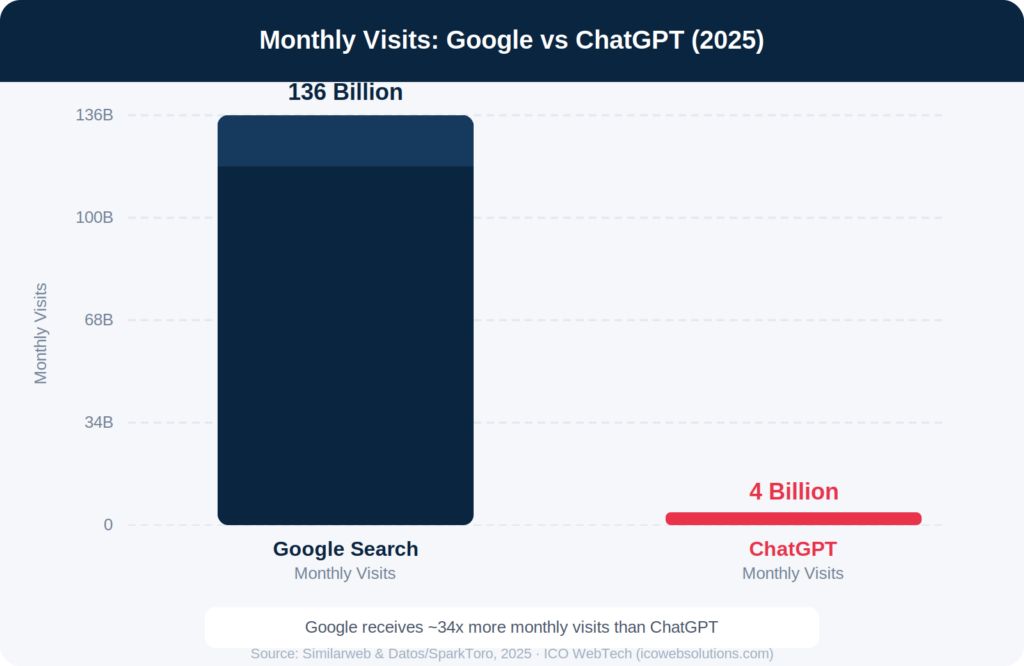
Despite ChatGPT’s explosive growth, Google remains overwhelmingly dominant. Yet the important insight is that 95% of ChatGPT users still also use Google — meaning both platforms are complementary, not competing, in how your audience discovers information.
“ChatGPT functions as a complement rather than a substitute for Google — but being invisible in either one is a strategic blind spot your competitors will exploit.”
— Advanced Web Ranking, 2025
2. What the Studies Actually Found: The Correlation Data
Multiple independent research organisations have now studied whether Google rankings predict ChatGPT citations. The results are surprising — and game-changing for SEO strategy.
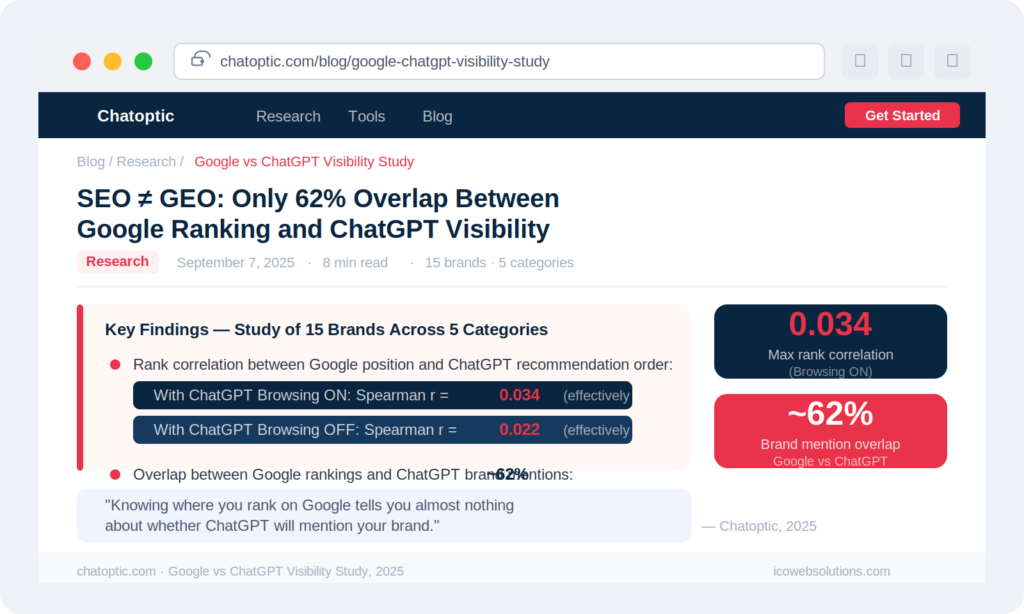
Key Finding from Chatoptic’s 2025 Study (15 brands, 5 categories):
Rank correlation between Google position and ChatGPT recommendation order:
- With ChatGPT Browsing ON: Spearman r = 0.034
- With ChatGPT Browsing OFF: Spearman r = 0.022
- Overlap between Google rankings and ChatGPT mentions: ~62%
In statistical terms, a correlation of ~0.03 is essentially zero — knowing your Google rank tells you almost nothing about your ChatGPT visibility.
Source: Chatoptic.com — SEO ≠ GEO Study, 2025
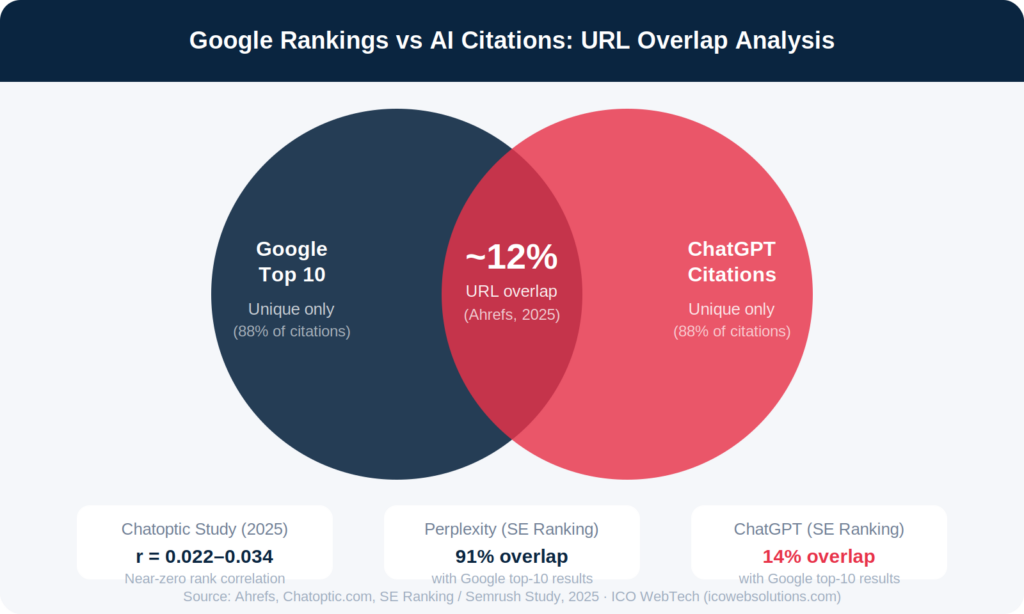
Note: Perplexity overlaps with Google top-10 rankings 91% of the time vs. ChatGPT at ~12–14%
Source: Ahrefs, SE Ranking / Semrush Study, 2025
Key Research Findings at a Glance
| Study | Key Finding | Source |
|---|---|---|
| Ahrefs Analysis (2025) | Only 12% of links cited by AI assistants (ChatGPT, Gemini, Copilot, Perplexity) appear in Google’s top 10 for the same query | Ahrefs via Beamtrace |
| Chatoptic Study (2025) | Rank correlation between Google position & ChatGPT order: r = 0.022–0.034 (effectively zero) | Chatoptic.com |
| BrightEdge Research (Oct 2025) | 54.5% of AI Overview citations match top organic URLs (up from 32% in 2024) — Google’s own AI leans on its index | PragoMedia / BrightEdge |
| SE Ranking / Semrush (2025) | Perplexity cites Google top-10 results 91% of the time; ChatGPT only 14% | PragoMedia |
| SE Ranking (2025) | Sites with 32,000+ referring domains are 3.5x more likely to be cited by ChatGPT | Yotpo / SE Ranking |
⚡ ICO WebTech Insight
The data is clear: ranking #1 on Google does not guarantee visibility in ChatGPT. But completely separate strategy isn’t the answer either — the two platforms share foundational trust signals. The winning approach is an integrated SEO + GEO strategy.
3. How Google and ChatGPT Work Differently
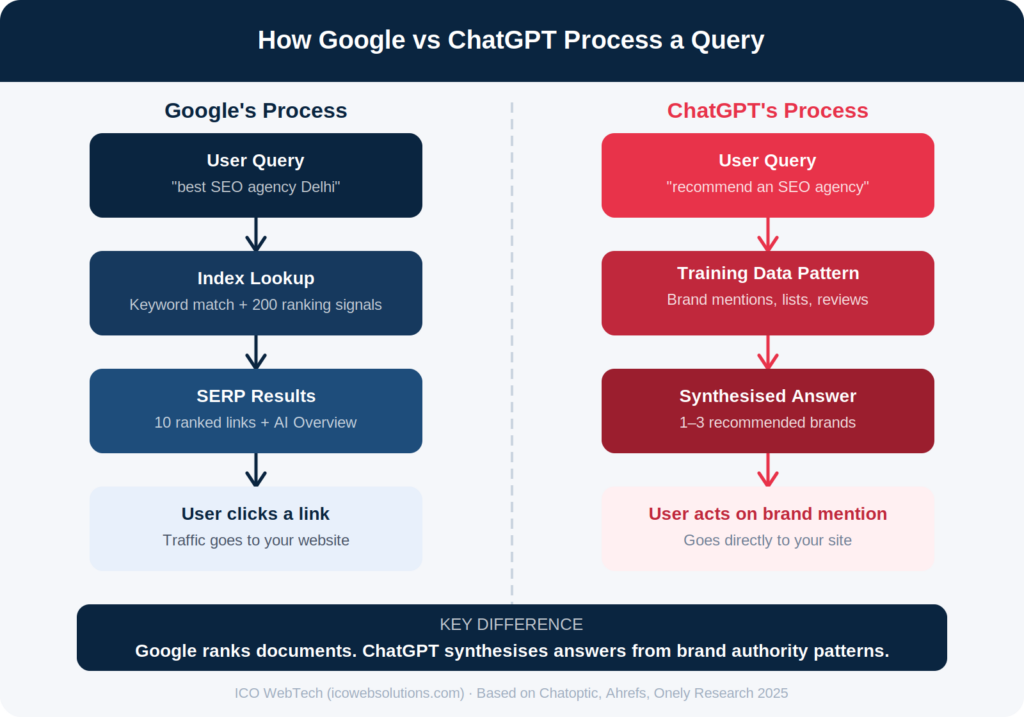
The root cause of the divergence is architectural. These two systems have fundamentally different goals and processes.
| Aspect | Google Search | ChatGPT |
|---|---|---|
| Core Task | Match your query to existing web documents and rank them by relevance | Generate a synthesised, conversational answer by predicting the most likely response |
| Primary Signal | 200+ ranking factors: backlinks, keywords, page speed, E-E-A-T | Brand authority patterns in training data, authoritative list mentions, and third-party citations |
| Output | A ranked list of 10 blue links (plus AI Overviews) | One synthesised answer mentioning a smaller “aristocracy” of sources |
| Freshness | Near real-time index crawling | Training data cutoff + optional Bing/web search plugin (when browsing is ON) |
| Citation Logic | Keyword + authority match for each document | Pattern recognition: brands consistently mentioned by trusted sources in training data |
| Risk Aversion | Long-tail content can still rank with moderate authority | Strongly prefers high-authority domains; “trust cliff” around 32,000+ referring domains |
How Each System Processes a Query
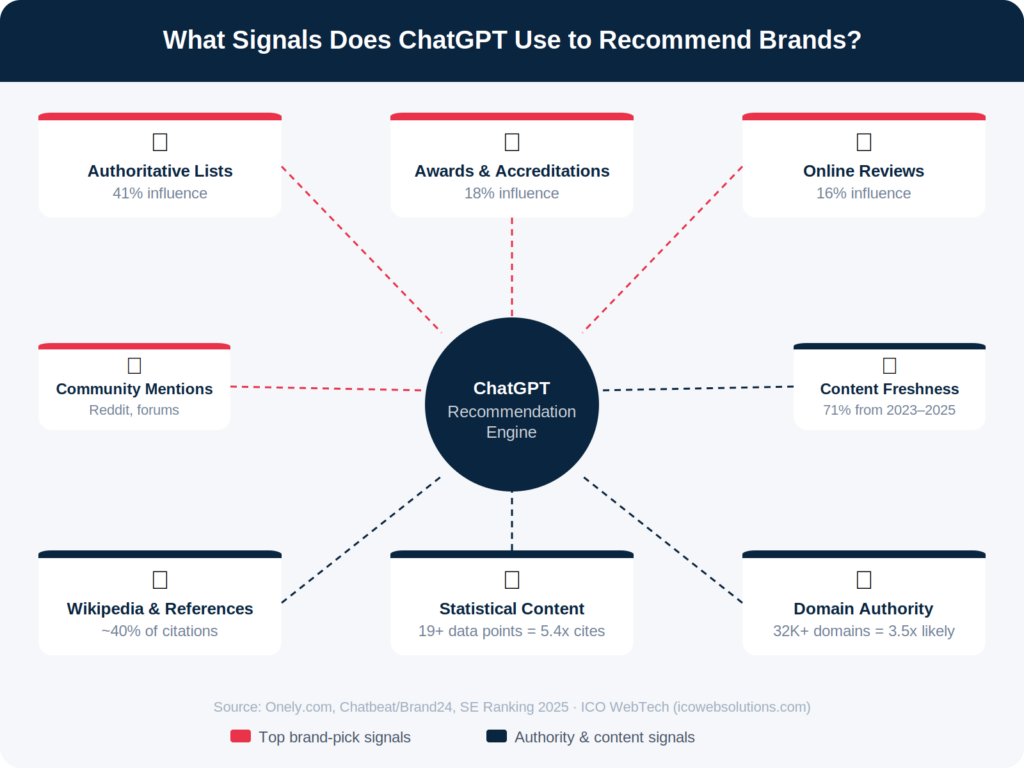
4. What Signals Does ChatGPT Actually Use?
If Google rankings barely predict ChatGPT citations, what does ChatGPT actually use to decide which brands to recommend? Research from Onely, SE Ranking, and Brand24 has reverse-engineered the key factors:
Authoritative List Mentions (41%)
Being featured in industry “best of” lists, expert roundups, and rankings is the single biggest driver. Think Forbes lists, G2 comparisons, Clutch.co rankings.
Awards & Accreditations (18%)
Recognition from established institutions signals credibility. Industry awards, certifications, and verified partnerships all contribute to ChatGPT’s trust model.
Online Reviews (16%)
Third-party validation from customers on platforms like Google, Trustpilot, and Clutch. Brands with an online review score below 70% are significantly less likely to be recommended.
Wikipedia & Reference Sites
Wikipedia accounts for approximately 40% of ChatGPT citations. Crunchbase, LinkedIn, and other authoritative reference platforms matter enormously.
Statistical & Data-Rich Content
Articles with 19+ statistical data points averaged 5.4 citations vs. low-data articles. ChatGPT prefers content it can confidently attribute to a clear source.
Domain Authority (Trust Cliff)
Sites with 32,000+ referring domains are 3.5x more likely to be cited. There is a non-linear trust threshold — authority matters, but differently to Google.
Reddit & Community Mentions
Domains with over 10 million Reddit mentions average 7 ChatGPT citations vs. 1.8 for brands with minimal Reddit presence. Community discussion matters.
Content Freshness
71% of ChatGPT citations come from 2023–2025 content. Regularly publishing authoritative, date-stamped content keeps your brand in the training and retrieval window.
Sources: Onely.com · Chatbeat / Brand24 · Medium / GEO Report
5. Where Google Rankings DO Help
It’s not a zero-sum game. There is meaningful overlap — especially when looking at Google’s own AI features and foundational authority signals.
76% of Google AI Overview cited pages rank in Google’s own top 10Ahrefs, 2025
54.5% AI Overview citations now match top organic URLs (up from 32% in 2024)BrightEdge, Oct 2025
0.664 Spearman correlation — brand mentions & Google AI Overview citationsAhrefs GAIO Study, 2025
Sources: Chatbeat.com · PragoMedia
The key insight: Google’s own AI Overviews DO correlate strongly with top organic rankings — but third-party AI platforms like ChatGPT operate on separate logic. This creates a two-tier AI visibility landscape:
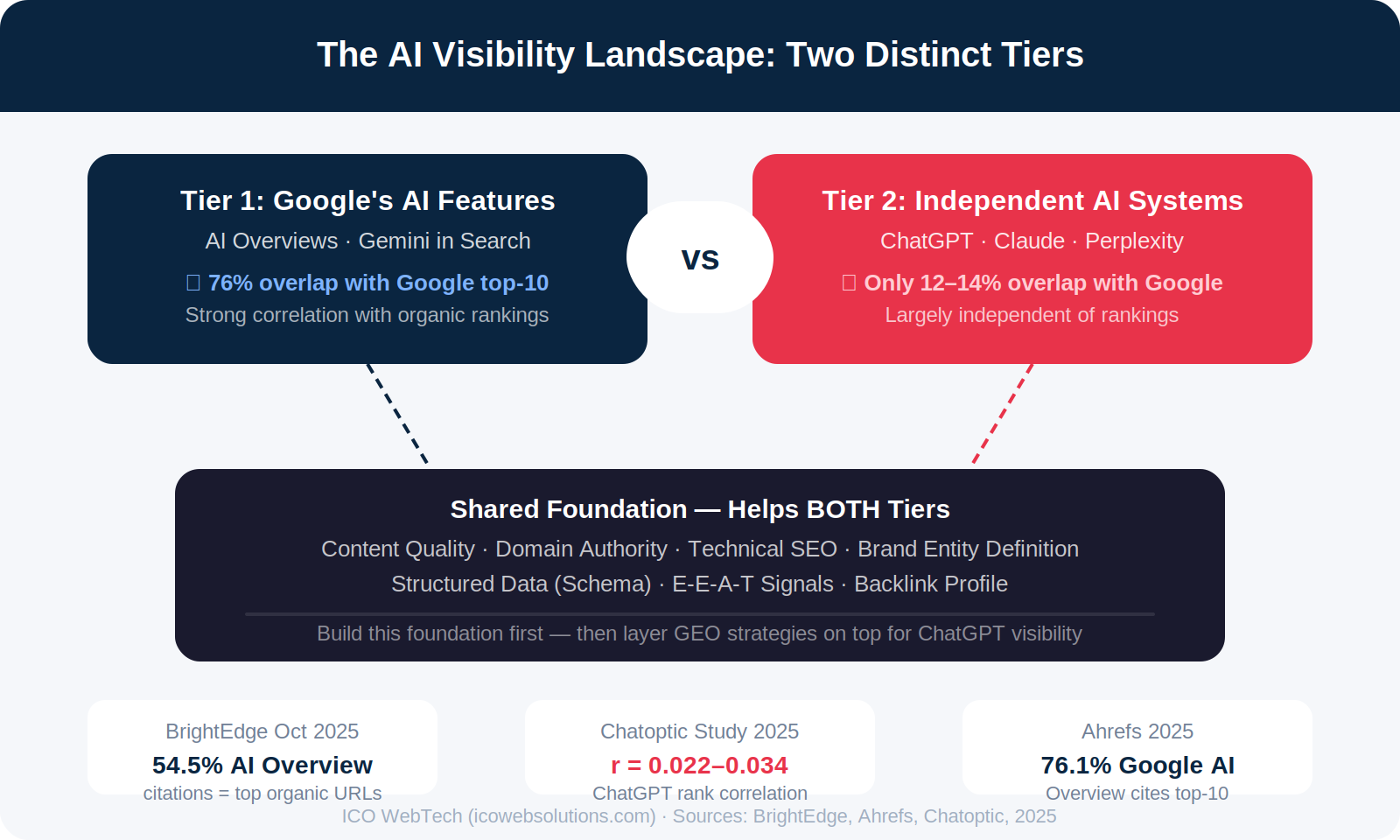
Strong SEO still matters — but it’s the foundation, not the ceiling. Winning in ChatGPT requires additional, targeted strategies beyond traditional rank-building.
6. The Rise of GEO: Generative Engine Optimization
The emerging discipline designed to address this gap is Generative Engine Optimization (GEO) — formally defined in academic research from Princeton, Georgia Tech, and IIT Delhi in 2024, and now entering mainstream marketing practice.
“I care less about Google rankings and more about whether AI tools like ChatGPT or Perplexity mention the brands I work with.”
— Relato’s 2026 GEO Analysis: the new operating reality for performance-driven marketers
SEO vs GEO: Key Differences
| Dimension | Traditional SEO | GEO (Generative Engine Optimization) |
|---|---|---|
| Goal | Rank in top 10 Google results | Get cited/recommended by AI systems |
| Primary Currency | Backlinks + keyword relevance | Authoritative brand mentions + entity recognition |
| Content Focus | Target keywords, search intent pages | Conversational Q&A, statistical content, entity-rich articles |
| Measurement | Rankings, organic traffic, CTR | AI citation rate, brand mention frequency, AI referral traffic |
| Key Platforms | Google Search Console, Ahrefs, Semrush | Conductor, Profound, Semrush AI Toolkit, Search Party |
| Timeline | 3–12 months typically | Ongoing — AI models re-train and update citation patterns |
Source: Enrich Labs — GEO Complete Guide 2026 · ALM Corp — ChatGPT Conversion Study
💡 Why GEO Matters for Conversions
ChatGPT referral traffic converts 31% higher than non-branded organic search — because users who arrive via an AI recommendation have already been pre-sold on your brand’s credibility. The volume is smaller, but the quality is exceptional.
Source: ALM Corp, 2025 Data Analysis — ChatGPT Traffic Converts 31% Higher
7 Steps to Improve ChatGPT Visibility (GEO Checklist)
- Get Listed in Authoritative “Best Of” Lists
Target Clutch, G2, Capterra, Forbes, and industry-specific directories. List placement is the #1 factor (41%) in ChatGPT recommendations. - Publish Data-Rich, Citable Content
Create original studies, surveys, and statistics. Aim for 19+ data points per article. Give AI something concrete to attribute to your brand. - Build Your Brand’s Wikipedia & Knowledge Graph Presence
Wikipedia drives ~40% of ChatGPT citations. Update entries on Wikipedia, Crunchbase, and Wikidata without self-promotion. Ensure NAP consistency everywhere. - Earn Third-Party Media Coverage
Digital PR, podcast appearances, and contributions to industry publications. AI models treat a Forbes mention as far more credible than your own blog. - Maintain Structured Data (Schema Markup)
Implement FAQ, HowTo, Review, and Organization schema. AI crawlers rely heavily on structured data to understand entity relationships. - Build Genuine Reviews on Trusted Platforms
Brands below a 70% positive review rate are significantly less likely to be recommended by ChatGPT. Focus on Google, Trustpilot, and niche review sites. - Track AI Visibility as a Separate KPI
Use tools like Semrush AI Toolkit, Conductor, or Profound to monitor your brand’s citation rate in ChatGPT, Gemini, and Perplexity. Rankings alone no longer tell the full story.
How ICO WebTech Can Help You Win Both Google & ChatGPT
Since 2011, we’ve helped businesses grow through every major algorithm shift. The AI visibility era is the most significant change since Google’s inception — and we’re ready to help you lead it.
AI Visibility (GEO) Service
We audit your current ChatGPT & Gemini citation footprint, identify gaps, and build a systematic GEO strategy covering authoritative mentions, structured data, and entity optimisation.
SEO + GEO Integration
We don’t treat SEO and GEO as separate silos. Our integrated approach builds domain authority and brand entity signals that strengthen your visibility across Google rankings AND AI recommendations simultaneously.
AI Visibility Reporting
We track your brand’s mention frequency in ChatGPT, Perplexity, and Google AI Overviews — giving you a complete picture of your digital visibility beyond traditional rank tracking.
Authoritative Content Creation
Our content team creates data-rich, citable articles, original research, and expert guides designed specifically to meet the citation criteria used by large language models.
Conclusion: Two Rankings, One Integrated Strategy
The data is unambiguous: Google rankings and ChatGPT citations operate largely independently. A rank correlation of near zero (r = 0.022–0.034) means your position on Google’s search results tells ChatGPT almost nothing about whether to recommend your brand. Only 12% of URLs cited by ChatGPT appear in Google’s top 10 for the same query.
But this doesn’t mean SEO is dead. Strong technical SEO, content quality, and domain authority remain the foundation — they’re just no longer the ceiling for AI visibility. Google’s own AI Overviews strongly favour top-ranking pages (76% correlation), making SEO essential for Tier 1 AI visibility.
Winning in 2026 and beyond requires a dual approach:
| To Win in Google Rankings | To Win in ChatGPT / AI Answers |
|---|---|
| Technical SEO excellence | Authoritative “best of” list placements |
| Keyword-targeted content | Data-rich, citable content with clear attribution |
| Quality backlink acquisition | Third-party brand mentions & digital PR |
| Page speed & Core Web Vitals | Wikipedia, Crunchbase & knowledge graph presence |
| E-E-A-T signals | Verified reviews & reputation management |
| Schema markup | Structured data & FAQ schema for AI parsing |


Failing Google’s New INP Metric? How to Fix Laggy Mobile Interactions
We have all been there as mobile internet users. You are browsing a website on your smartphone, looking to expand a drop-down accordion menu, open a mobile navigation drawer, or click a “Buy Now” button. You tap the screen with your thumb. Nothing happens.
You wait a fraction of a second. Still, the screen is frozen. Frustrated, you tap the button three more times, thinking your initial touch wasn’t registered. Suddenly, the website jolts into motion all at once, registering every single tap in a chaotic, broken sequence of layout shifts. Annoyed and impatient, you hit the back button, leave the site, and head straight to a competitor’s platform.
For years, website owners assumed that if their pages loaded fast initially, their user experience was flawless. Google’s core metrics historically favored initial loading benchmarks like Largest Contentful Paint (LCP). However, the modern mobile web has evolved. Users don’t just consume static pages; they interact with complex, JavaScript-heavy applications directly inside their mobile browsers. When those interactions feel heavy, sluggish, or unresponsive, users leave.
Recognizing this shift, Google officially introduced a major ranking metric paradigm shift: Interaction to Next Paint (INP). INP has formally replaced First Input Delay (FID) as a core pillar of Core Web Vitals. The implications have been swift and uncompromising. Across the globe, websites with gorgeous visual layouts are experiencing sudden, severe drops in mobile search rankings. Why? Because while their sites look incredible, their user interface feedback is fundamentally sluggish under the hood.
If your business is currently watching its hard-earned mobile search traffic slip away due to poor interaction scores, you are not alone. Fortunately, fixing this issue doesn’t require stripping your site down to bare-bones text. By deploying advanced JavaScript optimizations, minimizing main-thread blocking, and streamlining your CSS rendering paths, you can transform your mobile experience into an instant, snappy asset. Whether you operate a high-volume e-commerce store or a massive corporate portal, understanding INP is critical to digital survival. Let’s unpack exactly how to diagnose, fix, and master this complex performance metric.
The Anatomy of INP: Why Your Old Performance Metrics Lied to You
To solve an interaction problem, you must first understand how Google measures it. For a long time, the industry relied heavily on First Input Delay (FID) to quantify site responsiveness. But FID possessed a massive technical loophole: it only measured the delay *before* the browser began processing the very first interaction on a page. It completely ignored the time it took to actually run the JavaScript event handlers, and it ignored every single subsequent tap, click, or scroll action a user performed during their entire session.
INP closes that loophole permanently. It observes *all* interactions that occur during the entire lifespan of a user’s visit. It measures the comprehensive duration from the exact millisecond a user touches the screen to the precise moment the mobile browser renders the very next visual frame on the display. This total duration is broken down into three distinct operational phases:
- Input Delay: The time elapsed between the user executing the physical interaction and the browser’s main thread being completely free to accept and begin processing that interaction. This is usually caused by long-running background scripts.
- Processing Time: The duration required to execute the active JavaScript event listeners attached to that specific button, link, or component.
- Presentation Delay: The time it takes for the browser to recalculate the visual layout, repaint the altered pixels on the screen, and visually display the new framework to the user.
Google classifies an INP score under **200 milliseconds** as “Good” or Excellent. Anything between 200ms and 500ms needs substantial improvement, and any score exceeding **500 milliseconds** is flagged as “Poor,” triggering direct ranking penalties within mobile search algorithms.
This means your site could have an incredible 1.5-second initial load speed, but if your mobile navigation menu takes 600ms to open when a user clicks it, Google views your page as broken. To achieve a modern, fully compliant digital framework, brands are increasingly seeking specialized assistance from a premium Website designing company in Delhi India to overhaul their code environments from the ground up.
Phase 1: Advanced JavaScript Optimization – Taming the Event Loop
JavaScript is almost always the prime suspect behind a failing INP score. Modern frameworks pack massive script packages down to mobile devices, forcing low-tier mobile processors to work overtime just to parse and execute code. When a user interacts with a page, their action is queued up behind whatever JavaScript is currently dominating the engine.
1. Yielding to the Main Thread via Tactical Code Splitting
The single most effective way to eliminate input delay is to ensure that your JavaScript functions never block the main thread for longer than 50 milliseconds at a time. Tasks that take longer than 50ms are classified by Google as “Long Tasks.” If a user taps a mobile menu while a 300ms long task is running, the browser cannot respond until that task finishes completely.
To combat this, developers must break massive, monolithic code blocks into small, asynchronous chunks. By shifting non-essential steps out of the immediate execution path and utilizing API methods like setTimeout() or the modern scheduler.yield() native function, you allow the browser to safely pause script execution, look at the user interaction queue, process the tap immediately, and then resume the background script right where it left off.
2. Throttling and Debouncing High-Frequency Events
Interactive features like real-time search auto-suggestions, dynamic filter sidebars, or endless scroll trackers can flood the browser’s execution engine with hundreds of event fires every single second. If your site attempts to recalculate layouts on every single micro-movement or keypress, your mobile processing time will skyrocket.
By implementing strict debouncing patterns, you guarantee that a resource-heavy script will only execute after a specific pause in action (for instance, waiting 250ms until a user stops typing their search query). Similarly, throttling ensures an event function fires only once per specific time interval, dramatically reducing total CPU strain and keeping your application light and responsive.
Phase 2: Eradicating Main-Thread Blocking Tasks
The browser’s main thread is a single-lane highway. It handles layout styling, HTML parsing, script execution, and user interaction handling all at the same time. If a massive pileup occurs on that highway, the entire mobile interface freezes completely.
1. Auditing and Offloading Third-Party Bloat
On many modern corporate websites, the heaviest blocking tasks do not come from internal code; they originate from third-party tracking scripts, advertising tags, marketing automation software, and heat-mapping analytics tools. When multiple platforms attempt to inject tracking events simultaneously upon a mobile click, interaction responsiveness collapses.
To fix this, execute a brutal tag audit inside Google Tag Manager. Defer all non-essential third-party scripts so they do not execute during the critical interactive windows of your site. If an analytics tracker does not directly contribute to the immediate visual experience of the user, wrap its initiation in a requestIdleCallback() block, ensuring it only populates when the mobile CPU is completely resting.
2. Leveraging Web Workers for Heavy Computations
If your website relies on complex data calculations, heavy filtering algorithms, or client-side data sorting (common in enterprise-grade web applications), you should never force the primary UI layer to process that data. Doing so causes immediate visual freezing.
Instead, look to offload those complex, data-heavy operations entirely to a **Web Worker**. Web Workers allow you to spin up a completely independent background thread separate from the primary UI stream. The worker processes the raw data silently in the background and shoots a clean message back to the main thread only when the final result is ready. This keeps the primary mobile user interface perfectly agile, maintaining an instantaneous 60fps frame rate regardless of what calculations are occurring under the hood.
Phase 3: Streamlining the CSS Rendering and Painting Path
Once your JavaScript executes quickly, you face the final hurdle: Presentation Delay. The browser must calculate how the visual structural tree changes, figure out exactly where the layout components fit, and physically paint the updated colors onto the glass display of the phone.
1. Eliminating Forced Synchronous Layouts (Layout Thrashing)
Layout thrashing occurs when your JavaScript event handlers read a visual layout property from the DOM (like checking an element’s offset height) and immediately turn around and write a style adjustment to the DOM, over and over in a tight loop. This forces the mobile browser to run full layout calculations prematurely inside the script loop, creating a massive rendering bottleneck.
To eliminate this presentation lag, always separate your DOM reads from your DOM writes. Read all necessary visual values collectively first, then perform your style modifications in batch phases. Better yet, wrap your visual rendering updates inside a requestAnimationFrame() loop to align your styling adjustments perfectly with the native refresh rate cycle of the mobile screen.
2. Utilizing CSS Hardware Acceleration
When creating interactive components like sliding mobile menus, modal popups, or expanding filters, how you write your CSS styles matters immensely. If you animate a mobile sidebar layout using the left or top directional styling properties, the browser is forced to trigger full geometric layout calculations across the entire DOM tree for every single pixel shift.
Instead, utilize hardware-accelerated CSS properties like transform: translateX() and opacity. These specific properties completely bypass the browser’s layout and paint phases. Instead, they hand the visual adjustments directly to the device’s GPU (Graphics Processing Unit). This ensures that complex visual animations slide, fade, and interact at a flawless, ultra-responsive pace even on older, budget-friendly smartphones.
The Operational Imperative: A Comprehensive Look at INP Metrics
When tracking your mobile user experience, optimization can quickly feel abstract. To bring absolute clarity to your development pipeline, it is essential to look at the concrete operational targets required to pass Google’s rigorous performance guidelines.
| INP Performance Tier | Latency Window | Google Core Ranking Impact | Primary Remediation Action Required |
|---|---|---|---|
| Excellent / Passed | < 200 Milliseconds | Maximum ranking benefit; perfect mobile health status. | Maintain consistent code hygiene; continuous monitoring via CrUX dashboard. |
| Needs Improvement | 200ms – 500ms | Volatile mobile visibility; early ranking degradation warnings. | De-bloat third-party scripts; introduce asynchronous JavaScript yielding blocks. |
| Poor / Failed | > 500 Milliseconds | Direct algorithm penalties; severe drop in global mobile search exposure. | Complete code architecture overhaul; move styling animations to GPU layers. |
By mapping out your current interaction metrics against this framework, your technical team can pinpoint exactly how aggressively your site is losing ground and establish clear sprint priorities to salvage your organic search traffic.
Real-World Case Study: Saving an Enterprise Media Portal from Mobile Extinction
To contextualize these principles, look at the dramatic recovery of a leading global enterprise media portal. Generating millions of monthly pageviews from breaking news, editorial features, and interactive multimedia, this media powerhouse relied on high-volume mobile search visibility for over 70% of its total digital advertising revenue.
Following a massive layout expansion featuring infinite scroll modules, live-updating financial tickers, and auto-refreshing comment sections, their technical health scores began to fall. While the desktop experience remained relatively stable, their mobile interaction latency skyrocketed. Their INP metrics surged into a highly dangerous zone, averaging an abysmal 680 milliseconds across entry-tier mobile devices.
The ranking consequences were immediate and catastrophic. Within eight weeks, their mobile organic search rankings fell by nearly 25% across key informational head terms. This structural drop-off triggered a severe decline in monthly advertising impressions, threatening their quarterly corporate bottom line.
They realized that their existing infrastructure was structurally broken. Rather than putting temporary patches over bad code, they invested in comprehensive website redesigning services designed specifically to re-architect their mobile rendering ecosystem.
The engineering team executed a strict performance optimization blueprint:
- They decoupled the live financial data widgets from the primary visual rendering flow, offloading the real-time websocket data parsing to background Web Workers.
- They completely restructured their event delegation patterns, removing thousands of redundant event listeners across the infinite scroll containers and replacing them with a single, highly efficient parent listener.
- They audited their third-party advertising partners, implementing strict execution block rules that prevented ads from initializing until the page achieved absolute interactive readiness.
- They leveraged advanced CSS properties like
content-visibility: auto, ensuring that elements far below the fold were completely skipped by the browser’s layout engine until the exact moment they approached the viewport.
The operational transformation was spectacular. Within weeks of rolling out the optimized code framework, their mobile Interaction to Next Paint metric plummeted from a failing 680ms down to a stunning, lightning-fast 140 milliseconds, earning an “Excellent” rating from Google’s testing clusters. As Google’s web crawlers re-indexed the optimized framework, the media portal fully restored its dropped mobile search rankings, reclaimed its top-tier positions, and grew its overall mobile ad monetization metrics by an unprecedented 18% quarter-over-quarter.
Why Core Technical Engineering Dictates Search Dominance
The days when digital design only encompassed selecting beautiful color palettes, arranging grids, and drafting slogans are completely over. In the modern, mobile-first ecosystem of 2026, real performance *is* design. A website cannot be considered truly well-designed if its code engine frustrates its visitors and actively alienates search algorithms.
Fixing complex core vitals like Interaction to Next Paint requires a deep, uncompromising marriage between forward-thinking creative visual arts and technical web engineering. This reality is why ambitious global brands turn away from generic freelance template builders and establish strategic partnerships with a high-caliber Website designing company in Delhi India that builds with technical compliance as an absolute prerequisite.
When you focus deeply on building optimized code pathways, clean database interactions, and streamlined client-side scripts, you naturally build a digital footprint that both your target audience and Google’s search bots adore. Do not wait for a devastating ranking penalty to highlight the hidden code flaws within your mobile layout. Prioritize interaction engineering today, modernize your framework with elite technical redesign services, and make sure every tap your customers make delivers an instant, satisfying response.


Planning a Website Redesign? How ICO WebTech Prevents a Post-Launch SEO Nightmare
Imagine spending six months, thousands of dollars, and endless late-night meetings collaborating with top-tier designers to overhaul your brand’s digital storefront. The typography is elegant, the user interface is butter-smooth, and the checkout process feels like magic. With immense pride, your team flips the switch and launches the new site. You pop the champagne, celebrate the stunning visual upgrade, and wait for the compliments to roll in.
Then, day three hits. Your customer service team notes a drop in inbound leads. By day seven, your organic traffic analytics show a terrifying, vertical cliff-style dropoff. Keywords that your business spent five years climbing to the top of page one for have vanished entirely. Your hard-earned backlinks are suddenly pointing to digital dead ends, and your organic revenue plummets by 40% in a single week.
This is the post-launch SEO nightmare, and it happens far more often than most brands realize. The paradox of the modern internet is that Google’s search algorithms do not care how “pretty” your website looks if they can no longer find the roads, signs, and foundations that made your site authoritative in the first place.
When brands migrate to a new domain, restructure their content categories, or switch content management systems (CMS) without an airtight search strategy, they are effectively demolishing an old house and building a new one without telling the post office where to deliver the mail. Fortunately, this catastrophe is completely preventable. By leveraging professional website redesigning services backed by strategic technical execution, brands can modernize their online presence while preserving—and even accelerating—their organic search equity. As an experienced SEO company in India, ICO WebTech has perfected the art of the zero-loss migration. Here is an in-depth breakdown of how we protect your brand’s digital legacy during a website overhaul.
The Hidden Friction Between Creative UX and Technical SEO
To understand how to prevent an SEO disaster, it is vital to understand why it happens. Website redesigns are usually driven by creative, marketing, or product teams focused on visual identity, conversion rate optimization (CRO), and modernizing brand aesthetics. While these are critical goals, creative design and technical SEO often pull in opposite directions if not properly coordinated.
- The Minimalist Trap: Designers love clean layouts with minimal text. However, removing long-form copy from key landing pages to achieve a “clean look” frequently strips away the contextual semantic signals and keyword density that allowed those pages to rank on Google.
- Altering the URL Blueprint: Changing a URL from
example.com/services/digital-marketingtoexample.com/our-work/marketingwithout telling search engines causes immediate link breakage. Every external website pointing to your old link now delivers a frustrating 404 error, destroying your link equity overnight. - JavaScript-Heavy Frameworks: Modern websites often rely on complex client-side JavaScript frameworks (like React or Vue) to create dynamic, smooth transitions. If these frameworks are implemented incorrectly, search engine crawlers may see nothing but a blank page, failing to index your primary text.
- Disrupting Content Hierarchy: Replacing structured, keyword-optimized Heading tags (H1, H2, H3) with generic styled CSS classes to make text look a certain size completely blinds search engines to the informational hierarchy of your content.
At ICO WebTech, we bridge this gap. We ensure that your design evolution does not result in search engine devolution, treating SEO not as an afterthought to be sprinkled on post-launch, but as the very scaffolding upon which the new design is built.
Phase 1: Pre-Launch Prep and the Sacred Legacy Crawl
The secret to a flawless website launch lies entirely in the preparation. Before a single line of code is rewritten for the new site, ICO WebTech establishes a rigorous baseline data map of the existing website. Think of this as taking an exact structural inventory of a museum before moving its artifacts to a new gallery.
1. Mapping the Complete URL Inventory
We don’t just export a basic sitemap; we execute a comprehensive deep crawl of the live website using advanced data extraction tools. This captures every single URL that has ever been indexed, including hidden landing pages, old blog posts, and auxiliary resource files. We cross-reference this crawl with Google Search Console and Google Analytics data from the past 24 months to identify the “heroes”—the exact pages driving your organic impressions, clicks, and conversions.
2. Extracting the Backlink Database
Your domain authority is largely dictated by your backlink profile—the ecosystem of external websites linking to your content. We run extensive link audits via tools like Ahrefs and Majestic to catalog every high-authority backlink your site possesses. If a page has 50 premium editorial backlinks pointing to it, that page is flagged as a high-value asset that must either maintain its exact URL structure or be flawlessly redirected to preserve its incoming authority.
3. Benchmarking Current Rankings
We document your current keyword rankings across different geographic regions and device types. By knowing exactly where you stand for your primary head terms and long-tail variants, we establish a crystal-clear benchmark. If a specific keyword starts fluctuating post-launch, we immediately pinpoint the exact page responsible and deploy targeted adjustments.
Phase 2: The Core of Migration Strategy—Structured 301 Redirect Mapping
If there is one technical failure that destroys rankings faster than any other during a website redesign, it is faulty or missing redirect management. A 301 redirect is a permanent directive that tells search engine crawlers and human visitors: “This page has permanently moved to a new home. Please pass all our historical trust, authority, and ranking weight to the new URL.”
Many amateur teams make the catastrophic mistake of redirecting all old URLs to the new homepage out of sheer laziness. To Google, routing hundreds of distinct, topic-specific legacy pages to a single generic homepage is a major red flag, often treated as a “Soft 404.” This completely wipes out the individual ranking signals of those specific pages.
ICO WebTech avoids this via a highly structured, row-by-row 301 Redirect Mapping Matrix. Here is an illustrative look at how we systematically manage your link architecture during a redesign:
| Legacy URL (Old Site) | New Target URL (Redesign) | SEO Priority Status | Action & Rationale |
|---|---|---|---|
/about-us.html |
/about/ |
Medium | Standardize URL structure; remove outdated .html extension. |
/services/bulk-sms-marketing |
/services/sms-solutions/ |
CRITICAL | High-revenue landing page. Exact content and metadata migrated to prevent drop. |
/blog/article-v1-2021 |
/blog/modern-sms-strategies/ |
High | Maintains 45 external backlinks. Redirect preserves link equity completely. |
/category/old-products-2019 |
/shop/ |
Low | Discontinued line. Redirected to main shop category to capture traffic. |
By mapping out every single legacy path to its most relevant, contextually identical counterpart on the new site, we ensure that search engine bots experience a seamless transition without hitting a single broken link or encountering confusing semantic dead-ends.
Phase 3: Ironclad Protection on the Staging Environment
While developers build and refine your gorgeous new website, they work on what is known as a staging or development server. This environment is an exact working clone of what your new site will look like. However, if this sandbox environment is left exposed, it can trigger severe search engine issues before your site even launches.
If Google’s automated web crawlers discover your staging site (which frequently happens if a developer accidentally links to it or leaves it unprotected), Google will begin indexing your unpolished, incomplete development pages. This leads to severe internal keyword cannibalization and duplicate content penalties, as search engines find two distinct versions of your brand’s website competing against each other.
ICO WebTech prevents this early exposure through strict access protocols. We isolate the development environment behind robust HTTP basic authentication passwords, strict server-side IP address whitelisting, and specialized robots.txt directives that command search engine crawlers to stay away. This keeps your redesign completely under wraps until it is technically flawless and ready for public deployment.
Phase 4: Content Preservation and On-Page Equity Integrity
A website redesign often prompts brands to rewrite their corporate copy, refresh their messaging, or update their product descriptions. While evolving your brand voice is fantastic, blindly replacing historical content can inadvertently destroy the semantic phrases and keyword patterns that Google relies on to understand your topical authority.
If a specific service page currently ranks #1 for a competitive search query, it ranks there because the exact combination of body copy, heading hierarchies, alt text, and semantic context satisfies Google’s intent metrics. If your copywriter replaces that detailed, keyword-rich paragraph with a brief, punchy three-word marketing slogan, your rankings will collapse.
Our optimization experts audit every line of code on the new layout to guarantee that high-performing copy is structurally integrated into the new design. We ensure that:
- Title Tags and Meta Descriptions: High-performing meta tags are carefully preserved or strategically optimized rather than wiped clean.
- Heading Architectures: The primary H1 remains focused on the core topic, followed by structured H2s and H3s that maintain absolute clarity for search crawlers.
- Internal Link Ecosystems: The deep internal links within your blog posts and core pages—which distribute domain authority down to your deepest product pages—are systematically re-established on the new site layout.
The Mechanics of Launch Day: Executing a Flawless Switch
When the day arrives to go live, flipping the switch requires precise, military-style execution. A chaotic launch day can result in prolonged site downtime, during which search engines might drop your site from temporary indexes due to server unresponsiveness.
ICO WebTech executes website launches during off-peak traffic hours to ensure absolute safety and minimal consumer disruption. We carefully coordinate DNS propagation, monitor server responses, and immediately verify that the live environment is completely accessible to search crawlers by stripping away the staging site blocks.
The moment the domain goes live, we instantly generate and upload clean, optimized XML sitemaps directly to Google Search Console and Bing Webmaster Tools. This explicitly tells search engine crawlers: “The transition is complete. Here is the exact blueprint of our new architecture. Please come crawl and index our updated pages immediately.”
Phase 5: The Post-Launch Technical SEO Audit—Our Digital Safety Net
Even with meticulous planning, the first 48 hours following a live launch are critical. The web is a dynamic environment, and post-launch technical audits act as the ultimate safety net to ensure everything functions perfectly under real-world conditions.
The moment the site is live, the technical engineering team at ICO WebTech launches a rigorous, multi-point post-launch audit, focusing intensely on several key operational pillars:
1. Rapid Crawl Error and 404 Detection
We execute an immediate post-launch crawl of the live environment to catch any accidental broken links, misconfigured internal paths, or unmapped assets before Google’s standard automated bots encounter them. If any stray 404 errors appear, they are corrected and patched in real-time.
2. Verification of Canonical Tags
Canonical tags act as a website’s internal compass, telling search engines which exact version of a page is the definitive master copy. We audit the new CMS architecture to guarantee that canonicalization rules are dynamic and correctly configured, preventing massive duplicate content issues often caused by automated tracking parameters or alternative URL tracking paths.
3. Core Web Vitals and Page Speed Optimization
Google places immense ranking weight on user experience through its Core Web Vitals metrics. A gorgeous new website that takes five seconds to load on a mobile device due to unoptimized, uncompressed images or bloated design scripts will rapidly lose organic visibility. We optimize server configurations, leverage browser caching, compress image weights, and clean up asset code to ensure your new site loads blazing fast across all global devices.
Real-World Proof: How We Saved an E-Commerce Brand From the Brink
To see these technical principles in action, look no further than a recent website migration managed by ICO WebTech for a prominent mid-sized e-commerce retailer. Operating in a highly competitive consumer goods vertical, the client possessed over 15,000 active product SKUs and relied on organic search for more than 65% of their total monthly corporate revenue. Their legacy website looked outdated, performed poorly on mobile devices, and suffered from a rigid, counter-intuitive checkout funnel that hurt conversions.
The brand desperately needed comprehensive website redesigning services, but leadership was deeply terrified. Their internal teams knew that losing their keyword footprint for even a single week would derail their annual revenue goals and cause massive inventory bottlenecks.
They brought in ICO WebTech to manage the entire migration. Our technical teams collaborated directly with their creative agency from day one. We constructed a meticulous migration matrix mapping all 15,000 legacy product URLs, category structures, and filter parameters into a streamlined, high-performance architecture. We cleaned up years of legacy redirect loops and preserved the internal link equity of their top-performing transactional blog articles.
The results were flawless. During launch week, the brand experienced zero loss in keyword rankings and zero drop in organic revenue. In fact, because the new design was incredibly fast and optimized for mobile devices, their keyword footprints expanded. Within 30 days post-launch, their overall conversion rate spiked by 22%, and organic search revenue grew by 14% year-over-year—completely defying the industry myth that website redesigns must always suffer a temporary loss in organic traffic.
Why Partnering with a Specialized SEO Company in India Matters
A website redesign should always be an exciting catalyst for business acceleration, never a stressful gamble with your digital survival. Managing the intricate nuances of server configurations, complex database migrations, database structure changes, and metadata preservation requires deep technical expertise that general creative design agencies rarely possess internally.
By partnering with an established SEO company in India like ICO WebTech, you secure a dedicated team of technical web engineers, structural architects, and search optimization specialists who treat your organic search traffic as a high-value corporate asset. We establish absolute alignment between visual beauty and technical excellence, ensuring your modern website ranks beautifully, loads instantly, and converts visitors into loyal customers.
Do not leave your hard-earned search rankings to chance during your upcoming digital evolution. Contact ICO WebTech today to discover how our comprehensive website migration and technical search strategies can turn your next website redesign into a powerful, risk-free growth engine for your brand.


Invisible to Local Customers? How ICO WebTech Puts Your Business on the Map
Imagine this scenario: It is a crisp Tuesday morning. You have spent months, perhaps years, perfecting your business. Your storefront is immaculate, your inventory is premium, your staff is trained to offer world-class hospitality, and your services are unmatched in quality. You open the doors, turn on the lights, and wait. But the bell above the door remains silent. The foot traffic you expected is non-existent.
Frustrated, you take a walk down the street to clear your head. As you pass your direct competitor’s establishment just three blocks away, you notice something infuriating. Their waiting area is packed. Customers are lining up out the door. You know, with absolute certainty, that your product is superior and your prices are fairer. So, what is happening here? Why is the marketplace treating you like a ghost?
The answer isn’t found on the physical streets; it is found on the digital ones. While you were focusing on your physical storefront, your competitor was busy dominating the digital landscape. Right now, a customer less than a kilometer away is pulling out their smartphone and typing a simple phrase into Google: “best services near me” or “local retail store open now.” Within milliseconds, Google displays the coveted “Map Pack”—the top three local business listings tied to a map illustration. Your competitor is sitting comfortably at position number one. Your business, however, is buried on page three of the search results, completely invisible to the local ecosystem.
This is the harsh reality of modern commerce. If you do not appear in local search results and Google’s Map Pack, your business practically does not exist to high-intent local buyers. That is where partnering with a dedicated, ground-level SEO company in Delhi like ICO WebTech changes everything. We specialize in taking brilliant local businesses out of the shadows and planting them firmly where consumers are actively looking to spend money.
The Anatomy of Local Invisibility: Why Great Businesses Lose the Search Game
For a long time, traditional business advice dictated that location was everything. If you had a shop on a busy corner, you would succeed. While physical visibility still holds merit, digital proximity has superseded it. Modern consumer behavior has evolved into a “just-in-time” search methodology. We no longer wander around looking for signs; we let our mobile devices act as our digital concierges.
When someone searches for a local service, they are not casual window shoppers. They are high-intent consumers. A person searching for an emergency plumber, a dental clinic, a boutique garment hub, or a specialized printing press usually intends to make a phone call or visit a location within 24 hours. If your digital infrastructure is broken, you are effectively turning these ready-to-buy customers away and handing them directly to your competitors.
Standard SEO practices focus on global or national keyword rankings, which is fantastic for e-commerce giants or software companies. However, for a local storefront or regional service provider, a broad digital strategy is a waste of resources. You don’t need traffic from across the globe; you need traffic from your neighborhood, your district, and your city. Local optimization isn’t a passive setup; it’s a living, breathing digital storefront that requires the analytical precision of an experienced SEO company in Delhi to navigate the complex algorithmic rules that dictate local visibility.
The Core Pillars of Local SEO: How ICO WebTech Reclaims Your Turf
To move a business from the outer fringes of the internet to the absolute center of local search results, a multi-layered framework is required. At ICO WebTech, we do not believe in superficial fixes or vanity metrics. We deploy a comprehensive, four-part Local SEO strategy built to convince Google’s algorithm that your business is the most relevant, reliable, and authoritative choice in your area.
1. Master the Matrix: Google Business Profile (GBP) Optimization
Your Google Business Profile (formerly Google My Business) is the absolute foundation of your local digital presence. It is not merely a directory listing; it is an interactive asset that bridges the gap between search engines and physical foot traffic. Sadly, the vast majority of local business owners simply claim their profile, fill out the basic contact fields, and leave it to gather digital dust.
An optimized profile is highly dynamic. ICO WebTech goes deep beneath the surface to calibrate every aspect of your GBP:
- Category Harmonization: Google relies heavily on business categories to match intent. Selecting the wrong primary or secondary category can completely misalign your business with consumer searches. We run competitive analyses to identify the exact category mix that drives conversions.
- Hyper-Localized Micro-Copy: Your business description should not be a copy-paste of your website’s corporate pitch. It must incorporate neighborhood markers, specific regional service offerings, and local landmarks that signal geographic relevance to Google’s crawlers.
- Visual Geotagging and Media Audits: High-resolution photographs of your storefront, team, and products do more than just build customer trust; they send contextual metadata to search engines. We implement regular, optimized image updates that keep your listing fresh and highly favored by algorithms.
- Product and Service Attributes: We break down your offerings into interactive, scannable menus directly within your Google profile, enabling users to view pricing, specifications, and availability without ever leaving the search results page.
2. The NAP Consistency Matrix: Localized Citation Building
Imagine if your physical address was listed as “Street Number 4” on one street sign, “St. #4” on another, and your old phone number was still painted on a wall around the corner. Customers would get confused, and more importantly, the city planners would be frustrated. This is exactly what happens online when your Name, Address, and Phone number (NAP) data is inconsistent across the web.
Search engines crawl hundreds of local directories, business listings, and social platforms every single day. If Google finds your business listed as “The Spice Hub LLC” on Yelp, “Spice Hub Cafe” on TripAdvisor, and “Spice Hub” on your own website, it begins to doubt the validity of your data. When a search engine is confused, it hides your listing to protect its users from a poor experience.
ICO WebTech cleans up this digital clutter through systematic citation building and data normalization. We perform a comprehensive audit of every mention of your brand online. We erase duplicate listings, correct outdated phone numbers, and standardize your address across authoritative local directories, regional mapping applications, and niche-specific business portals. This creates an undeniable web of data consistency that proves your business is legitimate, established, and ready to be recommended.
3. The Reputation Engine: Authenticity-Driven Review Management
Let’s speak plainly about human nature: people trust people more than they trust advertisements. A stunning website design can say you are the best at what you do, but a stream of real, detailed feedback from your actual customers is what seals the deal. Reviews are the single most powerful form of modern social proof, and they double as a massive ranking factor for Google’s local algorithm.
However, getting consistent reviews is difficult. Customers who have a seamless experience often walk away happy but forget to say anything online, while the rare customer who encounters a minor inconvenience will scramble to leave a one-star review out of frustration. To win the local map game, you must actively steer your reputation engine.
ICO WebTech implements automated, frictionless review generation strategies. We help your business integrate smart SMS and email review triggers, custom QR codes for physical checkout counters, and automated follow-ups that gently encourage your best clients to tell their stories online. Furthermore, we train your team on how to respond to reviews natively. Replying to a five-star review with targeted keywords boosts your SEO, while responding to a negative review with poise, empathy, and a clear path to resolution signals to prospective customers—and Google—that you operate with absolute integrity.
4. Hyper-Local On-Page SEO Architecture
Your website needs to speak the language of your physical geography. If you serve multiple neighborhoods, sub-cities, or regions, a single generic contact page will not suffice. You need dedicated, beautifully structured local landing pages that cater specifically to the communities you operate within.
We restructure your website’s content architecture to integrate hyper-local signals. This includes creating localized service pages embedded with maps, regional case studies, neighborhood-specific service portfolios, and schema markup code. Schema markup acts as a direct translator for search engines, explicitly stating your exact coordinates, operating hours, and service radiuses in a structured data format that search bots can instantly catalog.
Real Transformation: The 90-Day Metamorphosis of a Local Brand
To truly understand the power of targeted local optimization, let us look at a real-world case study executed by our team. A premium, family-owned home decor and bespoke interior styling studio based in an upscale district was struggling to survive. They had invested heavily in inventory and a magnificent physical showroom, but their walk-in traffic was dwindling. Larger corporate franchises with massive corporate advertising budgets were vacuuming up all the local digital interest.
When the owners reached out to ICO WebTech, they were skeptical. They had tried running generic Facebook ads with minimal returns and had worked with standard digital agencies that promised global keyword rankings that yielded absolutely zero local phone calls or storefront visits. When analyzing why this transformation worked so quickly, it became apparent that working alongside an agile SEO company in Delhi helped the brand adapt to local algorithmic updates faster than their corporate competitors.
Our team stepped in and diagnosed the underlying issue: they were completely invisible on the map. Their Google profile was unverified, their business address format varied across four different directories, and they had exactly seven Google reviews accumulated over three years.
We immediately put our localized framework into motion:
- We claimed, verified, and completely overhauled their Google Business Profile, injecting high-definition visual tours of their showroom and categorizing their bespoke design services accurately.
- We deployed a rapid-response citation campaign, fixing 43 broken NAP instances and listing them on 60 highly authoritative regional business hubs.
- We integrated a post-consultation review system that prompted happy homeowners to share photos of their completed spaces directly onto the studio’s Google profile.
- We crafted hyper-local landing pages targeted at specific affluent neighborhoods within a 15-kilometer radius of their showroom.
The Dynamic Growth Shift
The results were nothing short of breathtaking. Within 90 days of continuous optimization, the studio’s analytics panel told an entirely new story. They achieved a staggering 140% increase in “directions requested” via Google Maps and an equally impressive surge in direct phone inquiries.
People were no longer stumbling upon their store by accident; they were actively using their smartphones to navigate directly to their front door. The studio went from being an unrecognized gem to the definitive choice for home decor in their region, proving that strategic localized visibility can comfortably level the playing field against competitors with far larger budgets.
A Strategic Roadmap for Local Business Dominance
For business owners who want to begin auditing their own digital presence today, here is a practical checklist to identify where you might be losing valuable leads:
| Local SEO Checkpoint | The Risk of Neglect | The Ideal Optimization Goal |
|---|---|---|
| Google Business Profile Verification | Unclaimed profiles can be modified or even hijacked by competitors or malicious user edits. | A fully verified, owned profile with complete operating hours, attributes, and services. |
| NAP Consistency Audit | Mismatched addresses and phone numbers confuse search bots and degrade your map trust scores. | Identical business name, phone number, and physical address across every directory on the web. |
| Review Acquisition Strategy | An empty review section or unanswered negative remarks drives prospective customers away instantly. | A steady, automated influx of authentic weekly reviews paired with professional, keyword-rich brand responses. |
| Mobile and Speed Optimization | Slow-loading websites cause users on mobile devices to bounce back to search results within seconds. | A lightning-fast, ultra-responsive website designed explicitly for mobile users who need instant data. |
Reclaim Your Neighborhood: Partner with ICO WebTech Today
The digital marketplace is highly competitive, but it is also remarkably democratic. The Google Map Pack does not care how large your physical corporation is or how massive your billboard advertising budget might be. It cares about relevance, proximity, clarity, and trust. When you give the algorithm exactly what it needs to see, it rewards you with unparalleled visibility that converts directly into cold, hard revenue.
Stop letting nearby competitors walk away with high-intent clients who should be yours. Stop allowing your immaculate storefront or premium service offerings to remain an undiscovered secret. Local growth requires a dedicated roadmap designed by digital specialists who understand your terrain, your audience, and the technical mechanics behind local search behavior.
If you are ready to turn your digital invisibility into an absolute local monopoly, it’s time to leverage the capabilities of a leading SEO company in Delhi like ICO WebTech. Let us do the heavy algorithmic lifting while you focus on what you do best: running an exceptional business and welcoming the massive wave of new customers walking through your doors.
Contact the expert team at ICO WebTech today for a deep-dive, no-obligation local search audit of your business. Let’s work together to put your brand exactly where it belongs—firmly on the map.
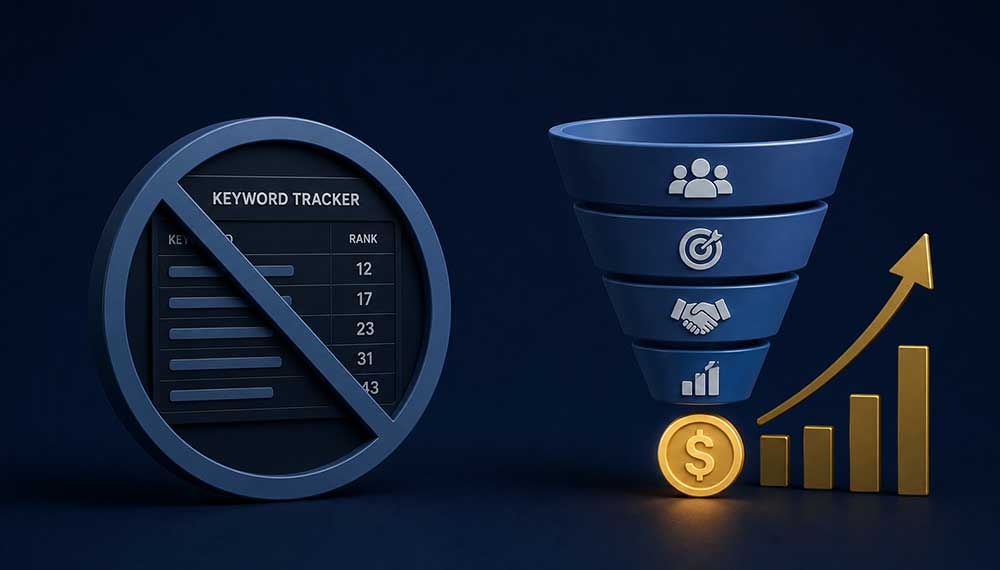
The Vanity Metric Detox: Moving Your Marketing Team from ‘Keyword Trackers’ to ‘Pipeline Contribution Value
Every quarter, a familiar scene plays out in executive boardrooms across the corporate landscape. The Chief Marketing Officer steps up to the podium, hooks up a presentation deck, and shares slides showing organic keyword movements. The arrows are universally green. The lines trend up and to the right. The report proudly highlights that the brand now owns position #1 for fifty high-volume industry terms, alongside a 35% year-over-year increase in raw organic impressions.
The board nods approvingly, but the Chief Financial Officer quickly raises a critical question: “If our organic search presence expanded by over a third this year, why is our qualified sales pipeline down by 12%? Where is the revenue matching these traffic spikes?”
This stark disconnect is the modern CMO’s dilemma. In an era dominated by algorithmic changes, fragmented buyer journeys, and rising customer acquisition costs, legacy organic search reporting remains stuck in a bygone era. For decades, marketing departments have operated under a dangerous addiction to “reporting theater”—focusing on surface-level vanity metrics like keyword rankings and total traffic volume while losing sight of actual business revenue. When marketing leaders look to scale operations globally, they often turn to an external SEO company in India to handle optimization workflows. However, if that partnership is built entirely on tracking arbitrary keyword positions, the brand is essentially paying for an expensive optical illusion.
To survive in today’s performance-driven market, corporate leaders must initiate a complete vanity metric detox. It is time to dismantle legacy reporting frameworks and replace them with multi-touch organic attribution models that track the metric that truly matters: Pipeline Contribution Value.
The Broken Metric Blueprint: Why Keyword Tracking is Obsolete
To break free from vanity metrics, we must first accept a harsh reality: tracking keyword positions as a primary measure of marketing success is functionally obsolete. The concept of a single, universal search results page no longer exists. Modern search engine architectures rely on highly dynamic, personalized vector systems that tailor search results in real time based on a user’s physical location, historical browsing habits, past search intent patterns, and device ecosystem.
Furthermore, the rapid expansion of AI-driven summary cards and interactive search features has created a permanent “Zero-Click” landscape. When a search engine extracts text from your website and displays it directly on the search page to answer a buyer’s question, that user never clicks through to your domain. Your traditional analytics platform flags this as a flatline in traffic, yet that user just walked away with high brand awareness and deep intent. Conversely, a webpage can rank position #1 for a high-volume keyword phrase, pull in thousands of clicks, and yield absolutely zero conversions because the intent of that traffic was purely informational rather than commercial.
When a marketing team or an outsourced SEO company in India focuses all their reporting energy on a static list of keywords, they are managing for activity rather than outcomes. Ranking for an enterprise software term is meaningless if the traffic it drives consists of college students downloading free templates instead of enterprise infrastructure directors looking for a software vendor procurement cycle.
Dismantling Legacy Reports: Shifting the Telemetry Framework
The vanity metric detox begins by changing what data gets delivered to the executive suite. This doesn’t mean you stop measuring operational performance data entirely; your technical search specialists still need to monitor impressions, crawl errors, and click-through rates to maintain site health. However, these operational diagnostic metrics should never be included in executive-level business briefs.
A high-performance business model requires separating operational diagnostics from executive success metrics. Below is a blueprint for restructuring your marketing dashboard, replacing legacy vanity indicators with true pipeline contribution indicators:
| Legacy Vanity Metric | The Operational Illusion | Pipeline Replacement Metric | The True Business Outcome |
|---|---|---|---|
| Keyword Position (#1-#3) | Signals visibility but ignores personalized results, localized search variations, and zero-click answer blocks. | Share of Search Voice (SoSV) | Measures your brand’s active footprint across a broad cluster of transactional entity topics. |
| Raw Organic Traffic Clicks | Includes low-intent informational visitors who bounce immediately without interacting with the brand. | Productive Pipeline Traffic | Tracks unique users who enter through search and perform a high-value action, like downloading a whitepaper or viewing a demo page. |
| Overall Site Bounce Rate | An unreliable, outdated metric that fails to show whether a user found their answer or left frustrated. | Core Engagement Time | Measures active scrolling, form interaction, and deep reading times on key landing pages. |
| Last-Touch SEO Conversions | Credits 100% of the deal value to the final click, completely ignoring earlier search research steps. | Organic Pipeline Contribution | Calculates the total dollar value of pipeline deals where organic search served as a key touchpoint. |
By shifting your dashboard metrics to focus on value, you instantly change how your marketing team thinks. When performance is judged on pipeline value rather than traffic volume, teams stop writing low-value, clickbait listicles to inflate traffic numbers. Instead, they shift their focus to building deep, comprehensive buyer guides, technical documentation, and product comparison landing pages—the exact middle-of-the-funnel assets that turn casual searchers into high-value sales leads.
The Mechanics of Multi-Touch Organic Attribution
The biggest hurdle to proving the true business value of your organic search strategy is the widespread reliance on **Last-Touch Attribution**. In a standard last-touch model, whichever digital marketing channel drives the very final click before a user fills out a contact form receives 100% of the financial credit for that lead. This model creates a massive structural bias in favor of paid search retargeting ads and direct brand traffic, while completely hiding the heavy lifting done by organic content channels earlier in the journey.
Consider a typical enterprise software buying journey: A VP of Operations searches for a broad solution to a core operational bottleneck, lands on a long-form diagnostic article published by your brand, and reads it for eight minutes. Two weeks later, remembering your insights, they search for a specific technical comparison and read your detailed product breakdown. A month after that, ready to buy, they click a targeted LinkedIn retargeting ad or type your brand name directly into their browser to request a formal sales demo. In a legacy last-touch model, paid social or direct traffic receives all the credit. Organic search is marked as a cost center, despite being the precise engine that discovered, educated, and qualified the buyer in the first place.
To fix this attribution gap, modern CMOs must move toward a **W-Shaped Attribution Model** or a customized, **Data-Driven Attribution Model**. We can mathematically calculate the Pipeline Contribution Value ($V_{pc}$) of an organic search campaign across long enterprise buying cycles using a multi-touch attribution weighting approach:
$$V_{pc} = \sum_{i=1}^{n} \left( W(t_i) \times Deal\_Value \right)$$
Where:
- $t_i$ represents an independent organic search touchpoint identified within an individual customer’s historical contact history.
- $W(t_i)$ represents the specific attribution weight assigned to that touchpoint based on its location in the funnel (e.g., First-Touch = 30%, Mid-Touch = 20%, Lead-Creation Touch = 30%).
- $Deal\_Value$ represents the actual closed-won contract value or qualified opportunity pipeline value recorded inside your CRM platform.
- $n$ represents the total number of organic search interactions that occurred prior to formal sales qualification.
Deploying this data infrastructure requires setting up closed-loop tracking that connects your front-end web telemetry data with your back-end Customer Relationship Management (CRM) databases, such as Salesforce or HubSpot. By working alongside a sophisticated SEO company in India that understands advanced data integration, brands can look past simple Google Analytics reports and track historical user journeys from initial organic anonymous clicks all the way down to final closed revenue pipelines.
The Operational Reality: When you transition from a simplistic last-touch model to a balanced W-shaped multi-touch model, the measurable revenue contribution of your organic search engine marketing campaigns typically scales by 150% to 300%. Suddenly, search is recognized for what it truly is: a powerful customer acquisition foundation.
Operationalizing the Shift: Realignment of Teams and Partners
Implementing a vanity metric detox requires a deliberate shift in how you incentivize your internal marketing teams and hold your external agency partners accountable. If your agency’s monthly performance bonuses are tied to hitting arbitrary keyword ranking milestones, they will continue to optimize for those exact metrics, regardless of whether that traffic generates a single dollar of profit for your business.
You must completely rewrite your agency contracts and key performance indicators (KPIs) to align with business growth. Instead of asking your agency partners to deliver a monthly report detailing where fifty keywords rank on Google, challenge them to show how their optimization efforts reduced your overall Customer Acquisition Cost (CAC) and increased your pipeline velocity. A mature, strategic SEO company in India will welcome this shift, as it frees them from the performative task of manual slide building and allows them to focus entirely on high-impact technical data engineering, conversion rate optimization (CRO), and deep entity mapping.
Internally, this architectural pivot dismantles the traditional walls that separate your content creators, web developers, and sales operations teams. Your search strategy ceases to be an isolated marketing project and becomes a core component of your pipeline generation engine, working hand-in-hand with paid media and account-based marketing (ABM) squads to target the exact corporate accounts your sales team is actively chasing.
The Long-Term Dividend: Predictable, Compounding Growth
Stepping away from the comfort of legacy keyword tracking templates can feel intimidating at first. It forces marketing organizations to accept full financial accountability for their budgets and requires an upfront investment in data infrastructure, attribution software, and cross-department collaboration. However, the long-term strategic benefits are undeniable.
When you stop chasing empty traffic spikes and start optimizing for pipeline contribution value, you build a sustainable competitive moat around your brand. Paid advertising channels deliver immediate, linear results, but the moment you stop spending money on ad networks, your lead flow drops to zero. Organic search, conversely, functions as a long-term capital investment. A single piece of high-value, deeply optimized technical content continues to capture high-intent enterprise buyers, educate prospective clients, and feed your sales pipeline for quarters and years after it is published—all without a recurring cost-per-click fee.
By conducting a comprehensive vanity metric detox, implementing multi-touch attribution loops, and partnering with an analytical SEO company in India focused on real business growth, you transform your organic search strategy from an unpredictable cost center into a reliable, scalable asset. You protect your brand from algorithm volatility, maximize your marketing efficiency, and build a high-performance marketing engine that drives measurable, predictable, and compounding revenue growth for the long-term future of your business.

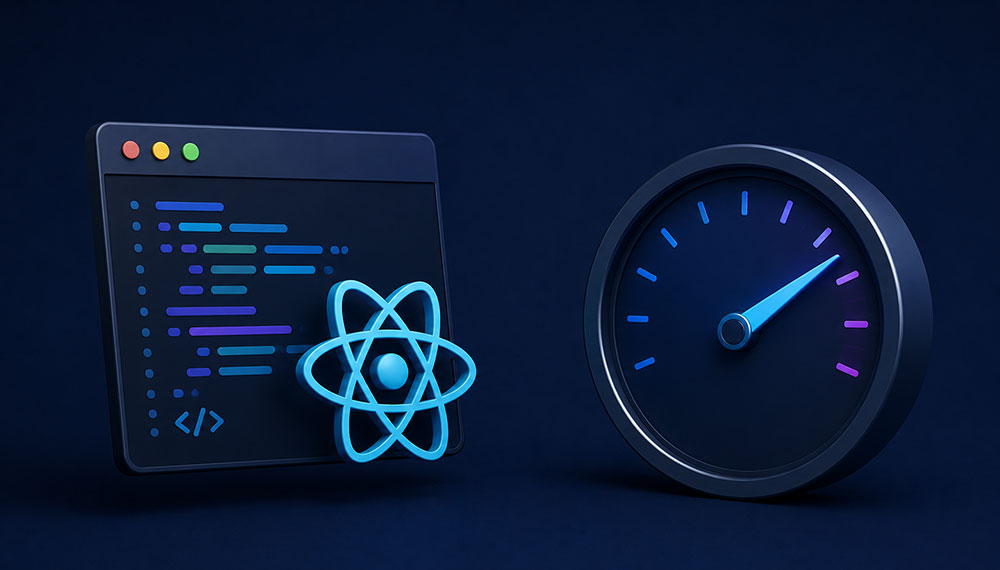
Beyond Crawl Budget: Optimizing Your JavaScript Hydration for Google’s Interaction to Next Paint (INP) Metric
For years, technical search engine optimization focused heavily on a clear and well-rehearsed checklist: clean up your XML sitemaps, eliminate redirect loops, manage your crawl budget, and optimize your images. If your server responded quickly and your pages loaded in under three seconds, you considered your technical foundation solid. However, the search landscape has shifted radically. Today, basic page speed metrics have evolved into deeply complex assessments of user experience and runtime execution.
Google’s Core Web Vitals framework fundamentally changed how we evaluate site performance. While metrics like Largest Contentful Paint (LCP) measure visual loading speed, the true battleground for rankings and conversion retention now centers on interactivity. Specifically, the focus has landed squarely on Interaction to Next Paint (INP). If your website relies on a modern JavaScript framework, your greatest SEO vulnerability likely isn’t your crawl budget—it is your JavaScript hydration loop.
When enterprise brands notice their search rankings slipping despite having clean code and fast servers, they often look in the wrong places. Partnering with an enterprise-grade SEO company in India to audit your code often reveals that the main thread is heavily congested, completely freezing the browser during critical user interactions. To protect your rankings, you must look past simple server metrics and optimize the complex execution of JavaScript hydration.
Understanding Interaction to Next Paint (INP)
Interaction to Next Paint measures a webpage’s overall responsiveness to user inputs throughout its entire lifecycle. Unlike its predecessor, First Input Delay (FID), which only measured the very first interaction, INP tracks every click, tap, and keyboard input from the moment a user lands on the page until they navigate away. It reports the longest latency observed, serving as a comprehensive health check for real-world usability.
When a user clicks a menu toggle, expands a product accordion, or types in a search box, they expect immediate visual feedback. If the browser takes too long to render the next frame following that input, the user perceives the site as laggy, broken, or completely unresponsive. Google categorizes INP scores into three clear performance brackets:
| INP Metric Range | Performance Evaluation | Impact on Organic Search Rankings |
|---|---|---|
| ≤ 200ms | Good | Fully satisfies Core Web Vitals criteria; maximizes ranking potential. |
| 201ms to 500ms | Needs Improvement | Triggers warnings in Search Console; flags latent performance debt. |
| > 500ms | Poor | Actively degrades user experience and penalizes organic search visibility. |
To mathematically understand what constitutes an interaction delay, we break the total latency down into three distinct components. Any cutting-edge SEO company in India will tell you that optimizing INP requires diagnosing which of these specific phases is causing the bottleneck:
$$INP = D_{\text{input}} + T_{\text{processing}} + D_{\text{presentation}}$$
Where:
- $D_{\text{input}}$ represents the Input Delay: the time between the user interaction and the moment the browser’s main thread can begin executing the associated event handler.
- $T_{\text{processing}}$ represents the Processing Time: the duration required to execute the JavaScript code within the event handler itself.
- $D_{\text{presentation}}$ represents the Presentation Delay: the time it takes the browser to recalculate the page layout, repaint the pixels on the screen, and display the next visual frame.
The Hydration Paradox: The Uncanny Valley of SSR
To understand why modern websites suffer from high input delays, we have to look closely at how frameworks like Next.js, Nuxt, Remix, and Gatsby deliver content. To ensure search engine bots can easily crawl text, these frameworks use Server-Side Rendering (SSR) or Static Site Generation (SSG). The server builds the complete HTML structure and sends it down to the user’s browser, where it renders almost instantly.
This approach creates an optical illusion known as the Uncanny Valley of Web Performance. The webpage appears completely loaded and visually perfect to the user. However, behind the scenes, it is completely frozen. The text and buttons are visible, but the interactive event listeners have not yet been attached to the DOM elements.
What is Hydration? Hydration is the technical process where the client-side JavaScript walks through the server-rendered HTML document, recreates the internal application state, and hooks up the interactive event handlers. Until this process finishes, the page is a look-but-don’t-touch experience.
During a massive hydration cycle, the browser’s main thread is heavily taxed. It must parse, compile, and execute megabytes of complex JavaScript all at once. If a user tries to interact with a button while the main thread is stuck in this heavy hydration loop, the browser cannot process the input. The interaction is forced to sit in a queue, causing $D_{\text{input}}$ to spike well past the acceptable 200ms threshold.
Why Traditional Speed Optimizations Fail to Fix INP
Many site owners make the mistake of applying old performance playbooks to solve modern hydration challenges. They invest heavily in Content Delivery Networks (CDNs), prioritize edge caching, and minimize server response times. While these steps improve your initial page load metrics, they often do absolutely nothing to lower your INP scores.
In fact, accelerating your server response times can sometimes make hydration bottlenecks worse. When the server delivers the initial raw HTML incredibly fast, the browser renders the visual elements on screen sooner. This prompts users to interact with the page much earlier—frequently right when the heavy client-side JavaScript bundles land and begin their hydration cycle. This intersection of early user input and a congested main thread creates a perfect storm for long input delays.
Solving this core bottleneck requires moving past traditional metrics and restructuring how your application loads and initializes its interactive code. Collaborating with a highly technical SEO company in India allows your brand to systematically decouple visual rendering from runtime execution, ensuring your site remains responsive from the very first frame.
Advanced Strategies to Optimize JavaScript Hydration
Fixing high INP scores requires a deliberate shift away from monolithic JavaScript execution. You must break up your code delivery so that the browser can handle tasks in smaller, manageable chunks. Here are the primary strategies engineered to keep the main thread clear:
1. Yielding to the Main Thread via `scheduler.yield()`
By default, JavaScript functions run to completion. If a hydration routine takes 300ms to evaluate a large component tree, it blocks the main thread for that entire duration, creating a prolonged “Long Task.” To prevent this, developers can introduce strategic yielding breaking up long-running scripts into smaller micro-tasks.
While developers historically used fallback options like `setTimeout(…, 0)` to yield control back to the browser, modern browser engines offer the dedicated native `scheduler.yield()` API. By placing yield points throughout your component initialization logic, you give the browser the breathing room to pause hydration, handle any queued user inputs, and then resume the hydration process immediately after.
async function hydrateLargeComponentTree(components) {
  for (const component of components) {
    hydrate(component);

    // Yield control to the browser if a native scheduler is present
    if (typeof scheduler !== 'undefined' && scheduler.yield) {
      await scheduler.yield();
    } else {
      // Graceful fallback for older browser environments
      await new Promise(resolve => setTimeout(resolve, 0));
    }
  }
}
2. Adopting Island Architecture and Partial Hydration
The most effective way to optimize hydration is to avoid doing it entirely for static content. Traditional single-page applications hydrate the entire document, including static footers, sidebars, and blocks of text that never change based on user input. This creates unnecessary processing overhead.
Modern frameworks like Astro leverage Island Architecture to solve this issue. In this model, the page is rendered as a static HTML document, but individual interactive widgets—such as an e-commerce shopping cart or a live search box—are marked as independent “islands.” The browser only downloads and executes JavaScript for these specific islands, leaving the rest of the page lightweight and completely free of hydration debt.
3. Implementing React Server Components (RSC)
If your stack is built on React or Next.js, transitioning to React Server Components provides a powerful way to lower your JavaScript overhead. Server Components execute exclusively on your infrastructure, and their dependency bundles are completely omitted from the final client-side JavaScript package sent to the browser.
By shifting heavy data manipulation, markdown parsing, and third-party libraries over to the server, you drastically trim down the size of the JavaScript bundles that need to be parsed and hydrated on the user’s device. Less client-side code means a clear main thread and an immediate drop in your INP metrics.
How to Audit and Diagnose Hydration Bottlenecks
Fixing INP issues requires a blend of real-world user metrics (field data) and controlled environment testing (lab data). Because hydration problems depend heavily on the device’s processing power, a site that runs flawlessly on a high-end development laptop might fail completely on a mid-range mobile device running on a slower mobile network.
This is precisely where an advanced SEO company in India focuses their telemetry efforts. They track performance across different device tiers to isolate exactly where the main thread is stalling. You can replicate this testing workflow using standard diagnostic tools:
Gathering Field Data via the Chrome User Experience Report (CrUX)
Your primary source of truth should always be real-world user data. Review the Core Web Vitals report inside Google Search Console to see which specific URLs are triggering INP alerts. Because field data reflects actual user behavior over a rolling 28-day window, it captures real interaction struggles that synthetic lab tests often miss.
Isolating Long Tasks with Chrome DevTools
To catch a hydration bug in a controlled environment, open your website inside Chrome DevTools and navigate to the Performance Panel. Set your CPU throttling to 4x or 6x slowdown to simulate a standard mobile device, and record a timeline trace during the initial page load.
- Look for long red flags at the top of the timeline indicating Long Tasks (tasks taking longer than 50ms).
- Inspect the bottom-up call tree to see exactly which functions are running. If you see terms like `hydrateRoot`, `mountComponent`, or long compilation blocks, your framework initialization is directly blocking the main thread.
- Review the Timings section to see exactly when the `DOMContentLoaded` event fires relative to your main JavaScript execution.
Balancing Rich Features with Advanced SEO Engineering
The transition to user-centric metrics like INP marks a clear shift in how search algorithms evaluate quality. Google’s systems are increasingly smart at identifying when a site uses superficial speed tricks to look fast, penalizing platforms that look ready but leave users clicking on unresponsive buttons.
This reality doesn’t mean you need to strip away interactive features or return to simple, flat HTML websites. Consumers want rich, dynamic experiences—they expect instant searches, personalized interfaces, and fluid animations. The key to success is building these features with smart engineering discipline, ensuring your visual elements match up perfectly with your site’s technical responsiveness.
Aligning your development framework with a forward-thinking SEO company in India ensures your brand doesn’t have to make a painful choice between high-end design and strong organic visibility. By mastering advanced techniques like progressive hydration, strategic code splitting, and intentional main-thread yielding, you can deliver an immersive, lightning-fast digital experience that satisfies both human visitors and search engine crawlers, protecting your search equity and driving long-term business conversion.

The ‘Quiet Quitting’ of Client Accounts: How Redundant Agency Reporting Kills Real SEO Velocity
Every Monday morning in digital marketing agencies across the globe, an invisible tax is levied on organic growth campaigns. It doesn’t appear as a line item on an invoice, nor is it openly discussed in pitch meetings. This tax is paid in pure cognitive energy and billable hours, spent compiling, formatting, and presenting bloated, redundant PDF reports. It is the phenomenon of “reporting theater,” and it is the single greatest killer of campaign momentum.
When businesses look to scale their online presence by partnering with an SEO company in India, they do so with a clear objective: they want to capture search market share, fix technical site debt, and drive revenue. Yet, within a few months of onboarding, a strange structural rot often sets in. The campaign’s focus subtly shifts from active, aggressive market execution to passive administrative maintenance. The agency team spends less time fixing broken crawl architectures and more time color-coding bar charts.
This structural stagnation leads directly to the “quiet quitting” of a client account. It is not that the agency stops working entirely; rather, the team checks out creatively. They default to a state of checklist compliance, spending their best hours preparing massive decks to justify their monthly retainer instead of executing the needle-moving strategies that actually drive rankings. If your organic growth has plateaued, the culprit might not be a Google core algorithm update—it might be the administrative weight of your weekly reporting loop.
The Illusion of Productivity: Unmasking “Reporting Theater”
To understand how reporting kills campaign velocity, we must first look at why these massive data dumps exist in the first place. Reporting theater is born out of mutual anxiety. For the client, organic search can feel like a black box; they are spending thousands of dollars every month on a marketing channel that takes time to yield visible returns. To ease this tension, they demand constant, granular proof of activity.
For the agency, providing a 50-page PDF filled with screenshots of data from Google Search Console, Semrush, and Ahrefs is an easy way to signal value. It acts as a shield. The implicit message behind a massive report is: “Look at how much data we gathered; therefore, we must be working incredibly hard.”
This is a trap that even the most talented SEO company in India can fall into if the contract mandates frequent, manual data compilation. The issue is that data collection is not the same as strategic execution. Reviewing data is highly valuable, but manually copy-pasting that data into a branded slideshow template adds absolutely zero value to the client’s actual domain authority or organic traffic.
How Bloated Reporting Stalls SEO Velocity
In digital marketing, speed of execution is your primary competitive advantage. We define “SEO Velocity” as the rate at which an agency can identify a technical flaw, write a piece of optimized content, or secure a high-quality contextual link, and successfully push it live. The faster these changes go live, the faster search engine crawlers index them, and the quicker the business realizes a return on investment.
When an account team is forced into a weekly or bi-weekly manual reporting cycle, their execution window shrinks dramatically. Let’s break down the actual mathematics of a typical agency account’s monthly billable hours:
| Monthly Agency Activity | Hours Allocated ( Bloated Reporting ) | Hours Allocated ( Velocity-First Model ) | Impact on Organic Campaign Growth |
|---|---|---|---|
| Data Extraction & Formatting | 12 Hours | 1 Hour (Automated) | Manual formatting steals time directly from technical site audits. |
| Slide Deck Narrative Building | 8 Hours | 0 Hours | Writing summaries of minor keyword fluctuations delays content creation. |
| Review Meetings & Revisions | 6 Hours | 2 Hours (Async/Loom) | Long review calls drain the client’s and agency’s strategic focus. |
| Active Strategy & Execution | 14 Hours | 37 Hours | Velocity-first models yield nearly triple the active implementation hours. |
As shown above, a traditional account model wastes over half of its available monthly resources simply explaining what happened in the past, rather than shaping what will happen in the future. By moving away from this redundant cycle, an agile SEO company in India can redirect those hours toward deep competitive analysis, internal link engineering, and schema deployment—the actual work that drives revenue.
The Psychology of Account Stagnation: When Strategists Check Out
The operational cost of redundant reporting extends far beyond wasted hours; it actively damages the creative health of your account team. High-level performance marketers and technical specialists do not join agencies to build slide decks. They are driven by problem-solving, outmaneuvering competitor domains, and watching traffic charts move up and to the right.
When an account team at an SEO company in India spends their best cognitive energy wrestling with formatting issues, chasing down client approvals for basic report structures, and answering identical questions about minor weekly keyword movements, burnout sets in. The strategist stops thinking about your long-term organic growth and starts thinking about how to survive the next reporting call.
The Reality of Account Stagnation: When reporting requirements become overly restrictive, an agency team will naturally pivot to a compliance-first mindset. They will deliver exactly what the report requires to avoid friction, but they will completely stop pitching the bold, innovative, or complex ideas that require real creative risks.
This is how client accounts quietly slip into decay. The client receives their neat weekly PDF on time every Friday. The metrics look busy, the charts are clean, and the status updates are green. Yet, the overall organic revenue line remains completely flat because no one has the time or motivation to push past the basic checklist and execute deep, creative digital strategy.
Shifting from Static PDFs to Live, Automated Dashboards
To rescue an account from this cycle of diminishing returns, the entire model of communication must be modern and streamlined. The static, multi-page PDF report is a remnant of 1990s corporate culture and should be retired from modern digital workflows entirely. It is obsolete the second it is exported, it cannot be interacted with, and it encourages a passive, rearview-mirror look at performance.
Forward-thinking businesses hiring an SEO company in India are changing the rules by demanding live, automated business intelligence dashboards. Platforms like Looker Studio, PowerBI, and Tableau allow agencies to build unified data environments that pull directly from live APIs. This infrastructure modernization shifts communication from a tedious task into a real-time competitive advantage:
- Real-Time Transparency: Clients can view their true keyword rankings, organic impressions, and e-commerce conversions whenever they like, eliminating the artificial anxiety of waiting for a weekly update.
- Interactive Segmentation: Instead of looking at a static screenshot of overall traffic, stakeholders can actively filter data by landing page, device category, or geographical region on the fly.
- Total Source Honesty: Automated dashboards display raw, unedited API data straight from Google, eliminating the temptation to selectively present or obscure performance dips behind clever design.
Setting up an automated data infrastructure takes a bit of upfront technical configuration, but it instantly frees up dozens of hours every month. Those hours are immediately returned to the campaign’s execution pool, giving your agency partners the freedom to focus entirely on driving real search engine visibility.
Transitioning to Asynchronous Communication and Action-Item Lists
Replacing static reports with live dashboards solves the data transparency issue, but it leaves one question unanswered: how do you maintain strategic alignment without spending hours in review meetings? The answer lies in adopting asynchronous video communication and shifting meeting structures to focus exclusively on upcoming action items.
Instead of scheduling an hour-long call to read a report that the client could easily read themselves, account strategists can record a brief, five-minute video screencast using tools like Loom or Vidyard. In this quick brief, the strategist highlights the single most important data trend from the dashboard, outlines the roadblocks solved over the past month, and maps out the next three technical priorities.
This asynchronous approach respects the calendar of both the agency team and the client’s internal stakeholders. It allows everyone to process performance data at their own convenience, keeps updates clear and concise, and ensures that when live meetings do happen, they are spent making critical decisions rather than passively listening to slide read-outs.
A Practical Guide to Revitalizing Your Agency Relationship
If you suspect that your current search campaigns are bogged down by administrative overhead, you need to actively realign your partnership parameters. This adjustment isn’t about letting your agency partners off the hook for performance; it is about ensuring that every single dollar of your budget is spent on tasks that build long-term digital enterprise value.
1. Conduct an Internal Audit of Your Reporting Requests
Ask yourself honestly: Who is actually reading the reports your agency sends every month? Are your executives genuinely digging into long lists of minor keyword variations, or are they only looking at overall organic traffic and revenue metrics? Identify the core business metrics that actually drive your internal business choices and cut out everything else.
2. Standardize on Mile-Stone Based Management
Shift your agency contracts away from arbitrary, calendar-based data dumps and move toward a milestone-driven accountability framework. Hold your strategy teams accountable for clear, tangible implementation goals: parsing your indexation bloat, optimizing meta architectures across top category walls, or delivering an authoritative cluster of long-form content. Judge the success of your campaign by the volume of optimization pushed to production, not by the thickness of their slide decks.
Embracing a Lean, Velocity-First Performance Model
The ultimate metric of any organic search strategy is its return on investment. A beautifully styled, meticulously detailed 60-page PDF report that documents a slow, steady decline in search share is worth absolutely nothing. Conversely, a brief, two-point bulleted email that accompanies a massive spike in organic revenue is a masterpiece of marketing communication.
Whether you are an agency owner looking to protect your team’s operational health or a marketing director looking to partner with a reliable SEO company in India, it’s time to move past the performance art of traditional reporting. True organic growth requires consistent execution, technical precision, and room for creative risk-taking. By cutting out redundant administrative tasks, setting up real-time automated dashboards, and focusing entirely on speed of execution, you can break through campaign plateaus, restore real momentum to your digital footprint, and build a high-performance marketing engine that drives measurable, long-term business growth.


SEO Rankings Dropping? Here’s How ICO WebTech Can Fix It
Few things strike fear into the heart of a business owner or marketing director quite like opening your analytics dashboard on a Monday morning only to find a jagged, downward-trending red line. Your organic traffic is slipping away. Keywords that used to sit comfortably at the top of Google’s first page have mysteriously plummeted to page three or four. The steady stream of inbound leads you relied on has slowed to a painful trickle.
When your search engine visibility drops, it feels like an invisible tax on your entire operation. Your customer acquisition costs suddenly skyrocket because you are forced to rely more heavily on expensive paid ads. Your brand’s digital footprint begins to fade, and your competitors gladly step into the vacuum you left behind.
If your SEO rankings are currently dropping, the absolute worst thing you can do is panic and start making haphazard changes to your website. SEO isn’t governed by luck or mystery; it is governed by an algorithm that operates on logic, technical health, user experience, and trust signals. When your rankings drop, Google is sending you a diagnostic message. You just need the right technical partner to decode it.
That is where ICO WebTech comes in. As an industry-leading digital strategy and SEO agency, we specialize in reversing negative traffic trends, diagnosing deep-seated technical issues, and rebuilding organic funnels from the ground up.
Here is a comprehensive look at why your rankings might be slipping, and exactly how the specialized team at ICO WebTech can reverse the damage to reclaim your digital real estate.
Part 1: Diagnosing the Bleeding — Why Are Your SEO Rankings Dropping?
Before you can fix a problem, you must understand exactly what caused it. A sudden or gradual loss of search engine visibility usually traces back to one of four major catalyst categories. When clients come to ICO WebTech for help, our first step is isolating which of these vectors is actively draining their traffic.
1. The Stealth Assault: Core Algorithm Updates
Google updates its search algorithms thousands of times a year, but a few times annually, it rolls out massive “Core Updates.” These changes are designed to fundamentally reshape how the algorithm evaluates content quality, user experience, and search intent. If your site was built on legacy SEO tactics—or if a recent update shifted the visual layout of the Search Engine Results Pages (SERPs) to favor different types of content—your rankings can drop overnight without you changing a single line of code on your site.
2. Technical Decay and Underlying Infrastructure Crumbling
Websites are dynamic organisms. Plugins update, themes change, content gets deleted, and structural code shifts. Over time, this natural evolution can cause “technical decay.” Common culprits include:
- A sudden drop in page speed caused by bulky code or unoptimized media.
- Broken internal redirect loops that trap search engine crawling bots.
- Critical indexing accidental blocks hidden deep within your
robots.txtfile. - A poor mobile user experience that fails Google’s strict mobile-first indexing criteria.
3. Aggressive Competitor Maneuvers
Sometimes, your rankings don’t drop because your website did something wrong; they drop because your competitors did something incredibly right. If a rival brand has recently hired a sophisticated SEO agency, they might be systematically out-publishing you, securing higher-authority backlinks, or optimizing their user experience to keep visitors on their site longer. If you stand still in SEO, you are actively moving backward.
4. Content Obsolescence and Search Intent Shifts
Information has a shelf life. If your core ranking pages haven’t been refreshed in months or years, the algorithm may begin to view them as stale or outdated. Furthermore, human search behavior changes. What users expect to find when they type a specific keyword today might be vastly different from what they wanted two years ago. If your content no longer satisfies the real-time intent of the searcher, Google will find a page that does.
Part 2: The ICO WebTech Recovery Framework — How We Rebuild Your Authority
Fixing a broken SEO trajectory requires an approach rooted deeply in data, empirical testing, and advanced engineering frameworks. At ICO WebTech, we don’t rely on generic checklists or superficial keyword adjustments. We deploy a multi-phased, custom-tailored recovery blueprint engineered to isolate friction points and execute permanent fixes.
Phase 1: The Forensic SEO Audit
We begin by treating your website like a digital crime scene. Our team performs an exhaustive, deep-dive technical and structural audit that looks far past the surface level. We analyze:
- Crawlability and Indexation: We inspect how search engine bots navigate your architectural layout to ensure no high-value pages are being ignored.
- Core Web Vitals Performance: We measure your precise interaction responsiveness, visual stability, and rendering speeds across desktop and mobile devices.
- Backlink Profile Integrity: We scrub your incoming link graph to identify and disavow toxic, spammy, or unnatural historical links that may be triggering algorithmic suppression.
Phase 2: Reverse-Engineering Competitor Strategies
To beat your competitors, we must first document their playbooks. ICO WebTech conducts an intensive competitive intelligence sweep of the brands currently occupying your lost positions. We map out their exact keyword footprints, dissect their content clusters, evaluate their technical execution, and measure their link velocity. This data allows us to discover critical content gaps and structural opportunities where your business can leapfrog them in the SERPs.
Phase 3: Technical Remediation & Structural Overhauls
Once the data is clear, our technical SEO specialists execute precise engineering sprints. We clean bloated code architectures, repair broken link networks, optimize server response times, fix schema markup deployments, and ensure your entire digital ecosystem is fully responsive and pristine for mobile-first indexing. We ensure that when a search engine bot visits your site, it finds an absolute masterpiece of technical efficiency.
Phase 4: Intent-Driven Content Optimization & Reconstruction
Keywords are useless unless they map perfectly to human intent. Our editorial and SEO teams work together to breathe new life into your content library. We update legacy articles with current data, restructure layout hierarchies for scannability, infuse missing semantic entities (LSI keywords), and build robust internal linking structures that distribute authority effectively throughout your high-value transactional landing pages.
Part 3: Real-World Proof — How Starmuse Entertainment Regained Their Digital Throne in Toronto
To truly understand the transformative power of elite search engine optimization, look no further than a real-world case study of an international brand that faced a devastating ranking crisis and emerged victorious through our specialized intervention.
The Client Profile
Starmuse Entertainment (https://starmuse.ca/) is a premier, highly acclaimed live entertainment, talent management, and event production agency based in Toronto, Ontario, Canada. Specializing in delivering world-class live performances, immersive acts, corporate event coordination, and luxury entertainment activations, their entire business model relies heavily on being discovered online by corporate event planners, high-end wedding coordinators, and luxury brand executives looking for elite performance talent.
| Client | Location | Core Industry | Digital Footprint |
|---|---|---|---|
| Starmuse Entertainment | Toronto, Ontario, Canada | Live Entertainment & Event Production | Ranking for 50+ High-Value Industry Keywords |
The Crisis
Despite being a top-tier brand offline, Starmuse Entertainment hit a massive digital bottleneck. Subtle shifts in search engine algorithms, combined with aggressive local competition in the ultra-competitive Toronto market, caused their primary organic visibility rankings to experience a severe downward turn.
Key transactional search terms began slipping off the first page. This drop directly threatened their lead generation pipeline, as corporate planners looking for world-class live entertainment options could no longer easily discover them on Google. The brand had a phenomenal portfolio and a stunning website, but their underlying search architecture was no longer communicating that brilliance effectively to the algorithm.
The ICO WebTech Intervention
When Starmuse Entertainment partnered with ICO WebTech, we instantly deployed our custom SEO Recovery Framework:
- Deep-Dive Local Technical Audit: We discovered that while the site was visually breathtaking, it suffered from structural optimization gaps that hindered local visibility metrics in the Greater Toronto Area (GTA).
- Keyword Footprint Extraction: Starmuse targeted an expansive footprint, needing to rank for more than 50 highly competitive keywords covering corporate event entertainment, specialized dance troupes, musicians, and live performance activations. We re-mapped these 50+ keywords directly into optimized, contextually rich landing pages.
- Content and Schema Alignment: We implemented advanced local business schema and event entertainment structured data code, allowing search engines to instantly parse their services, locations, and premium talent categories.
- Authoritative Local Link Building: We launched a highly targeted, clean outreach campaign to secure contextually relevant, high-authority digital PR and link assets within the entertainment and event planning sectors.
The Phenomenal Results
The transformation was spectacular. By fixing the structural leaks and aligning their rich media assets with strict SEO best practices, ICO WebTech successfully reversed the decline and propelled Starmuse Entertainment back to the top of the search results.
Today, they proudly and securely rank for more than 50 high-impact industry keywords, positioning them as the undisputed choice for live entertainment in Toronto. Their organic impressions surged, their traffic stabilized at an all-time high, and most importantly, their incoming inquiry box filled back up with high-budget corporate event leads.
Part 4: A Proactive Checklist — What To Do Right Now If Your Rankings are Slipping
If you are watching your rankings slide right now, here is an immediate diagnostic checklist you can run through before reaching out to the professionals at ICO WebTech:
Step 1: Rule out a Site-Wide Tracking or Analytics Bug
Sometimes, a drop in traffic isn’t an SEO problem—it’s a software tracking error. Check your source code to ensure your Google Analytics tag or tracking container hasn’t been accidentally detached or duplicated during a recent update.
Step 2: Check Google Search Console for Security Actions
Log into your Google Search Console dashboard and instantly check the “Manual Actions” and “Security Issues” tabs. Ensure your site hasn’t been penalized for an accidental policy violation, algorithmic filter, or security compromise.
Step 3: Audit Your Recent Website Modifications
Did your development team recently push a code deployment, change your URL taxonomy, alter your category structure, or launch a design update? Trace your rankings drop back to the exact calendar week it began, and audit all internal changes made during that window.
Conclusion: Stop Guessing. Let ICO WebTech Secure Your Digital Future.
SEO is not a game of chance. When your rankings drop, it is a clear sign that your digital ecosystem is out of sync with what modern search engines and human users expect. Trying to fix it yourself using generic advice or outdated tactics can easily compound the issue, driving your business further down the results page.
Don’t let your hard-earned visibility evaporate into the hands of your competitors. Follow the proven blueprint of market leaders like Starmuse Entertainment in Toronto. Whether you are battling a sudden core algorithm shift, fighting off aggressive local competitors, or struggling with underlying technical decay, the elite team of SEO engineers and strategic content creators at ICO WebTech possesses the tools, data platforms, and real-world experience to diagnose the root cause and execute a definitive turnaround strategy.
Contact ICO WebTech today for a comprehensive, data-driven SEO consultation, and let’s start transforming your declining traffic charts back into a powerful, compounding engine for business growth.
How AI Development Is Changing Your Technical SEO and Core Web Vitals?
The conversation about AI and SEO has largely been a content story. Which tools write better copy. How to optimize for AI-generated search results. Whether Google can detect AI-written articles.
That conversation matters. But it is missing something bigger.
The more consequential impact of AI in the development workflow is not on content. It is on the infrastructure that serves the content: server response times, deployment stability, error recovery speed, and the consistency of what Google actually crawls versus what you published. These are technical SEO outcomes, and they are directly shaped by how a site is built, tested, and deployed.
AI-assisted development is changing all of them. Most SEO teams do not know it yet.
The Technical SEO Problems That Live Upstream of Your Dashboard
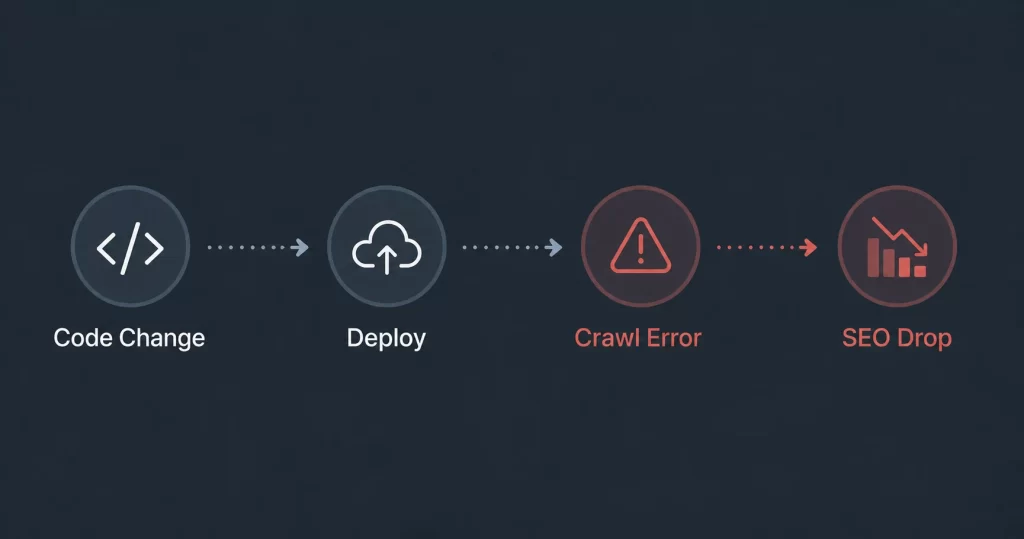
When an SEO or marketing team inherits a technical audit, they typically see the symptoms: elevated TTFB, crawl errors in Search Console, a Core Web Vitals report showing pages failing LCP or INP thresholds, redirect chains that appeared without anyone’s knowledge.
The instinct is to treat these as frontend problems. Compress images. Fix the redirect. Improve server caching. Often, those fixes work. But a meaningful portion of recurring technical SEO issues are not frontend problems. They are deployment pipeline problems.
Consider a few patterns that repeat across development teams:
- A bug fix ships that accidentally removes a canonical tag from a template. The fix was tested locally. It was not caught in code review. It went to production. Google crawled the affected pages before anyone noticed, and the duplicate content signal had already been recorded.
- A deployment fails midway through a rolling update. For 8 minutes, some users hit the old version and some hit the new one. Googlebot made a request during that window and received a 503. That 5xx response was logged in Search Console. If this happens repeatedly, Google begins to deprioritise crawl frequency for those URLs.
- A platform running on a shared infrastructure spins down inactive dynos to save cost. The first request after a period of quiet takes 4 to 6 seconds to respond as the server restarts. That latency hits TTFB directly, and TTFB is a component of how Google measures page experience for Core Web Vitals.
None of these problems originate in CSS or image compression. They originate in how the application is built, reviewed, and deployed.
What AI-Assisted Development Is Actually Fixing
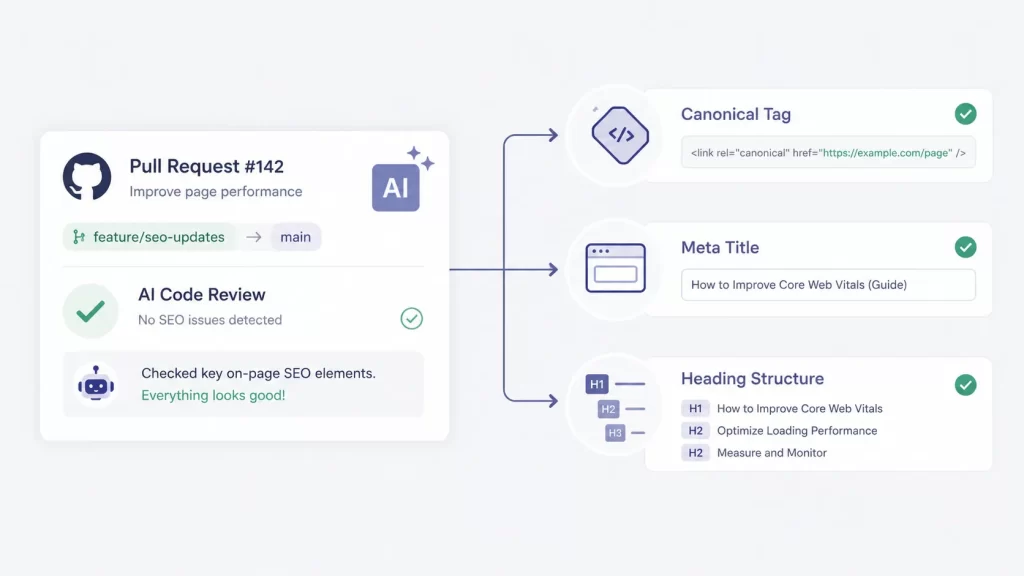
As of 2026, AI adoption in software development has crossed near-universal levels. According to Google’s State of AI-Assisted Software Development report, 97.5% of companies have integrated AI into their development workflows. McKinsey research puts the reduction in development time at 55% for teams using AI coding tools.
But the productivity gains that matter most for SEO are not about writing code faster. They are about catching errors earlier.
AI code review tools like CodeRabbit and Kodus leave automated review comments on every pull request before a human reviewer sees it. For SEO specifically, this matters because a significant class of technical regressions, broken internal links, removed meta tags, misconfigured redirects, altered heading hierarchy are code-level changes that ship in PRs alongside unrelated feature work.
Without AI-assisted review, these slip through because reviewers are focused on whether the feature works, not whether an h1 tag was accidentally removed from a component.
AI-assisted testing catches routing bugs that create duplicate URLs before they reach production. A new URL structure that generates both /product/item and /products/item without a canonical creates a duplicate content problem that may take weeks to identify from search data alone.
Caught at test time, it is a 5-minute fix. Caught from a Search Console report two months later, it is a content audit.
The upstream position of these tools relative to SEO outcomes is the key point. AI is not optimising your metadata. It is preventing the code changes that break your metadata from shipping in the first place.
How Deployment Speed and Stability Directly Affect Core Web Vitals
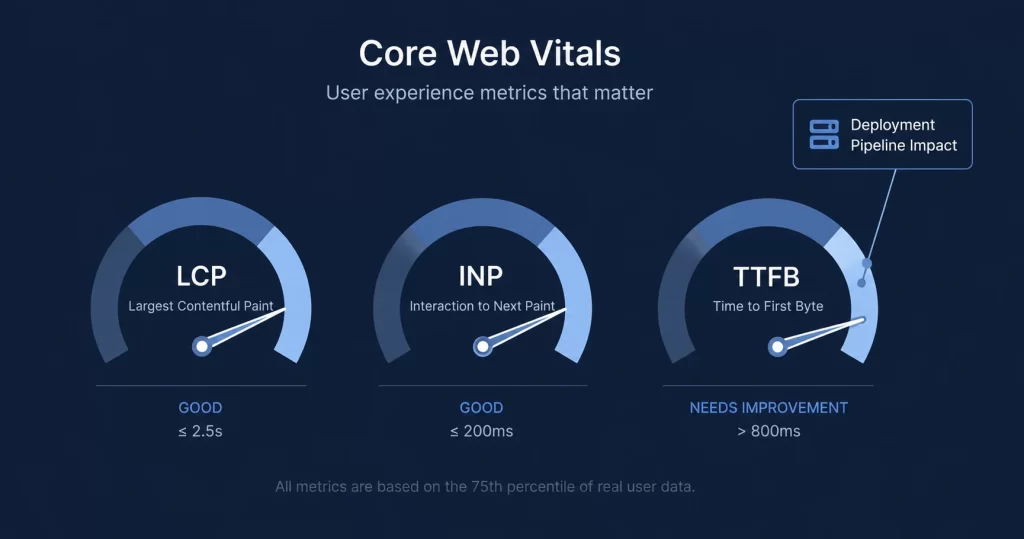
Core Web Vitals are a Google ranking signal. TTFB (Time to First Byte) is a component that Google’s CrUX data captures at the user level. A site with consistently high TTFB, whether from slow server response, cold start latency, or deployment instability, accumulates poor field data over time, and that field data feeds into ranking signals.
The deployment pipeline influences TTFB in two direct ways.
First, runtime environment sizing: An application deployed on an undersized server instance, or one that has not been tuned for its memory and CPU requirements, will have consistently elevated response times under normal load. For Java-based backends, this is particularly common: a Spring Boot application requires 300 to 500MB of RAM at startup. On an instance that is too small, it thrashes memory and slows every request. On a correctly sized instance, it is fast
Manual deployment requires the developer or DevOps engineer to make this sizing decision correctly every time. AI-powered deployment platforms that automatically detect the runtime environment and size instances appropriately remove this source of performance variability entirely.
Second, deployment downtime during updates: Traditional deployments involve stopping the old version and starting the new one. Even a few seconds of downtime during a production deploy can result in 503 responses that Google records. Zero-downtime deployment patterns, where traffic is shifted from the old version to the new one without any gap, prevent this entirely. Platforms that implement this by default, such as agentic AI deployment tools that handle the full release cycle automatically, eliminate a recurring source of crawl errors that SEO teams otherwise have to monitor and explain.
A useful reference on how this works in practice: a detailed breakdown of agentic AI deployment that covers how automated stack detection and zero-downtime deploys change the relationship between deployment pipelines and production reliability.
What SEO and Development Teams Should Actually Align On
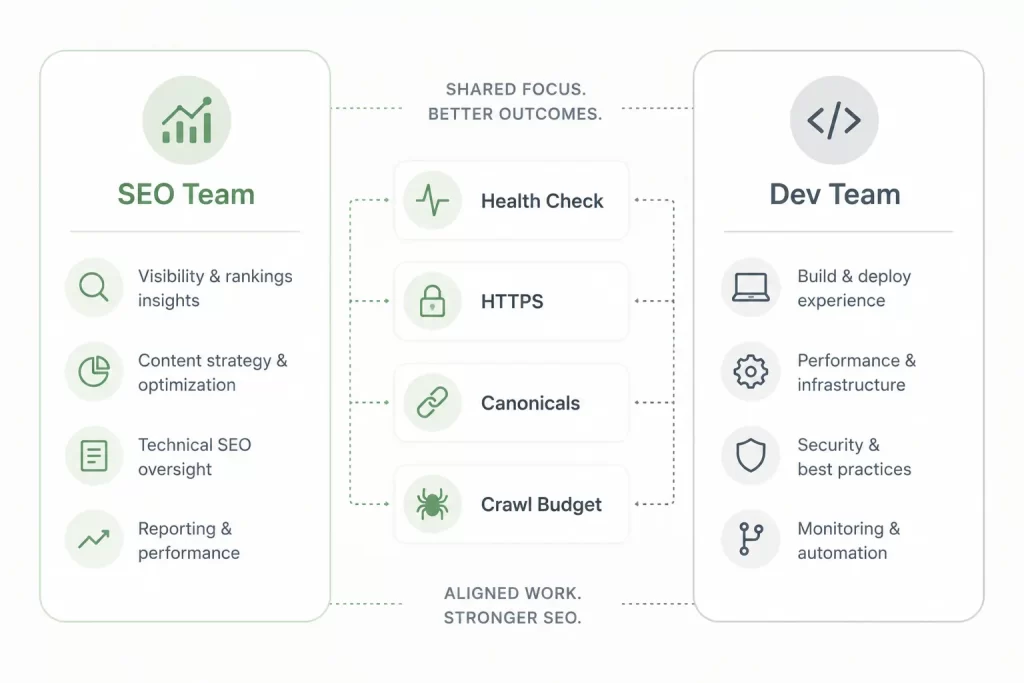
The structural problem is that SEO teams and development teams operate on different time horizons and different feedback loops. An SEO team measures impact in weeks and months. A development team ships and moves on in hours. By the time a technical SEO regression surfaces in search data, the developer who introduced it may not remember the relevant change.
AI-assisted development compresses this gap. Code review happens at PR time. Testing happens before merge. Deployment happens with automated validation. The feedback loop gets faster, and the issues that create technical SEO regressions get caught closer to where they originate.
There are specific alignment points worth establishing between SEO and development teams:
- Health check endpoints should be in place before any deployment goes live. A /health route that returns a 200 confirms the application started correctly. Without it, a failed deployment can route live traffic to a crashed process, generating 5xx errors at scale.
- HTTPS enforcement and redirect audits should run as part of the deployment pipeline, not as a monthly SEO check. AI-assisted CI/CD pipelines can run these checks automatically on every merge.
- Canonical tags, meta robots, and structured data should be treated as code-level assets with version control, not just as SEO configurations. When they change unexpectedly, it should surface in code review, not in a ranking drop six weeks later.
- Crawl budget is a finite resource. Every 5xx error response wastes a crawl credit on a URL that returns nothing. Development teams that treat deployment stability as an SEO concern, not just a reliability concern, protect crawl budget as a byproduct of doing their job well.
The Argument in One Sentence
AI-assisted development is not an SEO story yet. It should be. The teams that close the loop between deployment pipeline health and technical SEO outcomes will have a structural advantage over teams treating them as separate disciplines. The tools to close that loop, AI code review, automated testing, intelligent deployment platforms, exist today and are increasingly accessible to teams of any size.
The SEO and marketing professionals who understand this, and who can speak the development team’s language when raising these issues, will be the ones who stop debugging symptoms and start preventing the causes.


Why Most SEO Strategies Fail Because They Ignore Human Psychology
For years, SEO has been treated as a technical game.
Businesses obsess over rankings, backlinks, keywords, algorithms, and traffic charts. Entire marketing strategies are often built around trying to “please Google.”
But here is the uncomfortable truth many brands fail to realize:
Google is not your real customer.
Humans are.
And this is exactly where most SEO strategies begin to fail.
Many companies spend months optimizing websites for search engines while completely ignoring the psychology of the people actually visiting those websites.
They focus on clicks but ignore emotions.
They focus on rankings but ignore trust.
They focus on traffic but ignore behavior.
As a result, they may attract visitors but fail to create engagement, loyalty, conversions, or meaningful brand growth.
Modern SEO is no longer just about algorithms.
It is deeply connected to human psychology.
Search engines themselves are increasingly designed around understanding human behavior, user satisfaction, emotional relevance, and intent.
This means businesses that ignore psychology are not only failing users — they are also failing modern SEO.
The future of search belongs to brands that understand how people think, feel, decide, trust, and engage online.
Table Of content
SEO Was Never Really About Search Engines Alone
Traffic Means Nothing Without Human Connection
Human Attention Is the Real SEO Battlefield
The Psychology of First Impressions
Trust Is One of the Biggest Ranking Factors
People Search Emotionally, Not Just Logically
Why Keyword Stuffing Fails Psychologically
Storytelling Is an SEO Superpower
Cognitive Overload Is Killing Engagement
The Psychology of Social Proof
Why Authority Matters Psychologically
Modern SEO Is About Reducing Anxiety
The Future of SEO Is Emotional Intelligence
Why Human-Centered SEO Wins Long Term
The Role of a Modern SEO Company in India
SEO Was Never Really About Search Engines Alone
One of the biggest misconceptions in digital marketing is the belief that SEO is primarily about pleasing search engines.
For years, businesses have treated Google almost like a machine that simply needs the “right technical formula” to reward websites with rankings.
This mindset created an entire generation of SEO tactics focused heavily on:
- Keyword density
- Backlink quantity
- Meta tags
- Algorithm manipulation
- Technical loopholes
And while technical SEO absolutely matters, many businesses forgot something much more important:
Search engines were never the real audience.
Humans were.
At its core, SEO has always been connected to human behavior, human psychology, and human satisfaction.
Search engines exist for one fundamental reason:
To help people find the most useful, trustworthy, and relevant information possible.
That has always been the true purpose behind Google’s evolution.
Google’s Success Depends on Human Trust
Google’s entire business model relies on user trust.
If people consistently received poor-quality search results, they would eventually stop using the platform.
And if users stopped trusting Google, the entire ecosystem would collapse.
This means Google’s survival depends on one thing above all else:
Delivering satisfying experiences to human users.
Every major algorithm update over the years has moved toward this exact goal.
Google constantly tries to improve its ability to understand:
- What users truly want
- Which content feels valuable
- Which pages solve problems effectively
- Which websites appear trustworthy
- Which experiences create satisfaction
In many ways, Google’s algorithm is really a massive system designed to interpret human preferences and behavior.
That means SEO has always been deeply psychological — even if many businesses failed to realize it.
Search Engines Are Trying to Understand Human Intent
Modern search engines are no longer simple keyword-matching systems.
Google now invests enormous resources into understanding human intent.
When someone searches online, the algorithm is not just analyzing words.
It is trying to understand the meaning and motivation behind the search.
For example, if someone searches:
“Why is my website traffic dropping?”
Google understands this is probably not just an informational search.
The user may also be experiencing:
- Confusion
- Concern
- Frustration
- Anxiety
- Urgency
The search engine wants to provide results that not only contain information but also create reassurance and clarity.
This is why content that genuinely helps users often performs better over time.
Search engines increasingly reward pages that satisfy human needs psychologically, not just technically.
Google’s Mission Has Always Been Psychological
At a deeper level, Google’s algorithms are constantly attempting to answer very human questions such as:
- What does the user actually want?
- What content feels trustworthy?
- What result creates satisfaction?
- Which pages solve problems effectively?
- Which brands appear credible?
Notice how none of these questions are purely technical.
They are all connected to human perception, behavior, trust, and decision-making.
Search engines increasingly evaluate signals that reflect real human experiences.
This includes:
- Engagement patterns
- User satisfaction
- Brand trust
- Content quality
- Behavioral interaction
- Authority perception
Modern SEO is moving closer and closer to understanding people rather than simply optimizing pages.
SEO Is Becoming More Human-Centered Every Year
One of the clearest trends in SEO is the gradual shift away from mechanical optimization and toward human-centered experiences.
Google’s updates increasingly reward websites that:
- Provide real value
- Demonstrate expertise
- Offer strong user experiences
- Build trust
- Create helpful content
At the same time, low-quality manipulative tactics are becoming less effective.
This is not accidental.
It reflects Google’s larger goal of aligning search rankings with human satisfaction.
In other words, the more useful your content feels to real people, the more likely modern search engines are to reward it.
Many Businesses Still Approach SEO Mechanically
Despite these changes, many businesses still treat SEO as a purely technical process.
They focus heavily on:
- Keyword repetition
- Ranking reports
- Traffic numbers
- Mass content production
- Algorithm chasing
But they often ignore the human experience entirely.
As a result, their content may technically rank for certain keywords while still failing to:
- Build trust
- Create engagement
- Influence decisions
- Generate loyalty
- Deliver emotional connection
This creates one of the biggest disconnects in modern SEO.
Businesses optimize for visibility but forget to optimize for people.
Producing Content for Bots Creates Weak Experiences
Content written only for algorithms often feels obvious to users.
It may contain:
- Awkward keyword repetition
- Generic explanations
- Artificial phrasing
- Shallow information
- Emotionless writing
Even if users cannot explain exactly why, they often sense when content lacks authenticity.
Human psychology naturally reacts negatively to content that feels manipulative or robotic.
This reduces:
- Trust
- Engagement
- Emotional connection
- Perceived expertise
Modern SEO increasingly rewards content that feels genuinely useful and naturally human.
Human Decision-Making Is Emotional
One major reason mechanical SEO strategies fail is because human decision-making is not purely logical.
People do not engage with brands based only on information.
They also respond to:
- Emotion
- Confidence
- Familiarity
- Trust
- Psychological comfort
- Perceived credibility
For example, two websites may offer similar information.
But users will often choose the brand that:
- Feels more trustworthy
- Communicates more clearly
- Looks more professional
- Feels more authentic
- Creates emotional reassurance
This is deeply connected to psychology.
And modern search engines increasingly recognize these human preferences indirectly through user behavior.
Search Engines Observe Human Behavior Constantly
Google may not “feel emotions,” but it observes behavioral patterns connected to human satisfaction.
Search engines increasingly analyze signals such as:
- Click-through rates
- Dwell time
- Bounce behavior
- User engagement
- Search refinement patterns
These signals help Google understand whether users found content valuable or disappointing.
For example:
- If users quickly leave a page, it may suggest dissatisfaction.
- If users stay engaged longer, it may suggest the content solved their problem effectively.
- If users search again immediately, it may suggest the first result failed.
In many ways, Google is constantly learning from human psychology at scale.
The Rise of AI Search Makes Human Understanding Even More Important
AI-powered search is accelerating this human-centered shift even further.
Modern AI systems increasingly evaluate:
- Content clarity
- Contextual relevance
- Authority
- Trustworthiness
- User value
- Semantic meaning
These are all closely connected to human communication and human understanding.
As search becomes more AI-driven, content that genuinely helps people will likely perform even better.
Search engines are becoming more sophisticated at identifying authentic value versus manipulative optimization.
SEO Is Ultimately About Solving Human Problems
At its highest level, SEO is not really about rankings.
It is about solving human problems effectively.
Every search query represents a person trying to:
- Find information
- Reduce uncertainty
- Solve a challenge
- Make a decision
- Learn something important
Brands that understand this deeper human context create stronger content experiences.
Instead of asking:
“How do we rank for this keyword?”
the better question becomes:
“How do we genuinely help this person?”
That mindset shift changes everything.
The Future of SEO Belongs to Human-Centered Brands
The businesses that succeed in future search ecosystems will not necessarily be the ones using the most aggressive SEO tactics.
They will be the brands that understand people best.
Modern SEO increasingly rewards:
- Authenticity
- Trust
- Clarity
- Expertise
- Emotional relevance
- User satisfaction
This means businesses must stop viewing SEO as purely technical manipulation.
SEO is becoming a blend of:
- Technology
- Communication
- Behavioral psychology
- User experience
- Trust building
Search engines may use algorithms.
But those algorithms increasingly exist to understand humans better.
And the brands that recognize this reality will build far stronger visibility, authority, and long-term growth in the years ahead.
Traffic Means Nothing Without Human Connection
One of the biggest misconceptions in the SEO industry is the belief that more traffic automatically means more business success.
For years, businesses have been taught to treat traffic as the ultimate goal.
Monthly visitor numbers became the primary metric many companies obsessed over.
SEO reports focused heavily on:
- Organic traffic growth
- Keyword rankings
- Pageviews
- Search impressions
- Clicks
And while visibility absolutely matters, traffic alone is not what builds successful brands.
A website can attract thousands — sometimes even millions — of visitors and still struggle to:
- Generate leads
- Create trust
- Build authority
- Convert customers
- Retain audiences
This happens far more often than many businesses realize.
Some websites generate impressive traffic numbers but produce very little actual business growth.
Why?
Because human behavior is emotional, not purely logical.
And SEO strategies that ignore emotional psychology often fail to create meaningful engagement.
Traffic Is Only Attention — Not Trust
Traffic simply means someone visited your website.
It does not automatically mean:
- They trust your brand
- They believe your expertise
- They feel emotionally connected
- They are ready to buy
- They will return later
This is one of the most important psychological realities businesses must understand.
Visibility creates opportunity.
But trust creates conversion.
Many SEO strategies focus entirely on attracting users while completely ignoring what happens emotionally after those users arrive.
That creates a major disconnect.
Humans Do Not Make Decisions Purely Rationally
One reason traffic alone is unreliable is because humans do not make decisions based only on logic.
People often believe they make rational choices, but psychology tells a very different story.
Most decisions online are heavily influenced by emotions, subconscious perception, and psychological comfort.
For example, users may leave a website because:
- It feels untrustworthy
- The design looks outdated
- The messaging feels generic
- The content lacks emotional connection
- The brand feels unfamiliar
Even if the information itself is technically correct, emotional discomfort can still destroy engagement.
This is why human psychology plays such a major role in modern SEO success.
People Respond Emotionally Before They Respond Logically
Human brains process emotions incredibly quickly.
Before users consciously analyze your services or information, they often subconsciously evaluate:
- How the brand feels
- Whether the website appears trustworthy
- Whether the experience feels safe
- Whether the content feels authentic
- Whether the business appears credible
These emotional reactions happen almost instantly.
This means SEO success is no longer just about bringing users to a webpage.
It is also about shaping how users emotionally experience that page.
Many businesses ignore this completely.
They optimize for clicks but forget to optimize for feelings.
Emotion Strongly Influences Online Behavior
People do not buy products or hire services based only on features and information.
They respond to emotional triggers such as:
- Trust
- Confidence
- Relief
- Excitement
- Security
- Belonging
For example, someone searching for an SEO company in India is not just comparing technical services.
They may also be asking themselves:
- Can I trust this company?
- Will they understand my business?
- Will they waste my money?
- Do they seem experienced?
- Do they feel reliable?
These are emotional and psychological evaluations.
Businesses that fail to address these concerns often struggle to convert traffic into actual customers.
Trust Is the Bridge Between Traffic and Conversion
Trust is one of the most powerful psychological forces in digital marketing.
Without trust, traffic has very little value.
Users may visit a website briefly and leave without taking action.
Trust influences whether people:
- Read further
- Submit forms
- Book consultations
- Purchase products
- Return later
- Recommend the brand
Modern SEO increasingly revolves around building trust signals.
This includes:
- Professional design
- Authentic messaging
- Expert content
- Testimonials
- Case studies
- Transparent communication
These elements psychologically reassure users that the brand is legitimate and credible.
Perception Shapes User Behavior
One of the most overlooked aspects of SEO is perception.
Users do not respond only to objective information.
They respond to how information is presented.
For example:
- A clean design creates professionalism.
- Clear messaging creates confidence.
- Good storytelling creates emotional connection.
- Strong branding creates familiarity.
- Positive reviews create reassurance.
Perception shapes trust.
And trust shapes behavior.
Two websites may offer similar services, but users will often choose the brand that psychologically feels more credible.
This is why branding and SEO are becoming deeply connected.
Psychological Comfort Influences Engagement
People naturally avoid uncertainty online.
Users constantly look for signals that help them feel psychologically comfortable.
This includes:
- Clear navigation
- Easy readability
- Professional appearance
- Transparent pricing
- Human-centered language
- Visible expertise
When websites create confusion, friction, or uncertainty, users often leave quickly.
Human brains instinctively prefer simplicity and clarity.
This is why user experience has become such an important SEO factor.
Search engines increasingly reward websites that create smoother, more satisfying human experiences.
Social Proof Reduces Psychological Risk
One reason reviews and testimonials matter so much is because humans are heavily influenced by social proof.
People feel more comfortable making decisions when they see evidence that others had positive experiences.
Social proof helps reduce uncertainty and perceived risk.
This is especially important online because users cannot physically interact with businesses before making decisions.
Strong social proof may include:
- Customer testimonials
- Google reviews
- Case studies
- Media mentions
- Industry recognition
- Client success stories
These elements create psychological reassurance that encourages deeper engagement.
Authority Creates Psychological Confidence
Humans naturally trust perceived experts.
This is deeply rooted in behavioral psychology.
When users believe a business demonstrates expertise, they feel safer engaging with it.
This is why authority-focused SEO performs so well.
Authority can be built through:
- Educational content
- Thought leadership
- Detailed insights
- Industry expertise
- Real-world experience
People are far more likely to trust brands that appear knowledgeable and experienced.
Search engines increasingly reward these authority signals as well.
Engagement Is an Emotional Signal
Metrics like:
- Time on page
- Bounce rate
- User interaction
- Repeat visits
are not just technical analytics.
They often reflect emotional engagement.
When users stay longer on a website, it usually means:
- The content feels valuable
- The experience feels enjoyable
- The brand feels trustworthy
- The information feels relevant
Search engines increasingly use these behavioral patterns to evaluate content quality.
This means emotional connection indirectly influences SEO performance itself.
Modern SEO Is About Human Experience
One of the biggest shifts happening in SEO is the movement away from pure technical optimization toward human-centered optimization.
Modern search engines increasingly prioritize:
- User satisfaction
- Trustworthiness
- Content quality
- Engagement
- Experience
These are all deeply connected to psychology.
Businesses that focus only on attracting traffic often overlook the bigger challenge:
Creating meaningful human connection.
And without that connection, traffic becomes shallow and temporary.
The Real Goal Is Emotional Resonance
The strongest brands online are not simply the ones with the highest traffic numbers.
They are the brands that create emotional resonance.
They make users feel:
- Understood
- Confident
- Safe
- Inspired
- Supported
- Connected
This emotional experience builds loyalty and trust over time.
People remember brands that make them feel something meaningful.
That emotional memory often influences future buying decisions far more than isolated information alone.
SEO Success Now Depends on Human Psychology
In the modern digital landscape, SEO can no longer be separated from behavioral psychology.
Traffic generation is only the beginning.
The real challenge is influencing:
- Perception
- Trust
- Confidence
- Emotional comfort
- User satisfaction
Businesses that understand these psychological dynamics create far stronger long-term growth.
Because in the end, rankings may bring visitors.
But human connection is what turns those visitors into loyal customers.
Human Attention Is the Real SEO Battlefield
One of the biggest changes happening in digital marketing today is not just technological.
It is psychological.
The internet has become overwhelmingly crowded.
Every single day, users are exposed to an endless stream of:
- Articles
- Videos
- Advertisements
- Emails
- Social media posts
- Short-form content
- AI-generated information
- Notifications
People consume more information now in a single day than previous generations consumed in weeks.
This constant flood of content has created one of the biggest challenges in modern SEO:
Attention scarcity.
Human attention is becoming one of the most valuable and limited resources online.
And this is changing SEO completely.
The Internet Is Fighting for Human Attention Constantly
Every website, social platform, app, video creator, and brand is competing for the same thing:
The user’s attention.
This competition is intense.
Users now scroll through massive amounts of content extremely quickly.
Most people no longer read websites slowly from top to bottom.
Instead, they:
- Skim headlines
- Scan layouts
- Glance at visuals
- Judge pages instantly
- Switch tabs rapidly
Human behavior online has become faster, more selective, and more impatient.
This is not because users are careless.
It is because their brains are overloaded.
People simply do not have enough mental energy to deeply process everything they encounter online.
People Have Limited Cognitive Energy
Human attention is not unlimited.
Our brains constantly try to conserve mental energy.
Psychologists often describe attention as a limited cognitive resource.
This means users subconsciously filter information very aggressively.
They make extremely fast decisions about:
- What deserves attention
- What feels valuable
- What can be ignored
- What appears trustworthy
In many cases, these decisions happen within seconds.
Sometimes even milliseconds.
This creates enormous pressure on modern websites and content creators.
You are no longer competing only against direct competitors.
You are competing against every distraction on the internet.
Attention Is Deeply Psychological
One reason many SEO strategies fail is because they treat attention like a technical issue instead of a psychological one.
But attention is heavily influenced by human emotions, instincts, and perception.
Users are constantly asking themselves subconscious questions such as:
- Does this feel relevant to me?
- Can I trust this website?
- Is this worth my time?
- Does this feel useful or generic?
- Should I continue reading?
These judgments happen incredibly quickly.
And they strongly influence whether users stay engaged or leave immediately.
This means SEO is no longer just about getting users onto a page.
It is about capturing and holding human attention once they arrive.
Users Make Snap Judgments Instantly
Human brains are wired to evaluate environments rapidly.
Online, users form impressions almost instantly based on factors such as:
- Visual design
- Readability
- Content structure
- Branding
- Page speed
- Emotional tone
If something feels confusing, overwhelming, outdated, or untrustworthy, users often leave before reading deeply.
This is one reason why first impressions matter so much in SEO.
Even highly optimized pages can fail if they create poor psychological experiences.
People do not consciously analyze every detail.
Their brains make fast emotional evaluations automatically.
Confusion Destroys Attention Quickly
One of the biggest enemies of user attention is confusion.
Human brains naturally avoid complexity and uncertainty.
If a webpage feels difficult to navigate or mentally exhausting, users often abandon it quickly.
Common attention-killing problems include:
- Huge walls of text
- Cluttered layouts
- Poor formatting
- Aggressive popups
- Slow loading speed
- Unclear messaging
Even strong information can fail if users feel overwhelmed before consuming it.
This is why modern SEO increasingly overlaps with user experience psychology.
Search engines want to reward pages that create smoother, easier, and more satisfying experiences.
Boredom Is Also a Visibility Problem
Many businesses focus so heavily on technical SEO that they forget a simple truth:
Humans get bored easily.
Generic content rarely holds attention for long.
Today’s users are exposed to enormous amounts of repetitive information.
They quickly lose interest in content that feels:
- Predictable
- Emotionless
- Overly corporate
- AI-generated
- Lacking originality
This is why engaging communication matters so much.
Content that includes:
- Storytelling
- Human perspective
- Emotional relevance
- Clear examples
- Authentic insights
often performs far better because it stimulates curiosity and emotional engagement.
Attention is not maintained through keywords alone.
It is maintained through psychological interest.
Trust Determines Whether Users Stay
Attention and trust are deeply connected.
If users do not trust a page quickly, they often leave immediately.
Human brains constantly scan for signals of credibility.
This includes:
- Professional design
- Clear branding
- Expert language
- Social proof
- Author credibility
- Transparent messaging
Users may not consciously think about all these factors individually.
But psychologically, they strongly influence perceived trustworthiness.
Modern SEO increasingly depends on creating these positive trust signals quickly.
Attention Retention Is the New SEO Challenge
Traditional SEO focused heavily on attracting clicks.
But modern SEO increasingly depends on what happens after the click.
Getting visibility is only the first battle.
The bigger challenge is keeping users engaged.
This is why metrics such as:
- Dwell time
- Bounce rate
- User engagement
- Interaction patterns
- Scroll behavior
have become increasingly important.
These signals help search engines understand whether users found the experience valuable.
In many ways, attention retention is becoming one of the strongest indicators of content quality.
Search Engines Are Studying Human Behavior
Google’s algorithms are increasingly built around understanding human behavior.
Search engines constantly analyze patterns such as:
- What users click
- How long they stay
- Whether they return to search results
- What content satisfies them
- What experiences create frustration
This means SEO is becoming increasingly psychological.
Search engines are not simply rewarding keyword optimization anymore.
They are rewarding content experiences that humans genuinely value.
Modern Content Must Earn Attention
Because attention is scarce, modern content must work much harder to earn engagement.
Strong SEO content today usually includes:
- Compelling headlines
- Clear formatting
- Strong readability
- Emotional relevance
- Human-centered language
- Authentic expertise
Users should immediately understand:
- Why the content matters
- How it helps them
- Why they should trust it
- Why it deserves their attention
If content fails to communicate value quickly, users often move on.
Attention Scarcity Is Changing User Behavior
As content overload grows, users are becoming more selective about where they spend time.
People increasingly prefer:
- Clear communication
- Fast understanding
- Concise explanations
- High-value insights
- Authentic expertise
This does not mean long-form content is dying.
It means long-form content must remain engaging throughout the experience.
Depth alone is not enough anymore.
Content must sustain psychological interest.
AI Content Is Intensifying the Attention Battle
The rise of AI-generated content is making attention scarcity even more severe.
The internet is being flooded with enormous volumes of content created rapidly at scale.
Much of it sounds similar.
This creates fatigue for users.
As a result, authenticity and originality are becoming far more valuable.
Brands that create genuinely human, insightful, and emotionally engaging content will increasingly stand out in crowded search environments.
Attention is becoming harder to earn — but more valuable than ever.
The Future of SEO Belongs to Brands That Hold Attention
Many SEO strategies fail because they focus only on visibility.
They successfully attract clicks but fail to maintain engagement.
But visibility without attention retention creates shallow results.
The future of SEO belongs to brands that understand how human attention actually works.
The strongest websites will not simply rank well.
They will:
- Capture curiosity
- Build trust quickly
- Reduce friction
- Create emotional relevance
- Maintain engagement
- Deliver satisfying experiences
Because in the modern digital world, attention is no longer just a marketing metric.
It is the true battlefield of SEO.
The Psychology of First Impressions
Human beings form impressions incredibly fast.
Long before users carefully analyze your services, read your content, or compare your pricing, their brains are already making subconscious judgments about your website.
And these judgments happen almost instantly.
Multiple behavioral studies consistently show that users evaluate websites within just a few seconds of landing on them.
In many cases, the emotional reaction happens before users even consciously realize it.
This is one of the most important psychological realities modern SEO strategies often ignore.
People do not experience websites purely rationally.
They experience them emotionally first.
That emotional response heavily influences:
- Trust
- Engagement
- Attention
- Comfort
- Decision-making
Which means first impressions can quietly determine whether users stay, engage, or leave immediately.
The Human Brain Is Designed for Rapid Judgment
Psychologically, humans are wired to make fast evaluations.
Our brains constantly scan environments for signals related to:
- Safety
- Trustworthiness
- Clarity
- Relevance
- Quality
This instinct originally evolved as a survival mechanism.
Today, those same mental patterns influence digital behavior.
When users land on a website, their brains instantly begin asking subconscious questions such as:
- Does this website look trustworthy?
- Does this brand feel professional?
- Is this information worth my time?
- Does this page feel safe and credible?
- Should I continue exploring?
These evaluations happen almost automatically.
Users may not consciously analyze every design element individually, but psychologically, those details strongly shape perception.
First Impressions Are Emotional Before They Are Logical
One of the biggest mistakes businesses make is assuming users carefully evaluate websites logically from the beginning.
In reality, emotional reactions usually happen first.
Before reading deeply, users subconsciously react to:
- Design quality
- Visual clarity
- Brand professionalism
- Readability
- Emotional tone
These elements instantly shape how users feel about a brand.
And feelings heavily influence behavior.
For example:
- A clean design may create confidence.
- A cluttered layout may create stress.
- A modern interface may create trust.
- An outdated website may create skepticism.
- Clear messaging may create comfort.
- Confusing navigation may create frustration.
Even when users cannot explain their reactions precisely, those emotional impressions strongly affect engagement.
Design Quality Influences Trust Instantly
Design is not just visual decoration.
It is psychological communication.
Users often associate good design with:
- Professionalism
- Competence
- Reliability
- Credibility
Meanwhile, poor design can unconsciously signal:
- Low quality
- Inexperience
- Neglect
- Untrustworthiness
This happens because humans naturally use visual cues to judge credibility.
For example, if someone searches for an SEO company in India and lands on a poorly designed website filled with clutter, inconsistent branding, and confusing structure, they may leave immediately — even if the company actually provides excellent services.
The emotional first impression overrides the technical value.
This is why website design has become deeply connected to SEO performance.
Visual Clarity Reduces Cognitive Stress
Human brains prefer simplicity and clarity.
When users encounter visually overwhelming websites, their brains must work harder to process information.
This creates cognitive friction.
And cognitive friction often leads to disengagement.
Users are far more likely to stay on websites that feel:
- Easy to scan
- Well organized
- Visually balanced
- Clean and readable
Clear layouts help users feel psychologically comfortable.
They reduce mental effort.
And when experiences feel mentally easier, engagement improves naturally.
This is one reason modern UX design strongly influences SEO outcomes.
Readability Shapes Perceived Intelligence and Trust
Readability is far more important than many businesses realize.
If content feels difficult to read, users often perceive it as less valuable — even when the information itself is strong.
Human brains instinctively prefer communication that feels:
- Simple
- Clear
- Organized
- Easy to understand
Large walls of text, tiny fonts, poor spacing, and overly complicated language create psychological fatigue.
Users quickly lose patience when content requires too much mental effort.
This is why modern SEO content performs better when it prioritizes:
- Short paragraphs
- Clear headings
- Logical structure
- Readable formatting
- Natural language
Good readability improves both user satisfaction and attention retention.
Emotional Tone Influences Engagement
Every website communicates an emotional tone — even unintentionally.
Some websites feel:
- Welcoming
- Helpful
- Professional
- Trustworthy
- Human-centered
Others feel:
- Aggressive
- Cold
- Overly sales-focused
- Spammy
- Emotionally disconnected
These emotional signals strongly influence user behavior.
People naturally prefer brands that make them feel psychologically comfortable.
This is especially important in industries where trust matters heavily, such as:
- SEO
- Finance
- Healthcare
- Technology
- Consulting
If users feel emotionally uneasy, they often leave quickly regardless of technical optimization.
Clutter Creates Psychological Overload
One of the biggest reasons users abandon websites quickly is cognitive overload.
Human attention is limited.
When websites contain:
- Too many distractions
- Aggressive popups
- Excessive animations
- Confusing navigation
- Chaotic layouts
users often feel mentally exhausted.
The brain instinctively avoids environments that feel stressful or overwhelming.
This is why minimalism and clarity have become increasingly important in modern web design.
Simple experiences often create stronger emotional comfort and better engagement.
Outdated Websites Damage Credibility
Users subconsciously associate outdated websites with outdated businesses.
Even if the information itself is valuable, an old-fashioned appearance can create negative assumptions such as:
- The business may not be active.
- The company may lack professionalism.
- The brand may not be trustworthy.
- The services may be outdated.
These judgments happen rapidly and emotionally.
This is why visual modernization has become increasingly important for SEO success.
User trust often begins with appearance.
No Amount of Keywords Can Fix a Bad Experience
One of the biggest flaws in outdated SEO thinking is the assumption that rankings alone guarantee success.
But even if a page ranks highly, users may still leave instantly if the experience feels poor.
No amount of:
- Keyword optimization
- Meta tags
- Backlinks
- Technical SEO
can fully overcome a weak emotional first impression.
This is because SEO ultimately depends on human behavior.
If users consistently dislike the experience, engagement suffers.
And search engines increasingly recognize those behavioral signals.
SEO and UX Are Becoming Inseparable
Modern SEO is no longer just about visibility.
It is about creating satisfying user experiences.
This is why SEO and UX are becoming deeply interconnected.
Search engines increasingly track signals related to:
- User engagement
- Bounce behavior
- Dwell time
- Interaction patterns
- Content satisfaction
These signals reflect real human behavior.
Google wants to rank websites that users genuinely enjoy interacting with.
This means successful SEO now requires understanding both:
- Search engine optimization
- Human psychology
The technical side gets users to the page.
The emotional experience determines whether they stay.
Modern SEO Is About Emotional Comfort
At a deeper level, successful websites create psychological comfort.
Users want experiences that feel:
- Clear
- Trustworthy
- Simple
- Helpful
- Professional
- Human
When websites achieve this emotional balance, users naturally engage more deeply.
They stay longer.
They trust more.
They convert more easily.
This is why first impressions matter so much in modern SEO.
Because before users read your content fully, compare your pricing, or analyze your services, they are already deciding how your brand makes them feel.
And those emotional reactions quietly shape almost every online behavior that follows.
Trust Is One of the Biggest Ranking Factors
Many businesses still think of trust as something that belongs only to branding or customer service.
They often separate SEO and trust into two completely different conversations.
But in reality, trust has become one of the most powerful invisible forces behind modern search engine optimization.
In many ways, modern SEO is increasingly a system for identifying which websites people are most likely to trust.
This shift is happening because search engines are evolving around human behavior.
Google’s ultimate goal is not simply to rank pages with the most keywords.
Its real goal is to provide users with results that feel:
- Reliable
- Credible
- Authoritative
- Transparent
- Experience-driven
Why?
Because human beings naturally prefer trusted sources.
And Google knows that trust directly influences user satisfaction.
Humans Naturally Avoid Uncertainty
One of the most important principles in psychology is that people instinctively avoid uncertainty.
Human brains are constantly scanning environments for signs of safety and reliability.
Online, this psychological behavior becomes even stronger.
Users cannot physically see businesses.
They cannot shake hands with companies.
They cannot immediately verify expertise in person.
This means people rely heavily on trust signals when making online decisions.
Before users engage with a website, they subconsciously ask themselves questions such as:
- Can I trust this business?
- Does this brand seem legitimate?
- Do these people know what they are talking about?
- Is this information reliable?
- Will I regret engaging with this company?
These emotional evaluations happen very quickly.
And they strongly influence behavior.
This is why trust has become such an important part of modern SEO.
Google Is Increasingly Optimizing for Trust
Google’s algorithm updates over the years reveal a clear pattern:
The search engine increasingly prioritizes credibility and trustworthiness.
Modern search systems now evaluate signals connected to:
- Authority
- Experience
- Transparency
- Reputation
- User satisfaction
This is closely connected to Google’s EEAT framework:
- Experience
- Expertise
- Authoritativeness
- Trustworthiness
Trustworthiness is not just a branding concept anymore.
It has become deeply integrated into how search engines evaluate website quality.
Google increasingly wants to rank websites users feel confident relying on.
Trust Directly Influences User Behavior
One reason trust matters so much is because it heavily shapes human behavior online.
Users are far more likely to:
- Stay on a website longer
- Read content carefully
- Submit inquiries
- Make purchases
- Share information
- Return later
when they trust the brand.
Without trust, engagement becomes shallow and temporary.
Users may visit a website briefly but leave without taking meaningful action.
This is why many websites struggle despite generating strong traffic.
Visibility alone does not create confidence.
Trust does.
People Trust Brands That Feel Credible
Human beings constantly use mental shortcuts to judge credibility.
Users often evaluate trust based on signals such as:
- Professional appearance
- Clear communication
- Visible expertise
- Social proof
- Consistency
- Transparency
These elements create psychological reassurance.
For example, if someone searches for an SEO company in India, they are usually not only comparing technical services.
They are also evaluating:
- Which company feels trustworthy
- Which agency appears experienced
- Which brand communicates clearly
- Which website feels credible
- Which business reduces uncertainty
Trust heavily influences which company users ultimately contact.
Reviews Create Psychological Reassurance
Reviews are one of the strongest trust signals online because humans naturally rely on social validation.
People feel safer making decisions when they see evidence that others had positive experiences.
This is called social proof.
Positive reviews help reduce psychological risk.
They reassure users that:
- The business is legitimate
- Customers had good experiences
- The company delivers results
- The brand can likely be trusted
This is why users respond so strongly to:
- Google reviews
- Client testimonials
- Ratings
- Public feedback
Even before reading detailed content, users often scan reviews to assess credibility quickly.
Testimonials Humanize Trust
Testimonials are powerful because they create emotional relatability.
Users psychologically connect more deeply with real human experiences than with marketing claims.
Strong testimonials help potential customers imagine themselves achieving similar results.
This reduces uncertainty and increases emotional confidence.
Authentic testimonials often communicate:
- Problem-solving ability
- Professionalism
- Reliability
- Positive outcomes
- Customer satisfaction
These emotional signals strongly influence trust perception.
Case Studies Demonstrate Real Experience
Case studies are especially effective because they provide evidence.
They move trust from abstract promises into visible proof.
Users are far more likely to trust businesses that demonstrate:
- Real results
- Real challenges solved
- Real strategies applied
- Real client outcomes
Case studies psychologically strengthen authority because they show competence through action rather than claims alone.
In many industries, practical evidence creates far more confidence than general marketing language.
Professional Design Influences Credibility Instantly
Visual presentation strongly affects trust.
Human brains quickly associate design quality with business quality.
A professional website subconsciously signals:
- Competence
- Stability
- Investment
- Legitimacy
Meanwhile, outdated or poorly designed websites can trigger negative assumptions such as:
- The business may not be active
- The company may lack expertise
- The service quality may be poor
- The brand may not be trustworthy
These psychological reactions happen almost instantly.
This is why trust begins visually long before users fully analyze content.
Author Credibility Strengthens Trust Signals
People naturally trust identifiable experts more than anonymous content.
Users feel psychologically safer when they know:
- Who created the content
- Why that person is qualified
- What experience they have
- Whether expertise appears genuine
This is one reason author transparency has become increasingly important in SEO.
Search engines also increasingly evaluate expertise signals connected to authorship and authority.
Content written by credible professionals often creates much stronger trust and engagement.
Clear Messaging Reduces Psychological Friction
Confusion damages trust quickly.
Human brains prefer clarity because uncertainty creates discomfort.
Users are far more likely to trust businesses that communicate:
- Clearly
- Simply
- Directly
- Honestly
Websites filled with vague claims, overly complicated language, or aggressive marketing often create skepticism.
Clear messaging creates psychological ease.
It helps users feel:
- Informed
- Comfortable
- Confident
- In control
These emotional reactions strongly influence conversions and engagement.
Trust Reduces Decision Anxiety
Every online decision involves some level of risk.
Users constantly wonder:
- Will this company waste my money?
- Will this solution actually work?
- Am I making the right choice?
- Can I rely on this information?
Trust helps reduce these anxieties.
The more psychologically comfortable users feel, the more likely they are to engage deeply.
This is why trust-building elements often improve:
- Conversions
- Lead generation
- Retention
- User engagement
- Brand loyalty
Trust is not just emotional.
It directly impacts measurable business outcomes.
Search Engines Observe Trust-Related Behavior
Google increasingly monitors behavioral patterns connected to user satisfaction.
This includes signals such as:
- Dwell time
- Engagement
- Repeat visits
- Bounce behavior
- Brand searches
Trusted websites often perform better behaviorally because users engage with them more confidently.
Over time, these engagement patterns help reinforce search visibility.
This means trust indirectly strengthens SEO performance itself.
SEO Strategies That Ignore Trust Often Fail Long Term
Some businesses still focus almost entirely on rankings while ignoring psychological trust factors.
They may improve visibility temporarily but still struggle to:
- Convert visitors
- Retain audiences
- Build loyalty
- Create authority
- Generate meaningful engagement
This happens because SEO without trust creates shallow relationships.
Users may visit the site but feel emotionally disconnected or uncertain.
And uncertainty weakens engagement.
Modern SEO increasingly rewards businesses that create genuine confidence and credibility.
The Future of SEO Is Built on Trust
As AI-driven search continues evolving, trust will likely become even more important.
Search engines increasingly want to surface:
- Reliable information
- Credible brands
- Experienced experts
- Transparent businesses
- Helpful content
This means the future of SEO is not just technical optimization.
It is trust optimization.
The brands that succeed long term will be the ones that consistently make users feel:
- Safe
- Confident
- Informed
- Supported
- Reassured
Because in the end, search engines may rank websites.
But trust is what makes people stay, engage, and convert.
People Search Emotionally, Not Just Logically
One of the biggest mistakes businesses make in SEO is assuming that users search online purely for information.
At first glance, search behavior may appear highly logical.
People type questions into Google, compare options, read articles, and make decisions.
But underneath that surface behavior is something much deeper:
Human emotion.
In reality, most searches are not driven only by logic.
They are also driven by feelings.
Behind nearly every search query is a human emotional state influencing what users click, trust, read, and believe.
This is one of the most overlooked psychological dimensions of modern SEO.
Every Search Represents a Human Need
People do not search randomly.
Search behavior usually begins because someone wants to:
- Solve a problem
- Reduce uncertainty
- Find reassurance
- Gain confidence
- Avoid risk
- Relieve stress
- Improve a situation
These motivations are deeply emotional.
For example, when someone searches:
“how to grow ecommerce sales”
they may not simply be seeking marketing information.
They may actually feel:
- Frustrated because sales are declining
- Stressed about business performance
- Anxious about revenue goals
- Pressured by financial uncertainty
- Fearful of falling behind competitors
The search query itself looks informational.
But emotionally, the user may be seeking clarity, confidence, and hope.
This emotional context matters enormously in SEO.
Search Queries Often Hide Emotional Anxiety
Many searches are actually expressions of uncertainty.
People search because they do not fully feel in control.
For example:
- A customer searching “why website traffic dropped” may feel panic or confusion.
- A startup founder searching “best SEO company in India” may fear making the wrong investment.
- A business owner searching “how to improve Google rankings” may feel frustrated after months of poor performance.
In each case, the emotional layer strongly influences how users interact with content.
People are not just consuming information mechanically.
They are looking for emotional reassurance.
They want to feel:
- Understood
- Guided
- Supported
- Confident
- Less uncertain
Content that ignores these emotional realities often feels cold, generic, and disconnected.
Human Decision-Making Is Deeply Emotional
Psychology consistently shows that humans make decisions emotionally first and rationally second.
Even when people believe they are making purely logical choices, emotions heavily influence:
- Attention
- Trust
- Risk perception
- Confidence
- Decision-making
This applies strongly to online search behavior.
For example, when users compare service providers, they often choose the brand that:
- Feels more trustworthy
- Communicates more clearly
- Reduces anxiety
- Feels more relatable
- Creates emotional comfort
Logic helps justify decisions later.
But emotional perception often drives the initial engagement.
People Search for Reassurance as Much as Information
Many users are not simply looking for answers.
They are looking for reassurance.
For example, someone searching for:
“best SEO company in India”
is probably not just comparing technical services.
They may also be wondering:
- Who can I trust with my business?
- Which company understands my challenges?
- Who feels reliable and experienced?
- Who will actually deliver results?
- How do I avoid wasting money?
These concerns are emotional and psychological.
This is why businesses that communicate empathy, expertise, and transparency often perform better.
They reduce emotional friction.
Emotion Influences What Users Click
Even click behavior is heavily emotional.
Users are more likely to engage with content that:
- Feels relevant
- Addresses fears
- Promises clarity
- Offers confidence
- Creates curiosity
- Feels emotionally relatable
For example, a headline such as:
“Why Your Ecommerce Sales May Be Falling — And How to Recover”
often creates stronger engagement than a purely technical title because it connects emotionally with the user’s concern.
It acknowledges the emotional reality behind the search.
This psychological connection increases attention and trust.
Empathy Creates Stronger Engagement
One of the most powerful qualities in modern SEO content is empathy.
Empathy means understanding how users feel — not just what they search for.
Content performs better when it recognizes:
- User frustration
- Confusion
- Fear
- Curiosity
- Goals
- Aspirations
When users feel emotionally understood, they engage more deeply.
This is because empathy creates psychological connection.
It signals that the brand genuinely understands the user’s situation rather than simply trying to rank for keywords.
Many businesses overlook this entirely.
They optimize for search volume while ignoring emotional context.
Generic Content Often Feels Emotionally Empty
One major problem with mass-produced SEO content is that it often lacks emotional intelligence.
It may technically answer questions, but it feels:
- Cold
- Generic
- Mechanical
- Disconnected
- Emotionally flat
Users increasingly recognize this.
As AI-generated content becomes more common, emotional authenticity becomes even more important.
People naturally engage more with content that feels:
- Human
- Thoughtful
- Supportive
- Insightful
- Experience-driven
Psychological connection is becoming a major competitive advantage in SEO.
Helpful Content Reduces Emotional Friction
One reason genuinely helpful content performs so well is because it reduces emotional stress.
Strong SEO content helps users feel:
- More informed
- More confident
- Less confused
- More in control
- More optimistic
This emotional relief strongly influences engagement and trust.
For example, a detailed guide explaining why traffic dropped and how to recover can psychologically calm a worried business owner.
That emotional reassurance creates a far stronger connection than generic surface-level advice.
People Remember Emotional Experiences More Than Information
Human memory is strongly connected to emotion.
People often forget facts quickly.
But they remember how experiences made them feel.
This is why emotionally intelligent content creates stronger long-term brand impact.
Users are more likely to remember brands that made them feel:
- Supported
- Encouraged
- Understood
- Empowered
- Confident
Emotional connection increases:
- Brand recall
- Trust
- Loyalty
- Repeat visits
- Conversions
Modern SEO increasingly depends on creating these meaningful human experiences.
Search Intent Is Often Emotional Intent
SEO professionals frequently discuss “search intent.”
But many businesses interpret intent too narrowly.
They focus only on informational, transactional, or navigational categories.
In reality, there is often emotional intent beneath the search itself.
Users may be seeking:
- Confidence
- Security
- Hope
- Relief
- Validation
- Guidance
Brands that understand this emotional layer create much stronger content experiences.
They communicate with people more naturally because they understand what users are truly feeling.
Modern SEO Is Becoming More Human-Centered
Search engines themselves are increasingly rewarding content that creates positive human experiences.
Google’s systems continue evolving toward understanding:
- User satisfaction
- Content helpfulness
- Trustworthiness
- Engagement quality
- Emotional relevance
This means SEO is becoming less about mechanical optimization and more about meaningful communication.
Brands that understand people psychologically often outperform brands focused only on technical SEO tactics.
The Future of SEO Belongs to Emotionally Intelligent Brands
The businesses that succeed in future search ecosystems will not simply be the ones publishing the most content.
They will be the brands that best understand human behavior.
Modern SEO increasingly rewards businesses that:
- Communicate empathetically
- Reduce uncertainty
- Create trust
- Offer emotional reassurance
- Deliver genuine value
Because behind every keyword is a real human being experiencing emotions, pressures, goals, fears, and hopes.
And the brands that recognize those emotional realities create much stronger psychological engagement.
In the end, people may search with words.
But they engage through emotion.
Why Keyword Stuffing Fails Psychologically
For many years, keyword stuffing was one of the most common SEO tactics on the internet.
Businesses believed that repeating target keywords as many times as possible would help search engines understand relevance more clearly.
As a result, countless websites created content that sounded unnatural, repetitive, and heavily optimized.
Pages were often filled with awkward keyword repetition designed primarily for algorithms rather than for actual people.
At the time, these tactics sometimes worked because early search engines relied heavily on keyword frequency to determine relevance.
But search behavior — and search technology — has evolved dramatically since then.
Today, keyword stuffing is not only ineffective for modern algorithms.
It is also psychologically unpleasant for human users.
And that psychological discomfort is one of the biggest reasons older SEO tactics continue losing effectiveness.
Humans Instinctively Recognize Artificial Communication
Human beings are naturally sensitive to communication patterns.
Our brains constantly evaluate whether language feels:
- Natural
- Authentic
- Trustworthy
- Emotionally genuine
- Easy to understand
When content is overloaded with repetitive keywords, users often subconsciously detect that something feels “off.”
Even if they cannot explain it technically, the content creates psychological friction.
Over-optimized pages often feel:
- Artificial
- Manipulative
- Repetitive
- Difficult to read
- Emotionally disconnected
This reaction happens because human communication is naturally varied and conversational.
When language becomes excessively repetitive, it stops feeling human.
Keyword Stuffing Breaks Natural Reading Flow
One major reason keyword stuffing feels unpleasant is because it disrupts reading rhythm.
Human brains prefer smooth and natural communication.
People instinctively enjoy content that flows conversationally and feels easy to process mentally.
But excessive keyword repetition interrupts that experience.
For example, content that constantly repeats phrases unnaturally may sound robotic or forced.
Instead of focusing on the message itself, users become subconsciously distracted by the repetition.
This creates cognitive irritation.
The reading experience starts feeling mechanical instead of engaging.
And once users feel friction, attention begins dropping rapidly.
People Trust Human-Sounding Content More
Trust is deeply connected to communication style.
Users naturally trust content that sounds like it was written by a knowledgeable human being.
Authentic communication tends to feel:
- Conversational
- Clear
- Natural
- Helpful
- Emotionally intelligent
Meanwhile, keyword-stuffed content often feels overly optimized for search engines rather than written to genuinely help readers.
This creates psychological skepticism.
Users may subconsciously think:
- This feels spammy.
- This sounds automated.
- This content seems manipulative.
- This brand feels less trustworthy.
Even if the information itself is technically accurate, the communication style damages credibility.
Keyword Stuffing Reduces Emotional Connection
Human engagement depends heavily on emotional connection.
People connect more deeply with content that feels:
- Personal
- Empathetic
- Thoughtful
- Authentic
- Experience-driven
Keyword-stuffed content often removes these human qualities.
It prioritizes algorithmic repetition over meaningful communication.
As a result, the content may technically target keywords while emotionally failing users completely.
This emotional disconnect weakens:
- Trust
- Engagement
- Memorability
- User satisfaction
- Brand perception
Modern SEO increasingly depends on strengthening these psychological connections rather than weakening them.
Users Instinctively Resist Manipulation
One important psychological principle is that humans dislike feeling manipulated.
When content appears overly optimized or unnaturally repetitive, users often sense that the primary goal is ranking rather than helping.
This creates subtle resistance.
People psychologically prefer brands that feel transparent and genuine.
Keyword stuffing can create the opposite effect.
It may signal that the business is trying too hard to “game” search engines rather than provide real value.
This reduces emotional trust.
And trust is one of the most important drivers of engagement online.
Modern Users Are More Sensitive to Low-Quality Content
Internet users today are far more experienced than they were a decade ago.
People consume enormous amounts of digital content daily.
As a result, users have become better at identifying:
- Spammy writing
- Generic content
- Manipulative SEO tactics
- Low-quality articles
- AI-generated repetition
Users increasingly prefer content that feels genuinely useful and human-centered.
This is one reason why many old SEO strategies are becoming ineffective.
The internet is moving toward authenticity.
Keyword Stuffing Increases Cognitive Fatigue
Repetitive language creates mental exhaustion.
Human brains naturally seek variety and flow during reading.
When users repeatedly encounter the same phrases unnaturally, reading becomes mentally tiring.
This creates cognitive fatigue.
And cognitive fatigue often leads to:
- Higher bounce rates
- Lower engagement
- Reduced retention
- Weaker emotional connection
Modern SEO increasingly rewards content experiences that feel psychologically smooth and enjoyable.
Keyword stuffing creates the opposite experience.
Search Engines Are Becoming More Human-Centered
One of the biggest reasons keyword stuffing is dying is because search engines themselves are becoming more aligned with human behavior.
Modern algorithms increasingly evaluate:
- Readability
- User satisfaction
- Engagement
- Content quality
- Semantic relevance
- Behavioral patterns
Search engines no longer depend heavily on raw keyword repetition.
AI-driven systems can now understand:
- Context
- Intent
- Semantic meaning
- Topic relationships
- Natural language
This means content no longer needs excessive keyword repetition to establish relevance.
In fact, overly optimized writing may now create negative user experiences that indirectly weaken SEO performance.
Semantic SEO Is Replacing Mechanical Optimization
Modern SEO increasingly revolves around semantic understanding rather than keyword density.
Search engines now analyze broader contextual meaning.
For example, a strong article about digital marketing may naturally discuss:
- Branding
- Content strategy
- User behavior
- Conversion psychology
- Technical SEO
without needing to repeat the exact same keyword unnaturally dozens of times.
This shift allows businesses to write more naturally while still maintaining strong relevance.
Human-centered communication now aligns much better with how modern search systems work.
Natural Language Improves Psychological Comfort
Humans psychologically prefer communication that feels effortless to understand.
Natural language creates:
- Comfort
- Trust
- Flow
- Clarity
- Engagement
When content feels conversational and authentic, users relax mentally.
They become more willing to continue reading, trust the information, and engage with the brand.
This emotional comfort strongly influences:
- Dwell time
- User satisfaction
- Conversions
- Brand perception
Keyword stuffing disrupts that comfort by making communication feel unnatural.
Authenticity Is Becoming a Competitive Advantage
As AI-generated content becomes more widespread, authentic communication becomes even more valuable.
Users are increasingly overwhelmed by repetitive, generic content online.
Brands that communicate naturally and genuinely stand out more strongly.
Modern audiences increasingly prefer:
- Real expertise
- Clear explanations
- Thoughtful insights
- Human perspective
- Emotionally intelligent communication
This is why authenticity is becoming a major competitive advantage in SEO.
Positive Human Experience Is the New SEO Foundation
Modern search engines increasingly reward content that creates positive user experiences.
Google’s systems continue evolving toward identifying:
- Helpful content
- Natural language
- Trustworthy communication
- User satisfaction
- Emotional engagement
This means SEO is no longer just about inserting keywords.
It is about communicating effectively with real human beings.
The strongest content today sounds natural because it prioritizes:
- Clarity
- Usefulness
- Readability
- Trust
- Authenticity
And those qualities create far stronger psychological engagement than keyword repetition ever could.
The Future of SEO Belongs to Human Communication
The future of SEO is moving away from mechanical optimization and toward meaningful communication.
Search engines increasingly reward brands that understand people rather than simply manipulating algorithms.
Businesses that continue relying on outdated keyword stuffing tactics may still generate some visibility temporarily.
But long-term success now depends on creating content that feels genuinely human.
Because in the end, search engines are increasingly trying to rank the content people actually enjoy reading.
And humans naturally trust communication that feels authentic, intelligent, and real.
Storytelling Is an SEO Superpower
One of the biggest reasons many SEO articles fail is surprisingly simple:
They provide information, but they fail to create emotional connection.
The internet is already overloaded with facts, tips, tutorials, and generic advice.
Users scroll through endless streams of content every single day.
Most of it is quickly forgotten.
Why?
Because information alone is rarely memorable.
Human beings are not emotionally wired to remember isolated facts very well.
But stories are different.
Stories capture attention.
Stories create emotion.
Stories build trust.
Stories stay in memory.
This is why storytelling has become one of the most powerful psychological tools in modern SEO.
Humans Are Naturally Wired for Stories
Storytelling is deeply connected to human psychology.
Long before the internet existed, humans shared knowledge through stories.
Stories helped people:
- Understand experiences
- Learn lessons
- Build emotional bonds
- Pass down knowledge
- Create meaning
Our brains naturally process stories differently than raw information.
When people hear a story, they become emotionally engaged.
They mentally visualize situations.
They empathize with experiences.
They emotionally connect with outcomes.
This psychological immersion makes stories far more memorable than plain informational content.
Information Alone Often Feels Emotionally Empty
Many SEO-focused articles are written almost entirely around keywords and information delivery.
They may technically answer questions, but they often feel:
- Cold
- Mechanical
- Generic
- Emotionally disconnected
- Difficult to remember
Users may read the content briefly and forget it minutes later.
This happens because human memory is strongly tied to emotion.
Facts without emotional context rarely leave lasting impressions.
Stories create emotional meaning.
And emotional meaning dramatically improves engagement and recall.
Stories Create Emotional Resonance
One reason storytelling works so well is because it creates emotional resonance.
People connect more deeply with content when they emotionally relate to it.
For example, imagine two articles discussing SEO challenges.
The first article simply lists technical advice.
The second article shares:
- A business owner’s struggle after losing traffic
- The emotional stress behind declining sales
- The strategy used to recover visibility
- The lessons learned from the experience
Which one feels more engaging?
The second example feels human.
It creates emotional connection because users can psychologically relate to the experience.
This emotional resonance makes content far more impactful.
Stories Build Trust Faster
Trust is one of the most important psychological drivers behind SEO and digital marketing.
Stories help build trust because they feel authentic and personal.
People naturally trust real experiences more than abstract marketing claims.
For example, users are often far more influenced by:
- Real client journeys
- Case studies
- Personal lessons
- Behind-the-scenes experiences
- Honest challenges and outcomes
than by generic promotional language.
Stories reduce emotional distance between brands and audiences.
They help businesses feel more human and relatable.
This psychological familiarity strengthens trust significantly.
Storytelling Increases Engagement
Human attention naturally follows narrative structure.
Stories create curiosity because people instinctively want to know:
- What happened?
- What problem occurred?
- What was the outcome?
- What lesson was learned?
This narrative tension keeps users emotionally engaged.
Instead of passively consuming information, readers become psychologically invested in the journey.
As a result, storytelling often improves:
- Time on page
- User interaction
- Scroll depth
- Content retention
- Emotional engagement
These engagement signals increasingly matter in modern SEO because search engines prioritize satisfying user experiences.
Stories Improve Dwell Time Naturally
One major challenge in SEO is holding user attention.
Stories naturally help solve this problem.
When content follows a compelling narrative flow, users often stay longer because they want to continue reading.
This increases dwell time organically.
Unlike forced engagement tactics, storytelling feels psychologically natural.
People genuinely enjoy consuming stories because stories stimulate curiosity and emotional involvement.
This is one reason why story-driven content often performs better behaviorally than purely informational articles.
Stories Make Brands More Memorable
Most information online is forgotten quickly.
But stories tend to stay in memory much longer.
This happens because stories activate emotional and visual processing inside the brain.
People remember:
- Experiences
- Emotions
- Journeys
- Transformations
- Human struggles
far more easily than isolated facts.
For example, users may forget a list of SEO statistics.
But they may strongly remember a story about how a struggling ecommerce business recovered after improving its content strategy.
This memorability strengthens:
- Brand recall
- Authority
- Trust
- Audience connection
And stronger recall often influences future purchasing decisions.
Case Studies Are Powerful Psychological Tools
Case studies work extremely well in SEO content because they combine:
- Storytelling
- Evidence
- Emotion
- Practical insight
They help users see real-world application instead of abstract theory.
For example, a case study showing how an SEO company in India helped a business recover traffic creates far more emotional impact than simply listing SEO services.
Users can psychologically visualize the transformation.
They begin imagining similar success for themselves.
This emotional imagination strongly influences trust and engagement.
Personal Experiences Feel More Authentic
People increasingly crave authenticity online.
Generic content is everywhere.
But personal experiences feel unique and real.
When businesses share:
- Real lessons learned
- Mistakes made
- Industry insights
- Challenges faced
- Honest perspectives
content becomes far more emotionally compelling.
Users often connect more deeply with brands that feel transparent and human.
Authenticity creates psychological comfort.
And psychological comfort builds trust.
Customer Journeys Create Relatability
One reason customer stories perform so well is because they help users emotionally relate to situations.
People naturally compare their own experiences to the stories they read.
For example, if a business owner reads about another company struggling with declining traffic and eventually solving the problem, they may feel:
- Hope
- Reassurance
- Motivation
- Confidence
This emotional relatability creates stronger psychological engagement than generic informational content alone.
Stories Humanize Brands
Many businesses unintentionally sound overly corporate online.
Their content feels formal, distant, and emotionally disconnected.
Storytelling changes that.
Stories make brands feel:
- Human
- Approachable
- Authentic
- Emotionally relatable
- Trustworthy
This is especially important in modern SEO because users increasingly prefer businesses that feel real rather than purely transactional.
Humanized brands often create stronger loyalty and long-term audience relationships.
AI Content Makes Human Storytelling More Valuable
As AI-generated content becomes more common, storytelling becomes even more important.
AI can generate information quickly.
But deeply personal experiences, emotional nuance, and authentic human perspective remain far harder to replicate meaningfully.
The internet is increasingly flooded with generic AI-generated articles that sound similar.
Stories help brands stand out.
They create originality, personality, and emotional depth.
This emotional uniqueness is becoming a major competitive advantage in SEO.
Search Engines Increasingly Reward Human Engagement
Modern search engines increasingly prioritize content that users genuinely engage with.
Stories naturally improve:
- Engagement
- Dwell time
- User satisfaction
- Content memorability
- Emotional connection
These behavioral signals help search engines identify content that creates positive experiences.
This means storytelling is no longer just a branding strategy.
It is becoming a powerful SEO advantage as well.
The Future of SEO Belongs to Emotionally Engaging Content
The future of SEO is not just about delivering information.
It is about creating meaningful human experiences.
Brands that understand storytelling psychology can create content that:
- Captures attention
- Builds trust
- Creates emotional connection
- Improves memorability
- Strengthens engagement
Because in the end, people rarely remember isolated facts alone.
They remember experiences.
They remember emotions.
They remember stories.
And the brands that tell the most meaningful stories often build the strongest long-term visibility, authority, and audience loyalty online.
Cognitive Overload Is Killing Engagement
One of the biggest reasons many websites struggle with engagement today has nothing to do with keywords, backlinks, or even rankings.
The real problem is psychological exhaustion.
The modern internet overwhelms people constantly.
Users are already mentally overloaded before they even land on your website.
Every single day, people process:
- Emails
- Notifications
- Ads
- Social media feeds
- Videos
- News updates
- AI-generated content
- Work-related information
Human attention is under enormous pressure.
This means users now have far less patience for experiences that feel mentally difficult or exhausting.
And this is exactly where many SEO-focused websites fail.
They may technically contain useful information, but the experience itself feels overwhelming.
As soon as users feel mentally exhausted, they leave.
The Human Brain Constantly Tries to Conserve Energy
One of the most important principles in psychology is that the brain naturally tries to conserve mental energy.
Humans instinctively prefer experiences that feel:
- Simple
- Clear
- Organized
- Easy to process
This is because thinking deeply requires cognitive effort.
When websites demand too much mental processing, users subconsciously experience friction.
That friction creates discomfort.
And discomfort quickly reduces engagement.
In many cases, users leave websites not because the information is bad, but because consuming it feels mentally tiring.
Cognitive Overload Happens Faster Than Most Businesses Realize
Cognitive overload occurs when users are forced to process too much information or too much complexity at once.
This can happen because of:
- Huge walls of text
- Cluttered layouts
- Too many distractions
- Complicated navigation
- Aggressive popups
- Poor readability
- Chaotic design structures
When users encounter these experiences, their brains begin working harder just to understand the page itself.
That mental effort creates fatigue very quickly.
And once users feel mentally drained, attention disappears rapidly.
People Do Not Read Websites the Way Businesses Expect
Many businesses assume users carefully read every word on a page.
In reality, most users scan first.
They quickly evaluate:
- Whether the content feels easy to consume
- Whether key information is easy to find
- Whether the page feels organized
- Whether the experience feels overwhelming
Human attention online is selective.
People naturally avoid content that looks difficult to process.
This means even excellent information may fail if the presentation creates cognitive stress.
Walls of Text Create Psychological Resistance
One of the most common engagement killers is large, dense blocks of text.
Even when the content itself is valuable, huge paragraphs can feel intimidating.
Users often subconsciously interpret dense text as:
- Time-consuming
- Mentally exhausting
- Difficult to understand
- Hard to navigate
This psychological reaction often causes users to abandon pages before reading deeply.
Shorter paragraphs improve engagement because they reduce perceived mental effort.
They create breathing space for the brain.
Content feels lighter, more approachable, and easier to process.
Cluttered Layouts Increase Mental Stress
Human brains naturally prefer order and simplicity.
When websites contain excessive visual noise, users often feel overwhelmed.
Common examples include:
- Too many banners
- Excessive animations
- Aggressive advertisements
- Distracting sidebars
- Competing calls-to-action
These distractions force users to divide attention constantly.
This increases cognitive load.
The experience becomes mentally chaotic rather than enjoyable.
Modern SEO increasingly depends on reducing these friction points.
Complicated Navigation Creates Frustration
People expect digital experiences to feel intuitive.
When users struggle to find information, frustration rises quickly.
Human brains instinctively dislike uncertainty and confusion.
Complex navigation structures often create:
- Decision fatigue
- Confusion
- Mental strain
- Loss of attention
Users should never have to “work hard” to understand a website.
The easier the experience feels, the more psychologically comfortable users become.
This comfort strongly influences engagement and trust.
Too Many Popups Destroy Focus
Many websites unintentionally sabotage engagement by aggressively interrupting users.
Excessive popups, autoplay elements, and intrusive banners create constant cognitive interruptions.
Every interruption forces the brain to refocus attention.
This increases mental fatigue significantly.
Users often react emotionally to these interruptions because they feel disruptive and manipulative.
Instead of creating engagement, excessive interruptions frequently create irritation.
And irritation weakens trust quickly.
Readable Formatting Reduces Psychological Friction
One reason modern content formatting matters so much is because readability directly affects mental effort.
Content that feels easy to read creates psychological comfort.
This is why strong SEO content increasingly prioritizes:
- Clear structure
- Readable formatting
- Short paragraphs
- Logical flow
- Easy scanning
These formatting choices reduce cognitive friction.
They help users process information with less mental strain.
And when experiences feel easier, users naturally stay engaged longer.
Human Brains Prefer Predictable Structure
People psychologically feel more comfortable when information follows clear patterns.
Well-structured content helps users mentally organize information more efficiently.
Strong structure creates:
- Clarity
- Predictability
- Flow
- Reduced confusion
This is why headings, spacing, bullet points, and logical sequencing are so important.
They guide the user’s attention naturally.
Instead of forcing users to “search” for meaning, structured content helps information feel effortless to consume.
Easy Scanning Improves Attention Retention
Modern users rarely consume content line by line initially.
Most people scan pages quickly before deciding whether deeper reading feels worthwhile.
Users often look for:
- Headings
- Key points
- Highlighted ideas
- Visual clarity
- Logical organization
If scanning feels easy, users become more willing to stay engaged.
If scanning feels overwhelming, attention drops quickly.
This is why scannability has become such a major factor in modern content performance.
Cognitive Simplicity Builds Trust
One overlooked aspect of psychology is that simplicity often increases perceived trustworthiness.
Clear communication feels more confident and credible.
Meanwhile, overly complicated experiences may create subconscious skepticism.
For example, if someone visits the website of an SEO company in India and encounters confusing navigation, cluttered layouts, and overwhelming information, they may unconsciously question the professionalism of the business itself.
Psychologically, users often associate simplicity with competence.
Clear experiences feel safer.
And safety strongly influences trust.
Decision Fatigue Weakens Engagement
Every additional choice or distraction increases mental workload.
When users face too many options simultaneously, decision fatigue can occur.
This psychological effect reduces attention, patience, and engagement.
Websites overloaded with competing actions often confuse users instead of guiding them.
Strong UX and SEO increasingly depend on simplifying decision paths.
Users should feel guided, not overwhelmed.
Modern SEO Is About Reducing Mental Effort
One of the biggest shifts in SEO today is the growing importance of user experience psychology.
Search engines increasingly reward websites that create smooth, satisfying experiences.
This means SEO is no longer only about visibility.
It is also about reducing friction.
Strong modern SEO focuses on creating content experiences that feel:
- Easy
- Comfortable
- Natural
- Helpful
- Mentally efficient
The less cognitive strain users experience, the more likely they are to:
- Stay engaged
- Trust the brand
- Read deeply
- Convert
- Return later
Search Engines Increasingly Measure Human Satisfaction
Google increasingly analyzes behavioral signals connected to user satisfaction.
This includes:
- Bounce behavior
- Dwell time
- Engagement patterns
- Interaction quality
- User retention
These signals indirectly reflect cognitive experience.
If users consistently leave quickly, it may indicate the page created friction or dissatisfaction.
Search engines increasingly want to rank websites that users genuinely enjoy interacting with.
This makes psychological usability an important part of modern SEO success.
The Future of SEO Belongs to Simplicity
As the internet becomes more crowded and attention becomes more limited, simplicity will become even more valuable.
The brands that succeed in future SEO ecosystems will not simply be the ones producing the most content.
They will be the ones creating the easiest and most satisfying experiences for human minds.
Because in the end, users do not want to fight through content.
They want experiences that feel clear, effortless, and genuinely helpful.
And modern SEO increasingly rewards the brands that understand this psychological truth best.
The Psychology of Social Proof
Human beings are deeply influenced by the opinions, behaviors, and experiences of other people.
This psychological principle is known as social proof.
It plays an enormous role in modern SEO, branding, digital marketing, and online decision-making.
In simple terms, people feel safer trusting something when they see that others trust it too.
This behavior is deeply rooted in human psychology.
Our brains naturally look for signals from other people when making decisions, especially in uncertain situations.
And the internet is filled with uncertainty.
Users cannot physically interact with businesses online.
They cannot instantly verify expertise or reliability face to face.
As a result, people subconsciously rely on social proof to reduce risk and gain confidence before engaging with brands.
Humans Naturally Follow Collective Signals
Psychologically, humans are social creatures.
We often use the behavior of others as a shortcut for determining what is trustworthy, safe, or valuable.
This instinct developed long before digital marketing existed.
Historically, following group behavior often improved survival and reduced uncertainty.
Today, those same psychological patterns influence online behavior.
When users encounter a brand online, they immediately look for validation signals such as:
- Positive reviews
- Customer testimonials
- Media mentions
- Industry recognition
- Strong engagement
These signals help users feel psychologically reassured.
They reduce the emotional risk involved in making decisions.
People Fear Making Bad Decisions
One major reason social proof is so powerful is because people naturally fear uncertainty.
Online decisions often involve emotional questions such as:
- Can I trust this business?
- Will this product or service actually work?
- Am I wasting my money?
- What if I make the wrong choice?
These concerns create psychological tension.
Social proof helps relieve that tension.
When users see evidence that others had positive experiences, they feel safer moving forward.
This emotional reassurance strongly influences engagement and conversion behavior.
Positive Reviews Create Immediate Trust
Reviews are one of the strongest forms of social proof because they represent collective public opinion.
Users often trust reviews because they feel more authentic and unbiased than direct marketing claims.
For example, if someone searches for an SEO company in India, they are unlikely to rely only on the company’s own website messaging.
They will often immediately check:
- Google reviews
- Ratings
- Client feedback
- Public reputation
Why?
Because reviews help answer the emotional question:
“Can I trust this company?”
Strong positive reviews reduce psychological risk.
They reassure users that others already had successful experiences.
This creates emotional comfort.
Testimonials Feel Personal and Relatable
Customer testimonials are powerful because they humanize trust.
Instead of abstract marketing claims, testimonials provide real experiences from real people.
This makes them emotionally relatable.
Users psychologically imagine themselves achieving similar results.
For example, a testimonial explaining how a business improved traffic or sales creates much stronger emotional impact than simply stating:
“We provide excellent SEO services.”
Stories feel believable because they create human connection.
And emotional connection strongly strengthens trust.
Media Mentions Increase Perceived Authority
Humans often trust brands more when they are associated with respected external sources.
Media mentions psychologically signal legitimacy.
Users subconsciously think:
- This company must be credible.
- Others recognize this brand.
- The business appears established.
- The company may be an industry authority.
Even subtle external validation can significantly strengthen perceived trustworthiness.
This is one reason PR and SEO are becoming increasingly interconnected.
Brand reputation now influences search visibility more than ever.
Industry Recognition Builds Confidence
Awards, certifications, partnerships, and professional recognition also function as powerful trust signals.
These forms of social proof psychologically communicate:
- Competence
- Expertise
- Professionalism
- Credibility
Users often feel more comfortable engaging with businesses that appear respected within their industry.
Recognition reduces uncertainty by signaling that others already trust or validate the brand.
This psychological reassurance strongly influences buying decisions.
Strong Engagement Signals Popularity
People are naturally drawn toward businesses that appear popular or widely trusted.
Strong engagement often creates subconscious assumptions such as:
- This brand must be valuable.
- People seem interested in this company.
- The business appears active and trusted.
- This content must be worth attention.
Visible engagement can include:
- Social media interaction
- Comments
- Shares
- Community activity
- Audience participation
These signals create social validation.
Users often feel psychologically safer engaging with brands that already appear trusted by others.
Social Proof Reduces Decision Anxiety
Every online decision involves some level of emotional risk.
Whether users are purchasing products, hiring agencies, or reading advice, they constantly worry about making mistakes.
Social proof helps reduce this anxiety.
It provides emotional reassurance that:
- Others had positive experiences
- The business delivers results
- The company appears trustworthy
- The decision feels safer
This reduction in uncertainty is one of the strongest psychological drivers behind conversions.
People are far more likely to act when they feel emotionally confident.
Humans Trust Collective Validation More Than Self-Promotion
One reason social proof works so well is because users naturally trust third-party validation more than direct advertising.
Businesses will almost always claim they are excellent.
But when other people independently confirm positive experiences, trust becomes much stronger psychologically.
This is why:
- Reviews
- Testimonials
- Case studies
- External mentions
- User-generated content
often influence decisions far more than promotional messaging alone.
Social proof feels more objective and believable.
Search Engines Also Indirectly Recognize Trust Signals
Modern search engines increasingly evaluate signals connected to trust and authority.
While Google may not directly “read emotions,” it analyzes patterns associated with user confidence and brand reputation.
This includes:
- Brand mentions
- User engagement
- Behavioral patterns
- Authority signals
- Reputation indicators
Brands with stronger reputations often perform better because users engage with them more confidently.
Higher trust can lead to:
- Longer dwell time
- More clicks
- Better engagement
- Stronger brand searches
- Higher retention
These behavioral signals indirectly support SEO performance.
Social Proof Strengthens Brand Memory
People tend to remember brands that appear widely trusted.
Repeated exposure to positive social signals gradually strengthens:
- Brand familiarity
- Perceived credibility
- Emotional confidence
- Long-term trust
Over time, this creates psychological momentum.
Users become increasingly comfortable with the brand because they repeatedly encounter validation from others.
This familiarity strongly influences future decision-making.
Negative Social Signals Also Influence Psychology
Just as positive social proof builds trust, negative signals can damage credibility quickly.
Users often become hesitant when they encounter:
- Poor reviews
- Public complaints
- Low engagement
- Inconsistent reputation
- Lack of visible trust signals
Human brains naturally pay close attention to negative information because avoiding bad outcomes is psychologically important.
This means reputation management has become a major part of modern SEO and branding strategy.
Social Proof Creates Emotional Momentum
One reason social proof is so effective is because it creates emotional momentum.
Users begin feeling:
- More confident
- More comfortable
- Less uncertain
- More trusting
- More willing to engage
This emotional shift strongly influences:
- Lead generation
- Purchasing behavior
- User retention
- Brand loyalty
- Engagement quality
Modern SEO increasingly depends on creating these positive emotional experiences.
The Future of SEO Is Strongly Connected to Reputation
As AI-driven search evolves, trust and reputation will likely become even more important.
Search engines increasingly want to surface businesses that appear:
- Reliable
- Trusted
- Well-reviewed
- Recognized
- Experience-driven
This means social proof is no longer just a marketing tactic.
It is becoming a foundational part of long-term SEO success.
The brands that build strong reputations and visible trust signals will likely perform better across both human psychology and search visibility.
Because in the end, people may search individually.
But they often decide collectively.
Why Authority Matters Psychologically
Human beings naturally trust experts.
This behavior is deeply rooted in psychology.
From childhood onward, people are conditioned to rely on knowledgeable figures for guidance, safety, and decision-making.
Whether it is doctors, teachers, engineers, financial advisors, or industry specialists, humans instinctively feel more comfortable following people who appear experienced and credible.
This same psychological pattern strongly influences online behavior.
When users believe a brand demonstrates genuine expertise, they become far more likely to:
- Trust recommendations
- Consume content
- Stay engaged
- Make purchases
Authority creates emotional confidence.
And confidence heavily shapes human decision-making online.
This is one of the biggest reasons authority building has become central to modern SEO.
People Psychologically Seek Guidance from Experts
The internet contains an overwhelming amount of information.
Users are constantly exposed to:
- Conflicting opinions
- Generic advice
- AI-generated content
- Marketing claims
- Questionable information
This creates uncertainty.
And when humans feel uncertain, they naturally look for authoritative guidance.
People psychologically prefer sources that appear:
- Experienced
- Knowledgeable
- Reliable
- Confident
- Established
Authority helps users feel emotionally safer when making decisions.
It reduces the fear of making mistakes.
Authority Reduces Psychological Risk
Every online decision involves some level of perceived risk.
Users constantly wonder:
- Can I trust this information?
- Does this company actually know what they are doing?
- Will this advice help me or waste my time?
- Am I making the right decision?
Authority helps reduce this emotional uncertainty.
When a brand demonstrates expertise clearly, users feel more psychologically comfortable engaging with it.
This comfort strongly influences:
- Trust
- Attention
- Engagement
- Conversions
- Loyalty
Authority is not just about appearing intelligent.
It is about making users feel safe enough to trust your guidance.
Humans Use Expertise as a Mental Shortcut
Psychologically, humans often rely on mental shortcuts when making decisions.
This is especially true online because users are exposed to enormous amounts of information every day.
People do not have the time or mental energy to deeply verify every source they encounter.
Instead, the brain quickly evaluates credibility signals such as:
- Professional presentation
- Visible expertise
- Industry recognition
- Experience indicators
- Thought leadership
These signals help users quickly decide whether a source appears trustworthy.
Authority simplifies decision-making.
It reduces cognitive effort by helping users feel:
“This brand seems credible enough to trust.”
Authority Creates Stronger Engagement
Users naturally engage more deeply with content that appears authoritative.
When people perceive expertise, they become more willing to:
- Read longer articles
- Follow recommendations
- Share content
- Subscribe to updates
- Return for future guidance
This happens because authority increases perceived value.
Users psychologically assume expert guidance is more likely to help them achieve positive outcomes.
As a result, authoritative brands often create much stronger engagement patterns over time.
Google’s EEAT Framework Reflects Human Psychology
Google’s EEAT framework strongly mirrors how humans naturally evaluate trust and expertise.
EEAT stands for:
- Experience
- Expertise
- Authoritativeness
- Trustworthiness
Notice how these factors are not purely technical.
They are psychological.
Google increasingly wants to rank content users feel confident trusting.
This is because search engines ultimately aim to improve human satisfaction.
And people naturally prefer guidance from:
- Experienced professionals
- Recognized experts
- Trusted brands
- Transparent businesses
Modern SEO increasingly rewards websites that demonstrate these authority signals clearly.
Experience Creates Emotional Credibility
One of the strongest forms of authority is demonstrated experience.
Users trust advice more when it comes from someone who has genuinely done the work, solved the problem, or achieved real results.
For example, a business owner searching for an SEO company in India will often feel more confident working with an agency that shares:
- Case studies
- Real client results
- Industry insights
- Long-term experience
- Practical expertise
Experience creates emotional reassurance because it signals competence through real-world proof.
People trust demonstrated expertise far more than vague promises.
Recognized Experts Feel Safer to Follow
Humans naturally feel safer following recognized authorities.
This is why public credibility matters so much online.
Recognition may come from:
- Media mentions
- Industry speaking
- Published research
- Professional certifications
- Strong online reputation
These external signals strengthen perceived authority.
Users psychologically interpret recognition as validation.
They assume:
- Others trust this expert.
- This brand must be legitimate.
- The company likely knows what it is doing.
This collective validation strongly increases trust.
Authority Helps Users Feel Emotionally Secure
One of the hidden psychological benefits of authority is emotional security.
People feel less anxious when guided by someone who appears experienced and knowledgeable.
This is especially important in industries involving complexity or risk, such as:
- SEO
- Finance
- Healthcare
- Technology
- Business consulting
Users often feel overwhelmed by uncertainty in these fields.
Authority helps simplify that uncertainty.
It reassures users that they are receiving guidance from someone capable and informed.
Authority Increases Persuasion Power
Psychologically, authority strongly influences persuasion.
People are far more likely to follow recommendations when they come from sources perceived as credible.
This is why authoritative brands often achieve:
- Higher conversions
- Stronger engagement
- Greater influence
- Higher customer retention
- Better brand loyalty
Authority increases the perceived reliability of recommendations.
Users psychologically assume:
“If this expert recommends something, it is probably trustworthy.”
Transparent Businesses Build Stronger Authority
Modern authority is not only about appearing knowledgeable.
Transparency also matters enormously.
Users increasingly distrust businesses that feel:
- Overly secretive
- Overly promotional
- Vague
- Manipulative
Strong authority today often comes from brands that communicate openly and honestly.
Transparency may include:
- Clear authorship
- Honest insights
- Real experiences
- Detailed explanations
- Authentic communication
These qualities make expertise feel more believable and human.
Authority Improves Brand Memory
People tend to remember authoritative brands more easily.
Why?
Because authority creates stronger mental associations.
When users repeatedly encounter a brand associated with expertise, the brain gradually begins categorizing that brand as a trusted source.
Over time, this strengthens:
- Brand recall
- Familiarity
- Trust
- Emotional confidence
This long-term psychological positioning becomes incredibly valuable in competitive industries.
Search Engines Observe Authority Signals Indirectly
Google increasingly evaluates signals connected to expertise and authority.
This includes factors such as:
- Brand mentions
- Reputation
- Backlink quality
- Content depth
- User engagement
- Expert credibility
Authoritative brands often perform better behaviorally because users engage with them more confidently.
People are more likely to:
- Click trusted brands
- Stay longer on their websites
- Return later
- Search for them directly
These behavioral patterns indirectly strengthen SEO performance over time.
Weak Authority Creates Psychological Hesitation
Businesses that fail to establish authority often struggle with trust and engagement.
Even if they rank well temporarily, users may still hesitate because the brand lacks visible credibility signals.
Without authority, users may subconsciously think:
- Who are these people?
- Can I trust this advice?
- Why should I believe this brand?
- Do they actually have experience?
This hesitation weakens engagement and conversions significantly.
The Future of SEO Belongs to Trusted Authorities
As AI-generated content continues flooding the internet, authority will likely become even more valuable.
Users increasingly want guidance from sources that feel:
- Experienced
- Authentic
- Credible
- Recognized
- Trustworthy
This means future SEO success will depend heavily on authority building.
Brands that invest in expertise, transparency, thought leadership, and trust will likely dominate future search ecosystems.
Because in the end, people do not just search for information.
They search for guidance they feel confident believing.
Human Curiosity Drives Click Behavior
One of the most underestimated psychological forces in SEO is curiosity.
People are naturally driven by the desire to discover, understand, solve, and explore.
This instinct strongly influences how users behave inside search results.
Every click is not just a technical action.
It is a psychological decision.
And that decision often happens within seconds.
When users scroll through Google results, they are constantly making rapid subconscious judgments about:
- What feels relevant
- What feels valuable
- What feels emotionally compelling
- What deserves attention
This is why click-through rates are heavily psychological.
People rarely click links randomly.
They click content that emotionally or mentally pulls them toward curiosity.
Search Results Are an Attention Competition
Modern search results are extremely competitive.
Users are exposed to:
- Ads
- Featured snippets
- AI overviews
- Videos
- Knowledge panels
- Organic listings
Every result competes for limited human attention.
This means ranking on page one alone is no longer enough.
The listing itself must psychologically attract interest.
If a title feels bland, generic, or emotionally flat, users may ignore it entirely — even if it ranks highly.
This is one reason why many pages struggle with poor click-through rates despite having strong search visibility.
Humans Are Naturally Curious Creatures
Curiosity is deeply wired into human psychology.
Our brains are naturally drawn toward incomplete information, unanswered questions, and intriguing possibilities.
Psychologists often refer to this as the “curiosity gap.”
When people sense a gap between what they know and what they want to know, they feel psychological tension.
And humans naturally seek to resolve that tension.
This is exactly why curiosity-driven headlines perform so well.
They create a mental pull that encourages users to click.
For example, titles that hint at:
- Unexpected insights
- Hidden mistakes
- Unusual strategies
- Emotional outcomes
- Contrarian ideas
often generate stronger engagement because they activate curiosity psychologically.
Curiosity Gaps Trigger Attention
Curiosity gaps work because human brains dislike incomplete understanding.
When users feel there is valuable information they do not yet know, attention increases automatically.
For example, a title such as:
“Why Most SEO Strategies Fail Without Anyone Realizing It”
creates stronger curiosity than:
“SEO Strategy Guide for Businesses”
The second title is informational.
The first title creates psychological tension.
It makes users wonder:
- What are these hidden failures?
- Am I making these mistakes too?
- What important insight am I missing?
This emotional curiosity often increases clicks dramatically.
Emotion Strongly Influences Click Decisions
People do not click only because content appears relevant.
They also click because something emotionally resonates.
For example, users are often more drawn toward titles that create:
- Curiosity
- Hope
- Urgency
- Fear of missing out
- Excitement
- Relief
Human attention naturally prioritizes emotionally charged information.
This is because emotional signals help the brain decide what deserves focus.
Titles that feel emotionally meaningful tend to stand out more in crowded search results.
Emotional Tension Captures Attention
One reason emotionally charged titles perform so well is because they create tension.
Tension stimulates curiosity.
For example, a title such as:
“The SEO Mistake Quietly Destroying Your Traffic”
creates emotional discomfort and curiosity simultaneously.
Users immediately want to know:
- What is the mistake?
- Could this be affecting me?
- How do I fix it?
This psychological tension encourages clicks because people want resolution.
Human brains naturally seek closure when emotional uncertainty is introduced.
Practical Promise Increases Perceived Value
Users are also highly motivated by perceived usefulness.
People naturally pay attention to content that promises clear practical value.
Titles that communicate specific benefits often perform strongly because they answer the subconscious question:
“What will I gain from clicking this?”
For example:
- “How to Recover Lost Organic Traffic Fast”
- “7 SEO Psychology Tactics That Increase Conversions”
- “Why Users Ignore Most Websites Instantly”
These titles communicate immediate value and relevance.
Users feel the click may help solve a problem or improve a situation.
This practical promise increases psychological motivation.
Clear Benefits Reduce Decision Friction
Human brains prefer clarity.
When titles clearly communicate value, users experience less mental friction deciding whether to click.
Confusing or vague headlines often underperform because users cannot immediately understand:
- Why the content matters
- What benefit they will receive
- Whether the click is worth their time
Clear benefit-driven titles reduce uncertainty.
And reducing uncertainty strongly improves engagement behavior.
Bland Titles Fail Psychologically
Many SEO titles fail because they are technically optimized but emotionally weak.
They may contain keywords, but they lack psychological appeal.
For example, titles that feel:
- Generic
- Overly corporate
- Emotionless
- Predictable
- Too broad
often struggle to attract clicks.
Even strong rankings cannot fully overcome low emotional engagement.
Users ignore listings that fail to capture attention psychologically.
This is why modern SEO requires understanding both algorithms and human curiosity.
Users Scan Search Results Emotionally
People rarely analyze search results deeply.
Instead, users scan quickly and react emotionally.
Within seconds, they subconsciously evaluate:
- Which title feels most useful
- Which result feels trustworthy
- Which content feels emotionally relevant
- Which listing stands out visually or psychologically
These reactions happen incredibly fast.
This means titles must immediately communicate relevance and emotional value.
Otherwise, users move on instantly.
Curiosity Improves Engagement Beyond Clicks
Curiosity does not only influence click-through rates.
It also improves engagement after users land on the page.
When content maintains curiosity throughout the experience, users often:
- Stay longer
- Read more deeply
- Continue scrolling
- Consume more content
This is because curiosity creates psychological momentum.
People naturally continue engaging when they feel emotionally or intellectually invested.
Strong storytelling and structured information often help sustain this engagement.
The Best Titles Balance Curiosity and Clarity
One important mistake many marketers make is creating overly vague clickbait headlines.
While curiosity is powerful, users still want clarity and trust.
The strongest SEO titles usually balance:
- Curiosity
- Emotional relevance
- Clear value
- Trustworthiness
For example, titles should hint at meaningful insight without feeling deceptive or manipulative.
Modern users are highly sensitive to misleading clickbait.
Trust still matters enormously.
Brand Familiarity Also Influences Click Psychology
Users are more likely to click brands they recognize or trust.
This is because familiarity reduces uncertainty psychologically.
For example, if a well-known SEO company in India consistently publishes valuable insights, users may become more likely to click its content repeatedly.
Over time, strong branding strengthens click behavior because users associate the brand with trustworthy information.
This demonstrates how branding and SEO psychology increasingly overlap.
Modern SEO Is About Winning Attention First
In the modern search landscape, ranking alone is no longer the ultimate goal.
The real challenge is earning human attention.
Every search result must compete psychologically against dozens of alternatives.
The brands that succeed are often the ones that best understand:
- Curiosity
- Emotion
- Attention psychology
- User motivation
- Perceived value
Because visibility alone does not guarantee clicks.
The listing itself must emotionally and psychologically motivate users to engage.
The Future of SEO Belongs to Emotionally Intelligent Communication
As AI-generated content increases across the internet, human attention will become even harder to capture.
Users will increasingly ignore generic or emotionally flat content.
The strongest SEO strategies in the future will likely focus not only on ranking, but also on understanding how humans psychologically respond to information.
Brands that master emotionally intelligent communication will create:
- Higher click-through rates
- Stronger engagement
- Better retention
- Deeper trust
- Long-term authority
Because in the end, search engines may display results.
But human curiosity is what actually drives the click.
Modern SEO Is About Reducing Anxiety
One of the most overlooked truths in digital marketing is that most online decisions are emotionally stressful.
Even simple searches often involve uncertainty, hesitation, and subconscious anxiety.
People rarely talk about this openly, but emotionally, users are constantly evaluating risk when browsing online.
Every click, every form submission, every purchase, and every inquiry involves a psychological question:
“Can I trust this enough to move forward?”
This is why modern SEO is no longer just about visibility.
It is increasingly about reducing emotional friction and psychological uncertainty.
The websites that perform best today are often the ones that make users feel:
- Safe
- Confident
- Informed
- Guided
- Reassured
Because when anxiety decreases, engagement naturally increases.
Most Online Decisions Involve Hidden Fear
Many businesses assume users make decisions logically online.
But human behavior is far more emotional than most brands realize.
Behind almost every search query is some level of uncertainty.
For example, when someone searches for:
- “best SEO company in India”
- “how to recover lost traffic”
- “which marketing strategy works best”
- “how to choose a web design agency”
they are often not just seeking information.
They may also be experiencing:
- Stress
- Confusion
- Fear of making mistakes
- Financial anxiety
- Pressure to succeed
- Uncertainty about outcomes
This emotional context strongly influences how users behave online.
People do not simply search with logic.
They search with emotional concerns in the background.
Users Constantly Evaluate Risk
Every interaction online involves perceived risk.
Users subconsciously ask themselves questions such as:
- Can I trust this brand?
- Will this solve my problem?
- Am I making the right decision?
- Is this worth my time or money?
These questions are psychological, not technical.
They reflect emotional uncertainty.
And uncertainty is one of the biggest barriers to engagement and conversion.
Human brains naturally avoid situations that feel risky or unclear.
This means websites that fail to create emotional reassurance often struggle — even if they generate strong traffic.
Anxiety Quietly Shapes Online Behavior
Many businesses underestimate how strongly anxiety influences user behavior.
For example, users may leave websites quickly because:
- The brand feels unfamiliar
- The messaging feels vague
- The design looks unprofessional
- The content lacks credibility
- The experience feels confusing
Even if users do not consciously recognize these emotional reactions, their brains respond automatically.
When people feel uncertain, they often disengage rather than continue exploring.
This is why emotional reassurance has become so important in modern SEO and UX design.
Great SEO Content Reduces Emotional Friction
Strong SEO content does more than answer questions.
It helps users feel emotionally comfortable.
The best content reduces anxiety by providing:
- Clarity
- Transparency
- Guidance
- Confidence
- Reassurance
These qualities create psychological safety.
They help users feel more certain about what they are reading and who they are engaging with.
This emotional comfort strongly influences trust and engagement.
Clarity Reduces Mental Stress
Confusion creates anxiety.
Human brains naturally dislike uncertainty and complexity.
When websites communicate unclearly, users often feel mentally uncomfortable.
This is why clarity is so powerful psychologically.
Clear content helps users quickly understand:
- What the business offers
- How it helps
- Why it matters
- What steps to take next
When information feels organized and understandable, users experience less cognitive strain.
And lower mental strain usually leads to higher engagement.
Transparency Builds Emotional Trust
People feel safer when businesses appear transparent.
Modern users are increasingly skeptical of vague marketing language and exaggerated claims.
They prefer brands that communicate openly and honestly.
Transparency may include:
- Clear pricing
- Visible authorship
- Real case studies
- Honest explanations
- Authentic communication
These elements reduce suspicion and emotional hesitation.
Users psychologically trust brands more when they feel the business has nothing to hide.
Guidance Reduces Decision Fatigue
The internet presents users with endless choices.
This often creates decision fatigue.
People become mentally exhausted trying to evaluate:
- Different services
- Conflicting advice
- Competing businesses
- Complex options
Strong SEO content helps simplify this experience.
Instead of overwhelming users, it guides them clearly.
Helpful guidance makes users feel:
- More informed
- More confident
- Less overwhelmed
- More in control
This emotional relief improves engagement dramatically.
Confidence Increases Conversion Probability
People rarely convert when they feel uncertain.
Confidence is one of the strongest psychological drivers behind online action.
Users are far more likely to:
- Submit forms
- Book consultations
- Make purchases
- Contact businesses
- Return later
when they feel emotionally confident in the decision.
This confidence often comes from trust-building elements such as:
- Professional design
- Positive reviews
- Detailed content
- Authority signals
- Transparent messaging
Modern SEO increasingly depends on creating these confidence-building experiences.
Reassurance Is a Powerful Psychological Trigger
One of the most effective forms of content is reassurance-driven communication.
Users often want to feel:
- They are not alone
- Their problem can be solved
- Their situation is understandable
- There is a clear path forward
Content that reassures users emotionally often creates stronger engagement because it reduces stress and uncertainty.
For example, a business owner worried about declining traffic may feel calmer after reading a detailed guide explaining:
- Why rankings dropped
- What caused the issue
- How recovery works
- What realistic expectations look like
This emotional reassurance builds trust much more effectively than generic surface-level advice.
Many Websites Focus Only on Visibility
One major problem in SEO is that many businesses focus entirely on rankings and traffic while ignoring emotional experience.
They obsess over:
- Keywords
- Search volume
- Traffic charts
- Ranking positions
But they forget the emotional reality of the user journey.
Users are not robots.
They arrive on websites carrying:
- Questions
- Fears
- Goals
- Frustrations
- Uncertainty
If content fails to emotionally support users, engagement often suffers regardless of rankings.
Trust and Anxiety Are Closely Connected
Trust is essentially the psychological opposite of anxiety.
The more users trust a brand, the less emotional uncertainty they feel.
This is why trust-building has become so central to SEO.
Elements such as:
- Case studies
- Reviews
- Professional branding
- Expert content
- Transparent communication
all help reduce anxiety psychologically.
They reassure users that the brand is legitimate and capable.
Modern SEO Is Becoming Emotion-Centered
Search engines increasingly prioritize experiences that users find satisfying and trustworthy.
This means SEO is gradually becoming more aligned with human psychology.
Google’s systems increasingly reward websites that create:
- Positive experiences
- Trust
- Clarity
- Helpful guidance
- User satisfaction
These qualities all reduce emotional friction.
And reducing friction strongly improves engagement and retention.
The Best Brands Make Users Feel Safe
Ultimately, the strongest websites today are often the ones that create emotional safety.
Users want experiences that feel:
- Reliable
- Comfortable
- Helpful
- Transparent
- Trustworthy
Brands that successfully reduce anxiety build much stronger long-term relationships with audiences.
Because when people feel emotionally safe, they become more willing to:
- Trust
- Engage
- Convert
- Return
- Recommend the brand to others
This is why modern SEO is no longer only about attracting attention.
It is about creating emotional confidence after the click.
And the businesses that understand this psychological reality will build far stronger authority and long-term growth in the future of search.
Behavioral Signals Are Becoming More Important
One of the biggest shifts happening in modern SEO is the growing importance of behavioral signals.
Search engines are no longer focused only on keywords, backlinks, and technical optimization.
They are increasingly trying to understand something much deeper:
How real human beings interact with content.
This is a major evolution in search.
Because at its core, Google’s mission has always been connected to user satisfaction.
The search engine succeeds only if people consistently find results that feel useful, trustworthy, and engaging.
As a result, modern search systems increasingly analyze behavioral patterns such as:
- Engagement
- Dwell time
- Bounce behavior
- User interaction
- Content satisfaction
These signals matter because they reflect real human psychology.
They reveal how users emotionally and mentally respond to content after clicking.
Search Engines Want to Understand Human Satisfaction
Traditional SEO relied heavily on static ranking factors.
Search engines primarily analyzed:
- Keywords
- Backlinks
- Metadata
- Page structure
- Technical optimization
While these factors still matter, they do not fully explain whether users actually enjoy the experience.
Modern search engines increasingly want to understand:
- Did users find the content useful?
- Did they stay engaged?
- Did the page solve their problem?
- Did the experience feel satisfying?
Behavioral signals help answer these questions indirectly.
And these behaviors are deeply connected to psychology.
Human Behavior Reveals Emotional Reactions
Every interaction on a website reflects some form of emotional or psychological response.
For example:
- If users stay engaged for a long time, the content likely feels valuable.
- If users leave immediately, the experience may feel confusing or disappointing.
- If users continue exploring multiple pages, trust may be increasing.
- If users bounce quickly, expectations may not have been met.
These behaviors are not random.
They are emotional reactions expressed through digital actions.
This is why behavioral signals are becoming increasingly important in SEO.
They help search engines evaluate how people truly experience content.
Dwell Time Reflects Engagement and Interest
Dwell time refers to how long users remain engaged with content after clicking from search results.
Longer dwell time often suggests that users:
- Found the content useful
- Felt engaged
- Continued reading
- Experienced value
Psychologically, this usually means the content successfully captured and maintained attention.
Strong dwell time often comes from content that feels:
- Interesting
- Clear
- Relevant
- Emotionally engaging
- Helpful
When users stay longer voluntarily, it signals positive experience quality.
Bounce Behavior Often Reflects Dissatisfaction
If users consistently leave a page quickly, it may suggest the content failed to meet expectations.
This can happen for many psychological reasons, including:
- Poor readability
- Confusing structure
- Lack of trust
- Weak relevance
- Cognitive overload
- Emotionally disconnected content
Users abandon experiences that feel mentally exhausting, irrelevant, or disappointing.
Search engines increasingly analyze these behavioral patterns because they provide clues about user satisfaction.
High bounce behavior does not always mean failure, but persistent negative engagement patterns often reveal underlying experience problems.
Engagement Signals Reflect Attention Quality
Modern search engines increasingly care about engagement quality rather than simple visibility.
Engagement may include:
- Scrolling behavior
- Time spent reading
- Interaction with content
- Exploration of additional pages
- Repeat visits
These actions indicate whether users feel psychologically invested in the experience.
Content that creates emotional connection, curiosity, trust, or practical value often generates stronger engagement naturally.
This is why human-centered content increasingly outperforms purely mechanical SEO writing.
Behavioral Signals Reveal Trust Levels
User behavior often reflects trust.
When users feel comfortable and confident with a brand, they are more likely to:
- Stay longer
- Read more pages
- Return later
- Interact more deeply
- Convert more easily
Trust reduces emotional resistance.
And reduced resistance improves behavioral engagement.
This means psychological trust patterns indirectly influence SEO performance itself.
Content Satisfaction Is Becoming Central
One of Google’s biggest long-term goals is understanding content satisfaction.
The search engine increasingly wants to identify whether content genuinely solves user problems.
Content satisfaction depends on multiple psychological factors such as:
- Clarity
- Relevance
- Trustworthiness
- Emotional resonance
- Ease of consumption
If users consistently feel satisfied, engagement signals often improve naturally.
This creates stronger long-term SEO performance.
Human Psychology Now Shapes Search Rankings
One of the most fascinating changes in SEO is that human psychology increasingly influences rankings directly.
Search engines are gradually becoming better at analyzing how people emotionally respond to content experiences.
This means factors such as:
- Attention
- Trust
- Curiosity
- Emotional comfort
- Satisfaction
now play a much larger role in SEO success than many businesses realize.
Modern SEO is no longer just technical optimization.
It is increasingly behavioral optimization.
Low-Quality Content Often Creates Weak Behavioral Signals
Generic or shallow content often struggles behaviorally because it fails to create meaningful engagement.
Users quickly lose attention when content feels:
- Repetitive
- Artificial
- Emotionally flat
- Poorly structured
- Unhelpful
As AI-generated content floods the internet, users are becoming even more sensitive to low-quality experiences.
This makes behavioral satisfaction increasingly important.
Content that genuinely helps users often produces stronger engagement patterns naturally.
Behavioral SEO Rewards Human-Centered Experiences
The rise of behavioral signals is pushing SEO toward a more human-centered future.
Successful websites increasingly focus on creating experiences that feel:
- Easy to consume
- Emotionally engaging
- Trustworthy
- Helpful
- Clear
This shift aligns SEO much more closely with psychology and user experience.
Businesses can no longer rely only on ranking tactics.
They must also understand how users feel during interactions.
Attention Retention Is Becoming a Competitive Advantage
Modern users are constantly distracted.
Attention spans are under pressure from:
- Social media
- Notifications
- AI content overload
- Advertising
- Infinite scrolling environments
This means retaining attention has become extremely valuable.
Websites that successfully hold attention often create stronger behavioral signals.
And stronger behavioral signals may increasingly support long-term visibility.
This is why storytelling, readability, emotional relevance, and psychological engagement matter so much today.
Behavioral Patterns Help Search Engines Improve Results
Google’s ultimate goal is to continuously improve search quality.
Behavioral data helps search systems identify:
- Which pages users enjoy
- Which content creates frustration
- Which experiences satisfy intent
- Which results users trust
In many ways, human behavior acts like real-world feedback for search engines.
Users collectively help train search systems through their engagement patterns.
This means psychology increasingly influences how search evolves.
Brand Familiarity Improves Behavioral Signals
Users often engage more deeply with brands they already recognize or trust.
For example, a well-known SEO company in India may naturally achieve better engagement because users already associate the brand with credibility and expertise.
Brand familiarity reduces uncertainty.
And reduced uncertainty often improves:
- Click-through rates
- Dwell time
- User confidence
- Repeat visits
This demonstrates how branding and behavioral SEO increasingly overlap.
The Future of SEO Is Deeply Human
The growing importance of behavioral signals reveals something very important about the future of search:
SEO is becoming increasingly human-centered.
Search engines are moving closer toward evaluating content the way people experience it psychologically.
This means future SEO success will depend heavily on creating content that:
- Captures attention
- Builds trust
- Reduces friction
- Maintains engagement
- Creates satisfaction
Because in the end, search engines are not just ranking pages anymore.
They are increasingly trying to rank positive human experiences.
The Future of SEO Is Emotional Intelligence
For many years, SEO was treated primarily as a technical discipline.
Businesses focused heavily on:
- Keywords
- Backlinks
- Metadata
- Search rankings
- Algorithm updates
And while those factors still matter, the future of SEO is evolving in a much more human direction.
The brands that will dominate future search ecosystems are not necessarily the ones with the largest content libraries or the highest number of backlinks.
They will be the brands that best understand people.
This is one of the most important transformations happening in digital marketing today.
Search engines are increasingly moving toward understanding human behavior, human satisfaction, and human emotion.
That means emotional intelligence is becoming one of the most valuable competitive advantages in SEO.
SEO Is Becoming More Human-Centered
Modern search engines are no longer focused only on matching keywords.
AI-driven systems increasingly analyze:
- User intent
- Behavioral patterns
- Engagement quality
- Content satisfaction
- Trust signals
This shift reflects a deeper reality:
Google’s ultimate goal is understanding what humans truly value.
Search engines increasingly want to surface content that users genuinely find:
- Helpful
- Trustworthy
- Clear
- Relevant
- Emotionally satisfying
This means SEO is becoming less mechanical and more psychological.
Understanding human behavior is no longer optional.
It is becoming foundational.
Emotional Intelligence Creates Better User Experiences
Emotional intelligence is the ability to understand and respond to human emotions effectively.
In SEO and digital marketing, this means understanding:
- What users feel
- What they fear
- What motivates them
- What creates trust
- What reduces anxiety
- What captures attention
Brands with strong emotional intelligence create content experiences that feel more human and psychologically engaging.
Instead of simply targeting keywords, they communicate with empathy, clarity, and emotional awareness.
This creates stronger relationships with audiences.
Authenticity Is Becoming More Valuable
The internet is increasingly flooded with generic AI-generated content.
Much of it sounds repetitive, emotionally flat, and disconnected from real human experience.
As a result, authenticity is becoming far more valuable.
Users increasingly prefer brands that feel:
- Real
- Transparent
- Experience-driven
- Human
- Trustworthy
Authenticity creates emotional credibility.
People naturally trust communication that feels genuine rather than overly optimized or artificial.
This is why authentic storytelling, real experiences, and honest insights are becoming so important in modern SEO.
Clarity Reduces Psychological Friction
Human brains naturally prefer simplicity and clarity.
When websites communicate clearly, users feel:
- More comfortable
- Less confused
- More confident
- More willing to engage
Clear communication reduces cognitive overload and emotional friction.
This is one reason why readability, structure, and straightforward messaging increasingly influence SEO performance.
Search engines want to rank experiences users can consume easily and enjoy naturally.
Clarity is no longer just a UX preference.
It is becoming an SEO advantage.
Empathy Improves Psychological Connection
One of the strongest forms of emotional intelligence is empathy.
Empathy means understanding the emotional reality behind user behavior.
For example, someone searching for:
- “why my traffic dropped”
- “best SEO company in India”
- “how to grow ecommerce sales”
may not simply want information.
They may also feel:
- Frustrated
- Confused
- Anxious
- Overwhelmed
- Uncertain
Brands that recognize these emotional states create much stronger engagement.
Empathetic content makes users feel:
- Understood
- Supported
- Guided
- Reassured
This emotional connection builds trust far more effectively than generic informational content alone.
Trust Will Continue Dominating Search
As AI-generated misinformation increases online, trust will likely become even more important in search ecosystems.
Search engines increasingly want to prioritize:
- Reliable information
- Recognized expertise
- Transparent businesses
- Helpful content
- Authoritative brands
This aligns closely with human psychology.
People naturally avoid uncertainty and prefer trusted guidance.
Brands that consistently create trust through:
- Clear communication
- Real expertise
- Authentic experiences
- Transparent messaging
will likely gain long-term visibility advantages.
Emotional Resonance Improves Memorability
People rarely remember generic content.
But they do remember content that creates emotional impact.
Emotional resonance increases:
- Attention
- Engagement
- Brand recall
- User loyalty
- Trust
This is why storytelling, human experiences, and emotionally intelligent communication are becoming increasingly powerful in SEO.
Content that emotionally connects with users often creates much deeper and longer-lasting engagement.
User Satisfaction Is Becoming the Ultimate SEO Goal
Google’s long-term direction is becoming increasingly clear:
The search engine wants to maximize user satisfaction.
Behavioral signals such as:
- Dwell time
- Engagement
- Bounce behavior
- Interaction quality
all help search systems understand whether users enjoyed the experience.
And enjoyment is deeply psychological.
People stay longer with content that feels:
- Useful
- Interesting
- Clear
- Emotionally engaging
- Trustworthy
This means emotional intelligence increasingly shapes measurable SEO outcomes.
AI Search Is Becoming More Human, Not Less
Many people assume AI-driven search will make SEO more robotic.
Ironically, the opposite is happening.
Modern AI systems are becoming increasingly focused on understanding human behavior and intent more deeply.
AI search systems now analyze:
- Context
- Meaning
- User satisfaction
- Behavioral patterns
- Semantic relationships
The goal is not simply to understand keywords.
The goal is understanding what users truly want and value.
This makes emotional intelligence even more important in future SEO strategies.
Mechanical SEO Alone Will Become Less Effective
Older SEO tactics often focused heavily on manipulation and mechanical optimization.
Businesses tried to rank through:
- Keyword stuffing
- Mass-produced content
- Low-quality backlinks
- Algorithm loopholes
But modern search systems increasingly reward genuine user satisfaction instead.
Content that feels emotionally empty, manipulative, or artificial often struggles because users disengage quickly.
Human-centered experiences are becoming far more important than purely technical tricks.
The Strongest Brands Understand Human Psychology
The future winners in SEO will likely be brands that deeply understand:
- Human attention
- Trust psychology
- Emotional motivation
- User anxiety
- Decision-making behavior
- Content satisfaction
These brands will create experiences that feel psychologically comfortable and emotionally valuable.
Instead of simply chasing rankings, they will focus on creating meaningful human connection.
And search engines increasingly reward exactly that.
SEO and Branding Are Becoming More Connected
Modern SEO can no longer be separated from branding and emotional perception.
Users increasingly engage more confidently with brands they:
- Recognize
- Trust
- Feel emotionally connected to
- Perceive as credible
This means future SEO success will depend heavily on building:
- Authority
- Reputation
- Authenticity
- Thought leadership
- Trust
Technical optimization alone will not be enough.
The Future of SEO Belongs to Human Understanding
At its core, SEO is increasingly becoming the science of understanding people.
The strongest brands in future search ecosystems will not simply optimize for algorithms.
They will optimize for human experience.
They will understand how users think, feel, trust, hesitate, engage, and decide.
Because the future of search is not moving away from humanity.
It is moving closer toward understanding humanity more deeply than ever before.
And that is why emotional intelligence is no longer just a marketing skill.
It is becoming the foundation of modern SEO success.
Why Human-Centered SEO Wins Long Term
One of the biggest lessons in the history of SEO is that manipulative tactics rarely survive forever.
For years, many businesses focused heavily on trying to “beat” search engines rather than genuinely help users.
They relied on tactics such as:
- Keyword stuffing
- Low-quality backlinks
- Thin content
- Mass-produced articles
- Clickbait experiences
- Algorithm loopholes
Some of these strategies produced temporary ranking improvements.
But over time, many eventually collapsed as search engines evolved.
Why?
Because modern search systems are increasingly designed around human satisfaction.
Google’s long-term goal has always been improving the user experience.
And that means strategies focused purely on manipulation become less effective as search engines grow more sophisticated.
Meanwhile, SEO strategies rooted in genuine human value tend to survive and strengthen over time.
This is why human-centered SEO increasingly wins long term.
Search Engines Continuously Move Toward Human Satisfaction
Every major evolution in search has moved in a similar direction:
Toward understanding people better.
Modern search engines increasingly analyze:
- User intent
- Content quality
- Behavioral signals
- Trustworthiness
- Engagement patterns
- User satisfaction
These are all deeply human-centered concepts.
Search engines no longer simply evaluate whether a page contains keywords.
They increasingly evaluate whether users actually find the experience valuable.
This shift fundamentally changes what sustainable SEO looks like.
Manipulative SEO Often Ignores Human Experience
Many outdated SEO strategies focused almost entirely on algorithms while ignoring psychology and user experience.
The content was often designed to:
- Rank quickly
- Generate traffic artificially
- Exploit search patterns
- Increase keyword density
But these approaches frequently created poor experiences for actual users.
Content often felt:
- Artificial
- Repetitive
- Generic
- Emotionally empty
- Unhelpful
Users may have clicked initially, but long-term engagement often remained weak because the content failed to create genuine value.
Search engines increasingly recognize these weak experiences through behavioral and quality signals.
Human-Centered SEO Focuses on Real People
Human-centered SEO starts from a very different mindset.
Instead of asking:
“How do we manipulate rankings?”
it asks:
“How do we genuinely help users?”
This creates a much stronger long-term foundation.
Human-centered SEO focuses on:
- Helping users genuinely
- Creating trust
- Reducing friction
- Building emotional connection
- Delivering meaningful value
These qualities align naturally with where modern search engines are heading.
Helping Users Creates Sustainable Value
At its core, successful SEO increasingly depends on usefulness.
People search because they want to:
- Solve problems
- Reduce uncertainty
- Learn something valuable
- Make better decisions
- Improve situations
Content that genuinely helps users tends to create stronger engagement naturally.
Users are more likely to:
- Stay longer
- Share content
- Return later
- Trust the brand
- Recommend the business
These positive behavioral patterns strengthen long-term visibility much more sustainably than manipulative tactics ever could.
Trust Is a Long-Term SEO Asset
Trust compounds over time.
Brands that consistently create honest, helpful, and reliable experiences gradually build stronger authority and audience loyalty.
Users begin associating the brand with:
- Credibility
- Expertise
- Consistency
- Reliability
This emotional trust becomes extremely valuable in competitive search environments.
For example, a trusted SEO company in India that consistently publishes insightful, transparent, and experience-driven content may gradually build stronger brand recognition and audience confidence than competitors relying purely on aggressive optimization tactics.
Trust creates lasting relationships.
And lasting relationships often lead to stronger SEO performance over time.
Reducing Friction Improves User Satisfaction
Human-centered SEO also focuses heavily on reducing friction.
Friction refers to anything that makes the experience feel mentally difficult, confusing, or frustrating.
This may include:
- Poor readability
- Cluttered layouts
- Confusing navigation
- Slow loading speed
- Weak content structure
Human brains naturally prefer experiences that feel smooth and easy.
When websites reduce cognitive friction, users often feel:
- More comfortable
- More engaged
- More trusting
- More satisfied
Search engines increasingly reward these positive experiences because they align with user satisfaction goals.
Emotional Connection Strengthens Engagement
People do not connect deeply with brands that feel cold or mechanical.
Human-centered SEO recognizes that emotional connection matters enormously.
Content that feels:
- Empathetic
- Authentic
- Relatable
- Experience-driven
- Emotionally intelligent
often creates stronger audience engagement.
Users naturally trust brands more when they feel psychologically understood.
This emotional resonance improves:
- Attention retention
- Brand recall
- User loyalty
- Content memorability
These factors increasingly influence long-term SEO success.
Meaningful Value Creates Long-Term Authority
Search engines increasingly reward depth, usefulness, and originality.
Content that delivers meaningful value tends to outperform shallow content over time because users genuinely benefit from it.
Meaningful content often includes:
- Real insights
- Detailed explanations
- Practical guidance
- Experience-driven advice
- Original perspectives
Users engage more deeply with content that feels genuinely valuable rather than created solely for ranking purposes.
This deeper engagement strengthens authority naturally.
Human-Centered SEO Adapts Better to Algorithm Changes
One major advantage of human-centered SEO is long-term adaptability.
Manipulative strategies often depend heavily on exploiting temporary algorithm weaknesses.
When search engines update, those tactics may collapse quickly.
But strategies rooted in genuine user value tend to remain resilient because they align with the broader direction of search evolution.
Search engines consistently move toward:
- Better quality detection
- Improved user understanding
- Higher trust standards
- More sophisticated behavioral analysis
Human-centered SEO naturally aligns with these improvements.
AI Search Is Accelerating This Shift
The rise of AI-driven search is making human-centered SEO even more important.
AI systems increasingly prioritize:
- Contextual relevance
- Clear communication
- Trustworthy sources
- Semantic understanding
- User-focused content
Generic, low-quality, or manipulative content becomes easier for advanced systems to identify.
Meanwhile, authentic expertise and meaningful value become more important.
This means the future of SEO increasingly favors businesses that genuinely help people.
Human Psychology Is Becoming Central to SEO
Modern SEO is no longer just technical optimization.
It increasingly involves understanding:
- Attention
- Trust
- Curiosity
- User anxiety
- Decision-making behavior
- Emotional engagement
Brands that understand these psychological realities create much stronger user experiences.
And stronger experiences increasingly lead to stronger search performance.
Human psychology is no longer separate from SEO.
It is becoming deeply integrated into how search systems evaluate quality.
The Best SEO Strategies Feel Natural
One sign of strong human-centered SEO is that it feels natural rather than manipulative.
The content flows naturally.
The communication feels authentic.
The experience feels helpful.
Users feel guided rather than pressured.
This emotional comfort creates stronger trust and engagement.
And search engines increasingly reward these positive human experiences.
The Future of SEO Belongs to Brands That Truly Help People
The future of SEO is moving toward deeper alignment with human value.
Search engines increasingly want to surface content that:
- Helps users genuinely
- Builds trust
- Creates satisfaction
- Reduces friction
- Improves experiences
This means businesses focused only on short-term ranking manipulation may continue struggling long term.
Meanwhile, brands that invest in genuine audience value will likely continue strengthening over time.
Because in the end, search engines evolve constantly.
But one thing remains consistent:
People always prefer experiences that feel helpful, trustworthy, and genuinely human.
The Role of a Modern SEO Company in India
The world of SEO is changing rapidly.
Search is no longer driven only by keywords, backlinks, and technical optimization.
Modern search engines are increasingly becoming more human-centered.
They analyze:
- User behavior
- Content satisfaction
- Trust signals
- Engagement quality
- Behavioral patterns
- Search intent
This means businesses now need SEO strategies that combine both technology and psychology.
And that is why the role of a modern SEO company in India has evolved significantly.
Today’s leading agencies are no longer simply optimizing websites for algorithms.
They are helping brands understand how humans think, trust, engage, and make decisions online.
This shift is transforming the entire SEO industry.
Modern SEO Requires More Than Technical Optimization
Traditional SEO often focused heavily on technical tasks such as:
- Keyword targeting
- Metadata optimization
- Link building
- Site structure
- Indexing improvements
While these elements still matter, they are no longer enough on their own.
Search engines now increasingly reward experiences that users genuinely value.
This means modern SEO requires a much broader understanding of:
- Human psychology
- User behavior
- Content engagement
- Trust building
- Brand perception
The strongest SEO agencies today recognize that optimization is no longer purely technical.
It is also emotional and behavioral.
Behavioral Psychology Is Becoming Central to SEO
Modern search engines increasingly analyze behavioral signals such as:
- Dwell time
- User interaction
- Bounce behavior
- Engagement quality
- Content satisfaction
These signals are deeply connected to psychology.
They reflect how users emotionally respond to websites and content experiences.
A modern SEO agency must therefore understand:
- What captures attention
- What builds trust
- What reduces anxiety
- What keeps users engaged
- What influences decision-making
This psychological understanding is becoming increasingly important in future-focused SEO strategies.
Content Strategy Now Requires Emotional Intelligence
Modern content strategy is no longer simply about publishing large volumes of articles.
Today’s successful content must:
- Address real user intent
- Create emotional connection
- Reduce confusion
- Provide genuine value
- Build trust naturally
The best SEO agencies increasingly combine:
- Search data
- Behavioral psychology
- Audience understanding
- Brand storytelling
to create content experiences that feel genuinely human.
This is especially important as AI-generated content continues flooding the internet.
Businesses now need content that feels:
- Authentic
- Experience-driven
- Emotionally intelligent
- Trustworthy
Modern SEO agencies must help brands create this deeper level of communication.
Technical SEO Still Matters Deeply
Even though psychology and behavior are becoming more important, technical SEO remains a critical foundation.
Human-centered experiences still require strong technical performance.
Users naturally disengage from websites that feel:
- Slow
- Broken
- Confusing
- Difficult to navigate
This means modern SEO agencies must combine behavioral understanding with technical expertise.
A strong SEO strategy still depends on:
- Site speed optimization
- Mobile usability
- Crawlability
- Structured data
- Technical health
- Core Web Vitals
The difference today is that technical optimization is increasingly viewed through the lens of user experience and psychological comfort.
Brand Authority Is Becoming a Major Ranking Advantage
Search engines increasingly prioritize brands that appear trustworthy and authoritative.
This means modern SEO agencies must help businesses build:
- Industry credibility
- Thought leadership
- Reputation
- Brand recognition
- Trust signals
Authority is no longer built only through backlinks.
It is increasingly built through:
- Expert content
- Consistent branding
- Positive reputation
- Real expertise
- Public visibility
Search engines increasingly want to rank businesses users genuinely trust.
This is why branding and SEO are becoming deeply interconnected.
User Experience Optimization Is Now Essential
Modern SEO success increasingly depends on how users feel while interacting with a website.
If users feel:
- Confused
- Overwhelmed
- Distracted
- Frustrated
engagement usually suffers.
Modern SEO agencies must therefore think beyond rankings.
They must also optimize:
- Readability
- Navigation flow
- Content structure
- Attention retention
- Emotional comfort
This psychological layer of optimization is becoming increasingly important in AI-driven search environments.
AI-Driven Search Is Changing SEO Completely
The rise of AI-powered search experiences is accelerating the shift toward human-centered optimization.
Modern AI systems increasingly analyze:
- Context
- Semantic meaning
- User intent
- Behavioral patterns
- Trustworthiness
This means SEO can no longer rely on mechanical keyword repetition alone.
Modern optimization requires:
- Contextual relevance
- Clear communication
- Authority signals
- Experience-driven content
- Semantic depth
The best SEO agencies are already adapting to this future.
They understand that AI search systems increasingly reward content designed for humans first.
India Has Become a Global SEO Hub
India has emerged as one of the world’s leading hubs for advanced SEO services.
This growth has happened for several important reasons.
Many Indian agencies now combine:
- Strong technical expertise
- Strategic thinking
- Content specialization
- Data-driven analysis
- AI-focused optimization
- Behavioral understanding
Instead of approaching SEO mechanically, many agencies now focus on building long-term digital growth strategies.
This evolution has made India highly competitive in the global SEO market.
Modern Indian SEO Agencies Are Becoming More Strategic
The strongest agencies no longer focus only on rankings.
They increasingly help businesses improve:
- User trust
- Brand perception
- Audience engagement
- Content quality
- Conversion performance
- Long-term visibility
This broader strategic approach reflects the future direction of SEO itself.
Optimization today is no longer isolated from branding, psychology, UX, and content experience.
Everything is becoming interconnected.
The Best SEO Agencies Understand Human Perception
One of the most valuable qualities in a modern SEO agency is understanding human perception.
Successful optimization increasingly depends on understanding:
- What users trust
- What captures attention
- What reduces anxiety
- What creates emotional engagement
- What influences decisions
This is where psychology becomes incredibly important.
The best SEO agencies recognize that rankings alone do not create business growth.
User perception and emotional experience matter just as much.
SEO Is Becoming a Visibility + Trust Strategy
Modern SEO is no longer simply about getting traffic.
It is increasingly about:
- Building authority
- Creating trust
- Strengthening brand recognition
- Improving user experience
- Influencing audience perception
The businesses that succeed long term will often be the ones that create the strongest emotional confidence among users.
This requires a much more sophisticated approach than traditional SEO alone.
The Future of SEO Requires Multidisciplinary Thinking
The future of SEO sits at the intersection of:
- Technology
- Psychology
- Branding
- User experience
- Content strategy
- AI optimization
This means businesses increasingly need SEO partners that understand all these areas together.
Modern optimization is no longer just about gaming algorithms.
It is about understanding how humans think, search, trust, engage, and decide online.
The Best SEO Companies Help Brands Build Human Connection
Ultimately, the strongest SEO agencies today are not simply improving rankings.
They are helping businesses build meaningful human connection at scale.
They understand that modern search success increasingly depends on creating experiences users genuinely value emotionally and psychologically.
Because the future of SEO is not just technical.
It is deeply human.
The Future of SEO Belongs to Brands That Understand People
The biggest shift happening in SEO today is simple but profound:
Search is becoming more human.
Search engines increasingly reward websites that:
- Feel trustworthy
- Provide meaningful value
- Create positive experiences
- Understand user intent deeply
- Build emotional confidence
This means businesses must stop thinking of SEO as purely technical optimization.
At its highest level, SEO is really about understanding people.
It is about understanding:
- Attention
- Trust
- Emotion
- Behavior
- Decision-making
- Psychological comfort
The brands that master these human elements will build stronger authority, deeper engagement, and longer-lasting visibility.
Because in the end, algorithms may rank pages.
But humans build businesses.
