
The Origin Bottleneck: The High Cost of Dynamic Latency in B2B E-Commerce
In the consumer-facing retail landscape, pricing is relatively straightforward. A shirt costs forty dollars, a pair of headphones costs one hundred dollars, and every single user who lands on the product page sees the exact same numbers. However, when you cross the border into complex, business-to-business (B2B) digital commerce, that simple model completely falls apart. B2B pricing is rarely a static field inside a product database; it is a highly fluid, multi-dimensional matrix calculated in real-time based on the specific identity, history, and arrangement of the corporate buyer.
When a procurement officer logs into an industrial enterprise portal, the system cannot simply display a standard MSRP. Instead, it must instantly calculate a custom price matrix that evaluates several variables simultaneously:
- The customer’s specific negotiated contract tier.
- Volume-tiered price breaks based on the exact quantity added to the cart.
- Real-time inventory levels across multiple geographical distribution warehouses.
- Historical order frequencies and pre-arranged credit line agreements.
Calculating this matrix requires executing complex database logic. In a traditional centralized cloud architecture, every single page view, cart update, or bulk quantity adjustment forces the browser to send a request across the globe to an origin server. The origin server must then run multiple heavy, relational database queries, calculate the pricing math, and pass the results back across thousands of miles to the user’s screen.
This process creates a massive performance problem: database latency. While a two-second page load might seem like a minor annoyance to a casual shopper, to an enterprise buyer handling large bulk orders containing hundreds of unique line items, that delay manifests as a slow, frustrating interface. Every millisecond of database processing time chips away at the user experience, driving down engagement, complicating procurement workflows, and leading to lost contract renewals. To survive in a highly competitive market, B2B brands must find a way to eliminate this origin dependency entirely and serve custom pricing data instantly.
The Edge Revolution: Shifting Logic from Origin to the Network’s Perimeter
To eliminate the performance issues caused by database lookups, engineering teams are completely rethinking where application logic lives. For years, the industry standard for speeding up web delivery was to deploy a traditional Content Delivery Network (CDN). CDNs are highly effective at caching static digital assets—such as product images, CSS style sheets, and raw HTML wrappers—and serving them from server locations physically closest to the end user. However, when it came to dynamic, personalized data like a custom B2B price matrix, standard CDNs were completely useless. Because the data changes constantly based on user sessions, the request had to bypass the cache and travel all the way back to the main database origin.
This is where modern edge computing platforms, such as Cloudflare Workers, are completely changing the game. Edge computing doesn’t just cache static files at the network perimeter; it allows developers to run actual, lightweight server-side code directly inside the global CDN routing network itself.
Cloudflare Workers operate on a highly efficient V8 JavaScript isolate architecture rather than heavy, resource-intensive virtual machines or standard container instances. This design allows them to spin up and execute complex code blocks globally in less than a millisecond, completely eliminating cold-start delays. By moving the dynamic price calculation logic to these edge nodes, you effectively bring the computing power right to the user’s doorstep. The edge worker intercepts the incoming browser request, evaluates the user’s session state, runs the matrix logic, and serves the personalized pricing information instantly—all without ever waking up or touching your main backend database origin.
Mathematically, the performance benefits of this architectural shift can be measured by looking at the total round-trip time (RTT) savings. In a traditional infrastructure, total request latency is a combination of network travel time and deep database processing:
$$\text{Latency}_{\text{Traditional}} = \text{RTT}_{\text{User to Origin}} + \text{Time}_{\text{Database Query}} + \text{Time}_{\text{Application Logic}}$$
By moving the computation to an edge worker infrastructure, you drastically simplify this equation, reducing network travel to a local loop and completely removing the database processing bottleneck:
$$\text{Latency}_{\text{Edge}} = \text{RTT}_{\text{User to Local Edge Node}} + \text{Time}_{\text{Worker Isolate Execution}}$$
Because the isolate execution step typically takes less than 5 milliseconds, the total time to serve data drops from seconds down to mere milliseconds, creating a hyper-responsive application experience.
—
The Architectural Blueprint: Structuring Edge-Based Pricing Systems
Transitioning an enterprise B2B pricing model to an edge worker infrastructure requires a highly structured approach to data synchronization and session validation. You cannot simply copy-paste a massive SQL database into an edge script. Instead, you must decouple your data layers and use key-value data stores designed specifically for edge deployment.
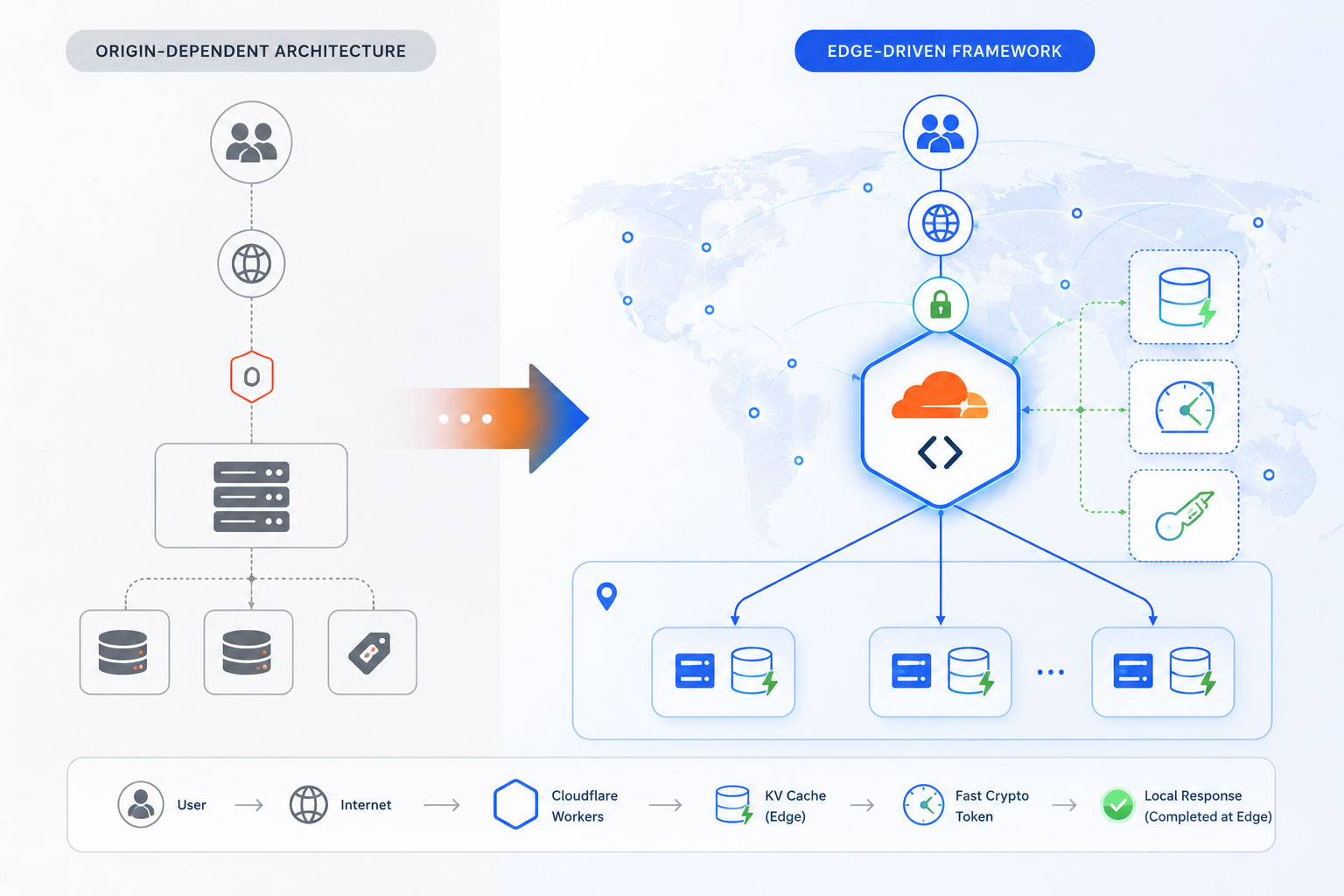
A technical map showcasing the transformation from an origin-dependent system to an Edge-Driven Framework, where requests are completely intercepted and processed within Cloudflare Workers using localized KV caches and high-speed cryptographic tokens.
1. Implementing Cryptographic Session Validation
Before an edge worker can calculate a customized price for a buyer, it must securely verify exactly who that buyer is. Forcing the worker to call the main origin server to check a user session would completely defeat the purpose of edge computing, reintroducing the exact latency bottleneck you are trying to fix.
To solve this, the architecture uses stateless JSON Web Tokens (JWT). When a B2B user logs into the portal, the primary origin identity system issues an encrypted JWT containing the user’s unique account ID, contract tier level, and company code. This token is securely saved in the user’s browser as an HttpOnly cookie. When the user browses product pages, the Cloudflare Worker intercepts the request, decodes the JWT locally using built-in Web Crypto APIs, and instantly extracts the user’s contract details—achieving secure verification at the edge without a single database call.
2. Leveraging Global KV and Hyper-Local Caching Stores
To serve pricing data at the edge, the worker needs immediate access to your price rules and volume matrices. This data is housed in globally distributed data stores like Cloudflare Workers KV or hyper-local caches like Hyperdrive.
Your core pricing matrices, discount structures, and product SKUs are periodically exported from your central ERP or PIM system and pushed directly into the edge KV store via automated sync APIs. Because Workers KV replicates data globally across hundreds of data centers simultaneously, the local edge worker can read the exact pricing rules for a specific SKU in less than a single millisecond, ensuring the necessary calculations happen instantly.
3. Real-Time Volume-Tier Calculation Mechanics
With the user’s contract profile decoded from the JWT and the master pricing matrices loaded from the local KV store, the edge worker can execute the volume-tier calculation logic instantly.
As the user adjusts ordering quantities on a bulk wholesale page, the client-side JavaScript fires a high-speed fetch request to an edge endpoint. The worker runs an optimized array-matching algorithm against the pricing rule matrix, pinpoints the correct volume discount tier for that specific quantity, applies the contract-specific percentage reduction, and returns a clean JSON response containing the final updated price. This entire operation completes in a fraction of a second, providing a completely smooth, interactive browsing experience for the procurement officer.
The Role of Enterprise Partners: Leveraging an Ecommerce Website Development Company in India
Migrating complex business logic from a traditional centralized server stack to a globally distributed edge computing network is an intricate technical challenge. It requires a complete redesign of how data flows through your platform, demanding expertise in asynchronous JavaScript engineering, Web Crypto standards, stateless token authentication, and advanced database synchronization routines. For global enterprises running expansive B2B setups with thousands of complex pricing variables, attempting this migration without specialized engineering talent can lead to system bugs, sync errors, or data security gaps.
To execute this digital transition smoothly, sophisticated international enterprises frequently partner with an established ecommerce website development company in India. The Indian tech landscape has evolved into a world-class hub for advanced cloud native engineering and serverless development talent. These specialized agencies bring the deep technical expertise needed to rewrite legacy database queries into lean edge scripts, design automated synchronization pipelines between internal ERP systems and Cloudflare KV stores, and thoroughly test edge applications for absolute reliability. Collaborating with an expert development partner allows brands to rapidly upgrade their platform infrastructure to cutting-edge speeds, while maintaining highly efficient capital allocation.
—
Comparative Strategy: Centralized Databases vs. Edge-Compute Architectures
To clearly see why moving your calculation logic to the perimeter of the network is the ultimate solution for building high-performance platforms, let’s contrast a standard database setup against an optimized, edge-compute architecture:
Case Study: Eliminating Database Latency for a Global Parts Distributor
To evaluate the clear, measurable operational returns of edge compute optimization, let’s look at the digital architecture turnaround executed by a massive multi-national industrial components distributor. This enterprise managed an active inventory of over 50,000 individual SKUs, serving contract procurement teams across North America, Europe, and Asia. Because every enterprise client operated under a uniquely negotiated contract with intricate volume tier variations, their platform layout was incredibly complex.
Every time a customer updated an ordering quantity grid, the front-end application had to fire complex nested database queries to an origin server cluster based in central Europe. As a result, users browsing from locations like Tokyo or New York faced severe latency issues, with page load times frequently stretching past three seconds during peak ordering hours. This lag caused a visible drop-off in user engagement, increased shopping cart abandonment, and placed a continuous, heavy processing load on the core database cluster.
To address this core operational bottleneck, the engineering team executed a complete migration to a serverless edge architecture:
- Decoupling the Logic: The team extracted the dynamic price-calculation logic from the primary application server, rewriting it into lean, optimized JavaScript modules built specifically for Cloudflare Workers.
- Stateless Authentication: They replaced old, server-dependent session cookies with high-security JWTs, allowing individual edge nodes to instantly identify and verify incoming corporate client profiles locally.
- Edge Synchronization: They built an automated database worker script that instantly synced any updates from the core ERP database directly into Cloudflare’s global Workers KV store within seconds of a change.
The Operational Results: The transformation was immediate and definitive. The time required to process and display customized B2B price matrices dropped from an average of 450 milliseconds down to just 8 milliseconds globally. Total page load speeds for international procurement teams improved by over 70%, resulting in an immediate, frictionless browsing experience.
By completely intercepting and handling these complex pricing queries at the network’s edge, the company reduced the processing load on its central origin databases by over 65%. This massive reduction in server strain allowed the business to scale down its expensive cloud server hosting configurations significantly, while ensuring the platform remained stable during high-traffic order periods. The final result was a major win for the enterprise: a fast, secure, and highly efficient application infrastructure built for global scale.
The Long-Game Advantage: Future-Proofing Global Enterprise Infrastructure
In a rapidly moving digital economy where speed is an absolute competitive differentiator, relying on centralized cloud server frameworks to handle complex, personalized data lookups is becoming a major operational bottleneck. B2B buyers have little tolerance for sluggish user interfaces or spinning loading wheels when navigating procurement workflows. Your digital experience is an integral part of your product offering; if your platform is slow, it reflects poorly on your operational capabilities.
Investing in a modern, edge-compute optimization strategy is the ultimate way to future-proof your digital storefront. By moving dynamic calculations to serverless networks like Cloudflare Workers, you create an incredibly scalable, hyper-responsive digital infrastructure that serves custom data instantly anywhere in the world. This approach protects your core database systems from traffic spikes, slashes your ongoing server costs, and ensures your customer experience remains completely flawless.
Stop letting legacy database latency compromise your business growth. Prioritize edge computing. Move your complex calculations away from your central origin, implement stateless validation models, and work with specialized engineering partners to turn your website architecture into a lightning-fast, high-conversion asset that drives long-term customer loyalty and sustainable enterprise growth.
Is Database Latency Quietly Draining Your B2B Sales Volume?
Slow processing speeds and delayed pricing matrices can subtly damage your digital customer experience and lead to lost procurement contracts. Our veteran cloud engineering and edge-compute development specialists can conduct a comprehensive performance audit of your web application stack, pinpointing exactly how to migrate your complex backend calculations to high-speed serverless frameworks.



Related items

For years, the e-commerce playbook was as simple as it was reliable: build clean product p


The digital checkout is the most volatile, high-stakes environment in the entire digital e


Imagine running a physical, brick-and-mortar retail store in a bustling metropolitan distr