
Gartner’s 2025 CMO Spend Survey found that marketing budgets average 7.7% of company revenue, and 59% of the marketing leaders surveyed reported budgets that fall short of what their strategy requires (Gartner, 2025). The survey focused mostly on larger companies, yet the pattern is likely familiar to owners and marketers at any size: there is usually more worth doing than there are hours, people, or dollars to do it. That is why the question of who does the work carries so much weight.
This guide walks through freelancers, agencies, and in-house teams in plain language. It introduces a three-question tool we call the 3C Fit Framework, and it shares a perspective that many providers may hesitate to mention: the best answer often changes as your business grows, so a thoughtful sequence can work better than one permanent choice.
As a website design and digital marketing agency, we are glad to say that the right starting point for many businesses is a freelancer or an internal hire. Our goal is for you to finish this article with a clear sense of which structure fits your next twelve months, whether or not that includes working with us.
The short version
Freelancers tend to fit defined projects and quick starts. Agencies tend to fit businesses that need SEO, website design, content, and paid media to work as one plan. In-house teams tend to fit companies with steady daily marketing work and the budget for a full compensation package. The 3C Fit Framework (Capacity, Coordination, Continuity) can help you decide, and many growing businesses find that one internal owner supported by external specialists offers a strong balance.
What you will find inside:
- Why this decision shapes your marketing results
- What each option looks like in plain language
- The 3C Fit Framework
- When a freelancer is a strong choice
- When an agency is a strong choice
- When an in-house team is a strong choice
- The Owner Hours Test
- A perspective worth considering
- A simple path to decide
- Questions worth asking any provider
- How this applies to SEO, website design, and lead generation
Why this decision shapes your marketing results
Choosing between a freelancer, an agency, and an in-house hire influences more than your budget. It affects how quickly campaigns launch, how well your website, SEO, and advertising work together, and how much of your own time goes into managing the work. A team that matches your stage of growth can make each of those areas smoother, while a mismatch can slow results even when everyone involved is talented.
Talent is rarely the only variable. In many cases, a capable professional placed in a setting that suits the business need will produce more than an equally capable professional in a setting that does not. For this reason, we encourage owners and marketing managers to begin with the shape of the work and compare prices afterward.
Your answer may also evolve. A founder launching a first website may benefit from a freelancer. A company running SEO, content, and paid media together may benefit from an agency. An established business with daily campaign needs may benefit from an in-house team. Each can be the right call at the right moment, and the sections below help you recognize which moment you are in.
It also helps to define what success means before comparing options. For most businesses, success comes down to a steady flow of qualified leads, a healthy conversion rate on the website, and a cost per lead that supports profitable growth. When those targets are written down, each structure can be evaluated against them, and the conversation becomes more objective and more productive for everyone involved.
What each option looks like in plain language
The Freelancer
A freelancer is an independent professional who usually specializes in one discipline, such as copywriting, web design, SEO, or paid search. Three points summarize how this option tends to work:
- Who it suits: businesses with a defined project or a specific skill gap.
- How it works: you agree on scope, timeline, and price, and the freelancer delivers while working directly with you.
- Why owners choose it: speed, deep specialization, and the flexibility to engage help only when it is needed.
The talent pool is broad. The Upwork Research Institute (2023) estimated that 64 million Americans, or 38% of the U.S. workforce, performed freelance work in 2023, and 47% of freelancers provided knowledge services such as marketing and programming. That range gives businesses plenty of choice, and it also means that careful selection is worthwhile.
The Agency
A digital marketing agency is a team of specialists, often including strategists, SEO professionals, designers, developers, writers, and paid media managers, working within one process.
- Who it suits: businesses that need several disciplines to support one goal, such as lead generation.
- How it works: engagements usually run on a monthly retainer or a defined project, with account management and regular reporting.
- Why owners choose it: breadth of skills, shared tools, and coverage when one person is unavailable.
The In-House Team
An in-house team is made up of employees who work solely for your company.
- Who it suits: businesses with steady, daily marketing work and the budget for salaries, benefits, software, and management.
- How it works: you recruit, onboard, and lead the team, and in return they learn your products, customers, and culture in depth.
- Why owners choose it: communication is quick, and priorities can shift the same day a conversation with sales or customer service suggests a new direction.
The 3C fit framework: capacity, coordination, continuity
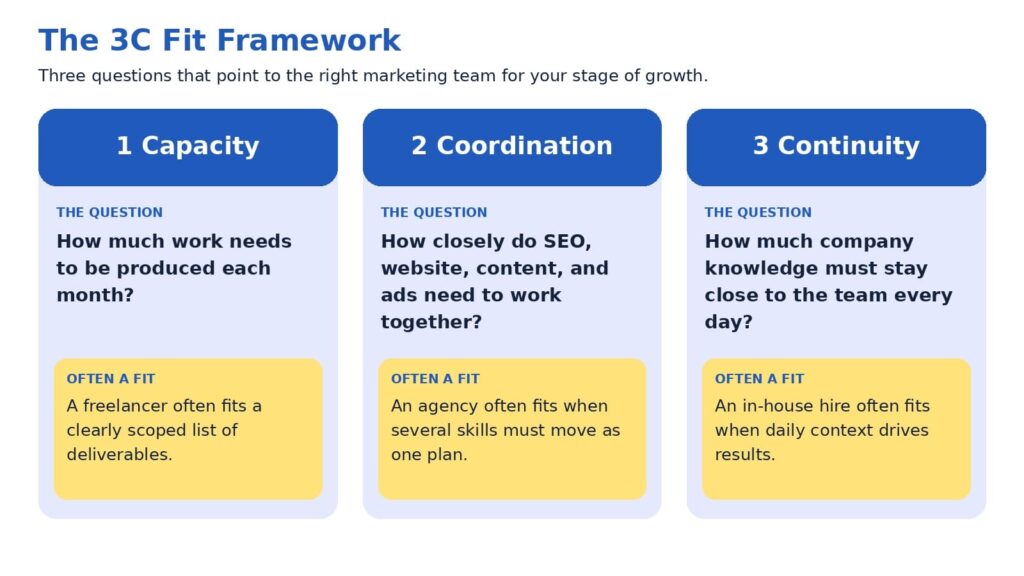
A useful way to compare the three options is to look at what your marketing needs from the team rather than at the team type itself. Three questions usually point toward an answer, and we call them the 3C Fit Framework.
- Capacity asks how much work needs to be produced each month, such as a set of service pages, a number of articles, a few ad campaigns, or a website rebuild. When the list of deliverables is clear and finite, a freelancer can often handle it efficiently.
- Coordination asks how closely your SEO, website, content, advertising, and analytics need to work together. Search intent informs page structure, page structure influences conversion rate, and conversion rate determines how much paid traffic is worth buying. When disciplines depend on one another this way, an agency’s shared process can reduce handoffs and keep decisions consistent.
- Continuity asks how much company knowledge needs to stay close to the work every day. Product details, sales feedback, and customer conversations all shape strong marketing, and an in-house team has the most direct access to them.
Most businesses start with one of the three C’s as their main need, and growth then adds the others. That progression is a big reason why the right structure shifts over time.
When a freelancer is a strong choice
Freelancers often shine when the goal is specific: a new landing page, a set of service pages, a technical SEO cleanup, or an email sequence. Because they work directly with you, feedback loops can be short, and many bring deep experience in a single craft. For a business testing a new offer or launching a first website, this can be an efficient way to move forward.
A few practices help the engagement go smoothly:
- Define the deliverables, the timeline, and what success looks like before work begins.
- Confirm availability for revisions and for questions after launch.
- Plan how the work connects to your other marketing channels, since one specialist typically covers one of them.
Because a freelancer usually covers one discipline, you or a teammate often serve as the coordinator who connects the pieces. Owners who enjoy that role may find this arrangement rewarding. Owners with limited time may prefer to review the Owner Hours Test later in this guide before deciding.
When an agency is a strong choice
An agency can be a strong choice when marketing outcomes depend on several disciplines moving together. Lead generation is a good example. Search visibility brings the right visitors, website design and messaging encourage them to act, paid media extends reach, and analytics show which efforts contribute to revenue. When those elements sit within one team, decisions can be made with the full picture in view.
It is also worth acknowledging that expectations of agencies are rising. In Gartner’s 2025 survey, 39% of CMOs planned to reduce agency budgets, and 22% said generative AI had lessened their reliance on external agencies for creativity and strategy. Among the top actions CMOs cited for saving on agency costs were ending unproductive relationships and streamlining agency rosters (Gartner, 2025). We see this as a healthy development, because it encourages agencies to demonstrate clear process, transparent reporting, and measurable contribution to leads and sales.
An agency may be a good fit when:
- Your goals involve more than one channel, such as SEO, website design, and paid media.
- You prefer a regular reporting rhythm and a named team over a single point of contact.
- You would like to scale activity up or down without recruiting.
The strongest agency relationships tend to feel like a partnership, with shared goals, open access to data, and honest conversations about what is working.
When an in-house team is a strong choice
An in-house team can be an excellent choice when marketing work is steady, varied, and closely tied to daily business activity. Team members learn your products, hear sales conversations firsthand, and can respond quickly when priorities change. For businesses with consistent campaign needs, that proximity can make marketing feel like a natural extension of the company.
The cost picture deserves a full view. The U.S. Bureau of Labor Statistics (2026) reports that benefits made up 30.0% of employer compensation costs for private industry workers in June 2026, with wages and salaries making up the remaining 70.0%. Using those averages for illustration, a role with $70,000 in wages would represent roughly $100,000 in total employer compensation. Recruiting adds to that figure, and the Society for Human Resource Management (SHRM, 2022) reported an average cost per hire of nearly $4,700 before any salary is paid. Software subscriptions, training, and management time are additional considerations.
A second factor is range. A single marketing hire usually brings one primary strength, such as content, paid media, or analytics, while growing businesses often need several. Many companies address this by pairing a first hire with external specialists, which leads naturally to the hybrid approach discussed below.
An in-house team may be a good fit when:
- Marketing work fills a full week, every week.
- You have a leader who can set priorities and review results.
- Your budget covers compensation, tools, and room to grow the team.
The three options side by side
The comparison below summarizes the patterns discussed so far. Individual freelancers, agencies, and companies vary, so please treat it as a starting point for your own evaluation.
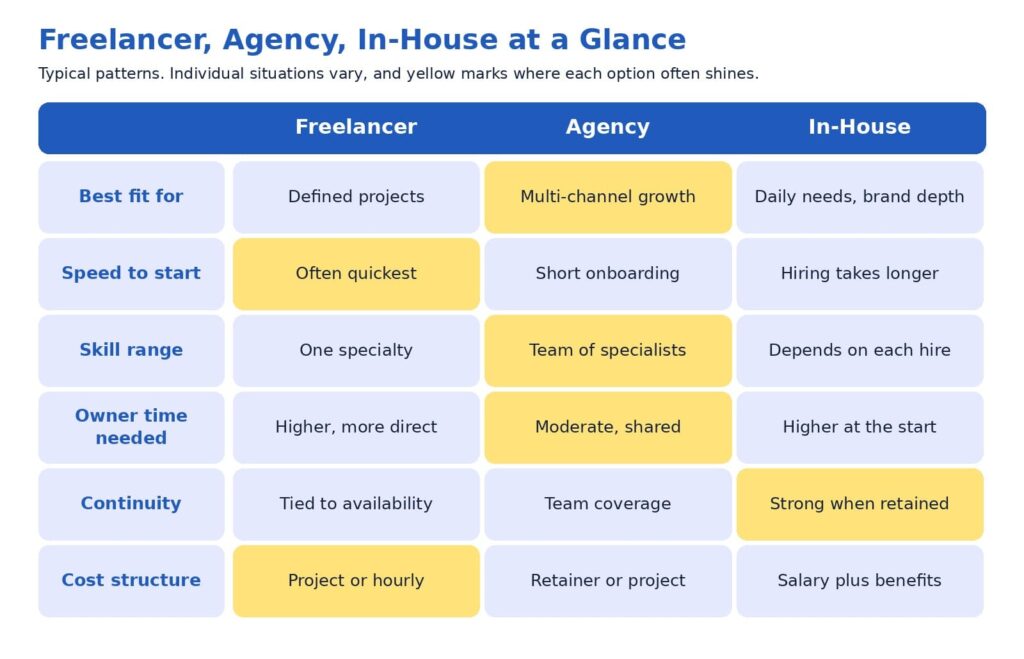
You may notice that no option leads in every row. That balance is exactly why the decision benefits from a framework instead of a ranking.
The owner hours test: a cost that rarely appears on an invoice
Every option has a price on the proposal and another one on the calendar. The calendar cost is the number of hours you and your team spend briefing, reviewing, coordinating, and following up. This cost is easy to overlook, yet it often decides whether an engagement feels smooth or demanding.
A simple test can bring it into focus. Estimate how many hours per week you are able to dedicate to directing marketing, and compare that with what each option typically asks of you. A freelancer working on several separate projects may rely on you to connect them. An agency usually supplies a project manager, which can reduce your coordination load. An in-house hire needs onboarding and ongoing leadership, especially in the first months.
If your calendar has room for hands-on direction, a freelancer or an in-house hire may fit comfortably. If your calendar is full, the coordination an agency provides may be worth more than it first appears on a proposal. Considering this early often leads to better satisfaction on both sides, because expectations match reality from the first week.
A perspective worth considering: rent execution first, then decide what to own
Here is a view that some providers may hesitate to share, because it can reduce their own project volume: many businesses may achieve better results by validating what works through external execution before building an internal team. The reasoning is practical. Early marketing involves a great deal of learning, such as which keywords bring buyers, which pages convert, and which channels produce qualified leads at a sustainable cost. External specialists can test those questions at a pace that fits your budget, and the answers then shape what a first internal hire should be responsible for.
A first hire made before those answers exist is often asked to cover strategy, writing, analytics, design coordination, and advertising at once. That is a wide range for one person, and even an excellent candidate may find it demanding to excel at every part. Starting with external execution gives the future hire a clearer job description, better data, and a stronger chance to succeed.
The same logic works as a business matures. Once you know which activities run every day and produce results, bringing a marketing leader in-house can strengthen continuity, while freelancers and agencies continue to supply specialist capacity. In short, direction can live inside the company while execution stays flexible. We find this structure tends to protect marketing ROI, since fixed costs grow only when the evidence supports it.
This perspective sometimes leads us to recommend a freelancer or an internal hire rather than our own services. We share it because clients tend to do well when the structure fits, and that outcome is good for everyone involved.
A simple path to decide
If you would like a quick way to apply the 3C Fit Framework, the path below turns three questions into a suggested starting point. It is intended as a guide for discussion with your team, so feel free to adapt it to your circumstances.
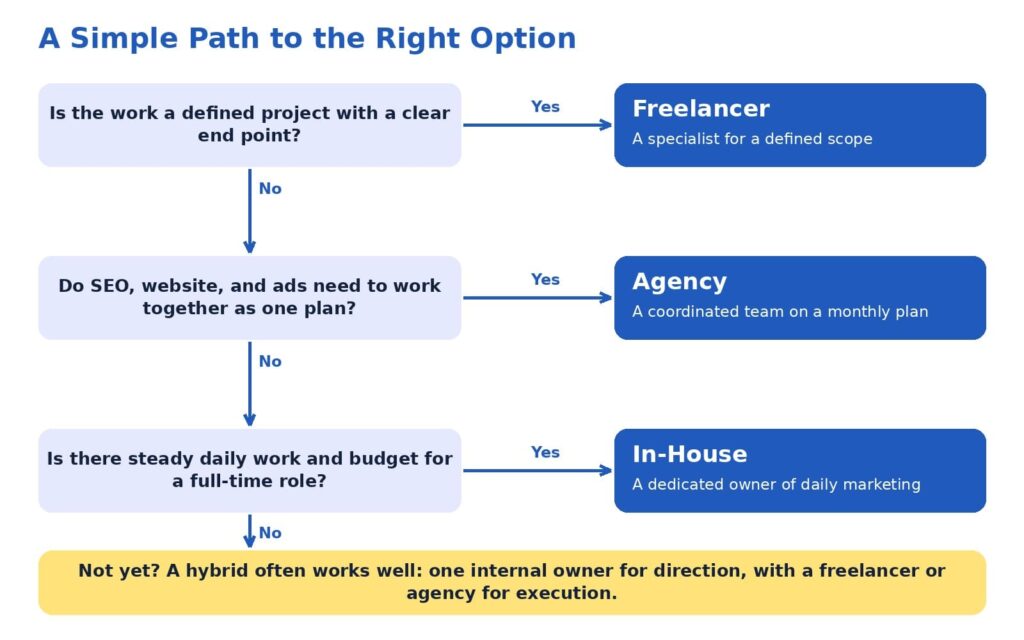
A few reminders can make the path even more useful:
- Plan around the next twelve months of goals, which is a longer horizon than the next few weeks.
- Select the option that matches your largest need, then add support where gaps appear.
- Revisit the decision once a year, since goals and budgets evolve.
Mixed answers are common and entirely fine. A business that needs defined projects today and daily management next year can begin with a freelancer or agency and plan an internal role for later, using results from the first phase to guide the hire.
Questions worth asking any provider
Whether you are speaking with a freelancer, an agency, or a candidate for an internal role, the conversation goes further when it includes specific questions. The following list can help you compare options consistently:
- Which results have you helped similar businesses achieve, and what process produced them?
- How will we measure success, and how often will we review it together?
- Who will do the daily work, and how can I reach that person?
- How will SEO, website, content, and advertising decisions be coordinated?
- What do you need from me each week to keep progress steady?
- Which numbers will you report, such as leads, conversion rate, cost per lead, and revenue influenced?
- What happens to my accounts, content, and data if we conclude our work together?
Thoughtful answers to these questions usually reveal how a provider thinks about results, communication, and long-term value. They also give you a fair way to compare very different proposals side by side.
How this applies to SEO, website design, and lead generation
SEO, website design, and lead generation make a useful case study because they depend on each other. SEO services attract the right audience by aligning pages with search intent. Website design services turn those visitors into leads or customers through clear structure, messaging, and user flow. Conversion optimization services then refine pages using real behavior data, so the same traffic produces more leads over time.
A freelancer can deliver any one of these areas with skill. An in-house marketer can manage them day to day. An agency can connect all of them into one system with shared reporting, so each improvement supports the next. At ICO WebTech, we build marketing systems that help businesses attract the right audience, convert visitors, and grow consistently, and we are glad to collaborate with freelancers and in-house teams whenever that is the best structure for a client.
If you would like a second opinion on which structure fits your goals, we would be happy to review your current setup and share what we see, including where an existing freelancer or internal team is already doing well.
Choosing with confidence
Freelancers, agencies, and in-house teams can each be the right answer. Freelancers bring focused skill and fast starts, agencies bring coordinated expertise across channels, and in-house teams bring daily context and continuity. The 3C Fit Framework helps you match those strengths to what your business needs now, and the Owner Hours Test helps you account for the time each option asks of you.
Many businesses grow best through a sequence: external execution to learn what works, an internal owner to guide direction, and specialists to keep capacity flexible. High expectations pair well with this approach, because each stage is designed to produce measurable leads and sales before the next investment is made.
If you are weighing these options for your own business, our team at ICO WebTech would enjoy helping you map the next twelve months. You can learn more about our web design agency work, our SEO agency approach, and our digital marketing agency approach to see how the pieces fit together.
References
Gartner, Inc. (2025, May 12). Gartner 2025 CMO spend survey reveals marketing budgets have flatlined at 7.7% of overall company revenue [Press release]. https://www.gartner.com/en/newsroom/press-releases/2025-05-12-gartner-2025-cmo-spend-survey-reveals-marketing-budgets-have-flatlined-at-seven-percent-of-overall-company-revenue
Society for Human Resource Management. (2022). The real costs of recruitment. https://www.shrm.org/topics-tools/news/talent-acquisition/real-costs-recruitment
U.S. Bureau of Labor Statistics. (2026). Compensation costs for private industry workers averaged $46.89 per hour worked in June 2026. The Economics Daily. https://www.bls.gov/opub/ted/2026/compensation-costs-for-private-industry-workers-averaged-46-89-per-hour-worked-in-june-2026.htm
Upwork Research Institute. (2023, December 12). Freelance Forward 2023. Upwork. https://www.upwork.com/research/freelance-forward-2023


Related items

A website redesign is one of the few marketing projects that can lower your traffic on the


A WordPress site rarely breaks all at once. It drifts. A plugin update here, a new image l