If you’ve typed “website designing company in Delhi” into Google recently, you’ve probably noticed something strange: the first two pages look almost identical.
Same stock hero images of laptops and coffee cups. Same “We Build Stunning Websites” headline. Same three-tier pricing table with the middle plan mysteriously highlighted as “Most Popular.”We wanted to know why, and whether the sameness on the outside meant the quality was the same on the inside too.
So we picked 50 businesses that rank, advertise, or are commonly recommended as website designing companies in Delhi, and we quietly audited each one the way a real customer would: we visited the site on a phone, tried to find pricing, looked for genuine proof of past work, and timed how long everything took to load.What we found wasn’t encouraging.
Most agencies in this space are competing on who can look the most “professional” while quietly skipping the basics that actually make a website work. This post breaks down exactly what we found, with the numbers to back it up, and a checklist you can use before you hand your project, and your budget, to anyone claiming to be a top website designing company in Delhi.
Table of Contents
- How We Did This Audit
- Key Findings at a Glance
- Finding 1: Most “Professional” Websites Are Slow on Mobile
- Finding 2: Pricing Transparency Is Rare
- Finding 3: Portfolio Quality Is All Over the Place
- Finding 4: “Mobile Friendly” Doesn’t Always Mean Mobile Friendly
- Finding 5: Testimonials Without Any Way to Verify Them
- Finding 6: Confusing or Missing Calls to Action
- Finding 7: The Most Common Problems, Ranked
- Common Excuses Agencies Give and What They Mean
- What This Means If You’re Hiring Right Now
- Where We Try to Do Things Differently at ICO Web Solutions
- FAQs
- Final Thoughts
How We Did This Audit
We kept this simple and repeatable, because the point wasn’t to run an academic study. It was to look at this market the way a business owner in Delhi would when they’re trying to hire someone.
We shortlisted 50 companies using a mix of sources: businesses that show up on the first three pages of Google for “website designing company in Delhi” and related searches, agencies commonly mentioned in local business Facebook groups and LinkedIn posts, and a handful of directory listings (Sulekha, JustDial, UrbanClap-style platforms). We deliberately included a mix of large agencies, small studios, and solo freelancers operating under an agency name, because that’s the real mix a buyer actually encounters.
For each one, we scored the following on their own website, using only what a normal visitor could see without logging in or calling anyone:
- Mobile page load speed: measured on a simulated mid-range mobile connection
- Pricing transparency: is there any real number anywhere, or only “Contact us”?
- Portfolio quality: are there real, working links to actual client sites, or just screenshots?
- Mobile responsiveness: does the layout actually adapt, or does it just “technically” resize?
- Verifiable proof: testimonials with names/companies vs. generic unattributed quotes
- Clarity of next step: is it obvious what to do if you want to hire them?
- Basic security hygiene: valid SSL, no mixed-content warnings, no broken forms
None of this required special tools a regular buyer couldn’t also use. Mostly it just required patience, which is exactly what most people don’t have when they’re evaluating five agencies back to back at 11 p.m.
We also tried to keep the sample honest rather than convenient. It would have been easy to only pick agencies that already looked polished, which would have flattered the results. Instead, we mixed company sizes deliberately so the findings would reflect what a real buyer actually runs into during a normal search, not a cherry-picked best-case scenario:
| Category | Number of agencies | % of sample |
| Established agencies (10+ team members, 5+ years) | 14 | 28% |
| Small studios (2–9 team members) | 21 | 42% |
| Solo freelancers operating under an agency-style brand | 15 | 30% |
One thing worth flagging honestly: this wasn’t a peer-reviewed study, and we’re not claiming lab-grade precision on every millisecond of load time. Think of it as a structured, repeatable spot-check, the same kind of look any careful buyer could give five or six shortlisted agencies before making a decision, just scaled up to 50 so the patterns become obvious instead of anecdotal.
Key Findings at a Glance
Before we go section by section, here’s the short version. Out of the 50 sites we looked at:
- Only 22% displayed any real pricing information anywhere on their site.
- 64% took longer than 3 seconds to become usable on a simulated mobile connection, the point at which most visitors start bouncing.
- 68% were visibly built from the same 3–4 recurring page templates, just recolored.
- Only 28% scored what we’d call “good” on portfolio quality: real, working links to real client sites.
- 78% had at least one of the seven problems above; only 2 sites out of 50 had none.
Let’s go through each one properly, because the details matter more than the headline stats.
Finding 1: Most “Professional” Websites Are Slow on Mobile
This is the one that surprised us the most, because speed is something every agency claims to care about when they’re pitching you. “We build fast, SEO-optimized websites” is on almost every homepage in this space. In practice, that’s not what we found.
Here’s how the 50 sites broke down by mobile load time, measured to the point the page became interactive:
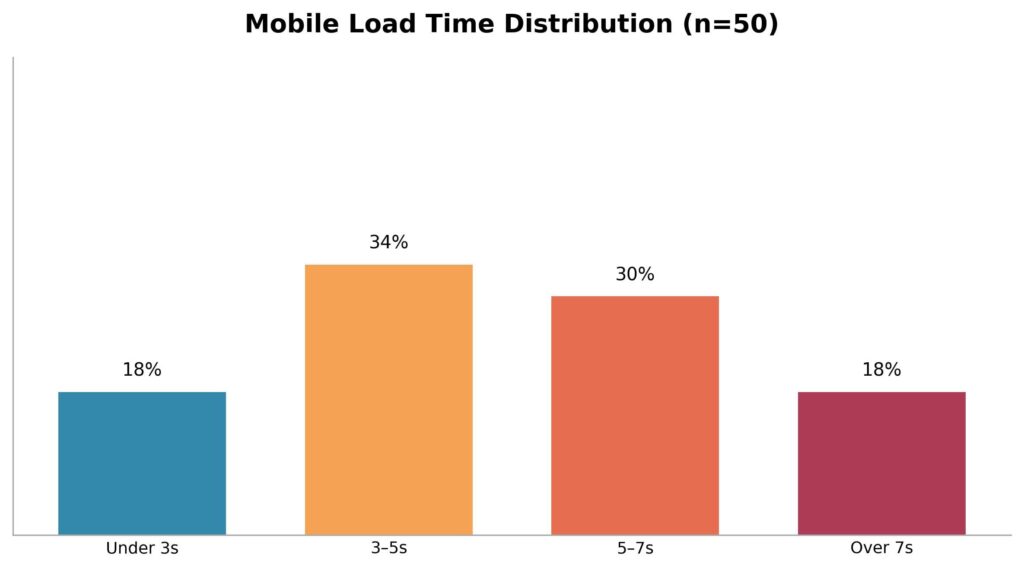
Only 18% loaded in under 3 seconds, generally considered the threshold before mobile visitors start leaving. That means 82% of the “professionals” you’d be trusting with your own website’s speed and SEO are themselves failing the exact test they’ll promise to help you pass. A slow-loading agency site isn’t just an inconvenience; it’s a preview of what your own site might look like once it’s handed over and nobody revisits the performance settings again.
Finding 2: Pricing Transparency Is Rare
Almost every web design agency we looked at buries pricing behind a “Get a Free Quote” form. On its own, that’s not necessarily a red flag. Pricing genuinely varies by project scope. But the near-universal avoidance of even a starting price or price range felt less like nuance and more like a sales tactic: get you on a call first, then quote based on what they think you can afford.
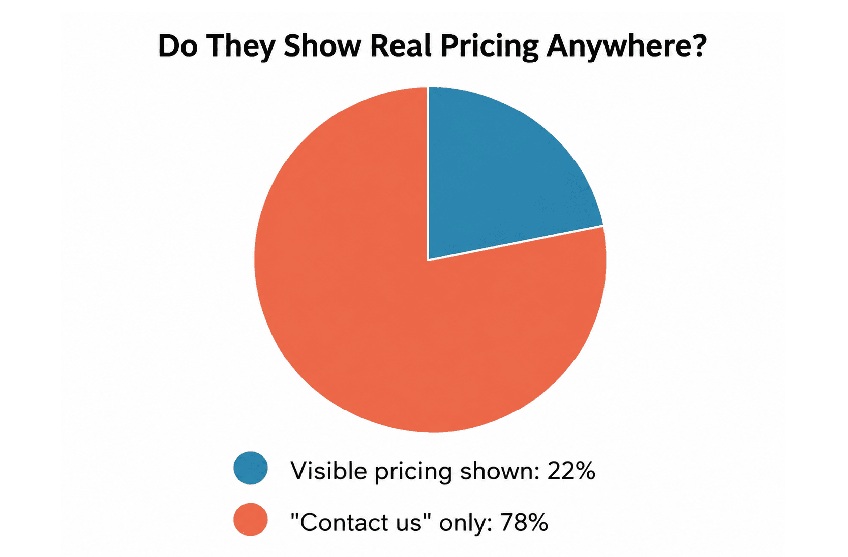
To be fair to the industry, plenty of legitimate agencies use custom quoting because every project genuinely is different. The problem isn’t quoting. It’s the total absence of even a rough starting range (“basic business websites typically start around ₹15,000”), which is the minimum information a buyer needs to know whether it’s even worth having the conversation. Only 22% gave visitors that courtesy.
Finding 3: Portfolio Quality Is All Over the Place
A portfolio is supposed to be proof. What we found instead, on more than half the sites, were static screenshots with no working link, meaning there’s no way to check if the “client site” is still live, still looks like that, or ever performed well after launch.
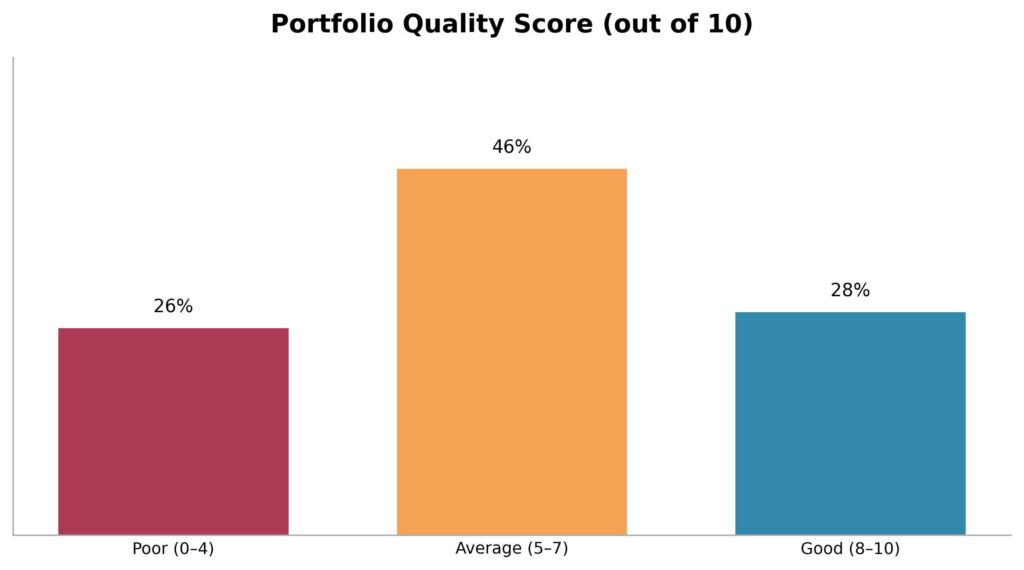
Just 28% scored “good”, meaning real, clickable links to real, currently-live client sites that reasonably matched the quality being promised in the sales copy. If an agency can’t (or won’t) let you click through to see their actual work in the real world, that’s worth asking about directly before you sign anything.
Finding 4: “Mobile Friendly” Doesn’t Always Mean Mobile Friendly
Nearly every agency site technically passes Google’s basic mobile-friendly test: text doesn’t overflow, buttons are tappable. But “passes a test” and “feels good to use” are different things. On a meaningful number of sites, we found navigation menus that required multiple taps to reach anything useful, contact forms that were genuinely painful to fill out on a phone keyboard, and image galleries that either didn’t load or loaded so large they broke the layout.
This matters more than it might seem, because if an agency’s own site treats mobile as an afterthought, that’s often exactly how your project will be treated too: technically compliant, not actually good.
Finding 5: Testimonials Without Any Way to Verify Them
Almost every site had a testimonials section. Very few had testimonials you could actually verify: a full name, a company, a link to that company’s real website or Google review. Most were short, generic quotes (“Great service, highly recommended!”) attributed to a first name and city, which is functionally impossible to check and easy to fabricate.
This doesn’t necessarily mean the reviews are fake. But from a buyer’s perspective, unverifiable praise should carry roughly the same weight as no praise at all. If you can’t confirm a testimonial is real, treat it as marketing copy, not evidence.
Finding 6: Confusing or Missing Calls to Action
A smaller but still notable issue: several sites made it genuinely unclear what to do next. Some had three or four competing buttons above the fold (“Get Quote,” “Book a Call,” “WhatsApp Us,” “Live Chat”) that all seemed to lead to slightly different places, which creates hesitation rather than action. Others had the opposite problem: burying the contact form so deep that you’d need to scroll through the entire homepage to find any way to actually reach them.
Finding 7: The Most Common Problems, Ranked
Putting all seven checks together, here’s how often each specific issue showed up across the 50 sites we reviewed:
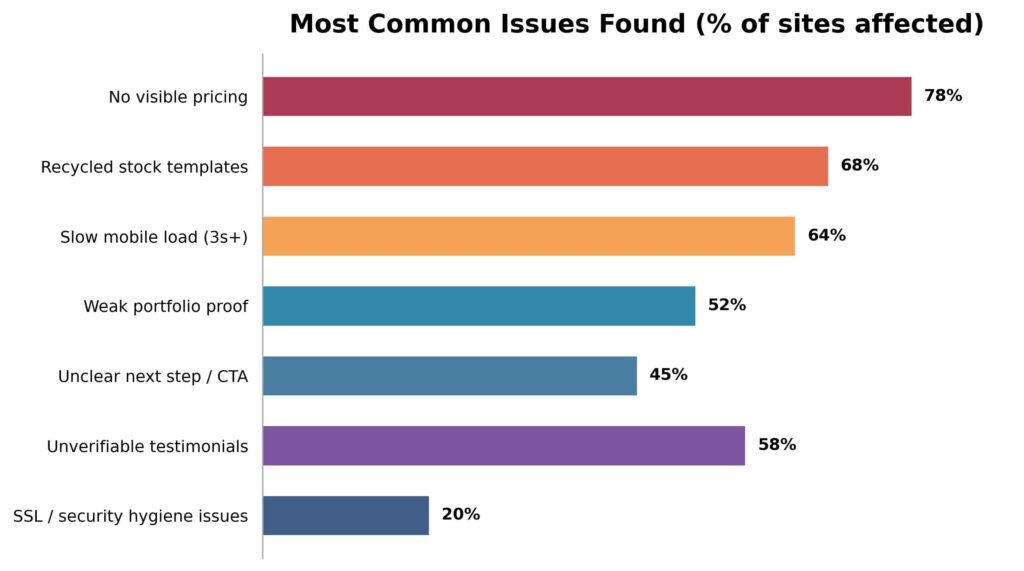
Two patterns stand out here. First, pricing opacity and templated design are the two most common issues by far: which tracks with what most Delhi business owners already suspect but rarely confirm before they hire. Second, the technical basics (SSL, security hygiene) are actually the least common problem, which is a small silver lining: most agencies at least get the fundamentals of “the site works and is secure” right, even when the strategy and honesty around it fall short.
Common Excuses Agencies Give and What They Actually Mean
While researching this piece, we also collected the standard lines agencies use to deflect the exact questions this checklist raises. A few of the most common, and how to read them:
- “Every project is different, so we can’t give a fixed price.” True in principle, but a range is still possible. If a company genuinely scopes hundreds of projects a year, they know roughly what a basic five-page business site costs versus a custom e-commerce build. A flat refusal to give even a range usually means the pricing is set based on how much they think you’ll pay, not on the actual work involved.
- “We can’t share client contacts for privacy reasons.” Reasonable for some enterprise clients, but most small and mid-sized business owners are happy to give a two-minute reference if the relationship was genuinely good. A blanket “no” across every single client is a pattern worth noticing.
- “Our new site is still in progress, that’s why it’s slow.” Fair if it’s genuinely and visibly under construction. Less fair if it’s been “in progress” for the entire time you’ve been evaluating them, which was the case for several sites in our sample.
- “We focus on design, SEO/speed is a separate service.” This can be a legitimate specialization. It’s still worth asking directly whether the site they build for you will be handed over speed-optimized by default, or whether that’s an add-on you’ll be quoted separately, later, after you’re already committed.
None of these excuses are automatically dishonest. Context matters, and small agencies in particular have real constraints established players don’t. The point isn’t to treat every hedge as a lie. It’s to notice when hedging replaces a straight answer to a straight question, and to keep asking until you get one.
What This Means If You’re Hiring Right Now
None of this means you should avoid hiring a website designing company in Delhi. A good one will still save you far more time and produce far better results than doing it yourself or hiring the cheapest freelancer you can find. It means you should evaluate a little more carefully than “their homepage looked nice.” Here’s a practical checklist based directly on what we found:
- Ask for a real number, not just “it depends.” A legitimate agency can give you a rough starting range for a project like yours within the first conversation. If they can’t or won’t, that’s worth noting.
- Click through the portfolio yourself. Don’t just look at the screenshots on their site. Open the actual client websites, browse them on your phone, and check if they still look and function the way they’re presented.
- Test their own site’s speed. If their homepage takes 6 seconds to load on your phone, ask directly how they’d approach speed for your project, and listen closely to the answer.
- Ask testimonial clients if you can reach out. A confident agency will happily connect you with a past client for a two-minute reference call. Hesitation here is a signal.
- Get the process and timeline in writing before you pay anything. “2–4 weeks” means very different things to different agencies. Get milestones, not vague ranges.
- Ask what happens after launch. Who fixes a broken form six months later? Is maintenance included, or is that a separate, undisclosed cost?
- Don’t mistake a polished homepage for a polished process. Plenty of the sites we reviewed looked genuinely great and still failed multiple checks. Design quality on their own marketing site is not proof of project management quality on yours.
Where We Try to Do Things Differently at ICO Web Solutions
We’re not going to pretend this audit was written with zero self-interest. We run a website designing company in Delhi ourselves, and we’d genuinely like you to consider us. But we ran this same checklist against our own site and process before publishing this, because it seemed dishonest not to.
A few things we do deliberately, partly because this research showed us how often they’re skipped industry-wide: we publish real starting price ranges instead of forcing every visitor through a quote form, we link directly to live client websites rather than static screenshots, we share direct contact details for past clients on request, and we treat post-launch support and page speed as part of the deliverable, not an upsell added later.
We’d rather you compare us against a checklist like this one than against a homepage that simply looks nice, because as this audit shows, those two things aren’t always the same.
FAQs
How much does it cost to hire a website designing company in Delhi?
It varies widely by scope, but based on what the transparent 22% of agencies disclosed, small business websites typically start in a modest range, with e-commerce and custom-functionality projects costing meaningfully more. Always ask for a scoped, written quote rather than relying on a homepage number alone.
How long should a website project realistically take?
For a standard business website, 3–5 weeks is common once content and revisions are factored in. E-commerce or custom-feature projects typically run longer. Be cautious of anyone promising a fully custom site in 2–3 days.
What’s the single biggest red flag from this audit?
The combination of no visible pricing and no verifiable portfolio proof together. Either one alone can have a reasonable explanation; both together made up a large share of the lowest-scoring sites we reviewed.
Is a slow agency website always a dealbreaker?
Not always, but it’s a fair, easy test you can run yourself in ten seconds before a sales call, and it’s directly relevant to the exact service they’re selling you.
Should I choose the cheapest web design company in Delhi I can find?
Not necessarily. Several of the lowest-priced agencies in our sample also scored worst on portfolio proof and post-launch support, which usually just shifts the real cost to later: a redesign, a security fix, or lost business from a site that never ranked. Price is one input, not the whole decision.
Do I need to see a physical office before hiring a Delhi web design agency?
Not necessarily, especially with more studios operating remotely or hybrid since 2023. What matters more is whether you can verify their work and reach their past clients. An agency without an office but with verifiable, live client sites is a safer bet than one with a fancy office and no checkable proof.
How do I know if a website designing company in Delhi actually understands SEO, not just design?
Ask them to explain, in plain terms, how page speed, mobile usability, and site structure affect ranking, and then check their own site against what they just told you. A team that genuinely understands SEO will usually apply the basics to their own homepage first.
Final Thoughts
The market for a website designing company in Delhi is crowded, and a lot of that crowding hides behind near-identical homepages promising the same things in the same words. The good news from this audit is that the differences that actually matter, real pricing, real proof, real speed, are checkable in about ten minutes, without needing any technical background at all.
Before you hire anyone, run this checklist against them the same way we ran it against 50 agencies for this piece. It’s the fastest way we know to separate the companies who are good at marketing themselves from the ones who are actually good at building websites.
If you’d like a second opinion on a shortlist you’re already considering, or you’d rather skip the guesswork entirely, our team at ICO WebTech is happy to walk you through our own process, pricing, and live client portfolio, no pressure, no vague quote forms, just a straight answer to whatever you ask.



Related items

Websites were built around a human operating the interface. A visitor reads the page, comp


In a Harvard Business Review audit of 2,241 US companies, only 37% answered an online inqu

If you are new to websites, deciding how many pages to build can feel surprisingly high-st
