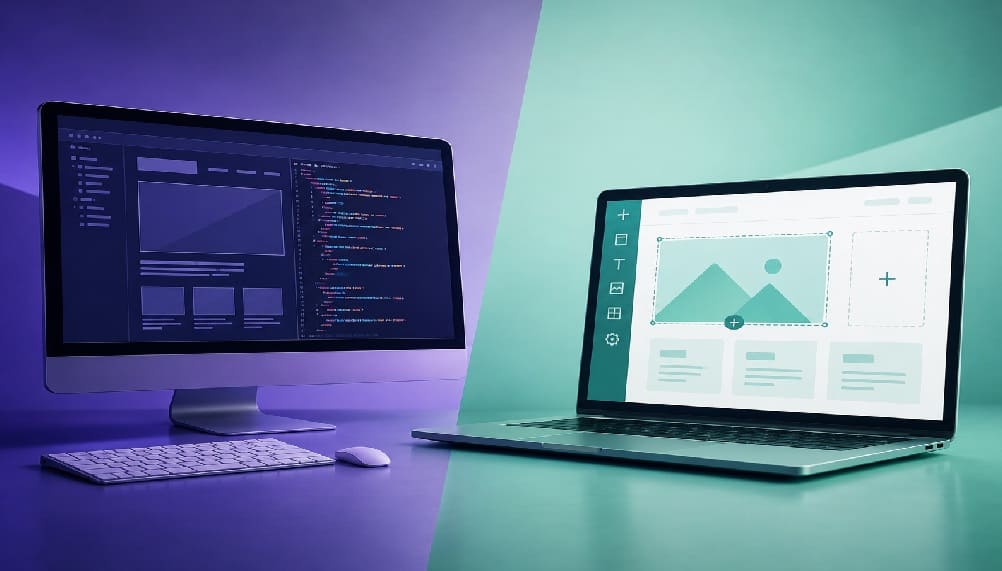
We run a website designing company in Delhi, so you’d expect this post to end with “just hire us.” It won’t, at least not automatically. Plenty of businesses genuinely don’t need to hire anyone yet, and telling them otherwise just to close a deal is the kind of short-term thinking that gives this entire industry a bad name.
What we want to do instead is give you the same honest comparison we’d give a friend who asked us over coffee: when does a DIY builder like Wix or WordPress genuinely make sense, when does hiring a website designing company in Delhi pay for itself many times over, and how do you tell which situation you’re actually in.
We build both custom sites and have set up plenty of DIY builders for clients who later outgrew them, so this comes from having watched both paths play out, not just from a sales script.
Table of Contents
- The Quick Answer
- What “DIY Builder” Actually Means in 2026
- Cost Comparison: Real Numbers, Not Marketing Numbers
- Time Comparison: What Each Path Actually Costs You in Hours
- When DIY Genuinely Makes Sense
- When DIY Backfires
- A Special Case: Ecommerce Sites
- SEO and Growth: Where the Gap Widens Over Time
- The Cost Nobody Budgets For: Ongoing Maintenance
- A Real Pattern We See Often
- The Middle Path Nobody Talks About
- If You Do Go DIY, How to Pick the Right Platform
- A Quick Decision Checklist
- FAQs
- Final Thoughts
The Quick Answer
If you need something online this weekend, have a genuinely simple offering, and your website’s job is basically to exist rather than to actively sell or rank, a DIY builder is a completely reasonable choice.
If your website needs to generate leads, rank on Google against real competition, sell products at scale, or represent a brand you’re serious about growing, working with a website designing company will almost always pay for itself faster than the DIY route costs you in lost time, lost conversions, and eventual rebuild fees.
The rest of this post breaks down exactly why, with real numbers, so you can make the call based on your actual situation rather than on whichever option someone is trying to sell you.
What “DIY Builder” Actually Means in 2026
“DIY” isn’t one thing anymore, and lumping it all together is where a lot of these comparisons go wrong. There are three meaningfully different paths:
- Drag-and-drop builders (Wix, Squarespace, Shopify‘s basic tier): fully hosted, template-based, minimal technical skill required.
- Self-managed WordPress: more flexible and powerful, but you’re responsible for hosting, security updates, plugin conflicts, and backups yourself, or you’re paying someone else to.
- AI website generators: newer tools that generate a starting template from a prompt, which then still need the same ongoing editing and maintenance as any other builder.
Each of these has a genuinely different cost and skill profile, so when we say “DIY” in this post, we mean the general category: you (or someone on your team who isn’t a professional developer) building and maintaining the site yourselves, regardless of which specific tool you pick.
Cost Comparison: Real Numbers, Not Marketing Numbers
The sticker price of a DIY builder always looks like the obvious winner, because the comparison usually stops at the monthly plan fee. That’s not the full cost. Here’s a more complete picture for a typical small business website over the first year, based on common platform pricing and typical small-business project quotes in Delhi, not a single made-up figure:
The DIY builder’s plan fee is genuinely lower on paper, usually somewhere in the range of ₹1,000 to ₹2,500 a month depending on the platform and apps you add, which works out to roughly ₹14,000 to ₹36,000 a year once you factor in stock images, extra plugins, and the occasional paid app. What the sticker price leaves out is the 40 to 80 hours most business owners actually spend building, tweaking, and troubleshooting it themselves, plus the eventual redesign when the DIY site stops matching how the business has grown.
A web design company typically charges a fixed project fee once, and for a straightforward small-business site that fee commonly falls somewhere between ₹20,000 and ₹40,000, though it varies by scope, page count, and whether custom features are involved. That fee already includes design time, copywriting guidance, mobile optimization, and a launch-ready site, so the comparison isn’t really “cheap vs expensive.” It’s “spread across your own unpaid hours vs paid upfront to someone who does this daily.”
Time Comparison: What Each Path Actually Costs You in Hours
Time is the cost most DIY comparisons quietly skip, and it’s usually the bigger one. Based on projects we’ve seen or been brought in to fix, here’s a rough breakdown of where the hours actually go:
| Task | DIY (typical hours) | Agency-managed |
| Learning the platform | 8 to 15 hours | 0 (not your job) |
| Design and layout decisions | 15 to 25 hours | Handled by designer |
| Writing and formatting content | 10 to 20 hours | You provide input; they format |
| Fixing mobile/layout issues | 5 to 15 hours | Built correctly the first time |
| SEO basics setup | 5 to 10 hours (if done at all) | Included in build |
| Typical total | 43 to 85 hours | 2 to 5 hours of your input time |
If your time is worth even a modest hourly rate to your business, 60-plus hours of DIY work often costs more in opportunity cost alone than a straightforward project with a website designing company in Delhi would have cost in fees. That doesn’t make DIY a bad choice; it just means the “free” or “cheap” framing is usually incomplete.
When DIY Genuinely Makes Sense
We’d be lying if we said DIY never made sense, because it clearly does in specific situations:
- You’re validating an idea. If you’re not yet sure the business will work, spending weeks and a large budget on a custom site is premature. Get something live, test demand, and revisit once you have traction.
- Your site’s job is simply to exist. A single-page site with your name, services, and phone number, mainly so people can confirm you’re real when they Google you, doesn’t need custom development.
- You genuinely enjoy building and have the time. Some founders like the hands-on control and treat it as a skill worth learning. That’s a legitimate reason on its own.
- Budget is the hard constraint right now. A decent DIY site beats no site, and beats delaying launch for months to save up for a custom build.
When DIY Backfires
The pattern we see most often with clients who come to us after starting on a DIY builder isn’t that the builder was bad. It’s that the business outgrew it faster than expected, and the rebuild ends up costing more, in both money and lost time, than starting with a proper build would have.
- You depend on search traffic. DIY builders can technically support SEO, but templated structures, slower load times, and limited control over technical details put you at a real disadvantage against a professionally structured site, especially if you’re competing for a term like website designing company in Delhi or anything similarly competitive in your own industry.
- You need custom functionality. Booking systems with unusual rules, multi-step quote calculators, membership areas, and industry-specific integrations often hit a wall on drag-and-drop platforms.
- Your brand needs to look established. Investors, enterprise clients, and larger partners often subconsciously judge credibility from site quality. A template that a hundred other small businesses are also using undercuts that signal.
- You don’t actually have the time you think you do. Most business owners underestimate DIY hours by half, and the site ends up half-finished for months, which often costs more in lost business than any agency fee would have.
A Special Case: Ecommerce Sites
Ecommerce deserves its own section because it’s where the DIY-vs-agency gap widens the most. Platforms like Shopify or Wix’s store builder are genuinely capable for a small catalog with straightforward shipping. But once you need custom checkout logic, inventory syncing across multiple sales channels, bulk pricing tiers, or a storefront designed around real conversion data rather than a generic template, that’s exactly the kind of project an ecommerce website designing company in Delhi is built to handle well, and where a DIY build tends to plateau.
The cost of getting this wrong is also higher in ecommerce specifically, because every friction point in checkout, page speed, or mobile layout translates directly into lost sales, not just lost pageviews. If online sales are meant to be a serious revenue channel rather than a side experiment, this is usually the clearest case where paying for a proper build pays for itself.
SEO and Growth: Where the Gap Widens Over Time
Here’s a comparison that’s often skipped in DIY-vs-agency discussions: what happens to search visibility over the following 12 months, not just at launch. Based on patterns we’ve tracked across client rebuilds:
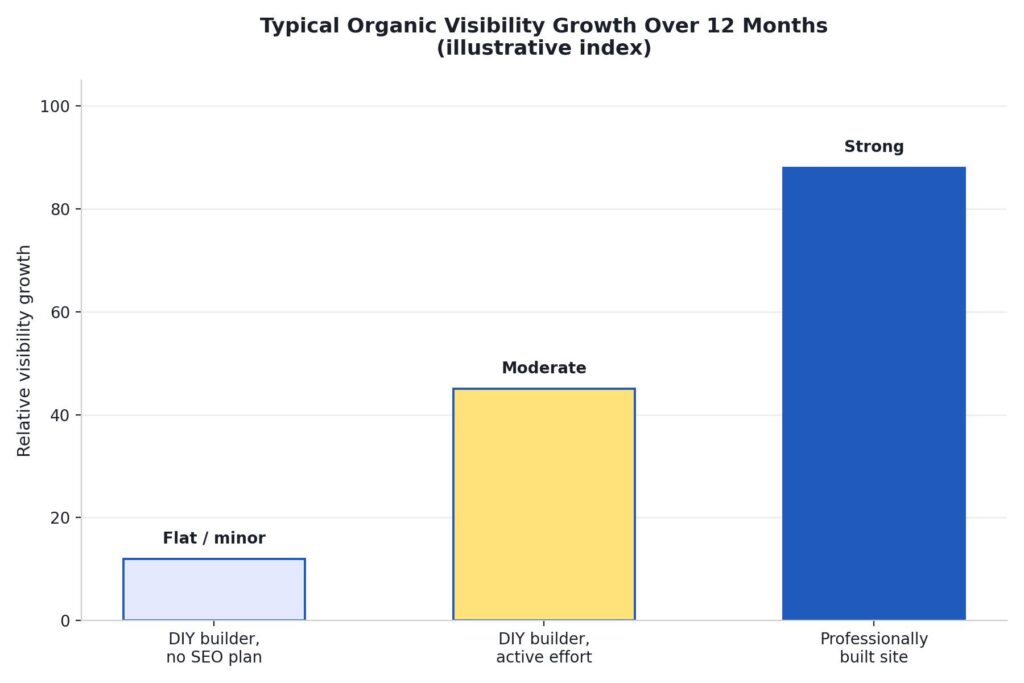
This isn’t a knock on DIY builders’ technical capability; modern platforms have improved a lot on this front. It’s more about what tends to actually get built. Professionally built sites are set up with clean structure, proper heading hierarchy, fast load times, and technical SEO fundamentals from day one, because that’s part of a website developer company in Delhi’s standard process rather than an optional extra you have to remember and configure yourself.
The Middle Path Nobody Talks About
Most comparisons frame this as a binary choice, but a lot of the smartest clients we’ve worked with actually split the difference: launch on a DIY builder to get moving fast and validate the idea, then bring in a website designing company in Delhi once there’s real traction and revenue to justify a proper build. This isn’t wasted effort. The content, product photos, and copy from the DIY phase usually carry over directly into the new build, so nothing is thrown away.
The one thing to watch with this approach: don’t wait so long that the DIY site is actively costing you business (slow load times turning away mobile visitors, a dated look turning away bigger clients) before making the switch. The right time to move is usually earlier than founders think.
The Cost Nobody Budgets For: Ongoing Maintenance
Most cost comparisons stop at launch day, which is misleading, because a website is never really “done.” Both paths carry ongoing costs; they just show up differently.
With a DIY builder, maintenance usually means you personally updating plugins, renewing apps, checking that a new browser update hasn’t broken your layout, and periodically rewriting content that’s gone stale. It’s rarely a large time cost in any single week, but it adds up over a year, and it’s easy to let slide when the business gets busy, which is exactly when a broken contact form or an outdated price list starts quietly costing you leads.
With a website designing company in Delhi, maintenance is usually either included in a support package or billed as occasional, predictable work: a content update here, a new page there, a security patch on the backend. The difference isn’t that one path has maintenance, and the other doesn’t. It’s that one path makes maintenance someone else’s job with a predictable cost, and the other makes it a recurring item on your own to-do list that competes with everything else you’re running.
A related cost worth naming honestly: platform lock-in. Moving a fully built Wix site to another platform later is rarely a clean export; it usually means rebuilding significant parts of the site from scratch. A professionally built WordPress or custom site tends to be easier to hand off, migrate, or extend later, because it isn’t tied to one proprietary builder’s ecosystem.
A Real Pattern We See Often
To make this less abstract, here’s a composite of a pattern we’ve seen repeat across several actual client conversations, details adjusted for privacy. A small business owner in Delhi launches on a drag-and-drop builder to get online quickly, spends around 50 hours over a few weekends getting it presentable, and it works fine for the first six to eight months. Sales come mostly from referrals and word of mouth, so search visibility isn’t yet a pressing concern.
Around month nine or ten, growth plateaus. The owner starts actively trying to bring in customers through Google rather than relying on referrals, and discovers the site isn’t ranking for anything meaningful. Competitors who invested in a proper build early are showing up above them for the exact searches that matter, including generic ones like website designing company in Delhi if that’s adjacent to their own industry’s competitive terms. At that point, they come to a website designing company in Delhi anyway, except now it’s a rebuild under time pressure, competing against established competitors, rather than a considered decision made at the start.
This isn’t every DIY story, and plenty of businesses on DIY builders never hit this wall because their situation genuinely doesn’t require it. But the pattern is common enough that it’s worth planning for honestly rather than assuming it won’t happen to you.
If You Do Go DIY, How to Pick the Right Platform
If you’ve read this far and DIY is still the right call for your stage, the platform choice itself matters more than most people assume. A few honest notes based on what we’ve seen work and not work for small Delhi businesses:
- Wix is the easiest starting point for non-technical founders, with the widest range of ready-made templates. It’s a reasonable pick for service businesses, portfolios, and simple informational sites. Its main downside is that heavily customized functionality and advanced SEO control are more limited than on WordPress.
- WordPress (self-hosted) gives you far more flexibility and a huge plugin ecosystem, which makes it a better long-term foundation if you expect to grow. The tradeoff is a steeper learning curve and genuine ongoing responsibility for hosting, security, and updates, which is exactly the maintenance burden discussed above.
- Shopify is worth a dedicated mention for anyone selling products, since it’s purpose-built for ecommerce in a way general site builders aren’t. For a small catalog with standard shipping needs, it’s often the most sensible DIY ecommerce starting point, though it hits the same ceiling as other builders once your catalog, pricing logic, or integrations get complex.
- AI website generators can produce a decent-looking first draft in minutes, which is genuinely useful for getting unstuck on a blank page. Treat the output as a starting template you’ll still need to edit and maintain, not a finished, hands-off solution.
Whichever you pick, resist the urge to install every available plugin or app “just in case.” Every added plugin is one more thing that can break, slow down your site, or create a security gap you’re now responsible for. Start minimal, and add functionality only when you actually need it.
A Quick Decision Checklist
- Choose DIY if: you’re pre-revenue or testing an idea, your site’s job is mainly informational, budget is the hard constraint right now, or you genuinely have the time and interest to build it yourself.
- Choose a website designing company in Delhi if: organic search traffic matters to your revenue, you need custom functionality a template can’t handle, your brand needs to read as established, or you’ve already tried DIY and it’s costing you more time than it’s saving.
- Choose an ecommerce website designing company in Delhi specifically if: you’re selling products online as a serious revenue channel, not a side experiment, and checkout friction or page speed is directly costing you sales.
FAQs
Can I start with Wix or WordPress and move to a professional site later without losing my content?
Yes. A competent website developer company in Delhi can migrate your existing pages, images, and written content into the new build, so switching later doesn’t mean starting from zero.
Is WordPress cheaper than hiring an agency long-term?
Only if you’re comfortable handling hosting, security updates, and plugin maintenance yourself, or you factor in what you’d pay someone else to do it. Self-managed WordPress has real ongoing responsibilities that a fixed-fee agency build doesn’t hand back to you.
How do I know if my business has outgrown a DIY builder?
Common signs: you’re spending more time fighting the platform than running your business, mobile visitors are bouncing due to speed or layout issues, you can’t add a feature customers are asking for, or competitors with professionally built sites are consistently outranking you.
Do website designing companies in Delhi ever recommend DIY builders to clients?
A genuinely honest one will, when it’s the right fit. If every conversation ends with “you need a custom build” regardless of your actual situation, that’s worth noticing.
What’s a realistic budget range if I do decide to hire a website designing company in Delhi?
It depends heavily on scope, but a straightforward small-business site typically costs meaningfully more upfront than a year of DIY builder fees, and meaningfully less than most owners expect once they account for their own DIY hours and an eventual rebuild. Ask any agency you’re considering for a specific range based on your actual requirements rather than a generic quote.
Will an agency-built site let me make small edits myself afterward?
A good website developer company in Delhi will hand over a site you can update yourself for routine changes like text, images, and prices, typically through WordPress’s standard editor, while keeping the technical foundation, hosting, and security in professional hands. If an agency builds you something you can’t touch at all without paying them for every small edit, ask about that upfront.
Final Thoughts
There’s no universally right answer between DIY and hiring a website designing company in Delhi; there’s only the right answer for where your business actually is right now. Early-stage and simple use cases genuinely favor DIY. Anything revenue-critical, search-dependent, or brand-sensitive tends to favor a professional build, usually by a wider margin than the upfront price difference suggests once you count your own time honestly.
The businesses that regret their choice most often aren’t the ones who picked DIY or the ones who hired an agency; they’re the ones who never revisited the decision as their situation changed. What was right at launch isn’t automatically right two years later, and it’s worth checking in on that honestly every so often rather than defaulting to whatever you set up on day one.
If you’re not sure which category you fall into, we’re happy to give you a straight answer, even if that answer is “you don’t need us yet.” Reach out to ICO WebTech and we’ll walk through your specific situation, whether that means a custom build, an ecommerce website designing company in Delhi conversation, or simply pointing you toward the right DIY setup for now.



Related items

Websites were built around a human operating the interface. A visitor reads the page, comp

In a Harvard Business Review audit of 2,241 US companies, only 37% answered an online inqu

If you are new to websites, deciding how many pages to build can feel surprisingly high-st
