AI search tools quote sources they can identify, connect, and verify. When your site describes your business as clearly defined things (entities) with named relationships, instead of a scattered pile of keyword phrases (strings), those tools have a much easier time understanding you and a much better reason to cite you. In one benchmark, putting the same business data into a knowledge graph lifted GPT-4’s accuracy from 16.7% to 54.2% (Sequeda et al., 2023). This post gives you a four-step framework, Canon-to-Chunk, to build that clarity into your own site, plus a 90-day plan and a way to measure whether it’s working.
In this blog:
- Why keywords quietly stopped being the whole game
- Entities in plain English
- How a RAG engine actually reads your website
- The part most agencies won’t say out loud
- The Canon-to-Chunk framework
- Build your internal knowledge graph
- A 90-day plan you can start Monday
- How to tell if it’s working
- Want a graph built around your business?
- References
Here is a number that should change how you think about your website: when researchers asked GPT-4 real business questions over a company database, it answered only 16.7% of them correctly, and that figure climbed to 54.2% once the very same data was represented as a knowledge graph (Sequeda et al., 2023). The model didn’t change, the questions didn’t change, and the underlying facts didn’t change either. The only thing that changed was how clearly those facts were organized, which tells us something hopeful about the age of AI search: the businesses that win won’t necessarily be the ones that publish the most, they’ll be the ones that make themselves the easiest to understand.
If you run marketing for a service business, that finding raises a practical question. Your buyers are already asking ChatGPT, Perplexity, Gemini, and Google’s AI Overviews who to hire and what to expect, and each tool builds its answer from a few passages it retrieved moments earlier. Whether yours is one of them depends less on how often you repeated a keyword and more on whether a machine can tell who you are, what you offer, and why anyone should believe you. That is a hopeful shift for companies willing to do the organizing work, because most of your competitors haven’t started.
Why keywords quietly stopped being the whole game
For two decades, search optimization rewarded a particular discipline: pick a phrase, place it in the right spots, earn links, and repeat. That treated a search as a string of characters to match, and it worked beautifully while the engines on the other end were matching strings too. The newer systems behave differently. A large language model doesn’t look for your phrase so much as it tries to understand the thing your phrase refers to, and then it assembles an answer from sources it considers reliable about that thing.
The technique behind most of these tools has a name worth knowing. Retrieval-augmented generation, usually shortened to RAG, was introduced in 2020 as a way to let a language model look up relevant documents before it writes an answer, instead of relying only on what it memorized during training (Lewis et al., 2020). In plain terms, the model gets a quick research assistant. When someone asks, “Which agency should redesign our ecommerce site?”, the assistant fetches a few passages, the model reads them, and the answer is built from whatever came back. Every one of those steps rewards sources that are specific, consistent, and easy to attribute.
That’s why a page stuffed with variations of “best web design company” often loses to a plainer page that says who you are, where you work, what you build, and what results you’ve delivered: the first gives a retrieval system a string to match, while the second gives it a fact to use.
Entities in plain English
An entity is simply a distinct thing that can be named and described, and each one carries facts of its own and connections to others. For a service business, the usual suspects are:
- Your company, with its name, founding year, and location.
- Each service you sell, with its scope and audience.
- The people who deliver the work.
- The cities, industries, and case studies that prove your experience.
What makes entities powerful is the relationships: your agency offers a service, a founder started the agency, and a client result proves that the service works. When those links are explicit, a machine can follow them the way you would follow a trail of references in a well-organized binder.
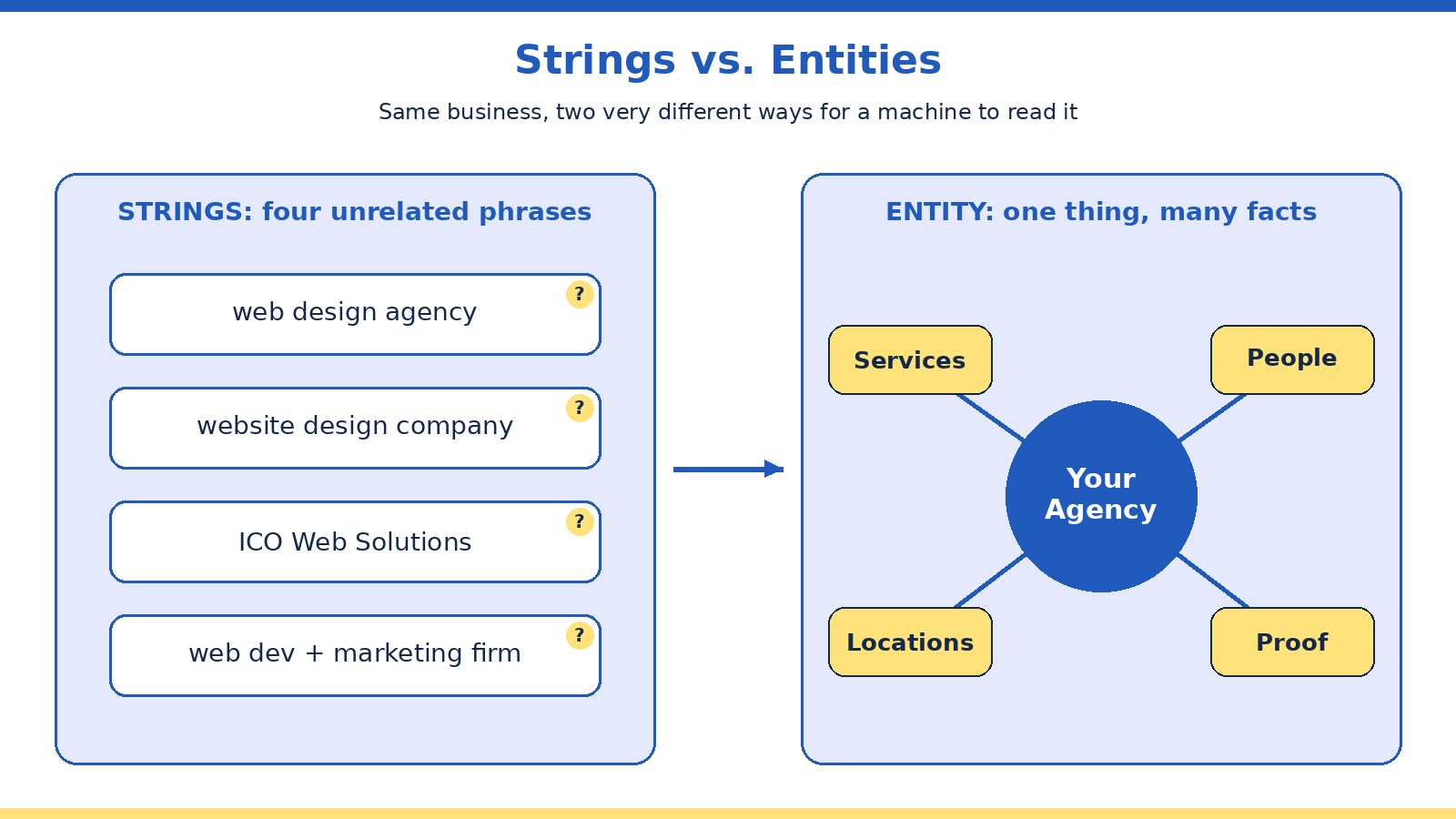
Strings, by contrast, are just text. “Web design agency,” “website design company,” and your brand name look like three unrelated phrases to a system that has no way of knowing they describe the same business. Humans resolve that ambiguity instantly, but software has to be told, and it’s told through consistent naming, clear definitions, and connections between pages and facts. The diagram below shows the difference at a glance.
Google has been moving in this direction for a long time, and its own documentation says that structured data helps its systems understand a page’s content and make it eligible for richer search features (Google Search Central, n.d.-b). The same documentation points out that Google can make general use of the sameAs property, which exists specifically to say “this thing is the same as that thing over there.” That single property captures the whole idea of entity optimization: you’re helping machines recognize that the dozen places your business appears are all one business.
How a RAG engine actually reads your website
Most RAG systems start by splitting content into chunks, converting those chunks into numerical representations, and retrieving the ones that sit closest to the question. That works well for simple lookups and struggles in a very specific way. Microsoft Research described it as an inability to “connect the dots,” meaning that when an answer requires linking several pieces of information through shared attributes, plain vector retrieval tends to miss the links (Larson & Truitt, 2024). It also has trouble summarizing big-picture themes across a large body of content, which is exactly what a buyer wants when asking which provider is the best fit.
Microsoft’s answer was GraphRAG, which uses a language model to extract entities and relationships from text, organizes them into a graph, and writes summaries of each cluster of related nodes in advance. Against naive RAG, it won roughly 70% to 80% of head-to-head comparisons on the comprehensiveness and diversity of answers (Edge et al., 2024). Just as important for trust, every claim in a graph-based answer can be traced to its source text, so a person can audit the response against the original (Larson & Truitt, 2024). That provenance is exactly the quality that makes an engine comfortable citing a source.
It’s worth being honest about what this evidence does and doesn’t show. Those studies measured private and enterprise datasets rather than the open web, the Microsoft team notes that a graph approach only pays off when its benefits outweigh the upfront indexing cost (Edge et al., 2024), and nobody outside the major AI companies can see exactly how ChatGPT or Perplexity choose their sources. What we can say is that the principle holds across every system studied: clear entities, explicit relationships, and traceable facts produce better answers, so a business that supplies them makes every retrieval system’s job easier.
The part most agencies won’t say out loud
Here is the point of view this article is built on, and it may ruffle a few feathers: the page is no longer the unit of SEO; the fact is. For years, agencies (ours included, at times) have organized work around pages, with one keyword per page and one page per intent. That structure made sense when engines ranked pages. But a RAG system doesn’t rank your page so much as it lifts a passage out of it, and a passage is only as good as the facts it contains and the consistency of those facts with everything else you’ve published.
That leads to an uncomfortable and, I’d argue, accurate conclusion about content volume. A site with 400 posts that describe the same service in slightly different ways, quote three different founding years, and list two sets of pricing tiers looks like a pile of contradictions to a retrieval system. In some cases a leaner site with one authoritative answer per question will outperform a larger one that argues with itself.
The second uncomfortable point concerns schema markup. Many vendors sell structured data as the master key to AI visibility, but Google’s own guidance says there’s no special schema.org markup you need to add for AI Overviews or AI Mode, and that structured data should match the visible text on the page (Google Search Central, 2025). Schema is a label, and a label is only useful when there’s something true and well-organized inside the box. The graph is the real asset: the decisions about what your entities are, what is canonically true about each one, and how they connect. Markup is simply one way of expressing that work to machines. Google’s newer guide to generative AI features says much the same about priorities: creating content people find unique, compelling, and useful will likely shape your presence in AI search more in the long run than any other tactic it lists (Google Search Central, n.d.-a).
The Canon-to-Chunk framework
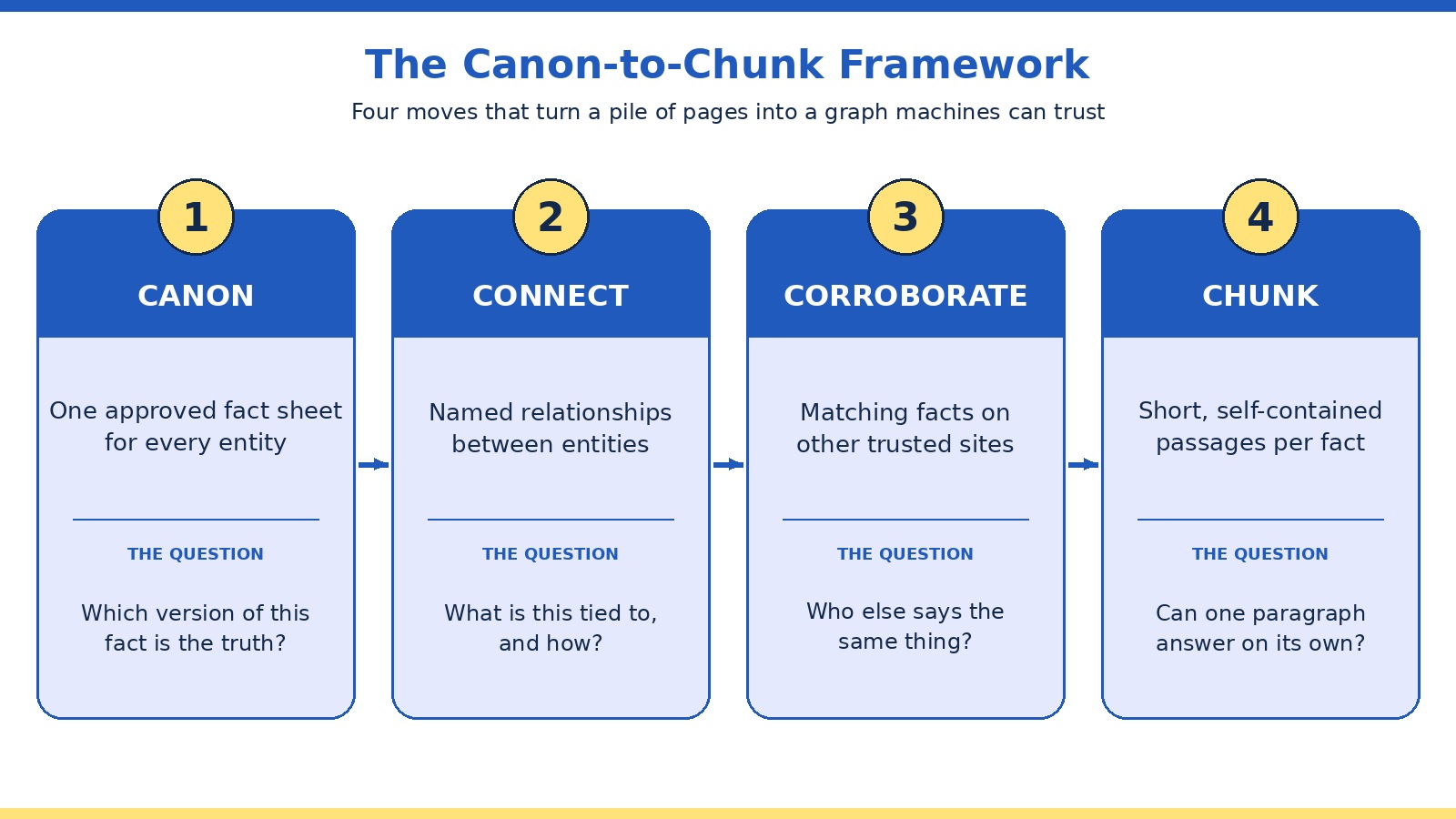
To make that discipline repeatable, we use a four-step model we call Canon-to-Chunk. Each step answers one question a retrieval system is implicitly asking about your business, and together they turn scattered content into a graph. The diagram summarizes the model, and the sections that follow walk through each step in practical terms.
Step 1: Canon, one approved fact sheet per entity
A canon is the single, approved description of an entity that everything else must agree with. For your company, it includes the legal and brand names, a one-sentence definition, the founding year, the location, the leadership, the services, and the claims you’re prepared to stand behind. For each service, it includes what the service is, who it’s for, what’s included, how long it typically takes, and how it’s priced or scoped. The goal is that anyone writing a blog post, a landing page, or a sales email can answer a factual question about your business by looking in one place.
Start with a simple spreadsheet before you touch any technology, because the hardest part of this work is organizational. Most teams discover they’ve been describing the same service three different ways, and resolving those differences is where the value comes from. Then give each entity a permanent home, usually a dedicated page URL, so other pages can point to it reliably.
- List your core entities: organization, services, people, locations, industries served, and flagship case studies.
- Write one definition sentence for each, in the plain language a customer would use.
- Record the facts that must never conflict, such as names, dates, numbers, and offerings.
- Assign one owner who approves changes, so the canon stays trustworthy.
Step 2: Connect, name the relationships
Entities become a graph when you describe how they relate. A service page should link to the case studies that prove it, the people who deliver it, and the industries it serves, and it should do so with context rather than a generic “learn more.” The sentence “Our technical SEO audit, led by our search team, helped a regional retailer recover its product-page visibility” contains three entities and two relationships, and it reads naturally to a human at the same time.
Internal linking is the most underrated tool here, because every descriptive link between entities draws an edge in your graph. A few habits make those edges count:
- Use descriptive anchor text such as “technical SEO audit” instead of “click here.”
- Keep the same anchor wording for the same entity across the site.
- Build a hub page for each major entity that defines it and points outward to every related page.
- Link service pages to the case studies, people, and industries that support them.
Step 3: Corroborate, let the rest of the web agree with you
An entity you describe only on your own site is a claim, and an entity that trusted outside sources describe the same way is closer to a fact. Corroboration means your name, description, address, leadership, and services match across your Google Business Profile, LinkedIn page, industry directories, press mentions, partner pages, and review platforms. Google’s guidance on making your content eligible for AI features still centers on helpful, reliable, people-first content and on technical basics like crawlability and good internal links (Google Search Central, 2025), and corroboration is the off-site extension of that same reliability.
Agreement across independent sources is one of the most convincing signals a retrieval system can find, and a focused company can achieve it faster than a sprawling enterprise. Here is where to start:
- Add
sameAslinks in your organization markup that point to your official profiles. - Keep every profile’s description close to your canon wording.
- Match your name, address, and phone details exactly across directories and review sites.
- Pursue a few relevant third-party mentions that describe your services the way you do.
Step 4: Chunk, write passages that can stand alone
Retrieval systems lift passages, so the final step is to write in a way that survives being lifted. A good chunk answers one question completely in a short block of text, names its subject explicitly instead of saying “it” or “this approach,” and includes the specific detail that makes it useful, such as a number, a timeframe, or a condition. If a paragraph only makes sense after reading the three paragraphs above it, a retrieval system may grab it without the context it needs and misrepresent you.
- Lead each section with a direct answer, then add the nuance.
- Name the entity in the paragraph instead of relying on a pronoun.
- Include one verifiable detail per passage, such as a figure, date, or named example.
- Keep structured data consistent with what visitors can actually see on the page.
Build your internal knowledge graph
The phrase “internal knowledge graph” can mean two useful things, and a strong strategy uses both. The first is the public-facing layer, the entity model your website expresses through pages, links, and markup. The second is a private graph that connects your own documents, case studies, proposals, and support content so that an assistant on your site, or a tool your sales team uses, can answer questions accurately. The research supports the second use directly: data.world’s team later showed that adding an ontology check and an automatic repair step pushed accuracy to 72.55% on the same benchmark (Allemang & Sequeda, 2024), which suggests that the more explicit your definitions are, the better the answers get.
You don’t need a graph database to begin. A spreadsheet with three tabs (entities, attributes, and relationships) is a legitimate first version, and it will teach you more about your business than any tool. When you’re ready to go further, WordPress can store entities as custom post types, such as Services, People, and Case Studies, with fields for each attribute and relationship, and open-source projects like Microsoft’s GraphRAG can index your content for a private assistant, though the indexing cost is a real consideration (Edge et al., 2024).
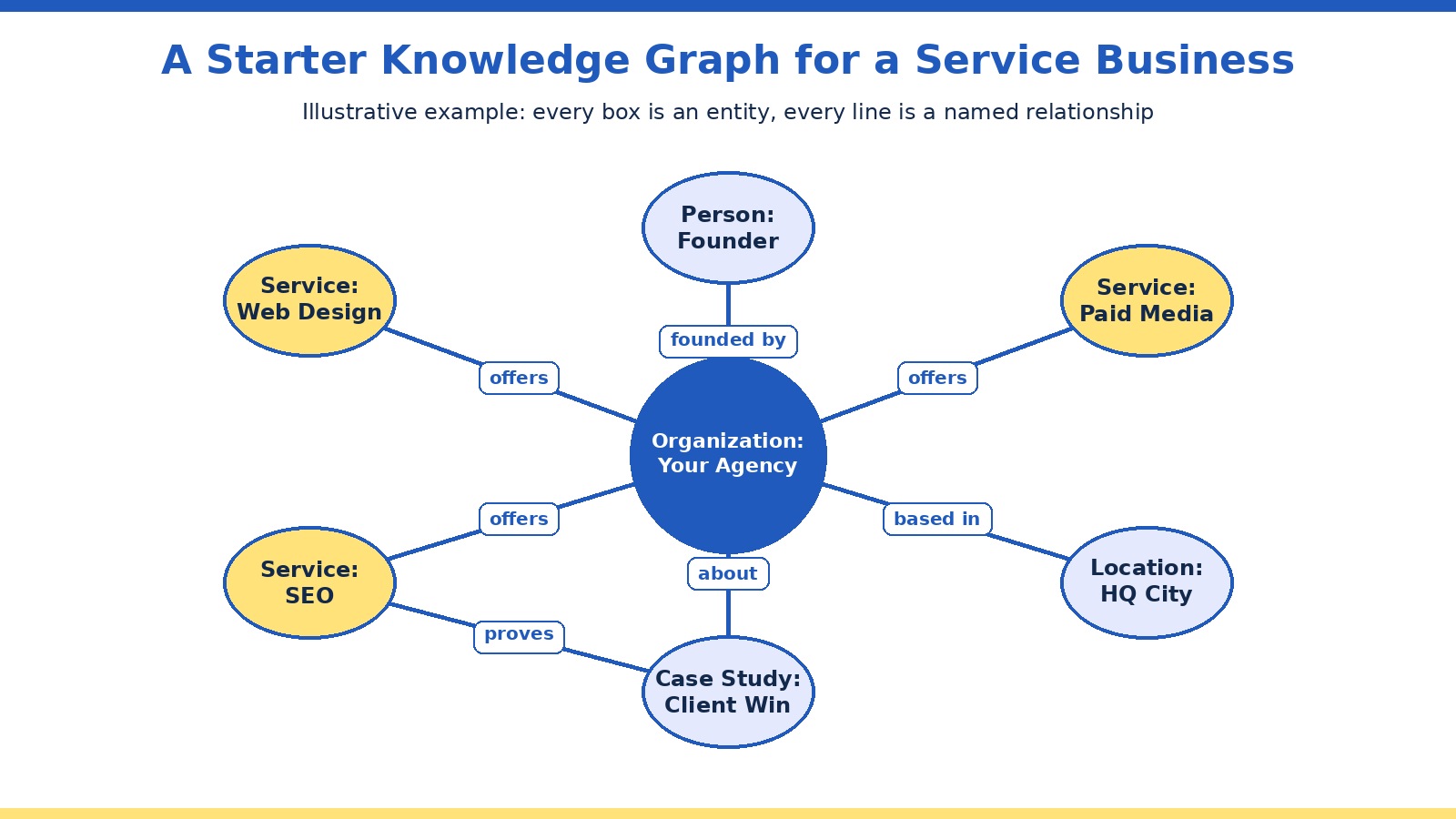
When you express the public layer in code, JSON-LD is a popular format for it, and it can live in the head of your page without changing what visitors see. The example below shows the heart of an organization entity, with a stable identifier, official profiles, and the topics the company is genuinely expert in. Treat it as a template: replace every placeholder with your canonical facts, and make sure every claim in the markup also appears in visible text on the page, which is a requirement Google spells out in its structured data guidelines (Google Search Central, n.d.-b).
<script type="application/ld+json">
{
  "@context": "https://schema.org",
  "@type": "Organization",
  "@id": "https://yourdomain.com/#organization",
  "name": "Your Agency Name",
  "url": "https://yourdomain.com/",
  "description": "One-sentence canonical definition of what you do and for whom.",
  "sameAs": [
    "https://www.linkedin.com/company/your-agency",
    "https://www.facebook.com/youragency"
  ],
  "knowsAbout": ["Website design", "Technical SEO", "Paid media"],
  "founder": { "@type": "Person", "name": "Founder Name" }
}
</script>
The @id value is the quiet hero of that snippet: by referring to it from your service, person, and article markup, you tell machines that every one of those pages belongs to the same entity.
A 90-day plan you can start Monday
Building a graph feels large until you put it on a calendar. The first month is about agreement, the second about structure, and the third about proof, and each phase pays off on its own through cleaner messaging, faster content production, and fewer internal debates about what the company actually offers.
- Days 1–30, Canon: inventory your entities, write the fact sheets, audit existing pages for contradictions, and decide which pages will be the permanent home for each entity.
- Days 31–60, Connect and Chunk: rebuild hub pages, tighten internal links with descriptive anchors, rewrite your top ten commercial pages so each key paragraph stands alone, and add organization, service, and person markup that matches visible text.
- Days 61–90, Corroborate: align every external profile with your canon, pursue a few relevant third-party mentions, publish two case studies built around named entities and measurable results, and run your first round of AI answer testing.
How to tell if it’s working
Entity work doesn’t always show up as a sudden jump in rankings, so it helps to measure the signals that matter in an AI-driven landscape. Google notes that sites appearing in AI features are counted within overall Search Console traffic and that clicks from pages with AI Overviews tend to be higher quality, meaning visitors are more likely to spend meaningful time on the site (Google Search Central, 2025). That’s a useful reminder that the goal isn’t merely to be mentioned; it’s to be mentioned in front of people who are ready to take the next step.
Build a monthly test set of 20 to 30 questions your buyers really ask, such as “Who are the best web design agencies for a growing ecommerce brand?”, and run them through the major AI tools. For each one, track these signals:
- Whether your brand appears at all.
- Whether the description of your business is accurate and consistent.
- Which of your pages, and which outside sources, get cited.
- Branded search growth, direct traffic, and the number and quality of inbound inquiries.
A few common mistakes are worth avoiding as you go, because each one can quietly undo good work:
- Marking up claims in schema that don’t appear anywhere on the visible page.
- Letting old blog posts keep contradicting your current services and pricing.
- Treating the graph as a one-time project instead of a living document with an owner.
- Chasing every AI platform’s rumored ranking factors instead of strengthening the shared fundamentals.
Want a graph built around your business?
The companies that benefit most from this shift are the ones that treat their website as a source of truth rather than a collection of marketing pages, and that mindset is available to any business willing to do the organizing work. If you’d like a partner who can take you from the first fact sheet through the finished site, markup, and measurement, our team at ICO Web Solutions builds exactly this kind of foundation, with the goal of turning better visibility into real conversations with qualified buyers.
Book a free entity and AI-visibility audit
In the audit, we’ll review how AI tools currently describe your business, map your core entities, flag the contradictions costing you trust, and hand you a prioritized plan you can use whether or not we work together.
References
Allemang, D., & Sequeda, J. F. (2024). Increasing the LLM accuracy for question answering: Ontologies to the rescue! arXiv. https://arxiv.org/abs/2405.11706
Edge, D., Trinh, H., Truitt, S., & Larson, J. (2024, July 2). GraphRAG: New tool for complex data discovery now on GitHub. Microsoft Research Blog. https://www.microsoft.com/en-us/research/blog/graphrag-new-tool-for-complex-data-discovery-now-on-github/
Google Search Central. (2025). AI features and your website. Google for Developers. https://developers.google.com/search/docs/appearance/ai-features
Google Search Central. (n.d.-a). Optimizing your website for generative AI features on Google Search. Google for Developers. https://developers.google.com/search/docs/fundamentals/ai-optimization-guide
Google Search Central. (n.d.-b). Introduction to structured data markup in Google Search. Google for Developers. https://developers.google.com/structured-data/
Larson, J., & Truitt, S. (2024, February 13). GraphRAG: Unlocking LLM discovery on narrative private data. Microsoft Research Blog. https://www.microsoft.com/en-us/research/blog/graphrag-unlocking-llm-discovery-on-narrative-private-data/
Lewis, P., Perez, E., Piktus, A., Petroni, F., Karpukhin, V., Goyal, N., Küttler, H., Lewis, M., Yih, W., Rocktäschel, T., Riedel, S., & Kiela, D. (2020). Retrieval-augmented generation for knowledge-intensive NLP tasks. Advances in Neural Information Processing Systems, 33, 9459–9474. https://arxiv.org/abs/2005.11401
Sequeda, J. F., Allemang, D., & Jacob, B. (2023). A benchmark to understand the role of knowledge graphs on large language model’s accuracy for question answering on enterprise SQL databases. arXiv. https://arxiv.org/abs/2311.07509


Related items

A visible consent banner proves only that a banner rendered. It does not prove that the pa

Baymard Institute’s 2026 benchmark found that 52% of desktop sites and 62% of mobile sites

Depending on which 2026 survey you read, somewhere between 34% and 77% of US shoppers have