Google’s fourth spam update of 2026 is live. The pattern across all four says more than the announcement does.
On September 24, Google’s Search Status Dashboard logged the release of the September 2026 spam update. The entry is brief: the update applies globally, covers every language, and may take up to two weeks to finish. Google’s own social post called it a normal spam update, and nothing more was disclosed.
That leaves site owners with the same question they face after every spam update: what changed, and does it affect my site? The announcement cannot answer it. The history of the year can help.
The four spam updates of 2026, at a glance
Update
Started
Rollout time
Google’s stated window
March 2026
March 24
About 19.5 hours
A few days
June 2026
June 24
About 2 days 1 hour
A few days
August 2026
August 18
About 2 days 16 hours
A few days
September 2026
September 24
In progress
Up to two weeks
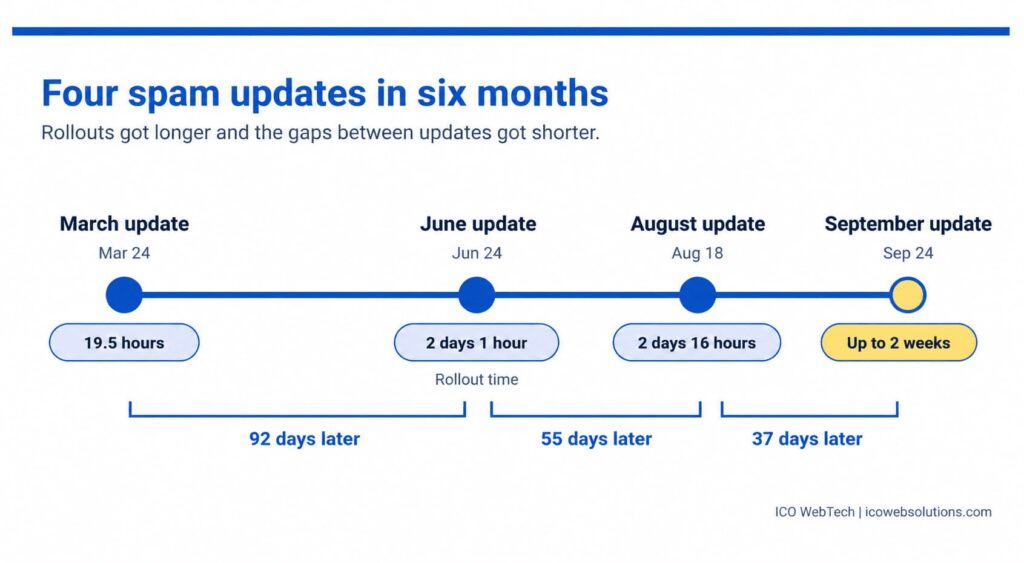
Google’s four 2026 spam updates: rollouts got longer and the gaps got shorter.
Each rollout ran longer than the one before it. March finished in under a day. June took a little over two days, and August took more than two and a half. Google described all three as taking a few days. September is the first to carry a two-week allowance.
What Google has said, and what it hasn’t
Google describes spam updates as improvements to its automated spam-detection systems, including SpamBrain. Sites that violate its spam policies can rank lower or disappear from results. Google’s spam update documentation also says a site that changes course may recover, but only after those systems observe compliance over a period of months.
What Google has not said is more useful to know. The status dashboard entry names no policy, no tactic and no affected share of queries. The last time Google announced new spam categories alongside an update was March 2024, when scaled content abuse, expired domain abuse and site reputation abuse were introduced. None of the 2026 updates came with a policy announcement.
The gaps are shrinking
Counting from the dates above, 92 days passed between the March and June updates. Then 55 days passed before August, and 37 days before September. Momentic’s update tracker notes that 2025 produced a single spam update all year, and 2024 produced three. Four in the first nine months of 2026 is a different rhythm.
The implication is practical. Spam enforcement now arrives roughly every five to eight weeks, so compliance cannot be a once-a-year audit. A site that was clean in March can drift by September: a plugin goes unpatched, a page gets compromised, a link profile fills with paid or automated links. Each update re-tests the site as it stands that day.
A two-week window is a ceiling, not a forecast
Google’s estimate is the maximum time it expects, not a prediction. The earlier three updates finished well inside their few-day windows. Long rollouts do have precedent, though. PPC Land, citing DemandSphere’s tracking, reports that the August 2025 spam update ran for 27 days, from August 26 to September 22.
Counting from September 24, the two-week ceiling falls on October 8. As of September 28, no completion note had appeared on Google’s dashboard. Any ranking movement seen before completion is provisional, because the update is still being applied.
Where spam policy meets website maintenance
Google’s spam policies cover more than content tricks. They also include hacked content, meaning pages placed on a site through security holes, and sneaky redirects. Neglected sites are the easiest to compromise. An unpatched plugin, an unsupported PHP version or a forgotten admin account can let someone inject pages and links the owner never wrote.
Google has not said this update targets hacked sites, so this is about exposure, not diagnosis. But the exposure is real, and it is a maintenance problem. ICO WebTech’s post on PHP version debt explains how old code leaves sites unprotected, and the post on how maintenance decides whether AI search can use your website covers the same neglect from the visibility side. A website maintenance company in Delhi that monitors for injected content and unexpected redirects is doing spam-policy work, whether or not it uses that label.
What site owners should do during and after a rollout
Compare Search Console performance data against the rollout dates rather than the announcement date, and annotate changes so cause and effect stay separable. Avoid rewriting large parts of the site while the rollout is running, because it muddies the data. If traffic changed, review Google’s spam policies against the affected pages before changing anything.
Three areas deserve a look regardless of movement. First, security: check Search Console’s security issues report and search your own domain for pages you did not create. Second, links: paid, automated or manipulative links are a classic exposure, and toxic backlink removal exists for cleaning up a profile that has accumulated them. Earned links are the safer route, as ICO WebTech’s guide to white-hat link building strategies for 2026 outlines. Third, content: thin pages produced in bulk are the pattern spam systems were built to catch.
The bottom line
The September 2026 spam update tells site owners little on its own. The four updates together tell them plenty: enforcement is more frequent, rollouts are getting longer, and Google is not naming its targets. The safest position is a site that stays compliant all year, not one that reacts to each announcement.
Search engine optimization is entering a new era of transparency. Google has officially launched dedicated AI visibility reports within Google Search Console, alongside new AI blocking controls—marking the most significant shift in search analytics since the advent of mobile tracking.
For over a year, webmasters, publishers, and SEO professionals have operated in the dark. Content surfaced inside Google’s AI Overviews and AI Mode was completely bundled into traditional organic search metrics. There was no clear way to separate standard “blue link” traffic from AI-driven citations.
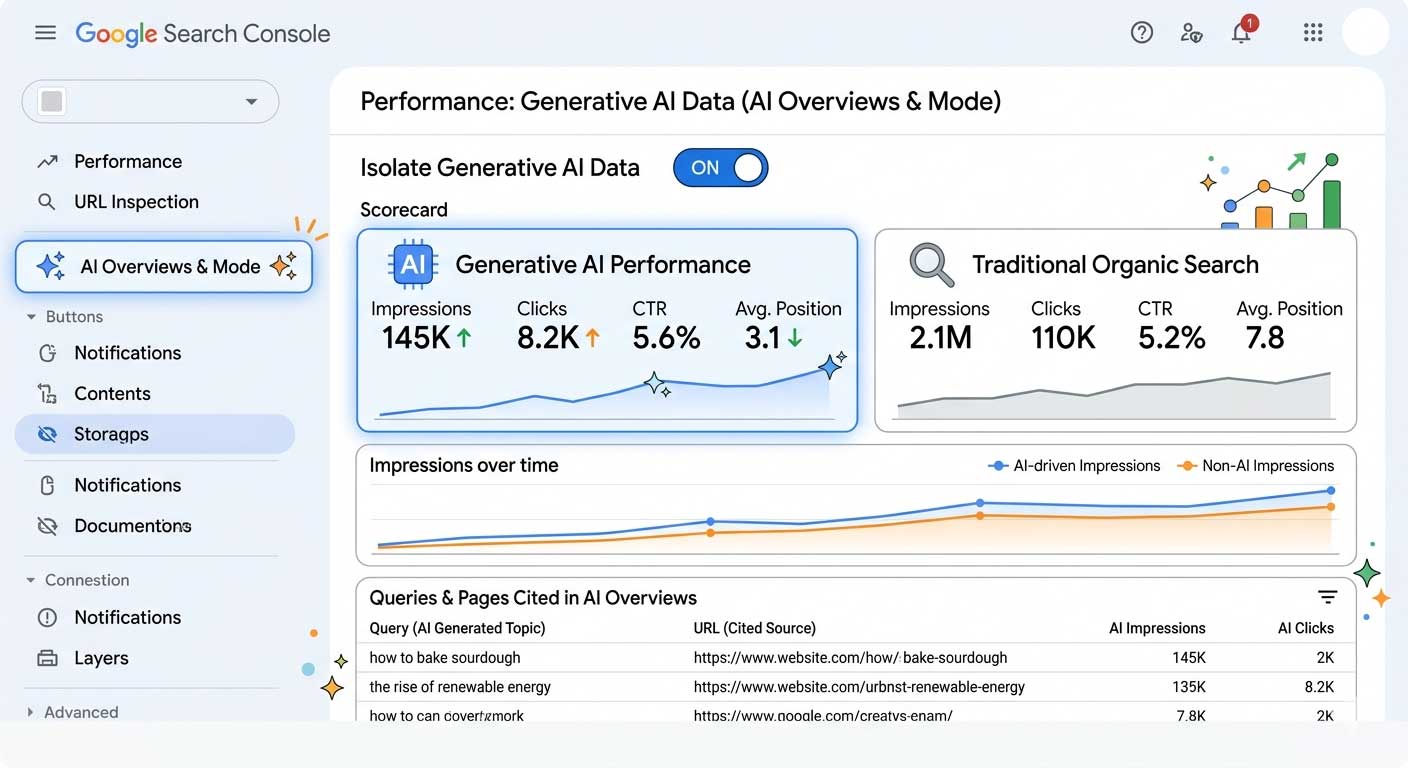
This data blackout ends today. The new Search Generative AI performance report introduces a standalone measurement layer, giving creators clear insights into exactly how Google’s AI models choose, display, and interact with their content.
Google’s new Search Console dashboard isolates generative AI metrics from traditional organic data.
Inside the AI Visibility Report: What Metrics Are Tracked?
The new dashboard isolates exposure data across AI-powered search environments, including Google Search and Google Discover. In its launch state, the report focuses heavily on top-of-funnel exposure. While query-level keywords and click data are noticeably absent, webmasters can analyze performance using a structured set of metrics and dimensions:
Metric / Dimension
Granular Data Tracked
Impressions
Tracks how often URLs from your domain are cited as foundational sources or “grounding data” within generative AI elements.
Pages
Identifies the exact URLs selected by Google’s algorithms to back up AI-generated responses.
Countries
Provides a geographical breakdown to trace where your AI presence is strongest globally.
Devices
Categorizes exposure by Mobile, Desktop, and Tablet to pinpoint user environments.
Dates
Offers historical timeline trends, with precision data available down to the hour.
Data Schema: Currently available metrics inside the Google Search Generative AI performance report.
Addressing the lack of click data, Google clarified that the initial release is optimized for visibility tracking. However, the company plans to introduce deeper engagement metrics, including user clicks, in upcoming iterations based on direct publisher feedback.
The AI Opt-Out Switch: Granular Control for Site Owners
Simultaneously, Google is introducing a major infrastructure update: a dedicated Search Generative AI control toggle directly inside Search Console settings.
This feature functions as a master kill-switch for AI inclusion. Flipping the toggle completely blocks Google’s large language models from sourcing, summarizing, or citing your content within live generative features like AI Overviews.
“Opting out of Search Generative AI features will have zero impact on your traditional organic search rankings.”
— Official Google Documentation Summary
Crucially, Google confirmed that choosing to opt out will not harm your traditional organic SEO rankings. If you turn off AI accessibility, your pages will still rank normally in the standard “blue link” organic results. However, your site will immediately stop receiving any impressions or downstream referral traffic generated by Google’s AI interface.
Why Now? Regulatory Pressures Force Google’s Hand
This structural change wasn’t purely an internal product upgrade; it was driven by global regulators. The rollout stems from a direct mandate by the UK’s Competition and Markets Authority (CMA). Regulators have increasingly pushed for tech giants to give publishers explicit, granular choices regarding how their intellectual property is handled for AI fine-tuning and real-time summaries.
Due to the targeted nature of this regulatory framework, Google is testing both the report and the opt-out toggle with a limited subset of UK website owners first. This localized rollout gives Google time to monitor publisher response, optimize data processing, and iron out bugs before deploying the features to a broader global audience.
Strategic Takeaways: How SEOs Should Adapt
The introduction of separate AI analytics demands a shift in content strategy. The industry is rapidly moving from purely optimizing for traditional CTR (Click-Through Rate) to optimizing for LLM Grounding Authority.
For creators and brands, a high volume of AI impressions combined with low baseline clicks should no longer be viewed as a failure. Instead, it indicates that Google’s models view your domain as a primary source of truth. The strategy must adapt: treat highly-cited informational pages as top-of-funnel conversion mechanisms. By strategically inserting high-value internal links and distinct call-to-actions (CTAs) within those heavily-cited informational hubs, you can capitalize on the visibility, routing that authority directly into your conversion funnels.
New offering combines GEO, AEO, and AI SEO to help brands appear in ChatGPT, Gemini, Perplexity, and Google AI Overviews — where modern purchase decisions increasingly begin.
NEW DELHI, India — ICO WebTech, today announced the launch of its AI Visibility (GEO) services, a structured offering designed to help businesses improve how they appear in AI-generated search results and recommendations.
As AI platforms such as ChatGPT, Google Gemini, Perplexity, Claude, and Google AI Overviews become central to how users discover and evaluate businesses, traditional search rankings alone are no longer sufficient. ICO WebTech’s new service addresses this shift by helping brands align their digital presence with how AI systems interpret, evaluate, and recommend information.
“The way people search and discover businesses has fundamentally changed. AI systems are now answering questions, making recommendations, and shaping decisions, often before a user ever visits a website. Businesses that are not optimised for AI-generated search are losing visibility at the most critical points of the buyer journey. Our AI Visibility services are built to close that gap.”
— Pratibha Sharma, Marketing Manager
What the AI visibility (GEO) service includes
The new offering combines multiple disciplines to improve a brand’s presence across AI-driven search environments:
Generative Engine Optimization (GEO) — optimising content and authority signals to appear in AI-generated answers across major platforms
Answer Engine Optimization (AEO) — structuring content for featured snippets, direct answers, and voice search
Conversational Content Strategy — aligning content with how users naturally ask questions in AI-powered search
Entity and Brand Structuring — ensuring AI systems accurately understand and represent a business across digital channels
Authority and Citation Building — strengthening brand presence across trusted external platforms and publications
Technical AI SEO Implementation — schema markup, structured data, and semantic HTML optimisation
AI Visibility Audits — assessing how a business currently appears across AI-generated search environments
AI Visibility Tracking and Reporting — monitoring brand frequency, positioning, and competitive presence in AI responses
Why AI visibility matters now
Rather than browsing multiple websites, users increasingly rely on AI platforms to generate summarised answers, comparisons, and recommendations. Visibility in these responses depends on content structure, entity clarity, authority signals, and cross-platform consistency — factors that traditional SEO alone does not address.
ICO WebTech’s approach treats AI visibility as a distinct and measurable discipline, with dedicated processes for auditing current AI presence, building a strategy, implementing optimisations, and tracking outcomes over time.
Who the service is designed for
The AI Visibility (GEO) service is available to enterprises, B2B organisations, SaaS companies, and growing businesses across industries. It is designed to complement existing SEO and digital marketing efforts, supporting broader discoverability in both traditional and AI-driven search environments.
ICO WebTech is a Delhi-based digital agency founded in 2011, serving clients across 15 countries with a 98% success rate. With over 2,500 projects delivered, the agency offers a full suite of services, including website design and development, SEO, content marketing, paid advertising, and now AI Visibility (GEO) optimisation. ICO WebTech works with enterprises, SMBs, and startups to build scalable, high-performing digital presences.
As artificial intelligence (AI) continues to advance, one of the burning questions in the tech industry is whether generative AI will eventually replace front-end developers. Generative AI, encompassing tools and algorithms designed to autonomously create content—ranging from text and images to code—has been making significant strides.
Prominent examples include OpenAI’s Codex, GitHub Copilot, and DeepMind’s AlphaCode, which are transforming the way code is generated and managed. However, the core issue remains whether these advancements will fully substitute the human element in front-end development or merely serve as enhancements to existing workflows.
In this detailed analysis, we will delve into the state of generative AI in web development, assess its potential to replace human developers, and explore how it might reshape the role of front-end developers in the future.
1. What is Generative AI in Web Development?
Generative AI refers to technologies that can produce new content or perform tasks that traditionally required human intelligence. In the context of web development, this involves:
Code Generators: These AI tools can generate front-end code, including HTML, CSS, JavaScript, and frameworks like React. For example, GitHub Copilot offers code suggestions and completions as developers work, while Tabnine predicts and suggests code snippets.
Design Generators: AI-driven design tools can create visual elements based on specified criteria. Tools such as Uizard and Figma’s Auto Layout leverage AI to automate layout adjustments and generate design components.
AI-Powered Prototyping Tools: Platforms like Figma and Sketch are incorporating AI to expedite prototype creation. These tools can quickly convert wireframes into interactive designs and even suggest design improvements.
These AI systems are becoming increasingly sophisticated, helping developers complete tasks more rapidly. However, they still require human oversight to ensure the quality and applicability of the generated code or designs.
2. How Generative AI is Currently Impacting Front-End Development
2.1. Automation of Repetitive Tasks
Generative AI significantly impacts the automation of repetitive coding tasks. AI tools can handle:
Boilerplate Code: AI can automatically generate standard code patterns, reducing the time developers spend on repetitive coding.
HTML and CSS Layouts: AI tools can quickly generate and suggest layout structures based on predefined templates.
Testing Scripts: AI can automate the creation of test cases and scripts, streamlining the testing phase.
Tools like GitHub Copilot and Tabnine are examples of how AI is reducing the time spent on routine coding tasks. By automating these repetitive elements, developers can redirect their focus toward more complex aspects of their projects.
2.2. UI/UX Design Assistance
AI tools are making strides in assisting with UI/UX design:
Responsive Design: AI tools like Figma’s Auto Layout can automatically adjust layouts to ensure responsiveness across different devices.
Design Generation: Tools such as Uizard generate design elements from wireframes, facilitating quicker transitions from concept to prototype.
User Testing: AI can analyze user interactions and provide data-driven recommendations for design improvements. For instance, it can identify usability issues and suggest changes to enhance user experience.
AI’s role in UI/UX design is to provide rapid, data-driven insights and generate design elements, though human input remains crucial for tailoring these suggestions to specific user needs and business objectives.
2.3. Error Detection and Debugging
Generative AI is proving useful in identifying and addressing issues in code:
Vulnerability Analysis: Tools like DeepCode and Snyk use AI to detect security vulnerabilities and syntax errors, helping developers address issues before they become problematic.
Performance Optimization: AI tools can identify performance bottlenecks and suggest optimizations, such as improving load times and reducing code redundancy.
By leveraging AI for error detection and debugging, developers can enhance the stability and security of their applications, although human expertise is still necessary to interpret and act on AI recommendations effectively.
3. Will Generative AI Replace Front-End Developers?
Despite the advancements in AI, it is unlikely to fully replace front-end developers in the foreseeable future. Several factors contribute to this conclusion:
3.1. Human Creativity and Problem-Solving
Front-end development involves more than just coding; it requires creativity and problem-solving skills to create engaging user experiences. AI can assist with generating code, but it struggles with the nuanced aspects of design and user experience. Developers need to:
Innovate: Tailor designs and functionalities to specific brand identities and user needs.
Solve Complex Problems: Address unique challenges that arise in interactive and dynamic content.
AI tools can provide suggestions, but human creativity is essential for making strategic decisions that align with business goals and user expectations.
3.2. The Need for Contextual Understanding
AI operates based on patterns and historical data, lacking the deep contextual understanding of human developers. For instance:
Custom Solutions: Developing customized features or addressing specific client requirements often involves understanding context beyond what AI can infer.
Collaborative Efforts: Developers frequently work with other departments to align web solutions with organizational objectives, a process that involves strategic thinking and negotiation.
Human developers bring contextual insights and strategic thinking that AI tools cannot fully replicate.
3.3. Complex Interactions and Customization
While AI excels at generating standard code and layouts, front-end development often requires:
Deep Customization: Crafting complex interactions and features that go beyond basic templates.
Unique Logic: Implementing custom logic for functionalities like discounts or tax calculations in e-commerce sites.
AI-generated solutions may provide a starting point, but human developers are essential for ensuring that these solutions meet specific and intricate requirements.
3.4. Maintaining Code Quality
AI-generated code might perform well initially, but maintaining long-term quality poses challenges:
Best Practices: Experienced developers follow best practices for writing clean, maintainable, and scalable code.
Documentation: Human oversight ensures that code is well-documented and organized for future maintenance.
AI tools may assist with code generation, but human developers are crucial for upholding code quality and maintainability.
3.5. Ethical and Accessibility Considerations
AI tools are not yet capable of fully addressing ethical and accessibility concerns:
Web Accessibility: Ensuring compliance with WCAG (Web Content Accessibility Guidelines) and making websites inclusive for all users requires a nuanced understanding that AI lacks.
Ethical Design: Human developers must make decisions that consider user privacy, ethical design practices, and avoid dark patterns.
AI can assist with technical aspects, but ethical considerations and accessibility require human judgment and empathy.
4. How AI Will Augment Front-End Developer Workflows
Rather than replacing front-end developers, AI is likely to enhance their workflows:
4.1. Automating Repetitive and Mundane Tasks
AI’s ability to handle repetitive tasks such as code generation and template creation will allow developers to focus on more critical and creative work. By automating these aspects, AI tools can improve efficiency and productivity.
4.2. Speeding Up Prototyping and Design
AI-powered design tools can accelerate the prototyping process, generating initial designs quickly and allowing developers to refine them. This can be particularly beneficial for smaller teams or startups with limited resources.
4.3. Code Optimization and Performance Tuning
AI can assist in optimizing code and improving performance. Tools like Tabnine and DeepCode can analyze codebases and suggest improvements, helping developers create more efficient and secure applications.
4.4. Collaborative Development
The future of development will likely involve a collaborative approach, where AI tools work alongside human developers. AI can assist with code reviews, testing, and suggestions, leading to faster development cycles and higher-quality solutions.
5. The Future of Web Development: Human-AI Collaboration
The future of web development is not one of replacement but of collaboration between humans and AI. As AI tools become more advanced, they will empower developers to be more productive and innovative.
However, the unique qualities of human creativity, empathy, and strategic thinking will remain essential.
5.1. AI as a Co-Pilot, Not a Replacement
As AI continues to evolve, its role in web development will increasingly resemble that of a co-pilot rather than a replacement for front-end developers.
AI tools will handle routine and repetitive tasks, allowing developers to focus on creative and strategic aspects of their projects. The integration of AI into development environments will enhance productivity, improve code quality, and expedite workflows.
AI’s Role in Collaboration: AI can provide real-time code suggestions, identify potential issues, and automate testing processes. For example, an AI tool might analyze a codebase for potential vulnerabilities and suggest fixes, while developers make final decisions based on context and specific project needs.
This collaborative approach will enable developers to leverage AI’s strengths in data processing and pattern recognition while applying their unique human insights and problem-solving skills.
Expanding Capabilities: AI will also expand the capabilities of front-end developers by providing tools that were previously inaccessible or impractical.
For instance, advanced AI-driven design tools can generate complex layouts and interactive elements that might be time-consuming to create manually. Developers can use these tools to quickly prototype ideas and iterate based on user feedback.
Human Creativity and AI Efficiency: The combination of human creativity and AI efficiency will lead to more innovative and user-centric web solutions.
Developers will use AI to handle mundane tasks, freeing up time to experiment with new design concepts, explore novel user interactions, and craft unique digital experiences that resonate with users on a deeper level.
6. Preparing for the Future: Adapting to AI Integration
To thrive in a future where AI is an integral part of the development process, front-end developers will need to adapt and embrace new skills. Here are some ways to prepare:
6.1. Embrace Continuous Learning
As AI technology evolves, developers must stay updated with the latest tools and advancements. Continuous learning and professional development will be crucial for understanding how to effectively integrate AI into development workflows.
Engaging with online courses, webinars, and industry conferences will help developers stay current and leverage AI technologies to their advantage.
6.2. Focus on Soft Skills and Creativity
While AI can handle many technical aspects, the demand for soft skills such as communication, creativity, and critical thinking will remain high.
Web Developers should focus on honing these skills, as they are essential for collaborating with teams, understanding user needs, and creating innovative solutions. Creativity will be particularly valuable for web designing engaging and user-friendly interfaces that stand out in a crowded digital landscape.
6.3. Develop a Hybrid Skill Set
Front-end developers should aim to build a hybrid skill set that includes both technical proficiency and an understanding of AI tools.
This includes learning how to use AI-driven design and development tools effectively, as well as understanding the limitations and potential of AI. A well-rounded skill set will enable developers to work seamlessly with AI tools and harness their full potential.
6.4. Advocate for Ethical and Inclusive Design
As AI becomes more integrated into web development, developers will play a crucial role in ensuring that ethical and inclusive design principles are upheld.
This includes addressing accessibility concerns, avoiding biases in AI-generated content, and prioritizing user privacy. Developers should advocate for best practices in ethical design and work to create inclusive digital experiences for all users.
7. Conclusion
Generative AI is set to transform the landscape of front-end development, offering tools that enhance efficiency, automate routine tasks, and streamline workflows.
However, while AI will play a significant role in augmenting developer capabilities, it is unlikely to fully replace front-end developers. The unique qualities of human creativity, problem-solving, and contextual understanding remain indispensable in crafting exceptional web experiences.
The future of web development lies in the collaboration between humans and AI. By leveraging AI tools as co-pilots, developers can focus on creative and strategic aspects of their work, while AI handles repetitive and routine tasks. This synergy will lead to more innovative, user-centric, and high-quality web solutions.
As AI continues to advance, front-end developers must adapt by embracing continuous learning, focusing on soft skills, and developing a hybrid skill set.
By doing so, they will be well-equipped to navigate the evolving landscape of web development and contribute to a future where human and AI collaboration drives innovation and excellence in digital experiences.
There is a direct correlation between good design and business growth.Therefore maximum businesses of the world are shifting towards a good website designing company. The sole reason for this correlation is the increasing number of users turning towards internet for their requirement. Which makes it even more important for businesses to have a web presence.
Be it local website designing or outsourcing web designing projects ICO WebTech is well equipped for both the processes. We have the suitable backup (experience, portfolio, awards, expertise etc) to support the recognition of being one of the top development agencies from around the world.
News on Benzinga about Top Web Development Agencies from around the world
Benzinga is a media organization which reaches more than 20 million people a month. It has headquarters in Detroit and operations team in other parts of the world too.
They shared the list on one of their news update regarding Web Development Agencies Who Can Build A Professional Custom Website.
As a best website design agency we have always believed that website design and development is a responsibility. This is because brands invest their time and money and more importantly a hope to receive more success with a working website. Therefore, we put out best foot forward in designing and developing a website for our clients.
We believe that the beginning should be made right. Which is why we make sure that the brands understand the importance of a website. And have an understanding of its features and functionalities. Thereafter, work with the web development agency to make it happen.
After giving attention to these details a brand can expect users on their website. And also potential sales and conversion with the right SEO efforts.
Contact us for your Web Design and Web Development Requirements
ANPUD stands for Asian Network of People who Use Drugs. It is a foundation instigated in 2008 and registered in 2010 in Honkong working for health and wellness of the people who use drugs.
ICO WebTech partnered with ANPUD in September 2018 for the development of a survey application which collects data and provides a robust analysis in dashboard.
ANPUD recently concluded a regional meeting cum training in Bangkok, Thailand from Oct 9th til Oct 12th 2018.
It was an honor for ICO WebTech to be a part of this meeting.
ICO WebTech was invited to provide a demonstration of a prototype web based software for the survey application and train ANPUD members on how to use the application.
It was fun and learning both by meeting the ANPUD team members from different countries and know about their objectives for this social cause,