Google Spam Updates 2026: Four in Six Months, and the Gaps Keep Shrinking
Google’s fourth spam update of 2026 is live. The pattern across all four says more than the announcement does.
On September 24, Google’s Search Status Dashboard logged the release of the September 2026 spam update. The entry is brief: the update applies globally, covers every language, and may take up to two weeks to finish. Google’s own social post called it a normal spam update, and nothing more was disclosed.
That leaves site owners with the same question they face after every spam update: what changed, and does it affect my site? The announcement cannot answer it. The history of the year can help.
The four spam updates of 2026, at a glance
Update
Started
Rollout time
Google’s stated window
March 2026
March 24
About 19.5 hours
A few days
June 2026
June 24
About 2 days 1 hour
A few days
August 2026
August 18
About 2 days 16 hours
A few days
September 2026
September 24
In progress
Up to two weeks
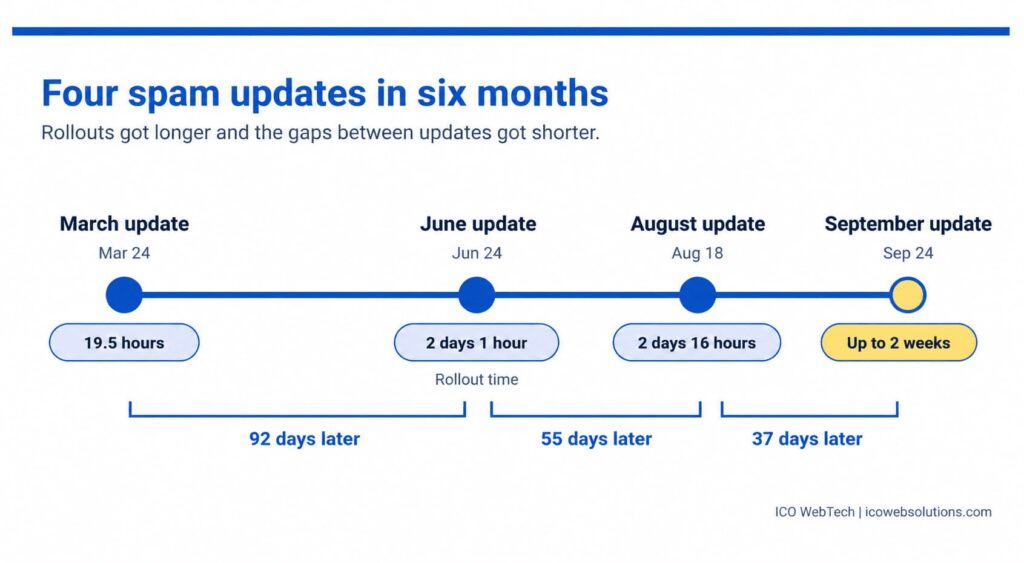
Google’s four 2026 spam updates: rollouts got longer and the gaps got shorter.
Each rollout ran longer than the one before it. March finished in under a day. June took a little over two days, and August took more than two and a half. Google described all three as taking a few days. September is the first to carry a two-week allowance.
What Google has said, and what it hasn’t
Google describes spam updates as improvements to its automated spam-detection systems, including SpamBrain. Sites that violate its spam policies can rank lower or disappear from results. Google’s spam update documentation also says a site that changes course may recover, but only after those systems observe compliance over a period of months.
What Google has not said is more useful to know. The status dashboard entry names no policy, no tactic and no affected share of queries. The last time Google announced new spam categories alongside an update was March 2024, when scaled content abuse, expired domain abuse and site reputation abuse were introduced. None of the 2026 updates came with a policy announcement.
The gaps are shrinking
Counting from the dates above, 92 days passed between the March and June updates. Then 55 days passed before August, and 37 days before September. Momentic’s update tracker notes that 2025 produced a single spam update all year, and 2024 produced three. Four in the first nine months of 2026 is a different rhythm.
The implication is practical. Spam enforcement now arrives roughly every five to eight weeks, so compliance cannot be a once-a-year audit. A site that was clean in March can drift by September: a plugin goes unpatched, a page gets compromised, a link profile fills with paid or automated links. Each update re-tests the site as it stands that day.
A two-week window is a ceiling, not a forecast
Google’s estimate is the maximum time it expects, not a prediction. The earlier three updates finished well inside their few-day windows. Long rollouts do have precedent, though. PPC Land, citing DemandSphere’s tracking, reports that the August 2025 spam update ran for 27 days, from August 26 to September 22.
Counting from September 24, the two-week ceiling falls on October 8. As of September 28, no completion note had appeared on Google’s dashboard. Any ranking movement seen before completion is provisional, because the update is still being applied.
Where spam policy meets website maintenance
Google’s spam policies cover more than content tricks. They also include hacked content, meaning pages placed on a site through security holes, and sneaky redirects. Neglected sites are the easiest to compromise. An unpatched plugin, an unsupported PHP version or a forgotten admin account can let someone inject pages and links the owner never wrote.
Google has not said this update targets hacked sites, so this is about exposure, not diagnosis. But the exposure is real, and it is a maintenance problem. ICO WebTech’s post on PHP version debt explains how old code leaves sites unprotected, and the post on how maintenance decides whether AI search can use your website covers the same neglect from the visibility side. A website maintenance company in Delhi that monitors for injected content and unexpected redirects is doing spam-policy work, whether or not it uses that label.
What site owners should do during and after a rollout
Compare Search Console performance data against the rollout dates rather than the announcement date, and annotate changes so cause and effect stay separable. Avoid rewriting large parts of the site while the rollout is running, because it muddies the data. If traffic changed, review Google’s spam policies against the affected pages before changing anything.
Three areas deserve a look regardless of movement. First, security: check Search Console’s security issues report and search your own domain for pages you did not create. Second, links: paid, automated or manipulative links are a classic exposure, and toxic backlink removal exists for cleaning up a profile that has accumulated them. Earned links are the safer route, as ICO WebTech’s guide to white-hat link building strategies for 2026 outlines. Third, content: thin pages produced in bulk are the pattern spam systems were built to catch.
The bottom line
The September 2026 spam update tells site owners little on its own. The four updates together tell them plenty: enforcement is more frequent, rollouts are getting longer, and Google is not naming its targets. The safest position is a site that stays compliant all year, not one that reacts to each announcement.
Pratibha Sharma is a digital marketing and content strategist at icowebsolutions.com with over 14 years of experience across SEO, content marketing, B2B marketing, and creative strategy. She has worked with technology and digital businesses, helping brands turn complex ideas into clear, engaging content that connects with their audiences. Her interests span search, AI-driven marketing, content strategy, lead generation, and digital growth. Pratibha regularly writes about emerging marketing trends, practical SEO strategies, and the changing relationship between technology and consumer behavior. She believes good marketing is not just about visibility, it’s about creating useful experiences that earn attention, build trust, and drive meaningful results.