By the ICO Web Solutions team | Updated November 26, 2026 | 12-minute read
TL;DR: International buyers usually can’t tour your factory, so they inspect your website instead, and they do it quietly, often before they ever write to you. They ask four questions in order: Is this company real, can it make what I need, is it easy to work with, and is it safe to commit to? Build a site that answers each one with proof, in the buyer’s language, with terms, specs, and a quote button within easy reach, and you’ll attract more serious inquiries. Start with your About page, product pages, and quote form before you touch the homepage design.
In this blog:
- The buyer who never calls
- The Factory Visit Principle
- The Four-Gate Buyer Test
- Speaking their language, then their currency
- Speed, mobile, and other quiet deal-breakers
- The first five seconds: an annotated homepage
- Your 30-day exporter website plan
- How to tell it’s working
- Quick answers
Here’s a number that should change how you think about your website: 67% of B2B buyers say they prefer a rep-free buying experience, which means they’d rather research and decide without talking to a salesperson (Gartner, Inc., 2026). That finding comes from a survey of 646 buyers, and it matches what many exporters see in their inboxes. By the time a serious buyer writes to you, the real evaluation is often finished, because someone in another country has already studied your website, compared it with two or three others, and decided whether you deserve an email.
That’s good news if you treat it that way, because your website is doing the first and most important sales meeting of the whole process, in every time zone at once. A site that answers a stranger’s questions calmly and completely can bring in better inquiries while your team sleeps, while a site that hides the answers, even a beautiful one, quietly sends buyers to the next supplier on their list.
This guide walks through what international buyers look for, in the order they look for it. You’ll get a framework we call the Four-Gate Buyer Test, a plain-English look at language, speed, and trust, an annotated homepage you can copy, and a 30-day plan, along with a few things about exporter websites that agencies don’t always say out loud.
The Buyer Who Never Calls
Gartner analysts reported in 2020 that buyers spend only about 17% of their purchase-journey time meeting with potential suppliers, and projected that 80% of B2B sales interactions between suppliers and buyers would happen in digital channels by 2025 (Gartner, Inc., 2020). Most of a buyer’s thinking, in other words, happens somewhere you can’t see, using the pages they choose to read, and your website is the page they read about you. The 2026 survey adds that 45% of buyers used AI during a recent purchase, and Gartner’s analyst noted that sellers can’t count on static collateral to carry influence while buyers work on their own (Gartner, Inc., 2026). For an exporter, the classic static collateral is the PDF catalog, a file that says the same thing to everyone and answers none of the questions a particular buyer is silently asking.
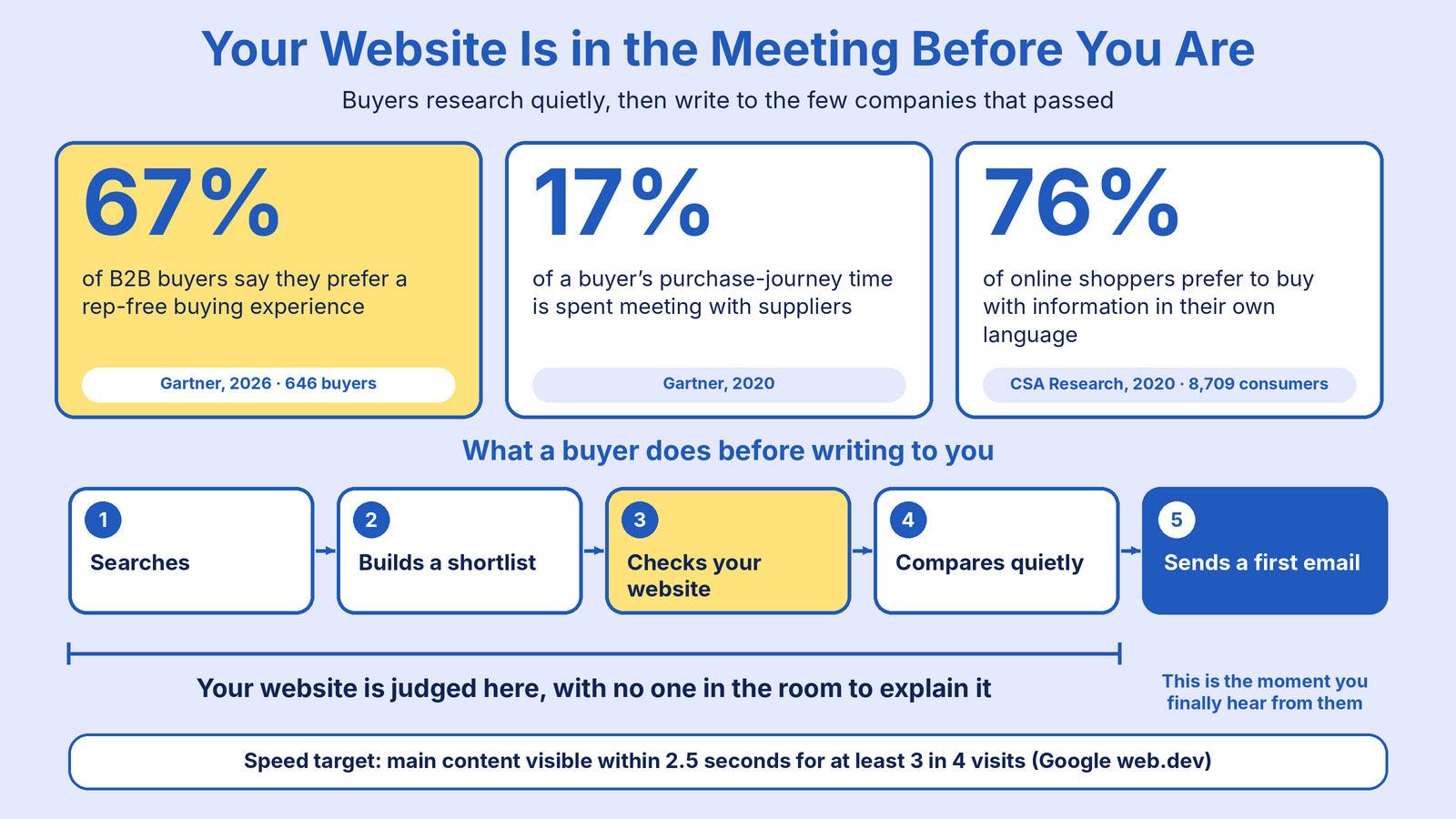
International buyers judge your website before they email you. See the four questions they ask and how to answer each one to win more quote requests.
The takeaway is encouraging. If buyers will evaluate you without you in the room, the quality of that evaluation is something you can design, because every question they have is predictable and every doubt they carry can be answered on a page.
The Factory Visit Principle
Not long ago, a serious importer would fly in, walk your production floor, shake hands with the owner, and ask to see the paperwork. Today most buyers compare too many suppliers in too many countries to visit more than a few, so they hand the job to your website. Whether you intended it or not, your site has become the factory visit.
Here’s the part few agencies say plainly: most exporter websites are designed to make the owner proud, not to make a stranger feel safe. They open with a sweeping hero video and a slogan about world-class quality, and none of it helps a buyer who’s quietly asking whether you’ll ship what you promise. Our view is that a buyer isn’t searching for beauty. They’re collecting reasons to say yes that they can comfortably defend to a boss, a partner, or a bank. That leads to what we call the Factory Visit Principle: your website should answer every question a skeptical visitor would ask if they were standing on your factory floor, in the order they’d ask it. Three uncomfortable truths fall out of that idea:
- A PDF catalog is not a website. It can’t adapt to the reader, it’s usually harder for search engines and translation tools to handle than a regular page, and it makes buyers do extra work to find what they need.
- “Contact us for price” is a cost, not a safeguard. In a Clutch survey of 451 business buyers who had recently hired a service provider or invested in software, transparent cost information ranked first among website elements (25%), ahead of case studies and testimonials (23%) and immediate access to information (17%) (Clutch, 2020).
- Your About page is a sales page. It’s the closest thing to meeting you, and buyers read it with more care than most owners expect.
That survey covered services and software rather than exporters specifically, so treat it as a general B2B signal and not a measurement of your market.
The Four-Gate Buyer Test
Buyers arrive with four worries and check them in a fairly predictable order: Is this company real? Can it make what I need? Is it easy to work with? Is it safe to commit? The diagram below shows what each gate asks, what to show, and what makes buyers hesitate. This is our framework rather than a measured law, built from the research in this article and from how procurement checks tend to work, so use it to organize your site and not as a promise of results.
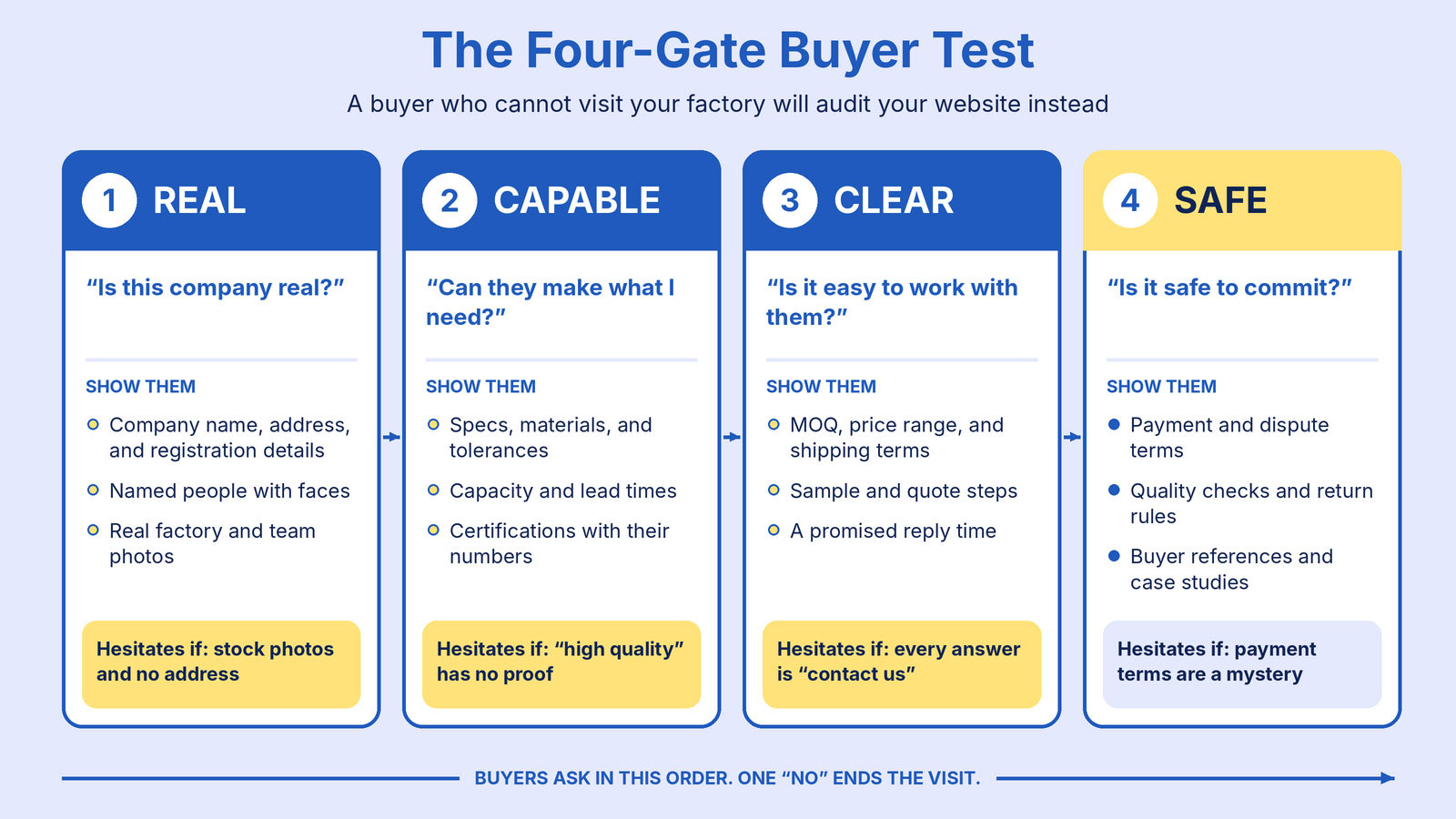
Most exporter sites impress the owner, not the buyer. Check your site against four questions every international buyer asks before sending an RFQ.
Gate 1: Is this company real?
Before a buyer cares about your price, they want to know you exist, and many exporter sites stumble here by hiding the basics: no address, no named people, and photos that look borrowed from a stock library. A buyer thousands of miles away can’t see your building, so every piece of evidence carries extra weight, and your About page is where it all comes together. Tell the story of who started the company and why, name the people a buyer will deal with, and show their faces.
- Show your legal name, registered address, and business registration details in the footer and on the contact page.
- Introduce the people buyers will deal with, with names, roles, and real photos.
- Use your own photos and short videos of the factory, the team, and shipping.
Gate 2: Can they make what I need?
Phrases like “high quality” and “advanced technology” appear on nearly every supplier site, which means they carry almost no information. What buyers can use are specifics: the materials you work with, the tolerances you hold, the volumes you handle, and how long an order takes from confirmation to shipment. Certifications work best when they’re verifiable, so show the standard’s name, the certificate number, the issuing body, and the expiry date, and link to a downloadable copy. A buyer who can confirm your ISO 9001 certificate in two clicks has learned that you’re comfortable being checked.
- Publish specs, materials, tolerances, and capacity on each product page, not just in a download.
- Show certifications with standard names, numbers, issuers, and dates.
- Add two or three short case studies that name the product, the market, and the result.
Gate 3: Is it easy to work with them?
Here many good manufacturers lose buyers they never knew they had. A buyer who’s satisfied you’re real and capable wants to know what working with you looks like, without sending three emails first: your minimum order quantity (MOQ, the smallest batch you’ll produce), a realistic price range, lead times, how samples work, and the shipping terms you offer. Those terms deserve a plain-English explanation, because small misunderstandings turn into big arguments. Incoterms are standard trade terms published by the International Chamber of Commerce that spell out buyer and seller responsibilities in a shipment, and the current edition has eleven rules meant to help businesses avoid uncertainty and costly disputes (International Chamber of Commerce [ICC], n.d.). FOB, CIF, EXW, and DAP are all Incoterms, so listing the ones you normally offer, with a one-line explanation, saves buyers a round of questions.
Then comes the request for quote (RFQ) form, which should ask only for what you need to reply well, such as product, quantity, destination, and timeline, because every extra required field loses a few buyers. Tell them what happens next, then keep that promise, since a fast, specific reply is one of the strongest trust signals a supplier can send.
- Publish your MOQ, typical lead times, and usual shipping terms, each with a one-line explanation.
- Keep the quote form short, and keep a Request a Quote button on every page and screen size.
- Promise a reply time, name who will answer, and send an auto-reply that confirms receipt.
Gate 4: Is it safe to commit?
The final gate is about risk. Even a buyer who loves your product is quietly asking what happens if the goods arrive late, the quality is off, or the two sides disagree about what was promised, and a site that addresses those worries before they’re asked feels dramatically safer. References are the strongest tool here: named customers, short testimonials with real roles and countries, and case studies with concrete outcomes let a buyer borrow confidence from someone who already took the risk. When you can’t name a client, describe them honestly by industry and region, and offer to connect serious buyers with a reference on request.
- Explain your quality checks, third-party inspection options, and what you do when something goes wrong.
- List accepted payment methods, such as bank transfer or letters of credit, and the basic terms.
- Show named testimonials and case studies, or offer references to serious buyers.
Speaking Their Language, Then Their Currency
Language is the quietest deal-breaker in export marketing, partly because the people most affected never complain. They simply leave. CSA Research surveyed 8,709 consumers in 29 countries and found that 76% of online shoppers prefer to buy products with information in their native language, and 40% said they will never buy from websites in other languages (CSA Research, 2020). Those are consumer numbers and business buyers are a different group, so we’d call this a strong signal and not proof, though anyone who has tried to read a technical specification in a second language knows how tiring it can be.
You don’t have to translate everything at once. The U.S. International Trade Administration suggests first internationalizing the site by making it culturally neutral, fast regardless of bandwidth, and structured for translation, then regionalizing with pages aimed at broad world regions, and only then localizing for specific countries, carefully and usually with professional help (International Trade Administration [ITA], n.d.). The UK government’s export guidance adds professional translation when export sales will be significant, plain English without idioms, and units your visitors actually use, and it notes that local domain extensions can help traffic and sales while subdomains are cheaper and easier to manage (business.gov.uk, n.d.). Ask your developer to add language tags to each version, known as hreflang tags, so search engines show the right page to the right buyer, and have a fluent human review product pages, safety information, and contract terms before they go live. Show prices in the currency your buyer plans in, and say whether they’re ex-works or delivered.
Speed, Mobile, and Other Quiet Deal-Breakers
A slow site feels like a slow supplier. Google’s Core Web Vitals give clear targets: the largest piece of content should appear within 2.5 seconds, the page should respond to a tap within 200 milliseconds, and the layout shouldn’t jump around by more than 0.1 on Google’s shift score, measured across at least 75% of visits (McQuade & Pollard, 2025). Because your buyer may be on a slower connection than your developer’s office, the ITA’s advice to build a site that’s fast regardless of bandwidth matters especially for exporters (ITA, n.d.). Oversized photos, autoplaying hero videos, and too many plug-ins cause most of the delay, so compress images, host where your main markets get fast loading, and test from the countries you sell to.
One more deal-breaker deserves a mention: a quote form that doesn’t work. Test yours from another country and another email provider, confirm that submissions reach a real inbox and not spam, and make sure the buyer sees a clear confirmation. Plenty of buyers also check suppliers on their phones between meetings, so make sure product tables and the quote form work on a small screen.
The First Five Seconds: An Annotated Homepage
Everything above comes together on the homepage, which has a surprisingly narrow job. It doesn’t need to tell your whole story. It needs to help a buyer decide in a few seconds that you’re worth a closer look, and to point them to the pages where the four gates are answered.
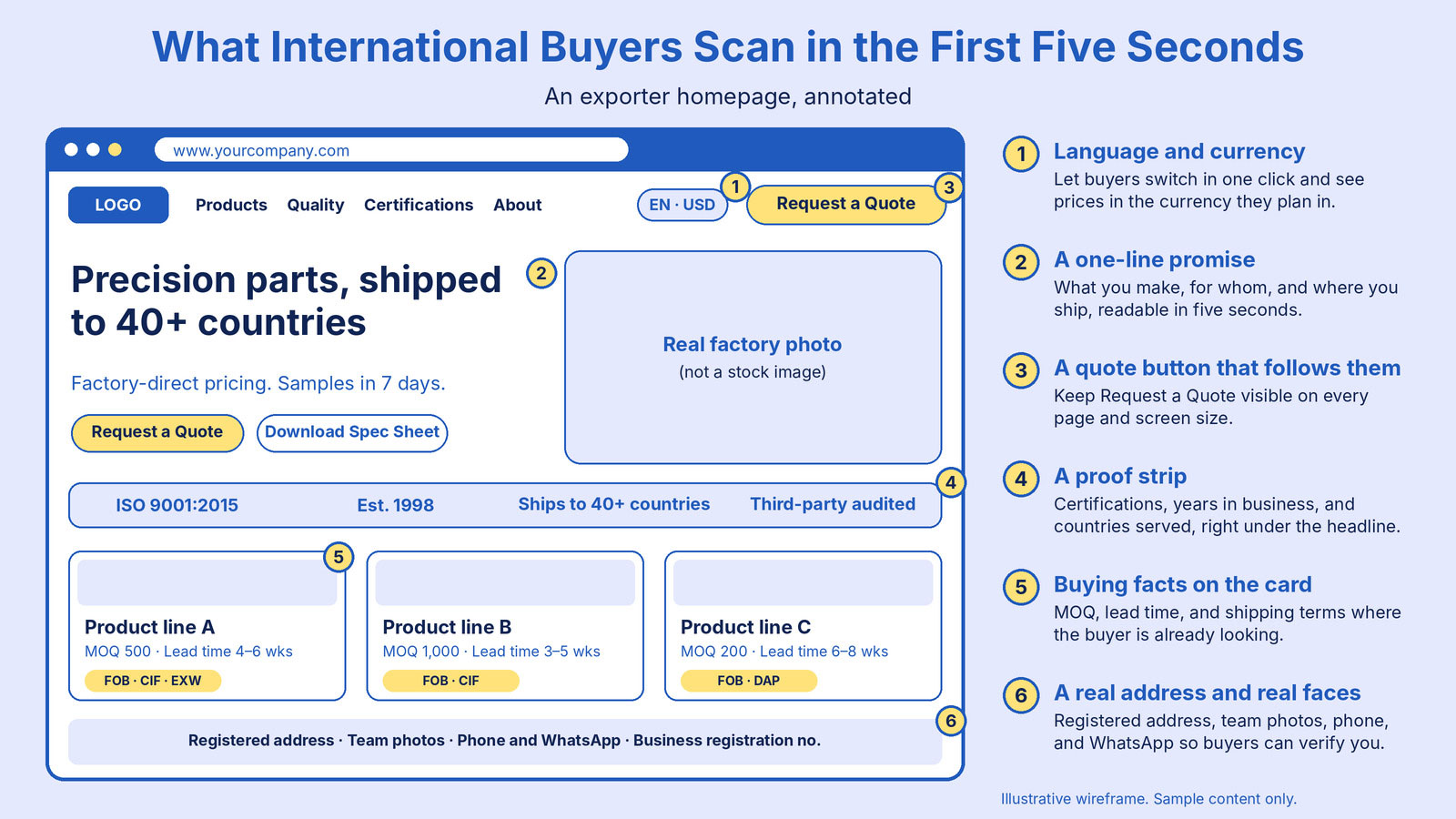
The headline carries a one-line promise that says what you make, who it’s for, and where you ship. A proof strip below it shows certifications, years in business, and countries served, and product cards show MOQ, lead time, and shipping terms where the buyer’s eyes already are. A language and currency switcher sits where people expect it, a quote button follows the visitor everywhere, and the footer carries your registered address, team details, phone number, and a messaging app such as WhatsApp for markets where buyers prefer it. If you’re ever unsure whether something belongs on the homepage, ask which of the four gates it helps a buyer pass, and cut it if the answer is none.
Your 30-Day Exporter Website Plan
You don’t need a full redesign to start winning more serious inquiries, because most of the improvement comes from adding proof and clarity to pages you already have. Here’s a pace that works for a typical small or mid-sized exporter.
- Week 1, audit like a buyer. Read your site as a stranger from your top three markets, note where each gate goes unanswered, and test your quote form from another country.
- Week 2, fix Real and Capable. Rewrite the About page with names, faces, and dates, replace stock photos with real ones, and add specs and verifiable certifications to your top products.
- Week 3, fix Clear and Safe. Publish MOQ, lead times, shipping terms, and payment options, shorten the quote form, promise a reply time, and gather two or three named testimonials or case studies.
- Week 4, translate and speed up. Professionally translate your homepage, top product pages, and quote form for your first priority market, compress images, and re-test speed from your main buyer countries.
How to Tell It’s Working
Traffic alone won’t tell you whether your site is doing its job, because the goal isn’t more visitors but more serious conversations. Track these monthly and compare against the month before you started, so you can see which fixes mattered most.
- Quote requests per 100 visitors, broken down by country and by product page.
- Inquiry quality, such as the share of requests that include quantity, destination, and timeline.
- Reply time, measured as the average hours between a form submission and your first answer.
- Speed scores for your main markets, using Google’s Core Web Vitals reports.
Quick Answers
What do international buyers look for on an exporter’s website?
Proof that the company is real, evidence it can make what they need, clear terms that make it easy to work with, and signals that committing is safe, which in practice means real photos and addresses, specs and certifications, MOQ and shipping terms, and visible references and policies.
Should an exporter website show prices?
Whenever you can, yes, or at least a realistic range or an explanation of how pricing works, because a site that explains costs tends to feel more trustworthy than one that asks for an email first.
Do I need a separate website for each country?
Usually not at the start. Many exporters begin with a strong main site, translate the most important pages for their top markets, and add country or region pages as demand grows.
Ready to Make Your Website the Best Salesperson You Have?
Buyers across the world are already looking at your website before they ever look at you, and the exporters who win those quiet evaluations aren’t always the biggest or the cheapest. They’re the ones who made it easy to believe them.
At ICO Web Solutions, we design and build exporter websites that carry the weight of the factory visit, from the About page and product pages to the multilingual structure and quote flow that turn quiet visitors into real inquiries. Book a free 30-minute Exporter Website Review, and we’ll walk through your site the way an international buyer would, showing you which gates are open, which are blocked, and the quickest fixes to start getting more serious quote requests.
Book Your Free Exporter Website Review
Sources
business.gov.uk. (n.d.). How to adapt your website for export. https://www.business.gov.uk/export-from-uk/learn/categories/prepare-sell-new-country/selling-with-e-commerce/adapting-your-website-to-export/
Clutch. (2020, February 26). B2B buyers most concerned about transparent costs on B2B companies’ websites, highlighting importance of trust in B2B sales funnel [Press release]. https://clutch.co/press-releases/b2b-buyers-most-concerned-about-transparent-costs-b2b-companies-websites
CSA Research. (2020, July 7). Consumers prefer their own language [Press release]. https://csa-research.com/Blogs-Events/CSA-in-the-Media/Press-Releases/Consumers-Prefer-their-Own-Language
Gartner, Inc. (2020, September 15). Gartner says 80% of B2B sales interactions between suppliers and buyers will occur in digital channels by 2025 [Press release]. https://gartner.com/en/newsroom/press-releases/2020-09-15-gartner-says-80–of-b2b-sales-interactions-between-su
Gartner, Inc. (2026, March 9). Gartner sales survey finds 67% of B2B buyers prefer a rep-free experience [Press release]. https://www.gartner.com/en/newsroom/press-releases/2026-03-09-gartner-sales-survey-finds-67-percent-of-b2b-buyers-prefer-a-rep-free-experience
International Chamber of Commerce. (n.d.). Incoterms® 2020. https://iccwbo.org/business-solutions/incoterms-rules/incoterms-2020/
International Trade Administration. (n.d.). Website internationalization. U.S. Department of Commerce. https://www.trade.gov/website-internationalization
McQuade, B., & Pollard, B. (2025, May 7). How the Core Web Vitals metrics thresholds were defined. web.dev. https://web.dev/articles/defining-core-web-vitals-thresholds


Related items
.ico-post{–b:#1F5ABC;–l:#E5E9FE;–y:#FFE27A;–t:#1f2a44;max-width:780px;margin:0 auto;c


Baymard Institute’s 2026 benchmark found that 52% of desktop sites and 62% of mobile sites


Depending on which 2026 survey you read, somewhere between 34% and 77% of US shoppers have