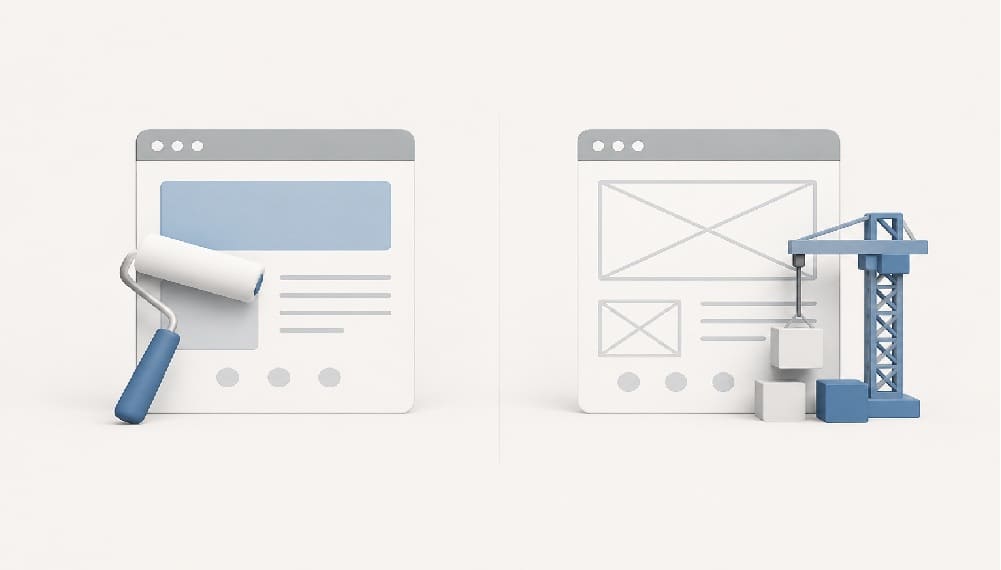
A redesign keeps your CMS, hosting, and database, and changes how the site looks and feels. A rebuild replaces the foundation itself. Most businesses don’t need a rebuild; they need a redesign and a CMS that isn’t fighting them. Before you sign off on either one, run the 20-minute test in this article. It’ll tell you, in less time than it takes to read this post twice, which project you actually need.
In this blog:
- The real difference between a redesign and a rebuild
- What each one actually costs and how long it takes
- Signs you need a redesign
- Signs you need a rebuild
- The 20-minute truth test (our framework)
- The uncomfortable part nobody in this industry says out loud
- Getting it right the first time
Redesign vs. rebuild: the question that’s costing businesses money
Here’s a number that should stop you mid-scroll: 80.8% of businesses start a website redesign because their existing site has stopped converting visitors into customers (We Are Tenet, 2026). That’s four out of five companies walking into a project convinced something is broken, without necessarily knowing what. And that one blurry starting point is exactly why so many teams end up buying the wrong fix. They ask for a “redesign” when their site needs a rebuild, or they get sold a full rebuild when a sharper redesign would have solved it in a third of the time.
This is the second post in our website redesign series on icowebsolutions.com, and it exists because this single decision- redesign or rebuild determines your budget, your timeline, and honestly, your stress level for the next several months. Get it right, and you fix the actual problem once. Get it wrong, and you pay for a project twice, sometimes within the same year.
Let’s define the terms plainly, without the agency jargon.
A website redesign keeps your current platform, your hosting, and your database intact. What changes is the visual layer: layout, navigation, typography, imagery, messaging, and calls to action. Think of it as renovating a house while you still live in it: new kitchen, new paint, new flow through the rooms, same plumbing and same foundation underneath.
A website rebuild, on the other hand, replaces the foundation. New CMS, new codebase, new hosting, sometimes a completely different content structure. Your brand and your content might carry over, but the engine underneath is brand new.
Neither option is inherently better. The mistake almost every business makes is picking one based on gut feeling, agency pressure, or simple frustration with how the site looks, rather than an honest look at what’s actually broken underneath the hood.
What each option actually costs, and why the gap is bigger than people expect
Cost is where most confusion starts, so let’s clear it up in plain terms rather than throwing numbers at you. For a growing Indian business, a redesign generally sits in the range of a few thousand to a handful of lakhs of rupees, depending on the size and complexity of the site.
A rebuild costs meaningfully more, since it involves a new CMS, new codebase, and often new hosting on top of everything a redesign covers (Digittrix, 2026; Pixeto, 2026).
As a rule of thumb, a rebuild runs two to three times the cost of a redesign on the exact same website, and it takes roughly twice as long to ship (Pryce Digital, 2026).
That gap isn’t a rounding error. It’s the difference between a project your marketing team can approve on their own and one that needs a proper budget conversation, so it’s worth getting an actual quote for your specific site rather than anchoring on a number you saw online.
Timeline follows a similar pattern.
A focused redesign can realistically ship in three to eight weeks. A rebuild, once you factor in content migration, integration rework, redirect mapping, and QA across every template, commonly stretches past six months for anything beyond a small brochure site. If your business runs on the website for lead generation or sales, six months of “we’re mid-migration” is six months of missed opportunity.
Here’s what the two paths look like side by side, in plain terms:
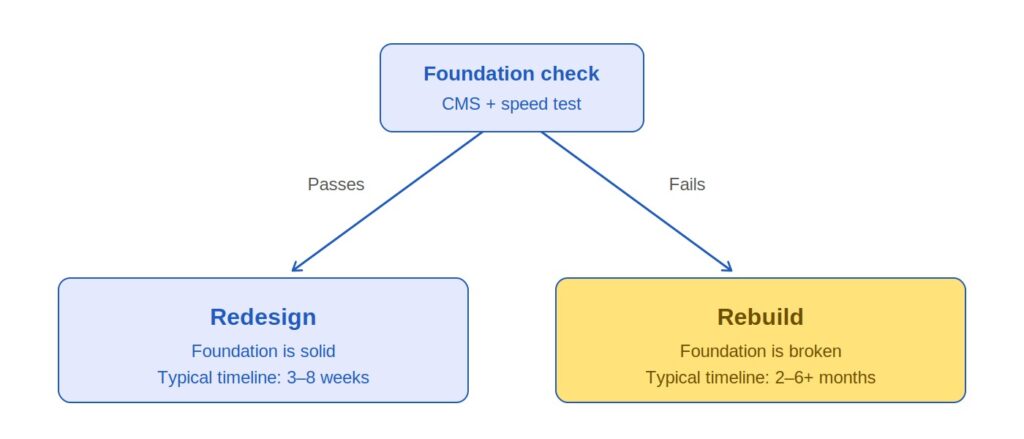
- Redesign — same CMS, same hosting, same database. Cost typically runs from the thousands into a few lakhs of rupees. Typical timeline: 3–8 weeks. Best for a site with a solid technical foundation that simply looks or performs poorly on the surface.
- Rebuild — new CMS, new codebase, often new hosting. Cost typically runs into several lakhs of rupees or more. Typical timeline: 8 weeks to 6+ months. Best for a site whose platform itself is holding the business back, regardless of how it’s styled.
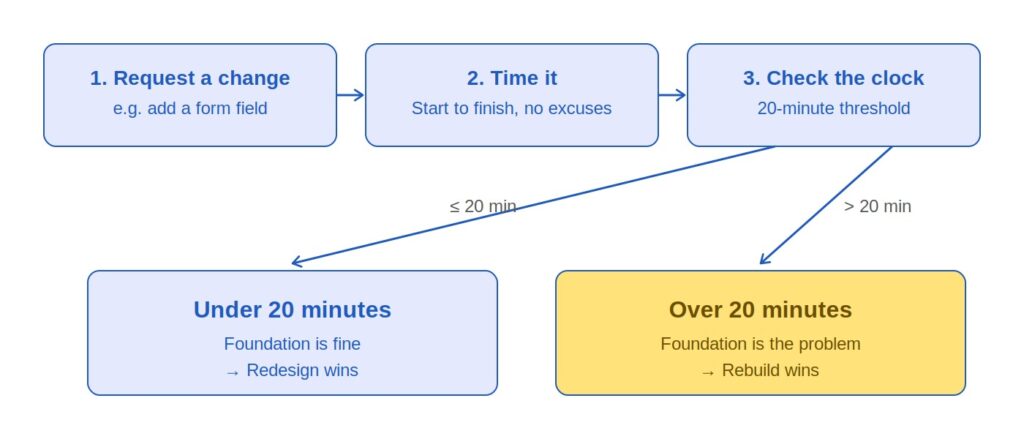
The visual below maps the decision path we walk every client through before we quote either project.
Signs your site needs a redesign, not a rebuild
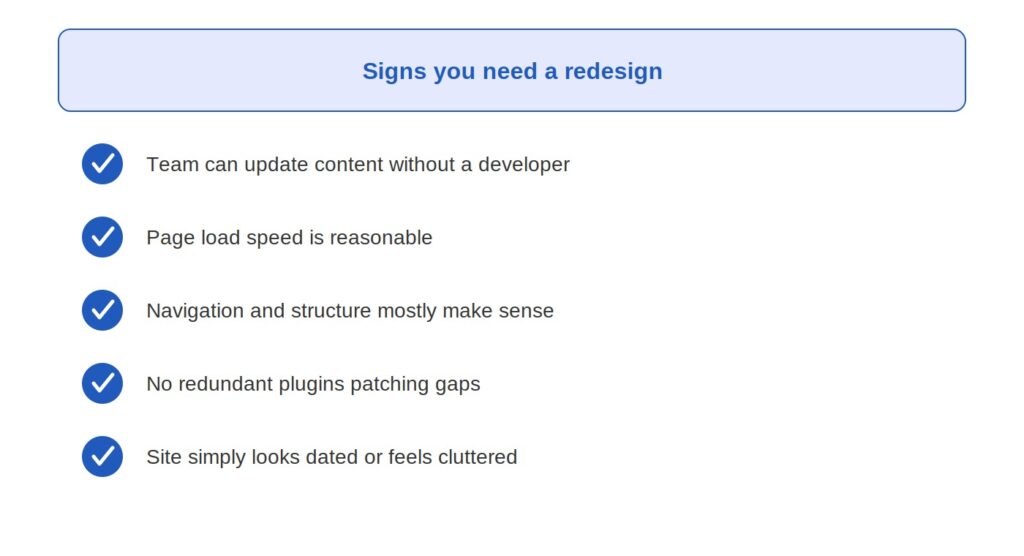
Most of the time, the fix is smaller than it feels. If your CMS lets your team update content without calling a developer every time, if your page speed scores are reasonable, and if the site’s basic structure makes sense once you walk through it, you’re very likely looking at a redesign candidate. The problem isn’t the engine. It’s the paint job, the layout, and possibly the messaging.
This matters because first impressions form faster than most people realize. Users form an opinion about a business based on its website design in roughly 0.05 seconds, and 75% of people judge a site’s overall credibility based on that design alone (We Are Tenet, 2026). A tired-looking layout on a perfectly healthy platform is an easy, fast, relatively affordable problem to solve — and solving it can move the needle fast, since sites that prioritize user experience see up to 400% higher visit-to-lead conversion rates compared to poorly designed competitors (We Are Tenet, 2026).
- Your team can add a page or update a form without waiting on a developer.
- Page load times are reasonable, even if they could be faster.
- The navigation and content structure mostly make sense; you’d tweak it, not tear it down.
- You’re not paying for multiple redundant plugins or tools just to patch around platform limitations.
- The site simply looks dated, feels cluttered, or doesn’t reflect your brand anymore.
Signs your site actually needs a rebuild
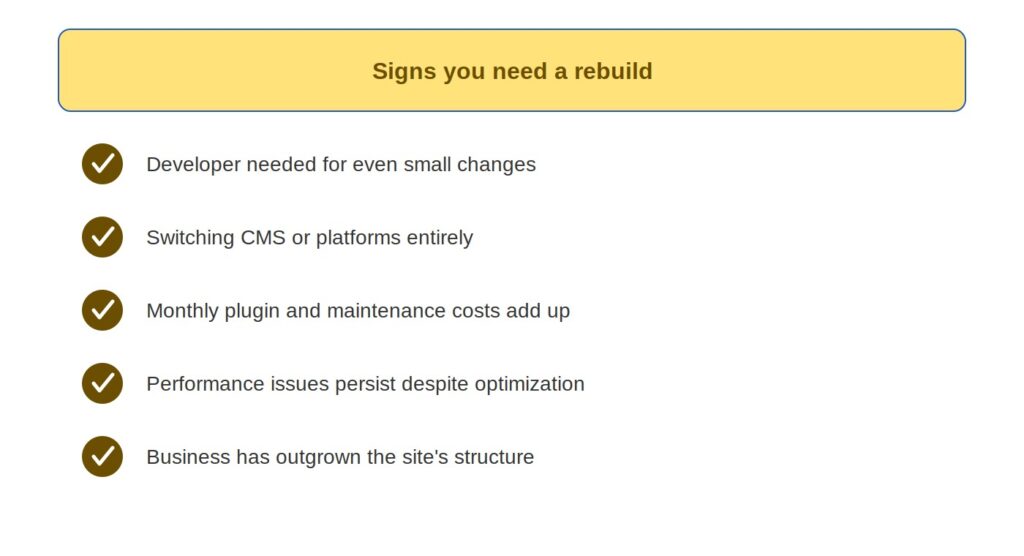
A rebuild earns its higher price tag when the problem sits underneath the surface. If your developer needs hours to make a change that should take minutes, if you’re switching platforms entirely, or if your services and positioning have outgrown the site’s basic structure, a fresh visual layer won’t fix any of that. You’d be repainting a house with a cracked foundation. It’ll look great for about six months, and then the same problems will resurface because you never touched what was actually broken.
Speed is often the tell here, and it’s a bigger deal than people assume. A 10-second load delay increases bounce rate by 123%, and 40% of visitors will abandon a site outright if it takes longer than three seconds to load (We Are Tenet, 2026; Codeyard, 2026). If your platform simply can’t be optimized any further no matter what your team tries, that’s not a design problem, that’s an architecture problem, and architecture problems need a rebuild.
- Adding a feature or integration means fighting the codebase every single time.
- You’re moving off a website builder onto a real CMS, or switching CMS platforms entirely.
- Your monthly platform, plugin, and maintenance costs have crept up into a meaningful line item, and a rebuild would eliminate most of it.
- Performance issues persist even after optimization, caching, and image compression.
- Your business has genuinely outgrown the site’s structure, not just its color scheme.
The 20-minute truth test: our framework for cutting through the noise
Here’s the framework we built at ICO Web Solutions after watching too many businesses get pointed toward the wrong project. We call it the 20-minute truth test, and it works because it replaces opinion with a stopwatch.
Ask whoever manages your website a staff member, a freelancer, or your current website design agency to make one small, real change: add a new field to a contact form, publish a new page using your existing template, or update a piece of navigation. Then time it, start to finish, from request to live on the site.
If that change takes twenty minutes or less, your foundation is fine. Whatever’s bothering you about the site- the look, the flow, the outdated imagery lives in the layer a redesign touches. But if the answer is “we can’t do that without a developer,” or the estimate stretches into days, or nobody’s entirely sure how to do it at all, you’ve just found your real problem, and it isn’t cosmetic. That’s a foundation issue, and a rebuild is the only way to actually resolve it.
We like this test because it’s honest in a way that gut feeling rarely is. It doesn’t ask how you feel about your site. It asks your site to prove itself, live, in real time.
The part of this industry nobody likes to say out loud
Here’s the uncomfortable truth, and we’re going to say it plainly because somebody should:
picking a rebuild when you only needed a redesign is a mistake that happens constantly, and it’s often pushed by agencies who’d rather sell the bigger project.
A rebuild bills at two to three times the rate of a redesign, so the financial incentive to recommend one runs in exactly one direction (Pryce Digital, 2026). We’re not saying every agency does this on purpose. Plenty genuinely believe a full rebuild is the safer, more thorough answer. But “safer for the agency’s invoice” and “correct for your business” aren’t always the same thing, and it’s worth asking any partner you’re evaluating to walk you through their reasoning, not just their recommendation.
The flip side is just as real and just as expensive. Businesses sometimes insist on a cheap redesign when their platform is genuinely the problem, and they end up paying for a fresh coat of paint on a structure that was never going to hold. Both mistakes are recoverable. Both are also avoidable, and that’s really the entire point of running the 20-minute test before you sign anything.
The financial impact of getting this right compounds over time, too. Teams that treat their CMS as content infrastructure rather than tearing it down every few years report better outcomes meaningfully: one recent analysis of a phased modernization approach — improving editing tools first, then redesigning navigation and structure on the existing platform found roughly a 24% conversion lift without a full rebuild at all (Droptica, 2026).
That’s not a small number. It suggests that in a lot of cases, the “safe” full rebuild wasn’t actually necessary to hit the growth goal in the first place.
Getting it right the first time
A website redesign and a website rebuild solve two genuinely different problems, and the businesses that come out ahead are the ones who diagnose before they spend. If your platform is solid and your team can move around within it without friction, a redesign can get you a sharper, faster-converting site in a matter of weeks, at a fraction of the cost of starting over. If the platform itself is the ceiling on your growth, no amount of new imagery or clever copy is going to change that, and a rebuild is the investment that actually pays off.
The average website gets redesigned every 1.5 to 2.5 years (Codeyard, 2026), which means most businesses reading this are already due for a decision one way or another.
The good news is that the decision doesn’t have to be a guess. Run the 20-minute test. Look honestly at whether your problem lives in the paint or in the plumbing. And if you’re not sure, that’s exactly the kind of question a short conversation with someone who isn’t trying to sell you the bigger project can answer in about the same amount of time it took to read this article.
If you want a second opinion before you commit budget to either path, our team at ICO WebTech will run a free site audit, walk you through exactly what we find, and tell you straight whether you need a redesign, a rebuild, or honestly, just a few smart fixes. No pressure toward the bigger invoice.
Book your free website audit here and get a clear answer before you spend a single rupee.
References
Claspo. (2026). Average bounce rates by industry: 2026 stats. https://claspo.io/blog/average-bounce-rates-by-industry-statistics-for-websites-and-emails-in-2023/
Codeyard. (2026). 100+ web design, redesign, facts, statistics (2026). https://www.codeyard.app/blog/web-design-statistics
Corazor Technology. (2026). Website redesign vs rebuild: A decision framework for growing companies. https://www.corazor.com/blogs/website-redesign-vs-rebuild-decision-guide
Digital Applied. (2026). Bounce rate benchmarks 2026: Industry and channel data. https://www.digitalapplied.com/blog/bounce-rate-benchmarks-2026-industry-channel-data
Digittrix. (2026). Website redesign cost guide for growing businesses 2026. https://www.digittrix.com/blogs/website-redesign-cost
Pixeto. (2026). How much does it cost to redesign a website? (2026 guide). https://www.pixeto.co/blog/website-redesign-cost
Droptica. (2026). CMS modernization vs rebuild: A phased framework. https://www.droptica.com/blog/dont-rebuild-evolve-phased-cms-modernization-framework/
Framer Websites. (2026). Conversion rate benchmarks: A complete guide for 2026. https://framerwebsites.com/blog/conversion-rate-benchmarks-guide
Pryce Digital. (2026). Website redesign vs rebuild: Which do you need? (2026). https://prycedigital.com/blog/website-redesign-vs-rebuild
Refact. (2026). Website redesign cost: 2026 budget guide. https://refact.co/insights/digital-product/website-redesign-cost
We Are Tenet. (2026). 90+ web design statistics for 2026. https://www.wearetenet.com/blog/web-design-statistics



Related items

Freelancer vs Agency vs In-House: How to Choose the Marketing Team That Fits Your Business Right Now
Gartner’s 2025 CMO Spend Survey found that marketing budgets average 7.7% of company reven

A website redesign is one of the few marketing projects that can lower your traffic on the


A WordPress site rarely breaks all at once. It drifts. A plugin update here, a new image l
