Your Google Ads Budget May Not Be the Problem
Here’s a number worth paying attention to: the average Google Ads conversion rate across industries was 7.52% in WordStream’s 2025 benchmark data, while the average cost per click was $5.26. In other words, every click has a price, and most clicks still do not become conversions.
That does not mean Google Ads is broken. Quite the opposite. Paid search works because it puts your business in front of people who are already looking for something you sell. The problem starts when you pay for the wrong searches, the wrong people, or the wrong kind of intent.
And those leaks rarely look dramatic.
They look like a few irrelevant clicks here. A broad-match search there. A campaign spending heavily outside your best locations. A landing page that gets traffic but barely converts. A keyword that has been “learning” for three months while quietly eating your budget.
Individually, these may not look dangerous. Together, they can turn a healthy PPC campaign into an expensive traffic generator.
Here’s the uncomfortable part: you may not need a bigger Google Ads budget. You may need to stop wasting the budget you already have.
That is the idea behind this article and our L.E.A.K. framework. Instead of treating PPC as a machine for buying more clicks, we look at it as a system for buying the right intent, filtering out waste, and putting more money behind the searches that can actually become customers.
Before We Get Into It
Most Google Ads problems do not begin with the budget. They begin with what the budget is being allowed to buy.
Your ads can appear for searches that are only loosely related to your offer. Broad match can expand beyond the words you originally entered. Poor location settings can put ads in front of people you cannot serve. Weak negative-keyword hygiene can allow the same irrelevant searches to return again and again. And a landing page that does not match the promise of the ad can turn an expensive click into a bounce.
Google itself explains that broad match can show ads for searches related to a keyword, including searches that do not contain the direct meaning of the keyword. It is also the default match type for keywords.
That reach can be incredibly useful when it is controlled properly. It can also become expensive when nobody is checking what the account is actually buying.
Our answer is simple: find the leaks, remove the waste, protect the budget, and then scale what works.
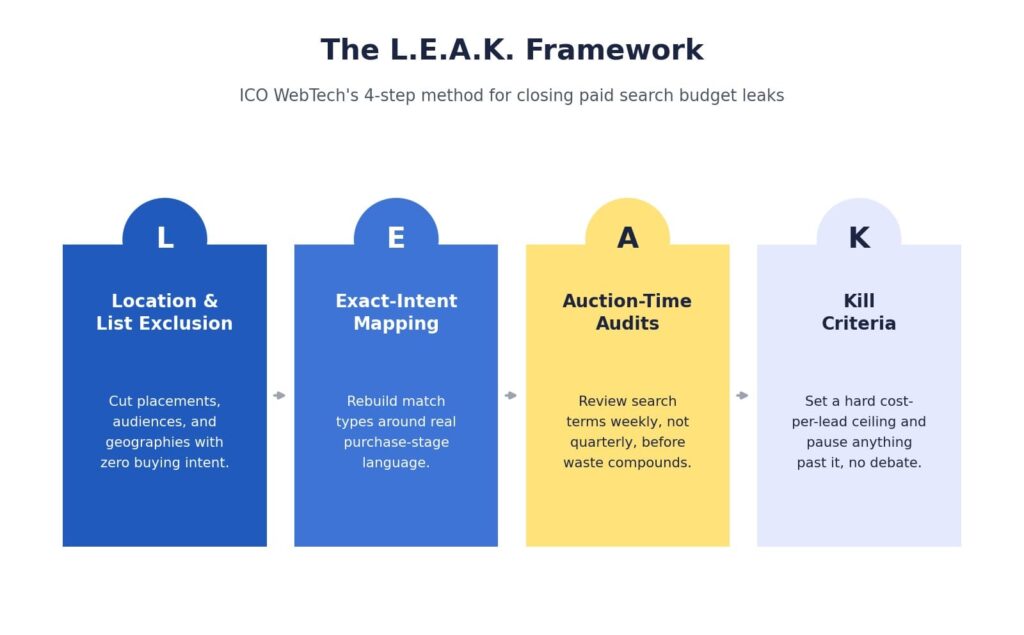
The L.E.A.K. framework gives that process four steps:
- L — Location & List Exclusion: Remove people, places, audiences, and traffic sources that should not receive your budget.
- E — Exact-Intent Mapping: Connect keywords and campaigns to the actual intent behind the search.
- A — Auction-Time Audits: Review what is triggering your ads regularly instead of discovering problems months later.
- K — Kill Criteria: Decide what gets paused before emotion and sunk costs take over.
The goal is not to spend less for the sake of spending less.
The goal is to make more of your existing spend work toward leads and revenue.
In This Blog
- Why your Google Ads budget may be leaking even when the campaign looks healthy
- How Google’s default settings can expand your reach — and your spend
- The most common places paid search budget disappears
- Why irrelevant search queries are more dangerous than a high CPC
- How the L.E.A.K. framework protects your PPC budget
- Why location and audience exclusions deserve more attention
- How to map keywords to genuine buyer intent
- Why weekly search-term reviews beat occasional account cleanups
- How kill criteria prevent bad keywords from becoming permanent budget drains
The Real Reason Your Google Ads Budget Keeps Leaking
Let’s clear up one thing first: Google Ads is not broken.
It is one of the most measurable advertising channels available to a business. You can see what people searched, which ad they interacted with, what they did on your website, and — with proper conversion and CRM tracking — whether those interactions eventually turned into business.
The problem is the gap between what you think you are buying and what your campaign is actually buying.
You might add the keyword commercial cleaning services because it perfectly describes your service. But the searches behind that keyword can reveal a much messier picture. People may be looking for cleaning jobs. They may want a cleaning course. They may be researching how to start a cleaning business. They may be searching for a free checklist.
The keyword looked right. The intent was wrong. That distinction is where a lot of PPC waste begins.
Google’s Search Terms Report exists precisely because the keywords in your account are not necessarily the same as the searches people actually type. The report shows the searches that triggered your ads and helps advertisers identify which queries are relevant, which are not, and which match types are producing useful traffic.
So if you are managing Google Ads by looking only at the keyword column, you are looking at the plan.
The Search Terms Report shows you what actually happened.
That is why we prefer to think of PPC optimization as a form of budget forensics.
We are not asking, “Which keywords should we add?” We are asking:
- Where did the money go?
- What searches caused that spend?
- Did those searches reflect buying intent?
- Did the resulting visitors become leads?
- Did those leads become qualified opportunities?
- And which parts of the account deserve more of the budget?
This changes the entire conversation.
A keyword that generates 500 clicks is not automatically a winner. A keyword that generates 20 clicks and two excellent sales opportunities may be far more valuable.
And a campaign with a higher CPC can sometimes be the better campaign if its traffic has stronger commercial intent.
Cheap traffic is not the objective. Valuable traffic is.
The Uncomfortable Truth About Google’s Defaults
Here is where PPC gets interesting.
Google has invested heavily in automation, machine learning, broad matching, Smart Bidding, and campaign systems designed to help advertisers find more opportunities. That is not inherently a bad thing. In fact, these systems can be extremely powerful when they have good conversion data and sensible guardrails.
But there is a difference between automation and autopilot.
And too many advertisers treat them as the same thing.
Broad match is Google’s default keyword match type. Google explains that broad match can reach searches related to your keyword and can use signals such as recent searches, landing-page content, assets, and other keywords in the ad group to understand intent.
That is useful if your goal is to discover relevant demand.
But it means you cannot assume that the phrase you entered is the only thing you are paying to appear against.
Then there are automatically applied recommendations. Google allows advertisers to choose certain recommendations to apply automatically, while also providing controls to review and manage which recommendations are enabled. Google recommends reviewing the Recommendations page regularly because the available recommendations can change over time.
None of this means Google is trying to waste your money.
It means something much simpler:
Google’s system is built to find opportunities. Your business still has to decide which opportunities are worth buying.
That distinction matters enormously for a small or mid-sized business.
You have a finite budget. You may serve a specific geography. You may sell a specialized service. You may need ten qualified leads rather than 10,000 visitors.
So a recommendation that makes sense for a large ecommerce advertiser with thousands of conversions may not make sense for a B2B company spending $5,000 a month.
The mistake is not using automation.
The mistake is using automation without guardrails.
Think of it like cruise control. It is incredibly useful on the right road. You still need to know where you are going, what speed you can afford, and when to take the wheel.
Where the Money Disappears
Paid search waste rarely arrives as one giant, obvious mistake. It usually arrives in small pieces.
A search that sounds relevant but has no commercial intent. A location that should have been excluded. A device that generates clicks but almost no leads. A landing page that makes visitors work too hard. A negative keyword that should have been added three weeks ago.
And because each leak looks harmless, the account can continue running for months without anyone realizing how much the small leaks add up to.
Irrelevant Search Queries
This is the classic leak. Your keyword is relevant enough for Google to consider a search, but the searcher is not relevant enough for your business.
Someone searching for “SEO jobs” does not need an SEO agency. Someone searching for “free PPC course” is not necessarily looking for PPC management. Someone searching “how to do SEO yourself” may be interested in learning, not buying.
Those searches can generate perfectly legitimate clicks. They are still the wrong clicks.
Broad-Match Drift
Broad match is designed to expand reach beyond exact and phrase matching. Google describes this as a way to discover additional relevant searches and give Smart Bidding more data.
The opportunity is real. So is the responsibility.
If you use broad match, you need to know what it is discovering for you. Otherwise, you are effectively asking Google to define relevance on your behalf without giving your business enough boundaries.
Weak Geographic Targeting
If you only serve customers in California, paying for clicks from someone searching in another state is not “reach.” It is leakage.
The same applies to businesses with city-specific service areas, regional franchises, local professional services, and companies that cannot legally or practically serve certain markets.
Geographic targeting should reflect your actual sales territory, not an abstract idea of where you would like to be visible.
Weak Device Performance
Not every device deserves equal budget simply because every device can generate a click.
If mobile traffic converts poorly because your form is difficult to use, your page loads slowly, or your CTA is buried below the fold, the problem is not necessarily “mobile traffic.” The problem may be the experience you are giving mobile visitors.
Before cutting a device, diagnose the reason for the performance gap.
Thin or Mismatched Landing Pages
This is where many advertisers lose money after doing everything else correctly. The ad says one thing. The landing page says something vaguely related.
The visitor has to figure out what the company actually offers, why it is different, and what they are supposed to do next. That is a costly moment to introduce confusion.
Your paid search visitor has already told you what they want through their search. Your landing page should continue that conversation rather than starting a completely different one.
Also read:
Why Businesses Lose Leads Due to UX
Why and how to use Google Ads for your brand?
Weak Negative-Keyword Hygiene
Some advertisers add negative keywords during setup and then never touch the list again.
That is like cleaning your house once and deciding you are done forever.
Search behavior changes. New queries appear. Campaigns evolve. New products and services get added. Your negative keyword strategy needs to evolve with them.
Google specifically recommends using search-term data to identify irrelevant searches and refine keyword targeting.
Automation Without Guardrails
Performance Max, broad match, Smart Bidding, and other automated features can be valuable parts of a modern Google Ads strategy.
But “Google will optimize it” is not a strategy.
Automation needs a useful conversion signal, sensible exclusions, accurate tracking, appropriate targeting, and regular human review.
The more control you hand to an algorithm, the more important it becomes to define what “good” actually means.
The L.E.A.K. Framework
Most PPC advice starts with keywords. We think that is backwards.
Before you obsess over bidding strategies, ad variations, or another 50 keywords to add to the account, ask a more basic question:
Are we allowing our budget to reach people we never wanted in the first place?
That is why our framework starts with exclusion and control before optimization and expansion.
L.E.A.K. stands for Location & List Exclusion, Exact-Intent Mapping, Auction-Time Audits, and Kill Criteria.
It is deliberately simple. The point is not to create another complicated PPC methodology that requires a 40-page spreadsheet.
The point is to create a repeatable system that protects the budget before you try to scale it.
L — Location & List Exclusion
First, stop paying for people who should never have been in your campaign.
That starts with geography.
If you serve three cities, your campaign should not casually spend money trying to find customers in 30. If you operate nationwide but have certain regions you cannot serve profitably, those areas need to be treated differently.
Then look at audience and customer exclusions.
If your campaign is designed to acquire new customers, do you really want to keep paying to advertise to people who already bought from you?
Maybe you do. Maybe you do not.
The important thing is that the decision should be intentional.
Also examine placements and other sources of traffic where relevant to your campaign type. The goal is straightforward: remove traffic that has no realistic path to becoming valuable business.
Think of this step as closing the front door before worrying about how beautifully you decorate the living room.
E — Exact-Intent Mapping
Once you have stopped obvious waste, get serious about intent.
Not every search containing your keyword deserves the same treatment.
Consider the difference between:
- “what is PPC advertising”
- “how does PPC work”
- “PPC advertising agency”
- “hire PPC agency for B2B”
These searches sit at different points in the buyer journey. The first search may be educational.
The last one is much closer to a commercial decision. Your campaigns should understand that difference.
That does not mean informational searches are worthless. They may be valuable for content and organic search. But if your goal is immediate lead generation, you should know exactly how much of your paid budget is going toward education versus purchase intent.
Map your keywords to the intent you actually want to buy.
Use tighter targeting where precision matters. Use broader matching where discovery creates value. Then let your conversion data tell you whether the expansion is producing customers rather than merely producing more traffic.
The keyword is not the strategy. Intent is.
A — Auction-Time Audits
This is the habit almost everyone skips. They launch a campaign, check it after a few days, check it again at the end of the month. Then they wonder why an irrelevant search has already spent $400.
Your Google Ads account is not static. New searches enter the auction. Search behavior changes. Competition changes. Performance changes.
That means optimization cannot be a quarterly ritual.
The Search Terms Report gives you visibility into the searches that actually triggered your ads and lets you examine how those searches relate to your keywords.
Use that information regularly.
A weekly review does not need to take hours. Start with the highest-spend queries and the queries that generated conversions. Look for patterns rather than obsessing over every individual search.
You are looking for three things:
- Block: Searches that clearly do not belong.
- Keep: Searches showing strong relevance and commercial intent.
- Investigate: Searches that could be valuable but need more data.
That simple classification can turn your search-term report from a forgotten dashboard into a budget-control mechanism.
K — Kill Criteria
This may be the most uncomfortable part of the framework.
Decide when something gets cut before you become emotionally attached to it.
Every PPC manager has done it.
“This keyword has spent a lot, but maybe the next few clicks will convert.”
“This ad group has been slow, but let’s give it another month.”
“We already spent $800 on it, so we shouldn’t pause it yet.”
That last one is the sunk-cost fallacy wearing a Google Ads dashboard as a disguise.
The money you already spent is gone. It should not determine whether you spend the next dollar. Instead, establish your criteria in advance.
For example, you might decide that a keyword, ad group, or campaign deserves review when it reaches a certain level of spend without a qualified conversion, or when its cost per qualified lead consistently exceeds your acceptable acquisition range.
The exact threshold will vary by business, margin, sales cycle, and customer value.
What matters is having one. Because when the rule is decided before the money is spent, the decision becomes analytical instead of emotional.
And that is the entire point of L.E.A.K.
Exclude first. Map intent second. Audit continuously. Cut decisively.
Only after those four things are working should you start asking the more exciting question:
“Where should we put more money?”
The 7 Most Expensive Google Ads Leaks
Most Google Ads waste does not come from one spectacular mistake. It comes from ordinary decisions that seem harmless when viewed one at a time.
A keyword attracts clicks but very little buying intent. A campaign spends outside your service area. A broad-match term keeps finding searches you would never deliberately target. Your homepage receives hundreds of paid visitors but gives them too many places to go. Your conversion tracking counts every form interaction as a lead, even when sales considers only a fraction of them qualified.
None of these problems looks dramatic in isolation.
Together, they can quietly turn a profitable advertising channel into a very expensive source of website traffic.
Here are the seven leaks we would investigate before recommending that you increase your Google Ads budget.
1. Irrelevant Search Queries
This is the leak most advertisers know about but surprisingly few monitor consistently.
You bid on a keyword because it sounds relevant. Google matches your ad to a search that is related enough to qualify. Someone clicks. You pay.
Then you discover the person was looking for a job, a tutorial, a free resource, a definition, a competitor, or something else entirely.
The keyword was not necessarily wrong. The search intent was.
That distinction matters because Google Ads can operate at a much more granular level than the keyword list suggests. The Search Terms Report shows the actual queries that triggered your ads, giving you the evidence needed to decide which searches deserve more budget and which should be excluded.
If you have not reviewed your search terms recently, do not assume your keyword list tells the whole story.
Your keyword list is what you intended to buy. Your search-term data tells you what you actually bought.
2. Broad-Match Drift
Broad match is not the villain here. Used properly, it can help advertisers discover valuable searches and give Google’s automated bidding systems more data to work with.
The problem is treating broad match like a set-and-forget feature.
Google says broad match can match searches related to the meaning of a keyword and can use contextual signals such as the user’s recent searches, the landing page, assets and other keywords in the ad group. That makes broad match powerful, but it also means the advertiser needs to pay attention to what the system is discovering.
Think of broad match as a fishing net. A larger net can catch more fish. It can also catch things you never wanted.
If you are using broad match, your negative keyword strategy, conversion tracking and search-term reviews need to be strong enough to tell Google what a valuable catch looks like.
3. Geographic and Audience Leakage
Here is an easy question that can expose a surprisingly expensive problem:
Can every person your campaign reaches actually become your customer?
If the answer is no, you need to know why those people are receiving your ads.
A remodeling company serving three Michigan cities does not need to pay for someone searching from a state it does not serve. A B2B software company selling only to enterprise organizations may not want to spend the same amount reaching students or job seekers. A business focused on new customer acquisition may not want to keep paying to advertise to existing customers without a specific reason.
Geographic targeting and audience exclusions are not glamorous PPC work. They are budget protection.
And that is exactly why they are easy to overlook.
Start with the areas and audiences that genuinely matter to the business, then examine where the campaign is actually spending. If your targeting settings and your sales territory tell two different stories, fix that before you touch your bidding strategy.
4. Weak or Mismatched Landing Pages
You can get the targeting right, the keyword right and the ad right — and still lose the lead after the click.
This happens when the landing page does not continue the conversation started by the search.
Someone searches for “PPC management for B2B companies.” Your ad talks about B2B PPC. They click.
Then they land on your homepage. Now they see SEO. Web design. Social media. Content marketing. Branding. About us. Careers. Blog posts. Six different buttons. A slider. A newsletter popup.
They came looking for one thing. You gave them a website. Those are not the same thing.
Google itself recommends matching the landing page closely to the ad and keywords and making sure the landing page reflects the call to action promised in the ad. Google also identifies landing-page experience as one of the diagnostic components of Quality Score. :contentReference[oaicite:0]{index=0}
Your landing page does not need to be complicated. It needs to answer the visitor’s immediate questions:
- Am I in the right place?
- Does this company offer what I searched for?
- Why should I trust them?
- What happens if I take the next step?
- How do I contact them?
If your paid traffic is healthy but your conversion rate is disappointing, do not automatically blame the keywords.
The leak may be happening after Google has already done its job.
5. Conversion Tracking That Counts the Wrong Things
This is one of the most dangerous leaks because it can make a bad campaign look successful.
Imagine your Google Ads account reports 80 conversions. That sounds great. Then your sales team tells you only 12 were genuine leads. Suddenly, the campaign does not look nearly as impressive.
This is why conversion tracking should not simply answer, “Did somebody do something on the website?” It should answer, “Did somebody do something that matters to the business?”
A page view may be useful for analysis. A button click may tell you something about user behavior. A brochure download can indicate interest.
But none of those necessarily equals a sales lead.
Google explains that conversion actions marked as Primary can be used for bidding and appear in the main “Conversions” column, while secondary actions can be tracked without being used directly for bidding optimization. Google also recommends ensuring conversion tracking is set up correctly before relying on conversion-focused Smart Bidding. :contentReference[oaicite:1]{index=1}
That distinction is crucial.
If you tell Google that a low-value action is your success signal, the system can optimize toward more of that action. And it may do exactly what you asked. It just may not be what your sales team wanted.
For lead generation, your measurement should ideally move further down the funnel:
- Lead
- Qualified lead
- Sales opportunity
- Customer
- Revenue
The closer your advertising data gets to actual business value, the more useful your optimization becomes.
6. Set-and-Forget Campaigns
Google Ads is not a crockpot.
You cannot turn it on, walk away and expect the same recipe to taste good six months later.
Search behavior changes. Competitors enter and leave auctions. Costs move. New search terms appear. Your website changes. Your offers change. Your customers change.
And the account itself can change as new recommendations, automation and campaign features become available.
The source material behind this framework makes an important point: the accounts that stay efficient are not necessarily the ones that received one brilliant audit. They are the ones that have a repeatable review cadence.
That is why a campaign that performed well in January can be quietly leaking money in August. The campaign did not necessarily “break.”
You simply stopped checking what changed.
7. Optimizing for Cheap Metrics Instead of Expensive Outcomes
This is the leak that hides behind a beautiful dashboard.
Your CPC is down. Your CTR is up. Your conversion rate looks healthy. Everyone is happy. Except sales. Because the leads are terrible.
Clicks, impressions, CTR and CPC are useful metrics. But they are not the same thing as business performance.
Google provides conversion value and conversion-value-per-cost metrics specifically to help advertisers move beyond simply counting conversions and understand the business value generated by advertising.
That is a much healthier way to think about PPC.
If Campaign A generates 100 leads at $30 each but only two become customers, while Campaign B generates 25 leads at $80 each and eight become customers, which campaign would you rather fund?
The answer is obvious once you stop looking at CPL in isolation.
The cheapest lead is not necessarily the cheapest customer.
And that brings us to the bigger question: what happens when you keep the budget exactly the same but remove the leaks?
Same Budget, Different Outcome
Let’s make this concrete.
The following is an illustrative example, not a client case study. The point is to show what can happen when the same advertising budget is managed differently.
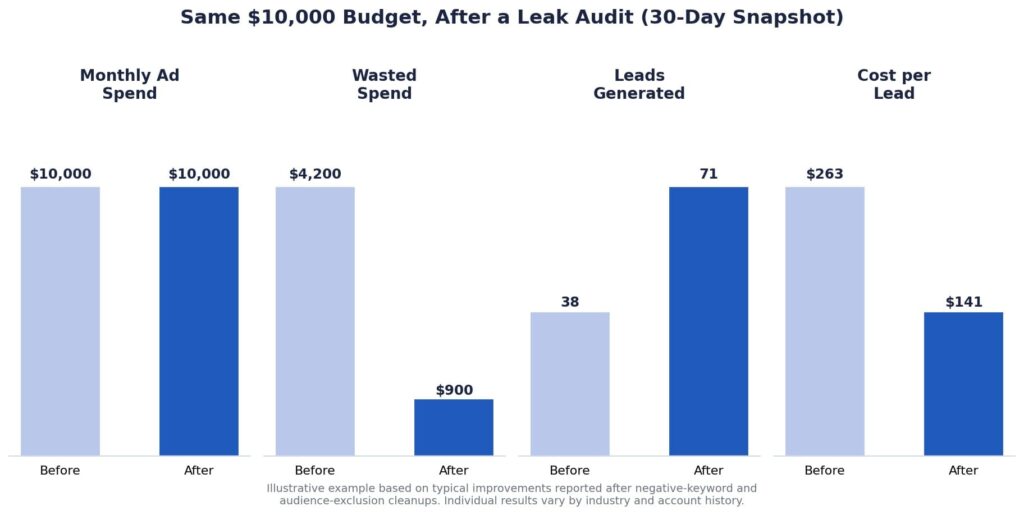
Imagine a company spending $10,000 per month on Google Ads.
Before the cleanup, the account has irrelevant searches, weak exclusions, poorly matched landing pages and conversion tracking that counts several low-value actions. The campaign generates traffic, but the business is not getting enough qualified leads from that traffic.
Now apply the L.E.A.K. approach.
- Remove irrelevant search queries.
- Tighten geographic and audience targeting.
- Strengthen negative keyword coverage.
- Separate high-intent searches from broader discovery traffic.
- Improve the landing-page experience.
- Clean up conversion actions.
- Set clear rules for when underperforming areas should be paused.
The monthly budget stays at $10,000.
The strategy changes.
That distinction matters. The source material behind this framework uses the same kind of illustrative before-and-after: the budget remains unchanged while wasted spend falls, qualified leads increase and cost per lead improves.
The lesson is not that every business will magically double its leads after an audit. That would be a ridiculous promise.
The lesson is that budget efficiency is itself a growth lever.
Before asking for another $5,000 in ad spend, ask whether the first $10,000 is being allocated intelligently.
Sometimes the fastest route to more leads is not buying more clicks.
It is getting more value from the clicks you already buy.
Why Your Homepage Is Probably Killing Your PPC ROI
We are going to say something that may annoy a few website owners:
Your homepage is probably one of the worst places to send highly specific paid-search traffic.
Not because your homepage is bad. Because it has too much to do.
Your homepage needs to introduce the brand. It needs to serve multiple audiences. It needs to explain your company. It needs to showcase your services. It needs to support navigation. It may need to rank organically. It may need to help existing customers. It may need to answer questions from people who have never heard of you.
A PPC visitor usually has a much narrower reason for arriving.
They searched for something. Your ad promised something. They clicked because they wanted that thing. Now give them that thing.
If someone searches for “Google Ads management services,” the landing page should make the relationship obvious. If someone searches for “SEO services for B2B companies,” they should not have to navigate through your entire website to find the SEO offering.
Google’s own guidance recommends sending users to landing pages that closely match the ad and keywords and says a relevant, useful landing page improves the chances of conversion. :contentReference[oaicite:5]{index=5}
There is another problem with sending paid traffic to a generic homepage: you lose the ability to control the conversation.
A dedicated landing page can focus the headline, proof, benefits, objections and CTA around one search intent.
Your homepage cannot realistically do that for every visitor.
So if your Google Ads campaign has a healthy click-through rate but disappointing conversion rate, look beyond the ad account. Open the landing page. Read it as if you just searched the keyword.
Then ask: “Does this page give me exactly what I thought I was clicking for?” If the answer is “sort of,” you have found a leak.
Your Conversion Tracking May Be Lying to You
Let’s make this one very practical. Open your Google Ads conversion actions.
Now ask what each one actually means to your business.
- Is a form submission a qualified lead?
- Is every phone call valuable?
- Does a brochure download have the same commercial value as a consultation request?
- Is a “thank you” page firing when somebody simply refreshes it?
- Are duplicate conversions being counted?
- Are micro-actions being included alongside genuine lead actions?
If your answer to some of these is “I’m not sure,” your campaign may be optimizing against a blurry definition of success.
Google’s conversion framework allows advertisers to distinguish between primary actions used for bidding and secondary actions that remain available for observation. That gives you a way to separate meaningful business goals from useful-but-secondary interactions. :contentReference[oaicite:6]{index=6}
There is another step worth taking: assign conversion values when you can.
Google says conversion values help advertisers understand the business impact of conversions and can be used to optimize toward conversion value rather than simply conversion volume. :contentReference[oaicite:7]{index=7}
For example, suppose a business knows that:
- A newsletter signup is worth very little.
- A content download is worth more.
- A qualified consultation is worth significantly more.
- A sales opportunity is worth even more.
Treating all four as identical conversions throws away useful information.
Your advertising platform can only optimize toward the signals you give it.
Bad tracking does not just create bad reports. It can influence where your future budget goes.
The 15-Minute Weekly PPC Audit
You do not need to spend half your Monday inside Google Ads.
You do need to look regularly.
The source material behind the L.E.A.K. framework recommends a weekly search-term review because waste accumulates while campaigns are running, not when your quarterly review finally arrives. :contentReference[oaicite:8]{index=8}
Here is a practical 15-minute version.
Minutes 1–5: Check Search Terms
Open the Search Terms Report and sort your attention toward the searches that spent the most money or generated conversions.
Look for obvious mismatches.
Ask:
- Would I actually want this person as a customer?
- Does this search show buying intent?
- Should this query become a negative keyword?
- Did we discover a valuable search theme worth building around?
Minutes 6–8: Check Spend Without Results
Find keywords, ad groups or campaigns that are spending but have not produced meaningful conversions.
Do not automatically pause everything. Look at intent, spend level, historical performance and the economics of the offer.
The question is not “Has it converted yet?” The better question is:
“Has this spent enough that we should expect evidence by now?”
Minutes 9–11: Check the Big Segments
Look at location and device performance. You are not searching for tiny statistical differences. You are looking for obvious anomalies.
Is one location consuming a disproportionate share of the budget?
Is one device generating lots of clicks but almost no meaningful action?
Has a particular segment suddenly become much more expensive?
Minutes 12–13: Check Conversion Quality
Look beyond the conversion number.
Are the conversions actual leads? Are they qualified? Are they reaching sales? Is the CRM showing something very different from Google Ads?
If Google says the campaign is improving but the sales pipeline says otherwise, investigate the gap.
Minutes 14–15: Make One Decision
This is important. Do not finish the audit with a giant list of 37 things you might change someday. Make one meaningful decision.
- Pause the obvious waste.
- Add the negative keyword.
- Flag the landing page.
- Move budget toward the stronger campaign.
- Investigate the suspicious conversion action.
Small decisions made consistently beat massive cleanups performed once a year.
Warning Signs Your Account Is Leaking
You do not need to be a PPC expert to spot the early warning signs.
In fact, some of them are painfully simple.
- Your clicks are increasing, but qualified leads are not.
- Your cost per lead has been creeping upward for several months.
- You cannot remember the last time anyone reviewed the Search Terms Report.
- Most of your spend runs through broad match, but your negative keyword list is thin.
- You are spending heavily in locations your sales team does not prioritize.
- Your ads send most paid traffic to the homepage.
- Your conversion count looks impressive, but sales says the lead quality is poor.
- You are optimizing toward form fills without knowing how many become opportunities.
- You have accepted Google recommendations without understanding what changed.
- You keep increasing the budget even though the underlying conversion economics have not improved.
The source material identifies several of these same warning signs, including healthy click volume without corresponding conversion growth, stale search-term reviews, heavy broad-match reliance with weak negative lists, rising CPL and unchecked automated recommendations. :contentReference[oaicite:9]{index=9}
One warning sign does not prove your account is leaking. Several together should get your attention.
And here is the encouraging part: these are not mysterious problems that require rebuilding your entire marketing operation. They are usually visible once someone looks in the right places.
What to Measure Instead of Just CTR and CPC
CTR and CPC are useful. They are just not enough. Think of them as dashboard lights rather than the destination.
A high CTR tells you that people are responding to the ad. A low CPC tells you that you are buying clicks relatively cheaply. Neither tells you whether those clicks are creating profitable customers.
For lead generation, your reporting should move progressively closer to the business outcome.
Start With These Metrics
- Cost: How much are we spending?
- Clicks: How much traffic are we buying?
- CTR: Are people responding to the ad?
- CPC: What are we paying for that traffic?
- Conversion rate: How often does traffic produce the defined conversion?
- Cost per conversion: What does each tracked conversion cost?
Then go deeper.
- Qualified lead rate: What percentage of conversions are actually worth sending to sales?
- Cost per qualified lead: What does a meaningful lead really cost?
- Opportunity rate: How many qualified leads enter the pipeline?
- Cost per opportunity: How much advertising spend produces a genuine sales opportunity?
- Customer acquisition cost: What does it cost to acquire a customer?
- Conversion value: What economic value are the conversions producing?
- Conversion value / cost: How much conversion value are you generating relative to advertising spend?
Google defines conversion value per cost as conversion value divided by advertising cost, providing an estimate of return on investment. :contentReference[oaicite:10]{index=10}
That is much closer to the question a business owner actually cares about.
Not: “Did our CTR improve?”
But: “Did our advertising produce enough valuable business to justify what we spent?”
And there is one final distinction worth remembering.
Do not confuse a reporting metric with a business objective.
- CTR can tell you something about your ad.
- CPC can tell you something about the auction.
- Conversion rate can tell you something about the post-click experience.
- Qualified leads can tell you something about demand quality.
- Revenue can tell you something about the business.
The closer your measurement gets to revenue, the harder it becomes for a pretty PPC dashboard to hide an ugly business result.
That is exactly where your optimization should eventually lead.
What to Measure Instead of Just CTR and CPC
CTR and CPC are useful metrics. They are just not enough.
Think of them as dashboard lights rather than the destination.
A high CTR tells you that people are responding to the ad. A low CPC tells you that you are buying clicks relatively cheaply. Neither tells you whether those clicks are creating profitable customers.
For lead generation, your reporting should move progressively closer to the business outcome.
Start With the Basics
- Cost: How much are we spending?
- Clicks: How much traffic are we buying?
- CTR: Are people responding to the ad?
- CPC: What are we paying for that traffic?
- Conversion rate: How often does traffic produce the defined conversion?
- Cost per conversion: What does each tracked conversion cost?
Then go deeper.
- Qualified lead rate: What percentage of conversions are actually worth sending to sales?
- Cost per qualified lead: What does a meaningful lead really cost?
- Opportunity rate: How many qualified leads enter the pipeline?
- Cost per opportunity: How much advertising spend produces a genuine sales opportunity?
- Customer acquisition cost: What does it cost to acquire a customer?
- Conversion value: What economic value are the conversions producing?
- Conversion value / cost: How much conversion value are you generating relative to advertising spend?
Google defines conversion value per cost as conversion value divided by advertising cost, providing an estimate of return on investment. :contentReference[oaicite:0]{index=0}
That is much closer to the question a business owner actually cares about.
Not:
“Did our CTR improve?”
But:
“Did our advertising produce enough valuable business to justify what we spent?”
And there is one final distinction worth remembering.
Do not confuse a reporting metric with a business objective.
CTR can tell you something about your ad.
CPC can tell you something about the auction.
Conversion rate can tell you something about the post-click experience.
Qualified leads can tell you something about demand quality.
Revenue can tell you something about the business.
The closer your measurement gets to revenue, the harder it becomes for a pretty PPC dashboard to hide an ugly business result.
The Controversial Take: Don’t Increase Your Budget Yet
Here is the advice you probably did not expect from a digital marketing agency:
Do not increase your Google Ads budget just because you want more leads.
Not yet.
If your current campaigns are leaking money, adding more money simply gives the leaks a larger pipe.
Imagine you are spending $5,000 a month and getting disappointing results. Your first instinct might be to increase the budget to $8,000 because “we need more volume.”
But what if the problem is not volume?
What if 20% of the current spend is going toward irrelevant searches? What if another portion is going to locations you do not serve? What if your conversion tracking is counting low-value actions? What if your landing page converts poorly because the visitor has to hunt for the offer?
In that situation, more budget does not solve the underlying problem.
It scales the problem.
This is one of the biggest mistakes we see in paid search: treating insufficient results as proof that the campaign needs more money.
Sometimes it does. But sometimes the campaign needs better economics before it needs more fuel.
Think about it this way. If you have a bucket with a hole in it, pouring in more water does not make the bucket more efficient.
You fix the hole. Then you pour in more water. Google Ads deserves the same logic.
When Should You Actually Increase the Budget?
Increase spending when you have evidence that additional budget can buy more of what is already working.
That usually means you have:
- Reliable conversion tracking
- A clear definition of a qualified lead
- Search terms that consistently show commercial intent
- Acceptable cost per qualified lead or customer
- Landing pages that convert reasonably well
- Strong geographic and audience targeting
- A clear understanding of which campaigns deserve additional spend
- Enough conversion data to make informed optimization decisions
Then increasing the budget becomes a growth decision rather than a rescue attempt. And that is a very different conversation.
The Better Question to Ask
Instead of asking:
“How much more should we spend?”
Ask:
“If I gave this campaign another $2,000, where exactly would that money go?”
If the answer is clear — more high-intent searches, more qualified locations, more profitable campaigns — you may have a case for scaling.
If the answer is “Google will find more people,” slow down.
That is not enough. We want to know which people, which searches, which campaigns and which business outcomes.
That is how you turn paid search from a monthly expense into a controllable acquisition channel.
How ICO WebTech Can Plug the Leaks
At ICO WebSolutions, we do not believe PPC success starts with “let’s run some ads.”
It starts with understanding where the money should go — and where it should not.
Our approach is built around the same principle running through this article: protect the budget before trying to scale it.
That means looking at the entire path from search to lead, rather than treating Google Ads as an isolated dashboard.
We Start With the Account, Not a Sales Pitch
A useful PPC audit should tell you something you can act on.
We examine campaign structure, keyword targeting, search intent, search terms, negative keywords, geographic targeting, audiences, bidding, conversion tracking, ad relevance and landing-page experience.
The objective is not to produce a 50-page report filled with screenshots.
The objective is to identify where your budget is being diluted and what should happen next.
We Connect Paid Search to the Website
A Google Ads campaign can only do so much if the page receiving the traffic is not built for the visitor’s intent.
That is why PPC and landing-page optimization should not live in separate rooms.
Our landing page optimization approach focuses on reducing friction between the ad click and the action you want the visitor to take.
The message needs to line up. The offer needs to be clear. The proof needs to be credible. The CTA needs to make sense.
And the page needs to give the visitor a reason to act now rather than another reason to open a new browser tab.
We Treat SEO and PPC as Complementary Channels
Paid search should not exist in a vacuum.
If the same high-intent topic is producing paid clicks and organic search demand, there may be opportunities to make both channels stronger.
Our SEO services focus on building sustainable search visibility, while PPC can provide immediate access to demand that already exists.
That combination can be particularly useful when you want to understand which topics, services and search intents are producing commercial interest before investing heavily in long-term organic content.
We Measure Leads, Not Vanity Numbers
Clicks are useful. Traffic is useful. But if the goal is lead generation, we ultimately care about the quality and business value of those leads.
That means looking beyond CTR and CPC and asking whether paid traffic is producing opportunities your sales team can actually work with.
Because a campaign that generates 200 cheap leads can be less valuable than one generating 40 expensive but highly qualified opportunities.
We Look for the Leaks Before Asking for More Money
This is probably the biggest difference in philosophy. We do not want to tell you to spend more simply because spending more is easy advice. We want to know whether your current budget is being used efficiently first.
Sometimes the answer will be, “Yes — you should increase the budget.”
Great. Now we have a reason. Other times the answer will be, “No — let’s fix these three leaks first.” That is also a win.
Because the goal is not to make your Google Ads account bigger.
The goal is to make it more profitable.
If your paid search campaigns are generating clicks but not enough qualified leads, talk to ICO WebSolutions. We can help identify where your PPC budget is leaking and build a clearer path from search intent to conversion.
FAQs
What is a Google Ads budget leak?
A Google Ads budget leak is spending that does not contribute meaningfully to your advertising objective. It can come from irrelevant search queries, poor targeting, weak negative keywords, inefficient landing pages, inaccurate conversion tracking, poor campaign structure or spending on traffic that has little chance of becoming a valuable customer.
How do I know if my Google Ads budget is being wasted?
Start with the Search Terms Report. Look at the searches that are consuming the most spend and ask whether those searches represent people you actually want as customers. Then compare Google Ads conversions with qualified leads in your CRM or sales process. A high number of conversions with poor lead quality is a strong warning sign.
Is broad match bad for Google Ads?
No. Broad match can be useful for discovering relevant searches and expanding reach, particularly when paired with Smart Bidding and reliable conversion data. The problem is using broad match without regular search-term reviews, appropriate exclusions and clear conversion signals.
Should I use exact match instead of broad match?
There is no universal answer. Exact match can provide greater control over the intent you are targeting, while broad match can help uncover additional relevant demand. The right approach depends on your goals, conversion volume, account maturity and ability to monitor search quality. The important thing is to manage match types based on business outcomes rather than choosing one because it is supposed to be “better.”
How often should I review Google Ads search terms?
For actively spending campaigns, a weekly review is a strong practical baseline. Higher-spend accounts or campaigns with significant search-volume changes may warrant more frequent checks. The important part is consistency. A search-term review is far more useful when it happens continuously than when it happens once every few months.
Why are my Google Ads clicks increasing but leads are not?
Several things could be happening. Your traffic may have become less relevant, your landing page may not match the search intent, your offer may not be compelling, your conversion tracking may be inaccurate, or the additional clicks may simply be lower-intent traffic. Look at search terms, landing-page behavior and lead quality together before changing the bidding strategy.
Should Google Ads send traffic to my homepage?
It can, but a dedicated landing page is often better when the campaign targets a specific service, product or commercial intent. A homepage has to serve many audiences and objectives. A focused landing page can continue the exact conversation started by the search and ad, reducing friction and making the next step clearer.
What is a good Google Ads conversion rate?
There is no single conversion rate that qualifies as “good” for every account. Conversion rates vary significantly by industry, offer, traffic source, search intent, landing page, sales process and conversion definition. More importantly, a high conversion rate is not automatically valuable if the conversions are low quality.
Should I increase my Google Ads budget if I need more leads?
Not automatically. First determine whether your existing budget is producing leads at an acceptable cost and whether those leads are becoming qualified opportunities. If the campaign is efficient and additional demand is available, increasing the budget can make sense. If the account is leaking, fix the leaks before adding fuel.
What should I measure besides CTR and CPC?
For lead generation, look at conversion rate, cost per conversion, qualified lead rate, cost per qualified lead, opportunity rate, cost per opportunity, customer acquisition cost, conversion value and conversion value per cost. The closer your measurement gets to actual revenue, the more useful your PPC optimization becomes.
Can PPC optimization reduce wasted ad spend without reducing leads?
It can. Removing irrelevant traffic does not necessarily mean reducing useful traffic. In many cases, the objective is to redirect spend from low-value clicks toward searches, audiences and campaigns with stronger commercial intent. The actual result will depend on the account, market and quality of the underlying demand.
References
Google. (n.d.). About keyword matching options. Google Ads Help. https://support.google.com/google-ads/answer/7478529
Google. (n.d.). About the search terms report. Google Ads Help. https://support.google.com/google-ads/answer/2472708
Google. (n.d.). About conversion tracking. Google Ads Help. https://support.google.com/google-ads/answer/1722022
Google. (n.d.). About conversion values. Google Ads Help. https://support.google.com/google-ads/answer/13405059
Google. (n.d.). About conversion value rules. Google Ads Help. https://support.google.com/google-ads/answer/6167130
Google. (n.d.). About landing page experience. Google Ads Help. https://support.google.com/google-ads/answer/6238826
Google. (n.d.). About automatically applied recommendations. Google Ads Help. https://support.google.com/google-ads/answer/10279006
Google. (n.d.). About conversion goals. Google Ads Help. https://support.google.com/google-ads/answer/10995153
WordStream. (2025). Google Ads benchmarks by industry. WordStream. https://www.wordstream.com/blog/2025-google-ads-benchmarks



Related items

Why a winning small-budget test doesn’t guarantee a winning big-budget campaign — and the


Performance Max now manages more than 80% of ad spend for the median enterprise Google Ads
Key Takeaways Digital advertising prices are shaped primarily by auction dynamics, not fix