
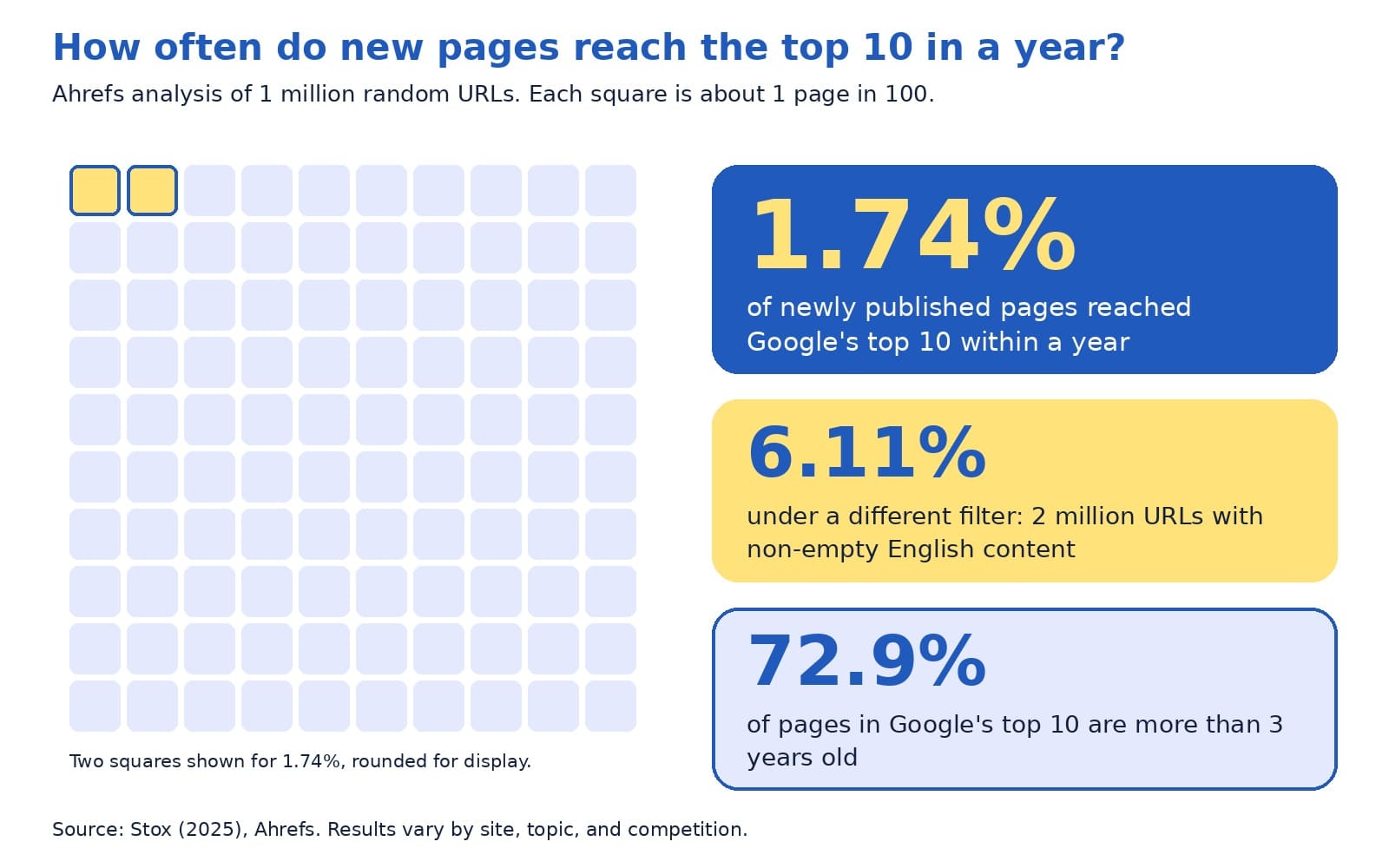
Ahrefs studied one million random web pages and found that only 1.74% of newly published pages reached Google’s top 10 within a year. Under a different filter, which looked at 2 million pages with non-empty English content, the figure was 6.11%. The same study found that 72.9% of pages in the top 10 were more than three years old (Stox, 2025).
Those numbers describe something owners often sense: search engine optimization, or SEO, rewards steady work over time. That is also why owners ask a very reasonable question once they start paying for SEO services: what exactly does the agency do each month, and how will I know it is working?
This guide answers both parts in plain English. You will see a month-by-month roadmap of what a good SEO agency typically does, an example of a clear monthly report, the questions Google itself suggests asking before you hire, and a few warning signs worth knowing. The schedule below reflects a common rhythm, and every site’s plan depends on its starting point, goals, and competition, so please treat it as a guide for your own conversations.
The quick answer
In month one, a good SEO agency audits your site, sets up measurement, and agrees on goals with you. Months two and three focus on fixing technical issues and improving your most important pages. From month four onward, the work shifts toward creating helpful content, earning trust signals such as reviews and links, and refining what the data shows. Every month you should receive a plain report with results, the work completed, and next month’s plan.
Inside this guide
- Key terms in plain English
- What SEO services usually include
- The monthly SEO loop: check, fix, create, earn, report
- A six-month roadmap
- How the plan changes by type of business
- What to ask for in your monthly report
- Questions to ask before you hire
- Warning signs to know
- How long does SEO take?
- A bolder view: judge your agency by decisions, not dashboards
- What you can do each month to help
- Quick answers to common questions
Key terms in plain English
A few terms appear throughout this guide. Here is what they mean:
- Organic traffic: visitors who arrive from unpaid search results.
- SEO audit: a review of your site that finds what helps and what holds back your visibility in search.
- Technical SEO: behind-the-scenes fixes, such as speed, mobile layout, and making pages easy for search engines to find.
- On-page SEO: improving the content of each page, including titles, headings, and links to related pages.
- Backlink: a link to your site from another website.
- Search Console: a free Google tool that shows how your site appears in Google Search.
What SEO services usually include
It helps to know the full menu before you read a proposal. Google’s guidance on hiring an SEO lists the kinds of services providers commonly offer: reviewing your site’s content and structure, technical advice on topics such as hosting, redirects, and JavaScript, content development, keyword research, management of online business development campaigns, expertise in specific markets and regions, and optimizing for generative AI search (Google Search Central, 2026a).
We group these into four buckets, which makes monthly reports easier to read.
Foundation covers the technical health of your site.
Content covers the pages and articles that answer customer questions.
Authority covers the signals that show your business is trusted, such as reviews, mentions, and links earned the right way.
Measurement covers the tracking and reporting that tie it all to leads. A healthy plan touches each bucket, and the mix changes as the months go by.
The monthly SEO loop: check, fix, create, earn, report
Behind the month-by-month schedule sits a simple loop that repeats every month. We call it the monthly SEO loop, and it gives you a quick way to see whether your agency is doing the work that matters.
- Check: review Search Console and analytics for changes in clicks, queries, and conversions, and scan for new technical issues.
- Fix: resolve the highest-impact problems first, such as pages that are not indexed, slow pages, or broken links.
- Create: publish or improve pages and articles that answer real customer questions.
- Earn: build trust signals, including reviews, local listings, and mentions that come from useful work.
- Report: explain what changed, why it matters, and what comes next.
The proportions shift over time. Early months lean toward check and fix, later months lean toward create and earn, and report appears every month without exception. If you ever wonder what your agency did last month, the loop gives you five specific questions to ask.
A six-month roadmap
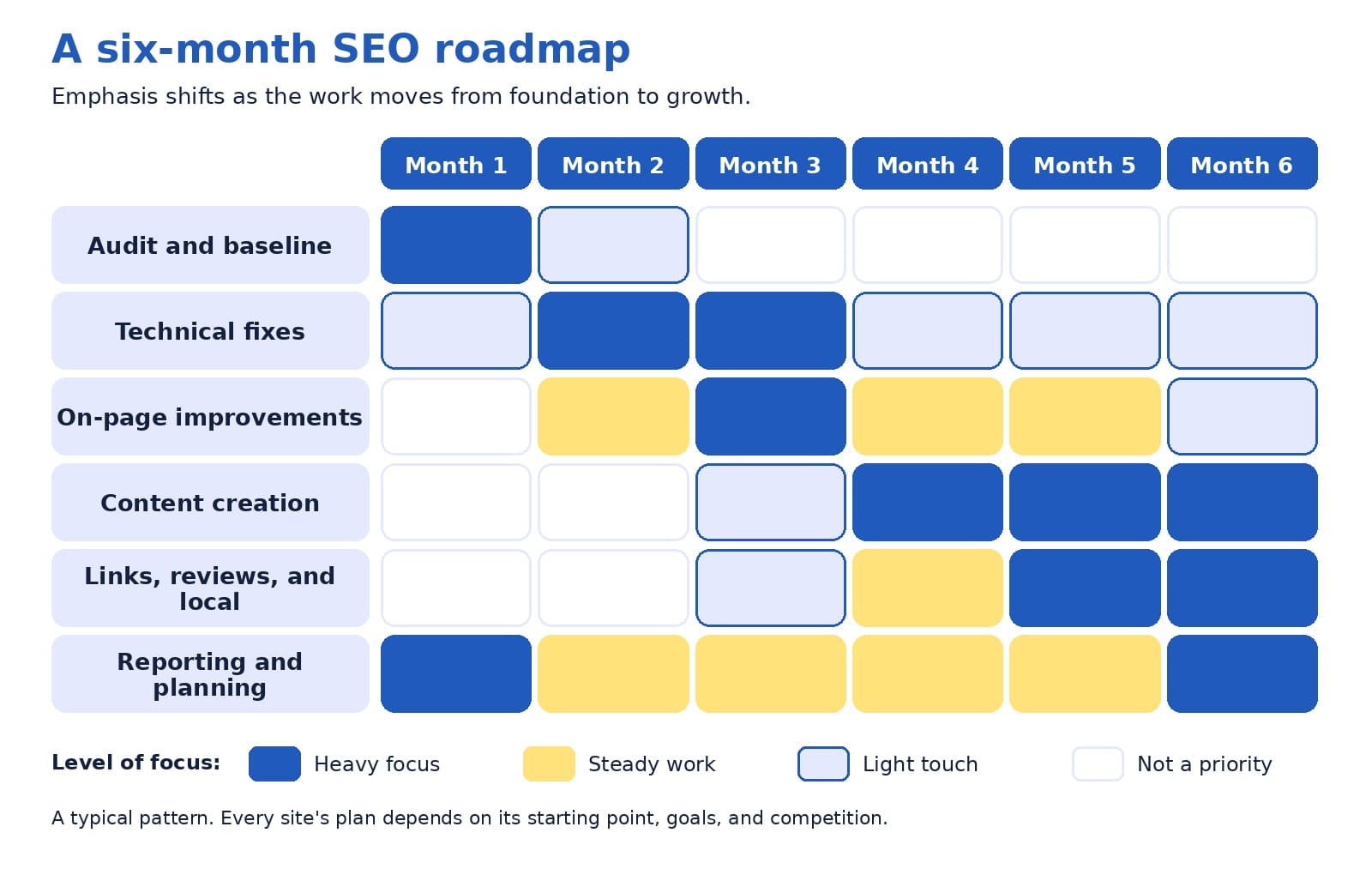
The grid below shows how emphasis typically moves from foundation to growth across the first six months. Darker blue means heavy focus, yellow means steady work, and light cells mean a light touch.
Month 1: audit and baseline
The first month is about understanding where you stand. The agency reviews how your site is indexed, how pages are organized, which pages bring in visitors, and what competitors are doing.
It also sets up measurement, including Google Analytics tracking for the actions that matter to you, such as contact form submissions and phone calls. Google advises granting only read access to Search Console while an audit is being considered (Google Search Central, 2026a).
The month ends with a baseline report and an agreed set of goals, so you can measure progress against a clear starting point.
Months 2 and 3: fix and strengthen
With the audit complete, the agency works through the highest-impact fixes. Technical work might include improving page speed, repairing broken links, setting up redirects, and resolving pages that Google cannot index.
On-page work includes sharpening page titles and headings, strengthening internal links, and updating the pages closest to revenue, such as service pages. Local businesses also tidy up their business profile and listings. These months often feel quiet from the outside, yet they build the platform that later content depends on.
Months 4 and 5: create and earn
Once the foundation is steady, the work moves toward growth. The agency publishes or improves content that answers the questions your customers ask, such as guides, comparison pages, and service area pages with genuinely local detail. It also helps your business earn trust signals, including customer reviews, local citations, and mentions from relevant websites.
Ethical link building belongs here, and the section on warning signs explains what to avoid. Teams also begin watching Google’s generative AI performance reporting in Search Console, since optimizing for AI features builds on the same SEO fundamentals (Google Search Central, 2026b).
Month 6 and beyond: review and refine
By month six, there is enough data to make informed decisions. The agency compares results with the baseline, identifies which pages and topics are gaining traction, and decides where to invest next. Ahrefs suggests that after about six months, content that has not reached the top 10 may benefit from an update, because chances tend to decline unless something changes (Stox, 2025).
From here, the loop continues, with each quarter informed by the one before.
How the plan changes by type of business
The roadmap bends to fit the business. A local service company, such as a clinic or a contractor, usually puts extra weight on its business profile, customer reviews, and pages for the areas it serves. An online store tends to focus on category and product pages, site speed, and clear product information.
A business-to-business firm often leans on content that answers longer research questions, along with case studies that show how it solves problems. The loop stays the same, while the mix of tasks follows how your customers search and decide.
What to ask for in your monthly report
A good report is short enough to read in ten minutes and clear enough to share with a colleague. Google’s guidance on measuring search performance offers a useful starting point: Search Console shows how your site performs in Google Search, including clicks, impressions, and queries, while Google Analytics shows what visitors do after they arrive, including conversions such as lead generation form fills (Google Search Central, 2026c).
The two tools count things differently, so the numbers will never match exactly. Google suggests focusing on the overall pattern of trends, and it names Search Console as the source of truth for search performance and Google Analytics as the source of truth for behavior on your site (Google Search Central, 2026c). The example below shows one way to bring those views together, using illustrative numbers.
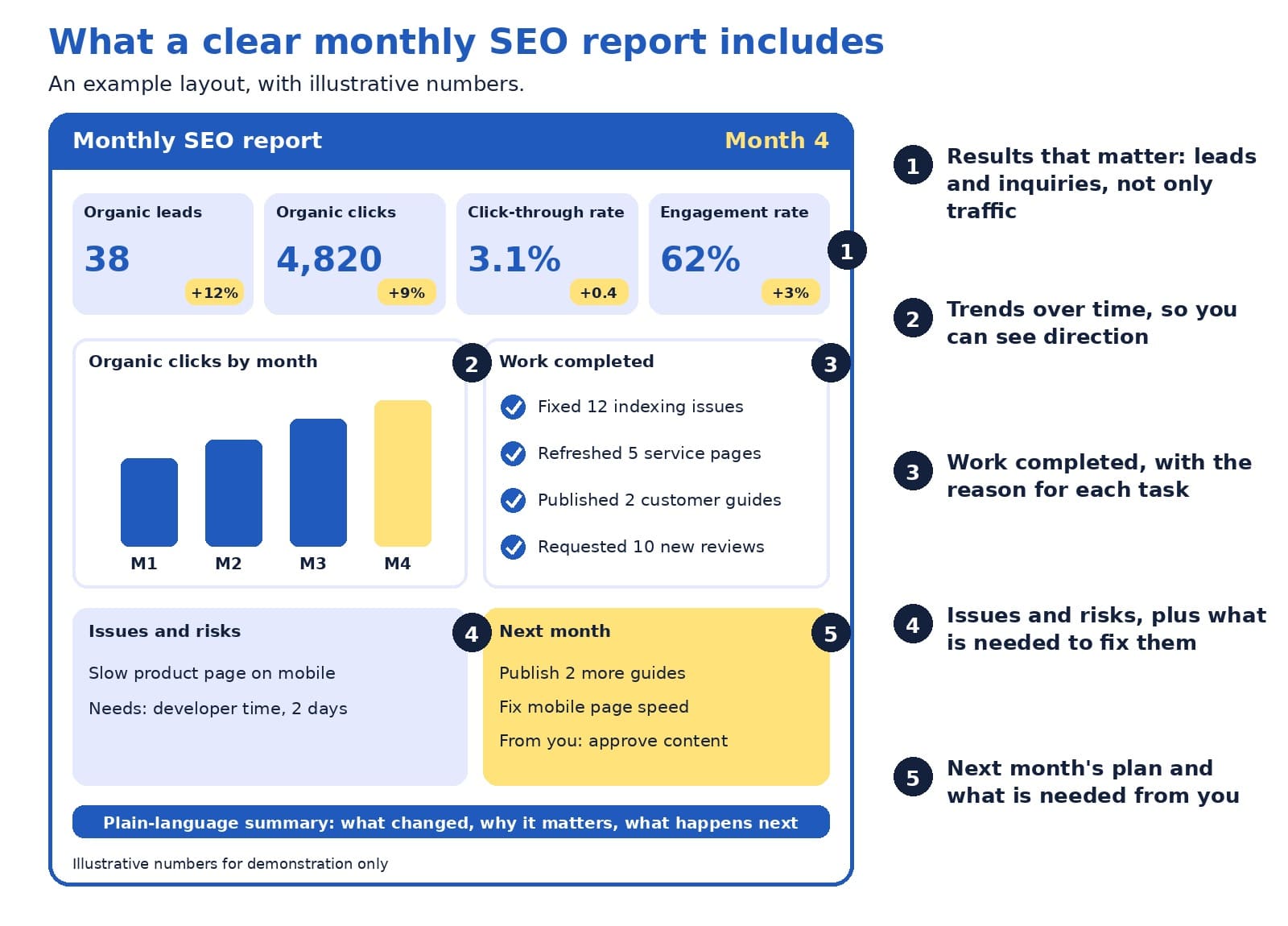
Here is how to read the example, following the numbers:
- Results that matter come first. Leads and inquiries from organic search sit beside clicks, click-through rate, and engagement rate, so you see business outcomes next to search activity.
- A trend chart shows direction. One month can fluctuate, so a simple chart of several months tells you more.
- The work completed list comes with reasons. Each item should explain why the task mattered, which fits Google’s suggestion to ask whether your SEO will share every change made along with the reasoning behind it (Google Search Central, 2026a).
- Issues and risks are stated openly. A report that names problems, and what is needed to fix them, is easier to trust than one that shows only good news.
- Next month’s plan includes what is needed from you. Approvals, photos, and customer stories often decide how quickly work moves.
A good monthly report explains what changed, why it matters, and what happens next.
Questions to ask before you hire
Google publishes a list of questions to ask any SEO provider, and they work equally well as a monthly check-in with an agency you already use (Google Search Central, 2026a). These are the most useful ones:
- Can you show me examples of your previous work and share some success stories?
- Do you follow Google Search Essentials?
- What results do you expect to see, in what timeframe, and how do you measure success?
- What is your experience in my industry and in my country or city?
- How can I expect to communicate with you, and will you share every change you make along with your reasoning?
- Do you cite official Google documentation for your recommendations?
Google adds two more suggestions that are easy to overlook. Ask past clients whether the provider was useful and easy to work with, and notice whether the provider asks about your business, your competitors, and how your customers find you. A provider who is curious about your business is usually one who will tailor the work to it (Google Search Central, 2026a).
Warning signs to know
Most agencies do honest work, and a few warning signs are worth knowing so you can spot the exceptions. Google’s guidance is direct on the most important one:
“No one can guarantee a #1 ranking on Google.”
Google Search Central (2026a)
The same guidance suggests being cautious about providers who claim a special relationship with Google, who are secretive about what they plan to do, who email you unprompted, or who talk about link popularity schemes. It also notes that you should never have to link to an SEO, and that you remain responsible for what companies you hire do on your site, because techniques that break Google’s spam policies can lead to a negative adjustment of your presence in search (Google Search Central, 2026a). A quick filter is this: if you cannot explain in a sentence what the agency is doing and why, ask until you can.
How long does SEO take?
The honest answer is that it varies with your competition, your site’s history, and the topics you want to be found for. The Ahrefs data gives a sense of scale. It also contains encouraging detail: among pages that did reach the top 10, 40.82% got there within a month, and ranking for lower-volume, more specific topics tends to happen sooner than ranking for high-volume terms (Stox, 2025). That is one reason agencies often start with specific, high-intent pages before aiming at the most competitive terms.
For your own monthly reviews, early signals matter as much as rankings. Google’s SEO Starter Guide suggests waiting a few weeks to see whether changes had a beneficial effect (Google Search Central, 2025). In the meantime, look for leading indicators such as more pages indexed, growing impressions, a wider set of queries bringing visitors, and improving engagement. Those signs often appear before leads grow, and a good agency will point them out.
A bolder view: judge your agency by decisions, not dashboards
Here is a perspective that a few providers may find uncomfortable, since it asks for more than a tidy dashboard: the most valuable part of a monthly SEO report is the decisions behind the numbers. Charts with rising lines are pleasant to look at, and they say little about whether the agency is choosing the right work.
Try treating the report as a short decision memo. What did we learn this month? What are we changing because of it? What did we decide not to do, and why? What do we need from the business? When an agency can answer those four questions clearly, you see judgment, and judgment is what you are paying for. Rankings and traffic are useful signals along the way, and leads and revenue are the reason the work exists, so it helps when every report connects the first group to the second.
What you can do each month to help
SEO works best as a partnership, and a few simple habits on your side can speed things up:
- Share what your sales team hears from customers, since those questions often become the best content.
- Approve drafts quickly, because waiting is one of the most common causes of delay.
- Keep your address, hours, and services accurate everywhere they appear.
- Reply to new inquiries promptly, since fast replies turn search visibility into customers. Our guide to the contact page explains how.
Quick answers to common questions
How much work happens each month? It depends on your plan and your site’s needs, so ask for a written list of deliverables and the hours or tasks it covers. A clear scope makes it easy to compare what you receive with what you were promised.
Should I hire an agency or do SEO myself? Google notes that if you run a small local business, you can probably do much of the work yourself, starting with its SEO Starter Guide, and that hiring a professional can help when you want extra expertise or time savings (Google Search Central, 2026a). Many owners start with the basics in-house and bring in an agency for the heavier technical and content work.
When is the best time to hire? Google suggests that a site redesign or a new site launch is a great moment, because the site can be built to be search engine-friendly from the start (Google Search Central, 2026a).
Do I need to give full access to my accounts? During an audit, Google advises read access to Search Console only (Google Search Central, 2026a). Later access depends on the work involved, and any provider should be willing to explain every change they make.
What about AI search? Google describes optimizing for generative AI features as part of SEO, and it suggests checking whether any AEO or GEO advice you receive lines up with its official guidance (Google Search Central, 2026a, 2026b). Our earlier guide to moving budget between SEO and GEO covers this in more detail.
What if results feel slow? Look at leading indicators first, such as indexed pages, impressions, and query variety, then ask your agency what they expect to change and when. If a few months pass without clear signals, a candid review of the plan is a healthy next step.
Are third-party SEO tools reliable? They can be useful, and Google notes that it does not evaluate or endorse them, so recommendations from any tool are worth checking against official guidance before you make big changes (Google Search Central, 2026a).
At the end of any month, a quick self-check shows whether the partnership is working. You should be able to say yes to each of these:
- I know which tasks were completed and why they mattered.
- I can see leads or inquiries from organic search, beyond traffic alone.
- Problems and risks were stated openly.
- I know what next month will focus on and what is needed from me.
- I could explain the plan to a colleague in a minute.
If you would like to see how this schedule would apply to your own site, we are happy to review your current setup and outline a first three months of work with a sample report.
Know what you are paying for
Good SEO services follow a rhythm: check, fix, create, earn, and report. The first months build the foundation, the middle months add content and trust, and every month ends with a clear report on what changed and what comes next. With the right questions, a plain-language report, and a realistic view of timing, you can judge your SEO agency by the progress that matters, which is more qualified leads for your business.
Ready to see this in practice? Our SEO agency team follows this monthly rhythm, our website designing company in Delhi specialists build sites that give SEO a strong foundation, and our digital marketing agency services connect search to the rest of your marketing.
References
Google Search Central. (2025, December 10). Search engine optimization (SEO) starter guide. Google for Developers. https://developers.google.com/search/docs/fundamentals/seo-starter-guide
Google Search Central. (2026a, June 5). Do you need an SEO? Google for Developers. https://developers.google.com/search/docs/fundamentals/do-i-need-seo
Google Search Central. (2026b, July 10). Optimizing your website for generative AI features on Google Search. Google for Developers. https://developers.google.com/search/docs/fundamentals/ai-optimization-guide
Google Search Central. (2026c, January 7). Using Search Console and Google Analytics data for SEO. Google for Developers. https://developers.google.com/search/docs/monitor-debug/google-analytics-search-console
Stox, P. (2025, May 15). How long does it take to rank in Google? And how old are top ranking pages? Ahrefs. https://ahrefs.com/blog/how-long-does-it-take-to-rank-in-google-and-how-old-are-top-ranking-pages/


Related items
If you are new to websites, deciding how many pages to build can feel surprisingly high-st


It is Monday morning, and a new proposal has landed in your inbox. It includes a fresh lin

Google’s fourth spam update of 2026 is live. The pattern across all four says more than th