
Websites rarely break because PHP changed. They break because years of skipped updates made them incompatible with anything newer.
A business owner logs in on Monday and finds a white screen. Nothing was edited. Nobody touched the site. The only thing that changed was a line in a hosting notice that never got read: the server had moved to a newer PHP version.
Agencies see this constantly, and the reaction is always the same. The owner blames the upgrade. But the upgrade did not break the website. It exposed a website that had been broken for years, waiting for a compatible environment to fail in.
That is PHP version debt: the gap between the PHP version your website was written for and the versions hosts still support. Every skipped plugin update, every abandoned theme and every custom function written a decade ago adds to it. Hosting providers eventually collect.
This article covers why the failure feels sudden, where the debt comes from, what breaks and why, and how to weigh patching against replacing. The argument matters more than any single fix, because the right fix depends on how much debt a site carries.
What PHP version debt actually is
Technical debt is a familiar idea in software. Shortcuts taken today create work later, and the work grows the longer it waits. PHP version debt is the same idea applied to a live website.
A site carries this debt when its code, plugins or theme depend on behavior that current PHP versions removed or changed. The site keeps working only because its server still runs an old release. While that stays true, the debt is invisible. The moment the server moves on, it becomes a fault.
Three things separate it from an ordinary maintenance backlog.
It is imposed from outside. Nobody chooses when a PHP version reaches end of life, and few owners choose when their host retires it.
It compounds. A site one version behind is a small job. A site six versions behind may need several components replaced at once, and each replacement has its own dependencies.
It hides. Nothing on the website announces it. Pages load, forms submit, orders arrive. Then one day they do not.
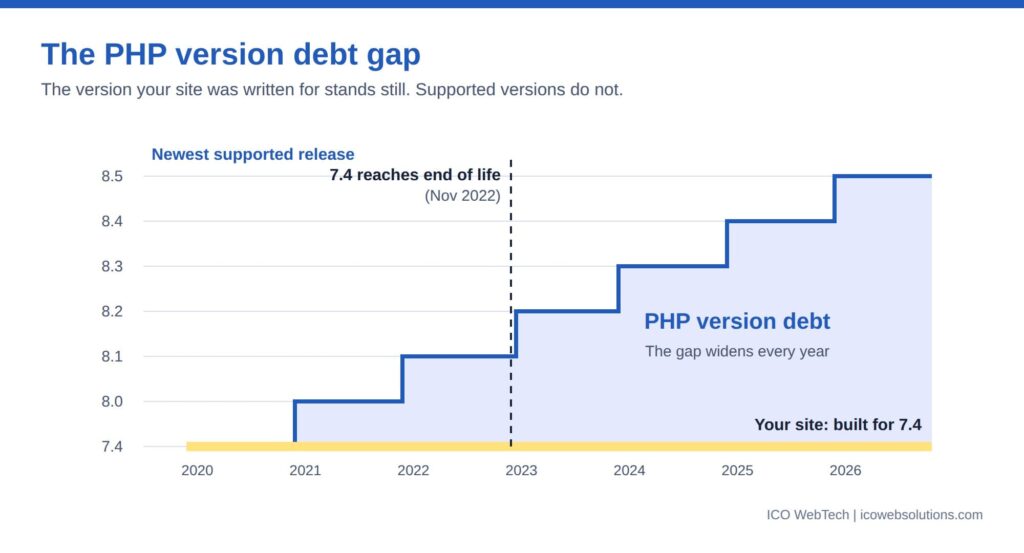

The support clock nobody watches
PHP follows a published support schedule. Each release gets a bug-fix phase, then a security-only phase, then reaches end of life: no fixes of any kind, including security patches. The table shows where versions stand as of September 2026, using dates from the PHP project.
| PHP version | End of life | Status |
|---|---|---|
| 7.4 | 28 Nov 2022 | No longer supported |
| 8.0 | 26 Nov 2023 | No longer supported |
| 8.1 | 31 Dec 2025 | No longer supported |
| 8.2 | 31 Dec 2026 | Security fixes only |
| 8.3 | 31 Dec 2027 | Security fixes only |
| 8.4 | 31 Dec 2028 | Actively supported |
| 8.5 | 31 Dec 2029 | Actively supported |
Two points follow. Sites still running any of the first three rows are already outside support, which makes them a security problem before they are a compatibility problem. End of life does not stop a site from running. It means every newly discovered vulnerability in the engine stays open.
The second point is timing. The end-of-life date for PHP 8.2 is three months away. Hosting providers set their own retirement dates, and many force an upgrade once a version loses security support. A site that runs on 8.2 today but depends on code from the 8.1 era will meet the same problem that sites on older versions have already met.
Why the failure looks sudden
The site worked on Friday and failed on Monday. To the owner, the cause is whatever changed in between, and in practice that is one setting on the server.
Hosts change PHP versions in several ways. Some fold it into a scheduled server migration. Some retire a version and move accounts to the next one. Others let customers pick a version in a control panel and default to the newest after a plan change. In every case the website’s own files stay the same, which is why nobody connects the failure to years of neglect.
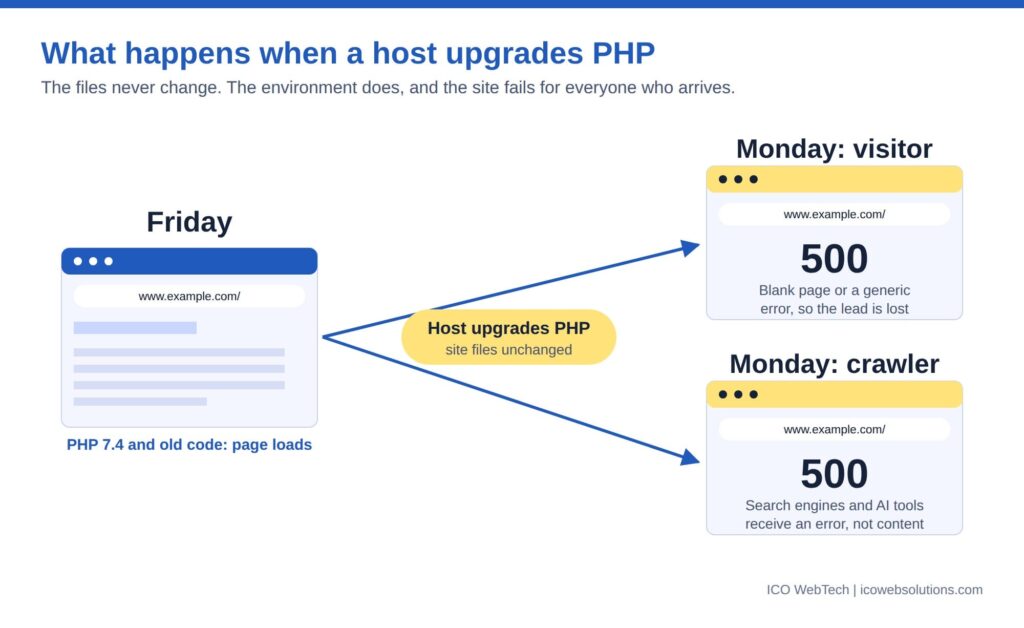
It is the same pattern covered in ICO WebTech’s post on why maintenance decides whether AI search can use your website: the most damaging problems are the ones the owner never sees. A PHP fatal error shows visitors a blank page or a generic 500 message. It shows crawlers the same thing. Search engines and AI tools that arrive during the outage receive an error where content should be, and repeated failures reduce how often they come back.
Monitoring is the gap. A basic ping or port check reports a site as up even when every page returns an error, because the server answered. Only a check that requests real pages and reads the response catches it.
Where the debt comes from
Four sources account for most of it.
Abandoned plugins and themes
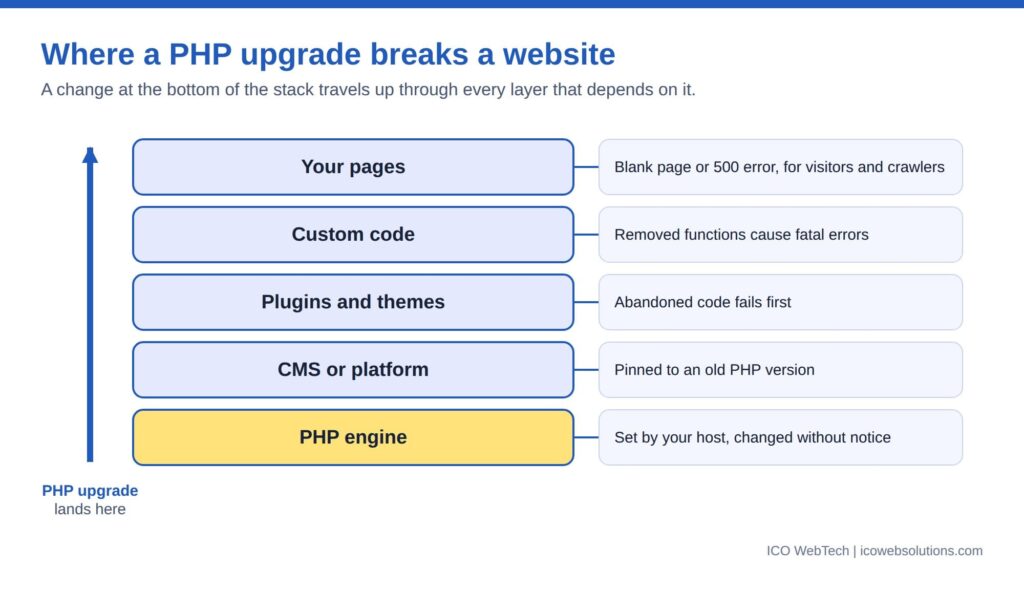
A plugin that has not been updated in years was written against an older PHP release. Its author may have stopped supporting it. It works until the version it relied on disappears. Premium themes bundled with old page builders behave the same way. The site owner cannot fix these in place, because the code belongs to someone else.
Custom code written for older PHP
Bespoke functionality written a decade ago carries habits that later versions reject: functions that no longer exist, constructors named after the class, loose handling of null values. This is the debt agencies leave behind when they build and move on. A website designing agency in Delhi that delivers a site and never revisits its code hands the client a countdown, not a finished product.
Platforms pinned to the past
Every CMS, ecommerce platform and framework declares which PHP versions it supports. Upgrading PHP without upgrading the platform breaks the platform. Upgrading the platform can break every extension built for it. Heavily extended ecommerce and WordPress builds are typical cases, because each extension adds its own dependency.
Hosting on autopilot
Budget shared hosting often runs one PHP version for every customer on a server. The owner never opens the control panel. Nobody owns the question of which version the site runs on, and nobody is told when it changes.
What actually breaks
The breakage falls into predictable groups. The table explains why each one fails, not how to repair it, because the repair depends on the codebase.
| Change | Version | Why old code fails |
|---|---|---|
| mysql_* database functions removed | 7.0 | Sites written before mysqli or PDO call functions that no longer exist. Any call is a fatal error. |
| create_function() and each() removed | 8.0 | Both were common in older scripts and plugins. Calling either now stops the page. |
| Class-named constructors no longer recognized | 8.0 | Old-style constructors stop running as constructors, leaving objects uninitialized. |
| Non-static methods cannot be called statically | 8.0 | Older code that called methods this way throws errors. |
| match becomes a reserved keyword | 8.0 | Code that uses the name for its own functions or classes conflicts with the language. |
| Passing null to built-in parameters that reject it is deprecated | 8.1 | Old code passes null to string functions constantly. Notices appear, and the deprecation signals a future error. |
| Dynamic properties deprecated | 8.2 | Objects that gain undeclared properties raise notices. Common in older plugins and themes. |
Two behaviors matter more than the list. Removals produce fatal errors, which stop the page. Deprecations produce notices, which do not. That difference is where the debt hides.

Deprecation notices are the warning nobody reads
A deprecation notice says that something works today and will not work in a future version. PHP writes it to the error log. On a production server, error display is normally switched off, so visitors see nothing and the log is rarely opened.
That creates a long period in which a site announces its own decline in a file nobody reads. A single outdated plugin can write a notice on every page load. Each one is a future failure with a date attached.
Reading that log is the earliest and cheapest form of compatibility checking. A site with a quiet log is in a different position from one whose log grows every hour, even when both look identical in a browser.
Fatal errors get fixed. Notices get ignored. The notices are the invoice arriving early.
The business cost: downtime is the cheap part
Owners price the problem as the cost of fixing a broken page. The real bill has more lines.
Lost enquiries. A blank page during business hours is a lost lead. Contact forms, checkout and booking flows fail first because they run the most custom code.
Search visibility. Server errors at crawl time reduce how reliably pages get fetched, and pages that keep failing can drop out of results until they recover. Speed shares the same root: older PHP releases generally run slower than current ones, which feeds the metrics covered in ICO WebTech’s post on the relationship between website speed and conversions.
Security exposure. After end of life, new vulnerabilities in the PHP engine stay unpatched. Sites that hold customer data or take payments sit an unpatched runtime under their own code.
Emergency pricing. Fixing a site during an outage costs more than fixing it on a calendar. Developers work under time pressure, testing gets skipped, and the fix often causes the next fault.
Forced rebuild. The last line item is the site itself. When enough components are incompatible, patching costs more than starting again, and businesses reach that decision in the worst possible week.
Set that against the cost of checking versions once a quarter. The gap explains why maintenance belongs in the budget as a running cost, not a rescue fee.
Patch, replace or rebuild: the economics
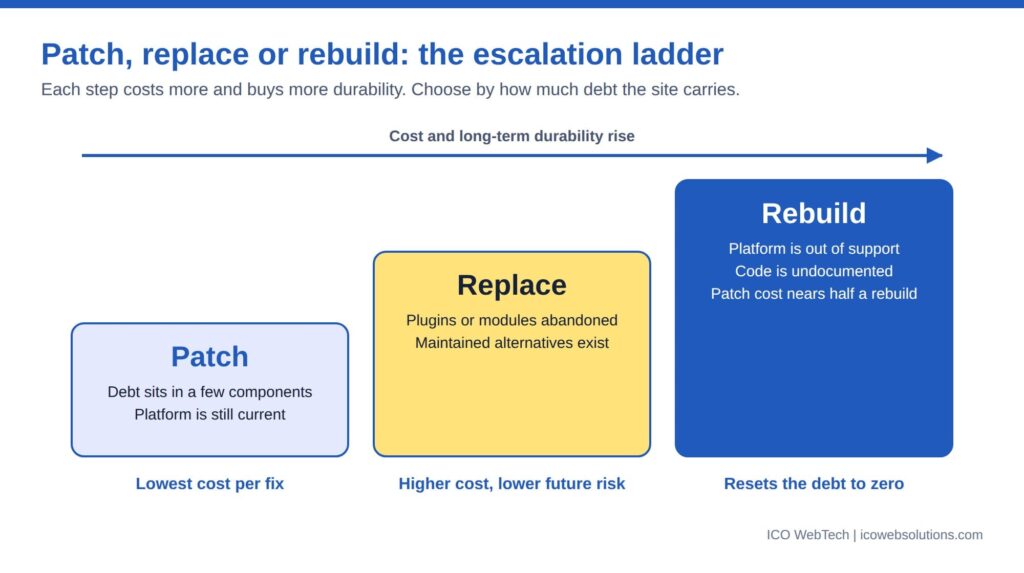
Every site with version debt faces the same three options.
Patch. Right when the debt is confined to a few components and the platform is current. It is the cheapest fix per incident, but each patch leaves the underlying dependency in place.
Replace components. Right when specific plugins or modules are abandoned and maintained alternatives exist. It costs more up front and lowers future risk.
Rebuild. Right when the platform is itself out of support, the custom code is undocumented, or the cost of the first two options approaches that of a fresh build. A workable test: if patching costs more than roughly half of a rebuild, the rebuild is the better spend, because the repairs buy nothing durable.

Rebuilding is not always the expensive answer. ICO WebTech’s website redesign work often starts from exactly this situation, and a rebuild is the point at which hosting, platform and code can finally be matched to each other. Hosted builders remove this class of problem because the vendor manages the runtime, at the price of flexibility, a trade-off covered in the post on choosing a website designing company or a DIY builder. A rebuild also changes URLs, which makes redirects and link hygiene part of the job; the internal linking guide covers the mechanics.
The ownership side of this problem is its own subject. Many sites carry debt because the person who built them left, a theme covered from the client’s side in the post on why business owners fire their website designer.
What a maintenance provider owes you
A plan that updates plugins and takes backups keeps a site running today. It does not manage PHP version debt. A website maintenance company in Delhi, or anywhere else, should be able to answer five questions:
- Which PHP version does each site run, and when does that version lose support?
- Is every plugin, theme and extension compatible with the next version up?
- Is there a staging copy where an upgrade gets tested before the live site changes?
- Who reads the error log, and how often?
- What is the plan when the host announces a retirement date?
These are the questions ICO WebTech’s maintenance service is built around, alongside the engineering handled by its PHP development company team. A provider that cannot answer them is maintaining a website, not the risk around it.
The same standard applies at the build stage. When comparing a website designing agency in Delhi, ask which PHP versions the finished site supports, how dependencies are documented, and who tracks compatibility after launch. An agency that answers with specifics has planned for the day the host moves on. One that changes the subject has not.
The bottom line
PHP version debt turns a routine hosting change into an emergency. The upgrade is never the cause. The cause is years of components that stopped being updated while the platform underneath kept moving.
Compatibility should be tracked on a schedule, with a named owner, before a host forces the question. The December 31, 2026 end-of-life date for PHP 8.2 is a natural deadline for that review.
Related: website maintenance, PHP development, website speed optimization and WordPress development.



Related items

Websites were built around a human operating the interface. A visitor reads the page, comp


In a Harvard Business Review audit of 2,241 US companies, only 37% answered an online inqu

If you are new to websites, deciding how many pages to build can feel surprisingly high-st
